FULL STORY:The Doctors Said My 86-Year-Old Grandpa Was Giving Up on Life — But His Golden Labrador Had Refused to Eat for Seven Days, and What Happened When I Finally Brought Him Into Room 312 Left the Nurses Speechless
FULL STORY CONTINUATION
I barely slept that night.
Every time I closed my eyes, I saw two images.
Grandpa lying in a hospital bed, his face turned toward the wall.
And Rocky lying at the front door, waiting for someone who wasn’t there.
The more I thought about it, the more unbearable it became.
For ten years, those two had done almost everything together.
They woke up together.
Ate breakfast together.
Walked together.
Watched television together.
And every night, when Grandpa turned off the living room lamp, Rocky followed him toward the bedroom.
They had a routine so familiar that I could almost predict every movement.
Now both were trapped in places where the other couldn’t follow.
Grandpa was surrounded by nurses, doctors, medications, and machines.
Rocky was surrounded by the familiar smells of home.
But neither seemed comforted by what was around him.
They wanted each other.
I lay awake thinking about the last conversation I’d had with the doctor.
“Your grandfather is receiving treatment,” he’d told me. “His pneumonia is beginning to respond, but his overall condition is still fragile.”
I had nodded.
“And he’s eating very little.”
The doctor looked tired.
“We’re doing what we can.”
I swallowed.
“Why doesn’t he want to talk?”
He hesitated.
“Illness can be physically and emotionally overwhelming, especially for someone his age.”
I looked through the glass toward Grandpa’s bed.
“He’s never been like this.”
The doctor spoke gently.
“Sometimes recovery requires more than simply treating the infection. We also need him to engage with his care as much as he’s able.”
That sentence stayed with me.
Engage with his care.
I knew Grandpa.
He had survived losing Grandma.
He had survived years of physical aches, difficult winters, and the quiet loneliness that followed the loss of his closest companion.
But he’d always had a reason to get up.
A golden Labrador waiting beside his bed.
I sat up.
What if Rocky could remind him?
The idea seemed impossible at first.
Dogs weren’t normally allowed to wander into hospital rooms.
There were infection-control rules.
Patient-safety concerns.
Medical equipment.
Other patients.
I understood all that.
But I also understood that Grandpa was slipping farther away from us.
And Rocky was losing his own appetite and strength.
I looked at the clock.
2:17 a.m.
I picked up my phone, found the hospital’s number, and began writing down everything I needed to ask the following morning.
I wasn’t going to demand that the staff ignore their responsibilities.
I wasn’t going to pretend that love could replace medical treatment.
But I was going to ask whether one carefully supervised visit might help.
Because I couldn’t bear the thought of Grandpa dying without seeing the dog who was still waiting for him.
Rocky was awake when I came downstairs.
Of course he was.
He lay beside the front door, his chin resting on his paws.
The hallway lamp cast a soft golden circle across his fur.
I crouched.
“Hey, old boy.”
His tail moved once.
I sat beside him.
For a while, neither of us did anything.
I listened to the refrigerator humming in the kitchen.
To the faint creaking of the house.
To Rocky’s slow breathing.
Then I reached for Grandpa’s cardigan.
It was hanging on the back of the chair, exactly where he’d left it.
I carried it to the hallway and placed it beside Rocky.
He lifted his head.
Sniffed the fabric.
Then pressed his nose into it.
I felt my throat close.
“Oh, Rocky.”
He settled with his muzzle against the cardigan.
And I began to cry.
Not loudly.
There wasn’t anyone there to hear me.
Just the quiet, helpless tears of someone trying to care for two beings she loved and feeling as though she was failing both.
“I’m trying,” I whispered.
Rocky lifted his eyes toward me.
“I’m trying so hard.”
I stroked his head.
“Grandpa needs you.”
His ears shifted.
I took a breath.
“And I think you need him too.”
Rocky returned his nose to the cardigan.
I sat with him until the sky began to lighten.
The next morning, I called the hospital.
I explained everything.
That my grandfather was eighty-six.
That he was being treated for pneumonia.
That he had become withdrawn and was barely eating.
That his Labrador had been his constant companion for ten years.
And that the dog was now showing worrying changes in appetite and behavior.
The first person I spoke with was sympathetic but uncertain.
She explained that animal visits required special approval.
I understood.
I asked whom I should speak to.
After several conversations and a review of the circumstances, a doctor agreed to consider a carefully controlled visit.
There would be conditions.
Rocky would need to be clean, calm, and safely handled.
He couldn’t interfere with medical care.
We would have to use the service entrance and freight elevator.
The visit could be stopped if there were any concerns.
I agreed to everything.
Then came the words I had been praying to hear.
“We can allow you to bring him tomorrow morning.”
I pressed my free hand over my mouth.
“Thank you.”
My voice shook.
“Thank you so much.”
When the call ended, I stood in Grandpa’s kitchen for a long time.
Sunlight streamed through the window.
A mug sat beside the sink.
Rocky’s leash hung from its hook near the door.
Everything looked ordinary.
Yet suddenly, for the first time in a week, I felt hope.
I turned toward the hallway.
“Rocky?”
He lifted his head.
I crouched beside him.
“Guess what, sweetheart?”
His tail moved.
“You’re going to see Grandpa.”
I knew he couldn’t understand that sentence the way I did.
But I smiled anyway.
“Tomorrow.”
Then I looked toward the empty armchair.
And whispered, “Please hold on, Grandpa.”
I spent the rest of the day preparing.
I made sure Rocky was clean and comfortable.
I checked his leash and collar.
I spoke with the veterinary clinic about his poor appetite and the stress he’d been showing.
I wanted to be sure that bringing him to the hospital was appropriate for him too.
The last thing I wanted was to overwhelm an elderly dog who was already distressed.
He had lost weight during the week.
Not a dramatic amount, but enough that I noticed when I touched his sides.
His energy seemed lower.
His usual excitement at mealtimes had faded.
He still drank water, and I continued monitoring him carefully, but his refusal to eat properly frightened me.
I wanted him to feel secure.
To regain his normal routine.
To know that the person he trusted most hadn’t simply vanished.
That afternoon, I took him on a gentle walk around the block.
We followed Grandpa’s usual route.
Past the white fence.
Past the maple tree.
Around the corner where a neighbor kept bright red flowers in wooden planters.
Rocky sniffed familiar places.
For a few minutes, he seemed interested in the world again.
Then we passed the bench where Grandpa often stopped to rest.
Rocky slowed.
He looked toward it.
And stood still.
I felt tears rising.
Grandpa used to sit there and say, “I’m not tired, Cathy. I’m just giving Rocky an opportunity to appreciate the scenery.”
Rocky would settle beside him.
They’d sit together while people passed.
Sometimes Grandpa waved.
Sometimes he simply enjoyed the quiet.
Now Rocky stood beside the empty bench.
Waiting.
I crouched.
“Not today, sweetheart.”
He looked at me.
“Tomorrow.”
We continued walking.
But my heart stayed beside that bench.
When I visited Grandpa that evening, he looked smaller than he had the day before.
His hospital gown hung loosely across his shoulders.
His hair was flattened against the pillow.
His hands rested on top of the blanket.
Those hands had once seemed enormous to me.
When I was little, he’d take my small fingers in his and walk me across busy streets.
He’d lift me onto his shoulders when I couldn’t see a parade.
He’d catch me when I slipped on icy steps.
Now his hands looked thin.
The skin fragile.
The fingers slightly curled.
I sat beside him.
“Hi, Grandpa.”
He didn’t turn.
I placed my hand over his.
“It’s Cathy.”
His fingers moved faintly.
I smiled.
“There you are.”
I wanted to tell him about Rocky.
That I’d arranged the visit.
That tomorrow might be different.
But I was afraid of raising expectations.
What if the staff changed their decision?
What if Rocky became too anxious?
What if Grandpa was too exhausted to respond?
I didn’t want to promise another thing that might be taken away.
So I simply talked.
I told him about the weather.
The flowers near his porch.
The neighbor who’d stopped to ask about him.
I mentioned that the kitchen faucet was still dripping and that I’d finally understood why he’d kept a towel beneath it.
Then I laughed weakly.
“You could’ve just called a plumber, you know.”
No response.
I stroked his hand.
“Grandpa?”
His breathing remained steady.
I leaned closer.
“I miss you.”
My voice broke.
“I miss talking to you.”
For a moment, he seemed to tighten his fingers around mine.
Then his hand relaxed.
I sat there until visiting hours ended.
Before leaving, I bent and kissed his forehead.
“I love you.”
His lips moved.
I leaned closer.
But no words came.
I held his hand a little longer.
Then whispered, “Please don’t give up.”
The following morning, Rocky stood when I picked up his leash.
It was the first time in days that he’d shown immediate interest in going somewhere.
I smiled.
“Come on, boy.”
He approached.
I clipped the leash to his collar.
Then opened the front door.
Rocky stepped onto the porch and looked toward the driveway.
The morning air was cool.
A few birds called from the trees.
I led him toward the car.
He hesitated beside the rear door.
Grandpa usually drove him in an old vehicle with a blanket across the back seat.
Rocky looked at my car uncertainly.
“It’s okay.”
I opened the door.
“We’re going to see him.”
He climbed in with gentle assistance.
I settled him safely.
Then stood beside the open door for a moment.
His amber eyes followed me.
He looked tired.
The fur around his muzzle had begun turning gray.
Ten years is a long time in a dog’s life.
He wasn’t the frightened puppy Grandpa had brought home from the shelter anymore.
He was an elderly Labrador whose world had been built around one familiar person.
I touched his head.
“Just a little longer.”
Then I closed the door and got behind the wheel.
The drive to the hospital felt endless.
Every traffic light seemed to take too long.
Every slow vehicle made my heart pound.
I kept glancing toward Rocky.
He sat quietly in the back.
Sometimes he looked through the window.
Sometimes he lowered his head.
I talked to him the entire way.
“You know, Grandpa always says you’re the best listener in the family.”
Rocky looked toward me.
I smiled.
“He says I talk too much.”
I paused.
“Maybe he’s right.”
My voice shook.
“But I need you to listen today, sweetheart.”
I gripped the steering wheel.
“He’s very sick.”
The words sounded different when I said them aloud in the car.
The house had become quiet.
The hospital had become frightening.
But I’d been trying to remain composed.
Now, with Rocky behind me, I could admit how afraid I was.
“I don’t know what’s going to happen.”
My eyes filled.
“But I want him to see you.”
I swallowed.
“And I want you to see him.”
Rocky shifted in the back seat.
I glanced toward him.
“We’re almost there.”
The hospital came into view.
I turned toward the service entrance.
And felt my stomach tighten.
What if this didn’t help?
What if Grandpa barely noticed?
What if Rocky approached the bed and received no response?
I couldn’t bear the thought.
But I pulled into the designated area anyway.
Because doing nothing had become more frightening than trying.
A staff member met us near the service entrance.
She checked the arrangements and reminded me of the visit’s conditions.
I nodded.
Rocky stood beside my leg.
His leash was loose.
His posture calm.
I was grateful he’d remained composed.
The hospital smelled of disinfectant and something faintly metallic.
The service corridor was quieter than the main entrance.
A cart rolled past.
Rocky’s ears moved.
He glanced toward the sound but stayed beside me.
“Good boy,” I whispered.
We approached the freight elevator.
The doors opened with a soft mechanical sound.
Rocky stepped inside.
I pressed the button for the third floor.
Then looked down.
He stood close enough that his shoulder touched my leg.
For ten years, Grandpa had been the person who reassured him when the world seemed unfamiliar.
Now I was trying to do the same.
The elevator began moving.
I watched the numbers.
One.
Two.
Three.
Then the doors opened.
Rocky lifted his head.
His nose moved.
He sniffed the air.
For a moment, he stood perfectly still.
Then his body changed.
His ears rose.
He leaned forward.
And the leash tightened.
I looked down.
“Rocky?”
He pulled again.
Not wildly.
Not aggressively.
But with sudden determination.
As though something familiar had reached him through the unfamiliar hospital smells.
My heart began racing.
“Oh, sweetheart.”
He moved toward the corridor.
I followed carefully.
He kept sniffing.
Turning his head.
Searching.
I couldn’t know exactly what he detected.
Maybe Grandpa’s scent.
Maybe something familiar carried through the air.
But his behavior was unmistakably different from the quiet uncertainty he’d shown downstairs.
He seemed to have found a reason to move.
I followed him toward Room 312.
And when we stopped outside the door, my hands began trembling so badly that I had trouble loosening my grip on the leash.
Grandpa lay in the same position as before.
His face turned toward the wall.
His shoulders slightly hunched.
The blanket pulled over his thin body.
The room was quiet except for the sounds of medical equipment.
I stood in the doorway.
Rocky looked inside.
His tail moved once.
Then again.
I glanced toward the staff member supervising the visit.
She nodded.
I took a breath.
“Okay, Rocky.”
My voice was barely a whisper.
“Go see him.”
I gave him enough slack to approach safely.
Rocky walked into the room.
His nails clicked softly against the linoleum.
One step.
Then another.
He didn’t bark.
Didn’t jump.
Didn’t rush toward the bed.
He moved slowly.
Carefully.
As though he understood that something was different about his person.
I followed a few feet behind him.
My heart was pounding.
Rocky reached the side of the bed.
He stopped.
His tail began wagging.
Slowly at first.
Then faster.
His entire body moved with it.
He looked up at Grandpa.
For a moment, nothing happened.
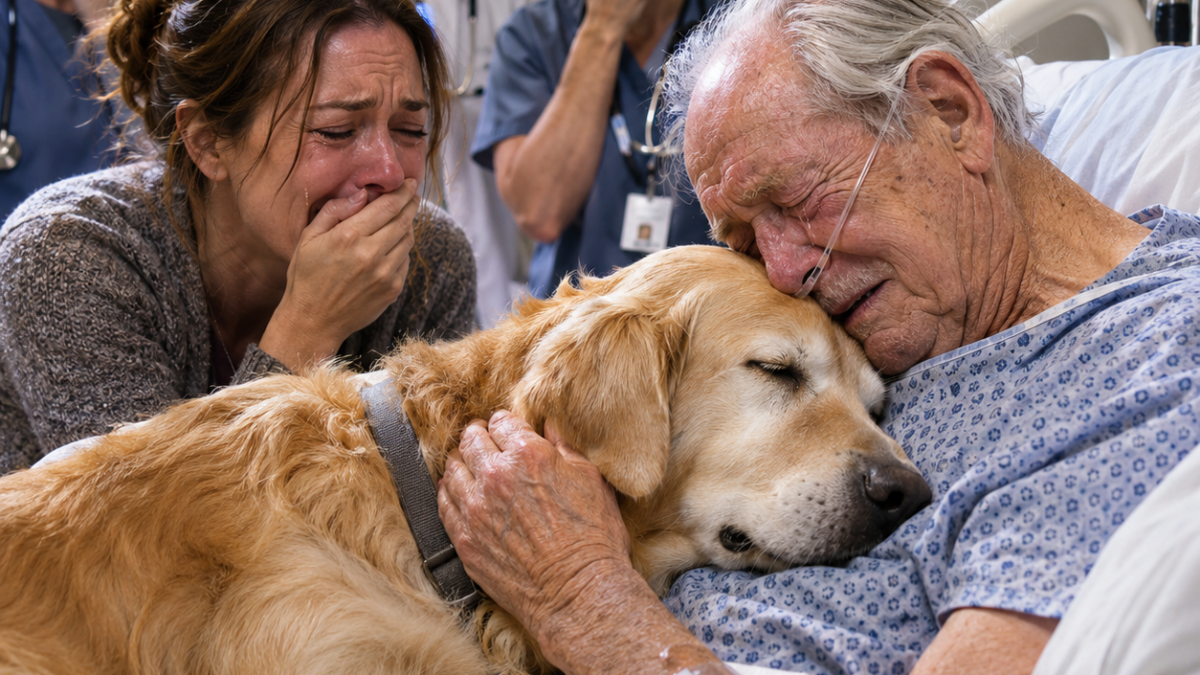
Then Rocky leaned forward and rested his large golden head on the edge of the bed, beside Grandpa’s hand.
I stopped breathing.
His gray-whiskered muzzle touched the blanket.
His nose rested near Grandpa’s fingers.
And he waited.
Grandpa didn’t move.
I felt fear rising.
Please.
I stared at his face.
Please, Grandpa.
Rocky’s tail continued wagging.
Then Grandpa’s fingers shifted.
Barely.
Just enough that I saw them move.
Rocky remained perfectly still.
A second passed.
Then another.
Grandpa’s eyelids fluttered.
I pressed a hand over my mouth.
His eyes opened.
At first, they seemed unfocused.
He stared toward the bed.
Then his gaze moved.
Slowly.
Toward the golden head resting beside his hand.
His expression changed.
I saw confusion.
Then recognition.
His lips parted.
And in a voice so weak I almost missed it, he whispered:
“Rocky?”
I began crying.
Not quietly.
I couldn’t help it.
Rocky’s tail wagged harder.
He made a soft, low sound in his throat.
Grandpa stared at him.
For the first time in days, he wasn’t looking toward the wall.
He was looking at someone.
Someone who had been waiting for him.
Grandpa lifted his hand.
I had watched that hand remain almost motionless for so long that the movement seemed extraordinary.
It trembled.
His fingers reached slowly toward Rocky’s head.
For a moment, they hovered in the air.
I wanted to help.
But I didn’t move.
This was their moment.
Grandpa lowered his hand.
His fingers touched Rocky’s fur.
Then settled behind his ears.
And he began stroking him.
Slowly.
Gently.
The same familiar motion I’d seen thousands of times in his living room.
Rocky closed his eyes briefly.
Then leaned closer.
Grandpa’s face softened.
His lips moved.
“My boy.”
I pressed both hands over my mouth.
Tears streamed down my face.
Grandpa continued stroking him.
The room was silent except for my unsteady breathing and Rocky’s tail brushing the side of the bed.
Finally, Grandpa looked toward me.
“Cathy?”
I stepped closer.
“I’m here.”
He looked back at Rocky.
“How…”
His voice cracked.
“How did he get here?”
I sat beside the bed.
“I brought him.”
Grandpa stared.
“The hospital let me.”
His hand remained on Rocky’s head.
I swallowed.
“He missed you so much, Grandpa.”
Grandpa’s eyes filled.
“He did?”
I nodded.
“He stopped eating properly.”
Grandpa looked horrified.
“He stopped sleeping in his usual spot.”
My voice broke.
“He stayed beside the front door.”
Grandpa’s fingers tightened gently in Rocky’s fur.
“He waited for you every day.”
A tear rolled down Grandpa’s cheek.
I continued, even though I was crying.
“Every time a car passed, he’d lift his head.”
Grandpa closed his eyes.
“He thought you were coming home.”
For a long moment, he said nothing.
Then he whispered something I’ll never forget.
“I forgot.”
I leaned closer.
“What?”
His face crumpled.
“I forgot someone was waiting for me.”
Those words broke something inside me.
I had spent the entire week trying to convince Grandpa that he needed to keep fighting.
I’d reminded him that I loved him.
That the doctors were helping.
That he could recover.
That people cared about him.
But I hadn’t understood what he was experiencing.
He’d been lying in a room filled with strangers, surrounded by equipment and reminders of his frailty.
He was exhausted.
Frightened.
And perhaps, somewhere inside that exhaustion, he’d begun feeling that returning home no longer mattered.
Grandma was gone.
His body was failing him.
His independence seemed uncertain.
The things that had always given his days meaning felt far away.
And he’d forgotten that one of those things was waiting beside the front door.
I reached for his hand.
“Grandpa.”
He looked at me.
“You’re not alone.”
His eyes filled again.
“I know, sweetheart.”
I shook my head.
“No.”
My voice trembled.
“You don’t understand.”
I looked toward Rocky.
“He needs you.”
Grandpa turned back toward the dog.
Rocky was still resting his head beside his hand.
His tail moved gently.
I swallowed.
“He doesn’t care whether you can take long walks anymore.”
Grandpa’s lips trembled.
“He doesn’t care whether you need help getting out of bed.”
I leaned closer.
“He just wants you.”
Grandpa lowered his face toward Rocky.
For a moment, I thought he might kiss the dog’s head.
Instead, he rested his cheek briefly against the golden fur.
And cried.
I sat beside them.
Letting my own tears fall.
I had never seen my grandfather look so fragile.
Or so deeply loved.
A nurse entered a few minutes later carrying a meal tray.
She stopped just inside the doorway.
Her eyes moved from Rocky to Grandpa.
Then to me.
I gave her a shaky smile.
“The visit was approved.”
She nodded.
“I know.”
Then she looked toward Grandpa.
“Good morning, Mr. Collins.”
Grandpa turned his head.
It was such a small thing.
But I’d watched him ignore greetings for days.
The nurse seemed to notice too.
She approached the bed.
“I’ve brought your meal.”
Grandpa looked at the tray.
For the past week, food had been a struggle.
He’d turned away from bowls of soup.
Taken a few sips of water.
Sometimes refused to try at all.
I expected him to close his eyes again.
Instead, he looked toward Rocky.
The dog lifted his head slightly.
His nose moved.
For the first time since entering the room, he seemed interested in something besides Grandpa.
I almost laughed.
Grandpa noticed.
A faint smile appeared at the corner of his mouth.
“Still hungry, aren’t you, boy?”
Rocky’s tail moved.
Then Grandpa looked toward the nurse.
“Could I…”
His voice was weak.
He cleared his throat.
“Could I try a little?”
The nurse froze.
I stared at him.
“Grandpa?”
He looked at the tray.
“Maybe some soup.”
The nurse’s face changed.
“Of course, Mr. Collins.”
I pressed my hand over my mouth.
He was asking for food.
Not because we begged.
Not because someone lectured him.
He was asking.
The nurse adjusted the tray.
Grandpa looked toward Rocky.
“See, old boy?”
His lips trembled.
“I’ll try.”
I began crying again.
Rocky leaned forward and gently touched his nose to the side of Grandpa’s face.
And my grandfather laughed.
It was a faint sound.
More breath than voice.
But it was laughter.
The first I’d heard from him in a week.
The nurse looked at me.
I looked at her.
Neither of us spoke.
What could we say?
The change wasn’t a medical miracle in the sense of a disease suddenly disappearing.
Grandpa still had pneumonia.
His heart still needed monitoring.
His body remained weak.
He was receiving medication and professional care, and those treatments mattered.
But something had shifted in the way he responded to the people around him.
He was looking at us.
Speaking.
Asking for food.
And reaching toward Rocky.
I watched the nurse help him begin the meal.
At first, he managed only a little.
A few spoonfuls.
Then a pause.
A small sip of water.
He looked tired.
I could see the effort it took.
But he didn’t turn away.
Rocky sat beside the bed.
His gaze moved between Grandpa and the tray.
Grandpa noticed.
“Don’t you start.”
His voice was rough.
“You have your own food.”
I laughed through tears.
The nurse smiled.
Grandpa took another spoonful.
And I felt a kind of relief I hadn’t dared allow myself.
Because for the first time in days, he was participating.
He wasn’t suddenly well.
But he was trying.
When the nurse left, I sat beside Grandpa.
Rocky rested near the bed.
For a while, Grandpa simply stroked his head.
Then he looked toward me.
“How long has he been like that?”
I knew what he meant.
“Waiting?”
He nodded.
“Since the day you came here.”
Grandpa closed his eyes.
“Oh, Rocky.”
He opened them again.
“Did you feed him?”
I smiled sadly.
“I tried.”
His face tightened.
“He needs to eat.”
“I know.”
“He’s getting old.”
“I know, Grandpa.”
He looked toward Rocky.
“Can’t have him getting sick.”
I took his hand.
“That’s why I brought him.”
Grandpa looked at me.
“Because he needs you too.”
He stared for a moment.
Then something softened in his face.
“You always were a good girl, Cathy.”
My throat closed.
I shook my head.
“I’ve been terrified.”
He squeezed my hand faintly.
“I know.”
I wiped my eyes.
“I thought I was losing you.”
He looked toward the window.
For a long time, he said nothing.
Then he whispered, “I thought so too.”
I felt a sharp ache in my chest.
He continued.
“I was so tired.”
I nodded.
“So tired of feeling weak.”
His voice trembled.
“I couldn’t get out of bed. Couldn’t breathe properly. Couldn’t even finish my meals.”
I listened.
“And I kept thinking about your grandmother.”
My eyes filled.
He looked toward me.
“I missed her.”
“I know.”
“I kept wondering whether it would be easier to stop fighting.”
I squeezed his hand.
He looked ashamed.
I shook my head.
“Grandpa, you don’t have to apologize for being frightened or exhausted.”
His eyes filled.
I continued.
“But you don’t have to face it alone.”
He looked toward Rocky.
The Labrador had settled with his head near the bed.
Grandpa stroked his fur.
Then whispered, “I suppose I have someone to get home to.”
I nodded.
“More than one someone.”
He looked at me.
For the first time, his smile reached his eyes.
“Yes, sweetheart.”
His voice broke.
“More than one.”
I stayed beside the bed until the staff told us the visit needed to end.
I dreaded that moment.
Rocky had been calm and gentle.
Grandpa had responded better than I’d dared hope.
But the visit was still subject to the hospital’s rules.
I didn’t want to push beyond what was appropriate.
The nurse approached.
“Cathy, we’ll need to let your grandfather rest.”
I nodded.
Grandpa looked toward Rocky.
His smile faded.
“Already?”
I felt my heart tighten.
“Just for now.”
He looked disappointed.
Rocky’s tail moved when Grandpa reached toward him.
I leaned close.
“I’ll bring him back if the staff says we can.”
Grandpa studied my face.
“Promise?”
I took a breath.
“I promise I’ll do everything I can.”
He nodded.
Then stroked Rocky’s head one more time.
“You behave yourself, old boy.”
Rocky leaned into his hand.
Grandpa smiled.
“And eat your supper.”
I laughed softly.
“He’s not the only one who needs to follow that advice.”
Grandpa looked at me.
Then nodded.
“Fair enough.”
I stood.
Took Rocky’s leash.
And guided him toward the door.
He hesitated.
Looked back at Grandpa.
For a moment, my chest tightened.
Then Grandpa lifted one trembling hand.
“See you soon, boy.”
Rocky’s tail moved.
He followed me into the hallway.
And for the first time since the hospital admission, I walked away feeling that Grandpa was waiting for another day rather than turning away from it.
On the drive home, Rocky seemed calmer.
He still looked tired.
He still needed careful attention.
But something about him had changed.
He no longer spent every moment staring toward the direction of Grandpa’s house.
When we arrived, he entered the hallway and sniffed the familiar places.
Then he walked toward the kitchen.
I stared.
“Rocky?”
He looked back.
I opened the container of food I’d prepared for him.
Placed a small, appropriate portion in his bowl.
And waited.
He approached.
Sniffed.
Then began eating.
I sat down on the kitchen floor so quickly my knees struck the tiles.
“Oh, Rocky.”
He continued.
I covered my mouth.
Tears ran down my face.
It wasn’t a dramatic feast.
He didn’t empty an enormous bowl in seconds.
He simply ate some of his food.
But after days of coaxing and worry, the sound of him chewing felt beautiful.
I reached out and stroked his back.
“That’s it, sweetheart.”
He ate a little more.
Then looked up at me.
His tail moved.
I laughed through tears.
“Good boy.”
I wanted to call Grandpa immediately.
I wanted to tell him Rocky had eaten.
But he needed rest.
So I wrote the news in a notebook to share later.
That evening, Rocky still settled near the front door.
The habit hadn’t vanished.
But when I brought his bed closer and sat beside him, he seemed more willing to rest.
I stroked his head.
“You saw him today.”
His eyes closed.
“He saw you too.”
I smiled.
“And we’re going to keep trying.”
The following morning, I called the hospital before leaving the house.
The nurse sounded pleased.
“Your grandfather had some breakfast.”
I stopped walking.
“He did?”
“Yes.”
I pressed a hand against the wall.
“How much?”
“Not a large amount. But more than before.”
I closed my eyes.
“Thank you.”
She continued.
“He also asked about Rocky.”
I laughed and cried at the same time.
“Of course he did.”
The nurse chuckled.
“He wanted to know whether the dog had eaten.”
I looked toward the kitchen.
Rocky was resting near his bowl.
“He did.”
I swallowed.
“Please tell Grandpa he ate.”
“I will.”
When the call ended, I stood in the hallway for a long moment.
Then I looked toward Rocky.
“Guess what?”
He lifted his head.
“Grandpa’s eating too.”
His tail moved.
I smiled.
“Good. Now both of you keep it up.”
The next several days were filled with cautious hope.
The medical team continued treating Grandpa’s pneumonia and monitoring his heart.
His progress wasn’t perfectly smooth.
Some mornings, he was exhausted.
Some afternoons, he needed more rest than conversation.
His appetite varied.
There were moments when the frightening weakness returned.
But the overall direction began improving.
His breathing became more comfortable.
His condition stabilized.
And he was increasingly willing to take part in the steps needed for recovery.
Whenever visits were permitted, Rocky came with me.
The hospital staff arranged them carefully.
The dog remained calm.
And Grandpa looked forward to them.
I learned that anticipation can change the atmosphere of a hospital room.
Before Rocky’s first visit, Grandpa rarely asked what day it was.
Now he’d ask, “Is today a Rocky day?”
Sometimes it was.
Sometimes the staff needed to limit visits.
But even when Rocky couldn’t come, Grandpa wanted to hear about him.
“Did he eat breakfast?”
“Yes.”
“Did he go outside?”
“Yes.”
“Was he good?”
I smiled.
“Mostly.”
Grandpa raised an eyebrow.
“Mostly?”
“He tried to steal a piece of toast.”
Grandpa chuckled.
“That’s my boy.”
And just like that, a little warmth returned to the room.
I noticed how the nurses responded.
At first, Rocky had been an unusual visitor requiring special arrangements.
Soon, people began asking about him.
“How’s the golden boy doing?”
“Is Rocky coming today?”
“Did Mr. Collins ask about him again?”
Someone brought a water bowl for the approved visits.
Another staff member smiled whenever she saw us approaching.
I was careful not to mistake their kindness for a promise that every patient could have an animal beside the bed.
The hospital had responsibilities to many people.
But I was grateful that the team recognized the value of this particular bond and worked with us where it was safe.
Sometimes other patients being walked through the corridor noticed Rocky.
They smiled.
A few asked his name.
One older woman said he reminded her of a dog she’d loved years earlier.
I would smile.
“His name’s Rocky.”
She looked at him.
“Well, Rocky, you’re a handsome fellow.”
His tail moved.
And for a moment, the gray hospital hallway felt less lonely.
One afternoon, I arrived to find Grandpa sitting a little more upright.
He looked toward the door before I reached the bed.
“Cathy.”
I stopped.
He had recognized my footsteps.
Or perhaps he’d simply been watching for visitors.
Either way, hearing him greet me brought tears to my eyes.
“Hi, Grandpa.”
He smiled.
“Where’s my boy?”
I laughed.
“Right here.”
Rocky entered calmly.
His tail began wagging.
Grandpa held out his hand.
“There he is.”
The dog approached the bedside.
Grandpa stroked his head.
“You keeping Cathy out of trouble?”
I smiled.
“Someone has to.”
Grandpa chuckled.
Rocky settled near him.
Then Grandpa began telling one of his stories.
Not because anyone asked.
Not because a nurse encouraged him to speak.
He simply started talking.
“Did I ever tell you how I found Rocky?”
I pulled a chair closer.
“About a thousand times.”
He grinned.
“Then you won’t mind hearing it again.”
I shook my head.
“Not at all.”
And he began.
He told me about the shelter.
How lonely he’d been after Grandma’s death.
How he’d spent months pretending he didn’t need another companion.
How the house felt too quiet.
He’d tried filling his days with errands.
Gardening.
Reading.
Television.
But evenings were difficult.
He’d sit in the living room and look toward Grandma’s empty chair.
Sometimes he’d speak aloud before remembering she wasn’t there.
One afternoon, a friend suggested adopting a dog.
Grandpa resisted.
“I’m too old for a puppy,” he’d said.
But the idea stayed with him.
Eventually, he visited the shelter.
He hadn’t intended to adopt that day.
He only wanted to look.
Then he saw Rocky.
The puppy was sitting quietly while the others jumped and barked.
Grandpa approached.
“Well, aren’t you a handsome little fellow?”
Rocky walked toward him.
Sat down.
And stared up into his face.
Grandpa laughed.
“It was as though he said, ‘All right, old man. Are we going home or not?'”
I smiled.
“I know.”
Grandpa looked toward Rocky.
“He wasn’t the loudest puppy.”
He scratched behind the dog’s ears.
“Wasn’t the biggest.”
His eyes softened.
“But he knew I needed someone.”
I watched his hand move through the golden fur.
He continued.
“And I think he needed someone too.”
My throat tightened.
Grandpa looked toward me.
“That’s how it works sometimes, Cathy.”
“What does?”
He smiled.
“Two lonely souls find each other.”
I looked at Rocky.
Then at Grandpa.
And I understood that the shelter adoption had never been simply a story about an elderly man getting a pet.
It was the beginning of a relationship that had carried them through ten years of ordinary days.
And now it was helping them find their way through one more difficult season.
Grandpa told more stories as he regained strength.
About Rocky’s first night at home.
How the puppy cried when Grandpa tried to settle him in the kitchen.
Grandpa finally moved the little bed beside his own.
Rocky fell asleep almost immediately.
“Your grandmother would’ve laughed at me,” he said.
I smiled.
“She would’ve.”
Then came the story about Rocky chewing one of his slippers.
Grandpa had found the ruined shoe beneath the kitchen table.
He’d held it up.
“What is this?”
Rocky looked away.
Grandpa laughed.
“Wouldn’t even make eye contact.”
I giggled.
“He knew.”
“Oh, he knew.”
Grandpa shook his head.
“Smartest guilty dog I ever met.”
He told me about their first long walk.
Rocky had been so excited that he tangled the leash around Grandpa’s legs.
About the winter storm when the power went out and they sat beside the fireplace beneath blankets.
About the time Rocky found Grandpa’s lost gardening glove and carried it around the yard like a prize.
Each story seemed to bring more color into the room.
More of Grandpa’s personality.
His humor.
His affection.
His memories.
And I found myself looking forward to the visits for reasons beyond monitoring his condition.
I was getting my grandfather back.
Not all at once.
Not completely unchanged.
But little by little.
One story at a time.
There was a morning when I arrived without Rocky because the hospital had scheduled additional assessments.
Grandpa looked disappointed.
“Where’s the boy?”
I sat beside him.
“He’ll come when we’re allowed to bring him.”
Grandpa nodded.
Then looked toward the window.
For a moment, I feared he’d withdraw again.
Instead, he said, “I want to get better.”
I stared at him.
“What?”
He looked back.
“I want to go home.”
My throat tightened.
“Grandpa…”
He continued.
“Rocky doesn’t understand why I’m gone.”
I took his hand.
“He knows you love him.”
Grandpa smiled faintly.
“I know.”
He looked toward the doorway.
“But I want to be the one who opens it.”
I felt tears gathering.
He squeezed my hand.
“I want to feed him in the morning.”
I nodded.
“Then we’ll keep working toward that.”
He looked at me.
“And I want to sit by the fire.”
I smiled.
“I’ll make sure the wood is ready.”
He chuckled.
“Your grandmother always said you were better at making promises than stacking firewood.”
I laughed.
“She wasn’t wrong.”
For a moment, we were simply Cathy and Grandpa again.
Not a frightened granddaughter and a critically ill patient.
Just two people remembering someone they loved.
And planning for a day beyond the hospital walls.
Recovery required work.
Grandpa had become weak after his illness and time in bed.
Sitting upright took effort.
Standing was more difficult.
Walking would need patience and support.
The medical team explained the importance of moving safely and gradually as his condition allowed.
I watched Grandpa listen.
A week earlier, he’d barely responded to conversations.
Now he asked questions.
“How long before I can go home?”
“What do I need to do?”
“Can I try sitting up today?”
The nurses encouraged him.
The physical rehabilitation staff helped him take appropriate steps.
Some days, he grew frustrated.
His body didn’t respond as quickly as he wanted.
He would pause, breathing heavily, and look discouraged.
I hated seeing that.
Grandpa had always been proud of his independence.
He’d carried heavy boxes.
Fixed broken furniture.
Mowed his lawn.
And insisted he could manage anything with enough determination and a proper toolbox.
Now he needed help with movements he’d once made without thinking.
One afternoon, he stared at his hands and whispered, “I hate this.”
I sat beside him.
“I know.”
He shook his head.
“I used to be strong.”
I took his hand.
“You still are.”
He smiled bitterly.
“Don’t tell me stories, Cathy.”
“I’m not.”
He looked toward me.
I continued.
“Strength isn’t only lifting heavy things.”
His eyes filled.
“Sometimes it’s trying again when you’re tired.”
He looked away.
I squeezed his hand.
“And you’ve been trying.”
For a long moment, he said nothing.
Then he whispered, “Rocky would understand.”
I smiled.
“Rocky would probably just lick your face.”
Grandpa laughed.
And the tension broke.
One day, Rocky arrived during a supervised visit while Grandpa was sitting in a chair beside his bed.
The dog stopped when he saw him.
For a moment, he seemed surprised.
Grandpa smiled.
“Well, look at that, boy.”
Rocky’s tail wagged.
Grandpa held out his hand.
“I’m out of bed.”
The dog approached gently.
Grandpa stroked his head.
“Not ready for our walks yet.”
I stood nearby.
My eyes filled.
“But we’re getting there.”
Rocky leaned against his leg.
Grandpa looked down.
“You don’t mind waiting, do you?”
The dog remained close.
I swallowed.
He’d already waited a week beside the front door.
Now he was being rewarded with something better.
His person was talking to him again.
Looking at him.
Reaching for him.
Making plans.
I pulled out my phone and took a photograph.
Not of a dramatic medical miracle.
Just an old man sitting in a chair with his golden Labrador beside him.
Grandpa looked up.
“Don’t make me look too old.”
I laughed.
“Grandpa, you’re eighty-six.”
“Exactly. I have a reputation to protect.”
I smiled.
“You look wonderful.”
And I meant it.
I sent the photograph to a few family members who had been worried about him.
The responses came quickly.
One cousin wrote that she was crying.
An aunt said she’d never seen Grandpa smile like that in a hospital.
Another relative asked whether Rocky could visit them too.
I looked at the picture again.
Grandpa’s face was thinner.
His hospital gown hung loosely.
His hair was disheveled.
Rocky had gray fur around his muzzle.
Neither looked like someone from a perfect photograph.
But there was something beautiful about them.
The way Grandpa’s hand rested on Rocky’s head.
The way the dog leaned toward him.
The softness in Grandpa’s expression.
They looked like two old friends who had been separated against their will.
And who were finally beginning to believe they might go home together.
I saved the photograph.
I would keep it forever.
One afternoon, I arrived at the hospital to find the nurse standing near Grandpa’s door.
She smiled when she saw me.
“Cathy, there’s something you should see.”
My stomach tightened.
For a split second, I feared bad news.
“What happened?”
She gestured toward the room.
I stepped inside.
And stopped.
Grandpa was sitting on the edge of the bed.
His feet rested near the floor.
His hands supported him.
Rocky lay beside him during an approved visit, his head resting near Grandpa’s slippers.
Sunlight streamed through the window.
Grandpa was looking outside.
He turned when he heard me.
“Cathy.”
I stared.
“Grandpa?”
He smiled.
“Look at me.”
My eyes filled.
“You’re sitting up.”
He nodded.
“With help.”
I approached.
“That’s wonderful.”
He looked toward the window.
“I wanted to see the sunshine.”
I swallowed.
For days, he’d turned his face toward the wall.
Now he was sitting upright, looking toward the light.
I felt as though the room itself had changed.
I sat beside him.
Rocky lifted his head.
Grandpa stroked his fur.
“Your grandmother used to love mornings like this.”
I nodded.
“She did.”
He smiled.
“She’d open every curtain in the house.”
“And complain that you kept closing them.”
Grandpa laughed.
“Because the sun was in my eyes.”
I laughed too.
Then he became quiet.
He looked down at Rocky.
“I want to go home, Cathy.”
My eyes filled.
“I know.”
He shook his head gently.
“No.”
He looked at me.
“I mean I really want to go home.”
His voice was stronger.
“I want my chair.”
I smiled through tears.
“My fireplace.”
I nodded.
“My old kitchen.”
He looked at Rocky.
“And my boy.”
I couldn’t speak.
Grandpa squeezed my hand.
“Our place is at home.”
I leaned against him carefully.
And for the first time since his admission, I allowed myself to imagine us returning there together.
Three days later, the doctors approved Grandpa’s discharge.
I remember the conversation clearly.
The physician reviewed his condition.
The pneumonia had responded to treatment.
His heart was stable enough for discharge under the care plan.
He still needed rest, follow-up appointments, and careful attention to his recovery.
He wasn’t returning home exactly as he had left it.
He was weaker.
He moved more slowly.
He would need help.
But he was ready to leave the hospital.
I listened carefully to every instruction.
Medication schedules.
Warning signs.
Nutrition.
Activity.
Follow-up care.
I wrote everything down.
Grandpa watched me with amusement.
“You’re making a whole textbook.”
I looked up.
“I used to have a grandfather who told me to write things down so I wouldn’t forget.”
He smiled.
“Smart man.”
“Very stubborn.”
“That too.”
We laughed.
Then the nurse asked whether I needed anything else explained.
I shook my head.
“I think I’ve got it.”
Grandpa looked toward the door.
“Is Rocky coming?”
I smiled.
“He’s waiting for us.”
Grandpa’s eyes filled.
“Good.”
He looked toward the window.
“Then let’s go home.”
Getting him ready to leave was emotional in ways I hadn’t expected.
I helped him into his familiar clothes.
His old trousers.
His comfortable shirt.
His cardigan.
The same cardigan Rocky had slept beside during those terrible nights.
When Grandpa slipped his arms into it, he paused.
“Smells like home.”
I smiled.
“It does.”
He looked at me.
“Did you wash it?”
I shook my head.
“No.”
He laughed softly.
“Good.”
I adjusted the collar.
He looked down at himself.
“Do I look respectable?”
I smiled.
“Very.”
He raised an eyebrow.
“Respectable enough for Rocky?”
I laughed.
“He’ll be thrilled.”
Then Grandpa reached for my hand.
“Cathy.”
I looked up.
“Yes?”
His expression grew serious.
“Thank you.”
My throat tightened.
“For what?”
He looked around the hospital room.
“For not giving up on me.”
I felt tears gathering.
“Grandpa…”
He squeezed my fingers.
“I know I made things difficult.”
I shook my head.
“You were sick.”
He looked down.
“I was frightened.”
I sat beside him.
“I know.”
He took a breath.
“Sometimes I didn’t know how to tell you.”
I leaned closer.
“You never have to hide that from me.”
His eyes filled.
He nodded.
Then whispered, “Thank you for bringing Rocky.”
I began crying.
I wrapped my arms around him carefully.
He held me as tightly as his recovering body allowed.
And for a moment, I felt like the little girl he’d once comforted after thunderstorms.
Only now, I was the one trying to reassure him.
The journey home was quiet.
Grandpa sat beside me.
Rocky rode safely in the back.
Every now and then, Grandpa turned to look at him.
“Still there, boy?”
Rocky’s tail moved against the seat.
Grandpa smiled.
“Good.”
I drove carefully.
The afternoon was bright.
The trees along the road were green.
People walked dogs on the sidewalks.
Children rode bicycles.
Everything looked painfully ordinary.
I’d driven those same streets every day while Grandpa was hospitalized.
But the world had seemed gray then.
Now every familiar landmark felt like part of a homecoming.
Grandpa looked toward the park.
“There’s our bench.”
I nodded.
“Rocky stopped there while you were gone.”
Grandpa’s expression softened.
“Did he?”
I nodded.
“He kept looking at it.”
Grandpa looked down.
“I missed our walks.”
I smiled.
“You’ll have walks again.”
He shook his head gently.
“Maybe shorter ones.”
“That’s okay.”
He looked back at Rocky.
“Think he’ll mind?”
I smiled.
“I think he’ll be happy just to go with you.”
Grandpa nodded.
“Me too.”
When I turned onto his street, Grandpa became quiet.
He leaned slightly toward the window.
I knew what he was looking for.
His house.
The little porch.
The familiar front door.
The place he’d left in an ambulance, uncertain whether he would ever see it again.
Then it came into view.
Grandpa inhaled shakily.
“There she is.”
I smiled.
“Home.”
He stared.
For a moment, tears gathered in his eyes.
I pulled into the driveway and turned off the engine.
We sat quietly.
Then Grandpa whispered, “I wasn’t sure I’d come back.”
I looked at him.
My heart tightened.
He continued.
“I wanted to.”
He swallowed.
“But there were days I didn’t think I could.”
I reached for his hand.
“You did.”
He nodded.
“We did.”
Then he turned toward the back seat.
“Ready, old boy?”
Rocky’s tail began wagging.
And suddenly, the car felt filled with life.
Rocky was the first one out.
The moment he reached the driveway, his behavior changed.
He looked toward the front door.
Then toward Grandpa.
Then back toward the house.
He moved eagerly but stayed under control on his leash.
I smiled.
“Easy, Rocky.”
Grandpa laughed softly.
“He’s in a hurry.”
The dog approached the porch.
Then turned back.
He looked toward Grandpa.
As though checking whether he was following.
Grandpa stepped carefully from the car with my assistance.
His legs were unsteady.
I supported his arm.
Rocky watched.
Then moved toward the porch again.
He stopped.
Turned back.
I began laughing through tears.
“Look at him.”
Grandpa smiled.
“He wants us inside.”
We walked slowly.
One step.
Then another.
Rocky waited near the front door.
I unlocked it.
The familiar smell of the house greeted us.
Wood.
Old books.
A little coffee.
The faint scent of the fireplace.
Rocky stepped inside.
He moved through the living room, sniffing familiar furniture.
The couch.
The kitchen doorway.
The fireplace.
Then returned to the entrance.
He sat.
And looked up at Grandpa.
I stopped.
My eyes filled.
Grandpa stood beside me, breathing carefully.
He looked at Rocky.
Then laughed softly.
“All right, boy.”
He took another step.
“I’m coming.”
I helped him through the doorway.
And just like that, they were home.
Both of them.
Together.
Grandpa’s armchair stood beside the fireplace.
It was old, brown, and slightly worn at the arms.
He’d owned it for years.
I’d suggested replacing it more than once.
He always refused.
“Your grandmother picked that chair.”
That was the end of the argument.
Now I guided him toward it.
He lowered himself carefully.
Then leaned back.
For a moment, he closed his eyes.
I watched him.
“Comfortable?”
He nodded.
“Oh, Cathy.”
His voice broke.
“I missed this chair.”
I laughed softly.
“I know.”
Rocky approached.
He stood beside Grandpa’s knees.
Then settled onto the rug.
His head came to rest across Grandpa’s feet.
Grandpa opened his eyes.
Looked down.
And began crying.
“There’s my boy.”
He reached toward Rocky.
The dog lifted his head.
Grandpa stroked him.
“Home.”
His voice trembled.
“We’re home.”
I stood near the doorway, unable to move.
I had imagined this moment for days.
When Grandpa was too weak to speak.
When Rocky wouldn’t eat.
When the doctors were worried.
When I sat beside the front door begging a dog to take a few bites of food.
I’d imagined bringing them together again.
But I hadn’t dared imagine it would happen here.
In Grandpa’s living room.
Beside the fireplace.
With afternoon sunlight falling across the rug.
Now I was watching it.
And I could barely believe it.
I stayed that evening.
Grandpa still needed help, and I wasn’t about to leave him alone on his first night home.
I prepared a simple dinner.
Chicken soup.
Fresh bread.
Water.
Nothing elaborate.
The kind of food Grandma used to make whenever someone was recovering from illness.
While the soup warmed, I heard Grandpa talking in the living room.
At first, I thought someone had arrived.
Then I realized he was talking to Rocky.
“You behaved yourself while I was gone?”
I paused in the kitchen.
Rocky’s collar jingled softly.
Grandpa continued.
“Cathy says you wouldn’t eat.”
I smiled.
His voice grew gentle.
“That was a foolish thing to do, old boy.”
I leaned against the kitchen doorway.
Grandpa stroked Rocky’s head.
“Don’t ever do that again.”
His eyes filled.
“You hear me?”
Rocky looked up.
Grandpa’s voice broke.
“I need you healthy.”
I pressed my hand over my mouth.
Then Grandpa whispered something that nearly brought me to my knees.
“I came back.”
He leaned forward slightly.
“I came back to you.”
Rocky rested his head against his leg.
Grandpa closed his eyes.
And I quietly returned to the kitchen before either of them noticed me crying.
When dinner was ready, Grandpa sat at the table.
I placed the soup in front of him.
He looked at it.
Then at me.
“Smells good.”
I smiled.
“Grandma’s recipe.”
He lifted an eyebrow.
“You didn’t follow it exactly.”
I laughed.
“How do you know?”
“She always used more parsley.”
I grinned.
“You’re impossible.”
He chuckled.
Then lifted his spoon.
For a moment, I held my breath.
He tasted the soup.
Swallowed.
Then took another spoonful.
I felt my eyes fill.
He continued eating.
Slowly.
Carefully.
But steadily.
I sat across from him.
At one point, he looked up.
“Why aren’t you eating?”
I laughed through tears.
“I’m watching you.”
He frowned.
“That’s unsettling.”
I smiled.
“Sorry.”
He pointed toward my bowl.
“Eat.”
I obeyed.
And for the first time in weeks, we shared a meal that felt like a family dinner rather than another moment of worry.
Rocky had his own food nearby.
He ate too.
I watched him between spoonfuls.
His appetite was beginning to return.
The sight made Grandpa smile.
“Good boy.”
Rocky’s tail moved.
Grandpa looked at me.
“See?”
I nodded.
“He’s doing better.”
Grandpa took another spoonful.
“So am I.”
I swallowed hard.
“Yes.”
My voice broke.
“You are.”
After dinner, we settled beside the fireplace.
I lit a small fire while Grandpa sat in his chair.
Rocky rested nearby.
The room glowed with warm orange light.
For a while, we simply listened to the crackling wood.
Then Grandpa began telling stories.
About fishing trips with Grandma.
About summers in the mountains.
About the first time they visited that house.
He described the day they moved in.
How the living room had been empty.
How Grandma insisted the couch belonged near the window.
How they’d spent their first evening eating sandwiches on the floor because the kitchen table hadn’t arrived.
I laughed.
“You never told me that.”
Grandpa smiled.
“Oh, there are plenty of things I haven’t told you.”
He looked toward the fireplace.
“Your grandmother was so happy here.”
His voice grew soft.
“She loved this room.”
I nodded.
“So do I.”
He looked toward Rocky.
“So does somebody else.”
Rocky’s tail moved lazily.
We laughed.
Then Grandpa became quiet.
For a moment, sadness crossed his face.
I knew he was remembering Grandma.
I reached for his hand.
“It’s okay to miss her.”
He looked at me.
His eyes filled.
“I do.”
I nodded.
“I know.”
He looked toward the fire.
“But I suppose she wouldn’t want me sitting around making everyone worry.”
I smiled sadly.
“She’d probably tell you to eat your soup.”
Grandpa laughed.
“She certainly would.”
Then he looked down at Rocky.
“And take care of this old fool.”
I laughed.
“Which one?”
He raised an eyebrow.
“Careful, young lady.”
For the first time in weeks, the house sounded like home.
Later that night, I helped Grandpa prepare for bed.
He moved slowly.
Needed support.
And became tired easily.
But he was cooperative.
Patient.
And determined.
When we reached the bedroom, he looked toward the small dog bed beside his own.
It had been there for years.
Rocky had slept in it as a puppy.
Now it held a softer mattress and a worn blanket.
Grandpa smiled.
“Still there.”
I nodded.
“Of course.”
He looked at me.
“Did Rocky sleep here while I was gone?”
I hesitated.
“Not much.”
His face softened.
“Where?”
I swallowed.
“By the front door.”
Grandpa looked down.
“Oh, boy.”
I helped him sit.
He remained quiet for a long moment.
Then whispered, “I’m sorry.”
I frowned.
“Grandpa?”
He looked toward Rocky.
“I’m sorry I left you waiting.”
The dog approached.
Rested his head against Grandpa’s knee.
I felt tears gathering.
I crouched beside them.
“Grandpa, you didn’t choose to get sick.”
He looked at me.
“You needed treatment.”
He nodded slowly.
“And Rocky knows you’re here now.”
Grandpa stroked the dog’s head.
“Yes.”
He looked around the room.
“We’re here.”
I helped him settle into bed.
Rocky lay nearby.
I turned off the overhead light.
Left a small lamp on.
And paused in the doorway.
Grandpa looked toward me.
“Cathy?”
“Yes?”
His voice softened.
“Thank you for bringing us home.”
I smiled through tears.
“Goodnight, Grandpa.”
“Goodnight, sweetheart.”
I looked toward Rocky.
“Goodnight, old boy.”
His tail thumped gently against the floor.
Then I closed the door almost all the way.
And stood in the hallway, crying quietly with relief.
I slept on the living room couch that night.
Not because Grandpa was in immediate danger.
But because I wanted to remain nearby while he adjusted.
I kept my phone close.
The medication schedule on the table.
The follow-up instructions beside it.
I listened for movement.
Every sound made me alert.
At one point, I woke and sat upright.
The house was quiet.
I looked toward the hallway.
The bedroom door was slightly open.
A warm light glowed inside.
I walked over carefully.
Grandpa was asleep.
His breathing was calm.
Rocky lay beside the bed.
I stood in the doorway.
Watching.
There was nothing dramatic about the scene.
No doctors.
No machines.
No nurses.
Just an old man sleeping in his own bed.
And an old dog resting nearby.
But I knew how close we’d come to losing that ordinary moment.
I pressed my hand against the doorframe.
Then whispered, “Thank you.”
I wasn’t sure whom I was thanking.
The doctors.
The nurses.
The people who approved Rocky’s visit.
Rocky himself.
Perhaps everyone.
I returned to the couch and slept until morning.
When I woke, sunlight filled the living room.
For a moment, I forgot where I was.
Then I heard a familiar sound.
A gentle laugh.
Grandpa.
I sat up.
Listened.
“Now, hold on, boy.”
Rocky’s collar jingled.
“You don’t need to supervise every step.”
I hurried toward the kitchen.
Grandpa was sitting at the table, with assistance he’d arranged from me earlier in the morning after I’d briefly awakened.
Rocky rested beside his chair.
Grandpa looked up.
“Morning, sleepyhead.”
I stared.
“You got up.”
He smiled.
“With some help. You already forgot?”
I laughed.
“I must still be half asleep.”
He pointed toward the coffeepot.
“There’s enough for you.”
I looked at him.
Then at Rocky.
Then back at Grandpa.
For a moment, I couldn’t speak.
A week earlier, I’d been standing beside a hospital bed, begging him to open his eyes.
Now he was sitting in his kitchen.
Making jokes.
Waiting for breakfast.
I crossed the room and hugged him carefully.
He chuckled.
“What’s all this?”
I held him.
“Nothing.”
My voice broke.
“Everything.”
He patted my back.
“Oh, Cathy.”
I cried against his shoulder.
He didn’t tell me to stop.
He simply held me as best he could.
Rocky rose and pressed against my leg.
And the three of us stayed like that for a long moment.
The next few weeks required patience.
Grandpa wasn’t suddenly restored to perfect health.
He had lost strength.
His breathing was heavier than before the pneumonia.
He tired more quickly.
There were days when he needed to rest after activities that once seemed effortless.
We followed the discharge plan.
Kept his appointments.
Managed his medications.
Made sure he ate regularly.
And adjusted his routine to fit what his body could safely do.
Rocky needed attention too.
His appetite gradually returned.
He became more comfortable sleeping in his usual place.
His energy improved.
The frightened waiting at the front door began to fade.
But he still watched Grandpa closely.
Whenever Grandpa stood, Rocky lifted his head.
Whenever Grandpa walked toward another room, Rocky followed at a gentle pace.
Sometimes I laughed.
“Rocky, you don’t have to supervise him every second.”
Grandpa looked down.
“Leave him alone, Cathy. He’s my security detail.”
I smiled.
“Very professional.”
Grandpa nodded.
“Best I’ve ever had.”
Rocky’s tail moved.
And I felt grateful that their bond had survived the separation.
We began taking short walks when Grandpa’s doctors agreed it was appropriate.
At first, we went only a little way down the street.
Grandpa used the support he needed.
I stayed beside him.
Rocky walked calmly on his leash.
The first time we reached the sidewalk, Grandpa stopped.
He looked around.
The sun was warm.
A breeze moved through the trees.
Somewhere nearby, a lawn mower hummed.
Grandpa inhaled slowly.
“Smells good.”
I smiled.
“Fresh air?”
He nodded.
“Home.”
Rocky sniffed the grass.
Grandpa watched him.
“He’s forgotten all about us.”
I laughed.
“He’s catching up on the neighborhood news.”
Grandpa chuckled.
We walked a little farther.
Then returned home.
It wasn’t much distance.
But it mattered.
Every step reminded us that recovery wasn’t only about surviving the hospital.
It was also about returning to the small things that gave life its shape.
A walk.
A familiar street.
A dog’s excitement over a patch of grass.
A conversation beneath the trees.
One afternoon, we reached the bench in the park.
The same bench Rocky had stopped beside while Grandpa was hospitalized.
Grandpa looked at it.
Then at me.
“Shall we?”
I smiled.
“Of course.”
We sat.
Rocky settled beside Grandpa’s feet.
For a while, we watched people pass.
A mother pushing a stroller.
Two children riding scooters.
An older man walking a terrier.
The world moved around us.
Grandpa looked toward Rocky.
“Remember this place, boy?”
Rocky’s ears moved.
Grandpa smiled.
“I do.”
I watched him.
His face was still thinner.
His movements slower.
But the familiar warmth had returned to his eyes.
He looked toward me.
“Cathy, can I tell you something?”
I nodded.
“Anything.”
He was quiet for a moment.
Then said, “When I was in that hospital, I thought my life had become very small.”
I listened.
“Just a bed. A wall. A ceiling.”
His eyes filled.
“Every day felt the same.”
I squeezed his hand.
“I know.”
He shook his head.
“No, sweetheart. I don’t think you could know exactly.”
I nodded.
“You’re right.”
He looked toward the trees.
“I felt like the world was moving on without me.”
My throat tightened.
He continued.
“And then Rocky came.”
His hand settled on the dog’s head.
“I touched him.”
He smiled faintly.
“And suddenly I remembered the kitchen.”
I stared at him.
“The fireplace.”
He swallowed.
“Our walks.”
His eyes filled.
“Your grandmother’s garden.”
I began crying.
“And you.”
I squeezed his hand.
He looked at me.
“I remembered that there was still life waiting outside that room.”
I leaned against his shoulder.
“And there still is.”
He nodded.
“Yes.”
He looked down at Rocky.
“There still is.”
Sometimes Grandpa talked about the week when he had barely responded.
He didn’t remember every detail clearly.
The illness.
The exhaustion.
The medications.
The confusion.
All of it had affected him.
But he remembered feeling distant.
As though the things that had once mattered were fading beyond his reach.
One evening, as we sat beside the fireplace, he said, “I don’t think I wanted to die, Cathy.”
I turned toward him.
He stared into the flames.
“I think I was afraid of living like that.”
My throat tightened.
He continued.
“Needing help with everything.”
I listened.
“Being a burden.”
I reached for his hand.
“Grandpa, you’re not a burden.”
He smiled sadly.
“That’s easy to say when you’re young.”
I shook my head.
“It’s true.”
He looked at me.
I continued.
“You spent your whole life helping people.”
His eyes softened.
“You helped me when I was small. You cared for Grandma. You looked after Rocky.”
He nodded.
“Now it’s our turn.”
He stared.
I smiled through tears.
“Love isn’t a debt that has to be repaid, Grandpa. But it doesn’t disappear just because someone needs more help.”
His eyes filled.
I continued.
“You don’t have to earn your place in this family by being strong every minute.”
He looked away.
A tear slipped down his cheek.
Then he whispered, “Your grandmother used to say something like that.”
I smiled.
“She was smart.”
Grandpa laughed softly.
“Smarter than both of us.”
I leaned against him.
And we sat quietly.
The more I watched Grandpa and Rocky, the more I understood why their reunion had affected him so deeply.
Rocky didn’t care about medical equipment.
Or age.
Or weakness.
Or how slowly Grandpa walked.
He didn’t compare the man in the hospital bed to the man who used to take long walks and carry heavy grocery bags.
He simply recognized his person.
The familiar voice.
The familiar hand.
The familiar scent.
The person who had loved him for ten years.
That was enough.
I thought about how often human beings struggle with accepting changes in ourselves and others.
We want to remain strong.
Independent.
Useful.
We fear becoming someone who needs help.
We worry that weakness will make us less lovable.
Grandpa had been carrying some of those fears.
Rocky didn’t understand them in human terms.
But his presence offered something simple and powerful.
He stayed close.
He accepted the familiar affection.
He responded to Grandpa as someone he wanted to be near.
And that seemed to remind Grandpa that his value had not vanished with his physical strength.
He was still Rocky’s person.
Still my grandfather.
Still loved.
One morning, I arrived at the house to find Grandpa standing near the fireplace.
He was leaning lightly on the support he’d been advised to use.
Rocky stood beside him.
Grandpa turned when he heard me.
“Morning, Cathy.”
I smiled.
“Morning.”
Then I noticed what he was holding.
An old photograph.
I stepped closer.
It showed Grandma and Grandpa sitting on the porch years earlier.
Grandma wore a blue dress.
Grandpa had one arm around her.
A much younger Rocky sat between them, looking toward the camera with his tongue hanging out.
I smiled.
“I love that picture.”
Grandpa nodded.
“Me too.”
He looked at it for a long moment.
Then said, “Your grandmother was the one who taught Rocky to sit properly.”
I laughed.
“I thought you did.”
He grinned.
“Not a chance. She had more patience.”
I studied the photograph.
Grandma’s smile.
Grandpa’s younger face.
Rocky’s bright eyes.
Three beings who had shared years of ordinary happiness.
Grandpa touched the glass.
“After she died, I thought the house would never feel like home again.”
My throat tightened.
He looked toward Rocky.
“Then this boy came.”
Rocky lifted his head.
Grandpa smiled.
“And reminded me that life keeps going.”
I nodded.
He looked back at the photograph.
“Funny.”
“What?”
“Ten years later, he had to remind me again.”
I couldn’t speak.
Grandpa placed the photograph on the mantel.
Then reached for Rocky.
“Good boy.”
As the months passed, Grandpa settled into a gentler routine.
His steps remained slower.
He rested more often.
He wasn’t able to do every task he’d once managed.
But he adapted.
We arranged help where necessary.
He learned to accept support without treating it as a defeat.
And Rocky adapted with him.
Their walks became shorter.
Their time beside the fireplace became longer.
Grandpa no longer tried to carry heavy things simply to prove he could.
Instead, he spent more time enjoying ordinary moments.
Reading.
Talking.
Watching the garden.
And sitting with Rocky.
Sometimes I found them both asleep in the afternoon.
Grandpa in his chair.
Rocky at his feet.
The television murmuring quietly.
I’d stand in the doorway and watch.
I wanted to preserve those moments.
Not because they were dramatic.
But because I’d almost lost the chance to see them again.
One evening, I asked Grandpa whether he ever thought about what would have happened if Rocky hadn’t been allowed into the hospital.
He looked at me for a long time.
Then down at the dog.
“I don’t know.”
I nodded.
Neither did I.
The medical treatment had been essential.
The doctors and nurses had worked hard.
His recovery depended on many things.
It would be wrong to claim that a dog had simply cured pneumonia or corrected a heart problem.
But I had seen something important.
I’d watched Grandpa move from near silence to recognition.
From refusing meals to asking for soup.
From staring at a wall to looking toward a window.
From seeming indifferent about tomorrow to asking when he could go home.
And Rocky’s presence had been central to those moments.
Grandpa stroked the dog’s head.
“I think seeing him reminded me of who I was.”
I looked at him.
He smiled faintly.
“Not just a sick old man in a hospital bed.”
His voice grew stronger.
“I was still Henry.”
He looked down.
“Still Rocky’s person.”
Then toward me.
“Still your grandfather.”
I began crying.
He smiled.
“And apparently still stubborn enough to cause trouble.”
I laughed.
“Very stubborn.”
He chuckled.
“Good.”
One Saturday, we sat together sorting through old photographs.
Grandpa had pulled out several albums from a cabinet.
The covers were worn.
The pages slightly yellowed.
Rocky slept nearby.
I turned a page and found a picture of Grandpa holding me as a baby.
I laughed.
“Look at my hair.”
Grandpa smiled.
“You didn’t have much.”
I pointed toward him.
“Neither did you.”
He raised an eyebrow.
“Watch yourself.”
We laughed.
Then I found another photograph.
Grandpa standing beside a lake.
Grandma laughing behind him.
A fishing rod held awkwardly in his hands.
I smiled.
“Was that the trip where you fell into the water?”
He groaned.
“Your grandmother promised she’d never tell anyone.”
“She told everyone.”
He shook his head.
“That woman.”
But he was smiling.
I watched his face.
The love remained there.
Even after all the years.
Even after her death.
Then I turned another page.
There was Rocky as a puppy.
His paws looked too large for his body.
Grandpa stood beside him holding the leash.
I stared at the photograph.
“Look how little he was.”
Grandpa leaned closer.
His eyes softened.
“That was the day I brought him home.”
I touched the picture.
Rocky had no idea how much he’d change our family.
He was simply a puppy.
A frightened little creature looking for somewhere to belong.
Grandpa looked toward the sleeping dog.
“Best decision I ever made.”
I smiled.
“What about marrying Grandma?”
He laughed.
“All right. Second best.”
Then his expression softened.
“Though I think she’d approve.”
I nodded.
“She would.”
The years we spend with animals can seem ordinary while we’re living them.
We feed them.
Walk them.
Clean up after them.
Take them to the veterinarian.
Laugh at their habits.
Complain when they track mud across the floor.
Sometimes we barely notice how deeply those routines become woven into our lives.
Grandpa used to say Rocky was his alarm clock.
Every morning, the dog would appear beside his bed and wait for him to wake up.
If Grandpa slept later than usual, Rocky might shift, sigh, or gently nudge him.
Grandpa would open one eye.
“Five more minutes.”
Rocky would wait.
Then try again.
Eventually, Grandpa would sit up.
“All right, you win.”
They’d walk to the kitchen together.
Grandpa would prepare breakfast.
Rocky would wait near his bowl.
Then they’d go outside.
The routine seemed insignificant.
Until it disappeared.
When Grandpa was hospitalized, there was no dog waiting beside his bed.
And in the house, there was no man waking to prepare breakfast.
Both routines were broken.
Both lives seemed incomplete.
Their reunion didn’t erase everything difficult about aging or illness.
But it restored something familiar.
A reason to wake.
A reason to eat.
A reason to take another step.
And sometimes, that’s where hope begins.
One rainy afternoon, I arrived at Grandpa’s house carrying groceries.
The sky was gray.
Rain tapped against the windows.
I expected to find him reading.
Instead, he was sitting beside the fireplace, talking quietly to Rocky.
I stopped in the hallway.
His voice was soft.
“You know, old boy, I used to think I was the one taking care of you.”
Rocky rested his head on Grandpa’s knee.
Grandpa stroked him.
“Fed you. Walked you. Took you to the doctor.”
He paused.
“Made sure you were warm.”
My throat tightened.
Then he continued.
“But when I was the one who couldn’t get up…”
His voice broke.
I stood very still.
“You came looking for me.”
Rocky’s tail moved.
Grandpa laughed shakily.
“Well, technically Cathy brought you.”
I smiled through tears.
“But you came.”
He rested his hand on the dog’s head.
“And you reminded me I still had a reason to fight.”
I pressed a hand over my mouth.
Grandpa leaned forward.
“Thank you, boy.”
Then he kissed the top of Rocky’s head.
I stepped back quietly.
I didn’t want to interrupt.
Some moments belong to the people—or animals—sharing them.
And that moment belonged to Grandpa and Rocky.
I often think about the day we first brought Rocky home from the shelter.
Grandpa had called me beforehand.
“Cathy, I think I might adopt a dog.”
I’d laughed.
“You?”
He sounded offended.
“What’s wrong with me?”
“Nothing.”
I smiled.
“It’s just that you keep saying you don’t want more responsibility.”
He sighed.
“Well, perhaps I’ve changed my mind.”
I asked why.
He was quiet for a moment.
Then said, “The house is too quiet.”
I understood.
Grandma had died the previous year.
Grandpa was still grieving.
I’d visited often, but I couldn’t fill every hour of his days.
No one could replace the woman he’d loved for decades.
I told him to take his time choosing.
He promised he would.
Then, later that afternoon, he called again.
“Cathy?”
“Yes?”
“I’ve got him.”
I laughed.
“Already?”
Grandpa sounded almost sheepish.
“He chose me.”
I smiled.
“What’s his name?”
There was a pause.
Then:
“Rocky.”
I could hear happiness in his voice.
Not complete happiness.
Not freedom from grief.
But something warm.
Something alive.
A little hope.
Now, ten years later, I understood that Rocky had been helping Grandpa carry his grief from the very beginning.
And when illness threatened to pull him away from everything familiar, that bond helped lead him home.
There was one moment, several months after his discharge, that brought everything full circle.
Grandpa had been feeling well enough for a short afternoon walk.
We went to the neighborhood park.
Rocky walked beside him.
The weather was beautiful.
The trees had begun changing color.
Golden leaves drifted across the sidewalk.
We reached the bench.
Grandpa sat.
Rocky settled near his feet.
I sat on the other side.
For a while, we watched the world.
Then Grandpa looked toward me.
“Remember when I was in the hospital?”
I nodded.
“Every day.”
He smiled sadly.
“I don’t remember everything.”
“I know.”
“But I remember Rocky coming in.”
My throat tightened.
He looked down at the dog.
“I remember hearing those little nails on the floor.”
I stared at him.
He continued.
“I thought I was dreaming.”
His voice softened.
“Then I felt his head beside my hand.”
I felt tears gathering.
“And I knew.”
I swallowed.
“Knew what?”
Grandpa looked toward the trees.
“That there was still someone who wanted me to come home.”
I reached for his hand.
He squeezed mine.
Then added, “Two someones.”
I smiled through tears.
“Yes.”
He looked toward me.
“Two.”
I wish I could tell you that after that hospital visit, Grandpa never had another difficult day.
That his health returned completely.
That Rocky never worried.
That life became simple.
But that wouldn’t be true.
Age continued.
There were medical appointments.
Days when Grandpa was tired.
Nights when he slept poorly.
Times when he needed more help than he wanted to admit.
Rocky grew older too.
His muzzle became grayer.
He slept longer.
His walks became slower.
And I knew that time would eventually ask difficult things of all of us.
But something had changed in the way we faced those realities.
We no longer treated every sign of weakness as proof that life was ending.
We focused on care.
Comfort.
Connection.
And the ordinary moments still available.
Grandpa began asking for help when he needed it.
Rocky accepted gentler routines.
I learned to stop trying to control every possible outcome.
None of us could guarantee tomorrow.
But we could make today good.
And we did.
One evening, Grandpa asked me to bring him a small wooden box from his bedroom.
It was old.
The corners were worn.
A faded photograph had been tucked beneath the lid.
I carried it to the living room.
“What’s this?”
He smiled.
“Memories.”
I opened it carefully.
Inside were letters.
Photographs.
A few old tickets.
A handwritten recipe in Grandma’s neat handwriting.
And a small picture of Rocky as a puppy.
I laughed.
“You kept this?”
Grandpa nodded.
“Of course.”
I lifted the photograph.
Rocky was sitting beside Grandpa’s chair, looking straight at the camera.
His ears were slightly crooked.
His enormous paws spread across the rug.
I smiled.
“He was adorable.”
Grandpa looked toward the sleeping Labrador.
“Still is.”
I laughed.
“Don’t let it go to his head.”
Grandpa chuckled.
Then he reached for a letter.
It was from Grandma.
I recognized her handwriting immediately.
Grandpa held it for a moment.
Then placed it back inside.
“I used to open this box when I missed her.”
My eyes filled.
“I know.”
He looked toward Rocky.
“After he came, I didn’t need to open it quite so often.”
I nodded.
“Because you weren’t alone.”
Grandpa smiled faintly.
“No.”
He looked around the room.
“I wasn’t.”
Then he added something I’ll never forget.
“Love doesn’t always replace what you’ve lost, Cathy.”
I listened.
“Sometimes it gives you the strength to carry the loss.”
My throat tightened.
He stroked Rocky’s head.
“And sometimes that strength has four paws.”
I laughed through tears.
Grandpa smiled.
Then closed the box.
I began visiting more often.
Not because I was constantly afraid of losing him.
But because I wanted to spend time with him.
There is a difference.
During his illness, every visit had been filled with anxiety.
Was he breathing comfortably?
Had he eaten?
Were the doctors worried?
Would he recognize me?
Would he ask to go home?
After his recovery, those questions gradually became less dominant.
I still paid attention to his health.
But I also allowed us to enjoy each other.
We cooked.
Looked through photographs.
Watched old movies.
Played cards.
Sometimes Rocky settled between us, forcing Grandpa to reach awkwardly around him.
I’d laugh.
“He’s taking up the whole couch.”
Grandpa would look offended.
“He’s a guest.”
I raised an eyebrow.
“He’s lived here for ten years.”
“Exactly. A long-term guest.”
We’d laugh.
Rocky would sigh contentedly.
And for a while, I could forget how frightened I’d been.
There were days when Grandpa asked me to talk about Grandma.
Not because he had forgotten her.
But because he liked hearing how other people remembered her.
I’d tell him about her baking.
Her laugh.
How she’d always kept candy in a little bowl near the front door.
How she used to pretend she didn’t know Grandpa hid cookies in the pantry.
Grandpa would grin.
“She knew.”
I smiled.
“Of course she knew.”
He’d laugh.
Then grow quiet.
Sometimes tears would fill his eyes.
I’d reach for his hand.
He’d squeeze mine.
And we’d sit with the memory.
Rocky would often rest nearby.
The house had room for both grief and happiness now.
I think that was the greatest change.
We no longer had to choose between remembering what we’d lost and appreciating what remained.
We could do both.
One morning, as I prepared breakfast, I heard Grandpa call from the living room.
“Cathy?”
“Yes?”
“Come here a minute.”
I hurried in.
He sat in his chair.
Rocky lay beside him.
Grandpa was smiling.
“What?”
He pointed toward the dog.
“Look.”
I looked down.
Rocky had placed one paw gently across Grandpa’s slipper.
I laughed.
“He’s holding your foot hostage.”
Grandpa grinned.
“Exactly.”
I smiled.
“Probably wants breakfast.”
Grandpa shook his head.
“No.”
He looked toward Rocky.
“He’s making sure I don’t go anywhere.”
My laughter faded.
I felt tears gathering.
Grandpa noticed.
“Oh, sweetheart.”
I shook my head.
“I’m okay.”
He reached for my hand.
I sat beside him.
Then looked at Rocky’s paw resting across the slipper.
It was such a small gesture.
Something a person might overlook.
But after the hospital, I couldn’t.
I remembered the week Rocky waited at the door.
The day he followed me into the freight elevator.
The moment he rested his head beside Grandpa’s hand.
And now he was lying peacefully, with one paw across the foot of the man he loved.
No fear.
No frantic waiting.
Just closeness.
I smiled through tears.
“Don’t move, Grandpa.”
He laughed.
“Wasn’t planning to.”
As time passed, neighbors began asking about Grandpa’s recovery.
Some had known him for decades.
Others recognized Rocky from their daily walks.
People stopped us in the park.
“Henry! Good to see you.”
Grandpa smiled.
“Good to be seen.”
They’d ask about Rocky.
He’d scratch the dog’s head.
“This fellow’s been keeping me in line.”
Sometimes people wanted to hear about the hospital visit.
I told the story carefully.
I explained that Grandpa had received essential medical treatment.
That his condition had stabilized.
That Rocky’s visit seemed to help him reconnect with familiar feelings and routines.
And that afterward, he had become more engaged in eating, talking, and participating in his recovery.
Some people cried.
Others smiled.
One elderly neighbor told us she’d experienced something similar when her daughter brought photographs of her childhood home during a long hospital stay.
Another said her husband’s spirits improved when he received regular visits from people he loved.
I listened.
And realized that what had happened to Grandpa was personal, but the underlying need was universal.
People need connection.
Especially when illness makes the world feel unfamiliar.
Sometimes that connection comes through a voice.
A familiar hand.
A photograph.
A favorite song.
Or, in Grandpa’s case, a golden Labrador who had been waiting at home.
One night, I couldn’t sleep.
I lay in bed thinking about the hospital.
The fear.
The uncertainty.
The way Grandpa had looked when he turned toward the wall.
I remembered standing beside him and feeling powerless.
No matter how much I loved him, I couldn’t make him recover.
I couldn’t force his body to heal.
I couldn’t remove the loneliness and fear he was experiencing.
All I could do was remain present.
Ask questions.
Work with the doctors.
Help him feel connected to home.
And keep loving him.
For a long time, I’d believed that if I couldn’t fix something, I was failing.
But caring for Grandpa had taught me otherwise.
Some problems can’t be solved through effort alone.
Sometimes the most meaningful thing we can offer is companionship while someone faces what we cannot control.
I thought about Rocky.
For a week, he’d waited.
He couldn’t call the hospital.
Couldn’t ask a doctor for information.
Couldn’t understand the discharge plan.
He simply knew that the person who always came home hadn’t returned.
When he finally saw Grandpa again, he didn’t need an explanation.
He approached.
Rested his head beside the familiar hand.
And stayed.
I closed my eyes.
Perhaps that was why the moment affected me so deeply.
Rocky offered the simplest form of reassurance.
I’m here.
Not a promise that everything would be perfect.
Not a guarantee that the illness was gone.
Just presence.
And sometimes presence is enough to help someone face another day.
The following weekend, I visited Grandpa in the afternoon.
He was sitting beside the fireplace.
Rocky slept on the rug.
Grandpa looked up when I entered.
“Hello, sweetheart.”
I smiled.
“Hi.”
I carried a bag of groceries into the kitchen.
When I returned, he was looking at the photograph I’d taken in the hospital.
The one where he sat in the chair with Rocky beside him.
I approached.
“Still like that picture?”
He nodded.
“Very much.”
I sat beside him.
He studied it for a while.
Then asked, “Did I really look that bad?”
I hesitated.
He smiled.
“You can tell me.”
I took a breath.
“You were very sick.”
He nodded slowly.
“I remember.”
I looked at the picture.
“But you were getting better.”
He smiled.
“Thanks to the doctors.”
“Yes.”
I nodded.
“And the nurses.”
“Absolutely.”
He looked toward Rocky.
“And a little help from my boy.”
I smiled.
“A lot of encouragement from your boy.”
Grandpa chuckled.
Then he grew serious.
“Cathy?”
“Yes?”
“Don’t ever forget to tell people you love them.”
My throat tightened.
He continued.
“Not just when they’re sick.”
I nodded.
“Every day.”
His eyes filled.
“Because you don’t know how much someone needs to hear it.”
I reached for his hand.
“I love you, Grandpa.”
He smiled.
“I love you too.”
Then he looked toward Rocky.
“And I love that old rascal.”
Rocky’s tail moved in his sleep.
Grandpa laughed.
“He heard me.”
One evening, we sat outside on the porch.
The sun was setting.
The air was warm.
Rocky rested beside Grandpa’s chair.
I brought out two cups of tea.
Grandpa took his.
“Thank you.”
I sat beside him.
For a while, we watched the sky turn orange and pink.
Then Grandpa looked toward me.
“You know what I remember most about that hospital?”
I smiled sadly.
“Rocky?”
He nodded.
“But not just seeing him.”
I waited.
“The feeling.”
“What feeling?”
He looked toward the garden.
“I’d been lying there thinking about how tired I was.”
His voice grew quiet.
“How much I couldn’t do anymore.”
I listened.
“Then I felt his head beside my hand.”
He looked down at Rocky.
“And it was the same as every morning at home.”
My eyes filled.
“The same warmth.”
He paused.
“The same fur.”
His lips trembled.
“The same old friend.”
I reached for his hand.
He continued.
“For a moment, the hospital didn’t feel so far from home.”
I swallowed.
“And I remembered that I wanted to get back.”
He smiled faintly.
“Not because I was suddenly strong.”
I listened.
“But because I wasn’t finished loving the people waiting for me.”
Tears rolled down my cheeks.
Grandpa squeezed my hand.
“That’s what I remember.”
Sometimes I imagine what Rocky would say if he could tell his side of the story.
Would he describe the first night without Grandpa?
The strange quiet in the house?
The way he listened for footsteps?
Would he remember the sound of my car and the disappointment of seeing only me?
Would he remember Grandpa’s cardigan lying beside the door?
Or the first moment he stepped out of the freight elevator and recognized something familiar?
I don’t know.
Animals don’t explain their experiences in human language.
And I won’t pretend to understand everything Rocky felt.
But his behavior told us enough.
He missed his person.
He struggled with the sudden absence.
He sought familiar places and smells.
And when they were reunited, he responded with unmistakable excitement and affection.
I think that was all Grandpa needed to see.
The dog he’d loved for ten years was still there.
Still connected to him.
Still eager to be close.
And Grandpa could finally reach toward him again.
I also think about the doctors.
The nurses.
The people who worked through the difficult days before Rocky arrived.
They were the ones treating Grandpa’s pneumonia.
Monitoring his heart.
Helping him eat and drink.
Watching his breathing.
Supporting him when he was too weak to move comfortably.
Their work saved and sustained his life.
Rocky’s visit didn’t replace that care.
It became part of the human side of recovery.
A reminder that a patient isn’t simply a collection of symptoms.
A patient is a person.
With memories.
Relationships.
Routines.
Hopes.
And things outside the hospital worth returning to.
Grandpa wasn’t only an eighty-six-year-old man with pneumonia.
He was Henry.
A husband who still missed his wife.
A grandfather who loved his granddaughter.
And the person an elderly golden Labrador had spent ten years following from room to room.
When Rocky arrived, all those parts of his life seemed to become visible again.
Even to him.
There was one final conversation I had with Grandpa about the hospital that I will always treasure.
We were sitting beside the fireplace.
Rocky slept between us.
The room smelled faintly of burning wood.
Grandpa had been telling me a story about Grandma.
Then he stopped.
Looked at me.
And said, “Cathy, I need you to know something.”
I set down my tea.
“Okay.”
He took a slow breath.
“When I was lying in that hospital bed, there were moments when I felt very far away from everything.”
I nodded.
He looked toward the fire.
“I was frightened.”
My throat tightened.
“I know.”
He shook his head.
“No, sweetheart. I mean I was frightened that I’d become someone nobody needed anymore.”
I stared at him.
He continued.
“Your grandmother was gone. I couldn’t do the things I used to do. I needed help with everything.”
His eyes filled.
“And I wondered whether I was just making life harder for everyone.”
I reached for his hand.
“Grandpa—”
He squeezed it.
“Let me finish.”
I nodded.
He looked down at Rocky.
“Then this old boy walked into the room.”
His voice broke.
“And he didn’t look at me like I was weak.”
I felt tears gathering.
“He didn’t care about the machines.”
Grandpa smiled sadly.
“He just wanted me.”
I couldn’t speak.
He continued.
“And when I touched his head, I remembered that being loved isn’t something you have to earn by being useful.”
Tears rolled down my face.
Grandpa looked toward me.
“You taught me that too.”
I shook my head.
“No.”
He smiled.
“Yes.”
He squeezed my hand.
“You kept coming back.”
I began crying.
“Even when I couldn’t give you anything.”
I leaned forward and hugged him.
He held me.
And for a long time, neither of us spoke.
Rocky shifted beneath our feet.
Then settled again.
The fire crackled softly.
And I realized that the man who had spent my childhood teaching me about love was still teaching me.
Even now.
Today, when I visit Grandpa’s house, the first thing I hear is usually Rocky’s tail thumping against the floor.
Sometimes the dog reaches the door before Grandpa does.
Sometimes Grandpa appears first, moving carefully but smiling.
Either way, they are together.
I look forward to seeing them.
Not because I have forgotten how close we came to losing Grandpa.
But because I remember.
Every time he opens the front door, I remember the hospital bed.
Every time Rocky lifts his head, I remember him waiting beside the empty house’s entrance.
Every time Grandpa asks whether I’d like tea, I remember the morning he could barely manage a spoonful of soup.
And every time he laughs, I remember the first faint laugh he gave when Rocky pressed his muzzle against his cheek.
Those memories haven’t disappeared.
They’ve become part of how I understand the gift of ordinary days.
Grandpa is still eighty-six.
His health requires attention.
He moves more slowly than he did before pneumonia.
Rocky is older too.
His golden fur is lighter around the face.
He rests more.
And our walks are gentler.
But neither seems troubled by the slower pace.
Grandpa takes his time.
Rocky stays near him.
They stop to watch birds.
To rest beneath trees.
To enjoy the sunlight.
Sometimes I accompany them.
Sometimes I simply sit on the porch afterward while Grandpa tells me about the walk.
“Rocky found a very interesting bush today.”
I laugh.
“Did he?”
“Spent five minutes investigating.”
“Important work.”
Grandpa nods solemnly.
“Very.”
We laugh.
And for a moment, the world feels exactly as it should.
The last time I stayed for dinner, I made chicken soup.
Grandma’s recipe.
This time, I added more parsley.
Grandpa noticed immediately.
He took one spoonful.
Then looked at me.
“Now that’s better.”
I laughed.
“You were right.”
He grinned.
“Usually am.”
Rocky rested nearby, waiting for his own meal.
After dinner, Grandpa settled into his chair.
I brought him a blanket.
He thanked me.
Then Rocky approached.
Slowly.
Comfortably.
He lowered himself onto the rug and rested his head across Grandpa’s feet.
I stood in the doorway.
The fire moved gently behind its screen.
The clock ticked on the mantel.
Grandpa leaned back.
Rocky’s breathing grew slow and steady.
For a moment, I saw the hospital again.
The gray room.
The bed.
The frail hand.
Then the golden head resting beside it.
I felt tears gathering.
Grandpa looked toward me.
“Cathy?”
I smiled through them.
“Yes?”
“You all right?”
I nodded.
“Just happy.”
He smiled.
“Good.”
Then he looked down at Rocky.
“So are we.”
People sometimes ask me whether I believe Rocky saved my grandfather’s life.
I think carefully before answering.
Because I know the doctors treated his pneumonia.
The medical team monitored his heart and supported his recovery.
I know that medicine mattered.
I know his condition could have developed differently, regardless of how much we loved him.
But I also know what I saw.
I watched Grandpa turn away from meals and conversation.
I watched him lie with his face toward the wall.
I heard the fear in the doctor’s voice when he explained how withdrawn Grandpa had become.
And then I watched Rocky enter the room.
I watched Grandpa open his eyes.
Recognize him.
Speak his name.
Reach for his head.
And ask for something to eat.
I watched hope begin returning to his words.
I watched him start talking about home.
About the fireplace.
About the garden.
About the dog who needed him.
And eventually, I watched them walk through their front door together.
So when people ask whether Rocky saved Grandpa, I tell them this:
The doctors helped Grandpa’s body recover. Rocky helped him remember why he wanted to come home.
And both mattered.
I learned something else during those weeks.
Something I wish I’d understood earlier.
Sometimes the people we love become so overwhelmed by illness, grief, or fear that they struggle to see how much they still matter.
We can tell them.
We can remind them.
We can sit beside them and repeat the words.
But sometimes the reminder that reaches them comes from somewhere unexpected.
A familiar smell.
An old photograph.
A childhood song.
The sound of someone laughing.
Or the quiet weight of a dog’s head against their hand.
Grandpa had been surrounded by people who cared.
I never stopped loving him.
The nurses were kind.
The doctors worked hard.
But Rocky carried a part of Grandpa’s ordinary life into that room.
The part that didn’t revolve around sickness.
The part where he was still needed and loved.
The part where he could simply be Henry.
I think about the first day Rocky arrived at the shelter ten years earlier.
A frightened puppy.
No idea what kind of life waited for him.
He approached an older man who had recently lost his wife.
Sat at his feet.
Looked into his face.
And somehow, those two began helping each other through loneliness.
For a decade, Grandpa cared for Rocky.
He fed him.
Walked him.
Kept him warm.
Took him for veterinary care.
Sat beside him during storms.
And offered him a place to belong.
Then the years passed.
Grandpa grew older.
His body became weaker.
And one day, the person who had spent ten years caring for that dog needed help himself.
Rocky couldn’t understand medical charts.
Couldn’t prescribe medication.
Couldn’t repair an injured heart.
But he could do something he’d done since he was a puppy.
He could approach Grandpa.
Rest his head beside his hand.
And stay.
That was enough to bring a familiar warmth into an unfamiliar room.
There is a photograph on my phone that I look at whenever life feels overwhelming.
It was taken a few weeks after Grandpa returned home.
He sits in his old armchair beside the fireplace.
Rocky rests at his feet.
The afternoon sun shines through the window.
Grandpa is smiling.
Not a broad, exaggerated smile.
Just the familiar, gentle expression I’ve loved since childhood.
His hand rests on Rocky’s head.
The dog looks comfortable.
Safe.
Home.
Whenever I see the photograph, I remember how uncertain everything once felt.
The week of hospital visits.
The untouched food bowls.
The empty doorway.
The frightening conversations.
Then the service entrance.
The freight elevator.
Rocky’s sudden interest when the doors opened.
The quiet hallway.
And the moment Grandpa whispered his name.
I still hear it.
“Rocky?”
Two syllables.
Barely louder than a breath.
But to me, they sounded like the beginning of coming home.
Tonight, Grandpa will sit in his chair.
Rocky will settle nearby.
The fire may crackle if the evening is cool.
There will be a book on the table and a cup of tea within reach.
Grandpa may tell Rocky about the weather.
Or remind him not to beg for food.
Rocky may sigh and move closer.
And eventually, when it’s time for bed, they’ll make their slow way down the hallway.
Together.
I don’t know how many more evenings they’ll share.
None of us knows that about the people or animals we love.
That’s part of what makes the ordinary moments precious.
But I know they’re here now.
And after everything, that is enough to fill my heart.
Sometimes I close my eyes and imagine the day Rocky walked into Room 312 one more time.
I remember the sound of his nails.
The slow movement toward the bed.
His tail beginning to wag.
His head resting beside Grandpa’s hand.
Then the faint movement of Grandpa’s fingers.
His eyes opening.
And the way his face changed when he recognized his old friend.
I remember him whispering, “I’d forgotten someone was waiting for me.”
And I think about how many people may be carrying that same quiet fear.
That they’ve become too old.
Too weak.
Too sick.
Too dependent.
That their lives no longer matter the way they once did.
I wish I could show them what I saw that morning.
An eighty-six-year-old man who believed he had become a burden.
A golden Labrador who had spent a week waiting for him.
And a moment of recognition that made the entire hospital room feel warmer.
Because love hadn’t forgotten Grandpa.
It had been waiting for him.
At the front door.
Beside his empty chair.
On the rug near the fireplace.
And finally, at his hospital bedside.
Rocky didn’t know how to make Grandpa well.
He only knew how to stay close to the person he loved.
And that simple devotion became part of the reason Grandpa found the courage to keep working toward recovery.
I used to think the greatest moments in life were the extraordinary ones.
Weddings.
Birthdays.
Graduations.
Big celebrations.
The days when everyone gathers to remember something important.
Now I think about smaller things.
The sound of soup being stirred in a kitchen.
An old man laughing at his dog’s habits.
A familiar chair beside a fireplace.
The warmth of afternoon sunlight across a rug.
A hand resting on golden fur.
A dog sleeping peacefully because the person he loves is finally home.
Those are the moments I nearly lost.
And those are the moments I treasure most.
A few days ago, I visited Grandpa just before sunset.
He was sitting outside on the porch.
Rocky lay beside him.
The sky was turning pink.
A gentle breeze moved through the trees.
I sat in the empty chair.
For a while, we didn’t speak.
Then Grandpa looked down at Rocky.
“You know, old boy, I think we’ve had quite an adventure.”
Rocky’s tail moved once.
Grandpa chuckled.
“Not one I’d care to repeat.”
I smiled.
“Me neither.”
He looked at me.
His eyes softened.
“But I’m glad you’re here.”
I reached for his hand.
“Always.”
He squeezed my fingers.
Then looked down at Rocky again.
“And I’m glad you’re here too.”
The Labrador lifted his head.
Grandpa stroked the gray fur around his muzzle.
“There you are.”
His voice grew tender.
“My faithful boy.”
Rocky leaned into his hand.
Grandpa smiled.
Then he whispered, almost too softly for me to hear:
“Thank you for waiting.”
I looked away.
Tears filled my eyes.
The sun lowered behind the trees.
The porch grew quiet.
And I realized that the story I’d been so afraid would end in a hospital room had become something gentler.
An old man.
An old dog.
A second chance to enjoy their familiar life.
Not because everything was perfect.
But because they were together.
When I finally got up to leave, Grandpa stood carefully with my help.
Rocky rose beside him.
We walked toward the front door.
The same door where Rocky had spent seven heartbreaking days waiting.
Grandpa paused.
Looked down.
Then smiled.
“Come on, boy.”
Rocky’s tail wagged.
Grandpa opened the door.
And the dog walked inside beside him.
I stood on the porch for a moment, watching them disappear into the warm light of the hallway.
Then Grandpa turned.
“Cathy?”
I looked up.
“Yes?”
He smiled.
“Don’t forget to come back tomorrow.”
My throat tightened.
“I won’t.”
He nodded.
“Good.”
Rocky appeared beside his leg.
Grandpa reached down to stroke his head.
Then looked at me again.
“We’ll be waiting.”
I smiled through tears.
“I know.”
And this time, those words didn’t frighten me.
Because the waiting was no longer filled with uncertainty.
It was filled with love.
The kind that makes a house feel like home.
The kind that asks for nothing extraordinary.
The kind that simply wants another morning together.
I watched Grandpa close the door gently.
Then I walked toward my car.
For a moment, I remembered Rocky lying on the floor of that same hallway, refusing his meals and listening for footsteps that never came.
Now I could hear Grandpa speaking to him inside.
A familiar voice.
A familiar laugh.
Then the soft click of paws following him toward the living room.
I stood beside my car and cried.
Not because I was afraid.
But because I was grateful.
Grateful for the medical team who cared for my grandfather.
Grateful for the people who helped us arrange that visit.
Grateful for the old Labrador who never stopped seeking his person.
And grateful that Grandpa had returned to the home where love was waiting for him.
Ten years earlier, Grandpa Henry had opened a shelter kennel and given a frightened golden puppy a home when he needed one most. Ten years later, when Grandpa lay in a hospital bed too weak and discouraged to imagine coming home, Rocky walked through the door, rested his head beside the hand that had loved him all his life, and helped remind him that he was still wanted. They didn’t save each other with grand promises or extraordinary powers. They saved each other in the quietest way love knows—by staying, by waiting, and by making sure neither one had to face the hardest days alone.








