FULL STORY:“THE 𝑔𝑢𝑛 IS IN HER BAG—CALL AIRPORT SECURITY AT SIX.” My Mother-in-Law Tried to Frame Me Before Dawn—She Never Knew I Had Recorded Everything
FULL STORY CONTINUATION
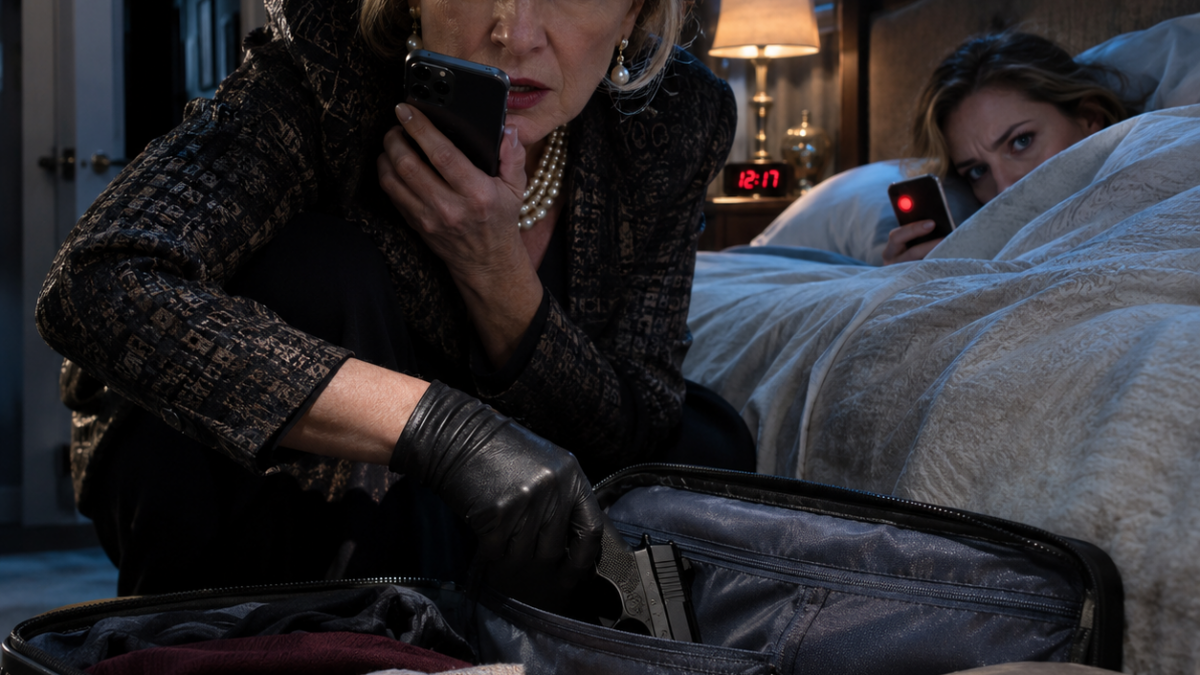
Brenda left my bedroom and closed the door.
I did not move for almost a full minute.
Not because I was uncertain about what I had seen.
Because terror has a strange physical weight.
It pins you.
The woman who had spent seven years smiling across Thanksgiving tables had just planted a hand𝑔𝑢𝑛 inside my luggage.
My husband was apparently waiting somewhere in the house for confirmation.
This was no longer intimidation.
No longer financial manipulation.
They wanted me stopped before I reached Atlanta.
They wanted police.
Airport security.
Headlines.
A weapons charge.
Whatever happened legally afterward almost did not matter to them.
The accusation itself would be enough.
Campbell Hospitality’s controlling shareholder arrested while attempting to carry a hidden hand𝑔𝑢𝑛 through airport security.
Austin could call an emergency board meeting before I even reached an attorney.
Question my judgment.
Question my stability.
Push the stock-transfer agreement again.
Maybe petition for temporary control.
At minimum, destroy my credibility before I presented the forensic records.
I understood the plan in less than thirty seconds.
And then I understood something else.
Brenda had done all of it directly in front of the hidden camera.
Two weeks earlier, after noticing desk drawers moved and papers placed slightly differently than I remembered, I installed a small security camera inside the digital alarm clock on my nightstand.
Austin had mocked me for buying the clock.
“You and your gadgets.”
I had smiled.
Now the little black lens had just recorded his mother planting a 𝑔𝑢𝑛 in my luggage.
I reached beneath my pillow.
Pulled out my phone.
Opened the live feed.
Replayed the last five minutes.
There she was.
Clear enough to identify her face.
Dusty rose robe.
Carry-on.
Hand𝑔𝑢𝑛.
Her hand pushing it beneath the lining.
Then the audio.
Austin, the 𝑔𝑢𝑛 is in place. Make the anonymous call at six sharp.
I watched it twice.
Then uploaded the file to one cloud folder.
A second.
A third.
One connected to an account Austin did not know existed.
My hands were trembling by then.
I did not touch the suitcase.
That instinct may have protected me more than anything else I did.
I called Officer Frank Dawson.
Not 911.
Frank already knew pieces of the financial investigation.
Three weeks earlier, after my attorney became concerned that Austin’s messages might escalate from coercion to something more serious, I had spoken privately with Frank, a longtime investigator familiar with financial-crime referrals.
He answered after three rings.
“Samantha?”
“Frank.”
My voice sounded unfamiliar.
“Something happened.”
Every trace of sleep disappeared from his tone.
“What?”
“My husband and his mother just crossed a line they can’t come back from.”
“Samantha, tell me exactly what happened.”
“Brenda entered my bedroom.”
“Okay.”
“She put a hand𝑔𝑢𝑛 in my carry-on.”
Silence.
Then:
“Do not touch that bag.”
“I haven’t.”
“Is she still in the house?”
“Yes.”
“Austin?”
“Yes.”
“Are you safe in the bedroom?”
“I think so.”
“Lock the door.”
I did.
“Camera?”
“Yes.”
“Recorded?”
“Everything.”
“Upload it somewhere they cannot access.”
“Already done.”
Frank exhaled slowly.
“Good.”
Then:
“Stay in that room.”
“Do not confront either one.”
“Do not move the luggage.”
“Do not wipe anything.”
“I’m coming.”
At 1:43 a.m., Frank arrived through the side entrance with Detective Miller.
I let them in through the back stairway.
The house was silent.
Austin’s bedroom door remained closed.
Brenda’s too.
The absurdity of that detail stayed with me later.
Three people sleeping beneath one roof.
Except two had just attempted to send the third to prison.
I wore lounge pants and a sweatshirt.
Frank entered my bedroom and immediately stopped several feet from the carry-on.
“Nobody touched it?”
“No.”
“Not even the zipper?”
“No.”
“Good.”
Miller slipped on gloves.
Frank looked at me.
“You’re calm.”
“I’m terrified.”
“You don’t look terrified.”
“I spent eleven years doing forensic accounting.”
“That doesn’t explain this.”
“No.”
I looked toward the bag.
“It explains why I know panic ruins evidence.”
Frank’s expression softened slightly.
“Fair.”
I handed him my tablet.
The surveillance video played.
Neither man spoke.
Brenda entered.
Opened the suitcase.
Removed the 𝑔𝑢𝑛 from her robe.
Placed it inside.
Called Austin.
When the video ended, Frank stared at the dark screen.
Then whispered:
“Well.”
Detective Miller said:
“She actually said his name.”
“Yes.”
“And instructed him to make the call?”
“Yes.”
Frank looked at me.
“Why would they do this?”
I pulled up the financial files.
“Because at nine this morning, I was supposed to sit down with corporate counsel in Atlanta.”
“For what?”
“To finalize the evidence package involving almost $2.4 million missing from Campbell Hospitality.”
Miller looked up.
“Your company?”
“My father’s company.”
I corrected myself.
“The company he built. I control fifty-two percent of voting stock.”
“And your husband?”
“Chief executive.”
“Mother-in-law?”
“Public relations.”
Frank’s eyes narrowed.
I continued.
“For months, Austin has been routing company funds to phantom consulting entities controlled by people connected to him.”
“How much proof do you have?”
“Enough that counsel wanted the originals signed and transferred in person.”
“Why not email?”
“Some material has already been sent securely.”
I pointed toward my laptop.
“But tomorrow’s meeting was supposed to finalize corporate action and preservation notices.”
Frank nodded.
“And they knew?”
“They knew I was going to Atlanta.”
“Did they know why?”
“Not officially.”
“But Austin suspected I was challenging him.”
I showed them his text.
Sign the stock transfer agreement, Samantha. Things are going to get remarkably ugly if you try to fight me.
Miller read it twice.
“He wrote that?”
“Yes.”
Frank shook his head.
“They never learn.”
“Learn what?”
“That threatening somebody in writing is still threatening somebody.”
Miller processed the luggage.
Photographs first.
Exterior.
Zipper position.
Interior.
The hand𝑔𝑢𝑛 still beneath the fabric.
He recovered it carefully.
Magazine.
Ammunition.
Serial number.
Everything documented.
Nobody touched more than necessary.
Frank looked at the weapon.
“Do you recognize it?”
“No.”
“Ever seen Austin with one?”
“No.”
“Brenda?”
“No.”
“We’ll run it.”
My stomach tightened.
Then Frank said:
“You’re not taking this suitcase through airport security with a firearm in it.”
“Obviously.”
“But if they believe you are…”
I looked at him.
He looked back.
The outline of the operation formed before either of us said it aloud.
“You want me to go to the airport.”
“If you’re willing.”
I thought about Brenda’s smile.
Austin’s text.
My father.
Campbell Hospitality.
“Yes.”
Frank lifted one hand.
“This is not about revenge.”
“I know.”
“If at any point airport command says stop, we stop.”
“Understood.”
“We’ll replace the weight so the bag appears unchanged.”
“Fine.”
“You do not improvise.”
“I won’t.”
“And Samantha?”
“Yes?”
“From this point forward, everything they say may matter.”
I almost smiled.
“That is the one part I understand perfectly.”
By 4:30, the 𝑔𝑢𝑛 was gone.
Evidence bagged.
The suitcase photographed.
Weighted padding replaced the approximate shape beneath the lining so the exterior did not appear disturbed.
Frank and Miller left through the garden.
I stood in the bathroom afterward and stared at myself.
Pale.
Eyes red.
No sleep.
I had an early flight, but there would be no Atlanta meeting that morning.
My attorneys already knew why.
One of them was coordinating remotely.
The purpose of going to the airport had changed completely.
I showered.
Pinned my hair back.
Dressed in a beige pantsuit.
Packed clothes around the untouched inner compartment.
Not because I was going anywhere.
Because Austin and Brenda needed to believe I was.
At 5:15, I entered the kitchen.
Austin stood near the coffee machine.
Crisp navy suit.
Silk cuffs.
He looked rested.
That hurt more than I expected.
He had slept.
After helping his mother plant a 𝑔𝑢𝑛 in my carry-on, my husband had gone to bed.
“Big day?”
he asked.
I spread butter on toast.
“Very.”
“Still planning to challenge my corporate decisions at the annual meeting?”
I looked up.
“Are you worried about your decorative shareholder?”
Austin laughed.
Actually laughed.
“The only thing I worry about is watching you humiliate yourself in front of the board.”
Brenda entered wearing gold earrings.
Perfect makeup.
Her expression warm enough for Christmas photography.
“Samantha, darling.”
“Yes?”
“Did you remember everything?”
I looked toward the suitcase beside the kitchen door.
“Everything.”
She smiled.
“Good.”
Then:
“I would hate for you to reach the airport and realize something important was missing.”
My pulse jumped.
I took a sip of orange juice.
“I don’t think anything is missing.”
Austin looked toward his mother.
Very brief glance.
Anyone else would have missed it.
I didn’t.
Brenda said:
“I hope your little journey is unforgettable.”
I picked up my handbag.
“Oh, Brenda.”
I smiled.
“I think none of us will ever forget this morning.”
For the first time, her expression flickered.
Only slightly.
Then it was gone.
At 5:48, I rolled my suitcase out to my car.
Placed it in the trunk.
Closed the lid.
As I pulled away, I checked the rearview mirror.
Austin’s luxury sedan emerged from our street less than a minute later.
Brenda sat in the passenger seat.
They followed me.
Of course they did.
The plan only worked if they could watch.
They wanted the humiliation.
That was the detail that finally killed whatever remained of my marriage emotionally.
It was not enough to stop me.
They needed front-row seats.
Frank had already coordinated with airport police.
Security cameras covered the terminal.
Dispatch had been briefed.
The officers involved knew the circumstances.
At 6:02, Austin made the anonymous call.
I did not hear it then.
I listened to the recording later.
His voice was slightly disguised.
Controlled.
He claimed there was a woman preparing to board with an unregistered hand𝑔𝑢𝑛 hidden in her carry-on.
He gave my approximate age.
Clothing.
Terminal.
Bag description.
Enough detail to direct officers straight toward me.
Then he hung up.
At 6:19, my phone buzzed.
Austin.
Security looks pretty tight this morning. Try not to make an embarrassing scene if they pull you aside.
I stopped walking.
Read it.
Another arrived.
Maybe after today, you’ll finally understand who actually runs this family.
For one moment, everything inside me went completely still.
No fear.
No grief.
Just clarity.
I forwarded both messages to Frank.
Then walked through the terminal doors.
Airport terminals have a particular morning sound.
Wheels rolling over tile.
Coffee machines.
Announcements.
Children crying.
Business travelers walking too quickly.
Nobody around me knew my husband had followed me to watch me be arrested.
Nobody knew a hand𝑔𝑢𝑛 had been inside my luggage hours earlier.
Nobody knew two officers were already waiting out of sight.
At 6:37, I stood near the priority check-in counter.
I saw Austin first.
Then Brenda.
They positioned themselves near the atrium.
Close enough to watch.
Far enough to pretend coincidence.
Brenda found me in the crowd.
Her face brightened.
She nudged Austin.
Two uniformed airport officers began walking toward me.
Austin straightened his jacket.
Brenda’s mouth curved upward.
There it was.
Anticipation.
The officer stopped directly in front of me.
“Are you Samantha Campbell?”
“Yes.”
“We received an urgent security report involving your luggage.”
Before I could answer, Brenda moved.
Fast.
Too fast.
“Oh my God.”
She hurried toward us.
“Samantha, what have you done now?”
Austin followed.
He shook his head dramatically.
“I warned her.”
One officer turned.
“Sir, please remain back.”
Austin spread his hands.
“We’re family.”
Brenda moved closer.
“My daughter-in-law has been emotionally unstable recently.”
I stared at her.
She continued.
“We’ve been terrified she might do something dangerous.”
The lead officer tilted his head.
“What kind of dangerous behavior?”
Brenda’s mouth opened.
Austin looked at her.
Too late.
“She has been making reckless decisions,” Brenda said.
“Especially around weapons.”
The officer’s expression did not change.
“Ma’am.”
“Yes?”
“How do you know this report concerns a weapon?”
Everything stopped.
The terminal noise seemed to recede.
Brenda blinked.
“I…”
The officer waited.
“I assumed.”
“Why?”
“Because…”
Austin stepped forward.
“Officer, this is becoming unnecessary.”
The officer’s voice hardened.
“Step back.”
Austin froze.
“This is a family matter.”
“No.”
“It isn’t.”
And then Frank Dawson stepped from behind a security column.
Detective Miller beside him.
Two airport investigators behind them.
The color left Brenda’s face.
Austin’s shoulders dropped.
Frank looked at me once.
Then at them.
“Mrs. Campbell.”
Brenda said nothing.
“We would like to speak with you regarding a firearm placed inside Samantha Campbell’s suitcase at approximately 12:07 this morning.”
Brenda’s knees seemed to weaken.
“I don’t know what you’re talking about.”
Frank raised the tablet.
The screen displayed a still frame.
Brenda.
Pink robe.
My carry-on open.
Black hand𝑔𝑢𝑛 in her hand.
She stared.
For several seconds, she did not breathe.
Then her eyes snapped toward me.
“You had a camera in your bedroom?”
I almost laughed.
“You entered my private bedroom after midnight to hide a 𝑔𝑢𝑛 in my luggage.”
Her face twisted.
“You were recording me?”
“Inside my own bedroom.”
“That is illegal!”
Frank said:
“Mrs. Campbell, stop talking.”
She did not.
“You set me up!”
I stared.
“I set you up?”
“You knew I would—”
She stopped.
Too late again.
Austin turned toward her sharply.
“Mom.”
That single word told the officers plenty.
Frank stepped closer.
“Mr. Campbell.”
Austin immediately changed.
Years of executive polish.
“Officer, clearly there has been some misunderstanding.”
“No misunderstanding.”
“I had nothing to do with anything she may have done.”
Brenda stared at him.
The betrayal between them happened instantly.
She whispered:
“Austin.”
He refused to look at her.
“I told my mother not to interfere in our marriage.”
Brenda’s mouth fell open.
I almost admired his speed.
Almost.
Then I said:
“Would that be before or after you told her to plant the 𝑔𝑢𝑛?”
Austin looked at me.
“You have no proof of that.”
Frank’s eyes shifted.
I said nothing else.
I did not need to.
Because the surveillance audio existed.
And so did the anonymous call.
And so did Austin’s texts.
Austin stepped toward me.
“Samantha.”
I backed away.
He reached for my wrist.
Grabbed it.
Not violently enough to injure.
Hard enough to frighten.
“Stop this.”
Frank moved immediately.
“Release her.”
Austin did.
“Right now.”
His face was sweating.
“Samantha, we can fix this privately.”
“Privately?”
“Yes.”
“You mean like the $2.4 million?”
Every muscle in his face tightened.
Around us, passengers had started watching.
Some phones were raised.
I hated that.
I did not want a public spectacle.
Austin had wanted one.
He had simply expected me to be the spectacle.
I said quietly:
“You tried to frame me for a weapons offense so I couldn’t reach my attorneys.”
His eyes darted around.
“Keep your voice down.”
That sentence.
After everything.
Protect the image.
Always the image.
I looked directly at him.
“No.”
Frank stepped between us.
“Mr. Campbell, move back.”
Austin did not.
Frank repeated:
“Move back.”
Finally, he obeyed.
Brenda broke first.
Not emotionally.
Strategically.
She turned toward Frank.
“I want to tell you what happened.”
Austin spun.
“Don’t.”
She pointed at him.
“He told me Samantha would destroy the family if she went to Atlanta.”
“Mom.”
“He said she had evidence.”
“Stop talking.”
“He told me she would take the hotels.”
“Shut up.”
Frank raised his voice.
“Both of you stop.”
But Brenda was crying now.
Mascara streaking.
Her fear had become anger.
“You coward.”
she hissed at her son.
“You told me to stop her.”
Austin’s face turned red.
“I told you to talk to her.”
“You gave me the 𝑔𝑢𝑛!”
That sentence landed like a physical blow.
Austin stared.
“You miserable—”
Frank stepped forward.
“Enough.”
Brenda shouted:
“You said if she got arrested, the board would force her out.”
Austin yelled back:
“You were supposed to scare her, not—”
He stopped.
Silence.
Frank’s expression changed.
Not dramatically.
Professionally.
That was worse.
“Mr. Campbell.”
Austin looked at him.
“You need to stop speaking now.”
For the first time in seven years, my husband took good advice.
They were separated.
Questioned.
Then taken into custody as the investigation proceeded.
I watched handcuffs close around Brenda’s wrists.
She looked at me.
“Samantha.”
I said nothing.
“We’re family.”
Those words almost made me sick.
She repeated:
“Please.”
I stepped closer only enough that she could hear without me raising my voice.
“Real family does not put a 𝑔𝑢𝑛 in your suitcase and call airport security.”
She began crying harder.
I stepped back.
Austin looked at me from several feet away.
He no longer looked like the chief executive of Campbell Hospitality.
No tailored authority.
No boardroom smile.
Just a frightened man in an expensive suit.
“Samantha.”
I met his eyes.
He whispered:
“You’re destroying everything.”
That was the final lie he ever told me as my husband.
I answered:
“No.”
“You did.”
I did not fly to Atlanta that morning.
My attorneys came to me.
By noon, emergency corporate counsel had been notified.
The board received preservation instructions.
Access to several company systems was restricted.
No one declared Austin guilty of embezzlement on the spot.
That mattered.
The company followed process.
Investigation.
Records.
Independent review.
But the evidence I had spent three months assembling was finally out of my hands and inside professional ones.
And Austin could no longer intimidate junior staff into changing entries while pretending nothing was wrong.
Three days later, Campbell Hospitality held an extraordinary shareholder meeting.
I entered the conference room carrying two binders.
My father’s portrait hung at the far end.
I stopped beneath it for a second.
Not for drama.
Because I suddenly missed him so badly I could barely breathe.
He had built everything in that room.
The company logo.
The properties.
The reputation.
And I had spent seven years allowing Austin to speak as though he had rescued a business that existed before he entered our lives.
I sat.
The board chair called the meeting to order.
Outside counsel summarized the immediate issues.
Austin’s arrest.
The attempted interference with a controlling shareholder.
The ongoing forensic review.
Then I presented my findings.
Not accusations.
Findings.
Vendor One.
Invoice numbers.
Bank destination.
Beneficial owner.
Vendor Two.
No staff.
No physical office.
Payments approved by Austin.
Third shell entity.
Consulting contract signed after invoices had already been paid.
Emails instructing junior accountants to move expenses.
Forged support documents.
The board members stopped interrupting after fifteen minutes.
One finally asked:
“How much?”
I answered:
“Approximately $2.4 million currently identified.”
Silence.
“Potentially more?”
“Possibly.”
“I won’t speculate.”
That sentence came directly from eleven years as a forensic accountant.
Never fall in love with your own suspicion.
Follow the evidence.
The board voted to cooperate fully with investigators.
Independent forensic accounting was authorized.
Outside management was appointed temporarily.
And because I held fifty-two percent of the voting stock, I exercised my rights alongside the board process to remove Austin from his executive role pending and then following the necessary corporate action.
No severance package for misconduct-related termination once the applicable findings were established.
No golden goodbye.
No quiet resignation announcing “personal reasons.”
The company owed employees and investors the truth.
Brenda was removed from public relations.
That part was almost absurd.
The woman responsible for protecting the company’s image had helped create the largest reputational crisis in its history.
The junior accountants cried when interviewed.
That detail stayed with me.
One young man named Eric kept apologizing.
“I changed the classifications.”
I asked:
“Why?”
“Austin told me to.”
“Did you know they were false?”
“I knew they were wrong.”
He looked down.
“He said I’d be fired.”
I did not absolve him.
But I understood fear.
“Tell investigators exactly what happened.”
He did.
Another employee produced emails I had not seen.
A third had kept copies of original invoices because she suspected something was wrong.
The evidence expanded.
Austin’s scheme had depended on everyone believing they were alone.
Once people started talking, the secrecy collapsed.
The divorce petition was filed quickly.
The divorce itself was not magically completed in days.
Real legal proceedings take time.
Assets had to be identified.
The criminal investigation moved separately.
Corporate claims separately.
Marital property separately.
But after the airport, there was no marriage left to discuss emotionally.
Austin sent messages through counsel.
At first angry.
Then bargaining.
Then almost sentimental.
We built this together.
No.
My father built it.
I inherited stewardship.
Austin exploited it.
Another message:
You know I loved you.
Perhaps he believed that.
People are capable of calling something love while repeatedly choosing themselves.
I stopped trying to determine whether his feelings had ever been real.
His actions were enough.
The mansion became another battleground.
Austin loved that house.
Seven bedrooms.
Stone exterior.
Pool.
Wine room.
A driveway designed to impress people before they reached the front door.
He had insisted we needed it because “hospitality executives entertain.”
My father would have hated it.
He believed any house requiring three refrigerators was a management failure.
During the financial proceedings, liens, restitution claims, and asset issues accumulated.
Eventually the property was sold as part of the broader resolution and recovery process.
I walked through it once before closing.
Empty rooms.
Echoes.
The kitchen where Austin had smiled over coffee the morning he planned to watch me arrested.
The staircase Brenda descended wearing gold jewelry and false concern.
My bedroom.
The clock was still beside the bed.
I unplugged it.
That was the only thing I personally took.
The $39 digital alarm clock that had destroyed a multimillion-dollar lie.
Brenda tried to bargain.
Her attorney approached with proposals.
Cooperation.
Reduced exposure.
Information about the weapon.
Information about Austin.
By then I was not involved in deciding criminal charges.
Nor should I have been.
That was for prosecutors and courts.
Eventually, Brenda accepted a plea agreement for her part in the firearm plot and related conduct.
Four years.
When I heard the number, I felt no joy.
That surprised me.
For months I had imagined sentencing as some enormous emotional conclusion.
It wasn’t.
It was paperwork.
A phone call from counsel.
A date.
A sentence.
Then dinner that evening because human beings still have to eat.
Brenda attempted to call me from detention before sentencing.
I declined.
Later she wrote.
I opened the letter once.
The first line:
Samantha, I know you think I betrayed you…
I stopped.
There are sentences that tell you immediately the person still does not understand.
I returned the letter to my attorney.
No response.
Austin’s case took longer.
Financial investigations usually do.
Accounts.
Electronic records.
Contracts.
Witnesses.
Bank transfers.
The original $2.4 million figure became documented through a broader forensic process.
Some money remained available.
Some had been spent.
Some converted into assets.
Some moved through shell entities.
The legal process pursued recovery through freezes, restitution mechanisms, and asset actions where permitted.
Austin eventually faced multiple counts involving financial fraud and the conspiracy surrounding the airport plot.
Seven years in federal prison.
Again, no satisfaction like movies promise.
I listened to the outcome from my attorney’s office.
She asked:
“You okay?”
I thought.
“Yes.”
Then:
“I don’t know.”
Both were true.
Seven years is long.
So was my marriage.
I had once slept beside that man.
Known how he took his coffee.
Known which shoulder hurt when it rained.
Known the way he hummed while shaving.
You can understand someone deserves consequences and still grieve the human being you thought existed.
Those emotions do not cancel each other.
Campbell Hospitality nearly suffered more from the scandal than from the stolen money.
Customers asked questions.
Business partners worried.
Employees feared layoffs.
Headlines reduced years of work to:
Hospitality CEO Arrested in Fraud and Airport Firearm Conspiracy.
My father’s name appeared in some coverage.
That enraged me.
He had been dead for years and still had to share a headline with Austin’s choices.
So I did something my old self might have avoided.
I spoke publicly.
Once.
No dramatic details about Brenda’s robe.
No revenge.
I stood at a press conference beside independent board members and said:
“Campbell Hospitality is not one executive.”
“It is hundreds of employees.”
“Housekeepers.”
“Front-desk teams.”
“Maintenance workers.”
“Regional managers.”
“Accountants.”
“Cooks.”
“People who did their jobs honestly while a small number of individuals violated the trust placed in them.”
Then:
“We will cooperate.”
“We will rebuild controls.”
“And no employee will be punished for reporting concerns in good faith.”
That became the real beginning of the recovery.
We promoted people Austin had ignored.
An operations vice president who had repeatedly warned about vendor controls became interim CEO.
A controller who refused to sign one questionable reconciliation was elevated into the oversight team.
Independent directors were added.
Procurement approvals were redesigned.
Related-party disclosures tightened.
Whistleblower reporting moved outside management.
I remained majority voting shareholder.
But I did not install myself as chief executive.
People found that surprising.
“You could run it.”
Yes.
I could.
That did not mean I should.
My strength was forensic accounting and governance.
The company needed an operator.
My father had taught me another lesson Austin never understood:
Ownership and leadership are not the same thing.
Good owners know when someone else should lead.
Recovery of the stolen funds took months.
Then longer.
Not every dollar simply reappeared.
But asset freezes.
Property recovery.
Restitution orders.
Corporate claims.
Insurance where applicable.
Sale of assets connected to the scheme.
Piece by piece, much of the loss came back.
Every time counsel sent an update, I entered it into a spreadsheet myself.
Not because the company lacked accountants.
Because I needed to see the numbers reconcile.
$38,000.
$112,000.
$470,000.
Another transfer.
Another asset.
Another recovered amount.
Money coming home.
Not to me.
To the company.
That distinction mattered.
I did not become personally rich because Austin stole from Campbell Hospitality.
I was already a major shareholder.
The recovery belonged to the entity he had harmed.
My father used to say:
“A hotel is a promise.”
I was sixteen the first time he told me that.
We were replacing broken lamps in the original property.
I rolled my eyes.
“It’s a building, Dad.”
“No.”
“A person gives you money and trusts that, for one night, this room will be safe, clean, and ready when they arrive.”
“That’s a promise.”
Years later, rebuilding the company, I finally understood what he meant.
Businesses are built on invisible promises.
Employees trust payroll.
Guests trust locks.
Investors trust records.
Owners trust managers.
Austin had broken all of them.
Repair required more than recovered cash.
It required people believing the records again.
Nine months after the airport incident, Brenda received her sentence.
Austin’s case was progressing toward its final resolution.
I no longer lived in the mansion.
I rented a quiet two-bedroom apartment near Campbell Hospitality’s corporate office.
People thought that was strange.
“You own hotel properties.”
“Yes.”
“So why rent?”
“Because I want one door, one refrigerator, and nobody hiding firearms in my luggage.”
That usually ended the discussion.
The first night there, I slept on a mattress on the floor because my furniture had not arrived.
I placed the old digital alarm clock on a cardboard box.
The camera still worked.
I stared at it.
Then switched the recording function off.
That felt bigger than I expected.
For months, surveillance had made me feel safe.
But I did not want to spend the rest of my life watching every doorway.
Safety should eventually allow you to stop watching.
Therapy helped.
I resisted it at first.
Typical forensic accountant.
Give me documents.
Give me facts.
Emotions seemed unacceptably vague.
My therapist, Dr. Keller, asked:
“What hurts most?”
“The betrayal.”
“Which betrayal?”
“All of it.”
She waited.
I hated therapists who understood silence.
Finally:
“That he slept afterward.”
She frowned slightly.
“What?”
“The 𝑔𝑢𝑛.”
I swallowed.
“After his mother put it in my bag, Austin went to sleep.”
My eyes filled.
“He could sleep knowing what would happen to me the next morning.”
There it was.
Not the money.
Not the prison plot itself.
The intimacy of indifference.
Dr. Keller said:
“You’re grieving the person you believed was beside you.”
“Yes.”
“Not merely the person who actually was.”
That hurt.
Because it was true.
For months, I woke around midnight.
12:07.
My body remembered even when my mind did not.
Door creak.
Silk robe.
Metal click.
I would sit up.
Check the room.
No Brenda.
No Austin.
Eventually those nights became less frequent.
Then rare.
Healing did not arrive as forgiveness.
It arrived as ordinary sleep.
Almost one year after the betrayal, I had another morning flight to Atlanta.
Corporate conference.
Real one this time.
My assistant asked:
“Do you want someone to inspect your luggage?”
I almost said yes.
Then stopped.
“No.”
“Security escort?”
“No.”
“Are you sure?”
“Yes.”
I packed myself.
Suit.
Shoes.
Documents.
Toiletries.
I opened the hidden compartment.
Stared into it.
Empty.
My hands trembled slightly.
Then I put a charging cable inside.
Normal object.
Normal bag.
I zipped it.
That was all.
At the airport, I arrived early.
No Austin following me.
No Brenda.
No staged anonymous call.
No officers waiting.
Just travelers.
Coffee.
Rolling luggage.
Announcements.
I passed through security.
My bag went onto the belt.
For one second, my chest tightened.
The scanner swallowed it.
I remembered Brenda’s face.
The 𝑔𝑢𝑛.
The tablet.
Then my suitcase emerged on the other side.
A security officer pushed it toward me.
“Have a good flight.”
Four words.
Ordinary.
I almost cried.
“Thank you.”
I boarded.
Window seat.
Stored my carry-on overhead.
Sat.
The sun was beginning to rise beyond the runway.
My phone chimed.
Corporate counsel.
Final frozen asset transfer cleared this morning. Funds have been returned to Campbell Hospitality’s recovery account. Updated reconciliation attached.
I opened the spreadsheet.
Read the number.
It did not mean every wound was healed.
It meant another ledger finally balanced.
I closed the file.
Turned off my phone.
Outside, golden light spread across the tarmac.
The aircraft began moving.
For seven years, Austin and Brenda had mistaken quiet for weakness.
They believed because I did not scream, I did not see.
Because I did not boast about my forensic background, I had forgotten it.
Because I loved my husband, I would surrender my father’s company rather than expose him.
Because I remained polite at dinner, I could be frightened into signing away fifty-two percent.
And when intimidation failed, they escalated to a plan so cruel they believed the spectacle itself would destroy me.
A 𝑔𝑢𝑛.
An airport.
An anonymous call.
A woman in handcuffs before breakfast.
They thought the plan was brilliant.
They never stopped to consider the possibility that the quiet woman sleeping in the bedroom had spent her entire career learning how evidence survives lies.
I often wonder what would have happened if I had awakened thirty seconds later.
If Brenda had entered while I was deeply asleep.
If I had never installed the clock.
If I had touched the suitcase before calling Frank.
If I had simply gone to the airport.
Those questions can consume you if you let them.
So I don’t.
I live in the version that happened.
I saw.
I documented.
I called for help.
Professionals did their jobs.
The truth came out.
That is enough.
People who eventually heard the story liked the airport moment best.
Of course they did.
Brenda volunteering details the officer had not mentioned.
Frank stepping from behind the pillar.
The tablet.
Her face going white.
Austin grabbing my wrist.
Mother and son turning on each other.
It sounded cinematic.
But when I think about the moment everything truly changed, I think of my bedroom.
Dark.
Quiet.
12:07 a.m.
Brenda bending over my suitcase.
Me beneath the covers.
Terrified.
And then the second I made the decision not to jump up.
Not to scream.
Not to confront her.
Not because I was weak.
Because evidence mattered more than rage.
That was the decision that saved me.
I also think about my father.
If he had been alive, he would have hated every second of what happened.
Then he would have asked me the only question he believed mattered.
“What do the records show?”
That was Dad.
Emotion later.
Documents first.
I inherited more from him than voting shares.
The company eventually placed a small framed photograph of him in the boardroom.
Not a giant portrait.
Dad would have considered that ridiculous.
Just a photograph of him standing outside the first Campbell hotel wearing work pants and holding a wrench.
Underneath, one sentence:
Trust is the asset you lose fastest and rebuild slowest.
He said that often.
Austin never listened.
I finally did.
There was no final prison visit.
No confrontation through glass.
No scene where Austin begged and I delivered the perfect line.
I did not need one.
He sent a letter through counsel after sentencing.
I read only part.
Samantha, I know you believe everything I did was about money…
Maybe it wasn’t.
Maybe some of it was fear.
Entitlement.
Pride.
A lifetime of believing he deserved control.
It did not matter enough for me to investigate his soul.
I had spent too many years doing unpaid emotional accounting for that man.
I stopped.
Brenda tried once more.
A short message through an intermediary.
I was only protecting my son.
That sentence explained everything and excused nothing.
Parents can love their children so badly that love becomes permission.
Brenda had spent years teaching Austin that consequences were attacks and boundaries were disrespect.
Then she helped him plant a 𝑔𝑢𝑛.
I did not reply.
I never became obsessed with revenge.
That may disappoint people who like stories with spectacular punishment.
The punishments happened.
Prison.
Lost positions.
Frozen accounts.
Sold property.
Broken reputations.
But those were consequences administered by systems larger than my anger.
My job was not to ruin Austin.
My job was to stop protecting him from what he had done.
There is a profound difference.
One of the junior accountants who had been terrified of Austin eventually became director of internal controls.
Eric.
The same young man who cried while admitting he changed classifications under pressure.
Two years later, he came into my office carrying a draft policy.
“I think this closes the vendor-approval gap.”
I reviewed it.
“You missed one thing.”
His face fell.
I pointed.
“Backup approver if the CFO has a conflict.”
He stared.
Then laughed.
“Right.”
I signed the review.
He stopped at the door.
“Samantha?”
“Yes?”
“Thank you for not firing all of us.”
I looked at him.
“Some people made mistakes under pressure.”
“Some participated willingly.”
“We dealt with those differently.”
He nodded.
Then:
“I should have said something earlier.”
“Yes.”
He looked down.
I added:
“Next time, say something earlier.”
He smiled slightly.
“Yes, ma’am.”
That was enough.
Campbell Hospitality did not become perfect.
No company does.
We made new mistakes.
Hotels missed targets.
A renovation ran over budget.
One regional manager resigned abruptly.
A new software rollout was a disaster.
Normal problems.
I loved them.
Normal problems do not require hidden cameras in bedrooms.
I dated no one for a long time.
People assumed I had become afraid of men.
Not exactly.
I had become protective of quiet.
After seven years with Austin, peace felt almost romantic.
I liked eating dinner without condescension.
Sleeping without wondering who had moved my papers.
Going to a board meeting without being patted on the hand.
There was no rush to replace that.
The mansion where the plot began belonged to someone else eventually.
I drove past it once by accident.
Different cars in the driveway.
Children’s bicycles near the garage.
Porch lights.
For a second, I imagined Brenda crossing the hallway in her rose robe.
Then the image faded.
A house does not belong forever to the worst thing that happened inside it.
Neither does a person.
I kept driving.
The black hand𝑔𝑢𝑛 remained evidence for a long time.
I never asked to see it again.
People sometimes assumed I would want the serial number.
Ownership history.
Every detail.
I didn’t.
Frank once asked:
“You don’t want to know where it came from?”
“Does it matter?”
“For the case, yes.”
“For me?”
I shook my head.
“No.”
By then, investigators had established enough.
I did not need to collect artifacts of trauma just because I had once collected evidence professionally.
Frank and I stayed in occasional contact.
Every year around November, he sent one text.
Still checking your luggage?
The first year I replied:
Three times.
Second year:
Twice.
Third:
Once.
Eventually:
Packed it and left the house like a normal person.
He replied:
Progress.
It was.
The strangest thing about surviving betrayal is that eventually the story becomes something that happened to an earlier version of you.
At first, every detail is present tense.
Brenda is entering.
Austin is calling.
The officers are approaching.
Then months pass.
Years.
The verbs change.
Entered.
Called.
Approached.
Past tense is a kind of freedom.
I still own fifty-two percent of Campbell Hospitality.
That never changed.
What changed was the way I held it.
Before, I treated ownership as something Dad left me.
Afterward, I understood it as responsibility.
Hundreds of people depended on decisions made inside rooms where Austin once laughed at me.
I stopped attending those meetings quietly.
Not loudly for the sake of performance.
Clearly.
If I wanted records, I asked.
If something did not make sense, I said so.
If somebody called me decorative, they did it only once.
Funny how quickly people learn when politeness stops being permission.
And I stopped pretending my eleven years in forensic accounting belonged to a previous life.
They were part of me.
I had minimized my expertise because Austin felt threatened by it.
That was not love.
Love does not require selective incompetence.
I knew that now.
The morning of that later Atlanta flight, when the aircraft finally lifted above the clouds, I watched the city shrink.
Somewhere below was the house where Brenda had planted the 𝑔𝑢𝑛.
The airport terminal where Austin expected to see me handcuffed.
The corporate office where we had rebuilt everything.
All of it became smaller beneath the wing.
I thought about the message Austin had sent:
Maybe after today, you will finally understand who actually runs this family.
He had been right about one thing.
After that day, I did understand.
Not Austin.
Not Brenda.
Not me, either.
Families are not supposed to be run like corporations.
Marriage is not ownership.
Love is not authority.
And anyone who needs fear to remain in charge was never leading in the first place.
My father spent his life building hotels because he believed travelers deserved a safe place to sleep.
Austin tried to use a journey to make me unsafe.
That contrast stayed with me.
So a year after the investigation closed, Campbell Hospitality created a fund in my father’s name.
Not for executives.
For hourly employees facing emergencies.
Temporary lodging.
Legal-aid referrals.
Emergency transportation.
Short-term financial assistance.
The board approved it unanimously.
No press release.
Dad would have liked that.
The first employee helped by the fund was a housekeeper whose apartment building had burned.
She and her two children stayed at one of our hotels for three weeks.
When she returned to work, she came to my office.
She cried.
I did too.
Then she apologized for crying.
I laughed.
“Please don’t.”
She said:
“I thought I was going to lose everything.”
I remembered my suitcase.
The 𝑔𝑢𝑛.
The airport.
“I know that feeling.”
She had no idea what I meant.
She did not need to.
Years later, when people asked how I knew something was wrong before the 𝑔𝑢𝑛, I always answered:
“Small things.”
A drawer moved.
A strange invoice.
A missing document.
A husband who became irritated by ordinary questions.
A mother-in-law who listened too closely when I mentioned travel.
Trust rarely collapses in one spectacular moment.
Usually the spectacular moment only confirms a pattern you have been explaining away.
I stopped explaining patterns away after Austin.
The hidden pocket in my carry-on still exists.
I use the same bag sometimes.
At first, I wanted to burn it.
Then I thought:
Why?
It is luggage.
Brenda does not own it.
Austin does not own it.
Fear does not own it.
So I cleaned the suitcase thoroughly after police released it.
Replaced the damaged lining.
And used it again.
The first trip was difficult.
The second easier.
Now that compartment holds charging cables.
Sometimes receipts.
Once, embarrassingly, three hotel soaps I forgot were there.
Normal things.
I like that.
If I could speak to the Samantha lying under that comforter at 12:07 in the morning, pretending to sleep while her mother-in-law planted a firearm five feet away, I would tell her:
Your heart is going to feel as if it is trying to break through your ribs.
Let it.
Do not move.
Do not confront.
Save the recording.
Call Frank.
Trust what you know.
You are not weak because you are afraid.
Courage is not the absence of shaking hands.
Sometimes courage is having shaking hands and still remembering not to touch the evidence.
I would tell her the airport will be terrible.
Brenda will perform.
Austin will lie.
They will turn against each other faster than you imagined.
But do not enjoy it too much.
Because the satisfaction will fade.
What remains is grief.
Then work.
Then healing.
And eventually freedom.
I would tell her the company will survive.
Not unchanged.
Better in some ways.
Wounded in others.
People will leave.
Others will step up.
Your father’s legacy will not disappear because two greedy people treated it like a personal bank account.
A business can recover money.
Trust takes longer.
Be patient.
I would tell her that one day she will pass through airport security again with the same bag and no one will stop her.
The officer will simply say:
“Have a good flight.”
And those four ordinary words will feel like victory.
Most of all, I would tell her not to confuse silence with surrender.
That was the mistake Austin and Brenda made.
For seven years, I listened.
Observed.
Let them underestimate me.
Partly because I loved my husband.
Partly because confrontation exhausted me.
Partly because some deep, foolish piece of me still believed that if I remained patient long enough, Austin would remember that marriage was supposed to be a partnership.
He never did.
By the time I stopped waiting, he had convinced himself my patience meant powerlessness.
That mistake cost him everything he had stolen.
The airport scene became the story everyone remembered.
But my favorite moment came later.
Much later.
I was at a Campbell Hospitality board meeting.
A new executive presented a proposal.
Halfway through, one number looked wrong.
I interrupted.
“Go back.”
He did.
“Slide twenty-three.”
He returned to it.
“Explain the variance.”
No sigh.
No joke.
No:
Don’t worry your pretty little head.
He explained.
I listened.
Asked two more questions.
He answered.
Then we moved on.
Five minutes.
Completely ordinary.
I sat there and suddenly realized how extraordinary it felt to be treated as though my questions belonged in the room.
I had always belonged in the room.
Austin had simply spent seven years convincing me otherwise.
At the end of that meeting, I stayed after everyone left.
Dad’s photograph remained on the wall.
Work pants.
Wrench.
Terrible haircut.
I looked at him.
“You were right.”
I almost laughed.
Dad loved hearing those words.
Then:
“Trust really is the hardest thing to rebuild.”
Silence.
I picked up my files.
Turned off the boardroom lights.
And went home.
That was the real ending.
Not the handcuffs.
Not the prison sentences.
Not Austin losing the mansion.
Not Brenda crying in the airport.
Not even the recovered money.
The ending was walking into rooms without shrinking.
Packing a suitcase without fear.
Sleeping through midnight.
Asking questions without apology.
Owning my father’s company without allowing his legacy to become a cage around my own life.
Austin and Brenda spent months trying to build a prison around me.
They used money.
Marriage.
Family loyalty.
Fear.
Finally, a 𝑔𝑢𝑛.
But the bars never closed around me.
Because the moment I saw Brenda bend over that suitcase, I stopped protecting the people trying to destroy me.
And once I did that, all they had left were their own choices.
Every threatening text.
Every forged invoice.
Every secret account.
Every whispered instruction.
Every anonymous call.
Every lie.
Piece by piece, they built the case that trapped them.
I only stopped dismantling it for them.
So yes.
At seven minutes past midnight, my mother-in-law slipped a loaded hand𝑔𝑢𝑛 into my carry-on.
At six in the morning, my husband called airport security expecting to watch me disappear in handcuffs.
At 6:37, they stood in the terminal smiling while officers approached.
Then Frank Dawson stepped into view.
The tablet came up.
Brenda saw herself on the screen.
Austin realized the anonymous call had been recorded.
And the two people who had spent years treating me as though I could not possibly understand what they were doing finally understood something about me.
I had understood almost everything.
I had simply been waiting until understanding became evidence.
Years later, when I think about that morning, I do not remember the handcuffs first.
I remember the airplane lifting above the clouds almost a year later.
My carry-on safely above my head.
My father’s company still standing.
The recovered funds back where they belonged.
And nothing hidden in my luggage except clothes, documents, and a charging cable.
For the first time in seven years, nobody was deciding my future behind a closed door.
Nobody was telling me which questions I was allowed to ask.
Nobody was calling me decorative.
Nobody was trying to frighten me into surrender.
I looked out the window as the sunrise spread across the clouds.
Then I smiled.
Because Austin had once warned me that things would become ugly if I fought him.
He was right.
They did.
He just never imagined the ugliest thing would be the truth.
And Brenda had whispered that I would be finished before breakfast.
She was wrong.
By breakfast, I had only just be𝑔𝑢𝑛.








