FULL STORY:“THAT DOG HASN’T SEEN HIM IN THREE YEARS!” The Prisoner Whispered Six Words Into His Dog’s Ear—Then Rex Led Police to the Evidence That Could Destroy Their Own Chief
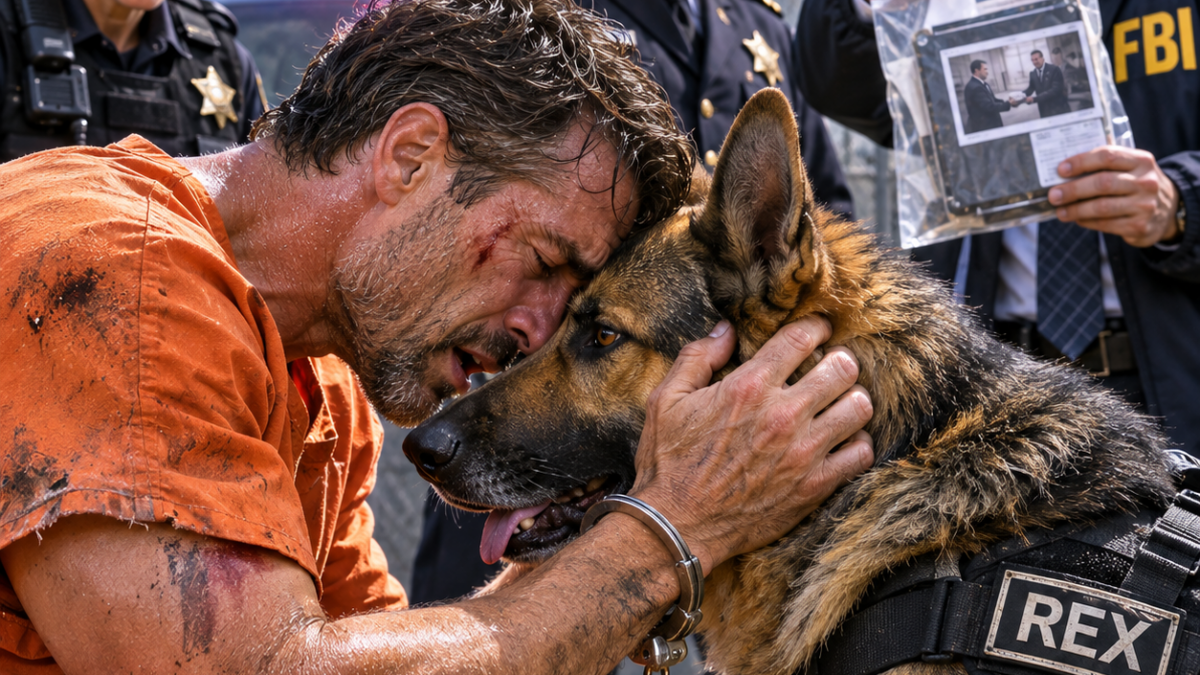
PART2
When the visiting room door shut behind Rex, William remained kneeling on the floor.
The guards told him to stand.
He heard them.
But for a moment, his body refused to obey.
Three years of waiting.
Three years of being called a suspect.
Three years of hearing his lawyer say there were still motions pending, more evidence to review, another hearing delayed, another request for release denied.
He had entered detention believing the misunderstanding would last a few days.
Then weeks.
Then months.
By the time the first year ended, the outside world had already built a story around him.
William Carter.
Violent mechanic.
Suspicious loner.
The man arrested near a murdered businessman’s warehouse.
The man who supposedly hated the victim.
The man who couldn’t explain why his fingerprints were on the victim’s truck.
The man whose dog vanished the same night.
There was no conviction.
No jury had declared him guilty.
But the court of public opinion had delivered its verdict before William ever saw a courtroom.
His picture appeared in local newspapers.
MECHANIC HELD IN HARTWELL MURDER INVESTIGATION.
People he had known for years stopped answering his calls.
His landlord terminated the lease after the property was sold.
His repair shop closed.
His savings disappeared into legal expenses.
And eventually even his younger sister stopped visiting.
Not because she was cruel.
Because she could no longer bear watching him grow thinner while nothing changed.
William didn’t blame her.
He blamed himself for the night everything happened.
Not for the murder.
He hadn’t killed anybody.
But for making one decision that seemed small at the time.
A decision involving a dog collar.
A recorder.
And a loading dock.
That night began at 11:14 p.m. on a rainy Thursday.
William had been closing Carter Auto Repair when he heard an argument outside the neighboring industrial yard.
His shop stood on the edge of Millbrook, a struggling former manufacturing district full of warehouses that had been built in the 1960s and abandoned one by one.
The city had spent years promising redevelopment.
Most of the promises ended as faded signs beside chain-link fences.
William’s shop survived because he was good at keeping old trucks running.
Fleet vans.
Farm pickups.
Delivery vehicles.
If it had an engine and somebody couldn’t afford to replace it, they brought it to William.
Rex lived with him.
The German Shepherd had been found as a thin, injured puppy beside a highway six years earlier.
William paid for surgery on a broken leg.
Slept beside his recovery crate.
Fed him by hand when the dog refused to eat.
Over time, Rex grew into a powerful, loyal animal who followed William everywhere.
Customers joked that the shop had two mechanics.
One who understood engines.
And one who understood people.
Rex disliked strangers who approached William too quickly.
He was never aggressive without reason.
But he watched.
Always.
That rainy Thursday, he was lying near the office door when William heard the first shout.
“YOU PROMISED THE PROPERTY WOULD BE CLEAR!”
The voice came from the neighboring Hartwell Logistics warehouse.
William recognized one of the men.
Anthony Vale.
A local developer who had been buying neglected industrial properties for years.
Vale was rich.
Connected.
Well dressed.
The sort of man who never visited the neighborhood unless he was purchasing something he intended to demolish.
The second voice belonged to Thomas Hartwell.
Owner of the warehouse.
Sixty-one.
Widower.
Hard businessman.
Not particularly kind, but not a man William believed deserved harm.
Hartwell had owned much of Millbrook’s industrial land.
For years, developers tried to persuade him to sell.
He refused.
He claimed the property would eventually be worth ten times their offers.
That night, the disagreement sounded different.
Not like negotiation.
Like desperation.
William stepped toward the back office window.
Rex rose beside him.
Outside, rain struck the loading dock.
Three dark vehicles were parked near the warehouse.
William could see Vale gesturing toward another man standing near a pickup.
Then Hartwell shouted:
“I HAVE THE ORIGINAL CONTRACTS!”
Vale stepped closer.
William couldn’t hear the reply.
Then Hartwell said something that made William’s skin tighten.
“If anything happens to me, I’ve already arranged for the truth to come out.”
A car door slammed.
Rex growled.
William pulled him back.
“Easy, buddy.”
He looked at the clock.
11:17.
He should have called the police immediately.
He thought about it.
But he’d seen drunken arguments outside industrial properties before.
Business disputes.
Angry truckers.
People whose tempers grew ugly after midnight.
He didn’t know a crime was about to happen.
Not yet.
Then he heard another voice.
Calm.
Authoritative.
A voice he recognized.
Detective Richard Mercer.
Senior investigator with the Millbrook Police Department.
Mercer had been a familiar figure around town for fifteen years.
He attended community events.
Appeared on local television after major arrests.
Spoke about public safety at city meetings.
William had repaired the brakes on Mercer’s personal pickup twice.
They weren’t friends.
But he knew the man’s voice.
And he knew Mercer wasn’t supposed to be standing behind an abandoned warehouse arguing with a developer at nearly midnight.
William stepped away from the window.
His hands were shaking.
He had recently purchased a tiny digital audio recorder for diagnosing intermittent engine noises and documenting customer complaints.
The device was smaller than a matchbox.
It could record for hours to internal storage.
William picked it up from the workbench.
For a moment, he considered keeping it in his own pocket.
Then looked at Rex.
The dog had begun pacing near the back door.
William made a decision.
He attached the recorder inside a specially modified compartment on Rex’s old leather collar.
He’d built the small pocket months earlier for a tracking tag.
The recorder fit.
He switched it on.
Then knelt beside Rex.
“Listen to me.”
The dog stared.
“Stay close.”
William touched his forehead to the animal’s.
“Find the truth, then come home.”
It was their private phrase.
Something William had begun saying during scent games when Rex was younger.
He would hide a small object somewhere on their property.
Tell Rex to find it.
Then wait at the shop door.
When Rex returned, William rewarded him.
Find the truth, then come home.
It was a silly phrase.
A mechanic’s private joke.
But Rex recognized the words as the beginning of a search.
William opened the rear door.
And stepped into the rain.
He never intended to confront the men.
That was what he told investigators later.
Again and again.
He intended to get closer.
Listen.
See whether anyone needed help.
Then leave.
He had his phone.
Could call for assistance.
And Rex was beside him.
They moved along the shadowed side of the shop.
Toward a fence separating William’s property from the old warehouse.
The argument grew louder.
Hartwell was furious.
“You forged the purchase authorization!”
Vale answered:
“Keep your voice down.”
“You think I’m letting you steal twenty million dollars in land?”
Another man spoke.
William couldn’t identify him.
Then Mercer.
A low, unmistakable voice.
“Thomas, nobody has to get hurt.”
Hartwell laughed bitterly.
“You’re a police detective.”
“You think I don’t know why you’re here?”
A moment of silence.
Then the developer said:
“We tried doing this the easy way.”
William’s stomach tightened.
He lifted his phone.
Began dialing emergency services.
Then Rex growled.
A figure moved behind him.
Someone grabbed his arm.
The phone fell.
William twisted.
A hard object struck the side of his head.
Pain exploded behind his eye.
He fell against the fence.
Rex lunged forward barking.
Another man shouted.
Then everything became confusion.
A struggle.
Boots on gravel.
Rain in his face.
Someone pulled Rex away.
William tried to stand.
A second blow knocked him down.
The last thing he remembered clearly was the sound of his dog’s frightened bark disappearing into the darkness.
Then a voice above him.
“Leave him here.”
And another.
The detective.
Mercer.
“He’ll do.”
William woke beneath fluorescent lights.
A hospital.
Two officers standing near his bed.
His head bandaged.
One wrist secured to the railing according to hospital custody protocol.
Detective Mercer stood beside the door.
“Mr. Carter.”
William tried to sit up.
Pain tore through his skull.
“Rex.”
Mercer looked at him.
“What?”
“My dog.”
“Where is he?”
Mercer ignored the question.
“Thomas Hartwell was found dead last night.”
William stared.
“What?”
“Single fatal gunshot wound.”
“No.”
Mercer opened a folder.
“You were located near the crime scene.”
“I was attacked.”
“Your fingerprints were found on Hartwell’s pickup.”
“I repair his truck.”
Mercer’s eyes remained flat.
“Witnesses report hearing a dispute between you and Mr. Hartwell earlier this week.”
William’s mouth went dry.
He had argued with Hartwell.
Three days earlier.
Over an unpaid invoice.
Two hundred eighty dollars.
Hartwell accused him of charging too much for a starter replacement.
William told him he wouldn’t release the truck until he paid.
They argued for five minutes.
Then Hartwell paid.
That was all.
Mercer knew.
He’d been standing in the shop that afternoon.
William stared at him.
“You were there.”
Mercer didn’t blink.
“Where?”
“The warehouse.”
“Last night.”
“I heard you.”
Silence.
Then Mercer leaned closer.
“Mr. Carter.”
His voice grew very quiet.
“You suffered a significant head injury.”
“It’s understandable if your memory is confused.”
William stared.
“No.”
“You were there.”
Mercer straightened.
“I’m investigating a homicide.”
“You’re the man—”
“Be careful.”
Two words.
Soft.
Almost gentle.
And William felt fear settle into his chest.
Not panic.
Recognition.
The detective standing beside his hospital bed wasn’t trying to solve the murder.
He was making sure the story stayed pointed at William.
The first hearing came quickly.
The prosecution argued William posed a flight risk.
The accusation was serious.
The evidence appeared troubling.
His presence near the warehouse.
The old argument over money.
A claim that he had been seen approaching Hartwell’s building.
Biological traces on his clothing that required analysis.
His own inconsistent statements following a head injury.
William’s court-appointed attorney, Daniel Pierce, argued that much of the evidence had innocent explanations.
The truck had been in William’s shop.
The financial disagreement was documented and settled.
The injury suggested he had been assaulted.
No murder weapon connected to him had been recovered.
He repeatedly asked that the surrounding businesses’ surveillance footage be preserved.
But the cameras near his shop had malfunctioned during the storm.
A critical warehouse recorder was reportedly missing.
The prosecution sought detention.
William was held pending further proceedings.
He thought he’d be released when investigators found the men he heard arguing.
Then weeks passed.
More allegations.
Additional financial records from Hartwell’s business.
Disputed forensic findings.
The prosecution’s theory grew larger.
William was portrayed as a financially desperate mechanic who had confronted an angry customer and killed him.
The defense requested independent testing.
Then broader disclosure.
Then hearings about missing evidence.
Some motions succeeded.
Others were delayed.
The case became entangled in procedural disputes, witness availability, and repeated continuances.
William remained in custody through a series of contested detention decisions.
His lawyer challenged the prolonged confinement.
The legal delays were extraordinary.
Controversial.
Increasingly difficult to justify.
But none of that mattered to the newspaper headlines.
To the town, he was the suspect.
And the suspect stayed in prison.
The first Christmas, William sat on the edge of his bunk listening to men in the corridor sing badly.
He tried not to think about Rex.
Failed.
He imagined the dog wandering through snow.
Hungry.
Confused.
Looking for him.
He wrote letters asking whether animal control had found a German Shepherd.
No answer.
He requested that his attorney contact rescue groups.
Daniel tried.
Nothing.
He asked guards whether dogs ever remembered people after long separations.
One laughed.
“Three years?”
“Dog’ll forget you in three weeks.”
William turned away.
He knew better.
Rex remembered every sound from their shop.
The rustle of a treat bag.
The click of the pickup door.
The whistle William used to call him inside.
He would remember.
William needed to believe that.
Because if Rex didn’t remember, then perhaps the last unbroken part of his old life had disappeared.
His sister, Emily Carter, visited for the first six months.
She brought photographs.
Money for his account.
News from the outside.
She had cried at every visit.
Then the visits became less frequent.
Their mother had died years before.
Their father was gone too.
William had only Emily.
And Rex.
One afternoon, Emily sat opposite him behind the visitation glass.
Her eyes were tired.
“I can’t keep doing this.”
William’s chest tightened.
“What?”
“Every time I come here, people recognize me.”
He stared.
“Emily.”
“My boss asked if I knew anything about the Hartwell case.”
“Someone left a note on my car.”
He closed his eyes.
She continued.
“I believe you.”
“I do.”
“But my whole life has become about proving my brother didn’t kill somebody.”
William reached toward the glass.
She began crying.
“I need to live too.”
He nodded slowly.
“I know.”
“Will you be okay?”
The question almost made him laugh.
No.
He wouldn’t be okay.
But he couldn’t ask her to keep breaking herself beside him.
So he said:
“Go live, Em.”
She covered her face.
“I’m sorry.”
“Don’t be.”
She stood.
Took one last look.
Then walked away.
William pressed his palm against the glass.
For a long time after she left, he remained sitting there.
Nobody came back.
The guard eventually told him to move.
He did.
Because inside prison, even grief had to follow a schedule.
The second year was worse.
The first year, he expected release.
The second, he began fearing the system might never correct itself.
He stopped counting holidays.
Stopped imagining how the shop would look when he returned.
It had already closed.
Equipment sold to cover debts.
Customers gone.
The building leased to another business.
The home he rented had been cleared out.
Most of his belongings were lost or stored in a small unit Emily could no longer afford.
Even if he walked out tomorrow, where would he go?
Who would hire him?
Who would believe him?
The accusation had become his identity.
He was no longer William the mechanic.
William who rescued Rex.
William who fixed an elderly widow’s car for free.
William who brought groceries to his sister when she was sick.
He was William Carter.
Murder suspect.
One afternoon, a new inmate asked:
“What’d you do?”
William stared at the wall.
“Nothing.”
The man laughed.
“Sure.”
William stopped answering.
The third year, Daniel Pierce received a letter from Laura Bennett.
The veterinary behavior specialist.
She worked with a rescue organization that had recently found a German Shepherd wandering near abandoned warehouses in Millbrook.
The dog was thin.
Weak.
Wary of strangers.
But his microchip connected to William Carter.
Laura began researching the owner’s situation.
Discovered the murder case.
Then contacted Daniel.
She wanted to know whether William might be permitted a supervised visit.
Daniel nearly dropped the phone.
“Is the dog alive?”
“Yes.”
“Are you certain it’s his?”
“Microchip registration and veterinary history match.”
Daniel sat down.
For years, he’d watched William’s hope grow smaller.
Now, for the first time, he had something that wasn’t a motion, appeal, or evidentiary dispute.
A living creature from the night everything happened.
He contacted the correctional facility.
The visit required approval.
Security planning.
Veterinary clearance.
Special arrangements.
Not simple.
But eventually, the prison administrator agreed to a controlled meeting.
And one November morning, Rex entered the visitation room.
Laura had never forgotten that day.
The dog knew.
She couldn’t explain exactly how.
Rex had been tense while traveling.
Uncomfortable around unfamiliar uniforms.
But the instant he entered the room and smelled William, his body changed.
Laura saw it.
The ears.
The breath.
The way he stared.
He recognized something.
Then William whispered into his ear.
Six words.
A private phrase.
And Rex became a younger dog for a moment.
Tail moving.
Face pressed against his owner’s chest.
Whining like an animal trying to recover every lost day at once.
Laura stood near the wall with tears in her eyes.
She had worked with frightened animals for years.
Abandoned dogs.
Abused dogs.
Animals recovering from injury.
She understood attachment.
But she’d never seen a reunion quite like that.
Afterward, when the guards took William back to his unit, Rex refused to leave the visiting room.
He turned toward the closed door.
Whined.
Pulled.
Then abruptly changed direction.
He moved toward the hallway leading to the building exit.
Nose working.
Body tense.
Laura followed.
“Rex?”
The dog pulled harder.
By the time they reached the parking lot, he was searching the air with growing urgency.
Not panicking.
Searching.
Laura had spent enough time observing animals to know that Rex wasn’t merely trying to escape.
Something had activated a memory.
She thought of William’s final whisper.
Remember the man who took you.
She didn’t know what it meant.
But she knew William had said it for a reason.
Laura called Daniel Pierce that afternoon.
“The dog is behaving strangely.”
Daniel listened.
“Strangely how?”
“He keeps pulling toward the highway.”
“Could be stress from the visit.”
“Maybe.”
“He’s looking for William.”
“I thought that too.”
She paused.
“But he isn’t simply distressed.”
“He seems to be following something.”
Daniel sighed.
“Laura, dogs can retain powerful scent and place associations, but three years is a long time.”
“I know.”
“And we can’t treat his behavior as proof of anything.”
“I know that too.”
She took a breath.
“Then let me ask a different question.”
“What?”
“Do you know where Rex was found?”
Daniel looked at the report.
“Near the old Millbrook industrial district.”
“Do you know where William says he was attacked?”
Daniel went quiet.
Then:
“Yes.”
Laura continued.
“I’m not saying the dog can solve a murder.”
“I’m saying there’s a location connection worth examining.”
Daniel stared at the file on his desk.
For three years, he’d followed evidence that kept leading to missing footage and unanswered questions.
Now a dog had reappeared near the original industrial district.
And his client had whispered something about remembering the man who took him.
Daniel opened his notebook.
“Laura.”
“Yes?”
“Don’t go trespassing through abandoned buildings.”
“I wasn’t planning to.”
“Let me speak to the independent investigator working on our post-arrest evidence review.”
She nodded.
“Okay.”
“And keep Rex safe.”
Laura looked down at the Shepherd sleeping near her feet.
“I intend to.”
The independent investigator was a former homicide detective named Rachel Monroe.
Forty-eight.
Methodical.
Skeptical.
Daniel had retained her through funds raised by a small legal-defense organization.
Rachel had been examining the case for months.
She knew William’s allegations.
The missing surveillance.
The questionable witness statements.
The unexplained injuries.
The relationship between Thomas Hartwell and Anthony Vale.
She also knew that one of the most troubling features of the investigation was how often Richard Mercer’s name appeared beside evidence that later proved difficult to verify.
Not proof of corruption.
But enough to make her uneasy.
Daniel called her.
Explained the dog.
Rachel was silent for a moment.
Then said:
“Where exactly was he found?”
Laura supplied the general area.
Rachel pulled up a map.
Old factories.
Warehouse buildings.
Rail spurs.
Loading docks.
Then she recognized something.
The rescue location was less than two miles from a property formerly associated with a company controlled by Anthony Vale.
Rachel stared.
“Interesting.”
Daniel said:
“What?”
“One of Vale’s old storage leases was in that district.”
“Still active?”
“Not sure.”
Rachel leaned closer to the screen.
“And the property was mentioned in a witness statement that never received much follow-up.”
Daniel sat upright.
“Which witness?”
“A night security guard.”
“He said he saw a dark van near the service entrance after the murder.”
Daniel’s heart accelerated.
“What happened to the statement?”
Rachel looked at the file.
“Marked as unrelated.”
“By whom?”
Silence.
Then:
“Mercer.”
Rachel wasn’t foolish enough to let a dog pull investigators through a building based solely on instinct.
She requested records.
Checked ownership.
Spoke to local authorities.
Reviewed the history of the abandoned properties.
Then arranged a supervised examination of accessible exterior areas with appropriate permission.
Laura brought Rex.
Not as an officially trained detection dog.
He wasn’t one.
He was William’s companion.
That distinction mattered.
Nobody could claim his behavior established the existence of criminal evidence.
But he might respond to a place he’d been before.
They began near the road where the rescue organization had first found him.
Rex sniffed the ground.
Pulled toward a narrow alley.
Then stopped.
Looked back.
Laura crouched.
“Easy.”
He moved forward again.
Past a rusted chain-link fence.
A broken streetlight.
A loading dock overgrown with weeds.
Rachel watched.
No conclusions.
No dramatic speech.
Just observation.
Then Rex reached an abandoned warehouse near the old rail line.
He stopped so abruptly Laura nearly stumbled.
His ears lifted.
He sniffed the air.
Then began barking.
Not the excited bark of a dog seeing a toy.
A sharp, insistent bark.
He moved toward a rusted service door.
Scratched at the lower panel.
Then looked at Laura.
The dog seemed desperate to enter.
Rachel examined the building.
Its registered owner had granted access to the exterior grounds but not to locked interior spaces.
She stopped the group.
“We don’t force that door.”
Laura looked at Rex.
“But—”
“We document this.”
“Then obtain the proper authority to go inside.”
Rachel photographed the location.
Recorded the dog’s behavior.
Noted the address.
Then contacted the investigators handling the renewed leads.
The warehouse had already appeared in the evidence history.
Now there was another reason to examine it.
Not because Rex had proved anything.
Because multiple independent facts connected the building to people and events surrounding Hartwell’s murder.
Investigators pursued lawful entry.
And several days later, they returned.
The warehouse smelled of rust.
Dust.
Mold.
Old machine oil.
The first officers entered carefully.
The building had been abandoned for years, but abandoned structures can be dangerous.
Unstable floors.
Broken glass.
Exposed wiring.
Concealed openings.
The team documented the interior before disturbing items.
Rex waited outside with Laura.
He whined whenever someone moved near the service door.
Rachel stood beside her.
Watching.
Waiting.
Inside, the first room was almost empty.
Broken shelving.
Old shipping labels.
A collapsed chair.
The second contained rotting cardboard boxes.
The third held discarded office furniture.
Then an investigator found a small storeroom behind a partition.
A heavy wooden table stood against the wall.
Its surface was covered in dust.
Except for a rectangular mark where something had been moved more recently.
Near the rear wall sat a gray metal box.
Lid closed.
No lock.
The investigator photographed it.
Then opened it using evidence-handling procedures.
Inside lay a leather dog collar.
Dark brown.
Worn.
With a brass buckle.
The same style William had described.
And inside the collar was a stitched compartment.
The investigator lifted it carefully.
There.
A small digital recorder.
Three years old.
Dusty.
Corroded around one edge.
The battery completely dead.
But physically intact.
For a moment, nobody spoke.
Then the investigator said:
“Photograph everything.”
He placed the collar and recorder in separate protective packaging.
The box was documented.
The area searched for additional evidence.
And outside, Rex finally stopped barking.
He sat beside Laura.
Stared toward the door.
Then lowered his head.
As though something he’d carried for three years had finally been handed to somebody else.
Rachel called Daniel.
Her voice was steady.
That frightened him more than excitement would have.
“Daniel.”
“Yes?”
“They found a collar.”
He stood.
“What?”
“Leather.”
“Compartment inside.”
“Recorder.”
His knees weakened.
He grabbed the desk.
“Is it Rex’s?”
“We need formal identification and forensic examination.”
“But it matches the description.”
Daniel sat.
For several seconds, he couldn’t speak.
Then:
“Does it work?”
“Battery is dead.”
“Storage may still be recoverable.”
He closed his eyes.
Three years.
Three years of asking where the dog went.
Three years of William insisting he’d hidden a recorder before the attack.
Three years of prosecutors treating that claim as another fragment of confused memory.
Now the device existed.
Not in William’s imagination.
Not in a desperate prison story.
Physically.
Inside the collar he’d described.
Daniel whispered:
“Thank God.”
Rachel didn’t answer immediately.
Then:
“Don’t celebrate yet.”
He opened his eyes.
“Why?”
“We don’t know what’s on it.”
She paused.
“And even if it contains audio, we need authentication.”
He nodded.
“Right.”
Then she added:
“But Daniel…”
“Yes?”
“For the first time, we have evidence investigators didn’t obtain through Mercer.”
That sentence carried weight.
The recorder had been recovered through an independent process.
Documented.
Packaged.
Transferred.
Its existence could now be examined by people who had no interest in protecting the original investigation.
And that changed everything.
The forensic laboratory didn’t simply switch on the recorder and hear a confession.
Real evidence rarely works that way.
The battery was dead.
The housing damaged.
The device had been exposed to moisture and years of storage.
A specialist examined the circuitry.
Documented its condition.
Created a forensic image of the surviving memory where possible.
Checked file structures.
Recovered fragments.
Some recordings were corrupted.
Others incomplete.
There were stretches of static.
Rain.
Scraping.
Movement.
Distant voices.
Then one segment began with a metallic bang.
Footsteps.
A man’s voice.
“Thomas, this is your last opportunity.”
The laboratory preserved the original data and produced working copies for analysis.
Investigators compared the voices with known samples under appropriate procedures.
The first clear speaker appeared to be Anthony Vale.
Then another voice.
Older.
Angry.
Thomas Hartwell.
“You forged the authorization.”
A pause.
Vale again.
“You were supposed to sign the transfer.”
Hartwell:
“I told you I’m not selling.”
Then an unfamiliar man.
“Enough.”
A scraping sound.
Something struck metal.
Hartwell cursed.
Then a voice William recognized instantly when Daniel later described the evidence to him.
Richard Mercer.
“Keep your voices down.”
A pause.
Then:
“We agreed nobody would know I was here.”
The recording continued.
Static.
Rain.
Rex barking.
A man shouting for somebody to control the dog.
Then a phrase.
Clear enough to make the room go silent.
“We can put it on the mechanic.”
Another voice:
“Carter?”
And then Mercer.
“Yes.”
“He argued with Hartwell.”
“His prints are on the truck.”
“He’ll do.”
The audio broke into noise.
Then resumed.
A sharp sound.
A cry.
Movement.
The recording didn’t provide a perfect visual narrative.
It didn’t reveal exactly who pulled the trigger.
But it placed men at the warehouse whose presence had never been disclosed.
It contradicted critical elements of the original investigation.
And it captured a discussion about directing suspicion toward William.
Most devastatingly, one speaker appeared to be the detective who had led the investigation from its earliest hours.
Richard Mercer.
Daniel sat with Rachel and the forensic summaries in a private conference room.
He looked at the transcript.
Read it.
Then read it again.
“We can put it on the mechanic.”
“Carter?”
“Yes.”
“He argued with Hartwell.”
“His prints are on the truck.”
“He’ll do.”
Daniel pressed both hands against the table.
For three years, he’d been fighting assumptions.
Evidence gaps.
Questionable interviews.
The momentum of an investigation that seemed determined to treat every uncertainty as proof of guilt.
Now he had something different.
A contemporaneous recording that appeared to explain how suspicion had been directed toward William.
Rachel watched him.
“Daniel.”
He looked up.
“We need independent prosecutors involved.”
“I know.”
“We need a complete review of the evidence.”
“I know.”
“And we cannot let Mercer control access to any part of this.”
Daniel nodded.
For a moment, he couldn’t speak.
Then whispered:
“William said he heard Mercer.”
Rachel looked at him.
“Yes.”
“He said it the first day.”
“Yes.”
“They called him confused.”
Rachel stared at the transcript.
“I know.”
Daniel closed his eyes.
“Three years.”
The words came out broken.
“Three years.”
The first time William heard that the recorder had been found, he didn’t believe it.
Daniel sat opposite him in the legal visitation room.
No dog this time.
No dramatic reunion.
Just a folder.
A table.
Two chairs.
William looked exhausted.
“Daniel.”
“I have news.”
William’s expression didn’t change.
He had learned to fear that sentence.
News usually meant another delay.
Another failed motion.
Another hearing scheduled months away.
Daniel leaned forward.
“Rex led the team to a warehouse connected to Vale.”
William stared.
“What?”
“They found a box.”
William’s fingers tightened.
Daniel continued.
“Inside was his old collar.”
William’s face changed.
Not happiness.
Shock.
“The leather one?”
“Yes.”
“The one with the—”
“Yes.”
Daniel swallowed.
“The recorder.”
William sat perfectly still.
For a long moment, he didn’t breathe.
Then whispered:
“You found it?”
“Yes.”
He covered his mouth.
Daniel continued carefully.
“The memory was damaged.”
“But specialists recovered audio.”
William looked up.
“What’s on it?”
Daniel explained what could be disclosed to him through counsel.
The argument.
Vale.
Hartwell.
The discussion about blaming the mechanic.
The voice apparently belonging to Mercer.
William’s eyes filled.
Then he asked:
“Did they hear me?”
Daniel paused.
“What?”
“Did they hear me on the recording?”
“Not in the recovered segment.”
William began shaking.
“Because I wasn’t there when he died.”
Daniel nodded.
“I know.”
William leaned forward.
“He’ll do.”
Daniel stared.
William repeated it.
“He’ll do.”
His voice cracked.
“That was what I heard before they hit me.”
Daniel’s throat tightened.
William pressed his hands against his face.
“I thought I remembered wrong.”
He shook his head.
“They kept telling me I remembered wrong.”
Daniel waited.
William looked up.
Tears streaked his cheeks.
“I wasn’t crazy.”
“No.”
“I didn’t invent it.”
“No.”
“He said it.”
“Yes.”
Then William began crying.
Not with joy.
Not yet.
With grief.
Because confirmation after three years doesn’t erase what those years cost.
It proves the loss was real.
The injustice wasn’t a misunderstanding.
The loneliness hadn’t been necessary.
The people who abandoned him had done so because a lie was allowed to stand.
And the man who had spent three years telling everyone the truth was finally hearing somebody say:
We found it.
Independent investigators reopened the central questions surrounding Thomas Hartwell’s death.
The recovered audio was examined alongside other evidence.
Authentication.
Timing.
Voice comparisons.
Device history.
Scene reconstruction.
Original forensic records.
The evidence that had been used against William.
The absence of alternative suspects in the early reports.
The way witness statements had been summarized.
The chain of custody for items collected by Mercer’s team.
Investigators uncovered inconsistencies.
Some were explainable.
Others were not.
A witness who said he’d seen William near the warehouse had been interviewed multiple times before signing a statement.
Earlier versions differed significantly.
A surveillance camera from a nearby trucking depot had reportedly been checked and found irrelevant.
The original review notes were incomplete.
A payment trail showed unusual financial connections between entities linked to Anthony Vale and an intermediary associated with Mercer.
The property transfer dispute provided a possible motive for Hartwell’s murder.
A separate investigation developed around Mercer and other individuals who might have participated in framing William or concealing evidence.
That didn’t mean every officer who worked on the original case was corrupt.
Several had relied on information they believed was accurate.
Others had raised concerns that were not pursued.
The independent review separated negligence, mistaken conclusions, and potential criminal conduct.
The truth was complicated.
But its central point became clear.
William Carter had been held for years under a case built around a narrative that the recovered recording directly challenged.
The prosecution could no longer proceed as though nothing had changed.
Daniel filed the necessary motions seeking review of the detention and dismissal of the charges.
The court held hearings.
The defense presented the recovered evidence and the concerns about the original investigation.
Independent prosecutors reviewed the case.
Additional materials were disclosed.
The legal system that had spent years moving slowly now had to confront evidence that threatened the entire foundation of the prosecution.
William attended a hearing.
He entered in custody.
Still wearing prison-issued clothing.
Still escorted.
Still a defendant.
But the room felt different.
For years, every hearing had begun with the assumption that the case against him was strong.
Now the question was whether the state could responsibly continue pursuing him at all.
Daniel stood.
Spoke carefully.
He didn’t tell the judge a dog had proven innocence.
He didn’t claim a recording automatically answered every factual question.
He explained the device’s recovery.
The forensic work.
The material contradictions.
The possible misconduct by the lead investigator.
The absence of reliable evidence tying William to the fatal act.
Then he said:
“My client has spent three years insisting he was attacked while trying to document a crime.”
“For three years, that account was treated as an excuse.”
“We now have physical evidence matching a central detail of his account.”
“And recovered audio that raises grave questions about the integrity of the original investigation.”
The courtroom was silent.
William sat beside him.
Hands folded.
Trying not to shake.
The prosecution acknowledged that the new evidence substantially altered its evaluation of the case.
There were further proceedings.
More arguments.
Additional review.
Not a single miraculous moment when every legal problem vanished.
But eventually, the state dismissed the murder charge against William because it could no longer responsibly sustain the prosecution on the available evidence.
The court ordered his release.
William heard the words.
Didn’t move.
Daniel touched his arm.
“William.”
He looked up.
“It’s over.”
William stared.
“What?”
“The charge is dismissed.”
He looked toward the judge.
Then back at Daniel.
“I’m leaving?”
Daniel’s eyes filled.
“Yes.”
William’s mouth opened.
Closed.
Then he whispered:
“Rex?”
Daniel smiled through tears.
“He’s waiting.”
Richard Mercer was removed from the original case and became a subject of the separate criminal investigation.
Anthony Vale faced renewed scrutiny over the Hartwell killing and related financial dealings.
Investigators pursued charges supported by the combined evidence.
The court process concerning their conduct continued separately.
William wasn’t required to wait for every other case to finish before regaining his freedom.
His innocence hadn’t been established by simply convicting someone else.
The state had abandoned the accusation against him after serious exculpatory evidence undermined its case.
That distinction mattered.
William had spent three years being defined by what he was suspected of doing.
Now, for the first time, the government was no longer pursuing him as the murderer.
The truth about everything that happened at the warehouse would continue to be examined.
But William could go home.
If he still had a home.
The morning he left North Ridge, the sky was clear.
A pale blue that looked almost white near the horizon.
William stood in a small release room while an officer returned the belongings he’d entered with.
A wallet.
A cheap wristwatch.
A folded photograph of Rex.
A key that no longer opened anything he owned.
He stared at the key.
The officer placed it in a plastic bag.
“You’ll need to sign here.”
William signed.
His hand shook.
Another form.
Another signature.
After three years, paperwork still stood between him and the next room.
Then a door unlocked.
A corridor.
Another door.
A final gate.
The officer looked at him.
“Mr. Carter.”
William turned.
“Yes?”
“You’re free to go.”
He stared.
The words seemed too small.
Free to go.
As though he’d been waiting at a counter.
As though three years were something he could fold up and place in his pocket.
He stepped outside.
Sunlight hit his face.
He squinted.
The air smelled different.
Grass.
Cold pavement.
Distant traffic.
He hadn’t realized how much he missed the ordinary smell of the outside world.
Then he heard a bark.
One sharp bark.
Familiar.
William looked up.
Across the parking area, beside Daniel Pierce and Laura Bennett, sat Rex.
The German Shepherd was wearing a new blue collar.
His ears were raised.
His eyes fixed on William.
For a second, neither moved.
Then William dropped his bag.
“Rex.”
The dog ran.
Laura released the leash within the safe designated area.
Rex crossed the grass with all the strength his aging legs could manage.
William knelt.
The dog collided gently with him.
Whining.
Licking his face.
Pressing against his chest.
William wrapped both arms around him.
And cried.
Three years of waiting.
Three years of doubt.
Three years of being a number.
And here was the one living creature who had known him before the accusation.
Still alive.
Still willing to trust him.
Still his dog.
William pressed his forehead against Rex’s.
“You didn’t forget.”
Rex whined.
William laughed through tears.
“You found it.”
The dog licked his cheek.
“You found it, buddy.”
Then William whispered the words he’d been unable to say with certainty for three years.
“We’re going home.”
There was no house waiting for him.
Not the old one.
Not the shop.
Not the life he’d left behind.
Daniel and Laura had arranged a temporary place for him to stay.
A small apartment above a community center operated by a local nonprofit that helped people rebuild after wrongful detention or legal hardship.
William accepted reluctantly.
He hated feeling dependent.
Hated that he needed someone else to buy groceries, explain transportation, and help him replace identification documents.
He had once owned a business.
Paid taxes.
Repaired engines.
Made decisions.
Now standing in a supermarket overwhelmed him.
The first time he went shopping, he stared at the cereal aisle for nearly ten minutes.
Too many choices.
Too much light.
Too much noise.
Rex stood beside him, calm.
William finally took one box.
Then left.
That evening, he sat on the apartment floor with the dog.
A television played quietly.
Food sat untouched on the table.
William looked around.
Freedom, he’d imagined, would feel like happiness.
Instead, it felt like exhaustion.
He was grateful.
Of course.
But he was also frightened.
He had lost three years.
A business.
Savings.
Friends.
A reputation.
And some part of his ability to trust the world.
He looked at Rex.
“You know what the worst part is?”
The dog raised his head.
“I kept thinking that when I got out, everything would be the way it was.”
Rex moved closer.
William scratched behind his ears.
“But it isn’t.”
The dog rested his head on William’s knee.
William closed his eyes.
Then whispered:
“Maybe we start from here.”
Rex’s tail tapped the floor once.
A small sound.
Enough.
Emily called two days later.
William stared at the screen.
His sister’s name.
He hadn’t heard her voice in nearly a year.
He answered.
“Hello?”
Silence.
Then:
“Will?”
His chest tightened.
“Hey, Em.”
She started crying.
He closed his eyes.
“I’m sorry.”
The words came from her before anything else.
“I’m so sorry.”
William sat on the edge of the bed.
“Emily.”
“I should’ve kept visiting.”
“You were hurting.”
“I left you there.”
He looked at Rex sleeping near the door.
“You were trying to survive.”
She cried harder.
“Can I see you?”
William hesitated.
He loved his sister.
That hadn’t changed.
But love didn’t erase the loneliness.
He needed to be honest.
“I want to.”
She drew a shaky breath.
“But?”
“I need a little time.”
Silence.
Then:
“Okay.”
He swallowed.
“I don’t want to punish you.”
“I know.”
“I just don’t know how to act like nothing happened.”
Emily whispered:
“Then don’t.”
He closed his eyes.
She continued.
“We can start wherever you need.”
William nodded, though she couldn’t see.
“Okay.”
They met a week later.
At a quiet park.
Emily approached slowly.
Saw Rex.
Stopped.
“Oh, my God.”
She knelt.
The Shepherd recognized her scent.
Moved forward.
Licked her hand.
Emily began crying.
William watched.
Then she stood.
Looked at him.
He opened his arms.
They hugged.
Not the kind of hug that fixes everything.
The kind that allows people to begin.
The renewed murder investigation brought more facts to light.
The exact sequence of Thomas Hartwell’s death became clearer as independent investigators compared the recovered audio with physical evidence and testimony.
Hartwell had discovered irregularities in proposed property transfers.
Anthony Vale stood to gain substantially if Hartwell signed away certain rights.
The documents involved questionable signatures and financial arrangements.
Mercer had undisclosed ties to people benefiting from those transfers.
The evidence indicated that William had been targeted because he was nearby, had a recent financial disagreement with Hartwell, and could be framed through traces that legitimately existed on the victim’s vehicle.
The audio recorder had captured critical conversations before William was attacked.
Investigators also established that Rex had been taken away from the scene and later kept in facilities associated with Vale’s network before disappearing.
The old collar and recorder were placed in storage at the warehouse.
The dog himself had eventually escaped or been abandoned.
He survived for an uncertain period through scavenging and occasional care from people in the industrial district.
That explained his thin condition when the rescue group found him.
No one could determine every day of his missing years.
But he had lived.
And he had returned near the place where evidence of William’s innocence remained hidden.
Laura often said:
“People think Rex understood the legal case.”
William smiled whenever she said it.
“He didn’t.”
“No.”
“He remembered places.”
“People.”
“Smells.”
“And you.”
William looked at the dog.
“That was enough.”
As the investigation continued, William struggled with anger.
Not ordinary frustration.
A deep, consuming rage.
He’d wake at three in the morning remembering Mercer standing beside his hospital bed.
Be careful.
The warning.
The confidence.
The way the detective had used William’s head injury to make his account sound unreliable.
Sometimes William imagined confronting him.
Asking why.
Demanding to know whether three years of his life had been worth protecting a corrupt property deal.
Then he looked at Rex.
The dog sleeping in the doorway.
And remembered what Laura had told him.
“You’re allowed to be angry.”
“But you don’t have to live inside it.”
William began counseling.
At first he hated it.
He’d spent three years telling authorities the truth while being treated as suspicious.
Now someone wanted him to sit in an office and talk about feelings.
But the counselor didn’t ask whether he was guilty.
Didn’t ask him to prove anything.
She asked:
“What did you lose?”
William stared.
Then started listing.
The shop.
The house.
The money.
The holidays.
His sister.
His reputation.
His peace.
Then he stopped.
The counselor waited.
William whispered:
“Myself.”
That was when the real work began.
A local mechanic named Frank Sullivan heard William’s story.
He owned a small repair garage outside town.
Sixty-two.
Widower.
Had known William’s father years earlier.
Frank called.
“Carter.”
William stiffened.
“Yes?”
“Still know how to rebuild a transmission?”
William almost laughed.
“I think so.”
Frank grunted.
“Good.”
“Why?”
“Got a truck in here that sounds like somebody filled the gearbox with rocks.”
William smiled despite himself.
“I don’t know if I’m ready to work.”
“Didn’t ask you to come back full-time.”
“Then what?”
“Come look at it.”
He paused.
“Bring the dog.”
William stared at the phone.
“Frank.”
“What?”
“Why are you doing this?”
Silence.
Then:
“Because everybody’s acting like they don’t know what to say to you.”
“I know what to say.”
William swallowed.
“What?”
“Can you fix the truck?”
He laughed.
For the first time in weeks, genuinely laughed.
“Yeah.”
“Probably.”
“Then come tomorrow.”
The shop smelled like hot metal and oil.
William stood in the doorway.
Rex beside him.
For a moment, his chest tightened.
Memories flooded back.
Tools.
Engines.
The sound of an impact wrench.
A radio playing badly in the corner.
Then Frank called:
“Carter.”
William looked up.
“You planning to stare at the floor all day?”
He smiled.
“Maybe.”
Frank handed him a wrench.
“Start with this.”
William took it.
The weight felt familiar.
Solid.
Real.
He walked toward the truck.
Crouched.
Studied the transmission housing.
Then reached for another tool.
For the next two hours, he forgot the prison.
Not completely.
But enough to work.
Enough to think about a mechanical problem instead of a courtroom.
Enough to remember that his hands still knew what to do.
Rex slept near the workbench.
Exactly as he had in the old shop.
Frank watched from a distance.
Didn’t make a speech.
Didn’t tell William he’d been given a second chance.
Just let him work.
At noon, he brought sandwiches.
William ate sitting on a stool beside Rex.
Frank looked at the truck.
“Think you can fix it?”
William nodded.
“Yes.”
Frank smiled.
“Good.”
Then:
“Come back tomorrow.”
William looked up.
“For what?”
“There’s another one.”
And just like that, part of his life began returning.
The eventual proceedings against those implicated in the original crime were long and difficult.
William testified.
He had to describe the night again.
The voices.
The warehouse.
The attack.
The missing dog.
The detective.
He answered questions from prosecutors and defense counsel.
He didn’t exaggerate what he’d heard.
Didn’t pretend he saw something he hadn’t.
He admitted where his memory was incomplete.
That honesty mattered.
So did the recovered recording.
The financial evidence.
The altered documentation.
The revised witness statements.
The independent forensic work.
The court ultimately reached decisions based on the evidence presented against the people charged.
William’s wrongful accusation remained a central part of the official history of the case.
Mercer’s conduct led to serious legal consequences when the misconduct supported by the evidence was established.
Other participants faced accountability according to their roles.
The proceedings did not restore the years.
But they prevented the original false narrative from remaining the final word.
And for William, that mattered more than seeing any particular person humiliated.
One afternoon, Daniel visited him at Frank’s garage.
William was underneath a truck.
Daniel stood beside Rex.
“William.”
“Just a second.”
A metallic clink sounded.
Then William rolled out.
His hands were greasy.
His shirt stained.
He looked older than he had three years earlier.
But healthier.
Stronger.
More present.
Daniel smiled.
“You look like a mechanic.”
William grinned.
“Terrible accusation.”
Daniel held up an envelope.
“I have something for you.”
William sat.
Inside was a formal notice confirming additional action toward correcting the official records associated with the dismissed prosecution.
William read it slowly.
Then looked up.
“They’re changing it?”
“The relevant records will reflect the final disposition and corrections supported by the review.”
William stared.
For years, every document carried the accusation.
Suspect.
Detained.
Charged.
Now, at least in the official record, the false case was being corrected.
He folded the paper.
Then asked:
“Will people stop thinking I did it?”
Daniel’s smile faded.
“Some will.”
William looked down.
“Some won’t.”
“No.”
Daniel sat beside him.
“You can’t control everybody’s belief.”
“I know.”
“But you can build a life that isn’t organized around convincing them.”
William looked at Rex.
The dog lay beside the door.
Sunlight on his fur.
“I’m trying.”
Daniel nodded.
“I can see that.”
A year after his release, William opened a small repair shop.
Not as big as Carter Auto Repair had been.
Just two service bays.
A rented building near the edge of town.
Used equipment.
A modest sign.
CARTER AUTO REPAIR — REOPENED
Emily helped paint the office.
Frank gave him an old workbench.
Laura donated a dog bed for Rex.
Daniel attended the opening.
Rachel Monroe stopped by with flowers and made everyone laugh because she admitted she knew absolutely nothing about cars.
William placed a framed photograph of Rex beside the register.
In it, the German Shepherd sat outside the prison gate with William kneeling beside him.
The moment of reunion.
Tears.
Sunlight.
Freedom.
Customers asked about the photograph.
William sometimes told the story.
Sometimes didn’t.
He was learning that being wrongfully accused didn’t have to become the only thing anybody knew about him.
One morning, a young mother brought in a vehicle with a failing alternator.
Her little boy looked at Rex.
“Can I pet him?”
William smiled.
“If he wants to.”
Rex approached.
Sniffed the child’s hand.
Then sat.
The boy stroked his head.
“What’s his name?”
“Rex.”
“Is he a police dog?”
William laughed softly.
“No.”
“What kind of dog is he?”
William looked at him.
Then answered:
“The kind that comes home.”
Rex began slowing down.
He was older now.
The missing years had left their marks.
Arthritis in one hip.
A sensitive stomach.
Scars beneath his fur.
He needed shorter walks.
Softer bedding.
More rest.
William worried constantly.
Sometimes too much.
Laura reminded him that Rex was aging, not necessarily suffering.
They managed his care with veterinary guidance.
Adjusted activity.
Monitored his health.
William gave him sunny places to sleep in the shop.
A water bowl beside the workbench.
Treats only when appropriate.
He refused to let customers feed Rex scraps.
Frank called him ridiculous.
William didn’t care.
He’d lost the dog once.
He wasn’t taking his remaining time for granted.
One evening, William sat on the floor beside Rex.
The shop was closed.
Rain tapped against the roof.
The same kind of rain that had fallen the night Thomas Hartwell died.
William stroked the dog’s fur.
“Do you remember?”
Rex lifted his head.
William smiled sadly.
“Probably not the way I do.”
The dog rested his chin on William’s knee.
William continued.
“I kept thinking about what I’d say if I saw you again.”
He swallowed.
“I had entire conversations in my head.”
“About where you’d been.”
“What happened.”
“Whether you were okay.”
He looked at Rex.
“And when you finally came…”
He laughed softly.
“I just cried.”
Rex’s tail moved.
William scratched behind his ear.
“Guess that was enough.”
The anniversary of his arrest remained difficult.
Even after release.
Even after the case against him was dismissed.
Even after the records were corrected.
He would wake on that date with his heart racing.
Hear rain.
Remember the warehouse.
Sometimes he avoided the industrial district entirely.
Other times he drove near it because he wanted to prove he could.
Therapy helped him understand that recovery wasn’t a competition.
He didn’t have to force himself to revisit every painful place.
He didn’t have to pretend he was healed because people wanted a happy ending.
Some wounds took time.
Others never disappeared completely.
But he could live a good life alongside them.
One November morning, Emily asked:
“Do you want to celebrate?”
William looked at her.
“What?”
“The anniversary.”
He laughed bitterly.
“Of what?”
“Your freedom.”
He thought.
Then shook his head.
“I don’t want a party about prison.”
Emily nodded.
“Okay.”
He looked at Rex sleeping beside the heater.
Then smiled.
“But maybe we can take him somewhere nice.”
Emily grinned.
“Like where?”
“The lake.”
So they went.
William.
Emily.
Laura.
Daniel.
Rex.
A quiet afternoon beside the water.
Sandwiches.
Coffee.
Wind.
No speeches.
No reporters.
No one asking William to relive the worst night of his life.
They simply walked beside the lake.
Rex moved slowly along the shore.
Sniffed the grass.
Looked at the water.
Then lay down beneath a tree.
William sat beside him.
And watched the sun move across the surface.
For once, the anniversary wasn’t only about what he’d lost.
It was about who was still there.
A reporter eventually asked William to describe the secret he’d whispered to Rex.
By then, the reunion video had circulated widely.
People were fascinated.
The prison visit.
The dog’s recognition.
The old collar.
The recovered recorder.
The corrupt investigator.
The release.
The story sounded almost impossible when reduced to a few paragraphs.
The reporter leaned forward.
“William, what exactly did you say into Rex’s ear?”
William looked toward the dog.
Rex was asleep on a mat near the office door.
He smiled.
“Find the truth, then come home.”
The reporter wrote it down.
“What did those words mean?”
William considered.
“Years ago, when Rex was young, we played scent games.”
“I’d hide something.”
“He’d find it.”
“Then bring it home.”
He paused.
“It was just our phrase.”
The reporter nodded.
“But you believed he could find the evidence?”
William shook his head.
“I hoped he might remember something.”
“That’s different.”
The reporter looked surprised.
William continued.
“I didn’t know the recorder still existed.”
“I didn’t know where the collar was.”
“I didn’t know whether the memory could be recovered.”
“I was desperate.”
He looked down.
“Rex remembered me.”
“And his behavior helped lead people toward a place worth examining.”
“The investigators found the evidence.”
“The forensic experts recovered the files.”
“The lawyers brought it to court.”
He stroked the dog’s head.
“Rex brought us back to the beginning.”
“That was enough.”
The reporter sat quietly.
Then asked:
“Do you believe he saved your life?”
William looked toward the sleeping Shepherd.
A dog who had lost years.
Endured hunger.
Wandered alone.
And somehow returned to the one man who loved him most.
William swallowed.
“Yes.”
Then added:
“But not because he’s magical.”
“Because somebody finally paid attention to what he was trying to show them.”
There was one person William never completely forgave.
Not Mercer.
Not Vale.
Emily.
Not because he hated her.
He loved her deeply.
But the memory of her walking away from the prison visiting room stayed.
Sometimes, during dinner, he would watch her laugh and suddenly remember the day she told him she couldn’t keep coming.
He’d feel the old loneliness.
Sharp.
Unexpected.
Then hate himself for feeling it.
One evening, he finally told her.
They were cleaning the shop after closing.
Emily was sorting receipts.
William was wiping down the counter.
“Em.”
She looked up.
“Yeah?”
“There’s something I need to say.”
Her smile faded.
He stared at the rag in his hands.
“I know you had reasons.”
She went still.
“Will—”
“Let me finish.”
She nodded.
“When you stopped visiting…”
He swallowed.
“I understood.”
“Part of me understood.”
“But another part thought that if my own sister couldn’t keep believing in me, maybe nobody ever would.”
Emily covered her mouth.
Tears filled her eyes.
“I never stopped believing you.”
“I know.”
“Then—”
“You weren’t there.”
Silence.
The words hurt both of them.
William continued quietly.
“I know you were suffering too.”
“I know you didn’t know how to keep going.”
“But I was alone.”
Emily began crying.
He set down the rag.
Walked around the counter.
She looked at him.
“I’m sorry.”
“I know.”
He opened his arms.
She stepped into them.
They held each other.
No perfect reconciliation.
No single sentence that erased three years.
But truth.
The kind they had both avoided because it was painful.
And as they stood together, Rex lifted his head from the dog bed.
Looked at them.
Then went back to sleep.
The dog had already understood something the humans were still learning.
You could return.
Even after a long absence.
And returning mattered.
The shop grew slowly.
William hired a young apprentice.
Then another.
He began taking on work for local nonprofits that helped people return to employment after long periods of incarceration or detention.
He was careful not to promise more than he could offer.
A job required skill.
Reliability.
Training.
But he understood what it meant to walk into a room with a past people were afraid to ask about.
He learned to look at the person standing in front of him rather than only the label written on an application.
One apprentice, Marcus, asked:
“Why’d you hire me?”
William stared.
“Because you know engines.”
Marcus laughed.
“I’ve got a record.”
“I read it.”
“And?”
William looked at him.
“Can you diagnose that misfire?”
Marcus nodded.
“Pretty sure.”
“Then start there.”
The young man smiled.
For William, that was enough.
Not everybody with a record was innocent.
Not every accusation was false.
But people were more than the worst thing written about them.
He knew that better than most.
Rex’s health declined during the following years.
One winter, the vet explained that his arthritis had worsened.
His kidneys required monitoring.
His strength was fading.
William sat in the examination room holding the dog’s head.
Laura stood beside him.
She had become a close friend.
Not simply the woman who found Rex.
She was part of the life William rebuilt.
The veterinarian spoke kindly.
They discussed treatment options.
Comfort.
Quality of life.
What signs William should watch for.
When the appointment ended, William remained seated.
Laura touched his shoulder.
“Will?”
He looked up.
“I lost him once.”
She nodded.
“I know.”
“I don’t know if I can do it again.”
Her face softened.
“You aren’t losing him the same way.”
He stared.
She continued.
“This time, you’re here.”
He looked at Rex.
The dog lifted his muzzle.
Licked William’s hand.
William began crying.
Laura sat beside him.
And for a while, neither spoke.
The final summer with Rex was gentle.
They walked at sunrise when the air was cool.
William took him to the lake.
Let him sniff along the grass.
Sat beside him beneath the trees.
Sometimes he told stories about the old shop.
Sometimes he read aloud from a newspaper.
Sometimes they just sat.
Rex no longer chased tennis balls.
Didn’t care.
He liked the sun.
Soft grass.
William’s voice.
And the smell of the garage.
One evening, a thunderstorm rolled over Millbrook.
Rain struck the shop roof.
William sat beside Rex’s bed.
The dog was sleeping.
William watched him breathe.
Then remembered another rainy night.
A warehouse.
A recorder.
Men shouting.
The moment his life fell apart.
For years, rain had meant fear.
Now he listened.
Rex stirred.
Opened his eyes.
William leaned closer.
“Hey, buddy.”
The dog wagged his tail once.
William smiled.
“Remember what I used to tell you?”
Rex’s ears moved faintly.
William whispered:
“Find the truth, then come home.”
He stroked the dog’s head.
“You did.”
His throat tightened.
“You came home.”
Rex closed his eyes.
And slept.
When Rex died, William was beside him.
Laura helped him through the final veterinary decisions.
The dog was old.
Tired.
His body no longer able to do the things he once loved.
William held him.
Talked quietly.
Told him he was safe.
Told him he was a good dog.
Told him there was nothing left he needed to find.
He whispered:
“You did enough.”
Rex’s breathing slowed.
Then stopped.
William stayed beside him for a long time.
Crying.
But the grief was different from what he’d felt three years earlier in prison.
Then, the dog had been gone without explanation.
No goodbye.
No certainty.
No knowledge of whether he was alive.
Now William knew.
He had brought Rex home.
Given him warmth.
Food.
Care.
Sunlight.
A place to sleep.
And love.
All the way to the end.
That didn’t make the loss easy.
It made it honest.
They buried Rex beneath an old oak tree on a small piece of land William had eventually purchased outside town.
The shop employees came.
Emily.
Daniel.
Rachel.
Laura.
Frank.
A few neighbors.
No grand ceremony.
Just people who understood that this dog had changed more than one life.
William placed a small stone above the grave.
It read:
REX
FAITHFUL THROUGH THE YEARS
HE FOUND THE WAY HOME
He stood beside it.
Hands trembling.
Laura approached.
“Will.”
He looked at her.
“You okay?”
He smiled sadly.
“No.”
She nodded.
“Me neither.”
They stood together.
Wind moved through the branches.
Then William said:
“You know what people always get wrong?”
Laura looked at him.
“What?”
“They say Rex never doubted me.”
She smiled.
“Didn’t he?”
William considered.
“I don’t think dogs believe in guilt or innocence the way people do.”
“He didn’t know the charges.”
“He didn’t understand the court.”
“He knew me.”
He looked at the grave.
“And sometimes that was enough to keep me alive.”
Laura took his hand.
William squeezed it.
Then whispered:
“Thank you for bringing him back.”
She shook her head.
“He brought himself back.”
William laughed through tears.
“Yeah.”
“He did.”
Years later, William still kept the old leather collar.
The recorder itself remained part of the evidentiary history, subject to the appropriate retention and release procedures.
But after the legal matters permitted it, the collar was returned.
He placed it in a glass-fronted cabinet at the shop.
Not as a trophy.
Not as a warning.
As a reminder.
Customers sometimes asked about it.
William would tell them part of the story.
A dog.
A whisper.
A warehouse.
An old recording.
Three lost years.
And the truth.
Some people cried.
Some shook their heads.
Some said the story was unbelievable.
William always smiled.
Then said:
“That’s what I thought when they told me they found him.”
On the tenth anniversary of his release, a local legal organization invited him to speak at a gathering about wrongful detention and evidence preservation.
William almost refused.
He didn’t like microphones.
Didn’t like being introduced as a symbol.
He had spent too long being defined by a headline.
But Daniel asked him to consider it.
“Will, people need to understand what happens when evidence isn’t properly tested.”
William thought about Mercer.
The original investigation.
The missing records.
The way everyone had treated his head injury as proof his memory couldn’t be trusted.
Then about Rex.
The tiny recorder.
The warehouse.
He agreed.
At the event, he stood behind a lectern.
His hands shook.
He looked at the audience.
Then began.
“My name is William Carter.”
A pause.
“Ten years ago, I walked out of prison after three years in custody for a murder I didn’t commit.”
He looked down.
“For a long time, I thought the worst thing about those years was losing my freedom.”
He lifted his eyes.
“It wasn’t.”
The room quieted.
“It was watching people slowly stop seeing me as a person.”
He described the prison.
The delays.
The uncertainty.
His sister.
The lost shop.
The dog.
Then said:
“I spent three years telling the truth.”
“And the truth didn’t become more true when somebody finally believed it.”
He paused.
“It had been true the entire time.”
A few people nodded.
William continued.
“The recording mattered because it could be examined.”
“Authenticated.”
“Compared with other evidence.”
“Challenged.”
“Tested.”
“It wasn’t a miracle.”
“It was evidence.”
Then he smiled.
“But the dog was pretty remarkable.”
The room laughed softly.
William looked at the empty space beside the stage.
For a moment, he imagined Rex there.
Gray muzzle.
Ears raised.
Waiting.
He swallowed.
Then finished:
“If you remember anything from my story, remember this.”
“A suspicion is not a verdict.”
“A headline is not a person.”
“And the truth deserves to be tested before we decide somebody’s entire life belongs behind a locked door.”
Applause followed.
William stepped away.
Not feeling triumphant.
Feeling heard.
That was enough.
Sometimes, late in the evening, William still dreamed about the warehouse.
The rain.
The voices.
The blow to his head.
Rex barking.
And the sound of the dog being taken away.
But the dreams changed over time.
At first, they always ended with William on the ground.
Helpless.
Unable to move.
Then, slowly, another ending began appearing.
A visiting room.
Cold floor.
A German Shepherd standing six feet away.
Gray around his muzzle.
Uncertain.
Watching.
William kneeling.
Whispering six words.
Then Rex crossing the room.
The embrace.
The tears.
The unmistakable feeling that something he’d lost wasn’t gone forever.
He didn’t dream about the corrupt detective being arrested.
Or the courtroom.
Or the headlines correcting his name.
He dreamed about the dog.
Because after three years of hearing that he was nothing but a suspect, Rex had looked at him and recognized something the rest of the world had forgotten.
William.
Not prisoner.
Not accused.
Not case number.
Just William.
The man who rescued him from a highway.
Who fed him when he was sick.
Who slept beside his crate.
Who threw tennis balls until his arm hurt.
Who told him secrets nobody else heard.
And who had never stopped hoping he’d come home.
One Sunday morning, William stood beneath the old oak tree.
The shop was closed.
The air warm.
Birds moving through the branches.
He carried a cup of coffee.
He placed it beside the stone.
Then sat.
For a long time, he didn’t speak.
Finally, he smiled.
“You know, buddy…”
He looked toward the hills.
“Everybody still asks what I whispered.”
The wind moved through the leaves.
William laughed softly.
“They think I gave you some secret command.”
“Some magical words that solved everything.”
He shook his head.
“I just asked you to remember.”
He looked at the stone.
“And you did.”
For a moment, his eyes filled.
Then he continued.
“People ask whether I hate the men who did this.”
He considered.
“Some days.”
“Other days I’m too busy living.”
A small bird landed near the fence.
William watched it.
Then said:
“I think you’d like the shop now.”
“New tools.”
“Better heater.”
“Frank still complains.”
“Emily visits every Sunday.”
He smiled.
“And Laura says I work too much.”
He looked down.
“She’s probably right.”
The wind shifted.
William closed his eyes.
For years, he’d imagined freedom as the moment a gate opened.
But he’d learned that freedom was also a series of small things.
Choosing when to wake.
Walking outside.
Eating dinner with someone who loved him.
Working.
Laughing.
Feeling safe enough to make plans.
Trusting that tomorrow might be ordinary.
Those things had returned slowly.
Not all at once.
And some parts of the old life never returned.
But the man sitting beneath the tree was no longer waiting for somebody else to decide whether he deserved to live.
He was living.
That mattered.
As he stood to leave, William touched the stone one final time.
Then whispered:
“You found the truth.”
His voice broke slightly.
“And you came home.”
He picked up his coffee.
Walked toward the house.
Sunlight stretched across the grass.
The road beyond the fence was quiet.
No patrol cars.
No prison transport.
No locked gate.
Just a man walking through a morning that belonged to him.
And somewhere in the memories that would stay with him for the rest of his life was the image of a tired German Shepherd standing inside a prison visiting room, staring at the owner he had lost three years earlier.
The guards saw a suspect.
The newspapers saw a headline.
The detective saw a convenient man to blame.
But Rex saw something else.
A familiar voice.
A familiar scent.
A person he loved.
That recognition didn’t replace evidence or the work of lawyers and investigators.
But it set people looking where they hadn’t looked before.
And the little recorder hidden in an old leather collar finally gave the truth a chance to be heard.
William Carter lost three years of his life to a lie.
He never got those years back.
But he recovered his name.
Rebuilt his work.
Found his sister again.
Learned how to trust.
And spent the remaining years of Rex’s life giving his oldest friend the home he’d always deserved.
Because sometimes the deepest loyalty doesn’t arrive with speeches, promises, or grand declarations.
Sometimes it returns quietly on four tired paws, carrying a memory that everyone else tried to bury.
And sometimes the truth doesn’t need to shout.
It only needs someone faithful enough to keep searching until the person who has been waiting in the dark can finally walk into the light.








