FULL STORY:“TAKE THAT DOG BACK TO THE BASE—HE DOESN’T BELONG TO YOU!” The Military Tried to Separate a Grieving Father From His Son’s K9—Then a Hidden Letter Inside the Collar Brought Everyone to Tears
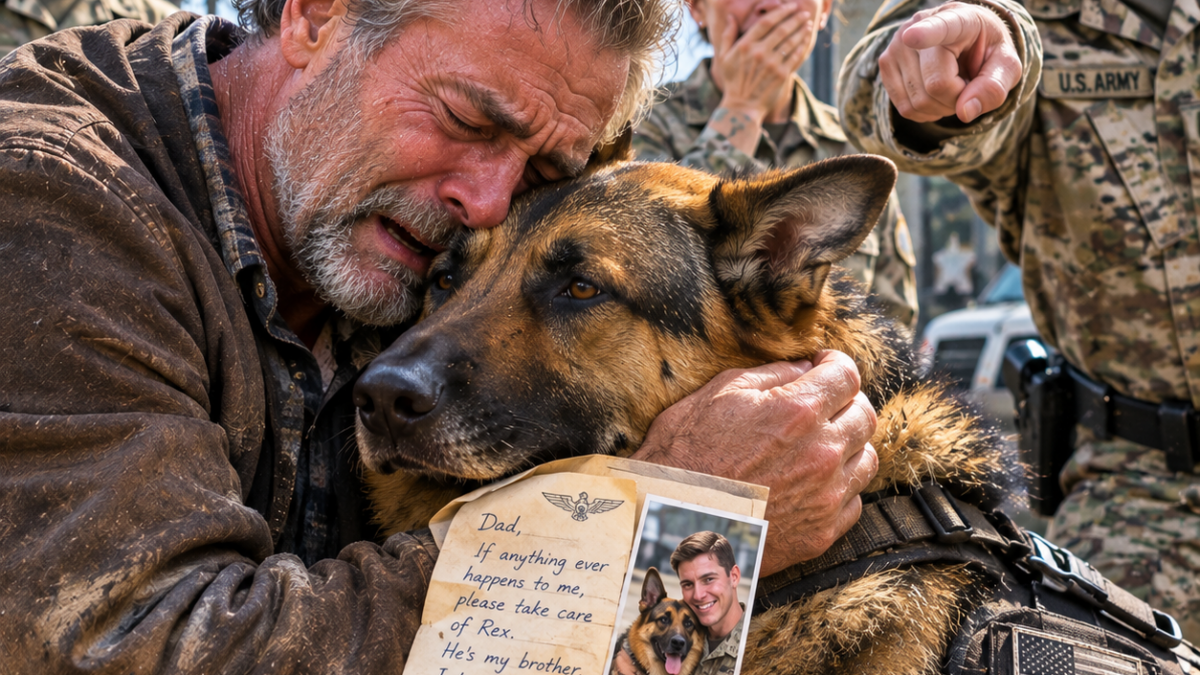
PART2
“Mr. Mitchell?”
The voice came from behind me.
I looked up.
A young soldier stood beside the grave.
Sergeant Aaron Brooks.
Twenty-seven, perhaps.
Tall.
Broad-shouldered.
His dress uniform immaculate.
His expression carefully controlled in the way young men sometimes arrange their faces when they are terrified of showing emotion in front of someone older.
“Yes?”
“Sir, I’m very sorry.”
I nodded.
He glanced at Ranger.
“I’m going to need to take him back.”
For a moment, I didn’t understand.
Then I looked at the leash.
The waiting military vehicle.
The open rear compartment prepared for the dog.
And suddenly something inside me tightened.
“Back where?”
“To the installation, sir.”
“Why?”
“He’s still an active-duty military working dog.”
I looked at Ranger.
The dog had not moved.
His muzzle rested on Daniel’s jacket.
The tip of his ear touched my wrist.
“He just buried his handler.”
Aaron swallowed.
“I understand, sir.”
“Do you?”
The words came out harsher than I intended.
The soldier looked down.
I closed my eyes.
“I’m sorry.”
He nodded.
“It’s okay.”
I looked toward the grave.
A fresh mound of earth.
Flowers.
The folded flag resting in Margaret’s lap several yards away.
Then back at Ranger.
“Can he stay a little longer?”
Aaron hesitated.
He looked toward the senior officer standing near the honor guard.
Then toward the dog.
“Five minutes, sir.”
I nodded.
“Thank you.”
He stepped back.
But Ranger knew something was happening.
The instant Aaron reached toward the leash again, the Malinois rose.
Not aggressively.
No growl.
No exposed teeth.
He simply moved closer to me and placed his front paws carefully beside my shoes.
His body became rigid.
His eyes fixed on Aaron.
The soldier gave a familiar command.
“Ranger. Heel.”
The dog didn’t move.
Aaron repeated it.
Softer.
“Come on, buddy.”
Nothing.
Another soldier approached.
Then another.
I heard someone whisper:
“He’s never done that.”
Aaron looked embarrassed.
I could see it.
Ranger had been trained to obey.
He’d worked around explosives, vehicles, aircraft, and gunfire.
He had followed Daniel through circumstances no ordinary dog should ever have to experience.
Now he wouldn’t follow a simple command across a cemetery.
I placed my palm against the side of his neck.
“Easy, boy.”
Immediately, his muscles relaxed.
Aaron stared.
Then looked at me.
“Sir, did Daniel teach you a command?”
I shook my head.
“No.”
“I just talked to him.”
Ranger leaned harder against my leg.
And I remembered something Daniel had said on a Sunday phone call almost a year earlier.
“Dad, that dog’s smarter than half the people I work with.”
I’d laughed.
“Careful, Danny. Somebody might hear you.”
He chuckled.
“Seriously, though. Ranger watches everything.”
“What do you mean?”
“He knows when I’m tired.”
“Knows when I’m upset.”
“Sometimes he figures out I’m having a bad day before I do.”
I could hear my own voice from that call.
“Sounds like your mother.”
Daniel laughed.
“Exactly.”
I looked down at Ranger now.
His eyes were wet.
Maybe from the wind.
Maybe from the cold.
Maybe I was imagining meaning because I desperately needed someone else to miss my son as much as I did.
But when the dog pressed his forehead against my hand, I knew one thing.
He was not ready to leave.
Neither was I.
My wife Margaret had barely spoken since the funeral began.
She sat beside Emily, our daughter, holding the folded American flag in both hands.
Her eyes looked empty.
Not because she didn’t feel anything.
Because she felt too much.
When military officers first came to our house, she had opened the door.
I was in the barn repairing a broken latch.
By the time I returned, two soldiers were standing in our living room.
Margaret sat in her favorite chair.
Her face was completely white.
I remember looking at the men and knowing before either said a word.
There are moments in life when your body understands a truth before your mind will allow it.
That was one.
One officer stood.
“Mr. Mitchell.”
I shook my head.
“No.”
He looked at me.
I stepped backward.
“No.”
Margaret whispered:
“Robert.”
I stared at her.
She was holding Daniel’s last birthday card.
The one she’d kept on the mantel.
Mom, thanks for teaching me that the toughest people are the ones who keep loving even when they’re afraid.
She pressed it against her chest.
The officer spoke.
I heard the words.
Staff Sergeant Daniel Mitchell.
Killed during an operation.
Enemy action.
We regret to inform you.
But the words didn’t fit together.
Not Daniel.
Not the boy who called on Sundays.
Not the child who slept with a baseball glove under his pillow.
Not the young man who had promised to come home before spring so he could help repair the old fence.
My son couldn’t be dead.
He had unfinished chores.
That was the terrible thought that went through my mind.
Absurd.
Cruel.
He still had things to do.
The barn door needed painting.
His mother had bought the ingredients for his favorite peach cobbler.
His old fishing rod was hanging in the garage.
He had promised to teach his niece how to cast.
People who have plans aren’t supposed to die.
But they do.
And when they do, the plans stay behind like broken furniture nobody knows where to put.
At the cemetery, Margaret finally looked toward Ranger.
Emily leaned beside her.
“Mom?”
Margaret didn’t answer.
She stared at the dog.
Then whispered:
“That’s Danny’s Ranger.”
Emily nodded.
“Yes.”
Margaret stood.
Unsteadily.
Our daughter supported her.
They walked toward us.
Ranger lifted his head.
Saw Margaret.
His ears moved.
Then he took one slow step toward her.
Margaret stopped.
Her hands trembled.
“Ranger?”
The dog’s tail moved once.
She covered her mouth.
“Oh, sweetheart.”
I watched the old woman I’d loved for forty-three years kneel in the damp grass.
The folded flag remained in Emily’s hands.
Margaret reached toward Ranger.
He approached.
Sniffed her fingers.
Then pressed his muzzle into her palms.
Margaret began crying.
Not the quiet tears she’d shed during the service.
These were deep, broken sobs that made her shoulders shake.
“He told me about you.”
She held Ranger’s face.
“Every Sunday.”
The dog stood still.
“He said you were brave.”
She stroked his ears.
“He said you were stubborn.”
A trembling laugh escaped her.
“Just like him.”
Ranger licked her hand.
Margaret closed her eyes.
Then whispered:
“Did he know we loved him?”
I looked away.
Because I couldn’t answer.
There was no answer that could make what had happened bearable.
But Ranger leaned closer.
His head rested against her shoulder.
And Margaret wrapped both arms around him as though the dog might hold together the part of her that had broken when the officers knocked.
That’s when Sergeant Brooks noticed the collar.
Aaron had spent nearly a year working with Daniel and Ranger’s unit.
He wasn’t Ranger’s regular handler.
He wasn’t qualified to pretend he could replace Daniel.
He was a fellow soldier who had accompanied the team on training and support missions.
Daniel trusted him.
I knew because his name had appeared in messages.
Brooks is getting married in June.
Tell Mom she was right about the boots—I bought the expensive ones.
Aaron says Ranger likes me better, but he’s delusional.
I remembered those jokes as Aaron crouched beside the dog.
“Sir?”
I looked up.
He was examining Ranger’s collar.
“What’s wrong?”
He frowned.
“There’s something here.”
The collar was dark brown tactical leather with reinforced stitching.
Worn along the edges.
A small metal tag bearing Ranger’s identification.
Inside, near the buckle, Aaron noticed a section of material thicker than the rest.
He touched it carefully.
Ranger turned his head.
Not aggressive.
Just alert.
Aaron looked toward me.
“Did Daniel ever mention modifying this?”
I shook my head.
“No.”
Aaron studied the stitching.
Then said:
“This isn’t standard.”
Another soldier stepped closer.
He was a staff sergeant named Luis Ortega.
He looked at the collar.
Then at Aaron.
“What is it?”
“There’s an extra layer.”
Luis leaned down.
“Could be a repair.”
Aaron shook his head.
“No.”
He moved his finger along the seam.
“It’s a pocket.”
I stared.
“A pocket?”
He nodded.
“Small.”
“Hidden under the inside lining.”
Margaret looked up.
Her cheeks wet.
“What would Danny keep in a dog’s collar?”
Nobody answered.
Aaron hesitated.
Then said:
“Sir, if this is personal property or a message Daniel left, we need to handle it carefully.”
I looked at the collar.
“Can you open it?”
He glanced toward the senior officer.
The officer approached.
Reviewed the unusual compartment.
Then authorized a careful inspection and documentation so that anything belonging to Daniel could be handled appropriately.
Aaron used a small tool to loosen the stitched flap without damaging the rest of the collar.
Inside was a thin waterproof packet.
Folded into a rectangle barely larger than a postage stamp.
My heart began pounding.
Aaron held it between two fingers.
“There’s paper inside.”
Margaret covered her mouth.
Emily gripped my shoulder.
I stared at the packet.
Then whispered:
“Daniel?”
Aaron carefully opened the protective sleeve.
Inside was a small sheet of paper.
Folded four times.
The edges softened from being carried.
But dry.
Intact.
He unfolded it.
And before anyone read a word, I recognized the handwriting.
My son’s handwriting.
The same slanted capital letters he’d used on birthday cards since he was twelve.
The same uneven R.
The same way he crossed his T too high.
I felt my knees weaken.
“Oh, God.”
Margaret reached for my arm.
“Robert?”
I couldn’t speak.
Aaron looked toward me.
Then at the letter.
“Mr. Mitchell.”
His voice shook.
“I think this is for you.”
I took the paper with both hands.
The wind lifted one corner.
My fingers trembled so badly I could barely hold it.
At the top, Daniel had written:
Mom and Dad,
Just those three words nearly brought me to my knees.
I had not seen my son’s handwriting since the morning we received the official notice of his death.
His last letter home was still sitting on Margaret’s bedside table.
Neither of us could bear to open it again.
Now there was another.
One he’d carried into danger.
One he’d hidden where he apparently believed somebody might someday find it.
I tried to read.
The letters blurred.
Margaret placed her hand against my back.
“Robert.”
I swallowed.
Then began aloud.
Mom and Dad,
If you’re reading this, it probably means I didn’t make it home. I know you’ll be angry that I’m writing something like that. Mom, I can already hear you telling me to stop being dramatic. Dad, I know you’ll say I should worry about getting home instead of planning for the worst.
I stopped.
A broken sound escaped Margaret.
I looked toward her.
She was crying.
But she nodded.
“Keep going.”
I took a breath.
I hope this letter stays hidden forever. I hope years from now I take it out myself and we all laugh at how serious I was being. But if that doesn’t happen, there is something I need you to know.
Ranger isn’t just a military dog to me. He’s my partner. He’s the one who stood beside me on nights when I was scared and too proud to say it. He’s the one who lay across my feet when I couldn’t sleep. He’s the one who trusted me every time I asked him to go somewhere dangerous.
My throat closed.
I looked down at Ranger.
He was sitting beside my shoes.
Watching.
Patient.
Still.
I continued.
I promised him something, even though I know he’s a dog and can’t understand all the words. I promised that if I ever had the power to decide where he spent his last years, he’d spend them somewhere warm, with people who love him for more than the work he can do.
I want that place to be our home.
Margaret gasped.
Emily began crying.
I held the paper tighter.
If I don’t make it back, please ask whether Ranger can be retired or transferred into a permanent home with our family through the proper process when he is eligible. I know he’s Army property and that decisions about working dogs aren’t mine alone. But I want you to try.
Dad, let him walk beside you when you go to the barn. He’ll probably try to herd the chickens, and you’ll complain that he’s making everything difficult. Mom, let him lie near your chair while you read. He likes hearing people talk, even when he pretends he’s sleeping.
I laughed.
A terrible, broken laugh.
Because I could hear Daniel saying it.
Could see him grinning.
Could imagine Ranger stealing the warmest spot in our living room.
Then I reached the line that destroyed what little composure I had left.
If Ranger comes home, a part of me will come home with him. Not because he’s a replacement for me. He isn’t. But because he carries the days we shared, the places we went, and all the times we made it through something together.
Please don’t spend the rest of your lives waiting for me at the window. Keep living. Keep laughing. Keep planting Mom’s flowers and fixing Dad’s fences. And if Ranger sits by the gate when the evening comes, sit with him for a while. He may be waiting for the same voice you are.
I couldn’t see.
The paper shook in my hands.
Margaret was sobbing openly now.
Emily had both arms around her.
The soldiers stood motionless.
Aaron wiped his face with the back of one hand.
I forced myself to read the final paragraph.
I love you both more than I ever learned how to say. I’m sorry for every Sunday I couldn’t call, every birthday I missed, and every time I told you not to worry when I knew you would anyway.
Take care of each other.
And please take care of my brother, Ranger.
Love always,
Danny
For a long time, nobody spoke.
The wind moved across the cemetery.
A flag shifted against its pole.
Somewhere in the distance, a car passed along the road.
Ordinary sounds.
A world continuing.
Even though mine had stopped.
I stared at the letter.
Then at Ranger.
The dog rose slowly.
Came forward.
And pressed his head against my chest.
I put one arm around him.
Then the other.
And held him with all the strength left in my body.
“Danny sent you home.”
My voice broke.
“He sent you home, boy.”
Ranger licked my wrist.
Then rested his head on my knee.
And every soldier standing there understood that the letter had changed what this moment meant.
The dog wasn’t merely refusing to leave a grave.
He was standing beside the people Daniel had loved most.
Exactly where Daniel hoped he might someday belong.
The letter did not automatically transfer Ranger to us.
I understood that later.
At the cemetery, grief made everything feel urgent and simple.
My son had written a wish.
The dog refused to leave.
Surely that should have been enough.
But Ranger was a military working dog.
A trained service animal with ongoing duties, medical needs, and specific rules governing retirement and adoption.
The officer who had come to escort him, Lieutenant Colonel Stephen Harris, approached quietly after we’d had time to absorb the letter.
He was in his late forties.
Gray near his temples.
A face that looked as though he’d delivered too much bad news in his career.
“Mr. Mitchell.”
I looked up.
He removed his cap.
“I want you to know something.”
I waited.
“Daniel’s letter is important.”
I nodded.
“But we need to follow the appropriate process for Ranger.”
My hands tightened around the paper.
“Are you taking him?”
Harris hesitated.
“For now, we have to maintain accountability and ensure he’s medically and behaviorally assessed.”
I looked down at the dog.
Ranger leaned against my leg.
“After everything he did?”
Harris’s expression changed.
“Sir, nobody here doubts what Ranger did.”
“Then why can’t he stay?”
“Because our responsibility includes making sure he’s safe and properly placed.”
I stared.
The words were reasonable.
I hated them anyway.
Margaret stepped forward.
“Colonel.”
“Yes, ma’am?”
“My son wrote that he wanted Ranger with us.”
Her voice shook.
“He knew the dog.”
“He loved him.”
“I understand.”
She looked toward the casket.
“Daniel asked us for one thing.”
Harris lowered his eyes.
“I hear you.”
For a moment, I thought Margaret might collapse.
Instead, she straightened.
The woman I’d married forty-three years earlier.
The woman who had survived losing her parents, raising two children, working night shifts, and watching our son deploy again and again.
She looked the lieutenant colonel directly in the eye.
“Then please help us do it properly.”
Harris nodded.
“Yes, ma’am.”
“I will.”
It wasn’t a promise that Ranger would immediately become ours.
It was a promise that our son’s request would not simply disappear inside a file.
And that was what we needed.
A beginning.
When the time came to leave the cemetery, Ranger resisted again.
Aaron approached with the leash.
“Come on, buddy.”
Ranger moved behind my chair.
Pressed against my knees.
Whined.
I looked toward Harris.
He gave a small nod.
I turned to Ranger.
“Hey.”
The dog raised his head.
I swallowed.
“Danny would want you to be good.”
His ears moved.
“You need to go with Aaron for now.”
The words hurt.
More than I expected.
Because I was asking the dog to leave just when he had finally found something familiar.
But I couldn’t let grief turn the moment into a struggle.
I took a breath.
Then whispered:
“We’re going to try to bring you home.”
Ranger stared at me.
I touched his forehead.
“I promise we’ll try.”
He sniffed my hand.
Then looked toward Aaron.
The young soldier held out the leash.
“Ranger.”
A pause.
“Come.”
The dog took one reluctant step.
Then another.
He stopped once.
Turned toward me.
And whined.
I raised the letter.
“Go on, boy.”
He followed Aaron toward the vehicle.
Slowly.
The rear door opened.
Ranger climbed inside.
Then turned and looked out.
I stood beside my son’s grave until the vehicle disappeared beyond the cemetery gate.
Margaret came to stand beside me.
She slipped her hand into mine.
For a long time, neither of us spoke.
Then she whispered:
“Robert?”
“Yes?”
“We’re bringing that dog home.”
I looked at her.
There was no anger in her voice.
No demand.
Only determination.
I nodded.
“Yes.”
“We are.”
That evening, the house felt unbearable.
We came home from the funeral carrying a flag, a folded uniform, boxes of personal effects, and a letter that smelled faintly of leather and desert dust.
Margaret placed the flag on the mantel.
Then sat down.
She did not take off her black coat.
Didn’t remove her shoes.
Just sat in the chair where she usually waited for Daniel’s Sunday calls.
I stood in the doorway.
Watching.
Emily was in the kitchen preparing tea.
Her daughter, eight-year-old Sophie, sat quietly at the table coloring a picture.
Sophie had loved her Uncle Danny.
He taught her how to tie fishing knots.
Sent postcards from every place he could.
Called her “Captain Trouble.”
At the funeral, she’d asked why Uncle Danny had a flag on his box.
Emily explained as gently as she could.
Sophie had nodded.
Then asked:
“Can he still hear us?”
No one knew what to say.
Now she sat drawing a dog.
A brown dog with enormous ears.
I looked at the picture.
“Who’s that, sweetheart?”
“Ranger.”
I sat beside her.
She pointed at the dog.
“Mom says he was Uncle Danny’s best friend.”
I swallowed.
“Yes.”
“Is he sad?”
I looked toward the living room.
Margaret hadn’t moved.
“Yes.”
“I think so.”
Sophie considered.
Then asked:
“Do dogs cry?”
I thought of Ranger’s whining beside the grave.
The way he pressed his head against Daniel’s uniform.
“Sometimes they show sadness differently.”
She nodded.
Then held up the picture.
“I drew him at Grandma’s house.”
I stared.
The drawing showed our farmhouse.
The barn.
A little gate.
And Ranger sitting beside an old man with gray hair.
Me.
I smiled through tears.
“That’s beautiful.”
She looked pleased.
Then:
“Can I give it to him when he comes home?”
My throat tightened.
I didn’t want to promise a child something we couldn’t control.
So I said:
“If we’re allowed to bring him here, he’ll have a place for it.”
Sophie nodded seriously.
“Good.”
Then she returned to coloring.
Children have a way of moving toward hope even when adults are still trapped inside grief.
I watched her draw.
And wished, desperately, that Daniel could see her.
That night, I carried my son’s uniform upstairs.
His childhood bedroom had become a guest room years earlier.
But some things remained.
A baseball trophy.
A photograph of his high school football team.
A small wooden airplane he’d built when he was eleven.
A faded poster of the mountains.
I opened the closet.
Hung the uniform inside.
Then stood staring at it.
The sleeves hung empty.
The collar curved around nothing.
A garment designed to fit a living body now hanging like a shape of absence.
I touched the name tape.
MITCHELL.
I pressed my fingers against the letters.
Then sat on the edge of the bed.
The room was silent.
I hadn’t cried in front of my children when they were young.
Not because I believed fathers weren’t supposed to cry.
Because I thought strength meant staying steady when they were afraid.
When Daniel was thirteen, he asked why I never cried.
I told him:
“Somebody has to be the strong one.”
He looked at me.
Then said:
“Mom cries and she’s stronger than you.”
I’d laughed.
He was right.
Now I sat on his bed.
Holding his uniform sleeve.
And cried until my chest hurt.
There was no one to be strong for.
Not at that moment.
Only a father who wanted his son.
Two days later, Lieutenant Colonel Harris called.
I answered before the second ring.
“Mr. Mitchell?”
“Yes.”
“This is Stephen Harris.”
My heart accelerated.
“Ranger?”
“He’s safe.”
I closed my eyes.
“Thank you.”
“He’s undergoing evaluation.”
“How is he?”
Harris paused.
“He’s eating.”
“Resting.”
“He’s physically recovering well.”
I waited.
“Emotionally, he’s having some difficulty adjusting.”
I looked toward the photograph on the mantel.
Ranger beside Daniel.
Both covered in dust.
My son grinning.
“Does he look for Danny?”
Harris didn’t answer immediately.
Then:
“He responds strongly to familiar equipment and scents associated with his handler.”
I swallowed.
“Of course he does.”
Harris continued.
“We’ve begun reviewing his suitability for retirement.”
I straightened.
“Already?”
“Yes.”
“There are medical and operational considerations.”
“The veterinary team and command will make the determination through the proper channels.”
“Is the letter helping?”
“It has been included as part of the relevant request and family information.”
I closed my eyes.
“Thank you.”
Harris paused.
Then said something I hadn’t expected.
“Mr. Mitchell.”
“Yes?”
“I knew your son.”
I sat down.
He continued.
“Not as well as his teammates did.”
“But well enough.”
I waited.
“Daniel was a good soldier.”
“More importantly, he was a good man.”
My throat tightened.
“Thank you.”
Harris’s voice softened.
“He talked about you.”
I couldn’t speak.
“He said his father taught him never to ask someone else to do a job he wasn’t willing to do himself.”
I looked toward the window.
The old barn.
The fence Daniel had promised to repair.
I laughed through tears.
“That sounds like him.”
Harris continued.
“And he talked about your wife.”
“What did he say?”
“That she could make a full meal out of almost nothing.”
I smiled.
“True.”
“And that no matter how far away he went, he could always tell when she was worried.”
I covered my eyes.
For a moment, I could hear Daniel on the phone.
“Mom, I know you’re worried.”
“Danny, of course I am.”
“I know.”
“Call when you can.”
“I will.”
And now there would be no more calls.
Harris let the silence remain.
Then said:
“We’ll keep you updated about Ranger.”
I nodded.
“Thank you.”
When I hung up, I sat with the phone in my hand.
For the first time since the funeral, I had heard someone tell me something new about my son.
Not about how he died.
About how he lived.
I didn’t realize how badly I needed that.
Three weeks later, Aaron Brooks came to our house.
Not in dress uniform.
Jeans.
A dark jacket.
Boots with mud on them.
He stood on the porch holding a small cardboard box.
I opened the door.
“Aaron.”
“Mr. Mitchell.”
“Come in.”
He hesitated.
Then stepped inside.
Margaret appeared from the kitchen.
The moment she saw him, her expression softened.
“You’re Aaron.”
He nodded.
“Yes, ma’am.”
She crossed the room and hugged him.
The young soldier froze for half a second.
Then hugged her back.
His shoulders began shaking.
I looked away.
We sat at the kitchen table.
Margaret made coffee.
Put out cookies.
Aaron stared at them.
Then whispered:
“Daniel used to talk about these.”
Margaret looked up.
“What?”
“Your oatmeal cookies.”
She smiled through tears.
“He said you made them every Christmas.”
“I do.”
“He said the ones you mailed overseas never lasted more than an hour.”
Margaret laughed.
A small, fragile sound.
“I mailed enough for everybody.”
Aaron nodded.
“We know.”
He took a cookie.
Bit into it.
Then covered his eyes.
For a moment, I thought something was wrong.
He shook his head.
“Sorry.”
Margaret reached across the table.
“Don’t be.”
Aaron swallowed.
“Just tastes like something he talked about.”
We sat quietly.
Then he opened the cardboard box.
Inside were photographs.
A worn baseball cap.
A small metal challenge coin.
A folded piece of paper with a sketch of a dog.
And a notebook.
“These were some personal items recovered later and cleared for return.”
I looked at the notebook.
“Danny’s?”
Aaron nodded.
“He kept notes.”
“Training.”
“Schedules.”
“Things he didn’t want to forget.”
I opened it.
Inside were pages of careful handwriting.
Dates.
Equipment lists.
Short reminders.
Then one sentence near the back:
Call Dad. Ask about the tractor.
I stared.
The tractor.
Our old John Deere had been giving me trouble for months.
Daniel used to call and ask whether I’d finally admitted it needed a new starter.
I’d tell him it was fine.
He’d laugh.
“Dad, that tractor is older than I am.”
I’d answer:
“And it’s still more reliable than you.”
He’d pretend to be offended.
Now the reminder sat on a page he would never use.
I pressed my hand against it.
Aaron looked down.
Then said:
“Sir, there’s something I want you to know.”
I looked up.
He hesitated.
Then continued.
“Daniel was scared sometimes.”
I stared.
“I know that sounds strange.”
“No.”
I shook my head.
“Not strange.”
Aaron looked relieved.
“He didn’t talk about it much.”
“But I knew.”
I waited.
“Ranger knew too.”
He smiled sadly.
“Some nights Daniel would sit beside him after a long day.”
“Wouldn’t say anything.”
“Just put his hand on the dog’s back.”
Aaron looked toward the window.
“And Ranger would stay awake until Daniel fell asleep.”
My throat closed.
Margaret wiped her eyes.
Aaron continued.
“When things were bad, your son never acted like he was too important to help somebody.”
“He’d carry gear.”
“Clean equipment.”
“Check on the youngest soldiers.”
“Make sure the dogs had water before he ate.”
A tear ran down his face.
“I wanted you to know that.”
I nodded.
Unable to speak.
Then Aaron whispered:
“He was brave.”
I looked at him.
“Was he afraid when he died?”
The question escaped before I could stop it.
Aaron froze.
Margaret’s hand went to her mouth.
I knew I shouldn’t have asked.
But it had been inside me since the officers came to our door.
Every night, the same thought.
Was my boy afraid?
Did he know?
Did he call for us?
Did he hurt?
Did he feel alone?
Aaron looked at his hands.
For a long time, he didn’t answer.
Then he said:
“Mr. Mitchell, I wasn’t in the exact position where Daniel was when the explosion happened.”
I nodded.
“I know.”
“I can’t tell you what he felt.”
I closed my eyes.
Aaron continued.
“But I can tell you he was doing his job.”
“He was with people who trusted him.”
“And Ranger was with him.”
I swallowed.
“Was Ranger hurt?”
“A shoulder injury.”
“Some other trauma.”
“He survived.”
I looked toward the notebook.
Then whispered:
“Thank God.”
Aaron nodded.
“We all said the same thing.”
After Aaron left, Margaret sat at the kitchen table holding the notebook.
She turned the pages slowly.
Stopped at little reminders.
A grocery list.
Names.
A phone number.
A doodle of Ranger wearing a ridiculous crown.
She laughed through tears.
“Look.”
I leaned closer.
Under the drawing, Daniel had written:
KING RANGER — DEMANDS CHICKEN, ACCEPTS BEEF.
I laughed.
The first real laugh I’d managed since the funeral.
Then Margaret looked at me.
And we both started crying.
Because laughter can hurt when the person who caused it is gone.
It reminds you of all the laughter you’ll never hear again.
But it also reminds you that joy existed.
That he was more than a casualty notification.
More than a folded flag.
More than a name carved into stone.
He was Daniel.
A boy who drew crowns on dogs.
Who argued with his father about a tractor.
Who mailed silly photographs from overseas.
Who loved oatmeal cookies.
Who had been frightened sometimes and did his job anyway.
I looked at the notebook.
Then at his letter.
And realized something.
The military had returned his belongings.
But the soldiers were returning pieces of the man.
And those pieces mattered more than anything we could have bought.
The formal adoption process took time.
Ranger’s medical assessment identified injuries and stress responses that required care.
The unit evaluated whether he could safely continue service.
His performance had changed after Daniel’s death.
He remained well trained.
But the bond between a military working dog and an experienced handler is not something that can always be replaced immediately.
A new pairing requires evaluation.
Trust.
Suitability.
Ranger was no longer a young animal.
He had served years in demanding environments.
And the veterinary and command teams eventually concluded that retirement was appropriate.
Even then, there were steps.
Applications.
Background information.
Home suitability.
Veterinary plans.
Assessment of our physical ability to care for a strong dog.
At seventy-two, I wasn’t as steady on my feet as I once had been.
My right knee had been replaced.
My left shoulder ached in cold weather.
Margaret had arthritis in both hands.
We couldn’t simply say we loved Ranger and ignore his needs.
So Emily helped.
She researched training support.
Prepared a practical care plan.
Found a local veterinarian experienced with retired working dogs.
Arranged for a fenced area behind the farmhouse to be inspected and improved.
We made sure Ranger would have a quiet place to retreat if he felt overwhelmed.
We arranged continuing behavioral support.
And we promised ourselves we wouldn’t expect him to become a substitute for Daniel.
He was a dog who had served beside our son.
A living being with his own needs.
His own fear.
His own future.
We would care for him because we loved him.
Not because he could repair our grief.
Then one morning, Lieutenant Colonel Harris called again.
I was in the barn.
Trying to start the tractor.
The engine clicked.
Nothing else.
Of course.
Daniel would’ve laughed.
My phone vibrated.
I wiped my hands.
Answered.
“Robert Mitchell.”
“Mr. Mitchell, Stephen Harris.”
I straightened.
“Colonel.”
“How are you?”
I looked at the tractor.
“Losing an argument with machinery.”
He laughed softly.
“Daniel warned me about that.”
My throat tightened.
Then Harris became serious.
“Sir, I have news about Ranger.”
I stopped breathing.
“What news?”
“The retirement determination has been approved.”
I gripped the workbench.
“And?”
“Your family has been approved to adopt him under the applicable process.”
For a moment, I couldn’t move.
The barn seemed to tilt.
I placed one hand against the wall.
“Mr. Mitchell?”
I swallowed.
“Say that again.”
Harris’s voice softened.
“Ranger can come home.”
I closed my eyes.
The words moved through me like warmth after a winter that had lasted too long.
“Thank you.”
My voice broke.
“Thank you so much.”
Harris paused.
“Your son made a request.”
“Your family followed the process.”
“And Ranger has a place where he can retire safely.”
I leaned against the workbench.
Then whispered:
“When?”
“We can arrange the transition next week.”
I laughed.
Then cried.
Then laughed again.
Harris waited.
When I finally found my voice, I said:
“Colonel?”
“Yes?”
“I think this is the first good news we’ve had since Daniel died.”
There was a long silence.
Then Harris replied:
“I hope it won’t be the last, sir.”
We spent the next week preparing.
Margaret washed blankets.
Then washed them again.
Emily brought a sturdy dog bed.
Sophie made a sign for the front door.
WELCOME HOME, RANGER!
She decorated it with paw prints and stars.
I repaired the fence beside the orchard.
Installed a secure gate.
Checked every latch.
Set up a water station.
Placed non-slip mats in the hallway.
And moved Daniel’s old boots from the closet into a small wooden chest.
I wanted Ranger to smell something familiar when he arrived.
Not because I expected the boots to cure his grief.
Because I wanted his first moments in our home to feel safe.
Margaret watched me polish the old boots.
“You’ve been working on those for an hour.”
I nodded.
“They’re still dusty.”
She sat beside me.
“Robert.”
I looked up.
“You don’t have to make everything perfect.”
I stared at the leather.
“I know.”
She smiled sadly.
“No, you don’t.”
I put down the cloth.
She took my hand.
“Danny never cared whether the house was perfect.”
“He cared that it was ours.”
I looked around.
The kitchen.
The old clock.
The photographs.
The window overlooking the barn.
Margaret squeezed my hand.
“Ranger doesn’t need a perfect house.”
“He needs a home.”
I nodded.
Then looked down at the boots.
“Danny would’ve wanted me to fix the fence anyway.”
She laughed softly.
“Yes.”
“He would’ve.”
The day Ranger came home, the sun was shining.
That detail mattered to me.
Not because I believed the weather meant something supernatural.
Because the day we buried Daniel had been gray.
And now, for the first time since the funeral, the sky looked open.
A military vehicle pulled into our driveway shortly after ten.
I was standing beside the porch.
Margaret held Daniel’s letter in her hands.
Emily and Sophie waited near the front door.
Lieutenant Colonel Harris stepped out.
Then Aaron.
Then a veterinary team representative who had helped coordinate Ranger’s transition.
Aaron opened the rear compartment.
Ranger stood inside.
He looked toward the house.
His ears rose.
His nose moved.
Then he saw me.
I took one step forward.
“Hey, buddy.”
His tail moved.
Aaron gave a quiet cue.
Ranger climbed down.
Stood on the driveway.
Looked around.
Then came toward me.
Not running wildly.
Not dragging the leash.
Just walking steadily.
As though he had been expected.
I knelt.
My bad knee complained.
I ignored it.
Ranger reached me.
Pressed his forehead against mine.
And let out a long breath.
I wrapped my arms around him.
“Welcome home, son.”
Behind me, Margaret began crying.
Ranger lifted his head.
Looked toward her.
Then moved closer.
She knelt.
He pressed against her shoulder.
And the three of us stayed there in the sunlight.
A father.
A mother.
And the dog their son had asked them to love.
Aaron stood nearby.
His eyes shone.
Harris removed his cap.
For a moment, nobody spoke.
Then Sophie came forward holding the drawing she’d made after the funeral.
“Ranger?”
The dog turned.
She held up the picture.
“Uncle Danny wanted you to live here.”
Ranger sniffed the paper.
Then her hand.
She looked up at me.
“Grandpa?”
“Yes, sweetheart?”
“Do you think he knows?”
I looked toward the sky.
Then at the dog.
I couldn’t tell her what Daniel knew or didn’t know.
But I could tell her something true.
“He knew how much we would love Ranger.”
Sophie smiled.
Then touched the dog’s shoulder.
“Good.”
Ranger’s first night was difficult.
People later imagined that bringing him home solved everything.
That he walked into the house, recognized Daniel’s smell, and instantly became a happy family pet.
It didn’t happen that way.
He explored carefully.
Sniffed corners.
Watched doors.
Startled at a metal pan falling in the kitchen.
Refused his dinner until the house grew quiet.
He didn’t want to sleep in the dog bed we’d purchased.
He chose a spot near the front hallway where he could see the entrance.
At midnight, I found him sitting there.
Head raised.
Ears turned toward the road.
I stood in the doorway.
“Ranger?”
He looked at me.
Then back toward the front door.
I sat on the floor.
Slowly.
My knee ached.
The tiles were cold.
I didn’t care.
“You waiting for him?”
Ranger lowered his head.
I looked toward Daniel’s photograph hanging above the small entry table.
My son in uniform.
Ranger beside him.
Both looking toward the camera.
I swallowed.
“Me too.”
The dog came closer.
Sat beside me.
I scratched behind his ears.
For a long time, we remained there.
No talking.
No instructions.
Just breathing.
Then I whispered:
“You know, buddy, I don’t think either of us understands what we’re supposed to do now.”
Ranger rested his head against my leg.
I smiled sadly.
“Guess we’ll figure it out together.”
The first Sunday was the worst.
For years, Daniel called around seven in the evening when his schedule allowed.
Not always exactly.
Sometimes earlier.
Sometimes later.
But Margaret began watching the clock around six-thirty.
She’d make tea.
Sit in her favorite chair.
Place the phone beside her.
Pretend she wasn’t waiting.
I knew.
She knew I knew.
We never said anything.
After the funeral, she kept doing it.
The clock would reach seven.
She’d look at the phone.
Then remember.
Sometimes she’d cry.
Other times she’d simply sit very still.
Ranger arrived on a Wednesday.
That first Sunday, Margaret sat in her chair at six-forty-five.
I watched from the kitchen.
Didn’t interfere.
At seven, the phone remained silent.
Margaret looked down.
Then whispered:
“Danny.”
Ranger lifted his head from the rug.
His ears rose.
He walked toward the chair.
Stopped.
Looked at her.
Then lay at her feet.
Margaret stared.
For a moment, she couldn’t move.
Then she reached down.
Touched his head.
And began crying.
I stood in the doorway.
My chest aching.
The dog remained.
He didn’t know what Sunday meant.
Not the way we did.
But he recognized the sound of Margaret’s distress.
The change in her voice.
The way her body tightened.
And he chose to stay near her.
That was enough.
After a while, she looked up at me.
“Robert?”
“Yes?”
“Come sit.”
I joined them.
She took my hand.
Ranger lay between our chairs.
The clock ticked.
Seven-ten.
Seven-twenty.
Seven-thirty.
No call.
But we were no longer waiting alone.
Over the following weeks, Ranger developed routines.
He followed me to the barn.
Stood near the fence while I repaired posts.
Watched the chickens with intense interest.
The first time one of them darted across the yard, he instinctively moved after it.
I gave the recall cue we’d practiced with the transition team.
He stopped.
Returned.
Sat.
I laughed.
“Danny wasn’t kidding about you herding the chickens.”
Ranger’s ears lifted.
I scratched his head.
“You’re going to make this place interesting.”
He also developed a habit of sitting beside the front gate in the evening.
Usually around the time Daniel used to call.
Some days he’d look toward the road.
Other days he’d simply lie in the shade.
At first, the sight broke my heart.
I imagined him waiting for a truck.
A familiar voice.
A man in uniform stepping through the gate.
But our veterinary behavior specialist reminded us to be careful about assigning human explanations to every action.
Dogs respond to routines.
Sounds.
Smells.
Times of day.
Places that feel safe.
We couldn’t know exactly what Ranger expected.
So we gave him consistency.
Gentle exercise.
Predictable meals.
Rest.
Companionship.
And plenty of time to be a dog.
That was important.
Daniel loved Ranger because he was more than a machine trained to work.
We owed him the same respect.
Margaret changed slowly.
Not all at once.
Grief doesn’t disappear because a dog comes to live in the house.
There were days she stayed in bed.
Days she couldn’t walk past Daniel’s photographs.
Days she cried because a shirt in the laundry smelled vaguely like the soap he used.
But there were also mornings when she came downstairs because Ranger needed breakfast.
Afternoons when she went outside because he wanted to walk.
Evenings when she sat on the porch instead of remaining in the dark bedroom.
Those small changes mattered.
One morning, I found her in the kitchen baking oatmeal cookies.
I stopped in the doorway.
For weeks, she hadn’t baked anything.
The kitchen had been quiet.
Now flour covered the counter.
Butter softened in a bowl.
The smell of cinnamon filled the room.
I stared.
“Margaret?”
She looked up.
“Don’t start.”
I smiled faintly.
“Start what?”
“Looking at me like I’ve done something extraordinary.”
I walked closer.
“What are you making?”
She raised one eyebrow.
“Cookies, Robert.”
“I can see that.”
“Then why ask?”
I laughed.
She smiled.
Then the smile faded.
“I used to make these for Danny.”
My throat tightened.
“I know.”
She looked down.
“I couldn’t stand the thought of making them again.”
I stepped beside her.
She wiped her cheek.
“Then this morning, Ranger followed me into the kitchen.”
“He sat near the oven.”
“Just watched.”
She laughed softly.
“I thought, well, if that dog is going to stare at me like I’m late with dinner, I might as well bake something.”
I placed an arm around her.
She leaned into me.
Then whispered:
“I miss our boy.”
“I know.”
“Every minute.”
“Me too.”
We stood there.
The oven warming.
Ranger lying near the doorway.
And the smell of Daniel’s childhood filling our home.
For the first time since the funeral, it didn’t feel only painful.
It felt like memory.
Still sharp.
Still sad.
But alive.
The letter from Ranger’s collar stayed in a frame on our mantel.
Not behind glass at first.
We were afraid to damage it.
Eventually, Emily helped us create a properly protected display using a high-quality copy while keeping the original safely stored.
Beside it sat Daniel’s photograph.
His challenge coin.
And a small brass tag from Ranger’s retired collar.
Sometimes visitors asked to read the letter.
We let them.
When we felt ready.
I watched people’s expressions change as they reached the line:
If Ranger comes home, a part of me will come home with him.
Some cried.
Some simply became quiet.
A few hugged us.
Others didn’t know what to say.
We learned not to expect perfect words.
People want to help.
But grief often makes language feel too small.
A casserole helps.
A repaired fence helps.
A neighbor sitting beside you without needing conversation helps.
The best things weren’t speeches.
They were presence.
That’s what Ranger had been giving us from the day of the funeral.
Presence.
No explanation.
No promise to fix what couldn’t be fixed.
Just staying.
Aaron Brooks visited again in spring.
This time he brought his wife, Olivia.
They were expecting their first child.
Margaret hugged them both.
Made too much food.
Asked too many questions.
Insisted Olivia sit while everyone else carried dishes.
Aaron laughed.
“Mrs. Mitchell, you’re exactly how Daniel described you.”
She smiled.
“Good.”
Then:
“Did he tell you I was bossy?”
“Repeatedly.”
I laughed.
Margaret pretended to be offended.
Later, Aaron went outside with me.
Ranger trotted beside us.
The grass was green again.
The orchard beginning to bloom.
We walked toward the fence.
Aaron watched the dog.
“He looks good.”
I nodded.
“He’s doing better.”
“He’s put on weight.”
“Yes.”
“Sleeping?”
“Most nights.”
Aaron smiled.
Then became quiet.
I looked at him.
“What is it?”
He stared toward the hills.
“I still think about that day.”
I swallowed.
“Me too.”
He looked down.
“Sometimes I wonder why Daniel didn’t make it and Ranger did.”
The question hung between us.
I couldn’t answer.
No one could.
Aaron continued.
“I know it’s stupid.”
“No.”
I said.
“It’s not.”
He wiped his face.
“I keep thinking there must’ve been something I could’ve done.”
I stopped walking.
“Aaron.”
He looked at me.
“You cared about my son?”
He nodded.
“Yes, sir.”
“You did your job?”
He swallowed.
“I tried.”
I placed one hand on his shoulder.
“Then don’t spend the rest of your life punishing yourself for surviving.”
He started crying.
I pulled him into an embrace.
He held on.
Like a boy.
Not a soldier.
Not a trained professional.
Just a young man who had lost someone he loved.
Ranger stood beside us.
Watching.
Then leaned against Aaron’s leg.
Aaron laughed through tears.
“Look at him.”
I smiled.
“He’s got room for both of us.”
The birth of Aaron’s daughter became one of the first joyful events our family could celebrate without feeling as though joy itself was betrayal.
They named her Lily.
Margaret knitted a blanket.
Emily brought meals.
I built a small wooden toy chest.
When Aaron sent the first photograph, I stared at the baby.
Tiny face.
Closed eyes.
One little fist near her cheek.
Then I looked at Daniel’s photograph above the mantel.
He would have loved this.
He would have joked about Aaron becoming a father.
Would have brought a ridiculous gift.
Would have told Olivia not to let Aaron teach the baby Army language.
I felt the familiar ache.
Then smiled.
Because Lily was alive.
Growing.
A new person entering a world that had taken our son.
And for the first time, I understood something Daniel had written in his letter.
Keep living.
Not forgetting.
Not pretending.
Living.
That was harder than dying of grief in small pieces.
But it was what our son had asked.
One evening, Emily brought Sophie to stay overnight.
Sophie was nine now.
She loved Ranger.
The dog tolerated her endless questions with patient dignity.
She knew not to pull his ears.
Not to climb on him.
Not to disturb him when he was resting.
She had learned to let him approach on his own terms.
That night, she sat beside me on the porch.
Ranger lay between us.
The sky turned orange over the fields.
Sophie looked toward the road.
Then asked:
“Grandpa?”
“Yes, sweetheart?”
“Does Ranger know Uncle Danny died?”
I stared.
The question was so simple.
So difficult.
I thought carefully.
“Ranger knows Danny isn’t here.”
She nodded.
“Does he miss him?”
“I believe he does.”
She stroked the dog’s shoulder.
“Can dogs love people that much?”
I smiled sadly.
“Yes.”
She considered.
Then:
“Will he forget Uncle Danny if he loves us too?”
My throat tightened.
I looked at Ranger.
Then at my granddaughter.
“No.”
I said.
“I don’t think love works that way.”
She tilted her head.
“What do you mean?”
I smiled.
“When somebody new comes into your heart, they don’t have to push somebody else out.”
Sophie thought about that.
Then looked at the dog.
“So Ranger can love Uncle Danny and us?”
“Yes.”
“And we can love Ranger without being less sad about Uncle Danny?”
I swallowed.
“Yes.”
She smiled.
“Good.”
Then leaned against me.
Ranger rested his head on her shoe.
We sat quietly.
And I thought:
A nine-year-old had just understood something that had taken me months to accept.
Love doesn’t replace what was lost.
It makes room beside the loss.
The anniversary of Daniel’s death came in autumn.
I dreaded it for weeks.
Every morning I woke counting backward.
Twenty days.
Fourteen.
Ten.
I kept thinking about the last call.
The last text.
The last photograph.
The last time I heard Daniel say:
“Love you, Dad.”
He had called on a Sunday.
I was in the barn.
The tractor had stalled again.
I answered with greasy hands.
“Danny.”
“Hey, old man.”
“Careful.”
He laughed.
“How’s the tractor?”
“Fine.”
“Liar.”
I smiled.
“Your mother’s in the kitchen.”
“I called to talk to you.”
That surprised me.
“What’s wrong?”
“Nothing.”
He hesitated.
Then asked:
“Dad, do you ever wish I’d chosen something else?”
I stopped working.
“What?”
“Than the Army.”
I leaned against the tractor.
“Why?”
“Just wondering.”
I thought about his years of service.
The deployments.
The danger.
The missed holidays.
Then I told him the truth.
“Sometimes I wish your job didn’t scare your mother so much.”
He laughed softly.
“Yeah.”
“But I never wished you were somebody different.”
Silence.
Then:
“Thanks, Dad.”
I swallowed.
“Listen, Danny.”
“Yeah?”
“I’m proud of you.”
He laughed.
“You don’t have to get sentimental.”
“Too late.”
He was quiet.
Then said:
“Love you, Dad.”
“Love you too, son.”
That was the last time.
I didn’t know it then.
No one ever knows.
We end ordinary conversations assuming there will be another.
Another chance.
Another Sunday.
Another joke.
Another call.
Then one day, there isn’t.
On the anniversary, we went to the cemetery.
Margaret.
Emily.
Sophie.
Aaron.
Olivia.
Little Lily.
And Ranger.
The cemetery was quiet.
The air cool.
Leaves moving across the grass.
I carried a small bouquet of wildflowers.
Daniel hated expensive arrangements.
He used to say:
“Dad, if somebody wants to honor me, tell them to plant something that grows.”
So we brought flowers from Margaret’s garden.
The ones she’d grown herself.
We stood beside the headstone.
STAFF SERGEANT DANIEL JAMES MITCHELL
Below his name were the dates.
The dates I still struggled to look at.
The day he was born.
The day he died.
Everything between compressed into one line of stone.
Ranger approached slowly.
Sniffed the ground.
Then sat beside the grave.
Not as though he understood the inscription.
But because we’d stopped there, and he settled near us.
Margaret reached down.
Touched his head.
Then looked at the headstone.
“Hi, Danny.”
Her voice broke.
“We brought your boy.”
I closed my eyes.
Emily began crying.
Sophie placed a drawing beside the flowers.
It showed Ranger sleeping on our porch.
Underneath, she’d written:
HE’S HOME, UNCLE DANNY.
I stared at it.
Then knelt.
Placed one hand on the stone.
“Hey, son.”
The wind moved through the trees.
“I fixed the fence.”
A laugh escaped me.
“Not because I wanted to.”
“Your dog’s got opinions about chickens.”
Margaret laughed through tears.
I continued.
“Your mother still bakes too much.”
“Emily’s doing good.”
“Sophie’s getting taller.”
“Aaron’s got a baby girl.”
I swallowed.
“And Ranger…”
I looked at the dog.
“He’s home.”
For a long moment, I couldn’t speak.
Then I whispered:
“We did what you asked.”
The words broke me.
Because that was all we’d wanted.
One thing we could still do for our son.
One promise we could keep after every other future had been taken.
I rested my forehead against the cool stone.
Then cried.
Ranger moved closer.
Pressed against my shoulder.
And for the second time at that grave, the dog stayed beside me while I fell apart.
As the years passed, Ranger grew older.
His muzzle turned gray.
The scar on his shoulder faded beneath thicker fur.
His steps slowed.
He needed more rest.
We adjusted.
Shorter walks.
Gentle exercise.
Veterinary care.
Quiet evenings.
He no longer followed me through every part of the farm.
Sometimes he preferred the shade beside the porch.
That was fine.
Daniel hadn’t asked us to keep Ranger working.
He asked us to give him a home.
We did.
The dog spent winter afternoons near the fireplace.
Summer mornings beneath the maple tree.
He slept beside Margaret’s chair.
Followed Sophie when she visited.
And occasionally sat near the gate at sunset.
That habit never completely left him.
Sometimes I watched from the porch.
The old Malinois looking toward the road.
And felt the ache again.
But I stopped imagining that he was trapped forever in waiting.
Ranger came inside when called.
Ate dinner.
Rested.
Played gently.
Let us love him.
He was living.
And so were we.
One December evening, Margaret found me in Daniel’s old room.
I was sitting on the bed holding the letter.
The original lay in its protective sleeve.
I hadn’t read it in weeks.
Then something about the weather brought me back.
Margaret stood in the doorway.
“Robert?”
I looked up.
“Hey.”
She came inside.
Sat beside me.
For a while, we said nothing.
Then she looked at the letter.
“Still hurts?”
I laughed softly.
“Every word.”
She nodded.
“Me too.”
I stared at the handwriting.
Then said:
“Sometimes I feel guilty.”
She looked at me.
“For what?”
“Being happy.”
She didn’t answer immediately.
I continued.
“I’ll be outside with Ranger.”
“He’ll do something ridiculous.”
“I’ll laugh.”
“Then I remember Danny isn’t here to laugh with me.”
I swallowed.
“And suddenly it feels wrong.”
Margaret took my hand.
“Robert.”
I looked at her.
“Do you remember when Daniel was little and he wanted us to come watch every baseball game?”
I smiled.
“Yes.”
“He’d stand at the fence and wave until we waved back.”
“Even when he was supposed to be paying attention.”
I laughed.
She smiled.
“He loved knowing we were happy to see him.”
I nodded.
Margaret squeezed my hand.
“Why would he want us to stop being happy now?”
I stared.
She continued.
“He wrote it himself.”
She pointed toward the letter.
Keep living. Keep laughing.
I looked down.
Then began crying quietly.
Margaret rested her head against my shoulder.
“We don’t have to choose between missing him and loving the life we still have.”
I held her hand.
For forty-three years, she had understood things before I did.
That night was no different.
The following spring, the military unit invited our family to a memorial gathering honoring Daniel and other fallen soldiers.
We attended.
Ranger was permitted to participate in a controlled, appropriate setting as a retired working dog.
Several of Daniel’s former teammates came.
Some had left the military.
Others continued serving.
All looked older.
Not because so much time had passed.
Because grief changes faces.
One soldier named Marcus Reed approached me.
He had served with Daniel during earlier deployments.
“Mr. Mitchell.”
“Marcus.”
He shook my hand.
Then looked at Ranger.
“Hey, old man.”
The dog lifted his ears.
Marcus knelt.
Scratched his neck.
“Still stealing the best sleeping spot?”
I smiled.
“Every day.”
Marcus laughed.
Then grew quiet.
He looked toward Daniel’s photograph on a memorial table.
“Your son used to tell us that if we ever met his dad, we’d understand why he was so stubborn.”
I laughed.
“Did he?”
“Yes, sir.”
“What else?”
Marcus smiled sadly.
“He said you taught him that courage isn’t the absence of fear.”
I stared.
“That you can be scared and still do the thing that needs doing.”
My throat tightened.
I’d told Daniel that when he was twelve.
He was afraid to climb a tall ladder to help me repair the barn roof.
I never forced him.
I simply explained that being afraid wasn’t shameful.
That if a job was unsafe, you stopped.
And if it was safe but frightening, you could choose to try with help.
He remembered.
All those years.
Across oceans.
Through deployments.
He remembered a sentence from his father.
I felt tears rise.
Marcus continued.
“He said he thought about that when he was scared.”
I looked toward the photograph.
Daniel grinning beside Ranger.
I swallowed.
“Thank you.”
Marcus nodded.
Then:
“He was never too proud to admit it to the people he trusted.”
That mattered.
More than any claim that my son had been fearless.
He wasn’t.
He was human.
And brave.
Both.
At the end of the gathering, a young soldier approached Margaret with a small photograph.
It showed Daniel sitting on the ground beside Ranger.
No helmet.
No weapon visible.
Just the two of them in the evening light.
Daniel’s hand rested on the dog’s shoulder.
He was looking away from the camera.
Smiling at something nobody else could see.
The soldier explained that he’d taken it during a quiet moment before the unit moved out.
“I thought you might want it.”
Margaret took the photograph.
Her hands trembled.
“Oh, yes.”
She touched Daniel’s face.
Then Ranger’s.
“Thank you.”
The soldier nodded.
“I didn’t know your son very long.”
He swallowed.
“But he was kind to me.”
Margaret looked up.
“What did he do?”
The young man looked embarrassed.
“Nothing big.”
“Tell me anyway.”
He hesitated.
Then:
“My first week, I messed up something simple.”
“I thought everybody would think I was useless.”
“Daniel stayed late and helped me fix it.”
“He didn’t make fun of me.”
“He just said everybody starts somewhere.”
Margaret began crying.
The soldier continued:
“I remember that.”
“I wanted you to know.”
She hugged him.
A long embrace.
Then whispered:
“Thank you for telling me.”
When he left, she looked at me.
“Robert.”
I nodded.
“I know.”
Another piece of Daniel.
Another memory we hadn’t known existed.
The living giving us parts of the dead.
Not enough to bring them back.
But enough to help us remember they had been fully alive.
By Ranger’s third year with us, the farmhouse felt different.
Not healed.
That word never quite fit.
But inhabited again.
Margaret laughed more.
Emily visited every weekend.
Sophie had grown into a teenager who still stopped to scratch Ranger’s ears before speaking to anyone else.
Aaron brought Lily to visit.
The little girl learned to say Ranger’s name before she could pronounce most other words.
She called him “Ray-ray.”
He tolerated it.
Sophie insisted the dog was secretly pleased.
I suspected she was right.
On Sunday evenings, we no longer sat in silence waiting for the phone to ring.
We gathered for dinner.
Sometimes Emily cooked.
Sometimes Margaret.
Sometimes I made a terrible attempt at barbecue and everyone pretended to enjoy it.
We told stories about Daniel.
The funny ones.
The embarrassing ones.
The ones that hurt a little.
The ones that made us laugh until we cried.
Daniel remained part of our family.
Not as a subject nobody dared mention.
But as someone we’d loved.
Someone we still loved.
That change mattered.
For a long time after his death, I had thought speaking his name would make the pain worse.
Then I learned that silence could hurt more.
Ranger seemed to sense the warmth in those evenings.
He’d lie near the table.
Sometimes lift his head when somebody laughed.
Then settle again.
And I liked to imagine Daniel sitting there with us.
Not in a supernatural way.
Not as a promise that I could still reach him.
Just through the memories we chose to share.
One evening, I sat on the porch with the old collar in my hands.
Ranger had a comfortable newer collar now.
The original was preserved beside Daniel’s letter.
The leather had grown soft over the years.
The stitching where Aaron found the hidden pocket was visible if you looked closely.
I ran one finger along it.
Such a small thing.
A thin strip of leather.
A folded page.
A few words.
And it had changed the direction of our grief.
Before the funeral, I believed the military would take Ranger back and he would become another part of Daniel’s life we had to say goodbye to.
Then the letter was found.
And our son asked us to try to bring his partner home.
The dog came.
He filled the house with the sound of paws on wooden floors.
The scrape of claws beside the kitchen.
The soft sigh of an animal settling near the fireplace.
He didn’t bring Daniel back.
Nothing could.
But he made the silence less complete.
Margaret came outside.
Sat beside me.
She saw the collar.
Then looked toward Ranger sleeping beneath the porch swing.
“Thinking about the funeral?”
I nodded.
She took my hand.
“That was the worst day of my life.”
“Mine too.”
She looked at the dog.
“But something good began there.”
I swallowed.
“Yes.”
She leaned against me.
“Isn’t that strange?”
I looked toward the fields.
“Maybe.”
Then:
“I think Danny would be glad.”
Margaret smiled through tears.
“I think so too.”
Ranger eventually began having difficulty climbing stairs.
We moved his bed to the main floor.
The veterinarian explained that age and years of demanding work were catching up with him.
We managed his pain.
Adjusted his activity.
Made sure he still enjoyed his days.
He loved the orchard.
The soft rug beside Margaret’s chair.
The sunny patch near the barn.
And the evenings when I sat outside reading.
He’d rest his head on my foot.
Listen.
Sometimes fall asleep.
I began reading Daniel’s favorite books aloud.
Adventure novels.
History.
Stories about explorers and soldiers.
The books my son borrowed from me when he was young.
One afternoon, Ranger lifted his head when I began reading.
I smiled.
“Your boy liked this one.”
The dog’s ears moved.
I kept reading.
Not because I thought he understood the story.
Because I liked sharing something Daniel loved with the one companion who’d known him in his final years.
Those moments made the world feel less divided between before and after.
The final Christmas we spent with Ranger was quiet.
Snow fell during the afternoon.
Margaret decorated the tree with the same ornaments we’d used when our children were little.
Emily and Sophie came for dinner.
Aaron, Olivia, and Lily joined us.
We placed a photograph of Daniel beside the tree.
No one objected.
No one thought it would make the holiday sadder.
It belonged there.
Sophie hung a small ornament she’d made.
A little dog wearing an Army-style vest.
Beneath it, she’d written:
RANGER — HOME FOR CHRISTMAS
I looked at the words.
Then at the old Malinois lying beside the fireplace.
My chest tightened.
I remembered Daniel’s letter.
Let him hear Mom’s voice. Let him walk beside Dad. Let him come home.
He had.
For years now.
He had.
Margaret carried a small plate into the living room.
Ranger lifted his head.
She smiled.
“No, sir.”
“Not for you.”
He lowered his head again.
Sophie laughed.
“Grandma, he knows when you’re talking about food.”
Margaret grinned.
“Just like your uncle.”
The room erupted in laughter.
I laughed too.
Then felt tears rise.
But this time, I didn’t try to hide them.
I let them come.
Because happiness and grief had finally learned to sit beside each other in our house.
Just like we had.
In the last months of Ranger’s life, I spent more time sitting with him.
I was seventy-seven now.
My knee bothered me.
My hands weren’t steady.
We were both old.
Both slower.
Both a little stubborn.
He lay near the porch steps while I watched the fields.
Sometimes I spoke to him.
About the weather.
The tractor.
The chickens.
The fence.
And Daniel.
Especially Daniel.
One evening, I said:
“You know, buddy, I thought I was supposed to take care of you.”
Ranger opened one eye.
I smiled.
“Turns out you did a fair amount of taking care of us.”
He sighed.
I laughed softly.
“You don’t have to deny it.”
Then I looked toward the road.
The old gate.
The same place Ranger sometimes watched at sunset.
“You waited with us.”
I swallowed.
“That’s what mattered.”
Ranger rested his head against my shoe.
I reached down.
Stroked his ears.
And whispered:
“Thank you.”
When Ranger died, he was not alone.
He had been declining for some time.
Our veterinarian helped us understand his quality of life and when comfort could no longer be maintained.
We made the hardest decision with guidance and love.
Margaret sat beside him.
Emily held her hand.
Sophie stood nearby, crying.
I knelt on the floor.
Ranger rested his head against my lap.
His breathing was slow.
His eyes tired.
I stroked his face.
“Hey, buddy.”
His ears moved slightly.
“You did good.”
My voice broke.
“You did real good.”
Margaret leaned toward him.
“Tell Danny we love him.”
Then she started crying.
I looked at her.
Knew what she meant.
Not that we could know what happened after death.
Not that the dog was carrying messages.
But that our love for Daniel and Ranger had become so intertwined that goodbye to one awakened goodbye to the other.
I bent forward.
Pressed my forehead against Ranger’s.
“Rest now, old soldier.”
He relaxed beneath my hand.
And when he died, the silence was terrible.
For a moment, I was back at the cemetery.
The folded uniform.
The fresh grave.
The young soldier reaching for the leash.
The dog refusing to move.
But this time, there was something different.
Ranger hadn’t died in a distant place.
He hadn’t vanished.
He hadn’t been taken before we could say goodbye.
He was home.
Surrounded by the people who loved him.
Exactly what Daniel had wanted.
That mattered more than I can explain.
We buried Ranger on our property beneath the old maple tree.
Not beside Daniel’s military grave.
That wasn’t our decision to make, and the regulations governing the cemetery were separate.
But the maple stood near the gate.
The place where Ranger had spent so many evenings.
We placed a modest stone there.
RANGER
LOYAL PARTNER TO STAFF SERGEANT DANIEL MITCHELL
BELOVED MEMBER OF OUR FAMILY
HE CAME HOME
Aaron attended.
Olivia and Lily.
Emily and Sophie.
Several of Daniel’s former teammates.
Margaret brought flowers from the garden.
I carried the old collar.
We stood beneath the tree.
No formal ceremony.
No rifles.
No flags folded.
Just people remembering a dog who had served, survived, grieved, and been loved.
Aaron asked if he could say something.
I nodded.
He stepped forward.
For a moment, he couldn’t speak.
Then:
“Daniel used to say Ranger understood him better than anybody.”
A few people smiled through tears.
Aaron continued.
“I used to laugh when he said that.”
“Then, after we lost Daniel, I saw Ranger at the cemetery.”
He looked toward me.
“And I understood.”
His voice broke.
“That dog wasn’t trying to be difficult.”
“He’d lost his person.”
Aaron swallowed.
“And he found the people his person loved.”
I covered my face.
Aaron continued:
“I’m glad he got to come here.”
“I’m glad he had these years.”
“And I’m glad Daniel’s last wish for him was honored.”
He looked at the stone.
“Good boy, Ranger.”
Then stepped back.
Margaret began crying quietly.
I placed the old collar beside the flowers for a moment.
Ran my fingers along the hidden pocket.
Then picked it up again.
The collar belonged with Daniel’s letter.
The two things that had brought Ranger home.
We would keep them together.
Months later, I found Margaret sitting beside Ranger’s grave.
It was a warm afternoon.
She had brought a folding chair.
A small bouquet.
Daniel’s photograph.
I approached slowly.
“Margaret?”
She looked up.
“Hello.”
I sat beside her.
For a while, we watched the leaves move.
Then she said:
“I miss the sound of his paws.”
I nodded.
“Me too.”
“The way he’d stand behind me in the kitchen.”
“Yes.”
“How he’d sigh when I stopped scratching his head.”
I laughed softly.
“He was demanding.”
“Very.”
She smiled.
Then looked at the stone.
“Robert.”
“Yes?”
“Do you think we did right by him?”
My throat tightened.
I thought about the adoption.
The care.
The difficult nights.
The veterinary visits.
The orchard walks.
The Sunday evenings.
The final Christmas.
His last moments.
Then nodded.
“Yes.”
Margaret stared at the flowers.
“And Danny?”
I took her hand.
“We did what he asked.”
She closed her eyes.
Then whispered:
“Good.”
For a while, neither spoke.
Then she leaned against me.
And we stayed there until the sun began falling behind the fields.
The letter still hangs beside Daniel’s photograph.
Sometimes I read it.
Sometimes I can’t.
There are days when the words are too heavy.
Other days, they comfort me.
I love the first line.
If you’re reading this, it probably means I didn’t make it home.
I hate it too.
Because he was right.
But farther down, he wrote:
Please don’t spend the rest of your lives waiting for me at the window. Keep living. Keep laughing.
For years, I struggled to understand how he could ask that.
How could we keep living when the person who made our lives brighter had been taken away?
How could Margaret laugh while our son’s chair remained empty?
How could I walk through the barn without hearing Daniel calling me an old man?
Then Ranger came home.
And suddenly there were things that needed doing.
Meals.
Walks.
Veterinary appointments.
A fence to repair.
A bed to move.
A frightened dog to comfort.
A good dog to praise.
Little things.
Ordinary things.
But they pulled us gently toward the world.
Not away from Daniel.
Toward the life he wanted us to keep.
People ask whether Ranger saved us.
I never know exactly how to answer.
He couldn’t bring Daniel back.
Couldn’t stop Margaret from waking in the night crying.
Couldn’t erase the empty chair at Thanksgiving.
Couldn’t make my son’s birthdays easier.
Couldn’t answer the questions I still ask about Daniel’s last moments.
But Ranger did something else.
He stayed.
When grief made us want to disappear into ourselves, he needed us.
When Sunday evenings felt unbearable, he lay between our chairs.
When the house became too quiet, his paws made noise across the floor.
When I sat outside wondering why I was still alive while my son wasn’t, he rested his head against my knee.
He didn’t explain death.
He didn’t heal us.
He gave us someone to care for while we learned how to carry what couldn’t be fixed.
And that was enough.
More than enough.
On what would have been Daniel’s thirty-seventh birthday, Emily brought Sophie to the farmhouse.
Sophie was older now.
Nearly a teenager.
She had grown tall.
Confident.
Still loved animals.
She stood beside Ranger’s grave holding a small wooden plaque she’d made in school.
I looked at it.
“What have you got there?”
She smiled shyly.
“Something for Uncle Danny and Ranger.”
I took it.
The wood was sanded smooth.
The letters burned carefully into the surface.
TWO SOLDIERS. ONE PROMISE. HOME.
My eyes filled.
Sophie looked worried.
“Is it okay?”
I pulled her into my arms.
“It’s beautiful.”
She hugged me.
Then asked:
“Grandpa?”
“Yes?”
“Do you still miss them every day?”
I looked toward the maple tree.
The stone.
The fields.
The road.
“Yes.”
She nodded.
“Does it ever stop hurting?”
I thought for a long time.
Then answered:
“It changes.”
She looked up.
“How?”
“At first, every memory feels like something sharp.”
“Later, some memories start feeling warm again.”
I smiled through tears.
“Sometimes you laugh.”
“Sometimes you cry.”
“Sometimes both.”
Sophie considered.
Then said:
“Like when Grandma tells the story about Ranger stealing the Christmas ham?”
I laughed.
“Exactly.”
She grinned.
Then:
“Uncle Danny would’ve thought that was funny.”
I looked toward the sky.
“Yes.”
“He would’ve.”
That evening, after everyone left, I sat alone on the porch.
Margaret had gone inside to make tea.
The fields were quiet.
The barn stood dark.
The gate at the end of the drive was closed.
I thought about the morning Daniel was born.
The first time I held him.
Tiny fingers.
A shock of dark hair.
A voice that filled the hospital room with outrage.
Then I remembered him at six with his broken wrist.
At thirteen with his baseball glove.
At eighteen driving away after enlistment.
At thirty-one in that last photograph beside Ranger.
I used to wish I could choose one memory and stay inside it.
But I couldn’t.
Life kept moving.
Children grew.
People left.
Dogs aged.
Parents buried sons.
And somehow the sun continued rising.
For a long time, that felt cruel.
Now I understood it differently.
The world continuing wasn’t proof that Daniel didn’t matter.
It meant we still had chances to honor what he’d left behind.
To be kind.
To love.
To help someone frightened.
To keep a promise.
To welcome an aging dog into our home and give him comfort after years of service.
Daniel had left us one final request.
Not money.
Not an inheritance.
Not an order to build a monument or demand that the world remember his name.
He asked us to care for his friend.
And in doing that, we found a reason to care for each other.
Margaret came onto the porch with two cups of tea.
She sat beside me.
For a while, we watched the sunset.
Then she asked:
“Thinking about Danny?”
I nodded.
“And Ranger?”
“Yes.”
She took my hand.
“You know what I remember most?”
“What?”
“The funeral.”
My chest tightened.
She continued.
“Not the flags.”
“Not the music.”
“Not the soldiers.”
I turned toward her.
“What then?”
She smiled sadly.
“Ranger refusing to leave you.”
I closed my eyes.
She continued.
“He was so determined.”
“Everyone kept trying to take him back.”
“And he just stayed.”
I nodded.
“I remember.”
“Then Aaron found the letter.”
Her voice broke.
“And for the first time that day, I felt like Danny was talking to us.”
I looked toward the maple tree.
The last light caught the stone beneath it.
Margaret squeezed my hand.
“I think that dog helped us listen.”
I swallowed.
“Yes.”
“I think he did.”
We sat quietly.
Then I whispered:
“I still hear the way Danny used to call me.”
Margaret smiled.
“Old man?”
I laughed.
“Old man.”
“He was so proud of that joke.”
“Terrible joke.”
She laughed.
“Very.”
Then she rested her head against my shoulder.
And for a few minutes, the world felt gentle.
Not empty.
Not fixed.
Gentle.
Years earlier, when Daniel was a little boy, he once asked me what made a family.
I told him:
“People who belong to each other.”
He considered.
Then asked:
“Does a dog count?”
I laughed.
“Of course.”
He smiled.
“Even if he can’t talk?”
“Especially then.”
I hadn’t thought about that conversation in decades.
Then, after Ranger died, it came back.
A boy asking whether a dog could be family.
A father answering without understanding how important those words would someday become.
Daniel grew up.
Joined the Army.
Met Ranger.
Loved him.
Trusted him.
And when he thought about the possibility that he might never return, he didn’t ask for medals or glory.
He asked that his partner be given a home.
That was my son.
Not because he was fearless.
Not because he was perfect.
But because even when facing the possibility of his own death, he thought about who would care for someone who depended on him.
I was proud of his service.
Proud of his courage.
Proud of the man he became.
But more than anything, I was proud of his heart.
On the last Sunday of every month, Margaret and I now sit beside the maple tree.
We bring tea.
Sometimes cookies.
Sometimes flowers.
We don’t always speak.
The two stones lie beneath the branches.
Daniel’s military grave remains miles away, where we visit on important days.
Ranger rests here at home.
The places are different.
The love is not.
We tell stories.
About Daniel as a boy.
About Ranger’s first night in the hallway.
About the chickens.
The cookies.
The tractor.
The way the dog leaned against me at the cemetery.
And sometimes, when the evening wind moves through the leaves, I remember holding my son’s uniform while a military officer reached for Ranger’s leash.
I remember the terrible thought that everything Daniel loved was being taken from us.
Then I remember Aaron opening the hidden pocket.
A folded piece of paper.
My son’s handwriting.
And the words that changed what happened next.
If Ranger comes home, a part of me will come home with him.
He did come home.
Not as a replacement for Daniel.
Not as a miracle that erased grief.
But as a living companion who needed love and gave it back.
He spent his remaining years beside the people Daniel had asked him to know.
He slept near Margaret’s chair.
Walked beside me to the barn.
Watched the gate in the evenings.
Loved our family.
And when his life ended, he did so surrounded by us.
That was the promise.
That was what we could give our son after death had taken everything else beyond our reach.
Sometimes people say the dog wouldn’t leave the grave because he knew Daniel was gone.
I don’t know what Ranger understood.
I don’t know whether he recognized the scent on the jacket.
Whether he sensed the grief in my voice.
Whether he remembered the man who had loved him and found some familiarity in the people standing beside his grave.
We can’t ask him.
But I know what I saw.
A loyal animal refusing to move away from a grieving father.
A young soldier finding a hidden letter.
A mother reading her son’s final wish.
And a family choosing to honor it.
The most extraordinary thing wasn’t that Ranger refused to leave.
It was that Daniel, knowing how uncertain his future might be, had thought far enough ahead to ask us to love the partner who might survive him.
And when that wish finally reached us, we had the chance to say yes.
To one last request.
To one last act of love.
To a dog who had also lost his person.
I am older now.
My hands shake.
My knee hurts in winter.
The tractor still starts only when it feels like cooperating.
Margaret still bakes too many cookies.
Emily still calls every Sunday.
Sophie is growing faster than either of us likes.
And the farmhouse still holds Daniel’s photographs.
His uniform.
His letters.
The little notebook full of reminders.
The drawing of Ranger wearing a crown.
And the worn collar with the hidden compartment.
Sometimes, when the house is quiet, I open the box that contains Daniel’s letter.
I read the final lines.
Take care of each other.
And please take care of my brother, Ranger.
Then I close it.
Look toward the maple tree.
And whisper:
“We did, son.”
I think about all the things I couldn’t protect him from.
The deployment.
The explosion.
The danger he chose to face.
The last morning he woke without knowing it would be his last.
Those thoughts still hurt.
But I also think about what I could protect.
His memory.
His partner.
His mother’s heart.
The family he loved.
I couldn’t bring Daniel home.
I would have given everything to do it.
But I could bring Ranger home.
And in caring for him, we learned that loving someone after they’re gone doesn’t mean standing forever at the place where we lost them.
Sometimes it means opening the front door.
Making space beside the fireplace.
Putting down a bowl of water.
And allowing another living creature to remind you that your heart can still hold warmth.
That is what my son gave us.
One final request.
One folded letter.
One loyal dog.
And a reason to keep loving when love had become almost too painful to bear.
The day we buried Daniel, I thought the dog was refusing to leave my son behind—but the letter inside his collar taught me the truth: Daniel had made sure that neither Ranger nor his family would have to face the rest of their lives alone.








