FULL STORY:“TAKE OFF HIS COLLAR—HIS LAST MISSION IS OVER!” The Colonel Fell to His Knees Crying Before His 15-Year Military K9—Then One Whisper Changed the Entire Ceremony
PART2
No one in formation looked away.
They had been trained to remain composed during ceremonies.
To stand still.
To respect silence.
But there was something about watching Colonel Mercer kneeling before that aging German Shepherd that made composure feel almost impossible.
The colonel had commanded men in combat.
He had signed recommendations for medals.
He had stood beside flag-covered coffins.
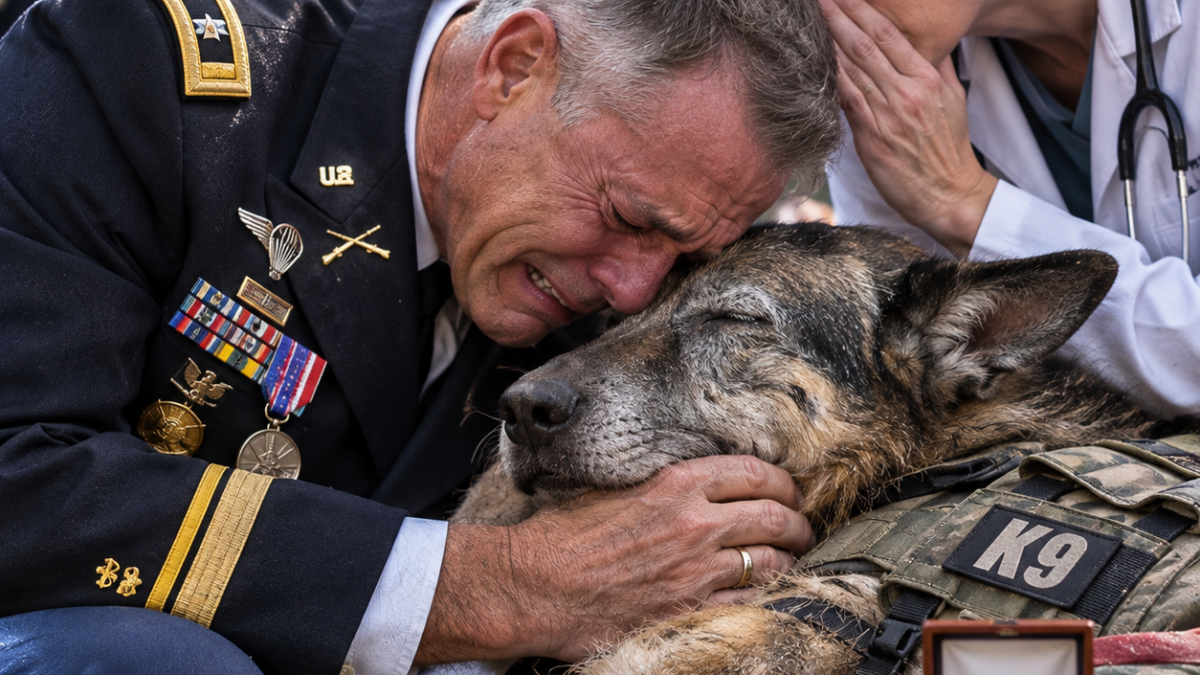
Yet now his shoulders trembled beneath his dress uniform as he pressed his face into the fur of an old dog.
“Thank you,” Jonathan whispered.
Rex leaned closer.
“God, Rex.”
The colonel took a shaking breath.
“Thank you for bringing me home.”
The words were barely audible.
But Caleb heard them.
And the young sergeant understood that the ceremony was carrying something far heavier than the retirement of a working animal.
It was carrying memories.
Fifteen years of them.
Some beautiful.
Some terrible.
And one that had almost ended with Jonathan Mercer being buried beneath a military flag.
Rex had been just twelve weeks old when Jonathan first saw him.
A German Shepherd puppy with oversized ears and a habit of tripping over his own paws.
Jonathan wasn’t a colonel then.
He was a forty-seven-year-old lieutenant colonel assigned to oversee a specialized military working-dog program.
The kennel supervisor, Master Sergeant Thomas Reed, had called him outside one spring morning.
“Sir, there’s something you should see.”
Jonathan followed him across the training yard.
Several young dogs were playing inside fenced enclosures.
One chased a rubber ball.
Another wrestled with a littermate.
A third had discovered a water bowl and was attempting to drag it across the concrete.
Then Jonathan noticed the smallest Shepherd.
He sat near the gate.
Alone.
Watching.
Not frightened.
Not withdrawn.
Simply observing everything around him.
“What’s wrong with that one?” Jonathan asked.
Thomas smiled.
“Nothing, sir.”
“Then why isn’t he playing?”
“He’s watching us.”
Jonathan approached the fence.
The puppy tilted his head.
Jonathan crouched.
“Well, hello.”
The little Shepherd stood.
Walked toward him.
Then immediately stepped on his own ear and stumbled.
Jonathan laughed.
Actually laughed.
A sound Thomas rarely heard during working hours.
The puppy recovered.
Shook himself.
Then marched straight to the fence as though nothing embarrassing had happened.
“What’s his name?” Jonathan asked.
“Rex.”
Jonathan looked at the puppy.
“That’s a very serious name for a dog who can’t walk across a kennel.”
Thomas grinned.
“He’ll grow into it.”
The puppy pressed his nose through the fence.
Jonathan extended two fingers.
Rex licked them.
Then sat.
Waiting.
Jonathan stared.
Something about those amber eyes held his attention.
The pup was still.
Focused.
Interested.
As if he had already decided this particular man mattered.
“Tell me about him.”
Thomas opened the training file.
“Strong scent drive.”
“Good environmental confidence.”
“Extremely attentive.”
“A little too independent.”
Jonathan smiled.
“Sounds familiar.”
Thomas looked at him.
“Sir?”
“Nothing.”
The following week, the puppy was assigned to the program Jonathan supervised.
Their formal partnership developed as Rex matured and completed the required training.
But Jonathan always remembered that first encounter.
The oversized ears.
The clumsy paws.
The way the puppy sat beside the gate and watched him.
He would later tell Thomas:
“I think he chose me before anyone finished the paperwork.”
Training transformed Rex.
The clumsy puppy became an athletic young German Shepherd with a powerful stride and extraordinary concentration.
He learned scent detection.
Tracking.
Controlled searches.
Obedience.
Movement through difficult environments.
He adapted to loud vehicles, aircraft, and unpredictable terrain.
He learned to ignore distractions.
Wait for direction.
And respond to subtle signals.
But he never lost his personality.
He still stole gloves.
Still carried leashes around like trophies.
Still considered a training ball one of the greatest treasures in the universe.
And he remained devoted to Jonathan.
Whenever the lieutenant colonel entered the training area, Rex seemed to recognize him before anyone announced his arrival.
His ears rose.
His tail moved.
And he sat straighter.
Thomas often laughed.
“Sir, I wish some of the recruits reacted that quickly when you walked in.”
Jonathan smiled.
“Maybe you should reward them with tennis balls.”
One rainy afternoon, Jonathan arrived after a difficult briefing.
He was exhausted.
Frustrated.
His uniform was damp.
He sat alone on a bench beside the kennels.
Rex approached under supervision.
Placed his muzzle against Jonathan’s knee.
Jonathan looked down.
“Long day, buddy.”
The dog leaned closer.
Jonathan scratched behind his ears.
“You don’t care about any of the politics, do you?”
Rex looked at him.
“Just whether we’re going for a walk.”
The dog’s tail moved.
Jonathan laughed softly.
“Fair enough.”
He took the leash.
They walked through the rain.
No conversation.
No rank.
No reports.
And when Jonathan returned an hour later, the weight on his shoulders felt lighter.
That became their routine.
Whenever the world became too complicated, Rex reminded him that some things were simple.
A walk.
A meal.
A familiar voice.
A hand resting against warm fur.
The comfort of knowing someone was glad you had returned.
The first deployment tested everything they had learned.
The landscape was harsh.
Rocky hills.
Dry riverbeds.
Narrow roads.
Long nights.
Even experienced soldiers struggled with the heat during the day and the cold after sunset.
Rex adapted.
He worked with professional focus.
Followed his assigned handler’s signals.
Detected hazards.
And earned the respect of soldiers who initially questioned whether a dog belonged in such demanding operations.
One of those soldiers was Corporal Michael Turner.
Twenty-three years old.
Newly married.
Quietly terrified of failing his team.
Michael had grown up in rural Ohio.
He loved dogs.
But he had never seen a military working dog operate in the field.
During one patrol, Rex stopped abruptly.
He became still.
Focused.
His training indicated something was wrong ahead.
The patrol halted.
Specialists assessed the area.
They discovered a hidden explosive threat along the planned route.
Had the men continued, the consequences could have been catastrophic.
After the danger was addressed and the unit moved to safety, Michael crouched beside Rex.
His face was pale.
“That’s it?”
Jonathan looked at him.
“What?”
“He just stopped.”
Jonathan nodded.
“Yes.”
“And that saved us?”
“It may very well have.”
Michael stared at the dog.
Rex looked back.
Then yawned.
Michael laughed shakily.
“He doesn’t even know what he did.”
Jonathan smiled.
“He knows he did his job.”
Michael touched Rex’s shoulder after asking permission.
“Thank you, buddy.”
Rex wagged his tail.
Michael wiped his eyes quickly.
But Jonathan noticed.
He pretended he hadn’t.
That evening, Michael wrote his wife a letter.
He told her he was safe.
That he missed her.
That he hoped he’d be home before their first anniversary.
He didn’t describe the threat in detail.
But he added one sentence.
There’s a German Shepherd out here named Rex, and I think I’m going to owe that dog more than I can ever repay.
Years later, Michael would bring that letter to the beach.
He had kept it all this time.
The most important night of Jonathan’s life came during a mission neither he nor Rex would ever forget.
The unit was operating through difficult terrain when fighting erupted unexpectedly.
Noise shattered the darkness.
Commands rang out.
Soldiers moved toward cover.
Jonathan was coordinating the withdrawal when an explosion struck nearby.
He remembered the shock.
The ground moving.
A flash of light.
Then pain.
His right side went numb.
He fell hard.
His vision blurred.
He tried to speak.
Nothing came out.
He could hear voices.
Boots.
Distant gunfire.
Then the sounds grew faint.
For a moment, he thought he was drowning in silence.
His last clear memory before losing consciousness was Rex turning toward him.
The dog’s ears were high.
His body tense.
And then everything disappeared.
When Jonathan regained consciousness, it was dark.
He was lying on rough ground.
His uniform was wet with blood.
His breathing hurt.
He tried to move.
Pain shot through his body.
Then he felt something warm against his face.
Breathing.
Slow.
Steady.
A muzzle touched his cheek.
Jonathan forced his eyes open.
Rex.
The dog was lying beside him.
One paw resting near Jonathan’s shoulder.
His ears alert.
His eyes scanning the darkness.
Jonathan tried to whisper.
“Rex.”
The dog’s head turned instantly.
His tail moved.
Jonathan closed his eyes.
He didn’t have the strength to lift his hand.
But he felt the dog press closer.
Later, the rescue team explained what happened.
Rex had remained near Jonathan after the blast.
When the immediate danger lessened, he alerted approaching personnel and helped them locate the injured officer in difficult terrain.
He refused to move far from Jonathan while medics worked.
Even after the colonel was prepared for evacuation, Rex remained intensely focused on him.
A medic finally spoke gently to the dog.
“Easy, boy.”
“We’ve got him.”
But Rex didn’t leave.
He followed.
Stayed close.
And settled only when Jonathan was placed under medical care.
The attending physician later told Jonathan:
“You were fortunate.”
Jonathan looked toward Rex lying beside the hospital bed.
“I know.”
The physician continued.
“The injuries were serious.”
“The timing of the rescue mattered.”
Jonathan nodded.
Then looked down at the dog.
“Yeah.”
He swallowed.
“I know.”
For the first time in his life, the man who had spent decades giving orders couldn’t find words large enough to explain what he felt.
He reached toward Rex.
The dog raised his head.
Jonathan rested his hand against the familiar fur.
Then whispered:
“You stayed.”
Rex looked at him.
Jonathan’s voice broke.
“You stayed with me.”
The dog moved closer.
Jonathan closed his eyes.
And cried.
Recovery took months.
Surgery.
Physical therapy.
Pain.
Frustration.
Days when Jonathan felt strong.
Days when standing seemed like an impossible task.
He hated needing help.
Hated the weakness in his leg.
Hated watching other soldiers continue working while he sat in a rehabilitation clinic.
Rex became a constant source of comfort.
Whenever visits were permitted, the dog arrived.
He walked into the room.
Found Jonathan.
And settled beside him.
No judgment.
No impatience.
No concern about whether the colonel’s next promotion would be delayed.
Just presence.
One afternoon, Jonathan became angry during physical therapy.
He had tried to complete an exercise.
Failed.
Tried again.
Failed again.
The frustration overwhelmed him.
He pushed the equipment away.
“Enough!”
The room went quiet.
The therapist stepped back.
Jonathan immediately regretted the outburst.
He lowered his head.
Then felt something against his hand.
Rex.
The dog had been waiting nearby.
He pressed his muzzle into Jonathan’s palm.
Jonathan looked down.
For several seconds, he said nothing.
Then whispered:
“I’m sorry.”
Rex wagged his tail.
Jonathan laughed bitterly.
“You don’t care that I can’t do it.”
The dog’s ears shifted.
“You just care that I’m here.”
He touched Rex’s head.
Then looked toward the therapist.
“Let’s try again.”
The exercise was difficult.
He didn’t complete it perfectly.
But he tried.
And the next day, he tried again.
The colonel later said Rex had helped him recover in ways no medical chart could capture.
Doctors treated his injuries.
Therapists rebuilt his strength.
But Rex gave him a reason to keep trying on days when progress felt impossible.
Over the following years, Rex participated in missions that protected many lives.
Some involved dangerous searches.
Others required careful detection work.
Some were ordinary days when nothing happened because a trained dog identified a problem before anyone reached it.
Not every mission ended dramatically.
Not every alert became a medal.
But those quiet successes mattered.
A soldier reaching home for dinner.
A child growing up with both parents.
A family receiving a phone call instead of a casualty notification.
The consequences spread far beyond the mission reports.
Michael Turner eventually left active duty.
He married the woman who had waited through his deployment.
They had two daughters.
He began working as a firefighter.
Every year, he sent Jonathan a Christmas card.
The first showed his wife holding their newborn daughter.
The second showed the little girl learning to walk.
The third showed her standing beside a Christmas tree.
Years passed.
The photographs changed.
One daughter became two.
Babies became children.
Children became teenagers.
And on the back of each card, Michael wrote almost the same sentence.
Please give Rex a hug from the Turner family.
Jonathan saved them.
All of them.
When Rex was ten, Michael visited with his daughters.
The girls were astonished.
“Dad, that’s him?”
Michael nodded.
“That’s Rex.”
The younger girl looked at the dog.
“He doesn’t look like a hero.”
Michael smiled.
“What does a hero look like?”
She considered.
“I don’t know.”
Michael knelt beside her.
“Sometimes he looks like an ordinary dog.”
He pointed toward Rex.
“Sometimes he just knows when something is wrong.”
The little girl smiled.
“Can I pet him?”
Jonathan nodded after confirming Rex was comfortable.
She approached gently.
Touched his shoulder.
Rex wagged his tail.
Michael watched.
His eyes filled.
Later, he told Jonathan:
“Sir, that might be one of the most important moments of my life.”
Jonathan looked surprised.
“Why?”
Michael stared at his daughters.
“Because they got to meet the reason I came home.”
Jonathan didn’t answer immediately.
He looked toward Rex.
Then toward Michael’s family.
And felt the weight of that truth settle inside him.
As Rex grew older, the military adapted his duties.
His work became less physically demanding.
Veterinary examinations became more frequent.
The younger handlers took on missions Rex once would have performed without hesitation.
At first, Jonathan resisted the changes emotionally.
Not because he wanted to overwork the dog.
He understood the necessity.
But each adjustment reminded him that their shared years were passing.
One morning, a younger German Shepherd ran across the training yard.
Fast.
Strong.
Eager.
Rex watched from beside Jonathan.
His tail moved.
The young dog completed a search exercise.
Received a reward.
Then bounded toward his handler.
Jonathan smiled.
“Remember when you could move like that?”
Rex looked up.
The colonel crouched.
“You were a menace.”
The dog wagged his tail.
“A complete menace.”
Jonathan scratched behind his ears.
Then whispered:
“And the best partner I ever had.”
Rex leaned into his hand.
Jonathan smiled.
At eleven, Rex officially left operational service.
At twelve, he transitioned to a quieter routine with authorized care arrangements.
Jonathan expected retirement to be easy.
No dangerous missions.
No deployments.
No demanding schedules.
Just peaceful mornings.
But old age carried its own battles.
At thirteen, Rex began developing arthritis.
His movements slowed.
He needed help climbing into vehicles.
Cold weather made his joints stiff.
At fourteen, he sometimes hesitated before standing.
Then, shortly before his fifteenth birthday, a veterinary examination raised concerns about his heart.
Not a sudden collapse.
Not a certain death sentence.
But enough to make everyone involved understand that Rex needed a different kind of life.
Gentler.
More closely monitored.
Focused on comfort rather than performance.
Jonathan took the news quietly.
He asked careful questions.
Wrote down every instruction.
Discussed treatment and quality-of-life considerations.
Then drove home.
He sat in his living room.
Rex lay beside the fireplace.
And for the first time, Jonathan realized that the future he had always imagined might be shorter than he wanted.
He looked at the dog.
The gray muzzle.
The scars.
The tired eyes.
Then whispered:
“Not yet, buddy.”
Rex lifted his head.
Jonathan swallowed.
“Please.”
The dog stood slowly.
Walked toward him.
Rested his head on Jonathan’s knee.
And the colonel finally allowed himself to cry.
That was when Thomas Reed proposed the ceremony.
Not a funeral.
Not a medical decision.
Not a final goodbye.
A military retirement tribute.
Fifteen years of service.
Fifteen years of loyalty.
A chance for soldiers whose lives Rex had touched to stand together and thank him while he was still alive.
Jonathan hesitated.
“He doesn’t need a parade.”
Thomas smiled.
“No, sir.”
“He doesn’t need applause.”
“No, sir.”
“He needs rest.”
“I agree.”
Jonathan looked at him.
“Then why a ceremony?”
Thomas took a breath.
“Because, Colonel, you’ve spent your whole career honoring people after they’ve given everything.”
Jonathan remained silent.
Thomas continued.
“Rex is still here.”
“He can still feel your hand.”
“He can still hear the voices he knows.”
“He can still enjoy being beside you.”
Thomas paused.
“Why should we wait until he’s gone to tell him what he means to us?”
Jonathan looked away.
For a long time, neither man spoke.
Then the colonel whispered:
“That’s a fair question.”
He agreed.
But insisted on one condition.
“This cannot be a farewell.”
Thomas nodded.
“Understood.”
“I don’t want people gathering to act like he’s already dead.”
“Yes, sir.”
Jonathan looked toward Rex.
The dog was sleeping near the fireplace.
“He’s earned a retirement.”
“Not a funeral.”
Thomas smiled.
“Then that’s what we’ll give him.”
The preparations took several weeks.
Old comrades were contacted.
Former handlers.
Veterans.
Military personnel whose paths had crossed with Rex’s service.
Michael Turner received the invitation while helping his younger daughter with homework.
He read it.
Then sat down.
His wife looked at him.
“Michael?”
He didn’t answer immediately.
Then handed her the message.
She read.
Looked up.
“Rex?”
Michael nodded.
“He’s retiring.”
She smiled.
“Then we should go.”
He swallowed.
“It’s on the coast.”
“I know.”
“Long drive.”
She took his hand.
“Michael.”
He looked at her.
“You’ve told me for fifteen years that dog helped bring you home.”
He nodded.
She smiled through tears.
“Then I think we can drive a few hours to thank him.”
Michael began crying.
His daughters came into the kitchen.
“Dad?”
He looked up.
Then laughed through tears.
“Girls.”
He held out his arms.
“Want to meet an old hero?”
Both nodded immediately.
And just like that, another family began preparing to travel to the beach.
Other veterans responded too.
Captain David Collins.
Staff Sergeant Henry Walker.
Lieutenant Samuel Price.
Several former working-dog handlers.
Men and women who remembered Rex during operations, medical recoveries, or the quiet aftermath of difficult missions.
Some had not seen Jonathan in years.
Some lived across the country.
One former soldier sent a letter because he couldn’t travel.
It read:
Colonel, I don’t know if Rex remembers me, but I remember him every day. My son is turning fourteen next month. Every birthday reminds me that there was a day when I almost never came home to meet him. Please tell Rex thank you for me.
Jonathan read it three times.
Then placed it in a wooden box beside the Christmas cards from Michael Turner.
Another veteran sent a photograph.
His family.
A wife.
Three children.
A golden retriever sitting between them.
On the back:
Rex taught me that heroes don’t always wear boots. Sometimes they have paws.
Jonathan laughed through tears.
Then shook his head.
“Old boy,” he whispered.
“You have no idea.”
Rex looked up from his bed.
His tail moved slowly.
Jonathan smiled.
“No idea how many people love you.”
The day before the ceremony, Jonathan couldn’t sleep.
He laid out his dress uniform.
Polished his shoes.
Checked the weather.
Reviewed the schedule Thomas had prepared.
Then sat on the floor beside Rex.
The dog was awake.
His amber eyes followed Jonathan’s movements.
The colonel smiled.
“Tomorrow’s about you.”
Rex tilted his head.
“Everyone’s coming.”
The dog wagged his tail.
Jonathan laughed softly.
“You don’t know what that means.”
He scratched behind Rex’s ears.
“But you’re going to have the biggest audience of your life.”
Then his smile faded.
He looked at the service collar around Rex’s neck.
Worn leather.
Scratched metal.
Fifteen years of history.
He touched the nameplate.
Remembered the younger dog.
The pup who stumbled over his own ears.
The disciplined K9 who stopped an entire patrol.
The loyal companion who stayed with him after the explosion.
He swallowed.
“Tomorrow, we take this off.”
Rex looked at him.
Jonathan’s voice trembled.
“Not because you did anything wrong.”
He paused.
“Because you’ve done enough.”
The dog moved closer.
Rested his head against Jonathan’s shoulder.
The colonel held him gently.
Then whispered:
“And after tomorrow, nobody asks you to be brave for us anymore.”
That promise meant more than anything else he could offer.
The next morning, the ocean was rough.
Wind swept across the beach.
Gray clouds crowded the horizon.
Thomas worried about the weather.
He called Jonathan.
“Sir, we can move indoors if needed.”
Jonathan looked toward Rex resting beside the door.
“What’s the forecast?”
“Conditions may improve by late morning.”
“Then we’ll reassess before bringing him out.”
Thomas nodded.
“Understood.”
They checked with the veterinary team.
Made sure Rex’s outing would be safe and brief enough for his condition.
The gathering remained flexible.
No ceremony was more important than the old dog’s comfort.
By late morning, the wind eased.
The waves settled.
Sunlight began to filter through the clouds.
The beach was accessible.
The medical team approved the planned appearance.
And the soldiers assembled.
Forty-seven of them.
A line of uniforms facing the ocean.
Some still serving.
Some retired.
Some carrying scars the world couldn’t see.
They stood without conversation.
Each remembered something different.
A dangerous mission.
A difficult night.
A comrade who never returned.
A moment when Rex’s alert had changed everything.
The silence wasn’t imposed.
It came naturally.
Because every person there knew this wasn’t an ordinary military ceremony.
It was an acknowledgment of loyalty.
A tribute to a creature who had spent his life serving without ever asking what the rewards would be.
When Jonathan approached Rex, he saw the years in the dog’s face.
The gray muzzle.
The small scars.
The familiar amber eyes.
He remembered the puppy who couldn’t walk across a kennel without stumbling.
And the young dog who had grown into the most reliable companion he’d ever known.
Then he looked at the soldiers.
The families.
The faces.
Some familiar.
Some older.
Some belonging to people Rex had protected before their children were even born.
Jonathan felt his throat tighten.
He stopped.
Caleb Brooks stood beside him.
“Sir?”
Jonathan shook his head.
“Give me a moment.”
Caleb nodded.
The colonel took a slow breath.
Then approached Rex.
The dog lifted his head.
His tail moved.
Jonathan knelt.
And Rex immediately stepped forward.
Pressed his head against the colonel’s chest.
The exact movement he’d made countless times before.
After difficult missions.
After long absences.
After nights when Jonathan couldn’t sleep.
The old man wrapped his arms around the dog.
Then began to cry.
“Rex.”
His voice broke.
“Oh, buddy.”
The dog stood quietly.
Jonathan held him.
For a long time, the only sound was the sea.
Then the colonel whispered:
“Thank you.”
One word.
But beneath it lived fifteen years.
Miles traveled together.
Nights spent awake.
Lives preserved.
Danger endured.
Silences shared.
And the simple comfort of coming home to a friend who never cared what kind of day he’d had.
Jonathan took a shaking breath.
“You gave us everything.”
He looked down at the dog.
“You protected my men.”
“You brought me home.”
His voice trembled.
“And now…”
He stopped.
The soldiers waited.
Jonathan placed one hand against Rex’s silver muzzle.
“Now your mission is complete.”
Caleb approached slowly.
He knelt beside them.
In his hands was a soft new collar.
Not military issue.
Not heavy-duty working equipment.
A comfortable collar intended for Rex’s retirement.
A small identification tag hung beneath it.
Caleb looked toward Jonathan.
“Sir?”
The colonel nodded.
Carefully, the young sergeant reached toward Rex’s old service collar.
Rex remained calm.
He had been handled by people he trusted for years.
The clasp opened.
A faint metallic sound broke the silence.
The old collar slipped free.
The nameplate tapped against the brass tag.
One final soft chime.
Caleb held it in both hands.
For a moment, he stared.
The leather was worn smooth.
The buckle scratched.
The metal faded.
He knew what this collar represented.
Not just equipment.
A whole life of service.
He turned toward the colonel.
“Sir.”
Jonathan looked up.
Caleb’s voice shook.
“Rex is officially retired from military working-dog service.”
The words hung over the beach.
Several soldiers lowered their eyes.
One pressed a hand against his mouth.
Michael Turner stood beside his daughters, tears running openly down his cheeks.
Jonathan looked at the old collar.
Then at Rex.
His voice broke again.
“Did you hear that, buddy?”
The dog tilted his head.
Jonathan smiled through tears.
“No more missions.”
Rex’s tail moved once.
“No more dangerous roads.”
The colonel brushed a hand along his shoulder.
“No more running toward things that might hurt you.”
He took a breath.
Then whispered the six words that changed the entire meaning of the morning.
“Now you’re coming home with me.”
Rex raised his head.
For a moment, he stared at Jonathan.
Then his tail began moving.
Slowly.
Then faster.
Jonathan laughed.
The sound surprised everyone.
He had been crying seconds earlier.
Now he was laughing through the tears.
“That’s right, buddy.”
He leaned closer.
“Home.”
Rex pressed his muzzle against his cheek.
Jonathan closed his eyes.
“You’re not being sent away.”
The dog leaned forward.
“Not to another unit.”
“Not to another handler.”
Jonathan smiled.
“You’re mine.”
Then corrected himself.
“No.”
He laughed softly.
“We’re family.”
The crowd had expected a final farewell.
Many believed Rex was being honored because his health had reached a point where his future was uncertain.
They had prepared themselves for grief.
But Jonathan’s words changed everything.
Rex was not being taken away to die.
He was being retired into a home prepared for his comfort.
He would receive veterinary care.
Warm bedding.
Gentle walks.
Familiar routines.
And the companionship of the man he had trusted for fifteen years.
There would still be medical uncertainty.
There would still be hard days.
Old age would not disappear.
But Rex would no longer be asked to work.
No more operational demands.
No more service schedule.
No more need to prove himself.
The ceremony wasn’t announcing the end of his life.
It was honoring the end of his duty.
Thomas Reed stepped forward.
His voice was thick.
“Colonel?”
Jonathan looked up.
Thomas smiled.
“I think somebody’s ready for retirement.”
A ripple of gentle laughter moved through the soldiers.
Jonathan wiped his face.
“I believe you’re right.”
Then Thomas turned toward the formation.
“At attention!”
The soldiers straightened.
The ocean shimmered behind them.
A formal salute followed, performed according to the ceremony’s arrangements.
Forty-seven soldiers honored the old German Shepherd who had served beside their comrades for fifteen years.
Rex looked toward them.
His ears moved.
He seemed curious about the stillness.
Then he turned back toward Jonathan.
The colonel smiled.
“Don’t worry about them.”
He scratched the dog’s neck.
“You’re off duty.”
And for the first time that morning, the old soldier looked peaceful.
After the formal tribute, Jonathan helped Rex toward the quieter section of the beach.
The dog’s new collar sat comfortably around his neck.
Caleb carried the old service collar in a wooden presentation box.
Thomas walked nearby.
The medical team remained available.
Jonathan kept the pace slow.
They had planned a brief, gentle outing rather than anything strenuous.
Rex stepped onto the damp sand.
Sniffed the sea air.
Looked toward the water.
Then walked a few feet ahead.
Jonathan laughed softly.
“Look at you.”
The dog turned.
His tail wagged.
He gave one clear bark.
A sound that carried across the beach.
Several soldiers smiled through tears.
Michael’s younger daughter laughed.
“Dad, he sounds happy!”
Michael wiped his eyes.
“Yeah, sweetheart.”
He looked toward Rex.
“He does.”
Jonathan crouched carefully.
Rex approached.
Pressed his muzzle against his hand.
Then looked toward the open beach.
The colonel smiled.
“No orders, buddy.”
He leaned closer.
“Just enjoy yourself.”
Rex walked slowly along the sand.
No heavy harness.
No operational task.
No mission.
He left a trail of uneven pawprints beside Jonathan’s boots.
The colonel watched.
For years, those paws had carried Rex into danger.
Now they carried him toward the beginning of an ordinary afternoon.
And somehow, that felt like the greatest reward of all.
The retirement arrangements had been prepared long before the ceremony.
Jonathan hadn’t wanted to risk delays that might separate him from Rex unnecessarily.
He worked with the appropriate military and veterinary personnel to complete the authorized adoption and care process.
Rex’s medical needs were evaluated.
His home environment inspected.
The colonel learned how to support the old dog’s joints, monitor his condition, and maintain a comfortable daily routine.
He replaced slippery floor coverings.
Installed a gentle ramp beside the porch.
Purchased orthopedic bedding.
Moved Rex’s water bowl closer to his resting area.
And cleared space beside the fireplace.
On the shelf above it, Jonathan placed a photograph of Rex from his first year of service.
A young German Shepherd with oversized ears and a determined expression.
Next to it sat the wooden box containing his retired service collar.
The colonel had never been particularly interested in decorating.
His house had always been practical.
Clean.
Orderly.
A place where he slept between demanding days.
But preparing for Rex changed that.
The living room grew warmer.
The porch became more inviting.
The garden path was adjusted to make walking easier.
Jonathan even bought a soft blue blanket because he remembered Rex choosing one during a visit to the veterinary rehabilitation center.
Thomas saw the blanket and laughed.
“Sir, that’s a very expensive blanket for a dog.”
Jonathan looked at him.
“He likes it.”
Thomas grinned.
“Yes, sir.”
“Then that’s the end of the discussion.”
For the first time, Jonathan wasn’t preparing his home for a soldier.
He was preparing it for family.
Rex arrived that afternoon.
Jonathan opened the front door.
The dog stepped inside.
Paused.
Sniffed the familiar furniture.
Then walked toward the fireplace.
He found the blue blanket.
Circled once.
Then lowered himself onto it with a deep sigh.
Jonathan stood in the doorway.
His throat tightened.
For years, Rex had lived within the rhythms of military service.
Kennels.
Training schedules.
Working assignments.
Medical checks.
Retirement arrangements.
Now he was home.
Not on temporary leave.
Not awaiting another mission.
Home.
Jonathan approached slowly.
Crouched beside him.
“Hey, buddy.”
Rex opened one eye.
His tail tapped against the blanket.
The colonel smiled.
“Welcome home.”
The dog stretched one paw toward him.
Jonathan placed his hand beside it.
Then whispered:
“No more duty rosters.”
Rex sighed.
“No more alarms.”
The colonel smiled.
“No more pretending you don’t want an extra treat.”
The dog’s ears moved.
Jonathan laughed.
“That’s what I thought.”
He sat on the floor beside Rex.
Rested his back against the couch.
And remained there until evening.
For once, there was nothing urgent to do.
No briefing.
No orders.
No deployment preparations.
Just the sound of an old dog breathing peacefully in his own home.
The first week of retirement surprised Jonathan.
He had expected Rex to be content simply resting.
And some days, he was.
But the old German Shepherd had spent fifteen years living with structure.
He still woke early.
Still watched Jonathan when the colonel put on his shoes.
Still became alert whenever a military vehicle drove past.
The first Monday after retirement, Jonathan rose at six.
He entered the kitchen.
Prepared coffee.
Then noticed Rex standing near the front door.
Waiting.
The colonel smiled.
“Morning.”
The dog wagged his tail.
Jonathan looked at the leash hanging beside the door.
“Oh.”
He laughed softly.
“You think we’re going to work.”
Rex stared.
Jonathan crouched.
“No, buddy.”
He scratched the dog’s chest.
“Not anymore.”
The German Shepherd tilted his head.
Jonathan reached for the leash.
“But we can go for a walk.”
The dog’s tail moved faster.
They walked slowly along the garden path.
Past the porch.
Toward a small stand of trees.
Then back.
No searching exercises.
No commands beyond those needed for safety.
No expectation that Rex perform.
Just a walk.
When they returned, Jonathan made breakfast.
Rex settled beside the table.
The colonel looked down.
“Not a bad retirement, is it?”
The dog sighed.
Jonathan laughed.
“Agreed.”
There were difficult days too.
Rex’s heart condition required ongoing monitoring.
His joints became stiff during cold weather.
Sometimes he needed extra rest.
Jonathan learned to recognize changes in his breathing and energy.
He followed veterinary advice carefully.
Attended appointments.
Asked questions.
Adjusted their routine when necessary.
He didn’t treat every tired morning as a disaster.
But he didn’t ignore genuine warning signs either.
Some nights, fear returned.
He would wake.
Listen.
Then reach toward the bedside lamp.
But instead of spending hours imagining the worst, he remembered what Dr. Morgan had told him.
“Colonel, you cannot make aging disappear.”
“You can give him comfort.”
“Consistent care.”
“Attention.”
“And a life worth enjoying.”
That became Jonathan’s new mission.
Not saving Rex through force of will.
Not demanding impossible medical certainty.
Simply helping him live well.
The colonel who had once coordinated complex operations now found satisfaction in small victories.
A comfortable walk.
A good appetite.
A playful tail wag.
A quiet afternoon.
And the way Rex still leaned against him whenever he sat on the porch.
Two months after retirement, Michael Turner visited with his daughters.
He carried the old letter he’d written to his wife after Rex’s first major mission.
The paper had yellowed.
The folds were soft.
Michael handed it to Jonathan.
“Sir.”
The colonel looked down.
“What’s this?”
“Something I wrote fifteen years ago.”
Jonathan read.
Then stopped at the final line.
There’s a German Shepherd out here named Rex, and I think I’m going to owe that dog more than I can ever repay.
The colonel stared.
Then looked toward Michael.
“Fifteen years.”
Michael nodded.
“Fifteen.”
His older daughter stepped forward.
She was seventeen now.
Almost an adult.
She held a framed photograph.
In it, Michael stood beside his wife and daughters on their front porch.
All smiling.
The younger girl carried a small dog.
The older one had one arm around her father’s shoulders.
Michael’s voice broke.
“Sir, I wanted Rex to have this.”
Jonathan swallowed.
“Why?”
Michael looked toward the old German Shepherd resting on his blanket.
“Because he gave me the chance to become a father.”
Silence.
Then:
“And I wanted you to know what he helped protect.”
Jonathan looked at the photograph.
The smiling family.
The ordinary porch.
The people whose lives had continued because Michael came home.
He nodded.
Then placed the frame beside Rex’s service photograph.
“Thank you.”
Michael smiled through tears.
“No, sir.”
He looked down at Rex.
“Thank him.”
The story of Rex’s retirement spread through the military community.
Not because Jonathan wanted publicity.
He didn’t.
But the ceremony had deeply affected the soldiers who attended.
Some shared photographs.
Others wrote about the old dog’s service.
And eventually, people beyond the base heard about the colonel who knelt crying before his aging German Shepherd.
The story moved people.
Veterans.
Dog handlers.
Families.
People who had lost pets.
People who understood how deeply an animal could become part of a life.
Letters arrived.
Some thanked Rex.
Some thanked Jonathan.
Others shared stories of their own service animals.
One came from a woman whose husband had died several years earlier.
She wrote:
When my husband was sick, our dog stayed beside him every night. After he passed, I thought I had lost everything. That dog gave me a reason to get out of bed. Watching your story reminded me that loving an animal is not a small thing. Sometimes it is what keeps us here.
Jonathan read the letter in silence.
Then placed it beside the others.
He had spent years believing that strength meant never allowing others to see his pain.
Now he was discovering that his tears on the beach had helped strangers feel less ashamed of their own.
That surprised him.
And humbled him.
One evening, Thomas Reed visited for dinner.
Rex lay beside the fireplace.
His breathing was steady.
His paws stretched comfortably across the blue blanket.
Thomas looked toward him.
“He seems happy.”
Jonathan smiled.
“He is.”
“Still bossy?”
“Worse.”
Thomas laughed.
“Impossible.”
“This morning he decided I was late with breakfast.”
“What happened?”
“He moved the empty bowl into the hallway.”
Thomas burst into laughter.
“Classic Rex.”
Jonathan smiled.
Then became quiet.
Thomas noticed.
“Sir?”
The colonel looked at the dog.
“Do you know what I was afraid of on the beach?”
Thomas leaned back.
“Losing him?”
Jonathan nodded.
“But something else too.”
“What?”
“I was afraid I’d never know who I was without him.”
Thomas remained silent.
Jonathan continued.
“Fifteen years.”
“Every mission.”
“Every difficult night.”
“Every time I came home exhausted.”
“He was there.”
The colonel looked toward the fireplace.
“I thought when he retired, everything we’d been would disappear.”
Thomas considered.
Then said:
“Sir, he hasn’t stopped being your partner.”
Jonathan looked up.
“He’s just not on duty anymore.”
The colonel smiled faintly.
Thomas continued.
“You don’t need a mission for someone to matter.”
Jonathan stared.
Then looked toward Rex.
The dog was sleeping peacefully.
No collar.
No harness.
No equipment.
No danger.
Just Rex.
Thomas smiled.
“Maybe that’s what this retirement is teaching you.”
Jonathan nodded slowly.
“Maybe.”
The following spring brought warm weather.
The trees along the coast turned green.
Birds returned to the garden.
And Rex began spending more time on the porch.
He liked the morning sun.
The breeze.
The familiar sound of Jonathan moving through the kitchen.
Every afternoon, the colonel brought a chair outside.
He sat beside the dog.
Sometimes reading.
Sometimes writing.
Sometimes simply watching the world.
One day, Jonathan found an old training ball in a box.
Faded red rubber.
Scratched.
Bite marks around the edges.
He held it up.
Rex’s ears lifted.
The colonel smiled.
“You remember this?”
The dog stood slowly.
His tail began moving.
Jonathan laughed.
“Oh, you definitely remember.”
He rolled the ball gently across the porch.
Only a short distance.
Rex walked after it.
Picked it up.
Returned.
Dropped it beside Jonathan’s boot.
The colonel smiled.
“Good boy.”
Rex wagged his tail.
Jonathan rolled it again.
They played for barely a minute.
Then Rex settled onto his blanket.
The colonel set the ball beside him.
That was enough.
No strenuous exercise.
No need to prove anything.
Jonathan leaned back.
Looked toward the ocean beyond the trees.
Then whispered:
“You’re still the same dog.”
Rex looked up.
The colonel smiled.
“Just a little slower.”
The dog sighed.
Jonathan laughed.
“Me too.”
One afternoon, Caleb Brooks visited.
The young sergeant had been promoted.
He carried a small wooden plaque.
Jonathan stared at it.
“What’s that?”
Caleb smiled.
“Something from the unit.”
He handed it over.
The plaque was simple.
Dark wood.
A brass plate.
And a photograph of Rex on the beach during the retirement ceremony.
Beneath it were the words:
REX — FIFTEEN YEARS OF SERVICE
DUTY COMPLETED. LOYALTY ENDURING.
Jonathan read the inscription.
Then read it again.
Caleb looked toward Rex sleeping beside the fireplace.
“I didn’t understand that day.”
Jonathan raised his eyes.
“What?”
“Why everyone was crying.”
The colonel smiled.
“You understood enough.”
Caleb shook his head.
“No, sir.”
“I thought we were saying goodbye.”
He paused.
“Then you said he was coming home.”
Jonathan looked toward the plaque.
Caleb continued.
“I’d never seen an officer cry like that.”
The colonel looked uncomfortable.
Caleb noticed.
Then said:
“It changed something for me.”
Jonathan frowned.
“How?”
The young sergeant took a breath.
“I’d been having trouble after a deployment.”
“Nightmares.”
“Anger.”
“Things I didn’t know how to talk about.”
He looked down.
“I thought asking for help meant I wasn’t strong enough.”
Jonathan remained silent.
Caleb continued.
“Then I watched you kneel in front of that dog and cry in front of everyone.”
He swallowed.
“And nobody respected you less.”
Jonathan felt his throat tighten.
Caleb looked up.
“So I finally talked to someone.”
The colonel stared.
Then slowly nodded.
“Good.”
Caleb smiled.
“Yeah.”
“Good.”
For a long moment, neither spoke.
Then Jonathan looked toward Rex.
The dog had raised his head.
Watching them.
The colonel laughed softly.
“Even retired, he’s still helping people.”
Caleb smiled.
“Yes, sir.”
“He is.”
Summer arrived.
The ocean turned deep blue.
The beaches filled with families.
Children ran along the shoreline.
Dogs chased balls.
Seagulls cried above the waves.
Jonathan often drove Rex along the coastal road.
Sometimes they stopped at a quiet overlook.
Sometimes they simply watched the water through the open windows.
The colonel had become more protective of Rex’s energy.
He knew long outings could be tiring.
So he kept them short.
Comfortable.
Flexible.
One morning, the veterinary team confirmed Rex was doing well enough for a carefully planned beach visit.
Jonathan packed water.
His medications.
A soft portable mat.
Everything necessary.
Then drove toward the place where the retirement ceremony had been held.
The same beach.
The same distant horizon.
But no soldiers this time.
No formation.
No microphone.
No formal ceremony.
Just the old colonel and his old dog.
Jonathan helped Rex onto the sand.
They walked slowly.
A few steps.
Then paused.
Rex sniffed the salty air.
His ears lifted.
His tail moved.
Jonathan smiled.
“Remember this place?”
The dog looked toward the sea.
Then back at him.
The colonel laughed.
“Yeah.”
“I thought you would.”
They reached a sheltered spot.
Jonathan spread the mat.
Sat down.
Rex settled beside him.
The waves moved gently against the shore.
For a long time, neither did anything.
Jonathan watched the horizon.
Remembered the gray morning months earlier.
The soldiers.
The collar.
The trembling in his hands.
The moment he knelt.
The tears he couldn’t stop.
Then the words he’d whispered.
Now you’re coming home with me.
He looked toward Rex.
The dog was resting against his leg.
His eyes half closed.
Peaceful.
Jonathan smiled.
And for the first time, he realized he wasn’t afraid of the silence anymore.
“Hey, buddy.”
Rex lifted his head.
Jonathan stroked his silver muzzle.
“Do you know what I thought that day?”
The dog’s ears moved.
“I thought I was losing you.”
He paused.
“I thought I was standing in front of the end of everything.”
The sea whispered against the sand.
Jonathan continued.
“But I was wrong.”
Rex leaned closer.
The colonel smiled.
“That wasn’t the end.”
“It was the beginning of something else.”
He looked toward the ocean.
“Fifteen years, I needed you to be brave.”
“Today, I just need you to be happy.”
Rex rested his chin against Jonathan’s knee.
The colonel scratched behind his ears.
For a long time, he remained there.
Not crying.
Not counting the days.
Not wondering how much time remained.
Simply grateful.
Because the future was still uncertain.
Rex was old.
His heart still needed monitoring.
There would be difficult mornings.
Veterinary appointments.
Changes in care.
And eventually, a farewell neither of them could avoid.
But today was not that day.
Today, the sun was warm.
The sea was calm.
And Rex was beside him.
Jonathan closed his eyes.
Then whispered:
“That’s enough.”
As the afternoon passed, Rex stood slowly.
He took a few steps toward the water.
Stopped.
Looked back.
Jonathan smiled.
“Coming, buddy.”
He rose carefully.
Walked beside him.
Their footprints pressed into the wet sand.
A pair of older companions moving at the same slow pace.
The dog paused whenever he needed to.
The colonel waited.
No hurry.
No orders.
No expectation that they reach a certain point.
Just movement.
Together.
At the edge of the beach, Rex turned once more toward the sea.
A wave rolled in.
Then retreated.
The dog lifted his head.
Gave one short bark.
Jonathan laughed.
The sound carried across the shore.
“Yeah, buddy.”
He looked toward the open water.
“Beautiful day.”
Rex wagged his tail.
Then walked back toward him.
Jonathan bent.
Rested a hand on the dog’s head.
And smiled.
That evening, they returned home.
Rex walked directly toward his blue blanket.
Circled once.
Then lay down.
Jonathan prepared dinner.
Checked his medication schedule.
Refilled his water.
Then sat in the chair beside the fireplace.
Above it hung two photographs.
One showed Rex as a young military working dog standing proudly beside Jonathan in uniform.
The other had been taken on the beach during the retirement ceremony.
In it, Jonathan was kneeling in the sand.
His arms around Rex.
His face pressed into the dog’s neck.
The soldiers stood behind them.
And the sea stretched toward the horizon.
Jonathan looked at the second photograph for a long time.
He remembered the fear.
The grief.
The weight of fifteen years.
Then he looked down.
Rex was sleeping.
His old body relaxed.
His breathing slow and comfortable.
One paw stretched beyond the blanket.
The colonel reached down.
Rested his fingers gently against it.
The dog opened one eye.
His tail moved once.
Jonathan smiled.
“Good night, soldier.”
Then he paused.
And laughed softly.
“No.”
He leaned closer.
“Not soldier anymore.”
Rex looked at him.
Jonathan whispered:
“Good night, my friend.”
The dog closed his eye.
And slept.
For fifteen years, Rex had answered commands.
He had followed soldiers into places where danger waited.
Protected men who might never have returned without him.
Stayed beside his wounded partner when every instinct might have urged him to flee.
He had given his strength.
His attention.
His courage.
And his trust.
He had never asked for medals.
Never understood the meaning of a salute.
Never cared about rank.
What he knew was simpler.
The sound of Jonathan’s voice.
The touch of his hand.
The safety of being together.
And when the day came for the military to remove his service collar, the old dog didn’t lose the thing that mattered most.
He kept his person.
The soldiers on the beach had believed they were watching the end of a remarkable life.
But sometimes the greatest reward for years of service is not another ceremony.
Not another medal.
Not another mission.
Sometimes it is the freedom to grow old without being asked to prove your worth again.
To sleep beside a warm fireplace.
To feel sunlight on your face.
To hear familiar footsteps coming down the hallway.
And to know that when your strength fades, someone will still bend down, wrap their arms around you, and whisper that you are loved.
Colonel Jonathan Mercer had spent a lifetime learning how to lead men through danger.
Rex had spent fifteen years teaching him how to love without conditions.
And on that quiet evening, as the ocean murmured beyond the distant dunes, the old colonel finally understood what his faithful companion had been trying to show him all along.
A soldier’s duty may end when the collar comes off—but the bond between a man and the dog who brought him home does not end with an order, a ceremony, or the passing of time. It simply becomes love, with nowhere left to go except home.








