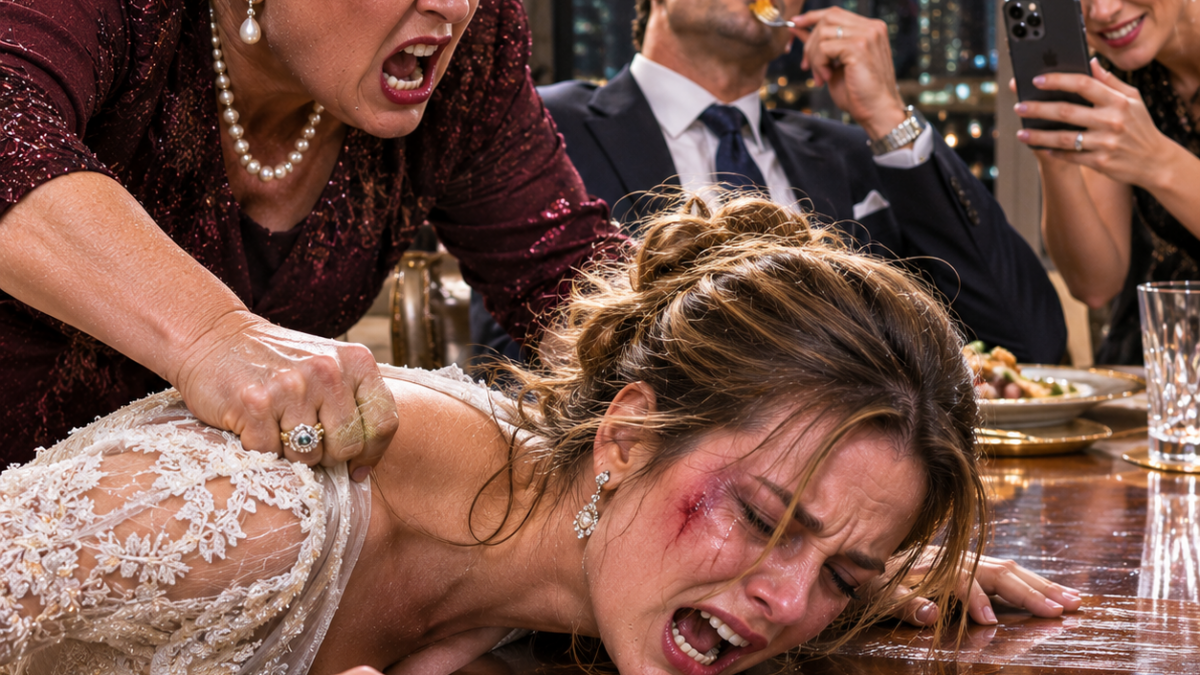
FULL STORY:“SIGN THE DEED, NORA—OR WE’LL MAKE EVERYONE THINK YOU’RE CRAZY!” Three Days After My Wedding, My Mother-in-Law Shoved Me Into an Oak Table Over My Father’s Penthouse—While My Husband Kept Eating and His Sister Filmed My Bruised Face, I Realized the Entire Family Dinner Had Been Planned…
𝗙𝗨𝗟𝗟 𝗦𝗧𝗢𝗥𝗬
His expression was empty.
Not surprised.
Not horrified.
Prepared.
Then Irene stood.
Her phone was already recording.
She shoved the camera toward my face.
“Come on, psycho.”
She laughed.
“Give us something good.”
And suddenly I understood why nobody had moved.
Why Susan had chosen a room filled with relatives.
Why Irene’s phone had already been positioned.
Why David looked calmer than everyone else.
They were not trying to convince me to sign.
They were trying to make me lose control.
I stood slowly.
My back burned.
I brushed my blouse straight.
Then smiled.
Susan’s eyes narrowed.
Without saying a word, I turned and walked into the kitchen.
Behind me, Susan laughed.
“Let her go. She’ll come crawling back.”
They thought I was going to cry.
Instead, I reached the stove.
A heavy cast-iron pan sat over high heat, smoke curling upward from the oil left after the kitchen staff had finished searing the final course.
I wrapped both hands around the handles.
And lifted it.
Because there was one thing the Sterling family did not know.
I had not married David without knowing who he was.
FULL STORY CONTINUATION
Two weeks before my wedding, I had almost canceled it.
Not because of cold feet.
Because of my father.
Or more accurately, because of something he had left behind.
After Charles Vance died, I spent months going through his private office.
Most of it was ordinary.
Contracts.
Old photographs.
Letters from my mother.
Board minutes.
Tax records.
Personal notebooks written in his tiny, nearly unreadable handwriting.
Then I found a storage drive taped beneath the bottom drawer of his desk.
My father was not a dramatic man.
He did not hide things for entertainment.
That alone frightened me.
The drive contained several encrypted folders.
One was labeled with a date from six months before his death.
Inside was a recording.
My father sat behind his office desk.
He looked tired.
Thinner than I remembered.
But his voice was clear.
“Nora, if you are watching this, I either did not have the opportunity or did not have the courage to explain this to you in person.”
I remember gripping the edge of my chair.
Dad continued.
“Vance Distribution has not been suffering only from market pressure.”
He paused.
“There has been deliberate interference.”
I stopped breathing.
At the time, Vance Distribution had spent nearly a year fighting unexplained disruptions.
Lost contracts.
Pricing information reaching competitors.
Warehouse bids failing by impossibly narrow margins.
A major client terminating a relationship weeks after confidential strategy meetings.
My father publicly blamed aggressive competition and supply-chain volatility.
Privately, the failures had consumed him.
Then he said a name.
“David Sterling.”
I replayed the recording twice because I could not believe him.
David.
The man I was engaged to.
My father explained that he had begun tracing information leaks through outside consultants.
Several suspicious transactions connected Sterling-controlled businesses to intermediaries that had benefited from Vance Distribution’s losses.
Nothing in the recording alone proved every allegation.
Dad knew that.
He said so.
“I do not want you accusing anyone based solely on this message.”
Then he leaned closer toward the camera.
“But do not give David access to company control. Do not transfer your inherited voting rights. And do not allow anyone to persuade you that marriage changes ownership.”
My hands were shaking by the time the recording ended.
There were documents too.
Copies of emails.
Payment trails.
Internal access logs.
Names of outside professionals Dad had contacted.
And one final handwritten note.
If I am wrong, investigate and forgive me.
If I am right, protect yourself before they realize you know.
I spent three days considering canceling the wedding.
Then I contacted my father’s attorney, Evelyn Shaw.
She did not tell me what to do.
She did something better.
She helped me separate suspicion from proof.
Some of Dad’s material could be independently verified.
Some could not.
But enough irregularities existed that we quietly brought in outside forensic accountants and counsel.
The more they examined, the worse it looked.
David appeared connected to people who had profited from confidential Vance information.
Not directly enough for me to accuse him publicly.
Enough that I stopped believing the coincidences.
That was when I made the hardest decision of my life.
I did not cancel the wedding.
I continued.
Not because I wanted revenge.
And not because I planned some elaborate vigilante trap.
I continued because David had already spent nearly two years trying to gain proximity to Vance Distribution.
If I suddenly ended the engagement without explanation, we believed records could disappear and communications could be destroyed.
Lawyers advised me repeatedly not to interfere with evidence or provoke anyone.
So I did exactly what David expected.
I smiled.
Finished wedding planning.
Signed nothing involving company control.
Transferred nothing.
And quietly strengthened security around my father’s estate and Vance Distribution.
The wedding happened.
David believed he had finally reached the center of the Vance family.
Three days later, Susan demanded the penthouse.
That was when I realized the Sterlings were moving much faster than even my father had anticipated.
I lifted the smoking pan from the kitchen stove.
The weight pulled at my wrists.
My back screamed from where I had struck the table.
I did not intend to throw anything at anyone.
That distinction mattered.
The Sterlings didn’t know it.
I walked through the kitchen doors.
Twenty heads turned.
The room changed instantly.
A woman near the end of the table screamed.
One of David’s uncles shoved his chair backward.
Susan grabbed David’s shoulder.
Irene raised her phone higher.
“Keep recording!”
David stood so quickly his chair tipped over.
“Nora!”
I continued toward the center of the room.
“Put that down!”
I said nothing.
His face went pale.
“Nora, this is insane.”
Irene laughed nervously.
“Come on. Do it.”
There it was.
Not fear.
Provocation.
She wanted me to move toward someone.
Wanted footage of a furious daughter-in-law carrying a dangerous object after an argument.
Something that could be edited, repeated, shown to a board, a doctor, an attorney.
Susan began crying loudly.
“She’s going to hurt us!”
I stopped.
Then looked toward the far corner of the room.
A blue plastic storage bin sat beneath a side table.
It had not been there when I arrived for dinner.
Earlier, while Susan was showing guests through the house, I had noticed a tiny red reflection beneath it.
Now I could see the lens.
Not Irene’s phone.
The real camera.
Wide angle.
Stationary.
Capturing the entire room.
I looked at David.
His eyes followed mine.
That was when I knew.
His expression changed before he could stop it.
I smiled.
“Found it.”
No one spoke.
I lowered the pan carefully onto an empty metal serving stand beside me.
The room seemed almost disappointed.
They had expected violence.
Instead, I walked toward the blue bin.
David moved.
“Nora, leave that alone.”
I stopped.
“Why?”
“It’s nothing.”
“Then you won’t mind if everyone sees it.”
I kicked the lightweight bin aside.
Not at anyone.
Across the floor.
It skidded several feet.
Underneath sat a small action camera fixed to a compact tripod.
Its red light blinked.
Irene lowered her phone.
Susan stopped crying.
I crouched just enough to examine it without touching it.
“Interesting.”
David approached.
“Turn that off.”
I looked up.
“Why?”
His jaw tightened.
“It’s my house.”
I smiled.
“And yet you were filming me without telling me during a conversation about transferring my property.”
Susan snapped:
“We were protecting ourselves!”
“From what?”
“You!”
I looked around the room.
“Before or after you shoved me into a table?”
Her face changed.
“I did not shove you.”
Irene immediately said:
“She threw herself.”
Two voices.
Same wording.
Almost rehearsed.
I straightened.
“Perfect.”
David stared.
“What does that mean?”
I reached into my pocket.
Pulled out a small silver flash drive.
Then set it on the table.
“This means Irene’s phone and your little floor camera are not the only recordings in this room.”
Silence.
David’s face went still.
I continued.
“My security consultant installed an authorized device inside my personal bag before I came here tonight.”
Technically, the setup was more complicated than that.
And everything had been reviewed with counsel because recording laws matter.
But David didn’t need a legal seminar.
He needed to understand one fact.
The conversation had not remained inside his townhouse.
“The recording is already backed up.”
Susan whispered:
“You secretly recorded us?”
I looked at her.
“You secretly filmed me first.”
David stared at the flash drive.
Then at me.
“What did you send?”
“Enough.”
His breathing changed.
“To whom?”
“My attorney.”
That was true.
“And a secure evidence account.”
Also true.
Then I added:
“People outside this house already know I was shoved after refusing to sign a deed.”
Susan’s face went white.
I looked toward Irene.
“And your camera just captured you encouraging me to hit someone.”
Irene lowered her phone completely.
“You were threatening us with a pan.”
“I carried it into a room.”
I pointed toward the metal stand.
“It is sitting over there.”
No one spoke.
I had never intended to throw oil.
Never intended to touch anyone.
I had wanted one thing.
Their reactions.
And I had them.
David recovered first.
He always did.
He straightened his shirt.
Then smiled.
“Nora.”
His tone changed completely.
Soft.
Almost loving.
“Let’s calm down.”
Three minutes earlier, I had been a psycho.
Now I was Nora again.
I almost admired the speed.
He stepped closer.
“You’re injured.”
“Yes.”
“My mother panicked.”
Susan opened her mouth.
David lifted one hand.
She closed it.
“We can resolve this privately.”
I laughed.
The sound echoed across the room.
“Resolve what?”
“The misunderstanding.”
“Which part?”
His eyes hardened.
I counted.
“Your mother demanding my father’s penthouse?”
Silence.
“Her putting her hands on me?”
Susan snapped:
“You slipped!”
I ignored her.
“Your sister recording my reaction?”
Irene looked down.
“The hidden camera?”
David said:
“That is a home-security device.”
“Under a plastic bin?”
His jaw tightened.
“And the deed?”
“It’s estate planning.”
“It transfers my penthouse into a trust you control.”
“For our marriage.”
“We have been married three days.”
He lowered his voice.
“Nora, married people combine assets.”
“Not automatically.”
His nostrils flared.
I watched him.
That was the first moment the polished David Sterling began slipping.
He had expected tears.
Maybe anger.
Probably confusion.
He had not expected resistance supported by people outside the room.
Then he said:
“You have no idea what you are doing.”
I smiled.
“That’s interesting.”
He stared.
“My father said something very similar about you.”
Nothing in that room moved.
Even Susan stopped breathing loudly.
David’s face emptied.
“What did you say?”
I reached into my handbag.
Not for another device.
For a folded copy of one page from Dad’s investigation.
I did not hand it to him.
I simply let him see the header.
His name.
His consulting entity.
A date.
His eyes changed.
And I knew my father had been right.
“Where did you get that?”
David’s voice was almost inaudible.
I folded the page.
“My father.”
“He’s dead.”
Susan gasped.
Even Irene looked uncomfortable.
I held David’s gaze.
“Yes.”
“And apparently he was doing quite a lot of work before he died.”
David looked toward the relatives.
Then back at me.
Whatever conversation he wanted, he did not want it in front of them.
“Nora, come into the library.”
“No.”
“We need privacy.”
“No.”
His face tightened.
I continued.
“You wanted witnesses.”
I looked around.
“You invited twenty.”
Several relatives shifted.
An uncle near the wall said:
“David, what is she talking about?”
He ignored him.
Susan snapped:
“She is bluffing.”
I turned toward her.
“Am I?”
She pointed toward the door.
“You came into this family with an agenda.”
I laughed softly.
“Three days ago, you called me the daughter you always wanted.”
“You deceived us!”
That was almost funny.
I stared at the woman who had just tried to pressure me into signing away inherited property.
“You invited me here, put a camera under furniture, shoved me into a table, and prepared a deed giving your son control of property he doesn’t own.”
Susan went silent.
Then I said:
“If anyone in this room was deceived tonight, it wasn’t you.”
One of David’s cousins stood.
“I’m leaving.”
Susan turned.
“Sit down.”
“No.”
Her voice cracked.
“Sit down!”
The cousin stared at her.
“I don’t want to be part of whatever this is.”
He walked toward the door.
Then another relative stood.
And another.
That terrified Susan more than my evidence.
The audience was leaving.
The performance was collapsing.
“Stop!”
No one listened.
Irene lowered her phone.
David looked at her.
“Keep recording.”
She stared.
“What?”
“Keep recording.”
“But—”
“Irene.”
His tone made her obey.
She raised the phone again.
I smiled.
“Good.”
Irene frowned.
“What?”
“Please keep recording.”
She lowered it slightly.
Now she understood the problem.
Her phone had captured things too.
Susan’s demand.
My refusal.
At least part of the shove.
Their taunts.
David telling me to sign.
The hidden camera being revealed.
Their plan had produced evidence in both directions.
A doorbell sounded.
Once.
Then again.
David froze.
Susan looked toward the foyer.
“Who is that?”
I checked my watch.
Right on time.
David stared at me.
“What did you do?”
“Before dinner, my attorney and security adviser knew where I was.”
The bell sounded a third time.
“I also told them that if I sent a specific alert, they should contact law enforcement and building security.”
Susan’s mouth fell open.
“You called the police?”
“I requested help after you assaulted me and tried to force a property transfer.”
“You cannot call that assault!”
“I can describe what happened.”
I looked at the camera.
“And let investigators decide what evidence supports.”
The pounding began.
“Building security!”
Another voice followed.
Then law enforcement identified themselves.
David’s composure disappeared.
Not dramatically.
His shoulders simply dropped.
He looked older.
Susan whispered:
“Do not open that door.”
I almost laughed.
“You were calling for police five minutes ago.”
No one answered.
That was the beauty of it.
When they believed police would find me holding a hot pan while frightened relatives screamed, law enforcement had been their threat.
Now that the entire conversation had been preserved, suddenly police were inconvenient.
Building security entered first.
Then officers.
I did not begin shouting.
My attorney had warned me about that too.
State facts.
Ask for medical evaluation.
Identify evidence.
Do not exaggerate.
An officer looked at the bruise forming along my arm and the area near my lower back.
“What happened?”
“My mother-in-law grabbed my wrist and shoved me after I refused to sign a deed transferring inherited property.”
Susan shouted:
“She is lying!”
The officer looked toward her.
“Ma’am, please let her finish.”
Susan looked personally offended by the concept.
I continued.
“There is a hidden camera under that table. Her daughter was also recording on her phone. I have my own preserved recording.”
David stepped forward.
“Officer, my wife is emotionally unstable.”
There it was.
I looked at him.
Not angry.
Almost relieved.
He had finally said the quiet part aloud.
The officer asked:
“Why do you say that?”
David opened his mouth.
Then stopped.
Because he needed examples.
And all he had was a woman refusing to transfer property.
Susan jumped in.
“She came out carrying a pan!”
The officer looked toward the serving stand.
The pan sat untouched.
“Did she threaten anyone with it?”
Susan hesitated.
“She was menacing us.”
“Did she say she would hurt you?”
Silence.
Irene whispered:
“No.”
David snapped his head toward her.
Irene stared at the floor.
The officer continued asking questions.
Separately.
That mattered.
Stories become harder to coordinate when people are separated.
I watched Susan led into another room.
Irene to the foyer.
David toward the library.
For the first time that evening, none of them could hear what the others were saying.
I went to the hospital.
Not because I was critically injured.
Because Evelyn insisted documentation mattered.
My wrist was bruised.
My lower back had a deep contusion.
No fracture.
No internal injury.
Painful.
Manageable.
The doctor asked whether I felt safe returning home with my husband.
“No.”
The answer came easily.
That surprised me.
Three days after marrying David Sterling, I knew with absolute certainty I would never sleep beside him again.
My wedding ring felt heavy.
I removed it.
Placed it in a plastic property bag with my watch and earrings while they examined me.
I stared at the diamond.
David had proposed on the terrace of my father’s penthouse.
That memory almost made me laugh.
Even the proposal had happened on the property his family later demanded.
I wondered how far back the plan went.
Then I stopped.
That question was for investigators.
Not for a bruised woman sitting on an emergency-room bed at two in the morning.
Evelyn arrived before I was discharged.
She looked furious.
Not loud.
Evelyn never needed volume.
She sat beside me.
“Do you want to tell me what happened?”
I did.
Everything.
When I finished, she took off her glasses.
“You carried a hot pan into the dining room?”
“Yes.”
Her mouth tightened.
“I didn’t throw it.”
“Nora.”
“I know.”
“That was dangerous.”
“I know.”
“And it gave them exactly the visual they wanted.”
I looked down.
“I know.”
She exhaled.
“But you stopped.”
“Yes.”
“And the recordings show that.”
“Yes.”
She put her glasses back on.
“Good.”
I appreciated that she did not congratulate me for terrifying them.
The truth was, the moment I lifted that pan, anger had almost overtaken strategy.
I had wanted them to feel fear.
Not pain.
Fear.
But those few seconds could have destroyed everything if I had crossed the line.
That became one of the hardest truths to admit afterward.
Being provoked does not make every reaction wise.
I had won that moment because I stopped before giving them the act they wanted.
Evelyn opened her briefcase.
“There’s more.”
I stared.
“What?”
“Your father’s forensic team finished reviewing two accounts yesterday.”
I sat straighter despite the pain.
“And?”
She placed a summary in front of me.
Payments.
Consulting invoices.
Intermediaries.
One entity connected to David.
Another linked to a former Vance procurement manager.
Then a transfer to a competitor that had won two contracts Vance lost by tiny margins.
My stomach turned.
“Is this enough?”
“Enough for what?”
“To prove he sabotaged the company.”
Evelyn shook her head.
“Not alone.”
I almost laughed.
Lawyers and forensic accountants had apparently joined a secret society devoted to ruining dramatic moments.
She continued.
“But it supports your father’s concerns strongly enough that outside counsel is referring the full package to the appropriate authorities and Vance’s board committee.”
I looked at the documents.
“He married me knowing this existed?”
“He probably didn’t know Charles had traced it.”
“No.”
I stared toward the hospital window.
“He married me because he thought Dad was gone.”
Evelyn did not answer.
She didn’t need to.
The next morning, Vance Distribution’s board held an emergency meeting.
David was not a director.
But after our engagement, he had been brought into several strategic discussions as an outside adviser.
My father had hated that.
At the time, I thought he was being protective.
Now I understood.
The board’s independent committee suspended David’s access to all Vance systems and facilities pending investigation.
A former executive whose access logs appeared in Dad’s files was also suspended.
External counsel preserved company records.
Nobody publicly accused David of a crime.
Not yet.
That distinction mattered.
But his access ended.
The man who married me believing he was moving closer to Vance Distribution found himself locked out seventy-two hours later.
Susan called me eighteen times that day.
I did not answer.
Irene called twice.
Then texted:
Please talk to me without David or Mom.
I stared at the screen.
Evelyn advised against substantive conversations without counsel.
So I replied:
Please communicate through my attorney for now. Preserve all recordings from last night. Do not delete anything.
Three minutes later:
I didn’t know about the company stuff.
I did not respond.
Then:
Mom said we were only trying to scare you into signing.
My heart stopped.
I screenshot the message.
Forwarded it to Evelyn.
Her response came immediately.
Do not reply.
For once, I happily obeyed.
David sent a longer message.
Nora, my family handled the dinner terribly. I was wrong not to intervene. But you need to understand that the trust was intended to protect marital assets, not steal your penthouse. Your father always hated me and apparently poisoned you against me before he died. We need to meet privately before lawyers destroy both families.
I read it twice.
Not because it moved me.
Because of the language.
My family handled the dinner terribly.
Not:
My mother assaulted you.
Not:
I pressured you.
Not:
We filmed you.
And then:
Your father poisoned you against me.
Dad had been dead eleven months.
Still David needed someone else to blame.
I forwarded the message to Evelyn.
Then blocked David’s direct number at her recommendation, leaving legal communication through counsel and designated channels.
That afternoon, I filed for divorce.
Some people later asked why not an annulment.
Because television had taught them that a three-day marriage automatically disappears like a bad hotel reservation.
Law is not that simple.
My attorneys chose the legal route supported by the actual facts and available claims.
What mattered to me was not the label.
I wanted out.
Permanently.
I returned to my father’s penthouse the following evening.
The building manager had changed access credentials at my request.
David had never been an owner.
Never a tenant on the deed.
Never entitled to control.
His few personal belongings were handled through attorneys.
I walked inside alone.
The city glowed beyond the windows.
For the first time since Dad died, the apartment felt exactly as he had left it.
Safe.
I stood beside the terrace doors.
Then finally cried.
Not because of the divorce.
Not entirely.
Because I missed my father.
I sat in his old chair and opened the recording again.
His face appeared.
“Nora, if you are watching this…”
I paused it.
“I’m sorry.”
My voice broke.
“For thinking you were wrong.”
I had argued with Dad about David.
Accused him of judging.
Told him he disliked anyone he couldn’t control.
My father never won those arguments.
He simply became quieter.
Now I understood that some of that silence had been fear.
Not of losing me to marriage.
Of failing to protect me without pushing me farther away.
I played the rest.
Near the end, Dad said:
“If I am right, Nora, do not let anger make you careless. People who manipulate others often depend on provoking the reaction they later use as evidence.”
I froze.
I replayed the sentence.
Then looked toward the kitchen.
Across the penthouse.
At nothing.
The pan.
I covered my face.
“Okay, Dad.”
A broken laugh escaped me.
“I almost messed that one up.”
For the first time since the dinner, I understood how close the Sterlings had come.
Not to taking the penthouse.
To making me help them.
Irene’s phone recording became unexpectedly important.
She preserved it.
All of it.
Her own attorney apparently told her that deleting anything after receiving preservation requests would be catastrophically stupid.
Her video began before Susan touched me.
It captured the deed.
Susan demanding the transfer.
Me refusing.
Susan grabbing my wrist.
The shove itself was partially obscured by someone standing, but the movement and impact were visible.
Then Susan’s performance.
“Why would you throw yourself?”
Then David:
“Stop acting hysterical and sign the deed.”
Then Irene’s own voice.
“Keep going, psycho.”
The irony was almost painful.
They had wanted a video showing my breakdown.
Instead, Irene had recorded the setup.
The stationary action camera also survived.
I had never destroyed it.
That mattered too.
It captured an even wider angle.
The kitchen doorway.
The room.
The blue bin.
My return with the hot pan.
My stopping several feet from everyone.
My discovery of the camera.
My setting the pan down.
No thrown liquid.
No burned relative.
No attempted attack.
Just an extremely angry woman carrying something she should not have carried and then choosing not to use it.
It was not a perfect look.
I never pretended otherwise.
But it was not the violent episode David had apparently hoped to manufacture.
Irene requested immunity from the family war.
Not legal immunity.
Emotional.
She wanted to meet.
Eventually, after lawyers worked out boundaries, I agreed.
We met in Evelyn’s office.
Irene looked nothing like the woman who shoved a phone into my face.
No designer dress.
No perfect makeup.
Hair tied back.
She looked twenty-six instead of thirty-five.
She sat across from me.
“I’m sorry.”
I said nothing.
She continued.
“I thought you were a spoiled heiress.”
I almost laughed.
“That made filming me okay?”
“No.”
She looked down.
“Mom said you were planning to cut David out of everything after the wedding.”
“I had not even changed my will.”
“I know.”
“Did you know about the penthouse deed?”
“Yes.”
My stomach tightened.
“How long?”
“Two days.”
“Did you know Susan planned to shove me?”
Irene looked horrified.
“No.”
I studied her.
She seemed sincere.
“That wasn’t supposed to happen.”
“What was supposed to happen?”
Her eyes filled.
“You were supposed to get angry.”
I felt cold.
“How?”
“Mom would push the deed. David would stay calm. I would record.”
“And?”
“They said if you yelled or threatened anyone, they could use it.”
“For what?”
Irene swallowed.
“To convince the Vance board you were unstable.”
I stared.
“That wouldn’t hand them my company.”
“I know that now.”
“Did you know it then?”
“No.”
She began crying.
“David said the board was already worried about you after your father died.”
That was a lie.
The board had been protective of me, if anything.
Irene continued.
“He said if there was enough evidence of erratic behavior, attorneys could challenge major decisions and pressure you into a management arrangement.”
That was more realistic than the fantasy of one video instantly creating guardianship.
It was still ugly.
They did not need one clip to prove incapacity.
They wanted the first clip in a larger campaign.
I looked at Irene.
“Were there going to be more?”
She nodded.
My stomach turned.
“Dinner wasn’t the end.”
“No.”
“What else?”
“I don’t know everything.”
Then she told me what she did know.
David had discussed psychiatric evaluations.
Claims that grief after my father’s death affected judgment.
Stories Susan could spread among family friends.
Concerns to raise with board members.
A narrative.
Not a single trap.
A campaign.
My father had warned me about exactly that.
Irene began cooperating.
Not because she suddenly became good.
Because she realized David had lied to her too.
He had told her the penthouse would become part of a Sterling family structure that would ultimately benefit all siblings.
The actual trust documents gave David overwhelming control.
Susan knew.
Irene apparently did not.
That discovery shattered something between them.
She provided texts.
Family-group messages.
A draft dinner “plan” Susan had sent.
It did not explicitly say shove Nora.
But it included bullet points.
Keep Nora talking.
David remains calm.
Irene records emotional escalation.
Do not argue about legal specifics.
Get her to say she does not trust David with assets.
I read it in Evelyn’s office.
Then asked:
“Who writes a plan for dinner?”
Evelyn gave me a look.
“People who should never write anything down.”
I almost smiled.
The corporate investigation was even worse.
My father’s evidence led to records involving a consulting intermediary that had received payments from companies connected to the Sterling network.
Investigators traced communications between David and a former Vance executive.
Confidential bid information had been shared.
Not every failed contract resulted from sabotage.
But enough evidence emerged to support serious allegations of misconduct and breach of duty by people with access to confidential information.
David denied directing any illegal scheme.
His attorneys argued that some payments involved legitimate consulting.
Some communications were ambiguous.
That process took months.
I learned not to expect one dramatic confession.
Real cases are built from layers.
Emails.
Bank records.
Access logs.
Witness statements.
Metadata.
Timing.
The boring things are often the things that survive cross-examination.
Susan tried a different strategy.
She became the victim.
Through friends, she spread the story that her new daughter-in-law had secretly married David while planning to destroy the Sterling family.
Some of it reached society pages.
A version appeared online.
NEW YORK HEIRESS’S THREE-DAY MARRIAGE IMPLODES AFTER FAMILY DISPUTE
Another article described a “volatile confrontation.”
I wanted to respond.
Evelyn said:
“No.”
“They’re lying.”
“Yes.”
“People believe it.”
“Some.”
“I should say something.”
“What?”
I opened my mouth.
Closed it.
She continued.
“Anything you say publicly becomes material for someone else to quote selectively.”
I hated that.
She was right.
Vance Distribution issued one statement.
Brief.
The company was cooperating with an independent investigation and would not comment on private family litigation.
I said nothing.
Within weeks, attention moved elsewhere.
That taught me something important.
Scandal feels permanent when you are inside it.
To everyone else, Tuesday comes.
David requested a private meeting during mediation.
My lawyer initially refused.
Then I agreed to a controlled conversation with counsel nearby because certain property issues might resolve faster if we spoke.
We sat in separate chairs.
No wedding rings.
David looked tired.
Not destroyed.
Not humbled into a different person.
Just tired.
“Nora.”
“David.”
He looked at me for a long moment.
“Did you ever love me?”
The question surprised me.
“Yes.”
His face changed.
“You married me knowing your father suspected me.”
“Yes.”
“How is that love?”
I thought carefully.
“It stopped being trust.”
He looked away.
“That’s not an answer.”
“It’s the only one I have.”
He rubbed his hands together.
“You used me.”
I almost laughed.
“You tried to take my penthouse three days after our wedding.”
“My mother pushed that.”
“You told me to sign.”
“I was under pressure.”
“You had a hidden camera.”
“I didn’t install it.”
“But you knew it was there.”
He said nothing.
I leaned back.
“You keep describing every decision as something another person caused.”
His jaw tightened.
“My father pressured me.”
“Your mother pressured you.”
“Your sister misunderstood.”
“Your lawyers advised you.”
“Madison—”
There was no Madison. Almost error. Need remove. We can instead “your business partners”. Continue.
“Your business partners expected things.”
I shook my head.
“Where are you in any of this, David?”
His eyes hardened.
“You think you’re innocent?”
“No.”
That surprised him.
“I married you while investigating you.”
“Yes.”
“I carried a hot pan into a room full of people.”
His eyes flickered.
“That was reckless.”
“It was.”
He seemed almost disappointed that I admitted it.
“But I didn’t shove anyone.”
Silence.
“I didn’t demand your inheritance.”
Silence.
“I didn’t create a hidden-camera setup to manufacture a competency narrative.”
His face tightened.
“And I didn’t sabotage Vance Distribution.”
“I never sabotaged your father’s company.”
“That’s for the evidence to determine.”
He leaned forward.
“Your father hated me.”
“My father suspected you.”
“He poisoned you against me.”
I stared.
“You always needed my father to be the problem.”
David laughed bitterly.
“He never thought I was good enough.”
“No.”
I shook my head.
“He thought you wanted access.”
David went still.
I continued.
“Three days after marrying me, your family asked for the penthouse.”
He looked away.
“That makes his suspicion difficult to dismiss.”
The divorce settlement did not give David anything from my father’s penthouse.
It remained mine.
The inherited Vance shares remained governed by the estate and corporate documents.
Marital property accumulated during our extremely short marriage was minimal.
That simplified one portion of the case.
The harder disputes concerned representations, legal fees, and the events surrounding the dinner.
Eventually, we reached a resolution on the divorce-related financial issues without me transferring any inherited property.
I kept the penthouse.
I kept my father’s company interests.
David kept what he lawfully owned.
No fairy-tale revenge transfer.
No judge handing me the Sterling townhouse because Susan was horrible.
Just separation.
Clean ownership.
And an ending to the marriage.
That was enough.
The criminal and corporate investigations moved on separate tracks.
Susan faced consequences related to the physical confrontation.
The exact resolution involved attorneys, evidence, and proceedings I will not reduce to a fake movie sentence about someone being “sent away for twenty years.”
What mattered to me was that the shove stopped being a family argument.
It existed on record.
Irene’s video.
The stationary camera.
My medical documentation.
Witness accounts.
Susan could no longer simply declare that I had thrown myself into furniture and expect that version to become truth.
Irene faced her own consequences for participating in the setup and later cooperated extensively.
Our relationship never became sisterly.
Some things do not need a sentimental ending.
But I eventually stopped hating her.
That was enough.
David’s position at his consulting firm deteriorated as the Vance investigation became public.
Clients asked questions.
Several relationships ended.
His attorneys continued contesting allegations.
Some claims were substantiated strongly.
Others were narrowed.
What ultimately mattered most to Vance Distribution was corporate protection.
The compromised executive was removed.
Access protocols changed.
Bid information was segmented.
Outside compliance oversight increased.
My father had spent the last months of his life believing his company was being attacked from inside.
I could not give those months back to him.
But I could make sure the same vulnerabilities did not remain.
I joined the board formally later that year.
Not because Dad had ordered me to.
Because I finally understood why he had spent so much of his life building the company.
Vance Distribution employed thousands of people.
Warehouse workers.
Drivers.
Dispatchers.
Managers.
Families who had nothing to do with the Sterling family’s ambitions.
Protecting the company meant protecting more than inheritance.
That realization changed me.
Six months after the wedding, I returned to the Sterling townhouse for the final time.
Not alone.
My attorney accompanied me.
Building staff were present.
I had one personal item to retrieve.
My mother’s antique brooch.
I had worn it at the rehearsal dinner and accidentally left it in an upstairs dressing room.
Susan was not there.
Irene had arranged access through counsel.
The dining room doors were open.
I stopped.
The table had been refinished.
No mark.
No evidence of the night.
For a moment, I saw everything again.
Susan gripping my wrist.
The console.
David’s spoon.
Irene’s phone.
The hidden camera.
The hot pan in my hands.
I stood still.
Evelyn looked at me.
“You okay?”
“Yes.”
And I was.
I walked to the far corner.
The blue bin was gone.
Of course.
The camera had been removed as evidence long ago.
I looked at the empty floor.
Then said quietly:
“This is where they thought I would destroy myself.”
Evelyn stood beside me.
“You almost helped them.”
I smiled.
“I know.”
“You hate when I remind you.”
“I do.”
“Good.”
I laughed.
Then we went upstairs.
I took my mother’s brooch.
And left.
No dramatic destruction.
No final speech.
The townhouse doors closed behind me.
That chapter ended with a click.
Irene contacted me on the anniversary of the wedding.
One year.
Her message was simple.
I know today is probably complicated. I’m sorry for my part in what happened. I hope you’re okay.
I considered ignoring it.
Then replied:
I’m okay. I hope you’re doing better too.
That was enough.
I did not need every Sterling to suffer forever.
That surprised me.
For months, I thought justice would feel like watching them collapse.
Instead, justice gradually became something quieter.
My property remained mine.
My company was protected.
My father’s concerns were taken seriously.
The false narrative failed.
And I no longer woke up thinking about David.
Freedom had nothing to do with how miserable they were.
It had everything to do with how rarely I thought about them.
Two years later, Vance Distribution opened a new logistics facility in New Jersey.
We dedicated part of the training center to my father.
THE CHARLES VANCE OPERATIONS ACADEMY
I stood in front of hundreds of employees.
Dad’s photograph hung behind me.
Not a formal portrait.
A candid image from one of the warehouses.
Sleeves rolled up.
Safety vest.
Laughing.
That was how employees remembered him.
Not as the man worth hundreds of millions.
As the owner who knew warehouse supervisors by name.
I gave a short speech.
No mention of David.
No Sterling family.
No scandal.
I talked about responsibility.
About protecting institutions people depend on.
About leadership being less about control than stewardship.
Afterward, an older driver approached me.
He had worked for Dad almost twenty-five years.
“Your father would’ve been proud.”
My throat tightened.
“Thank you.”
He shook his head.
“No.”
His eyes filled.
“He talked about you constantly.”
I laughed through tears.
“He also argued with me constantly.”
“That sounds like Charles.”
We both smiled.
Then he walked away.
I looked at Dad’s photograph.
For the first time, the memory of his final months did not lead me to David.
It led me back to him.
That mattered.
The penthouse remained exactly where it had always been.
Eventually, I renovated parts of it.
Not the terrace.
Never the terrace.
I kept Dad’s chair.
His desk.
The tiny scratch on the kitchen island from the year I dropped a cast-iron baking dish when I was seventeen.
Some friends told me I should sell.
Too many memories.
Too expensive.
Too large for one person.
Maybe someday.
But not because Susan Sterling once demanded it.
I refused to let her attempted claim turn the penthouse into a battlefield forever.
It was a home before David.
It became one again afterward.
One winter evening, I stood on the terrace watching snow begin to fall between the buildings.
My father’s recording was stored securely now.
I rarely played it.
I didn’t need to.
I remembered his warning.
Do not let anger make you careless.
That sentence became more important than his warning about David.
Because Dad had understood something I was still learning.
The people trying to manipulate you do not always need to defeat you directly.
Sometimes they only need you to react badly enough to defeat yourself.
Susan shoved me.
Irene taunted me.
David calmly demanded I sign.
They wanted anger.
For a few dangerous seconds, they almost got exactly what they wanted.
The pan had been hot.
My hands had been shaking.
Had I thrown anything, none of the evidence about their manipulation would have erased the fact that I chose violence.
I understood that now.
My strength was not walking back into the dining room carrying something dangerous.
My strength was putting it down.
Years later, people who heard pieces of the story always focused on that part.
“The boiling pan?”
“You really walked back in holding it?”
“What did David do?”
“Was Susan terrified?”
Yes.
They were terrified.
But that is not the moment I am proudest of.
I am proud of the next one.
The moment I saw the hidden camera.
The moment I understood what they wanted.
And the moment I refused to give it to them.
I set the pan down.
Exposed the camera.
Preserved the evidence.
Called professionals.
Let the facts continue where anger stopped.
That was the choice that saved me.
Not the threat.
The restraint.
Sometimes I wonder whether David ever genuinely loved me.
For a long time, that question kept me awake.
If he did, how could he participate in that dinner?
If he didn’t, how could I have misunderstood him so completely?
Eventually, I stopped needing one clean answer.
People are capable of affection and exploitation in the same relationship.
That does not make the exploitation less real.
Maybe David loved parts of me.
Maybe he loved being close to the Vance name.
Maybe he convinced himself that controlling my assets was the same as building a marriage.
Maybe ambition ate whatever love existed.
It no longer matters.
The important question became simpler.
Was the relationship safe?
No.
Was it honest?
No.
Was I willing to remain inside it?
No.
That was enough.
My father once told me that the worst business decisions begin when someone becomes more interested in winning than understanding what they are actually risking.
I think Susan made that mistake.
She wanted the penthouse so badly that she turned a private demand into a room full of evidence.
Irene wanted footage so badly that she recorded the very conduct they later tried to deny.
David wanted control so badly that he exposed how quickly marriage became leverage to him.
And I nearly made the same mistake.
For several seconds, I wanted them afraid.
I carried that pan because I wanted to shatter their confidence.
I succeeded.
But fear was not what saved me.
Evidence did.
Preparation did.
My father did.
And the decision to stop before anger made me become the person their camera wanted me to be.
On the third anniversary of my wedding day, I took the dress out of storage.
Not to wear it.
Not to burn it.
I simply wanted to see how I felt.
Ivory silk.
Hand-sewn beading.
My mother’s veil folded beside it.
For years, I thought the dress represented humiliation.
Three days.
That was all the marriage lasted before I learned what I had married into.
Then I looked at the photographs.
Dad wasn’t in them.
But my mother’s veil was.
My friends were.
People I loved.
I had been happy that day.
That happiness was not fake simply because David was.
I refused to give him ownership of that memory too.
I closed the box.
Kept the veil.
Eventually donated the dress.
No bonfire.
No dramatic scissors.
Some other woman might wear the fabric without inheriting my story.
I liked that thought.
The final piece of my father’s investigation concluded years after he began it.
Not every suspicion was proven.
That mattered to me.
Dad was right about enough to save the company, but he had also been working with incomplete information.
Some business losses truly had been market-related.
Some people he distrusted were innocent.
The investigation separated evidence from fear.
That was what Dad would have wanted.
The individuals whose misconduct was supported by evidence faced corporate, civil, and where applicable legal consequences through the proper processes.
Vance Distribution recovered from several losses.
More importantly, we rebuilt the systems that had allowed information to leak.
By then, David Sterling was no longer part of my life.
His name appeared only occasionally in legal summaries or old files.
The monster at the center of my story had become paperwork.
There was something deeply satisfying about that.
One evening, long after everything ended, I invited several Vance employees to dinner at the penthouse.
No crystal banquet.
No twenty relatives.
Just twelve people around my father’s table.
Warehouse managers.
Two board members.
My assistant.
Evelyn.
The old driver who had known Dad.
We ate too much.
Argued about football.
Told stories about Charles Vance that grew less accurate with every glass of wine.
At one point, someone asked why I had never moved.
I looked around.
“This place survived worse than me.”
They laughed.
After dessert, Evelyn followed me into the kitchen.
A pot of soup sat on the stove.
She looked at it.
Then at me.
“No.”
I burst out laughing.
“I wasn’t doing anything.”
“You were looking at it.”
“It’s soup.”
“Nora.”
I laughed harder.
For years, the memory had been dark.
Suddenly it was ridiculous.
A kitchen.
A pot.
An attorney who would apparently never let me forget one reckless moment.
I handed her a bowl.
“Relax.”
She took it.
“Is it safe?”
“Get out of my kitchen.”
We both laughed.
That was when I knew the memory had finally lost its teeth.
If I could return to that dining room three days after my wedding, I would change one thing.
I would leave the pan in the kitchen.
Everything else?
I would still refuse the deed.
Still expose the hidden camera.
Still preserve the recordings.
Still walk away from David.
Still protect the penthouse.
Still investigate what happened to my father’s company.
Still refuse to let twenty people nodding at the same lie convince me it was true.
Susan Sterling believed family pressure would make me surrender.
David believed marriage gave him access to property my father had intentionally left beyond his control.
Irene believed a camera could create reality if she pointed it at the right reaction.
They were all wrong.
A camera can record anger.
It cannot manufacture ownership.
Relatives can repeat a lie.
Repetition does not turn it into evidence.
A husband can demand a signature.
Marriage does not erase consent.
And a woman can be furious without becoming the monster someone needs her to be.
That was the lesson that remained.
Not revenge.
Control.
My own.
The last time I watched my father’s hidden recording, I sat in his chair with the city glowing behind the windows.
He reached the final lines.
“If I am wrong, investigate and forgive me.”
I smiled.
Then:
“If I am right, protect yourself before they realize you know.”
My eyes filled.
“I did, Dad.”
He continued.
“And Nora…”
I had forgotten this part.
Maybe because everything that came after overshadowed it.
“You do not protect yourself by becoming harder than everyone around you.”
I leaned closer.
“You protect yourself by knowing where your line is and refusing to let anyone push you across it.”
The recording ended.
I sat alone for a long time.
Then I looked toward the dining room.
The penthouse was quiet.
Mine.
Exactly as my father intended.
Susan once told me that transferring it into David’s control was “the price of bearing the Sterling name.”
She misunderstood something fundamental.
I had never needed their name.
They needed mine.
My father’s company.
My father’s property.
My father’s reputation.
And when they realized I would not surrender any of it voluntarily, they tried to manufacture a version of me who could be controlled.
Unstable.
Hysterical.
Violent.
Incompetent.
The woman they filmed never became real.
Because when the moment came, I did the one thing their entire plan depended on me not doing.
I stopped.
I thought.
And I chose evidence over rage.
Three days after my wedding, the Sterling family tried to take my father’s penthouse.
They lost far more than that.
They lost the story they had prepared.
They lost control of the evidence.
They lost access to Vance Distribution.
And David lost the woman he believed would always be easier to manipulate than to respect.
As for me?
I kept the penthouse.
I kept my father’s legacy.
I kept my name.
And most importantly—
I kept myself.








