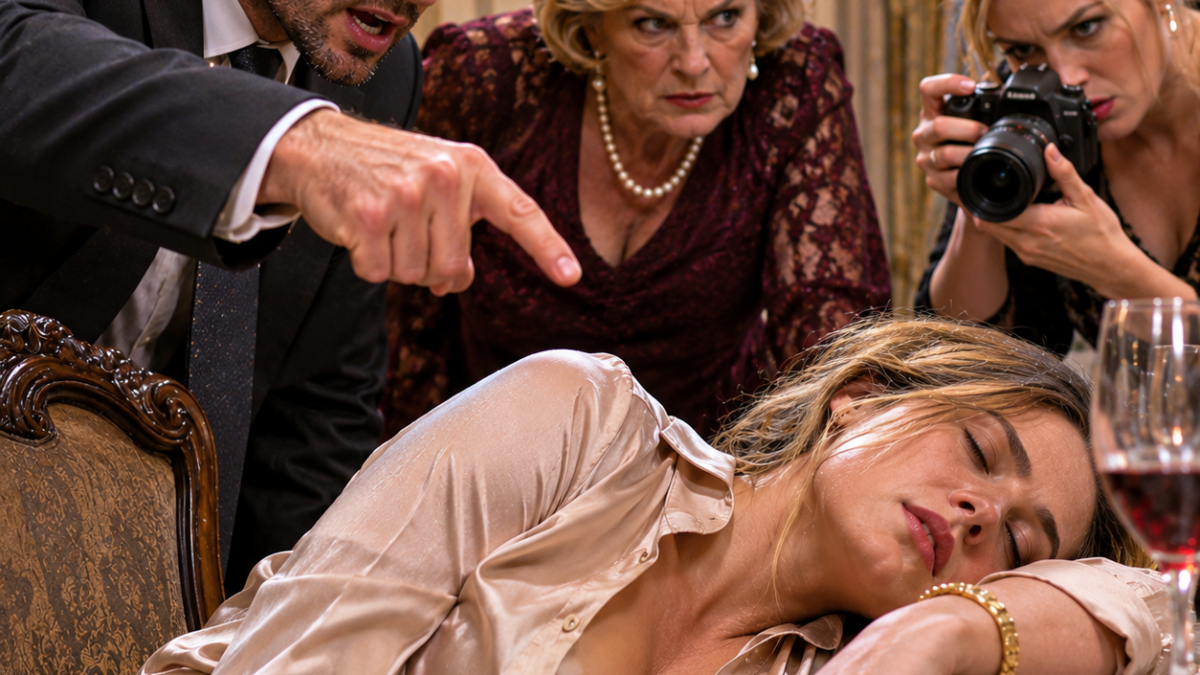
FULL STORY:“SHE’S OUT AGAIN—UNBUTTON HER BLOUSE, GET THE PAPERS, AND MAKE SURE THE PHOTOS LOOK REAL!” I Had Passed Out at My In-Laws’ Dinners Three Sundays in a Row—But This Time, I Pretended to Be Unconscious, Recorded Every Word, and Heard My Own Husband Give an Order That Made My Blood Run Cold…
FULL STORY CONTINUATION
I remember saying, “Something’s wrong.”
Brandon touched my forehead.
“You’re exhausted.”
“I can’t feel my legs.”
“You work too much.”
He helped me upstairs.
Then nothing.
When I woke, the clock said 11:18.
More than three hours were gone.
Brandon sat beside me scrolling through his phone.
“Welcome back,” he joked.
My blouse felt strange.
I looked down.
Two buttons were fastened into the wrong holes.
“What happened to my shirt?”
He glanced once.
“You probably twisted it in your sleep.”
I believed him.
The second month, it happened again.
This time I woke with my lipstick smeared from the corner of my mouth almost to my jaw.
Brandon laughed.
“You must’ve rubbed your face against the pillow.”
The third month, I tested them.
Before leaving home, I photographed my blouse.
I drew a tiny line beneath my watchband.
I synchronized my phone.
And at dinner, I noticed something.
A bitterness beneath the soup.
Subtle.
Easy to dismiss.
But real.
Ten minutes later, my arms became heavy again.
I pretended the dizziness was worse than it was.
Brandon carried me upstairs.
He laid me on the same bed.
Then, through half-closed eyes, I watched my husband take out his phone.
He photographed me.
Twice.
When he left, I fought the fog until I could sit.
My blouse had been disturbed.
The ink beneath my watch was smeared.
And when one of Brandon’s photographs automatically uploaded to our shared cloud account, I saw something near the bed.
A man’s hand.
Thick fingers.
Dark hair.
A heavy black ring.
I knew that ring.
Howard Pierce wore it every day.
For seven days, I said nothing.
I kissed Brandon goodbye.
Went to work.
Bought groceries.
Answered Loretta’s texts.
Slept beside my husband.
And quietly purchased a voice recorder and a tiny camera hidden inside a USB charger.
Then Loretta called.
“Come early Sunday, sweetheart. Howard has two gentlemen visiting from Dallas.”
My skin went cold.
When we arrived, the men were already there.
Dale Mercer barely looked at me.
Curtis Shaw never stopped.
Howard poured my wine.
I lifted the glass.
Pretended to swallow.
At seven, I let my eyes unfocus.
“My head feels strange.”
Brandon appeared beside me immediately.
“Not again.”
He sounded irritated.
Not worried.
He walked me upstairs.
Laid me on the familiar bed.
Kissed my forehead.
“Rest, babe.”
Then walked out.
The lock clicked from the outside.
I opened my eyes.
My heart was pounding so violently I thought they might hear it through the door.
Footsteps approached.
Curtis spoke first.
“She went down fast tonight.”
Then Howard answered.
“We gave her a little more.”
My blood turned cold.
The lock opened.
Three men entered.
Brandon.
Howard.
Curtis.
I closed my eyes.
And counted.
One.
Two.
Three.
Four.
Five.
Six.
Seven.
Then Brandon spoke.
“She’s out, Dad. Turn off her phone, get the Harbor Point papers, and make the pictures convincing this time.”
PART2
For one second, I forgot how to breathe.
There are moments when fear doesn’t feel like fear.
It feels like clarity.
Every sound became sharp.
Curtis’s shoe dragging slightly against the floor.
Howard’s breathing.
The tiny buzz of the charger camera I’d hidden near the dresser.
Brandon placing something heavy on the nightstand.
Then Howard said, “We need her signature before Monday.”
Curtis gave a nervous laugh.
“You really think she’ll sign after she wakes up?”
Howard answered calmly.
“She won’t have a choice.”
My stomach tightened.
Brandon lowered his voice.
“Dad, the pictures are enough.”
“No,” Howard said. “Pictures are leverage. Her signature is protection.”
A folder opened.
Paper slid against paper.
Then Curtis asked, “And if she still refuses?”
Silence.
Howard’s answer came slowly.
“Then we make sure nobody believes anything she says.”
I lay perfectly still.
My mind raced.
Harbor Point.
The project name had been haunting me for months.
A proposed redevelopment involving old industrial land, residential towers, commercial space, a marina, and public incentives.
Huge money.
Huge reputational stakes.
My firm had only peripheral involvement, but during a limited audit review, I had noticed a cluster of contractor invoices that didn’t make sense.
Different companies.
Same mailing addresses.
Duplicate billing patterns.
Consulting entities with no visible employees.
Payments routed through businesses connected by people nobody had properly disclosed.
I reported what I saw.
Nothing more.
I hadn’t accused anyone of fraud.
I hadn’t even known Howard was connected.
Until now.
Curtis moved closer.
“Let’s get the photograph.”
A hand touched my blouse.
My entire body screamed at me to move.
Instead, I heard Brandon say, “Wait.”
For one irrational second, hope rose.
Maybe he was stopping them.
Maybe some part of my husband still existed.
Then he said, “The top two buttons. Last time you opened too many and she noticed.”
Something inside me died.
I opened my eyes.
“Don’t touch me.”
Curtis jerked backward.
Brandon’s face went white.
Howard froze.
For perhaps the first time in his life, Howard Pierce looked genuinely surprised.
I pushed myself upright.
Curtis stumbled away from the bed.
Brandon whispered, “Gwen?”
I looked at him.
The man I’d married.
The man whose shoulder I slept against.
The man who had held my hand at my grandmother’s funeral.
“You knew.”
His mouth opened.
Nothing came out.
I reached into my purse.
Howard took one step forward.
“Gwen.”
I pulled out the recorder.
His expression changed.
I held it up between us.
“It heard everything.”
Curtis cursed.
Brandon looked toward his father.
Howard recovered almost instantly.
Of course he did.
Men like Howard built careers on recovering faster than everyone else.
“You’re frightened,” he said.
I laughed.
It came out broken.
“You drugged me.”
“Careful with accusations.”
“You just admitted it.”
“No.”
His voice became smooth.
“You heard a private conversation while emotionally distressed.”
I stared at him.
He was already rewriting reality.
Already building the defense.
Then Brandon stepped closer.
“Gwen, baby, listen to me.”
“Don’t call me that.”
His face crumpled.
“I can explain.”
“You photographed me unconscious.”
“It wasn’t what you think.”
“What do I think, Brandon?”
He stared.
I stood slowly.
My legs felt weaker than I wanted them to.
I had avoided most of the wine, but I didn’t know whether Loretta had put something in the food.
I kept the bed between us.
Curtis glanced toward the door.
Howard looked at my purse.
Then said, “Give me the recorder.”
“No.”
“Gwen.”
“No.”
His jaw tightened.
“You don’t understand how serious this is.”
I felt something almost like laughter rise inside me.
“I think I’m finally beginning to.”
Then the bedroom door opened.
Loretta stood there.
She looked from me to Howard.
Then to the recorder.
Her face drained.
“Howard?”
Nobody answered.
I stared at her.
The retired chemistry teacher.
The woman who prepared dinner every month.
The woman who always insisted on making my tea herself.
The woman who had kissed my cheek and told me I looked tired.
“You knew too.”
Her lips trembled.
“Gwen…”
“What did you put in my food?”
Howard snapped, “Loretta.”
She went silent.
I felt sick.
Not because she answered.
Because she didn’t.
I looked at Brandon.
“You all knew.”
His eyes filled.
“Not like you think.”
I almost screamed.
Instead, I heard pounding downstairs.
Everyone froze.
Then a voice.
“Houston Police! Open the door!”
Howard turned toward me.
His face changed completely.
“What did you do?”
I held his gaze.
“Made sure somebody knew where I was.”
Brandon whispered, “Oh my God.”
Howard moved toward the door.
Then stopped.
Another knock.
Louder.
“Police! Open the door!”
Loretta began crying.
Curtis backed toward the wall.
And I stood beside the bed shaking so badly I could barely hold the recorder.
But for the first time in four months, I wasn’t the person in that house with the least power.
Not because I had won.
Because the secret was no longer theirs alone.
The police did not immediately handcuff the entire Pierce family.
Real investigations don’t happen according to the timing of a Facebook revenge fantasy.
Officers separated us.
They secured the room.
They asked whether I needed medical treatment.
They documented the lock.
The papers on the table.
The recorder.
The charger camera.
My purse.
The dinnerware.
The food still downstairs.
They photographed the scene before moving things unnecessarily.
One officer asked whether anyone had touched me without consent.
I tried to answer.
My voice disappeared.
She crouched beside me.
“Take your time.”
I looked toward Brandon.
He was standing across the hallway with another officer.
His face was gray.
“I don’t know everything they did while I was unconscious before.”
The officer’s expression softened.
“Okay.”
“I woke up with my clothes changed.”
She nodded.
“We’ll document everything you remember.”
I looked toward Loretta.
She was crying quietly in the hallway.
Howard stood completely still.
His attorney wasn’t there yet, but I could almost see him thinking like one.
Curtis looked terrified.
Dale, who had apparently remained downstairs, kept insisting he had no idea what was happening upstairs.
Perhaps he didn’t.
That would be investigated.
Then Brandon tried to come toward me.
“Gwen.”
An officer blocked him.
“Sir, stay where you are.”
He looked over the officer’s shoulder.
“Please.”
I stared at him.
“Please what?”
His face collapsed.
“Don’t do this.”
For a moment, I couldn’t understand.
Then I realized he meant the police.
The recorder.
The consequences.
He still believed my response was the destruction.
Not what he’d done.
I looked at him.
“You drugged your wife.”
His eyes filled.
“Gwen—”
“You watched your father use me like a prop.”
“I didn’t—”
“You photographed me.”
He stopped.
“You helped convince me I was sick.”
His mouth trembled.
I could feel every officer in the hallway listening.
I didn’t care.
My voice broke.
“You made me afraid of my own memory.”
He looked down.
And I said the words that ended our marriage.
“You don’t get to ask me to protect you from what you did.”
Then I turned away.
Tessa met me at the hospital.
She came running down the corridor wearing jeans, mismatched shoes, and an old university sweatshirt.
I had never been happier to see another human being.
She stopped in front of me.
For one second, she looked as though she was about to ask a hundred questions.
Then she opened her arms.
I fell into them.
She held me while I cried.
No advice.
No interrogation.
No “I knew something was wrong.”
Just arms around me.
After several minutes, she whispered, “You did it.”
I pulled back.
“What?”
“You trusted yourself.”
That sentence nearly destroyed me.
Because she was right.
The recorder had helped.
The camera had helped.
The police mattered.
But everything began when I stopped accepting Brandon’s explanation.
My blood sugar.
Exhaustion.
Work stress.
Bad memory.
Sleeping badly.
All those explanations had one thing in common.
They required me to believe myself less than I believed him.
I looked at Tessa.
“I thought I was losing my mind.”
Her eyes filled.
“You weren’t.”
“I kept waking up wrong.”
“I know.”
“And he kept telling me—”
“I know.”
She took my face in both hands.
“Gwen, look at me.”
I did.
“You figured it out.”
I began crying again.
She hugged me.
And for the first time since I opened my eyes in that guest bedroom, I felt safe enough to stop being brave.
The hospital confirmed that something was in my system that I had not knowingly taken.
The medical team was careful about language.
They couldn’t tell me exactly how every prior episode had occurred based only on one night.
But the findings were consistent with my report.
Investigators later found substances and materials in the Pierce residence that became part of the evidence.
I won’t describe the specific drugs, concentrations, or preparation methods.
That isn’t the important part.
What mattered was intent.
Someone had repeatedly placed a sedating substance into something I consumed.
Someone had timed it.
Observed it.
Used my unconsciousness.
And then lied about what happened.
I spent the first night in the hospital staring at the ceiling.
Every time I closed my eyes, I heard Brandon’s voice.
The top two buttons.
Last time she noticed.
There is a special kind of horror in hearing someone you love discuss your body as though you aren’t a person.
Not Gwen.
Not his wife.
A problem.
A photograph.
A signature.
An obstacle.
At four in the morning, I asked the nurse whether I could shower.
She looked at the chart.
“Not yet.”
I nodded.
Then started crying.
I hadn’t realized how desperately I wanted to wash the Pierce house off me.
Detective Mara Valdez interviewed me the following afternoon.
She was in her early forties with dark hair pulled into a low ponytail and a voice that never rushed.
She didn’t tell me what she thought happened.
She asked what I remembered.
First dinner.
Second.
Third.
Fourth.
The button pattern.
The lipstick.
The hand with the black ring.
The recorder.
Harbor Point.
Brandon’s photographs.
When I finished, she asked, “Why did you suspect something before this dinner?”
I stared at my hands.
“Because the explanation stopped matching the evidence.”
She waited.
“I’m an auditor.”
A faint smile.
“I figured that part.”
I looked up.
“At work, if a number doesn’t reconcile, you don’t keep forcing it until it does.”
My voice trembled.
“You ask why.”
Valdez nodded.
“I kept trying to force my own life to reconcile.”
“How?”
“Brandon loved me. Therefore he wouldn’t hurt me.”
I laughed bitterly.
“So when the evidence said something happened, I changed the evidence instead of changing my assumption.”
Valdez’s face softened.
“That’s a very human thing to do.”
I looked down.
“It almost got me destroyed.”
She didn’t contradict me.
Instead, she asked about Harbor Point.
That was when the investigation became bigger than my marriage.
Harbor Point wasn’t merely one development.
It was a financial ecosystem.
Land acquisitions.
Construction contracts.
Environmental consulting.
Design work.
Municipal incentives.
Private lenders.
Investment vehicles.
Subcontractors.
A project large enough that money could disappear inside legitimate complexity.
Months earlier, I had been reviewing transactions connected to a client with exposure to the project.
One invoice caught my attention.
Then another.
Different company names.
Same formatting errors.
Same mailing suite.
Same unusual descriptions.
I followed the trail as far as my assignment allowed.
Then submitted an internal concern.
My supervisor escalated it.
I did my job.
Nothing more.
But Brandon knew I had found something.
I remembered the night.
We were eating takeout at our kitchen counter.
My notebook lay beside me.
He glanced at the cover.
“HARBOR POINT?”
I closed it.
“Work.”
“My dad knows that project.”
“I know.”
“What are you looking at?”
“I can’t discuss client information.”
He laughed.
“I’m your husband.”
“And I’m still bound by confidentiality.”
He kissed my cheek.
“Look at my little federal agent.”
I rolled my eyes.
He changed the subject.
At least, I thought he did.
Now Detective Valdez showed me a recovered draft document.
My name appeared at the bottom.
Gwen Hartley, Audit Associate.
There was a signature line.
My stomach dropped.
“What is this?”
“We’re still establishing how they intended to use it.”
I read the language.
It represented that I had reviewed certain records and found no material undisclosed conflicts related to contractor relationships.
I looked up sharply.
“I would never sign this.”
“Why?”
“Because it’s false.”
I pointed.
“I didn’t review all of these entities. I couldn’t possibly certify this.”
Valdez nodded.
“Could your professional title make the statement valuable?”
“Yes.”
My mouth went dry.
“If a lender or investor thought an independent auditor had reviewed the relationships, that could make the documents look cleaner than they were.”
Valdez watched me.
I whispered, “They needed me.”
“Your signature?”
“Yes.”
I felt sick.
“They weren’t drugging me because they hated me.”
Valdez remained silent.
I looked at the page.
“They were preparing to force me to validate the project.”
Two days later, Howard’s lawyers began their counterattack.
Not in court.
In public.
Someone anonymously emailed one of the staged photographs to my employer.
The image showed me apparently unconscious on the Pierce guest bed, blouse partly open, Curtis positioned near me in a way designed to imply intimacy.
No context.
No date explanation.
No mention that I had been drugged.
The email claimed I had engaged in “inappropriate conduct” with a consultant connected to a project under financial review.
It suggested I had hidden a conflict of interest.
I was sitting in Tessa’s apartment when my supervisor called.
His voice was careful.
“Gwen, I need you to come in.”
I closed my eyes.
“Did you receive a photograph?”
Silence.
Then:
“Yes.”
My stomach turned.
“It’s staged.”
“I understand there’s an investigation.”
“It was taken while I was unconscious.”
Another pause.
“Gwen, we’re not making assumptions.”
I felt tears gathering.
“But because Harbor Point overlaps with work you touched, compliance has to review the situation.”
I understood.
Professionally, I understood.
Personally, I felt destroyed.
“Am I suspended?”
“Administrative leave, with pay, while we assess the conflict and cooperate with authorities.”
I stared at the wall.
The Pierces had failed to get my signature.
So they were trying the second part of their plan.
Destroy my credibility.
That afternoon, I sat in Tessa’s kitchen and cried harder than I had at the hospital.
“My marriage is gone.”
She sat across from me.
“I know.”
“My in-laws drugged me.”
“I know.”
“Now I might lose my career.”
She shook her head.
“Not necessarily.”
“They have pictures.”
“They have staged pictures.”
“Do you think that matters to everyone?”
Tessa went quiet.
I laughed bitterly.
“Howard knows exactly how this works.”
My voice rose.
“He doesn’t need everyone to believe him.”
I wiped my face.
“He just needs enough people to wonder.”
Tessa reached across the table.
“Then let them investigate.”
I stared at her.
“What?”
“You’ve spent your career telling clients that records matter.”
She squeezed my hand.
“Let the records matter.”
I looked down.
She continued.
“You have the recorder.”
“The police have it.”
“You have medical findings.”
“Investigators have them.”
“You reported the contractor irregularities before any of this happened.”
I looked up.
Tessa nodded.
“That timestamp matters.”
For a moment, I couldn’t speak.
She continued.
“If Howard wants to tell a story, let him.”
Her eyes hardened.
“Facts don’t have to yell.”
I stared at my best friend.
Then laughed through tears.
“You should’ve been an auditor.”
“Absolutely not.”
That made me laugh again.
And for the first time since being placed on leave, I felt the smallest spark of fight return.
My employer’s investigation became unexpectedly important.
The firm’s IT department preserved the original internal report I’d submitted months earlier.
It showed that I had raised concerns about Harbor Point before the first suspicious photograph existed.
My email records showed I had refused to discuss confidential information with Brandon.
The metadata associated with the leaked photograph raised additional questions about its origin and editing history.
Compliance interviewed me.
Then Tessa.
Then my supervisor.
They coordinated with law enforcement.
It wasn’t instant vindication.
But slowly, the narrative Howard tried to create began collapsing.
I had not hidden a relationship with Curtis.
I had no business relationship with him at all.
I had not approved Harbor Point.
I had raised concerns.
The photographs were taken in a house where investigators were already examining suspected drugging.
And the man standing beside my unconscious body was connected to entities relevant to the financial inquiry.
What Howard thought would destroy me became another reason investigators looked harder.
That was his first catastrophic mistake.
His second was underestimating Loretta.
Loretta asked to speak with investigators.
Then she asked to speak with me.
I refused.
At first.
Three times.
I didn’t want her apology.
Didn’t want to hear that Howard pressured her.
Didn’t want tears from the woman who fed me meals before I lost consciousness.
My attorney, Nina Patel, never pushed me.
“She may provide evidence,” Nina said.
“That doesn’t mean you have to meet her.”
I nodded.
Weeks later, I changed my mind.
Not because I forgave Loretta.
Because I wanted one answer.
We met in a controlled setting with attorneys present.
Loretta looked ten years older.
No makeup.
Gray hair showing at the roots.
Hands trembling.
She sat across from me.
For a long moment, she couldn’t speak.
Then she whispered, “I’m sorry.”
I stared.
She began crying.
I felt nothing.
Not satisfaction.
Not pity.
Nothing.
I asked, “Did you know they were taking photographs?”
Her mouth trembled.
“Yes.”
My stomach tightened.
“When?”
“After the first dinner.”
I closed my eyes.
She continued quickly.
“Howard told me it was to protect Brandon.”
I opened my eyes.
“From what?”
“He said you had become obsessed with Harbor Point. That you were going to accuse people without understanding the consequences.”
“So you drugged me?”
Loretta sobbed.
“At first, he told me it was only to help you sleep.”
I stared.
“You were a chemistry teacher.”
She lowered her head.
“You knew better.”
“Yes.”
The word was almost inaudible.
“You knew better.”
“Yes.”
I felt tears rising.
“And you kept doing it.”
Her shoulders shook.
“Yes.”
I wanted to scream.
Instead, I asked, “Why?”
Loretta looked at me.
And finally gave an answer that sounded true.
“Because I was afraid of Howard.”
Silence.
She continued.
“I spent thirty-six years doing what he told me would protect this family.”
I stared.
“Did protecting your family include destroying me?”
She covered her face.
“No.”
“But you did.”
“Yes.”
For a moment, all I could hear was her crying.
Then she lowered her hands.
“There is something you don’t know.”
I stared.
“What?”
Loretta looked toward her attorney.
He nodded.
She turned back to me.
“Howard planned to use the photographs whether you signed or not.”
My blood went cold.
“Why?”
“To make Brandon look innocent if your marriage ended.”
I felt sick.
She continued.
“He wanted everyone to believe you were unstable and unfaithful.”
I stared at her.
“And Brandon knew?”
Loretta began crying harder.
“Yes.”
That answer hurt more than I expected.
By then, I knew Brandon had participated.
I’d heard his voice.
Seen the photographs.
Read messages.
But some irrational part of me still believed he had been trying to contain his father’s scheme.
Maybe protect the marriage after doing something unforgivable.
Maybe he was weak.
Maybe cowardly.
Maybe trapped.
Loretta destroyed that final illusion.
Brandon knew the photographs were intended to ruin me even if Harbor Point succeeded.
He wasn’t merely protecting his father.
He was protecting himself.
Our marriage had become collateral.
I stood.
Nina touched my arm.
“Gwen?”
“I need to leave.”
Loretta rose.
“Please.”
I turned.
She was crying.
“I know I don’t deserve forgiveness.”
“You’re right.”
Her face crumpled.
I continued.
“But if you’re cooperating because you finally understand what you did, tell them everything.”
She nodded.
“Everything.”
I looked at her.
“Not for me.”
She stared.
“For the next person Howard decides is disposable.”
Then I walked out.
Loretta’s cooperation changed the case.
She had kept things.
Howard’s instructions.
Old messages.
A calendar showing which dinners were planned around my monthly visits.
Notes she had made because, according to her, she had become frightened Howard would eventually blame everything on her.
Investigators found communications indicating Howard had increasingly viewed my professional concern about Harbor Point as an existential threat.
Brandon helped him understand my routines.
What I drank.
What I ate.
When I would become suspicious.
How I handled work conflicts.
What embarrassed me.
What could threaten my career.
My husband had turned intimate knowledge into operational intelligence.
That phrase came from Detective Valdez.
I hated it.
Because it was accurate.
One message from Howard to Brandon read:
If she starts questioning herself, she’s easier to manage.
Another from Brandon:
She already thinks the first episode was stress.
Howard replied:
Good. Keep reinforcing that.
I read those messages in Nina’s office.
Then walked to the bathroom.
Locked the door.
And vomited.
The financial investigation expanded beyond Howard’s immediate circle.
Banks.
Contractors.
Corporate records.
Subpoenas.
Search warrants.
Forensic accounting.
Harbor Point wasn’t merely inflated billing.
Several entities connected to Howard and Curtis had received payments disguised through consulting arrangements.
Some contractors billed for work that investigators alleged was overstated or duplicated.
There were undisclosed interests.
Side agreements.
And documents designed to make the transactions appear more independent than they were.
The exact criminal exposure depended on what prosecutors could prove.
But the project began collapsing under scrutiny.
A major lender paused financing.
Another investor withdrew.
A city-related approval was postponed pending review.
Howard blamed me publicly through carefully worded statements issued by counsel.
He never used my name directly.
But everyone knew.
A disgruntled relative.
A troubled marriage.
An employee exceeding her role.
He tried to turn me into the villain.
For several weeks, it worked on some people.
Online comments appeared.
Anonymous accounts called me vindictive.
Suggested I’d fabricated the poisoning after discovering Brandon’s supposed concerns about my fidelity.
I stopped reading them.
Tessa helped.
Whenever she saw my hand moving toward social media, she’d say, “Do you want evidence or strangers?”
I hated that question.
Because she was always right.
Three months after the fourth dinner, my employer called me into the office.
I sat across from our managing partner and head of compliance.
My stomach was knotted.
The compliance officer closed a folder.
“Gwen, we’ve completed our internal review.”
I gripped my hands beneath the table.
“We found no evidence that you concealed a relationship with any Harbor Point party.”
I stopped breathing.
She continued.
“Your original internal concern was appropriate.”
My eyes filled.
“The review also confirmed that you followed our confidentiality requirements when discussing work outside the firm.”
I looked toward the managing partner.
He smiled faintly.
“We’d like you to return.”
I covered my mouth.
For a moment, I couldn’t speak.
Then I whispered, “Really?”
“Yes.”
Tears spilled down my face.
The compliance officer continued.
“There are ongoing legal matters, and we’ll maintain appropriate boundaries. But professionally, we are satisfied that you acted properly.”
I nodded rapidly.
“Thank you.”
The managing partner leaned forward.
“Gwen.”
I looked at him.
“You raised a concern when it would’ve been easier not to.”
My throat tightened.
He continued.
“That matters here.”
I walked out of the building and called my father.
The moment he answered, I started crying.
“Dad.”
“What happened?”
“I got my job back.”
He went silent.
Then I heard him exhale.
“That’s my girl.”
I leaned against the building.
And cried even harder.
Brandon finally stopped calling.
Instead, he sent a letter through counsel.
Not an apology.
A proposal.
He wanted a divorce settlement.
He wanted financial terms resolved quickly.
And he wanted mutual confidentiality.
Nina read the proposal.
Then looked at me.
“He wants you to agree not to discuss the marriage publicly.”
I laughed.
“Of course.”
“He’s offering more favorable financial terms than I expected.”
I stared at her.
“In exchange for silence?”
“In part.”
I thought about it.
Then asked, “Would it prevent me from cooperating with investigators?”
“No agreement we recommend would interfere with lawful cooperation.”
“Would it stop me from correcting false statements about me?”
“We would need very careful language.”
I leaned back.
For a moment, money tempted me.
Not greed.
Freedom.
A fast divorce.
No more legal bills.
No more direct fighting.
Then I remembered being locked in that bedroom.
Brandon saying, Make the pictures convincing.
I shook my head.
“I won’t sign anything that forces me to pretend nothing happened.”
Nina nodded.
“I assumed you would say that.”
I smiled weakly.
“Am I predictable?”
“In the best way.”
We negotiated.
I received what I was legally entitled to.
No hush-money bargain.
No forced lie.
No agreement that transformed my truth into Brandon’s property.
When the divorce became final, I stood outside the courthouse with Nina.
She asked, “How do you feel?”
I looked at the sky.
“Sad.”
She nodded.
“Relieved.”
Another nod.
“Angry.”
She smiled faintly.
“Anything else?”
I thought for a moment.
“Free.”
That was the first word that made me smile.
The criminal case took longer.
Almost a year after the fourth dinner, prosecutors announced charges connected to the conduct investigators believed they could prove.
The exact allegations differed by defendant.
Howard faced serious charges tied to the financial scheme, coercive conduct, and conspiracy-related activity.
Brandon faced charges arising from his participation.
Curtis negotiated cooperation.
Loretta’s cooperation affected how prosecutors treated her role, but it did not erase what she had done.
Dale was not accused of participating in everything that happened upstairs, though investigators examined his business involvement separately.
The case moved through hearings.
Motions.
Evidence disputes.
Negotiations.
The kind of slow legal machinery that never feels satisfying while you’re living through it.
Then came the day Howard finally had to appear in court for a major proceeding connected to both the financial case and the acts against me.
The hallway was packed.
Reporters.
Attorneys.
Former business associates.
People who used to laugh at Howard’s jokes.
I arrived through a side entrance.
Not because I wanted attention.
Because prosecutors had asked me to be available.
When Howard entered, conversation stopped.
He looked older.
His famous confidence was still there.
But thinner.
Like a suit that no longer fit.
Then he saw me.
Our eyes met.
For years, Howard had looked at me like a junior employee who happened to marry his son.
A useful girl.
Smart enough to impress people.
Not important enough to threaten him.
This time, he didn’t smile.
I didn’t either.
He walked past.
And I realized something.
I wasn’t afraid of him anymore.
The most satisfying moment did not come when Howard was led into the courtroom.
It came later.
At a public meeting related to the Harbor Point project’s future.
The development had become so entangled in litigation, financing problems, and regulatory scrutiny that stakeholders needed to determine whether any version of it could proceed.
My firm did not send me as a representative.
I was there because portions of the record involved concerns I’d originally raised and because my testimony had been requested in another related proceeding.
Howard’s original project banners were gone.
The glossy renderings showing towers against a sunset had disappeared.
No champagne.
No cameras celebrating a closing.
Just lawyers.
Accountants.
Regulators.
Investors.
And documents.
A forensic accountant presented findings showing how money moved through the network.
A lender representative explained why financing had been suspended.
Then one of the attorneys displayed a document.
The draft certification bearing my name.
The one they wanted me to sign.
My stomach tightened.
The attorney said, “Ms. Hartley never approved this representation.”
Then displayed my original internal report.
Dated months earlier.
Before the staged photographs.
Before the fourth dinner.
Before anyone could claim revenge.
The room went silent.
He continued.
“Her actual documented position was the opposite.”
That was it.
No dramatic music.
No screaming.
Just two documents.
One they wanted to force me to sign.
One I had actually written.
Truth beside fabrication.
I looked around the room.
Several people who had once dismissed me were staring at the screen.
And suddenly, Howard’s entire strategy looked embarrassingly simple.
He had believed power could rewrite chronology.
It couldn’t.
The date on my report remained the date on my report.
No amount of money could change it.
Afterward, I walked outside.
Brandon was waiting near the courthouse entrance.
Not alone.
His attorney stood several feet away.
I stopped.
He looked thinner.
Tired.
For a long moment, neither of us spoke.
Then he said, “Gwen.”
I looked at him.
“I know I shouldn’t approach you.”
“Then why did you?”
His eyes filled.
“I wanted to see you.”
I felt nothing at first.
Then sadness.
Not love.
Not longing.
Grief for the man I’d believed existed.
He swallowed.
“I heard your firm cleared you.”
“Yes.”
“I’m glad.”
I stared.
He looked down.
“I know that means nothing.”
“It doesn’t mean nothing.”
He looked up hopefully.
I continued.
“It just doesn’t fix anything.”
His face fell.
“I know.”
We stood in silence.
Then he whispered, “I loved you.”
I almost laughed.
Instead, I asked, “When?”
The question startled him.
“What?”
“When did you love me?”
His eyes filled.
“Gwen—”
“When you watched me eat food you knew was drugged?”
He looked away.
“When you photographed me?”
His jaw trembled.
“When you told me my blood sugar dropped?”
He covered his face.
I felt tears gathering.
“You don’t get to use love as an explanation for what you did.”
He lowered his hands.
“I was afraid of my father.”
“So was Loretta.”
“I know.”
“And Curtis was afraid of being exposed.”
He nodded.
“Everyone was afraid of something.”
I stepped closer.
“So what?”
He stared.
“Fear explains why people feel trapped.”
My voice broke.
“It doesn’t erase the door they chose to lock behind someone else.”
Tears rolled down his face.
“I don’t expect forgiveness.”
“Good.”
He flinched.
I swallowed.
“Because I don’t have it for you.”
He looked down.
For a moment, I almost reached toward him.
Muscle memory.
Three years of marriage.
Then I stopped.
I didn’t need to comfort the man who had helped make me unconscious.
He whispered, “I’m sorry.”
I stared at him.
Then answered, “I hope someday you understand what you’re sorry for.”
And walked away.
Months later, Brandon entered a plea resolving significant parts of the case against him.
Howard continued fighting longer.
Of course he did.
Men like Howard mistake surrendering a lie for losing their identity.
But the financial evidence was extensive.
Witnesses cooperated.
Documents contradicted his public explanations.
The recordings mattered.
So did the texts.
So did the transaction trails.
Eventually, Howard’s position collapsed.
He was convicted on some charges and resolved others through the legal process.
The exact sentence mattered less to me than I expected.
For so long, I’d fantasized about the moment someone would say he was going to prison.
I thought I’d feel triumphant.
Instead, when Nina called with the outcome, I sat quietly.
“That’s it?” I asked.
“That’s the judgment.”
I looked toward my apartment window.
Houston traffic moved below.
People going to work.
Picking up children.
Buying groceries.
Living ordinary lives.
I whispered, “Okay.”
Nina paused.
“You don’t sound happy.”
I thought about it.
Then said, “I’m relieved.”
“That counts.”
I nodded.
Howard Pierce had spent decades building a reputation that made people afraid to challenge him.
In the end, he wasn’t defeated by a louder man.
Or a richer one.
He was defeated by records.
Dates.
Witnesses.
Bank transactions.
A frightened daughter-in-law who kept a recorder running.
And the fact that reality eventually becomes very difficult to negotiate with.
Loretta accepted responsibility for her part.
She lost friendships.
Reputation.
The comfortable life she’d spent decades protecting.
Through her attorney, she sent me one final message.
No excuse.
No request for forgiveness.
Just this:
I taught chemistry for twenty-eight years and spent my career telling children that actions produce consequences. Then I spent my marriage pretending that rule didn’t apply inside my own house. I am sorry.
I read it once.
Then put it away.
I didn’t respond.
Sometimes people deserve the dignity of changing without being rewarded with access to the person they harmed.
Curtis’s cooperation helped confirm what the staged photographs were intended to accomplish.
Several images were destroyed through the appropriate legal processes after they were no longer needed.
Others remained preserved as evidence subject to strict controls.
For months, I had nightmares that they would appear online.
A photograph of me unconscious.
A stranger beside me.
My clothes arranged to tell a false story.
Eventually, my counselor asked me a question.
“What would that photograph actually prove about you?”
I stared at her.
“That I was vulnerable.”
“Yes.”
I waited.
“What else?”
I thought.
“That people harmed me.”
She nodded.
“What would it prove about your character?”
I opened my mouth.
Then stopped.
Nothing.
The realization felt almost physically painful.
For months, I’d been terrified the image could shame me.
But the shame belonged to the people who created it.
Not the unconscious woman inside it.
I began crying.
My counselor waited.
Then said, “You don’t have to carry their shame for them.”
That sentence freed something inside me no court ever could.
Two years after the fourth dinner, I went back to River Oaks.
Not to the Pierce house.
I never entered it again.
The property had eventually been sold after Howard’s legal and financial problems grew.
Instead, I attended a charity dinner at a hotel three streets away.
My firm had invited me.
For days, I considered refusing.
Formal dinner.
Wine.
Men in suits.
Expensive food.
Everything about it reminded me of the Pierce Sundays.
Then I decided to go.
I wore the same white blouse from the third dinner.
The one I had almost thrown away.
The pearl buttons were fastened perfectly.
One.
Two.
Three.
I wore red lipstick.
Not because I needed to prove something.
Because I liked it.
Tessa came with me.
She looked at my blouse and smiled.
“That’s the one?”
I nodded.
“You sure?”
I took a breath.
“Yes.”
We entered the ballroom.
Hundreds of people.
Waiters carrying trays.
Glasses clinking.
Music playing softly.
For the first twenty minutes, I monitored every drink.
Every plate.
Every person walking behind me.
Then a waiter placed dinner on the table.
I stared at it.
Tessa waited.
I picked up my fork.
Took one bite.
Nothing happened.
Second bite.
Nothing.
Halfway through the meal, I realized I was listening to the woman beside me tell a ridiculous story about her dog instead of tracking who had touched my glass.
I smiled.
Then laughed.
Actually laughed.
Tessa looked over.
“What?”
I shook my head.
“Nothing.”
Her eyes narrowed.
“You’re crying.”
I touched my cheek.
She was right.
I whispered, “I’m eating dinner.”
Her expression softened.
“Oh, Gwen.”
I laughed through tears.
“I’m just eating dinner.”
She raised her glass.
“To boring food.”
I raised mine.
“To boring food.”
We clinked glasses.
And I drank.
Later that year, I was promoted.
Not because of Harbor Point.
Not as compensation.
Because I had done my work well.
My managing partner called me into his office.
“I want you helping train younger auditors.”
I stared.
“Me?”
He smiled.
“You ask uncomfortable questions.”
I laughed.
“That’s usually considered annoying.”
“Not in this profession.”
He leaned back.
“One of the hardest skills to teach is the difference between suspicion and professional skepticism.”
I nodded.
He continued.
“You don’t accuse without evidence.”
“No.”
“But you don’t ignore contradictions because somebody important wants you to.”
I felt my throat tighten.
“No.”
He smiled.
“That’s what I want you teaching.”
I accepted.
My first training session was about documentation.
Not poisoning.
Not marriage.
Documentation.
I stood in front of twenty young professionals and wrote one sentence on the board.
IF THE EXPLANATION DOESN’T MATCH THE EVIDENCE, STOP AND ASK WHY.
A young auditor raised his hand.
“What if the person giving the explanation is senior to you?”
I smiled.
“Then you ask respectfully.”
“What if they get angry?”
“Document the answer.”
A few people laughed.
I smiled too.
Then said, “Authority can make an explanation sound convincing.”
The room quieted.
“It doesn’t make the explanation true.”
I thought about Howard.
Brandon.
Loretta.
My own reflection after the first dinner.
Then continued.
“Your job isn’t to be fearless.”
I paused.
“Your job is to be honest about what the evidence says, even when you’re afraid.”
Three years after the night everything ended, my father took me to dinner for my thirtieth birthday.
Just the two of us.
He chose a small Italian restaurant.
When the waiter brought wine, Dad looked at me.
“Want me to taste it first?”
I stared.
He immediately looked horrified.
“I’m sorry. That was stupid.”
I surprised both of us by laughing.
Actually laughing.
“Dad.”
“I shouldn’t have—”
“It’s okay.”
He studied me.
“Really?”
I nodded.
Then reached for my glass.
“I’ll taste my own wine.”
His eyes filled.
I took a sip.
Set it down.
“Good.”
Dad smiled.
Then looked away quickly.
I touched his hand.
“I’m okay.”
He swallowed.
“I know.”
“No.”
I squeezed his fingers.
“I mean I’m actually getting there.”
His eyes filled.
“Good.”
For a moment, neither of us spoke.
Then Dad asked, “Do you ever think about Brandon?”
I looked toward the candle.
“Sometimes.”
“Do you miss him?”
I thought carefully.
“I miss who I thought he was.”
Dad nodded.
“That sounds hard.”
“It is.”
I looked around the restaurant.
“But I don’t miss being married to the person he really became.”
Dad squeezed my hand.
Then smiled.
“Good.”
I laughed.
“That sounded almost threatening.”
“I was a principal for thirty-five years. I can threaten people politely.”
I laughed so hard the waiter looked over.
It was one of the best dinners of my life.
Nothing dramatic happened.
Nobody passed out.
Nobody whispered behind a locked door.
Nobody photographed anyone.
We ate pasta.
Argued about dessert.
And drove home.
Ordinary.
Safe.
Mine.
I kept the recorder.
Not the original evidence device.
That remained handled according to the legal process.
I bought another one later.
Same model.
It sits in a drawer.
I don’t carry it everywhere.
I don’t secretly record every room I enter.
I’m not interested in living my entire life waiting for betrayal.
I keep it because it reminds me of something.
There was a night when everyone around me expected me to remain unconscious.
Howard expected silence.
Curtis expected fear.
Loretta expected obedience.
Brandon expected trust to protect him.
Instead, I listened.
Seven seconds.
That was all it took.
Seven seconds after my husband locked the door, he destroyed the lie he’d spent months teaching me.
Your blood sugar.
You’re exhausted.
You’re dramatic.
You’re imagining things.
You work too hard.
You’re too suspicious.
All of it disappeared the moment I heard his voice.
And although hearing it nearly broke me, I am grateful for one thing.
I finally stopped arguing against my own instincts.
People sometimes ask what the most satisfying part was.
Howard losing Harbor Point?
No.
Brandon pleading guilty?
No.
Getting my career back?
Close.
Winning the divorce?
No.
Walking into a courtroom and watching powerful people finally answer questions they couldn’t intimidate away?
That felt good.
But it still wasn’t the best part.
The best moment happened years later.
I was standing in my apartment getting ready for work.
White blouse.
Red lipstick.
Hair pulled back.
I reached the door.
Then stopped.
For no particular reason, I walked back to the mirror.
I looked at myself.
For years, mirrors had been evidence.
Were my buttons wrong?
Was my lipstick smeared?
Did I look confused?
Was there something I couldn’t remember?
That morning, I saw none of those things.
I saw me.
Gwen Hartley.
Thirty years old.
Senior auditor.
Divorced.
Still occasionally afraid.
Still sometimes angry.
Still capable of trusting people.
Still capable of trusting herself.
I smiled.
Then said aloud, “I believe you.”
It sounds ridiculous.
Nobody else was in the room.
But I needed to hear it.
Because there had once been a woman standing in that same mirror wondering whether she had imagined the evidence written across her own body.
That woman deserved an answer.
So I gave her one.
“I believe you.”
And that was the moment the Pierces finally lost everything they had tried to take from me.
Not money.
Not reputation.
Not Harbor Point.
Control.
Howard once believed forty-eight million dollars made him powerful enough to rewrite reality.
Brandon believed marriage gave him enough access to teach me not to trust myself.
Loretta believed keeping the family together justified silence.
Curtis believed he could hide behind men richer than he was.
Every one of them made the same mistake.
They believed truth was weak because it was quiet.
It isn’t.
Truth can wait.
It can sit inside a recorder.
It can remain in an email archive.
It can hide in timestamps.
Bank records.
Medical tests.
Metadata.
A frightened woman’s memory.
It does not have to shout on the first night.
It only has to survive long enough to be examined.
For four months, I thought something was wrong with my body.
There wasn’t.
Something was wrong with the people around me.
They drugged me.
They staged photographs.
They tried to make me doubt myself.
They tried to use my own professional reputation as a weapon against me.
And the man who promised to love me helped them do it.
But they failed.
Not because I was stronger than all of them.
Not because I was fearless.
I was terrified.
They failed because fear finally stopped being enough to make me ignore the evidence.
That fourth Sunday, I lay in a locked guest room pretending to be unconscious while my husband stood beside his father and discussed how to destroy me.
Seven seconds later, I knew the truth.
Years later, if you asked me what I would tell the woman lying on that bed, I wouldn’t tell her to be brave.
I wouldn’t promise that everything would be easy.
I wouldn’t tell her she would never be afraid again.
I would lean close enough for her to hear me and say the one thing nobody in that house wanted her to know.
“Gwen, you’re not crazy.”
“You saw what you saw.”
“You felt what you felt.”
“And the moment their story stops matching the evidence, believe yourself.”
Because the Pierces thought the most dangerous thing in their house was my recorder.
They were wrong.
The most dangerous thing was the moment I stopped doubting myself.








