FULL STORY:“SHE’S JUST THE MAID—WHO’S GOING TO BELIEVE HER?” My Fiancée Planted My Dead Mother’s Ruby Brooch in Our Housekeeper’s Coat—She Never Knew Every Cruel Thing She Did Was on Camera
PART2
Albert Hayes had worked for the Lawson family for forty years.
He was seventy-one.
White hair.
Straight posture.
Bad back.
Perfect manners.
He had been Scott’s parents’ butler before Scott was old enough to tie his shoes.
Calling him a butler did not entirely explain what he was.
He knew every lock in that house.
Every contractor.
Every family friend.
Every room where Scott’s mother had hidden Christmas presents.
He had held Scott’s father’s coat on the night the ambulance came.
He had stood three feet behind Scott at both parents’ funerals.
He had watched Lawson Manor become beautiful and quiet after grief emptied it.
And he had already begun watching Amber.
I did not know that.
That morning, he simply stood at the far end of the entrance hall while I wiped up the coffee Amber had deliberately spilled.
Amber inspected my work.
“Again.”
I looked up.
“What?”
“Clean the whole floor again.”
“I already—”
Her eyebrows rose.
I stopped.
“Yes, ma’am.”
She turned.
Albert said:
“Miss Amber.”
She looked back.
“Yes?”
“Was there something wrong with Faith’s work before the coffee spilled?”
Her smile changed immediately.
“Albert.”
“Yes, ma’am?”
“I’m sure Scott values your long service.”
A warning disguised as praise.
Albert smiled politely.
“I’m sure he does.”
Amber walked away.
I expected Albert to tell me to stop.
Instead he crouched carefully beside me and picked up the second cloth.
“You do half.”
“I’ll do half.”
I stared.
“Mr. Albert.”
“My back has survived forty years in this house.”
“It can survive marble.”
“You don’t have to.”
“No.”
He looked toward the hallway Amber had disappeared into.
“But neither do you.”
That sentence scared me.
Not because he meant the floor.
Because some part of me understood the larger meaning.
I shook my head.
“She’s stressed.”
“Wedding.”
“Press.”
“Guests.”
Albert’s mouth tightened.
“Pressure does not create cruelty.”
He wrung out the cloth.
“It reveals what somebody stops bothering to hide.”
I said nothing.
Because admitting he might be right meant admitting I was choosing to stay somewhere I was being mistreated.
And staying felt easier when I called Amber stressed.
The next day, my mother packed pasta for my lunch.
Homemade.
Tomatoes.
Garlic.
Cheap ingredients.
Good food.
I had been cleaning guest rooms since seven and was starving by one.
I sat at the small staff kitchen table.
Two bites.
Amber entered.
She stopped.
Her nose wrinkled.
“What is that smell?”
I looked up.
“My lunch.”
She leaned toward the container as though inspecting garbage.
“My mother made pasta.”
Amber gave a little laugh.
“This kitchen smells like a cheap snack bar.”
“I can eat outside.”
“No.”
I frowned.
“No?”
“You’ll eat nowhere in my kitchen.”
I thought she meant take it elsewhere.
I reached for the container.
Amber got there first.
“Ma’am?”
She lifted it.
Walked to the trash.
My stomach tightened.
“Please don’t.”
She looked at me.
That moment stayed with me longer than the brooch.
Because she heard me.
She understood exactly what I was asking.
And then she dumped the pasta into the garbage.
Slowly.
The container knocked against the metal rim.
Sauce splashed against paper towels.
Amber held the empty container out.
“There.”
I stared.
“That was all I brought.”
She tilted her head.
“Then perhaps tomorrow you’ll bring something less offensive.”
I swallowed.
“Kindness costs nothing.”
It came out before I could stop it.
Amber froze.
“Excuse me?”
My heart started pounding.
I should have apologized.
Old Faith almost did.
Instead:
“I said kindness costs nothing.”
She walked toward me.
Her heels clicked against the tile.
“You are lecturing me?”
“No.”
“Then what are you doing?”
“Telling the truth.”
Her face became cold.
“The truth?”
She stood close enough that I could smell her perfume.
“The truth is you’re replaceable.”
My eyes burned.
She continued:
“Do not confuse Scott being polite with you being important.”
I looked down.
“Yes, ma’am.”
“My guests arrive at three.”
“I want you at the front gate.”
“The gate?”
“Yes.”
“Outside?”
“Unless the gate moved into the house while I wasn’t looking.”
Rain hammered the windows.
I whispered:
“May I take an umbrella?”
Amber smiled.
“The umbrellas are for guests.”
I stood at the gate for two hours.
There were no guests.
Not one.
My uniform clung to my body.
My shoes filled with water.
Rain ran down the back of my neck.
At first, I thought perhaps people were late.
At 3:30, I checked the road.
At four, I started shivering.
At 4:20, I considered leaving.
Then remembered tuition.
Mom’s medication.
Two more years.
At five, Albert appeared carrying a black umbrella.
He held it over me.
I said:
“Thank God.”
He looked at my soaked uniform.
His eyes filled with something that looked almost like shame.
“There were never any guests.”
I stared.
“What?”
“I heard her on the phone.”
“She told her friend she sent you out here because she was tired of looking at you.”
My face went numb.
“No.”
Albert’s jaw tightened.
“I’m sorry.”
I looked at the house.
Warm lights behind glass.
Amber somewhere inside.
Dry.
Laughing.
I started walking.
Albert followed with the umbrella.
“Faith.”
“I’m fine.”
“No.”
“I’m fine.”
“You are shaking.”
“I said I’m fine.”
He stopped.
I stopped too.
Then he asked:
“Why do you stay?”
The question made me angry.
Not at him.
At myself.
“Because some of us don’t have retirement accounts and houses.”
Albert flinched.
I regretted it instantly.
“I’m sorry.”
“No.”
He shook his head.
“You’re right.”
I closed my eyes.
“My mother needs medication.”
“Two years of school left.”
“This job pays almost twice the others.”
“If I quit, Amber wins and I lose something I need.”
Albert looked toward the house.
Then said quietly:
“Need is not consent.”
I opened my eyes.
“What?”
“Needing a paycheck does not mean she owns the rest of you.”
I started crying.
Not loudly.
That made it worse.
Albert turned away slightly so I could keep some dignity.
Then handed me the umbrella.
“Take it.”
“What about you?”
“I’m seventy-one.”
“I’ve been wet before.”
I laughed through tears.
That night, Mom took one look at me and said:
“It rained inside the palace again?”
I tried to joke.
Failed.
She touched my wet hair.
“What did she do?”
“Nothing.”
“Faith.”
“Please.”
Mom stared.
I sat at the kitchen table.
Took out Dad’s notebook.
She waited.
Finally:
“She threw away my lunch.”
Mom went still.
“What?”
“Then she sent me outside.”
“For two hours.”
Mom’s face tightened.
“Why?”
“She said guests were coming.”
“Were they?”
I looked down.
“No.”
My mother stood.
“Give me the address.”
I almost laughed.
“Mom.”
“I’m serious.”
“What are you going to do?”
“Something illegal.”
That actually made me smile.
“Sit down.”
She sat reluctantly.
Then:
“Quit.”
“I can’t.”
“We’ll manage.”
“I need tuition.”
“We’ll manage.”
“Your medicine.”
“Faith.”
She reached across.
“I would rather skip medicine than know you’re buying it by letting some woman grind you down every day.”
Tears filled my eyes.
“That’s not fair.”
“No.”
“What’s not fair is my daughter thinking my pills are the reason she has to accept humiliation.”
I looked away.
Mom softened.
“Two more years.”
“I know.”
“You’re going to be a teacher.”
“Yes.”
“So start teaching now.”
“What?”
“Teach that woman how people are supposed to treat you.”
I laughed weakly.
“I don’t think she’s trainable.”
“Then teach yourself.”
That hurt because I understood.
I opened the notebook.
Mom waited.
“What’s today’s good thing?”
I wrote:
Mr. Albert brought me an umbrella.
Mom read it.
Then sighed.
“You know your father started that exercise so we wouldn’t lose hope.”
“I know.”
“He did not mean you had to turn every bad thing into permission for tomorrow’s bad thing.”
I closed the notebook.
Across town, Albert was in the small security room at Lawson Manor.
He saved the rain footage.
Then the kitchen footage.
Then the entrance hall.
He created a separate folder.
AMBER — STAFF CONDUCT
He had not installed cameras specifically to trap her.
Lawson Manor already had surveillance covering entrances, hallways, common work areas, and Scott’s study after a burglary years earlier.
But Albert had begun preserving clips because ordinary recording systems eventually overwrote old footage.
He had noticed Amber’s pattern.
Every time Scott left town, she changed.
He did not yet call Scott.
Years of service had taught Albert something complicated.
When rich families fracture, staff are often accused of interference.
He feared Scott would believe he was judging the woman Scott loved.
So he waited.
That decision would later haunt him.
Amber got worse.
Not dramatically at first.
She moved one vase, then blamed me for moving it.
She asked me to clean a guest room, then claimed she had asked for the library.
She had me polish silver twice.
Then three times.
One afternoon she watched me kneel beside a baseboard and said:
“Do you enjoy being told what to do?”
I looked up.
“No, ma’am.”
“Then why are you so good at it?”
I said nothing.
She smiled.
“Some people are made for service.”
That night, I wrote:
Mom and I had hot chocolate.
One good thing.
Amber began speaking openly about what would happen after the wedding.
The first time was to her friend Heather.
She did not know I was in the pantry.
“Once the ring is on my finger, the house changes.”
Pause.
“First the maid.”
I froze.
“Then Albert.”
“He’s practically furniture.”
Another laugh.
“And this whole gloomy mausoleum gets renovated.”
My hand tightened around a stack of napkins.
She wanted me gone.
That explained the notices.
The insults.
The constant manufactured failures.
She was building a reason.
Later that afternoon, she entered Scott’s study.
I was cleaning the adjoining hall.
I heard the drawer.
Then silence.
She emerged smiling.
I did not know what she had taken.
The camera did.
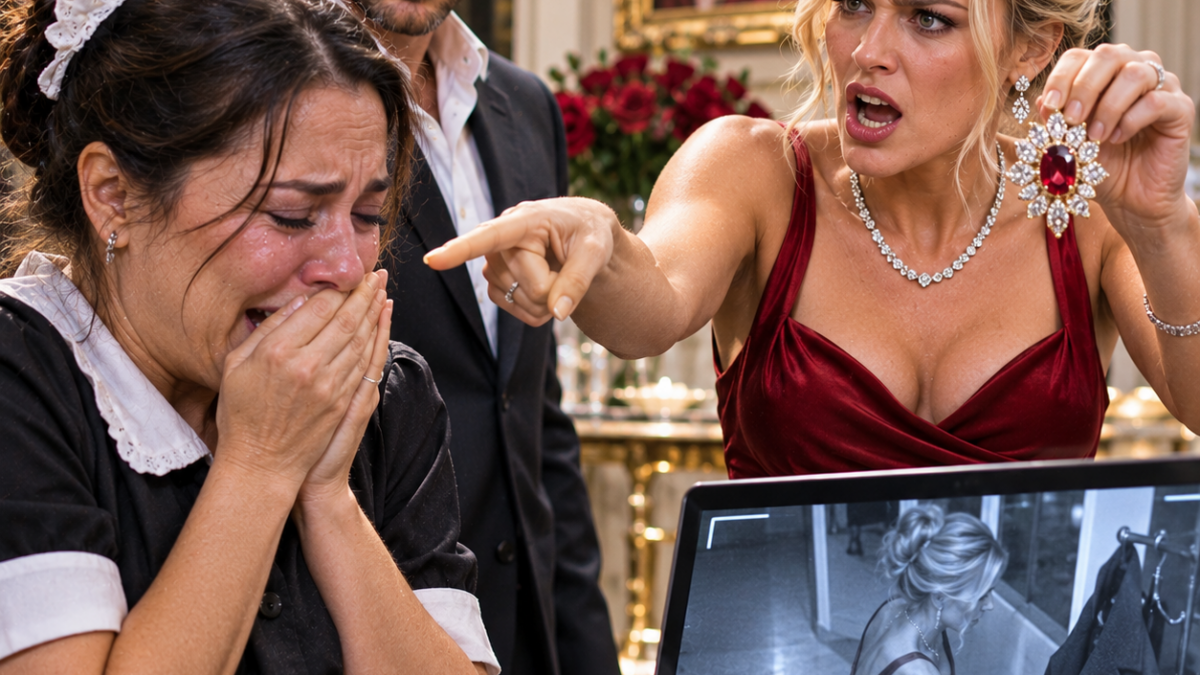
Scott’s mother’s ruby brooch.
Eleanor Lawson had died eighteen months earlier.
The brooch was not the most expensive piece in the house.
It mattered because she wore it.
Scott’s graduation.
His father’s funeral.
The last Christmas photograph before cancer changed everything.
Amber held it to the camera angle without realizing.
Her friend Heather’s voice came through speakerphone.
“Isn’t that his mother’s?”
“His mother’s precious brooch.”
Amber laughed.
“I have a better use for it.”
She slipped it into her purse.
Albert watched the clip that night.
That was when he called Scott.
Not immediately.
He paced.
Twice.
Then picked up the phone.
Scott answered from Chicago.
“Albert?”
“Sir.”
“What is it?”
Albert said:
“I need you to look at the security archive.”
Silence.
“Why?”
“Because I believe Miss Amber is behaving very differently when you are away.”
Scott did not respond for several seconds.
“What does that mean?”
“It means I would rather you see it yourself.”
Albert sent the files.
Scott watched them in a hotel room.
Coffee.
Lunch.
Rain.
Amber’s phone calls.
Her threat that I was replaceable.
He called Albert back.
His voice was different.
“How long?”
“About a week at this level.”
“Why didn’t you call me sooner?”
Albert answered honestly.
“Would you have believed an old butler over the woman you intend to marry?”
That silenced him.
Albert continued:
“I thought perhaps I was being protective.”
“Then I saw the brooch.”
Scott whispered:
“My mother’s brooch?”
“Yes.”
Scott watched that clip.
Then another.
Amber standing in the study mirror holding the ruby against her dress.
He did not sleep.
The next morning he changed his flight.
Amber thought he was returning Sunday.
He came Saturday.
No car.
No announcement.
Albert met him at the side entrance.
Scott looked exhausted.
“Where is she?”
“Garden.”
“And Faith?”
“Kitchen.”
Scott took off his coat.
“I want to watch.”
Albert frowned.
“You have watched enough.”
Scott looked at him.
“I need to know whether what I saw was a bad week or who Amber actually is.”
Albert’s face hardened.
“And while you investigate her character, what happens to Faith?”
Scott stopped.
That question would matter later.
But then he still thought he was being careful.
He said:
“Today.”
“Only today.”
Then he walked into the garden.
Amber saw him.
Her entire face transformed.
“Scott!”
She ran into his arms.
“You’re home.”
“You said Sunday!”
“I missed home.”
“You should have called.”
“I wanted to surprise you.”
She kissed him.
Scott kissed her back.
That fact hurt me later.
But in that moment I knew nothing.
I was in the kitchen making tea.
Scott appeared.
I smiled despite myself.
“Mr. Lawson.”
“Faith.”
“Welcome home.”
“Thank you.”
“Tea?”
“Yes.”
“Two sugars.”
He looked at me.
“You remember.”
“Someone in this house has to.”
I froze.
Too honest.
Scott almost smiled.
Then Amber entered.
Her voice became honey.
“Faith, dear, take Scott’s tea into the dining room.”
Scott said:
“I’m fine here.”
“The kitchen?”
“Yes.”
Amber’s smile tightened.
“Of course.”
Then:
“Faith, the silver needs polishing before tonight.”
“I did it yesterday.”
Her eyes warned me.
“Then it should be quick.”
“Yes, ma’am.”
Scott watched.
I lowered my head.
That afternoon, I caught him looking at me more than once.
Not romantically.
Studying.
I mistook it for suspicion.
Later, I would learn he had begun feeling ashamed.
Because every ordinary thing looked different once he knew.
The way I paused before answering Amber.
The way my shoulders tightened when her perfume entered a room.
The way I automatically apologized even when I had done nothing.
He asked Albert:
“Has she complained?”
“Faith?”
“Yes.”
“Not once.”
“Not even to you?”
“She defends Amber.”
Scott stared.
Albert said:
“That should bother you more than if she hated her.”
Then Scott told him about the engagement party.
“One hundred people.”
“Tonight.”
“I’m going to show them.”
Albert looked at him.
“Show who?”
“Amber.”
“No.”
Scott frowned.
“No?”
Albert stood straighter.
“You are thinking like a businessman.”
“Evidence.”
“Witnesses.”
“Public correction.”
“Faith is a human being.”
Scott’s jaw tightened.
“Amber accused her behind my back.”
“She hasn’t accused her of anything yet.”
“She took my mother’s brooch.”
“And you think she intends to use it.”
“Yes.”
“Then stop her.”
Scott stared.
Albert said:
“Do not let Faith become evidence in your case against Amber.”
Scott hesitated.
That was the moment he could have prevented the worst thing.
He did not.
He believed he needed proof nobody could dispute.
He believed if he confronted Amber privately, she would cry.
Lie.
Delete messages.
Call him controlling.
Tell mutual friends he had misunderstood.
He wanted the full truth exposed.
What he did not understand was that the price of his certainty would be paid by me.
At four that afternoon, Amber entered the study.
Then came running out twenty minutes later.
“Scott!”
I was carrying folded linens nearby.
He turned.
“What?”
“My brooch.”
“What brooch?”
“Your mother’s ruby.”
“I wanted to wear it tonight.”
“It’s gone.”
My stomach dropped.
Not because I knew.
Because she looked at me.
Immediately.
“Who cleaned the study?”
I stopped breathing.
Scott said nothing.
Amber asked again:
“Who?”
I whispered:
“I did.”
She looked horrified.
Perfectly horrified.
“No.”
“Amber—”
“Scott, I saw it yesterday.”
“I put it back in the box.”
“I swear.”
Then to me:
“Faith.”
“I never touched it.”
Her voice became soft.
Dangerously soft.
“Then you won’t mind if we check your things.”
My heart slammed.
“My things?”
She walked toward the mudroom.
I followed.
Scott followed.
Albert too.
My coat hung on a brass hook.
Amber reached inside the right pocket.
Her hand closed.
She pulled out red fire.
Ruby.
Gold.
Eleanor Lawson’s brooch.
My knees nearly gave out.
“No.”
Amber covered her mouth.
“Oh my God.”
I stared at the brooch.
“I’ve never seen that.”
My voice sounded far away.
Amber looked at Scott.
“We have to call the police.”
“No.”
Scott’s answer came immediately.
She turned.
“What?”
“No police.”
She interpreted it as compassion.
Toward me.
“Oh, Scott.”
She touched his arm.
“You are too kind.”
I looked at him.
“Mr. Lawson.”
He could not meet my eyes for half a second.
That was enough.
I saw guilt and mistook it for disappointment.
“I didn’t take it.”
“I know this is—”
“No.”
My throat closed.
“Don’t say you know.”
“I didn’t.”
“I would never.”
Amber folded her arms.
“Faith, please.”
“Do not make this uglier.”
Something inside me snapped.
I untied my apron.
Placed it on the table.
“Fine.”
Scott said:
“Faith.”
I looked at him.
“Do you believe me?”
There it was.
The only question that mattered.
He knew the truth.
He had watched the video.
He could have ended everything in one sentence.
Instead, he thought of the party.
The evidence.
The plan.
He said:
“Go home for today.”
My face burned.
That was my answer.
I nodded.
“Thank you for everything, Mr. Lawson.”
“No.”
“Faith—”
“I won’t stay in a house where I’m treated like a thief.”
Amber whispered:
“What a shame.”
I turned toward Albert.
He looked furious.
At Scott.
Not me.
“Take care of yourself.”
Albert’s eyes filled.
“Head high, young lady.”
I walked out.
The cold air hit my face.
My hands shook so badly I could not open the gate at first.
Behind me, Amber said:
“You did the right thing, darling.”
Then:
“Some people simply are not on our level.”
Scott did not answer.
I never heard the silence.
I only heard the gate click behind me.
On the bus ride home, I cried into my sleeve so nobody would see.
I thought about the brooch.
How it got into my coat.
Whether someone could have mistaken my coat.
Whether Amber—
I stopped.
Because accusing my employer’s fiancée without proof would sound exactly like what I feared everyone already believed.
Poor maid caught stealing expensive jewelry.
Of course she blames the bride.
When I reached our apartment, Mom knew immediately.
“What happened?”
“I lost my job.”
She stood.
“Why?”
I put my purse down.
“They think I stole something.”
Her face changed.
“What?”
“I didn’t.”
“I know.”
“You don’t even know what it was.”
“I know you.”
That sentence broke me.
I collapsed into her arms.
For several minutes, I could not speak.
Then the phone rang.
Staffing agency.
I answered.
A woman from compliance.
“Faith, we received a serious report from the Lawson household.”
My stomach dropped.
“What report?”
“An allegation involving theft of a family heirloom.”
“No.”
“Mr. Lawson declined criminal charges, but—”
“No.”
“You are being temporarily suspended from placement while we review the matter.”
“My mother…”
I stopped.
“What?”
“Nothing.”
“Faith, if you have documentation or a statement—”
“She found it in my coat.”
Silence.
“I didn’t put it there.”
“We’ll investigate.”
“When?”
“Normally three to five business days.”
I looked at Mom’s prescription bottles on the counter.
Three to five business days.
My tuition payment due in eleven.
Then the woman added:
“The caller requested a permanent integrity flag.”
My mouth went dry.
“What does that mean?”
“It means the allegation may be noted for future placements.”
My entire career in domestic work could disappear.
One phone call.
One lie.
When I hung up, Mom looked ready to set Lawson Manor on fire.
I said:
“Please.”
She sat.
“I’m going to fix this.”
“How?”
“I don’t know.”
“Then don’t promise.”
Mom looked at me.
I cried again.
At Lawson Manor, Albert found my notebook inside the apron.
It fell open.
He did not intend to read.
Then he saw his own name.
One good thing today: Mr. Albert brought me an umbrella.
He turned one page.
Mom’s medicine was ready on time.
Another.
Nolan at the corner store gave me free coffee because I looked tired.
Another.
The rain stopped before the bus came.
Scott entered.
Albert held the notebook.
“She left this.”
Scott reached.
Albert pulled it back.
“Do you know what she wrote the day Amber threw away her lunch?”
Scott said nothing.
“Me.”
“What?”
“She wrote that I brought her an umbrella.”
Albert’s voice shook.
“Every day that woman gave Faith nothing good, Faith found something good anyway.”
Scott looked down.
Albert continued:
“And you just taught her that goodness is stupidity.”
Scott flinched.
“That’s not fair.”
“No?”
“You knew she was innocent.”
“Yes.”
“You knew Amber planted the brooch.”
“Yes.”
“And you let Faith walk out of this house believing you did not believe her.”
Scott’s face collapsed.
“I needed Amber to stay confident until tonight.”
Albert stared.
“This is not a merger.”
“She is not a hostile shareholder.”
“She is a young woman who depends on this job.”
Scott whispered:
“I’ll fix it.”
“You’d better move quickly.”
Then his phone rang.
Staffing agency.
Not calling him.
Amber’s voice drifted from the sitting room.
“Yes.”
“This is Amber Whitmore.”
“Scott Lawson’s fiancée.”
Scott froze.
Albert heard too.
“The girl Faith stole a family heirloom.”
Pause.
“No, we’re not pressing charges.”
“Scott is far too compassionate.”
“But I don’t think any family in this city should let her through their door.”
Scott’s face went white.
Amber continued:
“Thank you.”
“You’ve been very helpful.”
She hung up.
Then whispered to herself:
“Problem solved.”
Scott moved.
Fast.
He called the agency first.
Then grabbed his coat.
Albert gave him my address.
And an umbrella.
Scott stared.
Albert said:
“It always rains on her.”
Scott drove across the city.
Our neighborhood did not look like Lawson Manor.
Brick apartment buildings.
Corner laundromat.
Pharmacy.
Bus stop.
Our building had no doorman.
No gate.
No marble.
Mom opened the door.
Scott said:
“Mrs. Carter?”
She stared.
“Scott Lawson.”
Recognition turned into anger.
“You have five minutes.”
“Mom.”
“No.”
She stepped back.
“Actually, take ten.”
“I’ll make coffee because I’d like to hear what excuse a man gives after allowing my daughter to be called a thief in his house.”
Scott looked like he wanted the floor to swallow him.
Good.
I sat at the kitchen table.
He put my notebook down.
“You left this.”
“Thank you.”
Then:
“I know you did not steal the brooch.”
I stared.
“What?”
“I know.”
“How?”
“The cameras.”
The room became silent.
“What cameras?”
“The house security system.”
“Amber took the brooch from the study.”
“She planted it in your coat.”
My chair scraped backward.
“You saw that?”
“Yes.”
I could barely breathe.
“You saw her put it there.”
“Yes.”
“And you let her pull it out in front of me.”
Scott stood.
“Faith.”
“No.”
I stepped back.
“You watched me beg you to believe me.”
“I did believe you.”
“You didn’t say it.”
“I needed—”
“Needed what?”
My voice rose.
“Needed me to look guilty long enough for your plan to work?”
Scott closed his eyes.
“Yes.”
The honesty did not help.
Mom set the coffee pot down harder than necessary.
Scott continued:
“I wanted to expose Amber tonight.”
“In front of everyone.”
“All the evidence.”
“Not just the brooch.”
“The lunch.”
“The rain.”
“The calls.”
I stared.
“You watched those too?”
His silence answered.
My face burned.
“You watched me stand outside for two hours?”
“Yesterday.”
“I saw it yesterday.”
“But you know now.”
“Yes.”
“You saw her dump my food into the trash.”
“Yes.”
“You heard her call me replaceable.”
“Yes.”
“And you let me walk out today.”
His voice broke.
“Yes.”
I laughed.
It sounded terrible.
“So I was your evidence.”
“No.”
“That’s exactly what I was.”
“Faith—”
“You needed your fiancée confident.”
“You needed a dramatic reveal.”
“You needed all your important friends to see.”
“And I needed a paycheck.”
Scott’s eyes filled.
“I called the agency.”
“I told them the allegation is false.”
“I’m sending them the footage.”
“That fixes the record.”
I said.
“It does not erase what you did.”
“I know.”
“No.”
“You don’t.”
I pointed toward Mom’s medication.
“Three days without placement matters to us.”
“A week matters.”
“Being branded a thief matters.”
“You get to design a perfect confrontation because you have the money to wait for Saturday night.”
“I do not.”
Mom said quietly:
“Faith.”
I turned.
She looked at Scott.
Then at me.
“He’s wrong.”
“Yes.”
“But your name is still out there.”
Scott said:
“The engagement party is tonight.”
I laughed bitterly.
“Congratulations.”
“Come.”
“No.”
“As my guest.”
“No.”
“You will not serve anyone.”
“No.”
“I want every person who might have heard Amber’s story to see the truth.”
I stared.
“You want another spectacle.”
“No.”
Mom said:
“Yes.”
Scott looked at her.
She continued:
“It will be a spectacle.”
“But sometimes lies spread in rooms where the truth has to follow.”
I shook my head.
“Mom.”
She touched my hand.
“You do not owe them a performance.”
“But you deserve not to spend years knowing a room full of people might remember you as the maid who stole a ruby.”
I hated that she was right.
Scott said:
“I promise you one thing.”
“What?”
“If you come and tell me to stop the presentation, I stop.”
“Immediately.”
“No argument.”
“No explanation.”
“And you do not have to say a word.”
I looked at him.
“Why should I trust you?”
His answer was immediate.
“You shouldn’t.”
That surprised me.
“Not yet.”
He continued.
“I broke that today.”
“I’m asking for one opportunity to begin repairing it.”
Not restore.
Repair.
Dad would have liked that word.
I said:
“Fine.”
“One night.”
Scott nodded.
“One night.”
When he left, Mom stared at the door.
Then:
“He’s handsome.”
I stared at her.
“Mom!”
“What?”
“You were threatening him ten minutes ago.”
“I can multitask.”
I laughed despite myself.
Then cried again.
That evening, Mom pulled an old dress from her closet.
Cream.
Simple.
She wore it to a cousin’s wedding before I was born.
I said:
“I’m not going.”
“You already said you are.”
“I changed my mind.”
“No.”
“Mom.”
She zipped the dress.
“You have spent your whole life avoiding rooms where you think you do not belong.”
“Tonight you belong more than anyone.”
At Lawson Manor, Albert opened the front door.
Not the staff entrance.
The front.
He looked at me.
Then at Mom.
His eyes filled.
“Mrs. Carter.”
“Albert.”
“You must be the umbrella.”
He smiled.
“I suppose I am.”
Then to me:
“Head high.”
I whispered:
“I’m trying.”
“You’re not working tonight.”
“I know.”
“Then stop saying sorry with your shoulders.”
I straightened.
Inside, one hundred guests filled the ballroom.
Crystal.
Flowers.
Music.
Champagne.
Amber stood near the fireplace in a red gown.
She looked radiant.
Then saw me.
Her face died.
“What is she doing here?”
Scott stood beside her.
“She’s my guest.”
“You brought her here?”
“Yes.”
“In front of everyone?”
“Yes.”
Amber looked at me.
Then at Mom.
Fine.
She recovered.
“Let her stay.”
Then quietly:
“But keep her in the corner.”
Scott heard.
He said nothing.
I almost left.
Then remembered:
One night.
My name.
I stayed.
At eight-thirty, Amber took the microphone.
“Thank you all for being here.”
Applause.
She smiled at Scott.
Then at the room.
“We’ve had such an exciting week.”
A few guests laughed.
“Even a little employee drama.”
My stomach tightened.
Mom whispered:
“We can go.”
Before I answered, Scott stood.
“Amber.”
She turned.
“Yes, darling?”
“May I say something?”
“Of course.”
Scott took the microphone.
He looked directly at me.
A question in his face.
I nodded once.
Barely.
He turned toward the room.
“My mother used to say something I ignored for too long.”
Silence.
“She said if you want to know who somebody really is, watch how they treat people they believe cannot do anything for them.”
Amber’s smile stiffened.
Scott continued:
“I thought kindness was obvious.”
“I thought I could recognize cruelty.”
“I was wrong.”
The screen came alive.
Entrance hall.
Amber.
Coffee.
My hand on the marble.
Her voice filled the ballroom.
Oops. Now it’s dirty. Clean it again.
Gasps.
Amber turned.
“Scott.”
He did not look at her.
Next clip.
Kitchen.
My mother’s pasta.
The truth is you’re replaceable. Remember that.
Mom’s hand tightened around mine.
The next clip hurt worse.
Rain.
Me outside.
Soaked.
Alone.
Then Amber’s voice on the phone inside:
There are no guests. I just wanted her out of my sight.
Someone whispered:
“Oh my God.”
Amber stepped toward the projector.
“Turn this off.”
Scott said:
“No.”
“This is private.”
“No.”
“This is my house too.”
“Not yet.”
That landed like a slap.
Amber looked at the guests.
“This has been edited.”
Albert spoke from beside the controls.
“No, madam.”
She stared.
He continued:
“Original house security files.”
“Dates.”
“Times.”
“Continuous footage.”
Amber’s face hardened.
“Albert.”
“After everything I planned to do for you.”
He smiled sadly.
“Yes.”
“I know.”
Then came her phone call.
Once the ring is on my finger, the maid leaves, then the old butler.
A guest near the front turned toward Albert.
Amber shouted:
“Enough!”
Scott looked at me.
“Faith?”
I understood.
Stop?
My whole body wanted to run.
Then I remembered my coat.
The ruby.
The agency.
My mother sitting at the kitchen table calculating medication.
I said:
“Keep going.”
Scott nodded.
The study appeared.
Amber entered.
Opened the box.
Removed Eleanor Lawson’s ruby brooch.
The room went absolutely silent.
Heather’s voice:
Isn’t that his mother’s?
Amber:
His mother’s precious brooch.
Then:
I have a better use for it.
Amber screamed:
“TURN IT OFF!”
Scott did not move.
The next camera.
Mudroom.
My coat.
Amber’s hand entering my pocket.
Ruby disappearing inside.
My breath stopped even though I had already been told.
Seeing it was different.
Seeing her hand inside my coat.
Seeing my future being destroyed in three seconds.
Then the final clip.
Amber on the phone with my staffing agency.
No family in this city should let her through their door.
Mom started crying.
Not softly.
Amber looked around.
Nobody moved toward her.
She pointed at me.
“She did this!”
I almost laughed.
Scott said:
“No.”
“You did.”
Amber turned on him.
“You believe a maid over me?”
Scott’s voice became quiet.
“I believe the cameras.”
“And I believe Faith.”
Amber laughed.
“You barely know her.”
“I know enough.”
“You know nothing about people like her.”
That sentence changed the room.
People like her.
My mother stood.
I grabbed her hand before she crossed the ballroom.
Scott said:
“What exactly does that mean?”
Amber realized too late.
“It means—”
“No.”
Scott stepped closer.
“Explain it.”
She looked around.
The room that had once protected her now trapped her.
“You know what I mean.”
“No.”
“I don’t.”
Amber’s face twisted.
“You want me to pretend she belongs here?”
I felt something cold pass through me.
Scott looked at me.
Then at Amber.
“She belongs here tonight because I invited her.”
“But that isn’t the point.”
He faced the room.
“She belonged in my house when she was cleaning it.”
“She belonged in the kitchen when she was eating lunch.”
“She belonged under an umbrella when it rained.”
“She belonged to her own dignity before anyone in this room knew her name.”
Nobody spoke.
Scott continued:
“And I failed her too.”
That shocked Amber.
It shocked me.
He said:
“I knew she was innocent before she left my house this afternoon.”
Murmurs.
Amber looked at him.
“What are you doing?”
Scott’s voice broke.
“I let Faith walk out thinking I doubted her because I wanted tonight’s reveal.”
“I thought exposing you perfectly mattered more than telling an innocent woman immediately that she was safe.”
He looked at me.
“I was wrong.”
The room changed.
This was no longer a rich man rescuing the maid.
He had confessed his own failure.
Publicly.
Amber snapped:
“You’re apologizing to her?”
“Yes.”
“In front of everyone?”
“Yes.”
She laughed in disbelief.
“She works for you.”
Scott said:
“Not anymore.”
Then:
“And even when she did, that never meant she was beneath me.”
Amber pulled her engagement ring off.
“You’re choosing her.”
“No.”
Scott shook his head.
“I’m choosing not to marry you.”
“That decision is about you.”
Amber threw the ring.
It struck the table and rolled beneath a chair.
Gasps.
She pointed at me.
“She wants you.”
I finally spoke.
Loud enough for the room.
“No.”
Amber froze.
“I wanted a job.”
“I wanted my mother’s medicine paid.”
“I wanted to finish college.”
“I wanted to go home without being called a thief.”
I felt tears running down my face.
“I never wanted your fiancé.”
The room disappeared.
All I could see was Amber.
“And that is what makes this so ugly.”
“You hurt me because you decided the only reason another woman could matter in this house was if she threatened your place in it.”
Amber’s mouth opened.
I continued.
“I defended you.”
Scott had told her already.
Now I said it.
“After you dumped my lunch in the trash, I told Albert you were stressed.”
“After you sent me into the rain, I told my mother the wedding had you under pressure.”
“I kept inventing excuses for you.”
My voice broke.
“And you still decided I deserved to lose my work.”
Amber whispered:
“Stop.”
“No.”
For once, no.
“You told me kindness costs nothing was a lecture.”
“It wasn’t.”
“It was a warning.”
“Not to you.”
“To me.”
“I was warning myself not to become like you.”
Amber looked as if I had struck her.
Scott said:
“The engagement is over.”
She turned.
“Scott.”
“No.”
“You’re angry.”
“I am.”
“You’ll regret this tomorrow.”
“Maybe.”
His voice was calm.
“But I would regret marrying someone I cannot trust much more.”
Amber looked toward Albert.
“You did this.”
Albert said:
“No, madam.”
“I pressed play.”
“You supplied the material.”
She looked around.
Her friends.
Business contacts.
Family.
People who had arrived expecting a celebration.
No one came forward.
Amber’s face cracked.
Not into tears.
Rage.
“Fine.”
She grabbed her purse.
“Keep your haunted house.”
“Keep the maid.”
“Keep your ancient servant.”
Albert’s eyebrows rose.
She pointed at me.
“And when she gets bored pretending she doesn’t care about your money, remember I warned you.”
I said nothing.
Scott answered:
“Leave.”
Amber stared at him.
Then walked out.
Heels against marble.
Click.
Click.
Click.
The ballroom remained silent after the door closed.
Scott took the microphone one final time.
“The party is over.”
He looked at me.
Then everyone else.
“One thing before you leave.”
“Faith Carter did not steal anything.”
“My mother’s brooch was planted in her coat.”
“The staffing agency has been notified.”
“Any statement you heard suggesting otherwise was false.”
“No one leaves this room confused about that.”
That mattered.
Mom squeezed my hand.
Guests began leaving.
Slowly.
Awkwardly.
Some avoided me.
Some apologized.
One elderly woman said:
“I’m ashamed I believed it when Amber whispered about the theft earlier.”
I had not even known she had been whispering.
Another wound.
Another reason the public correction mattered.
A younger woman said:
“She did something similar to my assistant once.”
I wanted to ask why she had never told Scott.
Then realized silence spreads for the same reason abuse does.
People do not want involvement.
Eventually, the ballroom emptied.
Flowers remained.
Champagne bubbles died in abandoned glasses.
The cake stood untouched.
A celebration turned crime scene without police.
Albert shut down the projector.
Mom sat.
Exhausted.
I stood beside the windows.
Scott approached slowly.
“Faith.”
I looked at him.
He held the ruby brooch.
It rested in his palm.
His mother’s.
I shook my head immediately.
“No.”
“I haven’t asked anything.”
“You’re about to.”
For the first time that night, he smiled slightly.
“My mother wrote something on the back of one of her photographs.”
“What?”
“Be kind.”
“It’s the only fortune that lasts.”
He swallowed.
“I think she would have liked you.”
I stared at the brooch.
“Scott.”
“Yes?”
“I do not want a prize for surviving your fiancée.”
His face fell.
“That isn’t what I meant.”
“I know.”
I gently closed his fingers around it.
“But right now, I can’t separate this from what happened.”
He nodded.
“Okay.”
I almost smiled.
“You can keep it for me.”
His eyebrows rose.
“For you?”
“For now.”
He actually laughed.
“Can I visit it?”
Mom gasped theatrically.
“Did the rich man make a joke?”
Albert said:
“His first in approximately twelve months.”
Scott rolled his eyes.
That small laugh saved the night from becoming something too heavy to carry.
Then he looked at me again.
“I want to ask you something.”
I tensed.
“Come back.”
“No.”
He lifted both hands.
“Not as staff.”
I stared.
“Then what?”
“As…”
He stopped.
“Someone I’d like to know.”
Mom suddenly became fascinated by a flower arrangement.
Albert looked at the ceiling.
I said:
“You watched your fiancée abuse me.”
“Yes.”
“You let me leave accused of theft.”
“Yes.”
“You used my humiliation as part of a presentation.”
“Yes.”
“And now you’re asking me out?”
“When you organize it like that, I sound clinically insane.”
I almost laughed.
“You are.”
He nodded.
“So no.”
His face changed.
I continued:
“Not now.”
He looked up.
“Not now?”
“Slow.”
“That is the only version I could even consider.”
Scott exhaled.
“Slow sounds perfect.”
The next morning, I woke to six missed calls.
The staffing agency.
My suspension was removed.
Formal written apology.
My file cleared.
Every family that had received Amber’s warning was contacted.
The agency offered me immediate placement.
I said no.
Not because domestic work was beneath me.
Because walking back into another private home made my stomach turn.
Mom watched me hang up.
“What now?”
I stared at my tuition statement.
“I don’t know.”
That terrified me.
Then something unexpected happened.
Scott did not offer me money.
Not directly.
Two days later, he emailed:
I found three scholarship programs for students working in education while supporting a dependent parent. I’m not involved in any of them. No pressure.
That mattered more than a check.
He had listened.
I applied.
Received one.
Not enough for everything.
Enough.
I increased my campus-library hours.
Tutored elementary students.
Worked weekends at a café.
We struggled.
But the money was ours.
Scott and I met once every two weeks at first.
Coffee.
Public places.
I refused Lawson Manor.
He accepted.
The first time he sent a car, I sent it back.
He drove himself the next time.
The first time he tried to pay for an expensive dinner, I said:
“No.”
We split it.
He looked horrified.
I said:
“Character building.”
He learned.
I learned too.
That accepting kindness was not the same as becoming dependent.
Scott went to therapy.
He told me after three months.
“My therapist says I observe emotion instead of entering it.”
I laughed.
“Your therapist is undercharging.”
He smiled.
Then:
“I keep replaying the brooch.”
“So do I.”
“I thought I was protecting you by building an airtight case.”
“You were protecting yourself from uncertainty.”
He looked at me.
That was the first time I understood him.
Scott’s parents had died close together.
He hated uncertainty.
He liked evidence.
Contracts.
Control.
He had turned Amber into a case file because a case file hurt less than asking:
What if the woman I love is cruel?
He had turned me into part of that evidence because admitting I was already suffering would have required him to act before he understood everything.
That did not excuse him.
But understanding and excusing are not the same thing.
Albert retired the next year.
He announced it at dinner like someone declaring war.
“I’m leaving.”
Scott stared.
“What?”
“Retiring.”
“You said next year.”
“It is next year.”
“No.”
Albert smiled.
“Your mother gave me that same look when I took my first vacation.”
Scott said:
“Who replaces you?”
“Nina.”
The house manager.
Competent.
Terrifying.
Scott nodded.
“Good choice.”
Albert looked toward me.
“I approve of yours too.”
I nearly choked.
“Mr. Albert.”
“Old men say what younger men are too afraid to.”
Scott said:
“Please retire faster.”
Albert laughed.
By then, Scott and I had become something.
Not quite boyfriend and girlfriend at first.
Then undeniably.
He never asked me to quit school.
Never offered to solve Mom.
Never turned my life into a project again.
When Mom’s medication increased in price, he asked:
“Do you want help?”
Not:
I’ll handle it.
I said:
“No.”
He nodded.
Six months later, when Mom needed a treatment we genuinely could not manage, she asked him herself for a loan.
He wrote terms because she insisted.
She repaid every dollar.
Scott tried once to forgive the final payment.
Mom sent it back.
He never tried again.
Three years after Amber’s engagement party, I graduated.
Bachelor of Education.
Third grade.
When my name was called, Mom screamed loudly enough to embarrass an entire section.
Albert stood.
Nina stood.
Scott stood.
I saw him clapping.
No giant bouquet.
No limousine.
No speech about how proud he was to have supported me.
Because he had not earned my degree.
I had.
Afterward, he handed me a small box.
I narrowed my eyes.
“No jewelry.”
“I learned.”
I opened it.
A brass classroom bell.
Engraved:
ONE GOOD THING
I cried immediately.
“That was manipulative.”
“Yes.”
“You planned tears.”
“A little.”
I laughed.
Then he reached into his pocket.
The brooch.
I went still.
“Scott.”
“Listen.”
I waited.
“This was my mother’s.”
“Yes.”
“I offered it to you once because I was overwhelmed and guilty.”
“Yes.”
“That was wrong.”
“Probably.”
He smiled.
“Now I’m giving it to you because…”
He inhaled.
“We are getting married in October.”
I laughed.
“So?”
“So if you still want me, you are becoming family.”
I took the brooch.
Finally.
Not because I had earned it.
Not because Amber had put it in my coat.
Because enough time had passed for the object to become something else.
Our wedding had forty-eight guests.
Not one hundred.
No presentation.
No projector.
No public humiliation.
Albert walked me partway down the aisle because Mom said Dad would have wanted “some stubborn old man represented.”
Mom walked the rest with me.
Scott waited.
His mother’s brooch was pinned inside my bouquet.
During his vows, he said:
“I once believed noticing was enough.”
“It isn’t.”
“Love means noticing.”
“But love also means acting before certainty becomes an excuse.”
I cried.
Then my turn.
“My father taught me to find one good thing in every day.”
“I spent years believing that meant I had to ignore the bad.”
“It doesn’t.”
“Sometimes the good thing is knowing when to say enough.”
Scott smiled through tears.
Albert whispered loudly:
“Finally.”
Everyone laughed.
I became a third-grade teacher.
Twenty-three students my first year.
One ate glue.
One believed dinosaurs still lived in Canada.
One cried every Monday.
One asked whether teachers slept at school.
They were exactly why I had wanted third grade.
They still thought every adult problem had an answer.
Every Friday, I gave them a small slip of paper.
ONE GOOD THING
Write one.
Anything.
A puppy.
Pizza.
My brother shared.
Nobody yelled today.
That last one came from a quiet little girl named Eva.
I did not interrogate her.
I notified the counselor.
We paid attention.
Scott’s mother’s lesson.
Dad’s notebook.
Albert’s cameras.
All of it had taught me one thing:
Seeing is not the same as helping.
Years later, one student asked:
“Mrs. Lawson, were you always rich?”
I laughed.
“No.”
“Were you poor?”
“Sometimes.”
“My mom says you were a maid.”
“Yes.”
“Was that embarrassing?”
That question stopped me.
“No.”
The class looked at me.
“No honest work is embarrassing.”
“Cleaning.”
“Cooking.”
Driving buses.”
“Teaching.”
“Running companies.”
“All work deserves dignity.”
Then another child asked:
“What if the person you work for is mean?”
I smiled sadly.
“Then their job does not make them more valuable than you either.”
Amber sent me one letter.
Eighteen months after the canceled wedding.
No return address.
Faith,
I do not expect forgiveness.
I read on.
She admitted planting the brooch.
Admitted the agency call.
Said she had spent months blaming Scott, Albert, me, the cameras, the engagement guests.
Eventually she ran out of people.
One paragraph stayed with me.
You made me feel judged because you kept being kind after I gave you reasons not to be. I thought kindness meant weakness, so every time you stayed calm I became more determined to prove I could make you break.
I read that twice.
Then:
I thought people who worked for people like Scott were supposed to disappear into the work. You kept being a person. I resented you for it.
Mom asked if I would respond.
“No.”
“Do you forgive her?”
“I don’t know.”
Mom nodded.
“That sounds healthy.”
Forgiveness is not another task women should be assigned after surviving someone else’s cruelty.
I kept the letter.
Did not answer.
Scott sold Lawson Manor years later.
Too large.
Too many memories.
We bought a smaller house.
Still beautiful.
But lived in.
Shoes in the hallway.
Student drawings on the refrigerator.
Tomatoes in the yard because Mom eventually moved into a small cottage nearby.
Before the estate sale, I walked through Lawson Manor alone.
Entrance hall.
Same marble.
I stood where Amber spilled the coffee.
For years, I imagined that spot as where everything started.
It wasn’t.
The cruelty had started in Amber long before me.
The silence had started in everyone around her.
The thing that started there was my education.
Not college.
Something harder.
I had believed kindness meant absorbing cruelty without becoming cruel.
I had been half right.
Kindness does mean refusing to become cruel.
But it does not require remaining available for abuse.
Boundaries are not unkind.
Leaving is not unkind.
Naming what happened is not unkind.
Scott found me in the hall.
“You okay?”
“Yes.”
“Do you want help?”
“With what?”
“Whatever this is.”
I smiled.
“Listen.”
So he did.
I told him again how I felt that afternoon with the brooch.
He did not say:
We already discussed this.
He listened.
Then:
“I’m still sorry.”
“I know.”
“If I could change one thing—”
“You would stop her before she planted it?”
“No.”
I looked at him.
“I would believe Albert the first time he told me something was wrong.”
That answer mattered.
“Then none of the rest happens.”
Maybe.
Maybe not.
Life does not provide alternate timelines.
Albert helped remove the old cameras before we sold the house.
He climbed down from a ladder holding one.
“This little thing caused trouble.”
I shook my head.
“No.”
“It recorded trouble.”
He smiled.
“Teacher.”
“Retired butler.”
“Former.”
“Still bossy.”
“Experience.”
Then he became serious.
“I should have spoken sooner.”
I looked at him.
“You did more than anyone.”
“I still should have spoken sooner.”
We stood quietly.
That was another lesson.
Good people can still wait too long because they are afraid they will not be believed.
That does not make them bad.
It does mean courage sometimes requires acting before the outcome is safe.
The story spread online eventually.
Not from me.
Some guest talked.
Someone wrote an anonymous post.
Then another version appeared.
In one, Scott was a billionaire.
He wasn’t.
In another, Amber got arrested at the party.
She didn’t.
One version had me secretly owning half the company.
Absolutely not.
Stories hate ordinary facts.
They want perfect villains and dramatic revenge.
But the true version matters more to me.
Amber lost Scott because her own behavior was exposed.
Scott lost my trust because his need for perfect evidence made him treat my pain like a tool.
He earned some of that trust back slowly.
I rebuilt my career myself.
Mom survived.
Albert retired.
I became a teacher.
And the ruby brooch eventually became simply a family object again.
That is harder and better than revenge.
The most important part of the entire story is something nobody includes in the viral versions.
My mother.
Sitting across from me after the rain.
Saying:
“Your father taught you to find one good thing so you would keep hope.”
“He did not teach you to use hope as an excuse for other people.”
That changed me more than the ballroom screen.
Years later, I watched a young teacher at my school accept insult after insult from a parent.
After the meeting, she said:
“He’s under stress.”
I felt the past hit me physically.
I said:
“Maybe.”
“But stress is not permission.”
She looked at me.
I continued:
“Understanding why somebody is cruel does not obligate you to keep standing where they can reach you.”
She started crying.
I hugged her.
Albert would have approved.
Scott and I had children eventually.
A daughter first.
Then a son.
When our daughter was six, she found the ruby brooch in my jewelry box.
“Mommy.”
“What?”
“Princess jewel.”
I laughed.
“Something like that.”
“Can I wear it?”
“No.”
“Why?”
“Because it has a complicated history.”
“What does that mean?”
“It means when you’re older, I’ll tell you.”
She thought.
“Was it cursed?”
I laughed so hard Scott came upstairs.
“What happened?”
“Apparently your mother’s brooch is cursed.”
He looked at it.
“Strong argument.”
I threw a pillow at him.
The brooch is still with me.
I wear it once a year.
First day of school.
Not because I need luck.
Because I need the reminder.
Scott’s mother’s words:
Watch how people treat those who serve them.
I changed the sentence for my students.
Watch how you treat people when you believe they cannot give you anything.
The lunch worker.
Janitor.
Substitute.
Bus driver.
The kid nobody chooses first.
The classmate who cannot help your grade.
The person whose accent sounds different.
The person cleaning the table after you leave.
That is where character becomes visible.
One year, a boy named Noah raised his hand.
“But Mrs. Lawson, what if everybody can give you something?”
“What do you mean?”
He shrugged.
“Like everybody can teach you something.”
I stopped.
Twenty-four children waited.
I smiled.
“Then maybe you already understand this better than most adults.”
That night, I opened Dad’s old notebook.
Most pages had faded.
The entry from the engagement party remained.
My handwriting.
Shaky.
One good thing today: the truth finally had a microphone.
I read it.
Then crossed out the truth.
Underneath, I wrote:
I did.
Because that is what I understand now.
Cameras did not give me dignity.
Scott did not.
Albert did not.
The ballroom did not.
The agency clearing my name mattered.
The public correction mattered.
Amber facing consequences mattered.
But my dignity existed before all of it.
Before the brooch.
Before the rain.
Before I became Mrs. Lawson.
Before anyone important decided to believe me.
The girl kneeling on the marble floor while Amber deliberately poured coffee beside her hand already mattered.
The girl watching her mother’s pasta fall into the trash already mattered.
The girl shivering at an empty gate already mattered.
The girl on the bus crying because she thought a wealthy family could erase her reputation with one phone call already mattered.
Nobody gave that girl value later.
She had it while everyone else was failing to see it.
That is the part I teach my children.
That is the part I teach my students.
And that is the part Scott says his mother would have wanted all along.
Amber once told me:
The truth is you’re replaceable.
She was wrong.
Jobs are replaceable.
Staffing roles are replaceable.
Relationships can end.
Houses can be sold.
Companies can change hands.
Even enormous engagement parties can disappear in ten minutes when the wrong video begins playing.
But people are not interchangeable simply because someone more powerful decides they are inconvenient.
And cruelty does not become harmless because it is aimed downward.
If anything, that is where cruelty tells the clearest truth.
Amber believed nobody important was watching.
She was wrong about the cameras.
But even if every camera had failed, she would still have been wrong about something far more important.
I was important before anybody watched.