FULL STORY:“SHE STOLE GRANDMA’S $11,000 BRACELET—GET HER OUT OF THIS HOUSE!” My Stepmother Framed Me in Front of My Dad—She Had No Idea Our Dog’s Camera Recorded What She Did Next
PART2
That became the pattern.
Dad left.
Lisa changed.
The first year of their marriage, it was subtle.
More chores for me.
Different expectations.
Jake could leave his basketball shoes in the hallway.
My backpack on a chair was “clutter.”
Jake could sleep until noon.
If I slept after nine, I was lazy.
He had soccer practice, so he needed to focus.
I had classes, a part-time campus job, and exams.
Apparently none of those counted.
By the third year, subtlety disappeared.
Tuesday morning, I woke at six because I had an accounting exam the following day.
Lisa stood at my bedroom door holding a laundry basket.
“Bathrooms.”
“What?”
“All three.”
“Then downstairs floors.”
“And Jake’s laundry.”
I sat up.
“Why am I doing Jake’s laundry?”
“Because he has practice.”
“I have an exam.”
“Then you should work quickly.”
Jake appeared behind her.
“I can do my own laundry.”
Lisa turned.
“No.”
“You need to focus on school.”
I stared at her.
“So do I.”
Her expression changed.
Not anger.
Something colder.
“You’re twenty, Emma.”
“You live in our house.”
“You can contribute.”
Our house.
Not your house.
Ours.
Meaning hers and Dad’s.
I wanted to say:
I grew up here.
Mom painted this room yellow when I was four.
Dad taught me to ride a bike in this driveway.
My height marks were still inside the pantry doorway.
Instead I got out of bed.
Because fighting Lisa always ended the same way.
She cried when Dad came home.
Not loud crying.
Worse.
Quiet disappointment.
She would say:
“I don’t know what I’m doing wrong with her.”
Then Dad would ask me to be more understanding.
“Lisa is trying.”
I was always the one asked to understand.
That afternoon, Dad called on FaceTime.
Lisa immediately transformed.
“There’s my handsome husband.”
Dad smiled.
“How are my two favorite women?”
Lisa turned the camera toward me.
I had a mop in my hand.
“Emma just finished helping me clean.”
“Em?”
Dad frowned.
“You look tired.”
“I’m okay.”
“Exam tomorrow?”
“Yeah.”
“Don’t stay up all night.”
“I won’t.”
Lisa wrapped one arm around my shoulder.
I almost flinched.
Dad said:
“Two more days.”
“Then I’m home.”
Lisa smiled.
“We love you.”
I looked into the screen.
For one second I almost said it.
Dad.
She doesn’t feed me with them.
She makes me clean Jake’s room.
She tells me I’m not family.
But Lisa’s fingers tightened slightly on my shoulder.
A warning.
Earlier that morning she had whispered:
“Tell your father anything and I’ll tell him what I found in your room.”
“There’s nothing in my room.”
She smiled.
“There will be.”
At the time I thought she was threatening to invent drugs.
Cash.
Something.
I had no idea she had already chosen jewelry.
So I smiled for Dad.
“Drive safe.”
The call ended.
Lisa removed her arm.
The warmth vanished from her face.
“Good girl.”
I hated those two words.
Not because praise is bad.
Because she meant:
You obeyed.
That evening, Jake found me making ramen.
He opened the refrigerator.
“There’s lasagna.”
“That’s apparently family food.”
His face changed.
“She said that?”
“Yes.”
He looked embarrassed.
“Emma.”
“It’s fine.”
“It’s not.”
“You’re eighteen, Jake.”
“What are you going to do?”
“Declare independence from your mother?”
He laughed despite himself.
Then took half the lasagna.
Put it on my plate.
“Now it’s mine.”
“I’m giving it to you.”
I looked at him.
“Your mom will kill you.”
“She’ll have to wait until after soccer.”
I laughed.
That was Jake.
Not brave all the time.
But good.
Or at least I believed he was.
The next morning, Lisa caught us.
Empty plate in the sink.
She did not yell.
She waited until Jake left.
Then came into my bedroom.
“You think you’re clever.”
“I ate food.”
“You are turning my son against me.”
“I didn’t ask him.”
“You always do this.”
“Do what?”
“Make yourself the victim.”
I stared.
“Lisa.”
“No.”
“You had John completely to yourself for years.”
“Now you can’t stand that he has a wife.”
That accusation was so absurd that I nearly laughed.
“My mother died.”
“I know.”
“You think I’m jealous because Dad remarried?”
“I think you’re used to being the center of his life.”
Her voice softened.
That made it more dangerous.
“And you won’t be forever.”
I remember that sentence because it was the first time I understood this was not about dishes or food.
Lisa saw me as competition.
Not romantic competition.
Control.
Dad loved me in a way she could not manage.
That made me dangerous.
Dad came home Friday.
The house smelled like roast chicken.
Lisa wore the blouse he liked.
She had set the table with Grandma Mary’s old serving dishes.
She put food on my plate before I could touch anything.
“Emma, you must be starving.”
I almost laughed.
Dad walked in carrying his duffel.
“Look at this.”
“My whole family at one table.”
Lisa smiled.
“That’s all I ever wanted.”
I looked at her.
She held my gaze.
Daring me.
Dinner lasted eleven minutes before I cracked.
“Dad, can we talk after?”
He looked concerned.
“Sure.”
Lisa touched his arm.
“Let him eat, Emma.”
Dad smiled.
“After dinner.”
“I promise.”
Upstairs, I closed my bedroom door.
Dad sat on the edge of my desk chair.
“What’s going on?”
I started with food.
Then chores.
Then the things Lisa said.
“She told me I’m not part of her real family.”
Dad frowned.
“That doesn’t sound like Lisa.”
That sentence hurt immediately.
Not:
What happened?
Not:
I’m sorry.
That doesn’t sound like Lisa.
I said:
“Because she doesn’t do it when you’re here.”
“Em…”
“I’m serious.”
“She wouldn’t let me eat dinner with them.”
“I made ramen.”
“Jake gave me his food.”
“Then she punished me for turning him against her.”
Dad rubbed his forehead.
He had driven three hours.
He was tired.
I knew that.
I hated myself for choosing that moment.
But when would there be a good one?
He said:
“I’ll talk to her.”
“Please don’t tell her I told you.”
His expression changed.
“Why?”
“Because it gets worse when she thinks I complained.”
Dad stared at me.
That should have been enough.
A twenty-year-old asking her father not to tell his wife because she was afraid of retaliation.
But Dad was still trying to hold two realities at once.
The woman he loved.
The daughter he trusted.
He said:
“Okay.”
Then Lisa appeared at the doorway.
“Tell me what?”
My stomach dropped.
Dad stood.
“Lisa.”
“What is she accusing me of now?”
“I’m not accusing—”
Lisa’s eyes filled instantly.
“She says I don’t feed her, doesn’t she?”
I froze.
How did she know?
Because she knew exactly what she had done.
Dad said:
“She says there’s a difference in chores.”
Lisa laughed bitterly.
“I cleaned the entire kitchen today.”
“She does nothing unless I ask.”
“That’s not true.”
“And Jake?”
Dad asked.
“Does he do the same chores?”
Lisa turned toward him.
“Jake has soccer.”
“And school.”
“He works hard.”
“So does Emma.”
Lisa’s face crumpled.
“Do you see?”
She pointed at me.
“She cannot tolerate you loving my son.”
“What?”
I almost shouted.
“She is jealous of him.”
“She has been since the wedding.”
Dad looked at me.
“Em?”
“No.”
My voice broke.
“That’s insane.”
Lisa cried.
Not ugly.
Beautiful crying.
One tear.
She whispered:
“I have tried so hard to love her.”
Dad moved closer to her automatically.
That movement said more than his words.
I stepped back.
“You believe her.”
“No.”
“I didn’t say that.”
“You moved to her.”
Dad looked between us.
“I’m trying to understand.”
Lisa buried her face against his shoulder.
Over Dad’s shoulder, she looked directly at me.
No tears in her eyes now.
Just victory.
That night, I locked my bedroom door.
For the first time in the house where I had grown up.
The next day was Grandma Mary’s seventy-second birthday.
Dad invited her for lunch.
Grandma was his mother.
She lived twenty minutes away and had always been the person I ran to when life felt too loud.
Jake loved her too.
She had never used the word step-grandson.
She called him:
“My bonus troublemaker.”
Dad had an idea.
His mother’s diamond bracelet.
A family piece from Great-Grandma Elaine.
Eleven thousand dollars according to insurance records.
Dad wanted Grandma to wear it for a birthday photo.
Lisa knew where it was kept.
So did I.
We all knew.
Dad kept family jewelry in a locked drawer in his home office.
That morning, while I was showering, Lisa entered.
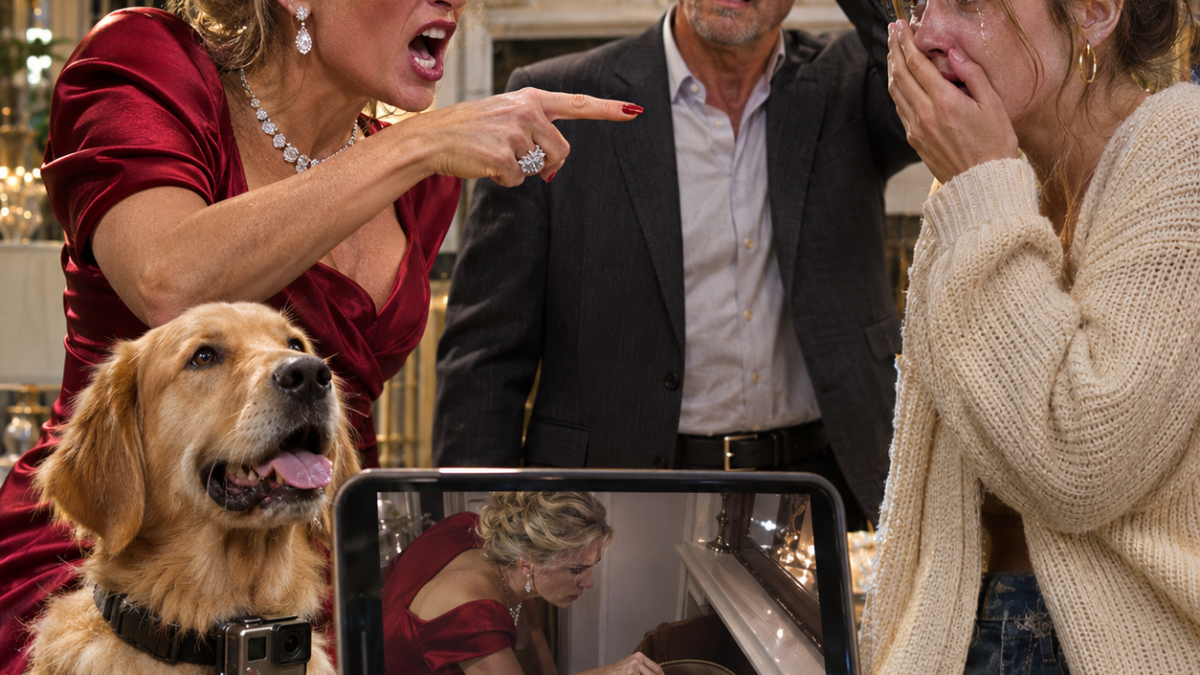
Our dog Biscuit followed her.
Biscuit was a twelve-year-old golden retriever who believed every open door represented a personal invitation.
Years earlier, when Biscuit had started having seizures, Dad had bought a tiny pet camera that could clip onto the dog’s harness.
It transmitted short video clips and motion footage to an old home-storage account.
The seizures improved.
We stopped using the camera regularly.
But Dad had recently charged it again because Biscuit had been wandering at night.
Nobody remembered it was still recording.
Least of all Lisa.
The camera showed her entering Dad’s study.
Opening the desk.
Taking the bracelet.
Then walking upstairs.
She stopped outside my bedroom.
Looked down the hallway.
Opened the front pocket of my college backpack.
Dropped the bracelet inside.
Then whispered into her phone:
“Front pocket.”
“She never checks it.”
Pause.
“Now it’s hers.”
Then:
“Let’s see who he believes.”
Biscuit wagged his tail.
Lisa scratched behind his ears.
“Shh.”
Then walked away.
At noon, Grandma arrived.
Jake carried the cake.
I had baked it.
Chocolate.
Grandma’s favorite.
Dad joked:
“Seventy-two candles will set off the smoke detector.”
Grandma hit him with a napkin.
We laughed.
For thirty minutes, we looked like the family Dad believed he had.
Then he went into the study.
“Mom, I want you wearing Grandma Elaine’s bracelet for the photo.”
He opened the drawer.
Silence.
I heard:
“Lisa?”
She came in.
“What?”
“The bracelet.”
“What bracelet?”
“Mom’s diamond bracelet.”
“It was here.”
Lisa’s face changed.
Concern.
Perfectly performed.
“Are you sure?”
“I put it here after the insurance appraisal.”
Grandma said:
“Maybe you moved it.”
Dad started searching.
Lisa stood still.
Then slowly looked toward the stairs.
“No.”
Dad saw.
“What?”
Lisa lowered her voice.
“Only one person was in this room this morning.”
My stomach dropped before she said my name.
“Emma.”
Dad turned.
“What?”
Lisa looked almost reluctant.
“She was upstairs.”
“So?”
“She was cleaning.”
“I saw her near the office.”
“I live upstairs.”
I said.
My heartbeat became loud.
Grandma frowned.
“Let’s not accuse anyone.”
Lisa said:
“I agree.”
Then:
“Emma won’t mind if we check her bag.”
I stared.
“My bag?”
“Just to clear this up.”
Dad said:
“Lisa.”
“If she didn’t take anything, there’s nothing to worry about.”
Jake stood near the stairs.
His face pale.
Later, he told me his mother had already instructed him:
If anyone asks, you saw Emma upstairs.
Technically true.
He had.
He just did not know why Lisa needed him to say it.
I walked to my backpack myself.
“Fine.”
I put it on the table.
Unzipped the main compartment.
Books.
Calculator.
Notebook.
No bracelet.
I looked at Lisa.
She said:
“Front pocket.”
That should have told everyone.
Why did she know exactly where to look?
But tension makes people stupid.
I unzipped it.
Grandma gasped.
Diamonds.
White gold.
Eleven thousand dollars.
The bracelet lay between two pens.
I stopped breathing.
“No.”
Dad stared.
“Emma.”
“No.”
I backed away.
“I didn’t put that there.”
Lisa whispered:
“Oh my God.”
Grandma sat.
Jake looked sick.
Dad lifted the bracelet.
“How…”
“I don’t know.”
Someone had put it there.
I looked at Lisa.
She smiled for less than a second.
Then fear covered it.
“You.”
I whispered.
Her hand flew to her chest.
“Excuse me?”
“You put it there.”
Dad said:
“Emma.”
“She knew which pocket.”
Lisa began crying.
“Of course.”
“Blame me.”
“I have done nothing but try to love this girl.”
Grandma said:
“Enough.”
But Lisa was building momentum.
“That bracelet is worth eleven thousand dollars, John.”
“I will not live in a house with someone stealing from us.”
I stared at Dad.
“Dad.”
He would fix it.
My father would fix it.
He always knew when I lied.
When I was nine, I broke a window throwing a ball in the house.
I blamed Biscuit.
Dad looked at me for three seconds and said:
“Try again.”
When I was sixteen, I told him I had not been crying after a breakup.
He brought ice cream without asking another question.
He knew me.
So I looked at him.
“Dad.”
“Look at me.”
He did.
“Tell them I didn’t do this.”
Silence.
My throat tightened.
“Dad.”
He looked at the bracelet.
Then my bag.
Then me.
“Em…”
“Say it.”
Lisa whispered:
“If she needed money, she could have asked.”
I shouted:
“I DIDN’T TAKE IT!”
Grandma stood.
“Everyone calm down.”
“No.”
I looked only at Dad.
“You know me.”
His eyes filled.
“I want to believe you.”
That sentence destroyed something inside me.
I whispered:
“That’s not the same thing.”
Lisa stepped forward.
“Either she leaves tonight or I do.”
Dad turned.
“Lisa, stop.”
“No.”
“I will not sleep under the same roof with someone who steals from your mother.”
Grandma said:
“She can stay with me.”
My head snapped toward her.
Grandma looked apologetic.
“Just a few days.”
“Until everyone calms down.”
Dad nodded too quickly.
“Maybe that’s best.”
I stared.
“You’re sending me away.”
“No.”
“I’m giving everyone space.”
“For her.”
“I’m not choosing anyone.”
I laughed.
Tears ran down my face.
“You just did.”
Dad reached for me.
I stepped back.
“Don’t.”
“Em.”
“I asked you one thing.”
“Look at me and believe me.”
“You couldn’t.”
I went upstairs.
Lisa followed.
Dad did not.
That hurt.
I pulled a suitcase from beneath my bed.
My bed.
My room.
The room Dad painted twice because I changed my mind about colors at thirteen.
My mother’s framed photograph on the dresser.
My high-school graduation tassel.
Twenty years.
I packed three days of clothes.
Then Lisa appeared in the doorway.
No tears now.
“Leave your house key on the kitchen counter.”
I stared.
“This is my home.”
She smiled.
“Not anymore.”
My hands stopped.
She continued:
“I told you.”
“You are not part of the real family.”
“You think Dad is going to forgive this?”
“He already chose.”
I looked at her.
For the first time, I genuinely hated someone.
Not anger.
Not resentment.
Hate.
The kind that frightens you because it feels clean.
Jake appeared behind her.
“Mom.”
“Go downstairs.”
He looked at me.
I said:
“You told them you saw me.”
His face collapsed.
“I saw you upstairs.”
“You never saw me take anything.”
“I know.”
“You said what she wanted.”
He looked down.
Lisa snapped:
“Enough.”
I zipped the suitcase.
Took Mom’s photograph.
Walked downstairs.
Dad stood near the door.
Grandma had her coat on.
I placed my key on the kitchen counter.
The metal click echoed.
Dad flinched.
I looked at him.
“You always knew when I was telling the truth.”
He whispered:
“I’m sorry.”
“No.”
“You’re sorry I’m upset.”
“Not that you don’t believe me.”
“Emma.”
Grandma opened the door.
Cold air rushed in.
Dad said:
“Just give me some time.”
I looked back.
“You had twenty years.”
Then I left.
Grandma’s car was cold.
I stared through the windshield.
Dad stood in the doorway.
Lisa behind him.
Jake farther back.
Biscuit escaped around Dad’s legs.
He ran toward the car.
“Biscuit.”
Dad called.
The dog ignored him.
He reached Grandma’s passenger door and whined.
I opened it.
He pushed his head against me.
I started crying again.
Grandma rubbed my back.
“Come on, sweetheart.”
Dad came down the steps.
He led Biscuit back inside.
I watched.
Then Grandma drove away.
At her house, I sat in my old childhood sleepover room.
Grandma made tea.
Apple pie.
Because according to her, apple pie fixed “at least seventy percent of human disaster.”
I could not eat.
Grandma said:
“I’m sorry.”
“You believed it too.”
She looked down.
“I believed what I saw.”
“The bracelet was in your bag.”
“Exactly.”
I wiped my eyes.
“You saw a bracelet.”
“You should have seen me.”
Grandma started crying.
That made me feel worse.
At home, Dad sat alone in the living room.
Lisa had gone upstairs after saying she “needed space.”
Jake shut himself in his room.
Dad stared at my empty place at the table.
He replayed my sentence.
You had twenty years.
Biscuit paced.
Whined.
Walked toward the hallway.
Came back.
Dad said:
“Not now, buddy.”
Biscuit barked.
Once.
Then walked away.
Dad followed because he had nothing else to do.
The dog stopped beside the small charging station where the old pet camera uploaded clips.
A green light blinked.
Dad frowned.
He had forgotten the camera entirely.
He picked it up.
Opened the old app on his phone.
Saved clips.
Hallway.
Kitchen.
Biscuit wandering.
Then:
10:42 a.m.
Dad almost skipped it.
Lisa appeared.
Talking on her phone.
Biscuit was behind her.
Dad turned up the volume.
Lisa’s voice:
“Once she’s gone, John is mine to manage.”
Dad froze.
The house.
The company.
One step at a time.
His breathing changed.
Then the video showed her entering the study.
Taking the bracelet.
Walking upstairs.
Dad stood.
“No.”
His hand shook.
“No.”
The camera followed because Biscuit followed.
Lisa opened my backpack.
Dropped the bracelet.
“Front pocket.”
“She never checks it.”
Then:
“Let’s see who he believes now.”
Dad’s knees nearly gave out.
He sat.
Replayed it.
Again.
Again.
Again.
Then he saw something worse.
Not Lisa.
Himself.
In memory.
Me at the table.
Dad, look at me.
You know me.
I want to believe you.
He whispered:
“Oh, Emma.”
Biscuit placed his head on Dad’s knee.
Dad started crying.
Not quiet tears.
He covered his face.
“I didn’t believe her.”
The dog whined.
Dad stood.
Then something in him hardened.
“Not one more night.”
He called Grandma.
Midnight.
She answered angrily.
“John?”
“Mom.”
“What happened?”
“I was wrong.”
Grandma sat up.
“About what?”
“Everything.”
“I have video.”
“Lisa planted the bracelet.”
Silence.
Then:
“Oh, John.”
“I’m coming.”
“Now?”
“Yes.”
“Emma is asleep.”
“I need my daughter home.”
Grandma whispered:
“She may not want to go.”
Dad closed his eyes.
“I know.”
He drove.
At 12:27, Grandma woke me.
“Emma.”
I opened my eyes.
Dad stood behind her.
I sat up immediately.
“What happened?”
His face looked destroyed.
“Em.”
“I’m so sorry.”
“Why now?”
He swallowed.
“Because I saw it.”
I laughed bitterly.
“Of course.”
His eyes filled.
“And I should have believed you before seeing anything.”
That stopped me.
Dad stepped closer.
“Biscuit’s camera.”
He showed me.
Lisa.
Bracelet.
Backpack.
I watched.
My whole body went cold.
Then came the phone call.
Once she’s gone, John is mine to manage.
The house.
The company.
One step at a time.
I looked at Dad.
“She said company.”
His face changed.
“Yes.”
“She does your books.”
“Yes.”
“How long?”
“Three years.”
“Who audits them?”
Dad looked away.
“Nobody.”
My stomach tightened.
“You trust her with bank logins?”
“Yes.”
“Payroll?”
“Yes.”
“Credit cards?”
“Yes.”
I got out of bed.
Dad said:
“First, you come home.”
I stared.
“She’ll twist this.”
“No.”
“Not this time.”
Dad’s voice became something I had not heard all week.
Certain.
“Stay behind me.”
We drove home.
Jake was awake.
Lisa came downstairs wearing a robe.
Her face changed when she saw me.
“What is she doing back in my house?”
Dad stopped.
“My house too.”
“She stole your mother’s bracelet.”
“No.”
Dad opened his phone.
“You put it in her bag.”
He played the video.
Lisa’s face drained.
For several seconds, nobody spoke.
Then she attacked the camera.
“You recorded me in my own home?”
Dad laughed once.
“Biscuit did.”
“You forgot it existed.”
Lisa pointed at me.
“She has been turning you against me from day one.”
Dad stared.
“No.”
“You did that.”
“I saw the rest too.”
Her eyes widened.
“What rest?”
“I saw how you talk to Emma when I’m gone.”
“I heard you say she’s not family.”
“I heard you say you want her gone.”
Lisa’s face twisted.
“She needs discipline.”
“She’s twenty.”
“She lives here for free.”
“She’s my daughter.”
“And Jake?”
“He gets everything.”
“Because he’s a boy?”
“Because he’s my son!”
Silence.
There it was.
Dad looked at Jake.
Then me.
Then Lisa.
Lisa realized.
“I didn’t mean—”
“Yes.”
Dad’s voice went quiet.
“You did.”
She started crying.
“John.”
“No.”
“You told my daughter she did not have a place at my table.”
“You starved her while I was gone.”
“I never starved—”
“You told her food was for your family.”
His voice cracked.
“My daughter will never have to beg for a place at my table.”
Lisa stared.
Then anger returned.
“You’re throwing away this marriage because of her?”
Dad looked at me.
Then back.
“I’m ending this marriage because of you.”
“Pack your belongings.”
Lisa froze.
“What?”
“Leave my house.”
“Tonight.”
“Where are Jake and I supposed to go?”
Dad looked at Jake.
“Jake can stay.”
Lisa’s eyes widened.
“He’s my son.”
“He’s eighteen.”
“He can decide.”
Jake looked terrified.
Lisa turned toward him.
“Get your things.”
Jake obeyed.
Not because he wanted to.
Because years with Lisa had taught him obedience too.
She packed quickly.
Then carried a laptop bag downstairs.
I saw it.
“Dad.”
“What?”
“She took the company laptop.”
Lisa stopped.
“It’s mine.”
Dad said:
“It belongs to Smith Builders.”
“I do the books.”
“Leave it.”
She gripped the strap.
“No.”
Dad moved toward her.
Not threatening.
Firm.
“Lisa.”
She dropped it onto the table.
Then smiled.
Cold.
“You’re going to regret this.”
“Every dollar.”
Dad stared.
“What does that mean?”
She picked up her purse.
“Goodbye, John.”
The front door slammed.
For a moment, nobody moved.
Then Dad looked at me.
“I’m sorry.”
I said nothing.
He reached.
I stepped away.
Not because I hated him.
Because forgiveness was not a switch.
He whispered:
“I deserve that.”
The next morning, Dad’s bank called.
Seventy-eight thousand dollars.
Gone.
Transferred Saturday night.
Payroll account.
Dad sat at the kitchen table.
“What?”
The banker repeated:
“$78,000 transferred from the operating payroll account.”
“To where?”
“A linked account.”
“Who authorized it?”
“Valid credentials.”
“Your wife is a listed account owner.”
Dad stood.
“My wife moved my payroll?”
“There is now a marital dispute.”
“We’ve frozen the remaining account pending review.”
Dad went pale.
“Frozen?”
“I have fourteen men to pay Friday.”
“I understand.”
“No.”
“You don’t.”
“Danny has rent.”
“Ray’s wife just had surgery.”
“Those men worked.”
“They get paid Friday.”
The banker apologized.
Review could take ten business days.
Ten.
Dad hung up.
Jack, his foreman, arrived an hour later.
“Boss?”
Dad looked destroyed.
“The payroll account is frozen.”
Jack sat.
“How much?”
“Enough that I can’t make Friday.”
Jack swore.
Dad said:
“I’ll sell my truck.”
“Tools.”
“Whatever.”
Jack shook his head.
“That truck won’t cover fourteen checks.”
Dad rubbed his face.
“I promised those men.”
Then a courier arrived.
Lisa’s divorce petition.
She wanted:
The house.
Half the company.
Half the marital accounts.
Temporary control of certain financial records.
And she accused Dad of hiding money.
Dad read it twice.
“She moved the money.”
“Then she says I hid money.”
His attorney, Carol Daniels, came that afternoon.
She had represented Dad on construction contracts.
Now she handled family law through a partner but stayed involved because Smith Builders was part of the dispute.
She read everything.
Then said:
“This is serious.”
Dad laughed bitterly.
“I noticed.”
“Lisa has been doing company books for three years?”
“Yes.”
“Full access?”
“Yes.”
“Who reviewed?”
“I did.”
“How often?”
Dad stopped.
Not enough.
Carol continued.
“She may claim the company increased in value through marital effort.”
“She may claim accounting involvement.”
“She may seek temporary restrictions.”
“And if there’s a dispute over funds, a judge may freeze business assets until we establish what happened.”
Dad stared.
“I could lose payroll.”
“Yes.”
“The hospital renovation contract?”
“If your crews walk.”
“Yes.”
“The company?”
“If cash flow collapses badly enough.”
“Yes.”
Dad whispered:
“I started with one truck.”
I had been sitting quietly.
Then I said:
“Let me see the books.”
Dad looked at me.
“Em.”
“I’m studying accounting.”
“You’re in Accounting 101.”
“Exactly.”
“I just spent a semester learning where people hide things when they think nobody looks at small numbers.”
Carol looked at me.
“Give her a copy.”
Dad hesitated.
Then did.
It was two in the morning when I found the first pattern.
Four hundred dollars.
Six hundred.
Eight hundred.
Five fifty.
Repeated vendor:
Bridgeway Supply.
Dad said:
“That’s our lumber yard.”
“Where?”
“Industrial park.”
“Thirty minutes away.”
I turned the laptop.
“This payment destination is Florida.”
Dad frowned.
“What?”
“Bridgeway Supply is in Pennsylvania.”
“This account is Florida.”
Carol leaned over.
“How far back?”
I searched.
Three years.
Every month.
Sometimes twice.
Total:
$93,000.
Dad stopped breathing.
“Three years.”
“The same week Lisa took over books.”
Carol said:
“This is useful.”
“But not enough.”
Dad looked at her.
“What do you mean not enough?”
“An account number doesn’t tell me who owns it.”
“Lisa can say you forgot about a supplier.”
“She can say it was authorized.”
“We need something connecting the account to her.”
I felt victory disappearing.
“So what?”
“A statement.”
“Bank letter.”
“Registration.”
“Something with her name.”
Dad stood.
“She would never leave that here.”
A voice came from the kitchen entrance.
“Maybe she did.”
Jake.
He held a stack of envelopes.
I stared.
“What are you doing here?”
His eyes were red.
“These were in Mom’s closet.”
Dad stood.
“Jake.”
He walked toward me.
“I lied.”
My chest tightened.
He shook his head.
“Not exactly.”
“But enough.”
“I said I saw you upstairs.”
“I knew what Mom wanted everyone to think.”
“I didn’t correct it.”
“I let you get thrown out.”
I looked at him.
He could barely meet my eyes.
“I owe you more than this.”
He handed me the envelopes.
Florida bank.
Addressed:
Lisa Cole.
Her maiden name.
Same account number.
I looked at Carol.
She looked at Dad.
Then at me.
We had it.
Statements.
Transfers.
Deposits from Smith Builders.
Some labeled vendor payments.
Some moved again.
Three years.
Ninety-three thousand dollars.
Jake whispered:
“She hid them every month.”
“How do you know?”
“I saw them.”
“She told me they were investments.”
“I didn’t care.”
Then he looked at Dad.
“I care now.”
Dad sat down.
The weight of betrayal finally hit all at once.
The bracelet.
Emma.
Company.
Payroll.
Three years.
He whispered:
“She was stealing from me while telling me my daughter was the problem.”
I corrected him.
“From the company.”
Dad looked up.
I said:
“That money belongs to the business.”
“To your employees too.”
That brought him back.
Payroll.
Friday.
We had forty-eight hours.
Carol moved fast.
Emergency hearing Thursday.
Lisa’s attorney arrived confident.
His settlement proposal was simple.
Dad signs.
Lisa gets negotiated ownership interests including the house and a large portion of company value.
In exchange she assists in releasing disputed funds.
Dad read.
Then pushed it back.
“No.”
Lisa sat across the conference table.
Perfect makeup.
Cream suit.
She looked like the woman Dad married.
That was the disturbing part.
She said:
“John.”
“Be reasonable.”
Her attorney said:
“If this proceeds, the court may freeze assets.”
“You could lose contracts.”
“Employees.”
“Your house.”
Dad looked at Lisa.
“You moved $78,000 from payroll.”
She smiled faintly.
“I moved marital funds.”
“That was payroll.”
“Our money.”
“My men earned it.”
“And I helped build that company.”
“You did books.”
“I ran the finances.”
“While stealing ninety-three thousand dollars?”
Her expression changed.
Her lawyer turned.
“What?”
Carol placed the statements down.
Three years.
Bridgeway Supply.
Florida account.
Lisa Cole.
Lisa stared.
Then recovered.
“Supplier.”
I said:
“Bridgeway is in Pennsylvania.”
Her eyes moved to me.
I continued.
“I called them.”
“Wrong account.”
Carol held up one letter.
“And this statement was mailed directly to Lisa Cole.”
Lisa said:
“My savings.”
“Ninety-three thousand dollars in company money is not savings.”
Dad’s voice was quiet.
She turned.
“You can’t prove I made those transfers.”
Jake entered.
Carrying the remaining statements.
Lisa froze.
“What are you doing here?”
Jake sat beside me.
“Family meeting.”
Her face twisted.
“Your family?”
“She isn’t even your sister.”
Jake looked at her.
“Then why did you work so hard to get rid of her?”
Silence.
Lisa’s voice became sharp.
“Give me those letters.”
“No.”
“I’m your mother.”
“You taught me to stay quiet when something felt wrong.”
He looked at me.
“I’m done.”
Lisa stared at her own son like he had betrayed her.
Maybe he had.
But sometimes refusing to help someone continue lying is the most loving betrayal possible.
Carol played the Biscuit recording.
Once she’s gone, John is mine to manage.
The house.
The company.
One step at a time.
Lisa shouted:
“That’s private!”
Dad leaned forward.
“What context makes that okay?”
She had none.
Her attorney asked for a private conference.
They left the room.
Dad looked at me.
His hands shook.
“I should have believed you.”
I stared at the table.
“I know.”
“No.”
He swallowed.
“You don’t understand.”
“I keep thinking about you asking me to look at you.”
“And I looked at the bracelet instead.”
My eyes filled.
Dad continued:
“For twenty years I told myself I knew my daughter.”
“One staged piece of evidence and I made you prove yourself.”
I whispered:
“You weren’t supposed to need proof.”
He closed his eyes.
“I know.”
I hated hearing him say it.
Because I wanted to stay angry.
Anger felt safer than grief.
Carol interrupted gently.
“They’re coming back.”
Lisa and her attorney returned.
He looked completely different.
Less aggressive.
“My client is prepared to withdraw claims to the house and Smith Builders.”
Dad said nothing.
“She will return the disputed $78,000 before noon.”
Carol replied:
“And the ninety-three.”
The attorney glanced at Lisa.
“Full restitution of the documented company transfers.”
“In exchange, civil financial issues are resolved within the divorce settlement, subject to required reporting and court approval.”
Dad looked at Carol.
She nodded slightly.
This was not a criminal courtroom.
We were resolving immediate financial claims.
Other legal consequences, if any, would be handled separately under applicable law.
Dad looked at Lisa.
“You really did this.”
She laughed bitterly.
“You think you won?”
“No.”
Dad shook his head.
“I lost plenty.”
“Years.”
“Trust.”
“Almost my daughter.”
Lisa leaned closer.
“You’ll end up alone.”
Dad looked at me.
Then Jake.
“I won’t.”
“I have my daughter.”
He paused.
“And apparently a bonus son who finally learned how to choose for himself.”
Jake looked down.
Lisa stood.
Her chair scraped.
“Goodbye, John.”
Dad answered:
“Goodbye, Lisa.”
The bank released the payroll funds that afternoon after documentation and settlement arrangements were processed.
Dad drove straight to the jobsite.
Every crew member stood around Jack’s truck.
Dad climbed out.
Jack asked:
“Well?”
Dad smiled for the first time in days.
“Every man.”
“Every dollar.”
“On time.”
The crew cheered.
Ray covered his face.
Danny hugged Dad.
Jack asked:
“How?”
Dad pointed toward me.
I froze.
“Dad.”
“She found ninety-three thousand dollars with a laptop and a calculator.”
I groaned.
The men laughed.
Jack held out his hand.
“Welcome to Smith Builders.”
I shook it.
“I’m not working here.”
“You found more money in one night than the rest of us save in five years.”
“Accounting.”
“Same thing.”
Dad said:
“She has school.”
Jack shrugged.
“Part-time CFO.”
“No.”
“Assistant CFO.”
“No.”
“Intern.”
I laughed.
“Maybe.”
Dad looked at me.
Something in his face cracked.
Pride mixed with guilt.
I knew what he was thinking.
The night before, he thought I was a thief.
Today he was telling fourteen men I had saved payroll.
Neither version defined me.
I was still Emma.
That became important.
Grandma Mary invited us to dinner Sunday.
Apple pie.
Obviously.
She hugged me before I got through the door.
“I owe you an apology.”
“Grandma.”
“No.”
She held my face.
“You’re my granddaughter.”
“I looked at jewelry when I should have looked at you.”
I started crying.
She did too.
Then she said:
“Apple pie fixes a lot.”
I laughed.
“It doesn’t fix framing somebody for theft.”
“Seventy percent.”
“Grandma.”
“Fine.”
“Sixty.”
Jake came later.
He stood awkwardly in the doorway.
Dad opened it.
“Your mom?”
“Florida.”
“She’s staying there.”
“And you?”
“I’m staying for college.”
He swallowed.
“I wanted to ask…”
“What?”
“Can I still come for dinner sometimes?”
Dad stared at him.
Then stepped aside.
“Sunday.”
“Every Sunday.”
Jake smiled.
“Thanks.”
I said:
“And Tuesday.”
He looked at me.
“Tuesday?”
“If you’re hungry.”
His eyes filled.
That sentence mattered because it was where the story had begun.
Food is for my family.
Lisa had tried to define family by withholding a plate.
We defined it by adding one.
Dinner began.
Dad served me first.
I rolled my eyes.
“Dad.”
“Emma first.”
“Always.”
Jake pointed at the food.
“Wait.”
He adopted Lisa’s old tone.
“Is this food for my family?”
Everyone froze for half a second.
Then Dad said:
“Every plate on this table is for my family.”
Jake smiled.
Grandma raised her glass.
“To Emma.”
“No.”
I covered my face.
“Yes.”
Dad continued.
“To the daughter who told the truth when nobody listened.”
Jake added:
“And Biscuit.”
The dog lifted his head beneath the table.
“The only one who actually caught her.”
We laughed.
Grandma said:
“Extra bacon tomorrow.”
Dad looked at me.
“I’m sorry it took me so long.”
My throat tightened.
“You found the truth.”
He shook his head.
“That is not enough.”
That surprised me.
He continued:
“I keep wanting you to tell me it’s okay because I fixed it.”
“But it isn’t okay.”
“I failed before I fixed anything.”
The room became quiet.
I looked down.
Dad said:
“You don’t have to forgive me quickly.”
“You don’t have to tell me I’m a good father.”
“I want to earn back the part of you that stopped feeling safe with me.”
I cried.
Dad did too.
Then I said:
“Start with one thing.”
“Anything.”
“Never tell me you ‘want to believe me’ again.”
He nodded.
“Deal.”
The divorce took months.
Lisa returned every dollar required under the settlement.
The financial records were reviewed.
Dad hired a professional bookkeeper and outside accountant.
No spouse.
No family member controlling the books alone.
Dual authorization for major transfers.
Payroll separated.
Bank alerts.
Monthly reconciliation.
Dad had spent twenty years protecting jobsites with safety rules while running his finances on trust.
He learned.
Painfully.
Smith Builders survived.
The hospital contract stayed.
The crew stayed.
I did not become CFO.
I finished college.
Accounting.
Not because Dad wanted me in the business.
Because somewhere during the investigation, numbers had stopped feeling boring.
They became stories.
Money moved.
Patterns appeared.
Someone could hide a lie inside twelve small legitimate-looking payments more easily than one giant theft.
I loved finding the difference.
I interned at a forensic accounting firm.
Dad was obnoxiously proud.
He told everyone:
“She caught a ninety-three-thousand-dollar fraud in Accounting 101.”
I corrected him every time.
“It was not that simple.”
He never stopped.
Jake changed too.
His relationship with Lisa became complicated.
She called.
He answered sometimes.
Not always.
He loved his mother.
That did not mean trusting her.
People wanted clean moral outcomes.
Bad mother.
Good son.
Life refused.
Jake remembered her packing lunches.
Driving him to practice.
Sitting at the hospital when he broke his wrist.
He also remembered her using him against me.
Both could be true.
One night he told me:
“I feel guilty for missing her.”
“Why?”
“Because of what she did to you.”
I said:
“She’s your mom.”
“You don’t have to hate her for me.”
He stared.
“How are you not furious?”
“I am.”
“But anger doesn’t get to decide who you’re allowed to love.”
He cried.
So did I.
We became actual siblings after Lisa left.
Not because blood changed.
Because choice did.
Dad started therapy.
He hated it at first.
“Paying someone to ask questions.”
I said:
“That is literally what lawyers do too.”
“Different.”
“How?”
“They answer eventually.”
Three months later, he admitted therapy helped.
He learned why Lisa’s tears had controlled him so effectively.
After Mom died, Dad had developed a terror of family breaking apart.
Any conflict felt like danger.
When Lisa cried, Dad rushed to stabilize.
When I became angry, he interpreted it as escalation.
So the quieter manipulator repeatedly received comfort while the louder injured person was told to calm down.
Dad said:
“I thought keeping peace made me a good father.”
I answered:
“You were keeping quiet.”
“Not peace.”
He wrote that down.
I laughed.
“You’re taking notes in therapy?”
“I forget things.”
We rebuilt slowly.
For months, I kept my bedroom door locked even after Lisa was gone.
Dad never commented.
Then one afternoon, the lock broke.
He offered to replace it.
I looked at the door.
Then said:
“No.”
Not because I trusted the universe.
Because the house felt like mine again.
We changed other things.
Lisa’s office became a guest room.
The desk where she managed Smith Builders went to charity.
Dad removed her family photographs from common spaces.
Not erased.
Stored for Jake.
We did not pretend she had never existed.
That would have been another lie.
Biscuit became famous among the Smith Builders crew.
Jack bought him a little orange safety vest.
SECURITY AUDITOR
Dad hated it.
Biscuit loved the attention.
When the dog turned fourteen, his hips weakened.
I carried him up the stairs sometimes.
One night I sat beside him on the kitchen floor.
The old camera was in a drawer now.
I scratched his ears.
“You saved my life, you know.”
Dad heard.
He sat beside me.
“No.”
I looked over.
“What?”
“Biscuit saved the evidence.”
Dad’s eyes filled.
“You saved yourself.”
I shook my head.
“Dad.”
“I mean it.”
“You told the truth when everyone failed you.”
“You walked out instead of confessing to something you didn’t do.”
“You came back and looked at the books.”
“You found the money.”
“Biscuit recorded a video.”
He smiled.
“He is still getting bacon.”
Fair.
Biscuit died that winter.
Fourteen years old.
Peacefully.
Dad and I were with him.
Jake came.
Grandma came.
The entire crew sent flowers.
The card said:
To the best auditor Smith Builders ever had.
Dad cried harder than I had seen since Mom died.
We buried Biscuit beneath the maple tree at the back of the property.
The little camera went into a box with his collar.
Not as evidence anymore.
Memory.
Years passed.
I became a certified forensic accountant.
The work was less dramatic than television.
Spreadsheets.
Invoices.
Bank statements.
Interviews.
Metadata.
People lying badly.
People lying brilliantly.
One of my first major cases involved a family company where an employee had been siphoning small amounts for seven years.
My supervisor asked:
“What made you look at that vendor?”
I said:
“The name repeated too cleanly.”
He nodded.
I did not explain Bridgeway Supply.
Some lessons remain personal.
Dad eventually brought me into Smith Builders—not as an employee, but as outside financial reviewer once a year.
Paid engagement.
Formal contract.
Independent.
The first invoice I sent him, he complained.
“My daughter charges me this much?”
I replied:
“My client complains too much.”
He paid.
Every cent.
Jake graduated.
Got a job in marketing.
Then moved into an apartment fifteen minutes away.
He still came every Sunday.
Not every Tuesday.
He had a girlfriend by then.
Dad complained she was stealing Tuesday dinner.
Jake said:
“Dad, that sounds possessive.”
We laughed.
Grandma Mary grew older.
At eighty, she still made apple pie.
At eighty-three, she let me make it.
She criticized everything.
“Crust too thick.”
“You said pie fixes things.”
“Good pie.”
She died at eighty-six.
Quietly.
Family around her.
Before she died, she held my hand.
“I’m still sorry.”
I knew immediately.
The bracelet.
“Grandma.”
“I should have believed you.”
“You were human.”
“That’s not a defense.”
I smiled.
“You sound like Dad.”
“Someone had to teach him.”
Then:
“Take the bracelet.”
I stared.
“What?”
Great-Grandma Elaine’s diamond bracelet.
The object that had nearly torn our family apart.
“I don’t want it.”
Grandma smiled.
“That is why you should have it.”
“No.”
“Emma.”
“Every time I look at that thing, I see the backpack.”
“Then change what it means.”
She touched my hand.
“It belonged to women before Lisa.”
“Do not give her ownership of the story.”
That was Grandma.
I accepted it.
Not immediately.
After she died.
The bracelet sat in a box for almost two years.
Then Jake got married.
He asked me to stand with him.
Not technically maid of honor.
He said:
“I don’t know the male equivalent of having your sister on my side.”
I wore the bracelet.
Dad saw.
His eyes filled.
I said:
“Don’t.”
He nodded.
No speech.
Good.
Lisa did not attend.
Jake had invited her to the ceremony with boundaries.
She declined.
Sent a card.
I never asked what it said.
That was between them.
At the reception, Dad gave a toast.
He looked at Jake.
Then me.
Then said:
“When I was younger, I thought family meant the people who stayed in the house.”
“I was wrong.”
“Family is the people who tell you the truth when the truth costs them something.”
Jake looked at me.
I cried.
Of course.
Dad continued:
“And if your daughter ever looks you in the eye and asks you to believe her…”
He stopped.
His voice broke.
“Believe her enough to listen before you make her prove who she is.”
The room became quiet.
That was Dad’s scar.
He never hid it.
I respected that.
People sometimes ask whether I forgave him.
Yes.
But not that night.
Not the next morning.
Not because he apologized.
Not because he threw Lisa out.
Not because he defended me at the settlement table.
Forgiveness arrived through hundreds of smaller things.
Dad knocking before entering my room.
Dad never dismissing a concern because “that doesn’t sound like someone.”
Dad auditing the books.
Dad telling Jake he could stay even after Lisa left.
Dad admitting publicly he failed.
Dad never demanding that my healing happen on his schedule.
Forgiveness became possible because he changed behavior.
Not because he hated himself loudly enough.
I forgave Jake too.
That was easier and harder.
He was eighteen.
He had been manipulated by his mother.
But he still said:
I saw her upstairs.
He knew exactly what Lisa wanted those words to imply.
He could have corrected it.
He did not.
His guilt made him find the bank letters.
But guilt alone did not make us siblings.
What mattered was what he did after.
He chose truth against the person who raised him.
Not because he stopped loving her.
Because he understood loving someone does not require helping them hurt somebody else.
That lesson stayed with both of us.
Lisa?
That answer is complicated.
I did not see her for almost nine years.
Then I did.
Airport.
Of all places.
She was standing near a coffee shop in Tampa.
I was there for a fraud conference.
She looked older.
Different hair.
No designer coat.
We recognized each other simultaneously.
For a moment, I considered walking away.
She said:
“Emma.”
I stopped.
“Lisa.”
Silence.
Then:
“I heard about Mary.”
“Grandma?”
“Yes.”
“I’m sorry.”
“Thank you.”
She looked at my wrist.
I was wearing the bracelet.
Not deliberately.
Just jewelry now.
Her face changed.
“I haven’t seen that in years.”
I almost covered it.
Then didn’t.
Lisa said:
“I was horrible to you.”
Not:
I made mistakes.
Not:
We both hurt each other.
Horrible.
I said nothing.
She continued:
“I spent years convincing myself I did what I did because I was afraid of losing John.”
“I thought you were always going to come first.”
“So I made sure you looked dangerous.”
My chest tightened.
“You stole from his company.”
“Yes.”
“Was that because of me too?”
She looked down.
“No.”
“Money was different.”
“I wanted something that was mine.”
“That’s what I told myself.”
She laughed sadly.
“It was theft.”
I had spent years in forensic accounting learning the power of naming a transaction correctly.
Theft.
Not savings.
Not compensation.
Not marital adjustment.
Theft.
Lisa looked at me.
“I don’t expect forgiveness.”
“Good.”
She nodded.
Fair.
Then:
“Jake speaks to me sometimes.”
“I know.”
“I’m glad he has you.”
That surprised me.
I said:
“He always had me.”
Lisa closed her eyes.
“I know that now.”
Our flight boards separated us.
No dramatic reconciliation.
No hug.
No promise.
I went to my gate.
She went somewhere else.
I did not feel triumphant.
I felt light.
There is a strange kind of freedom in realizing the person who once controlled your emotional weather has become simply another traveler walking away through an airport.
Dad retired at sixty-three.
Smith Builders continued under Jack’s son and two senior supervisors through a structured sale.
Dad kept a minority interest for a few years, then sold the rest.
He moved into a smaller house.
Same town.
Still too many tools.
He started volunteering with Habitat for Humanity.
I joked:
“You finally build houses without getting paid.”
He said:
“I’m bad at retirement.”
Sunday dinners continued.
Dad.
Me.
Jake and his wife.
Their children eventually.
My husband too.
Yes.
I married.
His name is Daniel.
He teaches high-school economics.
We met because his school hired my firm to teach a financial-literacy workshop.
Our first argument was over whether accounting was more useful than economics.
Obviously accounting.
He remains wrong.
When I first told him the Lisa story, he said:
“Your dad sent you away?”
“Yes.”
“And you forgave him?”
“Eventually.”
Daniel thought.
“What made the difference?”
“Accountability.”
He asked:
“Meaning?”
“He stopped defending the version of himself he wished he had been.”
That was it.
Dad never said:
I was tired.
Lisa manipulated me.
The bracelet was in your bag.
Anyone would have doubted you.
All of those things might contain pieces of truth.
He stopped using them.
Instead:
I should have listened.
Simple.
Difficult.
Powerful.
When Daniel and I had our daughter, Claire, Dad became unbearable.
Photographs.
Toys.
Baby-proofing advice no one requested.
At two, Claire learned “Grandpa.”
Dad cried.
At four, she broke a ceramic lamp and tried to blame Daniel.
Dad looked at me.
I saw the memory hit him.
He crouched beside Claire.
“Tell us what happened.”
She confessed.
No drama.
Later, Dad said:
“I’m never making that mistake again.”
I hugged him.
“You won’t.”
The bracelet eventually passed to me permanently through Grandma’s estate.
I keep it in a safe.
Not because it is worth eleven thousand dollars.
Probably more now.
Because value is strange.
Once that bracelet represented betrayal.
Then evidence.
Then Grandma.
Then survival.
Objects do not choose meanings.
We do.
The same is true of that house.
For a while, I hated it.
The kitchen table.
The staircase.
My bedroom.
The counter where I left my key.
Then years passed.
Dad remodeled the kitchen.
Not because of Lisa.
It needed work.
The old counter disappeared.
At first, I felt oddly sad.
The place where I put my key was gone.
Then I realized:
Good.
Not every scar needs a monument.
My childhood home became Dad’s house again.
Sunday dinner.
Grandchildren.
Burned rolls.
Jake opening the refrigerator without permission.
Daniel arguing economics.
Life.
One Sunday, Dad served pasta.
Jake looked at me.
I knew immediately.
He said:
“Emma.”
“No.”
“I have to.”
“Don’t.”
He adopted Lisa’s voice badly.
“Don’t.”
“That food is for my family.”
Everyone froze.
Then Claire, who knew nothing about the original moment, shouted:
“But Aunt Emma IS family!”
Silence.
Then laughter.
Dad covered his eyes.
Jake nearly fell out of the chair.
I laughed until I cried.
That was the moment the old sentence lost its power completely.
Children are good at that.
They walk into inherited pain and accidentally turn it into a joke.
Dad raised his glass.
“To family.”
Jake said:
“Every plate.”
Dad smiled.
“Every plate.”
Years earlier, Lisa had tried to remove me from the family by controlling where I ate.
Then by controlling where I lived.
Then by controlling what everyone believed about me.
Finally, she tried to control the company so Dad would have fewer choices without her.
All of it depended on one idea:
If she controlled enough evidence, she could control reality.
Food.
Chores.
Tears.
A bracelet.
Bank statements.
Passwords.
Money.
But reality has a stubborn habit.
It leaves traces.
A forgotten camera.
A Florida account.
Bank letters in a closet.
A supplier address that does not match.
A son who finally refuses to stay silent.
The truth rarely arrives as one glorious revelation.
Usually it appears as little inconsistencies somebody cares enough to notice.
That is probably why I became good at forensic accounting.
I know what it feels like to have evidence used against you falsely.
So I am careful with evidence now.
Numbers do not speak for themselves.
Bracelets do not speak for themselves.
A bracelet in a backpack looked devastating.
It was also a lie.
Context matters.
Source matters.
Who controlled the information matters.
Whenever a junior accountant on my team says:
“But the document shows…”
I ask:
“Who created the document?”
“Who benefited?”
“What came before it?”
“What does the independent record say?”
They think I am teaching fraud examination.
Maybe I am.
Maybe I am still sitting at Grandma Mary’s birthday table with diamonds in my backpack.
Dad once asked whether I wished Biscuit’s camera had never existed.
“No.”
Then I thought.
“Actually…”
“What?”
“I wish you had believed me without it.”
His face fell.
I touched his hand.
“But I’m grateful it existed.”
He nodded.
“That’s fair.”
That tension remains.
Evidence saved me.
But I should not have needed evidence to be treated as a daughter.
The same can be true at once.
The camera proved Lisa planted the bracelet.
It did not prove my worth.
The bank letters proved she moved company money.
They did not make me honest.
The truth existed before the proof arrived.
That is the part Dad understands now.
At seventy, he still apologizes occasionally.
I stop him most times.
Not because it no longer matters.
Because accountability eventually has to become something other than permanent self-punishment.
One Christmas, he said:
“I’m sorry.”
I sighed.
“Dad.”
“One last time.”
“You said that last year.”
“I lied.”
I laughed.
He became serious.
“I spent years thinking the worst thing I almost lost was the company.”
“No.”
“The worst thing was that you might have learned not to trust me with the truth.”
That landed.
I looked at him.
“For a while, I didn’t.”
“I know.”
“But I do now.”
He cried.
I said:
“Now stop before Claire asks why Grandpa is sad.”
Too late.
My daughter ran in.
“Grandpa?”
Dad wiped his eyes.
“I’m okay.”
Claire narrowed her eyes.
“You look sad.”
Dad smiled.
“I’m happy.”
She looked suspicious.
Children know.
He hugged her.
I watched.
The man who once failed to look at his own daughter properly had become a grandfather who stopped whatever he was doing whenever a child said something felt wrong.
People can change.
Not because consequences magically purify them.
Because some people allow consequences to teach them.
Lisa’s consequence was losing the marriage and financial control she had tried to secure.
Dad’s consequence was facing who he had been in one terrible moment.
Jake’s consequence was realizing silence can make you part of a lie.
Mine was more complicated.
I learned that being truthful does not guarantee immediate belief.
I wish that lesson were not true.
It is.
But I learned something else too.
Someone doubting you does not change what happened.
The truth can survive a room full of people looking at you wrong.
That is a hard lesson.
Also a powerful one.
I never again begged someone:
Look at me and tell me I’m telling the truth.
I will explain.
I will provide evidence.
I will answer questions.
But my identity is no longer something I hand another person and ask them to approve.
Lisa almost took that from me.
Almost.
Years after the airport encounter, Jake called.
“Mom’s sick.”
I sat quietly.
“What kind?”
He told me.
Not terminal.
Serious.
He was going to Florida.
He asked:
“Do you think I’m stupid?”
“For going?”
“Yes.”
“No.”
“After everything?”
“She’s your mother.”
He exhaled.
“I knew you’d say that.”
“Do you want me to come?”
Silence.
Then:
“Yes.”
So I did.
Not for Lisa.
For Jake.
We sat in the hospital waiting room.
Lisa saw me once.
She looked surprised.
“You came.”
“For Jake.”
“I know.”
Then she whispered:
“Thank you anyway.”
I nodded.
That was all.
No deathbed confession.
No reconciliation.
She recovered.
Life remained messy.
That experience helped Jake.
He learned caring for someone does not require pretending history never happened.
Boundaries can sit beside compassion.
I learned that too.
When Dad eventually sold the old house, he asked whether I wanted anything.
I took three things.
Mom’s framed photograph.
Biscuit’s collar.
And the kitchen table.
Daniel asked:
“Why the table?”
I looked at it.
Because that was where Lisa told me food belonged only to family.
Where the bracelet appeared.
Where Dad doubted me.
Where later we discovered the $93,000 pattern.
Where Sunday dinners returned.
Where every plate eventually became family food.
I said:
“It has history.”
Daniel sighed.
“It also weighs approximately a thousand pounds.”
True.
It sits in our dining room now.
Scratched.
Too large.
Claire does homework there.
Daniel grades papers.
Jake’s children spill juice on it.
Dad sits at one end every Sunday.
One night Claire asked:
“Why do we always eat here?”
I told her:
“Because tables are important.”
She rolled her eyes.
“That makes no sense.”
Maybe not yet.
One day it will.
Tables are where families decide who gets a seat.
That was the real fight.
Not the bracelet.
Not even the money.
Lisa had been trying to convince me that my seat was temporary.
Food for my family.
Not you.
Chores for you.
Freedom for Jake.
Your father will choose me.
Leave your house key.
You are not real family.
Every tactic pointed toward the same objective.
Erase Emma.
If I disappeared, Lisa controlled Dad emotionally.
Then financially.
The camera exposed the mechanics.
The books exposed the motive.
But my father’s greatest correction was not kicking Lisa out.
It was making the table bigger afterward.
Jake still had a seat.
That mattered.
He could have punished Jake for being Lisa’s son.
He did not.
He said:
“You can stay.”
That proved Dad understood the lesson.
Family was not blood versus marriage.
Not original child versus stepchild.
Not who had the stronger legal claim to the house.
Family was responsibility.
Truth.
Who protects a seat for you when things become hard.
Jake chose us when it cost him his mother’s approval.
Dad chose truth when it cost him his marriage.
I chose to return when staying angry would have been simpler.
Grandma chose to apologize rather than hide behind:
But the bracelet was in your bag.
Those choices became family.
Not Lisa’s definition.
Ours.
The last time Dad raised a glass at that old table before selling the house, he said:
“To Emma.”
I groaned.
“No speeches.”
He ignored me.
“To Emma.”
“The girl who told the truth when nobody listened.”
Jake added:
“And Biscuit.”
Dad smiled.
“And Biscuit.”
Claire asked:
“Who’s Biscuit?”
Everyone shouted:
“What?”
She was three when he died.
We brought out photographs.
Then the old collar-camera story.
Daniel had heard it, obviously, but the children had not.
Claire stared.
“The dog caught the bad guy?”
Jake laughed.
“Basically.”
My son asked:
“Did Grandma Lisa go to jail?”
I said:
“No.”
He looked disappointed.
“Why not?”
“Because real life isn’t always like TV.”
“Was she evil?”
That question stopped me.
Children want categories.
I thought about the airport.
The hospital.
Jake’s childhood.
The woman who had packed lunches for him and framed me for theft.
“No.”
I said.
“She did some very bad things.”
“That’s different.”
Dad looked at me.
He understood.
My son asked:
“Did Grandpa believe you?”
The room became still.
Dad answered before I could.
“No.”
My son looked shocked.
“You didn’t?”
Dad shook his head.
“I should have.”
“Why didn’t you?”
Dad thought.
“Because I looked at what was in her bag instead of listening to who my daughter was.”
My son frowned.
“That was dumb.”
Jake laughed.
Dad nodded.
“Extremely.”
Then Claire asked:
“What happened?”
Dad smiled at me.
“She gave me another chance.”
That was enough.
I raised my glass.
“To second chances.”
Dad shook his head.
“No.”
“To earned second chances.”
Better.
We drank.
The kitchen table is still in my house.
The bracelet is still in the safe.
The old camera sits beside Biscuit’s collar.
Smith Builders still exists under different ownership.
Dad still checks payroll on Fridays out of habit.
Jake still comes for dinner.
Lisa remains part of our history but no longer controls any part of our future.
And whenever someone asks me what the worst moment was, they expect me to say finding the bracelet.
It wasn’t.
It was looking at my father and saying:
“Dad, look at me.”
Then realizing he could see my face and still not see me.
That hurt more than being accused.
More than losing the house key.
More than the money Lisa stole.
Because there is a unique kind of terror in knowing the person who taught you what honesty means suddenly requires evidence that you are still yourself.
But that was not the end of our story.
The end came years later at a different table, when my father served pasta to every person sitting around it, Jake reached for the bread, my children argued over who got the last meatball, and Dad looked at me before filling my plate.
“Enough?”
I smiled.
“More.”
He gave me another spoonful.
No one said the food was only for the real family.
Nobody needed to.
Every chair already knew.
And that, more than recovering $171,000, saving fourteen paychecks, keeping Smith Builders alive, or exposing the woman who tried to steal my place in my father’s life, became the justice I cared about most:
I never had to earn my seat back.
It had always been mine.