FULL STORY:“SHE COULDN’T EVEN GIVE ME A CHILD—SHE DESERVES NOTHING!” My Husband Mocked Me at Our Divorce Hearing—Then the Judge Opened My Sealed Medical File
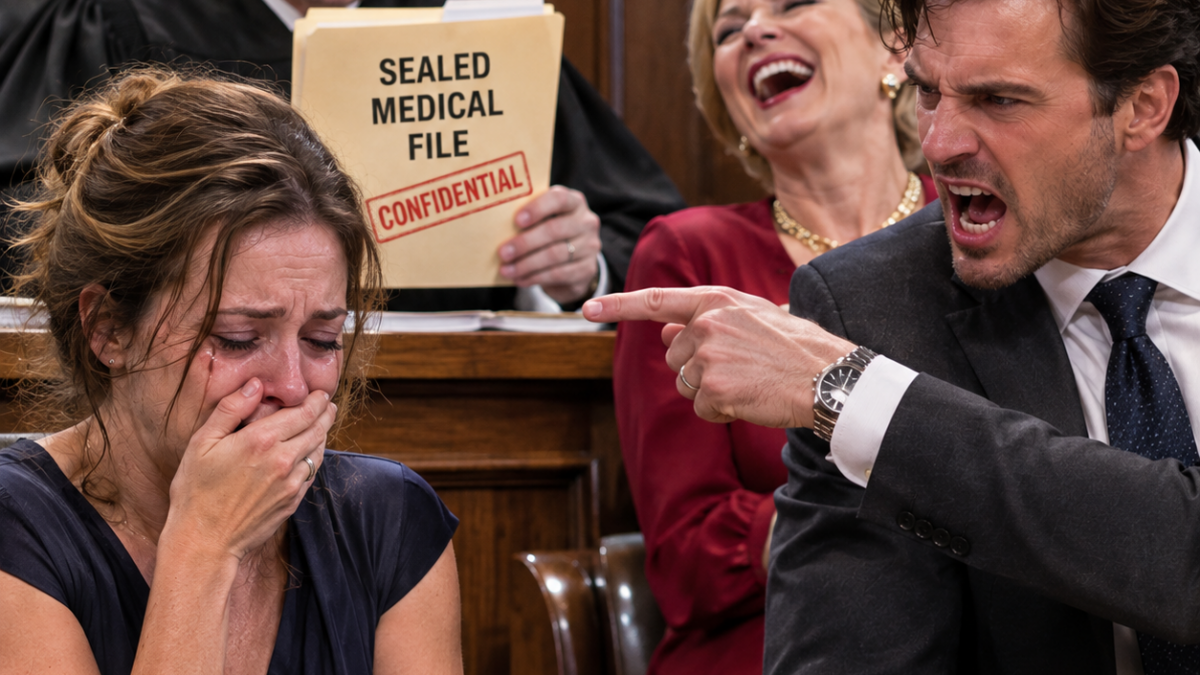
FULL STORY CONTINUATION
My first instinct was not joy.
It was terror.
That truth embarrassed me for months.
I had wanted a child for so long that I had imagined the moment hundreds of times.
I would cry.
Call Derek.
Buy some ridiculous gift box containing tiny shoes.
We would hold each other.
Instead, I sat on the porch thinking:
If I lose control now, I could lose everything.
Then I put one hand over my still-flat stomach.
And understood that “everything” no longer meant only me.
I did not call Derek.
I drove away.
For four nights, I stayed in a worn motel ten miles outside town.
Brown carpet.
A heater that clicked every twenty minutes.
A shower with almost no water pressure.
It was not dramatic.
It was simply the first place I could think.
Derek sent one message.
My attorney will contact you. Please don’t make this ugly.
I stared at it for a long time.
Then turned off my phone.
The woman who had helped him prepare those papers made the betrayal worse.
Chloe.
I had hired her three years earlier as a junior administrative assistant.
Bright.
Ambitious.
Organized.
She complimented my clothes.
Asked how I balanced marriage with work.
Once told me she hoped she could build a career like mine.
Then, after I left the company, Derek promoted her.
Secretary.
Executive assistant.
Then Marketing Director.
The speed had seemed strange.
Now it made sense.
What I did not yet understand was how much money she had already begun treating as hers.
I had gone back to the house only because I needed documents.
Birth certificate.
Passport.
Tax files.
I intended to be there twenty minutes.
Our old safe sat inside Derek’s study.
I opened it using the same combination we’d had for fifteen years.
Insurance policies.
Old vehicle titles.
Passports.
Then a thick folder labeled:
INSURANCE SCANS.
I almost ignored it.
Something made me open it.
Inside were fertility records.
Mine first.
Hormone results.
Ultrasounds.
Procedure notes.
Then Derek’s.
I sat on the floor.
Seven years earlier, our fertility specialist had told us there was a “male factor concern” but Derek later claimed his follow-up testing had been inconclusive.
That was the word he used.
Inconclusive.
The report in my hands was not inconclusive.
Severe oligospermia.
Near-total immotility.
A specialist’s note explaining that natural conception would be extremely unlikely.
Less than one percent was written in the counseling section.
I read it three times.
Then found the page that broke something inside me permanently.
Results reviewed with patient.
Patient:
Derek Lawson.
Date.
Signature.
He knew.
Not suspected.
Knew.
He had known while I injected hormones into my stomach.
Known while I underwent procedures.
Known while I cried after negative tests.
Known every time he called me barren.
Every time he said I could not fulfill my duty as a wife.
Every time he used infertility to excuse staying late with Chloe.
My own reproductive testing, meanwhile, had repeatedly shown no condition explaining the infertility.
Not perfect fertility.
No doctor promises that.
But nothing resembling the diagnosis Derek had hidden.
I photographed every page.
Then took the originals only after my attorney later instructed me how to preserve copies and chain of custody properly.
That night, in the motel, grief became something colder.
Not revenge.
Resolve.
I initially told myself I would never tell Derek about the baby.
I would disappear.
Raise my child alone.
Let him live with the story he had created.
That idea lasted less than forty-eight hours.
Then I met my attorney.
Marisol Vega had practiced family law for twenty-six years and possessed the useful habit of refusing to indulge emotional fantasies merely because they were understandable.
I told her everything.
The company.
The affair.
The hidden report.
The pregnancy.
Then:
“I don’t want him to know.”
Marisol removed her glasses.
“Rebecca.”
“I’m serious.”
“I know.”
“He spent years tormenting me over this.”
“I understand.”
“He doesn’t deserve—”
She stopped me.
“This isn’t about what Derek deserves.”
I hated that sentence.
She continued.
“You’re in a divorce.”
“You’re pregnant.”
“There may be legal issues involving parentage, disclosure, support, and the timing of the dissolution.”
“You do not solve those by hiding a pregnancy from your attorney or from the court.”
I looked away.
“I wanted one thing he couldn’t take.”
Marisol’s voice softened.
“He cannot take your relationship with your child simply because he learns the child exists.”
I cried.
Quietly.
She waited.
Then:
“We handle this carefully.”
“Not secretly.”
“Carefully.”
That was the first of many times Marisol saved me from turning pain into a legal mistake.
She also called a forensic accountant.
Daniel Cho.
The first time we met, he wore a gray suit and carried no dramatic briefcase.
Just a laptop.
He listened while I explained Lawson Commercial Roofing.
Then asked:
“Do you still have access to historical records from when you managed the books?”
“I have personal copies of some reports and tax records.”
“Legally obtained?”
“Yes.”
“Good.”
“Anything current?”
“Only what was sent to me as part of joint household financial documents.”
“Do not access company systems now.”
“I wasn’t planning to.”
“Excellent.”
That became the rule.
We would use discovery.
Subpoenas where appropriate.
Produced records.
Not break into systems because I knew old passwords.
I had built the company’s accounting structure.
That did not make every current record mine to take.
Again:
Evidence.
Not revenge.
Derek’s initial settlement proposal arrived ten days later.
I laughed.
Not because it was funny.
Because the audacity was almost artistic.
His attorneys described Lawson Commercial Roofing as “heavily leveraged” and “exposed to severe market risk.”
The company supposedly carried substantial debt.
Its future value was portrayed as uncertain.
Derek wanted sole ownership.
No spousal support.
Minimal equalization.
I could keep my salary at the credit union and the suburban house.
Generous.
Except the house was three years behind on property taxes.
I learned that through a title search Marisol ordered.
Derek had handled the payments after I left the company.
Or claimed he had.
Three years of delinquency.
Penalties.
I sat in Marisol’s office staring at the statement.
“He was going to give me the house with the tax problem.”
“Yes.”
“He knew.”
“We’ll establish what he knew through records.”
“And keep the company.”
“That is what he is asking.”
I leaned back.
“Does he actually believe I’m stupid?”
Daniel answered:
“He may believe you’re emotionally overwhelmed.”
That was worse.
Because he was probably right about Derek’s assumption.
The company records began arriving through discovery.
Derek had made another mistake.
He assumed stepping away from Lawson Commercial Roofing meant I no longer understood it.
But I had built the chart of accounts.
I knew how vendor codes were structured.
How project reserves worked.
Which entities were legitimate.
Which accounts normally carried deposits.
When Daniel spread the first three years of statements across a conference table, I saw irregularities before he did.
“That one.”
He looked.
“Blue Ridge Executive Services?”
“Never existed when I was there.”
Daniel clicked.
Payments.
Consulting fees.
Vehicle reimbursement.
Travel.
Another entity.
CB Marketing Strategies.
“CB?”
I asked.
Daniel looked at Chloe’s full name.
Chloe Bennett.
We said nothing.
Not yet.
Coincidence first.
Evidence second.
Further records showed reimbursements for luxury hotels.
Designer purchases categorized as client entertainment.
Aspen.
Miami.
Chicago.
Some expenses may have been legitimate business costs.
Others plainly did not match calendars, client records, or project activity.
Daniel never called them theft.
Not until evidence supported it.
He called them:
“Potentially nonbusiness expenditures requiring explanation.”
Accountants can make dynamite sound polite.
I respected that.
More important was the debt.
The company had obligations.
Large ones.
Commercial roofing businesses do.
Equipment financing.
Working capital.
Project credit lines.
But Derek’s settlement presentation treated every liability as if it reduced value dollar for dollar while ignoring cash, receivables, equipment equity, backlog, retained earnings, and contracts.
Daniel reconstructed.
The company was not on the edge of bankruptcy.
Not remotely.
Some debt had even been accelerated shortly before the divorce through transactions that required further explanation.
Then Daniel found something else.
Two related-party loans.
Money transferred from Lawson Commercial Roofing to a separate holding entity Derek controlled.
The company books showed the outgoing funds.
The settlement summary emphasized the reduction in cash.
But the receivable owed back to the company was barely discussed.
Daniel leaned back.
“He hasn’t made money disappear.”
“What did he do?”
“At minimum, he has presented the picture selectively.”
He tapped the screen.
“Very selectively.”
“How much?”
“Enough that I want every underlying document.”
My pulse quickened.
“Is this fraud?”
“Don’t use that word.”
“Why?”
“Because we don’t know yet.”
Again.
Evidence.
Meanwhile, the pregnancy progressed.
Six weeks.
Eight.
Ten.
Every appointment felt unreal.
I went alone at first.
Then Marisol insisted I stop treating support like weakness.
My sister came.
She cried harder than I did at the ultrasound.
“There.”
The technician pointed.
Heartbeat.
I turned my head.
Tears rolled into my hair.
Against the odds.
Against years of shame.
A heartbeat.
The question of parentage could not stay abstract.
I had not been with anyone else.
Derek was the father.
But given the rarity of the conception and the coming litigation, Marisol discussed medical documentation and eventually noninvasive prenatal paternity testing through appropriate channels.
I hated the idea.
Not because I doubted.
Because testing made the pregnancy feel like evidence.
Marisol understood.
“You do not have to make every decision today.”
We waited until medically appropriate.
I ultimately agreed.
The result:
Probability of paternity greater than 99.9%.
Derek Lawson.
I sat alone in my car afterward holding the report.
Then laughed.
A strange, exhausted laugh.
The man who had called me barren for ten years had fathered the child he said I could never give him.
Life has a vicious sense of irony.
Marisol did not allow me to send him the result in anger.
“Absolutely not.”
“I wasn’t going to.”
“You were thinking about it.”
I looked away.
She smiled.
“That’s why you hired me.”
Instead, we disclosed the pregnancy through appropriate legal channels.
Medical information filed under seal where necessary because Derek had injected fertility and alleged incapacity into his own sworn arguments.
That part mattered.
Derek’s filings were not simply:
We have no children.
They included declarations portraying me as the spouse who had failed to produce an heir and stepped away from the company, language his team apparently believed supported his narrative of separate value and reduced entitlement.
His attorneys had gone too far.
Personal cruelty had become sworn litigation strategy.
And once they made fertility relevant, the records became harder for them to dismiss as private history.
Marisol warned me:
“This is sensitive.”
“I know.”
“Your pregnancy may eventually become known.”
“I know.”
“You still want to proceed?”
I looked at my stomach.
Then at the medical report Derek had hidden.
“Yes.”
Not to humiliate him.
To stop him from using a lie as evidence.
The hearing that later became family legend was not the final divorce trial.
It was an evidentiary and temporary-relief hearing dealing with financial control, support, business valuation, preservation of assets, and several disputed declarations.
That is less glamorous than people make it sound.
Still, Courtroom 4B was full.
Derek’s attorneys.
Mine.
Daniel.
A few family members.
Chloe, who had absolutely no reason to sit directly behind Derek except that she wanted me to see her.
She was twenty-three but carried herself like a woman attending a coronation.
Designer dress.
New handbag.
Diamond bracelet.
I recognized the bracelet from a transaction Daniel had flagged.
Not proof of anything by itself.
But memorable.
Derek leaned toward me.
“You’ll never touch my money again.”
Then Chloe delivered her line.
“She couldn’t even give you a child.”
I said nothing.
Marisol’s hand rested briefly on my forearm.
Not comfort.
Reminder.
Let them talk.
Derek’s attorney, Charles Whitman, stood.
“My client respectfully maintains that Lawson Commercial Roofing is primarily the product of his independent entrepreneurial efforts and that Mrs. Lawson voluntarily removed herself from active company management nearly two years before separation.”
Partly true.
The most dangerous lies usually are.
He continued.
“The company’s present debt load makes any substantial equalization award speculative and potentially destructive to ongoing operations.”
Daniel wrote something on a pad.
Probably a number.
Whitman then argued against temporary spousal support and requested that Derek retain exclusive operational control pending valuation.
Reasonable request in part.
Then he made the mistake.
He referred to my “limited recent involvement,” my “independent credit-union income,” and the marriage’s “longstanding inability to produce children despite Mr. Lawson’s desire for an heir,” echoing Derek’s sworn declaration.
Marisol stood slowly.
“Your Honor.”
Judge Harrison looked over his glasses.
“Yes?”
“We object to the implication that a medical issue has any bearing on the equitable financial matters before the court, but since opposing counsel has again relied upon his client’s sworn characterization of that history, we request that the sealed supplemental disclosure previously submitted be reviewed.”
Whitman stiffened.
He had received notice of a sealed filing.
Not contents.
Derek looked at him.
Then at me.
Judge Harrison reached for the manila envelope.
He broke the seal.
The courtroom became very quiet.
I could hear Chloe’s bracelet click against the wooden bench behind Derek.
The judge read page one.
Then page two.
His eyebrows rose.
He stopped.
Then a dry chuckle escaped.
Not joyful.
More disbelief.
“Well now.”
He adjusted his glasses.
“Oh… this is good.”
Derek’s face changed.
“What?”
Judge Harrison looked directly at him.
“Mr. Lawson.”
Derek straightened.
“Before I discuss the substance of this filing, I am going to ask your counsel whether you wish to maintain your client’s sworn representation concerning the parties’ fertility history.”
Whitman stood.
“Your Honor, may we have a moment?”
Judge Harrison looked at him.
“You may.”
Whitman bent toward Derek.
Whispering.
Urgent.
Derek looked at me.
I did not move.
Chloe leaned forward.
“What is it?”
He ignored her.
Judge Harrison continued.
“The sealed disclosure includes medical records indicating that Mr. Lawson was diagnosed years ago with severe male-factor infertility, that those findings were documented as having been reviewed with him, and that Mrs. Lawson’s records did not support the characterization made in the declaration before this court.”
Nobody moved.
Then the judge added:
“There is also a current pregnancy disclosure, filed under seal, with supporting medical documentation.”
Chloe made a small sound.
Derek went white.
Judge Harrison was not finished.
“And because parentage may affect several procedural issues going forward, the filing includes laboratory documentation addressing that question as well.”
He looked at Derek.
“Would you like your attorney to request a recess?”
Derek’s mouth opened.
No words.
Chloe stared at the back of his head.
Then whispered:
“You told me she couldn’t.”
Every person near her heard it.
Judge Harrison did not announce every medical detail to the gallery.
Despite the story Derek later told, the court did not turn my pregnancy into entertainment.
The judge summarized only what was legally relevant and kept sensitive portions sealed.
That mattered to me.
The chuckle had not been because infertility was funny.
It was because a man had sworn to one version of reality while the documents he had hidden said the opposite.
The irony belonged to Derek.
Not the diagnosis.
Male infertility is not shameful.
Lying about it and weaponizing your wife’s pain is.
There is a difference.
One Derek had spent years refusing to understand.
Whitman requested recess.
Granted.
The second the judge left, Derek turned toward me.
“You’re pregnant?”
Marisol stepped between the conversation without physically moving.
“Do not answer him.”
Derek ignored her.
“Rebecca.”
I looked at him.
His expression had become something I had never seen.
Fear.
Hope.
Possession.
All at once.
“It’s mine?”
I said nothing.
Chloe stood.
“What did he mean about paternity?”
Derek snapped:
“Not now.”
Her face hardened.
“You said she couldn’t have kids.”
That sentence almost made me pity her.
Almost.
Derek looked around.
His mother was sitting farther back.
She had both hands over her mouth.
His brother stared at the floor.
Eighteen years of family mythology had just been punctured by two pages.
Then Chloe did something foolish.
She looked at me.
“You probably cheated.”
Marisol turned slowly.
Even Derek looked horrified.
I smiled for the first time that morning.
Not because she deserved humiliation.
Because her desperation had become transparent.
Marisol said:
“The laboratory report addresses paternity.”
Chloe stopped breathing for a second.
Then sat.
Deathly pale.
Exactly as people later described.
During recess, Derek tried to approach me in the hallway.
A bailiff stopped him after Marisol requested space.
He stood ten feet away.
“Rebecca, please.”
I looked at the man who had watched me cry over infertility for a decade.
“Did you know?”
He froze.
“About what?”
I almost laughed.
“Your report.”
His face answered before his mouth did.
“Rebecca—”
“Did you know?”
He lowered his voice.
“The doctor said there was still a chance.”
“That wasn’t my question.”
Silence.
“Did you know the problem was primarily yours?”
His eyes filled.
“Yes.”
One word.
Eighteen years rearranged around it.
I had already known from the signed report.
Hearing him admit it still hurt.
“Why?”
He rubbed both hands over his face.
“I was ashamed.”
“And so you made me ashamed instead?”
“No.”
“Yes.”
“I didn’t mean—”
“You called me barren.”
People moved around us.
Attorneys.
Clerks.
Other cases.
Normal courthouse life.
Derek whispered:
“I was angry.”
“For ten years?”
He had nothing.
I touched my stomach unconsciously.
His eyes followed the movement.
“Rebecca.”
“No.”
“You can’t keep my child from me.”
Marisol spoke before I could.
“Mr. Lawson, any parental matters will be addressed appropriately through counsel and the court. Do not attempt to pressure my client in a courthouse hallway.”
Derek looked at her.
Then me.
For once, he obeyed.
When court resumed, the medical contradiction was only the first problem for him.
Daniel’s forensic analysis came next.
No dramatic prosecutor.
No handcuffs.
A financial expert.
Spreadsheets.
Bank records.
Valuation methods.
Far more dangerous to Derek’s narrative than shouting could have been.
Daniel explained that Lawson Commercial Roofing did carry substantial liabilities.
But the company’s initial disclosures omitted material context.
Receivables.
Backlog.
Equipment values.
Related-party obligations owed to the company.
Cash moved into entities Derek controlled.
Personal expenditures categorized as business development.
The company was not worthless.
Not close.
The valuation would require further work, but the “near bankruptcy” portrait was misleading.
Judge Harrison asked Whitman:
“Is your client contending these related-party receivables have no value?”
Whitman answered carefully.
“No, Your Honor.”
“Then why were they not reflected with equal prominence in the financial summary?”
Whitman requested permission to supplement.
Granted.
The judge’s expression said enough.
Then my original contributions surfaced.
Bank records from eighteen years earlier showed transfers from my personal savings into Lawson Commercial Roofing during the first two years.
Not gifts documented as such.
Capital used directly for payroll, insurance, equipment, and startup obligations.
My role in the company was reflected in tax returns, payroll records, internal emails, and years of financial-management documentation.
Whether that entitled me to any specific percentage was a matter for law and valuation.
But Derek’s claim that I had merely been “the wife who helped with books” did not survive contact with his own archived records.
One email from our fifth year was read aloud because it was attached to a disputed valuation exhibit.
Derek had written to our bank:
Rebecca is the reason our financial side works. She built the cash controls, payroll systems, and municipal compliance process we rely on. I handle sales; she makes sure the company actually survives what I sell.
The email was fourteen years old.
Derek stared at the table.
History had testified against him.
Chloe left before lunch.
No announcement.
No scene.
She simply disappeared.
I noticed because the seat behind Derek became empty.
Part of me wondered if their relationship was over already.
Then I remembered something Marisol had told me.
“Stop checking whether consequences hurt them enough.”
She was right.
I had my own case.
My own baby.
My own life.
By the end of the hearing, Judge Harrison entered temporary orders preserving business records, restricting extraordinary transfers outside ordinary operations without documentation, and establishing processes for valuation and support while the divorce continued.
He did not hand me half the company on the spot.
He did not give me millions because Derek lied about fertility.
Courts do not work like revenge stories.
But the outcome that mattered most happened anyway.
Derek’s narrative collapsed.
He was no longer the sole heroic founder protecting a failing company from a useless wife.
I was no longer the barren dependent who deserved a suburban house with unpaid taxes and nothing else.
The court now had records.
And once facts enter the room, performance has less space to breathe.
Outside, reporters?
None.
This was not celebrity litigation.
No cameras.
No viral courthouse crowd.
Just people walking to elevators.
I was grateful.
I sat on a bench.
Marisol beside me.
Daniel standing nearby.
For several minutes, nobody said anything.
Then Marisol looked at my hands.
“You’re shaking.”
“I know.”
“Want water?”
“Yes.”
Daniel handed me a bottle.
I took one sip.
Then started crying.
Not because we had “won.”
We hadn’t.
The case had months to go.
I cried because for ten years I had carried a shame that never belonged to me.
Even though infertility would not have made me defective if it had been mine.
That was the deeper cruelty.
Derek had convinced me a medical condition—any medical condition—could determine my worth as a wife.
Now, pregnant against almost impossible odds, I finally understood that the real lie was larger than the lab report.
My value had never depended on conception at all.
Derek called that evening.
His attorney had apparently not yet convinced him to communicate only through counsel.
I did not answer.
He left voicemail after voicemail.
First:
“Please call me.”
Then:
“We need to talk about the baby.”
Then:
“I deserve to know everything.”
Then:
“I’m still the father.”
That one made me angry.
Still.
As though fatherhood began with genetics and nothing else.
Then I stopped myself.
My child would someday have questions.
Whatever I felt about Derek, I could not build the future out of pure retaliation.
Marisol and my therapist helped me separate two issues.
Derek as husband.
Derek as potential father.
He had failed catastrophically at the first.
The second would have to be evaluated through behavior, law, safety, and the child’s best interests—not my desire to punish him for what he did to me.
That was hard.
It was also necessary.
Chloe called too.
I did answer her once.
Mostly because I wanted the contact to stop.
She sounded furious.
“You knew.”
“Yes.”
“You knew you were pregnant while he was with me.”
“I learned the same day the divorce papers arrived.”
Silence.
“Did Derek know?”
“No.”
“So you trapped him.”
I actually laughed.
“How?”
“You knew a baby would change everything.”
“Chloe.”
“What?”
“He filed for divorce before I knew I was pregnant.”
She became quiet.
“You had the medical report.”
“I found it after.”
More silence.
Then:
“He told me you refused intimacy for years.”
I closed my eyes.
“That is not true.”
“He said you didn’t want kids anymore.”
“Also not true.”
“He said you left the company because you were jealous of my promotion.”
I almost felt dizzy from the number of parallel realities Derek had built.
“I left before you became Marketing Director.”
Chloe said nothing.
I continued.
“I am not going to explain my marriage to you.”
Then:
“But if you are building your future around Derek’s version of events, you may want to ask for documentation.”
Cruel?
Perhaps.
Accurate?
Absolutely.
She hung up.
We never spoke again.
Two weeks later, Chloe resigned from Lawson Commercial Roofing.
That was what the official announcement said.
Whether she resigned voluntarily or after company counsel began asking about expenses, I do not know.
Daniel eventually confirmed several charges connected to her were personal or inadequately substantiated.
Those amounts were treated appropriately in the financial analysis.
No dramatic embezzlement prosecution followed.
No million-dollar theft.
Just misuse, sloppy controls, and a chief executive who had allowed personal relationships to contaminate company spending.
That was damaging enough.
Derek’s board became involved.
Lawson Commercial Roofing had grown too large for him to behave as though it were still two trucks in a storage bay.
There were lenders.
Senior managers.
Outside accountants.
Insurance carriers.
Large municipal clients.
They did not care about the affair.
They cared about governance.
Related-party transfers.
Expense controls.
Business valuation.
Continuity.
Derek remained involved, but new financial oversight was added while the divorce proceeded.
He hated that.
I knew because for years he had mocked controls as “Rebecca’s obsession.”
Now professionals insisted on them.
Irony again.
My pregnancy became visible around the fifth month.
By then, most family members knew.
Derek’s mother, Elaine, requested a meeting.
I almost declined.
Then agreed with Marisol’s approval and my sister present nearby.
Elaine had spent years quietly accepting Derek’s infertility narrative.
Never as cruel as he was.
But enough comments.
Enough sympathy directed toward him.
Not me.
She sat across from me in a quiet café.
“You look beautiful.”
“Thank you.”
Then she cried.
“I owe you an apology.”
I waited.
“I believed him.”
“So did I.”
That answer surprised her.
“I asked him once whether he had been fully tested.”
My stomach tightened.
“What did he say?”
“That everything on his side was normal.”
I nodded.
Elaine covered her mouth.
“I told you to relax.”
“I remember.”
“I told you women sometimes wait too long.”
“I remember that too.”
She cried harder.
“I’m sorry.”
I accepted the apology.
Not because it repaired anything.
Because it was honest.
Then she asked:
“Will I be allowed to know my grandchild?”
There it was.
A future question.
“I don’t know yet.”
She looked hurt.
I continued.
“I’m not saying no.”
“I’m saying everything will be decided carefully.”
She nodded.
“That’s fair.”
It was the first time someone in Derek’s family used that word and meant it.
The final valuation came months later.
Lawson Commercial Roofing was worth substantially more than Derek’s initial disclosures suggested.
Not because Daniel magically found hidden millions.
Because proper valuation included the whole picture.
Assets.
Debt.
Receivables.
Backlog.
Market position.
Equipment.
Normalized earnings.
Related-party transactions.
Personal expenses.
My long-term contributions and the marital nature of business growth were addressed through the legal framework Marisol argued.
I will not pretend I received a clean fifty percent of everything.
Divorce settlements are rarely that simple.
Negotiation mattered.
Tax consequences mattered.
Liquidity mattered.
Keeping the company operating mattered.
Eventually, we reached a settlement that gave Derek continued operational ownership while compensating me through a combination of property, retirement assets, cash equalization, and structured payments reflecting my marital interest.
Substantial.
Fair.
Far from “nothing.”
The suburban house was sold after delinquent taxes were paid through the marital accounting.
I did not want it.
Too many memories.
Derek fought spousal support initially.
Then stopped once the broader settlement structure became clear.
My own income mattered.
So did the length of marriage, standard of living, contributions, and other factors counsel addressed.
The final arrangement was not designed to make me dependent on Derek forever.
That suited me.
I wanted independence.
Not symbolic victory.
The baby was born three weeks early.
A boy.
Healthy.
Seven pounds, one ounce.
I named him Samuel James Lawson.
Samuel after my grandfather.
James because I liked it.
Not after Derek.
Derek was present at the hospital?
No.
Not for the delivery.
That was my choice within the boundaries available to me and the medical setting.
But he was informed after Samuel was born through the proper channels.
He asked to see him.
I said not immediately.
Then, with attorneys and a parenting professional involved, we developed a gradual plan.
I hated every second of sharing anything with the man who had caused me so much pain.
Then Samuel wrapped one tiny hand around my finger.
And I understood that my job was not to make Derek suffer.
It was to make Samuel safe.
Those are not the same objective.
The first time Derek saw his son, he cried before touching him.
We met in a neutral family center.
He stared through the glass door first.
Then entered.
Samuel was six weeks old.
Derek looked at me.
“Can I?”
I nodded.
A specialist was present.
Derek washed his hands.
Sat.
I placed Samuel into his arms.
The man who had spent ten years telling me I had failed to give him an heir began shaking.
Samuel opened his eyes.
Derek whispered:
“Hey.”
Then broke.
Quietly.
I watched.
My feelings were complicated enough that I stopped trying to name them.
Anger.
Grief.
Relief.
Fear.
Memory.
And something like sadness for the years Derek had destroyed because he could not tolerate his own vulnerability.
He looked at me.
“I’m sorry.”
I said:
“This moment isn’t for that.”
He nodded.
Good.
He looked back at Samuel.
Derek did not become a perfect father overnight.
That would be fantasy.
He struggled.
Missed one early supervised visit because of a business emergency.
I was furious.
The parenting coordinator addressed it.
He improved.
He attended counseling.
Completed parenting education recommended in our plan.
Learned feeding schedules.
Diapers.
How to hold a baby without looking terrified.
The first time Samuel spit up on one of Derek’s expensive shirts, I laughed.
I could not help it.
Derek stared down at the stain.
Then laughed too.
For one second we were simply two exhausted parents.
Not husband and wife.
That distinction was possible.
Eventually.
I did not return to Lawson Commercial Roofing.
People assumed I would.
Absolutely not.
I had spent eighteen years building it.
I had no desire to spend another eighteen proving I belonged there.
I remained at the credit union.
Then, two years later, I moved into commercial lending.
My old skills returned in a healthier form.
I understood contractors.
Cash flow.
Seasonal businesses.
People came to me with companies that looked like Lawson had once looked.
Two trucks.
No systems.
Big ambition.
I was very good at seeing which founders had substance beneath the pitch.
Derek had taught me that, indirectly.
I also started mentoring women who had helped build family businesses without understanding their own financial position.
Not legal advice.
Not anti-marriage speeches.
Just questions.
Whose name is on the documents?
Do you know the debt?
Do you understand the accounts?
Are you being paid?
Do you have access to records you are legally entitled to?
What happens if something changes?
Trust is not the same as ignorance.
That became my favorite sentence.
Samuel grew.
One.
Two.
Three.
Blond hair.
Derek’s eyes.
My stubbornness, according to everyone.
Derek remained part of his life under the parenting arrangement that evolved over time.
Not because Derek deserved some reward.
Because Samuel deserved relationships that were safe and appropriately supported.
There were boundaries.
Strong ones.
Communication mostly through a parenting app at first.
No late-night emotional messages.
No using Samuel to discuss the marriage.
No Chloe.
That relationship had ended long before Samuel’s first birthday.
I never asked Derek why.
Eventually I stopped caring.
One afternoon when Samuel was three, Derek and I stood beside a preschool playground.
Our son was throwing wood chips into a plastic bucket.
Derek said:
“I think about the fertility report every day.”
I kept watching Samuel.
“Why?”
“Because I let shame turn me cruel.”
That was more honest than most of his apologies.
He continued.
“I thought if the problem was mine, I wasn’t a man.”
I looked at him.
“So you decided I should feel defective instead.”
“Yes.”
No excuse.
Just yes.
“I don’t know how to forgive myself for that.”
I looked back toward Samuel.
“That isn’t my job.”
“I know.”
“Good.”
He nodded.
Then:
“But I needed to say it.”
“Okay.”
Samuel ran toward us carrying one enormous pinecone.
Conversation over.
Children have good timing.
Judge Harrison eventually retired.
Years after the divorce, Marisol sent me a newspaper clipping.
Photo of him at a retirement luncheon.
I laughed when I saw it.
Not because of the judge himself.
Because the headline reminded me of Courtroom 4B.
The sealed envelope.
The chuckle.
“Oh… this is good.”
People who heard that line always imagined he had enjoyed humiliating Derek.
He hadn’t.
Judge Harrison was reacting to contradiction.
A man had sworn that his wife’s supposed infertility supported his narrative.
The documents showed that he had hidden his own diagnosis.
Then nature itself had produced the most extraordinary contradiction imaginable.
A pregnancy.
His child.
What the judge found “good” was not infertility.
It was the collapse of an arrogant lie under the weight of its own evidence.
That is how I remember it.
The medical records remained mostly sealed.
I was glad.
Derek’s diagnosis was never something I wanted broadcast for entertainment.
He had weaponized it against me.
I would not repeat that cruelty in reverse.
This matters.
Male-factor infertility is not shameful.
Female infertility is not shameful.
Needing treatment is not shameful.
Being unable to have children is not a moral failure.
The shame belonged to what Derek did with the truth.
He concealed it.
Then used me as a shield.
That was the betrayal.
Chloe eventually vanished from our orbit.
I heard she took a marketing job in another state.
Good.
I hope she built a life that did not depend on being chosen by married executives.
I do not wish her ruin.
I also do not want coffee.
Both are reasonable.
Lawson Commercial Roofing survived.
That surprised some people.
They expected the divorce to destroy it.
Why?
A company should be larger than one marriage.
Governance improved.
A professional CFO was hired.
Expense policies tightened.
Derek stepped back from some financial authority.
Sales remained his strength.
From what I heard, the company continued doing well.
Part of me was proud.
I had built too much of it to want hundreds of employees harmed simply because my marriage failed.
That was another distinction revenge stories rarely make.
I wanted fairness.
Not collapse.
My structured settlement payments arrived on time.
Every month.
Then quarterly after refinancing.
No drama.
No pleading.
Numbers again.
They did what numbers do when properly documented.
They behaved.
When Samuel was five, he asked:
“Did you and Daddy used to live together?”
“Yes.”
“Why don’t you now?”
I had prepared for that question.
Then forgot every prepared answer.
“Because we weren’t good at being married anymore.”
He frowned.
“Were you mad?”
“Sometimes.”
“Is Daddy bad?”
There it was.
I crouched.
“Your dad made choices that hurt me.”
Samuel’s face changed.
“But grown-ups can do wrong things without becoming only one thing forever.”
He thought.
“Did you do wrong things?”
I almost laughed.
“Yes.”
“What?”
“Plenty.”
He waited.
Apparently five-year-olds demand specifics.
“I stayed angry sometimes when I should have taken a break.”
“That’s not very bad.”
“Thank you, judge.”
He grinned.
I kissed his head.
Some truths belong to children later.
Not never.
Later.
Derek and I eventually became capable of attending the same school events without tension filling the room.
Not friends.
Not enemies.
Parents.
At Samuel’s kindergarten concert, Derek saved me a seat because parking made me late.
I sat.
“Thanks.”
“Of course.”
The simplicity almost made me cry.
Years earlier, he had tried to erase my claim to an empire.
Now we were sharing a folding chair row while our son wore a cardboard moon costume.
Life rearranges power in strange ways.
My parents adored Samuel.
My mother once whispered:
“He really is a miracle.”
I smiled.
Then corrected her gently.
“He’s a child.”
She looked confused.
“I know.”
“I don’t want him growing up thinking he has to carry what happened before he arrived.”
Mom understood.
We stopped calling him a miracle around him.
Privately?
Yes.
To me, he always would be.
But he deserved the freedom to be ordinary.
To spill milk.
Lose shoes.
Refuse vegetables.
Not exist as proof that Derek lied or that my body worked.
That was another lesson.
Children should not be born into roles adults created before them.
When Samuel was seven, Derek attended a fertility-awareness fundraiser through a business colleague.
He later told me he spoke privately to a group of men about his diagnosis.
That surprised me.
“What did you say?”
“The truth.”
I waited.
“I said the diagnosis wasn’t what damaged my marriage.”
“What did?”
“My shame.”
Then:
“And what I did with it.”
I nodded.
“That’s probably worth saying.”
He smiled sadly.
“Took me long enough.”
Yes.
It had.
I never remarried quickly.
People expected some wonderful man to appear and validate my happy ending.
No.
For years, I was busy.
Samuel.
Work.
Friends.
Rebuilding.
I dated occasionally.
Then, when Samuel was eight, I met Thomas.
Widower.
Civil engineer.
Quiet.
Divorced stories bored him because he had his own grief.
We moved slowly.
Very slowly.
The first time he asked about Derek, I said:
“Complicated.”
Thomas replied:
“Most eighteen-year marriages are.”
Good answer.
He never treated my history as a contest.
That mattered more than charm.
We eventually married in a small ceremony.
Samuel stood beside me.
Derek knew.
He sent one message through the parenting app:
I hope you’re happy.
I believed him.
That was enough.
People still ask which moment felt best.
Finding the fertility report?
No.
That devastated me.
The pregnancy?
Joyful, but terrifying.
Judge Harrison exposing Derek’s contradiction?
Satisfying for approximately thirty seconds.
The settlement?
Relief.
The best moment came years later.
Samuel was asleep upstairs.
Thomas was reading beside me.
Rain against the windows.
Nothing happening.
No lawyers.
No secrets.
No financial disclosures.
No one proving anything.
I realized my body was completely relaxed.
That was the victory.
Peace so ordinary you almost miss it.
I kept one copy of Derek’s hidden fertility report.
Legally obtained and stored with my divorce records.
For years, I could not look at it without anger.
Then one day, I shredded my personal duplicate after confirming the official legal records were no longer something I needed personally.
Not because the past disappeared.
Because I no longer needed the paper to prove I had been wronged.
I knew.
Derek knew.
The court knew.
Enough.
I kept something else instead.
The first ultrasound.
Tiny shape.
Heartbeat recorded in a still image.
Not because it proved Derek was wrong.
Because it reminds me of the night I almost believed the pregnancy was just another problem to manage.
Samuel deserved better than being evidence.
So did I.
If I could go back to the Rebecca who sat in that motel room holding divorce papers in one hand and pregnancy results in the other, I would tell her something she was not yet ready to hear.
Do not build your next life around making Derek regret the old one.
Protect yourself.
Document everything.
Tell your attorney the truth.
Do not hide the pregnancy.
Do not hide assets.
Do not destroy records.
Do not let anger convince you that fairness is weakness.
And most importantly:
Do not turn your child into a weapon just because your husband turned your infertility into one.
That would only continue the same cruelty in another direction.
I would also tell her:
The company matters.
But not as much as you think.
You built it.
Your contribution was real.
Fight for fair recognition.
Then let yourself leave.
You do not need to sit behind that same accounting system for the rest of your life simply because you once built it.
Sometimes receiving your share means finally allowing yourself to walk away.
Derek once believed Lawson Commercial Roofing proved his value as a man.
He needed an empire.
Then an heir.
Then a young mistress who admired the empire.
I spent years letting his insecurity define my worth too.
That was my deepest mistake.
Not marrying him.
Not trying fertility treatment.
Not leaving the company.
Allowing another person’s shame to become my identity.
The judge’s sealed envelope did not save me.
Evidence helped.
Lawyers helped.
Forensic accounting helped.
Medical truth helped.
But the real shift happened before the hearing.
In the motel.
When I stopped asking:
How do I make Derek understand what he did to me?
And started asking:
What do I need to do next whether he understands or not?
That question changed everything.
The answer was never:
Destroy him.
It was:
Protect the baby.
Protect the records.
Protect the financial truth.
Protect my future.
Let consequences belong to the people who created them.
That was enough.
Years later, Derek once asked me whether I had enjoyed watching his face change in Courtroom 4B.
Samuel was with a babysitter.
We were at a parent-teacher conference.
Strange place for the question.
I thought before answering.
“For a few seconds?”
“Yes.”
He nodded.
“Fair.”
Then I added:
“But not because you had the fertility problem.”
“I know.”
“Do you?”
He looked at me.
“Yes.”
“Because you made me carry it.”
Exactly.
He lowered his eyes.
“I deserved that moment.”
I shook my head.
“No.”
He looked surprised.
“I don’t think people deserve humiliation.”
I paused.
“But sometimes they deserve to be confronted with the truth they tried to hide.”
He nodded.
That was the closest we ever came to agreeing about our divorce.
Courtroom 4B became famous in our family only because my sister repeated the story badly.
According to her version, Judge Harrison practically laughed Derek out of court.
He did not.
According to her, Chloe fainted.
She did not.
According to her, I walked away owning seventy percent of the company.
Absolutely not.
Families improve stories with repetition.
The truth is quieter.
The judge read.
He chuckled once.
Derek’s smile vanished.
Chloe turned pale.
Then professionals spent months doing tedious work.
That tedious work changed my life more than the dramatic moment.
Forensic schedules.
Valuations.
Tax adjustments.
Parenting plans.
Medical filings.
Settlement drafts.
Boring documents.
People underestimate boring documents.
They are how reality becomes enforceable.
Derek had survived for years on narrative.
I survived the divorce on records.
I no longer call Lawson Commercial Roofing “his empire.”
Sometimes I call it “the company we built.”
Not because I want ownership of his present.
Because history matters.
I was there.
I mattered.
My unpaid labor mattered.
My capital mattered.
My expertise mattered.
The fact that I later left does not erase what I built before leaving.
Nobody gets to edit you out simply because they control the microphone.
And I no longer call myself barren.
Obviously.
But even before Samuel, I should never have.
That word had become a punishment disguised as diagnosis.
No medical report can define a woman’s completeness.
No pregnancy can prove it either.
Samuel made me a mother.
He did not make me worthy.
I already was.
That truth took me longer to conceive than any child.
If there is one thing I hope my son learns from our history, it is not that his father was wrong and his mother was right.
Life is more complicated.
I want him to learn this:
Never build your dignity by taking someone else’s away.
Never turn fear into cruelty.
Never use private vulnerability as public ammunition.
And when you are ashamed, tell the truth before shame convinces you to make someone else carry it.
Derek learned that late.
I nearly learned it too late.
Samuel will have the chance to learn it earlier.
That is enough legacy for me.
So when people repeat the courtroom line—
“Oh… this is good.”
—they usually smile.
They love the reversal.
The arrogant husband.
The mistress.
The sealed envelope.
The hidden fertility report.
The pregnancy.
The financial evidence.
The moment arrogance cracks.
I understand.
But the best part was never Derek’s face.
It was mine.
I did not cry.
Did not scream.
Did not call Chloe names.
Did not beg Judge Harrison to punish anyone.
I sat beside Marisol with one hand resting over the child Derek had said I could never give him, while the truth entered the record one page at a time.
For the first time in years, I did not need to convince anyone that I was valuable.
The evidence had a narrower job.
It proved what happened.
My worth was no longer on trial.
And that is why, when Derek’s smile disappeared and Chloe went pale, I did not smile back.
I simply breathed.
Because after eighteen years of building a company, carrying a marriage, enduring procedures, absorbing blame, and apologizing for a medical problem that had never been mine, I finally understood something far more important than whether I touched another dime of Derek’s money:
He could keep his arrogance.
He could keep the lies he had told himself.
But he would never again get to keep my story.








