FULL STORY:“SHE CAN SIT ON THE FLOOR!” My Family Laughed After My Sister Threw a Shoe at My Pregnant Wife—By Monday, the House I’d Paid For Had a FOR SALE Sign
FULL STORY CONTINUATION
That Saturday afternoon, Clare and I arrived around noon.
She was seven months pregnant.
Her back pain had become severe enough that some mornings I had to help her put on shoes.
Still, she rarely complained.
She worked three days a week as a high-school counselor and hated feeling helpless.
I carried lunch inside.
Roasted chicken.
Potatoes.
Salad.
Lemon tart.
Dad was watching college basketball.
Mom was in the kitchen.
Tessa was upstairs.
The living room was empty.
Clare placed one hand against the small of her back.
“Can I sit for a minute?”
“Of course.”
She lowered herself into the burgundy recliner.
Slowly.
Carefully.
Then sighed.
“Better?”
“So much.”
Three minutes later, footsteps came down the staircase.
Tessa walked into the room.
Stopped.
Her eyes locked onto Clare.
Then the chair.
Her expression looked almost offended.
“You’re in my chair.”
Clare blinked.
“I’m sorry?”
“My chair.”
Tessa pointed.
“Move.”
I set the food down.
“Tessa.”
“What?”
“She’s seven months pregnant.”
“So?”
“Her back hurts.”
“That isn’t my problem.”
Clare shifted slightly.
“I’ll get up in a few minutes. I just need my back to settle.”
Tessa’s voice sharpened.
“I always sit there.”
“Then sit on the sofa.”
“I don’t want the sofa.”
I looked at her.
“Then stand.”
Her face changed.
“You don’t get to tell me what to do in my house.”
That sentence stayed with me.
My house.
Not Mom’s.
Not Dad’s.
Certainly not Tessa’s.
Mine.
But I still didn’t say it.
Clare tried again.
“I’m not trying to upset you.”
“Then move.”
“I’m comfortable.”
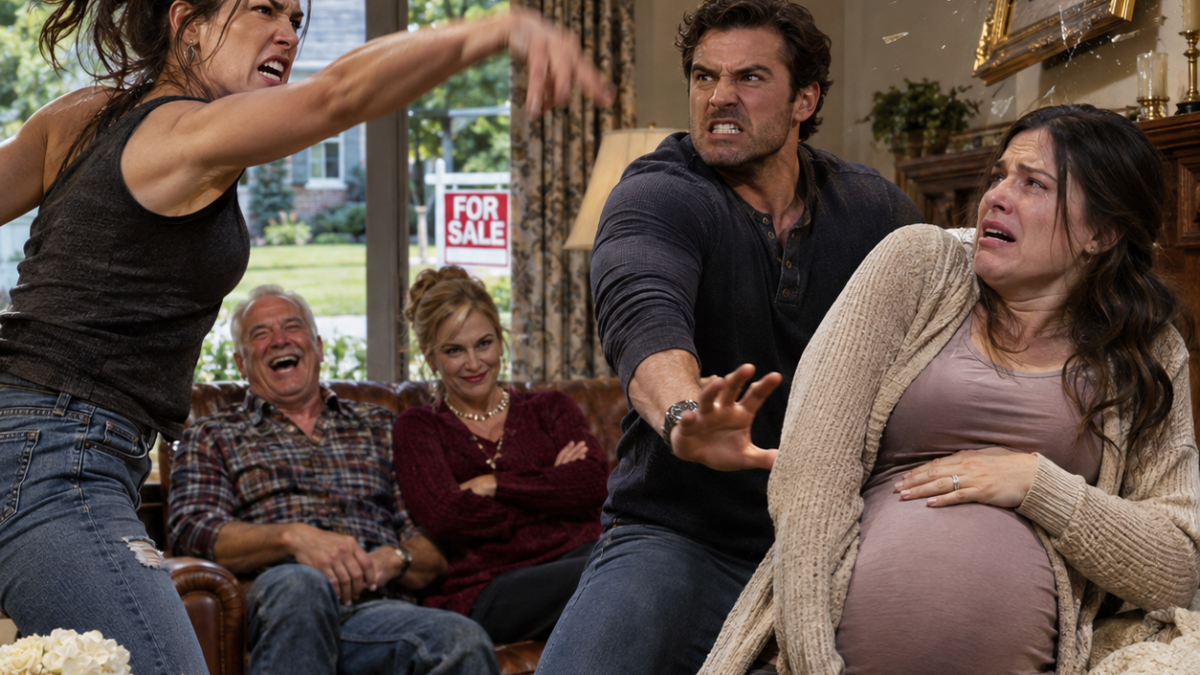
Tessa bent down.
Slipped off the heavy slipper she wore inside.
And threw it.
Hard.
It missed Clare’s temple by maybe three inches.
Hit the drywall.
Shattered a framed family photograph.
Glass dropped across the coffee table.
The slipper landed among the broken pieces.
For one second, the room stopped breathing.
Clare stared at her.
“Did you just throw a shoe at me?”
Tessa didn’t apologize.
“You wouldn’t move.”
That was when Dad started laughing.
Not nervous laughter.
Real laughter.
“Oh, good grief.”
He slapped his knee.
“The pregnancy hormones in this room.”
I stared.
“Tessa threw something at Clare.”
“She missed.”
That was his answer.
She missed.
As though accuracy determined whether the act mattered.
Mom entered from the kitchen wiping her hands on an apron.
She looked at the glass.
The shoe.
My wife.
Then Tessa.
“What happened?”
“She threw her shoe at me,” Clare said.
Mom sighed.
Not at Tessa.
At the situation.
Then gave Clare the sort of indulgent smile adults use with difficult children.
“Clare, honey, maybe next time you should just sit on the floor.”
I thought I had misheard.
Mom continued.
“You know how Tessa gets about her special chair.”
The floor.
My pregnant wife.
Seven months.
Back pain.
Inside a house I had saved from foreclosure.
Something inside me went quiet.
Years of obligation.
Done.
I picked up Clare’s coat.
Draped it over her shoulders.
Took her hand.
“Come on.”
Mom blinked.
“Where are you going?”
“Home.”
“I’m about to serve lunch.”
“We’re leaving.”
Dad groaned.
“Ian, don’t be dramatic.”
I looked at him.
“It’s a chair.”
He waved one hand.
“You’ll get over it tomorrow.”
Maybe he expected an argument.
He got none.
I helped Clare outside.
Closed the door.
And drove away.
For ten minutes, Clare stared through the passenger window.
No tears.
That scared me more.
At a red light, I asked:
“Are you okay?”
“Yes.”
“No.”
Her hand rested over her stomach.
“I’m not hurt.”
“That isn’t what I asked.”
She swallowed.
Then said quietly:
“Does your family hate me?”
I felt something collapse inside my chest.
“No.”
She laughed once.
“No humor.”
“Ian.”
“They don’t hate you.”
“Then why was everybody okay with that?”
I had no answer.
She looked at me.
“Your sister could have hit me.”
“I know.”
“She could have hit Audrey.”
Our unborn daughter.
My hands tightened around the wheel.
“I know.”
“And your dad laughed.”
“I know.”
“Your mom blamed me.”
“I know.”
She looked away.
Then whispered:
“I don’t want to go there anymore.”
“You won’t.”
Her head turned.
“What?”
“You don’t have to.”
“They’re your parents.”
“You are my family.”
Her eyes filled.
That sentence should have been obvious.
The fact that she needed to hear it told me I had failed somewhere.
At home, Clare showered and went to bed.
I sat in the living room.
Not drinking.
Not pacing.
Just thinking.
I thought about Brookfield.
Five years.
Mortgage arrears.
Second mortgage.
Taxes.
Roof.
Insurance.
Utilities.
Furnace repair.
Dad’s car.
Mom’s dental work.
Tessa’s credit card.
Her car insurance.
Her phone bill.
Trips.
Christmas.
One emergency after another.
Every time:
Ian can handle it.
And I had.
Quietly.
That was my mistake.
I had made rescue so invisible that they stopped seeing it as rescue.
At 10:18 p.m., I called Melissa Grant.
Two rings.
“Ian?”
“Sorry it’s late.”
“What happened?”
“Pull Brookfield.”
Silence.
“The house?”
“Yes.”
“What am I looking for?”
“The original file.”
Longer pause.
Then:
“Ian.”
“What?”
“What happened?”
I told her.
She did not interrupt.
When I finished:
“Is Clare okay?”
“Yes.”
“Baby?”
“Yes.”
“Good.”
Then attorney voice.
“Do you want them removed immediately?”
“No.”
“Good.”
That answer surprised me.
“Why good?”
“Because anger and residential occupancy law are terrible companions.”
“I own the property.”
“Yes.”
“They don’t pay rent.”
“Yes.”
“That doesn’t mean you change locks Sunday morning.”
“I know.”
“Good.”
“I want to sell.”
Pause.
“You’re sure?”
“Yes.”
“Tonight?”
“Yes.”
She sighed.
“No.”
“Melissa.”
“If you’re making a financial decision, we make a financial decision.”
“What does that mean?”
“It means I confirm title, occupancy status, notice requirements, and what we need to do before marketing.”
“Fine.”
“Then Monday.”
“I want it done tomorrow.”
“Sunday is a bad listing launch.”
“I don’t care.”
“I do.”
I nearly argued.
Then stopped.
She was right.
If I sold, I wanted market value.
Not theater.
“Monday.”
“Eight a.m.”
“Do it.”
Another pause.
“Once the sign appears, your family will know this isn’t another argument.”
I looked toward the hallway.
Clare sleeping.
Audrey moving inside her.
“They chose an old chair over my wife and unborn child.”
My voice stayed calm.
“Set everything in motion.”
Sunday morning brought messages.
Dad:
Calm down yet?
Then:
Your mother says tell Clare the tart was good.
Mom:
Everybody was emotional yesterday. Maybe all sides should apologize.
All sides.
Tessa:
Hope princess enjoyed ruining lunch.
I stared at the screen.
Saved all three.
Not because Melissa needed them.
Because I did.
Any doubt I had disappeared.
Clare came downstairs wearing one of my old restaurant sweatshirts.
I made eggs.
She took two bites.
Then:
“You called somebody.”
I looked at her.
“Melissa.”
Her fork stopped.
“The attorney?”
“Yes.”
“Why?”
“Brookfield.”
She went still.
“Ian.”
“I’m selling it.”
“No.”
I didn’t expect that.
“No?”
“You cannot make your parents move because Tessa threw a shoe at me.”
“It isn’t because of the shoe.”
“It happened yesterday.”
“It started five years ago.”
She rubbed her forehead.
“I don’t want them blaming me.”
“They already blame you for everything.”
“That isn’t the point.”
I sat opposite her.
“Do you know what I spend on them?”
She looked up.
“The house?”
“Everything.”
I told her.
Taxes.
Insurance.
Utilities.
Tessa’s insurance.
Dad’s storage unit.
Mom’s supplemental expenses.
Phones.
Repairs.
Emergency bills.
Clare’s face changed.
“How much?”
“About fifty-five thousand a year now, depending on repairs.”
Her mouth opened.
“You never told me.”
“I know.”
“Why?”
“Because I was embarrassed.”
“By helping them?”
“By how much they had come to expect.”
She sat back.
Then asked:
“If I hadn’t been pregnant, would you sell?”
I thought.
“Yes.”
“If Tessa had apologized immediately?”
“Maybe I would have waited.”
“If your dad had defended me?”
I answered before she finished.
“No.”
She understood.
The throwing was terrible.
The family response ended it.
Clare nodded.
“I don’t want revenge.”
“Neither do I.”
“Then promise me you do this legally.”
“I already am.”
“And give them time.”
“Yes.”
She reached across the island.
Took my hand.
“Then okay.”
Monday morning came with Ohio frost hard enough to crunch under boots.
I was at restaurant one before seven.
Produce delivery.
Heirloom tomatoes.
Baby kale.
Herbs.
At 7:52, Melissa texted.
Title confirmed. Occupancy notices prepared. Listing activates 8:00. Sign at 8:15.
At 8:16, a security-camera alert appeared.
Brookfield front lawn.
Wooden post.
White panel.
Red letters.
FOR SALE.
My stomach tightened.
There is something different about seeing a consequence become physical.
At 8:22, my phone began moving across the stainless counter.
Dad.
Mom.
Tessa.
Unknown number.
Dad again.
Miguel, my sous-chef, looked over.
“Everything okay, Chef?”
I picked up a bruised tomato.
Tossed it into compost.
“Couldn’t be better.”
He raised an eyebrow.
“My family is getting acquainted with capitalism.”
He laughed.
Phone again.
Ron.
I dried my hands.
Answered.
“What the hell is that sign doing in my yard?”
“If you mean the lawn, it’s still there.”
“The For Sale sign!”
“Yes.”
“Why?”
“Because I listed Brookfield.”
Silence.
Then:
“You can’t sell our house.”
“I can.”
“That title arrangement is a technicality.”
“No.”
My voice remained flat.
“That is literally the point.”
Movement.
Mom took the phone.
“Ian?”
“Hi, Mom.”
“Why are you doing this?”
“I’m selling an asset.”
“Over Saturday?”
“Saturday clarified the arrangement.”
“One misunderstanding?”
I closed my eyes.
“Tessa threw a hard object at my pregnant wife.”
“She was upset.”
“You told Clare to sit on the floor.”
“I was trying to stop an argument.”
“No.”
“What?”
“You were trying to stop Tessa from escalating.”
“Same thing.”
“No.”
I looked around the kitchen.
“Clare was the safest person in the room to blame.”
Mom went quiet.
Dad returned.
“Take the sign down.”
“No.”
“Your mother is crying.”
“I’m sorry she’s upset.”
“You’re really doing this?”
“Yes.”
“Over a chair?”
“No.”
“Then why?”
There it was.
The question he should have asked years earlier.
“Because I’ve been financing a family that thinks my support is automatic and my wife is optional.”
Silence.
Then:
“That’s ridiculous.”
“Okay.”
“Ian!”
“I have service.”
“Don’t hang up.”
“I’ll communicate through Melissa regarding the house.”
Then I ended the call.
Tessa called from a number I didn’t recognize.
I answered.
“You psycho.”
“Good morning.”
“You’re selling my house?”
“Brookfield is mine.”
“You bought it for Mom and Dad.”
“I bought it because foreclosure was six weeks away.”
“You said we could live there.”
“Yes.”
“Forever.”
“No.”
“Basically.”
“Not a legal term.”
She started crying.
“Where am I supposed to go?”
“You’re thirty-two.”
“That doesn’t answer me.”
“It does.”
“I barely make enough.”
“You make forty-seven thousand dollars.”
Silence.
“How do you know?”
“You asked me to cosign your SUV.”
“That was private.”
“Your salary isn’t the issue.”
“What is?”
“You’ve paid no rent for five years.”
“So?”
There it was.
So?
“You had five years to save.”
“I have bills.”
“So does everyone.”
“You have millions.”
“No.”
“You own restaurants!”
“Yes.”
“You can afford the house.”
“I can.”
“Then why sell it?”
“Because being able to afford something does not make me obligated to provide it.”
She was silent for two seconds.
Then:
“This is Clare.”
“No.”
“She turned you against us.”
“No.”
“You were never like this before her.”
“Tessa.”
“What?”
“Do not blame my wife for a boundary I should have set years ago.”
She hung up.
By ten, relatives knew.
Family telephone network.
Aunt Denise called.
“Your father says you are evicting them because Clare wanted Tessa’s chair.”
“No.”
“What happened?”
I told her.
Silence.
Then:
“Tessa threw it?”
“Yes.”
“At Clare?”
“Yes.”
“She’s pregnant.”
“Yes.”
“And Linda said what?”
I repeated the floor comment.
Long pause.
“Oh.”
Exactly.
Then Aunt Denise said:
“I thought Ron still owned the house.”
Of course she did.
“He hasn’t for five years.”
“What?”
I explained the foreclosure.
Debt.
Transfer.
Renovation.
“He told us he refinanced.”
I nearly laughed.
“Ask him for the loan documents.”
That conversation traveled.
By Monday night, Dad’s version was already changing.
Tuesday morning, he arrived at my restaurant.
Breakfast rush.
Customers.
Staff.
Miguel found me.
“Chef. Your dad.”
I walked toward the host stand.
Dad’s face was flushed.
“You can’t do this.”
“Not here.”
“I need five minutes.”
“I’m working.”
“You care more about breakfast service than your family?”
“That line isn’t going to work anymore.”
His expression changed.
“Take the listing down.”
“No.”
“I’ll pay you.”
That surprised me.
“With what?”
“My retirement.”
“How much?”
“Enough.”
“No.”
“Why not?”
“Because this is not a negotiation made in a dining room during breakfast.”
His voice lowered.
“Give us a year.”
“To do what?”
“Figure it out.”
“You had five.”
“That isn’t fair.”
“No.”
I looked at him.
“Paying everything for five years wasn’t fair either.”
Customers were starting to watch.
I hated that.
“Dad, go home.”
“You used to respect me.”
Old button.
He knew where it was.
I felt it.
Then answered differently.
“I do respect you.”
He seemed surprised.
“That doesn’t require financing you.”
I walked back into the kitchen.
Mom was the first one to apologize properly.
Tuesday afternoon.
Voicemail to Clare.
Clare played it for me.
“Clare, this is Linda.”
Pause.
“I’m ashamed of what I said.”
Another pause.
“I should have stopped Tessa immediately.”
Her voice shook.
“I should never have suggested you sit on the floor.”
Then:
“You did nothing wrong.”
Clare cried.
So did I.
Mom continued.
“I know Ian is selling the house.”
Long pause.
“I’m not asking you to make him stop.”
That mattered almost as much as the apology.
Clare called her back.
They talked.
I stayed out of it.
When she came downstairs:
“She understands more now.”
“Did she ask about Brookfield?”
“Once.”
“And?”
“I told her it’s your decision.”
I kissed her.
Dad’s apology arrived by text.
Sorry Saturday got out of control. Hope you’re feeling okay.
Not good.
Not nothing.
Clare replied:
Thank you.
Then left it.
Tessa remained silent.
But online she posted:
Amazing how quickly men forget the women who raised them once a wife starts controlling their money.
Then:
Imagine making your parents homeless over a chair.
Cousin Marie commented:
Doesn’t Ian own the house because he paid off the foreclosure?
Deleted within six minutes.
Screenshots lasted longer.
Family myths started collapsing.
Wednesday, Melissa called.
“You forgot something.”
“What?”
“Original occupancy acknowledgment.”
I had.
Five years earlier, she made everyone sign a simple family agreement.
Not a lease.
But clear.
I owned Brookfield.
My parents were permitted to occupy without rent subject to future written notice.
Tessa was listed as an adult occupant.
Dad had signed.
Mom.
Me.
Tessa initialed an acknowledgment page.
Melissa emailed it.
I stared at Dad’s signature.
He had not forgotten the truth.
He had become comfortable enough to rewrite it.
Entitlement has a strange relationship with memory.
The first offer came Thursday.
$421,000.
No.
Second Friday morning.
$436,000.
Weak contingency.
No.
Friday afternoon:
$452,500.
Strong financing.
Flexible closing.
Teacher.
Respiratory therapist.
Two children.
The buyer letter mentioned the backyard.
I usually hated buyer letters.
This one got me.
They wanted a place where their children could grow.
I looked at Clare.
“Accept?”
She asked:
“Do you want to?”
“No.”
That surprised her.
“Then don’t.”
“I think I need to.”
“Different answer.”
“Yes.”
Melissa reviewed everything.
The numbers were strong.
I accepted.
Subject to ordinary contingencies.
Brookfield was actually going to be sold.
Dad changed after that.
Fear replaced anger.
He called Friday night.
“Your mother and I found an apartment.”
“Good.”
“Two bedroom.”
“Okay.”
“It’s smaller.”
“I imagine.”
“We need the deposit.”
I closed my eyes.
Still.
Even after everything.
“How much?”
“Thirty-eight hundred including first month.”
“No.”
Silence.
“Ian.”
“I’ll pay the security deposit directly to the landlord.”
He paused.
“Thank you.”
“Not first month.”
“Fine.”
“And Tessa isn’t moving with you.”
His voice hardened.
“She’s our daughter.”
“And thirty-two.”
“She needs somewhere.”
“She needs to find somewhere.”
“You’re punishing her.”
“She makes forty-seven thousand dollars and has had five years without rent.”
“That’s not much anymore.”
“Then she needs a budget.”
“Your wife did this to us.”
The final reflex.
I went cold.
“No.”
“Ever since Clare came—”
“Stop.”
Dad stopped.
“I rescued Brookfield before I married Clare.”
Silence.
“I started paying your bills before Clare.”
Nothing.
“This is my boundary.”
I lowered my voice.
“Do not disrespect my wife by blaming her for a decision I made.”
He hung up.
Tessa appeared at our house the next afternoon.
Flowers.
Red eyes.
I opened the door only halfway.
“What?”
“I need to talk to Clare.”
I looked back.
Clare nodded.
We let her inside.
Tessa sat.
For once, not demanding a specific chair.
“I’m sorry.”
Clare waited.
“I shouldn’t have thrown the shoe.”
“No.”
“I was angry.”
Still waiting.
“I wasn’t trying to hit you.”
Clare tilted her head.
“You threw it directly toward me.”
Tessa looked embarrassed.
“Yeah.”
“That means you were willing to risk hitting me.”
Silence.
“Yes.”
Good.
Honesty.
“I’m sorry.”
Clare asked:
“Why did the chair matter that much?”
Tessa looked down.
“It was Grandma’s.”
That part we knew.
“She used to rock me in it when I was little.”
Clare softened slightly.
“I understand attachment.”
Tessa looked relieved.
Then Clare continued:
“I don’t understand throwing something at a pregnant woman because of it.”
Relief gone.
Good.
Tessa nodded.
“I know.”
Then she started crying.
“I’m losing my home.”
There it was.
The second reason she came.
Clare saw it too.
Tessa looked at me.
“Can I stay in the condo near your second restaurant?”
“No.”
Her face changed instantly.
“What?”
“No.”
“You’re not using it.”
“That isn’t the point.”
“You’d rather leave it empty than help your own sister?”
“I have helped my sister for five years.”
“That house was for Mom and Dad.”
“And you lived there rent-free.”
“I didn’t ask you to buy it.”
“No.”
“You just did.”
“Exactly.”
I leaned forward.
“And I never defined an endpoint.”
“That was my mistake.”
She stared.
“So you’re punishing me because you were generous?”
“No.”
“I’m ending an arrangement that became unhealthy.”
“I have nowhere to go.”
“How much do you have saved?”
She looked away.
“Tessa.”
“Fourteen hundred.”
Five years.
I almost couldn’t process it.
“Where did the money go?”
Her face hardened.
“None of your business.”
I nodded.
“Correct.”
Then:
“Neither is your rent.”
She stood.
“Forget the apology.”
Clare spoke.
“Tessa.”
She stopped.
“I accept your apology for throwing the shoe.”
Tessa turned.
Clare continued:
“That does not mean Ian owes you housing.”
Tessa’s face twisted.
“Then what’s the point?”
“An apology isn’t a transaction.”
Silence.
Then Tessa left.
The flowers stayed.
The following week, she sold her luxury SUV.
The one I had helped her finance.
Bought a used Honda.
Used the difference for an apartment deposit.
Interesting.
No homelessness.
No catastrophe.
An adult made an adult decision.
Dad and Mom signed for their two-bedroom.
I paid the security deposit directly.
Not rent.
Not furniture.
Not moving company.
Specific help.
Limited help.
Healthy help.
It felt strange.
The Brookfield inspection passed with only minor repairs.
Of course the electrical passed.
I had paid for all of it.
Closing scheduled.
Then I did something larger than selling the house.
I reviewed every recurring payment connected to my family.
Dad and Mom’s mobile-phone plan.
Tessa’s car insurance.
A storage unit.
Mom’s premium gym membership.
Streaming services.
Utility auto-payments.
Property insurance.
Several miscellaneous subscriptions.
There were so many that individually I had forgotten half of them.
Combined with Brookfield:
About $4,600 a month.
More than fifty-five thousand dollars a year.
I stared at the spreadsheet.
Clare sat beside me.
“You’ve been paying all this?”
“Yes.”
“Why?”
I laughed bitterly.
“Because each time something started, it seemed easier than arguing.”
She touched my hand.
“That’s expensive peace.”
Exactly.
We created transition dates.
Mom’s health-related coverage got time.
House expenses ended with closing.
Phones transferred after thirty days.
Insurance transitioned.
No sudden service shutoffs.
No cruelty.
Just endings.
When Dad noticed the phone transfer notice, he called.
“You’re cutting us off.”
“Financially, yes.”
“Completely?”
“Mostly.”
“Why?”
“Because you are adults.”
“You make plenty of money.”
“So?”
He went quiet.
Same word Tessa had used.
“So?”
As if my ability automatically created his right.
I said:
“My income is not your household budget.”
He sounded wounded.
“I never thought I’d hear my son say that.”
“I never thought I’d be forty-one paying my parents’ cable bill.”
He hung up.
Mom adapted.
Faster than Dad.
She made a budget.
First time in decades.
Canceled things.
Changed phone plans.
Joined a cheaper community center.
Called me after the first month.
“I didn’t realize how much you paid.”
“I know.”
“How much?”
I told her.
Silence.
“Oh my God.”
“Yes.”
“Why did you keep doing it?”
“Because saying yes was easier than having this conversation.”
“That was stupid.”
“Yes.”
She laughed.
So did I.
Truth becomes less painful once it stops being hidden.
Dad got a part-time consulting job.
At sixty-seven.
He complained constantly.
Then began enjoying it.
One afternoon, he called.
“I paid the electric bill.”
I laughed.
“Congratulations.”
“Shut up.”
“You called me specifically to announce this.”
“I did not.”
“You absolutely did.”
He laughed.
Our conversations started changing.
Less rescue.
More father and son.
I had not expected that.
Tessa struggled.
But not forever.
Her rent forced budgeting.
She cut delivery apps.
Canceled subscriptions.
Sold clothes.
Then got promoted.
A year later, she moved into a better apartment.
No call asking me for money.
That mattered.
Then Audrey was born.
Tessa asked to visit when Audrey was nine months old.
I hesitated.
Clare said yes.
Tessa arrived carrying a stuffed elephant.
She stood near the door.
“Can I hold her?”
Clare looked at me.
Then nodded.
Tessa sat.
Audrey immediately grabbed her necklace.
Tessa laughed.
Then cried.
“I keep thinking about that day.”
Clare said nothing.
“What if the shoe had hit you?”
“So do I.”
“I was horrible.”
Clare corrected her.
“You did something horrible.”
Tessa looked at her.
“That’s different?”
“Yes.”
“One means you can change.”
Tessa cried harder.
“I’m trying.”
“I know.”
That was the beginning.
Not the end.
Trust takes longer than apology.
Dad became a good grandfather.
Annoyingly good.
The man who had laughed while a shoe flew near my pregnant wife would spend forty-five minutes on the carpet letting Audrey stack blocks on his head.
Human beings resist simple categories.
That does not mean we excuse their worst behavior.
It means accountability is more useful than labels.
Dad still needed to repair what he had done.
He did.
Slowly.
Mom apologized again months after Audrey’s birth.
She and I were alone.
“I keep hearing myself tell Clare to sit on the floor.”
I looked at her.
“I wish I could erase it.”
“You can’t.”
“I know.”
Then:
“I was afraid of Tessa.”
That surprised me.
“Afraid?”
“Not physically.”
She shook her head.
“Afraid she’d explode.”
“So you asked Clare to surrender.”
“Yes.”
“Because Clare was reasonable.”
“Yes.”
Mom’s eyes filled.
“I’ve done that all my life.”
The reasonable person pays for the unreasonable person’s behavior.
Classic family peacekeeping.
“That isn’t peace.”
“I know.”
“It rewards whoever behaves worst.”
“I know.”
Then she said something I had never heard from her before.
“I’m sorry I made being good cost you and Clare more.”
That was real.
Dad’s proper apology came almost a year later.
We were grilling.
He waited until Clare went inside.
“I laughed because I didn’t know what else to do.”
I looked at him.
“The shoe.”
“Yes.”
“I thought if I made it funny, everyone would calm down.”
“That was your strategy for everything.”
He nodded.
“When your mother overspent.”
“Joke.”
“When Tessa lost another job.”
“Joke.”
“When foreclosure started.”
“Joke.”
“And then you fixed it.”
There it was.
His role.
My role.
“I’m sorry.”
I waited.
Then he said the sentence I needed.
“I should have protected Clare.”
I looked at him.
“Yes.”
“Instead I protected the person causing the problem.”
“Yes.”
“I was wrong.”
“Thank you.”
He exhaled.
“Are we okay?”
I almost smiled.
“No.”
His face fell.
“We’re better.”
He laughed.
“Fair.”
Brookfield sold.
The young couple moved in.
Teacher.
Respiratory therapist.
Two children.
A year later, they mailed me a Christmas card.
Photo in the backyard.
Swing set.
Message:
Thank you for taking such good care of this house before us. We love it.
I stared at that photograph for a long time.
Selling Brookfield had not destroyed a home.
It had ended an arrangement.
The building remained.
New memories.
New family.
That helped more than I expected.
The sale proceeds did not go toward revenge.
No sports car.
No luxury trip.
Part funded Audrey’s education account.
Part went into retirement.
Part to business reserves.
Dad found out.
“You sold my house for a toddler’s college fund?”
“My house.”
He rolled his eyes.
But he no longer said technicality.
Progress.
My parents stayed in the apartment three years.
Then bought a small condo.
Their names on the deed.
They called me after closing.
Dad sounded proud.
“Guess whose house this is.”
“Melissa’s?”
“Very funny.”
“Yours?”
“Mine and your mother’s.”
“No technicalities?”
He laughed.
“No technicalities.”
I was proud.
Dependency had not protected him.
It had delayed him.
Tessa bought her own condo at thirty-seven.
No money from me.
She called after closing.
“I did something.”
“What?”
“Bought a place.”
I sat down.
“You bought?”
“Do not sound shocked.”
“I’m not.”
“You sound completely shocked.”
She sent pictures.
Two bedrooms.
Balcony.
Small kitchen.
No burgundy recliner.
“Need anything?”
Long pause.
“No.”
Then:
“Actually, do you know a plumber?”
I smiled.
“That I can help with.”
That became our new relationship.
Help did not always mean money.
The chair remained with Tessa for years.
Eventually it broke.
She called.
“Do you want Grandma’s recliner?”
“No.”
“Mom doesn’t.”
“Then throw it away.”
She was quiet.
“It feels weird.”
“Why?”
“Everything happened because of it.”
“No.”
“What?”
“Nothing happened because of the chair.”
I said it clearly.
“It happened because we had no boundaries.”
Silence.
Then:
“Still throwing it away.”
“Good.”
She sent a photograph of the chair beside a dumpster.
Caption:
NO PREGNANT WOMEN WERE INJURED DURING DISPOSAL.
I laughed.
Then wrote:
Too soon forever.
She replied:
Fair.
That was healing too.
Not erasing.
Being able to touch the memory without becoming it again.
When Audrey was three, she climbed into Dad’s chair at family dinner.
Dad returned.
Stopped.
Everybody saw.
Tessa saw.
Clare saw.
I saw.
Dad looked at Audrey.
Then at the floor.
“Well.”
He lowered himself carefully.
“Guess I’m sitting down here.”
The entire room exploded laughing.
Tessa laughed hardest.
Clare covered her face.
I laughed until my eyes watered.
One stupid chair had carried enough symbolism for a lifetime.
People who hear the story usually want the satisfying version.
Pregnant wife insulted.
Rich restaurant-owner husband sells freeloading family’s house.
Everyone begs.
Justice.
Reality was better and more complicated.
Yes, I was angry.
Yes, seeing Dad discover the For Sale sign gave me a moment of satisfaction.
But if the goal had been punishment, I could have behaved much worse.
I did not lock anyone out.
Did not shut off utilities.
Did not dump belongings outside.
Did not use my ownership to humiliate them publicly.
Melissa handled notices.
I allowed transition time.
Helped Mom and Dad with a deposit.
Kept health-related support temporarily.
The goal was not:
Make them suffer.
The goal was:
End dependence.
Those things can look similar at first.
Time reveals the difference.
My family thought I was destroying them.
Instead:
Dad worked again.
Mom budgeted.
Tessa learned to pay rent.
Then bought property.
Nobody became homeless.
Nobody starved.
Nobody’s life collapsed.
The catastrophe they predicted was adulthood.
I had been protecting them from it for years.
That protection was not love anymore.
It was interference.
That realization forced me to admit something uncomfortable.
I liked rescuing them.
Not consciously.
But being Ian the Fixer made me important.
Ian knows someone.
Ian can pay it.
Ian will handle it.
Competence became my family identity.
I complained about being used.
Then kept volunteering.
Why?
Because being indispensable feels dangerously similar to being loved.
That was my work to do.
I was not responsible for Tessa throwing the shoe.
Not responsible for Dad laughing.
Not responsible for Mom’s comment.
But I had helped create a family system where I solved consequences so quickly that nobody had much incentive to change.
I stopped.
That changed all of us.
Clare never asked me to cut my family off.
In fact, she was the one who kept me from going too far.
When I wanted to cancel Mom’s insurance immediately:
“No. Give her transition time.”
When Dad made a terrible first apology:
“He’s trying badly.”
When Tessa apologized:
“Accept what she means, not what she wants from it.”
Clare understood boundaries better than I did.
Maybe because she was a counselor.
Maybe because she had not grown up inside my family.
Contrast is useful.
Once you experience respect, disrespect becomes harder to call normal.
Years later, Audrey asked:
“Did Aunt Tessa really throw a shoe at Mom while Mom was pregnant with me?”
Family stories travel.
“Yes.”
“That is insane.”
“Language.”
“Dad.”
“Fair.”
“Why do we still talk to her?”
I thought carefully.
“Because she changed.”
“How do you know?”
“Because she behaved differently for years when nobody was forcing her.”
Audrey considered that.
“So forgiveness is about behavior?”
“Sometimes.”
“And time.”
“And safety.”
She nodded.
“If she had hit Mom?”
I looked at her.
“I don’t know.”
Honest answer.
Not every relationship has to be repaired.
Ours could be.
That doesn’t mean every one should.
The most important thing Clare remembered was not the shoe.
Years later, she told me:
“I remember you putting my coat around me.”
I stared.
“Really?”
“Yes.”
“Why?”
“Because I knew you had finally chosen.”
I hated that.
“You should never have had to wonder.”
“I know.”
She touched my hand.
“But I did.”
That was difficult to hear.
For years, I had thought paying bills made me a good son.
I had not noticed that constantly protecting my parents and sister from consequences sometimes left Clare feeling second.
That Saturday changed that.
Not the sale.
The leaving.
I took my wife’s hand.
Left the room.
Did not ask her to absorb one more insult so I could preserve family peace.
That was the decision she remembered.
Dad had told me:
“You’ll get over it tomorrow.”
I never did.
Not the way he meant.
I did not forget.
Did not return to the old financial arrangement.
Did not pretend.
But I got through it.
Different.
Dad became independent.
Mom became more honest.
Tessa became responsible.
Clare stopped dreading family gatherings.
Our children grew up knowing relatives who had learned boundaries instead of adults permanently at war.
That was better than “getting over it.”
Dad died years later.
Heart attack.
Fast.
When Mom called, I still felt the old impulse.
Fix it.
There was nothing to fix.
I went.
Tessa came.
We sat with Mom.
Dad had organized everything.
Insurance.
Condo documents.
Passwords.
Bills.
Inside his desk was a folder labeled:
IN CASE IAN ISN’T AROUND TO FIX IT.
I laughed while crying.
On top:
Son, paperwork is cheaper than pride. Don’t let your mother remodel another kitchen. Love, Dad.
That was my father.
Still joking.
But now the joke came after responsibility.
Not instead of it.
I kept the note.
At his funeral, Tessa gave the eulogy.
She said:
“Dad spent years assuming Ian would catch all of us every time we fell.”
Then looked at me.
“One of the best things my brother ever did for Dad was finally stop.”
People outside the family probably thought that sounded cruel.
We understood.
Dad’s final years belonged more fully to him because his bills, housing, choices, and mistakes belonged to him.
Dependency had made him feel protected.
It had also made him smaller.
I never expected boundaries to give him dignity back.
They did.
Mom lived another decade.
Near the end of her life, she moved into assisted living.
She had a blue recliner.
One afternoon, Tessa visited.
Mom pointed at it.
“My chair.”
Tessa froze.
Mom smiled.
“Sit down.”
Tessa stared.
Then Mom started laughing.
We all did.
She had waited years to make that joke.
Worth it.
The final lesson came from Tessa.
She had a daughter of her own eventually.
At Thanksgiving, the little girl climbed into Tessa’s favorite chair.
I watched.
So did Clare.
Tessa walked in.
Stopped.
Her daughter looked up.
“Mommy, is this your chair?”
A pause.
Then Tessa lowered herself onto the floor.
Her knees cracked.
“Apparently not.”
Clare laughed so hard she nearly spilled her drink.
I had to look away because my eyes filled.
That was an apology delivered years later without words.
Behavior.
That is what convinced me the change was real.
I am older now.
The restaurants mostly run without me.
Miguel became an operating partner.
He still tells new staff the story about the morning my father called twelve times during a produce delivery.
He changes it to eighty.
Storytelling.
Clare and I have been married for decades.
Audrey is grown.
We have grandchildren.
Tessa owns her home.
Mom and Dad are gone.
Brookfield belongs to another family.
The burgundy recliner is long gone.
But that Saturday remains a dividing line.
Before it, I thought family love meant unlimited access.
After it, I learned family love needs boundaries more than almost anything else.
Because family knows exactly where guilt lives.
Exactly which old obligation to pull.
Exactly which sentence will make you feel selfish.
A healthy relationship does not require you to ignore that.
It requires everyone to stop exploiting it.
The For Sale sign was never the most important consequence.
It was simply the first visible one.
What changed everything was what came after.
I stopped paying every bill.
Stopped solving every emergency.
Stopped treating adult relatives like dependents.
Stopped asking Clare to endure disrespect because “that’s just how they are.”
Stopped measuring my goodness by how much resentment I could tolerate without complaining.
My family hated it at first.
Then they adapted.
Then some of them changed.
Then we rebuilt.
If I had to do it again, I would set boundaries five years earlier.
When I bought Brookfield:
Written expectations.
Utility responsibilities.
Annual review.
A deadline for Tessa.
Clear transition planning.
Not because family should operate like a corporation.
Because ambiguity turns gifts into expectations.
Expectations into entitlement.
Entitlement into anger when the gift ends.
I learned that too late.
Still learned it.
The younger version of me believed generosity was strongest when nobody knew the cost.
I think differently now.
If you constantly hide what helping costs you, do not be shocked when people start believing it costs nothing.
You don’t need applause.
But relationships need reality.
My family had no idea what I was carrying because I worked very hard to make sure they never had to see it.
Then I hated them for not seeing.
Part of the repair was mine too.
None of that excuses Saturday.
Complexity should never blur a clear line.
Tessa threw a hard object at my pregnant wife.
Dad laughed.
Mom suggested Clare sit on the floor.
Wrong.
Period.
Everything after that could be nuanced.
That moment wasn’t.
The Monday-morning calls eventually became family legend.
Dad yelling about “his” yard.
Mom crying.
Tessa calling me evil.
Miguel asking:
“Everything okay, Chef?”
And me saying:
“My family’s getting acquainted with capitalism.”
Miguel still thinks that is the funniest thing I ever said.
It probably is.
But beneath the joke was something I could not see then.
My family wasn’t really learning capitalism.
They were learning consequences.
And so was I.
I was learning that saying yes for years does not prohibit saying no today.
That owning the solution does not make you obligated to provide it forever.
That being able to pay does not mean you should.
And that if someone insults the woman carrying your child inside a house you are financing, you are allowed to stop financing the arrangement without first winning everyone’s approval.
Years after Dad died, I drove past Brookfield alone.
Snow.
Lights in the windows.
Different family.
Different cars.
I pulled over for thirty seconds.
Remembered the For Sale sign.
The phone calls.
The broken photograph.
Grandma’s chair.
Then I realized I felt no anger.
Only distance.
The house had become a house again.
Not rescue.
Not obligation.
Not revenge.
Not proof.
Just a building.
That was freedom.
When I returned home, Clare was in our kitchen.
She asked:
“Where were you?”
“Brookfield.”
She looked surprised.
“Why?”
“Just drove past.”
“And?”
I smiled.
“Nothing.”
She understood.
Sometimes nothing is the best possible ending.
My family once believed the worst thing I could do to them was sell the house.
They were wrong.
The worst thing would have been to keep paying while resentment poisoned every relationship we had.
Selling Brookfield forced the truth into the open.
My parents could survive without me financing them.
My sister could become independent.
I could love them without supporting every part of their lifestyle.
And Clare could finally know that when my family demanded a choice between their comfort and her dignity, I would not ask her to lose again.
That was why, decades later, when Clare told our grandchildren the story, she never began with the house.
She began with the coat.
“Your grandfather didn’t yell,” she’d say.
“He just put my coat on me.”
The grandchildren always look disappointed.
They want drama.
“Then what?”
Clare smiles.
“Then he took my hand.”
“And?”
“We went home.”
They wait.
She points toward me.
“Everything important happened after that.”
She’s right.
Because the most important thing I changed that weekend wasn’t ownership of Brookfield.
I already owned it.
It wasn’t my family’s finances.
Those took months.
It wasn’t even their behavior.
That took years.
The first thing I changed was myself.
I stopped confusing endurance with loyalty.
Stopped confusing rescue with love.
Stopped believing that being the dependable son meant everyone else was entitled to remain dependent.
And I stopped asking the woman I had promised to protect to keep swallowing disrespect so nobody else would feel uncomfortable.
My father laughed:
“Relax! It’s just pregnancy hormones!”
My mother sneered:
“Maybe she should sit on the floor next time.”
My sister stood there unrepentant beside the shattered photograph.
And for once, I did not argue.
I did not beg them to understand.
I did not explain how much money I had spent.
I did not remind them who owned the house.
I simply took my wife home.
Then I let the paperwork say the rest.
By Monday morning, the sign in the lawn told my family something I should have said years earlier:
My love was real. My help was generous. But neither one gave them permanent ownership of my money, my property, or my silence.
And when they finally understood that, they didn’t lose their family.
They lost the arrangement that had been slowly destroying it.
That was the consequence.
That was the repair.
And years later, watching my sister willingly sit on the floor so her own daughter could keep a chair, I finally knew the lesson had reached the one place no For Sale sign ever could:
her behavior.








