FULL STORY:“RONNIE’S PIT BULL MUST CHOOSE ONE OF US!” Twenty-Three Bikers Gathered to Honor Our Dead Brother’s Final Wish—But His Dog Refused Every Man Until We Realized Who She Was Waiting For
PART2
Ronnie wasn’t the biggest man in our club.
That distinction belonged to Big Bill, who stood six feet five and had shoulders wide enough to block an entire doorway.
He wasn’t the oldest.
Walter had been riding motorcycles before some of us learned to walk.
And Ronnie certainly wasn’t the loudest.
Frank could argue about spark plugs for three hours without stopping to breathe.
But Ronnie was the center of us.
When one of our brothers lost his job, Ronnie organized a collection without making the man feel embarrassed.
When Bill’s wife needed surgery, Ronnie drove six hours to help look after their grandchildren.
When my own marriage nearly collapsed, he showed up at my house carrying two cups of coffee and refused to leave until I’d stopped pretending everything was fine.
He never claimed to have all the answers.
He just stayed.
That was his gift.
He understood that people often needed someone beside them more than they needed another lecture.
And perhaps that was why he and Ella understood each other so well.
Ronnie found Ella six years before he died.
She was sitting outside a shuttered repair shop on the outskirts of Meridian.
Someone had apparently been feeding her occasionally, but nobody knew exactly where she’d come from.
She was thin, cautious, and frightened of sudden movements.
Ronnie noticed her while stopping for gas.
He offered her a little food.
She approached carefully.
Ate.
Then retreated.
The next afternoon, Ronnie returned.
Ella was still there.
He sat on the curb.
Waited.
She watched him from beneath an old pickup truck.
He didn’t try to grab her.
Didn’t chase her.
He simply talked.
“Hey, little lady. You planning to live under that truck forever?”
She stared.
“Not exactly a five-star hotel.”
He placed a little food nearby.
Then backed away.
For several days, he kept returning, gradually earning her trust.
Eventually, with appropriate help and after checking whether someone owned or was searching for her, Ronnie was able to bring her into his care.
He took her to a veterinarian.
Made sure she received the treatment and preventive care she needed.
And brought her home.
He named her Ella.
Nobody ever understood why.
When we asked, he smiled.
“Because she looks like an Ella.”
That was all the explanation we got.
At first, Ella was uncertain around the club.
Twenty-three men.
Heavy boots.
Leather jackets.
Motorcycles.
Loud voices.
Engines roaring.
It was a lot for a dog who’d spent time surviving on the street.
Ronnie was careful.
He never forced her into overwhelming situations.
He gave her a quiet place.
Let her approach people at her own pace.
And taught us to respect her boundaries.
Some brothers joked that Ronnie had gone soft.
He didn’t care.
“She’s not here to prove anything to you,” he told us.
“If she wants to be friendly, she’ll come over.”
And she did.
Slowly.
Bill was the first person besides Ronnie she approached.
He had been sitting beside the clubhouse door eating a sandwich.
Ella walked toward him.
Sniffed his boots.
Then sat.
Bill looked down.
“Can I help you?”
Ella stared at the sandwich.
Bill laughed.
“Ah. I see what this is.”
He checked with Ronnie before offering her an appropriate treat.
From that day onward, Ella greeted Bill whenever she saw him.
Frank took longer.
He was loud.
Impatient.
And always seemed to be arguing about something.
For weeks, Ella kept her distance.
Then one afternoon, Frank arrived looking miserable.
His father had died.
He sat alone on the clubhouse steps, staring at the ground.
Ella approached.
Stopped beside him.
Then rested her head against his knee.
Frank began crying.
He never admitted that to most of the club.
But I saw it.
Ronnie saw it too.
We said nothing.
And when Frank eventually stood, he stroked Ella’s head and whispered, “Thanks, girl.”
After that, nobody joked about her being just another dog.
She was one of us.
Ronnie and Ella became inseparable.
She traveled with him when the arrangements were safe and suitable for her.
She slept beside his bed.
Waited near the garage while he repaired motorcycles.
And followed him around the clubhouse as though she’d been appointed to supervise the entire operation.
She had her own cushion.
Her own water bowl.
Her own place beneath the big wooden table.
Ronnie spoke to her constantly.
Sometimes I heard him telling her about engine problems.
Sometimes about the weather.
Sometimes about things he wouldn’t tell the rest of us.
He’d sit beside her, scratch her ears, and say, “Well, little lady, it’s been one of those days.”
Ella would look up.
Rest her head on his knee.
And listen.
Ronnie used to laugh.
“Best listener in Mississippi.”
We’d tease him.
“That’s because she can’t argue back.”
He’d grin.
“Exactly. You fellas should try it.”
When Ronnie became ill, Ella seemed to notice the changes in his routine.
He moved more slowly.
Spent more time resting.
Stopped taking the longest rides.
Some mornings, he didn’t have the energy to leave the house.
Ella stayed close.
She followed him from room to room.
Lay beside his chair.
Watched him when he coughed.
And settled near his bed at night.
I visited often.
Sometimes Ronnie was cheerful.
Sometimes exhausted.
Once, I found him sitting on the porch with Ella resting beside his feet.
He looked toward the road.
Then said, “Jesse, I need you to promise me something.”
I frowned.
“What?”
He nodded toward Ella.
“If anything happens to me, don’t let somebody take her away just because they think they should.”
I looked down at the dog.
“What do you mean?”
Ronnie stroked her ears.
“Let her have a say.”
I laughed softly.
“She’s a dog, Ronnie.”
He looked at me.
“I know.”
“How’s she supposed to choose?”
He smiled.
“You’ll figure it out.”
I shook my head.
He turned toward me.
Then said something I’ll never forget.
“She’s spent enough of her life having people decide things for her. I want her to feel safe with whoever comes next.”
I looked down at Ella.
She was watching Ronnie.
Her eyes soft.
Her body relaxed.
I nodded.
“Okay, brother.”
Ronnie smiled.
“Good.”
At the time, I didn’t realize he was asking me to make one of the hardest promises of my life.
Ronnie died on a Tuesday morning.
He was sixty-three.
His final months had been difficult, and although we knew his health was declining, none of us was prepared for the emptiness that followed.
The clubhouse felt wrong without him.
His motorcycle sat in its usual space.
His old leather jacket hung behind the door.
A coffee mug remained on the shelf.
And Ella waited.
At first, she searched the rooms.
She walked toward the garage.
Sniffed the familiar places.
Returned to his chair.
Then the front door.
Whenever a motorcycle approached, she lifted her head.
Sometimes she stood.
Sometimes she hurried toward the window.
Then the rider entered.
And it wasn’t Ronnie.
She’d turn away.
Return to his old spot.
And lie down.
Watching her was almost unbearable.
Because Ella didn’t understand death in the way we did.
She knew Ronnie was absent.
She knew the house and clubhouse still smelled of him.
She knew his motorcycle remained where he’d left it.
And she kept looking for the person she trusted most.
At the reading of Ronnie’s will, we discovered the instruction he’d told me about.
Ella was to be placed with whichever member of the club she showed the clearest willingness to stay with, provided that person could offer her appropriate long-term care.
Ronnie had also left funds for her veterinary needs and other expenses.
He hadn’t simply assumed someone would figure out the practicalities.
He’d thought about them.
That was Ronnie.
Even when facing the end of his life, he’d been worrying about his dog.
Walter read the relevant portion aloud.
Then looked around the room.
“Twenty-three of us.”
Nobody spoke.
He continued.
“Any one of us would take her.”
Heads nodded.
Bill looked toward Ella.
She was lying beside Ronnie’s jacket.
Frank wiped his eyes.
I stared at the table.
Then said, “Let’s do what he asked.”
So we arranged a gathering.
The twenty-three of us.
One grieving pit bull.
And a promise we were determined to keep.
The clearing behind the clubhouse was surrounded by tall trees.
Ronnie loved that place.
We used it for summer gatherings.
Barbecues.
Motorcycle events.
Quiet afternoons when somebody needed a little space.
On the day of Ella’s choosing, the sunlight came through the branches in long golden strips.
Twenty-three men stood in a wide semicircle.
No shouting.
No engines.
No sudden movements.
We wanted Ella to feel comfortable.
Bill sat with a familiar blanket.
Frank offered a favorite toy.
Walter waited quietly near the edge.
I held Ronnie’s jacket.
Ella entered the clearing slowly.
She sniffed the grass.
Looked around.
Then stopped.
For a moment, all twenty-three of us held our breath.
She looked toward Bill.
Then Frank.
Then Walter.
Then me.
I crouched.
“Hey, girl.”
Her ears moved.
I smiled.
“Come here, sweetheart.”
She approached a few steps.
I thought she’d chosen me.
My heart began pounding.
Then she turned.
Walked past me.
Crossed the clearing.
And headed toward the parking lot.
Nobody moved.
We followed at a distance.
Ella stopped beside the empty space where Ronnie always parked his Sovereign.
Then she sat.
Facing the road toward Meridian.
And waited.
We stayed there for almost an hour.
Bill tried speaking to her.
Frank brought water.
Walter sat nearby.
I placed Ronnie’s jacket where she could sniff it.
Ella acknowledged us.
She wasn’t frightened.
Didn’t growl.
Didn’t try to escape.
But she wouldn’t follow any of us away from that place.
Eventually, she lowered herself onto the pavement.
Rested her head on her paws.
And looked toward the road.
Bill removed his sunglasses.
His eyes were red.
“She thinks he’s coming back.”
Nobody answered.
Frank looked away.
Walter folded his arms.
I stared at Ella.
Then I understood something that made my throat tighten.
We’d gathered to ask her to choose a new person.
But she wasn’t ready to choose.
She was still searching for Ronnie.
And all our careful plans had failed to account for the fact that grief doesn’t follow instructions.
That evening, I remembered Louanne.
Ronnie’s sister.
She lived in Meridian in a small house with a white roof and two rocking chairs on the porch.
She and Ronnie hadn’t been especially close in recent years.
They spoke occasionally, usually around New Year’s.
There had been old family disagreements neither of them seemed willing to discuss.
But I knew Louanne loved her brother.
And Ella had met her before.
I called.
She answered after several rings.
“Hello?”
“Louanne? It’s Jesse.”
A pause.
Then her voice softened.
“Jesse.”
I swallowed.
“How are you holding up?”
She sighed.
“Some days better than others.”
I looked toward Ella.
She was resting beside Ronnie’s motorcycle.
“I’m calling about Ella.”
Louanne became quiet.
Then asked, “Is she all right?”
I hesitated.
“She’s safe. But she’s struggling.”
I explained the gathering.
The twenty-three men.
The clearing.
How Ella walked past everyone.
How she’d returned to Ronnie’s parking space.
Louanne began crying.
“Oh, that poor baby.”
I swallowed.
“We thought maybe seeing you might help.”
She was silent for a moment.
Then said, “I’ll come tomorrow.”
I nodded.
“Thank you.”
Before hanging up, she added quietly, “Jesse?”
“Yes?”
“Please don’t let her think everybody has disappeared.”
I looked at Ella.
Then whispered, “We won’t.”
Louanne arrived just after eight the next morning.
I was standing outside the clubhouse with a paper cup of coffee when a silver sedan turned into the parking lot.
The driver parked beside the fence.
For a moment, nobody got out.
Then the door opened.
A woman in her late fifties stepped onto the gravel.
She wore jeans, a pale blue blouse, and a cardigan that looked slightly too thin for the morning air.
Her hair was streaked with silver.
But it was her eyes that stopped me.
They were Ronnie’s eyes.
The same deep brown.
The same slight downward turn at the corners.
Only softer.
Sadness rested in them now.
She looked toward the empty motorcycle space.
Then toward me.
“Jesse.”
I set down my coffee.
“Louanne.”
She approached.
We hugged.
For several seconds, neither of us spoke.
Then she whispered, “I keep expecting him to call.”
My throat tightened.
“Me too.”
She stepped back.
Wiped her eyes.
“Where is she?”
I looked toward the clubhouse.
Before I could answer, Ella appeared in the doorway.
She stopped.
Looked toward the woman.
Then stood perfectly still.
Louanne pressed one hand over her mouth.
“Ella?”
The pit bull’s ears lifted.
For a moment, she seemed uncertain.
Then her tail moved.
Once.
A small movement.
Louanne crouched.
“Come here, sweetheart.”
Ella walked toward her.
Not quickly at first.
Then faster.
She reached Louanne and pressed her broad head against the woman’s chest.
Louanne wrapped her arms around her.
“Oh, baby.”
Her voice broke.
“I know.”
Ella wagged her tail again.
Louanne began crying.
“I miss him too.”
I stood beside the clubhouse door and watched.
Then I turned away.
Because there are some moments when even a grown man wearing a leather jacket needs a little privacy to cry.
Louanne stayed most of the day.
She sat with Ella beneath the porch awning.
Talked about Ronnie.
His childhood.
The trouble he’d gotten into.
The ridiculous things he’d done to make his sister laugh.
She told us about the time he tried to build a treehouse when he was eleven and accidentally nailed one of his father’s good shirts to the roof.
Frank laughed so hard he nearly fell off his chair.
Bill shook his head.
“That sounds like Ronnie.”
Louanne smiled through tears.
“He was never afraid of making a mess.”
I looked toward the empty motorcycle space.
“No,” I said quietly. “He wasn’t.”
Ella rested beside Louanne’s chair.
Her breathing was calmer than it had been in days.
She accepted food.
Drank water.
And slept for almost an hour while Louanne stroked her ears.
We began hoping she might have found the person Ronnie had wanted her to choose.
Then Louanne asked to speak with me privately.
We walked toward the far side of the parking lot.
She looked down.
“Jesse, I wish I could take her.”
I felt my stomach tighten.
“But?”
Her eyes filled.
“I work thirteen-hour shifts at the pharmacy. My house doesn’t have a secure yard. I’m gone for most of the day.”
I nodded slowly.
“She’d be alone too much.”
Louanne wiped her face.
“And after everything she’s lost, I don’t want to put her through that.”
I looked toward Ella.
She was lying beside Bill, who had been reading a newspaper.
Her ears were relaxed.
For the first time since Ronnie died, she looked genuinely comfortable.
Louanne followed my gaze.
“She needs people around her.”
I nodded.
“She does.”
She swallowed.
“I can visit. I can help with her care. But I can’t promise the kind of home she deserves.”
I looked at her.
There was no selfishness in her answer.
It hurt because she was being responsible.
She loved Ella enough to recognize what she could and couldn’t provide.
I reached for her hand.
“Thank you for coming.”
Her eyes filled.
“Will she be okay?”
I looked toward the dog.
Then answered the only honest way I could.
“We’re going to make sure she’s cared for.”
That evening, we gathered around the big wooden table inside the clubhouse.
Twenty-three men.
Twenty-three mugs.
Twenty-three different opinions about what to do with one grieving dog.
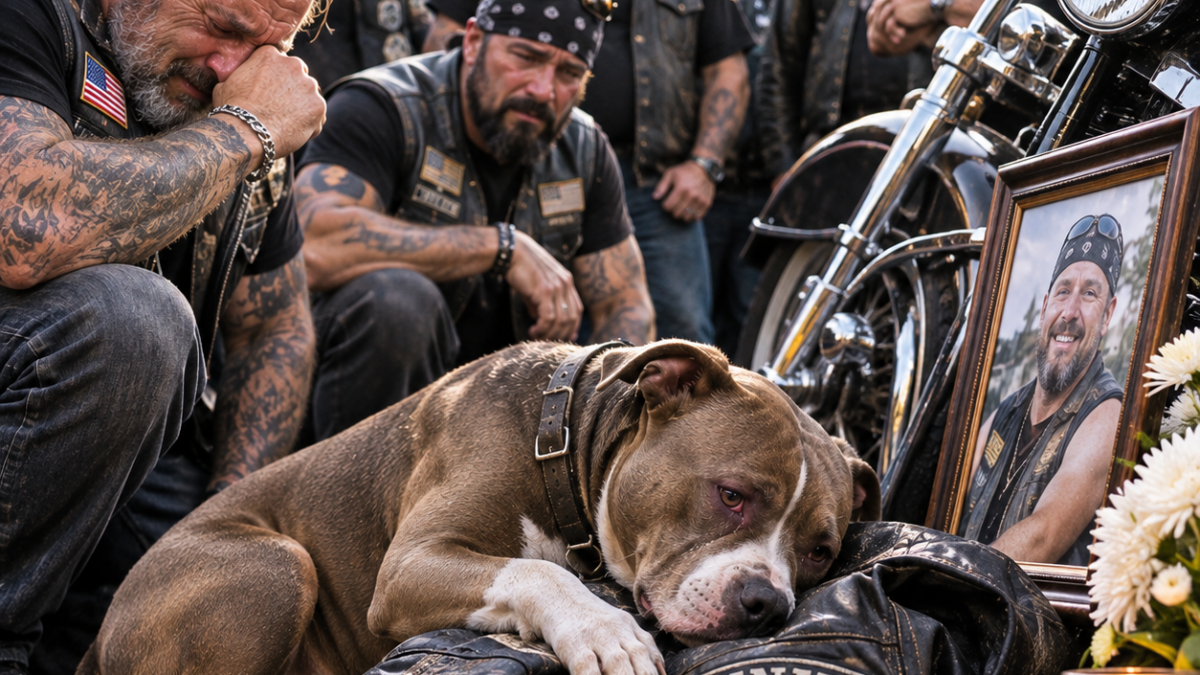
At the end of the table stood Ronnie’s photograph.
He was sitting on his old Sovereign, smiling beneath a black helmet.
Ella lay on her blanket nearby.
Every few minutes, someone glanced toward her.
Nobody wanted to be the first person to admit we’d run out of ideas.
Finally, I stood.
“I think we’ve been asking the wrong question.”
Walter looked up.
“What question?”
“Who should Ella belong to?”
Frank frowned.
“That’s what Ronnie asked us to decide.”
I nodded.
“I know.”
Bill leaned forward.
“What’s your point?”
I looked toward Ella.
She was watching me.
“I think Ronnie wanted her to be somewhere she felt safe.”
Walter nodded slowly.
“Of course.”
“He didn’t want her handed over to somebody just because that person was next on a list.”
“Right.”
I took a breath.
“Then maybe the answer isn’t one of us.”
Silence.
Frank raised an eyebrow.
“What do you mean?”
I looked around the table.
“What if we all take responsibility?”
Bill leaned back.
Walter frowned.
I continued.
“We can work out a care arrangement. Give her a familiar base. Make sure she always has proper supervision. Share expenses and responsibilities.”
Frank scratched his beard.
“So she’s everybody’s dog?”
I shook my head.
“Not exactly.”
I looked toward Ronnie’s picture.
“She’s Ronnie’s girl. We’re the people he trusted to look after her.”
For a moment, nobody spoke.
Then Walter leaned forward.
“Jesse.”
“Yes?”
“Ronnie said she had to choose.”
“I know.”
“And she hasn’t.”
I swallowed.
“No.”
He folded his arms.
“So we shouldn’t change the rules.”
I looked directly at him.
“Then let’s change the rules.”
The room went quiet.
Walter stared at me.
For a moment, I could see the stubbornness that had made him one of the club’s most respected members.
Then he looked toward Ella.
She was resting beside Ronnie’s old jacket.
Walter’s expression softened.
“Ronnie wasn’t asking us to worship a sentence in his will,” I said quietly. “He was asking us to take care of her.”
Bill nodded.
“Jesse’s right.”
Frank leaned forward.
“We can do it properly.”
I looked around the table.
“Then let’s vote.”
Twenty-two men voted yes.
Walter voted no.
I didn’t hold it against him.
He wasn’t rejecting Ella.
He was trying to honor Ronnie’s exact instructions.
And Walter had loved Ronnie longer than most of us.
But once the vote was finished, he stood.
Walked toward Ella.
Crouched beside her.
And rested his hand gently against her head.
“I’m not abandoning you, girl,” he whispered.
Ella looked up.
Then leaned against his knee.
Walter closed his eyes.
For a moment, his face changed.
Then he stood.
Looked toward me.
And said, “If we’re doing this, we’re doing it right.”
I nodded.
“Agreed.”
He pointed toward the men around the table.
“No leaving her alone overnight in an empty clubhouse.”
“Agreed.”
“Regular veterinary care.”
“Yes.”
“An actual schedule.”
“Absolutely.”
“And somebody responsible for every handoff.”
I smiled.
“Walter, are you volunteering to organize it?”
He scowled.
“Somebody has to keep you fools from making a mess.”
Bill laughed.
Frank raised his coffee mug.
And for the first time since Ronnie died, the clubhouse filled with something besides grief.
Not celebration exactly.
But purpose.
We worked with Ronnie’s estate representative to establish an appropriate long-term care arrangement consistent with his wishes as far as the law and circumstances allowed.
In practice, Ella had a primary residence with a familiar routine and designated caregivers.
The clubhouse remained an important place for her, but we didn’t leave her there alone as though she were a piece of furniture inherited by the club.
I handled much of the day-to-day coordination.
Bill helped with walks.
Frank assisted with transportation.
Walter managed the care schedule with almost military precision.
Louanne visited whenever she could.
And the remaining brothers contributed in ways that suited their abilities.
Some paid for supplies.
Some helped with veterinary appointments.
Others simply spent time with Ella, letting her enjoy quiet companionship without expecting her to perform happiness for them.
We set up a comfortable corner inside the clubhouse.
A clean bed.
A familiar blanket.
A water bowl.
Ronnie’s photograph.
And a small shelf where we kept her things.
The first week, Ella barely ate.
She’d approach the bowl.
Sniff it.
Then look toward the door.
Sometimes she’d take a little food.
Other times she’d turn away.
We became worried.
A veterinarian assessed her, helped us rule out urgent medical problems, and gave us guidance on encouraging a grieving, stressed dog to eat safely.
We followed the recommendations.
Kept her routine predictable.
Offered appropriate food.
And avoided overwhelming her.
But the hardest part wasn’t figuring out what to put in the bowl.
It was watching her look toward the door.
Waiting for footsteps that would never come.
On the sixth day, I arrived early.
The clubhouse was quiet.
The lights were dim.
Ronnie’s old leather jacket still hung behind the door.
Ella was lying on her bed.
She lifted her head when she heard me.
“Morning, little lady.”
Her tail moved weakly.
I crouched beside her.
“How are we doing today?”
She looked toward the door.
I sat down.
For a while, neither of us moved.
Then I began talking.
Not because I believed she understood every word.
Because the silence had become unbearable.
“You know, Ronnie used to complain about this place.”
Ella looked at me.
I smiled faintly.
“He’d say the coffee tasted like engine oil.”
I glanced toward the kitchen.
“Probably wasn’t wrong.”
Her ears moved.
I continued.
“He’d complain about Frank talking too much. Bill parking crooked. Walter telling everyone what to do.”
I laughed softly.
“Then he’d stay here until midnight because he didn’t want to go home yet.”
Ella lowered her head.
I swallowed.
“Because this was his family.”
For a moment, I couldn’t continue.
Then I reached toward Ronnie’s jacket.
Brought it closer.
Let Ella sniff the familiar leather.
She pressed her nose against it.
Her body relaxed slightly.
I sat beside her.
“I miss him too, girl.”
The words came out rough.
I hadn’t said them aloud since the funeral.
Not like that.
Not without trying to sound strong.
I looked at Ronnie’s photograph.
Then began crying.
Ella moved closer.
Rested her head against my leg.
And stayed.
We sat there for a long time.
Eventually, she rose and walked toward her food bowl.
She ate a little.
Then returned to me.
I looked down.
“Good girl.”
Her tail moved once.
And I realized something.
She didn’t need a grand ceremony.
She needed safety.
Familiarity.
Time.
And people who were willing to grieve beside her rather than demand she stop.
The first month was difficult.
Ella still searched for Ronnie.
Sometimes a motorcycle engine would make her stand suddenly.
She’d hurry toward the window.
Watch the rider.
Then slowly return to her bed.
Every time, it hurt.
There was no way to explain that the person she loved was gone.
We could only help her learn that she wasn’t alone.
Gradually, small changes appeared.
She began eating more regularly.
She greeted familiar brothers.
Rested comfortably in more than one home.
Played briefly with toys.
And sometimes approached us simply because she wanted attention.
The first time she carried Ronnie’s old tennis ball toward Bill, he stared as though he’d been handed a treasure.
“Well, look at you.”
Ella dropped the ball.
Bill picked it up.
Rolled it gently across the rug.
She followed.
Retrieved it.
Then returned.
Bill began laughing.
I watched from the doorway.
My eyes filled.
Because for weeks, we’d been waiting for a sign that Ella could still enjoy something.
Now she was playing.
Not forgetting Ronnie.
Not replacing him.
Simply finding one small reason to be happy.
By the third month, the club had changed.
Not dramatically at first.
But in little ways.
People arrived earlier because Ella liked a morning walk.
We kept the clubhouse quieter when she rested.
We organized our schedules more carefully.
We became better at checking on one another.
Before, a brother might disappear for several days without anyone asking whether he was okay.
Now Walter would call.
“Who’s taking Ella tomorrow?”
Someone would answer.
Then ask, “How’s your knee?”
Or:
“You sounded rough last night. Everything all right?”
The conversations became longer.
More honest.
We were still bikers.
Still argued about motorcycles.
Still made terrible jokes.
Still gave one another a hard time.
But Ronnie’s dog had created a routine that required us to show up.
For her.
And eventually, for one another.
Ten months after Ronnie died, we prepared for our annual ride toward the Ozark Mountains.
It was one of Ronnie’s favorite traditions.
Long roads.
Quiet forests.
Evenings around a fire.
Stories that grew more exaggerated every year.
The trip was nearly five hundred miles.
We wanted Ella with us.
But we weren’t willing to place her in an unsafe open trailer simply because we liked the image of a dog riding with a motorcycle club.
We arranged suitable enclosed transportation with proper restraint, ventilation, breaks, and supervision.
Ella traveled comfortably with a designated caregiver while the motorcycles followed the planned route.
At our stops, she joined us on leash.
Explored safe areas.
Drank water.
Rested.
And watched us with the familiar expression that made her seem mildly disappointed in the entire human race.
Bill laughed.
“She looks like she’s judging us.”
Frank nodded.
“She definitely is.”
I looked down at her.
“Ronnie taught her well.”
Her tail wagged.
The incident happened at a small town along the route.
We’d stopped for lunch.
Our bikes were parked in a row.
Ella sat beside me in a shaded area while we took a break.
A middle-aged man approached.
He looked at the motorcycles first.
Then at Ella.
His expression hardened.
“Is that a pit bull?”
I looked up.
“Yes.”
He shook his head.
“Those dogs should be banned.”
The conversation around us quieted.
I stood.
Not because I wanted to threaten him.
Because I wanted to keep the interaction calm and make sure Ella remained comfortable.
“She’s here with us,” I said.
The man looked at her.
“Dangerous breed.”
I took a breath.
“Individual dogs need to be assessed by their behavior and cared for responsibly.”
He scoffed.
“I don’t trust them.”
I nodded.
“You don’t have to approach her.”
He stared.
I kept my voice even.
“She isn’t bothering you.”
For a moment, the man looked as though he wanted to argue.
Then Ella stood.
I kept a comfortable hold on her leash.
She looked toward him.
Her tail moved gently.
I checked her body language before allowing any interaction.
The man hesitated.
Then crouched a little.
Ella approached calmly when invited.
She sniffed his shoe.
Then sat nearby.
The man looked down.
For several seconds, he said nothing.
Then he muttered, “Well.”
I almost smiled.
Ella looked up at him.
He shook his head.
“Guess she’s friendly.”
I nodded.
“She can be, when she’s comfortable.”
He stepped back.
“Take care of her.”
“We will.”
He walked away.
Bill looked at me.
Then at Ella.
Then he began laughing.
“What?” I asked.
He wiped his face.
“She didn’t even have to say anything.”
I looked down at the dog.
She was sitting quietly beside my boot.
I smiled.
“She’s Ronnie’s girl.”
That evening, we gathered around a campfire.
The mountains were dark.
The air smelled of pine and woodsmoke.
Twenty-three men sat beneath the stars.
Not all in one tight circle.
Some leaned against chairs.
Others stood near their motorcycles.
A few were arguing quietly about the next day’s route.
Ella lay on her blanket beside me.
She was asleep.
Her paws moved occasionally.
Her nose twitched.
I watched her.
Then looked toward the fire.
For a moment, I could almost hear Ronnie laughing.
He would have loved this.
The trip.
The ridiculous arguments.
The terrible coffee.
The sight of Ella sleeping peacefully beside the men who loved her.
I remembered something he used to say.
“Jesse, the hardest part isn’t riding. It’s staying on your feet.”
I had never fully understood that sentence.
At first, I thought he meant endurance.
The physical strength to keep moving.
To survive difficult roads.
To keep your motorcycle upright.
Now I understood he meant something else.
Staying when life became painful.
Showing up when grief made disappearing easier.
Keeping a promise after the person who asked you to make it was gone.
I looked down at Ella.
She stirred.
Lifted her head.
Then settled closer to my jacket.
I placed my hand against her shoulder.
And whispered, “We’re still here, brother.”
The fire cracked softly.
Nobody heard me.
Or if they did, nobody said anything.
And that was fine.
The following year, we made Ella an honorary member of the club.
It was Walter’s idea.
That surprised everyone.
He’d been the one vote against changing Ronnie’s original plan.
Now he stood before the group holding a small leather vest.
It had been specially made for Ella.
Comfortable.
Properly fitted.
Not intended for riding.
Just a keepsake she could wear briefly for club photographs and gatherings if she was comfortable.
On the back was the club emblem.
And beneath it, a small patch.
ELLA — RONNIE’S GIRL
Inside a little pocket, Walter had placed Ronnie’s old badge.
He looked toward us.
Then cleared his throat.
“Ronnie always said this dog was one of us.”
Bill nodded.
Frank wiped his eyes.
Walter continued.
“Seems only right we make it official.”
For a moment, he couldn’t speak.
Then he crouched beside Ella.
“Come here, little lady.”
She approached.
He gently fitted the vest.
Ella looked down at it.
Then at Walter.
Her tail moved.
The entire room began applauding.
Walter immediately raised his hand.
“Easy, boys. Don’t scare her.”
We laughed.
Ella stood beside him.
Calm.
Curious.
Unaware that twenty-three grown men were trying desperately not to cry.
I looked toward Ronnie’s photograph.
And smiled.
Because I knew he would have laughed at us.
Then probably cried too.
The years changed us.
They changed Ella too.
Her muzzle gradually turned gray.
Her movements became slower.
She no longer rushed toward the door every time a motorcycle arrived.
She still recognized familiar engines, though.
Sometimes she’d lift her head before the rider even reached the parking lot.
Bill would laugh.
“How does she know?”
I never had an answer.
Maybe she recognized the sound.
Maybe she knew our routines.
Maybe she’d simply spent so many years around us that our comings and goings had become part of the world she understood.
Whatever the reason, she always seemed to know when someone important was approaching.
And she always remembered Ronnie’s motorcycle.
We kept the old Sovereign in the garage.
Maintained.
Covered.
Preserved as a reminder of the man who had brought us together.
Occasionally, we’d roll it outside for a memorial gathering.
Ella would walk toward it.
Sniff the tires.
Circle once.
Then settle beside it.
She never tried to climb onto it.
Never seemed particularly interested in riding.
She simply liked being close.
Sometimes I’d stand across the parking lot watching her.
And remember that first terrible morning.
The twenty-three of us waiting in the clearing.
Ella walking past every man.
Then settling beside Ronnie’s empty space.
Back then, I thought her refusal meant we’d failed.
Now I knew better.
We’d asked her to choose one person.
But perhaps she didn’t need one man to replace Ronnie.
Perhaps what she needed was for the people Ronnie loved to remain part of her life.
One winter night, I arrived at the clubhouse shortly after one in the morning.
It had been a terrible week.
My business was struggling.
There were repairs I couldn’t afford.
An argument at home had left me feeling ashamed and angry.
And several decisions involving the club had become more complicated than anyone expected.
I was tired.
Not just physically.
The kind of tired that makes ordinary problems feel enormous.
I unlocked the door.
Stepped inside.
And shut it quietly behind me.
Only one lamp was on.
The building smelled faintly of coffee, leather, and old wood.
Ella was resting in the familiar corner during a supervised overnight visit while I stayed there.
She lifted her head.
Saw me.
Then stood.
“Hey, girl.”
My voice sounded rough.
She walked toward me.
Slowly.
Her nails clicked against the floor.
When she reached me, she sat.
Looked up.
Then placed her broad head against my knee.
I stared down at her.
For a moment, I couldn’t speak.
Then I sank onto the floor.
Ella moved closer.
Rested against my chest.
And I began crying.
I hadn’t cried like that since Ronnie’s funeral.
Not because the problems in my life were extraordinary.
People faced worse every day.
But I’d spent weeks telling everyone I was fine.
Managing.
Handling things.
Finding solutions.
Exactly the way I believed a grown man was supposed to behave.
Now I was sitting on the clubhouse floor with a pit bull pressed against my chest.
And suddenly I couldn’t hold it together anymore.
“I don’t know what I’m doing, girl.”
Ella looked at me.
I laughed bitterly.
“Ronnie always knew what to say.”
Her ears moved.
I stroked her head.
“He’d make some stupid joke. Then he’d tell me to get off my backside and deal with it.”
I wiped my face.
“I miss that.”
Ella leaned closer.
I wrapped one arm around her.
Then, for the first time, I began telling her everything.
The money problems.
The arguments.
The decisions.
The fear that I was letting people down.
I spoke for nearly an hour.
Ella didn’t offer advice.
Didn’t interrupt.
Didn’t tell me to stop complaining.
She simply rested beside me.
Occasionally, she looked up.
Sometimes she licked my hand.
And eventually, when my voice grew quiet, she fell asleep against my leg.
I looked down at her.
Then remembered the way Ronnie used to sit with her.
His hand resting on her broad head.
His voice low.
His worries finally allowed into the open.
For years, I’d assumed Ella was simply receiving comfort from him.
Now I understood how much she had given back.
The next morning, Walter found us.
I was sitting in an armchair.
Ella was asleep beside my feet.
Walter stood in the doorway holding coffee.
He studied me.
Then looked toward the dog.
“Rough night?”
I nodded.
He walked over.
Handed me a cup.
Sat opposite me.
For a while, neither of us spoke.
Then he said, “Ronnie used to come here at night too.”
I looked up.
“He did?”
Walter nodded.
“Sometimes after everyone went home.”
I stared.
“He’d sit right there.”
Walter pointed toward my chair.
“Ella would curl up beside him.”
I swallowed.
“What did he do?”
“Mostly talk.”
I laughed softly.
“To the dog?”
Walter smiled.
“Who else?”
I looked down at Ella.
She was breathing peacefully.
Walter continued.
“Ronnie said she was the only one who never tried to fix him.”
My throat tightened.
He took a sip of coffee.
“Sometimes a man doesn’t need someone to fix everything.”
I nodded.
“He just needs somebody to stay.”
I looked toward Ronnie’s photograph.
For a moment, it was almost too much.
Walter leaned back.
Then added, “Of course, you still have to deal with your problems.”
I laughed.
“There he is.”
Walter frowned.
“What?”
“Ronnie.”
He smiled faintly.
“Yeah.”
We sat quietly.
And Ella slept between us.
By the time Ella turned eleven, she had become the heart of our club.
Not because she attended every meeting.
Not because she belonged to everyone in exactly the same way.
But because caring for her had changed how we treated one another.
Bill stopped pretending he didn’t need help with his health problems.
Frank learned to sit quietly with people instead of filling every silence with jokes.
Walter softened.
Not completely.
He still argued about everything.
But he began asking whether people were okay before telling them what they’d done wrong.
And I learned to admit when life felt too heavy.
We still rode motorcycles.
Still wore leather jackets.
Still had tattoos and scars and reputations that made strangers sometimes cross the street.
But inside our clubhouse, there was a framed photograph of a pit bull beside an old motorcycle.
And twenty-three men who knew exactly why it mattered.
Ella’s aging frightened me.
More than I wanted to admit.
Her muzzle was nearly white.
She moved carefully after long periods of rest.
She slept more than she once had.
Sometimes she seemed stiff in the mornings.
We worked with her veterinarian to monitor her comfort, mobility, and changing needs.
We adjusted her exercise.
Made her resting places softer.
Kept her routines predictable.
And stopped expecting her to participate in long activities simply because she’d once enjoyed them.
She remained affectionate.
Still liked sitting near us during quiet gatherings.
Still greeted Louanne with a wagging tail.
And still preferred Ronnie’s old pillow.
I kept it at my house.
It was faded.
Flat.
The fabric had become soft from years of use.
Ella loved it.
Every evening, she’d settle onto it with a long sigh.
Sometimes she’d rest her muzzle on the edge and look at me until I scratched her ears.
Then she’d close her eyes.
And sleep.
I often sat beside her longer than necessary.
Watching her breathe.
Remembering how frightened we’d been when Ronnie died.
How desperately we’d wanted to do the right thing.
Now, years later, I understood that no arrangement could protect her from everything.
She would grow old.
Her needs would change.
One day, we’d have to face losing her too.
But Ronnie had never asked us to prevent grief.
He’d asked us to give Ella a good life.
And that was what we were trying to do.
Recently, I drove to Meridian with Ella.
Louanne had invited us for lunch.
She still lived in the little white-roofed house with two rocking chairs on the porch.
Her hair was grayer.
Her movements a little slower.
But her eyes still reminded me of Ronnie.
When we arrived, she stepped outside and smiled.
“Well, look who’s here.”
Ella lifted her head.
Her tail began wagging.
Louanne crouched carefully.
“Hello, sweetheart.”
Ella approached.
Rested her head against Louanne’s hand.
And closed her eyes.
I smiled.
Some things never changed.
We sat on the porch for most of the afternoon.
The weather was warm.
A light breeze moved through the trees.
Louanne brought lemonade.
Ella settled between our chairs, her head turned toward the sun.
She began snoring softly.
I laughed.
“She’s comfortable.”
Louanne smiled.
“Always was here.”
For a while, we talked about ordinary things.
Work.
Family.
The clubhouse.
The latest argument between Bill and Frank about motorcycle maintenance.
Louanne laughed until she had to wipe her eyes.
Then she looked toward Ella.
Her expression softened.
“Ronnie would be proud.”
I glanced at her.
“Of what?”
She smiled.
“All of you.”
I looked down.
“We just did what he asked.”
Louanne shook her head.
“No.”
I looked up.
She continued.
“He asked you to let Ella choose someone.”
I nodded.
“And when she couldn’t, you found a way to keep her safe without forcing her to leave everything familiar.”
I swallowed.
Louanne looked toward the dog.
“You gave her a whole family.”
I stared at Ella.
Her white muzzle.
Her broad chest.
The peaceful way she slept beneath the afternoon sun.
Then I whispered, “She gave us one too.”
Louanne’s eyes filled.
She nodded.
“Yes.”
For a long time, neither of us spoke.
Then she smiled.
“Ronnie used to say a pit bull could reveal a man’s true character.”
I laughed softly.
“That sounds like him.”
“He believed people showed who they were by how they treated someone who depended on them.”
I looked down at Ella.
Louanne continued.
“He said if a dog felt safe with you, it meant you were probably doing something right.”
I smiled.
“Ronnie had a way of making things sound simple.”
She laughed.
“He did.”
Then she looked toward me.
“And Jesse?”
“Yes?”
“He’d be proud of the man you’ve become.”
I couldn’t answer.
I looked toward the road.
The same road Ella had watched from the clubhouse parking lot after Ronnie died.
And for a moment, I felt the old grief rise.
Not as sharp as before.
But still there.
Because I missed him.
I always would.
On the drive home, Ella slept in the back seat.
Her gray muzzle rested on Ronnie’s old pillow.
Every now and then, she’d shift and sigh.
I drove carefully.
The sky turned orange.
Then pink.
Then deep blue.
I thought about the twenty-three men standing in that clearing years earlier.
We had expected a simple answer.
One dog.
One chosen owner.
A clear decision.
We’d believed that fulfilling Ronnie’s wish meant following the words exactly.
But Ella taught us that grief couldn’t be handled like a club vote or a mechanical repair.
She needed time.
Familiarity.
Safety.
And people willing to remain with her when she wasn’t ready to move forward.
In trying to provide those things, we’d learned how much we needed them ourselves.
Ronnie had spent decades holding us together.
After he died, we were afraid that the center of the club had disappeared.
But somehow, the dog he left behind gave us a reason to keep showing up.
Every morning.
Every Sunday.
Every difficult night.
Not because she understood what Ronnie had meant to us.
But because she needed care.
And caring for her reminded us how to care for one another.
These days, I wake early.
Usually before six.
I make coffee.
Open the curtains.
Then look toward Ella’s bed.
She’s often awake already.
Watching me.
Her amber eyes have softened with age.
Her face is white around the muzzle.
Sometimes she doesn’t stand immediately.
She waits.
I smile.
“Morning, little lady.”
Her tail moves.
Once.
Then again.
I crouch beside her.
Rub her ears.
And say the words Ronnie used every morning.
“Beautiful day, girl. Let’s try again.”
She sighs.
Rests her head against my hand.
And eventually gets up when she’s ready.
We take our time.
No rushing.
No need to prove anything.
We go outside when the weather is comfortable.
Walk as far as she wants and her condition allows.
Then come home.
I prepare her breakfast.
She eats.
And afterward, she usually finds a sunny spot beside the window where she can watch the world.
Sometimes I sit nearby.
Sometimes I talk to her about Ronnie.
Sometimes I don’t say anything.
It doesn’t matter.
She knows I’m there.
I still have Ronnie’s old badge.
Most days, it stays safely tucked inside the honorary vest we made for Ella.
Sometimes I take it out and hold it.
I remember Ronnie riding ahead of us.
His old Sovereign rumbling along the highway.
His leather jacket moving in the wind.
The way he’d raise one hand whenever we reached an open stretch of road.
I remember his laughter.
His ridiculous jokes.
The afternoons he helped somebody without asking for anything in return.
And I remember the last promise I made him.
We’ll take care of her.
For years, I worried we’d failed because Ella hadn’t chosen one of us.
But now I understand something.
She didn’t have to.
Ronnie wanted her to be loved.
Safe.
Protected.
And surrounded by people she trusted.
She has all of that.
Not because twenty-three men became perfect overnight.
We didn’t.
We still argue.
Still make mistakes.
Still disappoint one another.
But we’ve learned to come back.
To apologize.
To help.
To stay.
And when life gets hard, we remember the pit bull who once sat beside an empty motorcycle, waiting for a man who wasn’t coming home.
We remember that grief isn’t something you win.
It’s something you learn to carry.
Sometimes alone.
Sometimes together.
And sometimes with a warm, heavy head resting against your knee.
Last Sunday, all twenty-three of us gathered at the clubhouse.
Some moved slowly now.
A few had gray beards.
Walter needed help getting out of his chair.
Bill complained about his knees.
Frank told the same story twice and insisted he hadn’t.
We laughed.
The motorcycles were parked outside.
Ronnie’s old Sovereign stood in its usual place during our memorial gathering.
Ella lay on her blanket nearby.
She watched us.
Occasionally wagged her tail.
Accepted gentle attention from the brothers she knew.
Then rested again.
At one point, Walter raised his coffee mug.
“To Ronnie.”
The room became quiet.
We lifted our cups.
“To Ronnie.”
Walter looked toward Ella.
His eyes filled.
Then he added, “And to his girl.”
I swallowed.
Bill nodded.
Frank wiped his face.
I looked down at Ella.
She was resting peacefully.
Her eyes half closed.
For a moment, I could almost hear Ronnie laughing.
Not because I believed he was literally there.
But because every man in that room carried part of him.
His kindness.
His stubbornness.
His humor.
His belief that nobody should be left behind when they needed help.
And Ella had become the living reminder of the promise we’d made.
When the gathering ended, I helped Ella into the car for our ride home.
She settled comfortably on her familiar bedding.
I closed the door.
Then stood beside Ronnie’s motorcycle for a moment.
The paint had been polished.
The chrome still shone.
Someone had placed a small photograph of him near the seat.
I looked at it.
Then whispered, “We did our best, brother.”
The evening was quiet.
A breeze moved through the trees.
For a moment, I remembered the first time he helped me beside a highway.
I had been young.
Proud.
Stubborn.
Certain I could fix everything myself.
Ronnie had pulled over and made a joke.
Then spent two hours helping me.
At the end, he’d asked for only one thing.
Next time you see someone stranded, stop.
I smiled through tears.
Because that was what we’d done.
Ronnie had left behind someone who needed us.
A frightened pit bull who couldn’t understand why her person had disappeared.
We hadn’t fixed her grief.
Couldn’t return Ronnie.
Couldn’t make the world fair.
But we’d stopped.
Stayed.
And helped her build a life after the person she loved was gone.
In doing so, she’d helped us build one too.
People sometimes ask which of us Ella finally chose.
They expect a name.
Jesse.
Bill.
Frank.
Walter.
One of the twenty-three men who stood in that clearing.
I always smile.
Then tell them the truth.
Ella never chose a replacement for Ronnie.
She didn’t need to.
She kept her connection to the man she’d loved.
And slowly, she learned that the other people in his life could love her too.
She had a home.
A dependable care routine.
A place beside the clubhouse table.
A bed at my house.
Visits with Louanne.
Veterinary care.
Gentle hands.
Familiar voices.
And twenty-three men who understood that being Ronnie’s brother meant more than wearing the same patch on a leather vest.
It meant honoring what he’d cared about.
Even when that required us to change our plans.
Even when the answer wasn’t what we expected.
Tonight, Ella is sleeping beside my chair.
Her muzzle is white.
Her breathing is slow and peaceful.
Ronnie’s old pillow rests beneath her head.
I look down at her.
For a moment, I remember the dog she was when Ronnie died.
Sitting alone in the parking lot.
Facing the road to Meridian.
Waiting.
I wish I could tell that frightened younger Ella everything that came afterward.
That Louanne would come.
That Bill would bring treats.
That Frank would learn to lower his voice.
That Walter would make care schedules and pretend not to love her more than anyone.
That the club would give her an honorary vest.
That she’d travel with us to the Ozarks.
That she’d grow old surrounded by people who knew her name.
That she’d never have to understand why Ronnie was gone before she was allowed to feel safe again.
But she doesn’t need me to tell her.
She’s lived those years.
She knows where her bed is.
She knows which voices mean comfort.
She knows she can rest.
I reach down.
Gently stroke her head.
“Beautiful day, little lady,” I whisper. “Let’s try again.”
Her tail moves once.
Then twice.
She closes her eyes.
And I smile.
Because Ronnie was right about the hardest part of life.
It isn’t always the long road.
Or the storm.
Or the moment you fall.
Sometimes the hardest part is staying.
Remaining present when somebody is hurting.
Keeping a promise when the person who asked it is no longer there to remind you.
And choosing to love even when you know that someday, love will make you grieve.
Ronnie left twenty-three men a pit bull who was supposed to choose one new owner. Instead, Ella taught twenty-three men that family doesn’t always mean choosing one person—it can mean refusing to let someone face loss alone.
She never replaced Ronnie.
Nobody could.
But she carried his kindness into every home where she was welcomed.
Every quiet morning.
Every long ride.
Every difficult night.
And every time one of us needed a friend who wouldn’t judge us for falling apart.
I once believed Ronnie’s final gift to us was his dog.
Now I understand that the gift was the responsibility of loving her.
Because in learning to take care of Ella, we learned how to take care of one another.
And after all these years, when I see her resting peacefully on Ronnie’s pillow, I no longer think about the twenty-three men she walked past that first morning.
I think about the twenty-three men who stayed.
Ella didn’t choose a new master. She chose to keep loving Ronnie—and somehow, she gave the rest of us a home inside that love.








