FULL STORY:“PLEASE STOP—HE’S TRYING TO SAVE SOMEONE!” A Desperate Dog Chased Our Car for Miles on a Dark Highway—Then We Followed Him Into the Woods and Found What Everyone Else Had Missed
PART2
We followed.
At first, I thought we’d only go fifty yards.
Maybe a hundred.
Enough to see whether there was a farmhouse hidden beyond the trees.
But the dog kept moving.
He ran ahead.
Stopped.
Turned.
Waited.
Then ran again.
The grass reached our knees.
Rainwater soaked through my pants.
The ground was soft from days of winter storms.
Every few steps, my boots sank into mud.
Rebecca held her flashlight low, sweeping the beam across the terrain.
“Easy,” I called to the dog.
He looked back.
Barked.
Then continued.
I radioed our location and told dispatch we were checking a possible animal-related incident off the highway.
I gave the nearest mile marker and requested another unit to keep an eye on our vehicle.
The dispatcher acknowledged.
Then asked:
“Any indication of an injured person?”
I looked at the dog disappearing into the tall grass.
“Not yet.”
I paused.
“But something’s wrong.”
The field sloped downward.
Farther ahead, a line of brush marked what appeared to be a drainage channel.
The rain was colder away from the road.
Wind moved through the trees.
The only sounds were our breathing, the wet grass brushing against our clothes, and the dog’s frantic barking.
Then he vanished.
Rebecca stopped.
“Where’d he go?”
I raised my flashlight.
The beam moved across reeds and tangled branches.
Nothing.
“Buddy!”
No response.
I listened.
Then heard barking farther ahead.
We followed the sound.
The ground became uneven.
I slowed.
“Rebecca, watch your footing.”
She nodded.
We moved toward the brush.
Then the dog appeared again.
He stood beneath a leaning tree near the edge of a small ravine.
His body trembled.
He looked at us.
Barked twice.
Then lowered his head toward something hidden beneath the grass.
I lifted my flashlight.
At first, I saw only mud.
Broken branches.
A dark patch of wet fabric.
Then Rebecca gasped.
“Daniel.”
I stepped forward.
The beam caught a hand.
Human.
Pale.
Motionless.
I ran.
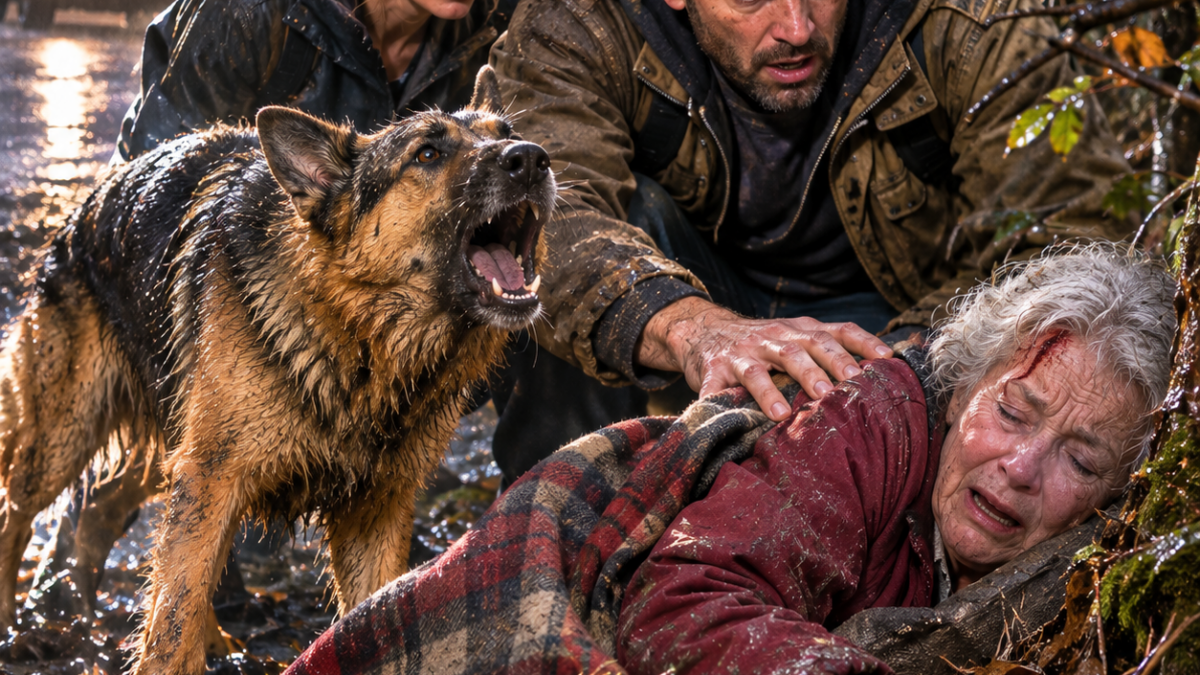
A man lay at the bottom of the shallow ravine, partly concealed by reeds and fallen brush.
His jacket was soaked.
Mud covered his face.
One leg was twisted beneath him.
Beside his right hand lay a shattered phone.
The screen was broken into fragments.
I dropped to my knees.
“Sir!”
No response.
I touched his shoulder.
“Sir, can you hear me?”
A faint sound came from his throat.
Rebecca knelt beside us.
“Oh God.”
I checked his breathing.
Shallow.
But present.
His pulse was weak and rapid.
His skin felt dangerously cold.
I looked at Rebecca.
“Call it in.”
She was already reaching for her radio.
“Dispatch, we have an injured adult male approximately four hundred yards off the highway, down an embankment. Altered consciousness, possible serious trauma and hypothermia. Send EMS and rescue personnel. We’ll transmit the most precise access point we can.”
I looked toward the man again.
His lips moved.
I leaned closer.
“What?”
For a moment, I heard nothing.
Then a whisper.
Barely audible.
“Dog…”
I looked up.
The German Shepherd stood beside us.
Panting.
Shaking.
Watching every movement.
The man whispered again.
“Don’t…”
His eyes fluttered.
“Don’t leave him.”
My throat tightened.
I leaned closer.
“We won’t.”
Then, because he needed to hear it, I added:
“Your dog’s here.”
The man’s face changed.
Just slightly.
A tiny movement around his mouth.
Then he lost consciousness again.
Rebecca looked at me.
“Daniel.”
I nodded.
“I know.”
The dog had been trying to tell us this all along.
My name is Daniel Foster.
I was fifty-one that winter.
A county sheriff’s deputy.
Father of two grown sons.
Husband to a woman who had spent nineteen years telling me that my greatest weakness was assuming I could solve every problem myself.
Rebecca was usually right.
But nothing in my career had prepared me for the look in that dog’s eyes.
I’d seen injured animals.
Frightened dogs.
Dogs guarding their owners.
Dogs refusing to leave accident scenes.
I’d even helped rescue a horse trapped in a flooded barn.
But this German Shepherd was different.
He wasn’t merely standing guard.
He had left the injured man long enough to find someone.
Then followed our vehicle.
Then risked being struck by traffic.
Then led us across a frozen field.
And now, with help finally beside his owner, he seemed unable to decide whether to stand, lie down, or keep moving.
Every few seconds, he turned toward the man’s face.
Sniffed.
Whined.
Then looked at us.
As if checking that we were still working.
I took off my outer patrol jacket and helped protect the injured man from further exposure while we waited for EMS, taking care not to move him unnecessarily because of the possibility of spinal injuries.
Rebecca monitored his responsiveness and breathing.
I relayed updates.
Our radios crackled.
Dispatch asked whether rescuers could approach from the highway.
I looked around.
The brush was too thick for an ordinary ambulance.
The field was muddy.
The slope uneven.
“We’ll need a rescue approach with appropriate equipment,” I answered.
“Possible access through the farm track north of mile marker eighteen.”
The dispatcher repeated the information.
I looked down.
The man was probably in his mid-fifties.
Gray at the temples.
Work-worn hands.
An ordinary wedding ring.
His jacket was torn along one sleeve.
There was dried blood near his hairline.
His breathing remained shallow.
I checked him again.
“Stay with us, sir.”
The dog made a low sound.
I looked at him.
“Easy, buddy.”
He stepped closer.
Rested his nose against the man’s hand.
Then licked his fingers.
Once.
Twice.
The hand didn’t move.
The dog whined.
Rebecca looked away.
I saw tears in her eyes.
She wasn’t crying because the scene was dramatic.
She was crying because she understood what the dog had already endured.
Hours, perhaps.
In the cold.
Beside a man who wasn’t waking.
Unable to call for help.
Unable to make another human understand.
Until finally he ran.
And kept running.
A distant siren reached us through the trees.
The dog lifted his head.
His ears turned toward the sound.
Then he looked at me.
I smiled faintly.
“That’s for him.”
He took one step toward the sound.
Then returned to his owner.
I watched.
The dog lowered himself beside the man’s shoulder.
His chest was still heaving.
His muddy body shook.
He looked exhausted beyond anything I could describe.
But even now, he kept his eyes on the man.
Rebecca gently rested a hand near the dog’s neck.
“Good boy.”
The dog didn’t react.
She tried again.
“You found us.”
His ears moved.
Rebecca’s voice broke.
“You did it.”
For a moment, the German Shepherd looked directly at her.
Then he rested his muzzle against the man’s wrist.
And waited.
The rescue team reached us fifteen minutes later.
It felt like an hour.
Four firefighters.
Two paramedics.
A rescue basket.
Medical equipment.
Portable lighting.
The dark ravine suddenly filled with movement.
Flashlights swept the ground.
People spoke in quick, controlled voices.
The lead paramedic knelt beside the injured man.
I gave the report.
Altered consciousness.
Prolonged cold exposure.
Possible crash-related injuries.
Broken phone.
Unknown downtime.
Possible head injury.
The paramedic checked him.
Another prepared equipment.
Rebecca explained the location and route back to the access track.
I stepped aside to let the medical team work.
That’s when the dog became frightened again.
He stood abruptly.
Moved toward the paramedic.
Barked.
Not aggressively enough to attack.
But loudly enough that everyone looked up.
The paramedic froze.
I stepped closer.
“Easy.”
The dog stared at the strangers handling his owner.
Then moved between the rescuers and the man’s head.
He had spent hours guarding him.
And now people he didn’t know were touching him.
I crouched a safe distance away.
“Hey, buddy.”
The dog looked at me.
“It’s okay.”
I pointed toward the medical team.
“They’re helping him.”
The German Shepherd whined.
Rebecca reached for the dog’s collar.
He wore an old brown leather one.
No identification tag visible from where we stood.
She gently held it while I spoke to him.
The dog resisted for a moment.
Then looked at the injured man.
Then at us.
Finally he stepped aside.
But he never stopped watching.
The paramedics stabilized the man for transport.
They moved carefully.
Coordinated every step.
The rescue team prepared the basket.
The dog followed every movement.
When the man was lifted, the German Shepherd stood.
Then moved alongside the basket.
He tried to remain close.
Every time the team advanced, he advanced too.
The mud was slippery.
The grass thick.
The slope difficult.
The men carrying the basket needed space.
I stayed beside the dog to keep everyone safe.
“Come on, buddy.”
He followed.
Not because he trusted me completely.
Because his owner was moving.
And there was no chance he was going to let that man disappear.
By the time we reached the access track, the dog could barely keep his feet beneath him.
His front paws were scraped.
The pads looked raw.
He’d been running on pavement and rough ground for an unknown distance.
His body trembled from exhaustion.
But as the paramedics loaded the man into the ambulance, he tried to jump inside.
One paw reached the step.
Then slipped.
He fell back.
Rebecca caught his collar before he could injure himself.
“Easy!”
The dog whined.
He tried again.
I crouched beside him.
“Buddy.”
The German Shepherd looked toward the ambulance doors.
His owner lay inside.
A paramedic continued treatment.
The dog’s eyes remained fixed on him.
He pulled forward.
Then paused.
He looked at Rebecca.
Then at me.
As though asking the same question.
Where are you taking him?
I felt something tighten in my chest.
I had delivered difficult news to families.
Told parents their child had been transported.
Told wives their husbands were injured.
Told people to drive carefully because their world had changed.
But standing beside that ambulance, I realized I had no words to explain what was happening to an animal who had given everything to save one person.
Rebecca knelt.
Placed one hand gently against the dog’s shoulder.
“Listen to me.”
The dog looked at her.
“We’re helping him.”
Her voice shook.
“He’s going to the hospital.”
The dog whined.
Rebecca swallowed.
“And we’re going to make sure you’re safe too.”
The doors closed.
The engine started.
The ambulance began moving.
The German Shepherd watched.
Every muscle tense.
He took two stumbling steps after it.
Then stopped.
The red lights disappeared along the road.
For a moment, the dog remained standing.
His ears were raised.
His body rigid.
Then something changed.
His shoulders lowered.
His tail fell.
He looked toward the place where the ambulance had disappeared.
And slowly, as if his body had finally been given permission to stop, he lay down in the wet grass.
Rebecca covered her mouth.
“Oh, Daniel.”
I crouched beside him.
The dog was breathing heavily.
He didn’t lift his head.
I touched his shoulder.
“Good boy.”
His tail moved once.
Barely.
Then became still.
I looked at Rebecca.
“Get the animal transport blanket from the cruiser.”
She ran.
I stayed.
I didn’t want the dog waking to discover that everyone had gone.
We took him to the emergency veterinary clinic.
The nearest one still open was twenty-seven miles away.
Rebecca sat in the rear of the vehicle with the dog securely and safely restrained on a blanket.
He was too exhausted to resist.
Every now and then, he raised his head and looked toward the window.
Then lowered it again.
I drove carefully.
The road was slippery.
The temperature continued dropping.
Rebecca stroked his shoulder.
“You did enough,” she whispered.
The dog sighed.
I looked in the mirror.
“Anything on his collar?”
“There’s something.”
She moved the worn leather gently.
A small metal tag was tucked beneath the buckle.
She read it.
“His name is Ranger.”
I glanced back.
“Ranger?”
She nodded.
The dog lifted one ear.
Rebecca smiled.
“That’s right, sweetheart.”
She touched his neck.
“Ranger.”
His tail moved.
Once.
Then again.
Rebecca looked toward me.
“Daniel.”
“Yeah?”
“He knows his name.”
I swallowed.
“Yeah.”
She lowered her head near the dog.
“Ranger, your person is getting help.”
The dog closed his eyes.
And for the first time since we’d found him on the highway, he seemed to relax.
The veterinarian’s name was Dr. Allison Moore.
She was working the overnight emergency shift.
When we arrived, she came out immediately.
Ranger was carried inside for assessment.
Cold exposure.
Exhaustion.
Paw injuries.
Dehydration.
The veterinary team examined him and began appropriate treatment.
Dr. Moore looked at us.
“How long was he outside?”
I shook my head.
“We don’t know.”
“He was chasing our vehicle along the highway.”
She frowned.
“Chasing?”
I explained.
The barking.
The stopping.
The field.
The ravine.
The injured man.
Dr. Moore listened without interrupting.
Then looked toward the treatment room.
Ranger lay on a padded table while a veterinary nurse cleaned his paws.
His head rested against the blanket.
His eyes were open.
Watching the door.
Dr. Moore shook her head slowly.
“He must have been running for quite some time.”
Rebecca swallowed.
“His owner was freezing.”
“So was he.”
The veterinarian nodded.
“We’ll assess his condition and keep him warm.”
Then she looked at us.
“You realize how unusual this is?”
I stared.
“What?”
“A dog repeatedly seeking out passing motorists, then leading people to an injured person.”
I looked through the glass.
Ranger shifted.
Raised his head.
Then rested it again.
I nodded.
“I do now.”
Dr. Moore looked at the old brown collar.
“Any owner’s information?”
“Just his name and a phone number.”
Rebecca read it aloud.
Dr. Moore checked the number against the intake information.
I called.
No answer.
Then voicemail.
A man’s voice.
Calm.
Friendly.
“You’ve reached Mark Bennett. Leave a message, and Ranger and I will get back to you.”
I froze.
Ranger and I.
Rebecca looked at me.
We listened again.
The voicemail ended.
I lowered the phone.
“That must be him.”
Rebecca’s eyes filled.
“The man in the ravine?”
I nodded.
“Mark Bennett.”
Then, because I didn’t know what else to do, I left a message.
“Mr. Bennett, this is Deputy Daniel Foster with the county sheriff’s department. We’ve found your dog, Ranger. He’s safe and receiving care. You’re being treated at the hospital. We’re making arrangements to reunite you as soon as possible.”
I hung up.
Then stared at the screen.
The man wouldn’t hear that message tonight.
Maybe not tomorrow.
Possibly not for days.
But I wanted it waiting for him.
Just in case he woke up and reached for his phone.
Just in case the first thing he worried about was the dog who’d stayed with him.
We learned what happened the following morning.
A damaged pickup had been found off an unpaved farm access route, partially concealed by vegetation, some distance from the highway.
The marks at the scene suggested the vehicle had left the track and come to rest against a shallow embankment.
Mark Bennett appeared to have gotten out.
Perhaps searching for help.
Perhaps attempting to reach the main road.
No one knew for certain.
At some point, he fell into the ravine.
His phone broke.
His injuries and the freezing conditions left him unable to climb out.
Ranger remained beside him.
Then, when Mark became less responsive, the dog apparently moved toward the nearest road where vehicles were passing.
Investigators reconstructed the likely sequence from the scene, available evidence, and what Mark later remembered.
No one could know exactly what Ranger understood.
But the result was undeniable.
He found the highway.
He chased vehicles.
And when one finally stopped, he led us back to the man who needed help.
Rebecca sat at our kitchen table listening as I explained the preliminary findings.
She looked exhausted.
We’d slept less than three hours.
Her hair was tied back.
Her eyes were red.
She held a cup of coffee between both hands.
Then she said:
“Daniel.”
“Yeah?”
“How many cars passed him?”
I stared.
“I don’t know.”
She looked down.
“What if we hadn’t stopped?”
I didn’t answer.
Because there were some questions nobody could bear to explore too far.
The cold had been severe.
Mark had been injured.
His breathing was compromised.
His condition deteriorating.
Without treatment, he could have died.
Rebecca looked toward the window.
“Ranger was running out of strength.”
I nodded.
“I know.”
She whispered:
“He just needed one person to listen.”
I reached across the table.
Took her hand.
Then said:
“We did.”
She started crying.
Mark Bennett was fifty-seven.
A mechanic.
Widower.
Father of a daughter named Emily.
He lived in a small farmhouse outside the county.
Ranger was his constant companion.
A seven-year-old German Shepherd he’d adopted after his wife, Susan, died.
Emily told us that when she arrived at the hospital.
She was thirty-one.
A schoolteacher.
Married.
Mother of a little boy.
She stood in the hospital waiting room wearing jeans, a winter coat, and the frightened expression of someone who’d received a phone call no daughter ever wants.
“Are you Deputy Foster?”
I stood.
“Yes.”
She looked toward Rebecca.
“Is my dad okay?”
I took a breath.
“The medical team is treating him.”
“He’s alive.”
“His condition is serious, but he’s receiving care.”
Emily covered her mouth.
Tears spilled down her cheeks.
“Oh God.”
Rebecca moved closer.
Emily whispered:
“They told me he was found in a ravine.”
I nodded.
“Yes.”
She stared.
“How?”
I hesitated.
Then told her.
About the dog.
The highway.
The running.
The barking.
The field.
The ravine.
Emily listened without moving.
When I finished, she began crying harder.
“Ranger?”
Rebecca nodded.
“He found us.”
Emily shook her head.
“That dog…”
Her voice broke.
Then she whispered:
“My dad always says Ranger saved him once already.”
I looked at her.
“What do you mean?”
She sat down.
Wiped her face.
Then began telling us the story.
Susan Bennett died four years earlier.
Breast cancer.
Mark and Susan had been married thirty-two years.
They lived simply.
A farmhouse.
A workshop.
A small vegetable garden.
Sunday dinners with Emily and her family.
Nothing extravagant.
But happy.
Then the diagnosis came.
Appointments.
Treatment.
Hospitals.
Bills.
Fear.
Mark did everything he could.
Drove Susan to treatment.
Cooked.
Cleaned.
Held her hand when pain made sleep impossible.
He sold one of his old trucks to help with expenses.
Then another.
He stopped working overtime only when Susan became too weak to be left alone.
Emily helped whenever possible.
But she lived two hours away.
And Susan, who had always been the heart of their home, grew weaker.
When she died, Mark stopped being himself.
He went to work.
Came home.
Ate cereal standing over the kitchen sink.
Then sat in his recliner until he fell asleep.
He stopped going to church.
Stopped visiting friends.
Stopped answering invitations.
Emily worried.
Her father insisted he was fine.
Every time.
“Dad, come stay with us.”
“I’m okay, sweetheart.”
“Dad, you haven’t eaten properly.”
“I ate.”
“Dad, you can’t keep living like this.”
He would smile.
Then change the subject.
Six months after Susan’s funeral, Emily brought him to a local animal rescue.
Mark protested.
“I don’t need a dog.”
Emily smiled.
“Then just come look.”
They walked past kennels.
Small dogs.
Large dogs.
Puppies.
Older animals.
Some barking.
Some sleeping.
Then Mark stopped beside a German Shepherd.
The dog was thin.
Quiet.
Watching.
His name was Ranger.
He’d been surrendered after his former owner became unable to care for him.
The shelter staff described him as affectionate but anxious in unfamiliar environments.
He needed patience.
Routine.
Someone willing to give him time.
Mark stood beside the kennel.
Ranger walked toward the gate.
Sat.
Looked up.
Mark crouched.
“Hey, buddy.”
The dog pressed his nose against the wire.
Mark extended his hand.
Ranger sniffed.
Then licked his fingers.
Emily watched.
For the first time in months, her father smiled without forcing it.
He looked toward her.
“What’s his name?”
“Ranger.”
Mark turned back.
“Well, Ranger.”
The dog wagged his tail.
“Guess you’ve had a rough year too.”
Emily started crying.
She knew then.
The dog was coming home.
Ranger changed Mark slowly.
Not like a miracle.
Not overnight.
He still grieved Susan.
Still had difficult mornings.
Still sometimes sat staring at her photograph.
But now somebody needed breakfast.
Needed exercise.
Needed a door opened.
Needed a reason to go outside.
Ranger followed Mark everywhere.
Into the garage.
Around the garden.
To the mailbox.
Across the yard.
When Mark sat in his recliner, Ranger rested at his feet.
When he worked on engines, the dog settled beside the tool cabinet.
When he cried, Ranger sometimes moved closer and placed his head on his knee.
Emily told us:
“My dad used to say Ranger didn’t make him forget Mom.”
Her voice shook.
“He just made the house feel less empty.”
Rebecca wiped her eyes.
Emily continued.
“Dad told me once that the dog saved his life.”
I looked at her.
“Did he mean emotionally?”
She nodded.
“Yes.”
Emily stared at the hospital floor.
“He said after Mom died, he stopped caring whether he woke up in the morning.”
Then she looked at us.
“But Ranger cared.”
The waiting room fell silent.
Emily continued.
“He needed walks.”
“Food.”
“Someone to take care of him.”
“And Dad started showing up for life again because that dog wouldn’t let him disappear into his grief.”
She laughed through tears.
“Now Ranger’s gone and saved him again.”
I didn’t know what to say.
Rebecca took Emily’s hand.
Then whispered:
“He loves your dad.”
Emily nodded.
“More than anything.”
Mark’s condition remained serious through the first day.
Doctors treated his injuries and the effects of prolonged cold exposure.
They monitored him closely.
His family was informed of the uncertainties.
No one promised a quick recovery.
But by the second morning, he began responding more consistently.
Emily was there.
She called Rebecca.
Rebecca put the phone on speaker.
“Daniel?”
I looked up.
“What?”
“Mark’s waking up.”
I felt my chest tighten.
“Really?”
Emily’s voice shook.
“He opened his eyes.”
“He knew who I was.”
I closed mine for a moment.
“That’s good.”
Then Emily said something that made me laugh and cry at the same time.
“The first thing he asked was, ‘Where’s Ranger?’”
I looked at Rebecca.
She covered her mouth.
Emily continued.
“He wouldn’t stop asking.”
“I told him Ranger was safe.”
“Then he started crying.”
I swallowed.
“Tell him we’ll bring Ranger when his medical team says it’s appropriate and the dog is well enough.”
Emily whispered:
“I will.”
Then she added:
“Deputy Foster?”
“Yes?”
“Thank you for stopping.”
I stared out the kitchen window.
Snow covered the yard.
The morning sun had begun to break through the clouds.
I took a breath.
“Your dad’s dog did the hard part.”
Emily cried softly.
“That’s what Dad keeps saying.”
Ranger remained at the veterinary clinic for two nights.
His paw pads needed treatment.
His body needed rest.
His dehydration and exhaustion were addressed.
He slept for long stretches.
Ate carefully.
Then, as he recovered, began paying attention to every person who entered the room.
Dr. Moore told us he stood whenever he heard footsteps.
Looked toward the door.
Then settled again.
Like he was waiting for someone.
Rebecca visited him during her lunch break.
She sat beside his bedding.
“Hey, Ranger.”
The dog lifted his head.
His tail moved.
Rebecca smiled.
“You remember me?”
She held out her hand.
He sniffed.
Then pressed his nose into her palm.
She scratched behind his ears.
“Your dad’s getting better.”
Ranger looked toward the door.
Rebecca swallowed.
“He’s still at the hospital.”
The dog shifted.
Tried to stand.
She gently encouraged him to remain comfortable.
“Not yet, buddy.”
She smiled through tears.
“But soon.”
The veterinarian confirmed his injuries were improving and discussed the next steps for his care.
He wasn’t going to be rushed back into strenuous activity.
Not after what he’d endured.
But the time for reunion was approaching.
And Rebecca had begun to suspect that the happiest moment of the entire rescue hadn’t happened yet.
Three days after the accident, I stood outside Mark Bennett’s hospital room carrying a folded leash.
Rebecca held Ranger’s collar.
Emily stood beside us.
A nurse had confirmed that a carefully managed visit was permitted under the hospital’s arrangements and Mark’s condition.
Ranger had been checked by the veterinary team and cleared for the visit.
The dog stood beside Rebecca.
His front paws were protected.
He was calmer now.
Still tired.
But alert.
The moment we approached the door, he lifted his head.
His ears turned.
His body stiffened.
Rebecca looked at me.
“Daniel.”
I nodded.
“I see it.”
Ranger stepped closer to the door.
Sniffed.
Then gave a tiny whine.
Emily covered her mouth.
“He knows.”
I looked toward the nurse.
She smiled.
“Go ahead.”
Rebecca opened the door slowly.
Inside, Mark lay propped against pillows.
A hospital blanket covered his legs.
His face was pale.
A bandage wrapped part of his forehead.
He looked exhausted.
Older than the photograph Emily had shown us.
But alive.
He turned toward the door.
Then froze.
“Ranger?”
The German Shepherd lifted his head.
For one breath, nobody moved.
Then Ranger surged forward as far as his leash safely allowed.
His tail began moving wildly.
He whined.
Once.
Twice.
Then made a sound I’d never heard from a dog before.
A high, trembling cry.
Mark covered his mouth.
“Oh, buddy.”
His eyes filled.
“Ranger.”
Rebecca guided the dog gently toward the bedside.
Ranger approached.
Careful now.
He placed his head against the edge of the mattress.
Mark reached down.
His hand trembled.
He touched the dog’s ears.
Then the side of his face.
Then wrapped his fingers around the familiar leather collar.
“Oh God.”
His voice broke.
“You’re here.”
Ranger pressed his muzzle into Mark’s palm.
The man began sobbing.
Not quietly.
Not politely.
The kind of crying that happens when someone realizes how close he came to losing everything.
He leaned toward the dog.
“I’m sorry.”
Ranger whined.
Mark continued.
“I’m so sorry, buddy.”
The dog pushed closer.
Mark stroked his head again and again.
“Good boy.”
His voice cracked.
“You’re such a good boy.”
Emily stood beside the bed crying.
Rebecca held onto my arm.
I looked away toward the window.
Because I couldn’t watch that reunion without feeling something in my own chest breaking open.
Mark reached toward Ranger.
The dog rested his head against his arm.
Then became still.
No frantic movement.
No desperate barking.
Just the quiet pressure of his muzzle against the hand he knew.
For days, he had fought to find that hand again.
Now it was there.
Warm.
Alive.
Touching him.
And for the first time since the highway, Ranger stopped searching.
Mark remembered little of the accident.
He recalled the icy road.
The truck slipping.
A sudden jolt.
Then finding himself outside the vehicle.
He remembered trying to reach the highway.
Falling.
Pain.
The cold.
Then Ranger’s face.
That memory was clear.
He remembered the dog pressing against him.
Licking his hand.
Moving around him.
Whining.
At some point, Mark realized he couldn’t stand.
His phone was broken.
He tried calling out.
But the wind swallowed his voice.
He became confused.
Exhausted.
Afraid.
He remembered telling Ranger to go.
“Go, buddy.”
The dog stayed.
Mark tried again.
“Find somebody.”
He wasn’t sure whether Ranger understood.
He couldn’t remember how clearly he spoke.
But later, the dog was gone.
Mark believed he’d lost him.
That was the worst part, he said.
Not the pain.
Not even the cold.
The moment he realized Ranger was no longer beside him.
He thought the dog had wandered off.
Or been hit by a car.
Or become frightened enough to run away.
He whispered:
“I remember lying there thinking I’d gotten him killed.”
Emily held his hand.
Mark stared toward Ranger.
Then continued:
“I kept calling him.”
His voice shook.
“But I couldn’t make much noise.”
He looked at me.
“Then I heard him again.”
I leaned forward.
“What?”
“Barking.”
“Far away.”
Mark swallowed.
“I thought I was dreaming.”
He looked down at Ranger.
“Then I heard voices.”
His eyes filled.
“And somebody said my dog’s here.”
I felt my throat tighten.
Mark stared at me.
“That was you?”
I nodded.
“Yes.”
He began crying again.
He reached for my hand.
Held it tightly.
“Thank you.”
I shook my head.
“Mark—”
“No.”
He squeezed harder.
“Listen to me.”
His voice broke.
“If you hadn’t followed him…”
He stopped.
We both knew what he meant.
I looked toward Ranger.
The dog was resting quietly against the bed.
Then said:
“He didn’t give us much choice.”
Mark laughed through tears.
“No.”
“He never does.”
The hospital reunion lasted only as long as Mark’s medical team considered appropriate.
Ranger needed rest too.
When Rebecca gently guided him toward the door, he resisted for a moment.
He looked back at Mark.
Whined.
Mark smiled weakly.
“It’s okay.”
The dog paused.
Mark continued.
“I’m not going anywhere.”
His voice shook.
“I promise.”
Ranger looked at him.
Then allowed Rebecca to lead him out.
At the doorway, he turned once more.
Mark raised one hand.
“See you soon, buddy.”
Ranger’s tail moved.
And then he left.
Not frantically.
Not like the night he chased our cruiser.
This time, he walked.
Because the man he loved was alive.
And because, perhaps, something inside him finally understood that help had arrived.
The story traveled through the county.
At first, it was simply a report among deputies.
A dog had chased a patrol vehicle.
Led officers to an injured man.
Helped save his life.
Then local reporters heard.
Neighbors talked.
People asked about Ranger.
The sheriff’s office released a carefully reviewed account of the rescue without disclosing unnecessary private medical details.
The local paper ran a photograph of Ranger resting at the veterinary clinic.
He looked tired.
His muddy coat had been cleaned.
His paws were bandaged.
His eyes remained alert.
The headline read:
DOG LEADS DEPUTIES THROUGH FREEZING FIELD TO INJURED OWNER.
People began sending messages.
Some offered donations for veterinary expenses.
Others asked whether Ranger needed food or supplies.
A retired teacher mailed a handmade blanket.
A veterinarian offered to contribute to follow-up care.
An elderly couple sent a note.
We lost our Shepherd last year. Please tell Ranger he reminded us how extraordinary a dog’s love can be.
Rebecca read that one aloud.
Then wiped her eyes.
I smiled.
“Not bad for a dog who almost got himself hit by a truck.”
She looked at me.
“Daniel.”
“What?”
“Don’t ruin the moment.”
I laughed.
She shook her head.
Then looked at Ranger’s photograph.
“He really wouldn’t stop.”
I nodded.
“No.”
She whispered:
“Because he couldn’t.”
I knew what she meant.
The dog had one purpose.
One person.
And every step he took that night brought him closer to saving him.
Mark spent another week in the hospital.
His recovery was gradual.
There were injuries to heal.
Strength to rebuild.
Follow-up appointments.
Rest.
He was fortunate.
The medical team expected him to recover well with appropriate care and rehabilitation.
That was the phrase Emily repeated whenever anyone asked.
Recover well.
Not instantly.
Not without pain.
But with a future.
And that future included Ranger.
When Mark finally returned home, Emily drove him.
Rebecca and I brought Ranger.
We arrived first.
The farmhouse looked exactly as Emily had described.
White siding.
A modest porch.
A detached garage.
A mailbox leaning slightly toward the road.
Snow covered the vegetable garden.
Inside, Susan Bennett’s photograph stood on the mantel.
Mark and Susan on their wedding day.
Young.
Smiling.
A lifetime ago.
I looked at the photograph.
Then at Ranger exploring the living room.
The dog sniffed the couch.
The kitchen doorway.
His old blanket.
The water bowl.
Then walked toward the front door.
Stopped.
Waited.
Rebecca crouched.
“Ranger.”
The dog looked at her.
She smiled.
“He’s coming.”
Ranger turned back toward the door.
Then sat.
The same dog who had run for miles now sat perfectly still.
Waiting for the sound of a familiar vehicle.
A few minutes later, we heard tires on the driveway.
Ranger stood.
His ears rose.
His entire body seemed to brighten.
The car door opened.
Emily spoke softly to her father.
Then the front door moved.
Mark stepped inside with assistance.
Ranger hurried forward, carefully guided so he wouldn’t knock against Mark’s healing injuries.
The man bent as much as he could.
“Hey, buddy.”
Ranger pressed against his leg.
Mark rested one hand on the dog’s head.
Then looked around.
Home.
The couch.
The fireplace.
Susan’s photograph.
The same ordinary rooms he’d left before the accident.
Mark took a long breath.
Then whispered:
“We made it.”
Ranger wagged his tail.
Mark smiled.
“Yeah.”
“You and me.”
He looked toward Susan’s picture.
His eyes filled.
Then he added:
“Still here.”
A month later, we visited them for dinner.
Mark was walking more confidently.
Ranger’s paws had healed.
The dog had regained his energy, though Mark kept his exercise routine sensible.
Emily and her family came too.
Her little boy, Noah, was six.
He loved Ranger.
Absolutely loved him.
He followed the German Shepherd around the living room carrying a stuffed dinosaur and asking questions.
“Grandpa?”
“Yes?”
“Did Ranger really run on the highway?”
Mark nodded.
“Yes.”
“Was he scared?”
Mark looked toward the dog.
Then said:
“I think he was.”
Noah considered.
“Then why did he keep running?”
The room went quiet.
Mark looked at us.
Rebecca’s eyes filled.
I stared at the table.
Then Mark crouched as far as his recovery allowed.
He placed one hand on Noah’s shoulder.
“Because sometimes being brave doesn’t mean you’re not scared.”
Noah frowned.
“What does it mean?”
Mark looked toward Ranger.
The dog lay near the fireplace.
Peaceful.
Comfortable.
Watching his people.
Then Mark answered:
“It means you keep going because somebody you love needs you.”
Noah thought about that.
Then walked over to Ranger.
He sat beside him.
Rested one small hand gently against the dog’s back.
And whispered:
“Thank you for saving Grandpa.”
Ranger wagged his tail.
Mark covered his mouth.
Emily started crying.
Rebecca reached for my hand.
And I realized that the story hadn’t ended in the ravine.
It hadn’t ended when the ambulance doors closed.
Or when Mark opened his eyes.
Or even when Ranger walked through the farmhouse door.
It was continuing.
In a little boy who would grow up remembering that love sometimes looks like muddy paws running through the dark.
Over the following months, Mark began speaking at local community events about winter driving safety and what had happened to him.
He didn’t pretend his story made him an expert in every kind of emergency.
He spoke about the practical lessons.
Weather.
Safe travel decisions.
Letting family know your route.
Keeping emergency supplies.
Maintaining a charged phone and having backup ways to seek help when possible.
He thanked the rescue team.
The paramedics.
The hospital staff.
The veterinary clinic.
And Rebecca and me.
But whenever someone called him a survivor, he pointed toward Ranger.
“Talk to him.”
People laughed.
Mark smiled.
Then became serious.
“He’s the one who found help.”
Ranger usually sat nearby.
Uninterested in the attention.
Interested in whether anyone had snacks.
Once, at a local school, a little girl raised her hand.
“Mr. Bennett?”
“Yes?”
“Did Ranger know how to save you?”
Mark paused.
Then answered honestly.
“I don’t know exactly what Ranger understood.”
The room became quiet.
“But I know he stayed beside me.”
“And when I couldn’t get up, he found people who could help.”
He looked toward the dog.
“Whatever he was thinking, he didn’t give up on me.”
The little girl smiled.
Then asked:
“Does he get a medal?”
Mark laughed.
“He gets something better.”
“What?”
Mark looked at Ranger.
“A very long retirement on the couch.”
The children laughed.
Ranger wagged his tail.
And the world felt a little kinder.
One evening that spring, Rebecca and I drove past the same stretch of highway.
The weather was completely different.
Blue sky.
Green fields.
Sunlight across the road.
No freezing rain.
No dangerous darkness.
No headlights behind us.
I slowed near the mile marker.
Rebecca looked out the window.
“Right there.”
I nodded.
“Yeah.”
She pointed toward the fields.
“That’s where he ran.”
I looked.
The grass had grown again.
The ravine was almost invisible behind new leaves.
If I hadn’t known what happened, I never would have guessed a man had nearly died there.
Rebecca turned toward me.
“Daniel.”
“Yeah?”
“Do you ever think about what would’ve happened if we’d kept driving?”
I looked toward the road.
For a long moment, I didn’t answer.
Then said:
“Sometimes.”
She swallowed.
“Me too.”
I pulled into a safe turnout.
We sat quietly.
A truck passed.
Then another.
Ordinary traffic.
Ordinary lives.
People moving toward dinner.
Work.
Family.
Home.
No one knew what had happened in the field months earlier.
They didn’t know about the man lying in the mud.
The broken phone.
The German Shepherd running until his paws bled.
The moment two tired deputies decided to stop.
Rebecca looked toward the grass.
Then said:
“I almost told you not to.”
I turned.
“What?”
“That night.”
Her voice trembled.
“I was tired.”
“It was freezing.”
“We didn’t know what the dog wanted.”
She looked down.
“And I almost said to just keep going.”
I took her hand.
“But you didn’t.”
She nodded.
“Neither did you.”
We sat quietly.
Then I said:
“You know what I keep remembering?”
“What?”
“His face.”
“Mark’s?”
I shook my head.
“Ranger’s.”
I looked toward the field.
“The way he turned back to make sure we were still following.”
Rebecca’s eyes filled.
“Like he was afraid we’d give up.”
I nodded.
“Yeah.”
“Exactly.”
That summer, Mark invited us to a barbecue.
Nothing fancy.
Hot dogs.
Hamburgers.
Corn.
Lawn chairs.
A small gathering of people who had been part of his recovery.
Emily’s family.
The firefighters.
Two paramedics.
Dr. Moore.
Several neighbors.
Mark insisted on doing most of the grilling himself.
Emily complained.
“Dad, you’re supposed to be taking it easy.”
He smiled.
“I’m grilling hamburgers, sweetheart, not climbing a mountain.”
Ranger lay in the shade beneath the picnic table.
Healthy.
Relaxed.
Watching every dropped crumb with professional concentration.
Rebecca sat beside me.
We watched Noah play with a toy truck.
Mark laughed at something Emily said.
The sound carried across the yard.
Then Dr. Moore approached.
She looked toward Ranger.
“Hard to believe this is the same dog.”
I nodded.
“He looks good.”
“He is doing well.”
She smiled.
“His paws healed.”
“His energy returned.”
“And I think he’s very satisfied with his current lifestyle.”
We looked toward Ranger.
The dog was asleep beneath the table.
A paper plate of food sat safely out of reach.
Mark glanced down.
“Ranger.”
One ear moved.
“Don’t even think about it.”
The dog opened one eye.
Everyone laughed.
That was when I realized how much had changed.
The last time I’d seen Ranger lying on the ground, he was collapsing in wet grass beside an ambulance.
Now he was lying beneath a picnic table surrounded by people who loved him.
The same animal.
The same heart.
But no longer fighting to be understood.
Simply home.
Before we left, Mark asked me to step inside.
He led me toward the mantel.
Susan’s photograph remained there.
Beside it stood a new frame.
A picture of Ranger taken after the rescue.
The German Shepherd sitting in the yard.
Ears raised.
Muzzle slightly open.
Looking almost proud.
Beneath the photograph was a small engraved plate.
RANGER
THE DOG WHO BROUGHT ME HOME TWICE
I stared.
Then looked toward Mark.
He smiled sadly.
“The first time was after Susan.”
I nodded.
“I remember.”
“The second time was that night.”
His voice broke.
He looked down.
“Daniel, I don’t know why he stayed.”
I considered.
Then answered:
“Because you were his person.”
Mark smiled through tears.
“Yeah.”
“Maybe.”
He looked at the photograph.
Then whispered:
“He never asked me for much.”
“Food.”
“A warm place to sleep.”
“A walk.”
“Someone to sit with him.”
He laughed softly.
“And somehow, he gave me my whole life back.”
I felt my throat tighten.
Mark turned toward me.
“Thank you for listening to him.”
I looked at the photograph.
The dog with the amber eyes.
The muddy paws.
The stubborn determination.
Then I said:
“He made himself pretty hard to ignore.”
Mark laughed.
“Yes.”
“He did.”
We shook hands.
Then he pulled me into a hug.
I didn’t resist.
Because some moments don’t need professional distance.
They need one person holding another and recognizing how close life came to changing forever.
Later that year, the sheriff’s department held a small recognition event for the rescuers and veterinary staff.
Ranger attended with Mark.
No dramatic military-style ceremony.
No false claims that the dog was a trained police K9.
He was simply an ordinary companion animal whose behavior had led rescuers to a critically injured man.
Mark didn’t want the occasion to become a spectacle.
Neither did we.
The sheriff thanked the deputies.
The firefighters.
The paramedics.
The veterinary team.
Then he looked toward Ranger.
“And this fellow.”
The dog lifted his head.
People laughed.
The sheriff smiled.
“I understand he was rather persistent.”
Rebecca nodded.
“That’s an understatement.”
The room laughed again.
Then the sheriff became serious.
“Sometimes an emergency reaches us through a phone call.”
“Sometimes through a radio.”
“Sometimes through an alarm.”
He looked toward Ranger.
“And sometimes it comes running down a highway because nobody else can ask for help.”
The room grew quiet.
The sheriff continued.
“What matters is recognizing when something needs attention.”
He looked toward me.
Then Rebecca.
“On that night, our deputies stopped.”
“They assessed the situation.”
“They followed the evidence in front of them.”
“And a man is alive because they did.”
The applause was warm.
I looked toward Mark.
He was standing beside Ranger.
One hand resting on the dog’s shoulder.
Emily and Noah stood nearby.
A family.
Still together.
I smiled.
Because that was what mattered.
Not the recognition.
Not the photographs.
Not the applause.
The fact that a grandfather would see his grandson grow up.
That a daughter could call her father.
That a dog would sleep beside the man he loved.
Years later, people still ask me about the night Ranger chased our vehicle.
Some want to know how far he ran.
We never established the exact distance.
Others ask how long Mark lay in the ravine.
The timing remained approximate.
Some ask whether Ranger understood that he was searching for police officers.
I tell them I don’t know.
We cannot read a dog’s mind.
We can observe behavior.
We can reconstruct events.
We can understand that animals form deep attachments and sometimes act with extraordinary persistence.
But the rest belongs to Ranger.
What I know is simpler.
A man was injured.
He couldn’t call for help.
His dog stayed with him.
Then the dog reached a highway.
Ran after passing traffic.
And when our vehicle slowed, he led us into the fields.
He didn’t stop until we reached the place where his owner lay.
And after Mark was taken to the hospital, the dog finally lay down.
Exhausted.
Cold.
But no longer frantic.
I think about that sometimes.
Not as proof of something supernatural.
Not as a miracle that excuses the dangers of winter roads.
But as a reminder that loyalty can look like action.
Real action.
Running.
Searching.
Waiting.
Trying again.
Even when there are no words to explain why.
One January evening, almost exactly a year after the rescue, Rebecca and I visited Mark for dinner.
Snow fell outside.
The farmhouse glowed warmly.
The kitchen smelled of chicken soup.
Ranger lay near the fireplace.
Mark had built him a new wooden bed frame with a thick cushion inside.
No expensive decorations.
No fancy plaque.
Just a comfortable place where an aging dog could sleep beside the people he loved.
After dinner, Mark brought out an old photograph album.
Pictures of Susan.
Their wedding.
Emily as a child.
The farmhouse before the porch was repaired.
Then newer photographs.
Ranger in the garden.
Ranger beside Mark’s workbench.
Ranger sleeping with Noah’s toy dinosaur tucked beside his paws.
Mark smiled.
“Funny.”
“What?” I asked.
He looked toward the dog.
“I used to think Susan was the reason this house felt like home.”
Rebecca watched him carefully.
Mark continued.
“She was.”
He swallowed.
“But after she died, I thought home was gone forever.”
He looked toward Ranger.
“Then this old fool showed up.”
The dog lifted one ear.
Everyone smiled.
Mark continued.
“And suddenly I had a reason to get up in the morning again.”
He looked toward us.
“Then that accident happened.”
His expression changed.
“For a while, I thought I was going to lose everything a second time.”
I nodded.
He reached down and rested his hand on Ranger’s head.
“But he wouldn’t let me.”
The room went quiet.
Mark looked at the dog.
Then whispered:
“You wouldn’t, would you?”
Ranger wagged his tail.
Mark smiled through tears.
“No.”
“You wouldn’t.”
As we prepared to leave, Rebecca crouched beside Ranger.
The dog approached.
Pressed his muzzle into her hand.
She smiled.
“Remember me?”
His tail moved.
Rebecca laughed softly.
“Of course you do.”
She scratched his ears.
Then whispered:
“You scared me half to death that night.”
Ranger tilted his head.
She continued.
“Running into traffic.”
“Barking.”
“Dragging us through the mud.”
I smiled.
“Rebecca.”
She ignored me.
“And then you went and saved somebody’s whole world.”
Her voice broke.
She leaned forward.
Rested her forehead gently against the dog’s head.
“Good boy.”
Ranger stood still.
Then licked her cheek.
Rebecca laughed through tears.
Mark watched from the doorway.
His own eyes glistened.
I looked around the room.
The warm lights.
The photographs.
The family.
The old German Shepherd standing beside my wife.
And I remembered the darkness.
The freezing rain.
The truck nearly hitting him.
The ravine.
Mark’s broken phone.
The shallow breathing.
The dog collapsing after the ambulance left.
For a moment, the memories seemed so close I could hear the siren again.
Then Noah laughed in the kitchen.
And the past loosened its grip.
Because this was what the dog had been running toward all along.
Not an ambulance.
Not an officer.
Not a medal.
This.
His person alive.
His family together.
A warm room.
The freedom to rest.
On the drive home, the highway was almost empty.
Snow drifted through the headlights.
Rebecca sat quietly beside me.
After several miles, she looked toward the shoulder.
“Daniel.”
“Yeah?”
“Do you think he would’ve kept running?”
I knew what she meant.
Ranger.
That night.
The cars passing.
The exhaustion.
The bleeding paws.
The desperate barking.
I considered.
Then said:
“I think he would’ve kept trying as long as he could.”
Rebecca nodded.
Then looked out the window.
For a long time, neither of us spoke.
Finally she whispered:
“I’m glad we stopped.”
I reached across the console.
Took her hand.
“So am I.”
We continued driving.
The wipers moved steadily.
The road stretched through the darkness.
And somewhere behind us, in a small farmhouse warmed by a crackling fire, a German Shepherd was lying beside the man he had refused to abandon.
No more running.
No more chasing headlights.
No more turning back to see whether someone was following.
The work was done.
His person was home.
And for the first time since that terrible winter night, the highway was simply a road again.
I still remember Ranger’s eyes.
Not the way they looked at the recognition event.
Not the way they shone when Mark came through the farmhouse door.
I remember them on the highway.
Wet.
Frightened.
Desperate.
Looking straight at me as though everything depended on whether I understood.
At the time, I didn’t.
I saw a dog.
Maybe a stray.
Maybe lost.
Maybe frightened by the storm.
I didn’t know a man lay bleeding in a ravine.
Didn’t know his phone was broken.
Didn’t know he’d been trapped in the freezing dark for hours.
Didn’t know an entire family was only one missed rescue away from tragedy.
All I knew was that a dog refused to stop running.
And I think that’s the part of the story that will stay with me for the rest of my life.
Sometimes the world sends a warning in a form we don’t recognize.
Sometimes it isn’t dramatic.
It doesn’t arrive with a clear explanation.
It doesn’t tell us exactly what to do.
Sometimes it is just a frightened animal standing in the rain, refusing to move because somebody somewhere needs help.
And on nights like that, the most important decision may be the simplest one.
To stop.
To look.
To listen.
To follow when something tells you there’s more to the story than you can see.
Because Ranger couldn’t call 911.
He couldn’t explain where Mark had fallen.
Couldn’t tell us how badly he was hurt.
Couldn’t say how long he’d been waiting.
He had no words.
Only his legs.
His lungs.
His courage.
And a heart that refused to leave someone behind.
So he ran.
Past headlights.
Along freezing pavement.
Through the dark.
Again and again.
Until two tired deputies finally understood that he wasn’t chasing them away.
He was begging them to come closer.
And when we followed, we found a man who was still alive.
A father.
A grandfather.
A widower who had already lost the love of his life once and wasn’t ready to leave the people who still needed him.
A man whose dog had given him a reason to live after grief.
And then, one winter night, helped give him that life a second time.
Now, whenever I pass the place where Ranger first appeared in our headlights, I think about the little boy sitting beside his grandfather’s dog and whispering thank you.
I think about Emily holding her father’s hand in the hospital.
I think about Rebecca kneeling beside Ranger after he collapsed in the wet grass.
And I think about the dog himself.
Exhausted.
Bleeding.
Cold.
But still turning back to make sure we were following.
That was the real meaning of the night.
Not that a dog became a hero because people called him one.
But that he never stopped trying to bring help to the person he loved.
Ranger didn’t need to know what a hero was. He only needed to know that his best friend was lying somewhere in the darkness—and that he couldn’t rest until someone finally followed him back.








