FULL STORY:“PLEASE FOLLOW HIM! HE’S NOT TRYING TO ESCAPE!” A Saint Bernard Refused to Leave the Floodwater, Swimming Past Every Rescue Boat Until We Followed Him to a Collapsing House—Where an 84-Year-Old Woman Had Already Said Goodbye to Her De@d Husband…
FULL STORY CONTINUATION
I nodded.
Command believed most of the neighborhood had been evacuated.
Most.
That word can kill people.
We had already found two residents who had been missed.
One diabetic man trapped in his attic.
One woman refusing to leave without six cats.
We found all six.
The woman cried harder for the cats than she did for herself.
We were almost ready to turn back when Daniel suddenly pointed behind the boat.
“Mark.”
I looked.
“What?”
“Dog.”
At first, I saw only water.
Brown waves.
Floating branches.
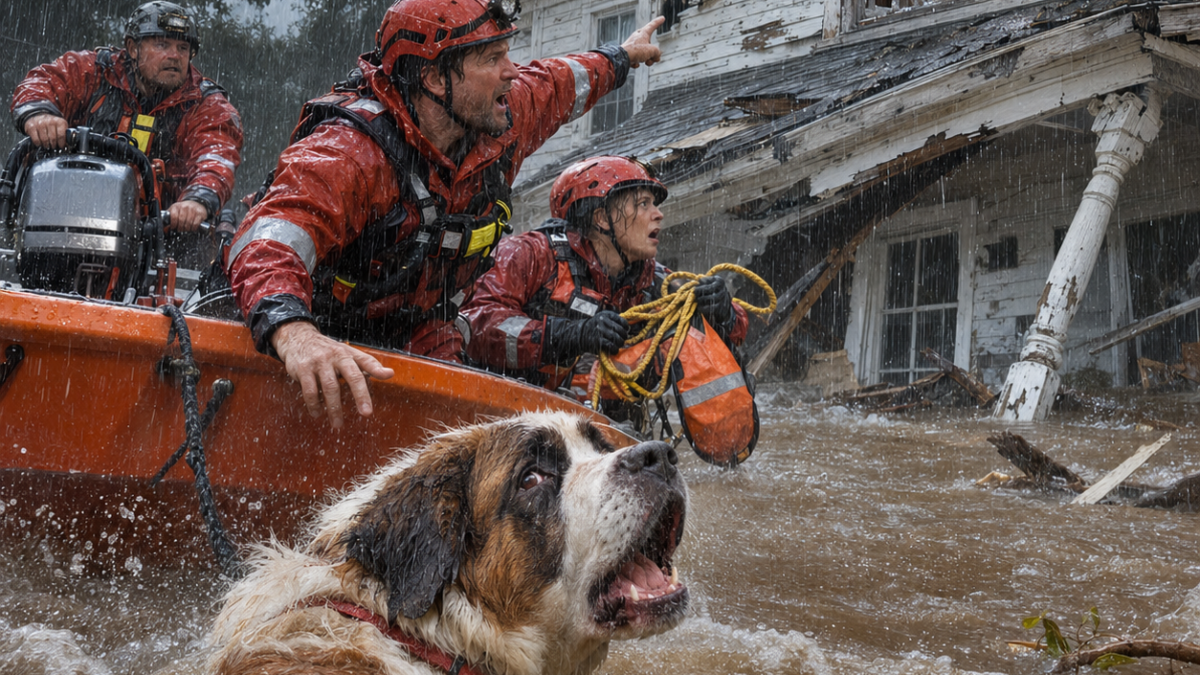
Then a broad head appeared.
White blaze down the face.
Dark ears flattened against the skull.
A massive Saint Bernard.
Swimming behind us.
Not drifting.
Swimming.
Hard.
His body vanished beneath the murky surface, but I could see the violence of his effort.
Each stroke lifted his head barely high enough to breathe.
“Slow down.”
Daniel pulled the throttle back.
The engine dropped to a growl.
The dog closed the distance.
When he reached us, I leaned over.
“Hey, buddy.”
His eyes met mine.
I will remember those eyes for the rest of my life.
Exhausted.
Terrified.
Focused.
I reached toward the thick fur at his shoulders.
“Come on.”
He moved away.
I tried again.
“No, no. It’s okay. We’ll get you in.”
He barked.
One sharp bark.
Then another.
Daniel opened an emergency ration packet.
“Maybe he’s starving.”
He held out a piece.
The Saint Bernard sniffed.
Any normal hungry dog would’ve taken it.
This one turned his head away.
Then swam ahead.
Twenty feet.
Stopped.
Turned toward us.
Barked.
I stared.
He swam farther.
Stopped again.
Looked back.
Barked.
Daniel glanced at me.
“You seeing what I’m seeing?”
“Yes.”
The dog disappeared briefly behind the remains of a hedge.
Then reappeared farther ahead.
He barked again.
And waited.
I felt a chill that had nothing to do with the rain.
“He doesn’t want us to pull him out.”
Daniel frowned.
“What?”
“He wants us to follow him.”
PART2
Daniel looked at the dog.
Then at me.
“You sure?”
“No.”
The Saint Bernard barked again.
Not at us.
Toward us.
There is a difference.
I don’t know how to explain it without sounding sentimental.
But anyone who has spent enough time around animals knows there are sounds made from fear, sounds made from pain, sounds made from anger—and then there are sounds that seem to carry intention.
That bark meant something.
The dog swam twenty yards.
Stopped.
Turned.
Waited.
Daniel pushed the throttle forward.
“Let’s find out.”
We followed.
The Saint Bernard led us through what had once been two residential streets.
He never went too far.
Every twenty or thirty yards, he would stop and look back.
If we slowed, he waited.
If debris blocked the way, he found another route.
At one point, a partially submerged wooden fence stretched across what used to be an intersection.
The boat couldn’t safely pass through the nearest opening.
The dog vanished around the side.
For five seconds, I lost him.
Then ten.
“Where’d he go?”
Daniel stood slightly.
“Can’t see him.”
My chest tightened.
Then the dog appeared fifty feet to our left.
He barked.
There was a gap in the fence.
Daniel steered toward it.
“He knows the neighborhood.”
“Looks like it.”
The current was getting stronger.
A trash bin shot past us.
Then a door.
An actual front door.
White.
Brass knob still attached.
It spun once and vanished behind us.
The Saint Bernard kept swimming.
But he was slowing.
I could see it.
His head dipped lower.
His strokes became uneven.
Twice, a wave rolled over his muzzle.
Each time, he resurfaced sputtering and kept going.
“Come on, buddy,” I whispered.
He had already swum farther than I thought an exhausted animal could.
There were moments when I wanted to grab him whether he liked it or not.
To pull him aboard.
Dry him.
Save him.
But every time we got close, he moved away.
Not far.
Just enough.
As though telling us:
Not yet.
Please.
Not yet.
Then the house appeared.
Old brick.
Two stories.
Or what was left of two stories.
The entire lower floor had disappeared beneath the flood.
Several windows were broken.
A curtain hung from one upstairs opening, soaked and heavy, lifting weakly in the wind.
Part of the roof had collapsed.
The chimney leaned.
One exterior wall bowed outward enough to make my stomach tighten.
Daniel swore under his breath.
“That structure’s bad.”
The dog didn’t hesitate.
He swam directly toward a narrow second-floor balcony that sat barely above the waterline.
He clawed his way onto it.
For a moment, his back legs slipped.
Then he hauled himself up.
He stood there trembling.
Water poured from his coat.
He turned toward the only intact window.
And barked.
Once.
Twice.
Again.
Different now.
Higher.
Sharper.
Desperate.
Then he stopped.
Listened.
Barked again.
Waited.
I stared at the window.
My skin prickled.
“There’s somebody in there.”
Daniel looked at me.
“You heard something?”
“No.”
The dog barked.
Then went silent.
His head tilted.
He was listening.
Daniel killed the engine.
Suddenly the world became enormous.
Water.
Wind.
Wood creaking.
The Saint Bernard’s breathing.
Daniel grabbed the loudspeaker.
“HELLO! EMERGENCY RESCUE! IS ANYONE INSIDE?”
Nothing.
He called again.
“IF YOU CAN HEAR US, MAKE ANY SOUND!”
Silence.
I began to wonder if I had imagined purpose where there was only an animal’s panic.
Maybe this was his house.
Maybe he was searching for his own family.
Maybe nobody—
“Here…”
Daniel froze.
I stared at him.
“Did you hear that?”
He raised one finger.
We listened.
Then again.
Faint.
So faint the wind almost stole it.
“Please…”
Human.
Old.
Weak.
Alive.
The Saint Bernard heard it too.
His ears lifted.
His tail began striking the balcony boards.
He turned toward us.
And I swear to you, the expression on that dog’s face broke something open in my chest.
Relief.
Urgency.
Desperation.
Hope.
All at once.
He looked at us as if he were saying:
There.
You hear her now.
I told you.
Please hurry.
We tied the boat to a bent metal pole sticking out of the water.
It had probably once held a mailbox.
Daniel radioed command.
“Rescue Three. Possible live survivor, upper floor of structurally compromised two-story brick residence. Sending coordinates now.”
The radio crackled.
“Copy, Rescue Three. Additional unit en route. Proceed with caution.”
Caution.
Another word that sounds simple until someone is waiting inside.
I clipped into my safety line.
Daniel grabbed my arm.
“Mark.”
I looked at him.
“If it shifts—”
“I know.”
“If that wall moves, you’re out.”
“I know.”
He stared at me.
“Say it.”
“If the structure shifts, I’m out.”
He nodded.
We had both seen rescuers become victims.
Heroism is useless if it creates another person who needs saving.
I stepped onto the balcony.
The boards groaned.
The Saint Bernard watched every movement.
Up close, I could see his condition.
Mud packed into his fur.
A shallow cut near one ear.
Both front paws scraped raw.
His legs trembled continuously.
He was barely standing.
I touched his shoulder.
“We found her.”
His tail moved once.
Just once.
As though that sentence was enough.
The window was locked from inside.
The glass was cracked but intact.
I cupped my hands.
“Ma’am! Rescue team! We’re going to enter through the window!”
A weak voice answered.
“All right.”
“Move away from the glass if you can.”
I waited.
Then used a rescue tool to break the pane.
Glass fell into the room and into the water below.
I carefully cleared the remaining edges.
The Saint Bernard tried to push closer.
“Stay.”
He stopped.
I don’t know whether he understood the command.
Maybe he understood tone.
Maybe he simply had no strength left.
I climbed through.
The smell hit me immediately.
Mold.
Wet wood.
Mud.
Stagnant water.
Something chemical from downstairs.
The room had once been a bedroom.
Now the floor tilted under several inches of water.
A small dresser floated against the wall.
A lamp lay sideways.
Photographs drifted facedown.
A chair had wedged against the door.
The bed sat in the far corner where the floor remained slightly higher.
And on it sat an old woman.
Tiny.
Wrapped in a wet blanket.
Gray hair tangled around her face.
Hands shaking uncontrollably.
Her skin looked almost translucent.
When she saw me, she smiled.
That smile nearly destroyed me.
Not relief first.
Not panic.
A smile.
“I knew it,” she whispered.
I moved toward her.
“Knew what?”
“That somebody would come.”
I knelt.
“My name’s Mark. My partner Daniel is outside. We’re going to get you out.”
Her eyes filled.
“Thank God.”
Then she shook her head.
“No.”
Her voice broke.
“Thank the dog.”
Her name was Evelyn Harper.
She was eighty-four years old.
Widowed.
Lived alone.
No surviving family nearby.
Her daughter lived more than a thousand miles away.
Evelyn had been in that room for almost forty-eight hours.
When the evacuation warning came, she believed she had time.
People always believe they have time.
She packed medication.
A sweater.
Her purse.
Some documents.
Then the water rose faster than anyone expected.
By the time she tried to leave, the downstairs hallway was already flooding.
She opened the back door and water pushed inward hard enough to knock a chair over.
She tried the front.
Impossible.
The current had swallowed the porch.
At eighty-four, with arthritis in both knees and an old hip injury, she knew she couldn’t fight moving water.
So she climbed the stairs.
Slowly.
One hand on the railing.
One step at a time.
The water followed.
“I kept thinking it would stop,” she told me while I checked her pulse.
Her voice shook.
“It always stops somewhere.”
But it didn’t.
The water reached the first floor ceiling.
Furniture crashed below.
Windows broke.
The electricity died.
Her phone lost signal, then battery.
She shouted whenever she heard engines outside.
Nobody answered.
The first night, she sat near the window.
Rain hammered the glass.
She wrapped herself in the blanket.
Listened to the house groan.
And waited.
“I thought they knew I was here.”
Her eyes dropped.
“Then I realized nobody did.”
That sentence has stayed with me longer than most things people have said during emergencies.
Not I thought I was going to die.
Not I was afraid.
Nobody knew I was here.
There is a kind of loneliness more frightening than death.
The fear that the world has already moved on without noticing you are still in it.
Daniel climbed in through the window carrying an evacuation blanket and medical kit.
He looked at Evelyn.
“Ma’am, I’m Daniel.”
“Hello.”
Her voice had the politeness of someone receiving unexpected dinner guests.
Daniel glanced at me.
His eyes said:
She’s bad.
I knew.
Dehydrated.
Cold.
Exhausted.
But alert.
That mattered.
I wrapped her in the dry thermal blanket.
She touched my wrist.
“The dog.”
“He’s right outside.”
“You saw him?”
“Yes.”
Her eyes filled immediately.
“He came yesterday.”
I stopped.
“Yesterday?”
She nodded.
The room seemed to narrow around her story.
“I was sitting by the window.”
She pointed weakly.
“I had stopped shouting.”
“Why?”
“My voice hurt.”
She swallowed.
“And I didn’t think anyone could hear me anyway.”
Then she smiled faintly.
“I saw something in the water.”
At first she thought it was debris.
Then a head rose.
Huge.
Brown and white.
Swimming.
“He came straight toward the house.”
She had never seen him before.
Did not know his name.
Had no idea where he came from.
He climbed onto the balcony.
Stood outside the window.
And stared directly at her.
“I thought I was hallucinating.”
Daniel smiled.
“Understandable.”
“I tapped the glass.”
Evelyn raised one trembling finger.
“Like this.”
Tap.
Tap.
Tap.
“The dog tilted his head.”
Her mouth trembled.
“So I tapped again.”
She looked at me.
“And then he barked.”
A tear rolled down her cheek.
“He knew I was there.”
“What happened next?”
“He stayed.”
“How long?”
“I don’t know.”
She looked toward the window.
“Long enough that I stopped feeling alone.”
My throat tightened.
Then she said:
“And then he left.”
Her face changed.
The tiny hope in it disappeared.
“I watched him swim away.”
She closed her eyes.
“I thought he was leaving me too.”
That line hit me harder than I expected.
Because disaster strips people down to old wounds.
Maybe Evelyn had lost people before.
Maybe everyone has.
When fear is big enough, every goodbye begins to feel permanent.
She continued.
“I told myself he was only a dog.”
A weak laugh.
“He had his own life to save.”
She looked down.
“I had no right to expect anything.”
Then came the first night after Rex left.
Evelyn waited.
Rain continued.
Water rose another inch.
Then two.
The bed frame shifted once.
She screamed.
Nobody came.
She thought about climbing out the window.
But there was nowhere to go.
The balcony was unstable.
The water below was fast.
She couldn’t swim.
She was eighty-four.
So she sat.
She prayed.
Not dramatically.
Not asking for a miracle.
She told me later she had already stopped asking to be rescued.
Instead, she prayed for her daughter.
Asked that somebody explain she had not been afraid at the end.
Asked that they find her wedding ring in the upstairs dresser.
Asked that her daughter not blame herself for living far away.
Then she began talking to her De@d husband.
Frank.
They had been married fifty-one years.
He had died eleven years earlier.
“I told him he might have to come get me.”
Evelyn smiled through tears.
“I said he’d better not complain about how long I took.”
Daniel looked away.
So did I.
Some moments deserve privacy even when you’re standing inside them.
Then Evelyn whispered:
“I think I said goodbye.”
Morning came.
Gray.
Cold.
She woke because something hit the window.
At first, she thought debris.
Then she heard barking.
Once.
Again.
Loud.
Familiar.
Evelyn crawled toward the glass.
And there he was.
The Saint Bernard.
Back.
Her voice broke when she told us.
“I couldn’t believe it.”
He had returned.
Not alone.
He had found us.
He had somehow swum through a drowned neighborhood, located a moving rescue boat, convinced two exhausted men to follow him, then retraced his route through floodwater to the exact house.
We will never know how.
Maybe he’d been searching all night.
Maybe he’d followed engine sounds.
Maybe he saw multiple boats before ours.
Maybe he tried with somebody else.
Maybe nobody understood.
All I know is that he didn’t stop.
Because Evelyn was still in that room.
We prepared to move her.
The building groaned.
Daniel froze.
I did too.
A cracking sound came from somewhere below.
“Mark.”
“I heard it.”
We moved faster.
But not recklessly.
Evelyn was so light when I lifted her that it frightened me.
“Sorry,” she whispered.
“For what?”
“Making you carry me.”
I stared at her.
“Evelyn, this is literally what we came to do.”
She gave me a tiny smile.
“Still.”
I lifted her toward the window.
Daniel climbed through first.
We passed Evelyn carefully between us.
The Saint Bernard stood beside the opening.
The instant he saw her, his whole body changed.
His ears lifted.
His tail began beating against the balcony.
Evelyn reached one trembling hand toward him.
“There you are.”
The dog pushed his head under her palm.
She began crying.
Not silently.
Not politely.
Deep, broken sobs.
The kind that come from somewhere below language.
“Oh, sweetheart.”
Her hand shook across his wet head.
“You came back.”
The dog licked her fingers.
Once.
Then pressed closer.
“You came back for me.”
Daniel swallowed hard.
I pretended to adjust equipment.
Men in rescue work become very interested in straps when they are trying not to cry.
We lowered Evelyn toward the boat.
She clung to my shoulders.
“Don’t leave him.”
“We won’t.”
“Promise.”
“I promise.”
“Don’t leave him.”
“I won’t.”
The Saint Bernard stayed on the balcony.
He watched.
Only watched.
He did not try to climb into the boat.
Not yet.
We settled Evelyn inside.
Wrapped another blanket around her.
Daniel checked her pulse.
I turned toward the dog.
“Come on, buddy.”
He stood trembling.
I slapped the side of the boat.
“Your turn.”
Nothing.
Evelyn lifted her head.
“Come here.”
The dog stared at her.
“It’s all right.”
He hesitated.
Then jumped.
His massive body hit the brown water.
For a second, he disappeared completely.
My heart stopped.
Then his head surfaced.
He swam toward us.
Slower now.
Much slower.
The job was done.
And maybe his body knew it.
I reached down.
This time, he did not pull away.
Daniel grabbed his shoulders.
I hooked my arms beneath his chest.
“He’s heavy.”
“No kidding.”
“Three.”
“Two.”
“One.”
We hauled him up.
He hit the bottom of the boat like a sack of wet concrete.
For several seconds, he couldn’t stand.
His legs shook.
His mouth opened and closed.
He gasped.
Then, with what looked like the last strength he had, he crawled toward Evelyn.
Turned once.
Lay down.
And placed his head across her knees.
His eyes closed.
Evelyn put both hands into his soaked fur.
“You did it.”
The dog breathed.
“You did it.”
She bent over him.
“You found them.”
I turned my face toward the flooded street because I could no longer pretend my eyes were dry.
Daniel started the engine.
Behind us, the brick house stood for another two minutes.
Then, as we rounded the corner, part of the roof collapsed.
Evelyn never saw it.
I did.
And I remember thinking:
If Rex had waited another hour…
I have never finished that sentence.
On the ride back, Evelyn thanked us repeatedly.
“Thank you.”
“You’re welcome.”
Two minutes later:
“Thank you.”
Daniel smiled.
“You already thanked us.”
She shook her head.
“No.”
Her hand moved through the dog’s wet fur.
“I’m thanking him.”
The Saint Bernard opened one eye.
Evelyn looked at me.
“You don’t understand.”
I waited.
“When you’re alone that long…”
She struggled.
“You start wondering if maybe the world has forgotten you.”
Her fingers brushed the white stripe down the dog’s face.
“He didn’t.”
At the emergency medical center, medics brought a stretcher.
The dog stood immediately.
When they moved Evelyn, he followed.
One medic blocked him.
“Animal area is that way.”
Evelyn panicked.
“No!”
Her hand reached out.
“Don’t take him.”
The Saint Bernard began whining.
I stepped between them.
“He’s coming as far as we can manage.”
The medic nodded.
Nobody was going to fight an eighty-four-year-old flood survivor over the dog who had saved her.
A volunteer animal team had set up beside the medical tent.
I walked the Saint Bernard there.
Every few steps, he turned toward Evelyn.
When she disappeared behind the medical flap, he stopped.
Refused to move.
I crouched.
“She’s okay.”
He stared at me.
“You did your job.”
Nothing.
“She’s safe.”
His ears lowered.
I scratched behind one.
“Now you.”
Something in him seemed to release.
His back legs folded.
Then the front.
He lay down on the concrete.
Within seconds, he was asleep.
Not peacefully.
Completely.
The sleep of a body that had pushed beyond what it had left.
He had no collar.
No tag.
Communications were still too disrupted for immediate microchip confirmation.
The volunteers wrote on the intake form:
SAINT BERNARD — MALE — FOUND EAST FLOOD ZONE
I hated that line.
It reduced him to species and location.
Daniel called him Captain.
“He led the mission.”
I called him Bear.
Evelyn called him “my angel.”
None of us knew his real name.
The veterinarian found no major injury.
Scraped paws.
Exhaustion.
Mild dehydration.
A cut near the ear.
He had swallowed dirty water.
But he was alive.
After hours of fluids, food and sleep, he lifted his head.
Then looked toward the medical tent.
Still waiting.
Still checking.
Evelyn’s condition was serious but stable.
Severe dehydration.
Exposure.
Low body temperature.
Exhaustion.
The doctor later told me another night might have been fatal.
I visited her after shift.
She looked tiny beneath the white hospital blanket.
Her eyes opened.
“Mark?”
“Hi.”
“The dog?”
“Sleeping.”
“Good.”
She closed her eyes.
Then opened them again.
“You won’t let them put him down?”
My chest tightened.
“No.”
“Promise?”
“He’s not dying.”
Relief spread across her face.
“Good.”
She took a breath.
“He belongs to somebody.”
“I hope so.”
“No.”
Her voice strengthened.
“He does.”
“How do you know?”
She smiled.
“A dog doesn’t learn love like that by accident.”
I stood quietly.
She looked toward the wall.
“Somebody taught him people matter.”
The flood continued.
That is the cruel thing about individual miracles during disasters.
The disaster doesn’t pause to admire them.
Daniel and I returned to the boat.
A family trapped on a garage roof.
A man refusing to leave without three cats.
A woman carrying a baby above chest-deep water.
Two teenagers stuck inside a convenience store.
An elderly couple holding hands on their porch because the husband refused to evacuate without his wife’s oxygen machine.
Hours.
Names.
Addresses.
Faces.
Rex became one story among dozens.
But I couldn’t stop thinking about him.
Every time I saw brown water, I pictured that head behind the boat.
Swimming.
Stopping.
Looking back.
How long had he been searching for somebody to follow him?
Had he approached another rescue team?
Had they assumed he simply wanted help?
Had he tried and failed?
What happened during the hours between leaving Evelyn and finding us?
Animals cannot tell us their version.
Maybe that’s why some stories ache.
We know only the part we were lucky enough to witness.
Three days later, the water began to recede.
Road signs appeared.
Cars emerged from mud.
The violent emergency slowly became a quieter catastrophe.
Search and rescue turned into recovery.
Recovery turned into cleanup.
The animal shelter operated from a middle-school gymnasium.
I stopped there after shift.
“Any word on the Saint Bernard?”
A volunteer smiled.
“The big hero?”
“I don’t know about hero.”
“Oh, everybody here does.”
She flipped through paperwork.
Then looked at me.
“He has a name.”
My heart lifted.
“What?”
“Rex.”
I smiled.
Of course he was Rex.
Some dogs just look like they should be named Rex.
“Family?”
She nodded.
My chest tightened.
“Alive?”
“Yes.”
I exhaled.
She continued.
“Parents. Two kids. Evacuated the first day.”
“What happened?”
“During loading, another surge hit the street.”
She pointed at the notes.
“Fence broke. Rex panicked. He got separated.”
“Did they look?”
“They tried.”
Her voice softened.
“National Guard wouldn’t let them back into the area.”
I understood.
Safety.
Always safety.
Sometimes doing the correct thing still breaks someone’s heart.
“They thought he drowned?”
The volunteer nodded.
“They’ve been asking every shelter every day.”
I looked toward the kennels.
“Do they know he’s here?”
“Not yet.”
“Why?”
“We confirmed the match twenty minutes ago.”
She smiled.
“You want to be here when they come?”
I had the next morning off until noon.
I arrived at the shelter at 10:40.
Rex was sleeping near the back.
Dry now.
Brushed.
Bandage on one paw.
New temporary collar.
He looked enormous.
Much bigger without floodwater flattening his coat.
But he seemed restless.
Whenever the gym door opened, his head lifted.
Then dropped.
Lifted.
Dropped.
At 11:06, a woman entered.
Early forties.
Hair pulled back.
Exhausted.
Behind her came a man and two children.
A girl around eight.
A boy maybe eleven.
The girl saw Rex first.
She stopped so suddenly her father nearly walked into her.
Her hands flew to her mouth.
“Rex?”
The dog lifted his head.
For one second, he didn’t move.
Then the girl screamed:
“REX!”
He exploded.
One moment lying down.
The next running.
Volunteers jumped aside.
The little girl dropped to her knees.
Rex hit her like a hundred-pound wave.
She wrapped both arms around his neck.
The boy started crying before he reached them.
Then the mother.
Then the father.
Four people on a gymnasium floor clinging to one soaked-out, exhausted Saint Bernard.
The sound Rex made is something I can still hear.
Not barking.
Not whining.
Something between them.
A broken, breathless cry.
He licked the girl’s face.
Then the boy.
Then pushed into the mother’s chest.
Then the father’s.
Back to the girl.
As though counting them.
One.
Two.
Three.
Four.
All here.
His family.
The mother buried her face in his neck.
“We thought you were De@d.”
She sobbed.
“Oh God, Rex, we thought we lost you.”
The father had both hands over his mouth.
The boy pressed his forehead against Rex’s head.
The little girl kept saying the same thing.
“You came back.”
“You came back.”
“You came back.”
I turned away.
There are moments in rescue work when you feel privileged to be present and ashamed to be watching.
This was both.
The father eventually noticed me.
“Were you the one who found him?”
I shook my head.
“No.”
“Someone said a rescue boat…”
“He found us.”
They looked confused.
So I told them.
Not dramatically.
I didn’t need to.
The truth was enough.
I described Rex swimming behind the boat.
Refusing food.
Refusing to come aboard.
Swimming ahead.
Waiting.
Barking.
Leading us through submerged streets.
The brick house.
The balcony.
Evelyn.
The old woman upstairs.
The mother began crying again.
The little girl clutched Rex harder.
“He saved somebody?”
“Yes.”
“Our Rex?”
“Your Rex.”
The boy stared at his dog as if seeing him for the first time.
The father sat down.
“What happened to the woman?”
“She lived.”
His shoulders dropped.
“Thank God.”
The mother stroked Rex’s face.
“Why would he do that?”
I didn’t answer immediately.
She looked at me.
“He didn’t know her.”
“No.”
“Then why?”
I looked at Rex.
He was licking tears off the girl’s cheek.
“I think he knew she needed somebody.”
That was the only explanation I had.
Maybe the only one necessary.
The family told me what happened before Rex found Evelyn.
Their names were Michael and Sarah Bennett.
The children were Lily and Noah.
They had lived four streets from Evelyn.
When evacuation became mandatory, the family rushed to leave.
Rex was terrified of the noise.
Sirens.
Engines.
Water.
People shouting.
As they climbed into a National Guard vehicle, part of a fence broke and slammed against the side.
Rex bolted.
Noah jumped down after him.
A guardsman caught the boy.
Rex disappeared between two flooded yards.
Michael tried to go back.
He was physically stopped.
Water was already rising to dangerous levels.
Sarah screamed Rex’s name from the truck until her voice failed.
Lily cried the entire evacuation.
For two days, they searched every list.
Every shelter.
Every rescue post.
No Rex.
On the second night, Michael told me later, he sat outside their temporary shelter and quietly accepted that his dog was probably De@d.
He did not tell the children.
He didn’t know what hurt worse.
Losing Rex.
Or knowing Rex had probably died alone.
Then the phone call came.
Not only alive.
A hero.
Michael shook his head.
“That stupid dog.”
His voice broke.
“He was lost.”
He looked toward Rex.
“And he still stopped for someone else.”
Evelyn left the medical center five days later.
Her house could not be saved.
The foundation had shifted.
One side wall had partially collapsed after we left.
Most of what remained was unsafe.
A community organization placed Evelyn in a furnished temporary apartment.
I visited two weeks later.
She wore a blue sweater.
Her gray hair had been combed.
She looked smaller somehow.
But healthier.
I carried a photograph.
Rex surrounded by his family.
Evelyn took it.
Her fingers shook.
“Oh.”
She touched the picture.
“That’s him.”
“Yes.”
She stared.
“Those are his people?”
“His family.”
A little smile appeared.
“Children.”
“Lily and Noah.”
“He has children.”
I laughed.
“Apparently he does.”
Tears filled Evelyn’s eyes.
“Good.”
Then she looked toward me.
“They thought he died?”
“Yes.”
She pressed the photograph against her chest.
“So we both thought we’d been left behind.”
That sentence hurt.
I sat across from her.
She looked out the window.
“But neither of us had.”
Evelyn told me more about those two days.
Not because I asked.
Because survivors often need to tell the story until it belongs to memory instead of fear.
She talked about Frank.
Her husband.
Fifty-one years together.
They had met at a church picnic.
He spilled lemonade on her dress.
She hated him immediately.
He spent the next six months making her laugh.
They married.
Bought the brick house when Evelyn was forty-five.
Raised a daughter there.
Lost a baby boy before that.
Weathered layoffs.
Illness.
Retirement.
Frank died eleven years before the flood.
Heart failure.
Evelyn said the house became too quiet afterward.
But she remained because every room still contained him.
His hammer in the garage.
A coffee stain on the old kitchen counter.
A pencil mark on a doorframe.
A chipped mug he refused to throw away.
During the flood, when the first floor disappeared beneath water, she could hear pieces of their life breaking.
Furniture.
Cabinets.
Photographs.
She knew the water was destroying memory one room at a time.
“I kept thinking Frank would be angry.”
I smiled.
“About what?”
“The house.”
“Why?”
“He fixed everything.”
She laughed softly.
“If a hinge squeaked, Frank took it personally.”
Her eyes filled.
“I thought he’d say, ‘Evie, what did you let happen?’”
Then her smile vanished.
“But that night…”
She looked toward the photograph of Rex.
“I would’ve traded every piece of that house for one person to know I was upstairs.”
She had one daughter.
Margaret.
Living in Arizona.
Margaret had tried desperately to reach her mother when the flooding began.
Calls failed.
Messages failed.
Emergency lines were overwhelmed.
She contacted authorities.
But records indicated the neighborhood had been largely evacuated.
Nobody could confirm Evelyn’s status.
Margaret eventually flew in.
She arrived at the medical center hours after our rescue.
I never saw their first reunion.
But Evelyn told me.
“My daughter came through the door screaming.”
She smiled.
“She’s fifty-eight and still screams like she did when she was twelve.”
I laughed.
“She hugged me so hard I thought she might finish what the flood started.”
Then Evelyn’s eyes filled.
“She kept saying, ‘I’m sorry. I’m sorry. I’m sorry.’”
“For being far away?”
“Yes.”
“What did you tell her?”
“That children are allowed to have lives.”
Evelyn looked down.
“She wasn’t the one who forgot me.”
“Nobody forgot you.”
She looked toward the Rex photograph.
“He didn’t.”
A week later, Rex’s family asked to visit.
I called Evelyn.
She panicked.
“My apartment isn’t ready.”
“Ready for what?”
“Guests.”
“Evelyn.”
“There are boxes.”
“You survived a flood.”
“That doesn’t mean I want strangers seeing my underwear in a moving box.”
I laughed.
“We’ll keep them out of the bedroom.”
Saturday afternoon, the Bennetts arrived.
Rex came through the door first.
The second he saw Evelyn, he stopped.
She sat in the chair by the window.
Her hands folded in her lap.
For several seconds, neither moved.
Then Evelyn whispered:
“Hello, sweetheart.”
Rex walked toward her.
Slowly.
No dramatic running.
No jumping.
He placed his head on her knees.
Evelyn cupped his face.
And cried.
The room cried with her.
Sarah covered her mouth.
Michael looked away.
Lily sat beside Evelyn.
Noah knelt near Rex.
Evelyn whispered:
“You came back again.”
Rex closed his eyes.
Her fingers moved through his fur.
“There you are.”
The words sounded like something people say to someone they have loved forever.
Not a dog she had known for two days.
Lily asked:
“Were you scared?”
Evelyn looked at her.
“Yes.”
Lily glanced at Rex.
“Did he make you less scared?”
Evelyn smiled.
“He did.”
The little girl put one hand on Rex’s back.
“He sleeps with me.”
Sarah sighed.
“He is not supposed to.”
Lily looked offended.
“He saved a lady.”
Noah nodded seriously.
“He can sleep anywhere now.”
We all laughed.
Even Sarah.
Evelyn bent toward Lily.
“Do you know something?”
“What?”
“Your dog didn’t just save my life.”
The girl tilted her head.
“What else?”
“He gave me hope.”
Lily looked at Rex.
As though hope was a physical object he might be carrying somewhere in his coat.
Evelyn continued.
“When he looked through my window, I knew at least one living thing knew I was there.”
Lily’s eyes filled.
“That matters when you’re alone.”
Then she took the little girl’s hand.
“A lot.”
Rex visited Evelyn every month after that.
Sometimes twice.
The Bennetts were rebuilding their own life.
They had lost most of their house too.
Insurance.
Temporary housing.
Contractors.
Forms.
Endless forms.
Yet they still made time.
Rex learned the route.
Michael told me whenever they turned onto Evelyn’s street, Rex would sit upright in the car.
By the time they reached the apartment complex, he would already be whining.
He always went to the same chair.
Always placed his head on her knees.
And Evelyn always said the same thing.
“There you are.”
The community decided to honor Rex.
The Bennetts initially refused.
They were private people.
Their children were still shaken.
They didn’t want cameras.
So the fire department organized something small.
No television.
No stage.
No giant sponsor banners.
Just first responders, volunteers, the Bennetts, Evelyn, and about fifty residents.
The fire chief placed a new red collar around Rex’s neck.
A small medal hung from it.
Rex immediately tried to chew the ribbon.
Everyone laughed.
Then Evelyn asked for the microphone.
She stood with a cane.
Small.
White-haired.
Fragile.
The room quieted.
“I spent two days believing nobody knew I was there.”
Her voice trembled.
Rex sat beside Lily.
“Then this dog looked through my window.”
She smiled.
“He couldn’t open the door.”
A few people laughed softly.
“He couldn’t use a telephone.”
More smiles.
“He couldn’t give anyone my address.”
Her eyes filled.
“So he did the only thing he could do.”
She looked at Rex.
“He refused to stop trying.”
Silence.
“That is why I’m standing here.”
Nobody applauded immediately.
It felt too sacred for noise.
Then someone started.
One person.
Then another.
The whole room rose.
Rex sneezed.
Lily hugged him.
Evelyn laughed through tears.
And I thought:
He has no idea.
He didn’t know he was being honored.
Didn’t understand the applause.
Didn’t care.
He looked at Evelyn because she was crying.
That was all.
Months passed.
The town rebuilt.
People tore out walls.
Replaced floors.
Argued with insurance companies.
Recovered photographs.
Lost photographs.
Returned to work.
Children returned to school.
Businesses reopened.
The flood gradually became something people referred to by month and year instead of by immediate fear.
Evelyn’s house came down.
I was there the day demolition began.
Not because I was assigned.
Because Evelyn asked.
She couldn’t bear to watch.
So I did for her.
The old brick walls fell inward.
The balcony where Rex had stood disappeared under the excavator.
The upstairs bedroom vanished.
I took one brick.
Not sure why.
Later, I gave it to Evelyn.
She held it in both hands.
“That ugly old brick.”
She smiled.
“Frank hated that color.”
I laughed.
“Then why did he buy the house?”
“It was cheap.”
She ran one finger across the rough surface.
Then cried.
Not loudly.
Just tears.
Thirty-nine years reduced to a brick.
I sat with her until she was done.
Not everything was lost.
Rescue workers recovered a metal box from an upstairs closet.
Photographs.
Letters.
Frank’s military papers.
A few family documents.
Her wedding ring.
Evelyn had stopped wearing it because arthritis made her fingers swell.
Someone cleaned it.
She put it on a chain.
Whenever I saw her afterward, she touched it unconsciously.
“I lost a house,” she told me.
“I didn’t lose everything.”
Rex aged.
That is another unfair thing about dogs.
They save pieces of our lives and then leave before we are ready.
His muzzle whitened.
His movement slowed.
Arthritis developed in his hips.
He stopped jumping into the car.
Michael built a small ramp.
Lily grew from eight to twelve.
Then thirteen.
Noah grew tall.
Rex continued visiting Evelyn.
But eventually, instead of running to her chair, he walked.
Slowly.
Carefully.
Still the same destination.
Still the same head on her knees.
Still:
“There you are.”
Evelyn turned ninety.
The Bennetts held a small birthday party.
I attended.
Lily, now a teenager, insisted Evelyn wear a paper crown.
Evelyn complained for twenty minutes.
Then wore it all evening.
Rex wore a blue bandanna.
He moved slowly.
His eyes were cloudy.
When Evelyn sat down, he settled beside her chair.
Not on her lap anymore.
Too much arthritis.
So she lowered her hand to his head.
Someone took a photograph.
Evelyn in a paper crown.
Rex in a blue bandanna.
Both with their eyes closed.
Her hand resting on him.
I framed that photograph.
It remains in my house.
Later that evening, Evelyn told me something.
“I used to think the flood was the worst thing that ever happened to me.”
I sat beside her.
“And now?”
“Oh, it was terrible.”
I laughed.
“That wasn’t where I expected that sentence to go.”
She smiled.
“People like to make everything meaningful afterward.”
I nodded.
“I don’t.”
She looked toward Rex.
“The flood was horrible.”
“Yes.”
“It took my house.”
“Yes.”
“It scared me half to death.”
I waited.
“But something horrible brought me something beautiful.”
Her eyes filled.
“That doesn’t make the horrible thing good.”
“No.”
“It means it didn’t get everything.”
I never forgot that.
Rex was twelve when Michael called me.
I knew from his voice.
“Mark.”
I sat down.
“What happened?”
“He’s not doing well.”
My chest tightened.
“How bad?”
“The vet says maybe days.”
I closed my eyes.
“Does Evelyn know?”
“Not yet.”
I looked at the framed photograph on my desk.
“I’ll tell her.”
Evelyn was ninety-one.
She listened quietly.
Her hands folded.
When I finished, she nodded.
“I knew.”
I stared.
“How?”
“He didn’t come last month.”
“He couldn’t get in the car.”
“I know.”
Her voice shook.
Then she whispered:
“Can I see him?”
Michael drove Rex over the next afternoon.
It took both him and Noah to help the dog out.
Rex’s legs were weak.
His breathing heavier.
He walked into Evelyn’s house.
Slow.
Painfully slow.
She sat in her chair.
The moment he saw her, his tail moved.
One weak sweep.
Then another.
Evelyn covered her mouth.
“There you are.”
Rex walked toward her.
His front legs trembled.
Michael tried to help.
Evelyn shook her head.
“Let him.”
He reached the chair.
Lowered himself.
Placed his head against her foot.
He could no longer lift it to her knees.
So Evelyn slid out of the chair.
We all moved.
“Evelyn—”
“I’m fine.”
She sat on the floor beside him.
At ninety-one.
Arthritic.
Fragile.
She rested his head in her lap.
Exactly as he had rested there in the rescue boat years before.
Rex closed his eyes.
Evelyn stroked his white muzzle.
“You found me.”
Her voice cracked.
Everyone in the room was crying.
“You found me when nobody else could.”
Rex breathed.
“And I found your people.”
She smiled through tears.
“So we’re even.”
Lily sobbed.
Noah looked away.
Michael held Sarah.
Evelyn bent down.
“Go home with your children.”
She kissed Rex’s forehead.
“You don’t have to worry about me anymore.”
Rex opened his eyes once.
Looked at her.
Then closed them.
He died the next morning at home.
With Michael.
Sarah.
Noah.
Lily.
His family.
Lily was holding his paw.
Michael later told me Rex’s breathing slowed.
Then stopped.
No struggle.
No fear.
Just tired.
Like the day he finally let us pull him into the rescue boat.
Afterward, Lily called Evelyn herself.
I don’t know exactly what they said.
I know both cried.
A week later, a photograph arrived at Evelyn’s house.
Rex lying in the grass.
Young.
Before the flood.
On the back, Lily had written:
He saved us too. We just didn’t know it then.
Evelyn placed the photograph beside her window.
For months after Rex died, she said she still heard him bark.
Not constantly.
Sometimes when wind moved around the house.
Sometimes when she woke at night.
“Probably my imagination,” she told me.
“Maybe.”
She smiled.
“I don’t mind.”
Then she looked toward his photograph.
“Some sounds are worth keeping.”
Evelyn died peacefully several years later.
Ninety-four.
Her daughter Margaret was with her.
I learned from a phone call.
Margaret said Evelyn had been declining for several weeks.
Nothing dramatic.
Just old age finally asking for what the flood had failed to take.
When they went through her room, they found Rex’s photograph beside the bed.
The red-collar medal duplicate the Bennetts had given her hung on the wall.
And inside the drawer was a folded note.
Margaret mailed me a copy.
Evelyn had written:
When I thought nobody knew where I was, a dog found me.
When I thought nobody was coming, he went to get them.
When I thought I would die alone, he reminded me that the world was still looking for me.
Then one final line.
If there is somewhere after this life, I hope Frank won’t be jealous when I ask to see Rex first.
I sat at my kitchen table and cried harder than I expected.
Not only for Evelyn.
For Rex.
For Daniel and me in that boat.
For Lily screaming his name in the shelter.
For that old brick house.
For every person who has ever believed they were forgotten and discovered they were not.
Years have passed.
I have participated in rescues far more dramatic than Rex’s.
Helicopters.
Collapsed buildings.
Swift-water extractions.
People clinging to trees.
Children carried through smoke.
Some stories ended well.
Others didn’t.
That is the part nobody likes hearing.
Rescuers do not always arrive in time.
Sometimes courage loses.
Sometimes the water wins.
That knowledge is why Rex remains with me.
Because on a day when we were already losing hope, an animal who should have been thinking only about his own survival made a different decision.
He had lost his family.
He had been thrown into chaos.
He was exhausted.
Hungry.
Terrified.
He had no idea whether his children were alive.
And yet somewhere in that drowned neighborhood, he found an old woman tapping against glass.
He could have kept going.
Nobody would have blamed him.
Instead, he stayed.
Then he left only to find help.
People ask whether he really “understood.”
I don’t know.
I don’t need to pretend I do.
Maybe dogs don’t think in sentences.
Maybe Rex did not formulate a plan.
Maybe he heard Evelyn’s distress and followed instinct.
Maybe he simply knew someone was trapped.
But whatever word you use—instinct, loyalty, compassion, attachment—the result is the same.
He went away.
Found us.
Came back.
And refused rescue until we followed.
That is fact.
Sometimes fact is more beautiful than interpretation.
I often think about the first moment we reached toward him.
Daniel with food.
Me with my hand over the side.
Rex could have climbed aboard.
Imagine that version.
We rescue the dog.
We take him to shelter.
Everyone calls it a successful animal rescue.
His family eventually finds him.
There are tears.
Happy ending.
And Evelyn?
Maybe another team searches the house.
Maybe a neighbor remembers her.
Maybe the structure holds.
Maybe.
Maybe.
Maybe.
Rescue work teaches you to fear that word.
Maybe can be another way of saying too late.
Rex did not allow maybe.
He kept swimming.
Daniel and I returned to Evelyn’s old street years later.
A new house stood where hers had been.
White siding.
Blue shutters.
Children’s bicycles on the lawn.
A basketball hoop.
Nobody there knew what had happened.
That is strange about places.
The earth forgets faster than people.
Daniel stood beside me.
“You still think about him?”
“Rex?”
“Yeah.”
“All the time.”
He nodded.
“Me too.”
We looked toward the new house.
Then Daniel said:
“You know what scares me?”
“What?”
“How close we came to not following.”
I knew.
We had been tired.
Command believed the neighborhood evacuated.
The dog might simply have been lost.
We could have pulled him aboard.
Moved on.
Daniel rubbed his jaw.
“He saved her because we finally listened.”
I shook my head.
“No.”
“What?”
“He saved her before us.”
Daniel looked at me.
“He found her.”
I stared toward the house.
“He stayed long enough that she didn’t die believing nobody knew she existed.”
Daniel said nothing.
Because sometimes rescue begins before anybody physically escapes.
Sometimes being seen is the first rescue.
Lily Bennett grew up.
I know because she still sends Christmas cards.
The little girl who screamed Rex’s name in the gym became a veterinary technician.
Later, she went back to school.
Last I heard, she was studying to become a veterinarian.
On one Christmas card, she wrote:
I think Rex picked my career before I did.
Noah became an engineer.
Michael and Sarah remained in the rebuilt house.
They planted a tree for Rex in the backyard.
Under it sits a small stone.
No dates.
No dramatic quote.
Just:
REX
HE CAME BACK
The first time I saw that, I couldn’t speak.
Because those three words belonged to everyone.
To Lily.
To Evelyn.
To us.
He came back.
Evelyn once told me the most frightening part of nearly dying was not pain.
It was the thought that no one knew she was still upstairs.
I understand that more as I get older.
Human beings spend our lives wanting to be seen.
Children call:
“Watch me.”
Teenagers pretend not to care who notices them.
Adults work, marry, raise families, accumulate things, and somewhere beneath all of it is the same ancient fear.
Does anybody know I’m here?
The flood erased Evelyn from the map.
Her phone failed.
Her street disappeared.
Her neighbors evacuated.
Her house looked empty from the outside.
But Rex knew.
For almost a day, that dog was the only living creature outside the house who knew precisely where Evelyn Harper was.
And he treated that knowledge like a responsibility.
That is what moves me most.
Not that Rex swam.
Saint Bernards can swim.
Not that he barked.
Dogs bark.
Not even that he led us.
Animals have remarkable navigation.
What moves me is that he refused safety.
We offered food.
He refused.
We offered the boat.
He refused.
We offered exactly what every frightened animal should have wanted.
And he kept telling us:
Not yet.
Because somebody else was still behind him.
I remember lifting him into the boat after Evelyn was safe.
His body had nothing left.
He collapsed.
Crawled toward her.
Put his head on her knees.
Closed his eyes.
Only then.
Only after she was inside.
Only after the boat was moving.
Only after the house was behind us.
Only then did Rex allow himself to stop.
That is the image I carry.
Not the medal.
Not the reunion.
Not the Christmas cards.
That exhausted dog finally resting because his job was done.
We humans love calling ourselves rescuers.
We wear uniforms.
We use radios.
We train.
We develop protocols.
We write reports.
We receive certificates.
But Rex reminded me that rescue is older than all of that.
One living thing recognizes the suffering of another.
And refuses to leave.
That’s all.
Everything else is equipment.
Sometimes I imagine Evelyn’s final moments.
Margaret beside her.
A quiet room.
No water.
No breaking house.
No cold.
Maybe Evelyn was afraid.
Maybe not.
Margaret said she was peaceful.
I like to imagine that in the final strange place between waking and sleep, Evelyn heard barking.
Not frightening.
Familiar.
One bark.
Then another.
A Saint Bernard waiting somewhere beyond the window.
And perhaps Frank beside him, annoyed because the dog got there first.
I know that’s sentimental.
Rescuers aren’t supposed to build stories around death.
But after enough years, you learn something.
Facts save bodies.
Stories help the living carry what remains.
So I keep that one.
I keep the Christmas card too.
Rex in the red scarf.
His family around him.
On the inside, Evelyn had written:
Some rescuers arrive in boats. Mine arrived swimming.
Whenever I read it, I remember the brown water.
The ruined streets.
The broken house.
And the moment Rex appeared behind us.
At first, I thought he needed us.
I was wrong.
He needed us to understand.
If there is one thing I wish people took from his story, it isn’t that dogs are magical.
It isn’t that Saint Bernards are born heroes.
It isn’t even that animals always know what humans don’t.
It’s simpler.
Pay attention when something keeps asking you to look again.
A dog barking.
A neighbor who hasn’t been seen.
A light in a window.
A name missing from a list.
A quiet person saying they’re fine too many times.
Sometimes the difference between being lost and being found is one person deciding not to dismiss the signal.
Rex signaled.
We listened.
Evelyn lived.
The flood eventually went down.
Water receded from streets.
Mud dried.
Damaged walls came out.
New walls went up.
People returned.
Life did what it always does.
Moved.
Changed.
Refused to remain inside tragedy forever.
Evelyn got another home.
Rex got his family back.
The Bennetts rebuilt.
Daniel returned to his terrible coffee.
I went back to work.
For a while, the story appeared in local newspapers.
Then another storm came somewhere else.
Another emergency.
Another headline.
The world moved on.
But some stories are too stubborn to disappear.
Like Rex.
Whenever someone asks me the bravest thing I have ever seen, I do not say a firefighter.
I do not say a soldier.
I do not say one of my own colleagues.
I think of a Saint Bernard.
Lost from his family.
Swimming through dirty floodwater.
Paws cut.
Body exhausted.
Still turning back to make sure our boat followed.
I think of him standing on that balcony.
Barking at the window.
Listening between each bark.
Waiting for the voice inside.
I think of Evelyn whispering:
“Here… please…”
And Rex’s tail beginning to move.
Because for him, hearing her voice meant the same thing it meant to us.
Still alive.
Still time.
I think of what Evelyn said years later.
Something terrible brought something beautiful.
That doesn’t make the terrible thing good.
It means it didn’t get everything.
The flood didn’t get everything.
It didn’t get Evelyn.
It didn’t get Rex.
It didn’t get the bond between two strangers separated by species, age, family, history—everything except the one thing that mattered.
One needed help.
One refused to leave.
Rex lost his family in the flood.
Evelyn believed she had been forgotten.
For one day, two lost souls found each other in a house surrounded by water.
Then one of them went searching for the world.
And came back with us.
That is the whole story.
Everything after—the medal, the reunion, the visits, the photographs—is beautiful.
But the heart of it happened before anybody applauded.
A frightened dog looked through a broken world and saw one person still waiting.
And he decided that mattered.
There is a moment I return to more than any other.
The boat is moving.
The house is behind us.
Evelyn is wrapped in a silver emergency blanket.
Her hands are shaking.
Rex is lying at her feet.
No.
Not at her feet.
His head is on her knees.
Her hand rests on his wet fur.
The dog is asleep.
Completely gone.
Safe enough to finally sleep.
Evelyn bends over him.
And whispers:
“You came back.”
She says it again.
“You came back.”
Then once more.
“You came back.”
At the time, I thought she was speaking only to Rex.
Years later, I think she was speaking to hope itself.
Hope had left the house.
And somehow found the way back.
That is why I still tell this story.
Not because it has a dog.
Not because it has a rescue.
Not because it ends well.
I tell it because there will always be people somewhere who feel like Evelyn did in that upstairs room.
Unseen.
Unheard.
Certain the world has forgotten their address.
And sometimes the thing that keeps them alive is not a solution.
Not yet.
Sometimes it is only proof that someone knows they are there.
A face at the window.
A hand through the glass.
A bark in the dark.
Something saying:
I see you.
Stay.
I’m going for help.
Rex could not promise Evelyn anything.
He couldn’t tell her rescue was coming.
Couldn’t tell her his name.
Couldn’t say he would survive the swim.
Could not know whether he would find anyone willing to follow him.
He only knew what he had seen.
An old woman trapped behind glass.
And that knowledge became enough.
We call dogs loyal.
I think loyalty is too small a word for what Rex did.
Loyalty usually belongs to someone you know.
Rex didn’t know Evelyn.
She wasn’t his owner.
Had never fed him.
Never opened a door for him.
Never called his name.
He owed her nothing.
Yet when disaster stripped the world down to its simplest terms, he saw another living being in trouble and refused to make her suffering someone else’s problem.
Maybe that is not loyalty.
Maybe it is compassion before language.
Maybe love before ownership.
Maybe courage without audience.
Rex never knew people called him a hero.
He never understood the medal.
Never read the newspaper story.
Never knew the fire chief praised him.
Never knew strangers cried hearing about him.
He knew Lily’s voice.
Noah’s hands.
Sarah’s smell.
Michael’s truck.
Evelyn’s lap.
The route to her house.
That was enough.
Maybe heroes are most pure when they don’t know the word.
Evelyn once asked me:
“Do you think he remembers?”
“Rex?”
“Yes.”
I smiled.
“I think so.”
“How?”
“I don’t know.”
She looked toward the window.
“I hope he remembers me.”
Then Rex arrived ten minutes later.
Before the Bennetts even knocked, he began barking outside.
Evelyn laughed.
“I suppose that’s my answer.”
The door opened.
Rex came straight to her.
There you are.
The last time I stood on that street, children were playing where floodwater once covered stop signs.
One little boy rode a bicycle across the exact place where Daniel and I first saw Rex turn back toward us.
He had no idea.
Why would he?
Children shouldn’t inherit every disaster that happened before they arrived.
But I stood there and remembered.
The water.
The dog.
The house.
The voice.
And I realized something.
The flood had erased almost every physical trace of that day.
But it failed to erase the most important thing.
The choice.
Rex chose not to leave.
We chose to follow.
Evelyn chose to keep answering.
Sometimes survival is nothing more than a chain of small choices made before anybody knows the ending.
If Rex had been able to speak that morning, I imagine he would not have said anything heroic.
He would not have said:
Follow me, brave rescuers. A helpless woman requires aid.
He was a dog.
He probably would have said something simple.
Something urgent.
Something like:
Come.
Please.
She’s there.
And maybe that’s why we understood.
The greatest courage I have ever witnessed did not wear a uniform.
It had soaked fur.
Bleeding paws.
A tired heart.
It did not ask whether Evelyn was family.
Did not ask whether she could repay anything.
Did not ask whether saving her would make the papers.
It simply kept swimming.
Years from now, most people who lived through that flood will be gone.
The new houses will age.
Children will grow.
Street names may change.
Someone will eventually tear down the new home built on Evelyn’s lot and replace it with another.
Memory does that.
It thins.
But somewhere, I hope somebody still tells the story.
Maybe Lily.
Maybe Noah.
Maybe one of their children.
Maybe they will point to an old photograph of a Saint Bernard and say:
“That was Rex.”
And a child will ask:
“What did he do?”
Then someone will tell them.
He got lost.
He found an old woman.
He left her.
But only because he was going to get help.
He found a rescue boat.
Made them follow.
Went back.
Waited until she was safe.
Then finally allowed himself to rest.
And the child may ask:
“How did he know what to do?”
Nobody will know.
That’s okay.
Not every beautiful thing needs an explanation.
I know only this.
The water was everywhere.
We were exhausted.
We were losing hope.
Then a Saint Bernard appeared behind our boat.
He could have climbed aboard.
He didn’t.
He swam ahead.
Stopped.
Looked back.
Barked.
Again.
Again.
Again.
Until we finally understood.
And somewhere beyond him, in a room filling slowly with cold water, an eighty-four-year-old woman who had already said goodbye to her De@d husband heard that barking and realized she had been wrong.
She was not forgotten.
Someone knew.
Someone had come back.
And because Rex refused to stop swimming, Evelyn Harper lived long enough to see another sunrise, meet the children who loved the dog who saved her, turn ninety with his head beside her chair, and spend the rest of her life knowing that on the worst night she had ever known, hope had not arrived with a siren.
It had arrived soaked.
Exhausted.
Terrified.
And barking outside her window.
Rex lost his own family in the flood, but he still chose to save someone else’s.
Evelyn thought she was waiting to die alone, but a dog she had never met decided she was worth going back for.
And long after the water disappeared, long after both of them were gone, that truth remained:
Sometimes love is not the one who stays beside you.
Sometimes love is the one who leaves—because it is going to bring help back.








