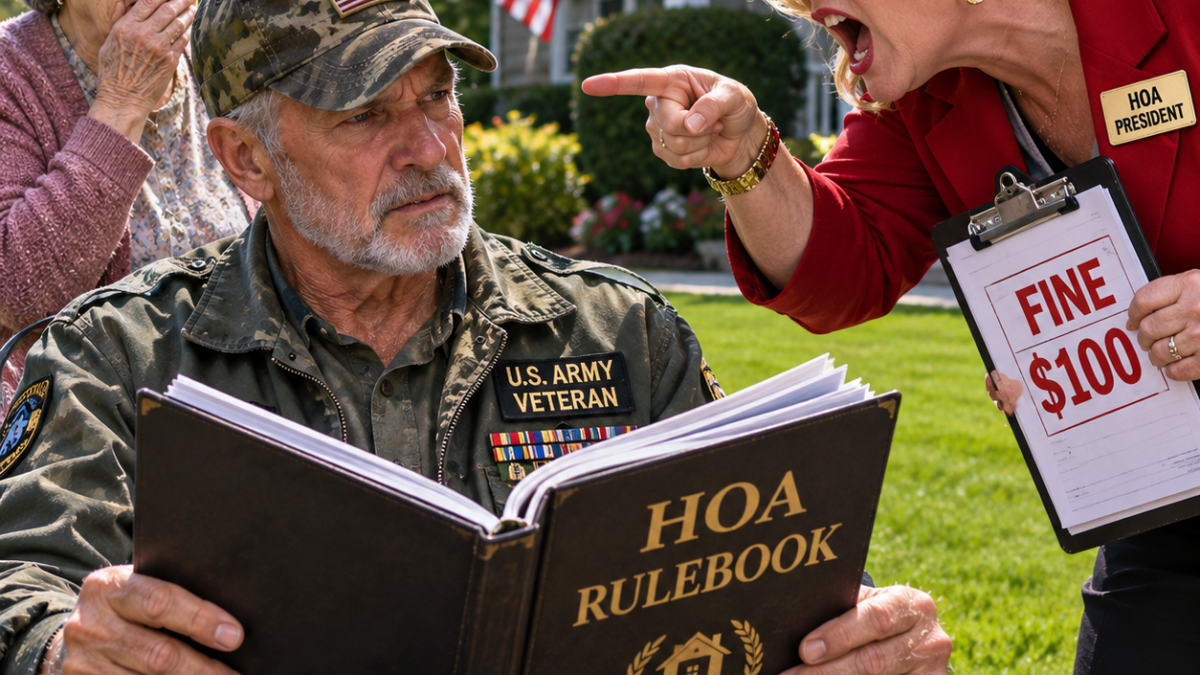
FULL STORY:“PAY THE $100 OR GET OUT OF MY NEIGHBORHOOD! I MAKE THE RULES HERE!” HOA Karen Humiliated a 20-Year Army Veteran Over His Perfect Lawn and Threatened His Elderly Neighbor With More Fines — But When John Opened the HOA’s Own Rulebook, He Found One Hidden Detail That Could Destroy Her Entire Reign
FULL STORY CONTINUATION
George stood on my porch for several seconds after I spoke.
The warm afternoon breeze moved through the maple tree beside my driveway.
His little terrier, Rusty, sniffed the edge of the porch step.
A lawn mower hummed somewhere farther down the street.
Everything around us looked peaceful.
But George’s hands were still shaking.
I guided him toward the empty chair beside mine.
“Sit down for a minute.”
He hesitated.
“I don’t want to bother you.”
“George, you’re not bothering me.”
He lowered himself carefully.
Rusty settled near his feet.
I went inside and brought out a glass of water.
When I returned, George was staring at his violation notice.
He held it as though it were something dangerous.
“I’m seventy-eight years old, John.”
His voice was quiet.
“I’ve paid my bills my whole life.”
I sat beside him.
He continued.
“When Martha and I bought that house, we thought we’d grow old there together.”
He looked across the street.
“Guess we only got half of that wish.”
I felt my chest tighten.
George had spoken about Martha before, but rarely with such naked sadness.
He was a private man.
Polite.
Soft-spoken.
The kind of neighbor who remembered birthdays and returned borrowed tools cleaner than he’d received them.
I’d met him shortly after moving to Harmony Creek.
He’d walked over with Rusty and introduced himself while I was unloading boxes.
“George Miller,” he’d said.
I laughed.
“John Miller.”
He grinned.
“Well, at least we’ll remember each other’s last name.”
That was George.
Gentle humor.
Quiet dignity.
A man who’d spent nearly eighty years trying not to impose on anyone.
And now Brenda had made him feel as though he was failing at the simple task of living in his own home.
I looked at the envelope in his hand.
“George, did she give you a warning first?”
He shook his head.
“Not that I remember.”
“Did she explain the three-inch rule?”
“She said I should know better.”
I felt my jaw tighten.
George looked embarrassed.
“She told me the lawn service was cutting the grass too low and that I needed to control what happened on my property.”
He swallowed.
“I told her I’d used the same company for five years.”
His eyes filled.
“And she said maybe five years of doing something wrong was five years too many.”
I stared toward the street.
For a moment, I couldn’t speak.
George continued.
“I tried to explain that Martha chose the company.”
His voice broke.
“She liked the way they kept the yard.”
He wiped his eyes quickly.
“I suppose that sounds foolish.”
I shook my head.
“No.”
He looked at me.
“Not foolish at all.”
For a moment, we sat quietly.
Then George whispered:
“After she died, I couldn’t bring myself to change much.”
I nodded.
“The flowers. The curtains. The little stone bird beside the steps.”
He glanced toward his house.
“Some things are different now, of course.”
His mouth trembled.
“But I kept the lawn service.”
He swallowed.
“Every other Thursday, they come, and for a little while, the house looks the way it did when Martha was still here.”
I looked away.
Because I understood then why the fine had hurt him so badly.
It wasn’t merely the money.
It was the feeling that someone had reached into the few familiar routines left after his wife’s death and declared them wrong.
And done it without even explaining why.
“George,” I said gently, “I want you to listen to me.”
He turned.
“We’re not going to ignore the notice.”
His expression tightened.
“But we’re also not going to assume it’s valid just because Brenda signed it.”
He stared.
I continued.
“The association has rules. It also has procedures.”
I tapped the binder beside me.
“If Brenda wants to impose a penalty, she needs to identify the rule, follow the required process, and explain the basis for the decision.”
George looked toward the thick book.
“Do you think she’s wrong?”
“I think the notice raises questions that deserve answers.”
His face softened slightly.
I continued.
“And I know the rule she cited doesn’t specify three inches.”
He looked surprised.
“Really?”
I opened the binder.
Found Article IV, Section B.
Then turned it toward him.
“Read this.”
George adjusted his glasses.
His lips moved as he followed the words.
Then he looked up.
“It says neat and healthy.”
I nodded.
“Exactly.”
He looked back down.
“Nothing about three inches.”
“That’s right.”
George stared at the page.
Then asked quietly:
“Can they just decide what healthy means whenever they want?”
I took a breath.
“An association may have some discretion under its governing documents, but that doesn’t mean it can impose arbitrary or inconsistently applied fines without scrutiny.”
George nodded slowly.
He looked toward his letter.
Then back at mine.
For the first time since arriving, something besides fear appeared in his eyes.
Curiosity.
And the faintest trace of hope.
I had moved to Harmony Creek less than a year earlier.
After twenty years working in military engineering, I wanted a place where I could finally enjoy small things.
A neat yard.
A reliable workshop.
A quiet street.
Neighbors who waved when they passed.
I didn’t expect luxury.
I didn’t want a large house with rooms I would never use.
I wanted a modest home that belonged to me.
A place where the biggest problem on a Saturday afternoon might be a stubborn sprinkler head or a dull mower blade.
My career had taught me how much ordinary infrastructure mattered.
Roads.
Bridges.
Water systems.
Drainage.
The unglamorous foundations that allow a community to function.
I’d worked on projects in places where those foundations had been damaged or destroyed.
There were families who depended on roads being repaired so supplies could reach them.
Communities waiting for essential routes to reopen.
People whose lives became more dangerous when something most Americans took for granted stopped working.
I never forgot them.
When I returned home for good, the sight of an orderly American neighborhood meant more to me than I could easily explain.
The streets were smooth.
The drainage worked.
The lights came on when I flipped a switch.
Mail arrived.
Garbage was collected.
Children rode bicycles on sidewalks.
It was a peaceful kind of order.
And after years of working in difficult conditions, I appreciated it.
That’s partly why I took care of my lawn.
Not because I thought a perfect yard made me better than my neighbors.
Because maintaining something simple with my own hands gave me satisfaction.
I could see the work.
Measure the result.
And know that for a few hours, everything was exactly where it belonged.
My routine was straightforward.
I woke early.
Made coffee.
Read for a while.
Then, when the weather allowed, worked outside.
Sometimes I repaired things in the garage.
Other days I trimmed hedges.
Cleaned the gutters.
Checked the sprinklers.
Or mowed the lawn.
I kept my tools organized.
Not obsessively.
Just carefully.
After twenty years of working around equipment where poor maintenance could create serious problems, putting things away properly had become second nature.
On the day Brenda first confronted me, I’d been particularly pleased with the lawn.
The grass was thick.
Green.
Even.
I’d checked the mower height.
Made the final pass.
Then stood back to admire the result.
It was one and a half inches tall.
That had been my usual setting.
The grass looked healthy to me.
There was no visible damage.
No large bare patches.
No obvious signs that my ordinary routine was causing the disaster Brenda described.
I was simply enjoying a beautiful afternoon.
Then her front door opened.
Brenda lived across the street in a beige house with white trim.
Her landscaping was immaculate.
Her driveway was spotless.
Her porch decorations changed with the seasons.
She had served as HOA president for several years and seemed to treat the position as a full-time occupation.
I had noticed her before.
Walking with a clipboard.
Talking sharply to contractors.
Inspecting flower beds.
Stopping homeowners to discuss things that looked perfectly ordinary to me.
When I first moved in, I’d assumed she was simply enthusiastic about the neighborhood.
Perhaps a little demanding.
But some communities benefit from volunteers willing to handle administrative work.
I had no problem with that.
The trouble began when I realized Brenda didn’t distinguish between responsibility and control.
A legitimate rule was something she could enforce.
A personal opinion was something she wanted everyone to obey.
And in her mind, the two seemed interchangeable.
I learned that during our first argument about the grass.
She stood beside my driveway.
Her pen tapping against the clipboard.
Her voice carrying that particular tone some people use when they want to make another adult feel like a misbehaving child.
“You’re cutting it too short.”
I asked where the three-inch minimum was written.
She gave me a lecture about sustainability.
Root growth.
Soil health.
Water conservation.
Then she talked about earthworms.
And finally used the phrase that made me question whether I’d heard her correctly.
“A tiny genocide.”
I stared.
For several seconds, I couldn’t think of a polite response.
I’d spent part of my career seeing the consequences of actual violence.
Real suffering.
Real destruction.
Hearing someone use that word to describe a freshly mowed lawn felt deeply inappropriate.
But I didn’t confront her about the language.
I asked for the rule.
She couldn’t produce one.
Instead, she warned me that I’d be hearing from the board.
Two days later, I did.
The official notice was printed on heavy cream-colored paper.
The Harmony Creek logo appeared in forest green.
My full name was typed beneath the heading.
John K. Miller.
The violation referred to Article IV, Section B.
The description accused me of cutting my grass to an excessively short height that supposedly harmed the turf and disrupted the aesthetic appearance of the community.
The notice stated that my lawn was approximately one and a half inches tall.
It instructed me to allow the grass to grow to at least three inches.
Then came the penalty.
$100.00.
I looked at the number.
For a moment, I laughed.
Not because it was amusing.
Because the absurdity was almost impossible to believe.
I’d maintained my own lawn.
Spent my own time.
Used my own equipment.
And now someone wanted a hundred dollars because she preferred a different mowing height.
I read the letter again.
The language was formal.
Confident.
Threatening enough to make an ordinary homeowner wonder whether ignoring it might lead to something worse.
Further fines were threatened if I didn’t comply within fourteen days.
The problem was that the letter never identified a specific adopted rule requiring a three-inch minimum.
It relied on broad language about proper maintenance and appearance.
I opened the CC&Rs.
Read the cited section.
Then the surrounding provisions.
I made notes.
Marked the relevant phrases.
And began asking a simple question.
Was the fine supported by the governing documents and the association’s required procedures?
Not whether Brenda believed three inches was better.
Not whether some lawn-care experts might recommend a taller setting in certain climates.
Whether the association had actually established an enforceable standard and applied it fairly.
That distinction became the center of everything that followed.
My career had taught me to separate a claim from the evidence supporting it.
When someone told me a bridge was unsafe, I didn’t dismiss the concern.
I examined it.
Reviewed the design.
Checked the loads.
Inspected the condition.
Looked at the measurements.
A serious claim deserves a serious investigation.
But a serious-sounding word doesn’t become proof simply because someone says it confidently.
Brenda’s notice used phrases like improper maintenance and detrimental to turf health.
Those terms might describe a genuine concern under some circumstances.
But they didn’t automatically establish that my lawn was unhealthy or that a specific three-inch threshold existed.
I wanted to know what the board had actually adopted.
What evidence it relied on.
Whether residents had been notified.
And whether the same standard was being applied across Harmony Creek.
The more I read, the more questions I found.
Then George arrived with his identical envelope.
And suddenly, the questions mattered to someone besides me.
George eventually finished his water.
He looked toward Rusty.
The little terrier had fallen asleep beside his chair.
Then he turned toward me.
“John?”
“Yeah?”
“Will you really help me?”
I looked at him.
“Of course.”
He swallowed.
“I don’t know anything about these meetings.”
I nodded.
“That’s okay.”
“And I’m not very good at arguing.”
I smiled gently.
“You won’t need to argue.”
His eyes filled.
“I just don’t want Brenda to get angry with me.”
I felt something tighten in my chest.
There it was.
The real problem.
An elderly homeowner was afraid of a woman elected to help administer the community he lived in.
He was frightened that asking for an explanation might make things worse.
I leaned forward.
“George, the association isn’t supposed to function that way.”
He looked at me.
“You pay dues. You own your home. You have a right to understand a fine and use the appeal process.”
His lips trembled.
I continued.
“We’ll be respectful.”
He nodded.
“We’ll use the documents.”
Another nod.
“And we’ll let the evidence speak.”
For a moment, George simply stared.
Then he whispered:
“Martha would’ve liked you.”
My throat tightened.
I smiled sadly.
“I wish I’d met her.”
George looked toward the street.
“She would’ve brought you a pie by now.”
I laughed softly.
“Then I’ve definitely missed out.”
He smiled.
A real smile this time.
And for a few seconds, the frightened expression disappeared.
After George returned home, I carried the binder into my office.
The room was small.
A desk.
A filing cabinet.
Shelves of engineering books.
A few photographs from my military career.
A framed picture of a road reconstruction project I’d worked on years earlier.
I placed the two violation notices side by side.
Same wording.
Same amount.
Same demand.
Two different homeowners.
One younger retired engineer.
One elderly widower living on a fixed income.
Brenda had treated them the same in one respect.
She’d issued both fines without pointing to a specific three-inch rule.
But the effect wasn’t the same.
I could afford a hundred dollars.
I didn’t want to pay an unsupported fine, but it wouldn’t force me to choose between groceries and a utility bill.
George was different.
He counted his expenses carefully.
He worried about unexpected charges.
And he lived with the quiet fear that one financial problem could become another.
I looked at the two notices.
Then opened my notebook.
On the first page, I wrote:
What rule was violated?
On the second:
How was the standard adopted?
On the third:
Was it applied consistently?
Then I drew a line beneath the questions.
Brenda had framed the matter as a disagreement about mowing preferences.
I intended to examine it as a question of governance.
Because if an HOA could impose a fine based on an undefined personal preference, no homeowner could know in advance what conduct would bring the next penalty.
And that was a much larger problem than grass.
For the next three evenings, my office light stayed on long after sunset.
I wasn’t looking for a fight.
I was looking for answers.
The distinction mattered.
There is something almost comforting about solving a technical problem.
You begin with what you know.
Identify what you don’t.
Gather evidence.
Test assumptions.
And separate conclusions supported by facts from conclusions based on what someone wants to believe.
For years, I’d applied that approach to damaged roads, construction plans, drainage systems, and logistical problems where mistakes could have consequences far beyond someone’s pride.
Now I was applying it to a hundred-dollar HOA fine.
I might have laughed at the comparison if George hadn’t been involved.
But every time I became tempted to dismiss the matter as ridiculous, I remembered his voice.
I’m on a fixed income, John.
And then:
I can’t afford these kinds of surprises.
I kept reading.
Article IV, Section B was short.
It required lawns to remain neat, harmonious, healthy, and well maintained.
It did not state that every property must maintain grass at three inches.
It did not describe a formal method of measuring lawn height.
It did not explain how a homeowner could determine whether a particular mowing height was unacceptable.
Nor did the materials I had identify an adopted three-inch threshold.
That didn’t automatically mean every possible landscaping enforcement decision was invalid.
The association could still have authority over visibly neglected or unhealthy landscaping under its documents.
But Brenda’s fine was based on something much more specific.
She claimed there was a minimum height of three inches.
And I couldn’t find the rule establishing it.
I highlighted the relevant paragraph.
Then wrote one word in the margin.
Undefined.
I searched the association’s other documents.
Meeting notices.
Architectural guidelines.
Landscape recommendations.
Rules distributed to residents.
I looked for any evidence that the board had adopted a three-inch standard.
I found general references to healthy lawns.
Suggestions about watering.
Recommendations about seasonal maintenance.
But nothing establishing the precise requirement Brenda had used to fine George and me.
I checked the procedural provisions governing appeals.
The bylaws allowed homeowners to challenge certain enforcement decisions before the board.
That mattered.
It meant I didn’t need to ignore the letters or begin an unnecessarily expensive legal dispute.
There was a process available.
I could request a hearing.
Present evidence.
Ask questions.
And give the board an opportunity to correct its own mistake.
I began preparing to do exactly that.
But one problem remained.
Even if the three-inch requirement hadn’t been properly established, Brenda might attempt to argue that a lawn cut below her preferred height was inherently unhealthy.
I wanted to understand whether her enforcement decisions reflected a consistent standard.
So I began studying the neighborhood itself.
Harmony Creek was a relatively small suburban development.
Tree-lined streets.
Similar houses.
Neatly maintained lawns.
A handful of cul-de-sacs.
Most residents took pride in their properties.
Some did their own yard work.
Others hired landscaping services.
On weekends, the hum of lawn mowers moved through the streets like a familiar neighborhood soundtrack.
I’d walked those sidewalks many times.
But I’d never paid particular attention to how tall other people’s grass was.
Now I did.
I noticed lawns that looked nearly identical to mine.
Deep green.
Closely trimmed.
Clean edges.
Some appeared taller.
Others shorter.
The variation was normal.
Different grass types.
Different mowing schedules.
Different homeowner preferences.
Yet all seemed to fit the general appearance of the community.
I wondered how many residents had received notices.
And whether the fines were being applied to every lawn allegedly below three inches.
I called George.
“Have you heard of anyone else being fined?”
He thought for a moment.
“Not about the grass.”
I nodded.
“Do you know who handles your lawn service?”
He gave me the company’s name.
I wrote it down.
Then asked:
“Would you be comfortable if we included your notice in the appeal?”
He hesitated.
I could hear his nervousness over the phone.
Then he said:
“If you’re there with me.”
My throat tightened.
“Of course.”
He paused.
Then whispered:
“Thank you, John.”
I looked toward the two notices on my desk.
“That’s what neighbors are for.”
The following morning, I took a walk.
I carried a small ruler, a notebook, and my phone.
I wasn’t going into anyone’s backyard.
I wasn’t sneaking around houses.
I intended to use observations from publicly accessible areas and measurements I could make without trespassing, asking permission when appropriate.
I wanted a reasonable comparison.
Not an elaborate secret investigation.
My first stop was a house on Maple Street.
The owner, Carol Jones, was watering flowers near her porch.
“Morning, Carol.”
She looked up.
“John!”
I smiled.
“Beautiful yard.”
She laughed.
“Don’t give me too much credit. The lawn company does most of it.”
I looked toward the grass.
“Mind if I ask how short they cut it?”
She considered.
“Pretty low, I think.”
I took out the ruler.
“Would you mind if I measured a spot near the sidewalk?”
She looked amused.
“Why?”
I explained the fine.
Her smile disappeared.
“A hundred dollars?”
I nodded.
“For one and a half inches.”
She stared.
Then laughed in disbelief.
“Are you serious?”
I showed her the notice.
She read it.
Her expression hardened.
“Brenda did that?”
“Yes.”
Carol shook her head.
“Well, measure mine.”
I crouched beside an accessible edge of the lawn.
Placed the ruler carefully against the soil.
And checked several blades.
Approximately one and a half inches.
I looked up.
Carol stared.
Then whispered:
“You’ve got to be kidding.”
I smiled faintly.
“Have you received a notice?”
She shook her head.
“Not one.”
I made a note.
Carol folded her arms.
“John, what is going on?”
I looked toward the street.
“That’s what I’m trying to find out.”
The next property was on Oak Avenue.
The lawn looked just as carefully maintained.
The owner had used a similar mowing height.
I spoke with the resident and received permission to check an accessible section.
Again, the grass was approximately one and a half inches.
No fine.
No warning.
No letter.
I continued.
House after house.
Not every lawn was that short.
Some were closer to two inches.
Others appeared taller.
But several were near the same height Brenda had declared unacceptable on my property.
And among the residents I spoke with, the claimed three-inch minimum came as a surprise.
One man laughed.
“Three inches? Since when?”
A woman frowned.
“I’ve never heard that.”
Another resident asked whether the board had sent out a new landscaping policy.
I explained that I hadn’t found one.
The questions multiplied.
So did my notes.
By the time I returned home, I had documented several apparently comparable lawns and recorded whether the residents I spoke with had received similar notices.
The pattern was becoming difficult to ignore.
But I still wanted to be careful.
A small sample doesn’t prove every enforcement decision is selective.
There could be facts I didn’t know.
Different dates.
Different notices.
Different circumstances.
I wasn’t interested in exaggerating.
I wanted to present the board with enough evidence to require a reasonable explanation.
And then I reached Mark’s house.
Mark served on the Harmony Creek HOA board.
He wasn’t president.
That was Brenda’s position.
But he regularly sat beside her during meetings and rarely challenged her decisions.
He lived at 36 Willow Way.
His house was attractive.
White trim.
A wide driveway.
A carefully maintained lawn that looked like a thick green carpet.
When I arrived, Mark was washing his car.
He looked up.
“John.”
I nodded.
“Morning, Mark.”
He turned off the hose.
“Everything all right?”
I looked toward the lawn.
“Actually, I’m reviewing some HOA landscaping concerns.”
His expression changed.
“Oh?”
I explained that Brenda had fined me for mowing at approximately one and a half inches.
Mark frowned.
“She did?”
I showed him the notice.
He read it.
Then gave a strange little laugh.
“Well, she does take landscaping seriously.”
I nodded.
“She does.”
I glanced toward his grass.
“Mind if I measure a spot by the driveway?”
He looked confused.
“Why?”
“I’m comparing lawn heights to understand how the standard is applied.”
Mark hesitated.
Then shrugged.
“Go ahead.”
I crouched.
Placed the ruler carefully.
Checked several nearby blades.
One and a half inches.
Almost exactly.
I straightened.
Mark stared at me.
I looked toward the grass.
Then at him.
“Have you received a hundred-dollar fine?”
His expression tightened.
“No.”
I nodded.
“Any warning?”
He shook his head.
“Not that I’m aware of.”
For a moment, neither of us spoke.
Then I took a photograph of the lawn and the measurement with his permission.
Mark watched.
He seemed uncomfortable.
I thanked him.
Then began walking away.
“John?”
I turned.
He looked toward the lawn.
Then back at me.
“Are you going to bring this up at the meeting?”
I considered the question.
“Yes.”
His expression changed.
I continued.
“I’m going to ask the board to explain the standard and how it has been applied.”
Mark looked away.
For a moment, he seemed almost embarrassed.
Then he nodded.
“I see.”
I walked home.
And for the first time since receiving the fine, I felt that I had the evidence needed to ask something Brenda would find difficult to dismiss.
I didn’t celebrate.
There was no reason to.
I hadn’t won anything yet.
George still had a hundred-dollar fine hanging over his head.
Mine was still listed as due.
And the board hadn’t reviewed either case.
But the comparison mattered.
The lawn of a board member appeared to be the same height as mine.
Yet the board member hadn’t received a violation notice.
That fact didn’t establish precisely why Brenda had selected George and me.
It didn’t prove every decision she’d made was improper.
But it raised a serious question about consistency.
And Brenda’s favorite defense—that she was merely applying the same standards to everyone—was going to need more than a confident smile.
I spread the evidence across my desk.
Photographs.
Measurements.
Notes.
Copies of the notices.
The governing documents.
I arranged them in a logical order.
First, the actual written provision.
Second, the notice.
Third, the absence of a specified three-inch minimum in the materials I’d reviewed.
Fourth, examples of lawns maintained at similar heights without comparable notices.
And finally, the written appeal requests.
I was careful about George’s documentation.
His name belonged on his own appeal.
His fine was his own matter.
I wasn’t going to assume I could speak for him without permission.
So I visited.
He was sitting in his living room when I arrived.
Rusty barked once, then came over to sniff my shoes.
George smiled weakly.
“John.”
I held up the folder.
“I’ve prepared the appeal.”
He looked nervous immediately.
“Already?”
I nodded.
“I want you to read it before we submit it.”
He adjusted his glasses.
I sat beside him.
Then went through the document carefully.
The citation.
The governing provision.
The request for review.
The questions about the three-inch standard.
George listened.
At one point, he looked toward me.
“You really did all this?”
I nodded.
“It needed doing.”
His eyes filled.
“You didn’t have to.”
I looked at him.
“George, I know what the fine means to you.”
He swallowed.
Then looked toward the photograph of Martha hanging near the fireplace.
For a moment, neither of us spoke.
Finally, he said:
“She’d have been furious.”
I smiled.
“About Brenda?”
He nodded.
“Martha didn’t like bullies.”
I laughed softly.
“Sounds like we would’ve gotten along.”
George smiled through tears.
“She would’ve liked you very much.”
Then he signed the appeal.
We delivered the paperwork to the HOA’s official address using a method that would preserve proof of submission.
I wasn’t leaving the appeal somewhere Brenda could later claim she’d never received it.
The request was straightforward.
We asked for a hearing under the bylaws.
We requested that the board review the basis for both fines.
And we provided notice that we intended to present relevant documentary evidence.
Then we waited.
The meeting was scheduled for the following week.
For George, those seven days felt longer than they should have.
For me, they were time to prepare.
On Monday, George called.
“John?”
I answered from my office.
“Morning.”
He sounded nervous.
“I’ve been thinking.”
I set down my pen.
“About what?”
“Maybe we shouldn’t go through with it.”
I paused.
“Why?”
A long silence.
Then he whispered:
“Brenda came by yesterday.”
My stomach tightened.
“What happened?”
“She asked whether I’d submitted an appeal.”
I sat straighter.
“What did you say?”
“I told her yes.”
George swallowed.
“She said the board doesn’t appreciate residents making unnecessary trouble.”
I felt anger rise.
But I kept my voice calm.
“Did she threaten you?”
George hesitated.
“Not exactly.”
I waited.
“She said if I wanted an unpleasant relationship with the association, that was my decision.”
I closed my eyes.
For a moment, I couldn’t speak.
Then George continued.
“John, I don’t need trouble.”
His voice broke.
“I’m too old for this.”
I took a breath.
“George, you don’t have to attend if you decide it’s too stressful.”
He was quiet.
I continued.
“The appeal is your right, but the decision is yours.”
For a moment, the line remained silent.
Then he whispered:
“Would you still go?”
“Of course.”
“Even if I don’t?”
“Yes.”
He took a shaky breath.
Then asked:
“Do you think Martha would’ve wanted me to stand up for myself?”
My throat tightened.
I looked toward the folder on my desk.
“From what you’ve told me about her, I think she’d want you to make the decision that lets you respect yourself.”
George was silent.
Then he said quietly:
“I’m going.”
I smiled.
“All right.”
His voice trembled.
“But I might need you sitting beside me.”
“I’ll be there.”
The following day, I found him working in his garden.
He was bent over near the roses Martha had planted.
Rusty lay in the shade.
I approached slowly.
“Morning, George.”
He straightened with difficulty.
“John.”
I looked toward the flowers.
“They’re beautiful.”
He smiled.
“Martha chose them.”
I nodded.
He touched one of the leaves gently.
“She used to spend hours out here.”
His voice softened.
“Even when her hands hurt, she’d come outside and tend them.”
For a moment, he stared at the flowers.
Then he said:
“You know what bothers me most?”
I looked toward him.
“The fine?”
He shook his head.
“No.”
I waited.
“It’s that I’ve spent my whole life trying to do things right.”
His eyes filled.
“Work hard. Pay what I owe. Be decent to people.”
He looked toward his house.
“And now I’m afraid to open the mailbox because somebody might have decided I’ve done something wrong again.”
The words struck me harder than Brenda’s insults ever had.
Because George wasn’t angry.
He was ashamed.
And he had nothing to be ashamed of.
I looked toward the garden.
Then back at him.
“George, asking for a fair explanation isn’t wrongdoing.”
He nodded weakly.
I continued.
“And you don’t become a bad neighbor because you challenge a fine you believe is unsupported.”
His lips trembled.
Then he whispered:
“I wish Martha were here.”
My throat tightened.
“I know.”
He wiped his eyes.
“She was always braver than me.”
I smiled gently.
“Maybe some of that courage rubbed off.”
George looked up.
For a moment, he seemed surprised.
Then he laughed softly.
“Maybe.”
As the meeting approached, I continued reviewing my presentation.
I wasn’t planning an emotional speech.
The evidence was strong enough without theatrics.
But I knew Brenda.
She had already tried to frame my questions as disrespect.
She would probably attempt to control the discussion.
Interrupt.
Change the subject.
Or insist that her experience as HOA president made her interpretation decisive.
I wanted to remain calm.
Not because anger was wrong.
But because I didn’t want George to watch me turn the hearing into something frightening.
He needed to see that challenging a decision didn’t require becoming aggressive.
It required preparation.
Patience.
And the willingness to ask reasonable questions even when the answers made someone uncomfortable.
I rehearsed the opening.
Not in front of a mirror.
At the kitchen table with the binder open.
The violation notice cites Article IV, Section B.
Where does that section establish a three-inch minimum?
Then:
If the board considers one-and-a-half-inch grass a violation, how does it explain comparable lawns receiving no notice?
That was enough.
Two questions.
One about authority.
One about consistency.
Everything else would follow from how the board answered.
Thursday evening arrived with dark clouds gathering above Harmony Creek.
The community room was in a small building beside the neighborhood’s shared facilities.
I’d been there twice before.
Both times, Brenda had dominated the meeting.
She spoke as though every agenda item were a test of loyalty to her leadership.
Residents asked questions cautiously.
Board members usually nodded.
Then the meeting ended.
No real debate.
No meaningful explanation.
I suspected Brenda expected our appeal to follow the same pattern.
She would read the violation.
Lecture us about proper lawn care.
Announce the fines stood.
And send us home embarrassed.
I intended to give her every opportunity to explain herself.
But I wasn’t going to accept unsupported assertions as answers.
I parked near the entrance.
Took my binder.
Then walked toward the door.
George was already waiting.
He wore a neatly pressed shirt and dark trousers.
His hair was combed carefully.
His hands gripped the handle of his cane.
When he saw me, he looked relieved.
“John.”
I smiled.
“Evening, George.”
He glanced toward the building.
“Is it time?”
I nodded.
“Almost.”
His throat moved as he swallowed.
Then he whispered:
“I feel like I’m going to court.”
I smiled gently.
“It’s an HOA meeting.”
He gave a nervous laugh.
“Somehow that doesn’t make me feel better.”
I rested a hand on his shoulder.
“We’ll go in together.”
He nodded.
Then looked toward the folder under my arm.
“Did you bring everything?”
I smiled.
“Every page.”
For the first time that evening, George laughed.
And together, we walked inside.
The community room smelled of stale coffee and furniture polish.
Fluorescent lights hummed overhead.
A row of folding chairs faced a long table.
At the front sat the HOA board.
Brenda occupied the center chair.
Of course she did.
She wore a navy jacket and a silver necklace.
Her clipboard rested beside a stack of papers.
To her left sat Mark, the board member whose lawn I’d measured at one and a half inches.
To her right sat Sarah, the board secretary.
Sarah was quiet.
Polite.
The sort of woman who seemed uncomfortable whenever a disagreement became public.
She was shuffling papers as we entered.
Mark glanced toward me.
Then immediately looked away.
Brenda, however, smiled.
It was the same expression she’d worn on my driveway.
The look of someone confident the outcome had been decided before anyone else spoke.
“Mr. Miller.”
I nodded.
“Brenda.”
Her gaze moved toward George.
“Mr. Miller.”
George swallowed.
“Good evening.”
She tilted her head.
“I’m glad you both decided to attend.”
Her tone suggested that showing up to appeal a fine was a favor she had generously permitted.
I helped George settle into a chair near the front.
Then sat beside him.
He kept his hands folded over the handle of his cane.
I could see his fingers trembling.
I leaned toward him.
“You okay?”
He nodded too quickly.
Then whispered:
“Just nervous.”
I smiled.
“You don’t need to speak unless you want to.”
He looked toward Brenda.
Then back at me.
“Thank you.”
More residents arrived.
Not hundreds.
Harmony Creek wasn’t that kind of neighborhood.
But enough to fill much of the room.
Carol Jones sat near the middle.
Mr. Turner from Oak Avenue arrived carrying a folded copy of the bylaws.
A woman I’d spoken with during my lawn survey took a seat near the back.
There were other familiar faces.
People I’d waved to.
People I’d chatted with briefly while walking past their houses.
Most had no personal stake in the hearing.
But several had heard about the unusual fines and wanted to understand what rule was being enforced.
I could sense Brenda’s irritation as the room filled.
She liked having an audience when she controlled the conversation.
But this audience seemed interested in asking questions.
And that was something she hadn’t expected.
At seven o’clock, Brenda tapped the microphone.
A sharp squeal came from the speaker.
George flinched.
I put a reassuring hand near his arm.
Brenda cleared her throat.
“Meeting called to order.”
She looked down at her agenda.
“The first item concerns appeals filed by homeowners John K. Miller and George Miller regarding landscape maintenance violations.”
Her eyes lifted toward us.
“Both residents were cited for cutting their grass below the acceptable height.”
I opened my binder.
Brenda continued.
“The association has been extremely patient.”
I looked up.
Patient?
We’d received the fines only days earlier.
She folded her hands.
“In the spirit of cooperation, the board has agreed to hear their objections.”
The implication was obvious.
Our ability to challenge the fines wasn’t being treated as part of the established process.
It was being presented as an act of generosity.
I took a slow breath.
Then waited.
Brenda looked directly at me.
“Mr. Miller, you may approach.”
I stood.
George reached toward my sleeve.
I looked down.
His eyes were frightened.
“John.”
I bent slightly.
“Yeah?”
He swallowed.
“Please don’t let her make you angry.”
My throat tightened.
I smiled.
“I won’t.”
Then I walked toward the podium.
I placed the binder on the wooden surface.
Opened it.
And looked toward the board.
“Good evening.”
Sarah nodded politely.
Mark shifted in his chair.
Brenda leaned back.
I continued.
“Thank you for allowing us to present our appeals.”
My voice was steady.
“I’m here because the association assessed a hundred-dollar fine against both George and me based on an alleged minimum grass height of three inches.”
Brenda interrupted immediately.
“Mr. Miller, let’s not complicate this.”
I looked toward her.
She continued.
“Did you cut your lawn to one and a half inches?”
I nodded.
“Yes.”
A small smile appeared on her face.
She looked toward Mark.
Then Sarah.
“As you can see, the violation isn’t disputed.”
I waited until she finished.
Then said:
“The mowing height isn’t disputed.”
Her smile tightened.
“The basis for treating that height as a violation is.”
Brenda’s expression changed.
I turned to the first marked page.
“The notice cites Article IV, Section B of the Covenants, Conditions, and Restrictions.”
I held up a copy.
“This section requires lawns to remain neat, healthy, harmonious, and well maintained.”
Sarah looked toward her own binder.
I continued.
“I agree that those are reasonable goals.”
Brenda nodded sharply.
“Good.”
I looked directly at her.
“But I haven’t found a sentence establishing a minimum grass height of three inches.”
The room became quiet.
I paused.
Then asked:
“Could the board identify where that exact requirement was adopted?”
Brenda blinked.
For a moment, her expression seemed frozen.
Then she leaned forward.
“Mr. Miller, this is common horticultural knowledge.”
I nodded.
“That may be your understanding.”
Her eyes narrowed.
I continued.
“But I’m asking about the association’s adopted requirement.”
She waved one hand.
“A healthy lawn needs proper growth.”
“I understand that different grass types and conditions may call for different maintenance.”
Brenda looked annoyed.
“Then why are you arguing?”
“Because the violation notice treats three inches as a mandatory threshold.”
I glanced toward the board.
“I’m asking where that threshold appears in our governing rules or an appropriately adopted standard.”
Sarah began turning pages.
Mark adjusted his glasses.
Brenda’s face reddened.
She said:
“We cannot write a separate rule for every possible landscaping issue.”
I nodded.
“Agreed.”
For a moment, she seemed surprised.
I continued.
“But when the association imposes a specific monetary penalty, the homeowner should be able to understand the requirement and the basis for finding a violation.”
I paused.
“Otherwise, a resident can maintain a neat, green lawn for years and suddenly receive a fine because one person prefers a different mowing height.”
A murmur moved through the audience.
Brenda’s jaw tightened.
She tapped her pen.
“Mr. Miller, you’re making this unnecessarily complicated.”
I looked at her.
“Then a simple answer should resolve it.”
The room went silent.
I waited.
“Where is the three-inch minimum written?”
Sarah looked down at her papers.
Mark shifted again.
Brenda stared at me.
Her mouth opened.
Then closed.
For several seconds, the only sound was the faint hum of the fluorescent lights.
Finally, she said:
“It’s an accepted standard.”
I nodded.
“Accepted by whom, and when did the association adopt it?”
Her face reddened further.
“I’m not going to sit here and be interrogated.”
I took a breath.
“I’m asking questions directly related to the fine under appeal.”
She leaned forward.
“You are challenging my professional judgment.”
I considered the statement.
“Brenda, are you a certified turf specialist or agronomist?”
She stared.
“What?”
“Do you have a qualification or an expert assessment establishing that my particular lawn is unhealthy because it’s cut at one and a half inches?”
Her eyes widened.
“You’re being disrespectful!”
I shook my head.
“I’m not questioning your right to have an opinion about lawn care.”
I paused.
“I’m asking what evidence supports the penalty.”
A few residents nodded.
Sarah cleared her throat.
“Madam President?”
Brenda turned sharply.
“What?”
Sarah looked uncomfortable.
“I don’t see a three-inch minimum in this section either.”
The room became very quiet.
Brenda stared at her.
For a moment, I thought she would shout.
Then she gave a forced laugh.
“Sarah, we have always relied on reasonable interpretation.”
Sarah lowered her eyes.
I watched her carefully.
She seemed torn between her loyalty to the board president and the words printed in front of her.
I decided not to press her.
Instead, I turned to the next page.
“Even if the board believes the general language permits some judgment about lawn health, there’s a second issue.”
Brenda sighed loudly.
“Oh, for heaven’s sake.”
I continued.
“Consistency.”
I explained that George and I weren’t the only homeowners maintaining lawns at approximately one and a half inches.
Several other properties appeared to be cut at the same height.
Yet the residents I’d contacted reported no comparable violation notices.
Brenda immediately sat straighter.
“That’s not relevant.”
I looked at her.
“It concerns whether the association applies its standards consistently.”
She waved her hand.
“Every property is different.”
I nodded.
“That’s true.”
Then I opened the photographic section of my binder.
“Which is why I documented the conditions of several properties and compared them rather than assuming they were identical.”
For the first time, Brenda looked uncertain.
I held up the first photograph.
“This is the lawn at 12 Maple Street.”
Carol Jones leaned forward.
I continued.
“Approximately one and a half inches.”
I placed the photograph on the table.
“Carol confirmed she hadn’t received a similar notice.”
Carol raised her hand.
“That’s correct.”
Brenda turned toward her.
“Carol, this isn’t your appeal.”
Carol looked surprised.
Then answered calmly:
“It’s my lawn.”
A few people murmured.
Brenda’s expression tightened.
I continued.
“This is 24 Oak Avenue.”
Another photograph.
“Approximately the same height.”
I placed it beside the first.
“No comparable notice reported.”
Then another.
And another.
I wasn’t trying to overwhelm anyone with paper.
I wanted the board to see that the condition Brenda called unacceptable was common throughout the neighborhood.
And in many cases, the lawns looked just as neat and healthy as mine.
Brenda interrupted.
“These measurements are hardly scientific.”
I nodded.
“They are field observations, not a formal agronomic study.”
She smiled as though she’d caught me admitting defeat.
I continued.
“That’s why I’m asking the board to explain its standard and enforcement records, not claiming these photographs alone settle every possible question.”
Her smile faded.
I turned another page.
“These comparisons raise a reasonable question about why George and I were selected for fines while apparently similar properties were not.”
Sarah studied the photographs.
Mark stared at the table.
Brenda folded her arms.
Then she said:
“Perhaps those homeowners maintain their yards properly in other respects.”
I nodded.
“Then the board can identify the differences relevant to the cited violation.”
She glared.
I continued.
“But the notice doesn’t cite weeds, bare patches, irrigation failures, or other maintenance problems.”
I held up the original letter.
“It cites grass height.”
For a moment, nobody spoke.
Then Mr. Turner raised his hand from the audience.
“Madam President?”
Brenda looked furious.
“Yes?”
He pointed toward the photographs.
“If those lawns are the same height, why aren’t they being fined?”
Brenda gave a tight smile.
“We don’t discuss other homeowners’ private enforcement matters.”
I nodded.
“That’s fair as a general privacy concern.”
Then I looked toward the board.
“But the board can explain the standard without revealing private details.”
Sarah glanced toward Brenda.
I saw her expression change again.
She was beginning to understand the problem.
I turned to the next photograph.
It showed Sarah’s lawn at 18 Elm Court.
The grass measured approximately two inches.
I placed it gently on the table.
“This is a board member’s property.”
Sarah looked toward the image.
Her face flushed.
I didn’t want to embarrass her.
She had been courteous throughout the hearing.
But the comparison was relevant.
I explained the approximate measurement.
Then moved on.
The final photograph remained in my binder.
I looked toward Mark.
He was sitting with his arms crossed.
His face had become tense.
I took a breath.
Then removed the picture.
“This is 36 Willow Way.”
The room grew quiet.
The image showed a neatly maintained lawn.
The ruler.
And enough of the house to establish which property it was.
I placed the photograph on the table.
“The grass measured approximately one and a half inches.”
Mark looked down.
Then away.
I continued.
“This is Mark’s property.”
A murmur moved through the room.
I turned toward him.
“Mark, you gave me permission to measure the grass near your driveway.”
He nodded stiffly.
“Yes.”
I paused.
“Have you received a hundred-dollar fine for maintaining it at this height?”
For a moment, he said nothing.
Brenda’s face tightened.
Then Mark cleared his throat.
“No.”
The room became completely silent.
I waited.
“Any warning that you must allow it to grow to three inches?”
He looked toward Brenda.
Then back at me.
“No.”
I nodded.
“Thank you.”
Then I turned toward the board.
“That’s the concern.”
My voice remained steady.
“George and I were fined for a condition apparently present at multiple other properties, including a board member’s home.”
I paused.
“If the board believes the condition violates its rules, it needs to explain the standard and how it’s being applied fairly.”
No one moved.
Then I added:
“And if the standard hasn’t been properly established or supported, the fines should not stand.”
Brenda’s face was bright red.
She stared at the photographs.
Then at Mark.
Then at Sarah.
For the first time that evening, she seemed unable to control the direction of the discussion.
She picked up her pen.
Set it down.
Then snapped:
“This is an ambush!”
I looked toward her.
“No, Brenda.”
She raised her voice.
“YOU WENT AROUND SPYING ON PEOPLE!”
I took a slow breath.
“I spoke with residents and documented accessible conditions with permission where needed.”
She pointed toward the photographs.
“You’re trying to humiliate this board!”
I shook my head.
“I’m asking the board to reconsider two fines.”
Her expression twisted.
“YOU THINK BECAUSE YOU WERE IN THE MILITARY YOU CAN COME IN HERE AND ORDER EVERYBODY AROUND!”
The words echoed across the room.
George flinched.
I looked toward him.
He was gripping his cane.
His face pale.
For a moment, my anger rose so sharply that I had to stop speaking.
I thought about everything George had told me.
His fixed income.
His fear.
His memories of Martha.
Then I looked back at Brenda.
“I’m not issuing anyone orders.”
My voice was quiet.
“But I am entitled to present an appeal.”
She laughed bitterly.
“You’re making a spectacle out of a hundred dollars.”
I stared.
For a moment, I couldn’t believe she’d said it.
Then I looked toward George.
And answered:
“Maybe a hundred dollars doesn’t mean much to you.”
The room became quiet.
I continued.
“But to some homeowners, an unexpected hundred-dollar charge is a serious problem.”
Brenda folded her arms.
“Then perhaps they should maintain their lawns properly.”
I felt my jaw tighten.
“George’s lawn is maintained by the same company his late wife selected.”
George lowered his head.
I continued.
“He’s kept that arrangement because it matters to him.”
Brenda rolled her eyes.
“Personal circumstances don’t excuse violations.”
I nodded.
“Agreed. Valid rules should be applied consistently.”
Then I looked directly into her eyes.
“But the board still hasn’t shown that the specific requirement behind these fines was established or fairly enforced.”
For a moment, nobody spoke.
Then I asked:
“Why should George have to sacrifice part of his fixed income to pay a fine that a board member with the same grass height never received?”
I heard a chair scrape.
George was standing.
I turned immediately.
He was holding his cane with both hands.
His face was pale.
I stepped away from the podium.
“George?”
He looked toward me.
Then shook his head.
Very slightly.
I stopped.
He wanted to speak.
I could see how frightened he was.
His hands shook.
His shoulders hunched.
And for one moment, he looked as though he might sit down again.
Then he turned toward the board.
“May I say something?”
Brenda looked annoyed.
“Mr. Miller, we’ve already heard quite a lot.”
Sarah looked toward her.
“Madam President, it’s his appeal, too.”
The room grew quiet.
Brenda’s jaw tightened.
Then she gestured dismissively.
“Fine.”
George took a breath.
I moved a chair closer in case he needed it.
He remained standing.
For a moment, he looked at the floor.
Then he raised his eyes.
“My wife was Martha.”
The room became very still.
George swallowed.
“We lived in Harmony Creek for a long time.”
His voice trembled.
“She loved our house.”
I felt my throat tighten.
George continued.
“She loved the roses. The little birdbath. The garden near the steps.”
He paused.
“And she liked the lawn kept short and neat.”
Brenda looked away.
George glanced toward her.
“We used the same lawn service for years.”
His eyes filled.
“After she died, I kept them.”
A long silence.
George looked down.
“I know that doesn’t mean I’m above the rules.”
His voice became steadier.
“I’ve never wanted to be above the rules.”
He looked toward the board.
“I’ve paid my dues.”
A pause.
“Kept the house in good condition.”
Another.
“Tried to be a good neighbor.”
His lower lip trembled.
“I’m seventy-eight years old.”
The room was silent.
“I don’t have a lot of extra money.”
He swallowed.
“And when I got that hundred-dollar fine, I was scared.”
I felt tears gathering.
George continued.
“I was afraid if I questioned it, there’d be another fine.”
His voice broke.
“Then another.”
He looked toward Brenda.
“And I was afraid I’d become somebody the HOA wanted out.”
For a long moment, nobody moved.
Then he whispered:
“It’s the house Martha and I built our life in.”
His eyes filled.
“I don’t have her anymore.”
He looked down at his trembling hands.
“But I’d like to keep the home we shared.”
I saw Sarah cover her mouth.
Mark lowered his head.
Several residents wiped their eyes.
George took another breath.
Then looked toward the board.
“I’m not asking you to feel sorry for me.”
His voice shook.
“I’m asking you to tell me what I did wrong.”
He held up the violation notice.
“Because I read this.”
He swallowed.
“And I read the rule John showed me.”
A tear rolled down his cheek.
“I still can’t find where it says my grass has to be three inches.”
He looked toward Brenda.
Then asked:
“Please, ma’am.”
His voice broke.
“Can you show me?”
No one answered.
Brenda stared at him.
For the first time that evening, her expression looked uncertain.
George waited.
His hands shaking around the cane.
Then he whispered:
“If it’s there, I’ll follow it.”
A pause.
“But if it’s not, please don’t make me pay money I need for things that actually matter.”
The room was completely silent.
George lowered his head.
Then sat down.
I moved beside him.
He looked toward me.
His eyes were wet.
“I’m sorry.”
I crouched.
“For what?”
His voice broke.
“I didn’t mean to get emotional.”
I shook my head.
“You have nothing to apologize for.”
He swallowed.
Then whispered:
“I just miss her.”
I rested a hand on his shoulder.
“I know, George.”
For a moment, I couldn’t speak.
Then I stood.
And looked toward the board.
Sarah was the first person to break the silence.
“Madam President.”
Her voice trembled.
Brenda turned.
“What?”
Sarah looked down at the governing documents.
Then toward George.
“I don’t think we can maintain these fines as issued.”
Brenda stared.
“Excuse me?”
Sarah swallowed.
“We haven’t identified an adopted three-inch minimum.”
Brenda’s face reddened.
Sarah continued.
“And the consistency concerns haven’t been resolved.”
For a moment, she looked frightened.
As though she’d never challenged Brenda publicly before.
Then she straightened.
“I think we need to correct this.”
Brenda leaned forward.
“Sarah, you don’t understand the broader landscaping policy.”
Sarah glanced toward the binder.
Then back at her.
“I understand what the notice says.”
Her voice grew steadier.
“And I understand what the cited section says.”
Brenda opened her mouth.
Sarah continued.
“They don’t establish the same thing.”
Mark shifted beside them.
For a moment, he looked at the photograph of his own lawn.
Then toward George.
His expression changed.
I couldn’t know exactly what he was thinking.
But I saw embarrassment in his face.
And something like regret.
Finally, he cleared his throat.
“Brenda.”
She turned sharply.
“What?”
Mark took a breath.
“I think Sarah’s right.”
The room became silent again.
Brenda stared at him.
“Are you serious?”
Mark nodded.
“We shouldn’t be fining John and George under a specific standard we can’t substantiate.”
He looked toward the photographs.
“And I can’t sit here pretending my own lawn is different.”
For a moment, I thought Brenda might stand and walk out.
Her face was crimson.
Her hands tightened around the clipboard.
Then Mark said:
“I move that we rescind the two hundred-dollar fines.”
Sarah immediately responded.
“Seconded.”
The room seemed to stop breathing.
Brenda looked from Sarah to Mark.
Then toward me.
Her expression was a mixture of outrage and disbelief.
“YOU CAN’T JUST THROW AWAY OUR STANDARDS!”
Mark looked toward her.
“We’re not throwing away the standards.”
He paused.
“We’re correcting fines that haven’t been properly supported.”
Brenda shook her head.
“This sets a terrible precedent.”
Sarah spoke quietly.
“I think it sets a necessary one.”
For a moment, Brenda looked speechless.
Then she glanced toward the audience.
People were watching.
No one was shouting.
No one was threatening her.
But several residents looked relieved.
Others leaned forward, waiting for the vote.
Brenda had spent the entire evening insisting that harmony required obedience.
Now the board was being asked to demonstrate something much more important.
Accountability.
Mark looked toward Sarah.
Then Brenda.
“Shall we vote?”
Sarah raised her hand in favor.
Mark raised his.
Two votes.
Brenda remained motionless.
Her jaw tightened.
She stared at the table.
For several seconds, nobody spoke.
Then, slowly, she lifted her hand.
The motion passed unanimously.
The fines were rescinded.
For a moment, I didn’t move.
I had prepared for questions.
Arguments.
Possibly another appeal.
I’d expected Brenda to fight the matter until the very end.
But the board had voted.
The penalty was gone.
Both penalties.
I looked toward George.
He was staring at the front table.
His mouth slightly open.
As though he hadn’t understood what happened.
I leaned down.
“George.”
He turned toward me.
His eyes were wet.
“They canceled them?”
I nodded.
“Yes.”
His lips trembled.
“Both?”
“Both.”
For a moment, he stared.
Then his face crumpled.
He covered his mouth.
And began crying.
I sat beside him.
He looked toward the floor.
Then whispered:
“Oh, thank God.”
His shoulders shook.
I rested a hand on his back.
For a while, neither of us spoke.
Then George looked up.
His eyes were full of tears.
“John.”
I smiled.
“Yeah?”
“I thought she was going to win.”
My throat tightened.
I shook my head.
“This wasn’t supposed to be about someone winning.”
He nodded.
But his voice broke again.
“I know.”
He looked toward the board.
“I just didn’t think anybody would listen.”
That was when I understood that the victory meant something different to him.
For me, it was an unsupported fine withdrawn.
For George, it was proof that a frightened old man could walk into a room, ask for fairness, and be heard.
Brenda began gathering her papers.
Her movements were sharp.
Angry.
She avoided looking toward us.
Mark remained seated.
Sarah was reviewing the meeting notes.
I stood.
Took my binder.
Then approached the podium once more.
Brenda looked up.
“What now?”
I kept my voice calm.
“Thank you for reviewing the appeals.”
Her expression tightened.
I turned toward Mark and Sarah.
“And thank you for considering the evidence.”
Mark nodded.
Sarah gave a small, tired smile.
I looked toward Brenda.
For a moment, I could see that she expected another confrontation.
Perhaps a lecture.
An insult.
A triumphant announcement.
But I didn’t want any of those things.
The board had corrected the fines.
That was the outcome I sought.
I closed my binder.
Then returned to George.
He was standing slowly.
I offered my arm.
He accepted it.
And together, we walked toward the door.
As we passed the last row of chairs, Carol Jones stood.
She looked toward George.
Then smiled.
“I’m glad they listened.”
George’s eyes filled again.
“Thank you.”
Mr. Turner approached next.
He held out his hand.
“John, that was a clear presentation.”
I shook it.
“Appreciate it.”
He glanced toward the board.
“Maybe we’ll start asking more questions at these meetings.”
I smiled faintly.
“That might be a good thing.”
Then we stepped outside.
The evening air was cool.
The sky had darkened.
A few porch lights glowed across the neighborhood.
George stopped near the entrance.
He took a deep breath.
Then looked toward me.
For a moment, he seemed unable to speak.
Finally, he whispered:
“John, I don’t know how to thank you.”
I shook my head.
“George, you helped yourself tonight.”
He laughed weakly.
“I barely got through three sentences without crying.”
I smiled.
“You said what mattered.”
His eyes filled.
Then he reached out.
I took his hand.
He gripped it firmly.
More firmly than I’d expected.
And whispered:
“Martha would have been proud.”
My throat tightened.
I nodded.
“I think so, too.”
We walked toward the parking lot together.
George moved slowly, leaning on his cane.
I matched his pace.
He looked tired.
Emotionally exhausted.
But something about him had changed.
His shoulders were no longer quite so hunched.
His hands weren’t trembling as badly.
And every few steps, he smiled.
Not a broad smile.
Just a small expression that appeared and disappeared whenever he remembered the vote.
After a while, he looked toward me.
“John?”
“Yeah?”
“Do you think Brenda’s angry?”
I almost laughed.
Then looked at him.
“Probably.”
George sighed.
For a moment, I thought the fear was returning.
Then he said something that surprised me.
“Well.”
He paused.
“I suppose she’ll have to get over it.”
I stopped walking.
Looked at him.
Then burst out laughing.
George began laughing, too.
For several seconds, we stood beside the parked cars, two men with the same last name laughing like schoolboys.
It was the first time I’d heard George laugh without restraint since meeting him.
And I realized that the sound meant more to me than the board’s vote.
The next morning, I found George sitting on his porch with Rusty.
He was drinking coffee from a chipped ceramic mug.
The sun was shining.
His rosebushes were beginning to bloom.
I walked across the street.
“Morning.”
He looked up.
“John!”
His face brightened.
“Come sit.”
I lowered myself into the chair beside him.
Rusty wandered over.
Sniffed my shoes.
Then settled near my feet.
For a while, we sat quietly.
The neighborhood was peaceful.
A mail carrier drove past.
A couple walked along the sidewalk.
Somewhere nearby, a sprinkler clicked.
George looked toward his lawn.
The grass was still neatly trimmed.
One and a half inches.
I smiled.
“Looks good.”
He laughed.
“Don’t let Brenda hear you.”
I shook my head.
Then looked toward the flowers beside the porch.
“They’re beautiful.”
George nodded.
“Martha planted those.”
He took a sip of coffee.
“She always said roses made a house feel loved.”
For a moment, his smile faded.
Then he looked toward me.
“Yesterday would’ve been our fifty-third anniversary.”
My chest tightened.
I hadn’t known.
“George.”
He nodded.
“I almost didn’t go to the meeting.”
I waited.
He looked toward the lawn.
“I kept thinking about what she’d say if I let somebody frighten me out of asking a simple question.”
His voice trembled.
“Then I remembered the way she used to stand up for our kids when somebody treated them unfairly.”
He smiled sadly.
“She wasn’t loud.”
I nodded.
“Just determined?”
George laughed softly.
“Very.”
For a moment, he stared toward the garden.
Then whispered:
“I wish she could’ve seen me last night.”
I looked at him.
Then said gently:
“George, you stood up in front of that whole room and told the truth.”
His eyes filled.
“I know.”
I paused.
“That’s something to be proud of.”
He lowered his head.
Then smiled through tears.
“Maybe I am.”
The days following the meeting were uneventful.
And after everything, that was exactly what I wanted.
The hundred-dollar fine disappeared from my account.
George’s fine was rescinded as well.
The association’s records reflected the board’s decision.
There were no additional penalties for the same disputed mowing height.
No new warning letters.
No attempt to turn the argument into something bigger.
Brenda continued serving in her position at that point.
She didn’t apologize.
And I didn’t expect her to.
When we passed each other on the street, she usually looked away.
Sometimes her expression remained cold.
But she no longer approached me with the same confidence that her personal interpretation was beyond question.
The board had demonstrated that it could reconsider an enforcement decision.
That mattered.
Not because Brenda had been humiliated.
But because the next homeowner who received a questionable notice might feel less afraid to ask for an explanation.
I occasionally thought about the strange path that had brought us there.
Twenty years in military engineering.
Road projects in dangerous places.
Long hours solving problems where the stakes were enormous.
Then retirement.
A small house.
A lawn mower.
And a woman accusing me of destroying earthworms.
On the surface, the situation was absurd.
But the underlying principle was familiar.
Systems work only when people follow procedures responsibly.
Rules need to be understandable.
Decisions need evidence.
Authority needs limits.
And people affected by a decision deserve a fair chance to question it.
Those ideas had mattered when I was designing roads.
They mattered in Harmony Creek, too.
The scale was different.
The consequences were different.
But fairness remained fairness.
One Saturday afternoon, I took the mower out of the garage.
The sun was warm.
A light breeze moved through the trees.
I checked the equipment.
Adjusted the blades.
Then began working.
The familiar sound filled the yard.
Pass by pass, the grass became neat and even.
When I finished, I turned off the engine.
Wiped my forehead.
Then stepped back.
The lawn looked beautiful.
Green.
Uniform.
Well maintained.
I smiled.
Across the street, George was standing beside his roses.
He raised one hand.
I waved.
Then he called:
“John!”
I looked over.
“Yeah?”
He pointed toward my yard.
“How tall is it?”
I laughed.
“One and a half inches.”
George grinned.
“Imagine that.”
I shook my head.
Then he laughed.
And I laughed with him.
Later that evening, I sat on the porch with a cup of tea.
The sky was turning orange.
Long shadows stretched across the lawn.
A few children rode bicycles along the sidewalk.
Someone called a dog inside for dinner.
Everything felt ordinary.
But I appreciated it in a way I hadn’t before.
For several weeks, I’d looked at my front yard and thought about Brenda’s clipboard.
The violation letter.
The appeal.
The burden placed on George.
Now I looked at it and saw grass again.
Nothing more.
Grass.
Something to maintain.
Something to enjoy.
Something that didn’t need to become a struggle for authority.
I leaned back.
Took a slow sip of tea.
And watched the sunlight fade.
Then George walked over.
Rusty trotted beside him.
I smiled.
“Evening.”
George nodded.
“Mind if we join you?”
I gestured toward the empty chair.
“Always room.”
He sat carefully.
Rusty curled beneath his feet.
For a while, neither of us spoke.
We watched the neighborhood settle into evening.
Then George looked toward me.
“John, I’ve been thinking about something.”
I turned.
“What?”
He hesitated.
Then said:
“Before all this, I used to feel like the neighborhood belonged to everybody except me.”
My chest tightened.
He looked down.
“After Martha died, I started keeping to myself.”
A pause.
“Didn’t want to be trouble.”
I nodded.
George continued.
“When Brenda sent that notice, I thought maybe I really was becoming a problem.”
His voice trembled.
“An old man who didn’t understand how things worked anymore.”
I set down my tea.
“George.”
He raised his eyes.
“You weren’t the problem.”
He swallowed.
I continued.
“You maintained your property. You paid your dues. And when someone fined you, you asked for an explanation.”
His eyes filled.
“That’s not causing trouble.”
George nodded slowly.
For a moment, he looked toward the street.
Then whispered:
“I wish I’d understood that sooner.”
I smiled gently.
“You understand it now.”
He looked at me.
Then laughed softly.
“Thanks to you.”
I shook my head.
“Thanks to you deciding to speak.”
He considered that.
Then smiled.
“Maybe we both helped.”
I raised my cup.
“I’ll agree to that.”
George lifted his coffee mug.
We touched the rims together.
A quiet toast.
To fairness.
To friendship.
And to a hundred dollars neither of us should have had to fight to keep.
I don’t know whether Brenda ever changed her opinion about the ideal height of grass.
Perhaps she still believes every lawn should be three inches tall.
She’s entitled to that preference.
A lawn maintained at three inches may be appropriate under many conditions.
So may a different height, depending on grass type, season, and local circumstances.
That was never the central question.
The issue was whether a personal judgment had been converted into a fine without a sufficiently established standard or fair application.
Brenda believed her title gave her the final word.
The board meeting showed that it didn’t.
She could express an opinion.
Recommend changes.
Present evidence.
And participate in adopting properly supported rules through the association’s procedures.
But she couldn’t simply punish George and me while leaving apparently comparable properties untouched without having to answer questions about consistency.
The difference might sound technical.
To George, it meant he could stop worrying about an unexpected hundred-dollar charge.
To me, it meant the community’s rules were once again something we could read and understand rather than something we had to guess from Brenda’s mood.
I have kept the original violation notice.
It rests in a folder in my office.
Not on display.
Not framed like a trophy.
Just filed alongside the appeal and the board’s decision.
Sometimes I open that folder while looking for another document.
I see the cream-colored paper.
The forest-green logo.
The official heading.
And the number that started everything.
$100.00.
Then I think about George.
Not his frightened expression when he first came to my porch.
Not the way his hands trembled around the envelope.
I think about him standing in the community room.
His voice breaking as he spoke about Martha.
The courage it took for him to tell strangers he was scared.
And the moment the board voted to rescind the fines.
I remember him looking toward me.
Tears in his eyes.
Asking:
“They canceled them?”
And I remember being able to answer:
“Yes, George.”
“Both?”
“Both.”
That memory matters more than anything Brenda said.
There are people who would look at this story and say it was only a hundred dollars.
Maybe they’re right about the amount.
But they would be missing the point.
For some homeowners, a hundred dollars is inconvenient.
For others, it is the difference between making a comfortable month and worrying about every remaining expense.
For George, the fine carried something even heavier.
It made him feel as though the home he’d shared with Martha was no longer a place where he could feel secure.
It frightened him into wondering whether he should quietly surrender rather than risk making an authority figure angry.
And no decent neighborhood should be built on that kind of fear.
A community isn’t protected by making its most vulnerable residents feel powerless.
It is protected by rules that are understandable, procedures that are fair, and neighbors who care enough to notice when somebody needs support.
This morning, I looked out my window and saw George walking Rusty.
The little terrier stopped near my driveway.
George followed him.
Then looked toward my lawn.
He shook his head with a smile.
I opened the front door.
“Something wrong?”
He grinned.
“Not a thing.”
I stepped onto the porch.
He pointed toward the grass.
“Still looks pretty short.”
I laughed.
“Sure does.”
George nodded solemnly.
“Hope the earthworms are recovering.”
For a moment, I stared.
Then we both burst out laughing.
The sound carried across the quiet street.
George wiped a tear from the corner of his eye.
I shook my head.
“Careful. Somebody might accuse us of disturbing the micro-ecosystem.”
He laughed harder.
Rusty barked once.
Then wagged his tail.
And as I stood there watching my elderly neighbor laugh in the morning sunshine, I realized something I hadn’t expected.
The absurd little dispute had given me a friend.
Not because suffering automatically creates something good.
It doesn’t.
But because when George needed help, I had chosen not to look away.
And when it was time to speak, he’d found the courage to stand beside me.
After George continued his walk, I went back inside.
Made another cup of coffee.
Then returned to the porch.
The air was cool.
The grass was still damp with dew.
Across the street, Brenda’s house looked immaculate.
Her hedges were trimmed.
Her walkway swept.
Her lawn carefully maintained.
I didn’t feel angry looking at it anymore.
I had no desire to inspect her property or search for something to complain about.
That would’ve made me exactly the kind of neighbor I didn’t want to become.
I wanted to care for my own home.
Respect other people’s space.
And live peacefully within rules that applied fairly to everyone.
So I sat down.
Opened my book.
And allowed the morning to be quiet.
After twenty years of military engineering, I thought retirement would mean leaving conflict behind.
Instead, a perfectly maintained lawn became the center of a struggle over authority.
A woman with a clipboard tried to make an ordinary homeowner feel powerless.
Then she frightened a widower whose only wish was to maintain the yard his wife had loved.
But the story didn’t end with either of us surrendering.
It ended in a community room, where the written rules were examined, the enforcement differences were questioned, and the board voted to correct its mistake.
Brenda didn’t lose her house.
She wasn’t arrested.
No hidden fortune appeared.
No dramatic stranger arrived to save us.
We didn’t need any of that.
We needed the documents.
The evidence.
A fair hearing.
And the courage to ask a simple question.
“Show us the rule.”
That was enough to begin changing everything.
Tonight, the sun is setting over Harmony Creek.
The grass glows softly in the fading light.
My mower is back in the garage.
The tools are clean.
And the hundred-dollar fine is no longer hanging over my head.
Across the street, George’s porch light has come on.
His roses are blooming.
Rusty is probably asleep beside his chair.
And somewhere inside that house is an elderly man who can look at the lawn Martha loved without seeing a threat from the HOA.
That makes me smile.
I take a sip of tea.
Lean back.
And listen to the evening.
For the first time since Brenda crossed my driveway with her clipboard, the grass feels like grass again.
Not a battlefield.
Not a symbol of defiance.
Not an excuse for somebody to demonstrate power.
Just a little patch of earth I’d worked hard to maintain.
And a reminder that peace doesn’t always come from avoiding conflict.
Sometimes it comes from refusing to let an unfair decision go unchallenged.
Brenda thought a $100 fine would teach me to obey without question. Instead, her own violation notice led me to the rules she hadn’t properly supported—and when the board saw how inconsistently those fines had been applied, even Brenda had to vote to rescind them.
But the part I’ll remember for the rest of my life isn’t her defeat. It’s George standing in that meeting room with tears in his eyes, finally finding the courage to speak for the home he and Martha had shared—and walking out knowing he didn’t have to sacrifice his dignity or his peace just to keep his lawn the way she loved it.
I finish my tea.
Set down the cup.
And look one last time across the quiet neighborhood.
Then I smile.
Because after twenty years spent helping rebuild roads and cities, I have finally found what I came to Harmony Creek looking for.
A home.
A good neighbor.
And an ordinary, peaceful evening.
With the grass cut exactly the way I like it.








