FULL STORY:My mother hurt me until I blacked out, my father watched without stopping her, and the last thing I saw before everything went dark was my little sister Emma standing over me with her phone, laughing while I begged her to call for help —Then Told Police I Was Insane, But They Didn’t Know I’d Hidden the Evidence
FULL STORY CONTINUATION
The invitation came from my mother.
Not Dad.
“Dinner,” she said.
“Just family.”
Her name was Caroline Whitmore.
Elegant.
Controlled.
The sort of woman who could insult someone without changing the volume of her voice.
She chaired the foundation’s fundraising committee and spent years presenting herself as the warm heart beside my father’s business mind.
Emma was twenty-six.
My younger sister by six years.
Beautiful.
Funny when she wanted to be.
Cruel when cruelty made her feel powerful.
Growing up, Emma could break something and cry first.
By the time Mom arrived, Emma was always the victim.
I was always “too harsh.”
“Too serious.”
“Intimidating.”
The family story became fixed before either of us was old enough to understand it.
Emma was sensitive.
Tessa was difficult.
That story would later become useful to them.
When Mom invited me to dinner, I almost refused.
Bridget told me:
“Do not confront them alone.”
“I’m not confronting anyone.”
“You’ve been collecting financial evidence against your father.”
“I’m going to ask him to explain.”
“That is confrontation with better vocabulary.”
She was right.
I still went.
Why?
Because part of me wanted Dad to give me one explanation that made everything innocent.
One accounting error.
One rogue employee.
One document I misunderstood.
I wanted Grandma’s note to be grief.
I wanted to be wrong.
That desire nearly killed me.
I arrived at 6:12.
Their house sat behind iron gates on nearly four acres outside Hartford.
My childhood home.
White columns.
Black shutters.
A circular driveway where Emma had once crashed Dad’s Lexus at seventeen and somehow convinced everyone I distracted her.
Mom opened the door.
Smiled.
“Leave your phone here.”
She pointed toward a silver tray.
I stopped.
“Why?”
“Your father doesn’t want business discussed while everyone records.”
My skin prickled.
“I’m not recording.”
“Then it shouldn’t matter.”
Emma appeared behind her.
“Oh my God, Tessa. Stop being dramatic.”
I kept my phone.
Mom’s smile tightened.
“Tessa.”
“No.”
Something in her face changed.
Small.
Then gone.
“Fine.”
Dinner began badly.
Dad poured wine.
Emma talked about a boyfriend.
Mom commented on my weight.
Normal Whitmore family evening.
Then Dad said:
“I hear you’ve been asking questions about the foundation.”
I set down my fork.
“Who told you?”
“People talk.”
“What people?”
“Tessa.”
His tone was warning.
I looked around the table.
They already knew.
This dinner was not reconciliation.
It was containment.
“I found financial irregularities.”
Mom laughed softly.
“Listen to her.”
Dad said:
“Stop.”
I looked at him.
“Nearly two million dollars.”
Emma stopped chewing.
Mom’s eyes sharpened.
Dad leaned back.
“You have no idea what you’re talking about.”
“Then show me.”
“Show you what?”
“Vendor contracts.”
“No.”
“Board approvals.”
“No.”
“Meridian Civic Solutions.”
Emma looked at Dad.
That reaction told me she knew the name.
I saw it.
She saw me see it.
Her face changed.
Dad stood.
“This conversation is finished.”
“No.”
His voice hardened.
“You came into my home.”
“This was Grandma’s home first.”
Mom’s hand slammed against the table.
“Do not use that woman against us.”
That woman.
Her mother-in-law.
The founder of everything they built their social identity around.
I looked at Mom.
“What did Grandma know?”
Silence.
That was when I understood the fear in the room.
Not anger.
Fear.
I reached for my phone.
Emma moved faster.
She snatched it from the table.
“Give it back.”
She backed away.
“Why? Going to record Daddy?”
“Emma.”
“Maybe I should record you.”
She opened the camera.
Pointed it at me.
I stood.
“Give me my phone.”
Dad moved between us.
“Sit down.”
“No.”
His hand closed around my arm.
Hard.
“Sit.”
“Let go.”
Mom stood too.
Everything happened after that in fragments.
My chair fell.
Emma laughed.
Dad held my arm.
I pulled away.
Mom slapped me.
Once.
Hard enough that my ears rang.
I stared at her.
She had never hit me before.
Not like that.
“Mom.”
She hit me again.
Then grabbed my hair.
I remember shouting her name.
Not in anger.
In disbelief.
“Mom!”
Even then.
Even at thirty-two.
Some part of me thought the word itself might bring her back.
Instead, she struck me again.
My shoulder hit the edge of the table.
I fell.
Emma’s phone stayed pointed down.
“Look at you, Tessa.”
She laughed.
Actually laughed.
“Your misery makes me happy.”
I reached toward her.
“Please, Emma.”
My voice sounded strange.
“Help me.”
She stepped backward.
Kept filming.
I looked toward Dad.
He stood near the doorway.
He had released my arm.
He was watching.
“Dad…”
He did nothing.
“Please.”
He turned away.
That moment remained clearer in my memory than anything my mother did.
Pain can blur.
Betrayal sometimes becomes perfectly sharp.
Then everything went black.
I woke briefly in a vehicle.
Back seat.
Cold leather.
My head against the door.
No coat.
My dress torn at the shoulder.
Shoes gone.
I tried to sit.
Couldn’t.
“Please…”
No answer.
Streetlights moved across the ceiling.
“Dad?”
Nothing.
“Don’t leave me.”
Emma’s voice came from the front.
“Stop whining.”
Then darkness again.
The next thing I remember was the rear door opening.
Cold air.
Emma above me.
She smiled.
“Good luck.”
Then pavement.
Freezing.
My cheek against concrete.
Tail lights moving away.
I tried to crawl.
Made it maybe three feet.
Then stopped.
I don’t know how long I lay there.
A night custodian named Miguel Alvarez found me behind a deserted strip mall.
He later told Detective Cole Voss that at first he thought I was dead.
He took off his work jacket.
Covered me.
Called 911.
Stayed.
Held my hand when the paramedics arrived.
A stranger gave me the mercy my family didn’t.
That fact broke me later.
Not that night.
That night I was barely conscious enough to understand kindness.
I woke in Saint Catherine’s Hospital.
IV.
Heated blankets.
Bruising.
Concussion.
Dehydration.
Cold exposure.
My shoulder badly injured but not broken.
My memory came back in pieces.
Then panic.
“My phone.”
A nurse touched my arm.
“It wasn’t with you.”
“My family.”
She paused.
Police already involved.
That should have comforted me.
It didn’t.
Four days later, Detective Cole Voss entered my room.
Forty-something.
Gray at the temples.
Careful eyes.
He closed the door.
“Ms. Whitmore?”
“Yes.”
“I’m Detective Voss.”
“I know.”
His expression shifted.
“From where?”
“News article. Pension fraud case two years ago.”
He almost smiled.
“Good memory.”
I did not feel good.
He sat.
“Your family has already provided statements.”
My stomach tightened.
“What did they say?”
Voss did not answer immediately.
Then:
“Your mother says you became physically aggressive during a family dispute.”
I stared.
“Your father says you were behaving erratically.”
My chest tightened.
“Your sister says you attacked your mother and then left.”
“Left?”
“They say you ran away.”
I looked at him.
“I was unconscious.”
“They’ve also expressed concern about your mental state.”
I actually laughed.
It hurt my ribs.
“Of course.”
Voss watched me carefully.
“Your father requested information about emergency psychiatric evaluation.”
There it was.
The real plan.
Not simply abandon me.
Discredit me.
If I lived, they needed my version to sound like illness.
Three family members.
Three matching stories.
One bruised daughter with a history they could reshape.
“Tessa has always been unstable.”
“Tessa is obsessive.”
“Tessa became paranoid after Grandma died.”
“Tessa has been investigating imaginary theft.”
I could hear them without hearing them.
They knew exactly how to make the evidence sound like delusion.
Voss asked:
“Do you have an attorney?”
“Yes.”
“Name?”
“Bridget Colton.”
“Can you call her?”
I looked toward the bedside table.
“My phone is gone.”
“I can arrange it.”
“Tell her one sentence.”
“What?”
“Get the box.”
Voss’s eyes narrowed.
“What box?”
“She’ll know.”
Two hours later, Bridget entered carrying a banker’s box.
Dark coat.
Red scarf.
No greeting.
She locked the hospital door behind her.
Set the box on the chair.
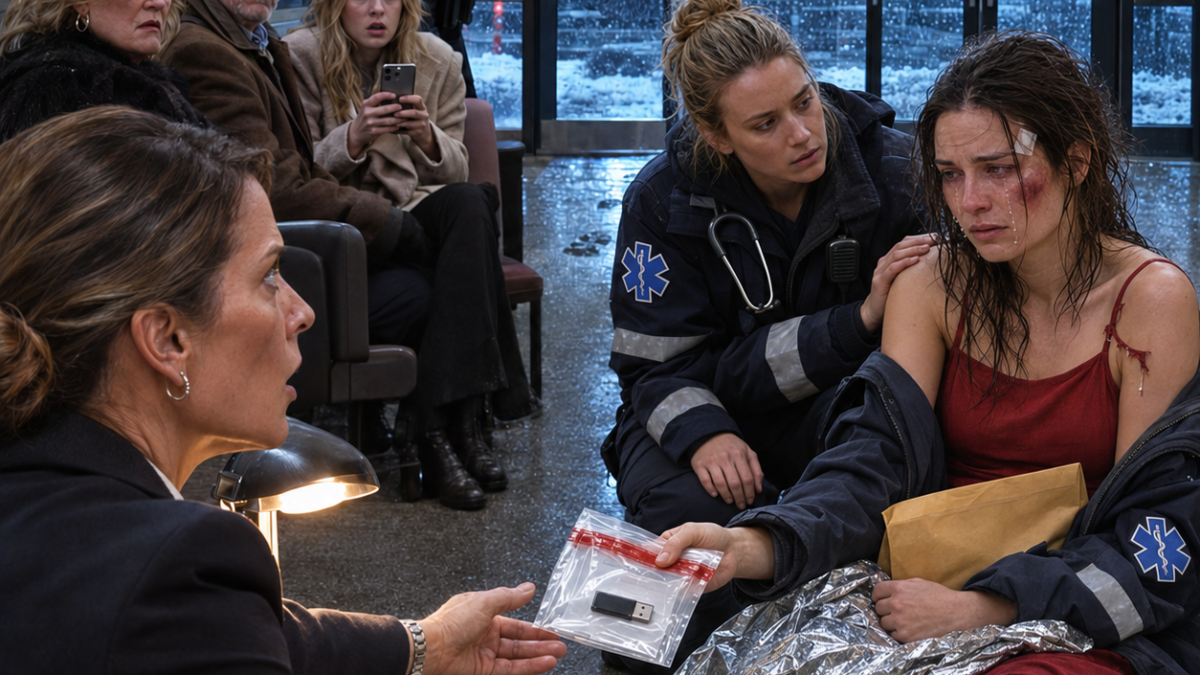
Then took out a sealed plastic evidence pouch.
Inside:
USB drive.
My eyes filled.
“You found it.”
“Exactly where you said.”
Detective Voss stood near the window.
“Where?”
Bridget looked at me.
I nodded.
“Safe-deposit envelope inside a locker at Union Station.”
Voss raised an eyebrow.
“That cautious?”
Bridget said:
“You haven’t met her family.”
He had, technically.
He just didn’t know them yet.
Bridget put on gloves.
Inserted the drive.
Folders appeared.
FOUNDATION.
MERIDIAN.
BOARD RECORDS.
GRANDMA.
VIDEO.
SIGNATURES.
BACKUP.
Voss opened the first spreadsheet.
His expression changed.
The second.
He leaned closer.
Payments.
Foundation accounts.
Related vendors.
Transfer chains.
Dates.
Names.
Then the estimated shortfall.
$1,876,440.
Not exactly two million.
Close enough to ruin lives.
“Tessa…”
I wiped my face.
“My father thinks I know too much.”
Voss opened another folder.
A document appeared.
Promissory agreement.
Foundation guarantee.
My signature at the bottom.
Except I had never signed it.
The agreement made me personally responsible for a $480,000 consulting liability associated with Meridian Civic Solutions.
If the financial scheme collapsed, the paperwork pointed toward me.
My profession.
My forensic background.
My signature.
I would look like the architect.
The compliance analyst who secretly created vendors and moved foundation money.
Voss whispered:
“Jesus.”
Bridget said:
“She found this in her grandmother’s files.”
I shook my head.
“No.”
They both looked at me.
“That copy came from the foundation archive.”
I pointed toward another folder.
“The copy Grandma had is different.”
Bridget opened it.
Same document.
No signature.
No personal guarantee.
Voss sat back.
Someone had altered the document after Grandma’s copy was made.
Then forged my name.
The psychiatric story suddenly had another purpose.
If I accused them:
Unstable daughter trying to avoid fraud liability.
If I died:
The forged paperwork stayed.
If I survived but was committed:
Even better.
They could tell the board I had been stealing and had mentally collapsed under pressure.
I started shaking.
Not from cold.
“Voss.”
“Yes?”
“They were going to blame everything on me.”
His face did not soften.
That was good.
I didn’t need pity.
“I think we need to determine exactly what they were preparing.”
The video folder came from something my family had forgotten.
Grandma loved cameras.
Not security paranoia.
Birds.
She had wildlife cameras around the property.
One overlooked the detached office where Dad sometimes met vendors.
After Grandma died, Dad stopped maintaining them.
He assumed they no longer worked.
One did.
A clip showed Calvin Price arriving late at night.
Another showed Dad.
Then Mom.
Boxes moving into the office.
One timestamp matched a night when the foundation’s archived vendor files had supposedly been transferred for “digitization.”
Another video showed Emma carrying folders toward Dad’s SUV.
Voss paused.
“Your sister works for the foundation?”
“Social media and events.”
“Access to financial records?”
“She shouldn’t.”
“Apparently she had access to something.”
Then Bridget opened the final visible folder.
EVELYN LETTER.
A scanned letter.
Addressed to me.
Tessa,
If you are reading this, Richard has probably realized you are looking.
I stopped breathing.
Grandma had written it six weeks before she died.
She described irregular withdrawals.
Her suspicion that Dad had created vendors through people he trusted.
Her fear Mom knew.
Her fear Emma had begun helping.
Then:
I placed original records somewhere Richard cannot reach.
Do not confront him without protection.
At the bottom was a bank name.
Private vault number.
And instructions.
Bridget stared at the screen.
“You never saw this?”
“No.”
“Where did the scan come from?”
I looked at the metadata.
File created after Grandma’s death.
Scanned by a multifunction printer at the foundation office.
Someone else had scanned Grandma’s letter before I found the drive.
But I had never placed it there.
Voss frowned.
“Then who did?”
That was the mysterious folder.
Evidence I did not collect.
Someone had been helping me.
I just didn’t know who.
We obtained the vault records lawfully through Bridget’s probate contacts and then investigators pursued the necessary process.
Grandma had left instructions naming me as authorized successor after her death.
The vault held original board minutes.
Bank statements.
Handwritten notes.
Old flash drives.
And a ledger.
Grandma’s handwriting.
Twenty-three pages.
Dates.
Transfers.
Names.
At the back:
RICHARD IS MOVING CHARITY FUNDS THROUGH CONSULTING COMPANIES. CAROLINE KNOWS. EMMA HAS BEGUN SIGNING EVENT EXPENSES.
My sister.
I stared at the line.
Some stupid part of me had still believed Emma was only cruel.
Not involved.
Grandma knew better.
Then we found something stranger.
A sealed envelope.
Not addressed to me.
Addressed to:
COLE VOSS.
The detective himself.
He looked at me.
“I never met your grandmother.”
Bridget opened it only after Voss agreed and documented the process.
Inside was one page.
Detective Voss,
If my granddaughter Tessa is ever accused of financial wrongdoing involving the Whitmore Family Outreach Foundation, please investigate my son before you investigate her character.
Voss read it twice.
“Why me?”
Then I remembered.
“The pension case.”
“What?”
“Grandma read everything about fraud prosecutions. She clipped articles. She respected you.”
Voss looked unsettled.
Grandma had selected a detective years before she died.
Not because she knew him.
Because she wanted one honest person’s name somewhere in the plan.
I started crying.
Safe tears again.
She had known.
Maybe not about the assault.
Maybe not the alley.
But she knew Dad would sacrifice me if necessary.
Then Voss showed me the photograph.
It arrived three days later through an anonymous envelope delivered to the department.
A dark SUV behind the strip mall.
My father’s.
Mom near the rear door.
Emma standing several feet away with her phone.
Time stamp.
1:18 a.m.
Someone had photographed them abandoning me.
On the back, handwritten:
YOU ARE NOT THE ONLY WITNESS.
Six words.
Voss placed it between us.
“Do you recognize the handwriting?”
“No.”
“Anyone who might have followed them?”
“No.”
Bridget looked at the image.
“Where was the photographer standing?”
Voss pointed.
“Across the street. Second-floor angle.”
There was an old insurance office there.
Closed.
But not empty.
The building had security cameras.
Investigators obtained footage.
The anonymous photographer turned out not to be a criminal mastermind.
Not a secret agent.
Not Grandma from beyond the grave.
Her name was Leah Monroe.
Fifty-eight.
Former foundation bookkeeper.
Fired eleven months earlier.
She had been watching my father because she believed he had set her up to take blame for missing money.
That night, Leah followed Dad from the foundation office to my parents’ house after seeing him remove boxes.
Then watched the SUV leave.
She followed.
When she saw them pull me out, she panicked.
Took photographs.
Did not confront them.
Called 911 anonymously after they drove away.
That anonymous call was the reason emergency services reached the area quickly after Miguel found me.
Leah had been terrified to identify herself.
Why?
Because my father had already threatened to accuse her of embezzlement.
Same strategy.
Different scapegoat.
When she learned I survived, she finally contacted Voss.
And she brought her own folder.
That was the evidence I had never seen.
Payroll records.
Original invoices.
Emails.
Copies of checks.
Documents showing Dad had been moving money for at least six years.
Grandma had noticed first.
Leah noticed second.
I noticed third.
Three women.
All separately told themselves they might be imagining it.
That realization made me furious in a way the bruises never did.
The investigation widened.
Properly.
Slowly.
Not one dramatic arrest based on a USB drive.
Subpoenas.
Search warrants.
Forensic accounting.
Foundation board interviews.
Vendor interviews.
Bank records.
Phone records.
Video authentication.
Medical evidence.
My family’s statements compared against physical facts.
Their story began failing almost immediately.
They said I ran away.
Hospital records showed injuries inconsistent with a voluntary departure.
Miguel found me without shoes or coat in freezing weather.
My torn clothing carried fibers from the cargo area of Dad’s SUV.
The vehicle’s navigation data showed it traveled to the strip mall at the relevant time.
Emma’s phone location did too.
The video she recorded became even worse for them.
She had not deleted it completely.
Cloud backup.
Investigators recovered the file through lawful process.
My mother striking me.
My voice asking for help.
Emma laughing.
Dad visible.
Then the camera angle changing.
One point captured Mom saying:
“Get her out of here before she ruins everything.”
Dad:
“What if somebody finds her?”
Emma:
“Then she ran away.”
That sentence ended the psychiatric-breakdown story.
Not legally by itself.
But morally.
They had planned the narrative before they abandoned me.
Mom was the first arrested on charges connected to the assault and abandonment.
Emma followed.
Dad’s arrest came later because investigators were building the financial case too.
I watched none of them in handcuffs.
I was still recovering.
Bridget told me.
Mom had cried.
Emma screamed that I was destroying the family.
Dad requested an attorney before answering questions.
Most rational thing he did in months.
For a week, every news station ran the story.
Philanthropic family.
Missing foundation money.
Daughter abandoned in cold.
Forged records.
I stopped watching television.
The headlines made me feel like my life had been turned into entertainment.
Miguel called once.
The custodian who found me.
He asked only:
“You eating?”
“Yes.”
“Good.”
That was kinder than every reporter question combined.
The emergency psychiatric petition my parents sought collapsed.
There was no basis once their statements were scrutinized.
That mattered deeply to me.
Not because psychiatric care is shameful.
It isn’t.
But they had tried to weaponize the idea of mental illness.
Make disbelief sound compassionate.
“She needs help.”
“She isn’t herself.”
“She’s paranoid.”
That tactic terrified me more than physical violence.
A bruise can be photographed.
How do you photograph someone telling the world your memory cannot be trusted?
Records.
That was the answer.
Always records.
The foundation board suspended Dad.
Then removed him.
An interim executive director came in.
Independent audit.
The missing amount eventually calculated at $1,932,718.
More than I had estimated.
Some went through Meridian Civic Solutions.
Some through fake event expenses.
Some through consulting contracts.
Some into accounts linked to Dad.
Some paid personal costs.
Mom benefited from several.
Emma had signed expense approvals and participated in document creation.
But the evidence showed levels of responsibility were different.
That mattered.
Dad designed the system.
Mom knew and helped conceal.
Emma participated in parts and helped construct the story against me.
Not equal.
All accountable.
Calvin Price cooperated.
He admitted Meridian was created at Dad’s request.
He kept a percentage.
Returned records.
His cooperation exposed more.
Dad had planned a “financial irregularity disclosure” blaming me.
A draft press statement existed.
I wish I were exaggerating.
The Whitmore Family Outreach Foundation has recently identified unauthorized financial activity believed to involve a former volunteer consultant with specialized fraud expertise.
Former volunteer consultant.
Me.
I had once helped review internal controls for free.
Dad planned to turn that into motive and access.
Attached talking points included:
“Tessa had become increasingly unstable after Evelyn’s death.”
“Tessa demonstrated obsession with finances.”
“Tessa had personal access to historical records.”
“Tessa may have manipulated documents.”
They had built the story before the assault.
I read it once.
Then vomited in Bridget’s office bathroom.
Not because I was fragile.
Because betrayal has physical weight sometimes.
Bridget waited outside.
When I returned, she handed me water.
“I’m sorry.”
I looked at her.
“For what?”
“For being right when I told you not to confront them.”
I laughed unexpectedly.
“Worst apology ever.”
She smiled.
Then we went back to work.
That was how I survived most of that year.
Cry.
Laugh once.
Continue.
Emma sent me a letter from jail pending trial.
I did not open it immediately.
Two weeks.
Then I did.
First page:
Tessa, I know you think I hated you.
I almost stopped.
Then:
I was jealous of you before I understood what jealousy was.
She wrote that Dad compared them.
“Tessa understands money.”
“Tessa got scholarships.”
“Tessa has discipline.”
Mom comforted Emma by telling her I was arrogant.
Over time, resentment became identity.
Then Dad began including Emma in foundation events.
Giving her attention when she helped.
Money.
Trips.
Status.
“When you started investigating, I thought you were trying to take away the one thing where he chose me.”
That sentence hurt.
Not enough to excuse anything.
But enough to explain something.
Then:
When Mom hit you, I kept recording because I wanted proof you were finally the problem.
I stopped reading.
That was the ugliest sentence.
Because it was honest.
Emma wanted evidence that matched the story she had believed about me her whole life.
When reality showed something else, she kept filming anyway.
She wanted my pain to become vindication.
Her last line:
I don’t expect forgiveness.
Good.
Because I didn’t have any to give then.
Dad never wrote.
Mom did.
Her letter was different.
Three pages explaining herself.
Stress.
Marriage.
Grandma’s pressure.
Dad’s manipulation.
My disrespect.
Nothing that sounded like responsibility.
I gave it to Bridget.
“Do I have to respond?”
“No.”
“Good.”
I shredded my copy.
Not evidence.
Just excuses.
The financial case took eighteen months.
Dad ultimately pleaded guilty to multiple financial offenses rather than take everything to trial.
The exact charge structure was complicated.
Fraud.
False statements.
Misuse of charitable funds.
Forgery-related conduct tied to the documents prepared against me.
He received a substantial prison sentence.
Mom entered a plea related to financial concealment and the physical case.
Her sentence was shorter than Dad’s.
Emma’s case separated the financial participation from the violence and false-report conduct.
She accepted responsibility in a plea agreement.
Time in custody.
Probation afterward.
Restitution obligations.
Mandatory counseling.
Some people online said they all deserved life.
Others said I destroyed my family over money.
Neither side knew us.
The internet likes punishment more than understanding.
I stopped reading comments.
The foundation survived.
That surprised me.
At first, I wanted it dissolved.
Burn the name.
Sell the building.
Erase everything.
Then I remembered Grandma.
It was hers before it was Dad’s.
She had built something real.
My father corrupted it.
Those are not the same thing.
The new board renamed it:
The Evelyn Whitmore Community Trust.
They invited me to join.
I refused the first time.
Then accepted a limited advisory role with no access to funds.
Bridget laughed.
“You trust nobody now.”
“Correct.”
“Healthy?”
“Probably not.”
But I helped design controls.
Dual approvals.
Vendor verification.
Independent annual audits.
Conflict disclosures.
No family-dominated board.
Whistleblower process.
Protected reporting.
Systems strong enough that one charismatic leader could not quietly become the system.
That was the work I could do.
Leah Monroe became the first director of internal compliance.
Fitting.
Dad had fired her because she asked questions.
Now she sat in the office next to his old one.
We became friends slowly.
The first time we had coffee, I asked:
“Why didn’t you tell me earlier?”
She looked ashamed.
“I was scared.”
I nodded.
“I know.”
That was enough.
Fear makes people late.
Late is still better than never.
Miguel Alvarez received a foundation community-service award.
He hated it.
Absolutely hated being on stage.
I presented it.
He whispered:
“You did this to me.”
“You saved my life.”
“I called 911.”
“You stayed.”
He looked uncomfortable.
“Anybody would.”
“No.”
I smiled.
“Not anybody.”
His eyes filled.
Mine too.
The audience never knew why we both laughed.
Detective Voss kept Grandma’s letter copy.
Original returned to me after evidence procedures allowed.
I framed it.
Not the whole letter.
One line:
Investigate my son before you investigate her character.
Grandma understood something important.
When powerful families are accused, they often attack the accuser’s personality before answering the facts.
Difficult.
Emotional.
Jealous.
Unstable.
Obsessed.
Ungrateful.
Grandma knew me.
She knew Dad.
She anticipated the language.
That one sentence protected me before I even knew I needed protection.
The hidden vault held more than financial records.
Family photographs.
Grandma’s wedding ring.
A savings bond she apparently forgot existed.
Letters.
One addressed to Emma.
I debated whether to send it.
Eventually, through her attorney, I did.
I never asked what it said.
Some things belonged between Grandma and her.
My physical recovery took months.
Concussion symptoms lingered.
Headaches.
Light sensitivity.
Nightmares.
The cold was worse.
For almost a year, if I woke up cold, panic came before consciousness.
I would wake convinced I was behind the strip mall again.
No shoes.
No coat.
Unable to move.
Therapy helped.
Yes.
Therapy.
The very thing my parents tried to weaponize became one of the things that helped me heal.
I liked that irony.
I was never ashamed of needing psychological care.
I became angry only when people used the idea of mental illness as a weapon against credibility.
There is a difference.
My therapist, Dr. Naomi Feld, once asked:
“Which family member do you dream about most?”
“Dad.”
“Because he participated financially?”
“No.”
“Why?”
“Because he turned away.”
She waited.
I stared at the carpet.
“Mom hurt me.”
“Emma laughed.”
“But Dad…”
I swallowed.
“He looked at me.”
“And?”
“He decided not to see.”
That was the wound.
Not active cruelty.
Chosen absence.
Children spend years believing the quiet parent is the safe parent.
Sometimes quiet simply means cowardice.
I had to grieve a father who had never physically existed the way I imagined.
That was harder than hating Mom.
Emma eventually completed counseling.
After two years, she requested contact through Bridget.
I said no.
Six months later, again.
No.
Another year.
I agreed to one letter.
Not meeting.
Letter.
She wrote:
I spent my whole life thinking your pain meant I had finally won something. I know how sick that sounds now.
At least she knew.
Then:
I am not asking you to call me your sister again. I am asking you to believe I know what I did.
I believed her.
That did not restore the relationship.
Accountability is not magic.
Some things do not come back because someone finally understands why they broke them.
I wrote one sentence:
I believe you understand more now. I am not ready for contact.
That was all.
She respected it.
That mattered.
Mom never reached that place.
Every message remained about herself.
Her health.
Her loneliness.
Her sentence.
Dad’s betrayal.
Emma’s mistakes.
My refusal to forgive.
Eventually, I stopped receiving them.
I told Bridget to block all non-legal contact.
Peace improved immediately.
Dad wrote once after three years.
One page.
No excuses.
That surprised me.
Tessa, I spent my life believing being the provider gave me the right to control the story. When the money became impossible to hide, I chose the story where you were guilty because I thought people would believe me before they believed you. I was right about that for longer than I deserve to admit.
I read that line three times.
I turned away that night because if I looked at you as my daughter, I would have had to stop everything. I chose myself.
No apology can fully repair that sentence.
But it was truth.
Finally.
I kept the letter.
Did not answer.
Maybe someday.
Maybe never.
The forged document bearing my signature was eventually publicly corrected through the legal process.
That mattered professionally.
My employer investigated me only briefly because I disclosed everything.
The company’s general counsel reviewed the circumstances.
My reputation survived.
Then improved.
Not because scandal helps careers.
Because I had documented carefully and cooperated.
Two years later, I became director of forensic compliance.
People congratulated me.
I went home and cried.
Grandma would have been unbearable about it.
“I told you those spreadsheets would amount to something.”
I could hear her.
My apartment changed.
At first, locks everywhere.
Two cameras.
Door brace.
Emergency bag.
Shoes beside the bed.
Coat on a chair.
Because the alley had taught my nervous system that clothing was part of survival.
Eventually, the emergency bag moved to a closet.
Shoes went back where normal people keep shoes.
I removed one camera.
Then another.
Healing is sometimes subtraction.
You stop preparing for a danger that is no longer coming.
I moved three years later.
Small townhouse.
Brick.
Maple tree.
A kitchen with too much sunlight.
The first winter, snow came overnight.
I opened the back door.
Cold air hit my face.
For one second, the alley returned.
Then I stepped outside anyway.
Barefoot.
Only for three seconds.
Stupid.
Freezing.
But mine.
I laughed.
Went inside.
Put on shoes.
That felt like a victory nobody else would understand.
The Evelyn Whitmore Community Trust recovered millions through restitution, insurance claims, clawbacks, settlements, and returned assets over several years.
Not every stolen dollar.
Real financial recovery rarely works perfectly.
But enough.
Scholarships resumed.
Housing grants resumed.
Veteran support expanded.
I insisted on one new program.
Emergency assistance for people leaving abusive family situations.
Leah understood why.
We named it the Evelyn Safe Start Fund.
No Whitmore Family branding.
Just Grandma’s first name.
Good enough.
One recipient was a twenty-four-year-old woman whose parents controlled her bank account and threatened institutionalization when she tried to leave.
When I read the anonymized grant request, I had to step outside.
Leah followed.
“You okay?”
“No.”
“Want me to reassign it?”
I looked at the paper.
“No.”
We approved temporary housing.
Legal consultation.
Transportation.
Phone.
Basic clothing.
I thought about the night I woke without shoes.
A stranger covered me.
Now the foundation Grandma built could cover somebody else.
That felt like the closest thing to redemption our family name would ever deserve.
Detective Voss retired.
At his retirement dinner, he invited me.
I did not expect that.
Bridget came too.
Someone asked Voss about his strangest case.
He looked at me.
I shook my head.
“No.”
He smiled.
Then told a story about a man who hid stolen watches inside frozen turkeys.
Better choice.
After dinner, Voss handed me a small envelope.
Inside was a photocopy of the anonymous photograph.
My family’s SUV.
Me barely visible.
The back:
YOU ARE NOT THE ONLY WITNESS.
I looked at him.
“Why?”
“Because I think the words belong to you now.”
I framed the back, not the photograph.
Six words.
They changed meaning over time.
At first:
Someone saw what happened.
Later:
I was not alone.
Now:
Neither is anyone else.
Bridget remained my attorney long after the criminal cases ended.
Mostly because she became my friend and refused to admit it.
Every birthday she sends me a message:
Please do not confront anyone without counsel.
I reply:
Please get a hobby.
She invoices me emotionally.
My relationship with Emma is the question people always ask.
“Did you forgive her?”
I hate the question.
Forgiveness has become shorthand for a happy ending.
We did not have one.
After five years, I agreed to meet her.
Public place.
Bridget knew.
Therapist knew.
Thirty minutes.
Emma looked older.
Thinner.
No makeup.
Hands shaking.
She said:
“I don’t know what to call you.”
“Tessa works.”
That hurt her.
Good or bad, I don’t know.
She apologized.
Not dramatically.
Specific.
For filming.
Laughing.
Helping them move me.
Lying to police.
Signing foundation expenses.
Resenting me.
Enjoying my humiliation.
No excuses.
Then she said:
“You don’t have to forgive me.”
That was the first thing she said that made forgiveness possible someday.
Because she stopped demanding it.
I told her:
“I don’t hate you.”
She cried.
“That’s not the same as wanting you in my life.”
“I know.”
We left separately.
A year later, we began exchanging occasional emails.
Birthdays.
Updates.
Nothing intimate.
She is not my little sister the way she was.
She is a person I once loved completely and may someday know differently.
That is the truth.
Messy.
Incomplete.
Real.
Dad remained incarcerated longer.
Mom was released earlier and moved near a cousin in Arizona.
We have no relationship.
I am at peace with that.
There is no law of nature saying every mother-daughter story requires reunion.
Sometimes distance is the healthy conclusion.
Dad’s release came years later.
He requested one meeting.
I spent three months deciding.
Then agreed.
Supervised setting.
Neutral room.
He stood when I entered.
Older.
Much older.
Hair white.
He did not try to hug me.
Good.
We sat.
He said:
“I don’t deserve anything from you.”
“Yes.”
He nodded.
Good start.
Then:
“I want to answer any question you have.”
I had imagined hundreds.
Only one remained.
“Why did you leave me there?”
His face folded.
Not theatrical.
Collapsed inward.
“I thought you were dead at first.”
My stomach tightened.
“And?”
“Your mother said if we called an ambulance, everything would come out.”
He looked down.
“Emma said we should make it look like you ran.”
“Did you believe that would work?”
“I didn’t think.”
“You drove.”
“Yes.”
“You put me in the SUV.”
“Yes.”
“You watched them leave me.”
“Yes.”
“Why?”
He looked at me.
“Because I was more afraid of losing my life than losing yours.”
There it was.
No excuse could compete with that honesty.
I started crying.
So did he.
Not reconciliation.
Not redemption.
Truth.
Sometimes truth arrives too late to save a relationship but still early enough to stop haunting a question.
I stood.
He said:
“Tessa.”
I turned.
“I loved you.”
I believed him.
That was the tragedy.
People can love you and still choose themselves in the moment that defines everything.
“I know.”
Then I left.
For a while, I was angry that the story became known publicly.
Then I began speaking selectively.
Not about gore.
Not about family humiliation.
About financial coercion.
False mental-health narratives.
Scapegoating.
Document preservation.
How abusers sometimes attack credibility before facts.
How financial crime inside families can hide beneath charitable reputation.
I spoke to nonprofit boards.
Compliance teams.
Victim advocates.
Detectives.
Once, a young investigator asked:
“What’s the biggest mistake victims make?”
I thought about it.
“Assuming evidence matters only after something bad happens.”
He waited.
“Preserve before confrontation.”
That was why I survived the lie.
The hidden drive existed before dinner.
Grandma’s records existed before her death.
Leah’s copies existed before she came forward.
You cannot always predict danger.
But when something feels wrong, document reality while reality is still easy to prove.
I still have the USB drive.
Not the only copy anymore.
Multiple secure archives.
The original sits in a safe-deposit box.
Bridget jokes:
“You know the case is over.”
“I know.”
“Then why keep it?”
I think about Mom.
Dad.
Emma.
The hospital.
The detective.
The first time the screen filled with folders.
“Because there was a moment when everyone thought my voice was the weakest evidence.”
Bridget nodded.
The drive had spoken when I couldn’t.
That is why.
Grandma’s letter hangs beside the six words.
Two frames.
One:
INVESTIGATE MY SON BEFORE YOU INVESTIGATE HER CHARACTER.
The other:
YOU ARE NOT THE ONLY WITNESS.
Together, they describe my life better than any family portrait.
One woman knew my character.
One stranger saw the truth.
Between them, my parents’ story failed.
Every winter, I donate coats.
Not through the foundation publicity office.
Quietly.
Miguel helps.
He still works nights, though now he supervises maintenance for three buildings.
We buy gloves.
Socks.
Thermal layers.
Shoes.
Emergency blankets.
The first year, he asked:
“Why shoes?”
I looked at him.
He remembered.
“Right.”
We never discuss the alley for long.
We don’t need to.
I once asked Miguel what he thought when he found me.
He said:
“I thought somebody had thrown away a person.”
That sentence stayed with me.
Thrown away.
That was exactly what my family tried to do.
Not kill me necessarily.
Discard credibility.
Discard identity.
Discard future.
Turn me into a problem everybody else could step around.
Miguel did the opposite.
He stopped.
That is humanity sometimes.
Not a giant rescue.
A person stopping when everyone else has decided to keep walking.
The foundation placed a bench outside its new community center.
Small plaque.
EVEN WHEN YOU ARE AFRAID, STOP FOR THE PERSON WHO NEEDS HELP.
Miguel hates that he inspired it.
Perfect.
I no longer think the financial evidence was “my revenge.”
That framing feels wrong.
Money was stolen from vulnerable people.
Families who applied for rental help.
Veterans.
Students.
People Grandma intended to serve.
Dad did not only betray me.
He betrayed strangers who never knew his name personally.
The legal consequences belonged to them too.
That realization helped me stop making the entire case about our family drama.
It was bigger.
One audit found that during a year Dad reported a major funding shortage, the foundation denied thirty-two emergency housing requests while money was routed through fake consulting contracts.
Thirty-two.
I read each anonymized case.
Eviction.
Domestic violence.
Medical crisis.
Children.
That was the hardest financial document in the whole investigation.
Not the $1.9 million.
Thirty-two names.
Fraud becomes real when money stops being a number and becomes the thing somebody did not receive.
Grandma had understood that.
Dad forgot.
The trust eventually paid supplemental grants to several families whose old applications could be located.
Not legal restitution.
Moral repair.
One woman wrote:
“I don’t know why you contacted me after all these years, but thank you.”
I cried at my desk.
Leah pretended not to notice.
Good friend.
My life is not dramatic now.
I want that understood.
Most days:
Work.
Coffee.
Emails.
Gym if I am disciplined.
Takeout if I am not.
A few dates.
Books.
Therapy less often.
Dinner with Bridget.
Occasional emails from Emma.
Quarterly foundation meeting.
Normal.
The worst thing about trauma stories is the way they make people believe survivors spend the rest of life in a permanent climax.
We don’t.
Eventually you argue with customer service.
Forget milk.
Get annoyed at traffic.
Laugh at stupid television.
Ordinary life returns.
That is the gift.
I turned forty last month.
Bridget gave me a USB drive.
Cheap.
Blue.
Empty.
Card:
FOR NORMAL FILES THIS TIME.
I laughed for ten minutes.
Then stored vacation photos on it.
Revolutionary.
Emma sent a birthday email.
One paragraph.
No emotional demand.
At the bottom:
I hope your life feels safe.
That line mattered.
I replied:
It does. I hope yours does too.
We are not sisters the way we were.
Maybe we are building something else.
Maybe not.
I have learned not to force endings.
Dad died several years after release.
Heart failure.
Emma called.
Mom did not.
I attended the funeral.
Sat in the back.
No speech.
No family procession.
I stood near his casket afterward.
Looked at the man who had once carried me on his shoulders.
The man who taught me multiplication.
The man who later left me behind a strip mall because he feared exposure.
Both were true.
Human beings are terrible that way.
We want people to become one thing after they hurt us.
Monster.
But my father was not one thing.
He was a man who loved me for years and failed me at the moment love required courage.
That made grieving harder.
I said:
“I know why now.”
Then left.
Enough.
Mom did not attend.
Emma did.
Afterward, she asked:
“Do you think he loved us?”
“Yes.”
She started crying.
“Then how did he do everything?”
I looked at her.
“Love without courage can become useless.”
I had never said that before.
I still believe it.
We had coffee after the funeral.
First unsupervised time together in years.
Emma said:
“I watched that video again once.”
My body tightened.
She immediately said:
“I’m sorry. I shouldn’t have said that.”
“No. Continue.”
“I wanted to understand who I was.”
Silence.
“And?”
“I hated her.”
“The woman in the video?”
“Me.”
I looked at my sister.
That was not healing I could give her.
She would have to live with herself.
Just as I lived with the memory.
“I don’t want you to hate yourself forever.”
She cried.
“I don’t know what else to do.”
“Become somebody she wouldn’t recognize.”
Emma stared.
That was as close to forgiveness as we had ever come.
Years after the alley, a reporter asked to photograph me in the same location.
I refused.
I did not want to become the woman frozen on pavement forever.
If she wanted a photograph, she could photograph me at the foundation’s new compliance office.
Or my townhouse.
Or the coat drive.
Or nowhere.
Trauma is part of my biography.
It is not my portrait.
I did eventually return to the strip mall.
Not for symbolism.
The pharmacy had reopened under a new name.
I needed allergy medication.
I parked.
Bought pills.
Then realized where I was.
Behind the building was the alley.
I could have left.
Instead, I walked around.
Daylight.
Trash dumpster.
Loading door.
Concrete.
Smaller than memory.
Everything traumatic becomes enormous inside the mind.
Reality sometimes shrinks it.
I stood where Miguel said he found me.
Cold February air.
I had boots.
Coat.
Phone.
Car keys.
A life.
I whispered:
“You survived.”
Then felt ridiculous.
So I added:
“Also buy milk.”
Normality saved the moment.
When I got home, Bridget had texted.
Did you get the antihistamines?
I replied:
And milk.
She wrote:
Proud of you.
She had no idea what she was proud of.
Maybe neither did I.
People still ask about the six words on the photograph.
YOU ARE NOT THE ONLY WITNESS.
At first, those words saved me because they meant someone saw the crime.
Later they saved me differently.
They reminded me my family’s version was never the only version.
My mother had a story.
My father had a story.
Emma had a story.
I had one too.
But beyond all of us were facts.
The custodian.
Hospital records.
Vehicle data.
Cloud files.
Grandma’s ledger.
Leah’s photographs.
Bank statements.
A forged signature.
Evidence does not love you.
It does not hate you.
Sometimes that neutrality is exactly what saves you.
My family believed three matching statements would outweigh one injured daughter.
For a few terrifying days, they almost did.
That is what people misunderstand about lies.
A lie does not need to win forever.
Sometimes it only needs to win long enough to isolate the truth.
Grandma understood that.
That was why she kept records.
That was why I hid the drive.
That was why Leah finally stepped forward.
We gave the truth enough time to survive the first story.
After that, the facts could work.
My mother hurt me.
My sister laughed.
My father turned away.
Those facts never changed.
But neither did these:
Miguel stopped.
Bridget came.
Voss listened.
Grandma prepared.
Leah spoke.
The board corrected.
The courts worked.
The foundation recovered.
I survived.
Trauma has a way of making the people who harmed you look like the only important characters in your life.
They aren’t.
Eventually, you remember everyone who helped.
That changed the story.
I once believed I needed my mother to admit what she did.
I don’t.
I wanted Dad to explain why he turned away.
He did.
It hurt.
Then helped.
I wanted Emma to understand why her laughter was unforgivable.
She understands.
Forgiveness remains complicated.
I wanted the money recovered.
Some was.
I wanted Grandma back.
Impossible.
I wanted my old family.
That family may never have existed in the way I remembered.
So I built something else.
Not a replacement family.
A life.
There is a difference.
Today, the Evelyn Whitmore Community Trust publishes every audited statement online.
Vendor list.
Board compensation.
Conflict disclosures.
Grant totals.
Boring pages.
I love them.
Transparency is not glamorous.
Neither is integrity.
They are mostly paperwork done before anyone applauds.
Grandma would approve.
Dad would probably complain the controls make everything slow.
Exactly.
Good systems are sometimes slow because they require more than one person to move money.
At the entrance hangs Grandma’s photograph.
Not Dad’s.
Not mine.
Grandma in her sixties.
Standing beside a folding table handing out winter coats.
No gala dress.
No champagne.
No banner.
Someone asked me why we chose that photo.
“Because this is what the money was supposed to do.”
That answer ended discussion.
Miguel’s coat drive now operates from the same lobby every December.
He still refuses interviews.
He arrives early.
Stacks boxes.
Leaves before speeches.
Last year, Emma volunteered.
I knew beforehand.
Leah asked if I wanted her removed.
I said no.
Emma spent three hours sorting gloves.
We barely spoke.
At the end, she held up a pair of winter boots.
Size seven.
For a second, both of us froze.
She knew.
I knew.
She put them carefully into a box.
No dramatic apology.
No tears.
Just care.
Sometimes healing is that small.
After everyone left, Emma asked:
“Do you remember not having shoes?”
“Yes.”
“I remember taking them off you.”
I stopped.
That detail had never returned clearly.
“You did?”
She nodded.
“Mom said people would believe you had run away if you looked disoriented.”
My stomach tightened.
Emma’s eyes filled.
“I’m sorry.”
I looked at the boots.
Then her.
“I know.”
That was all I could manage.
But it was more than years earlier.
That night, I dreamed about the alley.
First time in months.
But the dream changed.
I woke on the pavement.
Cold.
Then someone placed a coat over me.
Miguel.
Behind him stood Grandma.
Not realistic.
Dream logic.
She said:
“Get up, sweetheart. You left your files everywhere.”
I laughed in my sleep.
When I woke, I was crying.
Safe tears.
Again.
I still have Grandma’s note.
DON’T TRUST RICHARD.
Three words.
For years, I hated it.
Why didn’t she tell me more?
Why not confront him?
Why put the burden on me?
Then I became older.
I understood fear better.
Grandma had cancer.
Limited time.
A powerful son.
A foundation she feared losing.
She did what she could.
Not enough to stop him alone.
Enough to leave a path.
Sometimes the previous generation cannot finish the fight.
They leave records for the next person.
If I could answer Grandma, I would write:
I DIDN’T.
Maybe childish.
Still satisfying.
There is one thing my family did successfully destroy.
My belief that blood automatically creates safety.
I do not miss that belief.
It was dangerous.
I believe in earned trust now.
Bridget earned it.
Miguel earned it.
Voss earned it.
Leah earned it.
Emma is slowly earning pieces back.
Family can be blood.
It can also be behavior.
Preferably both.
But if forced to choose?
Behavior.
Every time.
I tell people not to romanticize evidence either.
The drive did not save me by itself.
Without Bridget, I might have mishandled it.
Without Voss, the family narrative could have delayed investigation.
Without warrants, financial records remained inaccessible.
Without forensic accountants, numbers stayed messy.
Without Leah, gaps remained.
Evidence needs process.
Process needs people willing to follow it.
That is why institutions matter even when families fail.
One student asked me after a compliance lecture:
“Were you scared your family would win?”
“Yes.”
“Really?”
“Yes.”
“But you had the evidence.”
I smiled.
“That doesn’t make fear disappear.”
People assume preparation creates confidence.
Sometimes preparation only gives fear somewhere useful to go.
Instead of panic:
Call Bridget.
Open folder.
Save file.
Write date.
Ask question.
Action does not erase fear.
It keeps fear from driving.
I no longer use the word “empire” for the Whitmore family.
We never had one.
We had reputation.
Money.
Connections.
A foundation.
A large house.
That looked like power from outside.
Then one honest audit arrived and most of it collapsed.
Real power is more durable.
Grandma’s coat program survived.
The scholarship survived.
The truth survived.
Dad’s social image did not.
Maybe that tells you which things were real.
My childhood home was sold during restitution proceedings.
I never went back.
Emma asked if I wanted anything.
“No.”
“What about Grandma’s piano?”
I paused.
“Yes.”
The piano arrived six months later.
Black upright.
Scratched.
Out of tune.
It sits in my townhouse living room.
I barely play.
Grandma did.
Sometimes I press one key.
Middle C.
Listen.
Then continue my day.
Objects don’t need to be useful to matter.
Mom once wanted the piano.
Emma told her no.
I asked why.
“She said Grandma left it to the family.”
Emma looked at me.
“I told her Grandma did.”
That was savage.
I did not criticize.
Growth can still have sharp edges.
The night my family left me behind that strip mall, they believed they had reduced me to the least credible version of myself.
No phone.
No shoes.
No coat.
Injured.
Confused.
Three people ready to say the same thing.
They thought credibility was something they could strip away like clothing.
They were wrong.
Credibility can live outside the body.
In timestamps.
Files.
Ledgers.
Video.
Bank records.
A dead woman’s handwriting.
A stranger’s photograph.
They had left me with nothing visible.
But I had already put the truth somewhere they couldn’t reach.
That is why the hidden drive matters to me.
Not because it destroyed them.
Because it survived me being unable to speak.
There may come moments in life when you cannot argue.
Cannot remember clearly.
Cannot defend yourself eloquently.
That does not mean truth disappears.
Build records before you need them.
Tell one safe person.
Keep copies.
Not because everyone should live afraid.
Because reality deserves a backup.
The woman who woke on the frozen pavement thought she had lost everything.
Her family.
Her home.
Her reputation.
Her future.
She had not.
She had lost an illusion.
A brutal loss.
But an illusion.
What remained was painful.
Useful.
Real.
A stranger’s coat.
A lawyer carrying a box.
A detective willing to read before judging.
A grandmother who had prepared for betrayal.
A witness who finally stopped hiding.
And a younger version of myself smart enough to put one small drive somewhere nobody could find it.
That was enough to begin again.
My mother believed violence would silence me.
My father believed a coordinated story would discredit me.
Emma believed filming my humiliation would prove I was weak.
Instead, every one of them underestimated the same thing:
I had stopped trusting appearances long before they stopped pretending to love me.
I had already followed the money.
Already copied the documents.
Already noticed the forged signature.
Already called Bridget.
Already hidden the drive.
By the time they left me freezing in the alley, the evidence was no longer inside their house.
And neither was their control over the truth.
Years later, when I look at the two framed sentences on my wall, I no longer see warnings.
I see instructions.
Investigate my son before you investigate her character.
Look at facts before reputation.
You are not the only witness.
Do not let isolation convince you nobody sees.
Those sentences carried me farther than any family motto ever did.
The night everything happened, I screamed one word.
“Mom.”
Sometimes that memory still hurts.
Because I know exactly what I wanted.
I wanted the woman who hurt me to suddenly become my mother again.
She didn’t.
But I learned something harder and better.
You can survive the moment the person you call for is the person you need protection from.
You can survive being disbelieved.
You can survive a family choosing a lie together.
You can survive losing the people whose approval once felt necessary.
And sometimes, after all of that, you build a life where the word family stops meaning the people who share your name and starts meaning the people who refuse to leave you on the ground.
My family thought they had destroyed the one person who could expose them.
They were wrong.
Grandma had left records.
Leah had photographs.
Miguel had seen me.
Bridget had the drive.
Voss had questions.
And eventually, Emma herself became another witness against the story she once helped create.
There was never only one person capable of bringing the truth out.
That was the meaning of those six words all along.
YOU ARE NOT THE ONLY WITNESS.
They left me behind a frozen strip mall believing I had finally become powerless.
What they never understood was that by then, the truth no longer depended on whether I could stand up.
It was already standing in places they could not reach.
And this time, when my family turned away from me—
the evidence didn’t.








