FULL STORY:My Husband Waited Until Our Honeymoon Ship Was Far From Shore to Lock Me in Our Suite and Raise a Baseball Bat—He Had No Idea What His New Bride Was Trained to Do
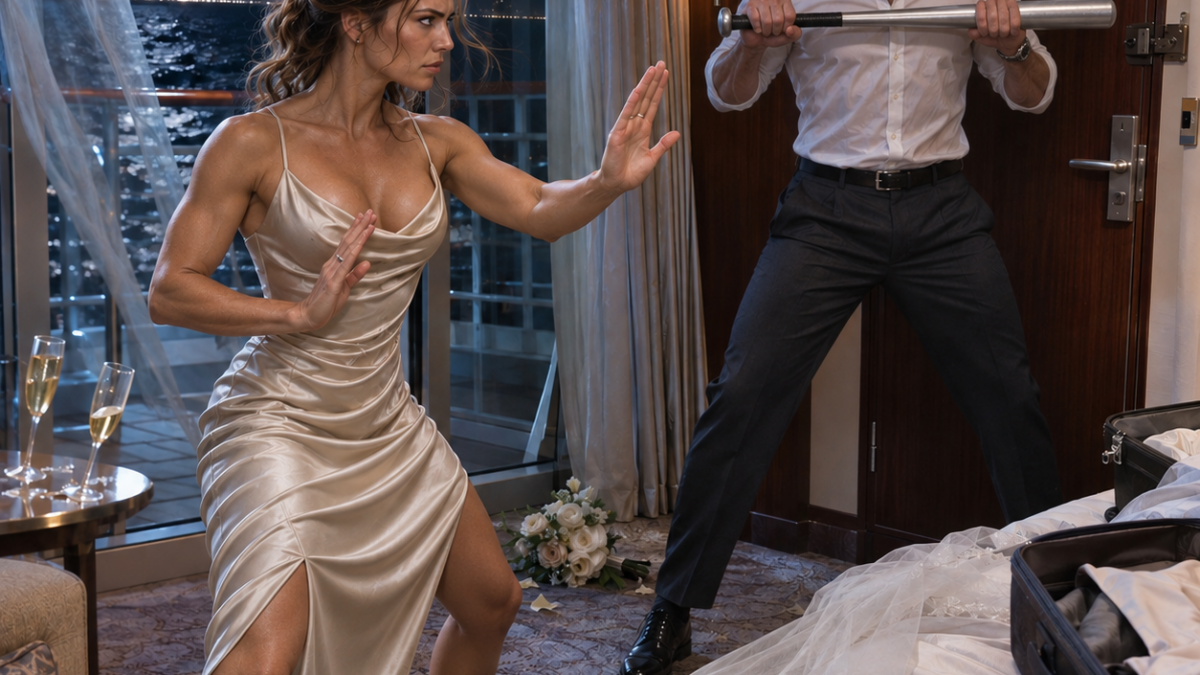
FULL STORY CONTINUATION
The bat moved fast.
Not as fast as Gregory imagined, but fast enough that the consequences could have been devastating if I’d stood still.
I shifted away from its path.
The aluminum barrel passed in front of me and struck the edge of the wooden desk with a tremendous crack.
The champagne glasses rattled.
One tipped over.
Gregory stumbled slightly as the impact pulled him off balance.
I moved before he could recover.
Years of training returned in one controlled burst of movement.
There was no dramatic exchange.
No prolonged struggle.
No opportunity for Gregory to take another swing.
I redirected his weapon arm, controlled the bat, and separated it from his grip.
He staggered backward.
The aluminum bat landed across the carpet near the bed.
For one suspended moment, neither of us moved.
Gregory stared at his empty hands.
Then at me.
His mouth opened.
“What the hell?”
I kept my distance.
“Stay where you are.”
He looked from the bat to my face.
The confident smile was gone.
“You—”
“Don’t move toward me.”
His face reddened.
“Who do you think you’re talking to?”
“A man who just tried to strike me with a baseball bat.”
He gave a short, incredulous laugh.
“Oh, don’t be ridiculous.”
I didn’t respond.
His eyes narrowed.
“You attacked me.”
I looked toward the dented desk.
Then back at him.
“You swung first.”
“That wasn’t an attack!”
I stared at him.
He pointed toward the bat.
“I was making a point.”
“With a weapon?”
He opened his mouth.
Closed it.
Then tried again.
“You’re blowing this completely out of proportion.”
I had heard similar words before.
From people trying to minimize what they’d done.
From men who mistook their intentions for the only facts that mattered.
But hearing those words from the man I’d married less than a day earlier made something inside my chest ache in a way no military training could prevent.
Gregory had threatened me.
He had swung a metal bat at me.
And now he wanted me to pretend that the situation was a misunderstanding.
I looked at him.
“Gregory, don’t touch the bat.”
He glanced toward it.
Then back at me.
For the first time, I saw uncertainty.
Actual uncertainty.
It was as though he had walked into the cabin expecting to perform a familiar scene, only to discover that the other person had refused the part assigned to her.
He had expected fear.
Tears.
An apology.
Compliance.
He hadn’t expected me to defend myself.
And he certainly hadn’t expected me to remain calm afterward.
“Where did you learn that?” he demanded.
I didn’t answer.
His eyes moved toward my hands.
“You’ve been hiding something.”
“No.”
“Don’t lie to me.”
I exhaled slowly.
“My military service was on my résumé, Gregory.”
He frowned.
“What?”
“The résumé you asked to see when we started dating.”
He stared.
I continued.
“I served four years in the Marine Corps. I worked in hand-to-hand combat instruction.”
For several seconds, his face remained blank.
Then he laughed.
Not with amusement.
With disbelief.
“You never told me that.”
“Yes, I did.”
“No, you said you were in the Marines.”
“And you assumed I spent four years behind a desk.”
He looked toward the bat again.
I shifted slightly to maintain a clear path to the door.
“Don’t.”
He froze.
I kept my voice level.
“Sit down.”
His expression twisted.
“You can’t order me around.”
“I’m not interested in ordering you around. I’m telling you not to come any closer.”
He stared at me.
Then, slowly, he sat on the edge of the bed.
His hands were shaking.
I noticed.
I also noticed the anger behind his fear.
Gregory wasn’t suddenly remorseful.
He was furious that his plan had failed.
And that distinction mattered.
I had joined the Marines when I was twenty-two.
Before that, I’d been a restless college graduate who believed discipline was something other people needed.
Military life corrected that misunderstanding quickly.
The first months were difficult.
I wasn’t the strongest person in every training group.
I wasn’t the fastest.
I made mistakes.
Plenty of them.
But I learned.
I learned that staying calm wasn’t the same as feeling no fear.
I learned that physical strength meant very little without judgment.
I learned that the purpose of training wasn’t to make you eager for confrontation.
It was to prepare you to respond appropriately when there was no reasonable alternative.
By the time I became an instructor, I’d developed a deep respect for restraint.
Some of the most dangerous situations I’d witnessed involved people who wanted to prove something.
People who mistook anger for courage.
People who believed domination was the same as control.
I didn’t want to become one of them.
When I left the Marines, I was proud of my service.
But I wanted a different life.
I went back to school.
Built a career.
Moved into corporate management.
Learned to navigate boardrooms instead of training facilities.
I bought clothes that made me feel feminine and elegant.
I grew my nails.
I learned to enjoy being underestimated in business meetings because it gave me time to understand what the other person wanted before revealing what I knew.
And eventually, I met Gregory.
He seemed to appreciate that version of me.
The polished professional.
The woman who wore designer heels and knew how to manage difficult clients without raising her voice.
He admired my career.
At least, that’s what I thought.
Looking back, I realized how often he’d praised my appearance while dismissing the work behind my success.
“You’re beautiful when you don’t argue,” he’d say with a smile.
Or:
“Sweetheart, you’re brilliant at your job, but you take everything too seriously.”
Sometimes he’d tell me that I didn’t need to be so independent anymore.
That marriage meant learning to rely on someone.
I had heard those comments and interpreted them generously.
I’d believed he wanted to care for me.
Now, standing in our honeymoon suite with a baseball bat lying on the carpet, I understood that Gregory had been imagining something entirely different.
He didn’t want a partner.
He wanted obedience.
“Open the door,” I said.
Gregory sat on the bed.
He looked up.
“What?”
“Unlock it.”
He laughed.
“You have got to be kidding.”
I kept my distance.
“Gregory.”
“Stop saying my name like that.”
“Unlock the door.”
He stood abruptly.
I moved toward the clear space beside the desk.
He stopped.
For a moment, I thought he might try to reach the bat again.
Instead, he pointed at me.
“You’re threatening me.”
“No. I want to leave.”
“Where are you going?”
“Somewhere you aren’t.”
His expression changed.
“Absolutely not.”
I stared.
“You don’t get to make that decision.”
His jaw tightened.
“I’m your husband.”
The words made me feel physically ill.
Only hours earlier, hearing him introduce me as his wife had filled me with happiness.
Now he said the same thing like a claim of ownership.
I looked toward the door.
“Move aside.”
He crossed his arms.
“We’re going to discuss this like adults.”
“You brought a baseball bat into our honeymoon suite.”
“It was symbolic!”
“You swung it at me.”
He shook his head.
“You provoked me.”
I stared at him.
“How?”
“By refusing to respect me.”
For a moment, I couldn’t speak.
Not because I lacked a response.
Because the man standing in front of me seemed to genuinely believe that my refusal to surrender my independence justified threatening me with a weapon.
I remembered how he’d described his parents.
His father was a strict man.
Old-fashioned.
Traditional.
Those were Gregory’s words.
When I’d met his parents, his mother had seemed unusually quiet.
She smiled politely.
Answered questions briefly.
Rarely contradicted her husband.
I’d thought she was shy.
Now I wondered how much silence she had learned to survive.
Gregory looked toward the balcony.
“We’re at sea, Ashlynn.”
I felt my stomach tighten.
He smiled again.
“Think about that.”
I kept my face neutral.
“You think that makes me helpless?”
He shrugged.
“Where are you going to go?”
I glanced toward the cabin telephone.
Then toward the door.
“Somewhere with security personnel.”
His smile disappeared.
“Don’t you dare.”
I took one step toward the telephone.
He moved.
Not quickly enough to stop me without another confrontation, but quickly enough to make his intentions clear.
I stopped.
“Gregory, listen carefully.”
He glared.
“Don’t speak to me like I’m a child.”
“Then stop behaving like someone who doesn’t understand consequences.”
His face flushed.
I continued.
“You have already threatened me with a weapon. If you try to stop me from contacting security, that will make this worse.”
He stared at me.
Then he said something I would remember for the rest of my life.
“No one is going to believe you over me.”
I felt a terrible familiarity in those words.
Not because I’d experienced this situation before.
Because I’d heard that kind of confidence from people who believed their social status made them untouchable.
Gregory had money.
Connections.
An expensive watch.
A respected professional reputation.
And a father who had apparently taught him that intimidation was an ordinary part of marriage.
He believed those things would protect him.
I looked directly into his eyes.
“You’re welcome to test that theory.”
The cabin telephone was attached to the wall near the bed.
I moved toward it while keeping Gregory in view.
He followed me with his eyes.
“Who are you calling?”
“Ship security.”
“Put that down.”
I lifted the receiver.
“Now, Ashlynn.”
I dialed the ship’s emergency assistance number listed beside the telephone.
Gregory took a step forward.
I turned slightly.
“Stay back.”
He stopped.
A calm voice answered.
“Guest services. How may I assist you?”
“My name is Ashlynn Hartman. I’m in a passenger suite. My husband has threatened me with an aluminum baseball bat and attempted to strike me. I need ship security immediately.”
There was a brief pause.
Then the woman’s voice changed.
“Ma’am, are you safe at this moment?”
“I’m maintaining distance from him. The bat is on the floor. He is still inside the cabin.”
“Understood. Can you confirm your cabin number?”
I gave it.
Gregory stared at me.
His face drained of color.
“Ashlynn,” he whispered.
I ignored him.
The woman on the telephone asked whether I needed immediate medical care.
“I don’t believe I’ve been injured.”
“Security is being notified. Please avoid further confrontation if you can do so safely.”
“I understand.”
Gregory stepped closer.
“Tell them it was a misunderstanding.”
I looked at him.
“No.”
His expression hardened.
“Tell them.”
I turned back toward the phone.
“He’s now demanding that I change my report.”
The woman remained calm.
“Thank you for telling me. Please stay on the line if it’s safe.”
Gregory backed away.
For the first time, he seemed to recognize that something was happening beyond his control.
He stared at the bat.
Then the door.
Then me.
And I saw him begin searching for an explanation.
Not the truth.
An explanation that would protect him.
He rubbed his forehead.
“Okay. Fine. I made a mistake.”
I remained silent.
“Ashlynn, sweetheart, I got carried away.”
The word sweetheart sounded grotesque.
He moved toward me.
I raised one hand.
“Stay there.”
His face twisted.
“Are you seriously afraid of me now?”
I stared.
“Gregory, you tried to hit me.”
“I barely swung!”
“You struck the desk hard enough to dent it.”
“That wasn’t what I meant to do.”
I looked at him.
“Then what did you mean to do?”
He opened his mouth.
No answer came.
For a moment, the room was quiet except for the distant hum of the ship.
Then there was a knock at the door.
“Security. Please open the door.”
Gregory froze.
I looked at him.
“Unlock it.”
He didn’t move.
Another knock.
“Ship security.”
I raised my voice.
“The door is locked. My husband is standing near it.”
Gregory stared at me.
Then slowly turned and opened the lock.
The moment the door opened, I felt something inside me loosen.
Not relief.
Not yet.
But the knowledge that the world outside the cabin still existed.
And Gregory no longer controlled whether I could reach it.
Two uniformed security officers stood in the corridor.
One was a tall man in his forties.
The other was a woman with dark hair pulled neatly behind her head.
They looked from Gregory to me.
Then toward the aluminum bat lying on the carpet.
The male officer spoke first.
“Ma’am, are you the person who called?”
“Yes.”
“Can you step into the corridor?”
I nodded.
Gregory immediately moved toward the doorway.
“Hold on. This is a private disagreement between my wife and me.”
The female officer looked at him.
“Sir, please remain where you are while we clarify what happened.”
Gregory laughed nervously.
“This is ridiculous.”
I walked into the corridor.
The female officer moved with me, maintaining enough distance that I didn’t feel crowded.
“Are you injured?”
“Not that I’m aware of.”
“Can you tell me what happened?”
I took a breath.
Then I described it.
The locked door.
The suitcase.
The baseball bat.
Gregory’s comments about his father.
His demand that I submit to his authority.
The swing.
The impact against the desk.
My defensive response.
The telephone call.
I kept the account factual.
I didn’t speculate about his motives beyond what he’d said.
I didn’t exaggerate.
I didn’t need to.
The facts were bad enough.
The male officer remained near the doorway while Gregory began protesting.
“She attacked me!”
I looked toward him.
He pointed at his arm.
“She hurt my elbow.”
The officer asked him to remain calm.
Gregory continued.
“She’s a trained fighter. She set me up!”
I closed my eyes briefly.
There it was.
The story he intended to tell.
I was dangerous.
He was the victim.
The fact that he’d brought the weapon into the cabin would become irrelevant if he could convince enough people that my response had been excessive.
I looked at the female officer.
“I would like the physical evidence documented.”
She nodded.
“We’ll follow our procedures.”
“The bat and the damaged desk.”
“Yes, ma’am.”
“And I don’t want to remain in that cabin with him.”
She looked at me.
“We’ll discuss safe accommodations.”
I swallowed.
“Thank you.”
Then Gregory spoke again.
“Ashlynn, stop this. You’re humiliating me.”
I turned.
For a moment, I looked at the man I’d married.
The carefully styled hair.
The expensive shirt.
The watch I’d given him as a wedding present.
His face was flushed with anger.
But there was no concern in his eyes.
Not for me.
Not for what he’d almost done.
Only for himself.
I looked away.
That was the moment I understood something terrible.
The man I’d thought I loved hadn’t disappeared when the cabin door locked.
The man in that cabin was showing me who he’d been beneath the charm.
I simply hadn’t seen him before.
Security escorted me to a quiet office elsewhere on the ship.
A supervisor introduced himself and explained that the ship would document the incident, review available information, and coordinate with appropriate authorities and company procedures.
I appreciated that he didn’t make promises he couldn’t keep.
There would be an investigation.
There might be additional questions.
My safety and accommodation needed to be addressed.
The authorities with jurisdiction would determine any criminal consequences.
But I would not be required to return to the suite with Gregory while arrangements were being made.
That was enough for the moment.
I sat in a chair with a glass of water between my hands.
The female security officer remained nearby.
She asked whether I wanted medical attention.
I said yes.
Not because I felt seriously injured.
Because I wanted a professional evaluation.
And because I knew the importance of having an accurate record.
A medical staff member examined me and documented what I reported.
My wrist was sore.
There was redness near one forearm.
Nothing suggested a major injury.
But the encounter had been real.
And I didn’t want Gregory’s version of events to become the only written account.
Afterward, I sat alone in the office.
The ship moved gently beneath me.
Somewhere beyond the walls, passengers were eating dinner.
Listening to music.
Exploring the ship.
Enjoying the beginning of their vacations.
I was supposed to be celebrating my honeymoon.
Instead, I was sitting in a security office trying to understand how my marriage had become something dangerous within hours of leaving port.
I looked down at my hands.
My carefully manicured nails were intact.
There was a faint red mark across one wrist.
I stared at it.
Then, unexpectedly, I began crying.
Not loudly.
Not dramatically.
Just tears.
One after another.
I had remained composed in the cabin.
During the confrontation.
During the call.
While speaking with security.
But now that Gregory wasn’t in front of me, the fear finally arrived.
And beneath it came something worse.
Grief.
Because the man I’d married wasn’t the man I’d thought he was.
The future I’d imagined had vanished before the honeymoon even began.
I cried for nearly twenty minutes.
Then I wiped my face.
Drank some water.
And took a slow breath.
A young crew member returned with a blanket and asked whether I needed anything.
I almost said no.
That was my habit.
Handle the problem.
Stay composed.
Don’t inconvenience anyone.
Then I looked at her.
“Could I have some coffee?”
She smiled gently.
“Of course.”
When she returned, she placed the cup beside me.
I held it between both hands.
And for the first time since the cabin door locked, I allowed myself to feel how frightened I had been.
I wasn’t ashamed of it.
Fear wasn’t failure.
I knew that.
I’d taught versions of that lesson to Marines who believed confidence meant never admitting uncertainty.
Fear was information.
The question was what you did with it.
I’d acted to protect myself.
Now I needed to decide what came next.
And that was going to require a different kind of courage.
A security supervisor returned with an update later that evening.
Gregory had been separated from me.
The bat had been secured as part of the incident documentation.
The damaged furniture had been photographed.
Statements were being collected.
The company was reviewing the incident under its safety procedures.
I asked whether Gregory would be allowed to approach me elsewhere on the ship.
The supervisor explained the restrictions being put in place and told me how to contact security immediately if I saw him or felt unsafe.
I listened carefully.
Asked questions.
Wrote down the contact information.
Then I requested a separate cabin.
He told me they were arranging one.
I thanked him.
He hesitated.
“Mrs. Hartman—”
I looked up.
He stopped.
Then asked, “Would you prefer another name?”
The question caught me off guard.
I stared at him.
For several seconds, I couldn’t speak.
Then I said, “Ashlynn is fine.”
He nodded.
“Of course.”
After he left, I thought about the name.
Mrs. Hartman.
Only yesterday, I’d smiled every time someone used it.
Now it felt like a reminder of something I wanted to escape.
But I reminded myself that a marriage certificate didn’t erase who I had been before the wedding.
I was still Ashlynn.
Still a capable woman.
Still someone who deserved respect.
Still someone whose future belonged to her.
Even if I had made a terrible mistake about the person I married.
I called my closest friend, Vanessa, that night.
She answered immediately.
“Ashlynn! How’s married life?”
I closed my eyes.
The cheerful question hurt more than I expected.
“Vanessa.”
Her tone changed.
“What happened?”
I tried to speak.
Nothing came out.
“Ash?”
I swallowed.
“Gregory tried to hit me.”
Silence.
Then:
“What?”
I told her.
Not every detail.
Enough.
The locked cabin.
The bat.
His words about his father.
The attack.
The security officers.
By the time I finished, Vanessa was crying.
“Oh, my God.”
I stared at the wall.
“I know.”
“Are you safe?”
“Yes.”
“Where is he?”
“Security separated us.”
“Do you need me to call someone?”
“Not yet.”
She took a breath.
“Ashlynn, listen to me.”
I closed my eyes.
“I’m listening.”
“You are not going back to him.”
I didn’t answer.
Not because I intended to return.
Because hearing someone say the words aloud made the end of my marriage feel real.
Vanessa softened her voice.
“Sweetheart?”
I stared at my wedding ring.
It was lying in a small envelope beside my phone.
I’d taken it from the desk before leaving the cabin.
“I married him yesterday.”
“I know.”
My voice broke.
“Yesterday.”
Vanessa began crying again.
“I know.”
I pressed my free hand against my forehead.
“I stood in front of everyone we love and promised to spend my life with him.”
“Ashlynn.”
“I said vows.”
“Yes.”
“And he—”
My voice collapsed.
I couldn’t finish.
Vanessa waited.
Then she said something I desperately needed to hear.
“Your vows were not permission for him to hurt you.”
I closed my eyes.
For a long time, I said nothing.
Then I whispered, “I know.”
But knowing something intellectually doesn’t always make it easier to accept emotionally.
I had loved Gregory.
At least, I had loved the man I believed he was.
And I was grieving that man even while realizing he might never have existed.
The next morning, I woke in a different cabin.
The curtains were closed.
My luggage had been delivered under supervision.
A security contact card lay beside the telephone.
I sat on the edge of the bed and tried to remember where I was.
Then everything returned.
The bat.
The locked door.
Gregory’s smile.
His words.
I felt sick.
For several minutes, I sat without moving.
Then I stood.
Opened the curtains.
And looked out at the ocean.
The horizon stretched endlessly beneath a pale morning sky.
The sea looked calm.
Indifferent.
Beautiful.
I thought about how happy I’d been less than two days earlier.
How I’d stood on the balcony beside Gregory, believing the future was opening in front of us.
Now I was watching the same ocean alone.
I took a breath.
Then another.
And decided I wasn’t going to spend the rest of the cruise hiding in my cabin.
I wasn’t going to pretend nothing had happened.
But I also wasn’t going to let Gregory’s violence determine every moment of my life.
I showered.
Dressed.
Called security to confirm the arrangements.
Then went to breakfast.
The dining room was busy.
Families talked over coffee.
Couples studied excursion brochures.
Children argued about pancakes.
I chose a small table near a window.
A server approached.
“Good morning. Coffee?”
“Yes, please.”
She smiled.
“Cream or sugar?”
“Black.”
She nodded.
When she walked away, I stared at the empty chair across from me.
Yesterday, Gregory would have been sitting there.
He would have ordered something expensive and complained if the service was too slow.
Then he would have smiled at me.
Taken my hand.
And told me how lucky he was.
The thought made my stomach turn.
A few minutes later, my breakfast arrived.
I tried to eat.
Managed a few bites.
Then stopped.
I was still looking toward the empty chair when a woman approached.
“Excuse me.”
I looked up.
She was perhaps sixty, with silver hair pulled into a neat bun and a warm expression.
“Are you all right?”
I almost smiled automatically.
The familiar answer rose.
Fine.
But I was tired of that word.
I looked at her.
“I’m having a difficult morning.”
Her expression softened.
“I’m sorry.”
I nodded.
She didn’t ask for details.
Didn’t offer advice.
Simply said, “I hope it gets easier.”
Then she walked away.
I stared after her.
Such a small kindness.
But it made me realize how much of the previous twenty-four hours had been spent defending my right to make ordinary choices.
Whether I could leave a room.
Whether I could call for help.
Whether I could tell the truth.
And now a stranger had simply allowed me to say I wasn’t okay.
Without arguing.
Without demanding an explanation.
I looked down at my coffee.
And cried again.
Later that morning, I spoke with the ship’s security staff about the next steps.
The incident would be documented.
Relevant evidence would be preserved according to their procedures.
Authorities would be informed or engaged as appropriate.
I asked how I could obtain the report information and whom to contact after returning to Florida.
They provided the available details.
I wrote everything down.
I didn’t want to rely on memory.
Especially not after the fear and shock of the previous day.
Then I contacted an attorney.
Not because I wanted a public battle.
Because I needed to understand my options.
I wanted to know how to preserve evidence.
How to protect myself if Gregory attempted to contact me.
How the marriage could be legally ended.
And what steps I should take once we returned to shore.
The attorney listened.
Asked questions.
Explained that the applicable procedures would depend on jurisdiction and the relevant facts.
She did not promise immediate results.
She didn’t tell me the case would be simple.
But she gave me something I hadn’t had since Gregory locked the cabin door.
A plan.
That afternoon, Vanessa called again.
“Have you eaten?”
I almost laughed.
“Some.”
“Ashlynn.”
“Vanessa.”
“Don’t start.”
I smiled faintly.
“I’m trying.”
She was quiet for a moment.
Then said, “I spoke to your sister.”
My stomach tightened.
“You told her?”
“I asked if it was okay to tell her you’d had an emergency. I didn’t share details.”
I exhaled.
“Thank you.”
“She’s worried.”
“I know.”
“Your parents too.”
I closed my eyes.
Gregory had spent months charming my family.
My mother adored him.
My father called him reliable.
My younger sister thought he was too polished but had eventually warmed to him.
And now I had to tell them the truth.
I wasn’t looking forward to it.
Vanessa seemed to understand.
“You don’t have to explain everything today.”
I nodded.
“I know.”
“But you don’t have to hide it either.”
I stared at the ocean.
Then said, “I think I’m going to call my mom.”
Vanessa’s voice softened.
“Okay.”
“I don’t know what to say.”
“Start with the truth.”
I swallowed.
Then whispered, “Right.”
My mother answered on the second ring.
“Ashlynn! Sweetheart! How’s the cruise?”
I closed my eyes.
“Mom.”
Her tone changed immediately.
“What happened?”
I tried to speak.
Then began crying.
My mother didn’t interrupt.
She waited.
When I could finally form words, I told her that Gregory had threatened me.
That he had brought a baseball bat into our cabin.
That he’d tried to strike me.
That I had defended myself and called security.
There was a long silence.
Then my mother whispered, “Is he with you now?”
“No.”
“Are you safe?”
“Yes.”
“Are you hurt?”
“Nothing serious.”
She took a shaky breath.
Then asked, “Can you come home?”
I looked toward the ocean.
“Not immediately. The ship is still at sea.”
“Okay.”
I could hear her trying to stay calm.
“Okay, sweetheart.”
Then she started crying.
And that nearly undid me.
Because my mother had watched me walk down the aisle.
She had helped arrange my veil.
She had held my bouquet while I hugged my father.
She had told me how beautiful I looked.
And now she was listening to me explain that the man she’d welcomed into our family had tried to hurt me before our honeymoon had properly begun.
“Mom, I’m sorry.”
Her voice changed.
“Ashlynn, don’t apologize.”
“I know, but—”
“No.”
She took a breath.
“You haven’t done anything wrong by telling me.”
I pressed a hand against my eyes.
She continued.
“Whatever happens next, we’ll handle it when you get home.”
I swallowed.
“Thank you.”
“Your father and I love you.”
“I love you too.”
After we hung up, I sat on the bed for a long time.
I didn’t feel strong.
I felt exhausted.
But I also felt less alone.
And that mattered.
Gregory tried to contact me through the ship’s communication system later that day.
I was informed of the attempted contact and asked how I wanted it handled.
I declined direct communication.
Then I notified my attorney.
I didn’t want to argue with him.
I didn’t want an apology delivered in private where he could later deny what he’d said.
And I didn’t want another conversation in which he tried to convince me that the real problem was my response.
He had already shown me how he handled disagreement.
I didn’t need another demonstration.
That evening, a message was relayed through appropriate channels.
Gregory wanted to apologize.
He claimed the baseball bat had been intended as a joke.
He said he’d never meant to frighten me.
He said the situation had gotten out of control.
I stared at the summary.
Then looked toward the window.
The sun was setting.
Orange light spread across the water.
I remembered the way Gregory had smiled while explaining how his father controlled his mother.
The way he’d locked the door.
The way he’d advanced with the bat.
The way he’d demanded that I apologize.
And the way he’d swung.
A joke?
No.
The word was almost insulting.
I didn’t answer.
By the third day, the shock had begun settling into something heavier.
Anger.
Not the clean, immediate anger that helps you recognize danger.
This was different.
It came in waves.
Sometimes I was furious with Gregory.
Sometimes with his father.
Sometimes with myself for not noticing warning signs.
I replayed our engagement.
The comments.
The small criticisms.
The way he’d sometimes insisted on choosing restaurants because he knew what I liked better than I did.
The time he’d become irritated when I refused to cancel a business trip.
He’d apologized afterward.
Bought flowers.
Told me he only missed me.
I had accepted that explanation.
Then there was the dinner when his father joked that marriage worked best when the husband had the final word.
Gregory laughed.
I didn’t.
His father noticed.
“Don’t worry, Ashlynn. You’ll learn.”
I’d assumed he was being old-fashioned and obnoxious.
Now I wondered whether he’d meant it literally.
The memories kept returning.
One after another.
I couldn’t know what Gregory had intended during every earlier conversation.
But the pattern looked different now.
I began recognizing moments when he’d tried to make my independence seem like a flaw.
When he’d praised me for agreeing and criticized me for disagreeing.
When he’d described controlling behavior as protection.
I’d been so focused on the charming version of him that I’d explained away the rest.
That realization hurt.
But I refused to turn it into proof that I was foolish.
Someone can conceal cruelty behind affection.
Recognizing that doesn’t make the person who trusted them responsible for what happened.
One evening, I stood on the balcony of my new cabin.
The sea stretched black beneath the stars.
The wind moved through my hair.
I held my wedding ring in my palm.
It looked beautiful.
A delicate band with a small row of diamonds.
Gregory had chosen it carefully.
I remembered the moment he’d placed it on my finger.
How happy I’d been.
How certain.
I turned it slowly.
Then I closed my hand.
I wasn’t going to throw it into the ocean.
That would have been theatrical.
And wasteful.
I also wasn’t going to put it back on.
Instead, I returned to the cabin and placed it in the envelope containing my other documents.
Evidence of a decision I’d made in good faith.
A decision that had become impossible to continue.
I sat on the bed.
Then whispered aloud, “I want a divorce.”
The words sounded strange.
We’d been married barely long enough to unpack our luggage.
But the length of the marriage didn’t change what had happened.
I didn’t need to wait for a second attack.
Didn’t need to prove I could forgive him.
Didn’t need to sacrifice my safety to preserve the appearance of a successful marriage.
I had entered that cabin believing Gregory loved me.
I was leaving it knowing he had deliberately tried to frighten and dominate me.
That was enough.
When the cruise returned to Florida, I was escorted through the necessary disembarkation arrangements separately from Gregory.
The morning was bright.
The terminal was crowded.
Passengers rolled suitcases toward taxis and waiting relatives.
Families laughed.
Children complained about being tired.
Couples held hands.
I walked through the terminal carrying a small suitcase and a folder of documents.
My parents were waiting beyond the exit.
My mother saw me first.
She hurried forward.
I barely had time to put down my bag before she wrapped her arms around me.
I held on.
Hard.
My father stood beside us.
His face looked older than it had at the wedding.
He waited until my mother stepped back.
Then he hugged me.
For a long time, he didn’t say anything.
Finally, he whispered, “I’m glad you’re home.”
I began crying.
Because that was what home meant to me.
Not a perfect house.
Not an expensive wedding.
Not a husband who looked impressive in photographs.
It meant people who were relieved you had arrived safely.
People who didn’t expect obedience in exchange for love.
People who asked whether you were hurt before asking what anyone else would think.
I looked at my father.
“Dad, I’m sorry.”
His expression hardened.
“Don’t.”
I swallowed.
He took my hands.
“Ashlynn, you came home.”
My eyes filled.
“That’s what matters.”
The weeks afterward were difficult.
There were legal conversations.
Evidence reviews.
Questions about the events aboard the ship.
Communications with the appropriate authorities.
And the painful practical work of disentangling a marriage that had barely begun.
I worked with my attorney.
I preserved the records I had.
I followed advice about limiting contact and documenting any unwanted attempts to reach me.
I didn’t try to handle everything alone.
That was a lesson I had been slower to learn than I liked admitting.
For years, I had been proud of being self-reliant.
The Marines had strengthened that part of me.
My corporate career had rewarded it.
But asking for help didn’t make me less capable.
Sometimes it was the most practical decision available.
The legal process didn’t move as quickly as I wanted.
Some questions required evidence.
Some procedures depended on jurisdiction.
Some outcomes were beyond my control.
I couldn’t simply walk into a courthouse and demand that everything be resolved because I’d been trained to fight.
And I didn’t want to.
I wanted the facts properly documented.
I wanted the marriage ended through the appropriate legal process.
I wanted protection from further intimidation.
And I wanted the freedom to rebuild my life without Gregory controlling the narrative.
Eventually, the relevant proceedings moved forward.
The physical evidence and statements from the ship became important parts of the record.
Gregory’s account was considered alongside the other available information.
The civil process allowed me to pursue ending the marriage.
The criminal-law questions were handled separately by the authorities responsible for them.
I learned to accept that accountability doesn’t always arrive in one dramatic scene.
Sometimes it consists of statements.
Documents.
Hearings.
Decisions.
Boundaries.
And the gradual restoration of control over your own life.
Gregory’s family tried to contact mine.
At first, his mother called my mother.
Then his father attempted to reach my father.
They wanted a private conversation.
They wanted to explain.
They claimed Gregory had been stressed.
That the honeymoon had become emotional.
That I had misunderstood his intentions.
My father refused to discuss the matter without the appropriate legal guidance.
My mother did the same.
Eventually, the calls stopped.
But one conversation stayed with me.
My mother told me that Gregory’s mother had sounded frightened.
Not angry.
Not offended.
Frightened.
I thought about the woman I’d met at family dinners.
The quiet smiles.
The lowered eyes.
The way she’d stopped speaking whenever her husband interrupted.
I wondered how many years she’d spent convincing herself that fear was simply part of marriage.
I felt sorrow for her.
Real sorrow.
But I also understood something important.
Her suffering didn’t excuse what Gregory had done.
And it wasn’t my responsibility to sacrifice myself in order to change the family that had taught him to behave that way.
I hoped she found help.
I hoped she found safety.
But my first obligation was to protect my own future.
Returning to work was harder than I expected.
I had built my career around being composed.
Effective.
Reliable.
The person who could walk into a difficult meeting and find a solution.
Now I sometimes found myself staring at an email without remembering what I’d intended to write.
Certain sounds startled me.
Once, a colleague dropped a metal water bottle in a conference room.
The sharp clang made my entire body react.
I froze.
My heart raced.
For several seconds, I was back in the cruise cabin.
The bat.
The desk.
Gregory’s face.
My colleague apologized for the noise.
I nodded.
Said it was fine.
Then excused myself.
In the restroom, I stood with both hands against the sink and waited for my breathing to settle.
I felt embarrassed.
That surprised me.
I’d trained people to understand that fear responses weren’t moral failures.
Yet here I was, treating my own reaction as something shameful.
I looked at myself in the mirror.
Then said quietly, “You know better.”
I made an appointment with a counselor.
Not because I believed I was incapable of handling my life.
Because I wanted to handle it well.
And I knew that surviving an immediate threat didn’t mean the emotional consequences vanished when the danger ended.
Counseling didn’t give me a dramatic revelation.
There was no single session in which everything suddenly made sense.
Instead, I began unpacking what had happened.
The shock.
The betrayal.
The humiliation.
The grief.
The anger.
The fear I’d felt when Gregory locked the door.
And the guilt I carried for believing him.
I talked about the Marines.
About leaving military life behind.
About my desire for peace.
About how carefully I’d built a civilian identity that seemed completely separate from the woman I’d been in uniform.
Eventually, I admitted something that made my throat tighten.
“I thought if I became soft enough, nothing violent would ever happen to me again.”
My counselor looked at me.
“What do you mean by soft?”
I considered the question.
“Elegant. Calm. Feminine. Less visibly capable of hurting someone.”
She waited.
“I wanted to be the kind of woman nobody would ever imagine fighting.”
I looked down.
“And I thought that meant I’d finally be safe.”
She asked gently, “Did Gregory threaten you because you were too strong or not strong enough?”
I stared at her.
Then shook my head.
“No.”
“Why did he threaten you?”
I swallowed.
“Because he chose to.”
She nodded.
I looked away.
For a long moment, I couldn’t speak.
Then I realized what I’d been doing.
I’d spent weeks searching for the version of myself that could have prevented Gregory from becoming dangerous.
The corporate executive who should have noticed.
The Marine who should have recognized the warning signs.
The bride who should have postponed the wedding.
The woman who should have asked different questions.
But Gregory’s decision to threaten me belonged to Gregory.
I could learn from the experience.
I could recognize warning signs more clearly in the future.
I could strengthen my boundaries.
But I didn’t need to carry responsibility for the violence he’d chosen.
That understanding didn’t make the pain disappear.
It made the pain easier to hold without turning it against myself.
One afternoon, Vanessa came over with takeout.
We sat on my living room floor because the dining table was covered in paperwork.
She looked around.
“Your apartment looks like a law office exploded.”
I laughed.
“Accurate.”
She handed me a container.
“Eat.”
I opened it.
My favorite noodles.
I smiled.
“You remembered.”
“Of course.”
We ate quietly for a while.
Then she asked, “Do you miss him?”
The question surprised me.
I looked down.
“Sometimes.”
Vanessa nodded.
I continued.
“Not the man on the ship.”
“I know.”
“I miss the man who brought me flowers.”
She listened.
“The man who called during lunch because he wanted to hear my voice.”
My throat tightened.
“The man who held my hand during my grandmother’s funeral.”
Vanessa’s eyes softened.
I stared at the food.
“I miss believing he loved me.”
She reached across the floor and took my hand.
I began crying.
Not because I wanted Gregory back.
I didn’t.
But because leaving a dangerous relationship doesn’t erase the attachment that came before the danger became visible.
I could know the marriage needed to end.
I could be certain I’d made the right decision.
And still grieve the future I’d imagined.
Vanessa stayed until late evening.
We watched a terrible comedy.
Made fun of the dialogue.
Ate dessert straight from the container.
And when she left, I realized I’d laughed for almost an hour without thinking about Gregory.
That felt like progress.
Small.
But real.
Months passed.
The legal matters continued toward resolution.
My life gradually settled.
I went to work.
Spent time with my family.
Saw friends.
Returned to activities I’d enjoyed before Gregory.
And slowly, I stopped defining every day by what had happened aboard the cruise ship.
There were still difficult moments.
Unexpected memories.
Questions from people who didn’t know the full story.
Occasional frustration when legal procedures moved slowly.
But I was building a life that belonged to me again.
One Saturday, I found my old Marine Corps photographs in a storage box.
I’d put them away years earlier.
Not because I was ashamed of my service.
Because I wanted to separate that chapter from my civilian life.
I sat on the floor and opened the album.
There I was at twenty-two.
Hair pulled tightly back.
Uniform pressed.
Face serious.
Then another photograph.
A training group.
Several young Marines standing together after completing a difficult course.
I remembered their names.
Their jokes.
Their determination.
The exhaustion.
The satisfaction of seeing someone master a skill they had once believed impossible.
I turned another page.
There was a photograph of me instructing a training exercise.
My expression was focused.
My posture confident.
I stared at the image.
For so long, I’d treated that version of myself as someone I’d left behind.
But she hadn’t disappeared.
She was still part of me.
Just as the corporate executive was part of me.
Just as the woman who loved elegant clothes and quiet evenings was part of me.
And just as the frightened bride in the cruise cabin was part of me now.
None of those identities canceled out the others.
I didn’t need to choose between strength and softness.
Between discipline and tenderness.
Between independence and love.
I could be all of them.
I closed the album.
Then smiled.
For the first time, I wasn’t trying to leave any part of myself behind.
One evening, my father invited me to dinner.
My mother made roast chicken.
My sister brought dessert.
We sat around the table discussing ordinary things.
Work.
Weather.
A neighbor’s renovation project.
My sister’s plans for the weekend.
Nobody treated me like I might shatter if someone mentioned marriage.
Nobody asked for updates about Gregory.
Eventually, my father looked at me.
“You seem happier.”
I considered that.
“I think I am.”
He smiled.
“Good.”
My mother reached across the table and squeezed my hand.
I looked at them.
Then said something I’d been thinking about for weeks.
“I spent so much time believing I needed to become a different person to have a peaceful life.”
My sister raised an eyebrow.
“A different person?”
I nodded.
“Less guarded. Less independent. Less…”
I searched for the word.
“Strong.”
My father frowned.
“Why?”
I smiled sadly.
“Because I thought strength meant I was always preparing for a fight.”
My mother shook her head.
“Ashlynn, strength can also mean knowing when to rest.”
I looked at her.
She continued.
“And knowing who deserves to be beside you when you do.”
I swallowed.
My sister reached for another helping of potatoes.
“For the record, your next boyfriend is getting a background check from all three of us.”
I laughed.
My father nodded solemnly.
“Possibly fingerprints.”
Mom rolled her eyes.
“Stop frightening her.”
I laughed harder.
And for the first time, the idea of a future relationship didn’t feel completely impossible.
Not because I wanted one immediately.
I didn’t.
But because I no longer believed Gregory had permanently damaged my ability to trust.
Trust would take time.
And I could give it time.
The day the legal process finally allowed me to put the marriage behind me, I expected to feel triumphant.
I didn’t.
I felt tired.
Relieved.
A little sad.
And deeply grateful that the uncertainty was ending.
I left the attorney’s office carrying a folder.
The weather was warm.
Traffic moved steadily through the streets.
Somewhere nearby, a woman laughed while talking into her phone.
I stood beside my car for several minutes.
Then opened the folder.
Inside were the documents marking the end of a marriage that had barely begun.
I looked at them.
For a moment, I remembered the wedding.
The flowers.
The music.
The way Gregory had smiled when he lifted my veil.
Then I remembered the bat.
The locked door.
His words about his father.
And the moment he realized I would not surrender.
I closed the folder.
Not angrily.
Not dramatically.
Just carefully.
Then placed it in the car.
The marriage was over.
Whatever feelings remained would take their own time to settle.
But I no longer belonged to Gregory.
And I no longer needed his permission to decide what happened next.
That evening, I went for a walk along the beach.
The sun was setting.
The sand felt cool beneath my shoes.
Families were packing up their towels.
Children ran toward the water.
A young couple walked past holding hands.
I watched them for a moment.
There had been a time, not long before, when that sight would have made me cry.
Now I felt something gentler.
Hope.
Not the naive certainty I’d carried into my marriage.
Something more grounded.
I knew love could be beautiful.
I also knew charm wasn’t the same as character.
Promises weren’t the same as respect.
And being married didn’t mean surrendering the right to make your own decisions.
I thought about the woman I’d been on the morning of my wedding.
She had wanted peace.
I still wanted peace.
But now I understood that peace didn’t come from making myself smaller.
It came from living where my boundaries were respected.
Where I could disagree without fear.
Where kindness wasn’t a performance designed to create obligation.
Where affection didn’t disappear the moment someone heard the word no.
I stopped near the water.
The waves rolled toward shore.
Then retreated.
Again.
And again.
I looked toward the horizon.
Months earlier, I’d stood on a cruise-ship balcony watching Florida disappear behind us.
I’d believed my life was beginning.
In a way, it had been.
Just not the life I’d expected.
I took a slow breath.
Then smiled.
Because the woman standing on that beach was still capable of happiness.
Still capable of love.
Still capable of building something good.
And she no longer believed that protecting herself made her less worthy of being loved.
A year after the cruise, Vanessa asked whether I regretted marrying Gregory.
We were sitting at a café.
She stirred her coffee.
I looked toward the window.
For a moment, I considered giving the easy answer.
Yes.
Of course.
It would have been understandable.
But the truth was more complicated.
“I regret that I trusted someone who was willing to hurt me,” I said.
Vanessa nodded.
“I regret how much pain it caused.”
I paused.
“But I don’t regret wanting love.”
She looked at me.
I continued.
“I don’t regret believing marriage could be beautiful. I don’t regret wanting a peaceful life.”
I smiled faintly.
“And I don’t regret defending myself when he tried to take that peace away.”
Vanessa’s eyes filled.
She reached across the table.
“I’m proud of you.”
I laughed softly.
“For what?”
“For coming home.”
The words caught me off guard.
I looked at her.
She continued.
“You could’ve let embarrassment keep you silent. You could’ve believed his excuses. You could’ve decided that protecting the marriage mattered more than protecting yourself.”
I swallowed.
“But you didn’t.”
I looked down.
Then smiled through tears.
“No.”
She squeezed my hand.
“You came home.”
I nodded.
And for some reason, those words meant more than any compliment about my military training ever had.
Because coming home had required me to admit that the life I’d chosen wasn’t safe.
It had required help.
Honesty.
Legal action.
And the painful acceptance that the future I’d imagined wasn’t going to happen.
But it had also given me something.
A chance to build a future that was real.
Sometimes I still think about Gregory’s face when the bat left his hands.
Not with satisfaction.
Not because I enjoyed frightening him.
But because that moment revealed something important.
He had walked into the cabin believing the marriage gave him authority over my body and my choices.
He had brought a weapon to enforce that belief.
And when I refused to become the person he expected, his confidence collapsed.
He had mistaken my gentleness for helplessness.
My elegance for weakness.
My desire for peace for a willingness to surrender.
He had mistaken love for ownership.
And he had mistaken marriage for permission.
I didn’t need to destroy him.
I didn’t need to humiliate him publicly.
I didn’t need to become violent beyond what was necessary to protect myself.
I needed to get away safely.
Tell the truth.
Preserve the evidence.
Seek appropriate help.
And refuse to return to a situation where I was being threatened.
That’s what I did.
The consequences that followed belonged to the legal process and to Gregory’s own decisions.
My future belonged to me.
I eventually stopped keeping the wedding ring in my bedside drawer.
I placed it with the other legal documents and put them away.
Not because I wanted to erase what happened.
Because I didn’t need to see that reminder every morning.
I kept other things.
My Marine Corps photographs.
The bracelet my grandmother gave me.
The first award I’d received at work.
A photograph of Vanessa and me laughing at a ridiculous birthday party.
A picture of my parents on their anniversary.
Small reminders of the life that had existed before Gregory and continued after him.
I hung one of my military photographs in my home office.
In it, I was standing beside a group of Marines after a training exercise.
My hands were bruised.
My uniform was dusty.
I looked exhausted.
But I was smiling.
For years, I’d wanted that woman to remain in the past.
Now I understood she had never been my enemy.
She had simply been one part of me.
The part that knew how to stay calm.
The part that understood boundaries.
The part that could act when necessary.
I didn’t need to live in a fighting stance.
I didn’t need to expect danger everywhere.
But I also didn’t need to apologize for knowing how to protect myself.
That was the balance I’d been searching for.
One quiet Sunday morning, I woke to sunlight coming through my bedroom curtains.
No alarm.
No urgent messages.
No legal appointments.
No plans I was obligated to attend.
I made coffee.
Opened the windows.
Put on music.
Then sat at my kitchen table with a book.
The apartment was quiet.
And for the first time in a long time, quiet didn’t make me uneasy.
It felt peaceful.
I thought about the morning I’d left for the honeymoon.
How carefully I’d packed my clothes.
How excited I’d been.
How certain that the future had finally become everything I wanted.
Then I thought about the woman I’d become afterward.
Not hardened.
Not bitter.
Not incapable of trust.
Just more certain of the difference between someone who loves you and someone who wants to control you.
I looked down at my hands.
My nails were manicured again.
There were faint old scars across my knuckles.
I’d stopped trying to hide them.
They were part of my history.
Not something shameful.
Not a warning.
Just evidence of a life I’d lived before becoming the woman I was now.
I smiled.
Then returned to my book.
Outside, the world continued.
Cars passed.
A neighbor watered plants.
Somebody laughed in the hallway.
Nothing dramatic happened.
No confrontation.
No revelation.
No sudden victory.
Just an ordinary morning.
The kind of morning I’d wanted all along.
And I finally understood something that would have been impossible to explain to the bride standing on that cruise-ship balcony.
Peace isn’t the absence of strength.
It’s the freedom to put your strength down because nobody is threatening you.
It’s being able to say no without fear.
It’s knowing that love will not turn into punishment when you disagree.
It’s choosing people who respect your independence instead of resenting it.
And sometimes, peace begins with walking away from the future you thought you wanted so you can build the one you actually deserve.
I never got the honeymoon I’d imagined.
I never got the marriage Gregory promised.
And I never got a satisfying explanation for how someone could stand at an altar, promise to love a woman, and then attempt to frighten her into submission less than a day later.
But I got something more important.
I got home.
I got the truth.
I got the freedom to rebuild.
And I learned that the woman who had spent four years teaching Marines how to defend themselves was also allowed to need protection, compassion, and help when her own life became frightening.
Gregory thought he had married someone he could control.
He was wrong.
But the greatest victory wasn’t the moment I took the bat away from him.
It wasn’t the look on his face.
It wasn’t the end of the marriage.
It was the morning I woke in my own home, poured myself a cup of coffee, and realized that I no longer had to prepare for someone else’s anger.
I could simply live.
And after everything that happened aboard that ship, being free to live without fear was the strongest thing I’d ever fought for.








