FULL STORY:My Entire House Was Burning—But All I Could See Were My Dog’s Eyes Waiting for Me to Save Him
FULL STORY CONTINUATION
The fire started just after midnight.
I woke because Bailey barked.
Not his ordinary bark.
Bailey had several.
One for squirrels.
One for delivery drivers.
One for people who dared walk dogs on our side of the street.
This one was different.
Short.
Sharp.
Urgent.
I opened my eyes.
For a second, I did not understand what had woken me.
Then he barked again.
I sat up.
The room smelled wrong.
Not wood smoke exactly.
Something electrical.
Hot plastic.
Then I saw the faint gray line slipping beneath the bedroom door.
Smoke.
I got out of bed so quickly my knee struck the nightstand.
“Bailey!”
He was already at the door.
I touched the handle.
Warm.
Not hot.
I opened it.
Smoke rolled in.
My mind did something strange.
It became incredibly calm.
Not brave.
Automatic.
Years earlier, Élise had insisted we put smoke detectors in every room after a neighbor had a kitchen fire.
I used to tease her.
“You preparing for war?”
She said:
“I’m preparing for you forgetting toast again.”
Now the alarms were screaming.
I moved toward the stairs.
Bailey stayed beside me.
The smoke was thicker below.
Somewhere near the back of the house, flames flickered orange against the wall.
I could hear a crackling sound.
Then glass breaking.
The kitchen.
I grabbed my phone from the bedroom.
Called 911.
Gave the address.
The dispatcher told me to leave immediately.
“I have my dog.”
“Take him if he’s with you, but do not delay.”
Bailey was with me.
That should have been enough.
We started down the stairs.
Then a loud crash came from the back hallway.
Bailey froze.
His ears lifted.
“Come on.”
He turned.
“Bailey.”
He ran the wrong direction.
Toward the smoke.
I shouted.
“Bailey!”
He disappeared.
I went after him.
The smoke hit harder near the hallway.
I could barely see.
I dropped to one knee.
“Bailey!”
A bark.
Farther back.
I crawled.
The heat grew.
The fire had reached the kitchen ceiling.
A cabinet fell.
I heard Bailey bark again.
Then nothing.
“BAILEY!”
I moved toward the sound.
Something hot struck my shoulder.
Burning plaster.
I slapped at my shirt.
Then the dispatcher’s voice came through the phone still clenched in my hand.
“Sir, you need to get out now.”
“My dog is inside.”
“Fire crews are almost there.”
“He’s inside.”
“Sir, if you become trapped, they will have two victims.”
I hated her for being right.
I crawled backward.
Coughed.
My eyes burned.
“Bailey!”
Nothing.
I reached the front door.
Cold air hit.
I stumbled onto the lawn.
Then turned around and tried to go back.
A neighbor grabbed me.
“Daniel!”
“Let me go!”
“Your house is on fire!”
“My dog is inside!”
I fought him.
I am not proud of that.
He was trying to save me.
I shoved him.
Tried to run.
Then sirens filled the street.
Red lights bounced across the houses.
Fire engines stopped so close to my driveway that tires crossed the grass.
Men and women jumped down.
Gear.
Masks.
Hoses.
Commands.
Everything happened fast.
A firefighter grabbed me.
“Anyone inside?”
“My dog.”
“Any people?”
“No.”
“Where?”
“Back hallway. Maybe kitchen. Golden retriever. Bailey.”
He turned toward another firefighter.
“Animal inside, rear hall.”
I grabbed his sleeve.
“Please.”
He looked at me through the helmet shield.
“We’ll go.”
Then he was gone.
I stood on my lawn while my life burned.
That sentence sounds dramatic.
It did not feel dramatic.
It felt stupidly physical.
Heat on my face.
Cold grass beneath bare feet.
Smoke in my throat.
Water hammering the roof.
Neighbors standing in pajamas.
A police officer wrapping a blanket around my shoulders.
Someone asking whether I needed oxygen.
I kept saying:
“My dog.”
Every answer returned:
“They’re looking.”
Minutes became something else.
Not time.
Punishment.
I watched firefighters enter.
Come out.
Return.
One shouted about a partial ceiling collapse.
Another brought equipment.
Nobody brought Bailey.
I remember thinking:
If he dies in there, I will never forgive myself.
Then another thought:
If he dies, I do not know if I can do this again.
Loss.
I had already done it once.
Élise.
Her hand in mine.
Machines.
Doctors.
The last breath.
The quiet after.
I could not imagine another quiet.
“Please.”
I do not know who I was speaking to.
God.
Firefighters.
Bailey.
Élise.
“Please.”
Then the front doorway filled with smoke.
A firefighter emerged.
Young.
Later I learned his name was Ryan Keller.
Twenty-eight.
Two years in the department.
At that moment, I knew none of that.
I only saw what he was carrying.
Golden fur.
Blackened with soot.
A limp head hanging against his arm.
Bailey.
My knees gave out.
“NO.”
Ryan moved quickly across the lawn.
“He’s got a pulse!”
I crawled toward them.
Someone tried to stop me.
I pushed past.
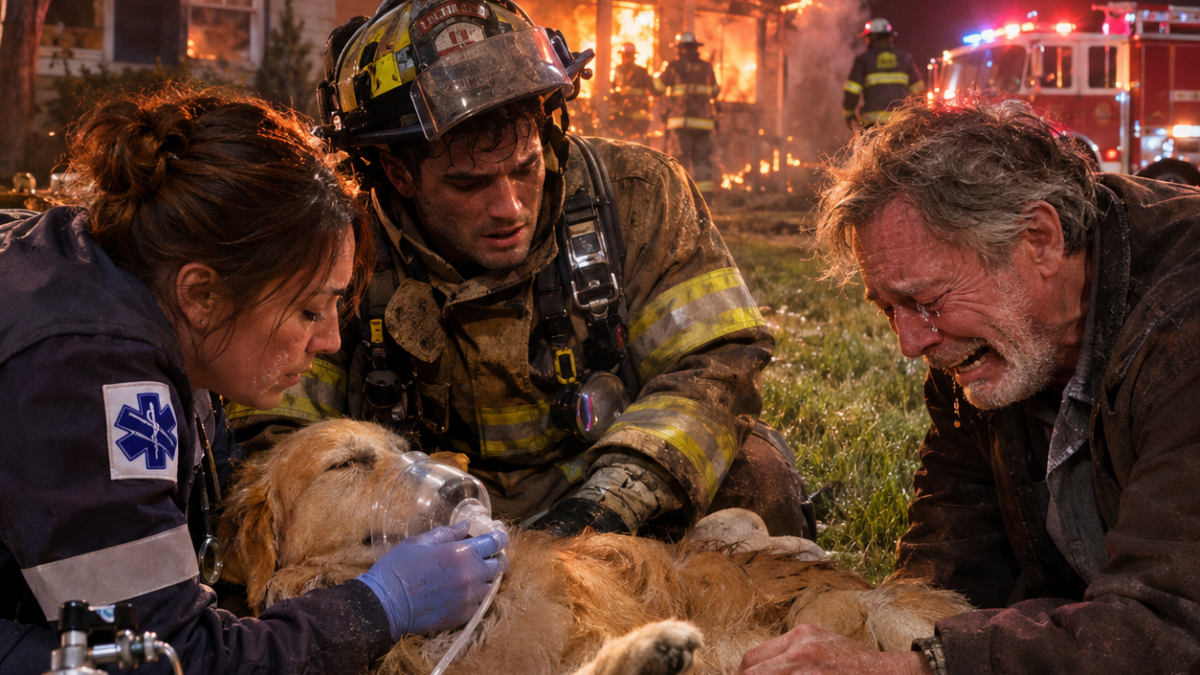
Ryan lowered Bailey onto the grass.
I reached him first.
His fur was warm.
Too warm.
Ash covered his face.
His tongue hung slightly from his mouth.
Eyes closed.
“Bailey.”
Nothing.
I lifted him.
Thirty kilograms of dead weight.
My dog had never felt heavy before.
Now he felt impossible.
“Bailey.”
I held his head.
“Please.”
I pressed my face against his ear.
The same ear that twitched when I whispered walk.
Treat.
Lake.
I love you.
“Come on, buddy.”
No movement.
“Don’t do this.”
Paramedics approached.
A woman knelt.
“Sir, we need him down.”
“No.”
“Sir.”
“No.”
Ryan touched my shoulder.
“Let them help him.”
Something in his voice reached me.
I let go.
The paramedics laid Bailey flat.
The woman checked his mouth.
Airway.
Breathing.
Pulse.
Someone brought an oxygen mask designed for animals.
Another person called a veterinary emergency clinic.
They began working.
Chest compressions.
Controlled breaths.
Oxygen.
I watched.
The burning house disappeared.
Firefighters shouted.
A second-story window broke.
The roof groaned.
None of it mattered.
Only Bailey.
Five minutes.
Maybe ten.
Time stopped.
Then I saw it.
His paw.
A small movement.
I almost thought I imagined it.
“There!”
The paramedic looked.
Bailey’s chest rose.
Once.
Then again.
His eyelids fluttered.
“Bailey?”
His eyes opened a fraction.
Cloudy.
Confused.
Alive.
I cried.
I had not cried like that since Élise’s funeral.
Not quietly.
Not with dignity.
I sobbed so hard I could barely breathe.
Ryan crouched beside me.
“He’s fighting.”
I grabbed his arm.
“Thank you.”
He shook his head.
“Not yet.”
Correct.
Not yet.
The emergency veterinary clinic was in Cambridge.
Twenty-four-hour facility.
They took Bailey immediately.
Dr. Ellen Foster met me in the treatment area.
Mid-fifties.
Gray beginning at her temples.
Calm voice.
Strong hands.
She examined him while technicians moved around us.
Smoke inhalation.
Possible thermal injury.
Burned paw pads.
Respiratory distress.
Soot in airway secretions.
They placed him in oxygen support.
Started fluids.
Monitored blood gases.
I understood almost none of it.
I understood her face.
Serious.
Not hopeless.
“Will he live?”
Dr. Foster looked at me.
“I think he has a good chance.”
Think.
Good chance.
Not promise.
I appreciated that.
“What do you need from me?”
“Let us work.”
Hardest instruction anyone can give someone who loves.
They put Bailey in an oxygen enclosure.
Clear walls.
Soft blanket.
He looked small.
Golden fur stained gray.
A line ran to his foreleg.
I sat on the other side of the glass.
“I’m here.”
His eyes were closed.
“I’m here, buddy.”
I do not know if he heard.
I stayed anyway.
At 2:30 in the morning, a police officer called.
The house was considered a total loss.
The fire had likely started near wiring behind the kitchen wall.
Investigation ongoing.
I listened.
Total loss.
Such a neat phrase.
As if loss can be totaled.
“Thank you.”
I hung up.
Nothing inside me reacted.
The house had burned.
Okay.
Bailey was breathing.
That was the only number that mattered.
The waiting room had six plastic chairs.
A coffee machine.
Muted television.
A magazine about gardening from three months earlier.
I sat there all night.
At some point, I thought about Élise.
Not the illness.
Earlier.
Summer evenings.
She used to sit on the porch with her feet on the railing even though she told everyone else not to put shoes on furniture.
I complained.
She laughed.
“Then arrest me.”
She would have hated the fire.
Not because of the house.
Because I ran back inside.
She would have yelled.
“You idiot.”
Then hugged Bailey until he tried to escape.
That was Élise.
She loved fiercely.
Grieved badly.
Laughed loudly.
When she died, the world did not merely lose a person.
It lost a sound.
Her laugh disappeared from rooms.
Bailey had never heard it.
That realization hurt.
He came after her.
He knew only the version of me that remained.
Maybe that was why he saved me.
He never compared me with who I had been.
He simply accepted the man in front of him.
Broken.
Quiet.
Not very interesting.
Still worth following from room to room.
Dogs do not require us to be our best previous version.
They love the present tense.
At five in the morning, Dr. Foster walked into the waiting room.
I stood so quickly the chair scraped backward.
Her face was tired.
But she smiled.
“He’s stable.”
I nearly fell.
“He’s breathing on his own.”
“His oxygen level is improving.”
“Can I see him?”
“Five minutes.”
Five minutes.
I would have paid anything.
Bailey was lying on a blanket.
No longer inside the larger oxygen chamber, though supplemental oxygen remained nearby.
His eyes were open.
I stepped closer.
“Hey.”
His gaze found me.
Then his tail moved.
Once.
Weak.
Barely an inch.
But it moved.
I laughed and cried at the same time.
“You stupid dog.”
His tail moved again.
Dr. Foster stood behind me.
“That’s a good sign.”
I touched his head.
Very gently.
“You scared me.”
Bailey’s eyes closed.
I whispered:
“Don’t ever do that again.”
Of course he had not chosen it.
Grief makes us say absurd things.
Dr. Foster explained the next twenty-four to seventy-two hours mattered.
Smoke inhalation can worsen.
Airway swelling.
Lung inflammation.
Complications.
His paw burns were mild compared with what they feared.
He had likely hidden in the rear hallway after smoke and debris blocked the easiest route.
Ryan found him behind a fallen section of drywall near the pantry.
One more collapse and Bailey might have been unreachable.
That sentence followed me for weeks.
One more collapse.
Life sometimes becomes defined by inches and minutes.
Ryan came to the clinic later that morning.
I was surprised.
He stood awkwardly near the entrance holding a paper cup.
“How is he?”
“Stable.”
Ryan exhaled.
“Good.”
I stared at him.
“You went back for him.”
“That’s the job.”
“Don’t say that.”
He looked uncomfortable.
“What?”
“You went into my burning house for my dog.”
“We go in for living things.”
“He’s alive because of you.”
Ryan looked through the treatment-room glass.
Bailey was sleeping.
He shrugged slightly.
“He was alive because he kept breathing long enough for us to find him.”
Maybe firefighters need humility to live with what they see.
I did not argue.
“Thank you.”
Ryan nodded.
“You’re welcome.”
Then he left.
No heroic speech.
No photographs.
Just a young man finishing one impossible night and going home.
I never forgot him.
Insurance came next.
Because disasters contain paperwork.
Marcus Lee, my adjuster, met me outside the remains of the house two days later.
He was young.
Maybe thirty.
Spoke fast.
But not carelessly.
The structure was gone.
Almost everything inside destroyed.
The back half had collapsed.
The upstairs ceiling had fallen.
Water damage everywhere else.
Smoke.
Ash.
Glass.
Metal.
The world Élise and I built had become debris.
Marcus talked about coverage.
Temporary housing.
Inventory.
Replacement cost.
Documentation.
I nodded.
Then I saw something near the porch.
A piece of blue ceramic.
Élise’s flowerpot.
Broken.
I stopped listening.
Marcus noticed.
“Do you need a minute?”
I crouched.
Picked up one piece.
Blue glaze.
Black edge from smoke.
Élise bought the pot during a trip to Maine.
She spent twenty minutes arguing with the vendor over three dollars.
Then tipped him five.
That was her.
I held the fragment.
The house suddenly mattered again.
Not the walls.
Memory.
I cried.
Marcus pretended to study paperwork.
Kind man.
The inventory process was brutal.
Sofa.
Dining table.
Television.
Clothes.
Books.
Kitchen equipment.
Tools.
Photographs.
Élise’s jewelry.
Some recovered.
Some not.
Her letters?
Gone.
That one almost destroyed me.
I had kept a box of letters from when we were dating.
Paper.
Twenty-eight years of handwriting.
Gone.
I sat in my rental car outside the burned house and screamed.
No one heard.
Good.
Then my phone rang.
Dr. Foster.
My heart stopped.
“Daniel?”
“Yes?”
“Bailey ate.”
Everything changed.
“What?”
“Not much.”
“But he ate.”
I laughed.
“What?”
“A little chicken.”
“Good?”
“Very good.”
The letters were still gone.
The house was still gone.
But Bailey ate chicken.
Grief and hope live beside each other more often than we think.
I rented a small apartment outside the city.
Gray building.
Second floor.
Barely furnished.
One bedroom.
Cheap sofa.
Tiny kitchen.
It felt nothing like home.
That was fine.
I did not need home yet.
I needed somewhere warm.
Every morning at nine, I drove to Cambridge.
Same parking spot when available.
Same coffee from the shop across the road.
Same chair beside Bailey.
I read to him.
At first because silence hurt.
Then because he seemed to like my voice.
I read novels.
Newspaper articles.
A gardening magazine.
Once an insurance document.
Bailey fell asleep immediately.
“Critic.”
I also told him about Élise.
Everything.
Stories I had not told anyone.
How she hated olives.
How she lied about liking camping during our first year together because I loved it.
How I discovered she hated camping only after she threw a wet sleeping bag across the car and announced:
“I would rather sleep in a bus station.”
How she danced while cooking.
How she cried during commercials involving old people.
How she wanted to name every stray cat.
Bailey listened.
Head tilted.
Sometimes licked my hand.
I began to realize I had kept Élise trapped inside me because saying her name made the loss real.
Bailey gave me somewhere to put the memories.
Maybe he had always done that.
His recovery was slow.
Smoke inhalation made him tire easily.
The first time technicians helped him stand, his legs shook.
He took two steps.
Stopped.
Looked toward me.
“Come on.”
He took another.
Burned pads made walking uncomfortable.
Dr. Foster used protective bandaging.
He hated it.
Tried to chew it.
That made me absurdly happy.
The dog who wanted to destroy medical equipment was more familiar than the one lying motionless.
“Good.”
Dr. Foster laughed.
“You’re happy he’s being difficult?”
“Yes.”
“Fair.”
On day six, Bailey wagged hard enough to move his whole body.
On day eight, he barked once at a technician carrying food.
On day ten, he stood without assistance.
On day twelve, he walked across the treatment room.
Every milestone felt enormous.
People become spoiled by normal life.
We complain when dogs bark.
When they shed.
When they wake us.
Then illness arrives and one bark becomes music.
Ryan visited again.
This time Bailey was awake.
Ryan entered carefully.
Bailey stared.
Then sniffed.
His tail moved.
Ryan crouched.
“Hey, buddy.”
Bailey leaned forward.
Sniffed Ryan’s sleeve.
Then licked his hand.
Ryan froze.
I smiled.
“He remembers you.”
“Probably smells smoke.”
“Let me have this.”
Ryan laughed.
Then his eyes became wet.
“I thought he was gone when I found him.”
My chest tightened.
“What happened?”
He looked at Bailey.
“He was behind debris.”
“Not moving.”
“I saw his chest once.”
“That’s why I grabbed him.”
He rubbed Bailey’s head.
“Stubborn dog.”
Yes.
The best kind.
Two weeks after the fire, I visited the ruins alone.
Insurance investigators had finished most of their work.
The fire was considered accidental.
Electrical fault.
No villain.
No arson.
No dramatic reason.
Sometimes disaster is simply wire, heat, bad timing.
I stood where the kitchen had been.
Charred beams.
Open sky.
The refrigerator was blackened.
One wall remained partially upright.
I found a metal drawer from Arthur? No—wrong story. Need keep Daniel/Élise.
I found the metal tin Élise used for recipes.
Warped.
Inside, most cards were ruined.
One survived partly.
Her handwriting:
APPLE CAKE — Daniel says too much cinnamon. Ignore Daniel.
I laughed so suddenly it hurt.
I kept it.
Smoke-stained.
Edges burned.
Half the ingredients unreadable.
Perfect.
That evening, I told Bailey.
“Found your mother’s cake recipe.”
Then corrected myself.
“Elise.”
I had never called her Bailey’s mother before.
He wagged.
“Fine. Your mother.”
Maybe family does not need precision.
By the third week, Dr. Foster started talking about discharge.
I did not believe her.
“Home?”
“Temporary home.”
“Apartment.”
“Yes.”
“He’s ready?”
“Almost.”
I stared through the glass.
Bailey stood eating.
Still thinner.
Still slower.
But himself.
“Are you sure?”
Dr. Foster smiled.
“You’ve asked me that six times.”
“I’ll ask seven.”
“Yes.”
She became serious.
“He’ll need rest.”
“Short walks.”
“Watch his breathing.”
“Protect the paws until fully healed.”
“Follow-up.”
“I’ll do everything.”
“I know.”
Then:
“Daniel.”
“Yes?”
“You need rest too.”
I almost laughed.
“I’m fine.”
She gave me a look.
Veterinarians apparently detect human lies too.
“You lost your house.”
“I know.”
“You nearly lost your dog.”
“I know.”
“You lost your wife.”
Years ago, but still.
“I know.”
She touched my shoulder.
“Surviving is not the same as processing.”
I looked away.
“I’m working on it.”
Bailey barked from the other room.
Dr. Foster smiled.
“He’ll make sure you do.”
Discharge day arrived with sunlight.
Bright.
Clear.
Unfairly beautiful.
Bailey walked out on a leash.
Slowly.
Bandages reduced.
His golden coat cleaned.
Smoke smell mostly gone.
He stopped on the sidewalk.
Lifted his muzzle.
Closed his eyes.
Breathed.
Deep.
I watched his chest rise.
Full.
Strong.
I cried.
Again.
Apparently I had become a man who cried in parking lots.
Fine.
Bailey opened his eyes.
Looked at me.
Tail wagged.
“Ready?”
We went home.
The apartment confused him.
He walked through every room.
Bedroom.
Kitchen.
Bathroom.
Back to living room.
Then looked at me.
I knew what he was asking.
Where is the porch?
Where is the yard?
Where is our house?
Where is everything?
I sat on the floor.
“I know.”
Bailey stood.
“I know, buddy.”
He came over.
Placed his head on my knee.
We stayed like that.
No answer.
The first nights were difficult.
Bailey woke at sounds.
Truck outside.
Neighbor closing a door.
Smoke alarm test in hallway.
That one caused panic.
He jumped up.
Barked.
Ran to me.
I turned off the sound as quickly as possible.
“It’s okay.”
His whole body shook.
I sat beside him.
“It’s okay.”
I realized Bailey had memories too.
Not like mine.
Maybe not stories.
But associations.
Smoke.
Alarms.
Heat.
Fear.
We had both survived.
Neither had simply moved on.
I began taking him outside at dawn when the neighborhood was quiet.
Short walk.
Half block.
Then one.
Bailey sniffed everything.
Grass.
Lamp posts.
Garbage bins.
A child’s bicycle.
Normal things.
His world slowly expanded.
I followed.
He was teaching me again.
Recovery rarely announces itself.
It happens when you realize you walked one block farther.
Slept one hour longer.
Laughed without guilt.
Forgot to be afraid for five minutes.
A month after Bailey came home, I went to Élise’s grave.
I had not visited since the fire.
I brought the piece of blue flowerpot.
Set it near the stone.
Bailey sat beside me.
I told her everything.
Out loud.
Fire.
Ryan.
Clinic.
Dr. Foster.
The recipe card.
Apartment.
I cried.
Then laughed.
“You would hate the apartment.”
Bailey wagged.
“She would.”
I rested my hand against the gravestone.
“For a few minutes, I thought I was going to lose him too.”
Wind moved through the trees.
No answer.
I whispered:
“I don’t know how many times I can start over.”
Bailey leaned against my leg.
That was answer enough.
Insurance eventually settled enough for rebuilding or replacement.
Everyone assumed I would rebuild the same house.
Same footprint.
Same porch.
Same kitchen.
I tried.
Architect drew plans.
Contractor discussed costs.
Then I stood on the property and realized I did not want it.
Not because of the fire.
Because rebuilding an imitation felt like pretending loss could be reversed.
I called Marcus.
“I’m buying somewhere else.”
He sounded surprised.
“You sure?”
“No.”
“Good enough.”
I sold the land later.
A young couple bought it.
They planned a new home.
For one second, that hurt.
Then I was glad.
Land should hold life.
Not become a monument to mine.
I found a smaller house forty minutes away.
One story.
Wide windows.
Large backyard.
Plain porch.
Nothing like the old place.
That was why I loved it.
The first time Bailey visited, he ran directly into the yard.
Not fast.
Paws still sensitive.
But he trotted.
Sniffed a tree.
Then rolled in grass.
I laughed.
“Really?”
He rolled harder.
Decision made.
We bought it.
Moving day contained almost nothing.
A bed.
Sofa.
Kitchen table.
New dishes.
Boxes.
The emptiness looked strange.
At the old house, every room had accumulated decades.
Here, walls were blank.
No Élise photographs yet.
No scratches.
No history.
At first that frightened me.
Then I realized blank walls are not empty.
They are available.
I hung one photograph.
Élise at the lake.
Wind in her hair.
Laughing.
Then one of Bailey.
Wet after swimming.
Then the burned apple-cake recipe in a small frame.
Not because I wanted the fire memorialized.
Because Élise’s handwriting survived.
Three things.
Enough to begin.
Bailey reclaimed the porch.
First evening, he lay at my feet.
Crickets.
Warm air.
New neighborhood.
I looked at him.
His breathing was steady.
No oxygen.
No monitors.
No smoke.
Just breath.
I whispered:
“We made it.”
His ear moved.
I smiled.
“Yeah.”
Six months after the fire, Ryan visited the new house.
I invited him to dinner.
He refused twice.
Then agreed.
When he arrived, Bailey barked from the porch.
Then ran—actually ran—toward him.
Ryan dropped to one knee.
Bailey nearly knocked him over.
I laughed.
Ryan hugged him.
“You remember me?”
Bailey licked his face.
Ryan looked away.
I pretended not to see tears.
Dinner was simple.
Chicken.
Potatoes.
Apple cake.
I had reconstructed the recipe from memory and what remained of the card.
Too much cinnamon.
Exactly as Élise intended.
Ryan ate two pieces.
“This is good.”
“My wife’s recipe.”
He nodded.
I showed him the framed card.
He read:
Daniel says too much cinnamon. Ignore Daniel.
Ryan laughed.
“Smart woman.”
“The smartest.”
After dinner, we sat outside.
Ryan asked:
“Do you ever think about the house?”
“Every day.”
“Bad?”
“Sometimes.”
He looked toward Bailey.
“I think about that night too.”
I turned.
“You do?”
He nodded.
“First animal rescue where I thought…”
He stopped.
“What?”
“That we weren’t getting him back.”
I waited.
Ryan looked embarrassed.
“Firefighters aren’t supposed to carry everything home.”
“Do you?”
“Yes.”
Honest.
We sat quietly.
Bailey rested between us.
I realized saving someone does not mean the rescuer walks away untouched.
That was another thing people forget.
I thanked him again.
He finally accepted without saying it was only his job.
Progress.
Dr. Foster came by a month later.
I invited her because apparently my life had become a reunion committee for everyone who saved my dog.
Bailey adored her less.
He remembered thermometers.
Still, she examined him.
Lungs clear.
Paws healed.
Some residual sensitivity.
Otherwise excellent.
She looked at me.
“And you?”
“Not your patient.”
“Convenient.”
I laughed.
“I’m better.”
“Really?”
“Yes.”
This time I meant it.
I started volunteering at a local animal rescue.
That surprised me more than anyone.
I had spent decades claiming I was not a dog person.
Bailey had made that argument impossible.
At first I cleaned kennels.
Then walked older dogs.
One golden mix named Charlie refused to leave the back of his enclosure.
Returned twice by adopters.
Too anxious.
I sat outside his kennel.
No touching.
No coaxing.
Just sat.
Volunteer coordinator asked why.
I said:
“Someone did this for me once.”
She looked confused.
I pointed toward Bailey waiting in the car.
She understood enough.
Charlie was adopted three weeks later by a retired teacher.
I cried.
Again.
Apparently permanent condition.
The fire changed how I understood possessions.
Not in the simplistic way people say:
Things don’t matter.
Things do matter.
Élise’s letters mattered.
The photograph albums mattered.
Her grandmother’s quilt mattered.
The coffee mug mattered.
Losing objects can hurt because memory attaches itself to physical things.
But objects are containers.
Not the memory itself.
That took time.
At first I thought the fire had taken Élise again.
Then one morning I woke remembering her singing badly in the kitchen.
No photograph triggered it.
No letter.
She was simply there in memory.
I realized the fire could destroy paper.
Not history.
That helped.
I replaced very little.
One television.
Basic furniture.
Kitchenware.
No urge to recreate everything.
I kept open space.
Friends thought I had become minimalist.
No.
I had become tired of dusting.
Élise would approve.
Bailey returned to the lake the following summer.
First time since the fire.
I worried about his paws.
Dr. Foster said they were fine.
We drove to the place Élise and I used to visit.
Bailey recognized it before I parked.
He whined.
Tail pounding.
Door opened.
He ran.
Straight into water.
I shouted:
“Bailey!”
Too late.
He swam.
Golden head above the surface.
Sunlight.
For one terrifying second, I remembered him limp in Ryan’s arms.
Then Bailey turned.
Barked.
As if saying:
Are you coming?
I laughed.
Took off my shoes.
Walked in.
Cold water.
Terrible idea.
Best day.
We sat on the shore afterward.
Wet.
Bailey asleep beside me.
I thought about the sentence I had repeated in the clinic.
We still have so many walks.
So many lakes.
So many porch nights.
At the time, it had been bargaining.
Please live because I have future plans for you.
Now one of those plans had arrived.
A lake.
A sunny afternoon.
Nothing dramatic.
That is what makes survival worthwhile.
Not simply avoiding death.
Getting ordinary days back.
One year after the fire, the department invited me to a fire-safety event.
Ryan suggested it.
They wanted Bailey too.
I almost refused.
Then agreed.
Bailey sat beside a fire engine while children pet him.
Ryan told the story carefully.
No exaggeration.
He emphasized smoke alarms.
Leaving quickly.
Not going back inside.
At that part, he looked directly at me.
I raised one hand.
“I know.”
Children laughed.
Then he said:
“Pets often hide during fires.”
“Tell responders where you last saw them.”
“Do not risk becoming another victim.”
I hated hearing it.
Still true.
Afterward, a woman asked:
“Would you go back in again?”
I answered too quickly.
“Yes.”
Ryan groaned.
Then I corrected.
“I would want to.”
“That’s different.”
He nodded.
That was the lesson.
Love makes you want irrational things.
Training exists because wanting and doing cannot always be the same.
Bailey became a quiet local celebrity after the event.
I hated it less than expected.
People recognized him at the park.
“Fire dog!”
He accepted attention shamelessly.
One child asked whether Bailey was brave.
I said:
“No.”
The mother looked surprised.
I continued:
“He was scared.”
“He survived anyway.”
“That’s brave.”
The child nodded.
Better definition.
Years passed.
Bailey grew gray around the muzzle.
Not immediately.
Slow.
The way all unbearable things approach.
He became slower on stairs—though new house had few.
Napped longer.
Still loved food.
Still barked at delivery drivers like national security depended on it.
Every evening, porch.
Sometimes I spoke to Élise.
Sometimes to Bailey.
Sometimes neither.
Silence became peaceful instead of empty.
That was perhaps the greatest change.
After Élise died, silence felt like proof of absence.
With Bailey beside me, silence became companionship.
Eventually, even when he slept inside and I sat alone, silence retained that warmth.
He had taught me to inhabit my own life again.
On the second anniversary of the fire, I invited Ryan and Dr. Foster to dinner.
Marcus too.
The insurance adjuster laughed.
“Why am I here?”
“You paid for the house.”
“Insurance paid.”
“You carried paperwork while I cried.”
He accepted.
We ate apple cake.
Again too much cinnamon.
Tradition.
Bailey moved from person to person collecting food he was not supposed to receive.
Everyone denied giving him any.
Liars.
After dinner, Ryan stood near the porch.
He looked toward the house.
“Hard to believe.”
“What?”
“That night.”
I nodded.
Then he said:
“I remember carrying him out.”
I looked at Bailey asleep beneath the table.
“So do I.”
Ryan’s face tightened.
“For a second, I thought you were going to collapse when you saw him.”
“I did.”
“I mean completely.”
I smiled.
“So did I.”
What I never told Ryan was that the sight of Bailey in his arms had carried another image.
Élise.
Hospital.
Nurse adjusting sheets.
Her body suddenly no longer inhabited the way it had before.
Grief recognizes posture.
Stillness.
The terrible slackness of something loved.
That was why I fell.
Not only because Bailey looked dead.
Because I had already seen that shape once.
My body remembered before my mind did.
Trauma is strange that way.
Sometimes the present touches an old wound and both begin bleeding.
Therapy helped.
Yes.
Eventually.
Dr. Foster had planted the idea.
My sister enforced it.
“You talk to the dog more than people.”
“He listens.”
“So will a therapist.”
“Unclear.”
I went.
At first I hated it.
Then less.
We talked about Élise.
Fire.
Guilt.
I admitted I blamed myself for leaving Bailey inside.
Therapist asked:
“Did you put him there?”
“No.”
“Could you see him?”
“No.”
“Did you call for him?”
“Yes.”
“Did you send rescuers?”
“Yes.”
“Then what are you guilty of?”
I had no answer.
Feelings do not care when logic wins.
But logic helps eventually.
I stopped waking every night smelling smoke.
Not immediately.
Months.
Then weeks between nightmares.
Eventually, a whole month.
The first time I realized I had not dreamed of the fire in weeks, I felt guilty.
As if healing meant betrayal.
Same feeling after Élise.
First day I laughed after her funeral, I felt ashamed.
Why?
Humans are strange.
We think pain proves love.
It does not.
Love does not require continuous suffering as evidence.
Bailey taught me that too.
He stopped trembling at smoke alarms eventually.
Did not mean he forgot the fire.
It meant his nervous system learned the present was safe.
I tried to do the same.
Three years after the fire, Ryan became a lieutenant.
He called.
I congratulated him.
Bailey barked in the background.
Ryan said:
“Tell him he helped.”
“Helped what?”
“My training presentation.”
Apparently Ryan used Bailey’s rescue in firefighter education about pet searches and owner behavior.
He told recruits:
“The owner will want to reenter.”
“Expect it.”
“Give clear instructions.”
“Ask species, location, hiding places.”
“Do not dismiss ‘just a dog.’”
That last part mattered.
To some people, Bailey was an animal.
To me, he was family.
Responders who understand that can communicate better.
Maybe one fire created small improvements elsewhere.
I liked that.
Bailey aged well.
Until he didn’t.
That is how aging works.
At twelve, arthritis.
Medication.
Shorter walks.
At thirteen, hearing faded.
I could open a snack bag without him appearing.
Terrifying milestone.
But smell remained excellent.
Chicken still summoned him from anywhere.
His lungs never developed severe lasting damage from the fire, which Dr. Foster called fortunate.
His paws remained slightly sensitive on hot pavement.
We adapted.
Morning walks.
Grass.
Soft bedding.
One evening, years after the fire, I sat on the porch and realized Bailey had been with me longer than Élise had been gone when he arrived.
Time folds strangely.
He rested his gray muzzle on my foot.
I touched his head.
“You know, you weren’t supposed to stay.”
His tail moved.
“Margaret said one night.”
He sighed.
“Worst houseguest ever.”
Tail again.
Then I whispered:
“Best thing she ever did.”
Bailey died at fourteen.
Not in a fire.
Not dramatically.
At home.
Old age.
Body tired.
Dr. Foster, now mostly retired, came because she had known him so long.
Ryan visited the week before.
Marcus sent a card.
Margaret sat with me.
Bailey lay on his favorite blanket near the porch doors.
Sunlight.
No smoke.
No sirens.
No fear.
I held his head.
The same head I had held on the lawn.
But this time I was not begging him to stay.
That was the final gift I could give.
Permission.
“You did enough.”
His eyes looked at me.
Still Bailey.
Always.
“You got me through.”
I cried.
“Go find Élise.”
I do not know what I believe about dogs and afterlife.
I did not care.
“Tell her I’m okay.”
His breathing slowed.
Then stopped.
Quiet.
Warm.
Loved.
For a few weeks, the new house felt as empty as the old one had after Élise died.
Different grief.
Same silence.
I expected collapse.
It did not come.
I was devastated.
But I kept eating.
Walking.
Seeing friends.
Volunteering.
The life Bailey had rebuilt in me did not die with him.
That was his final rescue.
Six years earlier—actually many years earlier—after Élise, I thought love leaving meant life leaving.
Bailey taught me otherwise.
When he left, I finally understood.
Love can finish its physical form and still leave structure behind.
Like a house foundation.
Not visible from every angle.
Still holding weight.
I buried some of Bailey’s ashes near Élise.
Not all.
Some remain in a small wooden box on my shelf.
Beside the burned apple-cake recipe.
Beside a photograph of Bailey at the lake.
No shrine.
Just family.
I kept volunteering at the rescue.
Eventually adopted another dog.
That surprised everyone.
Especially me.
Her name is Lucy.
Older Labrador mix.
Nine when I met her.
Nobody wanted an older dog.
I understood.
Older love feels dangerous.
You know time is limited.
Then I remembered what Bailey taught me.
Limited does not mean unworthy.
Lucy sleeps in the same spot Bailey used.
Not replacement.
Never replacement.
Continuation.
Sometimes people ask whether losing Bailey was worth having him.
What a terrible question.
Of course.
Pain at the end does not invalidate joy before it.
If we lived by that rule, we would love nothing.
Nobody.
Élise taught me that.
Bailey made me believe it.
The old house no longer exists.
The new owners built something modern.
I drove past once.
Almost did not recognize the property.
Good.
The world moved.
Our lives were not erased because the land changed.
Memory does not require architecture.
Ryan still sends a message each year on the fire anniversary.
Usually:
Thinking of Bailey today.
I answer:
Me too.
Once he sent:
He was a good dog.
I wrote back:
No. He was a terrible dog. Stole food. Barked at mailmen. Rolled in mud.
Ryan replied:
Best kind.
Exactly.
The fire took a house.
Furniture.
Letters.
Photographs.
Clothes.
A thousand ordinary objects I did not know I loved until they disappeared.
But it also forced me to confront something I had been avoiding since Élise died.
I had mistaken survival for loyalty.
I thought remaining half-alive honored her.
It did not.
Bailey dragged me into the present.
Walk by walk.
Meal by meal.
Tail wag by tail wag.
Then the fire nearly took him.
And for the first time, I understood clearly what his life had become inside mine.
Not comfort.
Not pet ownership.
Relationship.
Family.
Reason.
When Ryan emerged from the smoke carrying Bailey, I believed I was watching the last living piece of my life disappear.
I was wrong.
Bailey survived.
Then taught me something even bigger.
A home is not what survives fire.
A home is what you are still willing to build afterward.
Six months after the fire, our new house was barely furnished.
White walls.
Cheap table.
One comfortable chair.
Bailey’s bed.
I sat on the porch one evening.
He lay at my feet.
The yard smelled like cut grass.
Sunset turned the sky orange.
For a moment, the color reminded me of flames.
My chest tightened.
Then Bailey sighed.
Ordinary dog sigh.
I looked down.
He was asleep.
Safe.
The orange sky stopped being fire.
It became sunset again.
That was healing.
Not forgetting.
Reclaiming.
I leaned back.
Thought of Élise.
The old porch.
The old house.
The coffee mug.
Blue flowerpot.
Letters.
Then I looked at Bailey.
Everything I had lost remained real.
Everything I still had was also real.
Grief had taught me to stare backward.
Bailey taught me to look both directions.
Memory behind.
Life ahead.
People like to say disasters reveal what matters.
I dislike that phrase.
We should not need houses to burn before we value people.
But sometimes catastrophe strips away the arguments we use to distract ourselves.
That night, I did not think about property values.
Insurance.
Photographs.
Furniture.
I thought:
Bailey is inside.
That was clarity.
Terrible clarity.
And when he opened his eyes on the grass?
That was another kind.
Everything can disappear.
Still, something can return.
A breath.
A paw movement.
A tail wag.
Sometimes hope is very small.
Small enough to miss if you are not watching.
I was watching.
My name is Daniel Harper.
I once believed the worst thing life could do was take someone you loved.
Then I learned life can also leave you here afterward.
That may be harder.
Élise left me.
Bailey stayed.
Then Bailey left too.
And I stayed.
Not because loss became easier.
Because love had taught me how.
If I could return to the lawn that night, I would find the man kneeling in smoke and ash, holding Bailey’s limp body and begging.
I would sit beside him.
I would not tell him everything would be okay.
Because that sentence is usually too large.
I would say something smaller.
Something true.
“He is still here.”
“Right now.”
“So are you.”
“Start there.”
That is what we did.
Breath.
Then another.
Day.
Then another.
House.
Then another.
Life.
Then another.
For three weeks, Bailey fought his way back.
For six months, we rebuilt a home.
For years afterward, he kept teaching me what survival was for.
Not simply remaining alive.
Living.
Walking.
Playing.
Eating cake crumbs you are not supposed to eat.
Sleeping in sunlight.
Loving again after you once believed love had become too dangerous.
The fire could burn wood.
It could melt glass.
It could destroy photographs.
It could take everything Élise and I had physically built.
But it could not burn the years we had lived there.
And it could not burn the bond Bailey and I had built afterward.
That bond existed somewhere fire could not reach.
Inside habit.
Memory.
Trust.
Love.
The night my house burned, I thought I was losing everything for the second time.
Instead, I learned something I should have understood much earlier.
Everything was never the house.
Everything was the life inside it.
Élise had been that life once.
Then Bailey.
Then me.
And even after walls collapse, life can be carried forward.
Sometimes in your own hands.
Sometimes in the arms of a twenty-eight-year-old firefighter coming through smoke.
Sometimes in the weak movement of a golden paw against wet grass.
That is the image I keep.
Not the burning house.
Not the blackened roof.
Not the debris.
Bailey’s paw.
Moving.
Barely.
Enough.
Because sometimes enough is very small.
One breath.
One movement.
One reason not to give up.
Bailey had been that reason for me long before the fire.
And on the night I thought I was about to lose him, he gave it to me again.
His paw moved.
His chest rose.
His eyes opened.
And through all that smoke, all that grief, all those years of trying to survive without Élise, I understood one simple thing.
We were still here.
Together.
And for that moment, that was enough.








