FULL STORY:“JUST SIGN HERE—IT’S FOR THE WEDDING.” Two Weeks After I Married Him, My Mother-in-Law Brought a Lawyer to My Kitchen Table
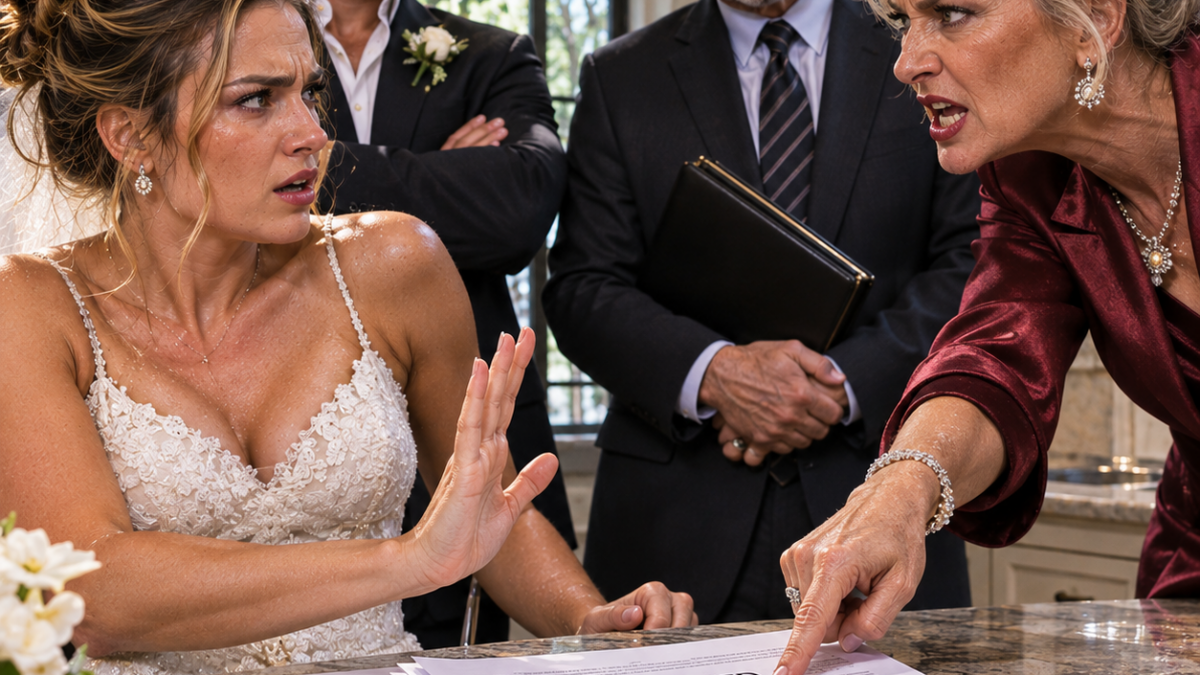
FULL STORY CONTINUATION
The color disappeared from his face for less than a second.
If I had looked down at the wrong moment, I might have missed it.
Then the husband I knew returned.
Relaxed shoulders.
Concerned eyes.
Small apologetic smile.
“Looks like my mother stopped by.”
He loosened his tie and approached me.
Cedarwood cologne.
The scent I had associated with Saturday dinners, airport reunions, and the morning he proposed.
Now it smelled like something designed to make me lower my guard.
“She brought a lawyer.”
I said.
Kevin closed his eyes dramatically.
“Please tell me she didn’t.”
“She did.”
“Bob?”
“Yes.”
He groaned.
“Oh, God.”
I watched him.
“Do you know Bob?”
“Mom has used him for small things.”
“Real estate?”
“No.”
He answered too quickly.
Then:
“I mean, I don’t think so.”
He came behind me and put his hands on my shoulders.
His thumbs began those slow circles he used whenever he thought I was stressed.
“Jessica’s venue issue has Mom losing her mind.”
“That paperwork was a warranty deed.”
“I know.”
Again.
Too fast.
I turned.
“You know?”
His expression changed.
“She mentioned some title arrangement this morning.”
“What kind of arrangement?”
“I barely listened.”
“You told her I get paranoid about legal jargon.”
Kevin stared at me.
Then laughed softly.
“She said that?”
“She said you warned her.”
“I probably said something like, ‘Alice reads every word.’”
“That is not the same thing.”
“No.”
He reached for me.
I stepped back.
A tiny movement.
Enough.
His hands dropped.
“Alice.”
“What exactly did your mother ask you this morning?”
“She wants the wedding at the ranch.”
“House.”
“What?”
“I call it a house.”
“Your family calls it the ranch.”
“Fine.”
He exhaled.
“She was worried about liability.”
“So she drafted a deed giving you ownership?”
“She didn’t draft anything.”
“Bob did.”
“Then Bob.”
He rubbed his forehead.
“Look, I agree she went too far.”
“That’s all?”
“What else do you want me to say?”
“I want you to explain why your name is on a deed that you apparently discussed before she brought it to me.”
Kevin leaned against the counter.
For the first time since coming home, the soft husband routine disappeared slightly.
“Because if we held the property jointly, I could handle the insurance.”
“You can insure events without owning the land.”
“I know that.”
“Then why transfer title?”
“It could simplify things.”
“How?”
“Contractors.”
“Umbrella coverage.”
“Vendor agreements.”
“You don’t need survivorship rights for any of those.”
His jaw tightened.
Only slightly.
“You’ve already spoken to someone.”
I said.
He smiled.
“You’re a Grant.”
“You probably have three lawyers hiding in the pantry.”
I did not smile back.
That bothered him.
Then he softened again.
“Okay.”
“Bad idea.”
“Mom overreached.”
“Bob is incompetent.”
“We’ll throw it away.”
He reached for the document.
I put my hand on it first.
“No.”
Kevin looked down.
“I’m keeping it.”
“Why?”
“Because someone tried to get me to sign it.”
His eyes met mine.
“Someone?”
“Yes.”
“My mother.”
“And your name is on it.”
Silence.
Then he smiled.
Not warmly.
Carefully.
“Alice.”
“We’ve been married two weeks.”
“Do you really think I’m trying to steal your house?”
I wanted desperately to say no.
That was the frightening part.
I loved this man.
I had married him fourteen days earlier beneath an oak canopy while my father’s old college friend played piano and Kevin cried before I even reached the aisle.
He wrote his vows himself.
He told me:
“I want your life with you, not your life for me.”
I remembered every word.
Now a deed on my kitchen island said something else.
“I don’t know what to think.”
I answered.
His face softened.
“Then don’t decide while you’re angry.”
“I’m not angry.”
That was true.
I was scared.
He mistook the difference.
“Good.”
He kissed my forehead.
“Let me handle Mom.”
“No.”
He paused.
“I’ll handle her.”
“I said no.”
His eyes changed.
“You don’t want me talking to my own mother?”
“I don’t want you handling this for me.”
“That’s not what I meant.”
“I know exactly what you meant.”
He looked irritated now.
Then he smiled again.
“Fine.”
“Your attorney can review it.”
He tapped the pages.
“Waste two thousand dollars having some downtown shark tell you the same thing.”
“What same thing?”
“That this was clumsy paperwork for an insurance problem.”
I looked at him.
“You’re certain that’s what my attorney will say?”
He hesitated.
Less than a second.
Enough.
“No.”
He said.
“I’m saying I trust you.”
That sentence should have comforted me.
Instead, I heard something underneath it.
Trust me back.
Do not investigate.
I put the document into my study.
Locked the drawer.
Then returned to the kitchen.
Kevin had already changed the subject.
His eleven o’clock presentation.
Traffic.
Dinner reservations.
Jessica’s florist.
He was so normal that for the next three hours, I almost convinced myself I had imagined everything.
That was Kevin’s greatest talent.
Not lying.
Normalizing.
At 2:40 that afternoon, I called Miriam Cole.
Miriam had been my family’s estate attorney for twenty-six years.
She drafted my father’s will.
Handled my grandfather’s trusts.
Told me, when I was sixteen, that “never sign what someone is too impatient to let you read” was more useful than most advice I would hear in college.
She answered:
“How’s married life?”
I stared at the deed.
“Potentially brief.”
Silence.
Then:
“What happened?”
I photographed every page.
Sent the file.
Miriam called back seventeen minutes later.
Her first sentence:
“Do not sign anything.”
“I wasn’t planning to.”
“Do not let Kevin remove those originals.”
“Already locked up.”
“Good.”
“Is it what I think?”
“Worse.”
My stomach tightened.
“How?”
“The deed itself is unsophisticated.”
“It attempts to convey the Dripping Springs property from you individually to you and Kevin as joint tenants with survivorship.”
“I saw that.”
“But Alice…”
She paused.
“This deed cannot transfer that property.”
I closed my eyes.
There it was.
The secret Kevin did not know.
Six days before the wedding, the Dripping Springs estate had stopped being mine individually.
Technically, I still controlled the use of it through the structure we created.
But legal title sat inside the Grant Legacy Preservation Trust.
An irrevocable asset-protection trust established under advice from my estate counsel.
The house.
Certain mineral interests.
Investment partnerships.
Private equity holdings.
A portfolio of municipal bonds.
Several commercial properties.
Approximately $120 million in family assets.
All transferred before marriage.
Not hidden from Kevin illegally.
Not concealed during any required financial disclosures.
He knew I had inherited substantial wealth.
Our prenuptial agreement disclosed categories and valuations.
What he did not have was the underlying architecture.
He had never asked.
He said:
“Your family money is your family money.”
I loved him for that.
Or thought I did.
Miriam continued:
“Your trust owns the property.”
“So even if I signed—”
“The deed Barbara brought identifies the wrong grantor.”
“It would not create valid title.”
“Could they correct it?”
“Not without trustee action.”
“And the trustee?”
“Not Kevin.”
“Not Barbara.”
“And not you acting alone.”
Exactly as planned.
That had been the point.
After my father died, I had inherited assets directly.
For years, accountants warned me that direct ownership exposed too much to future litigation, business risk, and poorly planned estate issues.
I resisted restructuring because it felt like giving away control.
Then I got engaged.
Not because I distrusted Kevin.
Because marriage forced me to think about what would happen if I died.
Or became incapacitated.
Or had children.
My father had spent forty years building that fortune.
I did not want my future spouse inheriting everything by accident because I was too sentimental to plan.
So Miriam built a structure.
Independent trustee.
Distribution standards.
Separate-property treatment.
Successor beneficiaries.
No spouse automatically becoming trustee.
No change of beneficial ownership through marriage.
No transfer of core assets without trustee approval.
If I died, Kevin could receive defined support under separate estate documents if we remained married.
But he would not inherit the Grant family principal.
Future children would.
If no children, designated family and charitable beneficiaries.
At the time, Kevin praised me.
“Smart.”
He said.
“I never want anyone thinking I married you for money.”
Now his mother had brought me a deed.
Miriam asked:
“Does Kevin know the property is trust-owned?”
“He knows there’s a trust.”
“How much?”
“Almost nothing.”
“Why?”
“He said he didn’t care.”
Miriam became very quiet.
Then:
“Maybe he cared enough to avoid asking questions.”
That chilled me.
The glaring detail I had noticed while Kevin rubbed my shoulders came back.
He said:
Maybe we should have a temporary joint ownership agreement drawn up properly.
Temporary joint ownership.
There was no such simple device that gave him title and magically reversed itself after Jessica’s wedding.
But it sounded reassuring.
Temporary.
Insurance.
Protection.
He was trying to sell permanent legal consequences using temporary emotional language.
Miriam said:
“I want you out of the house tonight.”
“That seems extreme.”
“Alice.”
“He hasn’t threatened me.”
“I didn’t say he had.”
“You just discovered your husband may be involved in an attempt to procure your signature on a deceptive deed.”
“Do not decide how serious that is based on whether he raised his voice.”
That sounded like Miriam.
I sat.
“What do I do?”
“First, copy everything.”
“Second, change no trust structures.”
“Third, sign nothing.”
“Fourth, meet me tomorrow morning.”
“And tonight?”
“Stay somewhere Kevin cannot access casually.”
I hated that.
It made everything real.
“I’m not afraid of him.”
“Good.”
“Then make the decision with a clear head instead of fear.”
I called my cousin Claire.
She lived thirty minutes away.
Told Kevin I had promised to help her with an event.
Not entirely true.
I hated lying.
Then reminded myself Kevin had apparently sent his mother to my kitchen with a deed.
Truth had already become complicated.
At Claire’s house, I told her everything.
She listened.
Then:
“I never liked Barbara.”
“That is not helpful.”
“It is emotionally satisfying.”
“Claire.”
“Fine.”
She poured wine for herself and sparkling water for me.
Then:
“What did Kevin know about the trust?”
“Enough to know we had a prenup.”
“That isn’t what I asked.”
I sighed.
“Before the wedding, Miriam reorganized almost everything.”
“Kevin knew?”
“He knew assets were being placed in estate structures.”
“Did he know he couldn’t inherit the principal automatically?”
“I don’t think so.”
Claire stared.
“Alice.”
“What?”
“You married a man without telling him what happens if you die?”
“It’s in the prenup.”
“Did he read it?”
“His lawyer did.”
“That is not what I asked.”
Apparently everyone had decided to become Miriam.
I thought back.
The prenup meeting.
Kevin joking.
“Your lawyers make me sound like a gold digger.”
I said:
“They make everyone sound dangerous.”
He laughed.
Signed.
His attorney advised him.
We both had independent counsel.
There was a schedule of separate assets.
Trust interests.
Family entities.
But the new irrevocable trust had not been finalized until six days before the wedding.
It did not change what Kevin was entitled to under the prenup.
It changed how my separate assets were held.
I had told him:
“The estate plan is finished.”
He kissed me.
“Good.”
That was it.
Maybe that had been my mistake too.
Not legally.
Relationally.
I believed his lack of curiosity was respect.
Maybe it was strategy.
At 6:52 p.m., Kevin called.
“You staying at Claire’s?”
“Yes.”
“You okay?”
“Tired.”
“Mom upset you.”
Interesting wording.
Not:
We upset you.
“Did you speak to her?”
“Yes.”
“And?”
“She’s embarrassed.”
I almost laughed.
“Embarrassed?”
“She thought she was helping.”
“By putting your name on my deed?”
“She admits Bob handled it badly.”
Again.
Bob.
Always Bob.
“Is Bob actually an attorney?”
A pause.
“Yes.”
“Licensed?”
“As far as I know.”
“Who hired him?”
“Mom.”
“Who gave him the legal description of my property?”
Silence.
Then:
“I assume Mom.”
“Barbara does not have the legal description.”
“She could get it from county records.”
True.
“What about my full legal name?”
“Also public.”
“And your survivorship preference?”
“Alice.”
His voice hardened.
“This is getting ridiculous.”
There.
First crack.
“Is it?”
“Yes.”
“My mother made a stupid decision.”
“You’re turning it into some conspiracy because you don’t like being asked to share.”
Share.
That word.
“I was asked to sign away half my property.”
“You would still own half.”
I stopped.
He heard himself.
Silence.
I said:
“So you do understand what the document did.”
“Alice, obviously I understand the concept.”
“Earlier you said it was about liability.”
“It can be both.”
“No.”
He exhaled.
“You’re exhausted.”
“Come home.”
There it was again.
The husband voice.
Soft.
Controlled.
“Tomorrow.”
I said.
Then ended the call.
My hands shook.
Claire sat across from me.
“He slipped.”
“Yes.”
“He knew.”
“Yes.”
I finally said it aloud.
My husband knew.
The next morning, Miriam’s office smelled like old leather and expensive coffee.
She spread the deed across a conference table.
Then placed my trust documents beside it.
“Two separate questions.”
She said.
“One: would this deed work?”
“No.”
“Two: why did they believe it would?”
That was more important.
Miriam had already started investigating Bob through public records.
Robert “Bob” Kellerman.
Licensed Texas attorney.
Mostly wills, minor real-estate closings, and small-business filings.
No disciplinary history.
Nothing obviously corrupt.
Barbara had lied by presenting the paperwork as a waiver.
Bob had said almost nothing.
Cowardice was not necessarily conspiracy.
Still troubling.
Miriam called him.
With my permission.
On speaker.
“Mr. Kellerman, Miriam Cole.”
A pause.
“I represent Alice Grant Mercer.”
Another pause.
Longer.
“I understand.”
“Did you prepare a warranty deed concerning the Dripping Springs property?”
“Yes.”
“On whose instruction?”
Silence.
“Mr. Kellerman?”
“Mrs. Barbara Mercer contacted me.”
“Only Barbara?”
A pause.
“Initially.”
My pulse increased.
“Who provided the requested ownership structure?”
“I’m not comfortable discussing—”
“My client is the proposed grantor.”
“That is fair.”
Then:
“Kevin Mercer participated in one telephone call.”
I closed my eyes.
Miriam stayed calm.
“What did Kevin request?”
“Joint tenancy.”
“With survivorship?”
“Yes.”
There it was.
Not Barbara misunderstanding.
Not Bob improvising.
Kevin.
Miriam continued.
“Did you tell Mr. Mercer the property owner would permanently convey an interest?”
“Yes.”
“Did you advise him the transfer could have gift-tax or separate-property implications?”
“I told him his wife needed independent counsel.”
“Did Barbara tell you she intended to present it as an event-liability form?”
Silence.
“I did not authorize that description.”
“Were you present when she did?”
“Yes.”
“Why didn’t you correct her?”
Bob sounded smaller.
“I should have.”
“Yes.”
Miriam’s voice became ice.
“You should have.”
Bob continued quickly.
“Mr. Mercer told me Alice would have her own counsel review anything before execution.”
I stared.
That almost made it worse.
Kevin expected me to review it?
Then why disguise it?
Unless the first attempt was not supposed to succeed.
Unless it was a test.
Miriam ended the call after instructing Bob to preserve all communications.
Then looked at me.
“What are you thinking?”
“I don’t know.”
“Say the ugly version.”
“That they were testing how closely I read.”
Miriam nodded.
“Possible.”
“And if I signed?”
“They won.”
“If I didn’t?”
“They learned I was vigilant.”
“Yes.”
My stomach turned.
“Why would they risk showing me their hand?”
“Maybe because the house was not the real objective.”
That was the moment the title of my life changed.
Not a house.
The fortune.
We requested communications through formal counsel channels rather than hacking phones or playing detective.
That sounds boring.
Good.
Boring kept me out of trouble.
Miriam advised me to preserve evidence.
I copied texts.
Emails.
Prenup communications.
Property discussions.
Then I remembered something.
Kevin had been asking unusual questions for months.
Nothing obvious.
“Who manages the Grant investment partnership now?”
“Do you still have voting rights in the ranch entities?”
“Would your trustee let you borrow against the portfolio?”
At the time, I thought he was interested in understanding my world.
One conversation stood out.
Three weeks before the wedding.
We were in bed.
Kevin said:
“If something happened to you tomorrow, what happens to everything?”
I laughed.
“Romantic.”
“I’m serious.”
“My estate plan handles it.”
“Would I be okay?”
“Of course.”
“How okay?”
I poked him.
“Gold digger.”
He laughed.
Then:
“No, really.”
“You’d have defined support.”
“The house?”
“Depends which one.”
“Dripping Springs.”
I said:
“The trust structure is being finalized.”
He rolled onto his back.
“Trust?”
“Yes.”
He went quiet.
Then kissed my shoulder.
“Good.”
I had interpreted that as respect.
Now I remembered his exact next question.
“Can trusts be changed after marriage?”
I said:
“Sometimes.”
Then we moved on.
Maybe he had not.
Three days after Barbara’s visit, I returned home.
Not alone.
Not because I feared Kevin physically.
Because I wanted a witness nearby.
Claire waited in her car at the gate.
Miriam knew I was there.
Kevin was at work.
I collected personal records.
Jewelry.
Laptop.
Medication.
My father’s handwritten notebooks.
Then I opened the home office desk Kevin used occasionally.
I did not search locked drawers.
I did not access his computer.
I collected only documents belonging to me or sitting openly in shared household space.
There, inside a stack of mail, I saw an envelope from a private bank.
Addressed to Kevin.
I left it.
Not mine.
Then another paper beneath it.
A brochure.
PRIVATE CLIENT LENDING AGAINST TRUST INTERESTS
I froze.
Again, not evidence of wrongdoing.
Anyone could request such material.
But beside it was a yellow sticky note.
Kevin’s handwriting.
Need trustee consent?
Beneficiary POA?
Incapacity route?
My skin went cold.
I photographed the note because it was sitting openly on the shared desk next to material concerning my trust interests.
Then I left.
Miriam looked at the photograph.
“Incapacity route.”
She repeated.
My stomach turned.
“What does that mean?”
“It could mean several innocent things.”
“Name one.”
“Planning for incapacity.”
“Whose?”
“That is the question.”
I thought about every time Kevin called me anxious.
Every time Barbara described me as overwhelmed by legal language.
The same narrative.
Paranoid.
Stressed.
Easily confused.
I felt physically sick.
Miriam leaned forward.
“Do not leap beyond evidence.”
“I know.”
“We have a deed.”
“A note.”
“Questions.”
“We do not have a plan to incapacitate you.”
I nodded.
Then whispered:
“But they were thinking about it.”
“Someone was.”
That was enough to make sleep difficult.
Kevin asked me to dinner.
I declined.
He asked again.
I agreed only if Miriam’s office conference room counted.
He hated that.
Still came.
Five days after the deed.
Kevin sat across from me.
No Barbara.
No Bob.
No Claire.
Miriam remained nearby but did not sit in unless needed.
I wanted to see whether my husband would tell me the truth.
He looked exhausted.
“Alice.”
“Did you ask Bob to put your name on the deed?”
He closed his eyes.
“Yes.”
There.
Finally.
“Why?”
“Because I thought it made sense.”
“For Jessica’s wedding?”
“At first.”
“What does that mean?”
He rubbed his hands together.
“Mom’s venue problem started the conversation.”
“She was worried about using your property.”
“I said if my name was on title, I could manage contracts.”
“You know that is unnecessary.”
“Yes.”
“Then?”
He looked at me.
“I thought it might be healthy for us.”
“To own something together.”
“We own plenty together.”
“Our checking account.”
“Two cars.”
“Furniture.”
“That is not what you mean.”
“No.”
His voice became sharper.
“I’m your husband.”
“Yet every major asset in our life is yours.”
“Because I inherited them.”
“Exactly.”
“And that bothered you?”
“Not at first.”
“At first?”
He leaned back.
“You don’t understand what it feels like.”
“To marry into your world.”
“Your lawyers.”
“Your trusts.”
“Your father’s name.”
“Your family office.”
“Every time I touch anything, there’s another legal structure reminding me I’m a guest.”
That hurt.
Because it was not entirely irrational.
“You could have told me.”
“You would have offered to buy something jointly.”
“Yes.”
“I didn’t want a consolation house.”
“So you tried to take half of mine?”
He flinched.
“When you say it like that—”
“How else should I say it?”
He looked down.
“I thought once we had one major property together, we’d feel equal.”
I almost believed him.
Then I placed the photograph of his sticky note on the table.
His face changed.
He stared.
“Where did you get that?”
“Shared office desk.”
“You went through my things.”
“It was sitting in the open.”
“Alice.”
“What does ‘incapacity route’ mean?”
He did not answer.
“What does it mean?”
He looked at the door.
Then back.
“It wasn’t what you think.”
“I haven’t told you what I think.”
Silence.
That was answer enough.
“Tell me.”
He rubbed his face.
“My mother has been obsessed with the trust.”
I stared.
“Barbara?”
“Yes.”
“How does she know anything about it?”
“I told her.”
“Why?”
“Because she kept saying I was stupid for signing the prenup.”
My stomach dropped.
“Continue.”
“She found some article about spouses challenging trusts.”
“I told her yours was established before marriage.”
“She asked if it could be amended.”
“I said I didn’t know.”
“So you researched.”
“Yes.”
“Why incapacity?”
Kevin looked miserable.
“There are situations where an agent can act for someone who is incapacitated.”
“You were researching whether you could act for me.”
“No.”
“Yes.”
“I was researching estate planning.”
“For whose estate?”
“Ours.”
“There is no ours when you are searching for a route around my trust.”
He stood.
Then sat again.
“Alice, I never planned to hurt you.”
The sentence terrified me because I had not accused him of physical harm.
“What did you plan?”
“Nothing.”
“Kevin.”
“I wanted leverage.”
There.
One word.
Leverage.
“In what?”
“Our marriage.”
I stared.
He continued.
“You have complete financial independence.”
“If you leave me tomorrow, you lose almost nothing.”
“I lose my husband.”
He looked away.
“That isn’t what I mean.”
“I know.”
He meant power.
I had it because I could leave without financial ruin.
And he hated that.
“What was the actual plan?”
I asked.
Kevin shook his head.
“There wasn’t one.”
“Your mother brought me a deed.”
“You requested survivorship.”
“You researched trustee consent.”
“You researched powers of attorney.”
“You wrote ‘incapacity route.’”
“That is a plan taking shape.”
He became angry.
“You make everything sound criminal.”
“Then make it sound innocent.”
He could not.
Finally:
“Mom thought the house was the first step.”
My blood went cold.
“First step toward what?”
“Building marital assets.”
“How?”
“She thought once we had joint property, we could borrow against it.”
“And?”
“Use that to invest.”
“In what?”
“Jessica’s business.”
Of course.
Jessica.
Barbara’s daughter.
The wedding emergency had not been random.
Jessica wanted to open luxury event venues outside Austin.
Her original financing had fallen through.
I knew that much.
Barbara had called it “temporary.”
“How much?”
I asked.
Kevin stared.
“How much did Jessica need?”
“Seven million.”
I laughed.
I could not help it.
“Seven million dollars?”
“The property would support the line.”
“My property.”
“Our property if you signed.”
There it was.
He heard himself.
Again.
Then Kevin said:
“The business could have been successful.”
“And after that?”
He did not answer.
“What did Barbara want from the trust?”
“Alice.”
“What?”
His voice cracked.
“She thought if you saw the family making money together, you’d loosen up.”
“Loosen up?”
“Invest more.”
“How much?”
“I don’t know.”
“You do.”
He looked at the floor.
“Twenty.”
Million.
Twenty million dollars.
I leaned back.
“So the country house was collateral.”
“The seven-million line funded Jessica.”
“If it worked, I’d be pressured to put twenty million of inherited capital into a Mercer family venture.”
Kevin said nothing.
“And if I refused?”
Nothing.
“The power-of-attorney research?”
He closed his eyes.
“I never agreed to that.”
“Barbara suggested it.”
“What exactly?”
“That married couples usually have broad durable powers.”
“She said if you ever became unable to manage things, I shouldn’t be locked out.”
“Locked out of what?”
“The trust.”
“He would still be locked out.”
I said.
“It does not work that way.”
“I know that now.”
“So you researched.”
“Yes.”
“And incapacity?”
He whispered:
“I wanted to understand whether a spouse could petition.”
A coldness moved through me that had nothing to do with air conditioning.
“To control my assets.”
“If you were actually incapacitated.”
“Who decides?”
“A court.”
“And who would tell the court I was incapacitated?”
“Alice—”
“You?”
“No.”
“Barbara?”
“No.”
“Then why research it?”
He stood.
“I don’t know!”
The room went silent.
Kevin breathed hard.
Then:
“I felt powerless.”
There.
The truth underneath everything.
“I married a woman worth a hundred times what I will ever earn.”
“Everything is protected.”
“Every lawyer reminds me.”
“Every document.”
“Every trust.”
“I thought marriage meant we built one life.”
I looked at him.
“We could have.”
“Without stealing mine.”
His face collapsed.
I left the conference room.
Not dramatically.
Miriam walked me into her office.
Closed the door.
I sat.
Hands shaking.
“Can I divorce him?”
She looked almost offended.
“You can divorce anyone.”
“I mean without losing everything.”
“Yes.”
“The trust?”
“Separate.”
“Prenup?”
“Strong.”
“House?”
“Trust-owned.”
“Joint accounts?”
“Those are divisible according to agreement and law.”
I breathed.
For the first time, I understood what my father’s planning had given me.
Not wealth.
Choice.
I did not need to stay because leaving was financially catastrophic.
The money did not make divorce painless.
It made coercion harder.
That distinction mattered.
Miriam sat across from me.
“Your father once told me something.”
“What?”
“He said the biggest purpose of the trust was not avoiding taxes.”
“Not creditors.”
“He said, ‘I want Alice to be able to make emotional decisions without anyone holding our family money over her head.’”
I started crying.
Dad had been dead four years.
Suddenly, he was sitting beside me again.
Not as a billionaire.
As my father.
Protecting my ability to say no long after he was gone.
I did not file for divorce that afternoon.
People expect that.
I went to therapy first.
Alone.
Then met Kevin again.
Why?
Because I needed to know whether the marriage could survive truth.
Not money.
Truth.
Kevin admitted more over the next two weeks.
Barbara had been criticizing the prenup from the moment she learned about it.
“Your wife doesn’t trust you.”
“She’s keeping you outside.”
“You’ll spend your life asking permission.”
Jessica’s failed venue financing created urgency.
Barbara saw my property.
Kevin saw a chance to prove he was not financially irrelevant.
The deed became their opening move.
Bob was told it was consensual.
Barbara lied to him about how she would present it.
Kevin knew she intended to “make it easy” for me.
He did not know she would literally call it a liability waiver.
I believed that part.
It did not save him.
He had created the conditions for deception, then blamed the person who executed them badly.
He admitted researching powers of attorney.
He admitted Barbara suggested that if we had broad reciprocal POAs, he might eventually have more influence over trust-related matters.
He claimed he never planned to fake incapacity.
I found no evidence he had.
That mattered.
I refused to inflate the story simply because the truth already made me furious.
The sin was enough:
He was searching for legal leverage over property that was deliberately protected from him.
Barbara called me after Kevin confessed.
I did not answer.
She left voicemail.
“Alice, this has gotten completely out of hand.”
Of course.
“I was trying to help my daughter.”
“Families help one another.”
“You have more money than you could spend in ten lifetimes, yet you’re destroying your marriage because we asked you to share one piece of property.”
Asked.
Interesting word.
Then:
“Kevin deserves security too.”
“He married you, and you made sure everything remained in your name.”
Wrong.
Trust name.
But that was not the point.
Her next sentence showed me exactly why the trust was necessary.
“If you truly loved my son, why would you need money he can’t touch?”
I saved the voicemail.
Not for court.
For myself.
Because whenever guilt appeared, I needed to remember the worldview I was dealing with.
To Barbara, love and access were synonyms.
My father had spent his life teaching me they were not.
Jessica called too.
That surprised me.
We had always been cordial.
Not close.
She cried.
“I didn’t know Mom was trying to transfer the house.”
I believed her.
“What did you know?”
“That she was asking you to host the wedding.”
“Did you know about the business financing?”
Silence.
“Yes.”
“How much?”
“Kevin said maybe the property could support a line.”
“So you knew the house was part of financing.”
“I thought you agreed.”
“Why?”
“Mom said you would.”
Of course.
Jessica continued:
“Alice, I swear I didn’t know she was hiding a deed.”
I said:
“Your wedding venue did not actually fall through, did it?”
Silence.
Then:
“We canceled.”
“Why?”
“Mom said using your property would be better.”
That was when I finally understood the full architecture.
There had been no emergency.
They created one.
Jessica had a venue.
Barbara canceled it.
Then manufactured urgency.
Two months.
Vendors.
Liability.
Sign quickly.
The wedding was not the reason.
It was pressure.
Jessica sounded ashamed.
“I’m sorry.”
“Did you agree to the seven-million-dollar loan plan?”
“Yes.”
“Did you expect me to fund it?”
“I thought Kevin had talked to you.”
“He hadn’t.”
She started crying.
I felt sorry for her.
Still angry.
Both.
“Jessica.”
“Yes?”
“Your business is not my responsibility.”
“I know.”
“Do you?”
Silence.
Then:
“I do now.”
Bob withdrew from representing Barbara immediately after Miriam’s call.
He sent a formal letter.
Admitted he failed to correct Barbara’s mischaracterization in my kitchen.
Returned his fee.
Preserved emails.
There was no glamorous courtroom punishment.
Professional consequences are often paperwork.
He also provided communications showing Kevin’s involvement.
One email:
Need survivorship structure. Want it simple. Alice has separate counsel but no need to overcomplicate initial presentation.
Initial presentation.
That phrase haunted me.
Kevin later admitted he hoped I would sign because I trusted his family.
If I did not, he intended to “discuss it properly.”
In other words:
Try easy deception first.
Consent second.
That destroyed whatever remained.
I filed for divorce six weeks after my wedding.
Six weeks.
People whispered.
Of course they did.
Some relatives said I had overreacted.
Others assumed Kevin cheated.
A gossip site claimed I discovered a secret child.
None of that was true.
The truth sounded too boring and too serious:
My husband wanted legal and financial leverage over assets he had promised not to touch.
He allowed his mother to try to obtain that leverage through deceptive paperwork.
Then admitted he feared the fact that I could leave him without becoming financially vulnerable.
That was enough.
I did not need adultery.
A second family.
A physical threat.
Trust was gone.
Kevin fought the divorce emotionally more than legally.
His own attorney told him the prenup was valid.
The trust assets were outside the marital estate.
The Dripping Springs house was not his.
There was no $120 million jackpot.
Our joint checking account?
Split according to agreement.
Wedding gifts?
Handled.
Furniture?
Negotiated.
His retirement?
His.
Mine?
Mine according to applicable agreements and law.
He kept his career.
His car.
His personal assets.
He did not become homeless.
He did not “lose everything.”
He lost access to me.
That was the consequence he struggled with most.
He wrote:
I never cared about the $120 million as much as you think.
I replied once:
Then you should have been comfortable never controlling it.
No answer.
Barbara refused to accept reality.
She came to Dripping Springs two months after filing.
The gate staff called.
“Mrs. Mercer is here.”
“No.”
“She says it’s urgent.”
“No.”
“She has Jessica with her.”
Still no.
Then Barbara called from another number.
I answered by mistake.
“Alice.”
“What?”
“You cannot keep us outside forever.”
“This is private property.”
“It’s family property.”
There.
Again.
“No.”
“Kevin is still your husband.”
“Temporarily.”
“You cruel little—”
I hung up.
She left.
The gate remained closed.
That image became symbolic in family gossip.
Rich Alice locks mother-in-law out.
Fine.
What nobody understood was that for the first time, I had stopped explaining boundaries to people committed to ignoring them.
A locked gate does not need to win an argument.
It simply stays locked.
The divorce took eight months.
Longer than the marriage.
That was almost funny.
Kevin eventually stopped contesting.
Therapy, apparently.
His lawyer, definitely.
In mediation, he said:
“I’m sorry.”
I believed he meant it.
That did not change the result.
He asked:
“Was there ever a point after the deed where I could have saved us?”
I thought.
“Yes.”
His face lifted.
“When?”
“When you came home.”
“You could have looked at the document and said:
‘My mother and I discussed putting my name on your house. I was wrong. Do not sign it. I need to tell you exactly what happened.’”
He looked down.
“But you lied.”
“Yes.”
“Then you proposed a cleaner way to do the same thing.”
“Yes.”
“That was the moment.”
He cried.
So did I.
People think divorce means love disappeared.
Not always.
Sometimes love remains while safety leaves.
That is worse in some ways.
Easier in others.
I did not hate Kevin.
I stopped trusting him.
Marriage cannot survive indefinitely on affection without trust.
Jessica’s wedding happened at the original venue.
The one that had supposedly “fallen through.”
I was not invited.
Good.
She married a man named Aaron.
Six months later, she sent me a handwritten note.
I’m sorry my business became part of an excuse to pressure you. I was so focused on getting funding that I accepted Mom’s version of everything without asking whether you had actually agreed.
Then:
The business plan was bad. Aaron convinced me to scale it down. We started with one small event property instead of trying to borrow seven million.
I smiled.
Good.
She continued:
It turns out not having seven million dollars forces you to make better decisions.
That made me laugh.
I replied:
Congratulations on the wedding. I hope the business goes well.
That was all.
We eventually became cordial.
Not family.
History.
Barbara never apologized meaningfully.
Her version evolved.
First:
It was routine paperwork.
Then:
Bob made a mistake.
Then:
Kevin misunderstood.
Then:
I humiliated the family.
Then:
I had always intended to divorce him and used the deed as an excuse.
The story changed because the truth did not serve her.
I stopped listening.
Years later, I heard she still called the Dripping Springs property “the house Alice stole from Kevin.”
You cannot steal property from someone who never owned it.
But facts are weak medicine for people committed to resentment.
I let her have the story.
She did not get the deed.
That mattered more.
The $120 million trust became quieter after the divorce.
That sounds strange.
Money can be loud even when it sits still.
Before Kevin, I treated the fortune like something I had to justify.
I worried people thought I was spoiled.
Inherited wealth carries its own discomfort when you did not earn the original capital.
Dad did.
Grandfather did.
Thousands of employees helped.
Markets helped.
Luck helped.
I benefited.
That was true.
The trust forced me to become more intentional.
I could not casually transfer principal because someone pressured me.
Independent trustee review created friction.
I used to dislike that.
After Kevin, I appreciated it.
Friction protects people from emotional decisions.
Miriam once said:
“An ironclad trust does not mean no one can ever access anything.”
“Nothing is literally ironclad.”
“It means the rules are strong enough that one emotional signature cannot rewrite generations of planning.”
That was the real protection.
Not magic.
Process.
Kevin and Barbara believed getting my signature was the key.
It wasn’t.
The structure required more.
Trustee authority.
Proper title.
Legal review.
Independent procedures.
My father had designed a system that assumed someday I might be in love, grieving, frightened, rushed, or simply wrong.
Good planning does not assume future you will always be brilliant.
It assumes future you will be human.
I remained in Dripping Springs.
People asked why I didn’t sell.
Because I loved it.
Simple.
The house was not contaminated by Kevin.
He lived there less than two months as my husband.
My grandparents existed in those walls for decades.
My father taught me to ride on that land.
My mother planted rosemary near the back steps.
Kevin did not get to own memory simply because he attempted to own title.
I replaced nothing dramatically.
Kept the kitchen island.
Same granite.
Same place Barbara put the deed.
For months, I looked at that spot every morning.
Then one day, I didn’t.
That was healing.
I changed the estate plan again two years later.
Not because I remarried.
Because life changed.
I created a foundation component focused on legal aid, financial literacy, and small-business grants for women.
Not because women need to be told all men are dangerous.
Because people should understand what they sign.
Property.
Debt.
Guarantees.
Joint title.
Powers of attorney.
Beneficiary designations.
A surprising number of lives are changed by documents people are embarrassed to admit they do not understand.
I had money for lawyers.
Many do not.
That mattered to me.
At one legal-aid event, a twenty-six-year-old woman asked:
“My fiancé wants me to put his name on the house I bought before we met.”
I did not tell her what to do.
I said:
“Why?”
“He says marriage means no separate property.”
“What do you think?”
“I don’t know.”
“Then do not sign until you do.”
She looked relieved.
That was enough.
Not:
Leave him.
Not:
He is stealing.
Information before signature.
Choice before pressure.
Exactly what Barbara tried to remove from me.
I dated again after three years.
Slowly.
Painfully.
A man named Thomas Reed.
Architect.
Widower.
No interest in my balance sheet.
Or maybe enough maturity not to pretend money did not exist.
On our sixth date, I told him:
“I have substantial inherited wealth.”
He nodded.
“I assumed.”
“Why?”
“You own eighty acres outside Austin and don’t have a visible panic every time property taxes are mentioned.”
I laughed.
Then:
“It’s in trusts.”
“Okay.”
“You would never control them.”
“Okay.”
“You would need separate counsel if we married.”
“Okay.”
I stared.
“That doesn’t bother you?”
“Should it?”
“Apparently.”
Thomas smiled.
“Alice, I already have a house.”
That sentence was so ordinary I almost cried.
We dated four years before marrying.
No rush.
Full financial disclosure.
His lawyer.
Mine.
Miriam, still terrifying everyone.
Thomas read every page.
Asked questions.
He did not interpret questions as proof of greed.
That was healthy too.
At the end of the prenup meeting, he said:
“Seems fair.”
Miriam almost smiled.
High praise.
We bought one property together.
Intentionally.
Fifty-fifty.
A small lake house.
Not small by every standard.
Small compared with Dripping Springs.
Both names on title.
Both contributing.
Agreement.
No yellow arrows hidden inside a wedding favor.
The first night there, Thomas held up the deed.
“Look.”
I laughed.
“What?”
“My name is on property with yours.”
“Congratulations.”
“Did I need your mother-in-law to trick you?”
“No.”
“Remarkable.”
I threw a cushion at him.
Humor returned to the subject.
That was healing too.
Kevin eventually remarried.
I found out through Jessica.
She asked if I cared.
I didn’t.
His wife was a physician named Mara.
Apparently financially independent.
Good.
I hoped he had learned something.
Years later, Kevin sent a letter through Miriam.
Not asking for money.
Not reconciliation.
Just an apology.
He wrote:
I spent years telling myself I was threatened by your family’s money. The truth is I was threatened by the fact that you could say no without needing my permission afterward.
I read that sentence several times.
Then:
I thought equality meant gaining access to what you had. I did not understand that real equality would have meant respecting what was yours and building something separate with you by consent.
That was exactly it.
Then:
My mother made the plan uglier, but I gave it permission to exist. That is mine to own.
Finally.
No Bob.
No Barbara.
No insurance.
His.
I did not reply.
He did not ask me to.
Sometimes an apology can arrive after its practical use has ended.
It can still be true.
Barbara died years later.
Jessica called.
I attended the funeral.
Not because Barbara earned forgiveness.
Because Jessica asked.
Thomas came with me.
Kevin was there.
Mara.
Extended family.
No drama.
At the reception, Jessica pulled me aside.
“She kept your wedding photograph.”
I stared.
“What?”
“Yours and Kevin’s.”
“Why?”
“I don’t know.”
Then:
“She also kept a copy of that deed.”
Of course she did.
I almost laughed.
Jessica handed me an envelope.
Inside was the forty-page document.
Not the original.
Copy.
Yellow arrows.
SIGN HERE.
I had not seen those pages in years.
My stomach did not tighten.
No fear.
Just paper.
Jessica said:
“You can throw it away.”
I looked.
Then tore it in half.
Not ceremonially.
The copy had no legal significance.
I put it in the recycling bin beside the catering station.
Appropriate.
The original remained in Miriam’s archive.
She refused to destroy evidence.
Lawyers.
Years later, when she finally retired, she called.
“I’m transferring client files.”
“Do you want the deed?”
“No.”
“Good.”
“Why ask?”
“Professional courtesy.”
“What happens to it?”
“Archived until retention ends.”
Then:
“After that, shredded.”
Perfect.
My father’s trust has changed too.
Assets grew.
Some declined.
Businesses sold.
Markets moved.
The number $120 million became larger for a while.
Then smaller after philanthropy and taxes and investments.
I stopped treating the number like identity.
Money is useful.
Powerful.
Dangerous when confused with love.
But it does something extremely important when managed well.
It creates options.
Dad did not build the trust so I could win against Kevin.
He built it so one bad marriage could not erase three generations of work.
That worked.
But the deeper thing the trust protected was not money.
It protected time.
I did not have to stay married for five miserable years because leaving meant financial ruin.
I could act early.
Six weeks.
That was the gift.
People sometimes say:
“Your family fortune saved you.”
Partly.
Money paid lawyers.
The trust stopped an impulsive transfer.
The prenup reduced uncertainty.
All true.
But plenty of wealthy people remain in terrible marriages.
The documents only mattered because I was willing to believe what they revealed.
I could have signed.
I could have ignored the deed.
I could have accepted Kevin’s explanation.
I could have told myself:
Marriage requires compromise.
Barbara is difficult.
Kevin feels insecure.
Jessica needs help.
Seven million is nothing compared with 120.
That last sentence would have been the most dangerous.
Because money creates another kind of pressure.
If you can afford to lose something, people start acting as though you have no right to refuse giving it.
But affordability is not consent.
Whether I had $120 million or $120, my signature still belonged to me.
The most chilling part of Kevin’s plan was never the amount.
It was the word:
Leverage.
He wanted leverage inside marriage.
Not because I was abusing him.
Not because I controlled his paycheck.
Because I could leave.
That should have been normal.
Adults should be able to leave relationships that become unsafe or unbearable.
Kevin experienced my freedom as his vulnerability.
So he tried to reduce mine.
That was the marriage-ending truth.
Years later, Thomas and I sat on the back terrace at Dripping Springs.
He was reading.
I was working.
My phone buzzed.
A trust report.
Quarterly.
I opened it.
Thomas did not look up.
I laughed.
“What?”
He asked.
“Nothing.”
“You’re laughing at a financial report?”
“Apparently.”
“Rich-people hobbies are strange.”
I threw a grape at him.
He caught it.
Then:
“Everything okay?”
“Yes.”
“Need anything?”
“No.”
“Excellent.”
He returned to his book.
No curiosity about balances.
No need to control.
No performance of indifference either.
Just trust.
Funny word.
Trust.
Legal structure.
Emotional structure.
Same word.
Different architecture.
Both require rules.
I still host weddings at Dripping Springs.
That surprises people.
Jessica’s never happened there.
But years later, a young woman who worked for our foundation asked if she could rent the property for a small ceremony.
I said yes.
Real contract.
Real liability waiver.
Event insurance.
No deeds.
When the paperwork arrived, I laughed.
Miriam’s successor asked:
“What?”
“Nothing.”
Then I turned to the signature page.
Read every word.
Signed.
The world did not end.
That mattered.
The lesson was never:
Never sign anything.
It was:
Understand what your signature does.
The first wedding we hosted had eighty guests.
At sunset, I stood far from the ceremony beneath the same oak trees where I once married Kevin.
For a moment, I expected pain.
Instead, I saw a bride walking toward someone who loved her.
That day belonged to them.
Not me.
Not Kevin.
Places can survive our mistakes.
So can people.
One of the foundation’s financial-literacy programs eventually used a fictional example:
A family member asks you to sign “routine paperwork” for an event. The document changes property ownership. What should you do?
The answer was boring.
Stop.
Read.
Get independent advice.
Do not sign under pressure.
I loved how boring it was.
Boring advice can prevent spectacular disasters.
If I could return to that Tuesday morning, I would watch Barbara walk into my kitchen again.
Gray-suited Bob.
Scuffed briefcase.
Yellow arrows.
I would still feel the shock.
Still feel the betrayal.
But I would tell myself:
Do not focus only on Barbara.
Look at Kevin.
The person pressuring you is not always the person standing in front of you.
Sometimes the most important question is:
Who benefits if I sign?
Then:
Who designed that benefit?
That question led me to the truth.
I would also tell myself:
Do not become obsessed with proving a giant criminal conspiracy.
There wasn’t one in the melodramatic sense.
No poisoned tea.
No fake mental-health commitment.
No secret assassin waiting for my inheritance.
The real scheme was more believable.
And therefore more dangerous.
Normalize access.
Get one property jointly titled.
Borrow against it.
Fund Jessica.
Prove family money could be moved.
Pressure me into larger investments.
Expand powers of attorney.
Increase Kevin’s legal influence.
Turn emotional language—
family,
marriage,
trust,
sharing—
into a bridge toward financial control.
Incremental.
Respectable-looking.
Paperwork instead of masks.
That is how many people lose autonomy.
One reasonable request at a time.
Kevin’s sticky note had frightened me:
Incapacity route?
For years afterward, I sometimes wondered how far he would have gone.
There is no useful answer.
He said he never would have lied about my capacity.
I found no evidence he planned to.
I choose to believe the evidence.
Not the fear.
That is important.
Once someone betrays you, imagination can become crueler than reality.
Healing required me to stop inventing crimes Kevin never committed simply because he committed enough real betrayals.
The truth was sufficient.
I did not need a monster.
I needed boundaries.
The $120 million remained protected.
But not frozen forever.
I used it.
Invested.
Gave.
Built.
Lost money sometimes.
Made money.
Supported causes Dad cared about.
Created scholarships.
Helped restore land around Dripping Springs.
Funded legal-aid clinics.
Money that sits behind walls forever becomes another prison.
The trust was designed to protect purpose, not fear.
That distinction took me time.
On the twentieth anniversary of my father’s death, I found the original letter he wrote when we began estate planning.
I had forgotten it.
His handwriting:
Alice, wealth is not valuable because it lets you control people. It is valuable because it can prevent other people from controlling you. If we do this correctly, you should never have to marry, stay married, work, quit, move, remain, speak, or stay silent because someone else holds the family money over you.
I sat at my desk.
Cried.
Dad had understood the risk before I did.
Not Kevin specifically.
Human nature.
Money attracts entitlement.
Sometimes from strangers.
Sometimes from family.
Sometimes from people who genuinely love you but cannot tolerate not controlling what they love.
I framed the letter.
It hangs in my study.
Not the deed.
Not the prenup.
Not the trust certificate.
Dad’s words.
Thomas read it once.
Then said:
“Smart man.”
“Yes.”
“Did he like lawyers?”
“No.”
“Even smarter.”
I laughed.
Miriam heard about that comment.
She still refuses to invite Thomas to dinner.
The Dripping Springs house eventually passed into a conservation-oriented family trust structure.
No future spouse could casually sell it.
Future children would not be forced to keep it either.
Choice again.
That was always the point.
My daughter, Grace, was born years after I married Thomas.
When she was twelve, she asked:
“Is this house mine someday?”
I said:
“Maybe partly.”
She frowned.
“What does that mean?”
“It means you’ll have options.”
“Can I sell it?”
“Possibly.”
“Can I live here?”
“Yes.”
“Can I turn it into a horse sanctuary?”
Thomas shouted from the kitchen:
“Absolutely not.”
Grace yelled:
“You don’t own it!”
I laughed so hard I nearly fell out of my chair.
Apparently estate planning had created a monster.
A healthy one.
When Grace turned eighteen, I taught her the difference between:
Beneficiary.
Trustee.
Owner.
Manager.
Agent.
Joint tenant.
Power of attorney.
She hated every minute.
“This is boring.”
“Good.”
“Why good?”
“Important things should sometimes be boring.”
Then I told her about Barbara.
Not every detail.
Enough.
Grace stared.
“She tried to trick you into giving Uncle Kevin half the house?”
“Kevin was not your uncle.”
“You know what I mean.”
“Yes.”
“Did Grandma Barbara go to jail?”
“No.”
Grace looked disappointed.
“Real life is poorly written.”
I laughed.
“She did not steal the house.”
“The deed failed.”
“There was no need to invent a bigger ending.”
Grace thought.
“Did you forgive Kevin?”
Interesting question.
“Yes.”
“Did you forgive Barbara?”
I looked toward the oak trees.
“I stopped needing an answer from her.”
“That isn’t the same.”
“No.”
“It isn’t.”
Grace nodded.
Children understand complexity when adults let them.
I gave Grace a copy of Dad’s letter.
Her grandfather.
She never met him.
She read:
Wealth is valuable because it can prevent other people from controlling you.
Then said:
“Isn’t money also a way to control people?”
“Yes.”
“So how do you know which one you’re doing?”
That was a better question than any lawyer had asked me.
I thought.
“You ask whether the other person can safely say no.”
Grace nodded.
Then:
“Like if you pay for my college?”
“Yes.”
“And I major in art?”
I narrowed my eyes.
“Let’s not abuse the principle.”
She laughed.
Years after Kevin’s letter, we happened to see each other at a charity event.
First time in more than a decade.
He looked older.
So did I.
Mara beside him.
Thomas beside me.
No dramatic reaction.
Kevin smiled.
“Alice.”
“Kevin.”
He introduced Mara.
I introduced Thomas.
Normal.
Later, Kevin found me near the terrace.
“Do you still have Dripping Springs?”
“Yes.”
He smiled.
“Of course you do.”
“You?”
“What?”
“Still think joint tenancy would simplify the insurance?”
He stared.
Then laughed.
Actually laughed.
“I deserved that.”
“Yes.”
A pause.
Then:
“You look happy.”
“I am.”
“So do you.”
“I am.”
That was it.
We had once promised forever.
Now we could stand five feet apart and wish each other well.
Life had not failed because the marriage did.
Before leaving, Kevin said:
“One thing.”
I waited.
“If you hadn’t created that trust, do you think you would have signed?”
I thought.
Fourteen-days-married Alice.
Barbara applying pressure.
Kevin coming home.
Soft voice.
Hands on shoulders.
Temporary.
Insurance.
Family.
Maybe.
That truth embarrassed me.
“I might have.”
Kevin looked devastated.
“I’m glad you didn’t.”
“So am I.”
Then he left.
That is the part people often misunderstand when they hear about the $120 million.
They imagine the trust defeated Kevin.
No.
The trust defeated urgency.
It created enough friction for me to stop.
Read.
Question.
Call Miriam.
Without it, one signature might have changed ownership of a multimillion-dollar property.
Then another document.
Another favor.
Another concession.
Maybe I would eventually realize.
Maybe not.
The trust did not make me smarter.
It gave me time to become skeptical.
Time is often what coercion cannot survive.
That is why people pressure you.
Wedding in two months.
Lawyer waiting.
Yellow arrows.
Just sign.
No time for your expensive attorney.
The urgency was not incidental.
Urgency was the weapon.
The trust made urgency irrelevant.
Fourteen days after my wedding, Barbara Mercer sat at my kitchen island and said:
“Why are you treating us like common thieves?”
For years, I remembered that sentence angrily.
Now I think about it differently.
I did not need to decide whether she was a thief before refusing.
That is another lesson.
You do not need to prove someone has criminal intent before protecting yourself.
You can simply say:
I do not understand this.
I do not agree.
I am not signing.
No courtroom.
No accusation.
No shouting.
Just no.
Kevin believed marriage should make us economically equal.
He was not entirely wrong.
Marriage should involve partnership.
What he failed to understand was that equality is not achieved by taking half of someone else’s premarital inheritance.
We could build equal things together.
We eventually did not.
Thomas and I did.
A lake house.
Joint savings.
Shared investments.
A life.
Voluntary.
Transparent.
That difference is everything.
Sometimes I look at the granite island where Barbara placed the papers.
Grace does homework there now.
Thomas leaves coffee cups on it despite my repeated complaints.
The deed is gone.
The fear is gone.
The house remains.
But if the trust required selling tomorrow?
I could.
The house is not freedom.
The ability to choose is.
That is what my father protected.
That is what Kevin failed to understand.
And that is why their plan was already dead before Barbara ever placed Bob’s forty pages in front of me.
They believed the fortune was protected by walls.
Accounts.
Lawyers.
Trustees.
It wasn’t.
Those were only tools.
The real protection was that somewhere inside those documents, my father had preserved one simple principle:
No one—not a husband, not a mother-in-law, not a lawyer with yellow arrows, not even a frightened version of me—could give away an entire life in one rushed moment.
Kevin wanted leverage.
Barbara wanted access.
Jessica wanted funding.
Bob wanted his fee.
I wanted a marriage.
For a while, all those wants sat around the same kitchen island pretending they were compatible.
They weren’t.
So I chose the thing that had belonged to me long before the money.
My judgment.
My signature.
My right to say no.
And the $120 million?
It remained exactly where it was supposed to be.
Not because I was smarter than everyone in the room.
Because six days before my wedding, I had made sure love would never be enough to override the safeguards I might someday be grateful for.
I was.
More than I could ever have imagined.








