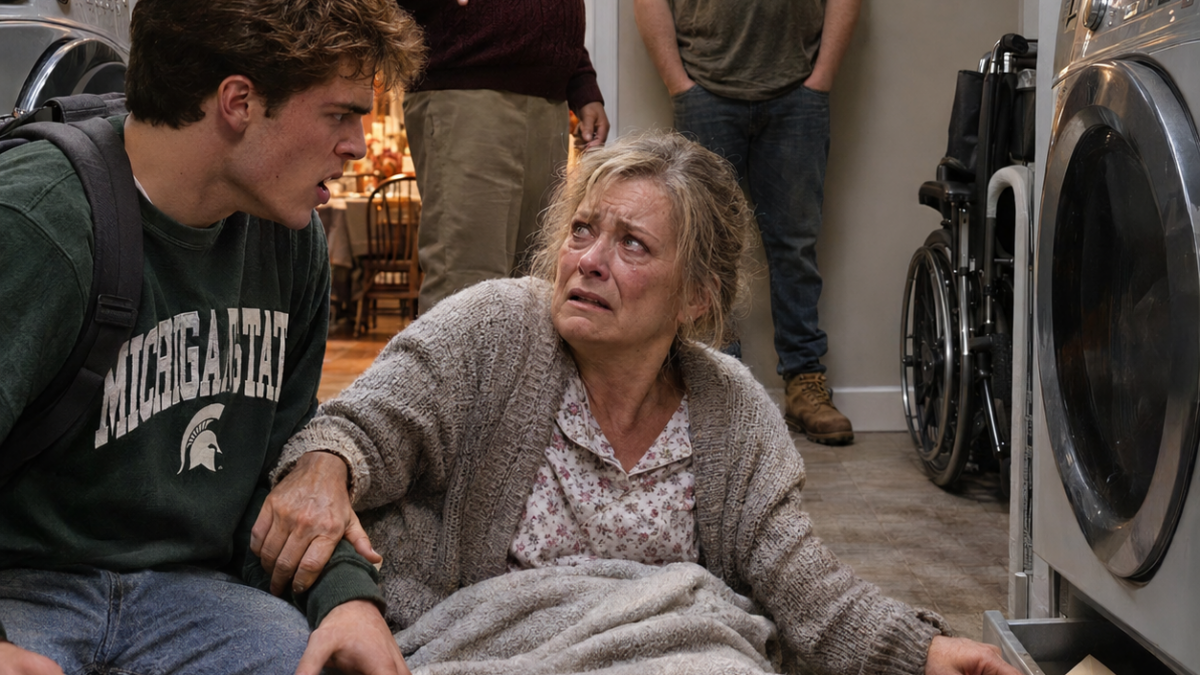
FULL STORY:I thought coming home early for Thanksgiving would mean surprising my mother with takeout and a hug, but instead I found her sleeping on a thin air mattress wedged between the washer and dryer, her wheelchair folded against the opposite wall where she couldn’t reach it, while my unemployed twenty-seven-year-old stepbrother slept upstairs in her bed with his boots still on.
FULL STORY CONTINUATION
For several seconds, I just stared at her.
My brain was already halfway into a rescue plan.
Call the police.
Call my aunt.
Get Garrett out.
Get Brody out.
Put Mom in a hotel.
Take her back to Colorado.
Do something immediately.
That was how I thought help worked.
Someone was in trouble.
You moved fast.
Mom was asking me to slow down.
I crouched beside the mattress.
“I promise.”
She studied my face.
“You really mean that?”
“Yes.”
“You’re not going to call everybody you know the second I tell you what’s in there?”
“Not unless you’re in immediate danger.”
A faint smile appeared.
“There’s the social-work major.”
“Mom.”
“I’m serious.”
“So am I.”
She glanced toward the ceiling.
“Garrett took his sleeping pill.”
“And Brody?”
“He drank until he passed out.”
The ease with which she said it made me sick.
I pulled the envelope out.
Brown paper.
Creased corners.
Her handwriting across the front.
MARLENE WHITAKER — PERSONAL
Underneath:
If Wesley comes home, give this to him.
I looked up.
“You wrote my name.”
She nodded.
“You knew I was coming?”
“No.”
“Then why—”
“Because eventually you would.”
That sentence sat in my chest like a stone.
I opened it.
Inside was no single dramatic document.
There were several.
The deed to the house.
Bank statements.
A copy of Mom’s marriage certificate.
A durable power-of-attorney form naming Garrett.
A business card for a lawyer.
ELENA RUIZ — ELDER LAW & FAMILY ADVOCACY
And three pages of Mom’s handwriting.
Dates.
Amounts.
Short notes.
August 14 — Garrett took debit card. Said I lose things.
August 22 — missed neurology appointment. Garrett said driving was too expensive.
September 3 — Brody moved into Wesley’s room.
September 18 — Brody moved into primary bedroom. Garrett said I didn’t need it because I can’t handle stairs.
September 19 — air mattress moved into laundry room.
September 25 — wheelchair placed across room after argument. Garrett said he didn’t want me transferring alone.
October 2 — Garrett told Linda I’m confused sometimes. I am not confused.
That last sentence had two lines under it.
I kept reading.
October 9 — $1,800 withdrawal I didn’t approve.
October 13 — $600 given to Brody.
October 27 — Garrett changed the online banking password.
November 4 — he says all of this is for my safety.
The final line stopped me.
I am starting to feel like a visitor in the house Daniel left me.
Daniel.
My father.
I lowered the papers.
The deed was in Mom’s name alone.
Garrett did not own the house.
Brody certainly didn’t.
Yet less than an hour earlier Garrett had looked me in the eye and said:
This is my house now, kid.
“He knows the house is yours?”
I asked.
Mom gave a tired laugh.
“Of course.”
“Then why does he keep saying it’s his?”
“Because if someone says something often enough…”
She looked down.
“…eventually you get too tired to correct them.”
I felt something inside me go cold.
“Has he ever hit you?”
“No.”
“Has he threatened you?”
“Not like that.”
“What does that mean?”
Mom rubbed one thumb across the blanket.
“He gets angry.”
“He stops talking to me.”
“He takes my phone because he says I get worked up.”
“If I argue about appointments, he says I’m confused.”
“Sometimes he stands in a doorway when I’m trying to leave.”
She paused.
“And if I push too hard, he makes everything more difficult afterward.”
I wanted to stand up.
She knew.
“Stay.”
“I’m staying.”
“Wesley.”
“I’m not doing anything.”
“You’re doing the face.”
“What face?”
“The one your father used before doing something expensive and stupid.”
Despite everything, I laughed.
Then hated myself for laughing.
Mom didn’t.
For a few seconds, we both smiled.
Then I picked up the power-of-attorney document.
“When did you sign this?”
“Last year.”
“Did you have your own attorney?”
“No.”
“Did anyone explain exactly what Garrett could do?”
“Not really.”
I closed my eyes.
“Mom.”
“Stop saying my name like I committed a felony.”
I almost smiled again.
Then I noticed the letter from Elena Ruiz.
Six weeks old.
I unfolded it.
Dear Ms. Whitaker,
Thank you for speaking with me by telephone. As discussed, a diagnosis of multiple sclerosis does not by itself establish legal incapacity. If you wish to revoke the existing power of attorney, review financial transactions, or discuss your marriage and residence, please contact my office from a safe phone or through someone you trust.
“You already called her.”
Mom nodded.
“From a pharmacy.”
“Why there?”
“Garrett was at work.”
“He thought I was having bloodwork done.”
“What stopped you from calling again?”
“I needed documents.”
Her eyes moved toward the envelope.
Then, after a long pause:
“And I was scared.”
That word hurt more than almost anything else.
My mother was not easily frightened.
She had buried my father.
Fought insurance companies.
Learned how to transfer from bed to wheelchair when one leg stopped cooperating.
Raised me through every stupid decision I made between twelve and eighteen.
Now she was afraid to call a lawyer in her own marriage.
I leaned closer.
“What do you want?”
She stared at me.
Not at the papers.
Not toward the stairs.
At me.
“I want Garrett out.”
I waited.
“And Brody.”
I nodded.
“I want my debit card back.”
“I want my wheelchair where I leave it.”
“I want to go to my neurologist without asking whether someone is willing to drive me.”
Her mouth trembled.
“I want my bedroom back.”
Then, quieter:
“And I want a divorce.”
I took her hand.
“Okay.”
Her eyes filled.
“That’s all?”
“What do you mean?”
“You’re not going to tell me to think about it?”
“You’ve had two months to think about it next to a dryer.”
She laughed.
Then broke into tears.
I moved onto the floor beside the mattress and held her.
For the first time that night, she stopped trying to make me feel better.
Eventually I asked the wrong question.
“How did it get this far?”
Mom stiffened.
I knew immediately I had phrased it badly.
She looked toward the folded wheelchair.
“At first, everything had a reason.”
“Brody’s job loss was temporary.”
“My relapse was bad.”
“The downstairs bathroom was easier.”
“Garrett said I’d be safer sleeping downstairs.”
“He said we’d buy a proper bed.”
“Then money was tight.”
“Then Brody’s back hurt.”
“Then one night on the mattress became a week.”
“A week became a month.”
She looked around the small room.
“You know what happens when something changes only a little at a time?”
I shook my head.
“You adjust.”
“The first night I was furious.”
“By the fifth, I was humiliated.”
“By the twentieth…”
She swallowed.
“…I stopped thinking of the bedroom upstairs as mine.”
That was the moment I understood something my textbooks had never made me feel.
Control does not always arrive loudly.
Sometimes it comes disguised as convenience.
Practicality.
Safety.
Care.
One small compromise becomes another until the person living inside them no longer remembers what normal used to feel like.
We did not call anyone that night.
Mom did not want to.
There was no immediate medical emergency that required me to override her decision.
I hated respecting that.
Which meant I needed to.
We made a plan.
Garrett left around seven for work.
Brody normally slept late.
Mom would call Elena from my phone.
We would pack the things she chose.
I would photograph the laundry-room setup and anything else she asked me to document.
Nothing sneaky.
Nothing taken from Garrett’s private property.
Only Mom’s records and the conditions she was living in.
Before sleeping, she showed me one more thing.
An old paperback on a shelf.
Inside was a transportation card.
“You still have this?”
“Garrett thinks I canceled the account.”
“You didn’t?”
“No.”
She sounded almost proud.
“You’ve been planning longer than you told me.”
“Six weeks.”
“Then why wait for me?”
She looked offended.
“I wasn’t waiting for you.”
That stopped me.
“I was trying to get strong enough to do it myself.”
“What changed?”
“Brody told Garrett he might stay through spring.”
She looked toward the ceiling.
“And Garrett told him he could turn your old room into an office.”
My anger rose again.
Mom saw it.
“No face.”
“I’m not making a face.”
“You absolutely are.”
At 6:42 the next morning, Brody appeared in the laundry-room doorway.
He stared at me on the floor.
“Why are you sleeping in here?”
I sat up.
“Why is my mother?”
Mom sighed.
“Wesley.”
Brody rubbed his face.
“She wanted to be downstairs.”
Mom looked at him.
“No.”
He blinked.
“What?”
“I wanted a bedroom downstairs.”
“That is not the same thing as wanting an air mattress beside a washing machine.”
He gave a little laugh.
Like she was being difficult.
“You said the stairs were hard.”
“They are.”
“So?”
“So you gave yourself my bed.”
“My back was screwed up.”
Mom’s face barely changed.
“I’m sure it hurt.”
Brody seemed relieved for half a second.
Then she added:
“It still wasn’t your room.”
Silence.
Garrett called from the kitchen.
“Brody!”
Brody looked at me.
Then left.
Mom turned toward me.
“Do not start.”
“I didn’t say anything.”
“You were about to.”
“Probably.”
She tried not to smile.
At breakfast, Garrett played caretaker.
He moved Mom’s medication bottle closer.
Poured coffee.
Asked whether her hands were worse.
If I had arrived at that moment instead of the night before, I might have thought he was attentive.
That was part of what made everything so confusing.
People do not behave badly every minute of every day.
Sometimes someone can install a grab bar and still take your bank card.
Sometimes they remember your pills while making sure you cannot easily leave the room.
Garrett looked at me.
“How long are you here?”
“Through Thanksgiving.”
“You should’ve called.”
“Why?”
“Your mother could’ve prepared.”
I looked at Mom.
She lowered her eyes.
I said nothing.
Garrett went on.
“School good?”
“Fine.”
“Still doing social work?”
“Yes.”
“Lot of debt for not much money.”
“Good thing it’s my career.”
His face tightened.
“Watch your tone.”
Brody opened the freezer.
“Any bacon?”
Garrett answered him.
The conversation moved on.
I could feel my mother waiting for me to explode.
I didn’t.
That morning, restraint was the most useful thing I could give her.
Garrett’s truck pulled away at 7:21.
We waited.
Brody went back upstairs.
At 7:34, Mom called the lawyer.
“Elena Ruiz.”
Mom froze.
I watched her lose courage.
Then find it again.
“This is Marlene Whitaker.”
The woman’s voice changed immediately.
“Marlene.”
“I’m glad you called.”
Mom began crying.
Elena did not rush to fill the silence.
Eventually Mom said:
“My son came home.”
“I’m ready to leave.”
Elena asked whether she was in immediate danger.
No.
Whether Garrett was there.
No.
Brody?
Upstairs.
Identification?
Yes.
Medication?
Yes.
Medical records?
Yes.
Mobility equipment?
Her chair.
Then Elena asked something that mattered.
“Marlene, I need to hear this from you.”
Mom straightened.
“Are you leaving because Wesley wants you to, or because you want to?”
“I want to.”
“Do you understand that leaving may involve legal proceedings, financial disputes, and conflict?”
“Yes.”
“Do you want me to represent you?”
“Yes.”
A tiny word.
But afterward, the room felt different.
We packed.
Mom insisted on one suitcase.
I insisted on two.
We compromised at two.
Clothes.
Medication.
Medical records.
Computer.
Chargers.
Her jewelry.
My father’s photograph from her bedside drawer.
She tucked it between two sweaters.
I noticed.
Did not comment.
We also unfolded her wheelchair.
She directed every step.
“Lock the brakes.”
“Closer.”
“No, not that side.”
“Arm only.”
I followed.
Because help done correctly is not grabbing someone faster.
It is letting them tell you how.
Brody came downstairs at 9:17.
He saw the luggage.
“What’s going on?”
Mom answered.
“I’m leaving for a while.”
“With suitcases?”
“Yes.”
“Where?”
“That is not your business.”
He stared.
“What did Wesley tell you?”
Mom’s hand hit the wheelchair arm.
“He didn’t tell me anything.”
Brody laughed nervously.
“Okay.”
“You’re acting weird.”
Then he stood partly in front of the hallway.
I moved.
Mom said:
“Wesley.”
I stopped.
She looked at Brody.
“Move.”
“I’m just asking—”
“Move out of my way.”
He hesitated.
Then stepped aside.
Mom rolled past him.
Her hands were shaking.
But she did not stop.
At the front door, she paused.
Looked back.
This was the house she and Dad had bought when I was four.
The house with the mesquite tree he planted.
The walls I had marked with my height.
The porch where Mom and Dad used to drink coffee.
The ramp Garrett had built when she still believed practical help meant safety.
“You ready?”
I asked.
“No.”
She inhaled.
“Go anyway.”
I followed.
Elena’s office was quiet.
Wide doors.
No loose rug.
Enough room for Mom to turn her chair without asking anyone to move.
I noticed all of it.
Mom caught me looking.
“Your degree is working.”
“Maybe.”
Elena shook Mom’s hand before mine.
Then made something clear immediately.
“Marlene is my client.”
She looked at me.
“You can stay if she wants you here.”
Mom said:
“He stays.”
For the next hour and a half, I listened.
Elena did not ask:
Why didn’t you leave earlier?
She asked:
“When did you lose control of your debit card?”
“When did you last access your bank account yourself?”
“Has Garrett prevented medical appointments?”
“Has he ever threatened you?”
“Has he represented you as mentally confused to providers or family?”
Mom answered.
Some of it I knew.
Some I didn’t.
Garrett had access to one household account.
He had also been using the power of attorney to access funds belonging to Mom.
There had been withdrawals and payments she did not recognize.
Nothing fantastical.
No secret millions.
Just enough money moving quietly enough that she had begun losing track of what was hers.
Elena held up the power-of-attorney document.
“Do you want this revoked?”
“Yes.”
“Do you want your banks notified?”
“Yes.”
“Do you want Garrett to retain access to accounts held solely in your name?”
“No.”
Then:
“Do you want him living in the house while the divorce proceeds?”
Mom took longer.
Eventually:
“No.”
Elena nodded.
“We’ll look at lawful options.”
No promise of instant revenge.
No dramatic eviction by sunset.
Just process.
And Mom making decisions inside it.
Then Elena said something I watched land inside my mother.
“Multiple sclerosis may affect mobility, fatigue, sensation, vision, and other functions.”
She leaned forward.
“But needing physical assistance does not automatically mean you have lost the ability to make your own decisions.”
Mom looked away.
Her eyes filled.
“I know I’m not stupid.”
“I didn’t say you were.”
“I know.”
Mom wiped her face.
“I think I needed to hear somebody else say it.”
Garrett started calling at 1:47.
Mom watched the screen.
Did not answer.
Again.
Again.
Then texts.
Where are you?
Brody says Wesley took you.
She almost laughed.
“Took me.”
Elena said:
“You can reply if you want.”
Mom typed.
Deleted.
Typed again.
Finally:
I left voluntarily with Wesley. I am safe. Do not contact him about my decision. My attorney will contact you.
She showed me.
“Okay?”
I nearly said yes automatically.
Caught myself.
“Do you want to send it?”
She looked at me.
Then pressed send.
The phone rang immediately.
She silenced it.
Then shut it off.
Her hands trembled.
Being free did not feel like freedom yet.
It felt like fear with more choices.
For three nights, we stayed in an accessible hotel.
Mom approved contact with a disability advocate and an adult-services caseworker who could help document what had been happening and connect her with support.
The process was boring.
Which was good.
Forms.
Calls.
Appointments.
Medical records.
Bank notifications.
A real exit often looks nothing like television.
It looks like paperwork.
Garrett texted me constantly.
You don’t know what caregiving does to a person.
Your mother is scared and confused.
Then:
Brody has nowhere to go.
That one nearly made me throw my phone.
The man sleeping in my mother’s bed suddenly deserved housing dignity.
Mom, apparently, had not.
I asked whether she wanted to see the messages.
“Yes.”
She read them.
Stopped at Brody.
Then said:
“Neither did I.”
Nothing else.
At her neurology appointment, Mom finally told Dr. Shah where she had been sleeping.
He stopped writing.
“What?”
She explained.
Then told him Garrett had been answering questions for her.
Calling her forgetful.
Describing disagreements as confusion.
With Mom’s agreement, Dr. Shah performed an appropriate cognitive assessment and documented her condition and decision-making abilities at that visit.
She missed one recall item.
Got angry.
He smiled.
“Marlene, people without MS miss words.”
She laughed.
That laugh sounded like relief.
For months, Garrett had turned every hesitation into evidence.
Now someone qualified was writing down the obvious:
Her disability was not permission to erase her.
Three days before Thanksgiving, Mom said:
“I want to go back.”
My stomach tightened.
“To the house?”
“Yes.”
“You want to move back now?”
“No.”
She looked annoyed.
“I want my things.”
Elena arranged the visit carefully.
Aunt Linda came too.
Mom’s older sister.
Five feet two inches of religious conviction and barely restrained violence.
Before we went inside, Mom warned her:
“If you start anything, you sit in the car.”
Linda mimed zipping her mouth.
I did not trust her.
Garrett opened the door.
Unshaven.
Tired.
Brody sat in the living room with a video game controller.
Garrett looked at our little group.
“You brought backup.”
Mom rolled forward.
“I brought my sister.”
“I know who Linda is.”
Linda smiled.
Terrifyingly.
Mom said:
“I’m collecting my belongings.”
Garrett ignored her and looked at me.
“This is your doing.”
Mom said:
“Look at me.”
He kept looking at me.
“Wesley filled your head with—”
“Garrett.”
Her voice cracked through the room.
He finally looked at her.
“This is why I left.”
“What?”
“You don’t speak to me anymore.”
“You speak around me.”
“You tell doctors what I think.”
“You tell Wesley what I need.”
“You tell everyone I’m confused.”
“And now I’m sitting right here telling you that I want a divorce, and you’re still asking my son why.”
The room went still.
Garrett looked at her.
Then something bitter came out.
“You think I wanted this?”
Mom’s face emptied.
He continued.
“I’ve spent years taking care of you.”
There it was.
The bill.
Not love.
The bill.
Mom asked:
“What did you give up?”
He stared.
“Appointments.”
“Driving.”
“Installing things.”
“All of it.”
Mom nodded slowly.
“And what did I give you?”
He looked away.
She pointed around.
“This house.”
“You moved in here.”
“My money covered most of the household bills.”
“You used my car.”
“I cooked until my hands became too unreliable.”
“I washed clothes.”
“I tried to be your wife.”
Her voice broke.
“Then your grown son needed my bedroom, and suddenly I was lucky you tolerated me.”
Garrett said nothing.
Mom whispered:
“I didn’t marry you because I needed a caretaker.”
“I married you because I thought you loved me.”
That sentence hurt even him.
I could see it.
Brody stood.
“This whole thing is ridiculous.”
Mom turned.
“My back was messed up.”
“So?”
Mom stared.
“You want to know what the difference was?”
He folded his arms.
“It was my room.”
That was all.
Not bigger.
Not more dramatic.
Mine.
Brody looked at his father.
Mom saw.
“So did you.”
She said.
“You always looked at him when I objected.”
“You never thought you needed my permission.”
Brody’s face reddened.
I stepped forward.
Mom raised her hand.
I stayed where I was.
She did not need me to finish this conversation.
We packed her clothes.
Medical supplies.
Computer.
Family jewelry.
Dad’s photographs.
Upstairs, Mom stopped at the entrance to her bedroom.
Brody’s boots were beside the bed.
His jacket hung across one of her chairs.
Her lavender quilt had been shoved into the closet.
She pulled it out.
Held it against her chest.
For a moment, she looked lost.
“Ready?”
I asked.
“No.”
Then she smiled through tears.
“Go anyway.”
Before we left, she rolled into the laundry room.
The mattress was still there.
That made me angrier than if Garrett had thrown it away.
Leaving it meant he still thought there was nothing to be ashamed of.
Mom opened the dryer drawer.
Empty now.
She ran her fingertips along the wood.
“This was the safest place in the house.”
My throat closed.
She pushed the drawer shut.
“No more.”
Then she left.
Thanksgiving arrived before the legal process finished.
Of course.
No movie-style victory.
No dramatic court ruling at dinner.
We ate in the hotel.
Room 214.
Restaurant turkey reheated in a microwave.
Mashed potatoes.
Aunt Linda’s pie.
Paper plates because I forgot anything better.
Halfway through, Mom looked around and started laughing.
“What?”
I asked.
“This is the saddest Thanksgiving table I have ever seen.”
Linda lifted a plastic fork.
“Luxury.”
Mom laughed harder.
Then suddenly cried.
“I’m sorry.”
“Why?”
“I should be happy.”
“I got out.”
“You don’t have to be happy yet.”
“I miss him.”
I froze.
She saw my face.
“That’s the part I hate.”
“I miss who he used to be.”
“The man who drove me to therapy.”
“The man who stayed awake with me during spasms.”
“The one who learned how my wheelchair folded.”
She cried.
“I miss somebody I’m also furious with.”
“That makes me feel stupid.”
“You’re not stupid.”
“I stayed.”
“You hoped the beginning would come back.”
She looked at me.
Then nodded.
That was grief too.
Not only losing a marriage.
Losing the version of it that once felt real.
I tried staying in Tucson.
Mom stopped me.
Classes resumed after Thanksgiving.
I told her I would take a semester off.
“No.”
“I already emailed my adviser.”
“Email again.”
“Mom.”
“Wesley Whitaker.”
Full name.
I knew I was losing.
“I’m not leaving you here alone.”
“I’m not alone.”
She counted.
“Elena.”
“Linda.”
“Dr. Shah.”
“My advocate.”
“Support services.”
“Tasha when we hire her.”
Then:
“I am building a team.”
“I am not replacing Garrett with my son.”
That sentence stung.
Because I had imagined exactly that.
I would become the dependable man.
Handle everything.
Make sure no one ever hurt her again.
It sounded loving.
It was still control if she didn’t choose it.
Mom looked at me.
“Go finish school.”
“What if you need me?”
“I will tell you.”
“What if you don’t?”
“Then trust me.”
I returned to Colorado.
I cried on the plane.
Two weeks later, a photograph arrived on my phone.
Her wheelchair.
Unfolded.
Parked beside a real bed.
The caption:
Revolutionary concept.
I laughed so loudly in the library that someone glared at me.
Then I cried.
The divorce took nine months.
Not nine dramatic months.
Nine tedious ones.
Financial records.
Property questions.
Temporary arrangements.
Lawyers.
Arguments.
Garrett claimed contributions to the house.
His lawyer made arguments.
Elena answered.
Mom kept me involved only as much as she wanted.
That became part of my education too.
I was her son.
Not counsel.
Not guardian.
Not decision-maker.
The financial review found money Mom had not knowingly authorized.
Some of it became part of the settlement.
Some transactions were difficult to challenge.
Garrett eventually agreed to repay part of the disputed amount over time.
It did not undo anything.
What mattered more to Mom was ending his access.
The day the bank confirmed the power of attorney had been revoked and her sole accounts were under her control again, she called me.
“I bought groceries.”
“Congratulations?”
“With my own debit card.”
I understood.
“Oh.”
“Coffee.”
“Yogurt.”
“Oranges.”
“Chocolate.”
“Wild living.”
Then her voice cracked.
“I didn’t ask anyone first.”
I sat down outside the student union.
“No.”
“You didn’t.”
When the court process eventually allowed Mom to return to the house with exclusive use while the separation continued, she did not reclaim the upstairs bedroom.
That surprised me.
She turned the downstairs den into a proper accessible bedroom.
Real bed.
Wide entrance.
Adapted bathroom.
Closet at a height she could reach.
Everything placed according to her instructions.
I asked why she did not move back upstairs for symbolic reasons.
Mom rolled her eyes.
“I don’t need a staircase to prove I won.”
Good answer.
The laundry room changed later.
For months, she avoided it.
The smell of detergent made her tense.
Eventually she hired a contractor.
Shelving replaced the space where the mattress had been.
The plastic chair disappeared.
The air mattress went into the trash.
Aunt Linda offered to stab it first.
Mom said:
“Please stop trying to turn my life into a crime documentary.”
The contractor pretended not to hear.
Garrett wrote letters.
At first, they were almost-apologies.
I never intended this.
Caregiving is difficult.
Brody was struggling.
We both made mistakes.
Mom did not respond.
Months later, another arrived.
Different.
Garrett wrote that counseling had forced him to see something ugly.
At some point, he stopped treating help as love and began treating it as proof that Mom owed him obedience.
He admitted moving her wheelchair had been controlling.
Admitted telling doctors she was confused when what he really meant was that she disagreed with him.
Admitted resenting Brody’s failures and taking some of that resentment out on her.
Mom cried while reading it.
“What will you do?”
I asked.
“Nothing.”
“Do you forgive him?”
“I don’t know.”
“Do you want him back?”
“No.”
“Then you don’t have to solve forgiveness today.”
She folded the letter.
Kept it.
Accountability mattered even without reconciliation.
Brody apologized much later.
Nearly two years.
He explained his back pain.
Depression.
Job loss.
Embarrassment.
Then finally wrote the sentence that mattered.
None of that made your bedroom mine.
Mom read it twice.
Another line:
I knew where you were sleeping. I told myself Dad had decided it, so it wasn’t my responsibility. But I slept in your bed anyway. I’m sorry.
Mom answered:
Thank you for apologizing. I hope your life is improving. I am not ready for further contact.
No revenge.
No absolution.
A boundary.
I made mistakes afterward too.
A lot.
I called too often.
“Medication?”
“Yes.”
“Appointment?”
“Yes.”
“Transportation?”
“Yes.”
“Bank?”
“Wesley.”
One day Mom stopped me.
“Ask whether I want help.”
“I’m only trying to—”
“I know.”
She paused.
“That’s what Garrett said.”
I went quiet.
She immediately looked guilty.
“I’m sorry.”
“No.”
“You’re right.”
That lesson hurt.
My motive was different.
The effect could still become similar.
So I practiced.
“Want help?”
Sometimes she said yes.
Sometimes no.
No stopped feeling like rejection.
School changed after that.
Terms that once lived in textbooks became painfully real.
Autonomy.
Financial exploitation.
Coercive control.
Supported decision-making.
Capacity.
Caregiver stress.
Most importantly, I stopped imagining vulnerable adults as people whose lives professionals should solve.
Mom never needed someone to replace her judgment.
She needed information.
Legal support.
Medical documentation.
Accessible transportation.
People willing to believe her.
And someone who would ask:
What do you want?
That became the most valuable question I carried into my career.
The next Thanksgiving, I came home early again.
This time Mom knew.
The front door opened before I reached it.
She was in her wheelchair at the kitchen counter.
The house smelled like cinnamon.
No cigarettes.
No beer cans.
No air mattress.
Flour covered half the kitchen.
“What happened?”
“I’m baking.”
“This looks more like evidence.”
“Get out.”
I hugged her.
Then my eyes drifted toward the laundry room.
Mom noticed.
“Go.”
“What?”
“Look.”
I walked in.
Bright.
Organized.
Open floor.
Shelving where the mattress had been.
She rolled behind me.
Opened the drawer beneath the dryer.
Inside was a white envelope.
She handed it to me.
I opened it.
The original brown envelope was inside.
Empty.
The legal papers had gone where important documents belong.
Mom had kept only the shell.
Across it, she had written:
THE LAST PLACE I HID MYSELF.
I looked at her.
“Very dramatic.”
“I’ve been spending too much time with Linda.”
From the kitchen:
“I heard that.”
Of course.
That Thanksgiving, Mom sat where she wanted.
At the head of the table.
Elena came for dessert.
Tasha, the home-care aide Mom had chosen, joined us too.
Halfway through dinner, Aunt Linda lifted her glass.
“To Marlene.”
Mom groaned.
“No speeches.”
“To my sister, who has finally proven she has terrible taste in husbands.”
Everyone froze.
Mom laughed first.
Then all of us did.
Healing sometimes means the story becomes something you can touch without bleeding every time.
Mom joined the city’s adaptive community advisory council.
She spent two years arguing about curb cuts, accessible bathrooms, paratransit, and building access.
At one meeting, a contractor referred to people as “wheelchair-bound.”
Mom interrupted.
“My wheelchair is what lets me leave my house.”
The clip circulated locally.
I sent it to classmates.
She called me.
“Take that down.”
“No.”
“Wesley.”
“Public figure.”
“Brat.”
She sounded alive.
When I graduated at twenty-two, Mom came to Colorado.
Blue dress.
Wheelchair.
Aunt Linda.
Tasha.
When my name was called, I crossed the stage and looked toward her.
She pushed herself partly upright from the chair.
Her legs shook.
She waved.
I almost tripped.
Afterward:
“You weren’t supposed to do that.”
She raised an eyebrow.
“You don’t decide what my body does.”
Fair.
Then she gave me Dad’s watch.
“I thought this was lost.”
“No.”
“Why now?”
“Your father loved helping people.”
She closed my fingers around it.
“But he never thought loving somebody gave him ownership of their choices.”
She looked at me.
“Remember that.”
I did.
The divorce eventually became final.
Mom sat at the kitchen table with the papers.
No party.
No champagne.
She removed her wedding ring slowly.
“I loved him.”
“I know.”
“That’s what I hate.”
“Why?”
“It would be easier if none of it had been real.”
But parts had been.
That is what made the betrayal painful.
She sold the ring later.
Used the money to buy a power-assist attachment for her wheelchair that insurance had declined to cover.
She called me after trying it.
“Best gift Garrett ever bought me.”
I laughed until my stomach hurt.
Brody found work eventually.
Good.
Garrett continued his payments.
Good.
Neither man needed to be destroyed for Mom to heal.
The goal had never been their ruin.
It was her freedom.
The house became noisy again.
Book club.
Aunt Linda.
Neighbors.
Friends from the MS support group.
Coffee.
Arguments.
Music.
For months before I came home, Garrett had slowly reduced visitors because Mom “tired easily.”
After he left, she discovered she preferred being tired from living over being rested from isolation.
Her disease continued.
Freedom did not cure MS.
There were relapses.
Medication changes.
Bad days when she needed help dressing.
Days when holding a fork was difficult.
But the difference was enormous.
A hard day belonged to her.
It was not evidence that someone else should take over her life.
She hired help.
Chose schedules.
Changed aides when she wanted.
Tasha always asked:
“Do you want help?”
Mom loved her for it.
Years later, I caught myself making the same mistake again.
Mom was having a rough week.
I started organizing everything.
Appointments.
Transportation.
Meals.
She let me go for two minutes.
Then:
“Are you finished managing me?”
I stopped.
“I’m worried.”
“I know.”
“What do you need?”
She smiled.
“Soup.”
That was it.
Soup.
Not a new care plan.
Not a son taking over.
Soup.
I made soup.
Progress.
When I became a social worker, I kept one photograph in my office.
Not the laundry room.
Never that.
I had documented the environment with Mom’s permission, but I refused to define her by her worst night.
The picture on my desk was from graduation.
Mom in blue.
Laughing.
One hand raised.
On the back:
ASK WHAT THEY WANT.
Whenever I became impatient with a client’s choices, I looked at it.
Once, an adult son came into my office with his disabled father.
He answered every question.
Where Dad should live.
What Dad needed.
What Dad could handle.
I watched the father become smaller inside the conversation.
Then I remembered Mom.
I turned toward him.
“What do you want?”
His son stopped talking.
The father looked surprised.
Then answered.
That moment felt like something passing from my mother through me to someone she would never meet.
Mom never remarried.
Not because nobody wanted her.
A man named Frank from her MS support group flirted shamelessly for years.
They went to movies.
Restaurants.
Museums.
I once asked why she wouldn’t marry him.
“I like my own bathroom.”
Reasonable.
Their relationship mattered anyway.
Love did not need legal paperwork to prove itself.
When I married Hannah years later, Mom adored her.
Mostly because Hannah argued with me.
At our rehearsal dinner, Mom told her:
“Never let Wesley confuse helping with managing.”
Hannah raised her glass.
“Already working on it.”
Traitors.
Both of them.
Before the wedding, Hannah asked Mom:
“Do you want help with your dress?”
Mom said yes.
No defensiveness.
No shame.
Because chosen help felt completely different from imposed control.
That became another lesson.
The goal had never been total independence.
Nobody is totally independent.
The goal was deciding what dependence looked like.
Who helped.
When.
How.
Why.
When Mom’s health eventually required more daily support, she planned it herself.
Care agency.
Schedule.
Backup.
Equipment.
I offered to move closer.
She said:
“Visit.”
“Call.”
“Come when I ask.”
“Do not make your entire adulthood a response to my disease.”
The same woman who had sent me to college was still sending me into my own life.
This time, I listened sooner.
Ten years after that Thanksgiving, I flew to Tucson five days early.
Tradition.
Mom was seventy-two.
Her MS had progressed.
Power wheelchair now.
More help each day.
But the house was full of life.
When I arrived, she was supervising pie preparation.
Not actually cooking.
Smart.
“You’re early.”
“Five days.”
She smiled.
“I remember.”
I kissed her forehead.
Then my eyes drifted toward the laundry room.
She noticed.
“You still do that?”
“What?”
“Check.”
“Sometimes.”
She rolled toward it.
On the wall was a framed sentence.
HELP IS SOMETHING I CHOOSE, NOT SOMETHING THAT CHOOSES FOR ME.
I stared.
“You wrote this?”
“Yes.”
“Sounds like a brochure.”
“Shut up.”
I laughed.
Then cried.
Mom rolled her eyes.
“You cry too much.”
Later, we sat alone.
She looked toward the laundry room.
“Do you wish you came home sooner?”
I asked.
She thought.
“No.”
The answer surprised me.
“Why?”
“Because I needed leaving to become my decision.”
“What if things had gotten worse?”
“They might have.”
“That scares me.”
“Me too.”
Then she said:
“But I needed you to arrive as my son.”
“Not as another owner.”
That sentence stayed with me.
Years later, when Mom chose to sell the Tucson house and move to an accessible community closer to me and Hannah, we planned for six months.
She toured three places.
Rejected one because the lighting was terrible.
Another because the dining room smelled like boiled vegetables.
The third had a patio.
She chose it.
Not me.
Before we emptied the Tucson house, she asked to visit the laundry room one last time.
I waited at the doorway.
She looked at the floor.
“This is where I thought my life had become small.”
I said nothing.
She continued:
“MS didn’t make it small.”
“Garrett did.”
Then she smiled.
“And then I helped make it bigger again.”
I.
Not Wesley.
Not Elena.
Not Linda.
I.
That word mattered.
She opened the dryer drawer.
Empty.
Touched the bottom once.
Then closed it.
“No ghosts?”
I asked.
“A few.”
She rolled toward me.
“They can stay.”
We left.
Mom’s new place had a patio.
Plants everywhere.
She forgot to water half of them.
My daughter Ellie grew up thinking Grandma’s wheelchair was simply part of Grandma.
At nine, Ellie once stopped a stranger in a restaurant from moving the chair without asking.
“Please don’t touch my grandma’s mobility equipment.”
Mom looked so proud I thought she might burst.
That is what repair can look like across generations.
A child learning early that assistance begins with consent.
When Mom prepared advance directives later, she chose me for some responsibilities.
Before signing anything, she looked directly at me.
“You remember?”
“Yes.”
“If I can still speak for myself, the paper does not make your voice louder than mine.”
I swallowed.
“I remember.”
Then she signed.
Trust is not permanent surrender.
It is authority held under conditions chosen by the person giving it.
I understood now.
Mom’s later years had pain.
Fatigue.
Good days.
Bad days.
Granddaughter laughter.
Terrible television shows.
A patio full of half-dead plants.
She remained Marlene.
Not MS.
Not Garrett’s ex-wife.
Not Wesley’s vulnerable mother.
Marlene.
That distinction was everything.
She used to tell the Thanksgiving story differently every year.
Brody became larger.
The mattress became thinner.
Garrett’s undershirt acquired stains that I swear were not there.
I accused her of rewriting history.
She said:
“I survived it.”
“I own adaptation rights.”
Fair enough.
But the envelope never changed.
That part remained exact.
The drawer.
The handwriting.
The promise.
Don’t decide what happens to me without asking me first.
One day Mom mailed me that old empty envelope.
I called her.
“Why?”
“I don’t need it anymore.”
“What am I supposed to do with it?”
“Remember.”
“Remember what?”
She was quiet.
“That I was scared.”
I closed my eyes.
“People like the version of me who sounds brave.”
“I was brave.”
“But I was scared too.”
“Don’t turn me into a superhero.”
“I won’t.”
“Good.”
“Heroes are exhausting.”
Then she added:
“And remember you didn’t save me.”
“I know.”
“You helped.”
“I know.”
“Better.”
She was right.
The story was never:
A heroic son came home and rescued his disabled mother.
That version would have repeated Garrett’s mistake.
It would have made Mom an object inside somebody else’s narrative.
The real story was simpler.
A woman realized her marriage had become controlling.
She documented what was happening.
Called a lawyer.
Saved papers.
Protected a transportation card.
Waited for a safe opening.
Asked for help.
Then made decisions.
Her son happened to come home early.
I was useful.
I am proud of that.
But she chose the direction.
Garrett’s cruelest line remained:
Who else is going to marry a woman in a wheelchair?
For years, part of me wanted the perfect response.
Some sentence that would humiliate him.
Eventually I understood that answering the premise gave him too much power.
Mom’s worth had never depended on whether another man wanted to marry her.
She did not need a better husband to prove Garrett wrong.
She needed a life where marriage was optional and dignity was not.
She built one.
One of our last Thanksgivings together, Mom demanded pie before dinner.
I said no.
She stared at me.
“Excuse me?”
“You’ll ruin dinner.”
“Autonomy.”
“This is dessert.”
“Control.”
“This is nutrition.”
“Oppression.”
Ellie sided with Grandma.
Hannah did too.
Mom got pie.
She took one bite.
Raised her fork.
“Freedom.”
We laughed.
And somehow that silly moment told me more about recovery than the court case ever did.
Freedom did not always need to be noble.
Sometimes freedom was eating pie too early simply because nobody else had the right to stop you.
Every Thanksgiving, five days before the holiday, I remember opening that Tucson door.
Beer cans.
Cigarette smoke.
Brody in Mom’s bed.
Her wheelchair folded across the room.
The mattress squeezed between machines.
I remember feeling one command inside me:
Fix this.
Then I remember her shaking hand catching my wrist.
Promise me you won’t decide what happens to me without asking me first.
That promise changed everything.
Without it, I might have helped Mom escape one controlling man and accidentally become another person who assumed love gave me the right to choose for her.
Instead, she taught me to ask.
If I could stand beside my nineteen-year-old self in that laundry room, I would tell him:
Be furious.
You should be.
But sit down first.
Unfold the chair.
Ask before touching.
Wait until the house is quiet.
Open the envelope.
Listen.
Then ask the only question that matters.
Mom, what do you want?
Because Marlene Whitaker did not need somebody to write the ending for her.
She needed people willing to hold the door while she wrote it herself.
Elena helped.
Linda helped.
Doctors helped.
Tasha helped.
I helped.
But Mom remained the author.
And the first sentence of the life she reclaimed had been hidden beneath the dryer all along:
I want my life back.








