FULL STORY:I Pulled a Mother Pit Bull and Her Puppies From a Sewer in 2019—Three Years Later, All Four Dragged Me Off a Dark Highway and Saved My Life In the spring of 2019, when I was twenty-six, I climbed into a muddy drainage hole to pull out an exhausted mother pit bull and three puppies, never imagining that the four trembling dogs would eventually become the only family I had ever truly trusted.
FULL STORY CONTINUATION
I did not intend to keep all four.
Nobody sane intends to suddenly become responsible for a mother pit bull and three puppies.
At least that is what I told myself.
Hope needed veterinary care.
The puppies needed food, vaccinations, deworming, socialization, and eventually homes.
I told everyone:
“I’m only helping until they’re ready.”
Then Hope started waiting for me beside the door.
Lucky followed me into every room.
Shadow learned to sleep with his nose pressed against my boot.
And Baby—smallest of the litter—would crawl against Hope’s stomach and stare at me as if she had already decided I belonged there.
Weeks passed.
People asked whether I had found adopters.
I said:
“Working on it.”
Then another week.
Then another.
The truth was simple.
I could not separate them.
Maybe someone else could have.
I couldn’t.
Hope had survived that hole by keeping her puppies together.
The puppies slept in a pile.
Ate together.
Played together.
If one disappeared into another room, Hope checked.
Eventually I stopped pretending.
They were staying.
All four.
My little house became ridiculous almost overnight.
Dog beds.
Water bowls.
Leashes hanging near the door.
Chewed shoes.
Toys under furniture.
Dog hair everywhere.
I had never considered myself especially sentimental.
Then I became the man who kept photographs of puppies sleeping in absurd positions.
Life humiliates you efficiently.
Hope changed the most slowly.
The puppies were young.
The world became normal quickly.
Hope carried history.
Certain movements made her flinch.
Raised voices.
Metal clattering.
Someone approaching too quickly from behind.
She hated being left alone outside.
If I stepped inside and closed the door, she immediately stood against it.
So I learned.
I stopped closing doors when I didn’t need to.
I sat outside with her.
I let her decide distance.
And gradually she discovered something that seemed new to her.
People could leave a room and come back.
Food could appear every day.
Sleep did not require one eye open.
Her puppies could run into another room without vanishing forever.
The first time I saw Hope asleep on her back with all four legs loose, I stood there for almost a minute.
That posture meant something.
Not scientifically.
To me.
A dog who once guarded three puppies in mud now felt safe enough to expose her stomach to the world.
That mattered.
Lucky grew into the largest of the puppies.
Big head.
Wide chest.
Emotionally, however, he remained convinced he was six pounds.
He attempted to sit in my lap for years.
Shadow got his name because he followed Hope everywhere.
If she moved, he moved.
If she sat, he sat.
If she looked toward the kitchen, Shadow looked too.
Baby remained the smallest.
Fastest.
Most stubborn.
She could steal a sock without creating enough sound to alert a sleeping cat.
Not that we owned a cat.
Baby would probably have stolen from one anyway.
Together they developed a routine.
Breakfast.
Outside.
Nap.
Wait for Josh.
Explode when Josh came home.
Dinner.
Sleep.
Repeat.
For someone who had spent most of his adult life moving from place to place, job to job, trying to figure out what “home” was supposed to feel like, their certainty affected me.
I would open the door.
Four dogs looked at me like there was nowhere else I could possibly belong.
It is difficult to explain what that does to a person who has never felt particularly rooted.
By 2022, I had found work at a farm.
The owner didn’t mind dogs as long as they behaved.
Mine did.
Mostly.
Hope, Lucky, Shadow, and Baby began riding with me.
Back seat of the pickup.
Seat covers permanently destroyed.
They were not noisy travelers.
No barking at cars.
No climbing into the front.
Usually Hope lay nearest the door while the three younger dogs piled around her.
When I glanced into the mirror, I saw heads stacked against each other.
Sometimes I wondered whether they remembered that drainage hole.
Probably not the way humans remember.
Animals don’t sit around narrating their past.
But something remained in Hope.
The closeness.
The need to know where her family was.
The instinct to gather everyone.
Including me.
Especially me.
The accident happened on an autumn night in 2022.
I had stayed late at work.
By the time we left, it was close to eleven.
Rain had started hours earlier.
Not a storm.
Steady.
Cold.
The kind that turns pavement into black glass beneath headlights.
Hope and the others were in the rear.
I remember looking at them before pulling onto the road.
“Ready?”
Lucky raised his head.
Baby yawned.
Hope looked at me.
Shadow kept sleeping.
“Great enthusiasm.”
I started driving.
Visibility was terrible.
Windshield wipers moving hard.
The road mostly empty.
I had driven that route dozens of times.
Maybe hundreds.
That familiarity can be dangerous.
You stop expecting surprise.
I approached an intersection.
I did not see the other vehicle soon enough.
Stopped or nearly stopped ahead.
Dark.
Rain.
Then suddenly—
Red.
Metal.
Impact.
No time to think.
No time to brake enough.
The sound was enormous.
Then nothing.
When I came back to consciousness, my face was against wet pavement.
For several seconds I could not understand why rain was hitting me.
Then pain arrived.
Everywhere.
My left leg was wrong.
I did not need medical training to know it.
The angle alone told me.
My right elbow felt as if someone had driven a hammer through it.
Every breath stabbed through my ribs.
One side of my chest felt tight.
Compressed.
I tried moving.
The world turned black around the edges.
I stopped.
“Help.”
The word barely came out.
Then I remembered the dogs.
My truck.
The door.
I turned my head.
Pickup damaged.
Driver’s door open.
Glass everywhere.
Rear door partly open.
“Hope?”
Nothing.
Panic hit harder than the pain.
“Lucky!”
A shape moved beside the truck.
Then another.
Hope appeared first.
Rain darkened her coat.
She came toward me.
Sniffed my face.
Whined.
“Hey.”
I tried lifting my hand.
Couldn’t.
“You okay?”
Ridiculous question.
She licked my cheek once.
Then moved around me.
I could barely see beyond my headlights.
The other car sat at the intersection.
A woman slumped forward against the steering wheel.
Later I would learn her name was Linda Collins.
Fifty-two.
At that moment, I did not know whether she was alive.
I could do nothing for her.
I could do nothing for myself.
The road was dark.
And I was lying almost directly in the travel lane.
That realization cut through the confusion.
Cars usually moved fast there.
A driver coming around the bend would see the wreck.
Maybe.
But me?
Dark jacket.
Wet pavement.
Low visibility.
Maybe not.
I tried pulling myself.
Pain exploded through my leg.
I screamed.
Then everything disappeared again.
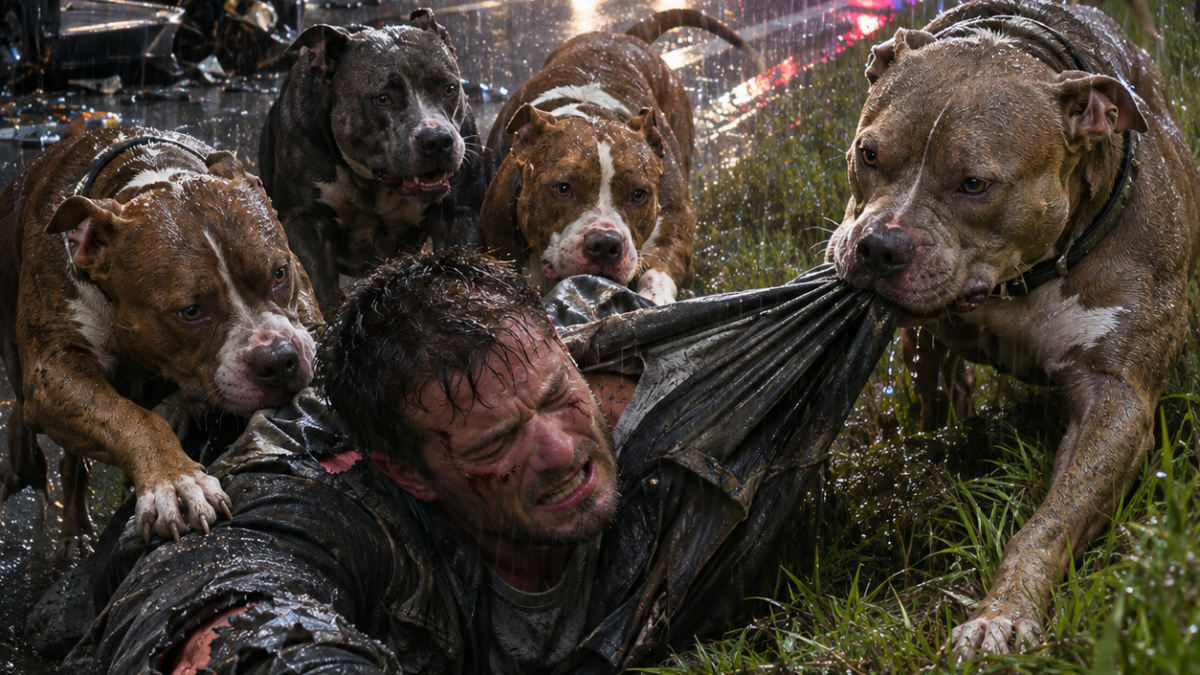
I woke because something was pulling my jacket.
My first confused thought was that a paramedic had arrived.
Then I heard growling.
Not aggressive growling.
Effort.
I opened my eyes.
Hope had my jacket collar in her mouth.
She was pulling backward.
Her paws slid on the wet asphalt.
She released.
Adjusted.
Pulled again.
“Hope.”
My voice came out broken.
“What are you doing?”
She pulled.
My body moved.
Maybe an inch.
Maybe less.
Pain shot through my ribs.
I nearly passed out.
Then another dog appeared beside her.
Lucky.
He grabbed fabric near my shoulder.
Hope released.
Lucky pulled.
Shadow joined.
Then Baby.
They did not work in perfect coordination like trained rescue animals.
They were dogs.
They grabbed where they could.
Released.
Moved.
Pulled again.
Sometimes two at once.
Sometimes only Hope.
My jacket twisted around my neck.
My injured leg dragged.
Every movement hurt.
I remember crying out.
“Stop.”
They did not.
Thank God.
Hope pulled again.
One step.
Two.
Her hind legs slipped.
She recovered.
Lucky grabbed my sleeve.
Shadow pulled at the side of my jacket.
Baby tried the lower edge.
I was too injured to help.
All I could do was lie there and understand what they were trying to accomplish.
Move Josh.
Off road.
Family in danger.
Move him.
That was it.
No miracle.
No complex reasoning required.
They knew I was down.
They knew the road was wrong.
They moved me.
Later, police measured the distance.
Nearly thirty feet.
Close to ten yards.
At the time it felt like miles.
Every foot cost pain.
I drifted in and out.
Rain.
Dogs.
Headlights from my damaged truck.
Hope’s breathing.
Then grass beneath part of my body.
Shoulder off pavement.
Another pull.
Finally they dragged me near a large tree beside the road.
Hope released my jacket.
I rolled slightly onto my back and almost screamed.
But I was no longer in the middle of the lane.
The dogs stood around me.
Hope sniffed my chest.
Whined.
Lucky paced.
Shadow licked my hand.
Baby ran toward the road.
Then something changed.
Hope lifted her head.
And barked.
I had heard Hope bark thousands of times.
At delivery drivers.
Squirrels.
A tractor she disliked.
Nothing sounded like that.
Long.
Deep.
Desperate.
She barked again.
Lucky joined.
Then Shadow.
Then Baby.
Four pit bulls standing beside a dark road in hard rain, barking into the night.
Not play.
Not excitement.
Alarm.
Again.
Again.
Again.
I closed my eyes.
Could hear them.
That sound kept me connected to consciousness.
I don’t know how long they barked.
Later people said maybe ten minutes.
Maybe fifteen.
Time does not work properly after trauma.
But they did not stop.
Two hundred yards away, Tom Hendrix woke.
He later told me he first thought someone’s dogs were fighting.
Then realized the barking was too consistent.
Too focused.
Another neighbor heard it.
Then another.
Several people called police.
Tom told reporters later:
“Dogs don’t bark like that for nothing.”
He was right.
I remember the first siren.
Very far.
Then closer.
Red and blue reflected against wet branches.
I wanted to tell the dogs:
You did it.
Could not speak loudly enough.
Hope lowered herself beside my head.
Not on me.
Near.
Her body blocked some rain.
The other three remained facing the road.
When the patrol car stopped, an officer got out cautiously.
Four pit bulls around an injured man is not a scene most officers approach casually.
Hope stood.
The officer stopped.
“Easy.”
Hope looked at him.
Then looked down at me.
Back to him.
She did not charge.
Did not bark.
Just stood between us for one second.
Then stepped aside.
The officer came closer.
“Oh, man.”
He radioed immediately.
“Need EMS expedited.”
Then he crouched.
“Can you hear me?”
“Yes.”
“What’s your name?”
“Josh.”
“Josh, stay still.”
“I wasn’t planning to dance.”
He laughed once.
Nervous.
Good sign.
I whispered:
“Dogs.”
“We’ve got them.”
“Don’t take them.”
“No one’s taking them.”
“Other driver.”
“Another officer is checking her.”
Then Hope sat.
Right beside my head.
The officer looked at her.
“She yours?”
“All four.”
He stared at the others.
“Of course.”
Paramedics arrived about three minutes later.
Getting me onto the stretcher became complicated.
Hope wanted to remain beside me.
Rachel? No, different story. No named rescuer here.
One paramedic tried gently moving her.
She resisted by leaning her weight against me.
Not growling.
Simply refusing to leave.
I whispered:
“Hope.”
Her head turned.
“It’s okay.”
I had used those words the first day beside the drainage hole.
Now they came back.
“Go.”
Lucky stood behind her.
Shadow.
Baby.
A police officer secured them safely near my truck while emergency crews worked.
Hope watched every movement.
I remember the stretcher lifting.
Then pain.
Then inside the ambulance.
Doors closing.
For the first time since the crash, I could not see them.
That terrified me.
I tried sitting up.
Paramedic pressed me down.
“Josh.”
“My dogs.”
“They’re safe.”
“I need—”
“They are safe.”
I believed him because I had no other option.
Then medication came.
The world faded.
I woke in the hospital.
Bright light.
Dry.
Machine sounds.
Everything hurt.
My left leg had been stabilized.
My right arm immobilized.
Breathing remained painful.
A doctor explained the injuries.
Four fractures.
Left leg.
Two ribs.
Right elbow.
One rib injury had caused serious concern near the lung, but they had managed my breathing and monitored for complications.
Surgery on the leg.
Possibly elbow.
I heard maybe half of it.
Then:
“Dogs.”
The doctor paused.
“What?”
“My dogs.”
A nurse smiled.
“They’re safe.”
“Where?”
“Animal services checked them and your employer arranged temporary care.”
“My employer?”
“Apparently somebody called him.”
I closed my eyes.
Relief almost hurt.
Then another question.
“Other driver?”
“Alive.”
My eyes opened.
“Okay?”
“Minor fracture from what I’ve been told.”
I exhaled.
Pain.
Didn’t care.
Alive.
Both of us.
An officer came later.
He explained what they found.
The tire marks.
Vehicle positions.
Where I was discovered beneath the tree.
How the dogs had been barking.
Then:
“They moved you.”
I stared.
“What?”
“We found drag marks.”
My throat tightened.
He continued.
“Jacket was torn.”
I looked toward the chair.
My jacket had been placed inside a plastic belongings bag.
The collar stretched.
Mud.
Dog saliva.
Fabric torn in several places.
I remembered.
Hope pulling.
Lucky.
Shadow.
Baby.
“How far?”
“About ten yards.”
I stared at the ceiling.
Then started crying.
The officer looked away politely.
I said:
“I pulled them out of a sewer.”
He looked back.
“What?”
“Three years ago.”
My voice broke.
“The mom and the puppies.”
He understood.
“Oh.”
That was all.
Sometimes one syllable carries enough.
The surgeon later told me something that spread farther than I ever wanted.
We were discussing the accident.
He said:
“If you had remained in the active roadway, another vehicle coming through that intersection in those conditions could have had almost no time to avoid you.”
I nodded.
He continued:
“Those dogs changed where rescuers found you.”
Simple.
Accurate.
But a reporter later paraphrased it into something more dramatic:
“Josh is alive because four pit bulls decided he should live.”
That sentence went everywhere.
News pages.
Social media.
Local television.
I hated being photographed in a hospital bed.
The dogs became local celebrities before I could walk.
Apparently they handled fame better than I did.
Linda Collins came to see me after she was discharged.
The other driver.
Fifty-two.
Bruised.
One minor fracture.
She stood awkwardly beside my hospital bed.
“I don’t know what to say.”
“Neither do I.”
She sat.
For a moment, neither of us spoke.
Then she said:
“I’ve been afraid of pit bulls my whole life.”
I smiled weakly.
“Mine are terrifying.”
She looked alarmed.
“I’m joking.”
“Oh.”
She laughed.
Then cried.
“I saw them after.”
“What?”
“Police showed me a photo.”
Hope near the stretcher.
Lucky and Shadow standing in rain.
Baby beside the truck.
Linda wiped her face.
“I think I changed my mind.”
I looked at her.
“About pit bulls?”
“Yes.”
“Good.”
Then:
“Judge dogs individually.”
She nodded.
“I will.”
That mattered more to me than calling mine heroes.
Dogs are not saints because of breed.
Not monsters either.
Mine were simply mine.
And that night, they did something extraordinary.
Recovery lasted months.
The first week was brutal.
Pain.
Surgery.
Breathing exercises.
Trying to sleep.
Feeling useless.
My biggest complaint?
The dogs couldn’t visit immediately.
Hospital policy.
Fair.
Unacceptable.
I called the farm owner.
“How are they?”
“Eating.”
“Hope?”
“Pacing.”
“Of course.”
“Lucky stole a glove.”
“Normal.”
“Baby won’t sleep unless she’s touching Hope.”
“Normal.”
“Shadow sits by the gate.”
That one hurt.
“Why?”
“I think he’s waiting.”
I closed my eyes.
“Tell him I’m coming.”
The owner laughed softly.
“I’ll tell him.”
The first reunion happened after I was released.
Crutches.
Brace.
Arm still limited.
I worried they would knock me over.
The farm owner brought them outside one at a time.
Hope first.
She saw me.
Stopped.
Just stopped.
Maybe because I looked different.
Crutches.
Bandages.
Smell of hospital.
Then I said:
“Hey, girl.”
She ran.
Not full speed.
Fast enough.
The man holding her leash almost lost it.
“Hope.”
She reached me and immediately slowed.
That still amazes me.
She seemed to understand I was fragile.
She pressed herself against my good leg.
Whined.
Then sat.
Head against my thigh.
I started crying.
Again.
Apparently that was my personality now.
Lucky came next.
No restraint.
Almost took out the crutch.
Shadow screamed.
Yes.
Dogs can make sounds that feel like screaming.
Baby spun in circles.
For twenty minutes, I forgot pain.
Almost.
Then Hope sniffed the torn jacket hanging nearby.
Her ears lowered.
I touched her head.
“You remember?”
Maybe.
Maybe not.
Didn’t matter.
I remembered enough for both of us.
Once I returned home, recovery changed.
Doctors gave instructions.
Physical therapists gave exercises.
The dogs gave deadlines.
Breakfast at six.
Outside after breakfast.
Dinner on time.
No self-pity long enough to interfere with schedule.
Hope followed me slowly when I practiced walking.
Lucky became obsessed with my crutches.
Shadow refused to let me go into another room alone.
Baby stole one physical-therapy resistance band and destroyed it.
My insurance did not cover canine sabotage.
The first time I walked across the yard without crutches, all four dogs watched.
I am not exaggerating.
They had learned the pattern of my recovery.
Crutches.
Then cane.
Then careful unsupported steps.
I reached the fence.
Turned.
Hope stood near the porch.
Tail moving.
“Don’t.”
I pointed.
“Do not make this emotional.”
Lucky barked.
I laughed.
Then my leg hurt so badly I had to sit.
Still progress.
At night, I dreamed about the crash.
Headlights.
Rain.
Impact.
Then waking on asphalt.
Sometimes I woke convinced I was still there.
Before I understood where I was, Hope would be beside the bed.
Not on it.
She slept closest to me.
Lucky, Shadow, and Baby piled together near the foot.
Four breathing bodies.
Home.
I would count them.
One.
Two.
Three.
Four.
Then sleep again.
People often ask whether dogs know when they save someone.
I have no idea.
Hope never acted like she deserved a medal.
Lucky certainly believed he deserved treats, but that was true before the accident.
Shadow remained Shadow.
Baby remained a criminal.
Their lives continued.
That helped me.
Humans turn extraordinary events into identity.
Hero.
Victim.
Survivor.
Dogs mostly ask:
Is it dinner?
That grounded me.
The local police department decided to recognize them.
I initially refused.
“No.”
The officer who had found me laughed.
“You don’t get to vote.”
“They don’t know what medals are.”
“You do.”
“That makes it worse.”
“Josh.”
“What?”
“People need good stories sometimes.”
I hated that he was right.
The ceremony happened several months later.
Small.
Police station.
Local shelter representatives.
Farm employees.
Neighbors who had called 911.
Tom Hendrix.
Linda Collins came too.
Hope wore a clean red collar.
Lucky blue.
Shadow black.
Baby yellow.
The department had four small gold-colored medals made.
DISTINGUISHED SERVICE
Ridiculous.
Beautiful.
I stood beside them using a cane.
An officer read the citation.
How they moved me.
How their barking brought attention.
How they remained with me until emergency personnel arrived.
Then they attached the medals.
Hope tried biting hers.
Of course.
Lucky shook his collar until the medal hit his neck repeatedly.
Shadow behaved.
Baby attempted to steal a microphone windscreen.
Heroes.
A reporter asked me:
“What did they do for you that night?”
I looked down at them.
The obvious answer:
Saved my life.
But that wasn’t the whole truth.
“They stayed.”
The reporter waited.
I continued.
“They didn’t leave when I was on the ground.”
Hope looked up.
I touched her head.
“That’s family.”
The quote later appeared as:
Family isn’t a house. Family is who doesn’t leave when you’re down.
Close enough.
After the accident, I started volunteering at the local shelter.
Not immediately.
Recovery first.
Then one afternoon I visited to donate food.
A pit bull sat in the third kennel.
Gray.
Wide head.
White chest.
Nobody looking at him.
People passed.
Paused at puppies.
Small dogs.
Fluffy dogs.
Then kept walking.
I stood.
The dog looked at me.
No barking.
Just watched.
Something about him reminded me of Hope.
Not physically.
That look.
Waiting.
A volunteer said:
“He’s been here six months.”
“Why?”
“People get nervous.”
I stared.
I knew what it was to need someone to choose you.
So I started coming back.
Walking dogs.
Cleaning kennels.
Talking to adopters.
Helping people understand behavior instead of judging appearance.
I was not an expert.
I learned.
Just like when I brought Hope home.
The first shelter pit bull I helped place was named Roscoe.
A retired couple adopted him.
The wife called two weeks later.
“He sleeps between us.”
I laughed.
“Of course.”
“He snores.”
“Normal.”
“He stole a roast.”
“Less ideal.”
She said:
“We love him.”
I sat in my truck afterward and cried.
Not because Roscoe had anything to do with the crash.
Because somehow one rescue had become another.
Then another.
Hope and her puppies had changed the direction of my life more than once.
Linda volunteered once.
The other driver.
She arrived looking nervous.
“I said I changed my mind.”
“Yes.”
“I didn’t say I stopped being afraid.”
“Fair.”
We started with a calm older dog.
Not a pit bull.
Then another.
Eventually Hope.
Linda crouched.
Hope sniffed her.
Then sat.
Linda touched the side of her face.
Her hand trembled.
“She’s the one?”
“Yes.”
“The mom?”
“Yes.”
Linda started crying.
Hope leaned into her.
That was Hope.
She had lived through enough and still chose softness when softness was offered.
I think that is why people loved her.
Not because she was perfect.
Because she kept trying.
My relationship with the dogs changed after the crash.
Before, I thought of myself as their protector.
Food.
Shelter.
Veterinary care.
Safe home.
Afterward, that hierarchy disappeared.
We were simply family.
Not equal in every practical sense.
They still needed me to open cans.
But emotionally?
No rescuer.
No rescued.
Just history.
Shared.
Sometimes I drove past the accident intersection.
At first I avoided it.
Then physical therapy required driving farther.
Eventually, one evening, all four dogs were in the truck.
I approached the road.
My hands tightened on the steering wheel.
Rain wasn’t falling.
Still, I could hear it.
Memory.
I slowed.
Stopped safely nearby.
Hope lifted her head.
Lucky looked out the window.
Shadow yawned.
Baby licked the glass.
I pulled over.
We got out.
On leash.
Walked to the large tree.
The one beside which they had left me.
I stood.
Hope sniffed the ground.
No sign she recognized anything.
Maybe she did.
I said:
“This is where you put me.”
Lucky pulled toward a smell.
“Good conversation.”
I laughed.
Then cried.
Mixed signals.
We walked back.
Together.
The drainage hole where I originally found them remained too.
Different road.
Different life.
Every once in a while, when passing nearby, I stopped.
At first, I did it alone.
Later, with the dogs.
Hope would sniff.
The puppies—grown now—wandered.
None behaved dramatically.
Again, maybe animals do not need places to hold memory because they carry information differently.
Humans build monuments.
Dogs follow scent.
I preferred their method.
One evening, years after the accident, a shelter volunteer asked me:
“Do you think Hope knew she owed you?”
I looked at him.
“Owed me?”
“For saving her.”
“No.”
I answered too quickly.
“She didn’t owe me anything.”
“Then why did she save you?”
“Because I was hers.”
That came out before I thought.
I smiled.
“That’s different.”
He nodded.
I realized it as I said it.
Love is not debt.
Hope did not drag me because she had been keeping score since 2019.
Lucky, Shadow, and Baby were not repaying a rescue.
They acted because I belonged to their social world.
Their family.
That made it more meaningful, not less.
The internet preferred a simpler version.
MAN SAVES PIT BULL FAMILY—DOGS REPAY HIM THREE YEARS LATER.
I hated the word repay.
It made love sound transactional.
I never pulled Hope from that drainage hole expecting anything.
She never slept by my bed under contract.
We simply kept choosing the same home.
Then one terrible night, instinct and attachment did what they did.
That was enough.
Hope aged first.
Of course.
By the time the puppies were entering their senior years, she had gray around her muzzle.
Her hips stiffened.
She still traveled with me less frequently.
Farm work became harder for her.
So she stayed home sometimes with another dog for company.
Usually Shadow.
He never outgrew following her.
If Hope was home, Shadow wanted home.
Lucky and Baby still rode with me.
Family adjusted.
That is what families do when bodies change.
Her last year was gentle.
That is the gift I am most grateful for.
No emergency.
No dramatic final rescue.
She slowed.
Arthritis.
More sleep.
Short walks.
Favorite spot beside the porch.
I bought orthopedic beds.
She ignored them for a week.
Then claimed two.
One in the bedroom.
One near the kitchen.
Lucky tried using one.
Hope stared until he moved.
Apparently leadership survives old age.
Émilie? No.
Different life.
Different rescue.
Sometimes stories blur when you’ve spent years at a shelter hearing everyone else’s pain.
But Hope’s story was always clear.
Mud.
Drainage hole.
Three puppies.
Head in my lap.
Then rain.
Highway.
Jacket.
Barking.
Those were the bookends people knew.
But the real life was everything between.
Morning walks.
Farm rides.
Toys.
Vet bills.
Naps.
Stolen food.
Nothing dramatic.
The ordinary years mattered most.
Hope died at home.
She was old.
How old exactly?
We never knew.
I sat beside her.
Lucky on one side.
Shadow near her feet.
Baby pacing.
Hope’s breathing slowed.
I kept my hand on her head.
“Hey, girl.”
Her eyes moved toward me.
Same eyes I had seen at the bottom of the drainage hole.
Different expression.
Back then:
Exhaustion.
Now:
Peace.
I whispered:
“You did good.”
Her tail moved once.
Then:
“Thank you.”
That felt inadequate.
Thank you for three puppies.
For trusting.
For staying.
For dragging me off a road.
For teaching me home.
How do two words carry that?
They don’t.
I said them anyway.
Hope died with us around her.
No one left.
That mattered.
Shadow took it hardest.
For days, he searched rooms.
Hope’s bed.
Porch.
Backyard.
He would stand and listen.
I understood.
I had done the same thing after people left my life.
Look in familiar places even when you know.
Lucky became quieter.
Baby slept closer to Shadow.
We became a smaller family.
Not broken.
Changed.
At the shelter, we created a small senior-dog fund in Hope’s name.
Not a giant nonprofit.
No media campaign.
Just money for older dogs needing medical care before adoption.
People asked why seniors.
Because Hope had taught me something.
People choose puppies quickly.
Older dogs wait.
I knew what waiting could mean.
So we helped where we could.
Lucky died two years later.
Cancer.
Shadow the year after.
Baby lasted longest.
Of course.
Smallest puppy.
Biggest attitude.
She lived long enough to become almost completely white around the face.
She still stole socks at an age when she could barely climb stairs.
I installed ramps.
She ignored them unless treats were involved.
When Baby finally died, the house became truly quiet for the first time since 2019.
I sat on the floor that evening.
Four collars beside me.
Hope.
Lucky.
Shadow.
Baby.
I expected to feel only grief.
Instead, I remembered the crash.
Four dogs barking into rain.
And I smiled.
Then cried.
Both.
I still volunteer.
More now.
The farm job changed.
Life changed.
The shelter became part of my week.
Whenever a frightened pit bull arrives, someone usually calls me.
Not because I possess magic.
Because I am patient.
Hope taught me that.
I sit outside the kennel.
Don’t stare.
Don’t force.
Wait.
Sometimes the dog comes.
Sometimes not.
Another day.
Again.
Rescue is repetition.
So is trust.
One dog named Mercy stayed at the shelter almost a year.
People passed her because she barked at the kennel door.
Outside?
Completely different.
She leaned against legs.
Loved tennis balls.
Good with calm dogs.
I filmed simple videos.
No sad music.
No dramatic captions.
Just Mercy outside the kennel.
Someone saw.
A teacher adopted her.
Months later, I received a photo.
Mercy asleep beside a little boy doing homework.
I stared at that photo for a long time.
Hope’s story continued without Hope being there.
That felt right.
Linda Collins and I remained loosely in contact.
The crash had connected us strangely.
No blame.
The investigation found circumstances more complicated than either of us could reduce to one person.
Weather.
Visibility.
Position.
Timing.
We both survived.
That became enough.
Every anniversary she texted:
Hope you’re doing well.
I replied:
You too.
The year Hope died, I told Linda.
She called.
Cried.
“I never even knew her long.”
“She had that effect.”
Linda donated to the senior fund.
I never forgot that.
Tom Hendrix, the neighbor whose call helped bring police, became a friend.
He once asked:
“Did you hear them barking?”
“Yes.”
“All of it?”
“Most.”
He shook his head.
“That sound woke half the road.”
I smiled.
“Hope always had opinions.”
Tom laughed.
Then became serious.
“If they hadn’t barked…”
I stopped him.
“Don’t.”
He nodded.
We both knew.
No need to finish.
Some alternate endings should remain unnamed.
The police department kept one photograph from the medal ceremony in their hallway.
Four pit bulls wearing little gold medals.
Me on a cane.
Hope looking bored.
Lucky trying to lick the officer beside him.
Shadow sitting perfectly.
Baby looking toward the food table.
Years later, I saw it again.
The desk sergeant said:
“Those your dogs?”
“Were.”
His face changed.
“Sorry.”
“Thanks.”
Then he said:
“Hell of a story.”
I looked at the photograph.
“Yeah.”
But I wanted to add:
You should’ve seen them at home.
That was always the part missing from stories.
Not heroes.
Dogs.
Family.
I am older now.
The accident still lives in my body.
Cold weather makes my left leg ache.
My elbow never regained quite the same motion.
One rib healed in a way I can sometimes feel after heavy work.
Scars are ordinary after enough years.
People ask whether I resent them.
No.
Every ache reminds me less of the crash than of waking beneath that tree.
Because somehow that is the memory that stayed strongest.
Not impact.
Not metal.
Hope beside my head.
Her coat soaked with rain.
The other three facing the road.
Barking.
Alive.
I once asked the surgeon years later whether he really believed the dogs saved my life.
He smiled.
“Doctors are careful with statements like that.”
“Meaning?”
“They moved you away from a dangerous position.”
“Yes.”
“They helped attract attention.”
“Yes.”
“Those actions improved your situation substantially.”
“So?”
He laughed.
“So yes, Josh.”
Then:
“You were very lucky.”
I smiled.
“His name was Lucky.”
The surgeon stared.
Then laughed too.
Perfect.
People love coincidences.
Lucky was named Lucky because he survived that drainage hole as a puppy.
Three years later, he helped pull me from the road.
Shadow followed Hope when he was tiny.
That night, he stayed beside her while she dragged me.
Baby had been the weakest puppy.
She became the most relentless barker.
Hope?
Hope became what her name promised.
But I did not choose those names because I saw the future.
Sometimes meaning grows backward.
We look at what happened and suddenly old names sound prophetic.
Maybe that is okay.
Humans need patterns.
Dogs need dinner.
If I could return to spring 2019, I would still climb into that drainage hole.
Even knowing everything.
The vet bills.
Destroyed furniture.
Fear.
Accident.
Loss.
Goodbyes.
All of it.
I would do it faster.
Because the alternative is a life where Hope and those puppies disappear from the world.
And I never learn what home feels like.
Not worth considering.
At twenty-six, I thought home was something other people had.
Family photographs.
Childhood bedrooms.
Parents who stayed.
A place where your name remained on a door.
My life had never felt that stable.
Then four dogs arrived.
No architecture changed.
Same small house.
Same worn floor.
Same leaky faucet.
But suddenly someone waited when I left.
Someone celebrated when I returned.
Four someones.
That is what changed the meaning of the building.
Home became expectation.
They expected me back.
And eventually I started expecting tomorrow too.
That is why the accident affected me beyond survival.
For the first time, the beings waiting for me became the ones who physically refused to let me disappear.
Hope could have run from the wreck.
All four could have scattered.
Fear alone would have been understandable.
Instead, they stayed.
Pulled.
Barked.
Waited.
They made sure strangers knew:
Our person is here.
Help him.
No medal could improve that.
I kept their medals.
Small box.
Four gold-colored disks.
Nothing valuable.
Everything valuable.
Sometimes shelter volunteers ask about them.
I tell the story briefly.
Then point toward the kennels.
“Now walk somebody.”
Because stories should lead somewhere.
If Hope’s story only makes people cry, that isn’t enough for me.
If it makes someone reconsider a dog they would have ignored?
Better.
If it makes someone foster?
Better.
If it makes one person slow down before judging an animal by breed?
Better.
Hope did not need fame.
Other dogs need homes.
The road where the crash happened is safer now.
Reflectors.
Better signage.
Intersection improvements.
I don’t know whether our accident influenced that.
Maybe.
Maybe not.
I drive it sometimes.
No dogs in the back seat now.
That still feels wrong.
One evening I stopped near the tree.
Sunset.
Dry weather.
I walked to where I think they dragged me.
Grass.
Nothing special.
I sat beneath the tree.
For a while I heard only traffic.
Then I closed my eyes.
Rain returned in memory.
Barking.
Hope.
Lucky.
Shadow.
Baby.
I whispered:
“We made it.”
The phrase surprised me.
Not:
You saved me.
We made it.
That felt more accurate.
I had rescued them once.
They rescued me once.
But those events were only the dramatic parts.
The deeper rescue happened every ordinary day in between.
I gave them food.
They gave my days structure.
I gave them a house.
They made it a home.
I gave them veterinary care.
They gave me a reason to stay connected when isolation would have been easier.
I taught them the sound of my truck meant I was returning.
They taught me someone could wait without eventually leaving.
That is not repayment.
It is relationship.
The first time someone said:
“They paid you back.”
I corrected him.
“No.”
He looked confused.
“They didn’t owe me.”
That became something I repeated often.
Rescued animals do not owe gratitude.
They do not owe perfect behavior.
They do not owe heroism.
Hope and her puppies happened to do something extraordinary.
But I would have loved them if they had run from the crash.
If fear had sent them into the fields.
If they had done nothing.
Love is not an investment waiting for a return.
That is exactly why what happened that night means so much.
They were free to leave.
They stayed.
Hope’s first act after I pulled her from the drainage hole had been resting her head in my lap.
Three years later, when I lay injured beneath that roadside tree, she lowered herself beside my head again.
Beginning.
Return.
Same dog.
Different moment.
I did not understand either one fully until much later.
The first time, she was exhausted and needed someone.
The second, I was.
And she stayed.
That is the image I carry most.
Not the medals.
Not newspaper stories.
Not the shelter fund.
Hope in rain.
Her body between my head and the road.
Lucky, Shadow, and Baby barking into darkness.
Four dogs that had once been trapped below ground now standing on their own feet, demanding the world notice that someone they loved was hurt.
There is poetry in that if you want it.
I don’t need to add much.
The facts are enough.
I still have Hope’s old red collar.
Lucky’s blue.
Shadow’s black.
Baby’s yellow.
Sometimes I think about hanging them somewhere.
I never do.
They stay in a drawer.
Private.
Not every memory needs display.
Some things remain meaningful because they are yours.
The shelter once offered to name a room after Hope.
I said no.
Then suggested:
“Name it Family Room.”
Why?
Because that was what she taught me.
Not pit bulls.
Not hero dogs.
Family.
A mother protecting puppies.
Puppies staying beside their mother.
All four staying beside me.
The room became a quiet space where adopters could meet dogs outside the kennel environment.
A small sign reads:
FAMILY IS WHO STAYS.
That one I approved.
Years later, a boy sat in that room with a nervous brown pit bull.
The dog hid behind a chair.
The boy waited.
No grabbing.
No calling repeatedly.
Just sat.
Ten minutes.
Then the dog approached.
Placed one paw near his shoe.
The boy looked at me.
“Should I touch him?”
“Let him decide.”
He waited.
The dog moved closer.
The boy smiled.
His mother started crying.
I stood outside the doorway and thought of Hope.
Maybe this is how rescue continues.
Not through one famous event.
Through behaviors passed forward.
Patience.
Choice.
Staying.
Sometimes, late at night, I still dream of the accident.
But the dream changed.
Years ago, it ended at impact.
Then it ended with me on the road.
Now, if it comes at all, I hear barking.
That is where I wake.
Not terrified.
Sad.
Grateful.
Because the sound that once meant emergency now also means:
They were there.
People say:
“You saved them, then they saved you.”
It is a good sentence.
Simple.
Viral.
Easy.
But after all these years, I would phrase it differently.
I found four dogs at a moment when they desperately needed someone.
Three years later, they found me at a moment when I desperately needed them.
Everything else was love doing what love sometimes does when nobody is keeping score.
The night after the medal ceremony, we returned home.
No reporters.
No police.
No applause.
I opened the door.
Hope sat in the middle.
Lucky to one side.
Shadow behind her.
Baby closest to my leg.
For once, they did not explode with excitement.
Maybe tired from the ceremony.
Maybe confused by medals.
They simply stood there.
Four tails moving.
Same rhythm.
I looked at them.
“Home?”
Hope stepped inside.
The others followed.
I stood in the doorway.
And suddenly I understood something I had spent twenty-six years failing to find words for.
Home was not the house.
Not the road.
Not the farm.
Not the town.
Home was being expected.
Being recognized.
Being missed.
Being worth coming back for.
I closed the door.
Four dogs settled around me.
And I was home.
I still stop sometimes near the old drainage site.
The hole was eventually repaired.
The roadside changed.
Grass grew.
You would never know what happened there.
That is okay.
Not every rescue needs a monument.
I remember.
I stand for a moment.
Then move on.
Because Hope moved on.
Lucky.
Shadow.
Baby.
Their lives became larger than the hole.
Mine became larger too.
If there is one thing I wish people understood about rescue, it is this:
Saving an animal is not the moment you pull them out.
That is only the beginning.
Saving is every ordinary day afterward.
Food at six.
Vet appointment.
Training.
Cleaning accidents.
Replacing a chewed shoe.
Sitting beside fear.
Opening the door when they need to go out at two in the morning.
Returning.
Again.
Again.
Again.
Until one day you realize the animal is no longer waiting to see whether you will disappear.
They expect you home.
That is when rescue becomes family.
Hope gave me that.
Her puppies multiplied it.
Then one dark night, when I could not stand, could not protect myself, and could barely stay conscious, they returned the same lesson in the most physical way imaginable.
They did not leave.
Hope pulled.
Lucky pulled.
Shadow pulled.
Baby pulled.
Then all four stood in rain and demanded help until someone came.
When the surgeon later told me another fifteen minutes in the roadway could have ended very differently, I did not feel lucky.
I felt humbled.
Because I remembered a muddy drainage hole.
A frightened mother.
Three tiny bodies pressed beneath her.
I remembered thinking:
They need me.
Three years later, beneath that roadside tree, I understood:
I need them.
That realization did not make me weaker.
It made the word family finally make sense.
Today, when I walk through the shelter and hear barking from every direction, I still search faces.
Some frightened.
Some excited.
Some angry.
Some simply waiting.
Every once in a while, I meet one that looks at me the way Hope did from that hole.
And I stop.
Because sometimes the biggest difference in a life begins when somebody stops.
Looks.
And decides not to keep driving.
I was twenty-six when I stopped beside a drainage hole because I heard whimpering.
I thought I was late for dinner.
Thought I had problems.
Thought I knew what loneliness felt like.
Then I saw Hope and three puppies in the mud.
I pulled them out.
Three years later, on a dark highway, they pulled me out.
But that is not why I call them family.
I call them family because of all the days when nobody was in danger.
All the quiet rides.
The sleeping pile in my pickup.
The scratches at the door.
The stolen socks.
The ordinary mornings.
The evenings when four dogs looked toward the sound of my truck and knew I was coming home.
That was the real miracle.
If Hope could understand one sentence from me now, I know exactly what I would choose.
Not:
Thank you for saving me.
Not:
You were a hero.
Not:
I rescued you.
I would tell her:
“You were home.”
Because that was what she gave me.
Lucky.
Shadow.
Baby.
All four.
A home I had not known how to name until they showed me what it looked like.
Four bodies sleeping beside my bed.
Four heads in the rearview mirror.
Four dogs barking into a storm because their person was down and they refused to let darkness swallow him.
That autumn night in 2022, Hope could have run from the wreckage.
So could Lucky.
Shadow.
Baby.
They had already survived one terrible place in their lives.
Nobody would have blamed them for choosing themselves.
Instead, they chose me.
Not because they owed me.
Not because they understood what I had done in 2019.
Because by then, I belonged to them.
That is the only explanation I need.
And when I think back to the moment Hope first laid her muddy head across my knees beside that drainage hole, I realize the story had already told me how it would end.
She was saying, in the only language she had:
Stay.
I did.
Then three years later, under a tree beside a wrecked pickup, with rain running into my eyes and pain stealing my consciousness, she stayed too.
Lucky stayed.
Shadow stayed.
Baby stayed.
And because they stayed, strangers came.
Sirens came.
Morning came.
I lived.
I once told reporters:
“Family isn’t a house. Family is whoever doesn’t leave when you’re down.”
I meant it.
I still do.
But now I would add one thing.
Family is also who lets you get back up.
Hope and her puppies did both.
They pulled me from the road when I could not move.
Then spent the following months walking beside me while I learned to move again.
And after they were gone, the lesson remained.
At the shelter.
In every frightened dog I choose not to walk past.
In every person who asks whether a pit bull can be trusted.
In every quiet home created because somebody finally looked beyond a kennel door.
Their lives kept moving outward.
Just like mine.
So when people tell me:
“You saved those dogs.”
I smile.
Then say:
“Once.”
Because that is true.
I saved them once.
They saved me every day after that.








