FULL STORY:“I HAVE THREE HOURS LEFT IN MY CAREER—BUT I CAN’T LEAVE HIM THERE!” On His Final Day After 30 Years in Uniform, Officer Michael Reed Abandoned His Retirement Farewell to Rescue a Whimpering Dog in an Empty Warehouse—Three Months Later, He Revealed Something That Left Me in Tears…
Rust spreading across corrugated steel.
We turned down a street so neglected that weeds had split open the asphalt.
At the very end stood the warehouse.
No lights.
No sign.
One enormous loading door hung crooked on rusted hinges.
Michael shut off the engine.
For several seconds, neither of us moved.
Rain hammered the roof.
Water streamed down the windshield.
Then Michael whispered:
“Listen.”
I did.
At first, I heard only rain.
Wind.
The ticking engine.
Then—
A sound.
Thin.
Broken.
Almost gone.
A whimper.
Somewhere inside that building, an animal was still alive.
Michael was out of the truck before I could reach for my raincoat.
“Mike.”
He grabbed a flashlight.
“What?”
“Your party.”
He looked toward the warehouse.
Then back at me.
“If we’re late, they’ll eat without us.”
“Your daughters are driving in.”
“They know what I do.”
“You retire in three hours.”
Michael opened the passenger-side storage compartment and pulled out gloves and bolt cutters.
“Then I have three hours left to do it.”
That was Michael.
No speech.
No heroic pose.
Just the next thing that needed doing.
We crossed the yard through ankle-deep water.
The loading door groaned in the wind.
Inside, darkness swallowed the beam of our flashlights.
Broken glass covered the concrete floor.
Sections of ceiling had collapsed.
Rusting shelves leaned into one another like exhausted men.
The dog whimpered again.
Closer now.
Michael stopped.
“Back there.”
We followed the sound through two storage rooms and a narrow corridor where parts of the floor had rotted away.
“Watch your left,” Michael warned.
I tested each step before putting my weight down.
Then we entered the deepest section of the building.
My flashlight swept over broken crates.
Cable reels.
Metal shelving.
Nothing.
Another whimper.
I turned.
Michael’s light reached the far corner.
And stopped.
“Oh, God.”
A medium-sized brown dog lay pinned beneath a collapsed web of rusted wire.
He was so thin I could see every rib.
Several strands had twisted around his legs.
One crossed his neck.
Another had trapped his tail.
His fur was filthy.
His eyes barely opened when the light reached him.
Michael stood completely still.
Thirty years on the job.
Murders.
Accidents.
Missing children.
Domestic calls.
Deaths.
People at their worst.
But something about that exhausted animal broke through every layer of experience.
Michael lowered himself slowly to his knees.
His retirement uniform sank straight into black warehouse grime.
He didn’t seem to notice.
“Hey, little guy.”
The dog’s eyes shifted toward him.
Michael’s voice became softer than I had heard it in years.
“We heard you.”
The dog whimpered once.
Michael put down his flashlight.
Then reached for the cutters.
“We’re not leaving without you.”
FULL STORY CONTINUATION
The first strand looked simple.
It wasn’t.
Years of corrosion had fused pieces of wire together, and several loops had tightened as the dog struggled.
Michael examined the tangle before touching anything.
“Hold the light lower.”
I crouched beside him.
The dog’s chest moved shallowly.
“How long do you think he’s been here?” I asked.
Michael studied his condition.
“Long enough.”
The animal’s tongue looked dry.
No food nearby.
No water except rain that might have blown through the broken roof.
Michael slid one gloved hand beneath the wire near the dog’s front leg.
The dog flinched.
“Easy.”
A low growl formed in his throat.
Not aggression.
Pain.
Michael stopped immediately.
“Okay.”
He kept his hand still.
“You don’t know me.”
The dog stared.
“I wouldn’t trust me either.”
I looked at Michael.
“You talk to suspects like that?”
“Suspects usually talk back.”
The dog’s ears moved slightly.
Michael waited another thirty seconds.
Then slowly touched the wire again.
No growl.
“Good.”
He clipped the first section.
The wire snapped.
The dog jerked.
Michael lowered his voice.
“That’s one.”
There were dozens more.
Outside, thunder rolled.
Rain struck the metal roof with such force that conversation became difficult.
Every few minutes, water dripped through holes above us.
Michael worked carefully.
Cut.
Unwind.
Pause.
Check circulation.
Move another strand.
The wire around the dog’s rear leg was particularly bad.
It had twisted into the fur and pressed against swollen skin.
Michael stared at it.
“We cut the wrong section, it tightens.”
I moved the flashlight.
“Can we lift the rack?”
“Too unstable.”
He looked around.
“Give me the small cutters.”
I handed them over.
His fingers moved slowly.
At one point, the dog cried out sharply.
Michael froze.
“Sorry.”
The animal tried to pull away.
There was nowhere to go.
Michael rested one hand flat on the concrete instead of touching him.
“Look at me.”
The dog’s eyes moved toward him.
“That’s it.”
Something in Michael’s voice changed.
It was the same voice I had heard years earlier while we talked a terrified five-year-old out from beneath a kitchen table after a domestic call.
No command.
No authority.
Just patience.
“You stay with me.”
The dog stared at him.
“We’ll do this together.”
The animal’s breathing slowed.
I looked at my watch.
Forty-seven minutes.
“Mike.”
“I know.”
“Your reception.”
“I know.”
“You want me to call Martinez?”
Michael clipped another strand.
“Tell him we’re working.”
That was all.
I radioed the station.
“Sergeant, we located the animal.”
Martinez answered.
“How bad?”
“Emaciated. Trapped in wire. Michael’s working on him.”
A pause.
Then:
“How long?”
“Unknown.”
Another pause.
I could picture the decorated room.
Cake.
Coffee.
Michael’s daughters probably arriving.
Martinez finally said:
“Tell the old man not to worry about us.”
Michael heard.
He smiled faintly without looking up.
I ended the transmission.
“Your daughters will kill you.”
“They’ve been trying for years.”
An hour passed.
Then another.
The dog gradually stopped trembling every time Michael touched him.
That amazed me.
He had every reason to fear us.
Maybe every human he had known.
There was no collar.
No tag.
No indication anyone had searched for him.
His nails were overgrown.
His coat was matted.
One ear carried an old scar.
At some point, he had survived things before this warehouse.
Yet slowly, almost imperceptibly, he began trusting Michael.
When Michael slid his fingers beneath a wire near the dog’s neck, the animal did not pull away.
Instead, he watched his face.
That image stayed with me.
Not the cutters.
Not the filthy floor.
The dog’s eyes.
Fixed on Michael.
As if he had made one final decision.
If this man hurts me, I have nothing left anyway.
Michael felt it too.
I knew because he became even more careful.
At 4:18, the rain began to ease.
We had been inside more than two hours.
Michael’s official retirement ceremony should have started.
Instead, he sat on a warehouse floor with his knees in dirty water.
His trousers were ruined.
His sleeves were streaked black.
His retirement watch—the gift his daughters had given him early that morning—was covered in grime.
I said:
“You know Martinez is probably giving your speech himself.”
“Good.”
“He wrote four pages.”
“Even better.”
The dog made a soft sound.
Michael looked down.
“See? He agrees.”
For the first time all afternoon, I laughed.
The final wire was wrapped around the dog’s tail and rear leg.
Michael studied it for several minutes.
“We’ll have to move him a little.”
“That going to hurt?”
“Yes.”
He looked at me.
“Support his shoulders.”
I moved slowly into position.
The dog tensed.
Michael stroked the side of his neck.
“Easy.”
The animal’s eyes stayed on him.
We shifted his body perhaps three inches.
He screamed.
Not barked.
Screamed.
The sound bounced through that empty warehouse.
My stomach turned.
Michael’s face broke.
“I know.”
He stopped immediately.
The dog panted hard.
“Give him a minute,” I said.
Michael nodded.
He kept one hand on the dog’s shoulder.
The dog’s head slowly lowered onto Michael’s wrist.
Neither of us moved.
It was the first time the animal had initiated contact.
Michael looked at me.
I could see it in his eyes.
Thirty years of police work had trained him to hide almost everything.
Not that.
He whispered:
“Okay, buddy.”
The dog closed his eyes.
“Okay.”
We waited.
Then finished.
The final strand came free at 4:52 p.m.
For several seconds, nothing happened.
The dog remained exactly where he had been, as if he did not understand that the thing holding him down was gone.
Michael sat back.
“You’re free.”
The dog opened his eyes.
Tried to move.
His legs failed.
Michael caught him.
“Whoa.”
He gathered the dog carefully into his arms.
The animal weighed almost nothing.
That frightened me more than the wires.
A dog his size should have been heavy.
He felt like a bundle of wet blankets.
Michael stood slowly.
His knees cracked.
I smiled.
“Thirty years showing.”
“Shut up.”
He adjusted the dog.
The animal’s head rested against his chest.
No fight.
No growl.
Complete surrender.
Or complete trust.
Sometimes they look similar until you understand the difference.
We walked back through the warehouse.
Slowly.
Every step careful.
The rain had stopped by the time we reached the loading door.
Outside, the sky had changed completely.
The storm clouds were tearing apart over the western horizon.
Orange light spilled beneath them.
Pink.
Gold.
The wet pavement reflected everything.
Michael stopped in the doorway.
I stood beside him.
For years, we had worked nights, mornings, storms, heat waves.
I had seen thousands of sunsets.
That one looked impossible.
Maybe because of what Michael was carrying.
A dying animal who had spent who knew how long tangled in rusted metal was now in the arms of a man whose badge technically had less than ten minutes left.
Michael looked at the sky.
Then down at the dog.
“Not a bad way to clock out.”
I swallowed.
“No.”
We reached the truck.
I opened the back door.
An old wool blanket lay across the seat.
Michael lowered the dog onto it.
“Easy.”
He turned to close the door.
Then the dog moved.
At first, I thought he was trying to climb out.
“Mike.”
Michael turned.
The dog struggled to stand.
His legs shook violently.
“Hey, stay down.”
But the animal took one step.
Then another.
Toward Michael.
Michael froze.
The dog reached the edge of the seat.
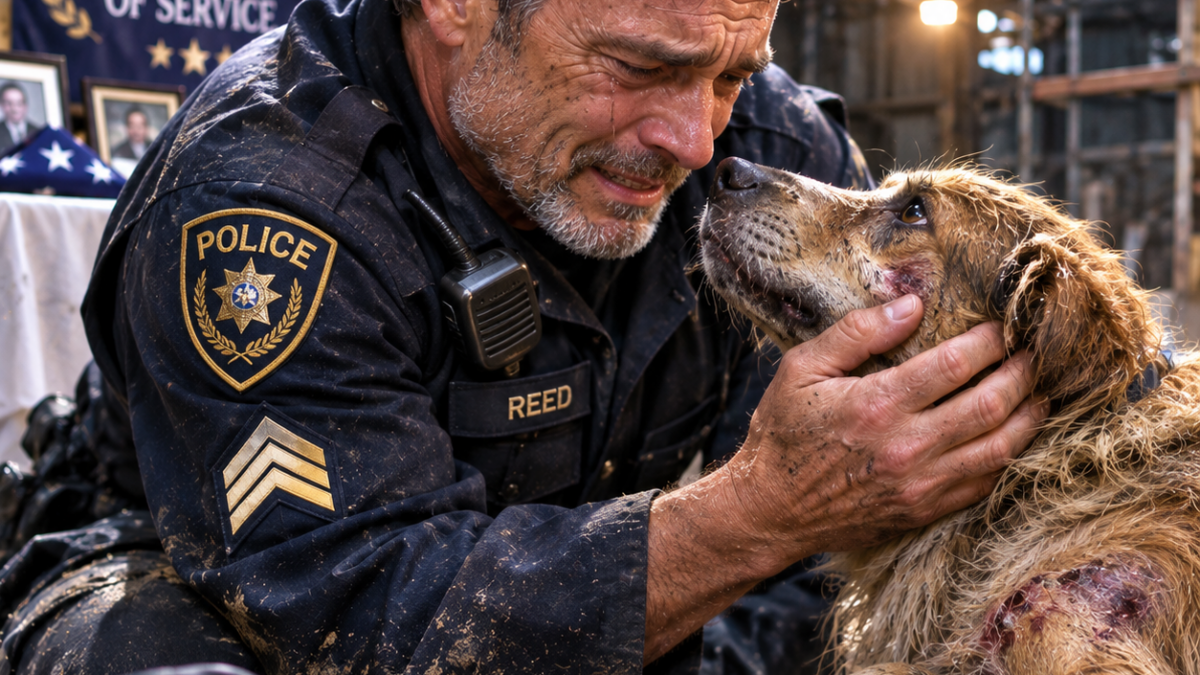
Then leaned forward.
His head came to rest against Michael’s knee.
That was all.
No bark.
No dramatic movement.
Just his head against the dirty uniform trousers of the man who had spent three hours freeing him.
The dog closed his eyes.
And sighed.
A deep, slow exhale.
Michael stopped breathing.
So did I.
For several seconds, the entire industrial yard seemed silent.
No rain.
No radio.
No traffic.
Nothing.
Michael lowered one hand.
Placed it gently on the dog’s head.
His mouth opened.
Closed.
Then he whispered:
“Thank you.”
I still don’t know who he was thanking.
The dog.
God.
The job.
The universe.
Maybe all of them.
We took the dog directly to an emergency veterinary clinic.
Michael insisted.
His retirement reception could wait another hour.
The veterinarian examined him.
Severe dehydration.
Malnutrition.
Multiple wounds from the wire.
No major fractures.
No internal bleeding.
His condition was serious but survivable.
The veterinarian looked at us.
“How long was he trapped?”
“We don’t know.”
She studied the dog.
“Based on the dehydration, possibly days.”
Michael’s jaw tightened.
“How many?”
“Hard to say.”
“Three?”
“Possibly.”
Three days.
No food.
Almost no water.
Tangled so tightly he could barely move.
Calling from inside a warehouse nobody entered anymore.
And somehow still alive.
The veterinarian said they would keep him overnight.
Michael asked:
“What happens afterward?”
She hesitated.
“If no owner is identified, animal services will handle placement.”
Michael looked through the examination-room window.
The dog was lying on a blanket.
Even from across the room, his eyes followed Michael.
I knew what was happening before Michael did.
I smiled.
“What?”
“Nothing.”
“Why are you smiling?”
“Retirement suits you.”
He frowned.
We returned to the precinct shortly after seven.
The retirement reception should have ended two hours earlier.
It hadn’t.
Cars filled the lot.
Lights were still on.
When Michael walked through the station doors, the entire room became silent.
His white retirement shirt was gray.
His pants were filthy.
His hair was damp.
There was dried rust on one sleeve.
His daughters stood near the cake.
One of them put both hands on her hips.
“Dad.”
Michael stopped.
“I can explain.”
She stared at him.
“We knew exactly where you were.”
Martinez emerged from behind her.
“You missed your own ceremony.”
“Sorry.”
“You ruined the schedule.”
“I know.”
“The captain had to leave.”
“Probably for the best.”
Martinez tried to look angry.
Failed.
Then he walked forward.
Looked at Michael’s filthy uniform.
And nodded.
Just once.
That nod said everything.
Thirty years.
Thousands of calls.
Hundreds of arrests.
Commendations.
Bad nights.
Good days.
Officers lost.
People saved.
One final call.
A dog nobody knew.
Martinez reached out.
Shook Michael’s hand.
“Good last shift.”
Michael looked down.
Then back up.
“Yeah.”
His voice broke slightly.
“Yeah, it was.”
The party resumed.
Someone cut the cake.
Michael’s daughters forgave him after making him promise never to turn retirement into another thirty-year career.
People told stories.
Some flattering.
Most embarrassing.
Martinez gave a shortened speech.
Then the captain called on speakerphone and accused Michael of avoiding the ceremony intentionally.
Around eight-thirty, I found Michael alone near his locker.
He was taking off his badge.
He held it in his palm.
Thirty years.
I leaned against the doorway.
“How does it feel?”
He looked at the shield.
“Smaller than I expected.”
“What?”
“The ending.”
I waited.
“You spend thirty years thinking retirement is this giant thing coming toward you.”
He placed the badge into a small wooden box.
“Then it’s just Tuesday.”
“Thursday.”
He looked at me.
“You know what I mean.”
I smiled.
“Going to miss it?”
He closed the box.
“I don’t know.”
That answer worried me.
Michael had been a police officer almost his entire adult life.
His wife was gone.
His daughters lived in other states.
For decades, the job had given every day structure.
Purpose.
Someone needed something.
Someone called.
Michael went.
Retirement sounded peaceful when people with hobbies described it.
Michael did not have hobbies.
He had work.
I wondered what happened when the radio stopped.
Then his phone rang.
Emergency veterinary clinic.
Michael answered.
“Yes?”
He listened.
His face changed.
“What happened?”
I straightened.
Another pause.
Then his shoulders relaxed.
“Oh.”
He listened longer.
“Yes.”
A smile slowly appeared.
“I can do that.”
He ended the call.
“What?”
“The dog made it through treatment.”
I smiled.
“Good.”
“He’s stable.”
“Even better.”
Michael looked at his phone.
“They asked if I’d visit tomorrow.”
I laughed.
“What?”
“Nothing.”
Again.
“Jack.”
I walked away.
“Enjoy retirement.”
The next morning, Michael was at the veterinary clinic before I arrived.
Of course.
The dog looked different already.
Still weak.
Still thin.
But his eyes were brighter.
Michael sat beside the kennel.
The moment the door opened, the dog tried to stand.
“Don’t.”
He pressed his hand gently against the blanket.
“You’ve done enough.”
The veterinarian smiled.
“He knows you.”
Michael looked embarrassed by how much that pleased him.
“Has anyone reported him missing?”
“No.”
“Microchip?”
“No.”
“Collar?”
“Nothing.”
Michael’s expression darkened.
The veterinarian continued.
“Animal services can place him in foster care once he’s medically cleared.”
Michael nodded.
Too quickly.
I crossed my arms.
“Or?”
He looked at me.
“What?”
“Nothing.”
“Stop doing that.”
The veterinarian looked between us.
Then smiled.
“If someone wanted to apply to adopt him, there are procedures.”
Michael stared at the dog.
The dog stared back.
I said:
“You have a house.”
Michael ignored me.
“A fenced yard.”
Silence.
“You’re retired.”
He turned.
“That is exactly why I don’t need another responsibility.”
The dog placed one paw on Michael’s shoe.
I looked down.
Michael did too.
The veterinarian covered a smile.
I said:
“Absolutely.”
Michael sighed.
“Shut up, Jack.”
He went home without signing anything.
That lasted twenty-four hours.
The next afternoon, he called.
“You busy?”
“Yes.”
“Can you come to the shelter?”
I smiled.
“Why?”
“Paperwork.”
“What kind?”
He hung up.
I laughed for a full minute.
The dog needed another week of medical care before release.
Michael visited every day.
He brought no treats without permission.
Asked too many questions.
Learned feeding schedules.
Medication.
Wound care.
The first afternoon the dog walked across the treatment room without collapsing, Michael sent me a video.
No caption.
He didn’t need one.
The adoption was approved.
Michael named him Rusty.
Not because he liked the name particularly.
Because of the corroded wire that had nearly killed him.
“That’s terrible,” I said.
“It fits.”
“It commemorates trauma.”
“It commemorates survival.”
I couldn’t argue with that.
Rusty went home with him two weeks after the rescue.
I visited Michael the following weekend.
His house sat near the edge of town.
Small.
Quiet.
A wooden porch wrapped around the front.
His late wife had planted hydrangeas along the walkway years earlier.
Michael never remembered to trim them properly.
Rusty was asleep on the porch.
He lifted his head when my truck pulled in.
Then stood.
His body was still thin.
Several patches of fur had been shaved.
Bandages remained around two legs.
But his tail moved.
I stepped out.
“Hey, Rusty.”
He watched me.
No recognition.
Fair enough.
Michael opened the front door.
“You’re late.”
“I’m retired too, apparently.”
“You’re forty-nine.”
“Spiritually.”
Rusty walked toward Michael.
Then leaned against his leg.
Michael rested one hand on his back without thinking.
That small automatic movement told me everything.
They already belonged to each other.
We sat on the porch drinking coffee.
Rusty slept at Michael’s feet.
The sunset looked strangely similar to the one outside the warehouse.
Orange along the horizon.
Gold behind the trees.
Michael watched the dog.
Then said:
“You know what I realized?”
“That you’re terrible at retirement?”
“That too.”
He smiled.
“For thirty years, if someone asked what my job was, I’d say law enforcement.”
I waited.
“I thought it meant catching bad guys.”
“Part of it.”
“Maintaining order.”
“Sure.”
“Enforcing law.”
I nodded.
Michael looked down at Rusty.
“But that warehouse…”
He paused.
“I kept thinking about it.”
“What?”
“No arrest.”
“No.”
“No suspect.”
“No.”
“No victim statement.”
I smiled.
“Rusty refused paperwork.”
Michael ignored me.
“Nobody cared if we went in.”
“That’s not true.”
“You know what I mean.”
He looked toward the horizon.
“If I’d told dispatch it wasn’t safe, somebody else might have gone later. Maybe not.”
His hand moved along Rusty’s head.
“And I realized something.”
I waited.
“The job was never really the badge.”
His voice became quiet.
“It was helping whoever needed help.”
I looked at him.
“Sometimes that’s a kid lost in a supermarket.”
He continued.
“Sometimes it’s an old woman whose husband died and she just wants someone to sit with her.”
He swallowed.
“Sometimes it’s somebody dangerous who still deserves to come out alive.”
Rusty shifted closer.
“And sometimes it’s a dog who’s been trapped for three days and has almost stopped making noise.”
Michael smiled.
“That’s the job.”
I said:
“Was.”
He looked at me.
“What?”
“The job was helping.”
Michael shook his head.
“No.”
He looked at Rusty.
“I think that’s the part that doesn’t retire.”
Rusty recovered slowly.
At first, he slept eighteen hours a day.
Food had to be introduced carefully.
He startled at metallic noises.
Construction equipment made him hide.
The first time Michael dropped a baking sheet, Rusty ran beneath the kitchen table and shook.
Michael sat on the floor.
Did not pull him out.
Did not force him.
Just waited.
Twenty minutes later, Rusty crawled toward him.
Michael told me about it afterward.
“Same look as the warehouse.”
“Fear?”
“Yeah.”
“What’d you do?”
“Nothing.”
I smiled.
Michael frowned.
“What?”
“You finally learned patience.”
“Get out.”
One month later, Rusty began running short distances in the yard.
Two months later, his coat had filled out.
Three months later, I barely recognized him.
He had gained weight.
His fur shone reddish brown in sunlight.
His eyes were alive.
He chased butterflies through Michael’s backyard like the warehouse had happened to another dog.
I stood on the porch watching.
Michael sat beside me with coffee.
Rusty sprinted across the grass.
Turned.
Ran back.
Then launched himself toward a yellow butterfly and missed by six feet.
I laughed.
“He’s terrible at that.”
“He’s improving.”
“You’re grading him?”
“He likes goals.”
Rusty ran past us again.
Michael smiled.
Not the polite smile he used at retirement ceremonies.
Not the tired smile officers use when families thank them.
A full smile.
Unprotected.
I had known Michael almost twenty years.
I had rarely seen it.
“He saved me, Jack.”
The words were so quiet I almost missed them.
I looked at him.
“What?”
Michael kept watching Rusty.
“He saved me.”
I waited.
“You mean emotionally?”
He nodded.
“After retirement…”
He exhaled.
“I was scared.”
Michael Reed rarely admitted fear.
I said nothing.
He continued.
“Thirty years, I knew where I belonged.”
His hands tightened around the coffee cup.
“Then suddenly everyone was congratulating me for not having to do it anymore.”
He laughed without humor.
“What was I supposed to do with that?”
“Sleep?”
“Apparently.”
“Fish?”
“I hate fishing.”
“I know.”
He watched Rusty.
“I kept thinking about coming home after the ceremony.”
“Empty house.”
“Yeah.”
The word carried his late wife inside it.
I looked away.
Michael continued.
“If that call hadn’t come in, I would’ve gone home that night with plaques and a bottle of bourbon and absolutely no idea what came next.”
Rusty stopped chasing the butterfly.
He looked toward Michael.
Then trotted back.
Michael scratched his neck.
“But instead, I came home thinking about him.”
Rusty sat beside his chair.
“Then the clinic called.”
Michael smiled.
“Then he needed somewhere to go.”
He looked at me.
“I spent thirty years needing people to need me.”
“That sounds unhealthy.”
“Probably.”
We both smiled.
Then Michael became serious.
“Rusty didn’t care that I retired.”
I looked at the dog.
“He needed breakfast.”
I laughed.
“He needed walks.”
“Medication.”
“Someone to sit beside him when storms scared him.”
Michael nodded.
“And suddenly tomorrow had a shape again.”
Rusty placed his head against Michael’s knee.
Same gesture.
Warehouse.
Truck.
Porch.
Michael looked down.
His eyes filled.
“I thought I saved him.”
He stroked Rusty’s head.
“But I think he showed up on exactly the day I needed something to save too.”
I didn’t answer immediately.
There are moments when saying something clever only makes the moment smaller.
So we sat there.
Two old cops.
One rescued dog.
Sunset.
Rusty eventually fell asleep.
Michael’s hand remained on his head.
News about Michael’s retirement rescue appeared briefly in the local paper.
OFFICER’S FINAL CALL SAVES ABANDONED DOG
There was a photograph of Michael in his dirty uniform carrying Rusty out of the warehouse.
Michael hated it.
“They made me look ninety.”
“You look ninety.”
“I was fifty-eight.”
“Rough fifty-eight.”
He threw the paper at me.
The article mentioned his thirty years of service.
Commendations.
Career highlights.
Then the dog.
For a few days, people stopped Michael at grocery stores.
He hated that more.
“I wasn’t the only one there.”
“No.”
“You helped.”
“I held a flashlight.”
“You held a lot more than that.”
“Still.”
Michael looked toward Rusty.
“They write like I did something special.”
“You did.”
He shook his head.
“No.”
Then smiled.
“I just heard him.”
That sentence stayed with me.
I just heard him.
Because there were probably dozens of people who passed near that warehouse during the days Rusty was trapped.
Drivers.
Workers.
Pedestrians.
Maybe nobody heard.
Maybe somebody did and assumed it was nothing.
The anonymous caller who contacted dispatch had heard enough to make a call.
Michael heard enough to go inside.
Heroism often looks smaller before the outcome.
A phone call.
A flashlight.
Stopping.
Listening.
Months passed.
Michael developed retirement routines.
Morning walk with Rusty.
Coffee.
Volunteer work at a local animal rescue twice a week.
He claimed I had manipulated him into that.
I had not.
Rusty did.
The shelter director asked whether Michael could help nervous dogs become comfortable around men.
He discovered he was remarkably good at it.
Of course he was.
Thirty years interviewing frightened people had taught him how to sit quietly without demanding trust.
One afternoon, I visited.
Michael sat inside a kennel enclosure with a terrified shepherd mix pressed against the far wall.
He was reading a newspaper.
Not looking at the dog.
I whispered to the shelter employee:
“What is he doing?”
“Nothing.”
“For how long?”
“Forty minutes.”
“Why?”
“She won’t approach anyone.”
I watched.
Five minutes later, the dog moved.
One step.
Michael turned a page.
Another step.
Then the dog sat three feet away.
Michael still didn’t look.
Eventually, she approached and sniffed his shoe.
I smiled.
Rusty had given Michael a second career.
He just wasn’t being paid.
The old officers teased him.
“Dog whisperer.”
“Officer Snow White.”
“Retirement ruined him.”
Michael ignored them.
Then one day Sergeant Martinez brought in an abandoned beagle he had found behind a gas station.
Michael stared.
“You’ve got animal control.”
Martinez shrugged.
“He looked sad.”
I laughed.
It spreads.
A year after Michael retired, the department invited him to speak to a new academy class about service.
He complained for two weeks.
“What am I supposed to tell them?”
“The truth.”
“They want war stories.”
“Then disappoint them.”
He did.
I sat in the back.
Forty recruits watched Michael walk to the podium.
No uniform.
No badge.
Just a gray shirt and old boots.
He looked uncomfortable.
Then said:
“When I started thirty-one years ago, I thought the strongest cop in the room was the one nobody scared.”
The recruits listened.
“I was wrong.”
He spoke about fear.
Patience.
Knowing when not to escalate.
Listening.
Then he told them about Rusty.
Not every detail.
Just enough.
He described the abandoned warehouse.
The wires.
The three hours.
Then the moment Rusty put his head against his knee.
A recruit asked:
“Sir, why is that the story you chose from thirty years?”
Michael thought.
“Because nobody was watching.”
Silence.
“No supervisor.”
“No newspaper.”
“No promotion.”
“No arrest statistic.”
He looked across the room.
“Just a life that needed help.”
He paused.
“If your integrity only works when someone is keeping score, you don’t have integrity.”
Nobody moved.
Michael added:
“Do the small calls right.”
He smiled faintly.
“Someday you’ll realize they weren’t small.”
Afterward, one recruit approached.
“My dad was a cop.”
Michael nodded.
“He died when I was ten.”
“I’m sorry.”
The young man hesitated.
“He used to bring injured animals home too.”
Michael smiled.
“Your mother probably loved that.”
The recruit laughed.
“She hated it.”
“Smart woman.”
The young man looked toward the door.
Then said:
“Thanks for the story.”
Michael nodded.
On the drive home, he was unusually quiet.
“What?”
“Nothing.”
“You’re doing the thing.”
“What thing?”
“Thinking too loudly.”
He looked out the window.
“I spent thirty years wondering whether any of it mattered.”
I frowned.
“You know it did.”
“Some days.”
He paused.
“Other days, the bad ones stack up.”
I understood.
Every officer does.
Calls you remember.
People you couldn’t help.
Decisions you replay.
Michael continued.
“Rusty was simple.”
“Simple?”
“He needed help.”
“You helped him.”
“He lived.”
Michael looked at me.
“No paperwork could make that complicated.”
I nodded.
Maybe that was why Rusty mattered so much.
Not because saving a dog was more important than saving people.
Because the moral question had no gray.
There was suffering.
Michael could help.
So he did.
Thirty years in law enforcement rarely gives you that kind of clarity.
Rusty grew older.
Years passed faster than either of us wanted.
His muzzle turned gray.
He stopped chasing butterflies.
Then stopped jumping onto Michael’s bed.
Michael built a small ramp.
I teased him until I saw how carefully Rusty used it.
One winter, arthritis made long walks difficult.
Michael bought him a wagon.
“You realize people are photographing you.”
“They can mind their business.”
A retired police officer pulling an elderly brown dog through the park in a wagon became a neighborhood fixture.
Children knew Rusty.
Neighbors brought treats.
Michael complained about all of them and remembered every child’s name.
One evening, I found Michael sitting on the porch beside Rusty.
The dog was asleep.
Michael looked worried.
“What’s wrong?”
“He’s slowing down.”
“He’s old.”
“I know.”
“Vet?”
“Tomorrow.”
I sat.
Michael kept one hand on Rusty’s side, feeling each breath.
“He gave me a lot of years.”
“Yes.”
“I don’t know what I’ll do when…”
He stopped.
The sentence did not need finishing.
I looked toward the yard.
“You’ll do what you did in the warehouse.”
Michael looked at me.
“What?”
“Stay.”
His eyes filled.
I continued.
“You couldn’t fix everything about what happened before you found him.”
“No.”
“You couldn’t make the wires never happen.”
“No.”
“You could just make sure he wasn’t alone anymore.”
Michael looked down at Rusty.
I said quietly:
“When the time comes, same job.”
He nodded.
“Stay.”
Rusty was still with Michael when I began writing this story.
Older.
Slower.
Loved beyond reason.
He slept most afternoons beside the same chair where Michael drank coffee.
Sometimes, when I visited, he lifted his head.
Looked at me.
Then apparently decided I wasn’t worth standing for.
Fair.
Michael said:
“He remembers you.”
“He has an odd way of showing it.”
“He remembers you held the flashlight.”
“Finally, some respect.”
People still ask Michael about his last day.
The retirement ceremony.
The abandoned warehouse.
The dog.
His answer never changes much.
“I heard something.”
Then:
“I went inside.”
He never tells the story as though he was heroic.
Maybe that’s why it stays with people.
He had every reason not to take the call.
His career was ending.
A party waited.
Family waited.
Rain was brutal.
The building was unsafe.
Nobody would have criticized him for passing it to another unit.
But there was a sound.
Weak.
Almost gone.
And Michael heard it.
That was enough.
I think about that warehouse more often than I expected.
Not the danger.
The darkness.
The moment the flashlight found Rusty in the corner.
There was something terrible about how small he looked.
A living creature in a huge abandoned building.
No name to us.
No owner.
No value anyone could measure.
If we had arrived hours later, perhaps he would have been silent.
That’s what haunts me.
Not every life in danger can shout.
Sometimes the sound is barely there.
Sometimes helping depends on whether somebody is willing to stop long enough to hear it.
Michael once told me:
“You know what the job taught me too late?”
“What?”
“Everybody thinks courage is moving toward danger.”
He scratched Rusty behind the ears.
“Sometimes courage is slowing down.”
I waited.
“Not forcing.”
“Listening.”
“Staying.”
He looked at me.
“Especially when nobody will ever know you did.”
That is Michael Reed’s career in one sentence.
Not the arrests.
Not the commendations.
Not the plaque hanging in his hallway.
Staying.
At scenes everyone else wanted finished.
With victims everyone else wanted transferred.
With frightened rookies after bad calls.
With families in hospital corridors.
And on his final afternoon in uniform, with a dog trapped beneath rusted wire in a building nobody cared about.
Three months after the rescue, I had asked Michael whether he believed Rusty understood what happened.
He had smiled.
“I don’t know.”
Then Rusty walked over.
Placed his head against Michael’s knee.
Michael looked down.
“Maybe.”
That answer is enough for me too.
Maybe animals understand rescue differently.
Maybe Rusty simply associated Michael with relief.
Maybe warmth.
Maybe safety.
Maybe the scent of the person who stayed beside him during the worst hours of his life.
Or maybe gratitude does not require language.
We spend too much time assuming that if something cannot be spoken, it cannot be understood.
Rusty taught me otherwise.
The most moving thing about Michael’s last day was not that he saved an abandoned dog.
It was that nobody expected anything from him anymore.
His official responsibility was nearly finished.
Thirty years completed.
He had already earned the pension.
Earned the plaque.
Earned the cake.
Earned the right to say:
Let the next shift handle it.
Instead, he heard a weak sound.
And answered.
That is character.
Not what a person does when the reward is ahead.
What they do after every reward has already been secured.
Years later, Michael’s retirement plaque still hangs inside his house.
I once asked why.
He shrugged.
“Daughters put it there.”
Underneath it sits a framed photograph.
Not Michael in uniform.
Not an award ceremony.
Rusty.
The photograph was taken three months after the rescue.
Running across the yard.
Healthy.
Mouth open.
Ears flying.
Sunlight on his coat.
When people visit, they notice the plaque first.
Michael notices the photograph.
That tells you everything.
If you asked Michael to rank the important moments of his career, he would refuse.
Lives do not work that way.
A lost child matters.
A frightened victim matters.
An officer who needs backup matters.
A trapped dog matters.
Service is not a competition between suffering.
It is a habit.
You answer what is in front of you.
That afternoon, Rusty was in front of him.
So Michael answered.
I sometimes think about the retirement reception waiting at the station.
The cake icing slowly drying.
Coworkers checking watches.
His daughters annoyed.
Martinez pretending not to worry.
All those people preparing to celebrate thirty years of service.
Meanwhile, Michael was in an abandoned warehouse doing the most Michael Reed thing possible.
Missing the ceremony because someone needed him.
I cannot imagine a more appropriate ending.
Except it wasn’t the ending.
That is what Rusty changed.
Michael believed retirement meant his usefulness had expired.
The dog proved otherwise.
The badge ended.
Service didn’t.
Now Michael volunteers.
Helps frightened animals.
Mentors officers.
Checks on neighbors.
Drives elderly residents to appointments when their families cannot.
He complains about being busy.
I remind him he’s retired.
He tells me to shut up.
Nothing really changed.
Only the uniform.
One afternoon, years after the warehouse, Michael and I sat on the porch while Rusty slept between us.
The sunset turned the sky orange.
Almost exactly like that first evening.
Michael looked toward the horizon.
“Funny.”
“What?”
“That day was supposed to be about leaving.”
I waited.
“Retirement.”
He smiled.
“Closing one door.”
Rusty shifted against his boot.
“Turned out I was bringing somebody home.”
I looked at him.
“And?”
Michael’s hand rested on Rusty.
“And maybe that’s what life is.”
“What?”
“You think something’s ending.”
He shrugged.
“Sometimes something else is just waiting for you to hear it.”
I laughed softly.
“That’s disgustingly sentimental.”
“I’m retired. I’m allowed.”
Rusty opened his eyes.
Looked at Michael.
Then placed his head on his knee.
Again.
The same gesture.
Years later.
Same answer.
Michael stroked his head.
Neither of us spoke.
We didn’t need to.
After thirty years in law enforcement, Michael Reed did not end his career chasing an armed suspect through city streets.
He did not end it receiving applause.
He did not end it beneath bright lights while a captain read his commendations.
His last real act in uniform happened on his knees in a dark warehouse.
Dirty floor.
Rusty wire.
Rain overhead.
One abandoned dog too weak to free himself.
Michael missed most of his own farewell because freeing that animal took nearly three hours.
By every ordinary measurement, it was a terrible retirement schedule.
By Michael’s measurement, it was perfect.
Because when the uniform came off that night, he knew exactly what the badge had meant all along.
Not power.
Not rank.
Not authority.
Responsibility.
Someone needs help.
You hear them.
You go.
Three months later, Rusty raced across Michael’s yard beneath a summer sunset.
The dog we had found half-starved and tangled in wire looked almost unrecognizable.
Healthy coat.
Bright eyes.
Strong legs.
Free.
Michael sat beside me on the porch watching him.
Then he said the words I have never forgotten:
“He saved me, Jack.”
I looked at him.
Michael smiled.
“I know how that sounds.”
“No.”
I shook my head.
“I think I understand.”
Rusty came running toward us.
Slowed when he reached the porch.
Walked directly to Michael.
And rested his head against his knee.
Michael closed his eyes.
For a moment, the retired officer and the abandoned dog were exactly where they had been months earlier outside that warehouse.
One had spent thirty years answering calls.
The other had spent three days making one.
And somehow, on the final afternoon of Michael Reed’s career, they heard each other.
That is why, when people ask me how we should measure the value of a lifetime of service, I no longer talk first about years.
Or arrests.
Or medals.
Or headlines.
I think about a rain-soaked warehouse nobody cared about.
I think about a man who could have gone home.
I think about one weak whimper from the darkness.
And I think about the dog who finally slept safely because someone decided that a small voice was still worth answering.
Sometimes the most important thing you do with your life will never appear on a plaque.
Sometimes nobody will be watching.
Sometimes there will be no reward waiting.
Sometimes the only witness will be a frightened animal who cannot say your name.
But if you listen when everyone else keeps walking—
if you go where someone else would rather not go—
if you stay until the last piece of wire is cut—
then maybe that is enough.
Michael once spent thirty years believing his work was about protecting a city.
Rusty taught him something simpler on his final day.
Service is noticing who still needs you when you believe your part is already over.
And sometimes, if you’re very lucky, the life you bend down to rescue will stand up afterward, walk toward you, rest its head against your knee—
and quietly rescue you too.








