FULL STORY:“HE’S TOO OLD AND TOO BROKEN TO SURVIVE THIS!” The Vets Had Almost Given Up on the Dying Tibetan Mastiff in the Ditch — But Four Months Later, He Did Something That Made His Rescuer Collapse to His Knees
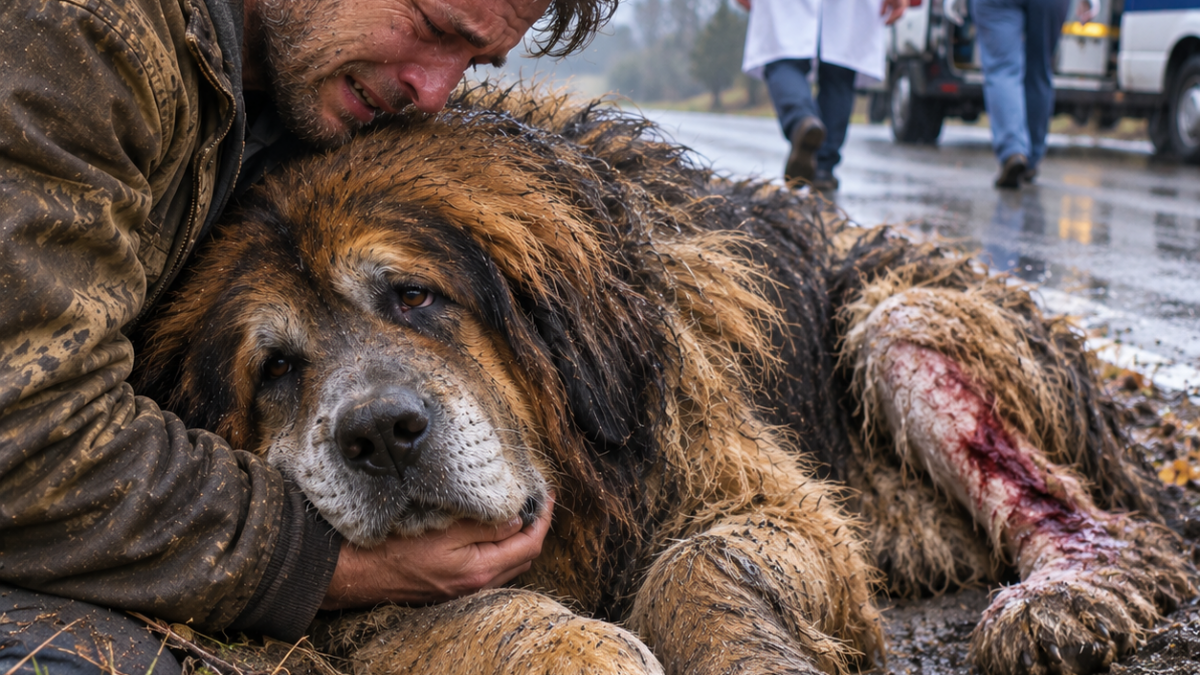
FULL STORY CONTINUATION
The first challenge was moving him.
Nathan and I both understood that an injured dog of that size couldn’t simply be lifted into a vehicle like a frightened puppy.
We didn’t know the extent of his injuries.
His hind leg was clearly in trouble, but the way he lay in the ditch suggested there might be damage we couldn’t see.
The last thing I wanted was to cause him more pain.
Nathan stayed on the phone with the veterinary team while we followed their guidance for getting him safely onto a suitable support and arranging transport.
I remember how careful everyone was.
How slowly we moved.
How frightened I felt each time the dog made the slightest sound.
He didn’t struggle much.
That frightened me even more.
A healthy Tibetan Mastiff might have resisted strangers approaching him.
This dog barely had the strength to react.
His eyes followed me.
Whenever I moved away from his line of sight, he seemed to search for me.
I couldn’t know exactly what he wanted.
Perhaps he was simply watching the unfamiliar person nearest to him.
But something about that gaze made me unwilling to step away.
“I’m here,” I whispered.
Nathan glanced toward me.
“Sebastian, we’ve got to keep moving.”
“I know.”
I looked back at the dog.
“You’re coming with us.”
The process felt painfully slow.
But eventually, he was safely prepared for transport.
I stood beside him for a moment before we left.
His thick coat was tangled with mud.
His sides rose and fell unevenly.
One enormous paw rested near my shoe.
I looked at its size.
Then at the fragile body attached to it.
How could an animal built to be so powerful end up so completely helpless?
I swallowed.
“We’re getting you help, buddy.”
Then we headed toward the clinic.
Nathan drove.
I sat close enough to monitor the dog during the journey, following the veterinary team’s instructions.
The road seemed to stretch endlessly.
Every bump made me tense.
Every time the dog shifted, I looked toward him.
I worried about his breathing.
About pain.
About what the X-rays might reveal.
Nathan tried to keep his voice calm.
“He’s still with us.”
I nodded.
“Yeah.”
“He made it out of the ditch.”
“I know.”
Nathan glanced at me.
“That’s something.”
I looked at the dog.
He was resting quietly, his eyes partly open.
“I just hope it’s enough.”
Nathan didn’t answer.
He didn’t need to.
We both knew there were injuries kindness alone couldn’t repair.
And whatever happened next would depend on medical care, time, and whether the dog’s weakened body could endure the treatment he needed.
Dr. Carlson was waiting when we arrived.
She was a veterinarian with calm hands and an attentive expression that usually reassured me.
I’d met her before through Nathan, and I knew she took complicated cases seriously.
But when she saw the dog, her face changed.
“Bring him inside,” she said.
Her voice was controlled.
“We need imaging right away.”
The veterinary staff moved quickly.
I stepped aside.
For the first time since stopping on the road, I wasn’t the person closest to the dog.
Other people were taking responsibility.
People who knew how to assess injuries.
People trained to manage pain and recognize complications.
I should have felt relieved.
Instead, I felt suddenly useless.
I stood in the corridor with mud on my jacket and dirt beneath my fingernails.
I didn’t know where to put my hands.
Didn’t know whether to sit.
Didn’t know whether I should call someone.
So I waited.
A door closed.
Footsteps moved down the hallway.
A telephone rang.
Somewhere nearby, another dog barked.
I stared at the examination-room door.
And remembered the eyes in the ditch.
The way they’d followed me.
The way he had remained almost motionless.
I wondered whether he was frightened.
Whether he understood that the hands touching him now were trying to help.
Whether he thought I had disappeared.
I looked at the clock.
Then at the door.
And whispered, “Please.”
An hour later, Dr. Carlson came out.
She looked tired.
Not exhausted.
Not defeated.
But serious.
She gestured toward a small room near the coffee machine.
“Sebastian, let’s sit down.”
My stomach dropped.
Those were the words people used before difficult conversations.
I followed her.
Nathan came with me.
We sat around a small table.
Dr. Carlson opened the imaging results.
I tried to concentrate.
But my mind kept returning to the ditch.
The gray sky.
The mud.
The dog’s face.
Finally, she began explaining.
“He has multiple fractures.”
I swallowed.
“How bad?”
“His hind leg is broken in two places.”
My hands tightened.
“His pelvis is fractured, and several ribs are damaged.”
I stared at her.
For a moment, the words didn’t make sense.
Leg.
Pelvis.
Ribs.
So much damage.
In one animal.
She continued.
“He’s also severely underweight and very weak.”
I looked down.
“And his age is another factor.”
I raised my eyes.
“How old?”
“We estimate around nine or ten years.”
I stared.
A large dog at that age was already a senior.
Aging bodies heal differently.
Recovery from major orthopedic injuries can be especially challenging.
Dr. Carlson looked at the images.
“For a dog of this size and age, treatment and rehabilitation will be demanding.”
I could hear my own heartbeat.
“Can he walk again?”
She hesitated.
“We need to address his injuries first. I can’t promise what his long-term mobility will look like.”
I stared at the table.
I had been hoping for certainty.
A clear answer.
A guarantee.
Something I could hold onto.
Instead, she was telling me that even with surgery, we couldn’t know whether he’d fully recover.
I looked up.
“What can we do?”
She took a breath.
“Surgery. Possibly more than one procedure. Then a prolonged period of rehabilitation.”
I nodded quickly.
“Okay.”
She studied me.
“And the cost could be considerable.”
I swallowed.
“Okay.”
“Sebastian, I need you to understand what you’re agreeing to.”
I looked straight at her.
“I do.”
She shook her head gently.
“Not yet.”
Then she explained.
The operations.
The risks.
The follow-up care.
The possibility of complications.
The time needed to rehabilitate an elderly dog with multiple fractures.
The likelihood that he would require assistance with basic movement for a considerable period.
And the very real possibility that, despite everyone’s efforts, he might never move as freely as a healthy dog.
I listened.
Every sentence made the responsibility feel larger.
Finally, she stopped.
“Do you understand?”
I nodded.
Then asked, “Is there a reasonable chance treatment can help him?”
She looked at me carefully.
“Yes. But it will be a difficult road.”
I took a breath.
“Then let’s give him that chance.”
I wish I could tell you the decision felt heroic.
It didn’t.
I was frightened.
I knew very little about caring for an enormous senior dog with major injuries.
I had never expected to become responsible for an animal whose medical treatment would require significant expenses and months of follow-up care.
I was also aware that wanting to save an animal doesn’t automatically mean every treatment is appropriate.
His welfare had to come first.
If the veterinarians believed his suffering couldn’t be meaningfully relieved or his condition was hopeless, I would have needed to listen.
But that wasn’t what Dr. Carlson had told me.
She had explained that treatment offered a possibility.
A difficult possibility.
With risks.
With no guarantees.
But a possibility.
And I couldn’t look at the dog I’d found in the ditch and decide his age made that possibility worthless.
So I repeated myself.
“Let’s do what gives him the best chance at a comfortable life.”
Dr. Carlson nodded slowly.
“All right.”
Nathan placed a hand on my shoulder.
I looked toward him.
He gave me a small, reassuring nod.
And I realized I wasn’t making the decision entirely alone.
That night, I sat in the clinic’s waiting room.
The dog had been prepared for surgery.
The staff explained what would happen.
I signed the necessary paperwork.
Then I waited.
My jacket was still dirty.
I hadn’t eaten properly.
My phone kept vibrating with messages from work.
I ignored most of them.
I couldn’t think about anything except the dog behind the operating-room door.
I needed a name for him.
He had become more than an anonymous injured animal.
He was someone I had chosen to care for.
Someone whose treatment I would help arrange.
Someone who needed a way to be identified that didn’t reduce him to his injuries.
I thought about his breed.
A Tibetan Mastiff.
A powerful mountain dog with a history connected to the Himalayan region.
Then I thought about the way he’d looked at me in the ditch.
So exhausted.
So still.
But with something unmistakably alive in his eyes.
I began considering names.
Nothing felt right.
Then one appeared in my mind.
Tenzin.
I said it quietly.
“Tenzin.”
The sound seemed to fit him.
I had encountered the name before in connection with Tibetan culture, where it is associated with upholding or preserving teachings.
For me, it came to represent the promise I’d made beside the road.
That I wouldn’t walk away without trying.
I repeated it.
“Tenzin.”
Then smiled faintly.
“That’s your name, big guy.”
The clock moved slowly.
And I waited for news.
The first operation lasted four hours.
Four hours doesn’t sound impossible until you’re waiting to learn whether an animal you’ve already become attached to will survive.
I tried reading.
Couldn’t concentrate.
I checked my phone.
Put it down.
Picked it up again.
Walked toward the coffee machine.
Then returned to my chair without taking anything.
Nathan arrived with a sandwich.
“Eat.”
I shook my head.
“I’m not hungry.”
He placed it beside me.
“You haven’t eaten since morning.”
“I know.”
“Sebastian.”
I looked at him.
He sighed.
“You need to take care of yourself too.”
I stared at the sandwich.
Then at the clock.
“What if something goes wrong?”
Nathan sat beside me.
“Then we’ll deal with it.”
I shook my head.
“I shouldn’t have let myself get attached.”
He looked at me.
“Too late.”
I laughed weakly.
Then covered my face.
“I keep seeing him in that ditch.”
Nathan was quiet.
I continued.
“He looked at me.”
I swallowed.
“And I told him I wouldn’t leave.”
Nathan placed a hand on my back.
“You didn’t.”
I looked up.
“He’s getting help because you stopped.”
I stared toward the hallway.
“But what if it isn’t enough?”
Nathan was silent for a moment.
Then said, “You can’t decide the outcome.”
I looked at him.
“You can only make sure he gets the chance.”
I wanted to believe him.
But fear isn’t always persuaded by reasonable words.
So I kept waiting.
When Dr. Carlson finally appeared, I stood so quickly that the chair scraped across the floor.
“How is he?”
She looked tired.
But there was relief in her expression.
“The surgery went well.”
I closed my eyes.
For a moment, I couldn’t speak.
Nathan exhaled beside me.
Dr. Carlson continued.
“He’s stable, but he’ll need close monitoring. This is only the beginning.”
I nodded.
I knew.
The fractures were serious.
His age remained a concern.
His body was weak from poor nutrition.
He still faced more treatment and months of rehabilitation.
But he’d survived the first operation.
And that was enough to let me breathe again.
I looked toward the hallway.
“Can I see him?”
“When he’s ready for a quiet visit.”
I nodded.
“Okay.”
Dr. Carlson placed a hand lightly on my shoulder.
“He’s a strong dog, Sebastian.”
I swallowed.
“I hope so.”
She looked at me.
“Strength doesn’t guarantee recovery. But he’s responding, and we’re going to keep helping him.”
I nodded.
Then whispered, “Thank you.”
The first time I saw Tenzin after surgery, I almost cried before reaching him.
He lay on clean bedding.
His legs were supported and bandaged.
His body looked enormous and fragile at the same time.
He was receiving appropriate pain management and postoperative care.
The room was warm.
Quiet.
Controlled.
Everything was different from the roadside ditch.
Yet his eyes were the same.
When I entered, they opened.
And followed me.
I stopped beside his bed.
“Hey, big guy.”
He watched.
“It’s Sebastian.”
His ears shifted faintly.
I smiled sadly.
“I know. You don’t know my name.”
I sat carefully beside him.
“But I’m here.”
He remained still.
I looked at his bandages.
The signs of surgery.
The effort his body was making simply to rest and heal.
I felt tears gathering.
“I’m sorry you had to go through this.”
My voice broke.
“I don’t know what happened before I found you.”
He watched me.
“But I’m going to do everything I can to make what comes next better.”
I sat quietly.
Then added, “And I’ve given you a name.”
His eyes shifted.
“Tenzin.”
I smiled.
“I hope you like it.”
He blinked.
For some reason, that nearly made me cry harder.
Tenzin remained at the clinic for three weeks.
I visited every day after work.
On weekends, I often came twice.
At first, the visits were simple.
I sat beside him.
Talked softly.
Followed the staff’s instructions about what kind of interaction was appropriate.
I never expected him to greet me excitedly.
He was recovering from major surgery.
His movements were limited.
He needed rest.
But every time I entered, he opened his eyes.
Then watched me.
I came to recognize that quiet attention.
It felt almost like a question.
You’re back?
And every time, I answered.
“Yes, Tenzin.”
I’d sit beside him.
“I’m back.”
Sometimes I told him about work.
Sometimes about Nathan.
Sometimes about my house.
I described the backyard.
The patch of sunlight near the fence.
The old maple tree.
The living room where I imagined placing his bed.
I talked as though he could understand every detail.
Of course, he couldn’t.
But my voice became part of his routine.
And perhaps that mattered.
One afternoon, I arrived later than usual.
Work had been difficult.
A meeting ran long.
Traffic was terrible.
By the time I reached the clinic, I was exhausted.
I entered the room quietly.
Tenzin lay on his side.
His eyes were closed.
I sat beside him.
“Sorry I’m late.”
His eyes opened.
He looked toward me.
I smiled.
“Yeah. I know.”
He moved one ear.
I laughed softly.
“Terrible employee. Can’t even manage to visit his dog on time.”
Then I stopped.
His dog.
The words had come out naturally.
I looked at Tenzin.
At his broad head.
His thick fur.
His careful breathing.
I hadn’t formally planned to adopt him.
Not yet.
There were still so many uncertainties.
But somewhere between the roadside ditch and the hospital visits, I’d begun thinking of him as mine.
Not as property.
Not as a possession.
As a living being whose welfare had become part of my responsibilities.
Someone I was unwilling to abandon.
I leaned closer.
“Well, I suppose that’s what you are.”
Tenzin watched me.
I smiled.
“My dog.”
The veterinary team continued monitoring his recovery.
Some days brought encouraging news.
Other days required adjustments and patience.
There were wounds to manage.
Pain to control.
Nutrition to rebuild.
Fractures that needed time to heal.
His body had been through a great deal.
And because he was large and older, even simple movement required careful planning.
I learned to stop measuring progress against what I wanted.
I wanted him standing.
Walking.
Running.
Happy.
But wishing couldn’t make bones heal faster.
So I began asking different questions.
Was his pain being managed?
Was he eating?
Was he resting comfortably?
Were the clinical signs moving in the right direction?
Was he tolerating the treatment?
Those became the things that mattered.
Not dramatic milestones.
Basic well-being.
One day at a time.
Nathan came with me several times.
He always greeted Tenzin the same way.
“Hey, mountain man.”
I’d laugh.
“That’s not his name.”
Nathan shrugged.
“Close enough.”
Tenzin would watch us quietly.
Nathan often brought coffee.
Sometimes food.
Sometimes nothing but company.
He had been there on the road.
He’d helped arrange the rescue and transport.
He understood why I couldn’t simply walk away now.
One evening, while we sat near Tenzin, Nathan asked, “You know what happens after he leaves here?”
I looked toward the dog.
“I’ve been thinking about it.”
Nathan nodded.
“He’s going to need help.”
“I know.”
“A lot of help.”
“I know.”
He looked at me.
“Sebastian, you’re working full-time.”
I sighed.
“I know.”
He continued gently.
“And a dog this size isn’t easy to care for under normal circumstances.”
I looked down.
He was right.
Tenzin would need a carefully prepared environment.
Follow-up appointments.
Assistance with mobility.
Physical rehabilitation.
Time.
Money.
Patience.
And the ability to manage setbacks.
I couldn’t simply take him home and hope everything would work out.
Nathan waited.
Finally, I said, “I’m going to figure it out.”
He looked toward me.
“Are you sure?”
I thought about the ditch.
The eyes.
The promise.
Then nodded.
“Yes.”
Nathan smiled faintly.
“Then I’ll help.”
During the last part of Tenzin’s clinic stay, I prepared my house.
I moved furniture.
Cleared a large space in the living room.
Bought a supportive dog bed.
Placed water nearby.
Made sure the floor offered appropriate traction.
Checked the route to the door.
Thought about how to help him outside.
I consulted the veterinary team about what equipment and support he would need.
I wanted the house to be safe for a recovering dog who couldn’t move independently.
The preparations weren’t glamorous.
There were no colorful decorations.
No elaborate welcome-home party.
Just practical work.
Moving chairs.
Rolling up unsuitable rugs.
Rearranging tables.
Creating a comfortable place for a large animal with limited mobility.
But every task made the future feel more real.
Tenzin might actually come home.
Not to a shelter.
Not to another temporary arrangement.
To my house.
Where I would continue caring for him.
The day Dr. Carlson told me he could be discharged into home care, I stared at her.
“Really?”
She smiled.
“With a strict care plan and continued follow-up, yes.”
I swallowed.
“He’s ready?”
“Ready for the next stage. Not fully recovered.”
I nodded.
“I understand.”
She reviewed everything.
Medication.
Monitoring.
Nutrition.
Support for movement.
Restrictions.
Warning signs.
Recheck appointments.
And rehabilitation planning.
I wrote it all down.
Then asked questions.
Probably too many.
Dr. Carlson remained patient.
Finally, she smiled.
“Sebastian, you’re going to have to learn to rest too.”
I laughed nervously.
“I’ll try.”
She looked at me seriously.
“This will be difficult.”
I nodded.
“I know.”
She paused.
“And some days may be discouraging.”
I looked toward Tenzin.
His eyes were open.
Watching us.
I smiled.
“Then we’ll take those days one at a time.”
Nathan helped me bring him home.
The transport was carefully arranged.
We followed the veterinary team’s instructions to protect his healing injuries and avoid unnecessary strain.
By the time Tenzin reached my living room, I was exhausted.
But I was also happy.
He lay on the supportive bed I’d prepared.
His water was close.
The room was warm.
Quiet.
Safe.
I crouched beside him.
“Welcome home, Tenzin.”
He looked around.
His eyes moved toward the windows.
The furniture.
The unfamiliar walls.
He didn’t seem excited.
He didn’t wag his tail wildly.
He simply watched.
Nathan stood near the doorway.
“He’s taking it all in.”
I nodded.
“Yeah.”
For a moment, I wondered whether Tenzin could believe this was where he’d be staying.
He’d been found injured and alone.
Then moved to a clinic.
Now another unfamiliar place.
Another change.
I knew it would take time for the environment to become familiar.
So I didn’t demand anything from him.
I simply sat beside the bed.
“You’re home, buddy.”
He looked toward me.
I smiled.
“And we’re going to take this slowly.”
The first night was terrible.
Not because anything dramatic happened.
Because I was afraid of everything.
I checked Tenzin’s breathing.
His comfort.
His position.
His water.
The schedule the clinic had given me.
I worried that I might miss some sign of distress.
That I might help him move incorrectly.
That I might misunderstand his needs.
I barely slept.
At midnight, I sat beside him.
At two in the morning, I checked again.
At four, I was awake before my alarm.
Tenzin remained quiet.
He looked tired.
Uncertain.
I sat on the floor.
“Well, big guy.”
His eyes moved toward me.
“This is new for both of us.”
I leaned against the sofa.
“I’ve never had a dog like you.”
He blinked.
“And you’ve probably never had a person quite as nervous as me.”
I laughed softly.
Then grew quiet.
“I hope I can do this.”
He watched me.
I reached toward him gently, staying within the handling guidance we’d been given.
“I’m going to try.”
The first month at home was the hardest.
Tenzin still couldn’t stand independently.
He required assistance with movement.
His rehabilitation plan had to account for his healing fractures.
I learned how to provide support safely using equipment and techniques demonstrated by the veterinary staff.
At times, a towel or supportive sling helped stabilize his hindquarters when movement was permitted.
Every task required planning.
Helping him change position.
Getting him outside.
Keeping his bedding clean.
Managing meals.
Monitoring medication.
Making sure he remained comfortable.
I had imagined caring for a dog meant walks, feeding, grooming, and companionship.
I hadn’t understood how physically demanding it could become when a large animal couldn’t move easily.
There were mornings when I woke aching.
Evenings when I was so tired I barely remembered eating dinner.
Moments when I looked at the schedule and wondered how I would manage another week.
Then I’d look toward Tenzin.
He’d be resting on his bed.
His enormous head turned toward me.
And I’d remember why I was doing it.
Not because I had promised myself an easy experience.
Because he’d been given a chance to recover.
And he needed someone willing to help him through the difficult part.
There were days when Tenzin didn’t want to eat.
Or at least seemed reluctant to take the food prepared for him.
I worried immediately.
Was he in pain?
Was he nauseated?
Was he simply tired?
I consulted the veterinary team when his appetite or behavior raised concerns.
I learned that good care required knowing when to ask for professional help.
Not trying to solve everything alone.
Sometimes the answer involved adjusting the plan.
Sometimes it meant monitoring carefully.
Sometimes it meant another examination.
I followed the guidance.
Then returned to his side.
“Come on, buddy.”
He watched me.
“We’re going to get through today.”
I never forced him to perform happiness for my sake.
If he needed rest, I let him rest.
If he was uncomfortable, I paid attention.
If something seemed wrong, I asked for help.
Those days taught me patience more effectively than anything else in my life.
I talked to him constantly.
Some people might have thought it strange.
But the house had never held another living creature before.
And now an enormous Tibetan Mastiff occupied the center of my living room.
So I told him everything.
What happened at work.
What Nathan said on the phone.
Why the weather was miserable.
What I planned to cook.
Sometimes I complained.
“Your medical schedule is more complicated than mine.”
He’d blink.
I’d laugh.
“Yes, I know. You have an excellent excuse.”
Other times, I admitted things I rarely said aloud.
That I felt lonely sometimes.
That I worried about money.
That I had spent years convincing myself I didn’t need much companionship.
That the house had always seemed too quiet.
Tenzin listened.
Or at least rested while I spoke.
And somehow, that made the quiet feel different.
One evening, I sat beside him after an especially difficult day.
Work had been exhausting.
I had rushed home to manage his care.
A follow-up appointment had raised another question about the pace of recovery.
Nothing catastrophic.
But enough uncertainty to leave me discouraged.
I sank onto the floor.
“I’m tired, Tenzin.”
He watched me.
I rubbed my face.
“Really tired.”
For a moment, I allowed myself to feel everything.
The fear.
The responsibility.
The frustration.
The helplessness of not being able to make him heal faster.
I looked toward him.
“I’m sorry.”
His ears moved slightly.
“I know you’re the one going through this.”
My voice cracked.
“But sometimes I wish I knew for certain that we’re doing enough.”
Tenzin remained still.
Then his tail moved.
Just once.
A small, weak movement against the bedding.
I froze.
I stared.
“Did you just…”
His tail moved again.
I began laughing.
Then crying.
“Hey.”
I leaned closer.
“Was that for me?”
He watched.
I smiled through tears.
“Good boy.”
For the rest of the evening, I couldn’t stop thinking about that tiny movement.
A tail wag.
Something I’d barely notice in a healthy dog.
But in Tenzin, it felt like an answer.
Not a promise of recovery.
Not proof he understood my words.
Just a moment of connection.
And it gave me strength to continue.
Nathan visited often.
Sometimes he helped with practical tasks.
Sometimes he stayed while I caught up on work.
Sometimes he brought dinner.
The first time he arrived with two large containers of takeout, I stared at him.
“What’s this?”
“Food.”
“I can see that.”
He walked into the kitchen.
“You’re welcome.”
I laughed.
“You didn’t have to.”
He looked toward Tenzin.
“Neither did you.”
I stopped.
Nathan smiled faintly.
“Sit down and eat.”
We ate at the kitchen table while Tenzin rested nearby.
Afterward, Nathan crouched beside him.
“How’s the mountain man?”
Tenzin opened his eyes.
Nathan smiled.
“Still enormous.”
I laughed.
“That hasn’t changed.”
Nathan looked toward me.
“You’re doing good, Sebastian.”
I shook my head.
“Some days I don’t think so.”
He stood.
“That’s because you’re measuring progress in miles.”
I frowned.
“What?”
He gestured toward Tenzin.
“Maybe right now it comes in inches.”
I looked at the dog.
His chest rose and fell calmly.
His eyes followed Nathan.
His tail moved faintly.
I took a breath.
“Inches.”
Nathan nodded.
“Still progress.”
The weeks passed.
And slowly, those inches began adding up.
Tenzin became more responsive to our voices.
His appetite improved under the care plan.
His body began regaining condition.
His coat received the grooming it needed as his health permitted.
He seemed increasingly comfortable in the house.
The frightened uncertainty of the first days began to fade.
He learned the rhythm of my routine.
When I woke.
When food arrived.
When Nathan visited.
When it was time for rest.
When we prepared for veterinary appointments.
He no longer watched every unfamiliar movement with the same tension.
And I began learning his habits.
The way he shifted his ears when he heard my car.
The way he looked toward the kitchen when I prepared food.
The way he settled after a quiet conversation.
The small tail movements that had become part of our daily life.
We were learning each other.
And that mattered.
By the end of the second month, Tenzin had made enough progress that the veterinary team was guiding us through increasingly purposeful movement within his rehabilitation plan.
I was hopeful.
But careful.
I knew how important it was not to push his healing body beyond what was safe.
Some days, he seemed eager.
Others, less so.
I followed the guidance.
Watched his comfort.
And tried not to turn every session into a test he had to pass.
Then one morning, something extraordinary happened.
I was sitting on the sofa with coffee.
The room was quiet.
Sunlight entered through the window.
Tenzin lay on his bed.
I’d been reviewing the day’s schedule when I noticed him lift his head.
He looked toward me.
Then shifted his body.
At first, I thought he was simply changing position.
But he placed his front paws more firmly beneath himself.
I lowered my cup.
“Tenzin?”
He pushed upward.
Slowly.
Carefully.
His body trembled.
I froze.
I was afraid that moving suddenly might startle him or cause him to lose his balance.
He continued.
His hindquarters rose.
His legs straightened.
And then, for a brief moment, he was standing.
On all four paws.
Without my hands supporting him.
I stared.
My heart began pounding.
“Tenzin.”
He looked toward me.
His legs trembled.
I knew he needed to remain within the movement limits we’d been given.
But he was standing.
I felt tears gathering.
“Good boy.”
My voice broke.
“You’re standing.”
Then he moved.
One paw shifted forward.
A small step.
Careful.
Unsteady.
But real.
I held my breath.
He took another.
Then another.
I stayed close enough to respond if he needed help, without forcing him onward.
He moved toward the sofa.
Slowly.
His body working hard.
His hind leg trembling.
Then he reached me.
Lowered his enormous head.
And rested it on my knees.
I stopped breathing.
For one moment, the entire world seemed to disappear.
I remembered the ditch.
The mud.
The broken leg.
The exhausted eyes.
The veterinarian explaining the fractures.
The surgery.
The weeks of limited movement.
The nights when I wondered whether he’d ever stand independently.
And now his head rested on my lap.
I lowered my hands gently toward him.
“Oh, Tenzin.”
My voice cracked.
“You did it.”
I began crying.
He remained close.
I stroked his head.
“We did it, buddy.”
Then I laughed through tears.
“Look at you.”
I didn’t know how long we stayed like that.
Probably only a short moment.
Tenzin still needed rest.
And the movement had been demanding.
I helped him settle safely according to his care plan.
Then sat beside him.
I couldn’t stop smiling.
He had taken his first unassisted steps.
Not far.
Not quickly.
But he’d moved toward me.
The same man who found him in a ditch.
The same man who sat beside him after surgery.
The same man who had spent weeks promising not to leave.
I looked into his eyes.
And felt something I can’t fully explain.
Gratitude.
Relief.
A kind of humility.
Because this enormous dog had spent so long unable to use his strength.
Now, little by little, he was finding it again.
I took out my phone.
Called Nathan.
He answered.
“What’s wrong?”
I laughed through tears.
“Nothing.”
“Sebastian?”
“Tenzin stood up.”
Silence.
Then:
“What?”
“He stood.”
My voice broke.
“On his own.”
Nathan exhaled loudly.
“Are you serious?”
“Yes.”
I wiped my face.
“He took a few steps.”
Nathan was quiet.
Then said, “I’ll be right over.”
When Nathan arrived, I was still emotional.
He entered the living room and looked toward Tenzin.
The dog lay comfortably on his bed.
Nathan crouched.
“Hey, mountain man.”
Tenzin’s tail moved.
Nathan smiled.
“So I hear you’ve been showing off.”
I laughed.
“He walked toward me.”
Nathan looked up.
“How far?”
“Just a few steps.”
He nodded.
“That’s a start.”
I sat on the sofa.
“I thought I was imagining it.”
Nathan smiled.
“You weren’t.”
I looked toward Tenzin.
Then said quietly, “I didn’t know if we’d get here.”
Nathan’s expression softened.
“Neither did anyone.”
I swallowed.
“Dr. Carlson warned me.”
“She did.”
“Months of treatment. No guarantees.”
Nathan nodded.
I looked toward him.
“And he still did it.”
Nathan smiled.
“He did.”
Then he sat beside me.
For a while, we watched Tenzin rest.
Neither of us needed to say anything.
The milestone was enough.
I told Dr. Carlson at the next appointment.
She was pleased but appropriately cautious.
His first independent steps were encouraging.
But healing was still underway.
His gait remained affected.
His body needed more rehabilitation.
And we had to continue respecting the treatment plan.
I listened carefully.
I didn’t want excitement to turn into impatience.
I knew the danger of expecting too much too soon.
But when I looked at Tenzin, I couldn’t help smiling.
He had come so far.
From lying helpless in a ditch.
To surviving surgery.
To learning to stand again.
I looked at Dr. Carlson.
“Did you think this was possible?”
She smiled faintly.
“I thought he had a chance.”
I nodded.
“That’s all I needed.”
She looked toward Tenzin.
“He’s still got work ahead.”
I smiled.
“So do I.”
The third month brought a new stage of rehabilitation.
Tenzin began supervised water-based therapy as part of his veterinary rehabilitation plan.
The specialized pool allowed him to practice movement with buoyancy reducing some of the load on his joints.
I remember the first session clearly.
He stood near the water.
His enormous paws planted firmly.
His ears were alert.
He seemed uncertain.
I looked toward him.
“Hey, buddy.”
He turned.
I smiled.
“New adventure.”
The rehabilitation professional guided him carefully.
No rushing.
No forcing.
Everything adapted to his medical condition and comfort.
At first, Tenzin hesitated.
The sensation was unfamiliar.
The movement different.
Then he began paddling.
Slowly.
Awkwardly.
But purposefully.
I stood nearby.
Watching.
And suddenly, I began laughing.
The sound surprised me.
It had been so long since I laughed without worrying about something.
Then the tears came.
Because I was watching a dog who had once been unable to stand begin using his limbs in water.
I thought about the strength his body had lost.
The work he’d done to regain movement.
And all the patient hours that had brought us here.
I pressed my hand against my face.
“Good boy, Tenzin.”
He continued paddling under supervision.
I smiled through tears.
“That’s it.”
The rehabilitation sessions weren’t always easy.
Some days, Tenzin seemed comfortable.
Other days, he tired more quickly.
Sometimes he needed extra rest.
Sometimes we adjusted expectations.
I learned that a dog’s progress could vary from day to day without meaning everything was going wrong.
The veterinary team helped guide the process.
And I became better at noticing his limits.
I wanted to celebrate every improvement.
But I also wanted to protect him from unnecessary strain.
He was an elderly dog recovering from major trauma.
His comfort mattered more than any photograph of him walking.
His well-being mattered more than reaching milestones on a schedule I’d imagined.
So we continued carefully.
Step by step.
At home, Tenzin became more confident.
He began moving around the living room with greater ease.
He learned the path toward the backyard.
He enjoyed resting in patches of sunlight.
Sometimes he’d lie near the window, watching birds move through the trees.
Other times he’d settle beside the sofa while I worked.
The house had changed.
There was dog hair on the rug.
A large bed in the living room.
Water bowls to refill.
Veterinary paperwork on the table.
And a red rubber ball Tenzin had become interested in during one of our gentle walks.
The ball was worn.
Nothing special.
But he liked it.
I’d place it nearby when appropriate.
Sometimes he’d nose it.
Sometimes he’d watch it.
And sometimes, when he felt playful, he’d move toward it.
I remember the first time he gave the ball a deliberate push with his nose.
I laughed.
“Oh, so that’s what we’re doing now.”
He watched it roll.
Then looked toward me.
I smiled.
“You’re learning to play.”
It was a simple moment.
But it meant something.
Because Tenzin was beginning to experience life beyond pain management and rehabilitation.
He was becoming a dog with interests.
Preferences.
A routine.
And a home.
One evening, I returned from work to find him resting near the door.
Not trapped.
Not frightened.
Just waiting in a comfortable place.
When I entered, his tail moved.
I stopped.
“Hey, Tenzin.”
He lifted his head.
I smiled.
“Did you miss me?”
His tail moved again.
I laughed.
“Well, I missed you.”
I set down my bag.
Crouched beside him.
And gently stroked his head.
For a moment, I thought about how empty the house used to feel.
I would come home and switch on the television simply to hear another voice.
Now I came home looking forward to seeing a large, shaggy face.
The change was so ordinary that I almost missed its importance.
Tenzin had become part of my day.
Part of my home.
Part of the life I hadn’t realized was missing companionship.
I smiled.
“Come on, big guy.”
He rose carefully.
We moved toward the living room together.
And I realized that I’d stopped thinking about whether I was ready to adopt him.
In every way that mattered, I already had.
By the fourth month, I had learned that recovery isn’t a straight line.
There were still mornings when Tenzin moved stiffly.
Days when I watched his gait carefully.
Moments when I felt frightened by the reminder that his body had endured multiple fractures and major surgery.
His age hadn’t changed.
He was still a senior dog.
The possibility of long-term limitations remained real.
But his quality of life was improving.
He was comfortable more often.
He could move through the house.
He enjoyed the garden.
He showed interest in toys.
He responded to familiar voices.
And he seemed increasingly at ease in the world around him.
That mattered more than anything.
I didn’t need him to become a young dog.
I didn’t need him to move perfectly.
I wanted him to have a life worth enjoying.
And he was beginning to have one.
Then came the Sunday morning I will never forget.
The sky was clear.
The grass was still damp with dew.
I had finished breakfast and was sitting outside with coffee.
Tenzin rested in the garden.
Sunlight warmed his thick coat.
A soft breeze moved through the trees.
His red rubber ball lay nearby.
I picked it up.
Looked toward him.
And smiled.
“Want your ball?”
His ears lifted.
His head turned.
I made a small, gentle toss into the grass, keeping the activity appropriate to the movement his rehabilitation team had cleared.
The ball rolled.
Tenzin watched it.
For a moment, he remained still.
Then he rose.
I smiled.
“That’s it, buddy.”
He moved forward.
At first, he walked.
Then his pace increased.
I leaned forward.
He moved into a brief, eager run.
Four paws carrying him across the grass.
His thick coat shifting with each movement.
His ears lifting in the breeze.
His tail raised.
I froze.
For a second, my mind refused to understand what I was seeing.
Tenzin was running.
Not quickly.
Not perfectly.
There was still a slight limp.
His body still carried the effects of everything he’d survived.
But he was running.
Because he wanted the ball.
Because he could move.
Because, for those few beautiful seconds, he was simply a dog enjoying a sunny morning.
I set down my coffee.
Stood.
Then sat straight back down in the grass.
My legs had gone weak.
I watched him reach the ball.
He lowered his head.
Nudged it.
Then turned toward me.
His tail moved.
I began crying.
I couldn’t stop.
Four months earlier, I’d found him lying in a ditch.
His leg broken.
His pelvis fractured.
His ribs injured.
His body underweight.
His eyes exhausted.
I remembered asking whether he’d ever walk.
Now he was standing in my garden with a red ball near his paws.
I covered my face.
“Oh, Tenzin.”
My voice broke.
“You did it.”
He looked toward me.
Then began moving back.
Slowly.
Carefully.
I remained on the grass.
Tears streamed down my cheeks.
When he reached me, I held out my hand.
He lowered his enormous head.
Rested it against my shoulder.
And I cried harder.
“Look at you, big guy.”
I stroked his fur.
“Look how far you’ve come.”
He stood quietly beside me.
I knew he didn’t understand why I was crying.
But I hoped he could feel that nothing about my tears meant danger.
I was crying because the dog who once couldn’t stand had found enough strength to run.
And because I’d finally seen what those four months of care had made possible.
I called Nathan.
He answered on the third ring.
“Morning.”
I tried to speak.
Nothing came out.
“Sebastian?”
I laughed through tears.
“Tenzin ran.”
Silence.
Then:
“What?”
“He ran.”
My voice cracked.
“In the garden.”
Nathan exhaled.
“You’re kidding.”
I shook my head, even though he couldn’t see me.
“No.”
I looked toward Tenzin.
He was resting in the grass with the ball nearby.
“He actually ran.”
Nathan was quiet.
Then he laughed.
A short, emotional sound.
“That old mountain man.”
I wiped my face.
“Yeah.”
Nathan’s voice softened.
“You okay?”
I laughed.
“No.”
“What’s wrong?”
“Nothing.”
I looked at the dog.
“Absolutely nothing.”
That afternoon, Nathan came over.
We sat in the garden while Tenzin rested nearby.
Nathan watched him for a long time.
Then shook his head.
“I remember that ditch.”
I nodded.
“Me too.”
“He couldn’t move.”
“I know.”
Nathan looked toward the dog’s hind leg.
“Dr. Carlson said the recovery would be difficult.”
“She did.”
He was quiet for a moment.
Then said, “You stayed.”
I looked at him.
“So did you.”
Nathan smiled.
“Mostly brought sandwiches.”
I laughed.
“And helped me carry an enormous dog into my house.”
He shrugged.
“Minor detail.”
We laughed.
Then I grew quiet.
“I almost didn’t stop.”
Nathan turned toward me.
“What?”
“That morning.”
I looked toward the road beyond the fence.
“The navigation sent me the wrong way.”
He nodded.
“I remember.”
“I was annoyed.”
My voice softened.
“I wanted to turn around.”
Nathan remained quiet.
I continued.
“If I’d done that…”
The sentence died.
I looked toward Tenzin.
He rested in the sunshine.
His chest rose and fell calmly.
Nathan put a hand on my shoulder.
“But you didn’t.”
I swallowed.
“No.”
He smiled faintly.
“You stopped.”
As Tenzin continued recovering, people in the neighborhood began noticing him.
It was difficult not to notice an enormous Tibetan Mastiff walking carefully beside a thirty-four-year-old man.
Some neighbors stopped to ask questions.
Others simply smiled.
One little boy pointed toward Tenzin and asked his mother whether I was walking a bear.
I laughed.
“Some days, it feels like it.”
Tenzin remained calm.
His thick coat made him look even larger than he was.
But the people who saw him relaxing in the garden began recognizing him as part of the neighborhood.
Sometimes I sat outside while he rested in the sun.
A neighbor would wave.
“How’s the big guy?”
I’d smile.
“Getting stronger.”
Another would ask whether he was still doing rehabilitation.
“Yes.”
“That’s wonderful.”
I appreciated the kindness.
But I tried not to turn every conversation into a dramatic account of his suffering.
Tenzin was more than a dog who had once been injured.
He was curious.
Sometimes stubborn.
Fond of his red ball.
And happiest when he could rest near me after a walk.
I wanted people to know those things too.
Eventually, I told a few colleagues about him.
One afternoon, during lunch, someone asked why I’d been leaving work so promptly every day.
I smiled.
“Dog responsibilities.”
My coworker laughed.
“Since when do you have a dog?”
“Since a wrong turn sent me down a country road.”
He stared.
I explained.
The ditch.
The rescue.
The surgeries.
The rehabilitation.
The first steps.
And the morning Tenzin ran.
When I finished, nobody spoke for a moment.
Then one woman asked, “How old is he?”
“About nine or ten.”
She looked surprised.
“And you adopted him?”
I nodded.
“Yes.”
“With all those medical problems?”
I smiled.
“Yes.”
She shook her head slowly.
“That must’ve been difficult.”
I thought about the sleepless nights.
The appointments.
The anxiety.
The physical effort of helping a large dog move.
Then I thought about the red ball rolling across my garden.
“It was.”
I paused.
“But I’m glad I did.”
One weekend, a reporter from a local newspaper contacted me.
She’d heard about Tenzin through someone in the neighborhood.
She wanted to write a short article.
I hesitated.
I had never liked attention.
I didn’t want strangers treating Tenzin as a spectacle.
And I certainly didn’t want his injuries displayed as entertainment.
But the reporter explained that she was interested in the care and commitment involved in helping an older animal recover.
I thought about the questions people had asked.
Why save a dog that old?
Why spend so much?
Why take on such a difficult responsibility?
And I realized that perhaps Tenzin’s story could encourage someone to consider the needs of an older or injured animal more carefully.
Not every case would have the same outcome.
Not every treatment would be appropriate.
But age alone shouldn’t automatically erase an animal’s chance of receiving compassionate care.
So I agreed.
The reporter came to the house on a sunny afternoon.
Tenzin was resting in the garden.
She watched him for a moment.
“He’s beautiful.”
I smiled.
“Thank you.”
She approached gently, respecting his space.
Then we sat at the patio table.
She asked how I’d found him.
I told her about the wrong turn.
The ditch.
The muddy coat.
The broken leg.
The exhausted eyes.
She asked about the clinic.
Dr. Carlson.
The operations.
The weeks of treatment.
I described them.
Then she asked, “What was the hardest part?”
I thought for a moment.
I could have said the cost.
Or the sleepless nights.
Or the physical effort of caring for such a large dog.
But something else came to mind.
“Not knowing whether he’d ever feel comfortable enough to enjoy life.”
She looked toward Tenzin.
He was resting beside his ball.
I continued.
“The injuries were serious. I knew that.”
I paused.
“But I didn’t want him merely to survive if his days were going to be filled with unmanaged suffering.”
The reporter nodded.
“What did you want for him?”
I looked at Tenzin.
“Comfort.”
My voice softened.
“A safe place to sleep.”
I smiled.
“Maybe a little happiness.”
Then I looked back at her.
“And eventually, he found his own reasons to enjoy being alive.”
She asked about the first time he stood.
My throat tightened.
I told her how I’d been sitting on the sofa with coffee.
How he pushed himself up.
How he took those careful steps.
And how he rested his head on my knees.
The reporter’s eyes filled.
Then she asked about the day he ran.
I laughed.
“I cried in the grass.”
She smiled.
“I think most people would.”
I shook my head.
“You should’ve seen him.”
I looked toward Tenzin.
“He was so proud of that ball.”
The reporter laughed.
“Did he bring it back?”
I grinned.
“Not exactly.”
She smiled.
“Typical dog.”
I nodded.
“Exactly.”
And for some reason, that made me happier than any description of heroism ever could.
Because Tenzin had become ordinary enough to be funny.
An enormous dog who could enjoy a toy.
Ignore a request.
Nap in the sun.
And demand breakfast by staring at me until I noticed.
Those were the moments I’d wanted for him.
The newspaper article appeared that weekend.
It described the discovery of an older Tibetan Mastiff in a roadside ditch.
His serious injuries.
The veterinary treatment.
The months of rehabilitation.
And his recovery.
The story was respectful.
It didn’t invent a cruel owner.
Didn’t pretend we knew how he’d been injured.
Didn’t portray me as someone who could overcome medical reality through willpower alone.
It focused on the practical care Tenzin received and the second chance he’d been given.
I appreciated that.
What I didn’t expect was the response.
People began contacting me.
Some offered to contribute toward his medical expenses, though I’d already arranged and paid for his care.
Others simply wanted to send good wishes.
A few shared stories about senior dogs they’d loved.
One elderly man called and told me he’d recently lost his dog.
His voice trembled.
“I wasn’t sure I could go through that again.”
I listened.
He continued.
“Then I read about Tenzin.”
I looked toward the living room.
Tenzin was sleeping beside the sofa.
The man whispered, “It reminded me why loving an animal is worth the heartbreak.”
I felt my throat tighten.
I didn’t know what to say.
Finally, I answered, “I’m sorry about your dog.”
He thanked me.
Then said, “Take care of that big boy.”
I looked toward Tenzin.
“I will.”
After the article, some people began describing me as a hero.
That made me uncomfortable.
I hadn’t stopped beside the ditch because I wanted anyone to notice.
I hadn’t agreed to the surgeries because I wanted praise.
And I hadn’t spent four months caring for Tenzin because I thought it made me special.
I had seen an animal in serious need.
Medical professionals believed treatment offered a worthwhile chance.
I had the means and support to pursue that care.
And I chose to do so.
That was all.
I didn’t want Tenzin’s recovery to become a story suggesting that love alone can overcome every medical obstacle.
It can’t.
Some injuries remain severe despite treatment.
Some animals need forms of care different from what we hope for.
And sometimes compassion requires making heartbreaking decisions based on welfare rather than our desire to keep an animal with us.
I was grateful that Tenzin’s situation had allowed us to pursue treatment and that he’d responded well.
But I knew the outcome wasn’t guaranteed.
Dr. Carlson had been clear from the beginning.
There were risks.
There would be limitations.
And there was no promise that he would run.
The fact that he eventually did made me grateful.
Not superior.
One afternoon, I sat beside Tenzin on the grass.
He was stretched out in the sunshine.
The red ball rested near his paw.
I looked at his enormous head.
His thick fur.
The gray beginning to appear around his face.
The slight limp that remained when he walked.
And I wondered what his life had been like before the ditch.
Had he once lived in a home?
Had someone brushed his coat?
Had he enjoyed walks?
Had he known other dogs?
Had he ever slept near a fireplace?
I didn’t know.
There was no reliable history.
Only the dog beside me.
I realized I could spend years imagining what had happened.
But I would never know for certain.
So I stopped trying to fill the unknown past with stories.
Instead, I focused on what I could offer now.
A place to rest.
Appropriate medical care.
Food.
Companionship.
Gentle exercise.
And the opportunity to enjoy whatever time remained.
I stroked his head.
“You don’t have to tell me everything, buddy.”
His eyes shifted toward me.
I smiled.
“We’ve got enough to do making new memories.”
Tenzin became part of my morning routine.
He learned when I usually woke.
Often, before my alarm, I’d hear him shifting near the bedroom.
Then a familiar movement.
A large head appearing at the edge of the bed.
Sometimes his nose touched the blanket.
Sometimes he simply waited.
I would open one eye.
“Tenzin.”
He watched me.
“Too early.”
His tail moved.
I sighed.
“Five more minutes.”
He remained still.
I laughed.
“You’re not going away, are you?”
His ears shifted.
I sat up.
“All right.”
He stepped back carefully.
Then followed me toward the kitchen.
I prepared breakfast.
He waited near his bowl.
The house filled with ordinary sounds.
Water running.
A spoon against ceramic.
His paws on the floor.
The familiar rustle of his coat as he settled.
And every morning, some part of me remembered the first time I found him.
When he was too weak to stand.
When his breathing frightened me.
When I wondered whether he’d live through the day.
Now he was reminding me to make breakfast.
I couldn’t imagine a better change.
The slight limp remained.
It was sometimes more noticeable after activity.
I continued following veterinary guidance and watching for discomfort.
I didn’t want his progress to tempt me into forgetting that he was older and had sustained serious injuries.
His body needed respect.
There was no reason to force him to behave like a younger dog.
He was allowed to rest.
To move at his own pace.
To have days when he preferred lying in the sunshine to chasing his ball.
And whenever he did choose to play, I felt happy watching him.
Not because I was measuring how far he could run.
Because he seemed to enjoy it.
That was enough.
One evening, I stood in the garden while Tenzin lay beneath the maple tree.
The sun was setting.
The air was cool.
Nathan sat beside me with a cup of coffee.
He looked toward the dog.
“Still hard to believe.”
I nodded.
“What?”
“That he was the same dog.”
I looked at Tenzin.
He was resting comfortably.
His coat moved slightly in the breeze.
“I know.”
Nathan was quiet.
Then he said, “Do you ever wonder what would’ve happened if you hadn’t stopped?”
I looked toward the sky.
“Every day.”
He nodded.
I continued.
“But I try not to dwell on it.”
“Why?”
I looked at him.
“Because I did stop.”
Nathan smiled faintly.
“Fair enough.”
I glanced toward Tenzin.
“And now he’s here.”
Eventually, I decided to return to the country road where I’d found him.
Not to recreate the rescue.
Not to force him to confront something frightening.
Simply because the area was quiet and, once he was medically cleared for suitable walks, it was a place we could visit carefully.
I wondered what it would feel like to stand there again.
The thought had been in my mind for weeks.
The ditch.
The weeds.
The narrow road.
The place where one unexpected decision had changed the course of my life.
One evening, I placed Tenzin’s leash in my pocket and prepared for a gentle outing.
“Come on, big guy.”
He rose.
His tail moved.
I smiled.
“Let’s go for a drive.”
The road looked almost exactly as I remembered.
The same trees.
The same uneven shoulder.
The same long stretch without nearby houses.
But the weather was different.
The sky was clear.
The ground dry.
Sunlight moved through the branches.
I pulled into a safe place and helped Tenzin begin our walk.
He moved beside me.
Carefully.
Confidently.
His head held high.
His ears attentive.
I watched him.
Four months earlier, he had been lying helpless in that landscape.
Now he was walking through it.
I felt my throat tighten.
We moved at a comfortable pace.
The road was quiet.
Birds called from the trees.
A breeze stirred the grass.
Then we approached the ditch.
I stopped.
Tenzin slowed beside me.
He looked toward the low ground.
For a moment, he stood still.
I didn’t know what he recognized, if anything.
I wasn’t going to pretend he understood the location the way I did.
But I knew what it meant to me.
I looked down.
The place where he’d been lying was now covered with grass.
There was no trace of the mud that had clung to his coat.
No sign that an injured dog had once been there.
I remembered the shape I’d mistaken for discarded blankets.
The faint breathing.
The exhausted eyes.
My trembling hands as I called Nathan.
And the promise I’d made.
I won’t leave you here.
I swallowed.
Then looked toward Tenzin.
He stood beside me.
Large.
Alive.
His body stronger.
His expression calm.
I crouched carefully.
“Hey, buddy.”
He turned toward me.
I rested a hand on his shoulder.
“This is where we met.”
His ears moved.
I smiled through tears.
“Not the best place for a first meeting, was it?”
He watched me.
I laughed softly.
“No.”
Then my voice broke.
“But I’m glad I found you.”
I remained there for a while.
Not because I wanted Tenzin to remember anything painful.
Because I needed to acknowledge how far we’d come.
I thought about Dr. Carlson.
The difficult conversation in the small room near the coffee machine.
The multiple fractures.
The operations.
The long rehabilitation.
I thought about Nathan bringing me a sandwich I couldn’t eat.
About the first night in my living room.
About waking repeatedly to check Tenzin’s comfort.
About learning how to help an enormous dog move safely.
About the first tail wag.
The first unassisted steps.
The head resting on my knees.
The water therapy.
And the red ball rolling across the grass.
All of it seemed to exist between two moments.
A dog lying helpless in a ditch.
And that same dog standing beside me now.
I looked at Tenzin.
His gaze moved toward the road ahead.
Then he shifted forward.
A small movement.
As though he was ready to continue walking.
I smiled.
“All right.”
I stood.
“Let’s go.”
And we walked away from the ditch together.
I thought about that evening long after we returned home.
Tenzin settled beside the sofa.
I sat with a notebook, trying to write down what the experience had taught me.
At first, I struggled.
The words sounded too dramatic.
Too grand.
Too certain.
I didn’t want to pretend our story proved that every animal could recover from catastrophic injuries.
It didn’t.
Nor did I want to suggest that saving a life was always the right decision regardless of suffering or prognosis.
That would be unfair to the animals whose welfare must come first.
But I did believe Tenzin’s story showed something important.
Age alone doesn’t determine the value of a life.
Neither does disability.
Neither does the cost of care.
The important questions are more compassionate and more difficult.
Can suffering be relieved?
Is treatment appropriate?
Can the animal have a reasonable quality of life?
Are we prepared to meet the needs that follow?
In Tenzin’s case, the veterinary team believed there was a chance.
And we’d been able to pursue it.
That chance had become a life.
Not a perfect life.
But a good one.
A life in which an older dog could rest comfortably, enjoy companionship, and occasionally run after a red ball.
I looked toward him.
He was asleep.
His breathing deep and steady.
I smiled.
Then wrote:
Some second chances don’t look like miracles. They look like ordinary mornings that almost never happened.
I often wonder what Tenzin would think if he could understand everything we’d been through.
Would he remember the ditch?
The clinic?
The first surgery?
The three weeks of hospitalization?
The long days when standing was impossible?
Would he remember the first time I sat beside him and said his name?
Or the first moment he took a step toward me?
I don’t know.
Animals experience the world in ways we can’t fully translate into our own stories.
I can observe his behavior.
His comfort.
His curiosity.
His growing confidence.
But I can’t know exactly what memories he carries.
And perhaps I don’t need to.
Because his life now tells me enough.
He rises in the morning.
Eats.
Rest.
Explores.
Enjoys the garden.
Responds to familiar voices.
And chooses to spend time near me.
He’s a dog with a home.
And for Tenzin, after everything, that is extraordinary.
The most meaningful part of caring for him has not been the dramatic milestones.
Not the first operation.
Not the moment he stood.
Not even the day he ran.
It’s the ordinary responsibility that continues afterward.
Every morning, I prepare his food.
Every day, I monitor his comfort and give him appropriate exercise.
I arrange veterinary follow-up when needed.
I make sure he has somewhere supportive to rest.
I pay attention when his movement changes.
I keep his environment comfortable.
And every evening, I look forward to returning home because I know he’ll be there.
Those things aren’t impressive enough for newspaper headlines.
But they’re what make his life secure.
Tenzin didn’t need a stranger who would perform one dramatic rescue and disappear.
He needed someone who would continue caring for him after the emergency ended.
I chose to become that person.
And the choice has changed my life.
Nathan still comes over.
He still calls Tenzin “mountain man.”
He still brings food when he thinks I’m too busy.
Sometimes we sit in the garden while Tenzin sleeps in the shade.
We talk about work.
The weather.
Plans for the weekend.
And occasionally, we remember the day of the rescue.
One evening, Nathan looked at the dog and said, “He really did get a second chance.”
I nodded.
“He did.”
Nathan took a sip of coffee.
“And so did you.”
I turned toward him.
“What?”
He smiled.
“You were pretty isolated before all this.”
I looked down.
He continued.
“Work. Home. Work. Home.”
I laughed weakly.
“That’s called being an adult.”
Nathan grinned.
“Sure.”
Then he looked toward Tenzin.
“But you seem happier now.”
I was quiet.
Because he was right.
Tenzin had brought responsibilities I never expected.
There were difficult days.
Expenses.
Worries.
And changes to my routine.
But he’d also brought companionship.
Purpose.
A reason to spend time outdoors.
And the simple happiness of caring for someone who depended on me.
I looked toward Nathan.
“Yeah.”
I smiled.
“I am.”
Sometimes I catch myself looking at Tenzin and wondering how many years we have left.
He’s an older dog.
A large breed.
His medical history is complicated.
I know there are no guarantees.
I know that someday I’ll have to face difficult decisions again.
The thought frightens me.
But I try not to let fear steal the days we have now.
Tenzin doesn’t spend his mornings worrying about a future he can’t predict.
He wakes up.
Looks toward the kitchen.
Enjoys his food.
Rest.
Walks.
And occasionally decides a worn red ball deserves his full attention.
I watch him.
And try to learn something from that simplicity.
The future matters.
But so does today.
And today, Tenzin is here.
This morning, I woke before my alarm.
A familiar sound came from beside the bed.
I opened my eyes.
There was Tenzin.
His enormous head rested near the mattress.
His dark eyes watched me.
I smiled.
“Morning, big guy.”
His tail moved.
I reached down gently and stroked his head.
“Sleep well?”
He leaned slightly into my hand.
I laughed.
“Good.”
Then I sat up.
For a moment, I looked at him.
At the thick coat that had once been caked with mud.
At the strong shoulders supporting his weight.
At the hind leg that still carried a slight limp.
And at the eyes I’d first seen looking up from a roadside ditch.
I felt a familiar tightness in my throat.
Four months.
That’s how long it took to move from that terrifying first day to the morning we watched him run.
Four months of surgery, medical care, rehabilitation, patience, fear, and small victories.
And now he was standing beside my bed, reminding me that breakfast was overdue.
I laughed softly.
“All right.”
I pulled back the blanket.
“I’m coming.”
He turned.
And walked toward the kitchen.
I followed.
Later, I took him into the garden.
The sun was warm.
The grass was green.
A gentle breeze moved through the maple tree.
Tenzin walked toward his favorite spot.
Then lowered himself carefully into the sunlight.
I sat nearby with coffee.
For a while, we did nothing.
No dramatic breakthrough.
No medical appointment.
No milestone.
Just an old dog resting beside the person who cared for him.
I looked toward the fence.
Then at the red ball lying near his paw.
I smiled.
“Want to play?”
He lifted his head.
His ears shifted.
Then he looked at the ball.
I laughed.
“Of course you do.”
I rolled it gently across the grass.
Tenzin watched.
Then rose.
Moved forward.
And followed it at his own comfortable pace.
I watched him with a smile.
His movements weren’t perfect.
His body had scars of a difficult past.
But he was doing something he’d been unable to do when we met.
Choosing to move because life had something enjoyable to offer.
I sat back.
And felt tears gathering.
Not because I was sad.
Because I knew what this ordinary morning had cost him.
And how much it meant.
I still have the jacket I wore on the day I found him.
There are faint marks near the sleeve that never completely washed out.
Sometimes I see it hanging in the closet.
And I remember the ditch.
The mud.
The frightened call to Nathan.
The clinic corridor.
The little room where Dr. Carlson explained his injuries.
I remember thinking I wasn’t prepared for any of it.
And I wasn’t.
But I learned.
I learned how to ask questions.
How to follow veterinary guidance.
How to accept help.
How to manage uncertainty.
How to celebrate small progress without demanding more than Tenzin could safely give.
And how to remain committed when the excitement of a rescue had long since faded.
Tenzin taught me those lessons simply by needing care.
And by continuing to respond to it.
People ask me why I stopped that morning.
Sometimes I make a joke.
“Bad directions.”
Sometimes I say I was lucky enough to look toward the ditch.
Both are true.
But the simplest answer is that I saw a living creature in distress and couldn’t convince myself to ignore him.
I didn’t know his name.
Didn’t know his history.
Didn’t know whether treatment would work.
Didn’t know whether I’d ever be able to take him home.
I only knew he needed help.
And I had a chance to do something.
So I stopped.
Everything else followed.
Tonight, when the sky darkens, Tenzin will settle near the sofa.
I’ll finish work.
Prepare his evening care.
Maybe read.
Maybe call Nathan.
Then I’ll turn off the lights.
Tenzin will sigh.
Shift on his bed.
And fall asleep.
A peaceful, ordinary evening.
The kind I used to take for granted.
Now I understand what it means.
It means he isn’t lying alone beside a road.
It means his pain has been treated and continues to be managed.
It means his body has regained enough function for him to enjoy daily life.
It means someone notices when he needs help.
And someone will be there tomorrow.
That is what I wanted to give him.
And somehow, he’s given me something just as meaningful.
A home that no longer feels empty.
Sometimes the world seems to measure an animal’s worth by how young, healthy, easy, or inexpensive they are to care for.
Tenzin didn’t meet any of those standards when I found him.
He was old.
Severely injured.
Underweight.
And facing a complicated recovery.
There was nothing convenient about saving him.
But he was still a living creature capable of experiencing comfort, companionship, and the pleasures of an ordinary life.
His age didn’t erase that.
His injuries didn’t erase that.
And when treatment gave him the chance to recover, he showed us how much life remained.
Not through anything extraordinary.
Through a tail wag.
A first step.
A head resting on my lap.
A cautious paddle in a therapy pool.
And a brief run across the grass after a red ball.
The moment I remember most clearly isn’t actually the running.
It’s the first step.
The morning he stood in the living room.
The way his hind leg trembled.
The slow movement forward.
Then another step.
And another.
Until he reached my knees and lowered his head.
That moment held everything.
The pain he’d survived.
The work of the veterinary team.
The nights I’d spent worrying.
The uncertainty we’d carried.
And the quiet trust that had grown between us.
I hadn’t taught him to believe in miracles.
I hadn’t promised him that everything would be easy.
I’d simply kept showing up.
And when he was finally able, he came toward me.
I will carry that memory for the rest of my life.
A few days ago, I watched Tenzin sleeping in the garden.
His body was stretched across the grass.
The sun warmed his coat.
His breathing was deep and steady.
I sat beside him.
And thought about how different things might have been.
There could have been no Tenzin in my house.
No large dog bed in the living room.
No red ball beside the fence.
No quiet morning greetings.
No walks.
No rehabilitation appointments.
No laughter when Nathan called him mountain man.
Just a story about a dark shape I’d once seen beside the road.
A shape I might have mistaken for garbage.
And kept driving past.
I felt tears gathering.
Then I reached down.
Rested my hand gently against Tenzin’s shoulder.
He opened one eye.
Looked toward me.
Then closed it again.
I laughed softly.
“Sorry, buddy.”
I smiled.
“Didn’t mean to wake you.”
He sighed.
And continued sleeping.
I sat beside him.
Grateful.
For the wrong turn.
For Nathan.
For Dr. Carlson and the veterinary team.
For every careful step of treatment.
For the chance we’d been given.
And for the enormous old dog who now trusted me enough to fall asleep beside me in the sunshine.
When I think back to the evening we returned to the ditch, I remember one final detail.
After Tenzin looked toward the place where he’d once been lying, he turned away.
He looked ahead.
Then started walking.
I followed him.
There was something deeply moving about that simple movement.
Not because I knew what he was thinking.
I didn’t.
But because the contrast was so clear.
When I first found him, he couldn’t walk out of that ditch.
He needed other people to bring him to safety.
Now he could leave it under his own power.
His movement wasn’t perfect.
His limp remained.
But he was going forward.
I realized that was enough.
He didn’t need to run forever.
He didn’t need to become young again.
He simply needed a chance to continue living with comfort and dignity.
And he’d found it.
My name is Sebastian.
I’m thirty-four.
I used to live alone in a house that always felt too quiet.
Then one morning, a wrong turn led me to an enormous injured dog lying in a ditch.
I didn’t know what saving him would require.
I didn’t know how frightened I would become.
How exhausted.
How attached.
Or how much happiness could come from watching an old dog take a few careful steps.
I gave him the name Tenzin.
I gave him a home.
And together, with professional care and the support of people who helped us, we made our way through four difficult months.
Now, when he rests beside my feet, I sometimes look down and remember the first time his eyes met mine.
He couldn’t stand.
He couldn’t walk.
He could barely lift his head.
But he was alive.
And there was still a possibility that his story could continue.
I’m grateful I stopped long enough to see it.
Because today, Tenzin has a life.
A real one.
With food.
Rest.
Sunlight.
Medical care.
A red ball.
And someone who loves him.
And I have a companion I never knew I needed.
Tonight, stars are beginning to appear above the backyard.
Tenzin stands beside me, his thick coat moving gently in the cool breeze.
I look down at him.
He raises his head.
For a moment, I see the same eyes I saw in the ditch.
But the exhaustion is gone.
The frightened stillness has been replaced by a calm familiarity.
I reach down.
Stroke his head.
Then whisper, “Ready to go inside?”
His tail moves.
He turns toward the house.
And begins walking.
I follow.
Not because his journey is finished.
He’s still an older dog.
He still has limitations.
He still needs care.
But because we have a life to continue.
A quiet, ordinary life.
One gentle day after another.
And that is the best ending I could ever have hoped for.
Four months earlier, I found an old Tibetan Mastiff lying broken in a roadside ditch, unable to stand, with injuries so severe that no one could promise he would ever walk again. Today, that same dog runs after a red ball, sleeps peacefully in my home, and rests his enormous head on my knees whenever he wants affection.
Tenzin didn’t teach me that love can magically heal every injury. He taught me something more important: when a life still has a meaningful chance, compassionate care, patience, and the willingness to stay can turn that chance into a future. And sometimes, the most extraordinary sight in the world is simply an old dog walking away from the place where he was once too broken to rise.








