FULL STORY:“HE’S ALREADY GONE—THERE’S NO WAY HE SURVIVED THAT COLD!” We Found a Veteran Trapped in a Crushed Truck After Four Hours at −16°F, but His Pit Bull Refused to Leave His Chest
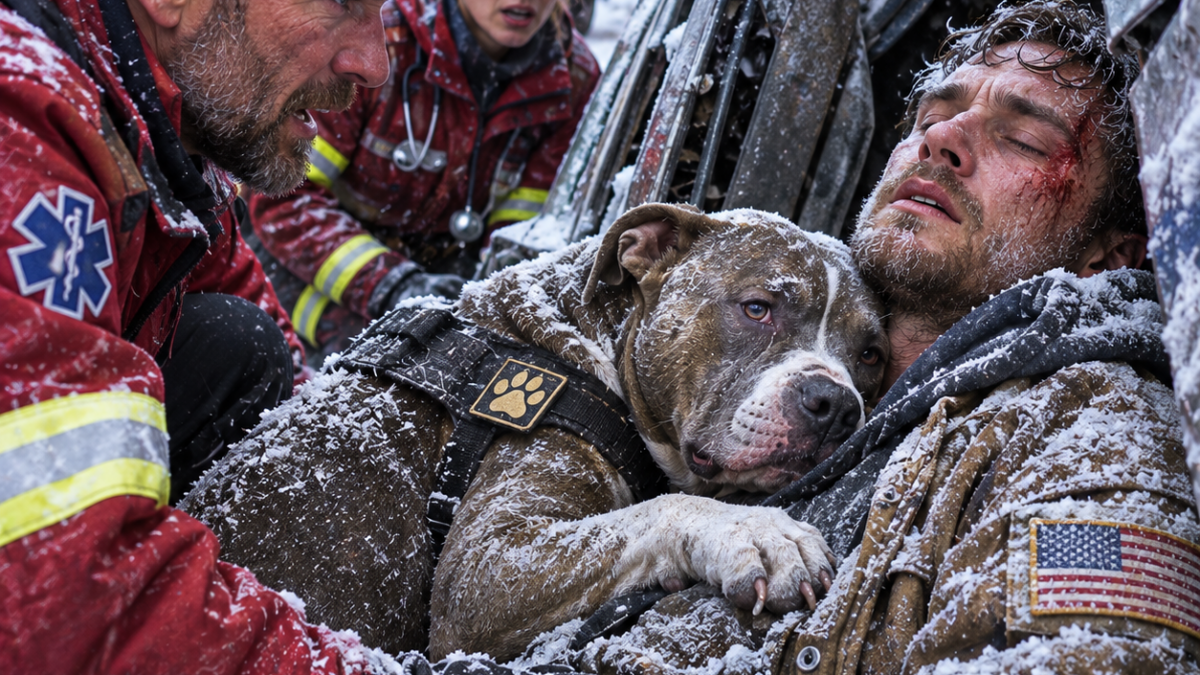
I will never forget the way that dog looked at me.
I’ve seen fear in animals before.
I’ve seen dogs trapped inside burning homes, cats hiding beneath collapsed porches, and frightened horses refusing to leave flooded fields.
Most terrified animals either try to escape or defend themselves when a stranger approaches.
This dog did neither.
He lifted his head just far enough to look at my flashlight.
His dark eyes were exhausted.
His ears lay close to his head.
His breathing was shallow, and frost clung to the short fur around his muzzle.
But he didn’t move away from the man beneath him.
Not an inch.
I crouched beside the damaged truck and lowered my voice.
“Hey, buddy.”
His eyes followed me.
“I’m Thomas. We’re here to help.”
Of course, he couldn’t understand my introduction.
But after nineteen years working in emergency rescue, I’d learned that a calm voice sometimes mattered as much as anything else.
I turned the flashlight away from his face.
“Good boy. That’s it.”
The dog blinked slowly.
Then he lowered his head against Wesley’s neck.
The movement was so gentle that something tightened inside my chest.
He looked like an animal who had finally reached the end of his strength but still hadn’t given himself permission to rest.
Behind me, Jenna climbed carefully down the embankment.
“Thomas, what have you got?”
“One adult male. Consciousness impaired. Severe cold exposure. Possible lower-body injuries.”
I paused.
“And a dog.”
“A dog?”
“Right against him.”
She moved closer.
Her flashlight swept across the wreckage.
Then she saw them.
“Oh, my God.”
I looked at her.
She had been a paramedic for thirteen years.
She rarely reacted like that.
But the sight was extraordinary.
Wesley was trapped in the narrowest surviving section of the cab.
The roof had crumpled.
The dashboard had shifted.
Broken glass glittered across his jacket.
And curled around the upper part of his body was a muscular brown-and-white pit bull, pressed as close as the wreckage allowed.
The dog’s body covered part of Wesley’s chest and shoulder.
His head rested beneath Wesley’s chin.
And one of Wesley’s hands remained tangled in his fur.
For a moment, Jenna and I simply stared.
Then she knelt.
“We need to assess him.”
I nodded.
“I’m going to try moving the dog.”
I reached slowly toward the pit bull.
He watched my hand.
His muscles tightened.
I stopped.
“Easy.”
He didn’t growl.
Didn’t show his teeth.
He merely turned his head toward Wesley, as though checking whether the man was still there.
I glanced at Jenna.
“Let’s give him a second.”
She nodded.
I lowered myself until my face was closer to the dog’s level.
“Listen, buddy. We have to help your person.”
The dog blinked.
I reached toward his shoulder.
This time, he allowed my hand to touch him.
His coat was cold on the surface.
Beneath it, I could feel the muscles trembling.
His body had been working through the night in brutal conditions.
I gently stroked the side of his neck.
“Good boy.”
He lifted his head.
For one moment, I thought he might climb away.
Instead, he turned toward Wesley and licked his cheek.
Slowly.
Once.
Then again.
Wesley’s eyelids moved.
I leaned closer.
“Sir? Can you hear me?”
His mouth opened slightly.
No sound came out.
Jenna moved into position.
“Wesley? My name is Jenna. We’re with emergency medical services.”
His eyes shifted toward her.
Barely.
But enough.
She looked at me.
“He’s responding.”
Relief moved through me.
Not certainty.
Not yet.
But hope.
And in that ravine, with the freezing wind cutting across our faces, hope felt precious.
We worked carefully.
The truck’s position made access difficult.
The driver’s side had absorbed severe damage, and unstable metal surrounded Wesley’s lower body.
We could not simply pull him out.
My team established a safe approach and began preparing the necessary equipment.
Jenna assessed his breathing, circulation, temperature, and neurological condition while coordinating immediate medical care.
Wesley’s body temperature was dangerously low.
Later, we learned it had fallen to approximately 32°C—about 89.6°F.
That degree of hypothermia can be life-threatening.
His heartbeat required close monitoring.
His legs weren’t responding normally.
And the extent of his injuries was still uncertain.
The fact that the dog had remained against his upper body might have helped reduce some heat loss, but none of us could know exactly how much warmth had been preserved or whether that alone made the difference between life and death.
What we knew was that Wesley was still alive.
And that the animal beside him had remained there through four hours of freezing darkness.
I looked down at the pit bull.
He was watching Jenna’s hands.
Carefully.
Every movement.
Then Wesley made a faint sound.
The dog immediately lowered his head.
Wesley’s lips moved.
I leaned closer.
“What did you say?”
His voice was almost inaudible.
“Rain.”
I stared.
“Rain?”
His eyes shifted toward the dog.
Then he whispered, “My dog.”
The pit bull’s ears moved.
I felt my throat tighten.
“His name is Rain?”
Wesley barely nodded.
I looked back at the dog.
“Well, Rain.”
I stroked his shoulder.
“Your person needs us now.”
And somehow, saying his name seemed to change everything.
Rain was still reluctant to leave.
I didn’t blame him.
He had spent the entire night pressed against Wesley.
To him, that battered truck was the only place where his person existed.
He couldn’t understand ambulances.
Medical equipment.
Rescue procedures.
He only knew that Wesley was hurt and that strangers were reaching toward him.
I continued speaking softly.
“Rain, you’re doing great.”
He looked at me.
“That’s it.”
Another team member brought an insulated blanket and supplies to protect the dog from further cold exposure.
We prepared a safe way to move him while the medical team continued working.
I placed one hand beneath his chest and another where I could support him without causing injury.
For a moment, he resisted.
Not violently.
He simply leaned back toward Wesley.
Then something happened that I remember more clearly than almost anything from that morning.
Wesley’s fingers moved.
Only slightly.
His hand had been resting in Rain’s fur.
Now those fingers tightened weakly.
The dog turned.
Pressed his nose against Wesley’s palm.
Then licked it.
I swallowed.
“It’s okay, boy.”
Rain looked at Wesley one last time.
And finally allowed me to lift him.
He was heavier than he looked.
Maybe fifty-five pounds.
Twenty-five kilograms or so.
But that morning, holding him felt strangely different from carrying an ordinary frightened dog.
Not because he weighed more.
Because I knew what he’d just endured.
His paws were painfully cold.
His body trembled.
He was exhausted.
And even as I carried him away from the wreckage, he kept turning his head toward the truck.
He never stopped watching Wesley.
I carried him to the protected area where another responder could assess and warm him appropriately.
Then I crouched.
“Rain, you’re safe.”
He looked at me.
I knew I couldn’t promise him that everything would be okay.
I didn’t yet know whether Wesley would survive.
I didn’t know whether his legs were permanently injured.
I didn’t know whether Rain himself had suffered serious cold-related harm.
But I could make one promise.
“We’re not leaving him.”
Rain lowered his head.
I rested my hand against his neck.
Then turned back toward the truck.
Because our work was far from over.
The extraction was difficult.
There were moments when I feared the damaged cab would shift.
We moved cautiously, stabilized what we could, and coordinated every step.
Jenna stayed focused on Wesley’s medical condition.
His breathing.
His circulation.
His temperature.
His responses.
He drifted in and out of awareness.
Sometimes his eyes opened.
Sometimes he seemed to hear us.
At one point, he whispered something I couldn’t understand.
I leaned close.
“Wesley?”
His lips moved again.
“Dog.”
I looked toward Jenna.
She glanced up.
“Tell him.”
I nodded.
I leaned nearer to Wesley.
“Rain is safe.”
His eyes moved toward mine.
I continued.
“We’ve got him. He’s being cared for.”
His breathing remained shallow.
But something in his face changed.
A tiny relaxation.
Then his eyes closed again.
I remember thinking that even in his condition, even while trapped beneath crushed metal with a dangerously low body temperature, he was worried about his dog.
Not his truck.
Not his belongings.
Not the cost of the rescue.
Rain.
The little animal he’d held against his chest through the night.
When we finally freed Wesley, the morning light had turned the sky a pale orange.
The ravine looked almost beautiful from a distance.
Frost glistened on the grass.
Pine trees stood motionless beneath the cold.
A thin layer of snow covered the shoulder of the road.
But down where we worked, there was nothing beautiful about the wreckage.
The truck was destroyed.
Glass lay scattered across the ground.
Metal had folded around the cab like paper.
I had no doubt that Wesley was fortunate to have survived the crash itself.
We transferred him carefully to a stretcher and moved him to the ambulance.
Jenna continued treatment and monitoring.
The team worked with the urgency that severe hypothermia and traumatic injuries demanded.
I returned for Rain.
He was wrapped in a blanket, alert enough to lift his head but clearly exhausted.
When he saw the stretcher moving toward the ambulance, he stood.
His body trembled.
“Easy, buddy.”
I approached slowly.
He looked toward the ambulance doors.
Then at me.
I knew what he wanted.
He wanted Wesley.
Of course he did.
I crouched beside him.
“We’re going to get you both help.”
Rain touched his nose against my hand.
Then looked back toward the ambulance.
I swallowed.
For nineteen years, I’d told frightened people that help was coming.
That they weren’t alone.
That we were doing everything we could.
But I’d never wanted so badly for an animal to understand those words.
During transport, Jenna and the medical team concentrated on Wesley’s condition.
Rain’s welfare was handled separately, with arrangements for him to receive veterinary attention and remain safely supervised.
I stayed close to him as circumstances allowed.
He was quiet.
Unnaturally quiet for a dog who had just survived an accident.
He didn’t bark at the unfamiliar voices.
Didn’t fight the blanket.
Didn’t struggle to get away.
He simply watched the direction in which Wesley had been taken.
Occasionally, he made a soft sound.
A little breath through his nose.
A tired whimper.
Each time, I stroked his ears.
“He’s getting help.”
Rain looked at me.
“He’s not alone.”
I couldn’t know whether those words comforted him.
But speaking them comforted me.
Because the truth was that none of us knew how the next few hours would unfold.
Wesley had serious injuries.
His temperature was dangerously low.
And we’d already lost so much time to the storm.
Yet we had reached him.
He was alive.
And Rain was alive too.
For that moment, I held on to those facts.
The hospital team took over Wesley’s care.
Rain was evaluated by a veterinarian for cold exposure, injuries, and the effects of the crash.
We later learned that he’d been chilled and exhausted but had escaped the kind of severe injury we feared.
That was remarkable in itself.
The truck had rolled down a steep embankment.
The cabin had been crushed.
Both occupants had been exposed to extreme cold for hours.
Yet Rain had survived.
I stood in the hospital corridor after handing over my report.
My hands were shaking.
I hadn’t noticed until then.
One of my younger team members, Chris, approached.
“You okay, boss?”
I looked at him.
“Yeah.”
He studied me.
“You sure?”
I nodded.
“Just cold.”
It wasn’t entirely true.
I was exhausted.
Shaken.
And unable to stop thinking about the pit bull lying against Wesley’s chest.
Chris looked toward the treatment area.
“That dog, man.”
I swallowed.
“Yeah.”
He shook his head.
“I’ve never seen anything like that.”
Neither had I.
And I had a feeling I never would again.
I went home that afternoon.
At least, I tried.
I drove through the familiar streets of our Arkansas town, past the grocery store, the old church, and the little diner where my team sometimes stopped after overnight calls.
Everything looked normal.
People were buying groceries.
Children were being picked up from school.
A man was scraping ice from his windshield.
The world continued.
It always did.
Even after a night when somebody came close to dying.
I pulled into my driveway and sat in the truck with the engine running.
My wife, Claire, appeared at the front window.
She waved.
I lifted one hand.
But I didn’t get out.
A few moments later, she opened the front door and walked toward me wearing her winter coat over her pajamas.
She tapped on the window.
I lowered it.
“Thomas?”
I looked up.
“Hey.”
Her expression changed immediately.
“What happened?”
I tried to answer.
Instead, I looked down at the steering wheel.
Claire opened the passenger door and climbed inside.
She didn’t ask again.
She simply waited.
We’d been married for twenty-one years.
She knew when I needed quiet.
Eventually, I told her.
The ice.
The overturned truck.
The crushed cab.
Wesley.
Rain.
The four hours.
And the way the dog had refused to leave.
Claire listened without interrupting.
When I finished, her eyes were wet.
“Oh, Thomas.”
I shook my head.
“I keep seeing him.”
“Wesley?”
“The dog.”
She reached for my hand.
I swallowed.
“He was exhausted. Freezing. And he stayed pressed against that man the whole time.”
My voice broke.
“He didn’t know we were coming.”
Claire tightened her grip.
“No.”
“He didn’t know anybody would find them.”
I closed my eyes.
“He just stayed.”
For a long time, we sat in the truck.
Then Claire leaned against my shoulder.
And I finally let myself cry.
People think emergency responders become accustomed to tragedy.
In some ways, we do.
We learn procedures.
We learn to remain calm.
We learn that panic makes difficult situations worse.
We learn how to act when everyone around us is terrified.
But none of that means the things we see stop affecting us.
Some calls stay with you.
A child’s shoe beside a flooded road.
An elderly man waiting outside a burning house for his wife.
A mother refusing to leave a hospital hallway.
The empty sound of a radio after someone stops answering.
And sometimes, a small brown-and-white pit bull curled against a man in a crushed pickup truck.
I had always believed that experience would make the hardest moments easier.
Instead, experience taught me how quickly life could change.
It taught me that ordinary mornings could become emergencies without warning.
And it taught me not to dismiss the quiet ways people—and animals—tried to keep one another alive.
Still, Rain was different.
I couldn’t explain why.
Maybe it was the way he watched Wesley.
Maybe it was the fact that he stayed in a dangerous place when he might have tried to escape.
Maybe it was Wesley using what little strength he had to ask whether his dog was safe.
Whatever the reason, I knew I wasn’t going to forget them.
That evening, Jenna called.
I answered immediately.
“Any news?”
She paused.
Then said, “Wesley made it through the initial emergency treatment.”
I sat down.
“Thank God.”
“He’s still seriously injured, and they’re monitoring him closely.”
I nodded.
“His legs?”
“There’s swelling and trauma. They’ll need further assessment as his condition stabilizes.”
I closed my eyes.
“Okay.”
Jenna continued.
“He’s responding to treatment for hypothermia.”
I let out a breath.
For the first time since midnight, I felt some of the pressure in my chest loosen.
Then I asked, “What about Rain?”
“The veterinarian says he’s recovering from the cold exposure and exhaustion. He needs rest and monitoring, but the early findings are encouraging.”
I smiled.
“Good.”
Jenna was quiet for a moment.
Then she said, “Thomas, I’ve been thinking about that dog all day.”
“Me too.”
“He wasn’t warm all over. He was cold too.”
“I know.”
She paused.
“His body may have reduced some of the heat Wesley was losing from his upper body. But we should be careful about claiming we know exactly how much that changed the medical outcome.”
I nodded.
“Of course.”
“We can’t measure what would have happened without him.”
“No.”
Jenna took a breath.
“But I do know something.”
“What?”
“When we arrived, Wesley was alive. Rain had stayed with him. And that dog had given him companionship and physical warmth in a situation where both were desperately needed.”
My eyes filled.
“That I can say.”
I looked toward the kitchen.
Claire was preparing dinner.
The house smelled of soup.
Everything was warm.
Ordinary.
Safe.
I swallowed.
“Jenna?”
“Yes?”
“I’m glad we got there.”
Her voice softened.
“So am I.”
Two days later, I visited Wesley.
Not in uniform.
I wore jeans, a dark sweater, and the old winter jacket Claire kept insisting I should replace.
I brought a small bag containing a few personal items the hospital staff had approved.
Mostly, I wanted to see how he was doing.
His room was on a medical floor overlooking a parking lot.
Sunlight streamed through the windows.
A television played quietly above the bed.
When I entered, Wesley was awake.
He looked younger than he had in the truck.
His face was still bruised.
His movements were limited.
But his eyes were open and alert.
I stopped beside the doorway.
“Wesley?”
He turned.
For a moment, he looked confused.
Then his expression changed.
“You.”
I smiled.
“Thomas.”
He stared.
“The rescue guy.”
I laughed softly.
“One of them.”
His eyes filled.
He looked toward the empty chair beside his bed.
“Come in.”
I walked closer.
“How are you feeling?”
He gave a weak laugh.
“Like I rolled a truck down a mountain.”
I smiled.
“Fair description.”
Then his expression became serious.
“Rain?”
I nodded immediately.
“He’s safe.”
Wesley closed his eyes.
For a moment, he didn’t move.
Then a tear slipped down his cheek.
I felt my throat tighten.
“He’s getting veterinary care. They’re pleased with his progress so far.”
Wesley covered his face with one hand.
“Thank God.”
I pulled up a chair.
He took several breaths.
Then looked at me.
“Did he get hurt?”
“He was very cold and exhausted. The veterinarian checked him. He’s recovering.”
Wesley nodded.
Again.
And again.
As though he needed to repeat the information until he could believe it.
I waited.
Then he whispered, “I thought he was going to die.”
I looked at him.
Wesley stared toward the window.
“Not me.”
His voice broke.
“Rain.”
For several moments, he couldn’t continue.
I didn’t rush him.
I’d learned long ago that people needed to tell the story of an emergency at their own pace.
Sometimes talking helped.
Sometimes silence did.
Eventually, Wesley wiped his face.
“He hates the cold.”
I frowned.
“What?”
“Rain.”
Wesley smiled faintly.
“He absolutely hates it.”
I looked at him.
He continued.
“Every winter, he acts like the entire state of Arkansas has personally betrayed him.”
I laughed.
Wesley smiled.
“If it’s below forty degrees, he’s under a blanket.”
I shook my head.
“A pit bull?”
“Yep.”
“Under a blanket?”
“Wrapped up like a burrito.”
I began laughing.
It was such an ordinary image.
A sturdy pit bull tucked beneath blankets, refusing to come out because the house wasn’t warm enough.
Then I remembered the ravine.
The frost.
The crushed truck.
The dog pressed against Wesley.
My smile faded.
Wesley noticed.
His eyes filled again.
“That night,” he whispered, “he stayed on me.”
I nodded.
“I saw.”
Wesley looked down.
“He was shaking.”
I swallowed.
“He was so cold.”
Then his voice broke.
“And I kept trying to tell him to find somewhere safer.”
I stared.
“He wouldn’t.”
Wesley took a slow breath.
Then began telling me about the crash.
He’d been driving home from a veterinary appointment.
Rain had developed a mild cough and seemed more tired than usual.
Wesley worried about him.
He worried about Rain whenever anything seemed wrong.
The veterinarian had examined the dog and recommended rest and monitoring for what appeared to be a mild respiratory illness.
Wesley had been relieved.
He’d bought Rain a new blanket on the way home.
A thick gray one.
He planned to put it on the dog’s bed beside the fireplace.
Then the weather worsened.
The road iced over.
Visibility dropped.
And somewhere along the rural highway, his truck lost traction.
“I remember the steering wheel moving,” Wesley said.
He stared toward the window.
“I remember trying to correct it.”
His fingers tightened around the blanket covering his legs.
“Then we were off the road.”
He swallowed.
“Everything turned over.”
I remained quiet.
“The noise was unbelievable.”
He looked toward me.
“Glass. Metal. Rain barking.”
His voice shook.
“Then nothing.”
For a moment, he closed his eyes.
“When I woke up, I couldn’t move my legs.”
My chest tightened.
He continued.
“The cab was crushed. I couldn’t get out. My phone was somewhere near the seat.”
He paused.
“I don’t know how long I spent reaching for it.”
I nodded.
“You managed to call.”
“Yeah.”
He looked at me.
“I told the dispatcher I was okay.”
I smiled sadly.
“I heard.”
Wesley laughed once.
“Wasn’t exactly true.”
“No.”
He looked down.
“I didn’t want her to panic.”
I shook my head.
“She was trying to help you.”
“I know.”
He swallowed.
“I think I was trying to convince myself.”
After the phone call ended, Wesley couldn’t reach the device again.
He was trapped.
His legs were numb.
Cold air entered through the broken windows.
He had no way to know how long rescuers would take.
He tried calling out.
No response.
He could hear the wind.
The occasional movement of damaged metal.
And Rain’s breathing.
At first, the dog moved around the small surviving space in the cab.
He sniffed Wesley’s face.
Licked his hand.
Tried to find a comfortable position.
Then he began climbing against Wesley’s upper body.
Wesley tried to move him.
“Go on, buddy.”
Rain didn’t.
He pressed closer.
Curled against Wesley’s chest.
Tucked his head beneath his chin.
And stayed.
Wesley stared at me.
“He’d never done that before.”
I looked down.
“He sleeps beside me at home. Sometimes against my legs. But not like that.”
His throat tightened.
“It was like he knew I needed him.”
I didn’t answer.
We couldn’t know exactly what Rain understood.
But we could see what he’d done.
And that was enough.
Wesley continued.
“I kept talking to him.”
“What did you say?”
He gave a faint smile.
“Everything.”
I waited.
“I told him he was a good boy. Told him we’d go home soon. Told him I’d make him breakfast.”
His eyes filled.
“Even told him he could sleep on the bed that night.”
I laughed softly.
Wesley looked toward the window.
“After a while, I couldn’t feel much.”
His voice dropped.
“I was so cold.”
I nodded.
“I know.”
“I kept thinking I should sleep.”
He looked at me.
“But Rain was there.”
A tear slid down his face.
“And every time I started drifting off, I’d feel him move or lick my face.”
Wesley swallowed.
“He gave me something to keep talking to.”
For a long moment, neither of us spoke.
Then he whispered, “I think that mattered as much as the warmth.”
I asked whether he had been afraid.
Wesley looked surprised.
Then he laughed softly.
“Of course.”
I nodded.
He stared at the blanket.
“But not the way you’d think.”
I waited.
“I was scared I might die.”
His voice tightened.
“But I was more scared of what would happen to Rain if I did.”
I looked at him.
He continued.
“I live alone.”
I nodded.
“My closest relatives are gone. I have friends, but nobody who checks on me every day.”
He swallowed.
“Rain is my family.”
I felt my chest tighten.
“He’d be trapped in that truck with me. Maybe nobody would find us for days.”
His eyes filled.
“He’d be hungry. Cold. Scared.”
I looked away.
Wesley wiped his face.
“I kept thinking, if I die, who takes care of him?”
His voice broke.
“So I kept talking.”
I swallowed.
“To Rain?”
He nodded.
“I told him we weren’t done.”
He smiled through tears.
“I told him I hadn’t bought that expensive bag of dog food for nothing.”
I laughed.
Then my own eyes filled.
Wesley continued.
“I told him he still had a new blanket waiting at home.”
He paused.
“And I promised him that when we got out, I’d never complain about him stealing the warm side of the bed again.”
For a moment, I couldn’t speak.
Because in the worst moments, people don’t always think about grand achievements.
Sometimes they think about ordinary things.
A warm kitchen.
A favorite chair.
A dog waiting for dinner.
And the fear that someone they love might be left alone.
“How did you find him?” I asked.
Wesley looked confused.
“Rain?”
I nodded.
“Before all this.”
His face softened.
“Three years ago.”
He smiled.
“On a road.”
I stared.
“What kind of road?”
“Backcountry road outside town.”
His eyes moved toward the window.
“It was raining.”
I sat back.
And he began telling me the story of the day Rain entered his life.
Wesley had been returning from a supply store when he heard something near the shoulder.
At first, he thought it was a bird.
A faint sound.
Almost swallowed by the rain.
He slowed down.
Pulled over.
Then walked toward the ditch.
There, beneath wet grass and mud, was a tiny puppy.
Newborn or nearly so.
Cold.
Hungry.
Barely moving.
No mother dog in sight.
No other puppies.
No shelter.
Wesley knelt beside him.
The puppy opened his eyes weakly.
Then made the smallest sound.
“I picked him up,” Wesley told me.
His expression changed as he remembered.
“He was so little I could hold him in one hand.”
I smiled.
“What did you do?”
“Drove straight to the vet.”
He laughed softly.
“Probably scared half the staff when I came running inside.”
The veterinarian examined the puppy and helped Wesley begin appropriate care.
The little dog was fragile.
He needed warmth, feeding, monitoring, and careful attention.
Wesley had never raised a puppy that young.
He was terrified.
He followed every instruction.
Set alarms.
Bought supplies.
Asked questions.
And spent long nights checking that the little animal was breathing normally.
He named him Rain.
Because rain was falling when they found each other.
For weeks, Wesley barely slept.
But the puppy survived.
Then grew.
And grew.
And grew.
Soon, the tiny animal who once fit in his hand became a powerful, affectionate pit bull who followed him everywhere.
Wesley smiled.
“He never really understood that he got bigger.”
I laughed.
“Most dogs don’t.”
“He still thinks he belongs on my lap.”
I smiled.
“Does he?”
“Every day.”
Wesley looked down.
“Sometimes I let him.”
I raised an eyebrow.
“Sometimes?”
He laughed.
“Okay. Every time.”
Then his smile faded.
He stared toward the window.
“I thought I’d saved him.”
I swallowed.
“And maybe I did.”
His eyes filled.
“But that night in the truck…”
He couldn’t finish.
I leaned forward.
Wesley looked at me.
Then whispered, “He saved me too.”
I stayed with Wesley for almost an hour.
Before leaving, I showed him a photograph of Rain taken by the veterinarian after his initial recovery from the cold.
Wesley stared.
His face crumpled.
He reached toward the phone.
“Can I?”
I handed it to him.
He held it carefully.
Rain was lying on a thick blanket, his head resting on his paws.
He looked tired.
But safe.
Wesley touched the screen.
“Hey, buddy.”
His voice broke.
I looked away.
He smiled through tears.
“Look at you.”
For a moment, he simply stared at the photograph.
Then he looked toward me.
“Does he know I’m alive?”
The question hurt more than I expected.
I took a breath.
“I don’t know what he understands.”
Wesley lowered his eyes.
I continued.
“But he’s safe, and the people caring for him know how important you are to him.”
He nodded.
I paused.
“We’re working with the appropriate staff on whether a visit can be arranged when it’s safe for both of you.”
His expression changed.
“Really?”
“Yes.”
He closed his eyes.
Then whispered, “Thank you.”
I shook my head.
“You don’t have to thank me.”
He looked up.
“Yes,” he said quietly. “I do.”
Three days later, Rain visited Wesley.
The hospital had reviewed the request with the appropriate staff, and the visit was arranged under controlled conditions that considered Wesley’s recovery and Rain’s health.
It wasn’t something we could simply assume every hospital would permit.
But in this case, the necessary arrangements were made.
I arrived a little early.
Jenna was already there.
She stood near Wesley’s room speaking with a nurse.
When she saw me, she smiled.
“You came.”
I nodded.
“Wouldn’t miss it.”
She looked toward the hallway.
“Rain’s on his way.”
I swallowed.
For some reason, I was nervous.
I’d seen the dog survive a wreck.
I’d carried him away from the truck.
I’d watched Wesley cry over his photograph.
But I wasn’t prepared for what happened next.
Rain entered the room slowly.
His handler kept him close and allowed him time to observe the unfamiliar environment.
The dog looked around.
The hospital equipment.
The bed.
The people.
Then he heard a voice.
“Rain?”
His ears lifted.
Wesley was lying against the pillows.
One hand rested on the blanket.
He looked toward the door.
“Hey, buddy.”
Rain froze.
For one suspended moment, he didn’t move.
Then his tail began wagging.
A small movement.
Then faster.
His entire body seemed to change.
He looked from Wesley to the handler.
Then back again.
When he was allowed to approach safely, he moved straight toward the bed.
Wesley began crying.
“Oh, buddy.”
Rain reached the bedside.
Lifted his head.
And pressed his nose toward Wesley’s hand.
Wesley touched his fur.
Then covered his face.
I stood near the door with my throat tightening.
The dog licked his fingers.
Then looked up at him.
For a moment, neither made a sound.
And somehow, that silence was the most emotional part of the entire rescue.
Wesley leaned forward as much as his condition safely allowed.
“I’m here.”
Rain’s tail moved.
“I’m here, boy.”
He stroked the dog’s ears.
His hands were trembling.
“You did good.”
A tear slid down Wesley’s cheek.
“You did so good.”
Rain leaned gently toward him.
I looked at Jenna.
Her eyes were wet.
The nurse beside her wiped her face.
And I felt something in my chest open.
For four hours, these two had endured the cold together.
Then they’d been separated by ambulances, medical treatment, and uncertainty.
Now they were in the same room again.
Wesley was alive.
Rain was alive.
And for a few precious minutes, the distance between them was gone.
Wesley kept one hand resting against Rain’s head.
The dog seemed content simply to remain close.
He didn’t need a toy.
A treat.
Or a walk.
He wanted Wesley.
And Wesley wanted him.
I thought about the first time I’d seen them.
The frozen truck.
The crushed cab.
The little animal curled against a dying man’s chest.
Then I looked at them now.
And I had to step into the hallway because I couldn’t stop crying.
Over the next three weeks, Wesley remained in the hospital.
His condition gradually improved.
The medical team continued treating his injuries and monitoring his recovery from hypothermia.
There were difficult days.
Pain.
Fatigue.
Uncertainty about his legs.
Frustration when he couldn’t do things he’d once taken for granted.
He was a former serviceman who had always valued independence.
Being unable to move easily was frightening for him.
He hated asking for assistance.
Hated waiting.
Hated feeling helpless.
I understood some of that.
Rescue work attracts people who like solving problems.
People who want to act.
Move.
Help.
Fix.
Wesley had spent much of his life relying on himself.
Now he had to learn to accept care.
It wasn’t easy.
But each time I visited, something had changed.
A little more strength.
A clearer voice.
A longer conversation.
A new rehabilitation goal.
And whenever Rain was able to visit, Wesley seemed to brighten in a way I couldn’t quite describe.
The dog would settle close.
Wesley would rest a hand on his head.
And for a while, the hospital room felt less like a place of pain and uncertainty.
It felt like somewhere two friends had finally found each other again.
I started visiting Wesley on my days off.
At first, I told Claire it was because I wanted to check his progress for the team’s records.
She raised an eyebrow.
“On your day off?”
I shrugged.
“Just for a little while.”
She smiled.
“Thomas.”
“What?”
“You like him.”
I looked away.
“He’s a good guy.”
She nodded.
“And the dog?”
I laughed.
“Rain’s a good dog.”
Claire folded her arms.
“I thought so.”
The truth was that I had become attached to both of them.
Wesley was quiet.
Thoughtful.
More comfortable asking questions than talking about himself.
He had served in the military, then returned to Arkansas hoping for a simpler life.
He bought a small farm.
Worked with his hands.
Repaired equipment.
Grew vegetables.
And tried to build a routine that kept him close to the land.
He lived alone.
Not because he disliked people.
Because life had become difficult after his service, and being alone sometimes felt easier than explaining himself.
Rain changed that.
The dog gave him structure.
A reason to get up.
A companion for work around the property.
Someone waiting at the door.
Someone who needed breakfast even when Wesley didn’t feel like eating.
I understood that too.
After almost twenty years in emergency services, I knew how quickly work could consume a person’s life.
How easy it was to come home exhausted and have nothing left for conversation.
How tempting it could be to withdraw.
Wesley and I had different histories.
But we understood silence.
And slowly, we became friends.
One afternoon, during his second week in the hospital, I found Wesley staring at the ceiling.
Rain lay beside his bed during an approved visit, resting quietly.
I pulled up a chair.
“Bad day?”
Wesley smiled without humor.
“Something like that.”
I waited.
He looked toward his legs.
“Therapy was rough.”
I nodded.
“Sorry.”
He sighed.
“I thought I was doing better.”
“You are doing better.”
He looked at me.
“Doesn’t feel like it.”
I considered the words.
Then said, “Progress doesn’t always feel like progress while you’re in the middle of it.”
He laughed softly.
“You sound like my therapist.”
“That’s concerning.”
He smiled.
Then stared toward the window.
“I keep thinking about that night.”
I leaned forward.
“Yeah?”
“What if you’d been later?”
My chest tightened.
He continued.
“What if nobody had heard the call?”
I didn’t answer.
“What if Rain had gotten too cold?”
His voice broke.
“What if I hadn’t found him three years ago?”
I looked down at the dog.
Rain was sleeping.
His chest rose and fell.
His paws twitched occasionally.
I took a breath.
“There are a lot of things that could have gone differently.”
Wesley nodded.
“I know.”
I continued.
“But we did find you.”
He looked at me.
“And Rain is here.”
Wesley lowered his hand onto the dog’s head.
I paused.
“Maybe the best thing you can do now is focus on getting stronger.”
He swallowed.
“For him?”
“For both of you.”
Wesley looked down.
Then nodded.
A week later, he told me something I hadn’t expected.
We were sitting beside the hospital window.
Rain wasn’t there that day.
Wesley had just finished a rehabilitation session and looked exhausted.
He stared at the floor.
“Thomas?”
“Yeah?”
“I almost didn’t go to the vet that afternoon.”
I frowned.
“Why?”
He shrugged.
“Rain was coughing a little. Nothing dramatic. He was still eating and drinking.”
I nodded.
“I thought maybe I was overreacting.”
He looked toward me.
“But I took him anyway.”
I waited.
“Then the road iced over.”
His expression tightened.
“For days, I kept thinking that if I’d stayed home, none of this would’ve happened.”
I understood.
The way people traced backward through an emergency, searching for the one decision that might have prevented it.
I had done it myself.
After difficult rescues.
After losses.
After calls where we’d arrived too late.
I looked at Wesley.
“You took Rain because you were concerned about his health.”
He nodded.
“That was an act of care.”
He stared at the window.
“The crash was a separate event.”
Wesley swallowed.
“I know.”
I waited.
He looked down.
“It’s just hard not to think about.”
“Yeah.”
I nodded.
“It is.”
For a while, we sat quietly.
Then he said, “If I could do it again, I’d still take him to the vet.”
I looked up.
He smiled faintly.
“Maybe I’d choose a different road.”
I laughed.
“That’s fair.”
Then he looked toward the empty chair where Rain usually rested during visits.
“But I’d still take care of him.”
I nodded.
“Of course.”
Wesley’s expression softened.
“That’s what you do when someone depends on you.”
The sentence stayed with me.
Because he’d said it so simply.
As though there was no other answer.
After three weeks, Wesley was discharged from the hospital into the next stage of his recovery.
He still couldn’t walk normally.
His legs required rehabilitation.
He needed help with certain tasks.
And returning immediately to his previous farm routine wasn’t possible.
But he was alive.
His medical team had a plan.
And Rain was waiting.
I helped coordinate a practical arrangement with the people assisting Wesley.
A neighbor agreed to check on the property.
A friend from his military days offered transportation.
Community members helped with meals and some chores.
Claire organized a few things from our end.
Wesley protested almost everything.
“You don’t have to do this.”
I laughed.
“Apparently, I do.”
He frowned.
“Thomas.”
I looked at him.
“Wesley, people want to help.”
He glanced away.
“I know.”
“Then let them.”
He was quiet.
I continued.
“You’ve spent three years taking care of Rain. You don’t have to prove anything by refusing help when you need it.”
Wesley looked toward the dog.
Rain was sitting beside him, watching the conversation.
Then Wesley smiled sadly.
“I guess he never asks whether he’s being a burden.”
I shook my head.
“Nope.”
“He just wants breakfast.”
I laughed.
“And a warm blanket.”
Wesley smiled.
“Definitely the blanket.”
The first time Wesley returned to his farm, I went with him.
It was a cold morning, but nothing like the night of the crash.
The sky was bright.
The roads were clear.
The fields lay quiet beneath thin winter sunlight.
Wesley’s property sat at the end of a gravel driveway.
A modest farmhouse.
A red equipment shed.
A few bare trees.
A narrow porch.
And a doghouse near the fence that appeared to have never been used.
I noticed it immediately.
“Rain doesn’t like his house?”
Wesley laughed.
“He’s never slept in it.”
I stared.
“Why have it?”
“Bought it when he was little.”
He shrugged.
“Thought he’d want somewhere outside.”
I looked toward Rain.
The dog was riding safely with us, alert and excited by the familiar surroundings.
Wesley smiled.
“He took one look at it, then walked back to my front door.”
I laughed.
“Smart dog.”
“Very.”
We helped Wesley settle inside.
Rain moved from room to room.
Sniffing.
Checking.
Rediscovering the place he knew.
Then he found his bed beside the fireplace.
He stopped.
Looked toward Wesley.
And wagged his tail.
Wesley smiled.
“There it is, buddy.”
Rain approached the bed.
Sniffed the thick gray blanket folded across it.
The one Wesley had purchased the day of the crash.
He turned toward his owner.
Then back to the blanket.
For a moment, nobody spoke.
Wesley swallowed.
“I never got to give him that.”
I looked at him.
He reached toward the blanket.
“Bought it right before we wrecked.”
His voice broke.
“I thought he was going to need it because he hated the cold.”
Rain stepped onto the bed.
Turned in a circle.
Then lay down on the blanket.
Wesley covered his face.
And began crying.
I looked away.
Because there are some moments when being a friend means letting someone have privacy, even while you’re standing in the same room.
Rain didn’t remain on the bed for long.
The moment Wesley settled into his chair, the dog got up.
Walked across the living room.
And placed his head against Wesley’s knee.
Wesley smiled through tears.
“Hey, buddy.”
Rain leaned closer.
Wesley stroked his ears.
“I know.”
The dog moved beside the chair.
Then settled on the rug within reach of Wesley’s hand.
I watched them.
The farmhouse was warm.
A fire crackled gently in the stove.
Sunlight fell across the wooden floor.
Outside, the wind moved through bare branches.
And I thought about how far they’d come from the ravine.
The crushed truck.
The broken glass.
The four hours of darkness.
The fear.
Now they were home.
Not fully recovered.
Not unchanged.
But together.
And that seemed more important than everything else.
Rehabilitation took months.
Wesley worked hard.
Some days he made progress.
Other days, pain and fatigue slowed him.
There were setbacks.
Appointments.
Exercises.
Frustrating limits.
He had to relearn how to move comfortably and safely.
Sometimes he called me after therapy.
“You ever feel like your body is arguing with you?”
I laughed.
“Every morning.”
He chuckled.
“Mine’s winning.”
I smiled.
“Give it time.”
He sighed.
“I’m trying.”
And he was.
He followed his care plan.
Accepted help when he needed it.
Gradually resumed manageable tasks.
And learned to distinguish determination from pushing too hard.
Rain remained beside him through it all.
He followed Wesley around the house.
Watched him practice movements.
Rested nearby while he exercised.
And waited beside the door when someone came to help.
I don’t pretend Rain understood rehabilitation.
He didn’t know what a therapy schedule was.
He didn’t know why certain movements mattered.
But he knew his person.
He recognized familiar routines.
And he kept Wesley company.
Sometimes that was enough to turn a lonely afternoon into something bearable.
One spring morning, Wesley called me.
His voice was unusually cheerful.
“Thomas?”
“Yeah?”
“You busy?”
I glanced at the paperwork covering my desk.
“Depends.”
He laughed.
“Come over after work.”
“Why?”
“Got something to show you.”
I smiled.
“What kind of something?”
“Just come.”
Then he hung up.
I stared at the phone.
For a moment, I wondered whether something was wrong.
Then I remembered the excitement in his voice.
I smiled.
Maybe something was finally right.
I arrived shortly after five.
Rain met me at the door.
His tail wagged so hard that his entire rear end moved.
I laughed.
“Hey, buddy.”
He sniffed my boots.
Then turned toward the hallway.
Apparently, I was expected to follow.
Wesley stood near the kitchen counter.
Not in his chair.
Standing.
He held a mobility aid within reach.
His posture was careful.
His movements controlled.
But he was upright.
I stopped.
“Wesley?”
He smiled.
“Hey.”
I stared.
Then looked at Rain.
The dog sat beside him.
Watching.
Wesley took a breath.
“Ready?”
I couldn’t speak.
He took one careful step.
Then another.
His movements were slow.
Deliberate.
Supported.
But he was walking.
I felt my throat tighten.
He looked toward me.
“Not pretty.”
I laughed through tears.
“Looks pretty good from here.”
He smiled.
Then took another step.
Rain remained beside him.
Not jumping.
Not rushing.
Just moving close enough to stay near.
Wesley reached the end of the kitchen.
Stopped.
Then turned toward me.
“I did it.”
I nodded.
I was crying now.
“Yeah.”
He smiled.
“I did it.”
For a moment, he looked like a boy who had just accomplished something he’d been dreaming about.
Then he lowered himself carefully into a chair.
Rain immediately approached.
Wesley stroked his head.
“Good boy.”
I stepped closer.
Placed one hand on Wesley’s shoulder.
And whispered, “I’m proud of you.”
He looked up.
His eyes filled.
“Thanks, Thomas.”
Over time, Wesley regained more mobility.
He never returned exactly to the way he had moved before the crash.
There was lingering weakness.
Some stiffness.
Days when the weather seemed to make everything harder.
But he could walk again.
He could move around his farm.
Enjoy the porch.
Care for Rain with appropriate help when needed.
And begin rebuilding a life he feared he’d lost in the ravine.
Sometimes he became frustrated by what he couldn’t do.
I understood.
But his recovery taught me something.
Surviving an emergency wasn’t the end of the story.
Sometimes it was the beginning of an entirely different kind of courage.
The courage to practice.
To accept help.
To rest.
To try again after a difficult day.
To live with uncertainty.
And to find meaning in progress that didn’t always look dramatic.
I had spent most of my career focused on getting people through the worst moments.
Wesley showed me what happened afterward.
The quiet work.
The ordinary effort.
The patience required to build a life again.
Our friendship deepened.
Claire and I began inviting Wesley to dinner.
At first, he hesitated.
He wasn’t used to being included.
Especially in family gatherings.
Then Rain made the decision for him.
The dog loved our house.
He particularly loved the rug beside the fireplace and the fact that Claire always remembered to keep his water bowl filled.
One evening, Wesley arrived carrying a homemade pie.
Claire looked surprised.
“You baked?”
He grinned.
“Don’t sound so shocked.”
She laughed.
“I’m impressed.”
I looked at the pie.
“Should I be worried?”
Wesley frowned.
“About what?”
“Food poisoning.”
Claire laughed.
Wesley pointed at me.
“You’re not getting any.”
Rain wagged his tail.
I looked down.
“At least somebody likes me.”
For the first time in years, Wesley seemed completely at ease.
He laughed.
Told stories.
Asked Claire about her garden.
Helped me clean up afterward.
And when he left, Rain followed him to the truck as though the most natural thing in the world was that they would return home together.
Claire watched them drive away.
Then looked at me.
“He needed people.”
I nodded.
“Yeah.”
She took my hand.
“And you needed a reminder that helping doesn’t always end when the ambulance leaves.”
I looked toward the road.
Then smiled.
“Maybe I did.”
The following winter, I visited Wesley on another January evening.
The weather had turned cold.
Not sixteen degrees below zero.
Not even close.
But cold enough that frost covered the fields and the wind whistled around the farmhouse.
I parked beside the porch.
Lights glowed through the windows.
When I knocked, Rain barked once.
Then Wesley called, “Come in!”
I opened the door.
Warm air greeted me.
The woodstove crackled.
A pot of soup simmered in the kitchen.
Wesley sat in his favorite chair with a book resting against his knee.
Rain was curled beside him beneath the thick gray blanket.
I smiled.
“Somebody looks comfortable.”
Wesley glanced down.
“Rain?”
“Yeah.”
He laughed.
“Cold weather. You know how he gets.”
I shook my head.
Rain lifted his head.
Saw me.
Then gave a lazy wag.
I crouched.
“Hey, hero.”
He stretched toward my hand.
I stroked his ears.
Wesley smiled.
“He remembers you.”
I looked up.
“Probably remembers I carried him away from you.”
Wesley laughed.
“Maybe.”
Then his expression softened.
“But he trusted you.”
I looked down at the dog.
His fur was warm beneath my fingers.
His breathing steady.
His body relaxed.
It was difficult to believe that a year earlier, I’d found him trapped in a wrecked truck, trembling in a cold so severe that I feared we might lose both him and his owner.
Now he lay beside a fireplace, sheltered from the wind, looking mildly offended that I’d interrupted his nap.
I smiled.
“Good to see you, buddy.”
Rain closed his eyes.
And went back to sleep.
After dinner, Wesley and I sat on the porch with hot coffee.
Rain remained inside, refusing to join us in the cold.
Wesley laughed when I looked through the window.
“Told you.”
I smiled.
“He’s made his position very clear.”
We sat quietly for a while.
The sky was dark.
Stars shone above the fields.
A thin wind moved through the trees.
Then Wesley said, “A year ago, I thought I was never going to see this place again.”
I looked toward the yard.
“I know.”
He took a breath.
“I remember the last part of that night.”
I turned.
“What do you remember?”
“The cold.”
His voice softened.
“And Rain.”
I waited.
“I couldn’t feel my legs. I could barely keep my eyes open.”
He stared into the darkness.
“I kept talking to him because I didn’t want him to think I’d left.”
My chest tightened.
Wesley continued.
“Then I heard something.”
I leaned forward.
“What?”
“Voices.”
He smiled faintly.
“At first, I thought I was imagining them.”
I swallowed.
“Then I heard you.”
He looked toward me.
“You kept telling Rain he was a good boy.”
I laughed softly.
“Sounds like me.”
Wesley smiled.
“And I remember thinking that if someone was talking to Rain, maybe we’d both be okay.”
For several seconds, I couldn’t speak.
Then I looked down at my coffee.
“I was afraid we were too late.”
Wesley nodded.
“I figured.”
I took a breath.
“But you were still there.”
He looked toward the house.
“Rain was still there.”
I followed his gaze.
Through the window, we could see the dog resting beside the fireplace.
Wesley smiled.
“Yeah.”
Then he said quietly, “He was.”
We talked about the night Rain had first entered his life.
The rainstorm.
The muddy ditch.
The tiny puppy crying beside the road.
Wesley smiled as he remembered.
“I almost didn’t stop.”
I looked at him.
“Really?”
He nodded.
“Thought it was a bird.”
I stared.
“Then I heard it again.”
He looked down.
“Something told me to check.”
For a moment, we sat quietly.
Then Wesley said, “Funny how life works.”
I smiled.
“What do you mean?”
“Three years ago, I was driving down a road when I heard a little animal needing help.”
He paused.
“I stopped.”
I nodded.
“Last January, you were driving down a road looking for a man needing help.”
I looked toward the fields.
Wesley continued.
“And Rain was already there.”
His voice tightened.
“Doing what he could.”
I swallowed.
He looked toward the window.
“I thought I rescued him when I found him as a puppy.”
He smiled through tears.
“But that night in the truck, I realized he’d been giving something back every day since.”
I watched him.
“Not just when he kept me warm.”
I nodded.
“Every morning he made me get up. Every time he waited by the door. Every day he made that farmhouse feel less empty.”
Wesley looked toward me.
“He’d been keeping me going long before the crash.”
For a moment, I couldn’t answer.
Then I whispered, “I think you’re right.”
When I returned home, Claire was reading beside the fireplace.
She looked up.
“How’s Wesley?”
“Good.”
“And Rain?”
I smiled.
“Refused to come outside.”
She laughed.
“Smart dog.”
I sat beside her.
For a while, we listened to the fire.
Then I said, “You know what I keep thinking about?”
She lowered her book.
“What?”
“That night.”
She nodded.
“The rescue?”
“Yeah.”
I stared toward the flames.
“I keep remembering how Rain looked at me.”
Claire waited.
“He wasn’t barking. Wasn’t trying to get away. He just looked exhausted.”
I swallowed.
“Like he’d done everything he could.”
She reached for my hand.
I continued.
“Then Wesley told me he was worried about Rain the entire time.”
Claire’s eyes softened.
“They were looking after each other.”
I nodded.
“Exactly.”
For nineteen years, I’d thought of rescue as something one person did for another.
We arrived.
We assessed.
We helped.
We transported.
We handed people over to medical care.
And sometimes, if everything went well, they survived.
But that night was different.
Wesley had saved Rain three years earlier.
Rain had stayed with Wesley through a freezing night.
Our team had reached them in the ravine.
The medical professionals had treated them.
Friends and neighbors had helped during recovery.
Nobody had done everything alone.
And maybe that was the lesson I’d needed.
Rescue wasn’t always one heroic moment.
Sometimes it was a chain of ordinary acts of care.
One person stops beside a road.
Another stays through the darkness.
A dispatcher keeps someone talking.
A crew fights its way through ice.
A veterinarian warms an exhausted dog.
A neighbor brings dinner.
A friend shows up after the ambulance is gone.
Each person does what they can.
And together, they make survival possible.
Today, Wesley walks.
Not exactly as he did before the crash.
But he walks.
He works around his farm within the limits of his recovery.
He watches the sunrise from his porch.
He meets friends for coffee.
And he still spends more money on Rain’s blankets than any reasonable person would consider necessary.
Rain is older now.
A little calmer.
Still stubborn.
Still affectionate.
Still convinced that winter weather is a personal insult.
And still inseparable from Wesley.
They have a habit that makes me smile every time I see it.
At night, when Wesley settles into bed, Rain comes close.
Sometimes he curls beside him.
Sometimes he rests partly against his chest, depending on what’s comfortable for both of them.
Wesley strokes his ears.
The dog sighs.
And they fall asleep.
Wesley once told me that the routine makes him feel safe.
Not because Rain is a heater.
Not because the dog can protect him from every possible danger.
But because when he wakes in the darkness, he knows he’s not alone.
He can reach out.
Feel warm fur.
Hear familiar breathing.
And remember that they made it home.
Together.
I still lead rescue teams in Arkansas.
There are nights when the radio comes alive just as I’m preparing to sleep.
Days when storms move through faster than the forecast predicted.
Calls that end with relief.
And calls that don’t.
The work remains difficult.
Sometimes exhausting.
Sometimes heartbreaking.
But every January, when the temperature drops, I think about that ravine.
The long drive over frozen roads.
The pale light arriving at dawn.
The truck crushed beneath the embankment.
And a dog curled against a man who had almost run out of strength.
I remember Rain lifting his head.
Looking at me.
Then lowering it against Wesley’s chest again.
He didn’t know my name.
Didn’t know how ambulances worked.
Didn’t know whether we’d arrive in time.
He only knew his person was hurt.
And he stayed as close as he could.
For four hours.
Through the bitter cold.
Until help finally reached them.
People sometimes call Rain a miracle.
I understand why.
But I try to speak carefully about that night.
We don’t know exactly how much heat Rain preserved.
We can’t prove how long Wesley would have survived without him.
We cannot turn one extraordinary rescue into a medical guarantee about what an animal’s body can do in freezing conditions.
The danger was real for both of them.
What Rain did was not safe for him, either.
But we can honor the devotion without exaggerating the science.
Rain stayed.
He gave Wesley warmth and companionship.
He remained close when the cab was crushed and the night seemed endless.
And Wesley, even while seriously injured, remained concerned about the little animal he had once pulled from a rainy ditch.
Those facts are powerful enough.
I don’t need anything else.
Last month, Wesley sent me a photograph.
Rain was sprawled across his bed beneath that same thick gray blanket.
Only his nose stuck out.
The caption read:
Apparently the forecast says it’s going to be cold tonight.
I laughed so hard Claire came into the room.
“What?”
I showed her.
She smiled.
“Still hates the cold.”
“Apparently.”
Then my phone buzzed again.
Another message from Wesley.
Thanks for making sure we both got home.
I stared at it.
For a long moment, I couldn’t answer.
Then I typed:
You two did the hard part. We just came when you called.
I looked at the message.
Then added:
Give Rain an extra scratch behind the ears for me.
Wesley replied with a photograph of Rain’s tail wagging beneath the blanket.
I smiled.
And put the phone down.
There is one detail about that morning I rarely talk about.
When we finally reached the wrecked truck, the sky was beginning to brighten.
I remember the color.
That pale orange light against the icy road.
I remember standing above the ravine, looking at the crushed cab, and feeling the terrible possibility that we’d arrived too late.
Then I climbed down.
Opened the damaged door enough to see inside.
And found them.
A man who had almost no strength left.
A dog who had spent the night beside him.
Both terribly cold.
Both still breathing.
I think about how small the distance can be between despair and hope.
Sometimes it’s the sound of a siren coming through the darkness.
Sometimes it’s a human voice calling your name.
Sometimes it’s an animal pressing close enough to remind you that someone is still there.
Rain had once been a starving puppy beside a rainy road.
Wesley had stopped.
Picked him up.
And taken him somewhere safe.
Three years later, Wesley was the one who couldn’t get up.
The one who was frightened.
The one who needed warmth and help.
And Rain stayed.
Not because he understood the danger the way we did.
Not because he expected a reward.
But because Wesley was his person.
The man who fed him.
Sheltered him.
Warmed him on cold nights.
And never stopped coming home.
So when Wesley needed him, Rain did the simplest thing he could.
He stayed close.
I am forty-four now.
Twenty years in emergency rescue.
I’ve seen floods, fires, wrecks, and storms.
I’ve watched people display courage in moments when nobody expected them to have any strength left.
I’ve seen strangers risk their safety to help people they would never meet again.
I’ve watched families hold one another through grief.
And I’ve learned that love is not always loud.
Sometimes it doesn’t make speeches.
Sometimes it doesn’t look impressive.
Sometimes it is simply a warm body beside yours when the world turns cold.
A familiar presence.
A refusal to leave.
A little dog looking toward the darkness, waiting for help to arrive.
When I think about Rain, I don’t remember a hero posing for a photograph.
I remember his tired eyes.
His trembling body.
His head resting against Wesley’s chest.
And the way he looked up when we finally reached them.
As though he had been holding on until someone else could take over.
Then, when Wesley’s hand moved weakly through his fur, Rain licked his cheek and allowed us to help.
That moment will stay with me for the rest of my life.
One winter evening, I visited Wesley again.
He was sitting beside the fireplace with Rain curled at his feet.
I watched the dog sleeping.
Then asked, “Do you ever think about that night?”
Wesley smiled faintly.
“Every time it gets cold.”
I nodded.
He looked down at Rain.
Then continued.
“But not in the way I used to.”
I waited.
“At first, I remembered the fear.”
His voice softened.
“The broken glass. The pain. The thought that we might never get out.”
He gently stroked the dog’s head.
“Now I mostly remember this.”
I looked at him.
“What?”
He smiled.
“The warmth.”
Rain stirred.
Opened one eye.
Then rested his muzzle against Wesley’s foot.
Wesley laughed softly.
“Not just his body heat.”
He looked toward me.
“The fact that I wasn’t alone.”
For a moment, neither of us spoke.
Then he said, “I saved him once, Thomas.”
I nodded.
“Yeah.”
“And somehow, when I needed him most, he was there.”
His eyes filled.
“I used to think I was the only one taking care of us.”
He smiled down at the dog.
“Turns out I was wrong.”
I watched Rain settle back to sleep.
And felt my throat tighten.
Because that was the truth of their story.
Not a man who saved a dog.
Not a dog who saved a man.
Two living creatures who had become each other’s family.
Each offering what he could when the other needed it.
When I left that evening, the temperature had dropped again.
Frost was forming on the fields.
I pulled my jacket tighter and walked toward my truck.
Behind me, the farmhouse door opened.
Wesley stood in the warm light with Rain beside him.
“Thomas!”
I turned.
“Yeah?”
He smiled.
“Drive safe.”
I nodded.
“You too, next time.”
He laughed.
Then Rain gave one cheerful bark.
I smiled.
“Goodnight, buddy.”
His tail wagged.
Wesley closed the door.
And I stood in the driveway for a moment, looking at the warm light behind the windows.
A year earlier, I’d found those two trapped in a frozen wreck at the bottom of a ravine.
Now they were home.
There would still be difficult days.
Wesley’s legs would still trouble him.
Rain would still need veterinary care and the ordinary attention every aging dog deserves.
Life hadn’t become perfect.
But it was theirs again.
And that was more than enough.
I climbed into my truck.
Started the engine.
And drove toward home.
People ask why I remember that rescue more vividly than so many others.
I could tell them about the dangerous temperature.
The difficult roads.
The crushed truck.
The complicated extraction.
The emergency medical care.
But that’s not what I see when I close my eyes.
I see a little pit bull refusing to leave the chest of the man who once lifted him out of the rain.
I see Wesley’s cold fingers moving weakly through his fur.
I see Rain looking up at us when help finally arrived.
And I remember the terrible relief of discovering that both were still alive.
Three years earlier, Wesley had found a helpless puppy on a rainy roadside and carried him somewhere warm. On the coldest night of Wesley’s life, that same puppy—now a grown dog—stayed beside him until someone came to carry them both to safety.
I don’t know whether Rain understood that he was helping save a life.
I don’t know whether he remembered the rainy ditch where Wesley found him.
I don’t know what passed through his mind during those four hours.
But I know what I saw.
A dog who wouldn’t leave.
A man who kept fighting because he was worried about that dog.
And two lives held together by the kind of devotion that needs no explanation.
I used to believe that the most important part of being a rescuer was arriving in time.
Now I know there is another kind of rescue that sometimes happens before the professionals reach the scene.
It happens when someone stays.
When someone gives warmth.
When someone keeps another living creature from facing the darkness alone.
And sometimes, that someone has four paws, a short brown-and-white coat, and a name given to him on the day he was found beneath a stormy sky.
Rain.
The dog who hated the cold.
The dog who stayed anyway.
The dog who was once saved beside a road—and who, three years later, refused to leave the man who saved him.
When we opened that crushed truck at dawn, I thought we had arrived to rescue a man and his dog. But they had already spent the night trying to save each other.
And whenever I remember that freezing Arkansas morning, I return to one image.
Not the wreckage.
Not the ice.
Not the danger.
The dog lifting his exhausted head, looking into my eyes, and finally letting us help.
Because after four hours of darkness, the light had reached them.
Wesley was still alive.
Rain was still beside him.
And this time, neither of them had to face the cold alone.








