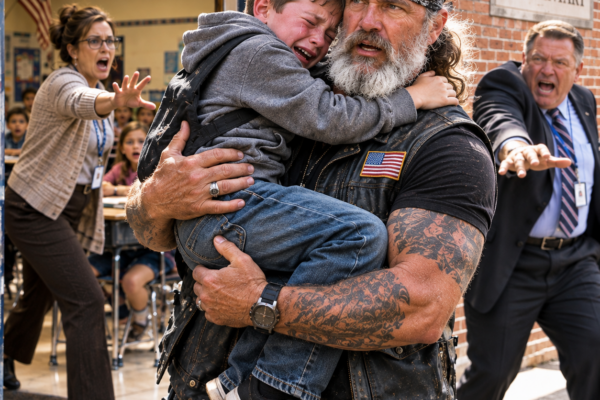
FULL STORY:“HE WASN’T INVITED—GET HIM OUT!” My Mom Had Security Throw My Dad Out of My Graduation—Then I Found Six Years of Birthday Cards She Hid
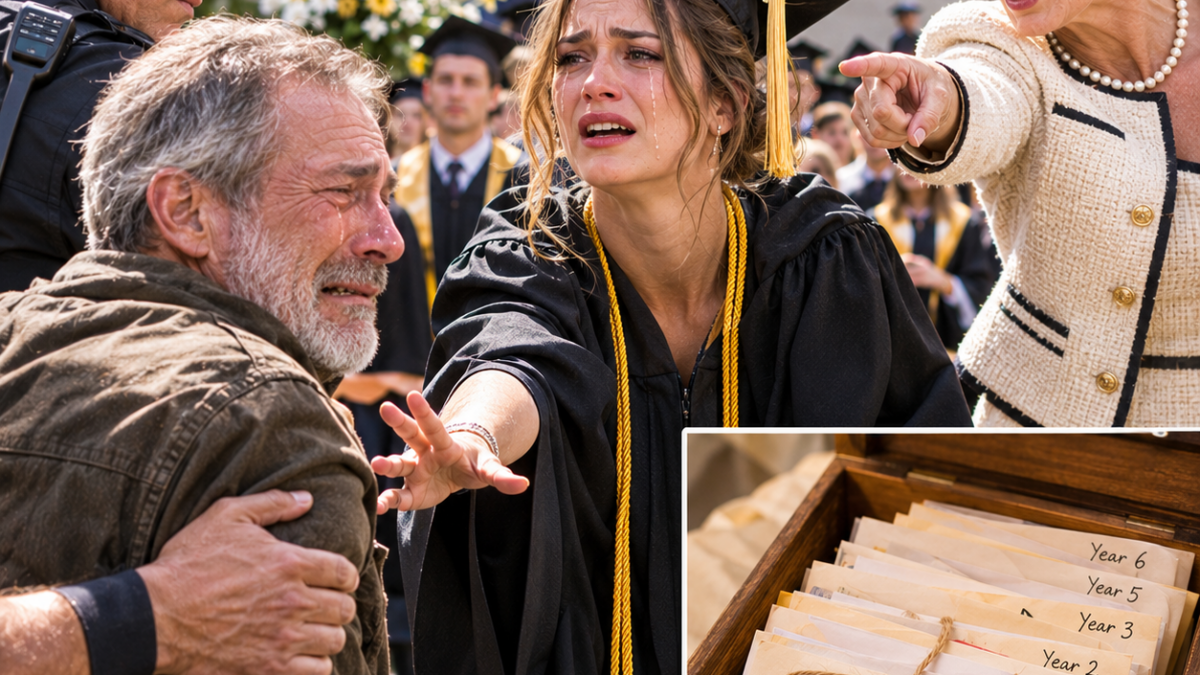
PART2
I walked across the graduation stage without remembering any of it.
Apparently people cheered.
My friend Maddie later told me I almost walked past the principal without taking my diploma cover.
I smiled for photographs.
Hugged teachers.
Told classmates congratulations.
All while watching the auditorium doors.
Dad never came back.
Mom acted as if nothing had happened.
By two o’clock, our backyard was full of relatives, white balloons, catered food, and a rented tent Mark insisted made the party “look like something.”
Mark liked things that looked like something.
His dealership sponsored charity golf tournaments.
His watch cost more than Dad’s motorcycle.
He believed success should be visible from fifty feet away.
Mom seemed to love that about him.
After Dad left us—or, more accurately, after Mom told me he had left us—Mark became the man who “stepped up.”
That was the phrase everyone used.
Mark stepped up.
Mark paid bills.
Mark came to school functions.
Mark bought Christmas gifts.
Mark financed family vacations.
Mark taught me to drive.
Mark was there.
Dad was not.
At least that was the story.
For six years, I accepted it.
Sometimes angrily.
Sometimes painfully.
But I accepted it.
At three-fifteen, Mark tapped a fork against his glass.
Everybody turned.
Grandma Helen.
Aunt Tina.
Cousins.
Neighbors.
Dealership friends.
Mom stood beside him.
Mark put one arm around me.
“I’ve had the privilege of helping raise Emily for six years.”
Applause.
I smiled because that is what you do when twenty people are staring.
“Today I’m proud to say she’s my daughter.”
More applause.
Something about that sentence bothered me.
Not because I hated Mark.
I didn’t.
There had been years when I loved him.
Or at least believed I did.
He came into my life when I was twelve.
Dad had moved twenty minutes away after the divorce.
For about a year I saw him on weekends.
Then less.
Then almost never.
Mom told me he stopped calling.
Stopped sending support.
Stopped trying.
Mark was there for braces.
Driver’s ed.
Homecoming.
College tours.
So when he said:
“My daughter,”
I usually let him.
That day it felt different.
Mark smiled.
“And because graduating deserves more than cake…”
He reached into his pocket.
Held up a key fob.
People gasped.
Outside the tent sat a white compact SUV with a giant red bow.
My mouth opened.
“Is that for me?”
“Of course.”
Mom clapped.
Everyone cheered.
For half a second, despite everything that had happened that morning, I was eighteen.
A car.
My own car.
Then Mark said:
“But there’s one thing I’d like you to do first.”
The party quieted.
I looked at him.
“What?”
“I think it’s time we stop pretending that man is part of this family.”
My stomach dropped.
“Mom?”
She looked almost relieved.
“Mark has done more for you than your father ever did.”
I stared at the car.
Then the key in Mark’s hand.
“You mean Dad.”
Mark’s jaw tightened.
“I mean the man your mother divorced six years ago.”
“He’s still my dad.”
“He didn’t raise you.”
Mom stepped closer.
“Emily, today is supposed to be happy.”
“You threw him out of my graduation.”
“He wasn’t invited.”
“I invited him.”
“You did that to hurt us.”
“No.”
“I wanted my father there.”
Mark held out the key.
“Take the car.”
I looked at it.
Then at him.
“What do you want me to say?”
“Nothing complicated.”
His voice became softer.
“Just that you understand who your real family is.”
My chest tightened.
Aunt Tina stopped smiling.
Grandma Helen lowered her fork.
I looked at Mom.
“You’re okay with this?”
She said:
“Mark paid for everything.”
“That isn’t what I asked.”
“He deserves respect.”
“So does Dad.”
Mom sighed.
“Oh, Emily.”
That tone.
The one that always meant:
You are young.
You do not understand.
I looked at the car again.
“I don’t want it.”
Mark blinked.
“What?”
“I said I don’t want the car.”
Silence.
Somebody near the buffet whispered:
“Oh, boy.”
Mark laughed like I had made a joke.
“Don’t be ridiculous.”
“I’m not.”
Mom stepped forward.
“Emily.”
“No.”
“I’m not taking a car because somebody wants me to stop loving my father.”
Mark’s face hardened.
“Look at that.”
He laughed toward the relatives.
“Six years of paying for everything, and she still worships a motorcycle mechanic.”
Something inside me snapped.
“At least he never asked me to stop loving somebody to get a present.”
The backyard went dead silent.
Mark’s face turned red.
“Then let him buy you a car.”
Aunt Tina stood.
“Mark.”
He pointed at her.
“Stay out of this.”
“No.”
I looked at Mom.
“Apologize to him.”
She stared.
“What?”
“Dad.”
“For what?”
“For this morning.”
Mom laughed.
“No.”
“Then I don’t want anything.”
“Renee,” Aunt Tina said, “she’s right.”
Mom turned sharply.
“Tina, stay out of it.”
“You don’t buy someone’s love with a car.”
Mark looked offended.
“I’m not buying anything.”
Tina stared at the key.
“Then why is there a condition?”
Mom snapped:
“Mark paid for everything.”
Tina folded her arms.
“Did he?”
Something about how she said it made Mark look at her.
“What’s that supposed to mean?”
Tina said nothing.
Not yet.
Mark turned back to me.
“Fine.”
“If Emily wants her father so badly, he can pay for college too.”
My stomach tightened.
Mom looked away.
I stared.
“What?”
Mark laughed.
“You think Oregon is free?”
I had been accepted to Western Oregon University.
Music production and digital media.
It was not an Ivy League school.
It was mine.
I had applied without Mark’s enthusiasm.
He wanted me close.
Mom wanted me close.
Oregon represented distance.
A dorm.
My own schedule.
A life that did not run through Mark’s dealership or Mom’s approval.
I said:
“The college fund covers most of first year.”
Mark smiled.
Mom still would not look at me.
That was when I knew.
“What?”
I asked.
Mark crossed his arms.
“We’ve made a decision.”
“What decision?”
“You’re staying home next year.”
I actually laughed.
Not because it was funny.
Because my brain rejected the sentence.
“No, I’m not.”
“You’ll work at the dealership.”
“You can start college next year when you’re more mature.”
“I already accepted.”
“We know.”
Mom finally spoke.
“We called them yesterday.”
My chest went cold.
“What?”
“To ask them to hold your place for a year.”
I stared at her.
“You called my university?”
“We’re paying.”
Mark said.
“So we decide.”
I felt everyone watching.
“You called behind my back?”
“It’s done.”
Mom reached toward me.
“You’ll thank us later.”
I stepped away.
“No.”
“I’m going in August.”
Mark’s face went flat.
“Then the car stays.”
“Fine.”
“Phone stays.”
He pointed toward the house.
“The laptop.”
“Everything I bought.”
“Fine.”
Mom whispered:
“Emily.”
I turned.
“Are you seriously letting him do this?”
She said:
“You’re eighteen.”
“You want adult decisions?”
“Start paying your own bills.”
Mark smiled.
“Exactly.”
I felt tears burning my eyes.
I refused to let them fall.
Not there.
Not in front of him.
I went upstairs.
Behind me, Mark said loudly:
“Let her cry.”
“She’ll be back before dessert.”
I reached my bedroom.
Locked the door.
Then sat on the floor.
For the first time that day, I cried.
Not because of the car.
Not the phone.
Not even Oregon.
Because my graduation had become a hostage negotiation.
Dad had been thrown out.
My university had been called.
My future had been rearranged.
And everybody kept calling it love.
After maybe ten minutes, I remembered my birth certificate.
Oregon needed final identity documents.
If Mom and Mark were serious about controlling the enrollment, I needed my own paperwork.
Birth certificate.
Social Security card.
Passport.
Dad had always told me:
“Keep copies of your documents.”
Mom said:
“You’re a child.”
She kept everything in a file box in the hall closet.
I went downstairs quietly.
Party still outside.
I found the box.
Insurance.
Taxes.
Medical.
School.
Nothing.
Then I saw another plastic storage container pushed behind winter blankets.
My name written across the top.
EMILY.
I pulled it out.
Inside were birthday cards.
Dozens.
My heart stopped.
The first envelope was dated six years earlier.
My thirteenth birthday.
Handwriting I recognized instantly.
Dad.
Happy birthday, Em. I’m proud of you. Love, Dad.
Unopened.
I stared.
Then opened it.
Inside:
A card.
Twenty dollars.
A handwritten page.
I know things are strange right now. I hope you know none of this is your fault. I love you. I’ll keep trying.
My hands started shaking.
Next.
Fourteenth birthday.
Unopened.
Fifty dollars.
I called twice. Your mom says you’re not ready to talk. I’ll wait.
Fifteenth.
Unopened.
I hope school is going well. I heard you made orchestra. I’m proud of you.
Sixteenth.
One hundred dollars.
For gas when you start driving. Call me anytime.
Seventeenth.
I don’t know if you read these, but I won’t stop sending them.
Eighteenth.
This year.
Still hidden.
Two hundred dollars.
Happy birthday, Em. I’m proud of you. I wish I knew how to make this easier.
Six years.
Cards.
Money.
Letters.
Every birthday.
Christmas too.
Some envelopes contained gift cards.
Some checks too old to deposit.
Some cash.
All hidden.
I sat on the floor surrounded by proof that the story I had lived inside was false.
Mom came upstairs.
“Emily?”
I looked up.
She stopped.
Her face went white.
I held up the cards.
“What are these?”
She closed the door.
“Emily.”
“Why are these here?”
“I can explain.”
“Six years.”
My voice broke.
“Dad sent me birthday cards for six years.”
“Lower your voice.”
“You told me he forgot.”
“He was inconsistent.”
“There are cards every year.”
“That doesn’t mean anything.”
“There’s money.”
“Emily.”
“You hid them.”
“I was protecting you.”
I laughed.
Actually laughed.
“Protecting me?”
“He would send a card, then disappear.”
“He confused you.”
“He made promises.”
“You told me he never sent anything.”
“Because the occasional card doesn’t make somebody a father.”
“Occasional?”
I threw one envelope down.
“Thirteen.”
Another.
“Fourteen.”
Another.
“Fifteen.”
“Sixteen.”
“Seventeen.”
“Eighteen.”
Then Christmas cards.
School notes.
One congratulations card for orchestra.
“You hid all of them.”
Mom’s face hardened.
“You don’t know what your father did to me.”
“Then tell me.”
“He embarrassed me.”
“He failed.”
“He promised things and didn’t deliver.”
“You made him sound like he abandoned me.”
“He did.”
“No.”
I held up the letters.
“He didn’t.”
Mom stared.
Then said:
“Go live with him.”
The sentence was so cold I stopped crying.
“What?”
“If he’s suddenly your hero, go.”
She opened the bedroom door.
“Let’s see how long he lasts.”
“Mom.”
“You want adult decisions?”
“Fine.”
“Make one.”
I stared at her.
She pointed toward the closet.
“Pack.”
Aunt Tina appeared in the hall.
“Renee.”
Mom turned.
“Tina, stay out of it.”
“What happened?”
I held up the cards.
Tina’s face changed.
“Oh, Renee.”
Mom snapped:
“Don’t.”
“You hid them?”
“I was protecting my daughter.”
“From birthday cards?”
“From being disappointed again.”
I said:
“You were the disappointment.”
Mom recoiled like I slapped her.
Then Mark’s voice came from downstairs.
“What’s going on?”
Mom shouted:
“Emily is leaving.”
Mark laughed.
“Twenty bucks says she’s back before dessert.”
I packed.
Not much.
Clothes.
Documents.
Laptop until Mark appeared and took it from my hands.
“I bought that.”
“Fine.”
Phone.
He held out his hand.
“That too.”
I stared.
Then placed it in his palm.
Mom stood beside him.
Neither stopped me.
At the front door, she said:
“Key.”
I froze.
“What?”
“You’re not living here anymore.”
“Give me the house key.”
Aunt Tina whispered:
“Renee, don’t do this.”
Mom held out her hand.
I placed the key in it.
She closed her fingers around it.
I looked at the woman who raised me.
“Six years of cards.”
Her jaw tightened.
“You’ll understand when you’re older.”
“No.”
“I think I understand now.”
Then I walked out carrying one suitcase and a grocery bag full of unopened love.
Dad’s motorcycle shop was fifteen minutes away.
I had no phone.
So Tina drove.
Mom screamed after her:
“Tina, don’t you dare.”
Tina stopped.
Turned.
“Renee.”
“She is your daughter.”
Mom shouted:
“Then you take care of her!”
Tina stared.
“I’m choosing her today.”
Then got in the car.
Dad was closing the shop when we arrived.
He saw the suitcase.
His face changed.
“Emily?”
I stepped out.
He walked toward me.
“What happened?”
I could not speak.
I handed him the cards.
He looked down.
Then froze.
One envelope.
Another.
His handwriting.
His face collapsed.
“Where did you get these?”
“Mom hid them.”
He looked at Tina.
She nodded.
Dad sat on the curb.
Actually sat.
Like his legs stopped working.
“I thought you hated me.”
My throat closed.
“What?”
He looked at me.
“Your mom said you didn’t want contact.”
“That you sent the gifts back.”
“That you asked me to stop.”
I shook my head.
“I never got anything.”
Dad covered his face.
For several seconds, nobody spoke.
Then I whispered:
“Can I stay with you?”
His hands dropped.
“Stay with me?”
“Mom threw me out.”
His expression changed instantly.
“Did she hit you?”
“No.”
“Did Mark?”
“No.”
“She took my key.”
“My phone.”
“The laptop.”
“She told me to go live with you.”
Dad stood.
He was angry.
Terrifyingly.
Then he looked at me.
And somehow swallowed it.
“I don’t have much, Em.”
“I know.”
“My apartment’s small.”
“I know.”
“I’ve got a spare room.”
I started crying.
He smiled.
“It’s yours.”
Tina wiped her eyes.
Dad opened his truck.
Not motorcycle.
An old Ford Ranger from the shop.
My suitcase fit behind the seats.
As we drove, I asked:
“Did you have the room ready?”
Dad stared at the road.
“For six years.”
I looked at him.
“Just in case?”
He nodded.
“In case you ever wanted it.”
That destroyed me more than the cards.
His apartment was over a hardware store.
Two bedrooms.
Tiny kitchen.
Old carpet.
One bathroom.
My room had a bed.
Cheap dresser.
Desk.
Bookshelf.
No posters because he did not know what I liked anymore.
But on the desk sat a framed photograph of me at eleven holding a violin.
Before the divorce.
Before Mark.
Before six years of lies.
Dad touched the doorframe.
“I changed the sheets every few months.”
I cried.
“I know that sounds weird.”
“No.”
“It doesn’t.”
He gave me towels.
Then stood awkwardly.
“Food?”
I laughed through tears.
“Pizza?”
He smiled.
“Definitely.”
While we waited, I asked the question that changed everything again.
“Dad?”
“Yeah?”
“Why does Mark keep saying he paid for everything?”
Dad looked at me.
“What do you mean?”
“College.”
“He says he and Mom built my college fund.”
Dad became still.
“Your college fund?”
“Yes.”
“How much?”
“Mom said around thirty thousand.”
Dad closed his eyes.
Then laughed bitterly.
“What?”
“Emily.”
“What?”
“Every month for six years, I sent your mother four hundred dollars for your college account.”
My stomach dropped.
“How many months?”
“Seventy-two.”
I calculated.
“Twenty-eight thousand eight hundred.”
“Yes.”
“Plus birthday money?”
“Separate.”
I stared.
“The college fund Mom brags about…”
Dad nodded.
“Should mostly be my money.”
“Your money?”
“Money I sent for you.”
My voice shook.
“Mom told me you never paid a dime.”
Dad looked away.
“I know.”
“And Mark stands up at parties taking credit?”
He exhaled.
“Emily.”
“No.”
“Why didn’t you tell me?”
“How?”
“You didn’t answer calls.”
“I never got calls.”
“Your mom blocked my number on your old phone.”
“I tried email.”
“Mom had the password.”
“I sent letters.”
I looked at the grocery bag full of unopened proof.
“I know.”
He rubbed his face.
“I didn’t want a war.”
“She started one.”
“Maybe.”
“No.”
I looked at him.
“She threw you out of my graduation.”
“She hid my cards.”
“They called my university.”
“They took my college fund.”
Dad said:
“We don’t know that.”
“Yet.”
Then:
“Tomorrow, I want records.”
His face changed.
“Em.”
“My diploma.”
“My money.”
“My documents.”
“Everything.”
He nodded slowly.
“Then I’ll drive you.”
The next morning, I was no longer crying.
I was furious.
And fury felt cleaner.
We went back.
Mom opened the door.
Mark stood behind her.
“Good.”
He said.
“You’re here.”
I walked in.
“What are you doing here?”
Mom asked Dad.
“She asked me to drive her.”
Mark folded his arms.
“Your mother and I talked.”
I almost laughed.
“You’re moving back home.”
“No.”
“You’re going to apologize to Mark.”
“No.”
Mark’s face hardened.
“Then we’ll call Oregon and tell them we’re no longer paying your tuition.”
I looked at him.
“You’re stopping me from going to college because I won’t apologize for wanting my dad at graduation?”
“You are making this very simple.”
Dad said:
“She doesn’t owe either of you an apology.”
Mark looked at him.
“And how exactly are you going to pay for her education?”
Dad’s jaw tightened.
“I don’t know yet.”
Mark smiled.
“That’s what I thought.”
I reached into my folder.
“He already paid for it.”
Mom froze.
Mark looked at me.
“What?”
“Four hundred dollars a month.”
“For six years.”
I put copies of Dad’s bank transfers on the table.
Dad had printed them that morning.
Seventy-two transactions.
Same date nearly every month.
Same recipient account.
Mom.
“Twenty-eight thousand eight hundred dollars.”
Mark looked at Renee.
“Is that true?”
Mom said:
“That money came into the household.”
I stared.
“What?”
“Your father’s support was not enough to cover everything.”
Dad stepped forward.
“That was separate from support.”
“I paid court-ordered support too.”
My head snapped toward him.
“What?”
Mom’s face went white.
Dad continued:
“Four hundred was extra.”
“Specifically for college.”
“I labeled every transfer.”
I looked at Mom.
“You told me he paid nothing.”
She said:
“We fed you.”
“Clothed you.”
“Raised you.”
“That money compensated—”
“No.”
Dad’s voice sharpened.
“The child support compensated household expenses.”
“The four hundred was a separate voluntary college contribution.”
Mark said:
“Money in Renee’s account is Renee’s money.”
Dad looked at him.
“No.”
“Not if it was transferred for a specific agreed purpose.”
Mark laughed.
“Then take us to court.”
Mom looked at him.
“Mark.”
“What?”
He stared at Dad.
“If he thinks he has a claim, file it.”
I turned to Mom.
“You’d keep my college money?”
She looked at me.
“Until you apologize to Mark.”
That was the moment any tiny part of me hoping for misunderstanding died.
“You’re using my college fund to force me to apologize?”
“I’m using consequences.”
“For what?”
“Disrespect.”
Dad said:
“Renee, that money is hers.”
Mom snapped:
“Then take me to court.”
Dad went quiet.
I looked at him.
Then at her.
“Fine.”
Mom blinked.
“What?”
“I’ll work.”
“I’ll apply for financial aid.”
“I’ll defer if I have to.”
“I’ll figure it out.”
Mark laughed.
“You’ll be crawling back in a month.”
“Maybe.”
I picked up my birth certificate.
Diploma.
Social Security card.
“Still going.”
Dad said:
“Emily.”
I looked.
He held out something.
A small envelope.
“This is yours.”
I opened it.
$1,600.
Cash from all the birthday cards Dad had sent that Mom never gave me, plus replacement money for old checks.
My eyes filled.
Mom snapped:
“Don’t you dare give her that.”
Dad looked at her.
“I already did six years ago.”
Then looked at me.
“Now I’m giving it correctly.”
I hugged him.
Mom said:
“If you walk out now, don’t expect us at your college graduation.”
I looked at her.
“You wouldn’t even let my dad attend this one.”
She flinched.
I walked out.
That afternoon, Mom called Aunt Tina.
Because I no longer had a phone, Tina drove to Dad’s apartment.
“Your mother wants to talk.”
I put the phone on speaker.
Mom’s voice:
“The college fund is in Mark’s business account now.”
Dad’s head snapped up.
I stared at Tina.
“What?”
Mom continued.
“You want it back?”
“You apologize in person in front of the whole family.”
My hands went cold.
“That money is Dad’s.”
“Not anymore.”
“Sunday dinner.”
“Six o’clock.”
“Or forget about August.”
Dad stood.
“I’ll sell the bike.”
I looked at him.
“No.”
“Em.”
“No.”
“It’s just a bike.”
It was not.
Dad had rebuilt that Harley with Grandpa before Grandpa died.
One of the few valuable things he owned.
“No.”
“They want me to beg?”
“Fine.”
Dad stared.
“You’re going to apologize?”
I smiled for the first time since graduation.
“No.”
“I’m going to Sunday dinner.”
“With every receipt.”
Tina leaned forward.
“And I’m bringing Grandma.”
I looked at her.
“Grandma?”
“Our mother.”
Mom’s mother.
Grandma Helen.
The woman who had stood at my graduation party silently watching everything.
Tina’s face hardened.
“She doesn’t know about the cards.”
“She doesn’t know about the four hundred a month.”
“She definitely doesn’t know Mark moved your college money into his business.”
Dad exhaled.
“This is going to get ugly.”
Tina nodded.
“Good.”
“Renee spent six years counting on everybody being too polite to ask questions.”
Then she looked at me.
“Let them try that Sunday.”
Sunday arrived with rain.
Dad wore a clean black shirt.
Not because he cared what Mark thought.
Because Grandma Helen had always liked him.
He carried a folder.
Every bank statement.
Every transfer.
Copies of child-support records.
Certified-mail receipts for birthday cards Mom claimed never came.
I carried the originals.
All six years.
Tina picked up Grandma.
At five-fifty-eight, we pulled into Mom and Mark’s driveway.
The white SUV with the graduation bow was gone.
Probably returned to the dealership.
Fine.
I did not want it.
Through the front windows, I could see relatives already seated.
Mark had made it public.
Exactly what I wanted.
Dad turned off the truck.
“You don’t have to prove anything to anybody.”
“I know.”
“We can leave.”
“No.”
“You sure?”
I looked at the house key Mom had taken from me.
I could almost feel it missing from my pocket.
“Yes.”
“I’m sure.”
We entered.
The dining room looked like Thanksgiving.
Grandma Helen.
Tina.
Uncle Charles.
Two cousins.
Mark’s sister Beth.
Mark’s mother Elaine.
Apparently humiliation required an audience.
Mom stood at the head of the table.
Her expression changed when she saw Dad.
“I said Emily.”
“I didn’t invite him.”
I answered:
“I did.”
Again.
Mark laughed.
“Here we go.”
Then Grandma Helen stood.
“Sit down, Renee.”
Mom stared.
“Mom?”
“I said sit.”
I had never heard Grandma use that voice.
Mom sat.
Grandma looked at me.
“Tina told me you found something.”
I placed the grocery bag on the table.
Cards spilled out.
Six years.
Grandma’s face changed.
“What is that?”
“My birthday cards.”
“From Dad.”
Mom said:
“Mother, there’s context.”
Grandma held up one hand.
“No.”
She picked up the thirteenth-birthday envelope.
“Unopened.”
Another.
“Unopened.”
Another.
Her hands began shaking.
“You told me David stopped sending anything.”
Mom’s face reddened.
“He was confusing her.”
Grandma opened one.
Read quietly.
Then looked at Dad.
“You wrote every year?”
Dad nodded.
“Birthdays.”
“Christmas.”
“Graduation.”
“Other things too.”
Grandma stared at her daughter.
“Renee.”
Mom’s voice sharpened.
“You don’t know what he put me through.”
Grandma answered:
“We are not discussing your divorce.”
“We are discussing what you told a child about her father.”
Mark interrupted.
“This is getting ridiculous.”
I turned.
“No.”
“We haven’t gotten to the money.”
Silence.
I opened Dad’s folder.
Placed the first sheet down.
“$400.”
Next.
“$400.”
Next.
“$400.”
Month after month.
Dad explained.
“Court-ordered child support was separate.”
“I made that payment every month too.”
“In addition, Renee and I agreed I would send four hundred into an account for Emily’s college.”
Grandma looked at Mom.
“Is that true?”
Mom stared at the table.
“Renee.”
“Yes.”
The word barely came.
Mark said:
“That doesn’t prove ownership.”
I looked at him.
“Where’s the money?”
He crossed his arms.
“You heard your mother.”
“In the business.”
Grandma stared.
“What business?”
Mark’s dealership.
A used-car and financing operation he owned with a partner.
Mark said:
“Temporary cash-management issue.”
Dad laughed.
Not pleasantly.
“You moved a teenager’s college account into operating cash?”
“It wasn’t a custodial account.”
“That doesn’t make it yours.”
“You aren’t a lawyer.”
“No.”
Dad looked at him.
“I’m a mechanic.”
“But even mechanics know when something belongs to somebody else.”
Mark stood.
“Careful.”
Grandma slammed her palm on the table.
“Sit down.”
Everybody froze.
Mark actually sat.
Grandma looked at Mom.
“How much money?”
Mom said:
“Not all of it.”
“How much?”
Mark interrupted:
“Renee.”
Grandma’s eyes flashed.
“I am talking to my daughter.”
Mom whispered:
“Twenty-four thousand six hundred.”
I stopped breathing.
“What?”
Dad leaned forward.
“You transferred twenty-four-six?”
Mom nodded.
“What happened to the rest?”
“Some went toward application fees.”
“School things.”
“Expenses.”
I said:
“My application fees were $310.”
Mom said nothing.
Dad asked:
“Where did the rest go?”
Mark finally said:
“Household expenses.”
Dad’s jaw clenched.
“You used her college fund for household expenses?”
“We raised her.”
“I paid support.”
Mark snapped:
“It didn’t cover everything.”
Dad stood.
Neither man moved toward the other.
But everyone felt it.
Dad’s voice came low.
“I worked fifty and sixty hours some weeks.”
“I paid every ordered dollar.”
“I sent extra.”
“I sent birthday money.”
“I called.”
“I wrote.”
“And you stood up at her party and told everybody I never paid a dime.”
Mark sneered:
“You want a medal?”
“No.”
Dad pointed toward me.
“I wanted my daughter to know I didn’t forget her.”
That shut the room down.
I realized Dad was crying.
He wiped his face angrily.
“Six years.”
“I thought she hated me.”
Mom whispered:
“I was protecting her.”
I turned.
“Stop saying that.”
“Emily.”
“No.”
“Protection would have been telling me the truth and letting me decide what relationship I wanted.”
“You were twelve.”
“I’m eighteen now.”
“You’re still acting like I’m twelve.”
Mark said:
“You live under our roof.”
“Not anymore.”
“Then why are you here?”
“To get my money.”
“And my life back.”
Mark laughed.
“You think you walk in with some receipts and we write a check?”
“No.”
Dad said:
“We asked an attorney Friday.”
Mom’s face changed.
“You did what?”
Dad continued.
“He said the exact claim depends on account structure, transfer records, and the written purpose.”
“So tomorrow we’re requesting the full history.”
“If money intended for Emily was diverted, we’ll use the legal process.”
Mark smiled.
“Good luck.”
Grandma looked at him.
“You think this is funny?”
He shrugged.
“She wants to behave like an adult.”
“Adults settle disputes.”
Grandma’s face became something I had never seen.
Disgust.
“You offered her a car if she stopped loving her father.”
Mark stared.
“You called her university behind her back.”
“She needed guidance.”
“You took money meant for her education.”
“It went into the business temporarily.”
Grandma looked at Mom.
“And you allowed this?”
Mom started crying.
“Mark said it would be back before tuition was due.”
“How long ago?”
Mom hesitated.
I knew the answer would be bad.
“Eight months.”
Dad whispered:
“Jesus.”
Mark said:
“The dealership had inventory opportunities.”
“We needed liquidity.”
Tina laughed bitterly.
“You used Emily’s college fund to buy cars?”
“Inventory.”
“Cars.”
“Assets.”
“Cars.”
Mark snapped:
“Do you people know how business works?”
Dad answered:
“Yes.”
“You use your money.”
Mark stood again.
“That money was sitting there.”
I looked at him.
“That money was my future.”
He turned.
“You think your father can fund Oregon?”
Dad said:
“Maybe not.”
That honesty saved me.
He did not pretend.
“I can contribute what I can.”
“Emily can apply for aid.”
“Scholarships.”
“Payment plans.”
“I can sell things.”
I interrupted.
“Not the bike.”
He looked at me.
“We’ll figure it out.”
I looked back at Mark.
“But I would rather work two jobs than let you tell me I owe you my life because you used my own college money to control me.”
Grandma slowly stood.
Then took something from her purse.
A checkbook.
Mom stared.
“Mom.”
Grandma ignored her.
“How much is the first-semester gap after aid?”
I said:
“I don’t know yet.”
“Find out.”
“Grandma, no.”
“I am not paying four years.”
She pointed at me.
“You will work.”
“Apply for scholarships.”
“Be responsible.”
Then:
“But no granddaughter of mine is delaying college because her mother and stepfather took her money.”
Mom started crying harder.
“You’re choosing her over me?”
Grandma looked at her.
“That sentence is how we got here.”
Silence.
Then Grandma said something I will never forget.
“I am not choosing Emily over you.”
“I am choosing not to help you hurt her.”
Mom looked shattered.
Good.
Maybe she needed to.
Not destroyed.
Confronted.
There is a difference.
Dinner never happened.
Nobody touched the roast.
Mark stormed into his office.
Mom went upstairs.
His mother Elaine stayed sitting at the table.
She looked humiliated.
Finally she said:
“Emily.”
I looked.
“I didn’t know.”
“I know.”
She took off her glasses.
“Mark told me he built that fund.”
“I know.”
“I bragged about him.”
“I know.”
She began crying.
“I’m sorry.”
I believed her.
Because unlike Mom, she did not add:
But.
We left at eight.
Grandma came with us.
Not to stay.
To see Dad’s apartment.
She stepped into my little bedroom.
Saw the bed.
Desk.
Photograph.
Then looked at Dad.
“You kept a room?”
He nodded.
“For six years.”
Grandma cried.
Dad looked uncomfortable.
“I didn’t know if she’d ever use it.”
Grandma hugged him.
The first time since the divorce.
“I’m sorry.”
Dad whispered:
“You didn’t know.”
“No.”
“I should’ve asked.”
That sentence became the theme of the next year.
I should have asked.
Tina should have asked why Dad disappeared.
Grandma should have asked why every card stopped.
Dad should have pushed harder.
I should have questioned the story sooner.
But the person who owed the biggest explanation was Mom.
And for a while, she refused.
The following week, Dad’s attorney sent formal requests regarding the college contributions.
Mark hired counsel.
Suddenly everybody became careful.
No more screaming voicemails.
No more threats.
Paper has a way of changing tone.
Bank records showed Dad had transferred exactly $28,800 in designated college contributions over six years, separate from child support.
Of that, only $3,912 remained in the original savings account.
About $24,600 had been transferred into Mark’s dealership business account in two transactions eight months earlier.
The remaining difference had been spent over several years on things Mom categorized as “Emily-related.”
Some were legitimate.
College applications.
SAT fees.
Music-program costs.
Some were questionable.
Family expenses.
A vacation deposit.
A new living-room sofa.
Dad’s lawyer did not tell me I magically owned every dollar.
Law is messier.
But the written messages mattered.
Dad had saved emails from the beginning.
I’ll send an extra $400 monthly for Emily’s college. Please keep it separate.
Mom replied:
Agreed. I’ll put it away for her.
That sentence changed the negotiation.
Mark’s attorney stopped laughing.
Within three weeks, they proposed settlement.
Return the $24,600 transferred to the dealership.
Add $2,500 reflecting a negotiated portion of other disputed withdrawals.
Dad waived further claims over some smaller expenditures to avoid draining money through litigation.
The money would go into an account requiring my authorization for educational expenses because I was now eighteen.
Mom refused initially.
Mark changed his mind when his business attorney saw the paper trail.
Not because he became kind.
Because he became practical.
He repaid the dealership transfer in two installments.
The first came from selling three inventory vehicles.
The second from a business line.
Ironically, the same kind of financing he had lectured Dad about not understanding.
I did not care.
The money returned.
$27,100.
Plus the $3,912 still in the savings account.
Just over $31,000.
Enough to make Oregon possible with grants, part-time work, and a small federal student loan.
Grandma contributed to travel and dorm setup.
Dad contributed what he could monthly.
I applied for scholarships.
Won two.
Not huge.
Enough.
I also took a campus job.
Mark never paid another dollar.
Neither did Mom.
That was fine.
What hurt was not losing their money.
It was understanding how much of what I thought was their generosity had been built with somebody else’s sacrifice.
Mom called three weeks before I left for Oregon.
I almost did not answer.
Dad said:
“You should if you want.”
Not:
You should.
If you want.
Important difference.
I answered.
“Hello?”
Mom cried immediately.
“Emily.”
“What?”
“I miss you.”
I closed my eyes.
“I miss who I thought you were.”
She went quiet.
Then:
“I deserve that.”
I was not expecting it.
“I’m sorry.”
“For what?”
I had learned Dad’s question.
Specificity.
Mom breathed shakily.
“For hiding the cards.”
“For lying about your father.”
“For telling you he forgot.”
“For calling the university.”
“For letting Mark use the money.”
“For taking your key.”
“For making graduation about whether you would choose me.”
My eyes filled.
That was the first real apology.
Then she ruined part of it.
“I was hurt.”
I almost hung up.
But she continued:
“That’s not an excuse.”
I stayed.
“Your father hurt me when we were married.”
“He disappointed me.”
“I was angry.”
“And I made you carry my anger.”
I sat on Dad’s kitchen floor.
“What did he do?”
Mom laughed weakly.
“Things adults do badly.”
“Money problems.”
“Arguments.”
“Promises.”
“He was always working.”
“We wanted different lives.”
“Was he abusive?”
“No.”
“Did he abandon us?”
She went silent.
“No.”
That word hurt more than I expected.
“Then why did you say he did?”
“Because after the divorce, he stopped fighting me.”
Dad was in the garage below the apartment working.
He could not hear.
Mom continued.
“I told him you needed space.”
“I blocked calls when you cried after visits.”
“I returned two packages.”
“I told myself I was stabilizing you.”
“Then Mark came.”
“He was reliable.”
“He had money.”
“He made life easier.”
“And every time you missed your dad, it felt like rejection of the family I was trying to build.”
I cried silently.
“So you erased him.”
“Yes.”
Her voice broke.
“I think I did.”
That was the first time I heard my mother admit it.
Not:
Protect.
Not:
He deserved it.
Erase.
The actual word.
“Why didn’t you tell me the truth when I was older?”
“Because every year made the lie harder to confess.”
That made sense.
It did not make it right.
“What about the college money?”
“Mark convinced me borrowing it was temporary.”
“You agreed.”
“Yes.”
“Why?”
“Because I trusted him.”
“More than me?”
Silence.
“I thought I could fix it before you knew.”
“That’s not an answer.”
“No.”
She cried.
“I prioritized my marriage.”
There it was.
The same pattern.
Dad at graduation.
Cards.
Money.
University.
Every time, Mom protected her marriage from a truth she thought threatened it.
Even when the cost was me.
I said:
“I’m not ready to come home.”
“I know.”
“I’m still going to Oregon.”
“I know.”
“You are not calling them.”
“I won’t.”
“You don’t get to manage my relationship with Dad.”
“I understand.”
“Do you?”
“I’m trying.”
Good enough for that day.
Not forgiveness.
A beginning.
I moved to Oregon in August.
Dad drove.
Two thousand miles in the Ford Ranger because flying with dorm stuff was impossible and Dad refused to trust shipping companies with my keyboard.
We stayed in cheap motels.
Ate diner food.
Argued about music.
He told me stories from the six years I missed.
I told him mine.
At one point in Wyoming, I asked:
“Why didn’t you take Mom to court earlier?”
Dad stared ahead.
“I should have.”
“Why didn’t you?”
“Money.”
“Fear.”
“Shame.”
I waited.
“Your mom told me you hated visits.”
“That you cried.”
“That seeing me made things harder.”
“I had a lawyer tell me I could fight.”
“But fighting would cost thousands I didn’t have.”
“And I thought…”
He stopped.
“What?”
“That maybe you really were happier.”
I turned toward the window.
“I wasn’t.”
“I know now.”
“Did you believe Mom?”
“Partly.”
“Why?”
“Because she knew you every day.”
“I saw you every other weekend until I didn’t.”
“I thought maybe she understood something I didn’t.”
He rubbed his face.
“And every time I called and couldn’t get through, I felt more ashamed.”
“So you sent cards.”
“Yes.”
“Why not show up?”
“I did twice.”
“What?”
“First year.”
“Your mom said you weren’t home.”
“Second time Mark came outside.”
“What did he say?”
Dad hesitated.
“Does it matter?”
“Yes.”
“He said you’d started calling him Dad.”
I stared.
“I never called Mark Dad.”
Dad nodded.
“I know now.”
“What else?”
“He said you didn’t want the confusion.”
I felt sick.
Dad continued.
“I should’ve knocked harder.”
“I should’ve gone back to court.”
“I should’ve kept showing up.”
“I didn’t.”
“That part is mine.”
I looked at him.
“You didn’t forget me.”
“No.”
“Never.”
That was enough for then.
Oregon changed me.
Not magically.
I was homesick.
Terrified.
Broke.
Worked twelve hours a week in the media lab.
Called Dad too often.
Sometimes called Mom.
Rarely Mark.
Mark and Mom’s marriage changed after the money fight.
For months Mom defended him.
Then she discovered the college fund was not the only business money issue.
Mark had used household savings to cover dealership inventory twice without telling her.
Nothing criminal.
Just secrecy.
The exact thing he had normalized with my money.
Mom started therapy.
Then couples counseling.
Tina kept me updated without turning it into gossip.
Mostly.
“She finally told Mark no.”
“To what?”
“Buying another dealership location.”
“Why?”
“Because he wanted to use the house equity.”
I laughed.
“Progress?”
“Tiny.”
Grandma visited me during freshman year.
She stayed in a hotel because dorm rooms are torture devices for seventy-one-year-old women.
She brought photographs.
One showed Dad holding me as a baby.
Mom beside him.
All three laughing.
I stared.
“They look happy.”
“They were.”
“What happened?”
Grandma sighed.
“Marriage.”
“That’s not an answer.”
“It’s the truest one I have.”
Then:
“Your mother was always proud.”
“Your father was always stubborn.”
“Mark made her feel safe.”
“David made her feel uncertain.”
“After the divorce, she started rewriting every uncertainty as proof your father never loved either of you.”
“Why didn’t you stop her?”
Grandma looked ashamed.
“Because Mark was generous.”
“There were nice Christmases.”
“He helped fix my roof.”
“Took the family to dinner.”
“And your father…”
She smiled sadly.
“Your father smelled like motor oil and always said he’d get to things next week.”
I laughed.
“That sounds like him.”
“Yes.”
“We confused polished with dependable.”
That sentence stayed with me.
Dad was not perfect.
But Mark’s money had made his version of family look more legitimate.
Bigger parties.
Cars.
Vacations.
College fund he claimed.
Dad offered cards we never saw and a spare room nobody told me existed.
Appearances won.
Until receipts arrived.
During sophomore year, Mom and Mark separated briefly.
I did not celebrate.
Despite everything, I did not want Mom destroyed.
She called me.
“I don’t know who I am without this family.”
I said:
“You have a family.”
“You just don’t control all of it anymore.”
She cried.
That sounded harsh.
Maybe it was.
But true.
They reconciled eventually under conditions.
Separate business accounts.
No access to money designated for anyone else.
No unilateral decisions involving me.
By then I was twenty.
They did not have authority anyway.
Still, symbolic.
Mark wrote me a letter.
Not email.
Actual paper.
Emily, I treated money as proof that I had earned the right to be your father. I realize now that I was competing with David, and I used you to keep score. The car was not generosity if it required you to reject someone you loved. Calling Oregon was wrong. Taking the college money was worse. I am sorry. I do not expect you to call me family.
I read it three times.
Then put it away.
I did not answer for two months.
Eventually:
Thank you for admitting it. I’m not ready for more than that.
He replied:
Understood.
And actually respected it.
That mattered.
Dad never asked me to hate Mark.
That surprised me.
One night freshman year, I was ranting.
“He stole my money.”
Dad said:
“He used it.”
“Same thing.”
“Maybe.”
“Why are you defending him?”
“I’m not.”
“Then what?”
Dad went quiet.
“Emily, if I teach you that loving me requires hating him, then I’m doing what your mother did.”
That stopped me.
He continued.
“Mark did wrong.”
“Your mother did wrong.”
“You decide what relationship you want.”
“I don’t need enemies to be your father.”
That was the healthiest sentence any adult gave me during the entire mess.
So I stopped trying to make Dad win.
He did not need to.
He simply needed a place in my life.
He had one.
By junior year, Dad’s motorcycle shop was doing better.
Not because of some billionaire twist.
No lottery.
No secret company.
He was still a mechanic.
He hired one apprentice.
Expanded into the unit next door.
Started specializing in vintage bikes.
He made enough to replace the Ford Ranger.
He didn’t.
Of course.
“I know every noise this truck makes.”
“That is not an argument for keeping it.”
“It is exactly the argument.”
He came to Oregon twice a year.
Always sat in the third row when I performed.
Exactly like he had promised at high school graduation and been prevented from doing.
Third row became our thing.
Mom came during sophomore spring.
She sat fifth row.
Her choice.
Afterward, we had dinner.
Awkward.
Dad was not there.
I had learned not every relationship needed one table.
Mom asked:
“Do you still hate me?”
“No.”
“Do you forgive me?”
“I don’t know.”
She nodded.
“Fair.”
I looked at her.
“Do you understand why I left?”
“Yes.”
“Do you understand it wasn’t Dad taking me?”
She started crying.
“Yes.”
“You sent me away.”
“Yes.”
That one still hurt her.
It needed to.
Not forever.
But enough to remember.
During senior year, Western Oregon announced graduation dates.
I received four guest tickets.
I stared at them for an hour.
Dad.
Grandma.
Tina.
Mom?
Mark?
Who?
I called Dad.
“Graduation.”
“I know.”
“You’re coming.”
“I already asked for the week off.”
I laughed.
“Third row?”
“If I have to tackle somebody.”
“No tackling.”
“Fine.”
Then I called Mom.
“I want you there.”
She cried.
“Really?”
“Yes.”
“One condition.”
“Anything.”
“You do not decide where Dad sits.”
She laughed through tears.
“I wouldn’t dare.”
“What about Mark?”
I thought.
“Invite him.”
“Are you sure?”
“No.”
“But yes.”
Graduation day arrived four years after security removed Dad from my high-school auditorium.
Dad was early.
Of course.
Black shirt.
Brown boots.
Same Seiko he had inherited from Grandpa? No—Dad’s watch was cheap digital, but let’s keep no inconsistent details. He wore his old leather shop jacket because Oregon weather refused to cooperate.
Mom and Mark arrived twenty minutes later.
For one terrible second, the old scene flashed through my mind.
Doors.
Security.
Mom’s face.
Dad being told to leave.
This time Mom walked toward him.
Dad stood.
Neither smiled.
Mom said:
“David.”
“Renee.”
Then:
“Your seat is third row.”
Dad stared.
She handed him the ticket.
“I know.”
She swallowed.
“That’s where Emily wants you.”
Dad took it.
“Thank you.”
Mom turned toward the fifth row.
Dad stopped her.
“Renee.”
She looked back.
“You can sit with us.”
Mom’s eyes filled.
He immediately added:
“If Emily wants.”
I had heard.
I walked over.
“Yes.”
Mom sat beside Dad.
Mark on the other side.
Grandma.
Tina.
Four years earlier, the idea would have seemed impossible.
Not because everyone loved one another.
They didn’t.
Because they had finally learned my graduation was not a referendum on which adult mattered most.
My name was called.
“Emily Cooper.”
I walked across the stage.
This time I remembered everything.
I heard Dad first.
“THAT’S MY GIRL!”
Mortifying.
Perfect.
Mom screamed too.
Grandma cried.
Mark applauded.
Tina recorded half the ceiling.
I received my diploma.
Looked toward third row.
Dad was there.
No guard.
No one blocking him.
There.
That was enough.
Afterward, Dad gave me three white roses.
Same as high school.
I stared.
“You remembered.”
“Of course.”
Mom approached.
She held a small box.
“No conditions.”
I laughed.
“What?”
“Before you panic.”
Inside was not a car key.
A house key.
I looked at her.
“What is this?”
“Home.”
“Mom.”
She shook her head.
“Not ownership.”
“Not control.”
“The lock changed two years ago.”
“This is a spare.”
“If you ever want to come over.”
“If you never use it, that’s okay.”
I stared at the key.
The last time she asked for one, it was to tell me I no longer lived there.
Now she offered one without demanding anything.
I took it.
“Thank you.”
Mark stood behind her.
He looked nervous.
Then held out an envelope.
I almost laughed.
“What’s this?”
“Not money.”
“Good start.”
Inside was the old graduation-party photograph.
The one taken before everything exploded.
Me in cap and gown.
Mom.
Mark.
Grandma.
Tina.
There was an obvious empty space on one side.
Mark had added another photograph in the frame.
Dad outside the auditorium that morning.
Three white roses in his hand.
Tina had apparently taken it from across the hall.
I stared.
Mark said:
“I thought the picture was incomplete.”
That hit me harder than I expected.
“Thank you.”
He nodded.
No hug.
None needed.
Dad walked over.
Looked at the frame.
Then Mark.
Mark said:
“David.”
Dad said:
“Mark.”
Painfully masculine.
I rolled my eyes.
Grandma laughed.
Then Dad looked at me.
“Pizza?”
I smiled.
“Obviously.”
Four years earlier, after I moved into his apartment, pizza had been the first meal we shared as father and daughter again.
Now it became the graduation dinner.
Not catered steak.
Not dealership champagne.
Pizza.
Everyone came.
Yes.
Even Mom and Mark.
Not because the family was magically healed.
Because healed does not mean returned to original shape.
Sometimes it means the pieces can occupy the same room without cutting one another.
At dinner, Grandma raised her glass.
“To Emily.”
Everyone echoed.
Then she looked at Mom.
“To people who learn.”
Mom smiled sadly.
“To people who forgive slowly.”
Dad added:
“And to receipts.”
Everyone laughed.
Mom groaned.
“I knew you’d say something.”
Dad smiled.
“I waited four years.”
“Growth.”
I looked around the table.
For years, adults had fought over who deserved credit for raising me.
Dad’s money.
Mark’s money.
Mom’s sacrifices.
Who attended.
Who paid.
Who stayed.
Who left.
I understood something then.
Children are not trophies awarded to whichever adult spends the most.
Love is not ownership.
Support is not leverage.
A car does not purchase loyalty.
A college fund does not buy obedience.
And hiding somebody else’s love does not create more love for you.
It creates an absence.
For six years, Mom had built Dad’s absence carefully.
Blocked calls.
Hidden cards.
Returned packages.
Changed stories.
Accepted money.
Let Mark receive credit.
By the time I was eighteen, the absence looked natural.
That was the cruelest part.
I did not know anything was missing until I found the box.
But paper remembers.
So do bank accounts.
A birthday card can wait six years in the dark and still tell the truth when somebody finally opens it.
Dad once asked me whether I wished I had found them sooner.
Of course.
I missed six years.
But I also learned something I might never have understood otherwise.
People can love you badly.
Mom loved me.
I believe that.
She also hurt me deeply.
Those things can exist together.
Dad loved me.
He also gave up too soon in some ways.
He admitted it.
Mark cared about me.
He also used money and control to compete with my father.
Then changed when he finally understood what he had become.
Nobody was completely one thing.
That does not erase accountability.
It makes accountability more important.
Because if only monsters hurt people, ordinary families would be safe.
They aren’t.
Ordinary people hurt people while telling themselves they are protecting them.
That was Mom.
She told herself hiding Dad’s cards protected me from disappointment.
Eventually the lie became too expensive to confess.
So she kept paying the cost with my relationship with him.
The account always comes due.
Sometimes six years later.
Dad kept the first card I finally opened.
My thirteenth birthday.
The one where he wrote:
I’ll keep trying.
He framed a copy in his shop.
I asked why.
“Because you did not keep trying enough.”
He nodded.
“I know.”
“Then why frame it?”
“To remind me promises are not the same as effort.”
That was Dad.
By then, he could admit his own mistakes without needing them to cancel Mom’s.
He should have gone to court.
Should have pushed harder.
Should have refused to accept that a twelve-year-old daughter suddenly hated him without hearing it from me.
But shame is powerful.
So is poverty.
He had legal rights he could barely afford to enforce.
Mom had daily access to my story.
She won by repetition.
That was why when he finally got me back, he never demanded I choose.
He knew what choosing had cost me.
I moved to Portland after graduation.
Music-production company.
Not glamorous.
Entry level.
Long hours.
I loved it.
Dad visited.
Mom visited separately at first.
Eventually together for birthdays.
Mark sold part of the dealership to his partner and became less obsessed with looking successful.
Or maybe I simply stopped being available as proof of his success.
The white SUV from high-school graduation sold to another customer the next week.
Sometimes I wondered who drove it.
Some eighteen-year-old probably thrilled.
Good.
It was never evil.
Just the condition attached to it.
Mom eventually admitted something else.
She had not called Oregon merely to “hold my place.”
She had attempted to frame the deferral as my choice.
Fortunately, the university required my direct confirmation before making a final change.
So nothing had actually been completed.
All that panic.
All that control.
And the school itself had protected me better than my family by requiring my consent.
That became funny years later.
Not then.
Mark repaid every dollar removed from the college fund.
Not only the settlement amount.
After my junior year, he sent Dad another check for the disputed household-use portion Dad had agreed not to pursue.
Dad returned it.
Mark called.
“Why?”
Dad said:
“Emily got through school.”
“We settled.”
“It’s over.”
Mark answered:
“I need it not to be.”
Dad eventually accepted the money on one condition.
It went to a scholarship at my old high school for students from divorced families facing financial hardship.
They named nothing after any of us.
Good.
The first scholarship was $2,000.
Then $3,000 annually.
Mom contributed too.
Not redemption through money.
Just one useful thing made from something ugly.
Aunt Tina never stopped telling everyone she was the hero.
She was not.
But she did bring Grandma to Sunday dinner.
So we let her exaggerate.
Grandma Helen lived long enough to see my college graduation.
She died two years later.
At her funeral, Mom and Dad sat beside each other.
No Mark between them.
No history erased.
Just two people who once loved each other and shared a daughter.
Afterward, Mom gave Dad a shoebox.
He opened it.
More letters.
Copies of returned packages.
Old photographs.
Things she had kept.
Dad cried.
Mom said:
“I should have given these to Emily years ago.”
He said:
“Yes.”
She nodded.
No argument.
Sometimes change is hearing the truth without defending yourself.
Dad never remarried.
Not because he spent his life waiting for Mom.
He dated.
Liked his shop.
Liked motorcycles.
Liked being able to eat cereal for dinner without anybody judging him.
Mom and Mark stayed married.
Their marriage became quieter.
More honest, according to Mom.
I do not know every detail.
I stopped being the third person in it.
Best decision.
Years after college, I came back for my thirtyth birthday.
Mom hosted dinner.
Dad came.
So did Mark.
At some point, Mom disappeared upstairs.
She returned carrying the old plastic storage box.
The one labeled:
EMILY.
My stomach tightened.
She placed it on the table.
“I kept this.”
Inside were photocopies of the birthday cards.
I had the originals.
Mom had copied them.
“Why?”
She touched the lid.
“To remember what lying cost.”
Nobody spoke.
Then she looked at Dad.
“I am sorry.”
He nodded.
“I know.”
She looked at me.
“I don’t need you to tell me it’s okay.”
“Good.”
She smiled sadly.
“I finally learned.”
Mark raised his glass.
“To learning things embarrassingly late.”
Dad laughed.
“I’ll drink to that.”
I did too.
I kept the house key Mom gave me at college graduation.
Still have it.
Rarely use it.
That is not the point.
A key is different when you are allowed to decide whether to carry it.
At eighteen, Mom demanded mine as proof that I no longer belonged.
At twenty-two, she offered one without conditions.
Same piece of metal.
Completely different meaning.
Dad also still keeps a spare room.
Not the old apartment.
He bought a tiny two-bedroom bungalow near the shop when I was twenty-four.
I teased him.
“Why two rooms?”
He said:
“Habit.”
I rolled my eyes.
Then stayed there over Christmas.
Some habits deserve keeping.
The motorcycle?
He never sold it.
Thank God.
He restored it again at sixty.
I learned to ride eventually.
The first time, he looked terrified.
“You are not taking this on the interstate.”
“I’m thirty.”
“Still no.”
“Mom doesn’t control me anymore.”
“I’m not your mom.”
“Exactly.”
“You’re worse.”
We laughed.
Then he handed me the helmet.
“Be careful.”
No conditions.
Just care.
That is the difference I notice now.
Control says:
Do what I want or lose my love, money, home, future, approval.
Care says:
I may disagree, but I will still be here.
I learned both before I was nineteen.
One almost cost me my father.
The other helped me find him again.
People who hear our story usually focus on the money.
$400 a month.
Six years.
$28,800.
College account.
Dealership.
Receipts.
But the money only proved the larger lie.
If Dad had never sent one dollar, he would still have been my father.
Mom’s worst deception was not telling me he failed to fund college.
It was telling me he failed to love me.
Those are different things.
A poor father can love his child.
A rich stepfather can hurt one.
A struggling mechanic can keep a room ready for six years.
A mother can love her daughter and still manipulate her.
Money made the truth easier to document.
It did not create the truth.
That is why the birthday cards mattered most.
Twenty dollars.
Fifty.
A hundred.
Some old checks worthless by the time I found them.
The value was not inside.
It was Dad’s handwriting.
I’m proud of you.
I heard about orchestra.
I hope school is good.
Call me anytime.
I won’t stop sending these.
Every card said:
I remembered.
Mom had told me:
He forgot.
That was the wound.
The last time Dad and I talked about high school graduation, we were sitting outside his shop.
He was sixty-three.
Gray in his beard.
Hands still permanently stained.
I asked:
“What did you think when security made you leave?”
He looked toward the street.
“That I deserved it.”
“What?”
“Not because of what your mom said.”
“Because I thought if I had fought harder years earlier, nobody could tell me I didn’t belong.”
I took his hand.
“You came.”
“Yes.”
“You promised.”
“Yes.”
“You were there.”
He smiled.
“Almost.”
“No.”
I shook my head.
“You were there.”
“I saw you before they made you leave.”
“That mattered.”
He looked at me.
“Really?”
“Yes.”
Then:
“But Oregon was better.”
He laughed.
“Third row.”
“Third row.”
Some promises arrive late.
They still count.
Not as replacements.
As new evidence.
That is how Dad rebuilt trust with me.
Not by saying:
Your mother lied, therefore I am perfect.
He was not.
He simply kept showing up after I finally knew where to look.
Phone calls.
Oil changes.
College visits.
Birthday cards handed directly to me.
Graduation.
Moving apartments.
Breakups.
New jobs.
Ordinary things.
Trust is boring when it works.
No giant reveal.
Just somebody being where they said they would be.
Mom rebuilt differently.
Slowly.
She stopped making my relationship with Dad about her pain.
Stopped asking whether I loved him more.
Stopped using Mark’s money as proof.
Learned to hear criticism without threatening the relationship.
Not every time.
She is human.
But enough.
One Christmas when I was thirty-two, Dad arrived late.
Mom laughed.
“Some things never change.”
Everyone froze.
Old sentence.
Old danger.
Then she looked at me.
“No.”
She shook her head.
“That sounded wrong.”
Dad smiled.
“Also accurate.”
Mom laughed.
“So you admit it?”
“I’m always late.”
I rolled my eyes.
No one weaponized it.
That is healing.
Not never touching the old wound.
Touching it and discovering it no longer controls the room.
If I could go back to the eighteen-year-old girl standing outside the graduation hall while a security guard escorted her father away, I would tell her:
Do not let adults convince you that love is a competition you have to judge.
Ask questions.
Keep documents.
Call people directly.
Do not accept:
“He doesn’t care,”
from someone who benefits from you believing it.
Do not accept:
“We pay, therefore we decide,”
as a definition of family.
And when somebody offers you something expensive in exchange for your loyalty, understand that the object may be a gift but the condition is a leash.
You are allowed to say no.
Even if saying no means starting with less.
I started college with a used laptop Aunt Tina gave me.
No car.
Prepaid phone Dad bought.
Part-time job.
Thirty-one thousand dollars recovered from the fund.
A few scholarships.
Student loan.
A tiny dorm.
It was enough.
More importantly:
It was mine.
My decision.
My future.
No one could take it away because I failed to apologize at Sunday dinner.
The funniest part?
Mark once told me:
“You’ll be crawling back in a month.”
I did come back.
Thanksgiving.
Because Dad drove me from the airport.
Mom asked whether I wanted to stay at the house.
I said:
“One night.”
She smiled.
“No conditions.”
I used the spare key.
Walked into my old bedroom.
She had left it mostly unchanged.
On the desk sat a stack of birthday cards.
New ones.
From Dad.
This time opened.
Displayed.
Mom stood in the doorway.
“I thought they belonged where you could see them.”
I cried.
She did too.
That was the first night I slept there again.
Not because Mom won.
Not because Dad lost.
Because I chose.
That was what every adult should have protected from the beginning.
My right to choose whom I loved.
Where I studied.
What relationship I wanted.
What future I built.
Years earlier, Mom had taken my house key and said:
“You don’t live here anymore.”
Dad opened his apartment door and said:
“I have a spare room.”
Those two sentences divided my life.
One used home as punishment.
The other offered home without conditions.
I never forgot the difference.
And when my own daughter was born years later, I made myself one promise.
No matter who her father and I become to each other someday, she will never be required to stop loving one parent to prove loyalty to the other.
She will hear the truth.
Not my version polished into truth.
The truth.
If I am angry, I will own my anger.
If he disappoints me, I will not make that disappointment her identity.
If we ever separate, no birthday card gets hidden in a box.
No call gets blocked because hearing his voice makes me uncomfortable.
No college fund becomes leverage.
No gift buys allegiance.
Because children grow up.
Boxes open.
Bank statements exist.
And eventually every story built on secrecy meets the one thing secrecy can never permanently survive:
A child old enough to ask for the receipts.
I asked.
I found them.
And once I did, nobody could ever tell me again that my father forgot me.