FULL STORY:“HE WAS RETIRED… BUT HE REFUSED TO LET HIS PARTNER DIE ALONE.” At 68, I Collapsed on My Kitchen Floor, Unable to Speak or Call for Help—My Gray-Muzzled K-9 Barked Desperately Into the 911 Phone Until Someone Understood, Then Pressed His Head Against My Legs as Paramedics Carried Me Away… Doctors Said Ten More Minutes Could Have Changed Everything.
FULL STORY CONTINUATION
What matters is that a connection opened.
At the county emergency center, Rebecca Wells answered.
Twenty-two years as a dispatcher.
Twenty-two years listening to fear.
Children crying.
Adults screaming.
People whispering goodbye.
She had heard almost everything.
But she had never answered a call where the only voice was a dog.
Her first thought was accidental call.
She nearly disconnected.
Then Bruno barked again.
And beneath him, Rebecca heard something else.
Me.
Breathing.
Slow.
Irregular.
Struggling.
She told me later her hand stopped above the disconnect button.
Because she had heard that breathing once before.
Her father had suffered a stroke.
Rebecca leaned closer to her headset.
“If you can hear me,” she said, “make any sound you can.”
I heard her through the speaker.
I tried.
Nothing.
Bruno barked.
Rebecca paused.
“Is your owner in danger?”
Bruno barked again.
Maybe coincidence.
Maybe not.
She asked another question.
Bruno answered with two sharp barks.
And somewhere in the strange space between training, instinct, panic, and love, Rebecca realized the impossible truth.
The dog was trying to speak for the man on the floor.
Rebecca did not hang up.
That decision gave me the rest of my life.
I want to be careful when I say things like that, because emergency response is not magic.
No one person saves somebody alone.
A chain has to hold.
The call.
The location.
Dispatch.
Paramedics.
Hospital.
Doctors.
Medication.
Rehabilitation.
Timing.
But every chain has a first link.
Mine was a woman who decided the sound of a barking dog deserved another thirty seconds.
Rebecca kept talking.
“Sir, if you can hear me, stay with me.”
I could hear her.
That was perhaps the most frustrating part.
My mind was there.
My body was not.
I knew I was on my kitchen floor.
Knew Bruno stood near my head.
Knew a woman was speaking through my phone.
And I could not answer a single question.
I tried to move one finger.
Nothing.
Tried to make a sound.
My throat produced something low and useless.
Bruno pressed his nose against my cheek.
Then barked again.
Rebecca heard both.
The bark.
The breathing.
She later told me that was the moment doubt disappeared.
“This is not an accidental call,” she told her supervisor.
She began working location data while keeping the line open.
Cell-phone location was not a perfect pinpoint.
But it narrowed the area.
My number was associated with an address in county records.
She coordinated dispatch.
Police.
Fire rescue.
EMS.
All while speaking to a man who could not respond.
And a dog who could.
“Help is coming,” she said.
Bruno barked.
“Stay with him.”
Another bark.
“I know you don’t understand me, sweetheart, but stay right there.”
Bruno stopped barking for a second.
I felt his nose against my hand.
Then his body lowered beside mine.
The floor was cold against my face.
My breathing sounded enormous inside my own head.
I remember looking toward the broken coffee mug.
Coffee spreading between the tiles.
Such a stupid detail.
When people imagine medical emergencies, they imagine dramatic thoughts.
Family.
Regret.
God.
I thought about coffee running under the cabinet.
Then I thought:
I am going to die looking at spilled coffee.
That terrified me.
Not dying.
The ordinariness.
The possibility that my entire life could end in the middle of a Tuesday morning before I had even washed the breakfast plate.
Bruno whined.
I looked at him.
His face was inches from mine.
Gray fur around the muzzle.
Eyes locked onto me.
And suddenly something else frightened me more.
What would happen to him?
Bruno had been my K-9 partner years earlier.
He was retired now.
But retirement had never changed the fundamental agreement between us.
He followed me.
I followed him.
We came home together.
When he first entered my life, he was a young, powerful shepherd mix with more energy than wisdom.
The first week we worked together, he ignored one of my commands because a squirrel had apparently become a higher law-enforcement priority.
My instructor laughed until he cried.
Bruno eventually learned discipline.
Mostly.
He learned my voice.
My posture.
My moods.
I learned his.
The small change in his ears when he caught scent.
The way his breathing changed before alerting.
The difference between excitement and uncertainty.
He knew when I was angry before I did.
I knew when his left hip hurt even before he started limping.
Years of partnership create a private language.
No one tells you when that language begins.
One day you simply realize you can look at a dog and know what he means.
That morning, Bruno looked at me and knew one thing.
Something was terribly wrong.
Rebecca kept speaking.
“Sir, emergency crews are on their way.”
I wanted to tell her thank you.
Couldn’t.
She said:
“Your dog is doing exactly what he needs to do.”
Bruno barked.
Rebecca actually laughed softly.
Later she told me it was the strangest conversation of her career.
She would speak.
Bruno would respond.
“Is your person hurt?”
Bark.
“Can he move?”
Two barks.
“Are you at home?”
Bark.
“Is there anyone else there?”
Silence.
Only my breathing.
Did Bruno understand each question?
Probably not literally.
I am not interested in turning him into a fantasy animal.
But dogs read tone.
Patterns.
Human attention.
And Bruno had spent years learning that when people asked questions during stressful situations, responses mattered.
Rebecca said it felt like he was giving her everything he had.
Even without understanding 911.
Without words.
He knew communication was happening.
So he participated.
That was enough.
Minutes become strange when you are trapped inside your own body.
A minute can hold a lifetime.
I heard the refrigerator running.
Rebecca’s voice.
Bruno’s nails on tile.
My own breath.
At some point Bruno ran toward the front door.
Then back to me.
Then the door.
Then me.
He knew someone was coming before I heard them.
Sirens.
Distant.
Then closer.
Bruno’s whole body changed.
He barked louder.
Ran to the door.
Scratched.
Returned to me.
Back to the door.
I could almost hear what he was trying to say.
Here.
He’s here.
Hurry.
Rebecca heard the sirens through the phone.
“They’re almost there.”
Bruno barked.
“Yes.”
Her voice cracked slightly.
“Good boy.”
That phrase mattered.
Bruno had heard it thousands of times.
Training.
Searches.
Successful alerts.
Every meaningful thing he had ever done ended with some version of those words.
Good boy.
He barked once.
Short.
Sharp.
Almost proud.
If I could have laughed, I would have.
The rescuers had to force the front door.
I heard the strike.
Wood splitting.
Voices.
“EMS!”
“Anybody inside?”
Bruno barked furiously.
Not threatening.
Guiding.
A young paramedic appeared in my field of vision.
Blue uniform.
Gloves.
Calm face.
“Sir, I’m here.”
That sentence broke me.
Not physically.
Emotionally.
Someone was there.
He touched my shoulder.
“Can you hear me?”
I blinked.
“Good.”
He turned.
“Possible stroke. Left-sided deficits. Aphasia.”
Other hands arrived.
Blood pressure.
Airway.
Monitor.
Questions I couldn’t answer.
They moved quickly.
Professional.
Efficient.
No wasted movement.
Bruno followed every step.
One paramedic tried to guide him away.
Bruno resisted.
Not aggressively.
He simply returned to where he could see me.
A female paramedic noticed.
“Is that his dog?”
Someone said:
“Apparently the dog triggered the call.”
She looked at Bruno.
Then at me.
“You hear that?”
I blinked.
“He got help for you.”
I knew.
God, I knew.
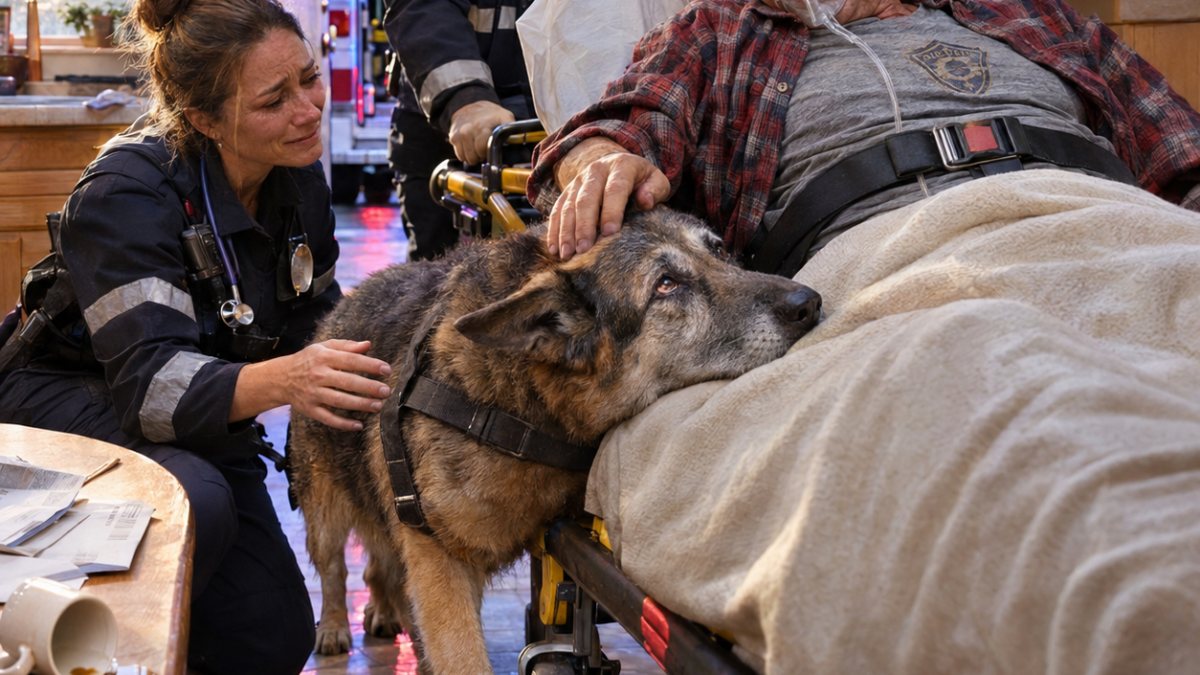
They lifted me onto the stretcher.
That frightened Bruno.
He barked.
Moved beside it.
The female paramedic crouched.
“Easy.”
Bruno looked at her.
Then at me.
“He’s coming with us,” she said.
I don’t know whether she meant it immediately.
But she looked at the situation and made a decision.
The old retired K-9 had done more than enough to earn a little rule-bending.
They loaded me.
Then Bruno.
Inside the ambulance, the world became light and motion.
Equipment.
Straps.
Radio.
A paramedic speaking.
I could feel almost nothing properly on my left side.
Then something warm touched my legs.
Bruno.
They had allowed him enough room to lie beside the stretcher.
He placed his head across my lower legs.
Exactly where he used to rest during long nights at home.
His amber eyes stayed on mine.
No barking now.
No panic.
He had done the active part.
Help was here.
Now his job was different.
Stay.
I stared at him.
Tears ran into my ears.
I couldn’t wipe them.
Bruno’s head remained there.
Heavy.
Warm.
Real.
And I remember thinking:
Don’t leave.
Not me asking him.
Me promising him.
Don’t leave.
At the hospital, they separated us.
That was necessary.
I knew it logically.
Emotionally, it felt like losing my voice twice.
Doors closed.
Bruno disappeared.
Then everything accelerated.
Doctors.
Scans.
Blood tests.
Medication.
Questions.
My memory becomes fragmented there.
Faces.
Lights.
Someone asking when I was last known well.
Someone trying to determine exact timing.
Someone telling me to squeeze a hand I couldn’t squeeze.
Then eventually a doctor explained what had happened.
Ischemic stroke.
Blood flow blocked to part of my brain.
Time mattered.
A lot.
The fact that emergency services arrived quickly mattered.
The exact outcome could not be reduced to one neat countdown, but one physician told me plainly that another delay of even several minutes could have left me with much more severe and potentially irreversible disability.
I heard one number repeated afterward.
Ten minutes.
Maybe ten minutes between the life I still had and one very different.
I thought about Rebecca nearly hanging up.
I thought about Bruno barking.
Ten minutes.
The first three days were the hardest.
I could not speak properly.
My left hand barely moved.
I could not walk.
People came into the room and spoke to me slowly.
Sometimes too slowly.
I wanted to tell them my mind still worked.
I wanted to tell them to stop looking at me like I had become a child.
Instead, I stared.
Nodded.
Blinking became language.
Yes.
No.
Pain.
Water.
Tired.
My world shrank to the smallest communication.
That was when I understood what Bruno had done for me.
He had become my voice before I even knew I had lost it.
The nurses learned the story.
Of course they did.
Hospitals run on medicine and stories.
Someone printed a photograph of Bruno.
Old picture.
Him sitting beside me on the porch.
Gray muzzle.
Serious eyes.
They taped it beside my bed.
The first morning I woke and saw it, I cried.
A nurse named Danielle noticed.
“That your dog?”
I nodded.
“The famous caller?”
I tried to smile.
She laughed.
“He’s handsome.”
I blinked once.
Absolutely.
Bruno was not allowed into the hospital.
My neighbor, Margaret, took him.
She had known us for years.
Bruno tolerated her.
More importantly, he trusted her house because he had visited before.
Margaret later told me the first two days were terrible.
He ate only when she stood nearby.
Slept near her front door.
Every car made him raise his head.
Every time she opened the curtain, Bruno looked toward my house.
At night, he paced.
Not constantly.
Just enough that she knew.
Waiting.
She brought him to my house briefly one afternoon.
He walked room to room.
Kitchen.
Bedroom.
Living room.
Then sat at the front window.
He knew I was missing.
Again.
But this time, he knew humans were still caring for him.
Maybe that was enough to stop the panic from the first morning.
On day four, the speech therapist sat beside my bed.
“Let’s try again.”
She held up a picture.
“Dog.”
I knew it.
Of course.
But knowing and speaking had become separate things.
I tried.
My mouth moved.
Nothing right came.
She waited.
No pressure.
I looked at Bruno’s photograph beside the bed.
Tried again.
“B…”
She leaned closer.
“Good.”
My throat tightened.
“Bru…”
I stopped.
Tears filled my eyes.
She smiled.
“Take your time.”
I looked at the photograph.
“Bruno.”
Not clear.
Not strong.
But recognizable.
My first real word.
Bruno.
The therapist wrote something on her chart.
Doctors later called it encouraging.
They did not understand.
The word mattered because he had been speaking for me since the moment my own voice disappeared.
Progress was humiliating at first.
I hated that word.
Rehabilitation.
It sounds positive until you are the one being taught how to stand.
How to lift a foot.
How to grip a cup.
How to form sounds.
I had spent my adult life being competent.
Independent.
Strong.
Now a twenty-something therapist clapped because I moved my left hand three inches.
I wanted to throw something at him.
With which hand, I wasn’t sure.
Humor helped.
Barely.
Every day, I asked about Bruno.
At first with gestures.
Then one word.
“Bruno?”
The nurses learned.
“Margaret says he’s good.”
Or:
“He ate.”
Or:
“She sent another picture.”
Margaret sent photographs constantly.
Bruno at the window.
Bruno asleep near my front door.
Bruno refusing the expensive dog bed and lying on my old jacket instead.
One photograph destroyed me.
He was on my side of the bed.
Head on my pillow.
Eyes open.
Waiting.
I stared at it for almost an hour.
People told me:
“You need to focus on yourself.”
They were right.
But recovery was easier when I imagined a destination.
Not walking independently.
Not returning to some abstract normal.
Home.
Bruno.
My front door.
The porch.
Coffee.
Ordinary life.
When therapists told me to stand one more time, I thought:
Bruno is waiting.
When I tried to form another word:
Bruno.
When my arm refused to cooperate:
Bruno.
A dog who knew nothing about neurology became the clearest goal in my rehabilitation plan.
Two weeks after the stroke, doctors cleared me to go home with continued therapy.
Wheelchair initially.
Cane later, they hoped.
I should have been ecstatic.
Instead, I became terrified.
Hospitals are controlled.
Home contains the place where your body betrayed you.
The kitchen.
The broken mug had been cleaned.
Of course.
But I could still see it in my memory.
Tile.
Coffee.
Bruno barking.
I told the therapist:
“Afraid.”
One of my better new words.
She nodded.
“That’s normal.”
I hated how much I hated normal.
Margaret brought Bruno back to my house before I arrived.
She told me later he seemed to know.
Maybe because she opened curtains.
Maybe because she cleaned.
Maybe because humans carry anticipation in our bodies and dogs read it.
Bruno sat inside the front door.
Waiting.
The medical transport van pulled up.
My heart pounded harder than during therapy.
The driver helped me into the wheelchair.
I stared at the house.
My house.
Same brick.
Same porch.
Nothing had changed.
Everything had.
Margaret opened the door.
Bruno appeared.
He stopped.
I stopped.
Two weeks.
That was all.
It felt like years.
His ears rose.
His body leaned forward.
Then he saw the wheelchair.
Saw the way I held my left arm.
Saw my face.
And the old working dog did something that made every person there cry.
He did not run.
He did not jump.
He did not explode with excitement.
Bruno walked.
Slowly.
Carefully.
Each step measured.
As if he understood I was breakable now.
He reached me.
Sat.
Looked up.
His tail moved once.
Then again.
And he placed his large gray head on my knees.
Exactly where it had been in the ambulance.
I tried to say his name.
“Bru…”
My voice broke.
Bruno looked up.
“Bruno.”
Clearer.
His tail hit the wheelchair.
I lowered my right hand onto his head.
“I’m…”
Breath.
“Home.”
That word cost me everything.
Bruno closed his eyes.
Margaret turned away crying.
The transport driver wiped his face.
I did not care who saw me.
I buried my hand in Bruno’s fur.
For the first time since the kitchen floor, I believed I might actually survive more than physically.
That first night home was awful.
Nobody tells you that part in inspirational recovery stories.
I was afraid to sleep.
Afraid of the kitchen.
Afraid every headache meant another stroke.
Afraid when my heart beat too fast.
Afraid when it beat too slowly.
Margaret stayed in the guest room.
Bruno stayed beside my bed.
At 1:00 a.m., I woke suddenly.
Did not know where I was.
Panic.
Then something touched my right hand.
Warm nose.
Bruno.
I breathed.
He looked at me.
I whispered the words slowly.
“You.”
He tilted his head.
“Here.”
His tail moved.
“Me.”
I touched my chest.
“Here.”
Bruno lay back down.
I stayed awake another hour.
But I was not alone.
That distinction became everything.
Eight months of recovery sounds like one sentence.
It isn’t.
It is hundreds of mornings.
Thousands of repetitions.
Failure.
Tiny victory.
Setback.
Anger.
Exhaustion.
My left hand regained some function.
Not all.
Walking returned slowly.
Walker first.
Then cane.
I hated the cane.
Bruno did not care.
The first time I walked from the living room to the porch without someone physically supporting me, Bruno followed at my left side.
Too close.
I nearly tripped.
“Space.”
The old command came out surprisingly clear.
Bruno moved six inches away.
Perfect heel.
I started laughing.
Then crying.
He looked offended.
Physical therapists began incorporating Bruno into my routine.
Not officially at first.
I did.
“Walk to Bruno.”
He sat ten feet away.
I walked.
“Touch his collar with your left hand.”
Hard.
My fingers shook.
Bruno waited.
I touched.
Good.
“Clip leash.”
Much harder.
The clasp seemed impossibly small.
I dropped it.
Again.
Dropped.
Again.
Anger rose.
Bruno sat.
No judgment.
Fourth attempt.
Click.
Leash attached.
I cried.
Therapist smiled.
“Good.”
I looked at Bruno.
“No.”
My voice still sometimes came slowly.
“Very good.”
Bruno aged during my recovery.
That frightened me.
His white muzzle spread.
He slept more.
Sometimes I thought the stress had aged him.
Probably unfair.
Time simply continued.
But I developed a strange guilt.
He had spent years protecting me.
Now while I recovered, he seemed to be getting older faster than I could catch up.
I wanted to become healthy quickly enough to give him back the walks he loved.
Bodies do not negotiate with guilt.
Recovery kept its own schedule.
So we adjusted.
Short walks.
Slow walks.
More porch time.
Bruno never complained.
Dogs are often better at accepting changed circumstances than humans.
We developed a new morning routine.
Before the stroke:
Coffee.
News.
Long walk.
Now:
Medication.
Stretching.
Speech exercises.
Coffee.
Short walk.
Bruno waiting.
At first, I hated the new routine because it reminded me I was not who I had been.
Eventually, I understood something.
Bruno did not care which version of William Hartley stood in front of him.
Officer.
Retired handler.
Healthy man.
Stroke survivor.
Man with cane.
None mattered.
I was me.
That was enough.
Being loved without being useful is difficult for men like me.
We spend decades measuring worth by what we can do.
Bruno loved me when I could barely button a shirt.
That humbled me more than any medal ever had.
The story about the 911 call traveled.
Emergency workers talked.
Hospital staff talked.
Eventually local media heard.
I refused interviews at first.
It felt too personal.
Then Rebecca sent a message through the hospital.
Not publicity.
Just:
I hope Mr. Hartley is recovering. Please tell Bruno he was the best caller I ever had.
I laughed so hard I started coughing.
That was the first time I decided I wanted to meet her.
Not for a newspaper.
For me.
Eight months after the stroke, I could walk with a cane.
My speech was slower but understandable.
My left hand still frustrated me.
But I was alive.
I called the emergency communications center.
“I’d like…”
Pause.
No one rushed me.
“To meet Rebecca Wells.”
The receptionist knew immediately.
“You’re Mr. Hartley.”
I smiled.
“Bruno’s…”
I searched for the word.
“Partner.”
“That’s me.”
The day of the visit, Bruno came too.
Of course.
He wore no working vest.
No badge.
Just his collar.
Older dog.
Retired.
Still dignified.
We entered the lobby.
Rebecca came through an interior door.
She stopped.
Her hands flew to her mouth.
For several seconds, nobody spoke.
Then she whispered:
“It’s you.”
I smiled.
“You’re the man the dog saved.”
I shook my head.
Words came slowly but clearly.
“I’m the man you saved.”
Her eyes filled.
“You listened.”
Rebecca shook her head.
“I did my job.”
“No.”
I leaned on the cane.
“You could have hung up.”
She looked down.
“I almost did.”
“I know.”
She stared.
“You know?”
“You told the nurse.”
She nodded.
Then cried.
Quietly.
“I thought it was accidental.”
I said:
“But you listened again.”
Rebecca looked at Bruno.
“He made sure I did.”
Bruno sat beside me.
She crouched carefully.
“Can I?”
I nodded.
Rebecca held out her hand.
Bruno sniffed.
Then let her touch his cheek.
Her face crumpled.
“You.”
She laughed through tears.
“You scared the life out of me.”
Bruno’s tail moved once.
Rebecca looked at me.
“It sounded like he was answering.”
“I believe you.”
“I’d ask something and he’d bark.”
“I know.”
She smiled.
“I still tell people the dog ran the call.”
Bruno wagged again.
We sat together in a small conference room.
Rebecca told me everything I could not remember.
How she almost disconnected.
How she heard my breathing.
How the sound reminded her of her father.
That detail stunned me.
Her father had survived a stroke years earlier.
“I knew that breathing,” she said.
“What does that mean?”
She took a breath.
“It sounds like someone whose body is failing to follow instructions.”
My throat tightened.
“My father couldn’t speak either.”
She looked toward Bruno.
“When I heard him barking over that breathing, I thought:
That dog is not playing.”
She paused.
“He was desperate.”
I touched Bruno’s back.
“He was.”
Rebecca continued.
“The strangest part was how he changed when I told him help was coming.”
I frowned.
“What do you mean?”
“His barking changed.”
“How?”
“More focused.”
She laughed slightly.
“That sounds ridiculous.”
“No.”
“It doesn’t.”
“He sounded like he knew the job had become guiding them in.”
That sounded exactly like Bruno.
Working dog.
Problem changes.
Task changes.
Adapt.
Rebecca told me she stayed on the line until responders entered.
“I heard them come in.”
“I heard you too.”
She stopped.
“You did?”
“Yes.”
Her eyes widened.
“I heard everything.”
Rebecca covered her mouth.
“I thought maybe you weren’t conscious enough.”
“I was.”
I looked at her.
“Couldn’t answer.”
That sentence still hurt.
Rebecca reached across the table and touched my good hand.
“But you weren’t alone.”
“No.”
I looked at Bruno.
“I wasn’t.”
Before we left, staff came out to meet Bruno.
Not me.
Bruno.
I found that appropriate.
Someone took a photograph.
Rebecca beside me.
Bruno between us.
My cane visible.
My left arm slightly stiff.
No attempt to hide what happened.
Survival does not need cosmetic editing.
Rebecca later mailed me the picture.
I framed it.
On the drive home, Bruno slept in the back seat.
I thought about all the people responsible for me being alive.
Rebecca.
The supervisor who trusted her.
Dispatch.
Paramedics.
Emergency physicians.
Neurologists.
Nurses.
Therapists.
Margaret.
Bruno.
A whole chain.
People sometimes want one hero.
Life is rarely that simple.
But there was one being who began the chain.
Bruno.
He recognized distress.
Found the phone.
Created enough chaos for the call to connect.
Barked.
Stayed.
Guided.
Followed.
Then rode beside me.
No training exercise had ever prepared him specifically for that morning.
He simply knew:
My person is wrong.
Do something.
That became the deepest thing I understood about our years together.
Training teaches behaviors.
Love teaches urgency.
Bruno had been trained to track.
Search.
Alert.
Protect.
Respond.
But nobody had ever trained him to watch his retired handler collapse alone in a kitchen and somehow bridge the distance between silence and help.
That part came from somewhere else.
Attachment.
Routine.
Instinct.
Trust.
Call it whatever word makes you comfortable.
I call it love.
After the stroke, I became more sentimental.
I dislike admitting that.
Bruno probably found it embarrassing.
I talked to him constantly.
“You saved me.”
He slept.
“Do you know that?”
No response.
“You should be insufferable.”
Tail thump.
“Already are.”
My evening routine changed most.
I spent more time on the porch.
Part rehabilitation.
Part gratitude.
Before, sunsets were background.
After nearly losing everything, ordinary things became foreground.
Wind in trees.
Neighbor children.
A passing car.
Coffee cooling.
Bruno breathing near my feet.
The world I had almost left suddenly felt excessively detailed.
I noticed all of it.
Sometimes I looked at Bruno and wondered whether he understood what happened.
Probably not in human terms.
He did not know ischemic from hemorrhagic stroke.
Did not know ten minutes.
Did not understand disability percentages.
He understood something more basic.
I fell.
I stopped responding.
He called.
People came.
I disappeared.
I returned.
Good enough.
Dogs may be lucky that way.
They do not necessarily relive every event with the same narrative machinery humans use.
I did.
I replayed the kitchen constantly.
At first, every morning.
The mug falling.
Tile.
Bruno barking.
My body not moving.
I began avoiding the exact spot.
Margaret noticed.
“You can’t avoid your own kitchen forever.”
“I can eat takeout.”
She stared.
“I’m sixty-eight. I can make bad choices.”
She laughed.
But she was right.
My therapist suggested exposure.
I hated the word.
One afternoon, I took my cane.
Walked into the kitchen.
Stopped at the place.
My chest tightened.
Bruno followed.
He sat beside me.
I looked down.
“That’s where.”
His ears moved.
I sat in the chair.
Breathing fast.
Bruno placed his head against my thigh.
I stayed.
Five minutes.
Then ten.
Nothing happened.
No stroke.
No collapse.
Just kitchen.
The next day, I made coffee.
My hand shook.
Not from weakness only.
Fear.
I carried the mug to the table.
Did not drop it.
I cried over coffee.
Again.
At my age, apparently coffee had become emotionally complicated.
Eventually, the kitchen became ordinary again.
That was healing.
Not forgetting.
Ordinary.
Bruno became more attentive to me after the stroke.
If I stood too fast, he watched.
If I dropped something, he rose.
If my breathing changed during exercises, he approached.
Maybe I projected.
Maybe not.
One afternoon, I became dizzy after therapy.
Sat quickly.
Bruno was beside me immediately.
Nose against my hand.
I said:
“Fine.”
He stared.
“Seriously.”
Still staring.
“I’ll tell Margaret.”
Tail moved.
Apparently Bruno had joined management.
He also became protective of my cane.
This was bizarre.
If someone moved it, Bruno watched.
Once Margaret picked it up while cleaning.
Bruno followed her.
She laughed.
“He thinks I’m stealing your leg.”
“Give it back.”
“You’re both impossible.”
My speech improved gradually.
Some words remained stubborn.
Telephone.
Electricity.
Rehabilitation.
Bruno was easy.
Always Bruno.
My therapist once said:
“Emotionally important words sometimes return strongly.”
I smiled.
“He had a head start.”
I learned to write more with my right hand.
My left hand never returned completely.
At first, that felt like failure.
Then I remembered what the doctor said:
You walk.
You speak.
You live independently.
Progress does not owe us perfection.
That lesson took months.
Bruno learned it faster.
He never looked at my left hand and thought less of me.
I began volunteering occasionally with retired K-9 organizations.
Not physically demanding things.
Speaking.
Visiting.
Helping older handlers understand transition.
People wanted Bruno’s story.
I told it carefully.
No exaggeration.
He did not deliberately dial a number like a human.
An emergency call became activated during the chaos.
He barked.
Rebecca listened.
That is amazing enough.
Truth does not need decoration.
One officer asked:
“Would Bruno have kept barking if she hung up?”
I looked at him.
“Yes.”
“How do you know?”
“Because he would’ve kept trying everything he knew.”
That was Bruno.
Failure simply meant change tactic.
Door.
Phone.
Window.
Bark.
Find somebody.
Working dogs are trained persistence.
Age had not erased that.
We eventually visited the ambulance crew too.
The female paramedic who allowed Bruno into the ambulance remembered him.
“You’re the guy.”
I smiled.
“Apparently.”
She crouched near Bruno.
“And you.”
Bruno wagged.
She looked at me.
“He would not let the stretcher out of sight.”
“I heard.”
“I probably broke three policies letting him ride.”
“Thank you.”
She shrugged.
“Sometimes rules have room for judgment.”
I never forgot that either.
Systems matter.
So does humanity.
She told me something I had not known.
When they carried me through the doorway, Bruno briefly stayed behind.
Not because he was confused.
Because he ran back to the phone.
Sniffed it.
Then followed.
Almost as if checking whether his job with Rebecca was finished.
That detail gave me chills.
Did he understand?
Not as we do.
Still.
He verified.
Then came with me.
There were nights I woke after dreams where Rebecca did hang up.
In the dream, Bruno barked.
No sirens.
Morning came.
Margaret found me too late.
I hated those dreams.
The therapist told me they were normal after trauma.
Again with normal.
I learned not to fight them.
I would wake.
Look down.
Bruno by the bed.
Alive.
Me alive.
Present.
Reality.
The dream ended there.
Months became a year.
My cane became optional inside the house.
Still needed outside on uneven ground.
Left hand remained weak.
Speech good enough that strangers no longer always noticed.
Bruno became grayer.
That hurt in a new way.
I had almost died and become obsessed with my own time.
Then I realized his was shorter.
No medical emergency required.
Just nature.
I hated that more.
“Don’t waste healthy time mourning future loss,” my therapist told me.
Good advice.
Difficult.
So I started taking photographs.
Not dramatic ones.
Bruno asleep.
Bruno at the porch.
Bruno staring at my sandwich.
Bruno in the yard.
Bruno’s gray face in sunlight.
Ordinary.
I wanted proof of the days after.
The famous story was the emergency call.
My favorite memories came later.
Slow walk around the block.
Bruno waiting when therapy ended.
His head on my knee.
The way he sighed before sleeping.
The sound of his nails on hardwood.
Life after rescue.
That is where the real story always lives.
One evening, Rebecca called.
We had stayed in occasional contact.
“How are you?”
“Still alive.”
She laughed.
“And Bruno?”
I looked down.
“Supervising.”
Bruno slept.
Rebecca became quiet.
“You know I still think about that call.”
“So do I.”
“I almost disconnected.”
There was guilt in her voice.
I said:
“But you didn’t.”
“I know.”
“That is the only version that happened.”
Silence.
Then she whispered:
“Thank you.”
I laughed.
“You saved me and you’re thanking me?”
“For saying that.”
I understood.
People who make split-second decisions often torture themselves with the wrong branch of possibility.
What if.
Rebecca had her own what-if.
I had mine.
We both needed the same lesson.
The thing that did not happen is not the life we have to live.
Bruno slept through the entire call.
Typical.
At sixty-nine, I gave a short talk at the emergency communications center.
Rebecca asked.
I nearly refused.
Public speaking after a stroke is terrifying.
That was exactly why I agreed.
I stood in front of dispatchers.
Cane beside the podium.
Speech notes in large print.
Bruno on the floor.
I began slowly.
“My name is William Hartley.”
Pause.
“Some of you know me as…”
I looked down.
“The man whose dog called 911.”
Laughter.
Good.
I continued.
“I’m here because one of you listened after the call stopped making sense.”
The room became quiet.
I talked about silence.
How I could hear everything but speak nothing.
How a dispatcher’s voice became the only human thread connecting me to the outside world.
Then I said:
“There are people who cannot explain their emergency properly.”
“Children.”
“Stroke patients.”
“People in shock.”
“People whose language you don’t speak.”
“People who are terrified.”
I looked toward Rebecca.
“And apparently dogs.”
Laughter again.
Then:
“Please listen one extra second.”
That was all I wanted to say.
One extra second.
Sometimes that is where the truth lives.
Afterward, several dispatchers met Bruno.
He handled celebrity with dignity.
Treats helped.
One young dispatcher asked:
“Do you think he knew he saved you?”
I looked at him.
“No.”
She seemed disappointed.
Then I continued.
“I think he knew I needed him.”
That was better.
As Bruno got older, stairs became harder.
I bought a ramp.
We were now two old men reorganizing the house around our failing machinery.
He had hips.
I had left-side weakness.
We made a good team.
Margaret called us “the rehabilitation unit.”
Rude.
Accurate.
Sometimes Bruno waited while I struggled to put on my shoes.
Years earlier, I waited while he learned difficult commands.
Fair exchange.
I began thinking about the first years of our partnership.
How demanding I had been.
Perfection.
Immediate response.
Focus.
Bruno gave me that.
Then age reversed us.
Now I moved slowly.
He waited.
No impatience.
Maybe dogs are better partners because they do not keep score.
One afternoon, I dropped the leash.
Left hand.
Bruno could have walked away.
He stopped.
Turned.
Picked up the leash in his mouth.
Brought it back.
I laughed.
“Show-off.”
He sat.
The old K-9 still there.
People sometimes asked whether Bruno had been formally trained to call emergency services.
No.
That is important.
He had training to respond to distress, retrieve, alert, problem-solve in various contexts.
But the exact call was circumstance plus instinct plus whatever years together had taught him.
That made it more moving to me.
No rehearsed script.
He improvised because I needed him.
I think many forms of love are improvisation.
Nobody trains you for the worst day.
You use what you have.
Bruno had paws.
Barking.
A phone on the floor.
Persistence.
Enough.
I had always believed humans saved animals.
Police dogs especially.
We feed them.
Train them.
Provide veterinary care.
Protect them.
Then you spend enough time beside one and realize the equation is dishonest.
They regulate us.
Notice us.
Force routine.
Create responsibility.
Bring us home emotionally after difficult calls.
Save us in ways no report counts.
Bruno had done that throughout our partnership.
The stroke simply made it literal.
When I was younger, I thought rescue meant pulling someone from physical danger.
At sixty-eight, I learned rescue can also mean speaking when they cannot.
Waiting when they are weak.
Making sure they wake to something familiar.
Bruno did all of that.
A year after the stroke, I returned to the kitchen floor.
Not accidentally.
On purpose.
I sat down carefully.
Bruno followed.
Looked confused.
I placed my hand on the tile.
Cold.
Same spot.
Bruno sat.
I said:
“This is where you found me.”
His head tilted.
“You did good.”
Tail.
I laughed.
“Very good.”
I stayed there maybe two minutes.
Then got up with difficulty.
Bruno waited.
The room no longer scared me.
That was one of the last pieces of recovery.
Bruno’s birthday was unknown.
His retirement anniversary wasn’t.
We celebrated that instead.
Extra chicken.
New bed.
He ignored the bed and slept on the rug.
Money well spent.
At seventy, I no longer thought of myself as a stroke patient first.
That took time.
For months, every introduction in my own head began:
I had a stroke.
Eventually it became:
I live with Bruno.
I volunteer.
I walk with a cane sometimes.
I like coffee.
I hate morning television.
I had a stroke.
The event moved farther down the list.
Healing.
I wanted the same for Bruno.
Not:
the dog who called 911.
Bruno.
Old police dog.
Loves chicken.
Hates thunderstorms less than the vacuum.
Sleeps too much.
Steals blankets.
Saved my life once.
Much better.
The story became famous enough locally that people recognized him at the park.
“Is that Bruno?”
I would say yes.
“Can we pet him?”
“If he says yes.”
Bruno almost always said yes.
Especially children.
One little boy hugged him around the neck before I could stop him.
Bruno simply sighed.
Retired officers tolerate civilians.
The boy’s mother apologized.
I smiled.
“He’s had worse arrests.”
She laughed.
Bruno looked at me.
Possibly offended by the joke.
One child asked:
“Did he really talk to 911?”
I thought.
“In his own way.”
“What did he say?”
I looked at Bruno.
“Help.”
The child nodded.
That was enough.
There are entire books written about communication.
Bruno reduced it to one word without speaking.
Help.
Rebecca heard.
The older I became, the more I thought about silent voices.
Not just emergency calls.
People whose pain looks like anger.
Older adults who stop asking because they assume nobody has time.
Animals whose suffering becomes invisible because they cannot explain it.
Bruno’s bark taught me attention has moral weight.
What we hear matters.
What we dismiss matters too.
Rebecca once said:
“The difference was that I listened beneath the barking.”
That sentence stayed with me.
Beneath the obvious noise was my breathing.
The actual emergency.
Maybe much of life works that way.
Listen beneath.
I started paying more attention.
Margaret saying “I’m fine” too quickly.
Old friend canceling lunch repeatedly.
My own body when tired.
No heroism.
Just attention.
Bruno had made me a better listener after saving me by being loud.
Irony.
His hearing eventually began to fade.
That felt unfair.
A dog who had once heard sirens before I did now sometimes slept through the doorbell.
But he could still sense me.
Footsteps.
Vibration.
Scent.
If I entered the room, his tail moved.
Even when his ears didn’t.
Love adapted.
I bought him softer food.
He hated one brand.
Refused.
I said:
“You ate department-issued kibble for years.”
He stared.
“Now suddenly you’re a food critic?”
Silence.
I changed brands.
He won.
I sometimes worried whether old age frightened him.
Probably less than it frightened me.
Bruno lived in the current day.
Breakfast today.
Walk today.
Nap today.
I was the one looking ahead.
Eventually I learned to follow him.
Today.
That became enough.
One evening on the porch, sunset turned the sky orange.
Bruno lay at my feet.
I said:
“You know, I owe you.”
Tail.
“Big debt.”
No response.
“How do you want payment?”
He lifted his head toward my sandwich.
I laughed.
“Of course.”
I gave him a tiny piece.
Debt reduced.
The porch became our favorite place.
Maybe because from there we could see the street.
Bruno had spent two weeks waiting at windows while I was hospitalized.
Even after my return, he liked watching arrivals.
Mail truck.
Neighbors.
Cars.
Sometimes he looked toward the road before I heard anything.
Old habits.
At night, he slept beside the bed.
Not on it.
Never liked that.
Too warm.
But close.
Always close.
I could reach down and touch him.
After the stroke, I did that often.
Sometimes just to confirm.
Warm fur.
Breathing.
Here.
He saved me once in the kitchen.
Afterward, he saved me nightly from the fear that survival could disappear without warning.
Not medically.
Emotionally.
There is a difference.
Important.
But real.
I never stopped taking my medications because Bruno made me feel safe.
Never replaced medical care with sentiment.
That would dishonor everyone who treated me.
Recovery required discipline.
Bruno provided companionship.
Both mattered.
When someone asks whether a pet can heal a person, I answer carefully.
Doctors healed my body.
Therapists rebuilt function.
Bruno made the work feel worth doing.
That is enough.
At seventy-one, I returned to the hospital for a routine appointment.
Same building.
Different entrance.
Bruno did not come inside.
Margaret waited with him in the car.
I passed the corridor where my room had been.
My chest tightened.
Then relaxed.
I was walking.
Slowly.
Cane.
But walking.
I whispered:
“Thank you.”
No one knew who I meant.
Probably everyone.
On the way home, Bruno had fallen asleep in the back.
I looked through the mirror.
Gray face.
Eyes closed.
The animal who once refused to let me vanish now trusted me enough to sleep while I drove.
That felt like a privilege.
The photograph from the emergency center remains framed in my living room.
Rebecca on one side.
Me on the other.
Bruno between.
People think it is a picture of the two humans who saved a life.
I see something else.
Three listeners.
Bruno listened to my body.
Rebecca listened to Bruno.
I listened afterward to what the experience was trying to teach me.
Maybe rescue begins with listening.
I told Rebecca that once.
She laughed.
“You’ve become philosophical.”
“I had a stroke.”
“Apparently.”
She and I stayed friends.
Christmas cards.
Occasional phone calls.
Every March she texts:
How are my favorite caller and his human?
I reply:
Caller demanding snacks. Human stable.
That tradition means more than I admit.
The first anniversary of the stroke was difficult.
I woke before dawn.
Same month.
Same cool air.
Body remembered before mind.
I went to the kitchen.
Made coffee.
Bruno followed.
I stood at the counter where I collapsed.
Hands trembling.
Then I picked up the mug.
Sat.
Drank.
Bruno lay beside me.
No ceremony.
That was how I marked survival.
Finish the coffee.
I did not want to celebrate almost dying.
I wanted to celebrate living normally afterward.
Margaret brought cake anyway.
Neighbors came.
Rebecca sent a card.
Bruno stole frosting.
Apparently everyone had different plans.
The card read:
One year ago, one old dog refused to let the line go silent.
I kept it.
Sometimes I imagine the call recording.
I have heard parts once.
That was enough.
Bruno barking.
Rebecca talking.
My breathing.
I never want to hear it again.
Some evidence is useful once.
Then memory can carry the rest.
The breathing disturbed me most.
It did not sound like me.
That was the point.
My body had become something I did not recognize.
Bruno recognized me anyway.
Maybe that’s why animals matter during illness.
Your appearance changes.
Voice changes.
Strength changes.
They still smell you.
Identity beneath function.
People can struggle with that.
We ask:
Are you back to normal?
Bruno never asked.
He simply adapted to the man who came through the door.
I tried to learn from him.
When my left hand stopped improving significantly, I grieved.
Quietly.
I had believed more therapy would restore everything.
Eventually the therapist said:
“This may be close to your long-term baseline.”
I hated her.
Not personally.
The sentence.
I came home.
Sat.
Bruno approached.
I held out my weak hand.
It trembled.
He sniffed it.
Licked the fingers once.
Then rested his head beneath it.
I laughed.
“Good enough for you?”
Tail.
Maybe I could learn good enough.
I did.
Not surrender.
Acceptance.
There is a difference.
Bruno’s own body became “good enough” too.
Old hips.
Gray muzzle.
Slower.
Still him.
We mirrored each other.
Two retired workers with imperfect machinery.
One morning, he struggled to stand.
I waited.
Did not rush.
He got up.
I understood.
Dignity.
Sometimes help means being near, not taking over.
Another thing he taught me.
Eventually I installed rugs along slippery floors.
For him.
Also useful for my cane.
Our accessibility upgrades were shared.
Margaret said:
“This house is now designed for geriatric mammals.”
Fair.
At seventy-two, I spoke more easily than immediately after the stroke, but fatigue still slowed words.
Bruno never filled my pauses.
Humans often do.
Dogs wait.
A surprisingly rare courtesy.
I began recommending that people learn from dogs in conversation.
Rebecca agreed.
“Except the barking.”
“Depends on the meeting.”
As Bruno aged, I thought more about the original 911 call.
Not with fear anymore.
With wonder.
How many things had to align?
Phone accessible.
Emergency call activated.
Rebecca listening.
Location data.
Fast response.
Bruno staying.
The paramedics understanding the scene.
Medicine available.
A thousand fragile links.
Gratitude became overwhelming if I followed the chain too far.
So I narrowed it.
Today.
Thank today.
The porch.
Sunset.
Bruno.
That became prayer enough.
One evening I said:
“I don’t know who saved who anymore.”
Bruno looked at me.
Classic cliché.
Still true.
I saved nothing for him that morning.
He had saved me.
But years earlier I had given him home.
Training.
Care.
Then after retirement, he had given me purpose.
Relationships rarely balance cleanly.
They aren’t supposed to.
I gave him a home.
He gave me years.
Fair.
What I want people to understand most is this:
Bruno did not need human language to communicate urgency.
Rebecca did not need perfect information to recognize distress.
The rescuers did not need my consent spoken aloud to help.
Medicine did not need me to understand every step.
Sometimes survival depends on people acting responsibly with incomplete information.
That requires judgment.
Attention.
Compassion.
Rebecca could have dismissed the call.
She didn’t.
That is why I visited her.
I needed her to understand that “just doing my job” can still be extraordinary when the job is done with care.
She eventually accepted that.
Mostly.
Dispatchers are stubborn.
So are retired K-9 handlers.
One year, on Rebecca’s birthday, I mailed her a card “from Bruno.”
It said:
WOOF.
Underneath:
You understood the first time.
She called me laughing and crying.
Worth it.
Bruno slept through the prank.
As years moved on, I worried about telling the story after Bruno was gone.
I hated even thinking the sentence.
So I stopped.
He was here.
That mattered.
Do not rehearse grief so much that you miss presence.
Another lesson I learned late.
I gave him more ear scratches.
More porch time.
Shorter but better walks.
Extra patience.
Fewer worries about rules that no longer mattered.
Retired dogs deserve some lawlessness.
He began sleeping through the night more deeply.
I sometimes woke and checked his breathing.
Roles reversed.
He had once listened to mine.
Now I listened to his.
Slow.
Steady.
Good.
There is something almost unbearably tender about caring for the creature who once cared for you.
Not debt.
Honor.
One morning, Bruno did not want breakfast immediately.
I panicked.
Vet.
Tests.
Nothing dramatic.
Upset stomach.
The veterinarian laughed gently.
“You’re anxious.”
“He’s old.”
“He is.”
“I don’t like that.”
“No one does.”
Bruno ate later.
I felt ridiculous.
Love makes fools of people.
Worth it.
At home, I told him:
“That cost me two hundred dollars.”
He looked unimpressed.
“Next time eat.”
Tail.
No remorse.
I have lived in this brick house since 1992.
For years it was simply address.
Then Bruno made it territory.
After the stroke, it became proof.
Home.
The place I nearly died.
The place I returned.
Both.
You can hold both meanings.
The kitchen floor remains the same tile.
I never replaced it.
At first because changing it felt like surrender.
Later because it became ordinary.
Eventually I could stand there and remember nothing.
That was the final victory.
Trauma location becoming just floor again.
Bruno still sometimes lay there because the tile stayed cool in summer.
The first time he did, I froze.
Then laughed.
“Really?”
He slept.
Apparently he had decided the site of my near-death was prime real estate.
Maybe that helped too.
Dogs reclaim spaces without ceremony.
At night on the porch, I often thanked him.
Not every night.
Enough.
“Thank you, Bruno.”
He would lift his head.
“For listening.”
Tail.
“For speaking.”
Tail.
“For staying.”
Sometimes he placed his head on my foot.
The conversation ended there.
The original article about us called him a hero.
He was.
But hero is not the word I use at home.
Partner.
That word lasted longer.
K-9 partnership taught us dependence without shame.
Humans often mistake independence for strength.
But I survived because I depended on a dog, a dispatcher, paramedics, doctors, neighbors, therapists.
That did not make me weak.
It made me alive.
At sixty-eight, I had to relearn that.
Bruno already knew.
A pack animal understands dependence.
Maybe humans are the strange ones.
The stroke changed my politics of pride—no, better not use politics. It changed my pride.
I let people help.
Margaret with groceries.
Neighbors with snow.
Therapists with exercises.
Rebecca with memory.
Bruno with everything else.
That may have been one of the hardest rehabilitations.
Accepting help without feeling diminished.
Bruno never treated me as diminished.
Excellent teacher.
Years after the call, a young 911 trainee asked Rebecca about the strangest call she had ever handled.
I happened to learn this later.
She told them:
“A barking dog.”
They laughed.
Then she explained.
No one laughed by the end.
Her lesson was not:
Assume every dog is calling for help.
Obviously.
It was:
Listen for the part that doesn’t fit.
The human breathing beneath the bark.
The detail that changes the call.
Attention.
Again.
I liked that.
Bruno’s story became training.
Not legend.
Useful.
That is better.
Our story also became part of K-9 retirement discussions.
Handlers asked about transition.
Purpose.
A retired dog still has working instincts.
Give them routines.
Mental engagement.
Respect.
Bruno’s response that morning showed his training never disappeared.
It changed context.
Retirement does not erase usefulness.
For dogs.
Or people.
Another obvious lesson I somehow needed.
I had struggled after leaving active law enforcement.
Not as dramatically as some.
But enough.
Who are you when the radio stops?
Bruno gave me continuity.
Walks.
Structure.
Responsibility.
Then, years later, he saved me during the most helpless moment of my life.
Partnership did not retire.
Maybe that is what moved me most.
He had no badge.
No harness.
No assignment.
No obligation.
He acted anyway.
Duty had become love long before either of us noticed.
I sometimes imagined him thinking like a cop.
Subject down.
Unable to respond.
Need backup.
Then I laughed.
Probably he thought nothing like that.
Maybe simply:
William wrong.
Make noise.
Still powerful.
The older I get, the less I need to anthropomorphize him.
He was a dog.
Fully.
That is enough.
Dogs can be extraordinary without secretly being human.
Bruno saved me as a dog.
Through scent.
Observation.
Training.
Attachment.
Persistence.
Exactly the way he was built.
Beautiful.
One evening Rebecca visited us.
She sat on the porch.
Bruno lay between us.
Sunset.
She said:
“I think about what would’ve happened if I disconnected.”
I looked at her.
“No.”
“What?”
“We agreed.”
She smiled sadly.
“I know.”
“Only version that happened.”
She nodded.
Then looked at Bruno.
“He never doubted.”
“About what?”
“That someone would answer.”
I thought.
“Maybe.”
She smiled.
“He just kept barking.”
Persistence can look like faith from the outside.
Maybe that’s enough.
Rebecca scratched Bruno’s ears.
“Best conversation I ever had.”
Bruno sighed.
She laughed.
“He’s done with me.”
“He’s retired.”
We sat there until dark.
No crisis.
That felt like the best ending.
But life continued.
Always.
My hand improved slightly more.
My cane became less frequent.
Bruno became slower.
Margaret moved to live near her daughter.
New neighbors arrived.
The world kept changing.
The story remained.
Not as a frozen miracle.
As foundation.
Whenever something difficult happened, I reminded myself:
There was a morning when you could not speak.
You can speak now.
Not to shame myself.
To appreciate.
Gratitude without comparison.
When my words tangled, I stopped apologizing.
People could wait.
Bruno always did.
Sometimes strangers finished sentences for me.
I learned to say:
“Please let me finish.”
That became another form of recovery.
Claiming time.
Bruno had barked until someone listened.
I could ask humans for the same courtesy.
I eventually wrote Rebecca a letter.
Handwritten with my stronger hand.
It took hours.
The final paragraph said:
You heard Bruno, but more importantly, you heard me underneath him. I had never been more silent in my life, and you still found me.
She framed it.
I found that out later.
That moved me almost as much as her first voice through the phone.
Communication is strange.
A dog’s bark.
A broken breath.
A dispatcher.
A letter.
Years later, meaning keeps moving.
Bruno’s favorite place remained beside my chair.
Head on knees when he wanted closeness.
Exactly as the day I returned home.
That gesture became our ending to many conversations.
I would say:
“Rough day.”
Head on knee.
“Good day.”
Head on knee.
“Scared.”
Head.
“Thank you.”
Head.
No need for more.
If Bruno could have spoken on the morning of the stroke, maybe he would have said:
He can’t speak.
I can.
Maybe that’s sentimental.
I allow myself some sentiment now.
I earned it.
The truth remains powerful without imagined words.
He barked.
Someone listened.
I lived.
That sentence is the spine of everything.
He barked.
Someone listened.
I lived.
Years later, when someone asks for the most important lesson, I do not say dogs are magical.
They aren’t.
I do not say every emergency will end well.
It won’t.
I say:
Listen.
Listen when something feels wrong.
Listen when communication is imperfect.
Listen beneath noise.
Listen to animals.
Listen to bodies.
Listen to people who struggle to speak.
Sometimes help arrives because one person chooses not to dismiss the strange thing they heard.
Rebecca listened.
Bruno persisted.
I got another sunrise.
Then another.
Then years.
That is a lot to owe to thirty extra seconds on a phone line.
At sunset, I still sit on the porch.
Bruno beside me.
His muzzle whiter now.
Breathing slower.
Me with my cane leaning against the chair.
Two old partners.
No uniform.
No emergency.
Sometimes traffic passes.
Bruno lifts his head.
Then relaxes.
I look toward the sky.
Think about the kitchen.
Then not.
The present is better.
I place my hand on his head.
“Thank you.”
His tail moves.
Slowly.
Firmly.
Like a heartbeat.
When I almost died, I lost my voice.
Bruno lent me his.
When I lost control of my body, Rebecca gave my silence meaning.
When I lost confidence in my future, rehabilitation gave me steps.
When I came home afraid I was no longer the man Bruno remembered, he placed his head on my knees and proved identity was deeper than strength.
That is my story.
Not simply a dog calling 911.
A chain of beings refusing to let silence become an ending.
Bruno is no longer a police dog.
He does not chase suspects.
Does not search buildings.
Does not protect perimeters.
His duty belt—if dogs can be said to have one—is gone.
But he still saves.
He saved me that morning.
Then kept saving small parts of me afterward.
Loneliness.
Fear.
Pride.
The belief that needing help makes you less of a man.
Old dogs can be excellent teachers.
I gave Bruno a home years ago.
That was what I believed.
Now I know home is not a gift one creature gives another.
It is something built between them.
Repeatedly.
Walk.
Return.
Feed.
Wait.
Sleep.
Come back.
Stay.
Bruno built home with me.
Then, when my body tried to take me away from it, he refused to accept the disappearance quietly.
He barked until the world answered.
I cannot promise what he understood.
I can tell you what he did.
He recognized something was wrong.
Stayed with me.
Reached the phone.
Barked through an emergency call.
Responded to a stranger’s voice.
Ran to the door when sirens arrived.
Followed the stretcher.
Rode beside me.
Waited two weeks.
Approached carefully when I returned.
Placed his head on my knees.
And every night afterward, stayed close enough that I could reach him.
Facts.
Enough.
If that is not loyalty, the word has no meaning.
My name is William Hartley.
I am older now than I was when the kitchen floor almost became the final place I ever saw.
My left hand still does not work perfectly.
Some mornings my speech is slower.
I still carry a cane when I need it.
I am not the man I was before the stroke.
That used to hurt.
Now I understand something.
Neither is Bruno the dog he was when we worked patrol.
His muzzle is white.
His hips ache.
His steps are slower.
We changed.
We remained ourselves.
That is what partnership taught me.
You do not love only the strongest version.
You stay for the changing ones.
Sometimes Bruno dreams.
His paws move.
Maybe running.
Maybe working.
Maybe nothing.
I watch.
Wonder whether he dreams about the morning I fell.
I hope not.
I hope his dreams contain fields.
Training balls.
Open doors.
Warm sun.
Maybe me walking without a cane.
Dogs deserve good dreams.
When he wakes, his amber eyes find me.
Every time.
Still checking.
I smile.
“Here.”
His tail moves.
Still here.
That is our final language.
Not commands.
Not 911.
Not sirens.
Just presence.
I used to think the most powerful call for help was a human voice screaming loudly enough for somebody to hear.
I know better now.
Sometimes the strongest call contains no words.
Sometimes it is heavy breathing beneath barking.
A paw against a phone.
An old K-9 refusing to stop making noise because the man he loves is lying on the floor and the world has not responded yet.
Sometimes salvation begins when someone on the other end says:
I’m listening.
Rebecca said it.
Bruno believed her.
And because both of them kept listening long enough—
I am still here to tell you what happened.
Every evening, when the sun begins dropping beyond the houses, Bruno settles beside my chair.
I place my hand on his head.
The same dog.
The same man.
Older.
Slower.
Alive.
And sometimes I whisper the words I could not say while I lay on the kitchen floor.
“Thank you, Bruno.”
His ears move.
“Thank you for hearing me when I couldn’t speak.”
His tail touches the porch once.
“Thank you for refusing to let me disappear.”
Another slow movement.
“And thank you for staying long enough to watch me come home.”
Then Bruno lifts his gray head.
Looks at me with those same amber eyes.
And rests it across my knees.
No sirens.
No dispatcher.
No stretcher.
No hospital.
Just home.
Just us.
Just the quiet answer he has given me all along.
I heard you.
I stayed.
You came back.








