FULL STORY:He Walked Into Our Shelter at 23 Below Zero and Asked for Nothing for Himself—Only a Warm Place for His Dog
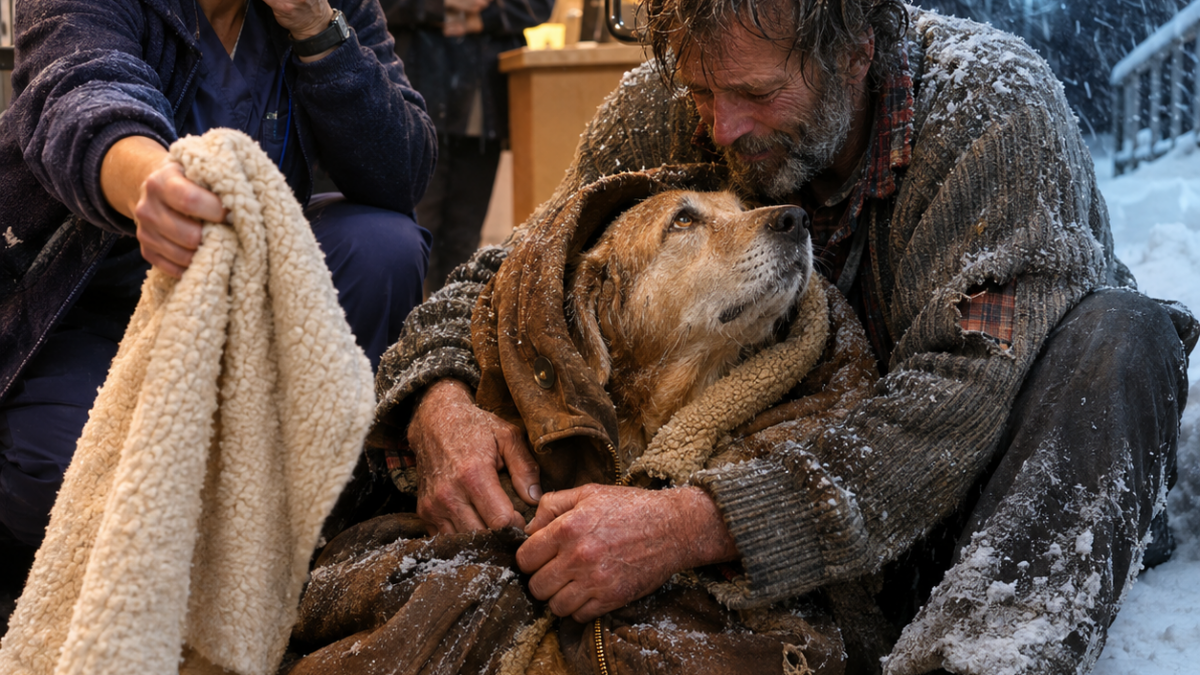
FULL STORY CONTINUATION
Buddy barked from beside us.
Not loud.
Not anxious.
One soft sound.
Almost a complaint.
Sam looked down.
“I’m here.”
Buddy stopped.
I would learn that pattern later.
Whenever Sam moved too far away, Buddy made one quiet bark.
Not panic.
Not demand.
A reminder.
I’m still here.
And perhaps:
You should be too.
I brought Buddy inside.
Sam followed only as far as the threshold.
Then stopped.
“You can sit in the lobby.”
“No.”
“You’re freezing.”
“I’m fine.”
“Your hands are blue.”
“They do that.”
“That is not reassuring.”
He looked down at them.
“They froze once before.”
“What?”
“Two winters ago.”
He said it like:
I had the flu once.
No drama.
No attempt to shock me.
“My feet too.”
I looked at his boots.
“Sam.”
He raised his eyes.
I realized I hadn’t asked his name.
“How did you know—”
“Your intake form.”
He had written it while I examined Buddy.
SAM CARTER.
No address.
Phone:
NONE.
Emergency contact:
blank.
I pointed toward one of the plastic lobby chairs.
“Sit.”
He smiled faintly.
“You always boss people around?”
“Mostly dogs.”
“I’m not a dog.”
“Sit anyway.”
He did.
I brought coffee from the staff room.
Too much sugar.
He took it with both hands.
The cup trembled.
“Thank you.”
I sat opposite.
Buddy had settled on the floor between us.
Still wearing Sam’s coat.
“What happened?”
Sam stared into the cup.
“To what?”
“You.”
He smiled without humor.
“That’s a big question.”
“Fair.”
I changed it.
“How long have you been outside?”
“Three years.”
Three years.
“And Buddy?”
“Same.”
“Where did he come from?”
Sam stroked the dog’s head.
“Another big question.”
I let it go.
For now.
“Why don’t you use the warming center?”
“They don’t allow dogs.”
“One does.”
“Full.”
“Another one across town.”
“Wouldn’t take him.”
“Why?”
“Size.”
I looked at Buddy.
He was maybe sixty pounds.
“That’s ridiculous.”
Sam shrugged.
“Rules.”
I worked inside a building full of rules.
Capacity limits.
Isolation protocols.
Vaccination requirements.
Insurance.
Liability.
Occupancy.
Safety.
Rules exist for reasons.
But staring at Sam’s blue fingers, I also understood what rules look like from the wrong side of a door.
I stood.
“I need to make a call.”
His expression changed.
“Don’t call police.”
“I’m not.”
“Social services?”
“No.”
He looked unconvinced.
“I’m calling my boss.”
“That sounds worse.”
Despite myself, I laughed.
“Probably.”
My supervisor, Denise, answered on the fourth ring.
“Julie?”
“Sorry.”
“What happened?”
“Nothing bad.”
“You only say that when something is bad.”
I explained.
Dog.
Man.
Minus twenty-three.
No warming center that would take both.
Blue fingers.
Broken boots.
Silence.
Then Denise said what I knew she would.
“Julie, we’re an animal shelter.”
“I know.”
“We are not licensed as human housing.”
“I know.”
“If he gets hurt overnight—”
“I know.”
“Insurance—”
“I know.”
“Fire code—”
“I know.”
She sighed.
“Then why are you calling?”
“Because I need you to tell me not to do what I’m going to do.”
Long pause.
“What exactly are you going to do?”
“Storage room B.”
“Julie.”
“It has heat.”
“It has dog-food bins.”
“Move them.”
“Old crates.”
“Stack them.”
“Cleaning supplies.”
“Locked cabinet.”
“It’s not a bedroom.”
“It’s warmer than a bridge.”
Silence.
I continued.
“He gave Buddy his only real winter coat.”
Another pause.
Then Denise said quietly:
“That man?”
“Yes.”
“What is he wearing?”
“A thin jacket.”
Silence again.
I pressed.
“If he goes outside tonight and something happens—”
“Stop.”
“I won’t sleep.”
“I said stop.”
I waited.
Finally:
“Technically I did not authorize anyone to sleep in Storage B.”
I smiled.
“Understood.”
“And technically I am hanging up.”
“Understood.”
“Julie.”
“Yes?”
“If something happens, you call me.”
“I will.”
“And move the bleach.”
“Already planned.”
Click.
That was Denise’s version of yes.
I walked back into the lobby.
Sam had finished the coffee.
The cup sat upside down beside his chair.
I frowned.
“Why’d you do that?”
“So snow doesn’t get inside.”
He had already assumed he would be taking it back outdoors.
That small detail broke something in me.
“Sam.”
He looked up.
“We have a room.”
“No.”
“Yes.”
“For Buddy?”
“For both of you.”
His expression changed instantly.
Hope.
Then fear.
Hope can scare people who have been disappointed enough.
“I don’t have money.”
“Nobody asked for any.”
“I can’t pay tomorrow either.”
“I know.”
“I don’t want charity.”
“Then don’t call it charity.”
“What should I call it?”
I looked at Buddy, still wearing the coat.
“Payment for services rendered.”
Sam frowned.
“What services?”
“You gave your coat to your dog in weather cold enough to injure you.”
“That isn’t a service.”
“It convinced me you’re not going to cause trouble.”
He almost smiled.
“That’s your logic?”
“It’s what I have.”
I stood.
“Come on.”
Storage Room B was exactly as glamorous as it sounds.
Concrete floor.
Metal shelves.
Old unopened bags of food.
Collapsed wire crates.
A radiator mounted beneath one narrow window.
It vibrated like it was preparing for liftoff.
But it was warm.
Actually warm.
I moved a few boxes.
Found two old blankets from our laundry shelf.
A clean dog bed.
A folding cot left over from an adoption event.
When I opened the door, Buddy entered immediately.
No hesitation.
He walked to the radiator.
Turned twice.
Lay down.
Then released the deepest sigh I had ever heard from a dog.
Sam stood at the threshold.
Did not step inside.
“What?”
He shook his head.
“Nothing.”
“Then come in.”
“Feels wrong.”
“Why?”
“Too warm.”
I stared.
“That may be the saddest answer anyone has ever given me.”
He looked embarrassed.
“I mean…”
“I know what you mean.”
Warmth had become unfamiliar enough to feel undeserved.
I hated that.
I pointed at Buddy.
“He thinks it’s fine.”
Buddy was already half asleep.
Sam finally entered.
He did not remove his boots.
Did not take off the green jacket.
He sat on the floor beside Buddy instead of the cot.
Placed one hand on the dog’s head.
“Good job, old man.”
Buddy’s tail tapped.
Sam whispered:
“Good job.”
I left them there.
Walked back to my office.
Closed the door.
And cried.
Not because the scene was tragic.
Though it was.
Because there are acts of goodness in the world nobody records.
No ceremony.
No headline.
No applause.
A man who owned almost nothing had one warm coat.
He gave it to his dog.
That was all.
It was also everything.
At six the next morning, I woke at my desk.
I had accidentally slept there.
My neck hurt.
The shelter was quiet.
I went straight to Storage B.
Door open.
Cot empty.
Buddy gone.
Sam gone.
I panicked.
Then saw the radiator.
A folded piece of paper rested on top.
Blue pen.
Shaky handwriting.
I opened it.
Julie,
Thank you. Buddy says that was the warmest night of his life. Don’t worry about me. We’ll come back when we can.
Sam
I read it twice.
Then ran outside.
“Sam!”
Nothing.
Snow had stopped.
The street was pale blue in the early light.
Two sets of tracks led away from the shelter.
Human boots.
Dog paws.
Side by side.
Toward the river.
I stood there staring.
Angry.
Worried.
Sad.
Maybe all three.
“Idiot.”
I said it aloud.
Not sure whether I meant Sam or myself.
I had expected one warm night to solve something.
Of course it didn’t.
Housing instability doesn’t disappear because one person opens one storage room.
Poverty doesn’t evaporate by sunrise.
Trust does not become permanent because somebody gives you coffee.
The tracks continued until they vanished beyond the corner.
I went back inside.
Picked up the note.
Put it in my desk drawer.
I told myself that was the end.
Three days later, the bell rang.
Sam stood outside.
Same green jacket.
No outer coat.
Buddy beside him.
Sam looked thinner.
Maybe that was imagination.
His cheeks certainly looked more hollow.
But his eyes were different.
Focused.
He stepped inside.
“I need to ask something.”
I folded my arms.
“If you’re here for another room—”
“No.”
“Food?”
“No.”
“What?”
“A job.”
I blinked.
“Here?”
“Yes.”
“What kind?”
“Anything.”
He pointed toward the kennels.
“I can clean.”
“Feed.”
“Walk dogs.”
“Carry things.”
“Fix stuff.”
“I don’t need money.”
“Stop.”
He did.
“You absolutely need money.”
“I need a place for me and Buddy more.”
“We do not pay people with storage rooms.”
“Then don’t pay me.”
“That is also illegal.”
He stared.
“I don’t need legal.”
I almost laughed.
“You really do.”
“I just need a chance.”
That stopped me.
A chance.
Not charity.
Not rescue.
Work.
Purpose.
Structure.
A reason to come back through the door.
I looked down at Buddy.
He sat against Sam’s leg.
Perfectly calm.
“Wait here.”
Sam groaned.
“You’re calling your boss.”
“Yes.”
“She’s going to hate me.”
“She barely tolerates me.”
Fair.
Denise answered immediately.
“You did it again.”
“How do you know?”
“Your voice.”
I explained.
Sam wanted work.
No wages initially.
Room.
Buddy.
Denise sighed.
“We cannot exploit a homeless person for labor.”
“Agreed.”
“We cannot have him unofficially sleeping there forever.”
“Agreed.”
“We don’t have a posted opening.”
“I know.”
“We do have volunteer shifts.”
“Yes.”
“Volunteers can’t receive housing compensation.”
“I know.”
She paused.
“What do you want?”
That was the real question.
“I want one week.”
“For what?”
“To see if he’s reliable.”
“And then?”
“Then we figure out something legitimate.”
“How?”
“I don’t know yet.”
Denise was silent.
Then:
“One week.”
I smiled.
“Really?”
“Volunteer.”
“Meals through community donations, not wages.”
“Temporary emergency arrangement only.”
“And you contact outreach services.”
“Yes.”
“Julie.”
“Yes?”
“This does not become permanent because you feel sorry for him.”
I looked through the glass.
Sam had crouched beside Buddy.
He was scratching the dog’s chest.
I said:
“I don’t feel sorry for him.”
That was true.
“I think he can work.”
Denise paused.
“Fine.”
“One week.”
Sam started that afternoon.
I expected problems.
Physical exhaustion.
Inconsistency.
Withdrawal.
Maybe he would vanish after lunch.
He did none of those things.
He cleaned kennel runs better than volunteers I had trained for months.
Not because he was faster.
Because he watched the animals.
If a dog was nervous, he did not blast water near it.
He moved the dog first.
If one had diarrhea, he told me before cleaning it so we could document.
If a dog refused food, he remembered.
He learned names immediately.
Not kennel numbers.
Names.
“Rosie didn’t finish breakfast.”
“Charlie keeps licking his left paw.”
“Duke is afraid of the mop.”
“How do you know?”
“He stops breathing when it comes near.”
I stared.
Most people would say:
Duke barks at mop.
Sam noticed the breath.
That was different.
By day three, every dog knew him.
Buddy followed everywhere.
Sam cleaned.
Buddy sat outside the kennel.
Sam carried food.
Buddy followed.
Sam folded laundry.
Buddy slept by his feet.
I said:
“He’s your supervisor.”
Sam looked down.
“He always has been.”
On day five, one newly surrendered hound refused to leave the back corner.
Terrified.
Growled whenever anyone approached.
I was preparing to use a more structured handling plan when Sam said:
“Can I sit with him?”
“You can sit outside the kennel.”
“I won’t touch.”
“Good.”
He sat.
For forty minutes.
No talking at first.
Then slowly:
“You don’t know me.”
The hound watched.
“That’s okay.”
I stopped working to listen.
“You don’t have to.”
Another ten minutes.
Eventually the hound moved forward.
One paw.
Then another.
Sam kept his eyes down.
The dog approached the bars.
Sniffed.
Sam placed his hand on the floor outside.
Did not reach.
The hound sniffed through the gap.
I whispered:
“How did you know?”
Sam shrugged.
“Same thing Buddy did with me.”
“What?”
“Waited until I decided.”
That sentence became one of the most important lessons I ever learned about him.
Sam understood fear because nobody had been able to force him out of his.
He knew the difference between invitation and pressure.
Animals responded.
One week became two.
Denise came in person.
She watched Sam work.
After an hour she asked me:
“Has he missed a shift?”
“No.”
“Late?”
“Once.”
“How late?”
“Four minutes.”
She looked annoyed.
“At you?”
“Yes.”
Reasonable.
She watched him help an elderly spaniel into a clean bed.
Then:
“We may have a maintenance assistant opening next month.”
I turned.
“What?”
“Part-time.”
“Actual payroll?”
“Yes, Julie.”
I almost hugged her.
She pointed at me.
“Don’t.”
I did not.
Barely.
Until then, Sam continued volunteering while outreach workers helped him replace identification.
That was another obstacle nobody sees from outside.
No stable address.
Lost ID.
No current phone.
No bank account.
No transportation.
Employment becomes difficult when basic paperwork assumes a life you no longer have.
Our community outreach coordinator, Lena, knew the system.
Birth certificate request.
State ID.
Mailing address through a service center.
Benefits review.
Medical clinic.
Foot care.
Yes.
His feet had been damaged.
Frostbite history.
Neuropathy.
The doctor looked at them and said:
“You are lucky.”
Sam laughed.
“No.”
Then looked at Buddy.
“I know what luck looks like.”
He resisted almost every kind of help that was not work.
New boots?
“No.”
Winter coat?
“I have one.”
“You gave it to Buddy.”
“He needed it.”
“Sam.”
Eventually we learned not to ask:
Do you need this?
We said:
We have donated boots in your size. Can you test them for us?
That worked.
Pride is not always arrogance.
Sometimes it is the last thing a person owns.
We learned to preserve it.
A month passed.
Sam was hired part-time.
Real paycheck.
Tax forms.
Employee ID.
He stared at the badge for a long time.
SAM CARTER – ANIMAL CARE ASSISTANT
“You okay?”
“Yeah.”
He touched the plastic.
“Haven’t had one of these.”
“A badge?”
“A place that expected me to show up.”
That hurt.
I looked away.
“Don’t get sentimental.”
He laughed.
“You’re crying.”
“Dust.”
“In the office?”
“Very dusty office.”
Sam’s first paycheck was small.
He still brought me coffee the next morning.
I stared.
“What is this?”
“Coffee.”
“I can see that.”
“My turn.”
“You need your money.”
“So do you.”
“What?”
“You drink terrible shelter coffee.”
He set it down.
“Consider it intervention.”
I drank it.
Best coffee I had ever tasted.
Not because of the coffee.
The storage room remained their sleeping space longer than anyone wanted.
Not officially.
We kept working on housing.
Waiting lists were brutal.
Pet-friendly housing made them worse.
Sam refused any placement that excluded Buddy.
Every time.
Lena once said:
“There is an opening.”
Sam’s eyes lifted.
“Dogs?”
“No.”
“Then no.”
“Sam, it’s temporary.”
“So was the bridge.”
He walked away.
I followed.
“You could get stable, then find another place for Buddy—”
He stopped.
“No.”
Not angry.
Absolute.
“He stayed when I had nothing.”
I said nothing.
“I’m not getting a roof by leaving him.”
That was the end of the discussion.
Housing had to include Buddy.
We made that the requirement.
Not negotiable.
Three months after that January night, I finally asked:
“How did you two meet?”
We were drinking coffee behind the shelter.
Spring beginning.
Snow melting.
Buddy lying in sunlight.
Sam looked at him.
Buddy looked back.
Something passed between them.
Memory, maybe.
“Three years ago.”
Sam’s voice changed.
“I was under the Mill Street bridge.”
I knew it.
Concrete columns.
Wind tunnel in winter.
Rough camps.
“Cold night.”
“How cold?”
“Minus thirty.”
I stopped.
He continued.
“I had a sleeping bag.”
“Bad one.”
“Two blankets.”
“Wet.”
“I remember thinking if I slept, I might not wake up.”
His voice remained matter-of-fact.
That made it worse.
“Then this dog shows up.”
Buddy lifted his head when he heard “dog.”
Sam smiled.
“Skinny.”
“Dirty.”
“Wouldn’t come near at first.”
“I had half a sandwich.”
“Gave him some.”
“He ate.”
“Then?”
“He left.”
I looked at Buddy.
“Apparently bad decision.”
Sam laughed.
“Thought so.”
He took a sip.
“About an hour later, he came back.”
“Why?”
“No idea.”
“He lay next to me.”
“Just like that?”
“Just like that.”
Sam’s face softened.
“Pressed against my side.”
“Under the blanket.”
“All night.”
I could see it.
Concrete bridge.
Thirty below.
One man.
One stray dog.
Body heat shared because neither had enough alone.
“When you woke up?”
“He was still there.”
Sam looked at Buddy.
“I told him to go.”
Buddy yawned.
“He didn’t.”
“Next day?”
“Still there.”
“Third?”
“Still.”
“So you named him?”
“Eventually.”
“Why Buddy?”
Sam smiled.
“Because ‘dog’ started sounding rude.”
I laughed.
Then he became serious.
“That first night…”
His eyes lowered.
“I think he saved my life.”
No metaphor.
Actual.
Body heat.
Presence.
Enough warmth to reach morning.
“That’s why you gave him your coat.”
Sam looked at me as if the answer were obvious.
“Of course.”
“He’d already given me his.”
I could not speak.
My throat closed.
Sam continued:
“People think I take care of Buddy.”
“I do.”
“But…”
He rubbed the dog’s head.
“He reminds me I’m still a person.”
I frowned.
“What do you mean?”
“When you’re homeless long enough, people stop looking at your face.”
His voice stayed calm.
“They look at your clothes.”
“Your bag.”
“Where you’re sitting.”
“If you’re in the way.”
“You become a problem before you become a name.”
Buddy shifted closer.
Sam rested a hand on him.
“This guy never did that.”
“He looked at me like I was Sam.”
“Even when I smelled terrible.”
I laughed softly.
“He probably smelled worse.”
“Definitely.”
Then Sam said:
“When nobody else expected anything from me, Buddy did.”
“What did he expect?”
“Breakfast.”
We both laughed.
Then:
“And that I’d wake up.”
That silenced me.
“He gave me a reason to wake up.”
Sam looked toward the shelter.
“Now these dogs do too.”
That conversation changed the way I saw employment.
Before Sam, I thought giving somebody work meant giving money.
Of course money matters.
But work can also restore evidence.
Evidence that you’re needed.
That someone notices if you don’t arrive.
That your choices have consequence.
That your skills exist.
That you are more than whatever label strangers use.
Sam didn’t need us to invent worth for him.
He already had it.
He needed somewhere that recognized it.
Important difference.
By summer, Sam had become indispensable.
He knew medication schedules.
Adoption personalities.
Which volunteers needed supervision.
Which kennels had bad latches.
He repaired three broken gates.
Fixed a leaking sink.
Built raised dog beds from donated lumber.
Denise promoted him to full-time animal care.
“Don’t make me regret this,” she told him.
Sam replied:
“Julie already regrets me.”
“I regret everything.”
Good team.
Buddy became unofficial shelter royalty.
He had no job description.
Did very little.
Mostly supervised.
But something strange happened.
Dogs calmed around him.
Especially frightened ones.
Buddy would lie outside a kennel.
No direct interaction.
Just presence.
Some dogs approached.
Some didn’t.
He stayed.
We began using him carefully during assessments with appropriate dogs.
Then during staff stress.
Then visitors.
One child who refused to enter the kennel wing sat with Buddy for twenty minutes.
Eventually she pet him.
Her mother cried.
Sam watched.
“See?”
“What?”
“He’s still working.”
The idea of therapy certification came from Denise.
I laughed.
“Buddy?”
“Why not?”
“He steals sandwiches.”
“Therapy professionals can have flaws.”
Fair.
We pursued training and evaluation properly.
Temperament.
Obedience.
Health screening.
Public behavior.
Buddy surprised everyone.
Calm.
Gentle.
Unflappable.
Hospitals.
Schools.
Senior centers.
He especially loved nursing homes.
People in wheelchairs could reach his head easily.
He would sit.
Lean.
Stay.
One woman with dementia stroked his ears for nearly an hour.
She called him Charlie.
Buddy did not correct her.
Professional.
Sam attended visits when permitted.
At first he stayed in the background.
He did not like crowds looking at him.
Then one teacher asked him to tell children where Buddy came from.
Sam hesitated.
Looked at me.
I said:
“Only if you want.”
He sat on the floor beside Buddy.
Twenty third-graders watched.
Sam said:
“Buddy didn’t have a house when I met him.”
One child asked:
“Was he homeless?”
“Yes.”
“Were you?”
Sam paused.
“Yes.”
The room went quiet.
Another child:
“Were you scared?”
“Yes.”
“Was Buddy?”
“Probably.”
“How did you help each other?”
Sam thought.
“We stayed.”
That was all.
The teacher later told me half the class wrote essays about it.
Sam refused to become a motivational speaker.
Thank God.
He hated attention.
But when children asked honest questions, he answered honestly.
No romance.
No pretending homelessness was spiritually enriching.
“It was cold.”
“I was hungry.”
“People stole from me.”
“I got sick.”
“I was scared.”
Then:
“Buddy made it less lonely.”
That truth was enough.
Housing took eight months.
Eight months of applications.
Deposits.
Pet restrictions.
Credit issues.
References.
One landlord rejected him after hearing his history.
Another accepted dogs but required an impossible deposit.
Then Lena found a small apartment on the east side.
Old building.
One bedroom.
Third floor.
Window facing the river.
Pet-friendly.
Rent within reach with assistance for the first months.
I went with Sam to view it.
He stood in the living room.
White walls.
Cheap carpet.
Old radiator.
Nothing special.
Buddy immediately walked to the window.
Sat.
Sam said:
“How much?”
The landlord told him.
Sam calculated.
Silent.
“I can do it.”
I almost cried.
Stayed professional.
Mostly.
Then Sam asked:
“Buddy okay?”
The landlord looked down.
“That’s Buddy?”
“Yes.”
“He famous?”
Sam sighed.
“Unfortunately.”
“Dog’s fine.”
Sam turned away.
I knew why.
He was crying.
I pretended not to notice.
Move-in day was absurd.
Shelter staff donated furniture.
Too much.
Sam protested everything.
“I don’t need a couch.”
“You need somewhere to sit.”
“I have a chair.”
“That chair is from 1987.”
“It works.”
“Take the couch.”
“Julie—”
“Take it.”
Buddy got two beds.
One from us.
One from the veterinary clinic.
He used the floor.
Of course.
The first night in the apartment, Sam called me.
He had a phone now.
Cheap prepaid.
Still.
My phone rang at 10:14.
“Everything okay?”
“Yes.”
“Then why are you calling?”
“Listen.”
Silence.
“What?”
“Exactly.”
I understood.
No shelter barking.
No traffic under bridge.
No wind through tarp.
Just radiator.
Buddy breathing.
Sam whispered:
“It’s quiet.”
“Good quiet?”
Pause.
“I think so.”
I smiled.
“You’ll get used to it.”
“I hope not.”
“What?”
“I want to notice.”
That sentence stayed with me.
People adapt to safety quickly.
Maybe we should.
But Sam wanted to keep noticing warmth.
Door.
Window.
Bed.
Water.
Ordinary things.
I respected that.
Months later, I visited.
Buddy met me at the door.
Tail.
Sam had framed his shelter employee badge.
I laughed.
“You framed it?”
“Shut up.”
On the refrigerator was the note from that first night.
The one he left me.
Buddy says that was the warmest night of his life.
“You kept a copy?”
Sam smiled.
“Wrote it twice.”
“Why?”
“One for you.”
“One for me.”
I swallowed.
“Sentimental.”
“Learned from Buddy.”
The river outside the window froze that winter.
Sam sent me a photo.
Buddy watching snow.
Caption:
Inside.
One word.
Enough.
He continued working at the shelter.
Full-time.
Then senior animal-care specialist.
Eventually training new staff.
I watched him teach a volunteer how to approach a frightened dog.
“Don’t corner him.”
“Give him space.”
“Let him decide.”
Same principles he had learned through survival.
Human and animal.
Choice matters.
Buddy aged.
Gray spread across his face.
Therapy visits became shorter.
Then fewer.
Arthritis.
Medication.
No more school hallways.
Still shelter office.
He had a bed beside Sam’s desk.
Visitors knew him.
Staff brought treats.
Too many.
Sam complained.
Then fed him half of them.
Hypocrite.
One January, exactly five years after the first night, temperature dropped brutally again.
Not minus twenty-three.
Close.
Sam and I stood outside at closing.
Snow beginning.
He looked toward the street.
I knew what he was thinking.
“There are people out there.”
“Yes.”
“With dogs.”
“Yes.”
We had already changed policy by then.
Not formally into human sheltering.
We could not.
But partnerships existed.
A local warming center agreed to accept clients with pets in designated rooms.
Our shelter provided crates, food, vaccination support, and temporary animal boarding when needed.
A nonprofit funded transportation.
It had taken years.
Meetings.
Liability reviews.
Arguments.
Paperwork.
Boring institutional work.
The kind nobody shares online.
But no one should have to choose between freezing outside with a dog or surviving indoors without one.
Sam had made that issue impossible for us to ignore.
That night a woman arrived with two cats in carriers.
Warming center full?
No.
They took her.
Cats too.
Sam watched the transport van leave.
“Good.”
That was all.
But his eyes filled.
I looked away.
Professional courtesy.
Buddy retired officially from therapy work at twelve.
We held no ceremony.
Sam hated ceremonies.
We gave him chicken.
He considered that appropriate.
He spent retirement at the shelter.
Sometimes apartment.
Sometimes visits.
Mostly sleeping.
People still came specifically to see him.
Buddy did not understand retirement.
He continued leaning against anyone who needed it.
A man in early recovery from addiction visited one afternoon.
He sat in the lobby.
Head down.
Waiting for an outreach appointment.
Buddy walked over.
Placed his head on the man’s knee.
The man froze.
Then started crying.
Sam saw.
Did not intervene.
Later the man said:
“I haven’t touched a dog in years.”
Buddy stayed.
Another ordinary moment.
No press.
No article.
Just a dog giving weight to a person trying not to disappear.
That was Buddy’s specialty.
Sam once told me:
“He knows the people who think nobody sees them.”
“That’s a big claim for a dog.”
“I know.”
“Still believe it?”
“Yes.”
I did too.
Secretly.
When Buddy was thirteen, his heart began weakening.
Not emergency.
Gradual.
Medication.
Fatigue.
Shorter walks.
Sam adjusted everything.
Carried him when needed.
Bought a ramp.
Slept on the floor beside him during bad nights.
I said:
“You need rest.”
“He gave me enough of his.”
“That’s not how sleep works.”
“Close enough.”
One evening I visited the apartment.
Buddy lay near the radiator.
Same posture as that first storage-room night.
Head on paws.
Long sigh.
Sam sat beside him.
“You remember?”
I asked.
“What?”
“First night.”
Sam smiled.
“He stole my coat.”
“You gave it.”
“He looked better in it.”
Buddy’s tail tapped.
Then Sam said:
“You saved us.”
I shook my head.
“No.”
“You opened the door.”
“Denise technically didn’t authorize it.”
“Still terrified of her?”
“Correct.”
He laughed.
Then became serious.
“Would’ve been a bad night.”
“I know.”
“Maybe my last.”
I looked at him.
He had never said that before.
“Your fingers—”
“No.”
“Me.”
My chest tightened.
Sam stroked Buddy.
“I was tired, Julie.”
Not physically.
I understood.
“Really tired.”
I said nothing.
“Buddy kept me going.”
“So that night…”
He looked toward the window.
“I didn’t care much what happened to me.”
“But I cared what happened to him.”
My throat closed.
He continued:
“Then you cared what happened to both of us.”
Silence.
“That was confusing.”
I laughed through tears.
“You’re welcome.”
He smiled.
“Changed the math.”
“What?”
“If one person cares whether you wake up…”
He shrugged.
“Harder to disappear.”
I reached for his hand.
Warm.
Strong.
No blue fingers.
I squeezed it.
Buddy’s final year was peaceful.
That matters.
No crisis.
No dramatic final rescue.
He slowed.
Slept.
Ate.
Went outside.
Stood by the river with Sam.
Came to the shelter less.
Everyone visited him instead.
Denise came.
Yes, Denise.
The rule-following supervisor who had once said:
“We shelter animals, not humans.”
She knelt beside Buddy.
He licked her chin.
She cried.
I said:
“Never thought I’d see this.”
She pointed at me.
“Tell anyone and you’re fired.”
I was director by then.
“Can’t.”
She glared.
Retired people remain dangerous.
The vet eventually told Sam the medication was no longer keeping Buddy comfortable enough.
Quality of life.
Pain.
Breathing.
Fatigue.
The conversation every animal person dreads.
Sam asked:
“How long?”
The veterinarian said:
“Could be days.”
“Could be weeks.”
“But I wouldn’t wait for a crisis.”
Sam nodded.
He did not cry there.
He waited until the parking lot.
Then called me.
“Julie.”
I knew.
“I’m coming.”
Buddy’s last day was at the apartment.
River outside.
Snow falling lightly.
Radiator humming.
Not vibrating like the old storage-room one.
Sam had washed Buddy’s blanket.
I brought coffee.
Denise came.
Lena.
A few shelter staff.
Then left so Sam could have privacy.
I stayed because he asked.
Buddy lay beside the radiator.
Sam sat on the floor.
I sat across.
He looked at me.
“Same as the first night.”
I looked around.
Warm room.
Dog.
Sam.
“Yes.”
“Better room.”
“Much.”
Buddy opened his eyes.
Tail moved once.
Sam placed his hand on the dog’s head.
“Good job, old man.”
The exact words from years earlier.
My eyes flooded.
“Good job.”
The veterinarian arrived.
Explained.
Sam listened.
Then he took off his sweater.
Folded it.
Placed it beneath Buddy’s head.
I smiled through tears.
“Still giving him your clothes?”
Sam laughed once.
“He likes mine.”
When the sedative began working, Buddy’s breathing softened.
Sam lay beside him.
Forehead against his.
“You kept me warm.”
He whispered.
“You stayed.”
“Every damn time.”
Buddy’s eyes half closed.
Sam continued:
“You can go.”
His voice broke.
“I’ll be okay.”
I had never heard a harder promise.
Buddy exhaled.
Long.
Deep.
Like that first night.
When he entered Storage B and finally felt heat.
Then his body relaxed.
The veterinarian gave the final medication.
Sam held him.
I held Sam’s shoulder.
Buddy died warm.
Inside.
With his person.
No bridge.
No snow.
No fear.
I think about that often.
Afterward, Sam sat beside him for a long time.
Then:
“I lied.”
“What?”
“I told him I’d be okay.”
I understood.
“You don’t have to be okay tonight.”
He nodded.
“Tomorrow?”
“Not tomorrow either.”
“When?”
“Whenever.”
Sam looked at Buddy.
“Good.”
The apartment felt enormous without a dog.
Sam almost stopped sleeping there.
I worried.
So did everyone.
He came to work every day.
But quieter.
The dogs helped.
Not as replacements.
Never.
One frightened shepherd began waiting for Sam each morning.
A senior beagle slept under his desk.
Therapy program continued with other dogs.
Buddy’s work had become bigger than Buddy.
That was good.
Still painful.
A month later, Sam brought Buddy’s old collar to the shelter.
He hung it in the staff room.
No plaque.
No dramatic display.
Just collar.
Someone asked:
“Should we put his name?”
Sam said:
“They know.”
We did.
The first anniversary after Buddy’s death, temperature dropped below zero.
Sam stood outside the shelter again.
I brought two coffees.
He took one.
“Remember?”
“Yes.”
“I was annoying.”
“You were freezing.”
“Both.”
He smiled.
Then pointed toward a van pulling up.
A man.
Backpack.
Large dog.
The warming-center partner had space.
Our pet-support worker came out.
Crate.
Food.
Transportation.
No argument about choosing one or the other.
The man and dog left together.
Sam watched.
Then whispered:
“That’s good.”
“Yes.”
Buddy’s legacy was not a story.
It was a system that worked better for the next person.
That was better.
Years passed.
Sam became shelter operations manager.
My right hand, just as I once joked he would.
Then more than that.
Colleague.
Friend.
Family, honestly.
People who met him later had no idea he had ever slept under a bridge.
Unless he chose to tell them.
That mattered to me.
A person should be allowed to become more than the worst chapter strangers know.
Some visitors did recognize him from community talks.
“Are you Sam?”
He would sigh.
“Depends.”
“The man with Buddy?”
“Used to be.”
Then usually smile.
They would tell him how the story affected them.
One woman said she started volunteering.
Another convinced her church to allow pets during emergency warming nights.
A teenager organized a coat drive.
Sam accepted these things awkwardly.
Then returned to work.
He preferred cleaning kennels to being inspiring.
I respected that.
One day, a reporter asked him:
“What saved you?”
I watched from across the room.
Expected:
Buddy.
Instead Sam said:
“Being expected.”
The reporter frowned.
“What does that mean?”
Sam explained.
“The dog expected me to wake up.”
“The shelter expected me to show up.”
“Julie expected me to work.”
“Eventually I started expecting something from myself too.”
I had to walk away before he saw me crying.
That may be the truest sentence of the entire story.
People talk about rescue as though one dramatic act changes everything.
Open door.
Warm room.
Job.
Apartment.
Dog.
But Sam’s life changed through expectation.
Tomorrow.
Come back.
Feed dogs at seven.
Clean kennels.
Take Buddy out.
Sign paperwork.
Make rent.
Answer phone.
Small obligations tied one day to the next.
Enough days became a life.
Sam eventually adopted another dog.
Not quickly.
Years.
A small white mutt named Pepper.
Absolutely nothing like Buddy.
Nervous.
Bossy.
Stole socks.
Hated rain.
Sam loved her because she wasn’t Buddy.
Different dog.
New relationship.
He once said:
“If I’d tried to find Buddy again, nobody would’ve been good enough.”
Smart.
Pepper slept on his pillow.
Buddy never did.
Good.
The river outside Sam’s apartment still froze each winter.
He eventually moved to a slightly larger place.
Still near water.
Pet-friendly.
Pepper had a balcony.
He bought a couch himself.
That detail made me stupidly emotional.
I said:
“Remember when you refused our donated couch?”
“It was ugly.”
“It was free.”
“Still ugly.”
Ungrateful.
Progress.
We kept Storage Room B.
Eventually renovated.
Better shelving.
No cot.
The radiator replaced.
On one wall we put a small sign.
Not about Sam.
Not even Buddy.
It says:
WARMTH IS A BASIC NEED. DIGNITY IS TOO.
Denise pretends she hates it.
She doesn’t.
People ask whether I broke the rules that night.
Yes.
Probably.
Would I tell every shelter worker to do the same?
No.
Safety.
Law.
Insurance.
Boundaries.
Organizations need procedures.
But I also believe procedures should evolve when real human needs expose gaps.
We did not solve homelessness with one room.
We did learn enough to build partnerships that made the next emergency safer.
That matters.
Compassion without structure can collapse.
Structure without compassion can become cruelty.
We need both.
I also stopped using the phrase:
“Homeless person.”
Not completely.
Sometimes it’s descriptively necessary.
But I became more aware of how easily the adjective swallows the person.
Sam was homeless.
He was also skilled.
Funny.
Stubborn.
Reliable.
Good with frightened animals.
Terrible at accepting gifts.
Excellent at fixing gates.
Coffee snob.
Friend.
A housing condition should not become a complete biography.
Buddy understood that before I did.
To Buddy, Sam was simply Sam.
The first winter after Sam moved into his apartment, he came to the shelter during a storm.
Not scheduled.
Carrying coats.
Donated.
“What’s this?”
“Extras.”
“From where?”
“People.”
“Specific.”
He rolled his eyes.
“We started collecting at the apartment building.”
“For humans?”
“And dogs.”
Of course.
He organized it every year after.
Coats.
Boots.
Leashes.
Dog sweaters.
Hand warmers.
No publicity.
Just shelves.
Take what you need.
That was Sam.
Kindness that did not need witnesses.
I sometimes think back to his blue fingers around that coffee cup.
Then see the hands he has now.
Strong.
Scarred.
Warm.
Holding a leash.
Signing schedules.
Training staff.
Hands tell stories too.
Buddy’s photograph hangs near the therapy-dog room.
Not the sad winter night.
We never had a photo of that.
Thank God.
It’s Buddy lying in sunlight at Sam’s first apartment.
River behind him through the window.
Gray muzzle.
Eyes half closed.
Safe.
Under it, one line Sam chose:
HE STAYED.
That’s all.
Children ask:
“Who is that?”
We tell them.
Not every detail.
Enough.
“He was a dog who stayed with his person when they both had nowhere to live.”
“And then?”
“They found somewhere.”
That is a good ending for children.
Honestly, for adults too.
But I know the longer ending.
Buddy aged.
Died.
Sam grieved.
Kept working.
Loved again.
Helped strangers.
Systems changed.
Life continued.
Endings are rarely single points.
They are doors into the next responsibility.
If I could return to that first night, I would do some things differently.
Call outreach earlier.
Find better boots immediately.
Document more clearly.
Maybe not sleep at my desk.
But I would still open the room.
I know that.
Because I remember Sam standing outside.
Minus twenty-three.
Buddy inside.
And Sam saying:
“You already helped my dog. I don’t need anything.”
That sentence revealed both the best and worst of what had happened to him.
Best:
He loved Buddy enough to sacrifice.
Worst:
He had stopped believing he was also worth bringing inside.
I am glad I argued.
Nobody should have to earn warmth by proving they love someone else.
I know that now.
At the time I joked:
“You already paid with your coat.”
But warmth is not payment.
Dignity is not reward.
Survival should not require heroism.
Sam deserved the room because he was human.
Buddy deserved it because he was alive.
Simple.
I learned the simple truth after the fact.
One evening years later, Sam and I were closing the shelter.
Pepper asleep in his office.
Snow outside.
He asked:
“Why did you open the room?”
I shrugged.
“Because you were freezing.”
“No.”
“What?”
“You could’ve called police.”
“Sent me to the warming center.”
“Kept Buddy.”
“Why didn’t you?”
I thought.
Then:
“Because he wouldn’t stop looking at you.”
Sam smiled.
“Buddy?”
“Yes.”
“He kept barking.”
“One little bark every time you moved.”
“I thought…”
I stopped.
“What?”
“I thought if I separated you, he’d spend all night believing you had left him.”
Sam became quiet.
Then:
“He would have.”
“I know.”
“And you?”
“What about me?”
“Would you have come back?”
He thought longer.
“I don’t know.”
That answer still scares me.
One room.
One night.
Not because it magically saved a life.
Because it kept two lives together long enough for another decision.
Then another.
That is how change often works.
Not giant transformations.
Enough stability to make the next decision possible.
Warm night.
Return in three days.
Volunteer shift.
ID.
Paycheck.
Apartment application.
Keys.
Therapy certification.
Years.
No single moment contains the whole rescue.
Each one creates room for the next.
Sam still carries that first apartment key.
It no longer opens anything.
He keeps it on his key ring.
I noticed once.
“Why?”
He looked embarrassed.
“Reminder.”
“Of Buddy?”
“No.”
“Then what?”
“That doors open.”
I had no joke for that.
Some answers should be left alone.
I keep his first note.
Still in my desk.
Paper yellowing.
Blue ink faded.
Buddy says that was the warmest night of his life.
I have considered framing it.
Never do.
It feels too private.
Some things deserve a drawer.
On the coldest nights, I reread it.
Not because I need inspiration.
Because I need accountability.
There are always people outside.
Always animals.
Always systems too small for need.
I cannot fix everything.
Neither can Sam.
Neither could Buddy.
But one night can still matter.
One room.
One coffee.
One phone call.
One person saying:
Come inside.
That is manageable.
So we do what is manageable.
Then someone else does the next thing.
The phrase people love from this story is:
“Home is where someone waits for you.”
Beautiful.
True.
Incomplete.
Home is also where someone notices when you don’t return.
Where your absence changes something.
Where your name exists on a schedule.
Where your dog lifts his head at your footsteps.
Where someone texts:
You late?
Where you are not invisible.
Sam had that with Buddy even beneath a bridge.
Buddy waited.
Sam waited.
They belonged to each other.
The shelter did not create that.
We simply gave their belonging walls for one night.
Then helped them build more.
Years after Buddy died, Sam told a group of volunteers:
“People used to say Buddy was lucky to have me.”
He smiled.
“They had it backward.”
A volunteer asked:
“Because he saved you from freezing?”
“Partly.”
Then Sam looked toward the photo.
“He kept proving I was worth waiting for.”
That sentence silenced the room.
Me too.
Maybe that is the entire story.
A dog met a man under a bridge.
Stayed.
The man woke.
Later, the man chose the dog’s warmth over his own.
A shelter worker noticed.
Opened a room.
The man came back.
Worked.
Built.
Lived.
The dog grew old.
Died loved.
The man kept going.
No miracle.
Just loyalty moving from one being to another until it became enough structure to support a life.
I no longer believe a home begins with walls.
Walls help.
Heat matters.
Keys matter.
Rent matters.
Housing matters enormously.
We should never romanticize living outside by saying love is all anyone needs.
Love did not fix Sam’s frostbite.
Love did not replace a safe apartment.
Love did not provide medical care or wages.
Material safety matters.
But love gave Sam a reason to keep reaching for those things.
That matters too.
Both truths belong together.
Buddy did not make homelessness beautiful.
He made it survivable long enough for Sam to leave it.
That distinction is important.
The apartment by the river was not symbolic.
It was rent.
Heat.
A locked door.
A mailing address.
A refrigerator.
A bathroom.
A bed.
It was ordinary.
Which is exactly why it mattered.
Sam had endured enough extraordinary hardship.
Ordinary became luxury.
The first time I visited after Buddy died, Pepper met me at the door.
She barked violently.
Sam shouted:
“She likes you.”
“Liar.”
Pepper stole my glove.
I looked at Sam.
“Therapy dog?”
“No.”
“Good.”
We laughed.
Then I saw Buddy’s photograph on the shelf.
Sam noticed.
“Still miss him?”
I asked.
“Every day.”
“Me too.”
Pepper dropped the glove.
Sat on Sam’s foot.
Different dog.
New life.
Grief and continuation in the same room.
That felt right.
I often tell new shelter staff one thing Sam taught me:
“Look at what the animal is telling you about the person.”
Not blindly.
Not always.
But relationships reveal things.
Buddy trusted Sam.
Stayed close.
Relaxed around him.
That told me something that first night before I knew anything else.
The dog was not afraid of the man.
He was afraid of losing him.
Big difference.
And Sam taught me to look at people the same way.
Not only:
What do they lack?
What can they do?
What do they know?
Who trusts them?
What responsibility have they already carried?
People are more than deficits.
That changed how I manage staff.
Volunteers.
Community partnerships.
Maybe how I live.
Buddy’s greatest contribution to the shelter was not therapy visits.
Not calming dogs.
Not the story people shared.
It was bringing Sam through the door.
Everything Sam changed afterward began because he refused to enter a warm building unless his dog was safe.
And because Buddy refused to stop caring whether Sam stayed nearby.
Two stubborn beings.
Excellent outcome.
If I close my eyes, I can still see that January night.
Glass door.
Snow.
Sam outside.
Buddy beside him.
One coat around the dog.
The man standing in less.
I remember thinking:
This is backwards.
Then understanding:
No.
This is love.
Not efficient.
Not rational.
But recognizable.
What mattered was making sure love did not become fatal.
So I opened the door wider.
That was my part.
Years later, when people call Sam inspiring, he usually says:
“Don’t be inspired.”
“Do something.”
He is annoying that way.
But right.
Donate boots.
Support pet-friendly shelters.
Hire people with gaps in employment when they can do the work.
Microchip pets.
Fund veterinary outreach.
Treat someone by name.
Small actions.
Useful.
Buddy never knew he became a symbol.
Good.
He would have hated the responsibility.
He preferred chicken.
Sunlight.
Sam’s coat.
Warm floors.
He understood priorities.
The last time I held Buddy’s head, he was old and tired.
The first time I met him, he was cold.
In between, he was warm.
For years.
That is the measure I care about.
Not whether the story makes people cry.
Whether warmth lasted.
It did.
Sam once told me:
“You know what Buddy’s real gift was?”
“What?”
“He made staying easier than leaving.”
I thought about that.
For Sam.
For me.
Maybe for everyone who met them.
There are times life feels like an endless series of exits.
People leave jobs.
Homes.
Relationships.
Cities.
Bodies.
Buddy’s entire nature was:
Stay.
Stay beside the bridge.
Stay by the door.
Stay near Sam.
Stay with frightened dogs.
Stay with children.
Stay with old people in hospital beds.
Stay until the person believes they are not alone.
Maybe that was his gift.
Presence.
On that first night, Buddy’s little bark had sounded almost sad.
I’m here.
Don’t leave me.
Years later, Sam told me that when Buddy was dying, the dog made no sound.
He didn’t need to.
Sam was already there.
That may be the most beautiful ending I know.
And if you ask me what changed everything, I cannot point to one moment.
Not the coffee.
Not the storage room.
Not the note.
Not the job.
Not the apartment.
It was the chain of people and choices afterward.
Denise bending a rule.
Lena navigating paperwork.
A veterinarian treating frostbite damage.
A landlord saying yes to a dog.
Staff donating furniture.
Sam showing up.
Buddy staying.
Again.
Again.
Again.
That is how lives change.
Rarely alone.
But the first step was still simple.
A man stood outside in dangerous cold and asked for warmth for his dog.
He expected nothing for himself.
I looked at Buddy.
I looked at Sam’s blue hands.
And I said:
“Come inside.”
Everything else came later.
If I learned anything from Sam and Buddy, it is that kindness is not valuable because it is dramatic.
Most of the important kindness in this world is undocumented.
Someone hands over a coat.
Makes coffee.
Opens a room.
Remembers a name.
Offers work.
Allows a dog.
Calls when someone is late.
None of it looks like a miracle while it is happening.
Then years pass.
You look back.
And realize an entire life turned because enough small doors stayed open.
Sam once thought he had no home.
Buddy disagreed.
To Buddy, home was wherever Sam lay down.
Then Sam got a storage room.
Then an apartment.
Then coworkers.
Friends.
A dog-therapy community.
A second dog.
A life with people who noticed if he did not arrive.
The walls came later.
Belonging came first.
Still, I would never say:
“No one is homeless if they have someone to love.”
That sounds beautiful but ignores the brutal need for actual housing.
Sam needed both.
Love and walls.
Buddy and heat.
Purpose and paychecks.
Connection and a key.
Human beings deserve the full thing.
So do animals.
What I will say is this:
Sometimes having one being who waits for you is enough to keep you moving toward the place where other people can begin waiting too.
Buddy did that for Sam.
Then Sam did it for dozens of frightened dogs.
And somewhere along the way, Sam became one of the people our shelter could not imagine functioning without.
The man who once wrote NONE beside “address” became the person whose name appeared on every emergency contact sheet.
Life can turn strangely.
I still have the blue-ink note.
Sam still has the first apartment key.
Buddy’s collar still hangs in the staff room.
And every January, when the temperature drops hard enough that the city issues warnings, Sam and I look at each other.
No words needed.
We check the warming-center partnership.
Pet spaces.
Transport.
Supplies.
Because memory should become preparation.
That is how you honor what happened.
On the coldest night of that January, Buddy needed warmth.
Sam believed only Buddy deserved it.
I disagreed.
Years later, I am still grateful I did.
Because that storage room did not give Sam a new life.
It gave him one warm night.
One night became three days.
Three days became a return.
A return became one week of work.
One week became a month.
A month became years.
Years became a home.
A career.
A friendship.
A life large enough to survive losing Buddy without collapsing back into the cold.
That is how change happened.
Incrementally.
And sometimes, late in the evening, when the shelter grows quiet and the last dogs settle into their beds, I can almost hear Buddy’s old bark again.
Soft.
One note.
Not afraid.
Just reminding the person he loved:
I’m here.
Sam always answered.
Eventually, so did the rest of us.
And that, more than anything, is what changed everything.
Not that one homeless man loved his dog enough to give him a coat.
Not that one shelter worker bent a rule.
But that, for one freezing night, two beings who had spent years being overlooked were finally met with the same answer they had been giving each other all along:
“I see you. I’m here. You don’t have to face the cold alone.”








