FULL STORY:“HE NEVER BIT HIM—HE WAS ONLY TRYING TO PROTECT ME!” A Rottweiler Was Chained Outside and Left to Suffer for Saving His Owner From Her Abusive Husband—Months Later, What He Did When Sarah Finally Whispered His Name Made the Entire Courtroom Break Down…
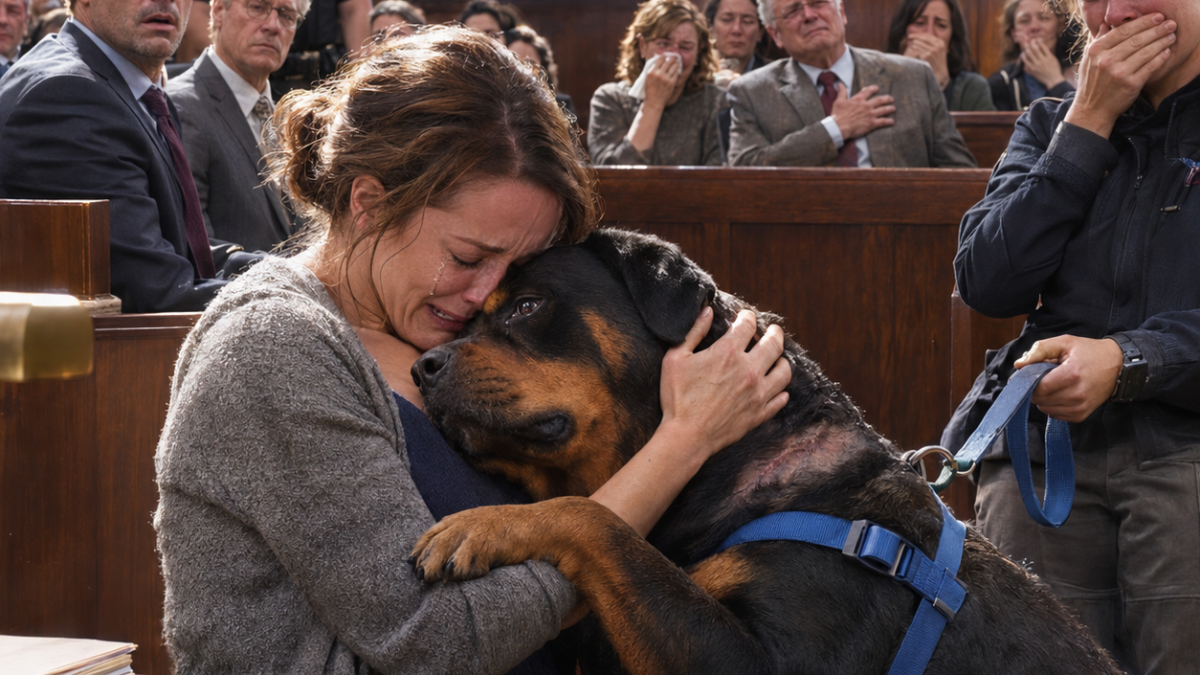
FULL STORY CONTINUATION
One woman said she hadn’t seen the animal standing for several days.
Another said the owner of the house had shouted at anyone who approached the fence.
That was enough for a welfare check.
When I pulled up, nothing looked dramatic.
That is the dangerous thing about some houses.
They look normal.
Beige siding.
Two-car driveway.
Mailbox.
Children’s chalk marks from some previous family still faintly visible on the sidewalk.
The curtains were drawn.
No car outside.
No obvious emergency.
I knocked.
Nothing.
Knocked again.
“Lakewood Hills Police.”
Silence.
Then, somewhere behind the house, I heard it.
A whimper.
Soft.
Weak.
Almost apologetic.
I walked along the side fence.
The gate was closed but not locked.
The smell reached me before the dog did.
Wet dirt.
Waste.
Old food.
And something unmistakable when you’ve spent enough time around neglected animals.
Sickness.
I opened the gate.
Then stopped.
The Rottweiler lay near a wooden post at the far end of the yard.
A heavy chain ran from his collar to the post.
There was an overturned water bowl beside him.
An empty metal food dish.
No shelter except a narrow strip of roof overhang that barely covered part of the dirt.
For several seconds, I thought he might be dead.
Then his ear moved.
“Hey.”
His eyes opened.
Dark brown.
Dull.
He didn’t lift his head.
I crouched at a distance.
“Easy.”
Nothing.
I moved closer.
He watched me.
Not aggressive.
Not welcoming.
Just watching.
There are animals who bark because they want distance.
Animals who growl because they are scared.
This dog did neither.
It was as though he had spent all his energy already.
I stopped several feet away.
“I’m not going to hurt you.”
His eyes remained on mine.
Then I heard movement behind me.
Animal Control had arrived.
David Chang came through the gate carrying equipment.
He was twenty-nine, newer to the job than he liked admitting, and usually impossible to shock.
He saw the dog.
Stopped.
“Oh my God.”
I nodded.
David crouched.
“How long?”
“I don’t know.”
He looked at the dog’s body.
Ribs visible beneath the coat.
Several raw areas along the back and shoulder.
One hind leg held at a strange angle.
“Can he stand?”
“I haven’t tried.”
David approached slowly.
The dog lifted his head.
Then something happened that stayed with me.
I spoke.
“It’s okay.”
The very tip of his tail moved.
Once.
Barely.
David looked at me.
I looked at him.
The dog did it again.
A creature who looked as though every expectation of kindness had been beaten out of him was still trying to answer a gentle voice.
That was the moment this stopped feeling like another animal-neglect call.
Not because the law changed.
Because I did.
I sat down in the dirt beside him.
Not touching.
Just there.
David glanced at me.
“You okay?”
“No.”
The dog’s eyes closed again.
I whispered:
“You don’t have to do anything.”
His breathing slowed.
“We’ll do the work now.”
PART2
While David and his partner began preparing to remove the chain safely, I returned to the back door.
I knocked harder.
“Police!”
Still nothing.
But this time, the kitchen curtain moved.
Just slightly.
Someone was inside.
I walked around the rear of the house.
Near the trash cans, I saw her.
A woman in her thirties.
Thin.
Pale.
Sweatshirt too large.
Arms wrapped tightly around herself despite the cold.
She stood as though she had been trying to decide whether to run.
I knew her name from the dispatch information.
“Sarah Wilson?”
She nodded.
No words.
I kept my voice low.
“My name is Officer Carter.”
Another nod.
“You live here?”
“Yes.”
Barely audible.
I looked toward the yard.
“Is that your dog?”
Her face collapsed.
Tears filled her eyes immediately.
“Buddy.”
She said the name like an apology.
I moved closer but kept distance between us.
“What happened to Buddy?”
Sarah looked toward the dog.
David was cutting away part of the chain assembly.
The Rottweiler didn’t resist.
“He shouldn’t be out there.”
“I know.”
“He never…”
She covered her mouth.
“He never did anything.”
I waited.
There are moments when questioning too quickly can close a person completely.
So I said nothing.
Sarah stared at Buddy.
Then whispered:
“He was protecting me.”
I felt something in my chest tighten.
“From whom?”
Her eyes moved toward the house.
Then away.
I already knew.
Still, she needed to say it.
“My husband.”
His name was Kevin Marshall.
Sarah had been married to him four years.
According to her, the beginning had been good.
People always say that.
And I believe them.
Cruelty rarely introduces itself honestly.
It usually arrives disguised as concern.
A question about where you’ve been.
A comment about a friend.
An argument about money.
A hand on your wrist held one second too long.
Then apologies.
Promises.
Flowers.
Weeks of calm.
Then something else.
Sarah spoke slowly.
At first Kevin shouted.
Then broke things.
Then pushed her.
Then began hitting her.
Not every day.
That mattered to Sarah.
She repeated it several times.
“He wasn’t like that all the time.”
I had heard that sentence many times before.
I never argued with it.
Someone can be kind on Monday and dangerous on Friday.
Friday still matters.
Buddy had been Sarah’s dog before the marriage.
A Rottweiler mix she’d adopted when he was approximately two years old.
Big.
Gentle.
Quiet.
He slept beside her bed.
Followed her from room to room.
Loved tennis balls.
Hated vacuum cleaners.
Never bit anyone.
Sarah smiled for half a second when she told me that.
“He was scared of the vacuum.”
I looked toward the yard.
The dog being lifted onto a stretcher had once run from a vacuum cleaner.
That detail hurt more than it should have.
“What happened three weeks ago?”
Sarah’s smile disappeared.
Her hands began shaking.
“Kevin was angry.”
“About what?”
“I don’t remember.”
She looked ashamed.
“That sounds terrible.”
“No.”
“I really don’t.”
Her breathing became unsteady.
“After a while, everything could become a reason.”
I nodded.
“That makes sense.”
She looked surprised that I believed her.
Then continued.
They had been in the kitchen.
Kevin was shouting.
Sarah tried to leave.
He blocked the doorway.
Buddy entered.
Not barking.
Not growling.
He simply stepped between them.
Sarah pointed toward the yard.
“That’s what he always did.”
Her eyes filled.
“He’d stand in front of me.”
“What did Kevin do?”
“He told him to move.”
Buddy didn’t.
“Then?”
“Kevin shoved him.”
Sarah swallowed.
“Buddy moved back.”
She shook her head.
“But he stepped in front of me again.”
I closed my eyes briefly.
“And Kevin?”
“He got furious.”
Her voice dropped.
“He said the dog respected me more than him.”
That sentence told me more about Kevin Marshall than a hundred pages of reports could have.
Sarah continued.
“Buddy never snapped.”
She looked directly at me.
“Please write that down.”
“I will.”
“He never tried to bite him.”
“I believe you.”
“He just stood there.”
Her voice broke.
“Like a wall.”
Kevin dragged Buddy outside.
Chained him to the post.
Sarah tried to intervene.
Kevin threatened her.
And from that day forward, Buddy remained outside.
At first Sarah sneaked food to him.
Then Kevin found out.
He controlled the back door.
Her phone.
Her car keys.
He told her that if she tried helping the dog again, she would “join him outside.”
Sarah’s voice became almost inaudible.
“I was afraid.”
I took one slow step closer.
“Sarah.”
She looked at me.
“I should have done something.”
“You’re doing something now.”
“I waited three weeks.”
“You survived three weeks.”
Her eyes filled.
“Buddy didn’t deserve that.”
“No.”
I didn’t lie to her.
“He didn’t.”
She started sobbing.
“I heard him every night.”
I waited.
“He cried.”
She pressed both hands against her face.
“And I stayed inside.”
I reached out slowly.
She allowed me to take her hand.
Her fingers were ice cold.
“Sarah.”
She looked at me.
“Today changes.”
Her breathing hitched.
“Buddy is leaving that yard.”
She stared.
“And you do not have to stay in this house.”
Something shifted in her face.
Not relief.
Relief comes later.
At first, hope often looks like disbelief.
Kevin returned that evening.
By then, Sarah had agreed to leave the property.
A domestic-violence advocate was on the way.
Her injuries were photographed with her consent.
Neighbors had begun giving statements.
Buddy had been transported to White Oak Veterinary Center.
I remained at the house with another officer.
Kevin drove into the driveway at 7:12.
He got out carrying a gym bag.
Saw the patrol cars.
Stopped.
Then saw Sarah sitting inside one of them.
His face changed.
Not fear first.
Anger.
He walked toward me.
“What happened?”
I identified myself.
He looked toward the yard.
“Where’s the dog?”
“Receiving veterinary care.”
His jaw tightened.
“That animal is dangerous.”
“Why?”
“He’s aggressive.”
“Who did he bite?”
Kevin stared.
“He tried.”
“Who?”
“He came at me.”
“Did he make contact?”
Silence.
“Did he bite you?”
“No.”
“Did he bite Sarah?”
“No.”
“Any neighbor?”
“No.”
“So what did he do?”
Kevin’s face hardened.
“He got between me and my wife.”
There it was.
I let the silence sit.
Kevin realized how it sounded.
He quickly added:
“He’s territorial.”
I said:
“Sarah describes him as standing between you during an argument.”
His eyes moved toward the patrol car.
“She lies.”
Behind the windshield, Sarah flinched.
I saw it.
Kevin saw that I saw it.
He tried another angle.
“I was training the dog.”
I looked toward the post.
“By chaining him outside without adequate food, water, shelter, or medical care?”
“He needed discipline.”
“No.”
My voice stayed even.
“What he needed was veterinary attention.”
Kevin stepped closer.
“You don’t know anything about my house.”
I held his gaze.
“You’re right.”
Then I glanced toward the evidence photographs.
“That’s why we’re documenting it.”
His expression changed.
He was arrested later that evening on charges supported by the investigation.
No dramatic fight.
No heroic takedown.
The important part was simpler.
Sarah watched him being placed into the patrol car.
She didn’t smile.
Didn’t celebrate.
She cried.
People sometimes misunderstand that.
Leaving someone who has hurt you does not instantly erase love, fear, history, grief, dependency, or confusion.
Freedom can hurt at first.
That does not make it the wrong direction.
I went to White Oak Veterinary Center the next morning.
Dr. Amanda Foster met me near the treatment area.
She specialized in trauma rehabilitation.
Forty-seven.
Soft voice.
Very little patience for people who harmed animals.
“How is he?”
She looked through the glass.
“Alive.”
That answer frightened me.
“How bad?”
“Serious but stable.”
Buddy lay on thick bedding.
Clean now.
That somehow made his condition harder to look at.
Mud had hidden some of the damage.
He was severely underweight.
Several areas of skin required treatment.
One rib had been fractured in the past and healed poorly.
Another injury near his hindquarters needed careful evaluation.
Dr. Foster pointed gently.
“Some wounds are recent.”
Then her voice changed.
“Some aren’t.”
I looked at her.
“What do you mean?”
“There are older scars.”
My stomach tightened.
“Before the three weeks outside?”
“Yes.”
“Can you tell what happened?”
“No.”
She shook her head.
“And I don’t want to invent a history we can’t prove.”
I appreciated that.
“But he has been living with pain longer than this incident.”
I stared at Buddy.
He lay in the back corner.
Eyes open.
Not asleep.
Not watching us.
Simply staring toward nothing.
Dr. Foster said quietly:
“The physical injuries are one problem.”
“And the other?”
“Trust.”
I looked at her.
“He shuts down when people approach.”
“Shuts down?”
“He makes himself small.”
My throat tightened.
“Rottweilers don’t exactly make themselves small.”
“They try.”
She folded her arms.
“He expects something bad to follow human attention.”
I looked through the glass.
“And Sarah?”
“He reacts differently to her name.”
“How?”
“His ears move.”
My eyes filled.
Dr. Foster studied me.
“What did she call him?”
“Buddy.”
She nodded.
Then asked:
“Are you keeping that?”
I stared through the glass.
Buddy.
A simple name.
A sweet name.
But all I could see was a dog standing between a frightened woman and danger.
Not attacking.
Not threatening.
Just refusing to move.
“A guardian.”
Dr. Foster looked at me.
“What?”
“He was her guardian.”
I glanced at her.
“Maybe that’s who he is.”
She smiled faintly.
“Guardian.”
I whispered it.
The dog didn’t move.
Not yet.
I visited every week.
At first, Guardian barely acknowledged me.
I sat outside his enclosure.
No reaching.
No forcing.
I talked.
About patrol.
Weather.
Traffic.
The terrible coffee at the station.
David’s obsession with expensive running shoes.
Things that did not matter.
Dr. Foster told me the words weren’t important.
Predictability was.
Same voice.
Same distance.
Same calm.
Nothing bad afterward.
One afternoon I sat there for twenty minutes.
“Mrs. Henderson called police again because her neighbor’s tree dropped leaves into her yard.”
Guardian stared at the wall.
“I know.”
I sighed.
“Crime of the century.”
Nothing.
“I told her trees lack criminal intent.”
One ear moved.
I smiled.
“There you are.”
I didn’t move closer.
That’s another thing Guardian taught me.
Trust often grows faster when nobody grabs at it.
By the end of the second week, he was eating consistently.
The third week, he began walking short distances.
His hind leg improved.
The wounds healed.
His coat slowly regained its shine.
But emotionally, recovery came in millimeters.
Then one Tuesday afternoon, I walked into the rehabilitation room.
Guardian lifted his head.
Not accidentally.
He looked directly at me.
I stopped.
“Hello.”
His eyes followed me.
I sat in my usual spot.
“Busy day.”
Guardian kept watching.
“A teenager tried explaining to me that a stop sign was optional because nobody else was at the intersection.”
His ear moved.
I smiled.
Then—
His tail moved.
Only the tip.
Once.
I stopped talking.
Dr. Foster was standing behind me.
She saw it too.
Neither of us breathed.
The tail moved again.
I whispered:
“Hi, Guardian.”
One more movement.
Dr. Foster turned away.
I knew why.
I did too.
Because sometimes a one-inch tail wag means more than a standing ovation.
It meant part of him was coming back.
Sarah’s recovery moved differently.
I saw her through the legal process.
She had relocated to a confidential safe place.
Then temporary housing.
She began counseling.
Changed her phone number.
Returned to part-time work.
For the first month, she apologized constantly.
To advocates.
To police.
To prosecutors.
To me.
For crying.
For forgetting dates.
For being afraid.
For returning to Kevin after previous incidents.
For not helping Guardian sooner.
One afternoon, I stopped her outside the courthouse.
“Sarah.”
She looked at me.
“You have to stop apologizing to me.”
“I know.”
“No.”
I softened my voice.
“You don’t.”
Her eyes filled.
“I should have protected him.”
“He protected you because he chose to.”
She started crying.
“That doesn’t make what happened to him your fault.”
“He suffered because of me.”
“No.”
I looked directly at her.
“He suffered because someone chose cruelty.”
She looked away.
“Those are not the same thing.”
For a long time, she said nothing.
Then whispered:
“I don’t know how to forgive myself.”
I nodded.
“Maybe don’t start with forgiveness.”
She looked at me.
“Start with surviving today.”
The criminal case took months.
That is another thing movies get wrong.
Consequences take paperwork.
Interviews.
Medical documentation.
Continuances.
Hearings.
Experts.
Evidence.
Sarah decided to testify.
Nobody pressured her.
Her advocate made that clear.
She could cooperate without turning the courtroom into another place where someone controlled her.
But Sarah wanted to speak.
The night before her testimony, she called me.
“Emily.”
“I’m here.”
“I can’t do it.”
“Yes, you can.”
“No.”
Her breathing was fast.
“He’ll look at me.”
I sat on the edge of my bed.
“You don’t have to look at him.”
“He’ll think I’m weak.”
“Sarah.”
Silence.
“He already knows you were afraid.”
She cried.
“Being afraid didn’t stop you from leaving.”
Her breathing slowed slightly.
“That isn’t weakness.”
“What if my voice shakes?”
“Let it.”
“What if I cry?”
“Cry.”
“What if I forget something?”
“Say you don’t remember.”
She was quiet.
Then asked:
“Will you be there?”
“Yes.”
“Promise?”
“I promise.”
Sarah testified for almost two hours.
Her hands shook.
Her voice broke.
She cried.
And she stayed.
She described the progression of control.
The shouting.
Isolation.
Threats.
The kitchen incident.
Guardian stepping between them.
Kevin ordering him away.
Guardian refusing to move.
No growling.
No attack.
No bite.
Just his body.
A wall.
Then what followed.
The chain.
The backyard.
Her fear.
At one point, the prosecutor asked:
“Why didn’t you simply go outside and free the dog?”
Defense counsel objected to the phrasing.
The judge handled it.
Sarah eventually answered.
Her voice was barely audible.
“Because Kevin told me if I did, he’d put me beside him.”
Silence filled the courtroom.
She continued.
“I believed him.”
I watched the jury.
Several faces changed.
Sarah looked toward Kevin for the first time.
He stared back.
Her shoulders tightened.
Then she said something I don’t think anyone expected.
“I know people will ask why I stayed.”
Her attorney started to move.
The prosecutor waited.
Sarah continued.
“I ask myself too.”
Her eyes filled.
“But Buddy never asked.”
My throat tightened.
“He never punished me for being afraid.”
Kevin looked down.
“He just stood there.”
A tear ran down Sarah’s cheek.
“Even when I couldn’t stand up for myself.”
The courtroom was completely silent.
“He stood up for me.”
I testified two days later.
I described the yard.
The chain.
The empty bowls.
Guardian’s physical state.
Sarah’s condition.
What Kevin told me.
Then the prosecutor asked:
“Officer Carter, based on what you observed, did the dog exhibit aggression toward you?”
“No.”
“Toward animal-control personnel?”
“No.”
“Any documented bite history?”
“None that we found.”
“Did he attempt to attack Mr. Marshall when officers were present?”
“No.”
Then came the question that stayed with me.
“Why do you think Guardian did not attack Kevin Marshall despite being mistreated?”
Defense counsel objected to speculation.
The question was narrowed.
I answered only based on what I knew.
“What I can say is that everything we documented was consistent with Sarah’s description.”
I looked toward the jury.
“This wasn’t a dog looking for a fight.”
My voice tightened.
“He was trying to create distance between two people.”
I remembered Sarah’s words.
“A wall.”
The prosecutor nodded.
I continued.
“He didn’t need to bite to protect her.”
I looked toward Kevin.
“He simply refused to move.”
Kevin was convicted on charges supported by the evidence, including domestic violence offenses and animal cruelty.
There were additional legal consequences related to confinement and abuse established through the case.
He received a prison sentence.
People outside the courthouse called it justice.
I understand why.
But justice does not rewind time.
It did not erase Sarah’s memories.
It did not restore Guardian’s lost weight overnight.
It did not make old scars disappear.
Justice is not magic.
Sometimes justice is simply society finally saying:
What happened to you was wrong.
That matters.
For Sarah, it mattered enormously.
When the judge finished, she sat still.
Then asked me:
“Is it over?”
“The criminal trial is.”
She nodded.
Then started crying.
I expected relief.
Instead she whispered:
“I thought I’d feel happy.”
“You don’t have to.”
“I don’t?”
“No.”
I sat beside her.
“You can feel safe before you feel happy.”
She looked at me.
That sentence seemed to help.
Guardian kept healing.
A month passed.
Then two.
He learned Dr. Foster’s footsteps.
Learned mine.
Started accepting treats directly from my hand.
The first time his nose touched my palm, he jerked back.
Nothing happened.
He tried again.
A week later, he allowed Dr. Foster to scratch beneath his chin.
Another milestone.
Then one afternoon, I was sitting on the floor near him.
I had finished telling him about an argument between two neighbors over a recycling bin.
“You’d think I work in international diplomacy.”
Guardian stood.
I stopped talking.
He walked toward me.
Slowly.
One step.
Then another.
I stayed still.
He reached me.
For a moment, he simply stood there.
I could feel his breath on my hand.
Then Guardian lowered his enormous head onto my knees.
I stopped breathing.
Dr. Foster, across the room, froze.
My eyes filled instantly.
“Hey.”
Guardian closed his eyes.
I placed one hand lightly on his head.
He did not flinch.
“You’re safe.”
My voice broke.
He leaned more weight against me.
“Nothing bad is coming next.”
Tears ran down my face.
“Not anymore.”
His tail moved against the floor.
That afternoon, I understood something about traumatized animals that I later realized applies to people too.
Healing isn’t one brave decision.
It is hundreds of tiny experiments.
If I eat, will someone take the bowl?
If I sleep, will something happen?
If I approach, will the hand hurt?
If I trust, will I regret it?
Guardian had been testing us for months.
And one afternoon, he decided to try one more time.
He put his head on my lap.
Trust is terrifying when you have evidence against it.
That made his choice extraordinary.
Sarah visited Guardian three months after the rescue.
We had discussed it carefully.
Dr. Foster wanted to ensure both of them were ready.
Sarah was terrified.
“What if he doesn’t remember me?”
“He might.”
“What if he does?”
I understood.
Remembering could hurt too.
“What if he hates me?”
I looked at her.
“Sarah.”
Her eyes filled.
“What?”
“I have never seen that dog hate you.”
She looked down.
“He suffered while I was inside.”
“He also stood between you and Kevin before he suffered.”
She began crying.
“What if he thinks I abandoned him?”
“I can’t tell you what a dog thinks.”
I touched her shoulder.
“But I can tell you what happens every time we say your name.”
She looked up.
“What?”
“His ears move.”
That made her cry harder.
The day she came, Guardian was in the rehabilitation room.
No cage.
No chain.
No locked outdoor post.
Just an open room with a bed, toys, water, and sunlight through large windows.
Sarah stood outside the door.
She couldn’t move.
“Take your time.”
“I can’t breathe.”
“Yes, you can.”
She inhaled.
Then entered.
Guardian was lying on his bed.
He heard the door.
Lifted his head.
Saw her.
Everything stopped.
Sarah covered her mouth.
“Buddy.”
Guardian’s ears rose.
Not Guardian.
Buddy.
The name from before.
The name from home.
The name from nights at Sarah’s feet before fear entered the house.
Sarah’s knees nearly gave way.
“Hi, baby.”
Guardian stood.
Slowly.
His tail did not move yet.
Sarah stayed where she was.
“I’m sorry.”
Her voice broke immediately.
Guardian took one step.
Sarah began sobbing.
“I am so sorry.”
Another step.
“I should’ve gotten you out.”
Another.
“I was afraid.”
Guardian stopped several feet away.
Sarah lowered herself to the floor.
She didn’t reach.
Didn’t call again.
She simply cried.
“I understand if you don’t want me.”
That was when Guardian moved.
He crossed the remaining distance.
Not quickly.
No dramatic leap.
He approached the woman he had protected.
Sniffed her hair.
Then her shoulder.
Sarah didn’t move.
Guardian’s tail began to wag.
Once.
Twice.
Then faster.
Sarah gasped.
Guardian pushed his face against her chest.
She wrapped both arms around him.
The sound that came out of her didn’t sound like crying at first.
It sounded like something breaking.
Or healing.
Sometimes they sound the same.
“Oh my God.”
Guardian licked her face.
Sarah held him.
“You remember me.”
His entire body was moving now.
Tail slamming the floor.
He pushed closer.
“You remember.”
Dr. Foster began crying.
I did too.
There was no shame in the room.
Only a woman and a dog who had both survived the same house.
And neither blamed the other.
Sarah stayed for nearly two hours.
At first, Guardian would not leave her side.
If she shifted, he moved.
If she stood, he stood.
When she sat again, he lay at her feet.
Exactly as he had before Kevin.
Dr. Foster eventually said:
“He still sees you as home.”
Sarah covered her face.
“I don’t deserve him.”
Guardian lifted his head.
I crouched beside her.
“Maybe stop deciding what he deserves.”
She looked at me.
“Let him decide where he feels safe.”
Sarah stared at Guardian.
Then asked:
“Can I take him back someday?”
Dr. Foster smiled.
“If the legal placement is cleared and both of you are ready.”
Sarah’s eyes filled.
“I want him.”
Guardian’s tail moved.
I laughed.
“I think that’s two votes.”
The adoption and return process took time.
Sarah had moved to another city.
She lived in a small rental home with a fenced yard.
She had a job at a medical billing office.
A therapist.
A support group.
No contact with Kevin except through legal channels.
She wanted Guardian back.
But wanting something and being ready for it aren’t always the same.
So Sarah prepared.
She bought a bed.
Food.
Toys.
A blue collar.
Then returned the collar because it reminded her of the chain.
She bought a soft red one instead.
She sent me photographs.
“Too much?”
Her living room contained three dog beds.
“Yes.”
“I don’t care.”
I laughed.
Good.
Guardian’s final physical evaluation came five months after the day we found him.
His weight was healthy.
The infected wounds were gone.
The old rib injury had been addressed as well as possible.
His coat shone.
He walked normally except for a slight stiffness after long activity.
The psychological scars would remain.
Loud male voices still made him tense.
Certain movements frightened him.
He disliked chains of any kind.
But he played now.
That mattered.
The first toy Guardian loved was a pink rubber ball.
Nobody knew why.
He carried it everywhere.
Dr. Foster joked that the intimidating Rottweiler had terrible aesthetic taste.
Guardian didn’t care.
The morning Sarah took him home, I arrived early.
I wanted to be there.
Maybe selfishly.
Guardian had become part of my life too.
He saw me and came over.
Placed his head against my hip.
I scratched behind his ears.
“Big day.”
His tail moved.
Then the front door opened.
Sarah entered.
Guardian turned.
The pink ball dropped from his mouth.
Sarah smiled.
“Hey, Buddy.”
He ran.
Not walked.
Ran.
Straight toward her.
She crouched.
Guardian almost knocked her over.
Sarah laughed.
The sound was different from the woman I’d met behind the trash cans.
Stronger.
Freer.
She buried her face in his neck.
“You’re coming home.”
Guardian licked her chin.
She laughed harder.
Dr. Foster handed Sarah the paperwork.
Then the leash.
Sarah looked at it.
A soft fabric lead.
No metal chain.
She swallowed.
Guardian watched her.
“You ready?”
His tail moved.
She clipped the leash gently.
Then stopped.
Her eyes filled.
I knew what she was remembering.
The yard.
The post.
The chain.
She whispered:
“This one’s different.”
Guardian looked up.
“This one means we leave together.”
She opened the door.
They walked out side by side.
Not one dragging the other.
Not one behind.
Side by side.
I watched until they disappeared.
Then cried in the parking lot.
Six months passed.
Sarah sent photographs.
Guardian sleeping in a sunny patch of grass.
Guardian carrying the pink ball.
Guardian on a couch beside Sarah.
Guardian watching her cook.
Guardian asleep with one paw resting on her foot.
With one photograph, Sarah wrote:
He still stands between me and anything that scares me.
Then another message arrived.
But now I’m learning to stand too.
I saved both.
Sarah eventually volunteered with a local domestic-violence organization.
Not immediately.
Years later.
After therapy.
After rebuilding enough of herself that helping others didn’t require reopening every wound.
She never presented herself as someone who had all the answers.
She told women:
“I stayed longer than I thought I ever would.”
Then:
“You are not stupid for being afraid.”
Sometimes she brought Guardian to approved events.
Not as a spectacle.
As comfort.
He would lie quietly beside someone crying.
Never push.
Never demand.
Just be there.
That was what Guardian had always done.
Stand.
Stay.
Make space between fear and the person inside it.
One afternoon Sarah called me.
Her voice was shaky.
“Emily.”
“What happened?”
“Nothing bad.”
I sat down.
“Okay.”
“I bought a house.”
I smiled.
“Sarah.”
“A little one.”
“Still counts.”
“There’s a backyard.”
“Guardian will approve.”
She laughed.
Then became quiet.
“I signed everything myself.”
My eyes filled.
“That’s a big deal.”
“I almost called Kevin.”
I understood what she meant.
For four years, every major decision had required his approval.
Even after freedom, habits remain.
“What did you do?”
“I called my realtor.”
“Better choice.”
She laughed through tears.
Then whispered:
“I didn’t know ordinary things could feel this important.”
“They are.”
The first time I visited the new house, Guardian met me at the gate.
Healthy.
Muscular.
Gray beginning slightly around his muzzle.
He barked once.
Then recognized me.
His tail exploded.
“Guardian!”
He ran over.
Nearly knocked me backward.
Sarah stood on the porch laughing.
“He’s gained manners.”
“Clearly.”
I crouched.
Guardian put both front paws against my shoulders.
For one second, I remembered the dirt yard.
The chain.
The dog too weak to lift his head.
I hugged him.
“You look good.”
He licked my ear.
“Still disgusting.”
Sarah smiled.
Then said:
“Watch.”
She walked toward the front door.
Guardian followed.
Halfway there, Sarah stopped.
He stopped.
She changed direction.
He changed direction.
I laughed.
“Still attached?”
“Always.”
Then Sarah walked beside him.
Not behind.
Not protected by his body.
Beside him.
I noticed.
She noticed me noticing.
Her eyes filled.
“He doesn’t have to stand in front anymore.”
I smiled.
“No.”
She rested one hand on his back.
“We’re safe.”
Years passed.
Kevin eventually completed his sentence and remained subject to the legal restrictions associated with his case.
Sarah never reconciled with him.
Never resumed contact beyond what was legally necessary.
There was no dramatic final confrontation.
No revenge meeting.
No speech where she made him kneel.
That wasn’t Sarah’s victory.
Her victory was absence.
A phone that did not ring with his name.
A house where doors could close without fear.
A dog sleeping with his belly exposed because he finally believed nobody would hurt him while he rested.
Freedom is often boring.
That’s what makes it beautiful.
Guardian got older.
Rottweilers don’t get enough time.
No dog does.
At nine, he slowed.
At ten, arthritis appeared.
At eleven, the pink ball became something he carried rather than chased.
Sarah sent a photograph of him sleeping with it between his paws.
Caption:
Still his favorite.
I replied:
Still terrible taste.
Sarah sent laughing emojis.
When Guardian was twelve, Sarah called me again.
This time, I knew from the silence.
“Emily.”
I stopped what I was doing.
“What happened?”
“Dr. Foster says…”
Her voice broke.
I closed my eyes.
“What?”
“Cancer.”
I sat down.
Sarah cried.
Guardian had a large internal mass.
Treatment options existed but were limited by age and overall condition.
Sarah chose comfort.
Dr. Foster supported her.
There are moments when love asks us to fight.
Others when love asks us to stop making someone fight for our sake.
Sarah struggled with that.
Of course she did.
Guardian’s whole story had been survival.
“How do I let the dog who saved me stop fighting?”
She asked me that one night.
I had no good answer.
So I said:
“Maybe this is your turn to stand between him and something painful.”
Silence.
Sarah started crying.
“What if I choose too soon?”
“You’ll choose with the vet.”
“What if it’s too late?”
“You’ll choose with the vet.”
“I hate this.”
“I know.”
Then I said:
“You don’t have to make the perfect decision.”
Her breathing shook.
“Just the loving one.”
Guardian had several good weeks.
Sarah spoiled him shamelessly.
Steak.
Car rides.
Slow walks.
Sunshine.
The pink ball always nearby.
She brought him to White Oak one final time when he could still walk comfortably.
Dr. Foster sat on the floor with him.
“So.”
Guardian put his head on her knee.
She laughed through tears.
“You finally trust me?”
His tail moved.
“Only took twelve years.”
Sarah cried.
I cried.
Dr. Foster absolutely cried despite denying it later.
Guardian’s final day came at home.
Sarah called me early.
“Today.”
I understood.
I drove there.
Dr. Foster came too.
The living room was full of afternoon sunlight.
Guardian lay on a blanket beside the couch.
The pink ball near his paw.
He looked tired.
But when he saw me, his tail moved.
Once.
Then again.
“Hey, big guy.”
I knelt.
He lifted his head.
I touched my forehead to his.
“You remember me?”
His tongue touched my chin.
Very weak.
I laughed.
“Okay.”
My voice broke.
“Message received.”
Sarah sat beside him.
Her face was swollen from crying.
“I don’t know how to do this.”
I took her hand.
“You already are.”
Guardian shifted.
Then did something that brought all of us back to the beginning.
He tried to stand.
Sarah immediately reached for him.
“No.”
He struggled.
“Buddy, stay.”
Guardian got his front legs underneath him.
Slowly.
Painfully.
Then he placed himself beside Sarah.
Not in front.
Beside.
His body leaned against hers.
Sarah froze.
Guardian lowered himself again.
Head on her lap.
Exactly where he wanted to be.
Sarah broke.
“Oh, baby.”
She bent over him.
“You’re still here.”
Guardian breathed slowly.
“Still taking care of me.”
She kissed his head.
“You can stop now.”
Her voice shattered.
“You hear me?”
His eyes opened.
“You don’t have to protect me anymore.”
Tears ran down her face onto his fur.
“I can stand.”
Guardian watched her.
“You taught me.”
His breathing slowed.
“I’ll be okay.”
That may have been the bravest thing Sarah ever said.
Maybe Guardian knew she was lying a little.
People always lie when saying goodbye.
We say we’ll be okay because we need the person—or animal—we love to believe leaving is permitted.
Sarah stroked his head.
“You saved me.”
Guardian’s eyes closed.
“And I’m going to be okay.”
Dr. Foster gave him peace.
Sarah held him.
I kept one hand on his back.
His final breath was quiet.
No fear.
No chain.
No dirt yard.
No one shouting.
No one hurting him.
Only sunlight.
Sarah.
The pink ball.
Hands he trusted.
Then stillness.
Sarah held Guardian for almost an hour afterward.
Nobody rushed her.
Eventually she whispered:
“He’s heavy.”
I almost laughed.
“He always was.”
“No.”
She looked at me.
“He feels different.”
I understood.
The body of someone we love becomes unbearably physical after the life leaves.
Sarah pressed her face into his neck.
“I don’t know who I am without him.”
I sat beside her.
“Yes, you do.”
She looked up.
“You’re Sarah.”
She cried.
“The woman he protected.”
I paused.
“And the woman who learned to protect herself.”
Her mouth trembled.
“That’s who he leaves behind.”
A few weeks later, Sarah mailed me a package.
Inside was Guardian’s red collar.
Not the original chain collar.
The soft red collar she’d bought for their new life.
Attached was a note.
I can’t keep this in a drawer. It deserves to be somewhere his story is remembered.
At the station, we mounted it in a small shadow box.
Beside it, a photograph.
Guardian sitting next to Sarah in her sunny backyard.
No dramatic rescue image.
No wounds.
No chain.
Healthy.
Happy.
Free.
Underneath, a small plaque read:
GUARDIAN
HE NEVER NEEDED TO ATTACK.
HE JUST STOOD THERE.
I thought that was perfect.
Sarah planted a tree for him in her backyard.
A maple.
Underneath, she placed the pink ball.
I told her it would probably rot.
She said:
“Then it rots where he was happy.”
Fair enough.
Years later, Sarah remarried.
That surprised even her.
She called me before the wedding.
“Emily.”
“Yes?”
“I think I’m going to throw up.”
“Excellent start.”
She laughed.
His name was Daniel.
A teacher.
Quiet.
Kind.
He knew everything.
Never tried to compete with a dead dog.
That mattered.
Before marrying him, Sarah asked one question.
“What happens when we disagree?”
Daniel apparently looked confused.
“We talk?”
She asked:
“And if I walk away from the argument?”
He answered:
“Then I give you space and we try again.”
Sarah cried.
Not because the answer was extraordinary.
Because once you’ve lived with fear, ordinary decency can feel miraculous.
At the wedding, there was one empty chair near the front.
On it sat a framed photograph of Guardian.
Not because Sarah couldn’t move forward.
Because moving forward doesn’t require pretending the ones who carried us there never existed.
I attended.
When Sarah walked down the aisle, she looked toward Guardian’s photograph.
Then toward me.
For half a second, I saw the woman behind the trash cans.
Thin.
Pale.
Arms wrapped around herself.
Terrified.
Then she smiled.
And I saw who she had become.
The ceremony was simple.
At the reception, Sarah pulled me aside.
“I need to tell you something.”
“What?”
“The day you found us…”
Her eyes filled.
“I had packed a bag.”
My stomach tightened.
“What kind of bag?”
“To leave.”
I nodded.
“But I was too afraid.”
She looked toward Guardian’s photograph.
“When I saw them carrying him out of the yard…”
She swallowed.
“I thought he had suffered because I couldn’t leave.”
“Sarah—”
“I know.”
She lifted one hand.
“I know better now.”
She smiled through tears.
“But at the time, I thought I’d failed him.”
I waited.
“Then you told me today everything changes.”
I remembered.
“You said I was free.”
Her voice broke.
“I didn’t believe you.”
“That makes sense.”
“But Guardian did.”
I frowned.
She continued.
“When they put him on the stretcher…”
Her eyes filled completely.
“He lifted his head.”
I remembered.
“He looked at me.”
“Yes.”
“And he moved his tail.”
I had seen it.
Barely.
Once.
Sarah whispered:
“He was telling me to go.”
I couldn’t speak.
“I know that sounds crazy.”
“No.”
“He had spent three weeks outside because he protected me.”
She looked toward the photograph.
“And when they finally rescued him, he still looked at me like I was someone worth saving.”
That broke me.
I hugged her.
For several seconds, neither of us could speak.
Then Sarah whispered:
“That dog believed in me before I did.”
I think about Guardian often.
Especially on difficult days.
Police work can make cynicism feel intelligent.
You see people lie.
Hurt one another.
Choose cruelty when kindness would have been easier.
After enough years, you can start believing hardness is wisdom.
Then I remember Guardian.
A dog who had every reason to become dangerous.
He didn’t.
Every reason to stop trusting.
Eventually, he trusted again.
Every reason to answer violence with violence.
Instead, his defining act was standing still.
Between Sarah and danger.
No teeth.
No attack.
No glory.
Just presence.
Courage is often portrayed as action.
Running.
Fighting.
Charging toward danger.
Sometimes courage is that.
But Guardian taught me another kind.
Sometimes courage is refusing to move when moving would leave someone vulnerable.
Sometimes it is occupying one small piece of floor.
Making your body a boundary.
Saying without words:
You do not get past me.
Sarah eventually began speaking publicly about survival.
Small groups.
No cameras.
Shelters.
Training events.
She always brought Guardian’s photograph.
She never called herself brave.
That wasn’t her style.
When someone asked why she finally left, she answered:
“Because one day I saw what my dog was willing to endure to keep me safe.”
Then she paused.
“And I realized I had to learn to do for myself what he had been trying to do for me.”
Stand.
One evening years after Guardian’s death, Sarah sent me a photograph.
The maple tree in her backyard had grown tall.
Daniel sat beneath it reading.
A little girl played nearby.
Sarah’s daughter.
She had named her Grace.
Beside the tree was Guardian’s small memorial stone.
Grace had placed flowers on it.
Sarah’s message read:
She knows Guardian was the dog who helped Mommy become brave.
I stared at the picture for a long time.
Then saved it.
That is how Guardian’s story continued.
Not in a courtroom.
Not in a veterinary hospital.
Not in the yard where we found him.
In a child who would grow up in a house where fear wasn’t normal.
A woman who learned that love does not require shrinking.
A husband who knew that disagreement is not permission for intimidation.
A family whose history changed because one dog once refused to move.
People sometimes ask whether Guardian really “saved” Sarah.
I think the word rescue is complicated.
Police helped.
Animal Control helped.
Advocates helped.
Attorneys helped.
Therapists helped.
Dr. Foster helped.
Sarah helped herself more than anyone.
Guardian did not do all of that.
But on one night in a kitchen, when Sarah was terrified and another person was trying to dominate the room, Guardian made one choice.
He stood between them.
Maybe that gave Sarah enough space to breathe.
Maybe enough time.
Maybe enough proof that what was happening was wrong.
Sometimes one small interruption changes the direction of a life.
Guardian interrupted.
And Sarah saved Guardian too.
Not perfectly.
Not immediately.
Fear delayed her.
That truth hurt her for years.
But healing is not a competition over who acted fastest.
When Sarah finally had an opening, she told the truth.
She testified.
She rebuilt.
She returned for him.
She gave him a home.
Food.
Safety.
Sunlight.
A soft red collar instead of a chain.
She stayed until his final breath.
That matters.
The original chain was retained as evidence for a time.
Eventually, when it was released, Sarah was offered the chance to take it.
She refused.
“Destroy it.”
No ceremony.
No dramatic burning.
No photograph.
She didn’t need it.
The chain belonged to the worst chapter.
Guardian’s red collar belonged to the rest.
I sometimes drive past Oakwood Drive.
The house looks different now.
New owners.
New paint.
Children’s bicycle near the garage.
The wooden post is gone.
Grass covers the place where Guardian once lay chained.
Nobody looking at that yard would know.
I’m glad.
Places should be allowed to become ordinary again.
But I know.
Sarah knows.
David knows.
Dr. Foster knows.
And somewhere in our station hangs a red collar reminding everyone who sees it that the dog who wore it once had nothing but his body to offer.
So he offered that.
If I could speak to Guardian as clearly as I speak to people, I would tell him something.
You were never just Buddy.
You were never just Guardian either.
You were proof.
Proof that gentleness and weakness are not the same thing.
Proof that a creature can be powerful without using violence.
Proof that trust can return after betrayal.
Proof that standing beside someone can sometimes save more than fighting for them.
I would also tell him this:
Sarah made it.
She really did.
Not perfectly.
She still had difficult days.
Anniversaries that hurt.
Sounds that startled her.
Moments when old fear came back without warning.
Healing never erased the past.
It simply stopped allowing the past to control every room she entered.
She learned to laugh loudly.
Drive anywhere she wanted.
Leave arguments without asking permission.
Sleep through the night.
Choose who came into her home.
Choose who stayed.
She became a mother.
A wife again.
A friend to women who thought no one would understand.
She stood.
Guardian would have liked that.
The last photograph I ever received of him alive remains my favorite.
Not the rescue.
Not the rehabilitation center.
Not even the reunion with Sarah.
It was taken two months before his diagnosis.
Guardian was lying in the backyard.
Gray muzzle.
Pink ball beside him.
Sarah sat in the grass reading.
Her back leaned against his.
Neither looked at the camera.
No danger.
No heroism.
No one needed saving.
Just an ordinary afternoon.
That is what I wanted for both of them from the beginning.
Not a dramatic life.
A safe one.
Sometimes safety is the happiest ending there is.
When Sarah spoke at a shelter fundraiser years later, she told the audience:
“For a long time, I thought Guardian saved me because he stood between me and Kevin.”
Then she shook her head.
“That was only the beginning.”
She looked toward the photograph beside her.
“He saved me because afterward, when I looked at what happened to him, I understood something.”
The room was silent.
“I would never have blamed that dog for being afraid.”
Her voice trembled.
“I would never have called him weak because he froze.”
Tears filled her eyes.
“I would never have told him he deserved what happened because he didn’t escape fast enough.”
Then she looked at the women sitting in front of her.
“So I had to stop saying those things about myself.”
I cried in the back row.
No one noticed.
Or maybe they were polite enough to pretend.
That may be Guardian’s greatest legacy.
Not that he stopped one act of violence.
Not that he helped convict anyone.
Not that he became a symbol.
He taught Sarah to extend to herself the same compassion she gave him.
That is harder than people think.
We can forgive animals instantly for being afraid.
We understand survival instinct when we see it in them.
We understand freezing.
Hiding.
Submitting.
Running.
But when people do the same, we ask:
Why didn’t you leave?
Why didn’t you fight?
Why didn’t you tell?
Guardian’s story answered those questions without words.
Fear changes behavior.
Survival is messy.
And none of that means the suffering was deserved.
I still remember the first time Guardian looked at me in that yard.
Not begging.
Not expecting rescue.
Just tired.
Then the tiny movement of his tail.
One inch.
Maybe less.
People might hear that and think I am sentimental.
I am.
I have earned the right.
Because I have seen how little hope sometimes looks from the outside.
A tail moving once.
A woman whispering yes when asked if she wants help.
A dog lifting his head after three weeks of staring at a wall.
A survivor walking into court with shaking hands.
A leash clipped to a red collar.
A front door opening onto a new home.
Tiny things.
Until you realize they are not tiny at all.
They are how lives change.
The day we found Guardian, Sarah told me:
“He just stood there.”
At the time, she was describing what he did in the kitchen.
Years later, I realized that sentence described his whole life.
He stood there.
When Sarah was afraid.
When Kevin shouted.
When pain came.
When the world taught him humans could hurt.
Later, when Sarah needed him again, he stood beside her.
Not ahead.
Not behind.
Beside.
And eventually, Sarah learned to stand there too.
That was the ending Guardian deserved.
Not revenge.
Not Kevin suffering forever.
Not endless fear.
Sarah standing in her own home.
Her own keys.
Her own decisions.
Guardian beside her.
Sunlight on his coat.
No chain.
No shouting.
Nothing between them and the door.
If you ask me what courage looks like now, I don’t immediately picture a badge.
I don’t picture a weapon.
I don’t picture someone charging into danger.
Sometimes I picture a large black-and-tan Rottweiler standing quietly in a kitchen.
A frightened woman behind him.
An angry man in front.
Guardian could have attacked.
He didn’t.
Could have run.
He didn’t.
He simply planted his paws.
And stayed.
Kevin believed strength meant making others afraid.
Guardian showed me the opposite.
Real strength can make someone feel safe.
That difference is everything.
Years after all of this, I visited Sarah’s house one last time before I retired.
Grace was six.
She ran into the yard holding a stuffed Rottweiler.
“Officer Emily!”
“Just Emily now.”
She didn’t care.
She showed me the toy.
“This is Guardian.”
“I know.”
“No.”
She corrected me seriously.
“This one is Little Guardian.”
“Ah.”
I nodded.
“Important distinction.”
Sarah came outside laughing.
Behind her, Daniel carried lemonade.
We sat under the maple tree.
Grace played.
The small memorial stone rested nearby.
I watched Sarah.
She looked peaceful.
Not the artificial peace of someone pretending nothing happened.
The earned kind.
Scars present.
Life larger.
She noticed me staring.
“What?”
“Nothing.”
“Emily.”
I smiled.
“You did good.”
Her eyes filled.
Then she looked at the memorial.
“We did.”
I nodded.
“Yes.”
We did.
Before I left, Grace ran toward me.
“Wait!”
She handed me a drawing.
A black dog.
A woman.
A police officer.
Three stick figures standing beneath a giant yellow sun.
“What is this?”
“Guardian saving everybody.”
Sarah laughed.
“He has become somewhat mythological.”
I looked at the picture.
Guardian was drawn larger than the house.
Appropriate.
I folded it carefully.
Still have it.
Some stories end when the danger ends.
Guardian’s didn’t.
His story continued in everything that came after.
Sarah’s testimony.
The rehabilitation room.
The first tail wag.
The first touch.
The reunion.
The red collar.
The little house.
The pink ball.
The maple tree.
Grace.
All because one frightened animal decided someone behind him was worth protecting.
I think sometimes about what would have happened if Guardian had been aggressive.
If he had bitten Kevin.
Maybe the story would have become about a “dangerous dog.”
Maybe someone would have misunderstood.
Maybe his own protective instinct would have been used against him.
Instead, what happened was quieter.
He stood.
That quietness saved the truth.
There were no bite wounds to distract from the violence in the room.
No excuse that Guardian had started something.
Only a dog placing his body in the space between fear and harm.
That image became impossible to erase.
When I retired from policing, the department held a small ceremony.
David was there.
Dr. Foster.
Henry from another unit.
Patty from dispatch.
Then Sarah arrived.
I hadn’t expected her.
She carried something.
The shadow box with Guardian’s red collar.
“What are you doing with that?”
She smiled.
“It belongs with you now.”
“No.”
“Yes.”
“Sarah—”
She held it tighter.
“You were the first person who told me everything was going to change.”
I looked at the collar.
“And you were right.”
My eyes filled.
She continued.
“Guardian’s story saved more than me.”
She placed the box in my hands.
“Take him home.”
I cried.
Of course I did.
Retirement ceremonies apparently destroy whatever emotional control police officers pretend to possess.
The shadow box hangs in my house now.
Beside the drawing Grace gave me.
Sometimes visitors ask.
“Who was Guardian?”
I never give the short answer.
He deserves the long one.
I tell them about Oakwood Drive.
The yard.
The chain.
Sarah.
The kitchen.
The way he stood.
The way he stopped trusting.
The first tail movement.
The day Sarah came back.
The red collar.
The final afternoon in sunlight.
Then I tell them what I believe.
Guardian wasn’t remarkable because he was fearless.
He was afraid many times.
He wasn’t remarkable because he was invulnerable.
He was badly hurt.
He wasn’t remarkable because he never lost trust.
He did.
For a while.
Guardian was remarkable because after the world gave him every reason to remain afraid forever, he still found his way back to love.
That is the part that makes me cry.
Not the suffering.
I have seen suffering.
The return.
The first moment he rested his head on my knees.
The first time his tail wagged when Sarah said Buddy.
The day he chose to trust her again without demanding an explanation.
Dogs are strange that way.
They do not need our perfect apologies.
They need evidence.
Gentle hands.
Food.
Time.
Consistency.
Safety.
Sarah gave him that.
He gave it back.
Near the end of Guardian’s life, Sarah sent me one final message about him.
It said:
He still stands beside me when I cry.
Then:
But now I know I can stand when he can’t.
I didn’t answer for a while.
There was nothing to improve.
That was the whole story.
Guardian had spent his life teaching Sarah that she deserved protection.
Before he left, Sarah finally believed him.
And maybe that is what a guardian truly does.
Not protect someone forever.
Teach them what safety feels like long enough that one day they can recognize it, demand it, and build it for themselves.
Guardian did that.
Without a uniform.
Without words.
Without ever understanding courts, statutes, convictions, therapy, or recovery.
He understood only one thing.
Sarah was afraid.
So he stood between her and the thing frightening her.
For that, he was chained.
Starved.
Isolated.
Nearly broken.
But the cruelty did not get the final word.
That matters.
Kevin’s anger was not Guardian’s ending.
The chain was not Guardian’s ending.
The veterinary cage was not Guardian’s ending.
His scars were not his ending.
Guardian’s ending was an old dog lying in sunlight while the woman he loved read beside him.
It was a pink ball.
A red collar.
A maple tree.
A child growing up in a house where shouting wasn’t normal.
It was Sarah whispering on his final day:
“You don’t have to protect me anymore. I can stand.”
That was the ending.
And I cannot imagine one more deserving.
The first time I saw Guardian, he was lying in dirt with a chain around his neck and barely enough strength to move the end of his tail.
The last time I saw him alive, he was old, gray, loved, and resting with his head in Sarah’s lap.
Between those two images was everything.
Fear.
Law.
Healing.
Trust.
Freedom.
Home.
People say some heroes wear capes.
Others say badges.
Uniforms.
Helmets.
Guardian had none.
He had four paws.
A scarred back.
Dark eyes.
And a heart that somehow survived what people did to it without learning to become cruel in return.
He did not save Sarah by being the strongest creature in the room.
He saved her by refusing to leave her alone in it.
And after everything he endured, Sarah returned the favor.
She refused to let him leave this world alone too.
So when my work is difficult, when memory brings back houses I’d rather forget, I look at that red collar on my wall.
And I remember.
Courage is not always loud.
Sometimes courage is a frightened woman saying:
“Yes. I need help.”
Sometimes it is a police officer opening a gate.
Sometimes it is a dog lifting his head after weeks of despair.
Sometimes it is a survivor walking into a courtroom with shaking hands.
And sometimes—
sometimes courage is simply four paws planted on a kitchen floor.
A woman standing behind them.
A man standing in front.
And a dog saying, without teeth, without violence, without one human word:
If you want to reach her, you have to go through me first.
Guardian nearly lost his life for that choice.
But because he made it, Sarah eventually found hers again.
And years later, when she stood beneath the maple tree growing above his pink ball, holding her daughter’s hand, she finally understood what Guardian had been trying to tell her from the very beginning:
You are worth protecting.
You are worth saving.
You are worth standing up for.
And at last—
she believed him.








