FULL STORY:“HE MAY NEVER OPEN HIS EYES AGAIN, OFFICER!” The Vet’s Warning Nearly Broke Marcus as He Faced the K9 Who Took a Bullet to Save His Life — But When He Held Axel’s Paw and Whispered Their Secret Promise, Something Happened That Left the Entire ICU in Tears
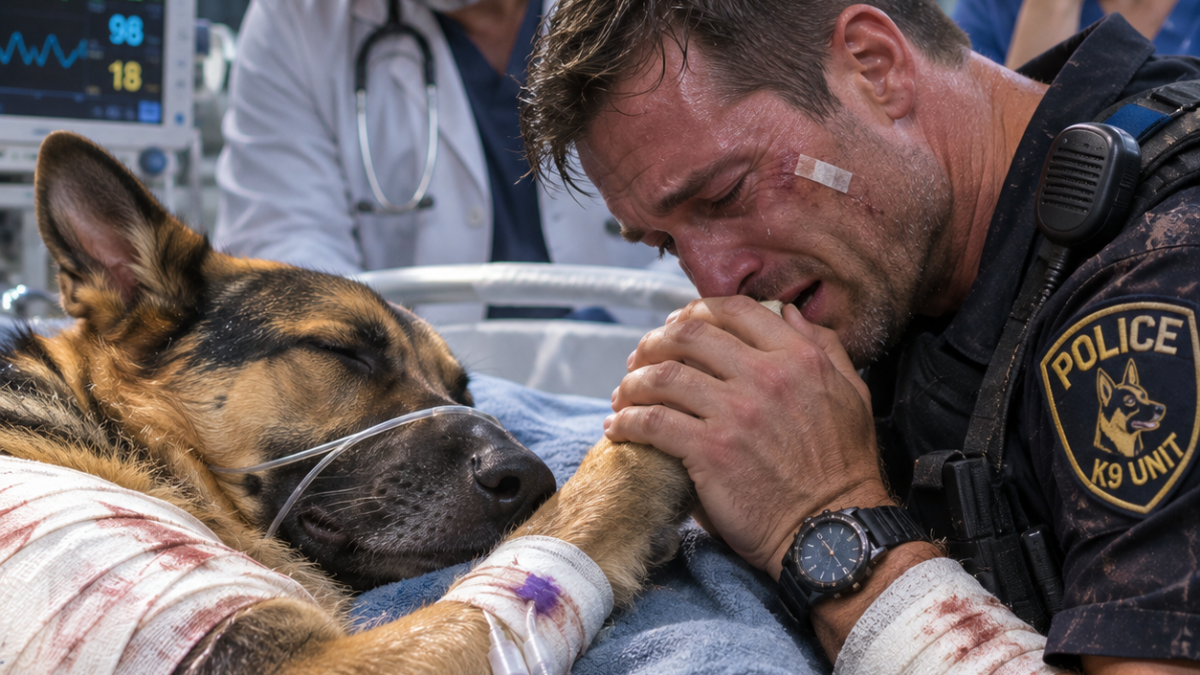
Marcus moved more slowly than I’d ever seen him move.
He had always been the sort of man who seemed incapable of standing still when something needed to be done.
During our years working together, I’d watched him climb stairs two at a time, cross training fields with Axel running beside him, and move through difficult operations with a kind of controlled urgency that made everyone around him feel steadier.
Now every step looked painful.
He kept one hand close to his injured side.
His shoulders were tense.
His face had gone pale beneath the harsh clinical lighting.
Yet he didn’t take his eyes off Axel.
Not once.
The veterinary nurse moved a chair closer to the bed.
“Officer Reed, you can sit here.”
Marcus shook his head.
“I need to get closer.”
Dr. Wallace studied him.
“Please be careful.”
Marcus nodded without looking away.
Then he lowered himself beside the padded bed.
I could see how much it cost him.
His jaw tightened.
His breathing became shallow.
A sheen of perspiration appeared on his forehead.
For one frightening moment, I thought he might collapse.
I stepped forward.
“Marcus, let me help.”
He raised one hand.
“I’m okay.”
He wasn’t.
Not entirely.
But he was determined.
And after eleven days of watching my friend suffer through the helplessness of not knowing whether his dog would survive, I understood why he needed this moment.
He finally reached Axel’s side.
Then stopped.
For several seconds, he simply stared.
The dog who’d once moved with extraordinary strength and precision lay motionless beneath a soft blanket.
His once-beautiful gray-brown coat had lost some of its shine.
His ears rested against his head.
His eyes were closed.
And the body that had carried him through years of training, dangerous assignments, and long nights beside his handler seemed impossibly fragile.
Marcus reached toward him.
Then hesitated.
I saw his hand shaking.
“Can I touch him?”
Dr. Wallace nodded.
“Gently. Avoid the injured areas.”
Marcus swallowed.
Then rested his bandaged hand against Axel’s front paw.
For a long moment, nothing happened.
The monitors continued their quiet rhythm.
The nurse stood near the equipment.
Dr. Wallace watched carefully.
And I remained near the doorway, suddenly afraid that the next few minutes might become a memory none of us would ever recover from.
Marcus bent his head.
His forehead nearly touched the edge of Axel’s bed.
Then he whispered two words.
“Hey, partner.”
I closed my eyes.
Because I had heard those words a thousand times.
At the beginning of a shift.
Before training.
When Axel settled beside Marcus’s chair after a long day.
Whenever my friend opened the back of the K9 vehicle and greeted the dog who trusted him more than anyone else in the world.
Hey, partner.
It had always been an ordinary greeting.
Now it sounded like a man begging someone he loved not to disappear.
For a moment, Marcus waited.
Then he touched Axel’s paw again.
“It’s me.”
His voice broke.
“I’m here, buddy.”
Nothing.
He swallowed.
“I’m sorry it took so long.”
A tear fell onto the blanket.
“I tried to get here sooner.”
I looked toward Dr. Wallace.
The veterinarian’s expression had softened.
Marcus leaned a little closer.
“Axel, I need you to hear me.”
His fingers curled gently around the dog’s paw.
“You brought me home.”
The room became completely still.
Then Marcus whispered, “Now let me help bring you home.”
I should tell you about Axel before I tell you what happened next.
Because if all you knew about him was that he took a bullet for a police officer, you might imagine he was simply an extraordinary working dog who responded to danger the way he’d been trained.
He was extraordinary.
But that wasn’t the whole story.
Axel wasn’t merely an animal assigned to Marcus Reed.
He was his partner.
His constant companion.
The one living creature who could recognize a change in Marcus’s mood before most of us noticed anything.
The dog who waited beside the front door when Marcus took off his boots.
The dog who rested his head on Marcus’s knee whenever a difficult day followed him home.
The dog who seemed to understand that the man who cared for him was more than a handler in uniform.
He was family.
And the bond between them had been built long before the gunshot that almost took their lives.
I met Axel when he was still young.
He was a gray-brown working dog with bright, intelligent eyes, a powerful build, and enough energy to exhaust three grown men.
Marcus had just been assigned to work with him.
I remember walking onto the training field and seeing Axel circle excitedly around his new handler.
Marcus stood with his hands on his hips.
“Daniel.”
I smiled.
“What?”
He gestured toward the dog.
“This one is going to test every ounce of patience I’ve got.”
Axel immediately dropped a training toy at Marcus’s feet.
Then sat.
Perfectly.
As though he’d understood every word.
I laughed.
“Looks pretty well behaved to me.”
Marcus stared at him.
“That’s what he wants you to think.”
Axel tilted his head.
I laughed harder.
And Marcus, despite his complaint, reached down and scratched the dog behind his ear.
The gesture was quick.
Almost automatic.
But I noticed how Axel leaned into it.
I also noticed how Marcus smiled.
It was the beginning of something neither of them could have fully understood.
They were learning to trust one another.
And over time, that trust would become the most important thing either carried into the field.
Marcus was not a man who trusted easily.
He was fair.
Dependable.
The sort of officer you’d want beside you when a situation became dangerous.
But he kept much of himself private.
He rarely spoke about what frightened him.
He didn’t complain when he was exhausted.
And when something troubled him, he usually found another task rather than explaining how he felt.
I knew him well enough to recognize the signs.
He would become quieter.
More deliberate.
He’d check equipment that had already been checked.
Clean his desk.
Review reports long after the rest of us had gone home.
Then Axel came into his life, and something changed.
The dog didn’t care whether Marcus was good at talking about feelings.
He didn’t need explanations.
If Marcus sat in silence, Axel sat beside him.
If Marcus became tense, Axel would lift his head.
If Marcus laughed, the dog seemed to become excited simply because his person sounded happy.
I remember one evening when a difficult assignment had left everyone unusually quiet.
Marcus was sitting alone in the common room.
His elbows rested on his knees.
He was staring at the floor.
I approached with two cups of coffee.
“Long day?”
He nodded.
“Yeah.”
I handed him one.
He accepted it.
Then Axel walked over.
Without being called, the dog lowered himself beside Marcus’s chair.
Marcus rested a hand against his head.
For several minutes, nobody spoke.
Then Marcus sighed.
Axel lifted his head and looked at him.
My friend smiled faintly.
“You always know, don’t you?”
The dog pressed his muzzle against Marcus’s knee.
Marcus scratched behind his ears.
I watched the tension begin leaving his shoulders.
That was when I first understood that the relationship was becoming something deeper than professional cooperation.
Axel didn’t simply work with Marcus.
He gave him a place to be quiet without being alone.
And I think Marcus gave Axel something equally important.
A person he could trust completely.
Their first year together was not effortless.
Axel was intelligent, driven, and full of confidence.
Sometimes that confidence made him impatient.
During training, he’d anticipate a command.
Move before Marcus expected him to.
Then glance back with an expression that almost seemed to ask why everyone else was so slow.
Marcus worked patiently with him.
They practiced.
Repeated exercises.
Learned each other’s timing.
There were days when everything seemed to come together beautifully.
And others when Marcus returned from the field shaking his head.
“That dog is going to make me gray before my time.”
I’d look toward Axel.
He would be sitting beside his handler, looking perfectly innocent.
“You sure it’s the dog?” I’d ask.
Marcus would give me a look.
Then Axel would lean against his leg.
And my friend would laugh.
It became a familiar pattern.
Frustration.
Practice.
Improvement.
Then that unmistakable moment when a handler and dog seemed to understand one another without needing an extra word.
Eventually, their partnership became remarkable.
Marcus could recognize a shift in Axel’s attention almost instantly.
A change in his breathing.
The way his ears moved.
A subtle adjustment in his posture.
Axel, in turn, learned Marcus’s signals.
The tone of his voice.
The rhythm of his steps.
The gestures he used when he needed the dog to focus.
They became extraordinarily responsive to one another.
People noticed.
During training, younger officers sometimes stopped to watch them work.
Marcus never made a big show of it.
He’d simply finish the exercise, praise Axel, and begin preparing for the next one.
But I saw the pride in his eyes.
He loved that dog.
Even before he was ready to say it out loud.
One night, after their first year together, our team was waiting in the rain.
The weather was miserable.
Cold water ran down the windshield.
The streets beyond the vehicle were nearly empty.
We had finished a difficult assignment and were waiting for the rest of the team to return.
Marcus sat in the driver’s seat.
Axel rested behind him.
I was nearby, checking something in the equipment compartment.
The waiting seemed endless.
Rain drummed against the roof.
Marcus leaned his head back.
For a while, he simply listened.
Then Axel moved forward as far as his position allowed and rested his head against Marcus’s shoulder.
I looked up.
Marcus turned.
His expression softened immediately.
“Hey, buddy.”
Axel remained there.
His eyes half closed.
Marcus raised one hand and stroked the dog’s cheek.
“You tired, too?”
The rain continued.
The dog made a small sound.
Marcus laughed quietly.
“Yeah. Me too.”
Then he said something I would remember years later.
Something he probably didn’t realize I’d heard.
“We don’t leave each other behind, okay?”
Axel lifted his head.
Marcus looked at him.
“No matter what happens.”
He swallowed.
“We come home together.”
The dog placed his paw against Marcus’s arm.
My friend smiled.
“That’s a deal.”
I went back to my work without interrupting.
At the time, it was simply a tender moment between a tired officer and his dog.
Years later, in a veterinary intensive care unit, those words would become the only ones Marcus could think to say.
Axel loved working.
You could see it in the way he responded when Marcus prepared his equipment.
The moment the dog realized they were going out, his entire body became alert.
His ears lifted.
His eyes focused.
He watched Marcus’s hands.
Sometimes he made a low, impatient sound.
Marcus would look over.
“Easy, partner.”
Axel would sit.
Then stand again when he thought the time had come.
I’d laugh.
“He’s ready.”
Marcus would grin.
“He was ready twenty minutes ago.”
But Axel also knew how to rest.
At home, he was a different dog.
Not careless.
Not untrained.
Still attentive.
But softer.
He liked to lie near the living-room sofa while Marcus read.
He had a favorite blanket.
A particular place beside the kitchen doorway.
And a habit of placing one paw on Marcus’s knee when he wanted attention.
Marcus pretended to find it annoying.
“Axel, I’m trying to eat.”
The paw remained.
“Buddy.”
The dog stared at him.
Marcus sighed.
Then reached down to scratch his head.
I watched this happen so many times that I began teasing him.
“You know he’s trained you, right?”
Marcus would shake his head.
“Not a chance.”
Axel would lean closer.
And Marcus would continue petting him.
I never argued.
The evidence spoke for itself.
There was an old photograph hanging in Marcus’s hallway.
It showed the two of them on their first training day together.
Marcus was kneeling beside Axel.
One hand rested against the dog’s shoulder.
Both were looking toward the camera.
Marcus had told me once that it was his favorite picture.
“Why that one?” I asked.
He considered the question.
Then smiled.
“Because neither of us knew what we were getting into.”
I laughed.
He looked toward Axel.
The dog was lying near the doorway.
Marcus’s expression softened.
“And because that’s where it started.”
I nodded.
Then my friend added quietly, “He’s been with me through some difficult things.”
I looked toward him.
He didn’t elaborate.
He didn’t have to.
I knew.
I’d watched the two of them work through long hours.
Uncertain assignments.
Exhausting training.
Moments when the outcome depended on trusting each other without hesitation.
I’d also seen them return to the station after a hard day.
Marcus tired.
Axel muddy.
Both looking ready to sleep for twelve hours.
But the moment Marcus crouched to check his partner, Axel would move toward him.
Tail wagging.
Eyes bright.
As though nothing in the world mattered more than making sure they were together.
There was one particular afternoon I will never forget.
We’d been working on a training exercise involving several teams.
The weather was hot.
Everyone was tired.
Axel had completed his work well.
Marcus was kneeling beside him, offering water and checking his condition.
I approached.
“Good run.”
Marcus smiled.
“Thanks.”
Axel glanced toward me.
I held out my hand.
He sniffed it.
Then looked back at Marcus.
I laughed.
“Nice to know where I rank.”
Marcus scratched his ears.
“Don’t take it personally.”
I shook my head.
“He’d follow you into anything, wouldn’t he?”
Marcus’s smile faded slightly.
He looked down at the dog.
For a moment, he didn’t answer.
Then he said, “That’s what worries me.”
I frowned.
“What?”
He rested his hand against Axel’s shoulder.
“He trusts me.”
I nodded.
“Of course.”
Marcus looked toward me.
“Completely.”
His voice became serious.
“So I’d better be worthy of it.”
At the time, I admired the statement.
Later, after the shooting, it haunted me.
Because Marcus would spend eleven days blaming himself for the exact trust he had worked so hard to honor.
The operation that changed everything began like many others.
There had been a briefing.
Information to review.
Responsibilities to assign.
Equipment to check.
No one expected the morning to end with two members of our team being rushed for emergency medical treatment.
I won’t pretend I can recreate every detail of the operation.
Some things happened too quickly.
Others belong to official records rather than a personal story.
What I remember most clearly is the moment everything changed.
We were working in a tense situation that required careful coordination.
Marcus and Axel were together.
I was nearby.
There was shouting.
Movement.
A sudden realization that a weapon had become an immediate danger.
Then a gunshot.
One terrible, unmistakable sound.
I remember turning.
I remember seeing Marcus move.
And I remember Axel.
The dog reacted in the instant when the threat became real.
He threw himself into the line of danger between his handler and the shot.
There was no time to call him back.
No opportunity to change what was happening.
One moment, Axel was beside Marcus.
The next, he had been struck.
Marcus went down amid the chaos.
And for a fraction of a second, I saw something on his face I’d never seen before.
Not fear for himself.
Absolute horror.
Because Axel was hurt.
“AXEL!”
Marcus’s voice tore through the noise.
I will remember that sound for the rest of my life.
It wasn’t the voice he used during training.
Wasn’t the calm, controlled tone he used on difficult calls.
It was the voice of a man watching someone he loved collapse.
I moved toward them as the rest of the team responded to the danger.
Axel lay near Marcus.
His body was frighteningly still.
Marcus tried to reach him.
His injured arm faltered.
He struggled.
“Axel!”
I crouched near him.
“Marcus, stay still.”
He looked at me.
His face was pale.
“Daniel, the dog.”
“I see him.”
“Help him.”
His voice cracked.
“Please.”
Medical assistance was being summoned.
The scene was being secured.
People were moving quickly.
Orders were being given.
But Marcus seemed able to focus on only one thing.
Axel.
I remember the dog’s fur beneath my hand.
I remember checking for signs of life and trying not to let my fear show.
I remember someone calling for immediate veterinary assistance.
And I remember Marcus gripping my sleeve.
“Don’t let him die.”
The words nearly destroyed me.
Because I couldn’t promise him that.
Not then.
Not while Axel lay seriously wounded.
Not while Marcus himself needed urgent treatment.
I looked directly at my friend.
“We’re getting him help.”
Marcus’s eyes filled.
“Daniel.”
“I know.”
His grip tightened.
“Please.”
I swallowed.
“We’re doing everything we can.”
The next minutes became a blur of movement.
Marcus was taken for emergency medical care.
Axel was transported for urgent veterinary treatment.
Both were critically injured.
Both needed professionals with the equipment and expertise to give them the best possible chance of survival.
I remember standing between two terrible obligations.
My friend needed help.
His dog needed help.
And neither could wait.
There was no perfect decision.
No way to remain beside both.
I stayed involved as the team coordinated their care and families were notified.
But I remember the helplessness more vividly than the logistics.
I had spent years working beside Marcus.
I trusted him.
I loved Axel.
Yet in that moment, my ability to do anything meaningful felt painfully limited.
I couldn’t undo the gunshot.
Couldn’t take away their injuries.
Couldn’t promise either would survive.
All I could do was make sure the right people had the information they needed and that neither was forgotten amid the emergency.
Then I waited.
Marcus underwent surgery.
I wasn’t allowed into the operating room.
Of course I wasn’t.
But knowing that didn’t make waiting easier.
I sat in the hospital corridor with my elbows on my knees and my phone in my hands.
Every time it rang, my heart jumped.
Every time a door opened, I stood.
The building smelled of disinfectant.
Footsteps echoed along the hallway.
Somewhere nearby, someone laughed at something on a television.
The normal sounds of hospital life felt almost cruel.
How could people still laugh?
How could someone drink coffee?
How could the world continue when my friend and his dog might be dying in separate medical facilities?
I knew the answer.
Life doesn’t stop simply because one person is terrified.
But that night, I resented it.
I stared at the wall.
Then remembered Marcus kneeling beside Axel after a training exercise.
He trusts me completely.
I closed my eyes.
And whispered into the empty hallway, “Come on, both of you.”
When the surgeon finally came to speak with us, I stood so quickly that the chair scraped across the floor.
He explained that Marcus had survived the operation.
My knees nearly buckled.
He was stable enough for continued care.
There would be recovery.
Pain.
Restrictions.
Uncertainty about how quickly he could regain strength.
But he was alive.
I closed my eyes.
For one moment, relief washed through me so completely that I couldn’t speak.
Then I asked the question Marcus would ask as soon as he was able.
“What about his dog?”
The surgeon didn’t know.
He wasn’t responsible for Axel’s care.
I understood that.
But I suddenly felt desperate again.
Because Marcus and Axel had survived the same terrible moment.
And I couldn’t bear the thought of one coming home without the other.
Dr. Wallace called later.
His voice was careful.
Professional.
The sort of voice people use when they know the person listening is trying to find hope in every word.
Axel had undergone emergency treatment.
His injuries were serious.
He was being closely monitored.
The veterinary team was doing everything appropriate to support his condition.
For a moment, I heard only the sound of my own breathing.
Then I asked, “Is he going to make it?”
A pause.
“We’re working to give him that chance.”
I swallowed.
“But you don’t know.”
“No.”
His honesty hurt.
But I was grateful for it.
Dr. Wallace continued explaining Axel’s condition and the need for ongoing intensive care.
I wrote down what I could.
Then asked whether Marcus would be able to visit when he recovered enough.
The veterinarian’s voice softened.
“Of course. When it’s medically safe for both of them.”
I looked toward the hospital corridor.
“Marcus is going to ask.”
“I imagine he will.”
I swallowed.
“He’s going to ask every day.”
Dr. Wallace was quiet.
Then he said gently, “Tell him Axel isn’t alone.”
I closed my eyes.
And wished those words could somehow reach both of them.
When Marcus woke, he didn’t ask about himself.
Not first.
He looked toward me.
His eyes were cloudy with exhaustion.
His lips dry.
He struggled to focus.
Then he whispered, “Axel?”
I moved closer.
“Hey, buddy.”
He tried to lift his head.
Pain crossed his face.
“The dog.”
I gently encouraged him to remain still.
“He’s at the veterinary hospital.”
Marcus stared.
“Alive?”
I nodded.
“Yes.”
His eyes filled immediately.
For a moment, he seemed to stop breathing.
Then he closed his eyes.
A tear ran toward his ear.
“Thank God.”
I swallowed.
“He’s receiving intensive care.”
Marcus opened his eyes again.
“Can I see him?”
“Not yet.”
His expression changed.
I continued quickly.
“You’ve just come out of surgery, Marcus.”
He shook his head.
“Daniel—”
“You need to recover enough for a safe visit.”
His face crumpled.
“He doesn’t know.”
I leaned forward.
“What?”
“He doesn’t know where I am.”
My throat tightened.
“He knows you love him.”
Marcus looked away.
Then whispered, “He needs me.”
I sat beside him.
For a long time, neither of us spoke.
Finally, I said, “Then get strong enough to go see him.”
Marcus looked toward me.
I continued.
“Follow the doctors’ instructions. Let yourself recover.”
His eyes filled.
“And when they clear you to visit, I’ll take you myself.”
He closed his eyes.
Then nodded.
That became the promise that carried him through the next eleven days.
The first night after Marcus regained consciousness, he asked about Axel six times.
I counted.
Not because I was annoyed.
Because every question broke my heart a little more.
“Did they call?”
“Not since the last update.”
“Is he breathing on his own?”
“They’re monitoring him closely.”
“Has he opened his eyes?”
“Not yet.”
“Did Wallace say anything else?”
“No new changes.”
“Can somebody tell him I’m alive?”
That last question almost undid me.
I sat beside the bed.
Marcus looked at me with the exhausted expression of a man trying to carry guilt and physical pain at the same time.
“Daniel.”
I leaned closer.
“Yeah?”
“Can somebody talk to him?”
I swallowed.
“Of course.”
He looked toward the ceiling.
“Tell him I’m coming.”
A tear rolled down his cheek.
“Tell him I didn’t leave.”
I nodded.
“I’ll make sure they know.”
And when I spoke with the veterinary team, I told them.
Not because I believed a message could replace medical treatment.
Not because I expected words to perform a miracle.
But because Marcus needed to know someone was remembering the relationship that existed beyond the monitors and the injury.
The staff understood.
They cared for Axel as a critically injured patient.
And they also knew he was a working dog whose closest companion was recovering in another hospital.
Both things mattered.
The second day brought no dramatic change.
Marcus was more alert.
His doctors continued managing his recovery.
He began asking questions about the injuries he’d suffered and what he would need to do before leaving the hospital.
But every conversation eventually returned to Axel.
He wanted to know whether the dog was eating.
Whether he was comfortable.
Whether anyone had noticed movement.
Whether his breathing had improved.
Whether the veterinary staff thought he recognized familiar voices.
Sometimes I had answers.
Often, I didn’t.
The uncertainty exhausted us both.
Marcus would listen to the update, nod, and stare toward the window.
Then, a few minutes later, he’d ask again.
I never told him to stop.
I understood.
He was trapped in a hospital bed while the partner who had saved him lay critically injured somewhere he couldn’t reach.
There was no amount of reassurance that could make that helplessness disappear.
On the third day, I brought him a photograph.
It was one of my favorites.
Marcus was standing beside his vehicle.
Axel sat close to his leg.
The dog’s ears were upright.
His eyes were fixed on the camera.
Marcus was laughing.
Not smiling politely.
Laughing.
His face was open.
Relaxed.
Full of the kind of happiness I’d rarely seen before Axel entered his life.
When I placed the photograph on the bedside table, Marcus stared.
Then picked it up carefully.
For a long time, he said nothing.
Finally, he whispered, “He hated that camera.”
I smiled.
“He looks pretty good in the picture.”
Marcus gave a tiny laugh.
“He wanted to work.”
I looked toward him.
“We’d just finished training,” he explained.
I nodded.
“I remember.”
“He kept watching my hands because he thought I had his toy.”
I laughed softly.
Marcus touched the edge of the photograph.
Then his smile disappeared.
“Daniel.”
“Yeah?”
“What if he doesn’t come back?”
The question was so quiet I almost pretended not to hear it.
I didn’t want to answer.
I wanted to reassure him.
Tell him Axel was strong.
Tell him we’d seen dogs survive terrible injuries.
Tell him their bond was too powerful for anything to separate them.
But I couldn’t promise what I didn’t know.
I pulled a chair closer.
“I don’t know what’s going to happen.”
Marcus lowered his head.
I continued.
“I wish I did.”
His eyes filled.
“But I know he’s receiving care, and I know we haven’t stopped trying.”
Marcus stared at the photograph.
Then whispered, “I should’ve been able to protect him.”
I took a slow breath.
“Marcus, he protected you during something neither of you could control.”
He shook his head.
“I was responsible for him.”
“Yes.”
My voice softened.
“And you still are.”
He looked toward me.
I continued.
“Right now, being responsible means recovering, staying informed, and being ready to support him if he gets through this.”
Marcus’s lips trembled.
“What if he doesn’t?”
I swallowed.
“Then you’ll know he wasn’t abandoned.”
For a long moment, neither of us spoke.
Then Marcus bowed his head over the photograph and cried.
I’d seen my friend injured before.
I’d seen him exhausted after long assignments.
I’d seen him furious when an operation went badly.
But I’d never seen him grieve someone who was still alive.
That’s what those eleven days felt like.
A strange, suspended grief.
Axel hadn’t died.
But he wasn’t recovering the way we hoped.
Marcus couldn’t celebrate his survival without fearing what the next call might bring.
He couldn’t mourn because there was still hope.
He couldn’t fully rest because his mind was always somewhere else.
And I couldn’t find a way to help that felt sufficient.
I brought coffee.
Read updates.
Kept track of messages.
Sat beside him when he didn’t want to talk.
Sometimes I made terrible jokes.
Most of them failed.
Occasionally one made him smile.
Those small moments meant more to me than I knew how to explain.
Because every time he smiled, I remembered that the man sitting in the hospital bed was still Marcus.
Not only an injured officer.
Not only Axel’s frightened handler.
My friend.
The man who’d helped me through difficult years of my own.
The man who’d stood beside me when work became overwhelming.
The man who always seemed to have enough strength for someone else.
Now he needed people to be strong for him.
And I intended to stay.
On the fourth day, Dr. Wallace gave us another update.
Axel remained seriously ill.
His veterinary team continued monitoring his vital signs and providing supportive treatment.
There had been no sustained improvement in his responsiveness.
The news wasn’t unexpected.
But Marcus looked devastated.
He turned toward the wall.
For a long time, he refused to speak.
I sat beside him.
Eventually, I heard him whisper, “He used to wait for me.”
I looked up.
Marcus stared at the wall.
“When I came home late, he’d hear the truck before I reached the driveway.”
I nodded.
“I remember.”
“He’d be at the door.”
His voice broke.
“Every time.”
I swallowed.
Marcus continued.
“Didn’t matter if we’d had a terrible day. Didn’t matter if I was tired or angry or hadn’t eaten.”
He closed his eyes.
“He was always happy I was home.”
A tear rolled down his cheek.
“Now he’s somewhere waiting for me, and I can’t get to him.”
I felt the familiar ache return.
I wanted to say Axel wasn’t necessarily waiting in any way we could know.
I wanted to say that his lack of responsiveness was a medical condition, not evidence of loneliness.
But I understood what Marcus meant.
He wasn’t trying to explain a veterinary problem.
He was expressing the unbearable distance between himself and someone he loved.
So I said, “We’re going to get you there as soon as your doctors say it’s safe.”
He turned toward me.
“You promise?”
I nodded.
“I promise.”
The fifth day was the first time Marcus asked me to bring his phone instead of simply telling him the updates.
He wanted to see the photographs again.
Videos.
Training clips.
Anything that showed Axel moving.
He scrolled through them slowly.
Sometimes he smiled.
Sometimes he laughed.
Then the laughter would disappear.
He’d stare at the screen with wet eyes.
I watched from the chair.
At one point, he played a short video from a training day.
Axel ran across the field toward him.
Focused.
Energetic.
Perfectly sure of where he needed to go.
When the dog reached Marcus, he sat beside his leg and looked up.
In the video, Marcus laughed.
“Good boy.”
Then the recording ended.
My friend played it again.
And again.
Finally, he turned the phone facedown.
His hands trembled.
“I keep watching him run.”
I looked toward him.
He swallowed.
“And all I can think is that I might never see him do that again.”
For a moment, I couldn’t answer.
Then I reached toward the phone.
“Do you want me to put it away?”
Marcus shook his head.
“No.”
He picked it up again.
His eyes filled.
“I don’t want to forget what he looks like when he’s happy.”
I leaned back.
And stayed with him while he watched.
The sixth day brought a small improvement in Marcus’s physical condition.
He could sit up more comfortably.
Move short distances with assistance.
Participate more actively in the recovery plan his medical team had established.
The doctors were cautious.
He was still injured.
Still weak.
But his body was beginning to heal.
I should have felt relieved.
And I did.
Partly.
But the contrast became painful.
Marcus was making progress.
Axel remained critically weak.
Every time someone congratulated Marcus on improving, I saw him glance toward the photograph of his partner.
As though recovery had become something he felt guilty about.
A nurse came into his room that afternoon.
She smiled.
“Officer Reed, you’ve made good progress today.”
Marcus nodded politely.
“Thank you.”
She checked his chart.
Then left.
I looked toward him.
“You did well.”
He stared at the blanket.
I waited.
Then he whispered, “It doesn’t feel right.”
“What doesn’t?”
“Getting better.”
My chest tightened.
Marcus looked toward Axel’s photograph.
“What good is it if he doesn’t?”
I moved closer.
“Marcus.”
He shook his head.
“I know what you’re going to say.”
“Then listen anyway.”
He looked at me.
“Axel saved your life.”
His eyes filled.
“And he fought to do it.”
I paused.
“Don’t turn your own recovery into something you should feel ashamed of.”
Marcus lowered his head.
“I’m trying.”
I nodded.
“I know.”
Then I added gently, “If he were standing beside this bed right now, do you think he’d want you to stop getting better?”
Marcus looked at the photograph.
For a long moment, he said nothing.
Then he whispered, “No.”
I squeezed his shoulder.
“Neither do I.”
On the seventh day, Marcus asked whether Dr. Wallace would take a recording of his voice to Axel.
The idea came after a restless night.
Marcus had barely slept.
When I arrived, he was staring at the ceiling.
“Daniel.”
I set down my jacket.
“Morning.”
“Can you ask Wallace something?”
“Sure.”
He swallowed.
“Would it be okay if I sent Axel a message?”
I looked toward him.
“A message?”
“My voice.”
He hesitated.
“Just so he can hear me.”
I sat beside him.
For a moment, I thought about the uncertainty of whether Axel could meaningfully process any recording while he remained so unresponsive.
I knew it wasn’t a treatment.
Marcus knew it, too.
But I could see how much the idea mattered.
“I can ask.”
He nodded.
“Please.”
We discussed it with the veterinary team.
They explained that the priority remained Axel’s medical care and that any familiar sound would need to be appropriate to his condition and the clinical environment.
Marcus understood.
He didn’t demand special treatment.
He simply recorded a short message in case it could be played safely.
I was there when he did it.
He held the phone in his good hand.
Looked toward Axel’s photograph.
Then began.
“Hey, buddy.”
His voice broke immediately.
He stopped.
Closed his eyes.
Tried again.
“Hey, partner.”
A long pause.
“It’s me.”
He swallowed.
“I know I haven’t been there.”
Tears filled his eyes.
“But I’m coming.”
His voice trembled.
“Just keep fighting, okay?”
He looked down.
“I’m doing the same.”
Then he whispered, “We still have to go home together.”
The recording ended.
Marcus stared at the screen.
For a moment, he seemed unable to breathe.
Then he handed me the phone.
“That’s all I can say.”
I nodded.
And somehow managed not to cry until I reached the hallway.
The eighth day was one of the hardest.
Marcus had expected news.
Not because anyone promised improvement.
But because hope sometimes invents deadlines the body has never agreed to meet.
He had begun telling himself that after a week, something would change.
A movement.
A sound.
Any indication that Axel was becoming more responsive.
But the update remained cautious.
No meaningful change.
Marcus listened.
Thanked the person who called.
Then put down the phone.
For a long moment, he sat still.
Finally, he turned toward me.
“Daniel.”
I looked up.
“Yeah?”
“I need you to tell me the truth.”
My stomach tightened.
“About what?”
He swallowed.
“Are they keeping him alive because they think there’s a chance?”
I took a breath.
“The veterinary team is continuing treatment because they’re assessing his condition and believe ongoing care is appropriate right now.”
Marcus stared.
“And if that changes?”
I felt my throat tighten.
“Then they’ll talk to us.”
His eyes filled.
He nodded slowly.
For a moment, I thought he would ask another question.
Instead, he looked toward the photograph.
Then whispered, “I don’t know how to lose him.”
The words were almost soundless.
I moved beside the bed.
Marcus covered his face.
His shoulders began shaking.
I rested one hand on his back.
He didn’t try to hide the tears.
Didn’t apologize.
He simply cried.
And I stayed until he was ready to speak again.
That evening, I drove home through the cold.
The streets were wet from an earlier rain.
Headlights reflected off the pavement.
I turned on the radio.
Then turned it off again.
I couldn’t stand hearing people discuss ordinary problems while Marcus lay in a hospital worrying about Axel.
When I reached my driveway, I sat in the car without moving.
For a while, I stared at the steering wheel.
Then I remembered the training field.
Axel running toward Marcus.
The dog looking up at his handler.
The way Marcus would always crouch to praise him after an exercise.
I thought about what would happen if Axel died.
Not the official ceremony.
Not the memorial photographs.
Not the words people would say about courage and sacrifice.
I thought about Marcus opening his front door and not hearing paws on the floor.
About coming home after work and finding an empty space beside the sofa.
About waking in the morning and reaching toward the place where Axel used to sleep.
Those were the losses I couldn’t bear to imagine.
The quiet ones.
The moments when grief stops being an event and becomes part of every ordinary day.
I covered my face.
And cried.
By the ninth day, Marcus was desperate to leave the hospital.
He asked his doctors repeatedly when he might be able to visit Axel.
He was cooperative with treatment.
He attended to his recovery.
But every conversation returned to the same goal.
“When can I go?”
The medical team explained what they needed to see before approving a visit.
He listened.
Asked questions.
Worked within his restrictions.
Then asked again the following morning.
I understood his impatience.
But I was also frightened for him.
He was still recovering from a serious injury.
The last thing either of them needed was for Marcus to endanger himself trying to reach the clinic too soon.
I told him that.
He looked at me.
For a moment, he seemed angry.
Then his expression crumpled.
“I know.”
His voice broke.
“I’m just scared he’s running out of time.”
I swallowed.
“So am I.”
He looked surprised.
I rarely admitted it.
Not because I wanted to deceive him.
Because I’d been trying so hard to remain steady.
But that morning, I couldn’t pretend.
I sat beside him.
And said quietly, “Marcus, I’m terrified.”
He looked down.
I continued.
“I love that dog, too.”
His eyes filled.
“I know.”
“And I don’t want to lose him.”
For a moment, neither of us spoke.
Then Marcus reached toward me.
I took his hand.
We sat there quietly.
Two grown men.
One injured.
Both frightened.
Waiting for news about a dog who had become family.
On the tenth day, Marcus’s doctors agreed he was approaching the point where a carefully planned visit might be possible.
He remained weak.
His movements were limited.
But his condition had improved enough for the team to discuss the logistics.
I remember telling him.
He stared at me.
“Really?”
I nodded.
“They’re looking at whether you can go with the appropriate precautions.”
His eyes filled.
“When?”
“We’re still waiting for the final clearance.”
He looked toward the window.
For a moment, his expression became almost hopeful.
Then fear returned.
“Daniel.”
“Yeah?”
“What if I get there and he’s gone?”
I couldn’t answer immediately.
He swallowed.
“What if he doesn’t make it until morning?”
I moved closer.
“We’re staying in contact with the clinic.”
His eyes filled.
“I know.”
I took a breath.
“And if anything changes, they’ll tell us.”
Marcus nodded.
But he didn’t look reassured.
Because no reassurance could shorten the distance between his hospital bed and Axel’s veterinary unit.
Only time could do that.
And time had become the thing he feared most.
That night, Marcus barely slept.
Neither did I.
I stayed near my phone.
Every vibration made my heart jump.
I checked the time.
Watched the hours pass.
Tried to read.
Couldn’t focus.
At one point, I opened a photograph of Axel on my phone.
He was standing in a field beside Marcus.
His mouth slightly open.
His ears upright.
The expression on his face seemed almost joyful.
I stared at it.
Then whispered, “Hang on, boy.”
My throat tightened.
“Just one more morning.”
I set the phone down.
Then sat in the dark.
Waiting.
On the eleventh morning, the call finally came.
Marcus had been cleared for a carefully supervised trip to the veterinary clinic.
The arrangements were confirmed.
Dr. Wallace knew he was coming.
And I had promised to drive.
When I entered Marcus’s hospital room, he was already dressed.
His face pale.
His hands shaking.
The little photograph of Axel resting beside the bed.
He looked toward me.
And I understood that he had been preparing for this moment all night.
That’s where the morning I’d been describing began.
The drive.
The quiet clinic.
Dr. Wallace’s cautious warning.
Marcus walking toward the intensive care unit with more determination than his body could comfortably support.
Now we were there.
Eleven days after a gunshot tore their lives apart.
Marcus had finally reached Axel.
And for the first time since the operation, he could speak to his partner without a telephone, a photograph, or a recording standing between them.
I stood near the doorway.
Dr. Wallace remained beside the monitors.
The nurse watched carefully.
Marcus knelt beside Axel.
His bandaged hand rested against the dog’s paw.
The room was so quiet that every breath seemed enormous.
“Axel.”
My friend’s voice was barely audible.
“Buddy, it’s Marcus.”
Nothing happened.
The dog remained still.
Marcus swallowed.
“I know it’s been a long time.”
He looked toward Axel’s face.
“I’m sorry.”
A tear fell.
“I tried to get here.”
He gently touched the dog’s paw.
“But they wouldn’t let me leave until I was strong enough.”
His voice broke.
“I know you don’t understand hospital rules.”
I almost smiled through my tears.
Marcus lowered his head.
“You never liked waiting.”
For a moment, his expression softened.
Then he whispered, “Remember how you’d sit by the door every time you thought we were going to work?”
I closed my eyes.
I remembered.
Axel’s upright ears.
His eager little movements.
The way he’d look at Marcus as if the entire world were waiting to begin.
Marcus continued.
“You’d watch me put on my boots.”
His voice shook.
“And if I took too long, you’d start making that noise.”
He gave a tiny, broken laugh.
“You remember that?”
The monitors continued.
Axel didn’t move.
Dr. Wallace glanced toward the nurse.
Marcus didn’t seem to notice.
He was looking only at his dog.
Only at the face he’d been terrified he’d never see again.
“Remember the rain, buddy?”
Marcus’s voice changed.
Became softer.
Almost intimate.
I felt my stomach tighten.
Because I knew which rain he meant.
The night in the vehicle.
Their first year together.
The promise I’d heard without realizing how much it would matter.
Marcus gently rubbed Axel’s paw.
“We were waiting for the team.”
A pause.
“You were tired.”
His voice broke.
“I was tired.”
He swallowed.
“Then you came up behind my shoulder and put your head right here.”
Marcus touched the side of his neck.
For a moment, he couldn’t continue.
Then he whispered, “I told you we wouldn’t leave each other.”
Tears filled my eyes.
“No matter what happened.”
Marcus bent closer.
“Remember?”
The room remained quiet.
He looked down at Axel’s paw.
“You kept your promise.”
His voice cracked.
“You brought me home.”
I saw his shoulders begin shaking.
Marcus closed his eyes.
“But I haven’t kept mine yet.”
A tear slipped from his face onto the blanket.
He swallowed.
“So I’m here now.”
He gently held Axel’s paw.
“I’m right here.”
Then he spoke the words I will never forget.
“I won’t leave you behind, Axel. Not while there’s still a chance for us to go home together.”
For a moment, nothing happened.
The monitors continued their steady sounds.
Dr. Wallace remained beside the bed.
I stood near the doorway with my hands trembling.
Marcus leaned forward.
His forehead nearly touched Axel’s.
Then he whispered, “Come on, partner.”
And Axel’s ear moved.
It was such a small movement that I almost missed it.
A faint twitch.
No more than a slight change in the position of Axel’s ear.
But I’d been staring at him for so long that even the smallest movement seemed enormous.
I took a step forward.
Then stopped.
Had I imagined it?
I looked toward Dr. Wallace.
He was watching the dog.
His expression had changed.
The nurse leaned closer to the monitors.
Marcus remained beside the bed, unaware that anything unusual had happened.
He was still speaking softly.
“It’s okay, buddy.”
His voice trembled.
“You don’t have to be strong for me right now.”
He gently touched the dog’s paw.
“You’ve already done more than anybody could ask.”
I watched Axel.
There it was again.
A subtle movement of his ear.
Not large.
Not dramatic.
But real enough that Dr. Wallace stepped closer.
“Officer Reed.”
Marcus looked up sharply.
“What?”
The veterinarian raised a hand.
“Keep talking.”
My heart began pounding.
Marcus stared at him.
Then looked back at Axel.
“Buddy?”
The dog’s ear moved again.
The nurse whispered something to Dr. Wallace.
He checked the monitors.
His expression became intensely focused.
Some of the readings were changing.
Not in a way anyone could interpret as recovery by itself.
But enough that the veterinarian was paying close attention.
Marcus leaned toward Axel.
“Hey.”
His voice broke.
“Hey, partner.”
I stopped breathing.
The dog’s eyelids moved.
Only slightly.
A faint flutter.
For a moment, nobody spoke.
Then Marcus whispered, “Axel?”
The eyelids moved again.
Dr. Wallace leaned closer.
I watched my friend’s face.
He looked terrified.
Hopeful.
Almost afraid to believe what he was seeing.
“Come on, buddy.”
His hand trembled.
“Look at me.”
And slowly, Axel opened his eyes.
There are moments in life that remain clear no matter how many years pass.
You might forget what you wore.
Or what the weather was like.
Or exactly how somebody stood.
But you remember the feeling.
I will always remember Axel opening his eyes.
Because in that instant, the entire room seemed to change.
Nothing around us disappeared.
The monitors were still there.
The tubing.
The medical equipment.
The serious injuries.
The uncertainty.
All of it remained.
But Axel’s eyes were open.
And they were directed toward Marcus.
My friend froze.
For one heartbeat, he didn’t seem able to speak.
Then his face crumpled.
“Oh, buddy.”
His voice sounded almost unrecognizable.
“Axel.”
The dog blinked slowly.
His gaze remained near Marcus’s face.
I looked toward Dr. Wallace.
The veterinarian was checking Axel’s response carefully, making sure that what we were witnessing was more than a fleeting reflex.
He spoke quietly to the nurse.
She moved toward the equipment.
Marcus didn’t interrupt.
He kept his hand resting gently against Axel’s paw.
Then he whispered, “It’s me.”
His eyes filled.
“It’s really me.”
Axel’s eyes remained open.
For a moment, the dog seemed too weak to do anything more.
Marcus looked toward the veterinarian.
“Can he hear me?”
Dr. Wallace answered carefully.
“He’s showing a response to stimulation, and we’re assessing it.”
Marcus nodded.
He looked back at his dog.
Then said something so tender that I had to turn away for a second.
“You don’t have to do anything else.”
His voice broke.
“Just stay with me.”
The next movement was even smaller.
Axel’s tail shifted.
At first, I thought it was an involuntary change in position.
Then it moved again.
A faint, unmistakable motion.
Marcus saw it.
His lips parted.
For a moment, he couldn’t breathe.
Then he whispered, “Did you see that?”
I nodded.
My eyes were full of tears.
“Yes.”
He looked toward Dr. Wallace.
“Did you?”
The veterinarian’s expression softened.
“Yes.”
Marcus let out a sound that was half laugh, half sob.
Axel’s tail moved again.
Weakly.
Slowly.
But unmistakably.
The same tail that had moved whenever Marcus returned to the room.
Whenever his handler approached with a favorite toy.
Whenever he heard the familiar voice that meant work, praise, food, rest, and home.
Marcus bent his head.
His forehead rested gently near Axel’s.
Then he began crying.
I had never seen him cry like that.
Not even during the first terrible days after the shooting.
His whole body shook.
His bandaged hand remained around Axel’s paw.
And through the tears, he kept whispering:
“Good boy.”
Again.
“Good boy.”
Then, almost inaudibly:
“You heard me.”
I covered my mouth.
Because I couldn’t trust myself to make a sound.
Dr. Wallace remained focused on his patient.
He asked Marcus to keep his movements gentle while the team checked Axel’s condition.
The dog’s response was encouraging.
But there were still serious medical concerns.
Arousal and recognition were important observations.
They didn’t mean his injuries had disappeared.
They didn’t guarantee a full recovery.
They didn’t replace the treatment he’d received during the preceding eleven days.
Marcus understood.
Even through the overwhelming emotion, he listened.
When Dr. Wallace asked him to give the staff a little room, he nodded.
Then gently released Axel’s paw.
The dog remained awake for a short time.
His eyes followed movement near the bed.
Marcus watched from the chair the nurse had positioned beside him.
I helped him sit.
His face was still pale.
He was trembling with exhaustion.
But his eyes were different.
For eleven days, they’d been filled with the hopelessness of waiting.
Now there was something else.
A fragile, almost frightened hope.
He looked toward me.
“Daniel.”
I sat beside him.
“Yeah?”
He swallowed.
“Tell me I didn’t imagine that.”
I shook my head.
“You didn’t.”
His lips trembled.
“His tail?”
I nodded.
“I saw it.”
“And his eyes?”
“I saw those, too.”
Marcus covered his face.
For a moment, he seemed unable to speak.
Then he whispered, “Thank God.”
I rested one hand on his shoulder.
And finally allowed myself to cry.
The nurse approached us a few minutes later.
Her eyes were bright.
She had clearly been affected by what happened, though she remained professional.
“Officer Reed,” she said softly, “we need to continue examining him.”
Marcus nodded.
“Of course.”
She looked toward Axel.
Then back at him.
“We’re encouraged by this response.”
For a moment, Marcus simply stared.
Then he whispered, “Thank you.”
His voice broke.
“Thank you for keeping him alive.”
The nurse’s expression changed.
She looked down briefly.
Then said, “He’s had a very dedicated team.”
Marcus nodded.
“I know.”
He looked toward Dr. Wallace.
“I don’t know how to thank you.”
The veterinarian came closer.
He looked tired.
There were dark circles beneath his eyes.
He had clearly spent many difficult hours trying to help Axel recover.
“Officer Reed,” he said, “we still have a long way to go.”
Marcus nodded immediately.
“I understand.”
Dr. Wallace continued.
“His response today is meaningful, but we’ll need to monitor whether it continues and what his functional recovery looks like.”
Marcus looked toward Axel.
“I’ll do whatever he needs.”
The veterinarian smiled faintly.
“I believe you.”
For a moment, neither man spoke.
Then Marcus added quietly, “I know he didn’t wake up because I found some magic words.”
Dr. Wallace nodded.
Marcus’s eyes filled.
“I know you’ve been treating him for eleven days.”
He swallowed.
“But I’m glad I got here in time to see him open his eyes.”
The veterinarian’s expression softened.
“So am I.”
Eventually, we had to leave.
Marcus was exhausted.
The trip had demanded more strength than he wanted to admit.
He’d spent a long time kneeling, speaking, crying, and sitting beside Axel while the veterinary staff assessed the dog’s condition.
His doctors had cleared him for a limited visit, not an entire day away from his own recovery.
I could see the fatigue settling over him.
His shoulders had begun slumping.
His injured arm rested carefully against his body.
His face looked pale.
I leaned closer.
“Marcus.”
He knew what I was going to say.
“No.”
I sighed.
“You need to rest.”
He looked toward Axel.
“I just got here.”
“I know.”
His voice broke.
“Daniel, he finally opened his eyes.”
I swallowed.
“I know.”
For a moment, he looked like a frightened child.
“What if he closes them again?”
That question nearly destroyed me.
I crouched beside him.
“Marcus, the veterinary team needs to keep caring for him.”
He looked down.
“And you need to keep healing.”
His lips trembled.
I continued.
“Today was an important day. But this isn’t the end of either of your recoveries.”
He looked toward Axel.
For a long moment, he said nothing.
Then he nodded.
Slowly.
Painfully.
“All right.”
I helped him stand.
Before leaving, he approached the bed one more time.
Dr. Wallace gave him room.
Marcus rested his fingers gently against Axel’s paw.
“Hey, partner.”
The dog’s eyes were partly closed.
He looked exhausted.
But his ear moved slightly.
Marcus smiled through tears.
“I’ve got to go rest.”
His voice broke.
“Doctor’s orders.”
He gave a tiny laugh.
“Believe me, I’m not happy about it either.”
I smiled despite the tears running down my face.
Marcus continued.
“But I’ll come back.”
His expression grew serious.
“I promise.”
Then he leaned closer.
“We’re still doing this together.”
He gently released Axel’s paw.
Turned toward me.
And let me help him out of the room.
On the drive back to the hospital, Marcus barely spoke.
He sat in the passenger seat with his head resting against the window.
The morning sunlight moved across his face.
He looked exhausted.
But every few minutes, I saw the corners of his mouth lift.
A tiny smile.
As though he was replaying the same moment.
Again.
And again.
Finally, he whispered, “Daniel.”
I glanced toward him.
“Yeah?”
“His tail.”
I smiled.
“I know.”
He turned toward me.
“It moved.”
My throat tightened.
“Yes.”
He looked out the window.
For a moment, he was quiet.
Then he whispered, “He knew I was there.”
I kept my eyes on the road.
What exactly Axel had understood was something I couldn’t know with certainty.
But he’d responded while Marcus was close to him.
And that meant something deeply important to both of them.
I nodded.
“He responded to you.”
Marcus smiled.
A tear slipped down his cheek.
Then he closed his eyes.
For the first time since the shooting, he looked as though he might actually rest.
When we reached the hospital, Marcus insisted on telling the nurse himself.
She entered the room to check on him.
He looked up immediately.
“Axel opened his eyes.”
Her expression brightened.
“Did he?”
Marcus nodded.
“And he moved his tail.”
The nurse smiled.
“That’s wonderful.”
He looked toward me.
Then back at her.
“He looked right at me.”
His voice broke.
For a moment, the nurse seemed emotional, too.
She touched the bed rail.
“I’m very glad you got to see him.”
Marcus nodded.
Then, almost shyly, asked, “Could I have my phone?”
I handed it over.
He opened the photograph of Axel.
Looked at it.
Then placed the phone beside him.
For a long time, he simply rested.
Every so often, he’d look toward the picture again.
And smile.
The following morning, Dr. Wallace called with another update.
I was with Marcus when the phone rang.
My friend sat straighter immediately.
His expression became tense.
“Daniel.”
I answered.
Listened.
Then looked toward Marcus.
The veterinarian reported that Axel had continued showing signs of responsiveness.
The team was encouraged, although his condition remained serious and the next steps would require careful monitoring.
I repeated the update.
Marcus closed his eyes.
His shoulders lowered.
For a moment, he seemed overwhelmed.
Then he asked, “Can I talk to Wallace?”
I handed him the phone.
“Doctor?”
His voice was shaky.
He listened.
Nodded.
Asked questions.
Then said something that made my eyes fill.
“Please don’t rush him.”
A pause.
“I know he’s been through a lot.”
He swallowed.
“Just help him get strong.”
Another pause.
Then he whispered, “I’ll be patient.”
I looked toward my friend.
The man who’d spent eleven days desperate to see his dog.
Now promising to give Axel as much time as he needed.
That was when I understood the next part of their journey would require a different kind of courage.
Not the instant reaction that had saved Marcus’s life.
The quieter courage of recovery.
Of uncertainty.
Of taking one difficult day at a time.
Marcus’s rehabilitation continued.
At first, his progress was slow.
He needed rest.
Careful movement.
Medical follow-up.
He couldn’t simply stand up and return to work.
His injuries demanded patience.
Something he’d never been particularly good at.
I reminded him of that whenever he became frustrated.
He’d glare at me.
I’d grin.
Then he’d shake his head.
But underneath the humor, I could see how hard it was for him.
He was accustomed to being useful.
Active.
Capable.
Now there were things he couldn’t do without help.
Some mornings, he woke feeling stronger.
Other mornings, pain and fatigue made even routine movements difficult.
He had to accept assistance.
Follow restrictions.
And resist the temptation to push ahead too quickly.
Axel, meanwhile, was recovering through a different but equally demanding process.
His veterinary team continued monitoring the effects of his injuries.
His strength returned gradually.
His responsiveness improved.
But he was far from the energetic working dog we’d known before the shooting.
There were days when he seemed bright.
Others when he tired quickly.
His movement had to be managed carefully.
His comfort remained a priority.
And nobody could promise exactly how much function he would regain.
They were both alive.
Both improving.
And both learning that survival was only the beginning.
The first time Marcus saw Axel after the initial awakening, he approached the bed with cautious hope.
He was still weak.
Still needed help.
But his face looked better than it had on the eleventh day.
Dr. Wallace met us near the clinic entrance.
“Officer Reed.”
Marcus immediately asked, “How is he?”
The veterinarian smiled slightly.
“He’s making progress.”
Marcus stopped.
For a moment, those words seemed almost too good for him to accept.
Then he nodded.
“Can I see him?”
“Of course.”
We followed him inside.
Axel was resting on his padded bed.
His eyes were open.
When Marcus entered, the dog’s ears moved.
Then his tail gave a faint wag.
Marcus stopped in the doorway.
His lips trembled.
“Hey, buddy.”
Axel looked toward him.
For a moment, neither moved.
Then Marcus approached.
He sat beside the bed.
Rested his hand near Axel’s paw.
And smiled through tears.
“You remember me.”
The dog moved his head slightly toward Marcus’s hand.
My friend laughed.
A soft, broken sound.
“There you are.”
He gently stroked Axel’s cheek.
“There’s my boy.”
I stood near the doorway.
And felt the ache in my chest begin changing into something almost unfamiliar.
Relief.
Not complete.
Not certain.
But real.
Their visits became something everyone looked forward to.
Whenever Marcus’s medical condition permitted, he returned to the clinic.
Sometimes he could remain only a short time.
Other visits lasted a little longer.
He’d sit beside Axel.
Talk to him.
Tell him about ordinary things.
The weather.
The people at the station.
The old training field.
The dog food he would be eating when he was ready.
Sometimes he’d bring a familiar item if the veterinary team approved.
Other times, he simply came with his voice and his hand.
The visits weren’t a replacement for treatment.
But they became part of the emotional rhythm of recovery for Marcus.
Something to anticipate.
Something to work toward.
Something that reminded him he wasn’t healing alone.
I watched him change.
At first, every visit was filled with fear.
He’d watch Axel’s breathing.
Search his expression.
Ask the staff whether each movement was normal.
Gradually, Marcus became more comfortable accepting the uncertainty.
He learned to recognize the small improvements.
A steadier gaze.
Greater alertness.
A little more movement.
Longer periods of comfortable rest.
He celebrated them without demanding they become something larger immediately.
And that patience was one of the most beautiful things I’d ever seen in him.
There were setbacks.
Of course there were.
Recovery rarely follows the neat path people imagine when they hear that someone has survived.
There were days when Marcus felt physically stronger but emotionally exhausted.
Days when Axel seemed tired and the staff adjusted his activity.
Moments when both had to stop and rest despite wanting to do more.
I remember one afternoon when Marcus came out of a rehabilitation session looking defeated.
He sat beside me.
Stared at the floor.
Then said, “I used to be able to do that without thinking.”
I looked at him.
“I know.”
He rubbed his forehead.
“Now everything takes twice as long.”
I waited.
Then he looked toward me.
“Do you think he feels that way?”
I frowned.
“Who?”
“Axel.”
My chest tightened.
He continued.
“He used to run.”
His voice broke.
“He loved running.”
I nodded.
Marcus stared at his injured hands.
“Now every movement is work.”
For a moment, neither of us spoke.
Then I said gently, “He isn’t comparing himself to his old training times, Marcus.”
My friend looked up.
I continued.
“He’s working with the body he has today.”
Marcus considered that.
Then looked toward the window.
After a while, he whispered, “I guess I should do the same.”
I smiled.
“Wouldn’t hurt.”
He laughed softly.
And for a moment, the frustration eased.
The first time Axel stood with assistance after his critical illness, Marcus wasn’t there.
His own rehabilitation schedule had prevented the visit.
Dr. Wallace called to tell us.
Marcus listened.
Then covered his face.
I watched his shoulders begin shaking.
For a moment, I thought he was upset that he’d missed it.
Then he looked up.
His eyes were wet.
“He stood?”
I nodded.
“With support.”
Marcus laughed through tears.
“He stood.”
I smiled.
“Yeah.”
He leaned back.
Closed his eyes.
Then whispered, “Good boy.”
For a long moment, he sat smiling.
I remember thinking about all the times Axel had stood beside him without anyone noticing.
During training.
At the station.
Beside the vehicle.
Near the front door.
It had been such an ordinary thing.
Now a few seconds of supported standing felt like a gift.
Weeks passed.
Then more weeks.
Marcus continued rebuilding his strength.
Axel slowly regained more of his ability to move.
There were days when the dog seemed eager to do more than his body was ready for.
That didn’t surprise anyone who knew him.
Axel had always been impatient.
Marcus would laugh when Dr. Wallace mentioned it.
“That’s my boy.”
The veterinarian would smile.
“We’re keeping him from overdoing it.”
Marcus nodded.
“Good luck with that.”
It was the first time I’d heard the old playfulness return to his voice.
For a moment, I looked toward him.
Then smiled.
Because I remembered a training field years earlier.
A young Axel anticipating commands.
A younger Marcus complaining that the dog would make him gray.
And I thought about how far they’d traveled since then.
One afternoon, Marcus was allowed to participate in a short, supervised visit during Axel’s mobility work.
I stood near the doorway.
Dr. Wallace and the veterinary rehabilitation staff were present.
Axel was moving carefully.
His gait was hesitant.
He still needed close monitoring.
Marcus crouched as much as his own condition permitted.
“Hey, buddy.”
Axel lifted his head.
His ears moved.
Then he began moving toward Marcus.
Not running.
Not charging across the floor.
Just a few careful steps.
Marcus held his breath.
The dog continued.
One paw.
Then another.
Slowly.
Deliberately.
Until he reached his handler.
Marcus leaned forward.
Axel rested his head against his knee.
And my friend began crying.
“Oh, Axel.”
His voice broke.
“Look at you.”
The dog wagged his tail.
Marcus laughed through tears.
“Still coming to find me.”
I looked away.
Because I couldn’t watch that moment without remembering the blood, the emergency vehicles, the hospital corridors, and the eleven days when we didn’t know whether Axel would ever open his eyes again.
Now he was standing beside Marcus.
Tired.
Unsteady.
Still healing.
But there.
And the man who had almost died beside him was stroking his head with a hand that was becoming stronger every day.
It took months before Marcus and Axel could spend time together outside a treatment room without the constant fear that one of them might become exhausted.
And even then, things weren’t the way they had been.
Marcus walked more slowly.
There were movements that still caused discomfort.
Sometimes he grew tired in the middle of an afternoon that would once have felt effortless.
Axel’s recovery had its own limits.
His gait was more careful.
His endurance had changed.
He sometimes needed to stop and rest rather than continue moving.
There were medical evaluations, rehabilitation sessions, and decisions about what activity was appropriate for each of them.
Neither could simply return to their old working routine.
But something remarkable happened during those months.
They stopped measuring every day against the lives they’d had before the shooting.
They began learning how to be together again.
And for Marcus, that meant discovering there was more to loving Axel than needing him to be the strongest, fastest, most dependable working dog on the team.
He loved him when he was weak.
When he was tired.
When he needed help.
When the walk from one side of a room to the other required more effort than an entire training exercise once had.
He loved him when the dog was simply sleeping.
Or eating.
Or resting his head against Marcus’s knee.
And Axel seemed just as content to be near him.
They didn’t need a dangerous assignment to prove their bond.
They didn’t need a uniform.
Or a training field.
Or the sound of a command.
Sometimes all they needed was a quiet room, a familiar hand, and the certainty that neither had been forgotten.
I remember the day Axel was finally well enough to spend a peaceful afternoon beside Marcus outside the clinic.
The veterinary team had assessed his condition and approved the outing within his recovery plan.
Marcus had been looking forward to it for days.
He arrived early.
As always.
He wore a simple gray jacket and comfortable shoes.
His injured arm had healed considerably, though he still moved cautiously.
When I met him near the entrance, he looked nervous.
I smiled.
“You ready?”
He nodded.
Then laughed.
“Feels like the first day I brought him home.”
I understood.
There had been so many nights when he wasn’t sure Axel would ever leave the intensive care unit.
So many calls.
So many medical updates.
So many moments when hope felt too dangerous to trust.
Now the dog was coming outside with him.
I watched Marcus take a careful breath.
Then he looked toward the clinic door.
And smiled.
Axel appeared with a member of the veterinary team.
His gray-brown coat had regained some of its shine.
He was still thinner than before the shooting.
His movement was measured.
But his eyes were bright.
The moment he saw Marcus, his ears lifted.
His tail began moving.
Marcus stopped breathing.
Then he smiled so widely that I almost didn’t recognize him.
“Hey, partner.”
Axel moved toward him.
Carefully.
Steadily.
Marcus crouched just enough to greet him safely.
The dog reached him.
Pressed his head against Marcus’s hands.
And stayed there.
For several seconds, my friend couldn’t speak.
He simply stroked Axel’s face.
Then whispered, “There you are.”
The dog wagged his tail again.
Marcus laughed.
It was a real laugh.
Warm.
Unrestrained.
The kind I hadn’t heard since before the shooting.
I stood beside them.
And felt something inside my chest finally begin to heal.
We spent that afternoon in a quiet outdoor area.
Nothing demanding.
Nothing that pushed either of them beyond what their medical teams had recommended.
Marcus sat with Axel beside him.
Sometimes the dog rested his head against his handler’s knee.
Sometimes he lifted his nose toward the breeze.
Sometimes he watched a bird moving across the grass.
Marcus followed every movement with the expression of someone who had been given back something precious.
At one point, Axel settled beside his chair.
Marcus looked down.
Then laughed softly.
“What?”
I raised an eyebrow.
“Nothing.”
He smiled.
“You’re staring.”
I shook my head.
“Just remembering.”
He looked toward Axel.
His expression softened.
“Me too.”
For a while, neither of us spoke.
Then Marcus rested one hand against the dog’s head.
“Daniel.”
I looked toward him.
“Yeah?”
“Do you remember that night in the rain?”
I nodded.
He smiled faintly.
“When I promised we’d come home together?”
My throat tightened.
“I remember.”
He looked down at Axel.
For a moment, his eyes filled.
“I thought I’d broken that promise.”
I swallowed.
Marcus continued.
“For eleven days, I thought I was going to lose him without ever getting the chance to tell him I was coming back.”
His voice trembled.
I sat beside him.
He looked toward the dog.
“Now here we are.”
Axel rested his head against Marcus’s knee.
My friend smiled through tears.
“Here we are.”
We returned to the training grounds gradually.
At first, those visits were simply part of helping Marcus and Axel become comfortable in familiar surroundings.
There was no pressure to perform.
No expectation that they could immediately resume the work they’d done before the shooting.
The medical and veterinary teams continued guiding their recovery and future activity.
But being in that familiar place mattered to them.
The fields.
The buildings.
The sound of people talking nearby.
The places where they’d spent so many hours learning to work together.
One afternoon, I stood by the fence watching them move along a quiet section of the grounds.
Marcus walked slowly.
Axel stayed beside him.
Their pace was different now.
Marcus’s steps were more deliberate.
Axel’s movements were careful.
But they were walking together.
I watched the dog’s head turn toward his handler.
Marcus looked down.
Smiled.
Then said something I couldn’t hear.
Axel’s tail moved.
I felt my eyes fill.
Because I remembered seeing that same picture years earlier.
A younger Marcus.
A younger Axel.
Both moving across the training field with an ease that seemed permanent.
I hadn’t known how quickly everything could change.
None of us had.
And now, standing beside the fence, I understood why the sight before me felt so extraordinary.
They weren’t the same physically.
But the connection between them was still there.
The familiar glance.
The quiet attention.
The way Axel seemed happiest when he was close to Marcus.
And the way Marcus could never look at his dog without softening.
Some evenings, our team gathered in the common room.
We told stories.
Shared meals.
Talked about old assignments and people we’d known.
There were moments of laughter.
Moments of silence.
And sometimes conversations that made us all remember how fragile life could be.
Marcus often sat near the end of the table.
Axel rested beside him.
When someone told a story from an earlier operation, Marcus would sometimes smile.
Other times, he would simply listen.
His hand usually found its way to Axel’s head.
The gesture was so natural that I doubt he even noticed himself doing it.
He’d stroke the dog’s fur.
Slowly.
Thoughtfully.
And occasionally Axel would lift his head and look toward him.
Marcus would smile.
“Hey, buddy.”
Then the dog would settle again.
I watched those moments with a gratitude I couldn’t fully express.
Because for eleven days, I’d been afraid I’d never see that ordinary exchange again.
Dr. Wallace remained part of their lives through the recovery process.
I think the case stayed with him.
Not because he believed Marcus’s voice had replaced veterinary medicine.
He understood the importance of surgery, monitoring, supportive treatment, and rehabilitation better than any of us.
But he’d also witnessed how meaningful the reunion had been.
He had seen a critically ill dog begin showing renewed responsiveness during a visit from the person most familiar to him.
He had watched an injured handler find hope at a moment when he was beginning to despair.
And he’d helped both of them through the long period of recovery that followed.
When we spoke about the experience later, Dr. Wallace was careful.
He didn’t claim he could prove precisely why Axel became responsive at that particular moment.
He knew medical recovery can be complicated.
That changes in neurological responsiveness may occur gradually or unexpectedly.
That no single moment should erase the treatment and care that made survival possible.
But he also knew the significance of what he’d seen.
One day, I asked him whether he’d ever forget that morning.
He looked toward Axel resting beside Marcus.
Then smiled faintly.
“No.”
I waited.
He continued.
“I’ve spent my career trying to help animals through their worst days.”
He paused.
“Sometimes you don’t know whether the work is going to be enough.”
I nodded.
Then he looked toward Marcus.
“That morning, we were all hoping for something encouraging.”
His voice softened.
“And we got to witness it together.”
For a moment, neither of us spoke.
Then he smiled.
“I think I’ll remember that for a very long time.”
People sometimes ask me whether Axel understood the promise Marcus made.
I can’t answer that the way someone might answer a medical question.
I don’t know exactly what dogs understand about human promises.
I don’t know whether Axel remembered the rainy night in the vehicle.
Or whether he recognized individual words Marcus spoke in the intensive care unit.
I won’t pretend to know things nobody can establish.
But I know what I saw.
I saw a man who had been critically injured struggle through his own recovery because he desperately wanted to see his dog.
I saw him enter an intensive care unit with tears in his eyes.
I saw him kneel beside the partner who had saved his life.
I heard him speak in the voice Axel had known for years.
And I watched the dog’s ear move.
His eyelids flutter.
His eyes open.
His tail begin to wag.
I know that Axel’s veterinary team had worked tirelessly to support his recovery.
I know he received medical treatment that was essential to his survival.
And I know the long months afterward required extraordinary patience from everyone involved.
But I also know that when Marcus finally reached him, the two were together again.
And after eleven days of fear, that mattered more than any of us could explain.
There’s one memory I return to more often than the others.
It isn’t the gunshot.
I wish I could forget that sound.
It isn’t the hospital corridor.
Or the moment Dr. Wallace told us Axel remained critically weak.
It isn’t even the first movement of his ear.
It’s something smaller.
Quieter.
A moment that happened months later.
We were outside on the training grounds.
The afternoon was cool.
The sun was beginning to set.
Marcus was sitting on a bench.
Axel lay beside his feet.
I approached carrying two cups of coffee.
“Here.”
Marcus looked up.
“Thanks.”
I handed him one.
Then sat beside him.
For a while, we watched the empty field.
The grass moved gently in the breeze.
Somewhere nearby, a door closed.
A vehicle started in the distance.
Everything was ordinary.
Then Axel lifted his head.
He looked toward Marcus.
My friend lowered his hand.
The dog placed his paw against it.
The same familiar gesture.
The one he’d made years before.
During training.
While waiting in the vehicle.
When he wanted affection.
When he seemed to need reassurance that his person was still nearby.
Marcus stared at the paw resting against his hand.
For a moment, he didn’t move.
Then his eyes filled.
I looked toward him.
“You okay?”
He nodded.
But his voice broke when he answered.
“Yeah.”
He gently held Axel’s paw.
Then smiled.
“I’m okay.”
I sat beside him.
And watched my friend lower his head until his forehead rested gently against the dog’s.
For a long time, they stayed that way.
No one spoke.
No one needed to.
Today, when I look across the training grounds, I still see Marcus and Axel walking together.
Not as quickly as before.
Not with the same effortless movement.
Their bodies carry the consequences of what happened.
Marcus has scars.
Axel has scars.
Some are visible.
Others belong to the memories of an afternoon that nearly took both their lives.
Neither of them has forgotten.
Neither has returned unchanged.
But they are here.
That is what matters.
I watch Marcus pause near the edge of the field.
Axel stops beside him.
The dog looks up.
Marcus reaches down.
His hand rests gently against the familiar gray-brown fur.
For a moment, I see the younger officer who once complained that his new dog was going to make him gray.
I see the young Axel who couldn’t wait to begin working.
I see the night rain falling against the windows of a vehicle.
The paw resting against Marcus’s arm.
And the quiet promise made when neither could imagine how severely it would be tested.
We don’t leave each other behind.
I remember the gunshot.
The emergency treatment.
The frightened nights.
The eleven days when Marcus couldn’t reach his partner.
Then I remember the intensive care unit.
The bandaged hand.
The faint movement of an ear.
The eyes opening.
The tail moving against the blanket.
And I think about how close we came to losing the simple, beautiful sight in front of me.
Marcus turns.
He sees me standing near the building.
And smiles.
“Daniel!”
I raise one hand.
“Yeah?”
He gestures toward Axel.
“Look who’s ready for his walk.”
I laugh.
“Still impatient?”
Marcus grins.
“Some things never change.”
Axel looks toward me.
His tail moves.
And suddenly, I’m laughing and crying at the same time.
Because some things have changed.
Everything about our lives is different after that day.
We understand how fragile an ordinary morning can be.
How quickly a familiar voice can become something you desperately hope to hear again.
How precious it is to watch someone you love move, breathe, rest, and simply exist beside you.
But one thing remains exactly as it was.
Marcus loves Axel.
And Axel still turns toward Marcus as though the world makes sense whenever his person is near.
That evening, I watched them return from the field.
Marcus walked carefully.
Axel stayed close.
They moved through the fading sunlight together.
One step.
Then another.
There was nothing dramatic about it.
No applause.
No reporters.
No one calling it a miracle.
Just an officer and his dog, moving at the pace their recovering bodies allowed.
But I remembered the eleven days when even that simple scene had seemed impossibly far away.
Marcus paused beside the door.
Axel looked up.
My friend smiled down at him.
Then spoke the same words I’d heard so many times.
“Hey, partner.”
Axel’s tail wagged.
Marcus gently scratched behind his ear.
“Ready to go home?”
The dog moved closer.
And the two continued toward the waiting vehicle.
I remained where I was.
Watching.
Until they disappeared from view.
Then I looked toward the darkening sky.
And finally understood what I wanted to remember most about their story.
It wasn’t that love had magically erased the consequences of a gunshot.
It hadn’t.
It wasn’t that a dog could survive by determination alone.
He couldn’t.
It was that extraordinary medical care, time, perseverance, and the bond between a man and his dog had given them the chance to be together again.
A chance neither of them would ever take for granted.
Eleven days after Axel threw himself in front of a gunshot to save Officer Marcus Reed, we stood inside a veterinary intensive care unit afraid that the brave dog would never open his eyes again. But when Marcus finally reached his partner, held his paw, and whispered the promise they’d made years before, Axel began responding—and that tiny movement became the first unforgettable moment of a long, difficult road back to life together.
The bullet changed both of them forever, but it didn’t take away the one thing that had carried them through every dangerous day before it: the promise that neither would willingly leave the other behind. And when I see them walking side by side today, slower and scarred but still together, I no longer think first about the gunshot that nearly ended their story—I think about the quiet sound of their footsteps as they finally make their way home.








