FULL STORY:“HE HAS TWO DEADLY VIRUSES… I DON’T KNOW IF HE’LL MAKE IT!” The Vet’s Words Shattered Me After I Rescued a Dying Black Kitten — Then the Nurse’s Tearful Message the Next Morning Changed Everything
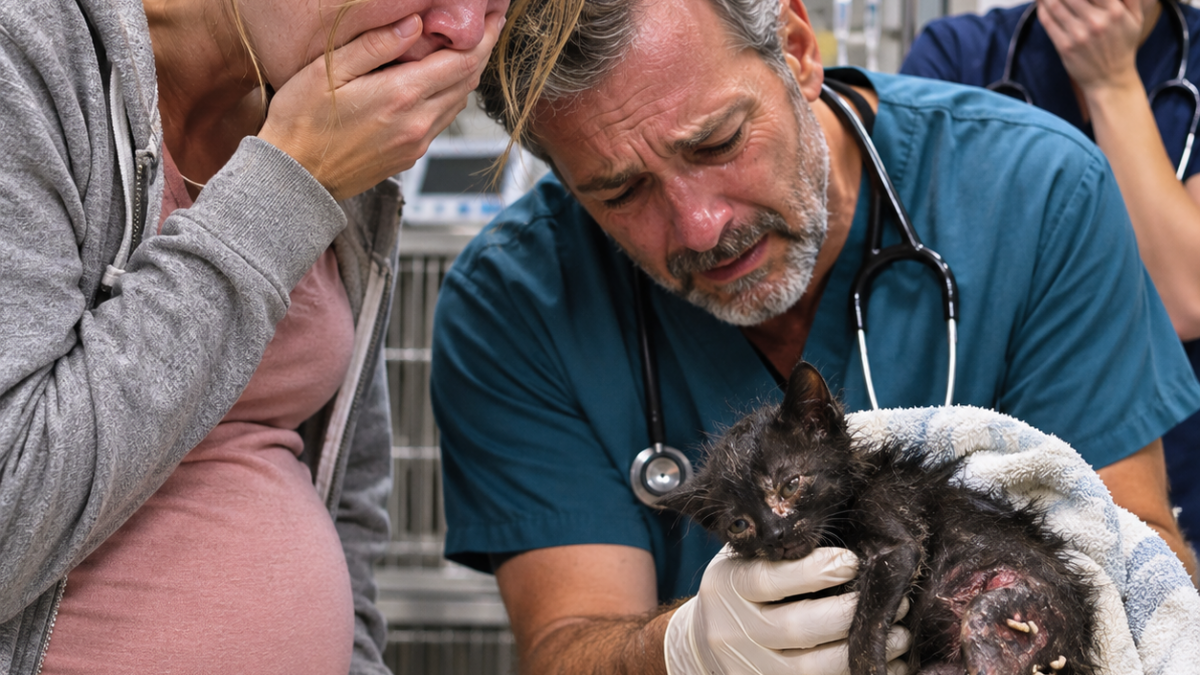
FULL STORY CONTINUATION
I stared at him.
For a moment, the words didn’t register.
One month old.
Thirty days, perhaps a few more.
A life so new that this kitten should still have been learning how to play, how to groom himself, and how to explore the world without wandering far from safety.
Instead, he’d been lying beside a road with flies gathering around wounds he was too weak to escape.
I looked at the examination table.
The little black kitten lay on a clean towel.
His eyes remained almost completely closed.
His tiny chest moved unevenly.
One of the nurses was preparing supplies while another carefully assessed his temperature and condition.
The veterinarian spoke gently.
“We need to stabilize him first.”
I nodded.
“Okay.”
“He’s severely underweight, and those wounds need immediate attention.”
My eyes moved toward his hind legs.
I could see the pale larvae.
I wished I couldn’t.
But looking away wouldn’t help him.
“Please do whatever he needs,” I whispered.
The veterinarian nodded.
“We’ll do everything we reasonably can.”
I swallowed.
“Is he in pain?”
The veterinarian’s expression softened.
“He’s in very poor condition.”
That was enough.
I looked down at the kitten.
His whole body seemed to fit inside the nurse’s hands.
And I began crying again.
I’ve thought about that first hour more times than I can count.
The clinic was brightly lit.
Clean.
Cool.
There was a faint smell of disinfectant.
The floor had been polished.
A telephone rang behind the reception desk.
Somewhere in another room, a dog barked.
Ordinary sounds from an ordinary veterinary practice.
Yet for me, time seemed to stop.
I stood near the treatment area watching people work to save a creature I’d met less than an hour earlier.
I hadn’t planned to rescue a kitten.
I hadn’t even planned to walk that particular stretch of road.
At thirty-eight weeks pregnant, my days were supposed to revolve around preparing for my baby.
Hospital appointments.
Checking the packed maternity bag.
Washing tiny clothes.
Making sure the crib was ready.
Trying to sleep despite an enormous belly and an aching back.
I was already frightened about giving birth.
I wondered whether I’d recognize the beginning of labor.
Whether my baby would be healthy.
Whether I was prepared to become a mother.
And now, suddenly, there was another tiny life in front of me.
One that might not survive the afternoon.
I couldn’t understand why the sight of him hurt so much.
He wasn’t my pet.
I didn’t know where he’d come from.
I didn’t know whether he’d ever belonged to anyone.
But when I saw him beside the road, breathing with such difficulty, something in me responded before I could think about practicalities.
I couldn’t leave him.
Not there.
Not surrounded by flies.
Not with his little body giving up one breath at a time.
The nurse began cleaning him carefully.
I watched as she worked around his damaged fur and inflamed skin.
She used appropriate veterinary supplies, moving slowly so she wouldn’t cause unnecessary pain.
The filth was astonishing.
Dirt had dried into his coat.
His fur had clumped around the wounds.
His little feet were so tiny that I could barely believe they belonged to a living animal.
Another nurse assisted as the team removed the maggots from his hind legs.
They worked patiently.
Checking the wounds.
Cleaning.
Examining again.
Making sure the areas that needed treatment weren’t overlooked.
I stood near the doorway.
My hands were trembling.
At one point, I had to sit down because my back began aching and I felt lightheaded.
The nurse noticed immediately.
“Are you all right?”
I nodded.
“I’m pregnant.”
She looked at my belly.
Her eyebrows rose.
“How far along?”
“Thirty-eight weeks.”
Her expression changed.
“Oh, my goodness.”
I tried to smile.
“I know.”
She pulled out a chair.
“Please sit. We can take care of him.”
I lowered myself carefully.
“I’m sorry.”
She shook her head.
“You don’t have to apologize.”
Then she looked toward the kitten.
“You’ve already done something important by bringing him in.”
I watched the veterinarian working.
“But what if it isn’t enough?”
The nurse didn’t offer a false promise.
She simply said, “Right now, we’re giving him the care he needs.”
I nodded.
And tried to hold onto that.
When they cleaned his face, I saw how badly his eyes were infected.
Crust and discharge had gathered around them.
The lids were swollen.
I wondered how much he could see.
Had he watched people pass him on the road?
Had he been able to distinguish a human figure from the moving shadows of traffic?
Had he crawled toward the open pavement because he was searching for help?
Or had he simply become too weak to remain hidden?
The questions came faster than answers.
I thought about the elderly sanitation worker.
His tired face.
His worn work clothes.
The way he’d said the kitten had crawled from the bushes several times.
I pictured him watching that tiny black creature appear and disappear, perhaps hoping its mother would return.
I wondered how many people had walked past without noticing.
Then I stopped myself.
I didn’t know what anyone else had seen.
I didn’t know what they could have done.
And judging strangers wouldn’t help the kitten lying in front of me.
What mattered was that he was here now.
Inside.
Away from traffic and insects.
Surrounded by people who knew how to treat him.
For the first time since I’d seen him, he had a chance.
After the initial cleaning, the veterinarian spoke with me again.
He explained that the kitten was extremely weak and needed supportive care.
They were concerned about dehydration, inadequate nutrition, infection, and the possibility that other illness was contributing to his condition.
His blood glucose was low.
That could be dangerous for such a small animal.
They were addressing it while continuing their assessment.
I listened carefully.
Then asked, “Can he eat?”
“We’re going to see what he can tolerate.”
The nurse approached with a small syringe containing glucose solution.
Everything was handled carefully because he was so weak.
I watched her bring it near his mouth.
For a moment, he did nothing.
My heart sank.
Then his tiny mouth moved.
He began sucking eagerly.
I leaned forward.
“Oh.”
The nurse smiled.
“There you go, little one.”
He continued.
Such a small movement.
Barely noticeable compared with the energy of a healthy animal.
But to me, it felt enormous.
His body had been failing.
He could barely open his eyes.
Yet when offered something he needed, he responded.
I pressed a hand against my chest.
“That’s good, right?”
The veterinarian nodded.
“It’s encouraging.”
I began crying.
Again.
I was embarrassed by how easily the tears came.
But the exhaustion, pregnancy, fear, and relief had become impossible to separate.
I looked at the tiny kitten.
And whispered, “Good boy.”
The clinic staff dried his fur after cleaning him.
That was the first moment I saw how little of him there really was.
Under the dirt, he was almost all bones.
His spine formed a delicate ridge beneath his coat.
His hips looked sharp.
His neck seemed impossibly narrow.
The rounded little belly that healthy kittens often have was absent.
He looked smaller now that the clumps of dirt were gone.
More fragile.
More exposed.
I had seen photographs of starving animals before.
Like most people, I’d felt sad, perhaps shared a post, or wished someone could help.
But photographs didn’t prepare me for standing beside a living creature whose body felt as though it might break under a careless touch.
I could see every shallow breath.
Every weak movement.
Every sign that survival was requiring nearly everything he had.
I asked whether he might be able to stand.
The veterinarian looked toward him.
“We’ll find out as he stabilizes.”
Later, after more treatment, something happened that made the nurse call me over.
I had been sitting near reception, drinking water and trying to ease the ache in my back.
Then I heard her voice.
“Would you like to come see him?”
I stood carefully.
“What happened?”
She smiled faintly.
“Come look.”
I followed her.
The kitten was on a clean towel.
A nurse supported him gently.
His little head lifted.
Then one front paw shifted.
Another.
His hind legs trembled.
For a moment, he seemed uncertain how to support his own weight.
Then he stood.
Not steadily.
Not confidently.
Just a tiny black kitten on four shaking legs.
I covered my mouth.
“Oh, sweetheart.”
He remained standing for only a short while.
His body swayed.
Then he lowered himself again.
But he had done it.
He’d stood.
I looked at the veterinarian.
“He’s getting better?”
The vet’s expression remained cautious.
“It’s a positive sign.”
I smiled through tears.
Then he added, “But we still have concerns.”
The words brought me back to reality.
I looked toward the kitten.
He’d stood.
He’d swallowed the glucose.
His wounds had been cleaned.
But his body was still dangerously weak.
And the veterinarian wasn’t ready to tell me he would survive.
I wanted to stay.
I wanted to sit beside him until he opened his eyes and looked around.
I wanted to be there when he ate his first proper meal.
I wanted to know whether he could sleep comfortably.
Whether the pain was easing.
Whether his breathing was improving.
But I couldn’t remain at the clinic indefinitely.
I was thirty-eight weeks pregnant.
My back was throbbing.
The baby had been moving all afternoon.
And my family was waiting for me at home.
I stood near the treatment area for a long moment.
The kitten was resting on his towel.
He looked impossibly small.
The nurse explained that they would continue monitoring and treating him.
I nodded.
Then asked, “Can I call tomorrow?”
“Of course.”
My voice trembled.
“And can I come see him?”
She smiled.
“Yes.”
I looked down at the kitten.
“Okay.”
I wanted to say something important to him.
Something he could somehow understand.
But all I managed was a whisper.
“Please stay.”
Then I went home.
That night, I couldn’t stop thinking about him.
I tried to eat dinner.
Tried to rest.
Tried to focus on the baby moving beneath my hand.
But every few minutes, my mind returned to the roadside.
The flies.
The tiny black body.
The maggots.
The infected eyes.
The faint rise and fall of his belly.
I imagined him lying in the bushes before anyone found him.
Cold nights.
Hunger.
Pain.
The terrifying noise of passing vehicles.
I wondered whether he’d cried for his mother.
Whether she’d been nearby.
Whether something had happened to her.
Or whether he’d simply become separated from her too early.
I didn’t know.
And I didn’t want to invent a story about his past.
But I couldn’t stop wondering how a one-month-old kitten had ended up in such a terrible condition.
I placed my hand over my belly.
My baby kicked.
A strong little movement.
I smiled through tears.
Then thought about the kitten again.
One tiny life was protected inside my body.
Another had been fighting to survive alone beside a road.
The contrast felt unbearable.
I barely slept.
Every time I closed my eyes, I saw his trembling legs.
At midnight, I checked my phone.
No update.
At two, I woke again.
I thought about calling the clinic.
Then reminded myself that the staff had work to do and would contact me if we’d arranged an urgent update.
At four, I sat on the edge of my bed.
My feet were swollen.
My lower back ached.
I was exhausted.
But the only question I wanted answered was whether the kitten had survived the night.
By morning, I could barely wait to hear.
When I contacted the clinic, a nurse answered.
I told her who I was.
“The woman who brought in the tiny black kitten yesterday.”
There was a pause.
Then she said, “Yes, I know.”
My heart began pounding.
“How is he?”
She took a breath.
“He’s still with us.”
I closed my eyes.
For a moment, I couldn’t speak.
Then I whispered, “Thank God.”
The nurse continued.
“He’s receiving treatment, but we’re still concerned about his appetite and overall condition.”
I sat down.
“Is he worse?”
“Not necessarily. But the veterinarian wants to run further tests.”
My stomach tightened.
“Why?”
She explained that the low blood sugar didn’t account for everything they were seeing.
The kitten remained too sick.
Too reluctant to eat.
Too vulnerable.
Something else might be happening.
I gripped the phone.
“Please test him.”
“We are.”
I swallowed.
Then asked, “Can I visit?”
“Yes.”
I looked toward the door.
“I’ll come.”
When I arrived, the nurse who had helped him the previous afternoon met me near reception.
She looked tired.
Her eyes were wet.
For a moment, my heart stopped.
“Is he alive?”
She nodded immediately.
“Yes.”
I began breathing again.
Then she said, “We have the test results.”
I looked toward the treatment room.
“What did they find?”
She hesitated.
And I understood that whatever she was about to tell me would change the fight ahead.
The veterinarian came out a moment later.
He held a clipboard, but unlike the previous afternoon, he didn’t immediately lead me toward the treatment table.
He asked me to sit.
I knew that was rarely a good sign.
I lowered myself into a chair, my heart hammering.
“Please,” I said. “Just tell me.”
He sat opposite me.
“The kitten tested positive for feline panleukopenia, often called feline distemper.”
I stared at him.
I’d heard the word distemper before.
But I knew almost nothing about what it meant for a kitten.
“Is that serious?”
He nodded.
“Very.”
I swallowed.
Then he continued.
“We also have evidence of feline calicivirus infection.”
For a moment, I couldn’t speak.
Two infections.
Not one.
Two.
In an animal so young that he barely filled a person’s hand.
The veterinarian explained that feline panleukopenia could be especially dangerous in young, unvaccinated kittens. It could cause severe gastrointestinal illness, dehydration, and profound weakness, while affecting the body’s ability to fight infection.
Calicivirus could cause additional illness, including upper respiratory and oral symptoms.
The combination was concerning, especially given how severely malnourished and injured the kitten had been when he arrived.
I listened.
But one thought kept repeating.
He’s only a month old.
I looked at the veterinarian.
“Does this mean he’s going to die?”
He didn’t answer immediately.
Then he said, “He’s critically ill. We cannot promise an outcome.”
My eyes filled.
“But he stood up yesterday.”
“Yes.”
“And he drank the glucose.”
“Yes.”
“Doesn’t that mean something?”
“It does.”
He leaned forward.
“Those are encouraging signs. But they don’t mean the underlying illness has resolved.”
I looked down at my hands.
My fingers were trembling.
Then I asked the only question that mattered.
“Are you going to keep trying?”
His expression softened.
“Of course.”
The words feline distemper followed me everywhere for the next several days.
I thought about them while brushing my teeth.
While folding baby clothes.
While trying to sleep.
I knew the veterinarian had been careful to explain the severity without claiming the kitten couldn’t survive.
But I couldn’t stop imagining the worst.
A tiny body overwhelmed by infections.
A kitten who had already endured wounds, parasites, starvation, and pain.
A life that might end before he had learned what it felt like to sleep safely in a home.
I asked about treatment.
The veterinarian explained that the team would continue appropriate supportive care, manage his wounds, maintain hydration and nutrition, monitor his condition, and address complications as they arose.
There was no simple medicine that could instantly erase everything making him sick.
His own body would need to fight while the staff supported him.
I looked toward the treatment room.
“Can I see him?”
The veterinarian nodded.
“Yes. We’ll make sure the visit is handled safely.”
Because the kitten had contagious infections, the clinic had isolation precautions in place.
I followed their instructions.
I didn’t touch anything I wasn’t supposed to.
I kept my distance when asked.
And I tried not to let my fear interfere with the work being done.
He looked so small.
That was my first thought when I saw him again.
The treatment area was clean and carefully arranged.
His body rested on a soft towel.
The black fur that had been filthy the day before was now mostly clean.
His wounds had been treated.
His face looked less obscured by dirt, though the infection around his eyes remained obvious.
A small medical line was helping provide the supportive care he needed.
His chest still rose and fell more rapidly than I wanted to see.
And he wasn’t eating voluntarily.
I watched him for a long moment.
Then whispered, “Hi, baby.”
His ear moved faintly.
I froze.
“Did he hear me?”
The nurse smiled.
“He may have.”
I leaned closer from the permitted distance.
“It’s me.”
Of course, he had no reason to recognize my voice.
We’d spent only a little time together.
I knew that.
But I wanted him to know that someone had come back.
That the world hadn’t simply lifted him from the road and forgotten him in another unfamiliar place.
“I’m here,” I whispered.
He moved his little head.
Not much.
Just enough to make me cry.
One of the nurses was working on his feeding.
She spoke to him softly.
“There we go, sweetheart.”
He didn’t seem interested.
She waited.
Tried again.
Offered a small amount of appropriate food under the clinic’s feeding plan.
For a moment, he turned away.
I felt my stomach tighten.
“Why won’t he eat?”
The nurse looked toward me.
“He’s very sick.”
I nodded.
“But he needs food.”
“Yes.”
Her voice remained gentle.
“That’s why we’re helping him.”
I watched her.
There was no impatience in the way she handled him.
No frustration when he refused.
Just patience.
A little food.
A pause.
Another careful attempt.
Then something changed.
His mouth moved.
He swallowed a small amount of the pureed meat.
The nurse smiled.
“Good boy.”
I leaned forward.
“He ate?”
“A little.”
My eyes filled.
She looked toward the veterinarian.
Then back at him.
“Let’s see how he tolerates it.”
I wanted to cheer.
To laugh.
To call everyone I knew.
But the nurse’s calm expression reminded me that this was not a miracle ending.
It was a tiny step.
One swallow.
One little effort.
For a kitten who had been starving and was now battling serious infections, it mattered enormously.
But he needed many more.
I started thinking of him as the little shadow.
Not because he was frightening.
Because he was so small and black, like a tiny piece of darkness that had somehow survived being left beneath the sun.
I never officially named him.
There was no ceremony.
No collar with a tag.
No moment when I declared that he belonged to me.
But whenever I called the clinic, I asked about “our little shadow.”
The nurses knew exactly whom I meant.
“The black baby?” one would say.
“Yes.”
“How’s his appetite?”
“Any improvement?”
“Did he sleep?”
“Is he breathing comfortably?”
Sometimes I asked too many questions.
I knew that.
But the staff answered what they could.
And when they couldn’t promise something, they didn’t pretend.
I appreciated their honesty more than they realized.
That afternoon, after my visit, I returned to the parking lot and sat in my car.
The hospital bag for my baby was on the back seat.
A folded blanket lay beside it.
I looked at the bag.
Then thought about the kitten.
One baby almost ready to arrive.
One kitten fighting for the chance to grow.
My emotions were tangled.
I wanted to help him.
But I was exhausted.
I was close to giving birth.
And I knew I couldn’t become the person responsible for all his care at home.
Not immediately after delivering a newborn.
Not while recovering.
Not while trying to protect my baby and manage a fragile kitten’s medical needs.
The realization made me feel guilty.
I had lifted him from the road.
Brought him to safety.
Begged the veterinarian to help.
And now I wasn’t sure I could give him a home when he left the clinic.
I pressed my hands over my face.
“What am I supposed to do with you, little one?”
The car remained quiet.
Then my baby kicked.
I lowered my hands.
Placed one palm on my belly.
And sat there crying.
That evening, I spoke with my family.
I explained the kitten’s condition.
The infections.
The treatment.
How tiny he was.
How desperately he needed help.
Then I admitted what had been weighing on me.
“I can’t bring him home right now.”
The words hurt.
I had imagined rescuing him meant carrying him all the way to safety and keeping him close until he was healthy.
But the clinic had explained that, because of his illnesses and injuries, he would need careful continued care, medication, rest, monitoring, appropriate nutrition, and a household prepared to follow those instructions.
I also had my own responsibilities.
My baby could arrive any day.
I couldn’t predict how delivery would go.
Or how much help I’d need afterward.
Taking in a recovering, medically fragile kitten without being able to meet his needs wouldn’t be kindness.
It would be another risk.
Still, saying the words aloud felt like failure.
I looked down at my belly.
“I don’t want him to think I’m leaving him.”
Someone gently reminded me that the kitten needed a suitable home, not a promise I couldn’t safely keep.
I knew that was true.
But knowing it didn’t make the thought easier.
For the next several days, my phone became the center of my world.
I had it beside me while eating.
Beside my pillow at night.
On the table when I rested.
I kept checking whether the clinic had sent an update.
Every time it rang, my heart jumped.
I was afraid of bad news.
But I was even more afraid of missing it.
One morning, I called.
The nurse told me he’d swallowed a little more food.
I cried.
Another day, she said he was showing more movement.
I cried again.
Then came a day when she told me he had rested more comfortably.
That time, I simply closed my eyes and whispered, “Thank you.”
I began measuring his progress in tiny details.
Not pounds gained.
Not weeks survived.
Not dramatic transformations.
A few more mouthfuls.
A little more strength.
A steadier movement.
A moment of alertness.
Each one mattered.
The hardest part was never knowing whether the next improvement would last.
After hearing that he’d eaten a little, I wanted to believe he would eat normally the next day.
But recovery didn’t follow a straight line.
His appetite remained fragile.
He still needed close monitoring.
He was weak.
Sometimes he seemed more responsive.
At other times, he rested quietly and showed little interest in anything around him.
I learned not to interpret every quiet moment as disaster.
Sick kittens need rest.
But I also couldn’t ignore the danger.
He was young.
Underweight.
And fighting illnesses that could be deadly.
One afternoon, the nurse explained that they were continuing to watch his hydration and nutrition carefully.
I asked whether he could get stronger without eating enough.
She told me why maintaining nutrition was so important.
I listened.
Then looked toward the little black kitten.
“Please,” I whispered.
“Just one more bite.”
I began remembering the old sanitation worker.
His weathered face.
The cardboard box.
His hands holding it steady while I placed the kitten inside.
At the time, I hadn’t asked his name.
Everything had happened so quickly.
I’d been too frightened to think about anything except reaching the veterinarian.
But his kindness stayed with me.
He had seen the kitten before.
He knew the little creature was there.
And when I asked for help, he didn’t turn away.
He found a box.
Held it.
Helped me lift the kitten carefully.
Then wished him strength.
It was such a small action.
A cardboard box.
A few minutes.
A stranger deciding that an animal’s suffering mattered.
But without that help, I might have struggled to transport the kitten safely.
Sometimes rescues begin with extraordinary interventions.
Other times, they begin because an elderly worker notices something in the bushes and refuses to pretend it isn’t there.
I wished I could tell him the kitten was still alive.
I wanted him to know that the little creature he had watched crawl out of the vegetation had reached a place where people were fighting for him.
On the fourth day, I visited again.
I had been feeling unusually tired that morning.
My baby was moving frequently.
My back felt as though it had been carrying a mountain.
But when the clinic confirmed that a short visit was possible, I went.
I followed the isolation instructions.
Then looked toward the kitten.
He was awake.
Not fully energetic.
Not yet behaving like a healthy one-month-old animal.
But awake.
His eyes, though still recovering, seemed more open than before.
His head was raised.
And when the nurse approached, he followed her movement.
I felt my breath catch.
“Look at you.”
The nurse smiled.
“He’s showing more interest.”
I watched him.
Then asked, “Has he eaten?”
“A little.”
I nodded.
“On his own?”
“Not reliably yet. We’re still helping.”
I swallowed.
“But he’s trying?”
She smiled.
“He is.”
I stood there with tears gathering.
That word meant everything.
Trying.
His body had been through so much.
Yet he was still trying.
A nurse offered him some appropriate food.
He sniffed.
Turned his head.
Then hesitated.
I gripped my hands together.
“Come on, sweetheart.”
The nurse waited patiently.
He moved his mouth.
Took a small amount.
Swallowed.
Then another.
I held my breath.
She smiled.
“Good.”
I looked toward the veterinarian.
“That’s better?”
He nodded.
“It’s encouraging.”
I laughed through tears.
“That’s becoming my favorite word.”
The vet smiled.
“Encouraging?”
“Yes.”
He nodded.
“Then I hope we get to use it more.”
Afterward, I stood near his enclosure for a moment.
He was resting again.
I watched his breathing.
It no longer sounded quite as desperate to me as it had beside the road.
I knew my impressions weren’t medical measurements.
But I could see that he looked cleaner, more comfortable, and more alert.
And somehow, that made me realize how terrible his condition had been when I first found him.
The kitten on the roadside had barely resembled an animal capable of surviving.
He’d looked like a handful of dirty fur wrapped around bones.
Now I could begin seeing the kitten he might become.
A little black face.
Tiny ears.
Small paws.
A body that would one day be able to run.
Perhaps chase a toy.
Perhaps sleep on a couch.
Perhaps curl up beside somebody who loved him.
Those weren’t promises.
They were possibilities.
And after days of fearing he might never leave the clinic alive, possibilities felt precious.
When I got home, I began looking for someone who might be able to adopt him when he was ready.
I didn’t post dramatic promises about a miraculous rescue.
I didn’t say he had recovered.
He hadn’t.
I explained honestly that he was receiving treatment and would need a responsible home prepared to follow veterinary instructions.
I told people he was extremely young.
That he’d been found injured and malnourished.
That he’d tested positive for serious feline infections.
And that any adoption would depend on the veterinarian determining when he could safely leave.
I wanted someone who understood the responsibility.
Not someone who only saw a photograph of a tiny black kitten and decided he was adorable.
He was adorable.
Even sick.
Even covered in medical complications.
But cuteness wouldn’t give him his medication.
Cuteness wouldn’t ensure follow-up appointments.
Cuteness wouldn’t feed him properly.
Cuteness wouldn’t protect him if his symptoms returned.
He needed more than admiration.
He needed care.
At first, I received sympathetic messages.
People asked about his condition.
Sent encouragement.
Wished him well.
Some wanted photographs.
A few asked whether he was available immediately.
I explained that he wasn’t.
He was still hospitalized.
Still recovering.
Still under the veterinarian’s care.
One person told me they could take him but had never cared for a kitten before.
Another seemed uncertain about the medical needs.
I didn’t judge them.
Not everyone is prepared to care for a recovering animal.
But I knew this little kitten couldn’t afford another situation where his needs went unmet.
So I kept looking.
Then a family came forward.
They asked thoughtful questions.
Not simply how cute he was.
Not whether he would remain tiny.
Not whether they could have him that afternoon.
They wanted to understand his treatment.
His feeding.
His medication.
The follow-up care.
The precautions they would need to take.
They listened when I explained that he was still recovering.
They understood that the veterinarian would decide when he was ready for discharge.
And they were willing to follow the clinic’s instructions.
I felt something in my chest loosen.
For the first time, I could imagine him leaving the clinic without returning to danger.
But I didn’t want to rush.
I needed the veterinary team to confirm his condition.
And I needed to be sure the family understood what they were accepting.
A tiny kitten.
Still fragile.
Still recovering.
Still requiring care.
Not a story with all its difficulties already finished.
I thought about the home he’d never had.
Or perhaps had lost.
I didn’t know his history.
I didn’t know what had happened in the bushes.
I didn’t know whether he had littermates.
Or whether his mother was still alive.
There were no answers to those questions.
But I could help decide what happened next.
He wouldn’t return to the roadside.
He wouldn’t be placed in another cardboard box and left near traffic.
He wouldn’t be sent somewhere without people understanding his needs.
If he survived, he would leave the clinic with a family ready to care for him.
I promised myself that much.
The next update came late in the afternoon.
The nurse sounded happier than she had during our earlier conversations.
“He’s moving around more.”
I sat up.
“Really?”
“Yes.”
“How much?”
She laughed softly.
“He’s becoming much more active.”
I pressed one hand over my mouth.
“Oh, baby.”
She continued.
“He’s still recovering, but this is good progress.”
I asked about his appetite.
She said they were continuing to work on feeding and monitoring how he responded.
I listened.
Then asked the question I asked almost every day.
“Do you think he’s going to make it?”
The nurse paused.
“We’re hopeful, but we’re still taking it one day at a time.”
I nodded.
One day.
One meal.
One breath.
That had become the rhythm of his recovery.
That night, I dreamed about him.
Not about the maggots.
Not about the blood or the flies.
In my dream, he was standing in a patch of sunlight on a clean floor.
His black fur looked soft.
His eyes were open.
He turned toward me.
Then walked away on four steady paws.
When I woke, I was crying.
My baby moved beneath my hand.
I looked at the clock.
Still early.
I lay there for a long time, staring toward the window.
Then whispered, “Please let him have that.”
Not an extraordinary life.
Not fame.
Not a dramatic ending.
Just the chance to walk toward something good without pain.
The next morning, the clinic sent an update that nearly made me drop my phone.
He had used the litter box.
On his own.
I stared at the message.
Then read it again.
A litter box.
Such an ordinary thing.
Any healthy kitten might use one without inspiring tears.
But this kitten had been too weak to stand beside the road.
His hind legs had been wounded.
Maggots had been living in the damaged tissue.
His body had barely been able to support him.
And now he had walked to the litter box and used it.
I sat on the edge of my bed.
Then began crying.
It wasn’t just about the litter box.
It was what the action meant.
He was moving.
He was recognizing a basic need.
He was strong enough to do something without being carried or supported through every step.
His body was beginning to function in ways it couldn’t when I found him.
I laughed through tears.
“Look at you, little shadow.”
My baby kicked.
I placed a hand on my belly.
“You have no idea how much your mommy is crying over a kitten.”
Then I laughed again.
I called the clinic later that day.
The nurse confirmed what the message said.
He had begun using the litter box independently.
He was more alert.
His movements were steadier.
And although the team was still carefully monitoring his condition, there was genuine reason to be encouraged.
I asked whether I could visit.
She checked.
Then said yes.
I could hardly contain myself.
I gathered my things.
Made sure I had water.
And left.
The walk from the clinic’s entrance to the treatment area felt strangely familiar by then.
I’d learned the sound of the reception bell.
The smell of the hallway.
The pattern of footsteps behind the counter.
I’d learned which nurse usually answered my calls.
Which doorway led to the area where the kitten was being treated.
I had never expected a veterinary clinic to become such an important place in my life during the last weeks of pregnancy.
But there I was.
Walking through the door again.
Looking for the same tiny black face.
The nurse greeted me.
“He’s having a better day.”
My heart leaped.
“Can I see?”
She smiled.
“Of course.”
He wasn’t lying motionless.
That was the first thing I noticed.
His head was up.
His eyes were more open.
His fur looked cleaner and softer.
And he was standing.
Not for one trembling moment before collapsing back onto a towel.
Standing.
Then he took a step.
Another.
A third.
I froze.
The nurse looked toward him.
“Come on, little guy.”
He moved forward.
His body still looked thin.
His legs were still delicate.
But his steps were far steadier than the first time I’d watched him struggle to support himself.
I felt tears begin falling.
“Oh, sweetheart.”
He stopped.
Turned his little head toward my voice.
Then opened his mouth.
“Meow.”
It was tiny.
A thin, high sound.
But it was clear.
I covered my face.
For a moment, I couldn’t speak.
He’d been nearly silent beside the road.
So weak that opening his mouth seemed to require more strength than he had.
Now he’d walked toward the sound of my voice and meowed.
I didn’t know whether he recognized me personally.
Perhaps he was responding to attention.
Perhaps he wanted food.
Perhaps he was simply expressing himself as he grew stronger.
But I didn’t need to assign him some extraordinary understanding.
Hearing that meow was enough.
He was alive.
And his little voice was finally strong enough to reach me.
The nurse laughed gently when she saw my tears.
“He’s becoming quite talkative.”
I wiped my face.
“Really?”
She nodded.
“Much more than before.”
I looked toward him.
He took another step.
Then another.
The nurse encouraged him back to a safe resting area.
I watched as he settled.
His tail moved slightly.
He looked around.
Then lowered his head.
I smiled through tears.
“I’m so proud of you.”
The nurse touched my shoulder lightly.
“He’s worked hard.”
I nodded.
“So have all of you.”
She smiled.
“We’re glad he’s responding.”
I looked around the clinic.
The clean towels.
The supplies.
The little containers of food.
The notes recording his condition.
Then thought about the people who had spent days caring for him when I couldn’t.
The staff who cleaned his wounds.
The veterinarian who ordered tests when his weakness didn’t improve as expected.
The nurses who patiently encouraged him to swallow food.
The people who monitored his breathing and hydration.
I was the one who had found him.
But I hadn’t saved him alone.
Not even close.
Later, the veterinarian joined us.
He examined the kitten and discussed his progress.
I asked about the two infections.
He explained that the kitten had shown meaningful improvement, but recovery still required caution.
His nutritional needs remained important.
His wounds and eyes needed continued care.
He had to be monitored for signs of complications.
And his future environment would need to be appropriate for a young kitten recovering from contagious illness.
I nodded carefully.
I was trying to remember everything.
Then I asked, “Does he still need the IV?”
The veterinarian explained that he would reassess his fluid needs as the kitten continued eating and drinking.
I looked toward the tiny black body.
Every answer still seemed to contain a qualification.
If he keeps improving.
If he maintains his appetite.
If he tolerates the treatment.
I understood why.
The staff had watched animals improve and then encounter complications.
They weren’t going to promise something they couldn’t guarantee.
But I could see the difference.
The kitten I had carried in a cardboard box had barely been breathing.
Now he could walk.
He could meow.
He could use the litter box.
And he was beginning to behave like a kitten rather than a helpless bundle of fur.
For the first time, I allowed myself to imagine the day he might go home.
The family I’d been speaking with asked for another update.
I told them how much he’d improved.
I described his little meow.
His steps.
The litter box.
They were happy.
But they didn’t ask to take him before the veterinarian approved his discharge.
That mattered to me.
They understood there was still work ahead.
I shared the clinic’s expectations for continued care, without pretending I could replace the veterinarian’s instructions.
They asked about follow-up appointments.
Food.
Medication.
How best to prepare a safe space for him.
I felt relieved by the questions.
Because this time, the responsibility wasn’t falling onto someone who happened to find him near the road and acted out of desperation.
It was being accepted thoughtfully.
A family was preparing for him.
Not for a photograph.
For him.
I began thinking about how strange rescue can be.
The kitten hadn’t chosen me.
He hadn’t crawled toward the road because he knew I was leaving a hospital that afternoon.
He hadn’t known about the elderly sanitation worker.
Or the cardboard box.
Or the veterinary clinic.
He’d simply been trying to survive.
And somehow, a series of ordinary moments had brought him to help.
An old man noticing movement in the bushes.
A pregnant woman stopping beside the road.
A cardboard box being found.
A clinic door opening.
A nurse recognizing the urgency.
A veterinarian ordering additional tests when the first explanation didn’t account for everything.
Someone patiently offering food.
Someone checking whether he could walk.
None of those moments alone guaranteed his recovery.
But together, they gave him the chance he hadn’t had while lying in the dirt.
There was another day when I arrived and found him eating.
I wasn’t expecting it.
I’d been told his appetite was improving, but I still imagined him needing coaxing with every mouthful.
The nurse led me to the appropriate viewing area.
And there he was.
His little head lowered toward a dish of canned food.
Eating.
Not reluctantly.
Not after repeated attempts to persuade him.
Eating because he was hungry.
I stood completely still.
His tiny mouth moved.
He swallowed.
Then went back for another bite.
And another.
I felt my knees weaken.
“Is he…?”
The nurse smiled.
“Yes.”
I looked toward her.
“By himself?”
She nodded.
“By himself.”
I pressed one hand over my mouth.
For days, the team had been trying to get enough food into him.
Now he was eating eagerly.
His body was asking for nourishment.
His appetite, once almost absent, was returning.
I watched him continue until the dish was nearly empty.
Then he lifted his head.
There was food around his little mouth.
He looked so ordinary.
So wonderfully, unbelievably ordinary.
And I began crying harder than I had when he first stood.
The nurse laughed softly.
“He’s discovered he likes canned food.”
I wiped my eyes.
“Apparently.”
The kitten lowered his head again.
One more mouthful.
Then another.
I laughed through tears.
“Slow down, baby.”
Of course, the feeding plan and amounts were being managed by the veterinary team.
He couldn’t simply make up for prolonged starvation in one meal.
But watching him show enthusiasm for food was extraordinary.
I thought about the roadside.
His hollow belly.
His barely moving body.
I had wondered whether he’d experienced a proper meal in days.
Now he was eating in a warm clinic with someone nearby to make sure he received what he needed.
The contrast was almost too much.
I placed my hand against my chest.
Then whispered, “You deserve every good thing that’s coming.”
That evening, I returned home with a photograph from the clinic.
The little black kitten was standing beside his food dish.
His fur was still short and uneven in places.
His body remained thin.
His eyes were still recovering.
But he looked alert.
Alive.
Interested in the world.
I stared at the picture for a long time.
Then placed my phone beside the folded baby clothes on the table.
For weeks, I’d been preparing to welcome a newborn.
Now I was also preparing to say goodbye to another little creature.
One I’d only known for a handful of days.
One I couldn’t bring home.
One I loved anyway.
I hadn’t expected that.
I hadn’t expected to become attached to a kitten found beside a road.
But love doesn’t always begin with a plan.
Sometimes it begins with the sight of a tiny belly rising and falling beneath a cloud of flies.
And the realization that walking away would mean leaving someone who couldn’t save himself.
My baby continued reminding me that time was moving.
I felt kicks.
Pressure.
Aching.
The constant physical discomfort of late pregnancy.
The maternity bag waited beside the door.
My doctor had explained the signs that would mean it was time to go to the hospital.
I knew labor could begin any day.
Sometimes I wondered whether my baby would arrive before the kitten was discharged.
Would I be in a delivery room when the family came to collect him?
Would I miss the moment he finally left the clinic?
The thought hurt.
Then I felt guilty for caring so much about a farewell when I had a baby of my own about to arrive.
I knew my priorities.
I knew my child came first.
But I also knew that I wanted to see the kitten reach safety.
I wanted the story I’d entered so unexpectedly to end with him going somewhere warm.
Somewhere he could recover.
Somewhere he would no longer need to fight for every breath.
The veterinarian’s next update brought another milestone.
The kitten was eating and drinking well enough that he no longer required IV fluid support.
I stared at the message.
Read it twice.
Then called to confirm I’d understood correctly.
The nurse explained that the veterinarian had determined he could maintain hydration without that line, while the staff continued his treatment and monitoring.
I sat down slowly.
No IV.
For the first time since the day I found him, the kitten didn’t need that particular form of support to keep his little body going.
I remembered the first examination.
How weak he had been.
How his breathing seemed to pause between efforts.
And now he was eating on his own.
Walking.
Meowing.
Using the litter box.
And no longer needing IV fluids.
I whispered, “You did it.”
Then immediately corrected myself.
“Not all of it yet.”
I knew he still needed treatment.
Still needed time.
Still needed careful care.
But I could finally see the direction he was moving.
Toward life.
By the end of the week, the veterinary team was discussing discharge.
I could hardly believe it.
Approximately seven days.
That was all that separated the kitten struggling to breathe beside the road from the little animal who was now moving around, eating, and showing curiosity.
Seven days sounded short.
But living through them had felt like an eternity.
The veterinarian explained that he was almost fully recovered from the acute crisis, while making clear that he would still need medication, rest, good nutrition, and follow-up care after leaving.
I took notes.
Asked questions.
Repeated instructions to make sure I understood.
The prospective adoptive family would need to receive the full care plan directly.
I couldn’t simply hand them a kitten and say he was fine.
He was better.
Much better.
But he had been critically ill.
And his recovery deserved to be protected.
I visited him once more before discharge.
The nurse smiled when she saw me.
“Your little friend is getting ready to leave us.”
My eyes filled immediately.
“Really?”
She nodded.
“The veterinarian is pleased with his progress.”
I looked toward the treatment area.
“Can I see him?”
“Of course.”
When I approached, the kitten was standing.
He turned his little head.
Then opened his mouth.
“Meow.”
I laughed.
“Oh, there you are.”
He took a few steps.
Steady little steps.
Not the trembling struggle I’d witnessed after his first treatment.
He looked toward the nurse.
Then back toward the sound of my voice.
I wanted to reach for him.
To cradle him against my chest.
To kiss the top of his little head.
But I respected the clinic’s infection-control instructions.
I stayed where I was supposed to stand.
And looked at him.
“Do you know how hard you’ve worked?”
He meowed again.
The nurse laughed.
“He has quite a lot to say now.”
I smiled through tears.
“I’m glad.”
For a while, I simply watched him.
He explored a small safe area under supervision.
Stopped.
Looked around.
Then walked toward his food.
His body was still tiny.
He would need to grow.
To gain strength.
To continue healing.
But his movements no longer looked like desperate attempts to remain upright.
He was beginning to discover what his body could do.
And I thought about how much life might be waiting for him.
A warm bed.
A family.
A clean food dish.
A litter box.
A quiet place to rest.
Perhaps toys.
Perhaps sunny windows.
Perhaps ordinary mornings when the worst thing that happened was that someone forgot to put down breakfast quickly enough.
I smiled.
That was the future I wanted for him.
Nothing grand.
Just a life where he could be a kitten.
The nurse came to stand beside me.
“You’ve been worried about him.”
I laughed softly.
“Is it that obvious?”
She smiled.
“Every time you call.”
I wiped my eyes.
“I couldn’t stop thinking about him.”
She nodded.
“He was in terrible shape.”
I looked toward the kitten.
“I thought he was dying when I found him.”
The nurse was quiet.
Then said, “He was very sick.”
I swallowed.
“I didn’t think someone so tiny could survive all that.”
She looked at him.
“He had a lot of help.”
I nodded.
“Yes, he did.”
I thought about the sanitation worker.
The cardboard box.
The veterinarian.
The staff.
The family preparing to adopt him.
A whole chain of people had become part of his life.
Most of them would never know one another well.
But each had contributed something.
The old man had helped get him off the road.
I’d brought him to the clinic.
The veterinary team had treated him.
And soon another family would take responsibility for the future.
I looked at the kitten.
Then whispered, “I think that’s how it was supposed to happen.”
That night, I barely slept again.
But the feeling was different.
I wasn’t lying awake imagining the kitten dying.
I was imagining the moment he’d leave.
Would I cry?
Of course.
Would I wish I could keep him?
Probably.
Would I worry that the family might not understand how fragile he’d been?
I had done everything I could to make sure they did.
Still, the thought of handing him over filled me with a strange ache.
It felt almost like losing something.
Then I reminded myself of the truth.
I had never found him so he could belong to me.
I found him because he needed help.
And the entire purpose of helping him was to give him a chance at the life he deserved.
If that life belonged with another family, then letting him go was part of the rescue.
The morning of discharge, I woke early.
I was tired.
Very pregnant.
And emotional before my feet even touched the floor.
I dressed carefully.
Checked my phone for any change in the plan.
Then gathered the notes I’d made about his medication and care instructions.
The adoptive family had confirmed they would come.
The clinic had prepared the discharge information.
The veterinarian would explain the medications and necessary follow-up.
Everything was arranged.
Yet I stood beside the door for several minutes, unable to leave.
My hand rested on my belly.
I thought about the kitten’s first breath in the cardboard box.
The way I’d looked down every few seconds, checking whether his stomach still moved.
Now I was going to see him leave under his own strength, with a family ready to care for him.
I should have felt nothing but happiness.
Instead, tears ran down my face.
Because sometimes a happy ending asks you to say goodbye to someone you’ve spent days praying would survive.
When I entered the clinic, the receptionist recognized me immediately.
Her expression brightened.
“Good morning.”
I smiled nervously.
“Good morning.”
“Here for the little black kitten?”
I nodded.
“Yes.”
She smiled.
“He’s doing well.”
I felt my eyes fill.
Even after all the positive updates, hearing those words still affected me.
He’s doing well.
A week earlier, nobody could have said that.
A week earlier, he was a tiny body struggling to breathe.
Now the staff were preparing to send him to a home.
I looked toward the treatment room.
“Can I see him?”
“Of course.”
The veterinarian greeted me and went over the discharge plan.
The kitten had improved enough to leave the clinic, but he still needed medication, rest, nutritious food, a safe environment, and monitoring as he continued recovering.
The family would need to follow the clinic’s instructions carefully.
They would also need to understand the precautions associated with his recent contagious illnesses and arrange any recommended follow-up care.
I listened to every word.
I didn’t want the happiness of discharge to make anyone careless.
He had come too far.
He had survived too much.
His future mattered too much to risk treating recovery as though it were already complete.
The veterinarian finished explaining.
Then looked at me.
“Do you have any questions?”
I swallowed.
Only a thousand.
But the one that mattered most came out first.
“Do you think he has a good chance now?”
The veterinarian smiled gently.
“His progress has been very good. We want him to continue receiving the right care.”
I nodded.
My eyes filled.
“Thank you.”
He shook his head modestly.
“The team worked hard, and he’s responded.”
I looked toward the little kitten.
“Thank you for not giving up on him.”
The nurse brought him over in his prepared carrier.
For a moment, I simply stared.
Was that really the same kitten?
The one I’d found beside the pavement?
The one whose body had been so filthy and thin that I was frightened to touch him?
His black fur looked clean.
His eyes were open and alert.
His face had the curious expression of a young kitten beginning to notice the world.
He was still small.
Still delicate.
Still in need of care.
But he was no longer the nearly motionless creature I’d carried into the clinic.
He moved inside the carrier.
Then looked toward the nurse.
“Meow.”
I laughed through tears.
“Hello, sweetheart.”
He opened his mouth again.
Another little meow.
I pressed one hand against my chest.
“Oh, baby.”
The nurse smiled.
“He’s letting everyone know he’s ready.”
I laughed.
“I can hear that.”
Then the family arrived.
I turned toward the entrance.
They approached with the nervous excitement of people about to welcome a new animal into their home.
I watched them look toward the carrier.
Their expressions softened.
One of them whispered, “Oh, he’s so little.”
I nodded.
“He is.”
They stepped closer, listening as the veterinary staff reviewed the kitten’s condition and the instructions they would need to follow.
I noticed how carefully they paid attention.
They asked questions.
Clarified the medication schedule.
Discussed feeding.
Asked about monitoring and the follow-up plan.
They understood that he had recently been very ill and still needed a protected environment while he recovered.
I felt something in my chest begin to relax.
They weren’t treating him as a toy.
They weren’t dismissing the seriousness of what he’d survived.
They were preparing to take care of him.
I handed over the notes I’d brought.
The family accepted them gratefully.
I explained what I knew about the day I’d found him.
The roadside.
The elderly sanitation worker.
The cardboard box.
The terrible condition of his hind legs.
The infected eyes.
The way he’d barely been breathing.
For a moment, nobody spoke.
Then one family member looked toward the carrier.
“You poor little thing.”
I nodded.
“I thought he wouldn’t survive.”
My voice broke.
I looked down.
“But he did.”
The kitten shifted inside the carrier.
His little black nose appeared near the opening.
And suddenly I was crying again.
I wanted them to understand one thing above all else.
He wasn’t simply a kitten who had been lucky enough to survive a week in a clinic.
He was a living creature whose body had endured pain, severe weakness, and serious illness.
He needed patient care.
Gentle handling.
Appropriate food.
A safe place to rest.
And people who would notice if something seemed wrong.
The family listened.
They reassured me that they had prepared for him and would follow the veterinarian’s instructions.
I nodded.
Then looked toward the carrier again.
My little shadow.
The kitten who had barely moved when I first saw him.
Now he was watching the world through bright, curious eyes.
The nurse asked whether I wanted a moment before he left.
I swallowed.
“Yes, please.”
We remained in the clinic’s designated area.
The carrier rested securely nearby.
I crouched as much as my pregnant body allowed, keeping to the handling and hygiene guidance the staff had given me.
I looked through the carrier opening.
“Hi, sweetheart.”
The kitten turned his head.
I smiled through tears.
“You made it.”
He meowed.
I laughed softly.
“Yes, you did.”
For a moment, I remembered the first day with such clarity that it almost hurt.
The pavement.
The flies.
His tiny body sitting against the edge of the road.
The old man’s voice telling me he’d crawled out of the bushes.
The cardboard box.
The terrifying trip to the clinic.
The way I kept looking down to see whether he was still breathing.
Then the veterinarian saying he was only about a month old.
The maggots.
The infected eyes.
The first little swallow of glucose.
His trembling attempt to stand.
The diagnosis.
The nights I lay awake fearing he might die.
The nurses patiently helping him eat.
And now this.
A clean, alert little kitten waiting to go home.
I looked at him.
And whispered, “You don’t have to be brave all the time anymore.”
I don’t know whether he understood anything about the moment.
Probably not.
He was a kitten.
He didn’t know what a hospital was.
He didn’t know what rescue meant.
He didn’t know how many people had been frightened for him.
He didn’t know that his tiny body had occupied my thoughts for an entire week.
And he certainly didn’t know that a woman only days away from giving birth was about to cry over handing him to a family who could provide what she couldn’t.
But perhaps he could feel that he was warm.
That he had eaten.
That his wounds had been treated.
That the carrier beneath him was clean.
That nobody was leaving him beside the road.
Those things were enough.
When the family prepared to leave, I stood carefully.
My back ached.
My feet were swollen.
I felt exhausted.
But I couldn’t stop smiling.
One of the family members took responsibility for the carrier.
The clinic staff made sure the discharge arrangements and instructions were complete.
Then the family thanked us.
I shook my head.
“Just take good care of him.”
They smiled.
“We will.”
My throat tightened.
I looked toward the kitten one last time.
“Goodbye, little shadow.”
He moved inside the carrier.
His tiny face appeared for a moment.
Then he turned away again.
I laughed through tears.
“That’s okay.”
I wiped my face.
“You’ve got a whole life to get started on.”
I watched the family walk toward the door.
The carrier moved gently in their hands.
The little black kitten was safe inside.
I followed them with my eyes.
One step.
Another.
Then the clinic door opened.
Sunlight spilled across the entrance.
For a moment, the carrier was outlined against the brightness.
Then the family walked outside.
And he was gone.
I stood there longer than I expected.
The nurse came to stand beside me.
“Are you okay?”
I nodded.
Then began crying again.
She smiled gently.
“It’s hard to say goodbye.”
I wiped my face.
“I didn’t even have him for a week.”
She looked toward the door.
“You helped get him here.”
I swallowed.
“I know.”
“And now he’s going home.”
I nodded.
That was the part I kept repeating to myself.
He’s going home.
Not back to the bushes.
Not beside the road.
Not into a place where flies could gather around wounds nobody treated.
Home.
To people who knew he needed medication and food.
People who had listened to the veterinarian.
People who were ready to care for him as he continued recovering.
I smiled through tears.
“He’s going home.”
The nurse nodded.
“Yes.”
Before leaving the clinic, I thanked the staff again.
I thanked the veterinarian for continuing to investigate when the kitten’s low blood sugar didn’t explain everything.
I thanked the nurses for cleaning his wounds and helping him eat.
I thanked everyone who had cared for him during the dangerous days when survival was uncertain.
They had other patients.
Other emergencies.
Other animals who needed attention.
But to me, this one tiny kitten had become the center of the world for a week.
And the care they gave him had made all the difference.
When I stepped outside, the sunlight was bright.
The afternoon air was warm.
Cars passed along the road.
People moved through their ordinary routines.
Some were going to work.
Some were returning home.
Some were carrying groceries.
Nobody seemed to know that a tiny black kitten had just been given a second chance at life.
I stood beside my car.
My hand rested on my belly.
My baby moved.
I smiled.
“It’s all right, little one.”
Then I looked toward the road.
And remembered how the story had begun.
A week earlier, I’d been leaving a hospital.
Tired.
Heavily pregnant.
Thinking only about getting home.
Then I’d seen flies gathered beside the road.
I could have walked past.
Not because I was heartless.
But because I had every reason to be exhausted.
I had appointments.
Physical discomfort.
A baby arriving soon.
A life already filled with responsibilities.
Yet something had made me look closer.
And beneath those flies was a kitten.
A month old.
Painfully thin.
Breathing as though each breath might be his last.
I didn’t know his future.
I didn’t know whether he’d survive.
I only knew I couldn’t leave him where he was.
That decision had changed his life.
And in a quieter way, it had changed mine.
I thought about the old sanitation worker.
I wished he could have seen the kitten leaving the clinic.
I wished I could have shown him the clean fur.
The little bright eyes.
The steadier legs.
The eager appetite.
I imagined his face if someone told him that the tiny creature he’d watched crawl out of the bushes was now safe enough to be discharged.
Perhaps he would smile.
Perhaps he’d simply nod.
Then return to work.
He hadn’t asked for anything.
No recognition.
No reward.
He’d found a cardboard box and helped place a suffering animal inside.
A simple act.
But an important one.
I hoped he knew that.
On my way home, I passed another stretch of road.
There were bushes.
A narrow shoulder.
Cars moving quickly.
For a moment, my chest tightened.
I remembered how helpless the kitten had looked.
And I thought about the thousands of vulnerable animals who never attract anyone’s attention.
Not every rescue ends well.
Not every sick kitten survives.
Not every person who stops can afford to provide treatment.
I knew that.
I also knew how close this little one had come to dying before anyone could help him.
That knowledge made his recovery feel even more precious.
But I didn’t want to spend the rest of the day imagining all the terrible endings that might have happened.
I wanted to think about the ending that had actually occurred.
He had lived.
He had received treatment.
He had begun eating.
He had regained strength.
And he had left with a family prepared to care for him.
When I reached home, I sat down carefully.
The maternity bag was still beside the door.
The baby’s clothes were folded.
The crib was waiting.
Everything in my life was moving toward a beginning.
And somewhere else, a little black kitten was beginning his new life too.
I didn’t know which room his family would choose for him.
I didn’t know where they’d place his bed.
I didn’t know what toys he might eventually enjoy.
I didn’t know how big he would grow.
Or whether he’d become a quiet cat who slept in sunny windows or a playful one who chased everything that moved.
I couldn’t know any of those things.
And I didn’t want to pretend I had witnessed a future that hadn’t happened yet.
But I knew the family had taken him home with a care plan, medication instructions, and a willingness to continue his recovery.
That was real.
That was enough to make the ending feel right.
That night, I looked at the last photograph from the clinic.
The little black kitten stood on his own legs.
His eyes were open.
His head was raised.
He looked toward the camera with the uncertain curiosity of an animal discovering that the world might hold something besides pain.
I enlarged the photograph.
Then looked closely.
The fragile body was still there.
The little ears.
The narrow face.
The tiny paws.
But the expression was different from the first day.
He no longer looked like a creature using his final strength simply to remain conscious.
He looked like a kitten.
A real kitten.
One who might soon discover how much fun life could be when he didn’t have to fight for every breath.
I stared at the screen.
Then began crying softly.
I imagined the simplest possible morning for him.
A clean bowl waiting nearby.
Fresh water.
A soft place to rest.
Someone entering the room and speaking gently.
The kitten lifting his head.
Opening his little mouth.
Meowing because he wanted breakfast.
Not because he was alone in the bushes.
Not because his body hurt too badly to move.
Just because he was hungry.
An ordinary kitten asking for an ordinary meal.
That thought made me smile.
Because after everything he’d endured, an ordinary life would be extraordinary.
For days, I had prayed that he would survive the next hour.
Then the next night.
Then the next meal.
I’d celebrated when he swallowed pureed meat.
When he stood.
When he used the litter box.
When he greeted me with a meow.
When he finally began eating canned food without help.
When he no longer needed IV fluids.
And at last, when the veterinarian said he was ready to leave.
None of those moments had seemed small while I was living them.
Each one felt like a door opening.
A tiny step away from the roadside.
And toward home.
I thought again about his first weak attempt to stand.
How his hind legs trembled.
How carefully the nurse supported him.
How quickly he needed to rest afterward.
Then I remembered watching him walk steadily several days later.
The difference almost seemed impossible.
But it wasn’t impossible.
It had happened because he received treatment, nutrition, monitoring, and care while his little body fought to recover.
I didn’t want to turn his survival into a fairy tale.
He hadn’t been healed by love alone.
He’d needed a veterinarian.
Diagnostic tests.
Wound care.
Feeding support.
Medical treatment.
Careful observation.
And time.
The love mattered because it brought him to those things and made sure someone continued advocating for him.
But the people with the knowledge and skill to care for him had done the work that gave him his chance.
The following morning, I woke to birds outside my window.
My baby moved beneath my hand.
For a moment, I forgot the kitten had left the clinic.
I reached toward my phone, ready to ask for another update.
Then I remembered.
He wasn’t there anymore.
The hospital bed was empty.
The little towel had been cleared away.
His medical chart had become discharge paperwork.
And the family who’d come to collect him had taken him home.
I lowered my phone.
Then smiled.
For the first time in a week, I didn’t need to call the clinic to find out whether he’d survived the night.
His care had passed to the people who would continue looking after him.
I hoped his recovery remained smooth.
I hoped the medication worked as intended.
I hoped he gained weight and grew stronger.
I hoped his eyes healed well.
I hoped the wounds on his hind legs became a distant memory.
Most of all, I hoped he’d never again have to sit beside a road too weak to move away from flies.
There is one image from the day I found him that I will always carry.
Not the maggots.
Not the infected eyes.
Not the terrible thinness.
It’s the moment after we placed him in the cardboard box.
The elderly sanitation worker was holding one side.
I was holding the other.
And the kitten lay between us.
His little belly rose.
Fell.
Then rose again.
I remember watching that movement with desperate concentration.
Nothing else mattered.
Not the passing cars.
Not the heat.
Not my swollen feet.
Not the fact that I was only days away from giving birth.
Just that one tiny breath.
Then another.
And another.
At the time, I thought those breaths might be all he had left.
I couldn’t have imagined that a week later I’d watch him stand with clean fur, brightening eyes, and an appetite strong enough to finish his food.
I couldn’t have imagined hearing him meow when I visited.
Or seeing his little paws move steadily across the clinic floor.
I couldn’t have imagined handing his discharge instructions to a family ready to take him home.
All I had was the next breath.
And the choice not to leave him behind.
People sometimes think saving an animal means keeping it forever.
I understand that feeling.
I wanted to keep this kitten close.
I wanted to watch him grow.
I wanted to know every little thing about the cat he would become.
But I was thirty-eight weeks pregnant.
My baby needed me.
And the kitten needed a home prepared for his particular circumstances.
I couldn’t make those needs disappear simply because I had become attached to him.
So I found people who could care for him.
And when the day came, I let them take him home.
It hurt.
But there was relief inside the sadness.
Because saying goodbye didn’t mean I was abandoning him.
It meant the rescue had reached the point where I could safely hand his care to someone else.
If I could return to that afternoon beside the road, I would still stop.
I would still crouch despite my aching back.
Still ask the elderly sanitation worker for a box.
Still hurry toward the veterinary clinic.
Still cry when I saw the wounds.
Still lose sleep over the test results.
Still feel frightened when the veterinarian explained the two infections.
Still celebrate every tiny improvement.
And still give him to a suitable family when the time came.
Because nothing about the ending required him to belong to me.
The purpose was never ownership.
It was survival.
Then safety.
Then the chance for a good life.
I don’t know whether that tiny black kitten will ever remember the woman who carried him in a cardboard box.
He may never recognize my voice again.
He may grow into a healthy cat who has no reason to think about the road where he was found.
I hope that’s exactly what happens.
I hope his new life becomes so ordinary and secure that those first terrible weeks are no longer reflected in his behavior.
I hope he learns that hands bring food.
That voices can be gentle.
That resting doesn’t mean becoming vulnerable to danger.
That the world contains warm places where he can sleep without fear.
And that the people who care for him will return, day after day.
One week.
That’s how long his struggle at the clinic had occupied my life.
Seven days of uncertainty.
Seven days of phone calls.
Seven days of wondering whether a kitten who barely weighed anything could survive two serious infections while recovering from malnutrition and wounded legs.
Seven days of hoping.
And then he walked out.
Not alone.
Not abandoned.
Not carried in the same dirty cardboard box.
But protected inside a proper carrier, accompanied by a family who had come specifically to take him home.
That difference is everything.
Now, when I think of him, I choose to remember the last day.
The clean black fur.
The little face looking out from the carrier.
The way his tiny voice filled the room.
The family listening carefully to the veterinarian’s instructions.
The nurse smiling.
The sunlight spilling through the clinic door.
And the moment he disappeared into a future I wouldn’t get to witness firsthand.
There was no dramatic farewell.
No music.
No extraordinary declaration.
Just a small kitten leaving a veterinary clinic with people prepared to love and care for him.
But after everything he’d survived, I couldn’t have asked for a better ending.
When I found him beside the road, flies covered his filthy body, maggots infested the wounds on his hind legs, his eyes were severely infected, and every breath looked like it might be his last. Then the veterinarian discovered that this one-month-old kitten was also fighting feline distemper and calicivirus, and I was terrified that even the best care might not be enough.
But the little kitten kept fighting. He swallowed his first drops of glucose, learned to eat again, found the strength to stand, began using the litter box, greeted me with a meow, and finally ate eagerly without assistance. After approximately a week of treatment, he was well enough to leave the clinic with medication, continued care instructions, and a family waiting to welcome him.
I couldn’t bring him home myself.
My baby was almost due.
But I had carried him as far as I could.
And when it was time, someone else carried him the rest of the way.
I think about that whenever I remember his tiny body lying beside the pavement.
He hadn’t needed one person to do everything.
He’d needed people who cared enough to do what they could.
An elderly worker found a box.
I brought him to safety.
A veterinary team fought to give him a chance.
And a family opened its home.
That was his rescue.
Not one impossible miracle.
A series of acts of care that gave a tiny life a future.
And somewhere beyond the hospital, beyond the road, beyond the bushes where he’d struggled alone, a little black kitten was finally going home.
The last time I saw him, he wasn’t fighting to take another breath. He was looking out at the world, ready to begin living in it.
And after everything that tiny body had endured, that was the ending I’d prayed for.








