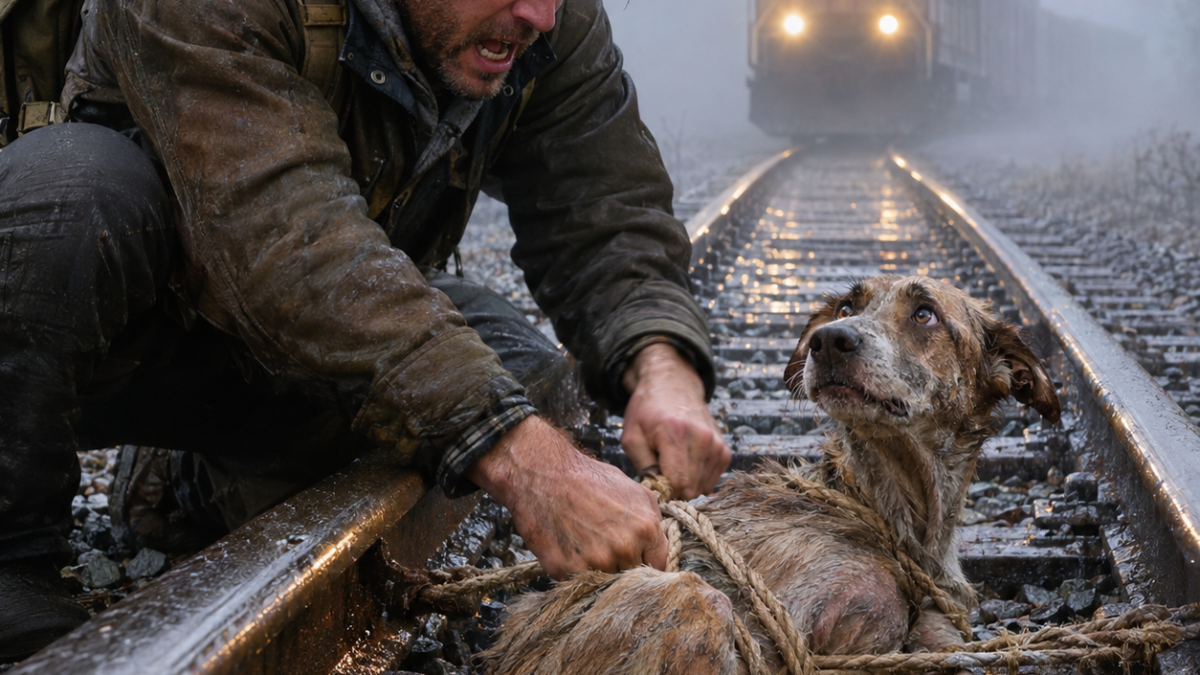
FULL STORY:“HE HAD ALREADY GIVEN UP… BUT I REFUSED TO LEAVE HIM THERE.” I Had Just 15 Minutes to Free a Starving Dog Deliberately Tied Between Railroad Tracks Before an Express Freight Train Arrived—The Rope Kept Tightening Around His Body, the Rails Began to Vibrate, and When the Whistle Finally Screamed Through the Fog… I Realized I Might Have to Choose Between Saving Him and Saving Myself.
FULL STORY CONTINUATION
I pressed the radio.
“Dispatch, Schneider. Emergency on Section 7 near Curve 4.”
Anna Weber answered immediately.
“What do you have?”
“Animal tied to the rails.”
Silence.
“What?”
“Dog. Deliberately restrained. I need BF-447 stopped.”
Another second.
I knew what I was asking.
Disrupting an express freight movement was not like stopping a car.
Hundreds of tons of cargo.
Network timing.
Connecting routes.
Safety consequences.
Reports.
Investigations.
Money.
A lot of it.
“Anna, confirm immediate stop.”
Her answer came firm.
“Understood. I’m stopping the train.”
I dropped the radio.
Then grabbed the rope.
The knot was brutal.
Multiple loops.
Pulled tight.
I tried loosening one section.
It tightened somewhere else.
The dog whimpered.
“Sorry.”
I stopped.
Changed position.
Tried again.
Nothing.
My gloves were too thick.
I pulled them off.
Rope fibers immediately burned my fingers.
6:50.
I could hear Anna over the radio coordinating with the train.
Then another voice.
Lukas Bauer.
Driver.
“Emergency braking initiated.”
Good.
But freight trains do not stop instantly.
Especially not at speed.
I bent lower.
Worked faster.
The dog watched me.
“I’m not leaving you.”
My voice shook.
“You understand?”
The dog’s tail moved once.
So faintly I almost imagined it.
Then the rail beneath my hand trembled.
Very slightly.
My stomach dropped.
I knew that vibration.
The train was coming.
For one second, I stopped breathing.
The vibration beneath the steel was still faint.
More sensation than sound.
But I had spent enough years around rail lines to know exactly what it meant.
Distance was closing.
I grabbed the radio.
“Anna.”
“Martin?”
“I can feel him.”
“I know. Lukas is braking.”
“How far?”
A pause.
I heard voices behind her.
Keyboard sounds.
Radio traffic.
Then:
“Still approaching. Get clear as soon as you can.”
I looked at Rex.
I did not know his name yet.
To me, he was just a dog who should never have been lying there.
“What’s the stopping distance?”
“Martin—”
“Anna.”
Her voice became harder.
“Keep working, but do not get yourself killed.”
Not an answer.
Which was an answer.
I dropped the radio again.
The dog watched me.
“You hear that?”
His ears moved.
“She thinks I’m stupid.”
The tail moved once.
“Yeah. You agree.”
I went back to the knot.
It was not ordinary rope work.
Whoever tied him had created a cruel arrangement.
The more the dog struggled, the more certain loops had cinched.
That explained the marks along his body.
He had fought.
Probably for hours.
Maybe longer.
Eventually he had learned movement hurt.
So he stopped.
I tried pushing slack back through the first loop.
Nothing.
Second.
Nothing.
The fibers had swollen with moisture and tension.
My fingers were already bleeding.
I barely noticed.
“Come on.”
The dog shifted.
“No.”
I touched his shoulder.
“Stay still.”
He looked at me.
Not trusting exactly.
Maybe too tired to resist.
I kept talking because silence felt unbearable.
“You picked a terrible place to spend your morning.”
His eyes stayed on mine.
“Mine was supposed to involve coffee.”
The track vibrated again.
Stronger.
I looked toward the fog.
Nothing visible.
That made it worse.
The curve hid the approach.
I could hear a low mechanical rumble now.
Far away.
But real.
My radio crackled.
Lukas.
“Martin, emergency braking is engaged.”
I grabbed it.
“Copy.”
“Can you move the dog?”
“Not yet.”
Silence.
Then Lukas said:
“I’m doing everything I can.”
His voice was calm.
Too calm.
The voice of a man controlling something enormous that did not want to stop.
“Understood.”
I put the radio down.
Then looked at the dog.
“So are we.”
I tried cutting the rope with the small utility blade on my inspection tool.
The angle was wrong.
Too close to the dog’s skin.
One mistake and I could injure him badly.
I abandoned it.
The rumble grew.
Wind moved differently now.
The dog heard it.
His ears rose.
His body tensed.
He tried to stand.
Pain stopped him.
He cried.
“Easy!”
I pushed one hand against his shoulder.
“Don’t fight it.”
The dog stared toward the curve.
He understood danger.
Animals do.
Maybe not schedules.
Maybe not locomotives.
But vibration.
Noise.
Ground moving.
Something enormous approaching.
His breathing changed.
Fast.
Shallow.
Panic returning.
I leaned close.
“Look at me.”
He looked toward the curve.
“Hey.”
I touched his face.
“Look at me.”
His eyes found mine.
“Good.”
My voice sounded nothing like I felt.
“We’re getting out.”
I did not know whether that was true.
But I said it anyway.
At dispatch, Anna Weber was dealing with chaos of her own.
I learned the details later.
The BF-447 had already passed into an active section where stopping it would affect several other scheduled movements.
Anna blocked the line.
Held another freight service.
Redirected one passenger connection.
Alerted the network supervisor.
Every button she pressed created another problem.
She did not care.
When her supervisor asked what the emergency was, she said:
“A dog is tied to the tracks.”
He apparently stared.
Then asked:
“Deliberately?”
“Yes.”
“How long until BF-447 reaches him?”
“Minutes.”
Her supervisor gave one instruction.
“Stop everything you need to.”
Anna did.
I never forgot that.
There are organizations where people hide behind procedure when life becomes inconvenient.
That morning, nobody did.
Inside the locomotive, Lukas Bauer pulled full emergency braking.
He had driven trains for twenty-three years.
Fifty-five years old.
Calm.
Experienced.
The kind of man who rarely raised his voice.
He told me later that the moment Anna said dog tied to the rails, he stopped thinking about the schedule entirely.
He thought about one thing.
Max.
Not my dog.
His.
A dog dead almost five decades.
But I did not know that yet.
All I knew was that somewhere beyond the fog, Lukas was trying to stop a massive train before it reached me.
And the rope still would not come free.
6:53.
The whistle sounded.
Long.
Distant.
The dog jerked.
My heart slammed against my ribs.
The whistle came again.
Louder.
Lukas signaling his approach.
A warning to anyone near the line.
To me, it sounded like a countdown.
I pulled harder.
Rope tore skin from two fingers.
“Come on!”
Nothing.
The dog whimpered.
I stopped.
If I panicked, I would hurt him.
I forced one breath.
Then another.
Think.
Tools.
No cutter suitable.
No time to retrieve more from the vehicle.
Knife unsafe.
Rope too tight.
Think.
I looked down.
My work boot.
Lace.
Thin braided synthetic cord.
I yanked it free.
Wrapped both ends around my hands.
Then fed the center beneath an exposed section of the restraining rope.
I began sawing.
Back.
Forward.
Back.
Forward.
Friction.
The shoelace heated almost immediately.
My fingers burned where I gripped it.
The rope fibers began fuzzing.
“Yes.”
I worked faster.
The track vibration intensified.
The rumble was no longer distant.
The dog began trembling.
“Stay with me.”
Back.
Forward.
“Stay with me.”
The whistle screamed again.
Fog seemed to move.
I could feel the train now through my knees.
Back.
Forward.
Smoke.
Tiny.
The smell of heated nylon.
My hands screamed.
I ignored them.
“Come on!”
One strand broke.
Not enough.
Again.
Faster.
The dog stared at me.
His eyes had changed.
No resignation now.
Fear.
Hope.
I almost preferred resignation.
Hope created responsibility.
My radio shouted from the ballast.
“Martin!”
Anna.
I could not answer.
“Martin, respond!”
Back.
Forward.
The rope softened.
The train sounded enormous now.
I looked toward the curve.
A light appeared through fog.
Headlight.
My entire body went cold.
“Come on!”
The shoelace snapped.
I cursed.
But part of the rope had nearly separated.
I grabbed it with both hands.
Pulled.
Nothing.
Pulled again.
My palms burned.
The dog cried.
“Sorry!”
I twisted.
Fibers tore.
One.
Another.
The headlight grew.
Then—
SNAP.
The rope broke.
The sudden release threw me backward.
For half a second I lay on the stones staring at the sky.
Then I remembered the dog.
He tried to stand.
Collapsed.
“No.”
The train horn blasted.
I grabbed him under his chest and hips.
He was lighter than he should have been.
Far lighter.
I dragged him clear of the first rail.
Then the second.
Not enough.
I needed distance.
I lifted.
He cried.
“Sorry.”
I stumbled down the embankment.
Boot slipped.
We fell together.
I turned so my body took most of the impact.
We rolled into wet grass.
The dog landed partly across my chest.
And at that exact moment, BF-447 came around Curve 4.
Even braking, the train looked impossibly fast.
The locomotive emerged from fog like a wall.
Metal.
Noise.
Wind.
The horn thundered.
I wrapped both arms around the dog instinctively.
Not because the train could reach us where we lay.
Because after everything, I needed to hold onto something.
The locomotive passed the point where Rex had been tied only seconds earlier.
My face pressed into wet grass.
The dog’s heart hammered against my chest.
The train kept moving.
Slower.
Slower.
Cars passing.
Steel screaming.
Then, several hundred meters down the track, BF-447 finally stopped.
Silence did not return immediately.
Metal settled.
Air systems hissed.
My own breathing sounded terrible.
I looked down at the dog.
“You alive?”
His eyes were open.
His chest moved.
Fast.
But moving.
Then something touched my side.
Faint.
Soft.
I looked.
His tail.
Moving.
Once.
Twice.
Weakly.
I laughed.
Then cried.
I did not even realize the difference.
“We did it.”
The dog’s tail moved again.
“We actually did it.”
Anna’s voice came from the radio somewhere above us.
“Martin!”
I pushed myself upright.
Pain in my shoulder.
Hands bleeding.
Dog across my lap.
I grabbed the radio.
“I’m here.”
There was a sound at the other end.
Not words.
Relief.
Then:
“Dog?”
“Alive.”
Silence.
Anna exhaled.
“Thank God.”
I looked toward the stopped train.
“Lukas?”
A second voice came through.
“I’m here.”
“Stopped.”
“Yes.”
“Thank you.”
Lukas answered quietly:
“No.”
Then after a pause:
“Thank you.”
I didn’t understand why.
Not yet.
Emergency services arrived around twenty minutes later.
Local ambulance.
Railway response crew.
Police.
A veterinarian named Dr. Henning Keller, contacted after Anna informed regional emergency coordination that an injured animal was involved.
I sat on the ambulance steps.
Blood dried across my palms.
A medic cleaned my fingers.
I barely noticed.
My attention stayed on the dog.
He was on a blanket.
Dr. Keller examining him.
“Male.”
“Dehydrated.”
“Underweight.”
“Multiple abrasions.”
“Ligature injuries.”
One paw badly inflamed.
No obvious major fractures.
When the vet lifted part of the rope still attached around the dog’s harness area, his face hardened.
“This was deliberate.”
A police officer nearby said:
“We know.”
I looked toward the tracks.
Deliberate.
The word kept getting worse.
Someone had placed a living animal there.
Tied him so struggling tightened the restraint.
Then walked away.
There are things I wish I understood less about people.
The dog was transported to the veterinary clinic.
I wanted to go.
My supervisor ordered me to complete medical treatment first.
My hands required cleaning and bandaging.
Minor cuts.
Nothing serious.
Compared with the dog, embarrassing.
By 10:30 a.m., I was back in the operations office.
Anna had left the dispatch console temporarily.
Lukas had been relieved after the emergency stop and required inspection procedures.
The three of us ended up sitting in a small room.
Coffee in paper cups.
Nobody drinking.
For several minutes, silence.
Then Anna looked at my hands.
“You used a shoelace?”
“Yes.”
She stared.
“I’m going to pretend that makes sense.”
“It worked.”
Lukas gave a short laugh.
First sound he had made.
Then he looked down.
His hands were shaking.
That surprised me.
The man had sounded calm through the radio.
Now his coffee trembled.
“You okay?” I asked.
He nodded too quickly.
Anna looked at him.
“Lukas?”
He stared at the table.
“Later.”
We let him have later.
The clinic called shortly before noon.
The dog was stable.
That word felt enormous.
Then another piece.
Microchip.
He had a name.
Rex.
Registered to the Kramer family.
Twenty kilometers away.
Reported missing.
Four months earlier.
I stared at the phone.
“Four months?”
The clinic employee confirmed.
Storm damage had broken part of the family fence.
Rex disappeared during the night.
The Kramers searched.
Posters.
Shelters.
Police notices.
Local online groups.
Nothing.
Their eight-year-old daughter, Emma, had apparently asked every night whether Rex might still come home.
Four months.
And now someone had found him tied to railway tracks.
Alive.
Barely.
But alive.
I drove to the clinic after work.
Bandaged hands on the steering wheel.
My body had begun understanding how exhausted it was.
The veterinary hospital smelled like disinfectant and wet fur.
Dr. Keller met me.
“He’s doing better than expected.”
“Can I see him?”
“Yes.”
Rex lay inside a clean kennel.
Front paws bandaged.
IV line.
Blanket beneath him.
His eyes were open.
When I entered, his ears moved.
I crouched outside the kennel.
“Hey.”
His tail moved.
Slow.
Weak.
But definitely.
Dr. Keller smiled.
“He remembers you.”
I looked at Rex.
“You caused a lot of paperwork.”
Tail.
“Entire freight network.”
Another movement.
“You better be worth it.”
Rex closed his eyes.
I laughed.
“Yeah.”
“Okay.”
“You’re worth it.”
The Kramer family arrived that afternoon.
I considered leaving.
The moment belonged to them.
Dr. Keller asked me to stay because Rex seemed calm with me nearby.
So I stood near the back wall when the door opened.
A man.
Woman.
Then a little girl with brown hair tied in two uneven braids.
Emma.
She saw Rex before anyone spoke.
Her whole body stopped.
For one second, she simply stared.
Then whispered:
“Rex?”
The dog’s eyes opened.
His ears lifted.
Emma dropped to her knees outside the kennel.
“Rex.”
His tail began moving.
Not weakly this time.
Faster.
His body tried to rise.
Dr. Keller stepped forward.
“Careful.”
But Rex struggled up.
His legs shook.
He reached the kennel door.
Emma put both hands through the safe opening.
Rex licked her fingers.
Once.
Again.
Emma began crying.
Not quiet tears.
The kind children cry when they have been trying to be brave for too long.
“I knew.”
She pressed her forehead near the bars.
“I knew you weren’t dead.”
Her mother covered her face.
Her father put one hand against the wall.
I looked away.
Some reunions deserve privacy even when you’re in the same room.
Emma kept talking.
“We looked everywhere.”
Rex licked her hand.
“I saved your blue blanket.”
Tail.
“Mom wanted to wash it.”
Her mother laughed through tears.
“I did wash it.”
Emma turned.
“You said you didn’t!”
“I lied.”
Everybody laughed.
Even Dr. Keller.
Rex’s tail kept moving.
I stood there with bandaged hands and felt something inside me settle.
Hours earlier, the train had seemed like the ending.
Now I was watching the beginning.
The police asked questions.
Where had Rex been for four months?
Who had tied him?
Why?
No clear answer.
The condition of his body suggested he had been underfed for some time.
Whether he had been living stray, held somewhere, or passed through multiple hands was unknown.
The investigation continued.
Evidence from the rope.
Nearby access.
Possible vehicles.
No immediate suspect.
I wanted one.
Badly.
I wanted a face for my anger.
Someone to explain how you tie a family dog to railway tracks and leave.
Eventually, I learned anger does not always get a destination.
That evening, Lukas found me at the rail office.
Most people had gone.
He stood in the doorway.
“Martin.”
I looked up.
“Hey.”
“Do you have a minute?”
“Sure.”
He closed the door.
Sat.
For a while, he said nothing.
Then:
“I need to tell you why I stopped the train.”
I frowned.
“Because Anna ordered you?”
“No.”
I smiled.
“She’d love that answer.”
Lukas did not.
His expression was different.
Painful.
Old.
“When I was seven,” he began, “we lived near a railway line.”
I sat back.
“We were poor.”
He shrugged.
“Not important.”
“My best friend was our dog.”
His voice changed.
“Max.”
The name caught somewhere in his throat.
“He was ugly.”
I smiled faintly.
“Brown, white, one ear that never stood properly.”
Lukas looked toward the dark window.
“One afternoon, I was playing near the tracks.”
He swallowed.
“I shouldn’t have been.”
“There was a train.”
“I didn’t hear it.”
My smile disappeared.
Lukas continued.
“Max did.”
Silence.
“He ran at me.”
“Hit me from the side.”
“Knocked me off the rail bed.”
Lukas stared at his hands.
“The train missed me.”
I already knew the next part.
I didn’t want to.
“Max didn’t make it.”
His voice broke.
For twenty-three years, Lukas Bauer had driven trains.
And somewhere beneath every kilometer sat that seven-year-old boy.
“He died pushing me clear.”
Lukas wiped his face.
“I never told anybody at work.”
“Why would you?”
“I don’t know.”
He breathed.
“Maybe because people make things into stories.”
He looked at me.
“But I made him a promise.”
“What promise?”
“That if I ever had the chance to stop for another animal…”
His eyes filled.
“I would.”
I sat completely still.
“When Anna said there was a dog tied to the tracks, I didn’t think about cargo.”
“Damage.”
“Schedule.”
“Reports.”
He shook his head.
“I saw Max.”
Everything about the morning changed.
Not the facts.
The meaning.
Lukas had not simply obeyed an emergency instruction.
He had answered a promise almost fifty years old.
A little boy saved by a dog grew into a man controlling hundreds of tons of steel.
Then one morning, another dog needed the train to stop.
And Lukas stopped it.
No hesitation.
Maybe that was why he thanked me over the radio.
Saving Rex had touched something he had been carrying his entire life.
I said:
“You kept your promise.”
Lukas looked down.
“I hope so.”
“You did.”
His mouth tightened.
“He would’ve been old a long time ago.”
“Max?”
“Yes.”
He laughed sadly.
“I still think about him as the same dog.”
I understood.
Memory protects some creatures from aging.
The following morning, Anna, Lukas, and I went to the veterinary clinic together.
Nobody planned it ceremonially.
We simply all wanted to see Rex.
He looked better.
Still weak.
Still bandaged.
But alert.
When I entered, tail.
Lukas stopped near the door.
He did not approach immediately.
I knew why.
Maybe Rex wasn’t Rex for him in that moment.
Maybe he was another dog.
Another rail line.
Another morning.
Another life.
I touched Lukas’s shoulder.
“You okay?”
He nodded.
Rex looked toward him.
Lukas crouched.
Held out his hand.
Rex sniffed.
Then licked his fingers.
Lukas cried.
No embarrassment.
No apology.
Anna stood behind us with tears in her eyes.
“What a mess you two are.”
Her voice broke too.
I looked at her.
“You’re crying.”
“Allergies.”
“Veterinary clinic.”
“Exactly.”
The Kramer family arrived soon after.
Emma carried something.
A blue blanket.
Apparently the famous one.
Dr. Keller had approved familiar bedding.
The moment Rex smelled it, his entire expression changed.
Emma placed it beside him.
“See?”
She stroked his neck.
“I kept it.”
Rex lowered his head onto the blanket.
Emma looked toward us.
“Which one of you saved him?”
That question made all three adults uncomfortable.
I pointed at Anna.
Anna pointed at Lukas.
Lukas pointed at me.
Emma frowned.
Dr. Keller laughed.
“All of them.”
Emma considered this.
Then asked:
“Was he scared?”
I looked at Rex.
“Yes.”
“Did he know the train was coming?”
“Probably.”
Her face crumpled.
Her father put a hand on her shoulder.
I continued gently:
“But he wasn’t alone at the end.”
Emma looked at me.
“I stayed with him.”
She swallowed.
“Even if you couldn’t untie him?”
Lukas closed his eyes.
Anna looked away.
I answered carefully.
“I was going to do everything I could to get both of us away.”
Emma studied me.
Then hugged me.
Suddenly.
Arms around my waist.
My hands hurt when I hugged back.
I didn’t care.
Rex remained at the clinic for nearly two weeks.
Then returned home.
The Kramers sent photographs.
Rex sleeping beside Emma’s bed.
Rex in the yard.
Rex wearing a ridiculous red bandanna.
Rex sitting beside a bowl that said WORLD’S BEST DOG.
I thought that was excessive.
Emma disagreed.
Recovery took months.
Weight returned.
Wounds healed.
His paw improved.
Certain sounds frightened him.
Metal clanging.
Train horns.
The Kramers worked with a behavior professional.
No forced exposure.
No dramatic “facing his fear.”
Safety.
Routine.
Choice.
I appreciated that.
Rex had endured enough.
Three months after Curve 4, the Kramers invited Anna, Lukas, and me to their home.
Rex looked almost like a different dog.
Coat shiny.
Body filled out.
Eyes bright.
He saw me.
Ran.
Not perfectly.
A slight limp remained after long activity.
But fast enough.
He hit me at the knees.
“Whoa!”
Emma laughed.
“He remembers!”
I knelt.
Rex licked my face.
“Yeah, yeah.”
Tail everywhere.
“I remember you too.”
Lukas stood back.
Rex noticed.
Walked toward him.
Lukas crouched.
Rex placed his head against the old driver’s chest.
Lukas froze.
Then wrapped both arms around him.
Emma watched.
“Why is he crying?”
I looked at Anna.
Anna looked at me.
Lukas answered himself.
“Because he reminds me of somebody.”
Emma asked:
“Another dog?”
“Yes.”
“What was his name?”
Lukas smiled through tears.
“Max.”
Emma remembered that name.
Children are good at holding the important pieces of stories.
Later, she showed us a drawing.
Tracks.
A train.
Rex.
Three adults.
Then another smaller brown dog above them.
I stared.
“Who’s that?”
“Max.”
Lukas covered his mouth.
Emma said:
“Mom says dogs go somewhere good.”
Her mother looked embarrassed.
“I said maybe.”
Emma ignored her.
“So Max helped stop the train too.”
Nobody corrected her.
Some truths do not need to be literal.
The police investigation never identified the person who tied Rex to the tracks.
That frustrated me for a long time.
I wanted accountability.
Still do.
Cruelty should have consequences.
But eventually I stopped allowing an unknown person to occupy the center of Rex’s story.
They had already taken enough from him.
The important people were the ones who did not keep walking.
Anna.
Lukas.
Dr. Keller.
Emergency crews.
The Kramers.
Emma.
Maybe me.
The person who tied Rex represented the worst question.
Why?
The people who stopped represented the better one.
What now?
What can we do?
That is where I chose to stay.
The emergency stop generated reports.
Many.
I filled out forms.
Anna filled out more.
Lukas participated in equipment inspections.
Schedules were disrupted.
Freight arrived late.
There were costs.
Network supervisors reviewed everything.
I expected somebody eventually to ask whether stopping an entire line for a dog had been justified.
A senior manager did.
He sat across from me.
“Would you make the same call again?”
“Yes.”
No hesitation.
He looked at my report.
“Even knowing the consequences?”
“Yes.”
He nodded.
“Good.”
That was it.
No disciplinary spectacle.
No absurd punishment.
Safety systems exist precisely because when a life is on the track, trains stop.
The inconvenience was real.
So was Rex.
Lukas’s emergency braking did require inspections.
Everything checked.
No major damage.
The cargo remained secure.
The delay cost money.
Nobody denied that.
But every time someone mentioned cost, I saw Emma kneeling beside the kennel.
Rex licking her hand.
There are expenses you regret.
That wasn’t one.
Anna later told me something funny.
When she first sent the stop instruction, another controller asked:
“For what?”
Anna answered:
“A dog.”
The controller said:
“A dog?”
Anna looked at him.
“Yes.”
Apparently something in her face ended the conversation.
I liked that.
She became fiercely protective of the story.
Whenever someone exaggerated, she corrected them.
“The train wasn’t seconds from impact.”
“It was minutes.”
“The dog was not on the rail with a locomotive already fifty feet away.”
“We had time to respond because people acted early.”
That mattered.
I agreed.
Real courage does not require impossible Hollywood timing.
The truth had been terrifying enough.
Lukas also corrected people.
“Emergency braking is not magic.”
He explained inertia.
Stopping distance.
The responsibility involved.
Then he would end with:
“That is why Martin called early.”
I appreciated that.
The story was not:
One man beat a train.
The story was:
One man noticed.
One dispatcher acted.
One driver stopped.
One network cooperated.
One veterinarian treated.
One family waited.
Rex survived because a chain held.
I began stopping near Curve 4 most mornings.
Not on the track.
On the maintenance shoulder.
I would look at the place.
Grass had grown back.
No rope.
No blood.
No emergency.
Just railway.
At first the memory hit hard.
The vibration.
Whistle.
Rex’s eyes.
Then gradually something changed.
I started seeing the later images too.
Emma.
Blue blanket.
Red bandanna.
Rex running.
Memory expanded.
That helped.
Lukas did something similar.
Whenever BF-447 or another service he drove crossed Section 7, he looked toward the curve.
He later admitted that he whispered one name.
Max.
Every time.
Not Rex.
Max.
The dog who had died before Lukas was old enough to understand sacrifice.
The dog whose memory had reached across decades to another rail line.
One afternoon, I rode in the cab with Lukas during a scheduled inspection.
As we approached Curve 4, he became quiet.
I noticed.
He looked toward the embankment.
Then whispered:
“Max.”
Barely audible.
I pretended not to hear.
Some rituals deserve privacy.
After the curve, he said:
“You know what bothers me?”
“What?”
“I drove past this place thousands of times before.”
“And?”
“Nothing.”
He looked ahead.
“Just tracks.”
I nodded.
“Now?”
He smiled.
“Now it’s two dogs.”
I understood.
Places collect meaning.
Anna had her own ritual.
She kept a photograph Emma sent.
Rex sitting beside her.
On the back, Emma had written in uneven handwriting:
THANK YOU FOR STOPPING THE TRAIN.
Anna taped it inside her locker.
Someone teased her.
She told them to get out.
Months later, Emma visited the control center with her parents.
Anna showed her the board.
Not operational details.
Just enough to understand.
“This is where I was sitting.”
Emma stared.
“You pressed the button?”
“Several.”
“Which one stopped the train?”
Anna smiled.
“Lukas stopped the train.”
Emma frowned.
“But you told him.”
“Yes.”
“So you both did.”
Anna laughed.
“Exactly.”
Children again.
Better at distributing credit.
Then Emma asked:
“Were you scared?”
Anna paused.
“Yes.”
“But you sounded calm?”
Her father looked surprised.
“How do you know?”
Emma said:
“Martin told me.”
Anna smiled.
“You can be scared and still do the job.”
That became one of Emma’s favorite sentences.
Her mother told me later she repeated it before a school presentation.
I liked that.
The rescue continuing in strange directions.
Rex developed a habit after returning home.
Every morning, he waited beside the front door while Emma got ready for school.
Then walked with her and her father to the corner.
Not all the way.
Traffic.
Routine.
At the corner, Emma hugged him.
Then left.
Rex returned home.
Every morning.
The dog who had been missing four months now became obsessed with seeing Emma leave safely.
Maybe coincidence.
Maybe dogs build routines.
Either way, the Kramers cherished it.
One photograph showed Emma kneeling beside Rex before school.
Backpack.
Braids.
Rex’s head against her shoulder.
I kept that one.
Not the railway photo.
That one.
Recovery should be documented more often than danger.
I thought about whoever tied him less.
Then more.
Then less again.
Anger is cyclical.
One day I asked Dr. Keller:
“How do you work with cruelty cases without hating people?”
He looked at me.
“I don’t always succeed.”
Fair.
Then:
“But the animal needs me focused on healing, not rage.”
That stayed with me.
Healing is work.
Rage can wait.
Rex had scars.
Physical.
Behavioral.
Some faded.
Some remained.
The Kramers did not make him prove he was “over” anything.
If trains in the distance made him nervous, they closed windows.
If certain ropes triggered fear, they used different equipment.
If he needed space, he got it.
Recovery is not passing tests.
It’s building a life large enough that fear stops being the whole story.
By six months, Rex was running normally enough for play.
Emma sent video.
Ball thrown.
Rex charging across the yard.
I watched it five times.
The train story had become famous among railway staff.
The running dog was better.
Our network later implemented extra guidance for animal-obstruction reports.
Not because dogs suddenly outranked human safety.
Because any obstruction on active rail requires serious response, and deliberate cruelty cases needed coordination with police and animal services.
Rex’s case became a training example.
Again, useful.
I preferred useful to legendary.
One new employee asked me:
“What if Anna hadn’t stopped the train?”
I said:
“She would have.”
“But what if?”
I looked at him.
“That question doesn’t help operations.”
He seemed confused.
“So what helps?”
“Ask what made stopping possible.”
He waited.
“Early detection.”
“Clear communication.”
“People willing to act.”
“Good systems.”
“Then build more of that.”
What-if can teach.
But only if it leads somewhere.
The young employee nodded.
I thought about Rebecca—no, wrong story. Need keep Anna.
Anna would have approved.
A year after Rex’s rescue, the Kramers invited us for dinner.
Emma was nine.
Rex had gained all his weight back.
The limp nearly gone.
He slept beneath the table.
At dessert, Emma asked Lukas:
“Do you still think about Max?”
Lukas looked surprised.
“Yes.”
“Every day?”
“Not every day.”
Then smiled.
“Often.”
Emma thought.
“Do you think Max knows you saved Rex?”
The room became quiet.
Lukas looked at me.
Then Anna.
Then Rex.
“I don’t know.”
Emma frowned.
Lukas continued.
“But I hope so.”
She accepted that.
Then said:
“I think he does.”
Lukas cried.
Again.
Emma seemed used to making grown men cry by then.
Later, on the porch, Lukas told me:
“I spent years thinking Max’s death was only a loss.”
I waited.
“It was.”
He nodded.
“But that morning…”
He looked toward the house where Rex slept.
“For the first time, something came back from it.”
I understood.
Not justification.
Nothing justifies losing a beloved dog as a child.
But pain had shaped a promise.
The promise became action.
Action saved Rex.
Meaning can grow from loss without making the loss necessary.
Important distinction.
Anna joined us.
“You two being philosophical?”
“Yes.”
“Stop.”
She handed us coffee.
We did not stop.
As years passed, Curve 4 became ordinary again.
Fog.
Fields.
Rails.
Trains.
But never completely.
Sometimes during inspections, I found myself slowing.
Remembering.
The first sound.
Whimper.
Then eyes.
I wondered how long Rex had been there before I arrived.
Hours?
A night?
We never knew.
I tried not to imagine.
The part I knew was enough.
I heard him.
That is what mattered.
There are sounds in railway work you learn to ignore.
Birds.
Wind.
Metal contracting.
Brush against fencing.
If I had categorized that whimper as background noise, the outcome would have been different.
Attention matters.
One extra second.
Turn your head.
Look.
Not every strange sound is an emergency.
But sometimes it is.
I became more attentive afterward.
Not fearful.
Attentive.
A fox trapped near fencing.
A deer caught between barriers.
A stray dog wandering near an access road.
Most situations mundane.
Some needed help.
Rex sharpened my ears.
Anna once joked:
“Martin now stops for every squirrel.”
Not true.
Mostly.
Lukas retired several years later.
At his farewell ceremony, someone told the Rex story.
Lukas groaned.
Then they told the Max story.
He went silent.
The department gave him a framed photograph.
Not of a locomotive.
Of Rex and Emma.
On the back, Emma had written:
FOR MAX.
Lukas could not speak for almost a minute.
Best retirement gift I ever saw.
After retirement, Lukas visited the Kramers sometimes.
Rex loved him.
Maybe because Lukas carried treats.
Maybe because animals sense soft people beneath hard jobs.
Maybe coincidence.
Who cares.
They became friends.
Anna eventually moved into a supervisory role.
She trained dispatchers.
One of her recurring lessons was simple:
“When someone in the field uses the word immediate, listen to the rest before thinking about inconvenience.”
She never mentioned money first.
Safety first.
Good dispatcher.
I remained in inspection work.
Still stopped at Curve 4 sometimes.
Still smiled.
Not because I enjoyed remembering fear.
Because the place held proof.
Steel did not always win.
Cruelty did not always win.
Sometimes someone heard.
Sometimes systems responded.
Sometimes the train stopped.
Sometimes the dog went home.
Rex grew older.
Photographs changed.
Gray around muzzle.
Emma grew too.
Braids disappeared.
Then braces.
Then teenager.
Rex remained beside her.
The dog who vanished when she was eight stayed long enough to watch her grow.
That felt like a gift beyond calculation.
When Emma was twelve, she wrote a school essay about Rex.
She sent me a copy.
The title was:
THE DAY THREE STRANGERS BROUGHT MY BEST FRIEND HOME
I corrected her.
“More than three.”
She answered:
“I know. But that sounded better.”
Writer already.
In the essay, she barely mentioned the train.
She wrote about searching.
Posters.
Empty bed.
Blue blanket.
Her parents telling her they might never find Rex.
Then the phone call.
Clinic.
His tongue on her hand.
She ended with:
I learned that missing does not always mean gone forever.
I had to stop reading.
Children understand grief with frightening precision.
I framed the last paragraph.
Never told her.
Years after the rescue, people still occasionally asked me whether I was afraid on the tracks.
Yes.
Anyone saying otherwise is lying or foolish.
I was terrified.
Not noble.
Not calm.
My hands shook.
I thought I might fail.
I thought about running.
That mattered.
Courage is not a personality where fear disappears.
It is deciding what matters while fear is present.
That morning, Rex mattered.
Simple.
Would I have stayed on the rail until impact?
People ask.
I dislike the question.
Emergency work is not about dramatic self-sacrifice.
You try to save without becoming another victim.
I was working to free him and move both of us.
The train was braking.
Dispatch knew our location.
I was not seeking martyrdom.
I was refusing to abandon the rescue while viable options remained.
There is a difference.
Important.
The romantic version says:
I would have died with him.
The responsible version says:
I would have done everything I could to get both of us out.
I prefer responsible.
Rex needed a living rescuer.
I tell younger inspectors that.
Do not confuse courage with recklessness.
Call early.
Communicate clearly.
Use the system.
Trust dispatch.
Respect stopping distances.
Then act.
That is what saved Rex.
Not bravado.
The shoelace gets too much attention.
People love the detail.
“How did you think of it?”
I didn’t.
Not really.
My brain searched for something thin enough to create friction without cutting Rex.
It was there.
I used it.
Improvisation only works after training gives you a structure.
Another less exciting truth.
My hands healed.
Scars faded.
One small line remains near my index finger.
Sometimes I notice it.
Rope.
Fog.
Dog.
Train.
Then Rex running in Emma’s yard.
Always continue memory past the danger.
That became a rule for me.
The first image your brain stores is often crisis.
You have to deliberately add the healing.
Otherwise tragedy keeps winning after it ended.
I added healing.
Rex home.
Emma older.
Lukas smiling.
Anna’s photograph.
Curve 4 quiet.
Train passing safely.
All of it.
Whoever tied Rex there was never identified.
That remains unfinished.
But Rex’s life is not unfinished.
There is a difference.
We do not always get complete justice.
Sometimes we get rescue.
Then recovery.
Then years.
Take the wins that exist while still acknowledging what is missing.
One morning, long after the case went cold, I realized I had passed Curve 4 without thinking about the unknown offender once.
I thought about Rex.
That felt like progress.
The person who harmed him had finally lost narrative control.
Good.
Rex became the center again.
Where he belonged.
The Kramers eventually moved to a house farther from the rail corridor.
Larger yard.
Emma sent a photograph.
Rex lying beneath an apple tree.
Caption:
NO TRAINS.
I laughed.
Excellent real-estate criterion.
I visited once.
Quiet countryside.
Rex asleep in grass.
I sat beside him.
Older.
He opened his eyes.
Tail moved.
I stroked his head.
“Remember me?”
He sighed.
Probably not.
Maybe scent.
Maybe yes.
No need.
I remembered him.
Enough.
Emma came outside.
“He still sleeps beside my bed.”
“How old is he now?”
“Vet thinks around ten.”
I smiled.
“Old man.”
Rex opened one eye.
Emma defended him.
“He’s distinguished.”
Fair.
She sat beside me.
“Martin?”
“Yes?”
“Were you really going to stay?”
There was that question again.
I looked at her.
“I was going to keep trying until we were out of options.”
She nodded.
“Were you scared?”
“Yes.”
“Really?”
“Very.”
She seemed relieved.
“Why?”
She shrugged.
“I get scared a lot.”
“That doesn’t mean you can’t do things.”
She looked at Rex.
“I know.”
Anna’s lesson.
Passing onward.
Emma later studied veterinary science.
At least that was her plan as a teenager.
I don’t know where life eventually took her.
But Rex influenced her.
Again, one rescue moving outward.
Lukas once said:
“Max saved me once.”
“Rex saved something in me later.”
I asked what.
He thought.
“Forgiveness.”
“For who?”
“Myself.”
I looked at him.
He explained.
“For years, some part of me believed Max died because I was stupid enough to be on the tracks.”
I stayed quiet.
“I was seven.”
“I know.”
“Seven-year-olds don’t know that.”
His eyes filled.
“Stopping for Rex didn’t bring Max back.”
“No.”
“But maybe it helped me believe his death wasn’t my fault.”
That was heavier than anything I expected.
I put a hand on his shoulder.
He did not need words.
Trauma survives in strange places.
A fifty-five-year-old engineer braking a freight train because a seven-year-old still remembers a dog.
Time is not linear inside grief.
Maybe rescue isn’t either.
Sometimes you save the present.
Something in the past breathes easier too.
Anna heard that conversation later.
She cried.
Again blamed allergies.
Consistent.
As for me, Rex changed one belief permanently.
Before him, I thought railway work was mostly about systems.
Precision.
Predictability.
Infrastructure.
Afterward, I understood systems reveal their values during interruption.
Schedules matter.
Freight matters.
Cost matters.
But when life enters the equation, priorities should become clear.
That morning, they did.
Everyone acted.
That made me proud of people.
A feeling not always easy to maintain.
There is cruelty in the world.
Somebody tied Rex there.
No lesson erases that.
But cruelty did not operate alone.
A worker heard.
Dispatcher responded.
Engineer braked.
Emergency crews came.
Veterinarian treated.
Family returned.
One cruel act met an entire chain of people saying no.
I prefer remembering the chain.
That is perhaps why the story endured around the railway.
Not because a train nearly hit a dog.
Because many people interrupted their normal work for one life none of them knew.
No reward.
No fame.
No idea there was a little girl waiting somewhere.
Rex mattered before we knew Emma existed.
That is important.
We did not save him because he belonged to a sweet family.
We saved him because he was alive.
The family reunion was a gift afterward.
Sometimes people ask:
“What if he had been stray?”
Same answer.
Stop the train.
Free him.
Help him.
A life does not require an owner to become worth saving.
Dr. Keller agreed.
He told me once:
“The chip made the ending happier.”
“It didn’t make the dog more valuable.”
Exactly.
The rope from that morning remained police evidence for some time.
Eventually, I had an opportunity to see a photograph.
I declined.
I did not need it.
I remembered enough.
I kept the broken shoelace for several months.
Then threw it away.
People were shocked.
“Why?”
Because I did not need a relic of fear.
I had Rex’s photograph.
Much better.
My favorite shows him beside Emma.
No rails.
No train.
No bandages.
Just dog.
That is who he became again.
The best rescue endings are boring.
Breakfast.
Walk.
Bed.
School.
Home.
Ordinary.
Three months after the rescue, I had thought his recovery was complete.
Years later, I understood recovery continues.
Every safe day counters something.
Every ordinary morning says:
That wasn’t the end.
Rex got thousands of those mornings.
Good.
Curve 4 still exists.
Fog still settles over the fields.
Freight trains still come through.
Steel still vibrates.
Schedules still matter.
I still inspect.
Sometimes when the BF-447 route approaches, I step back and watch from a safe position.
The train passes.
No emergency.
I smile.
Normal operation.
Beautiful.
Lukas once asked why.
“Why what?”
“Why do you smile when trains pass there?”
I thought.
“Because now they’re just trains.”
He understood.
Eventually, the intensity faded.
It should.
Human nervous systems cannot remain inside one morning forever.
But meaning stayed.
That is healthier.
The story changed how our team talked about attention.
Not paranoia.
Attention.
One sound.
One glance.
One extra check.
A lot of safety begins there.
I think about Rex when people say one person cannot change much.
True in scale.
False in moments.
I didn’t save Rex alone.
But if I kept walking, nobody else in the chain got activated.
Anna mattered.
Lukas mattered.
The whole network mattered.
But someone has to notice first.
Sometimes your job is only to be the first link.
That’s enough.
Anna noticed my voice.
Lukas trusted her instruction.
I trusted both.
Rex trusted me enough to remain still while I worked.
Trust everywhere.
That story is as much about trust as rescue.
Rex could have bitten me.
He was terrified.
Hurt.
Restrained.
He didn’t.
Maybe exhaustion.
Maybe temperament.
Maybe something in my voice.
I will never know.
But I respected him for it.
Not because “good dogs don’t bite.”
Fear can make any animal defend itself.
He gave me room to help.
That mattered.
I gave him the same.
Moved slowly.
Stopped when he cried.
Talked.
Worked.
Trust is reciprocal even in fifteen-minute emergencies.
Years later, when I trained younger staff, I told them:
“Technical competence matters.”
Then:
“But so does how you approach a frightened living thing.”
Equipment cannot replace compassion.
Compassion cannot replace equipment.
Need both.
Emma once sent me a birthday card.
Mine.
She wrote:
THANK YOU FOR NOT LEAVING HIM.
That sentence still destroys me.
Because from her perspective, that was the whole story.
Not logistics.
Not braking.
Not rope.
Not money.
I didn’t leave.
Maybe that is the simplest definition of rescue.
You find someone in danger.
You refuse to leave while help is possible.
Lukas did the same.
Anna too.
In different places.
She stayed at the console.
He stayed on the brakes.
I stayed with Rex.
Three people.
One promise none of us said aloud.
Not leaving.
The irony is that Rex probably understood none of our institutions.
Rail dispatch.
Braking systems.
Emergency hierarchy.
He knew only that someone appeared.
Touched the rope.
Spoke softly.
Then the noise grew.
Then freedom.
Then grass.
Maybe that was enough.
I hope his memory eventually blurred the rest.
Dogs deserve that.
One winter after his recovery, Emma sent a photo of Rex asleep beside a Christmas tree.
Red bow.
Ridiculous.
I showed Lukas.
He smiled.
“Max hated bows.”
I laughed.
“Rex looks like he does too.”
“Good dogs have standards.”
The photograph stayed on my desk for years.
Whenever paperwork became tedious, I looked at it.
Thousands of euros in delays.
Reports.
Meetings.
All reduced to one sleeping dog.
Worth it.
Every second.
Every euro.
Every report.
Worth it.
People sometimes make financial language sound cold.
Money matters.
Infrastructure matters.
But cost is not the same as value.
The rescue cost something.
Rex had value.
Not because he was expensive.
Because he was alive.
Different accounting.
That morning taught me to keep those categories separate.
The older I get, the more I think about Lukas’s childhood promise.
Seven years old.
Dog pushes him away.
Dog dies.
Boy promises never to ignore another animal in danger.
Decades pass.
Career.
Marriage.
Children.
Thousands of train journeys.
Then one radio call.
The promise wakes up.
That is extraordinary.
Not mystical.
Human.
We carry old promises farther than we realize.
Maybe Emma carried one too.
Maybe she became a vet.
Maybe she simply grew into an adult who stops for animals.
Either way, Rex’s rescue continued beyond us.
That is how good acts spread.
Not perfectly.
Not visibly.
But outward.
If you ask me whether I consider myself a hero, no.
I know that answer sounds obligatory.
Still true.
I was an inspector who heard a dog.
Anna was a dispatcher who followed emergency procedure with courage.
Lukas was a driver who braked when told—and with a lifetime of personal reason behind it.
Dr. Keller treated.
The Kramers loved.
No superhero.
Just people doing what needed doing.
Maybe that is more hopeful.
Heroes feel rare.
People are everywhere.
Curve 4 became proof ordinary people can interrupt terrible outcomes.
That matters more to me than any hero story.
Years later, I once stood there in light snow.
No fog.
No emergency.
I looked at the exact patch of grass where Rex and I landed.
Nothing marked it.
No plaque.
Good.
Nature had forgotten.
Maybe places don’t need memorials to matter.
I knew.
Enough.
A train approached in the distance.
Normal speed.
I stood safely clear.
The horn sounded once.
For a second, my body remembered fear.
Then the train passed.
I looked down the line.
Whispered:
“Max.”
I surprised myself.
That was Lukas’s word.
Now mine too.
Not because I knew the dog.
Because some stories become shared.
A dog from Lukas’s childhood.
A dog from Emma’s childhood.
Two lives separated by decades.
Connected by steel rails and one decision.
Stop.
I understood then why Lukas whispered the name.
It wasn’t grief only.
It was gratitude.
Max’s final act had continued farther than he could ever know.
That can happen.
We do something loving.
It echoes after us.
Sometimes decades.
Rex never knew Max.
Still benefited from him.
That is one of the most beautiful ideas I carry from the whole experience.
We may be helped by kindness from people—or animals—we never meet.
Because someone remembers them.
Because someone made a promise.
Because love taught a lesson that survived.
Lukas had been saved by Max.
Rex was saved partly because Lukas never forgot.
Emma got Rex back because of a dog who died before she was born.
Try explaining that without getting emotional.
I cannot.
The person who tied Rex to the tracks tried to make that railway a place of ending.
They failed.
Completely.
Curve 4 became a beginning.
Rex went home.
Emma got her best friend back.
Lukas kept a childhood promise.
Anna carried proof that disruption can be the correct decision.
I learned that noticing is sometimes the most important part of a job.
Even the railway learned.
Procedures improved.
People remembered.
One ugly act produced a larger answer.
Not because cruelty was useful.
Because others refused to let it have the last word.
That distinction matters.
Do not thank cruelty for resilience.
Thank the people who respond to it.
I still hate that somebody hurt Rex.
I hope accountability found them in some other way if not ours.
But their identity no longer matters to the part of the story I choose to tell.
Rex’s identity does.
Emma’s.
Anna’s.
Lukas’s.
Max’s.
Those are the names worth remembering.
Three months after the rescue, I visited Curve 4 and smiled.
Years later, I still do sometimes.
Not every day.
That would be strange.
But enough.
I remember the vibration.
The headlight.
The rope snapping.
Rex’s body against my chest.
Then the tail.
Weak.
Once.
Twice.
That tail is the detail I return to most.
Because before we knew the family.
Before recovery.
Before Emma.
Before anything.
Rex was lying in wet grass beside me.
Train stopping hundreds of meters away.
Both of us shaking.
And his tail moved.
Life.
Still there.
That was enough.
Everything afterward was a gift.
If Rex could have spoken, perhaps he would not have thanked us.
Maybe he would have asked for water.
Or food.
Or simply sleep.
That is fine.
Rescue does not require gratitude.
We help because help is needed.
Not because the rescued must understand the sacrifice.
Another lesson.
Rex did not owe me his tail wag.
Still, I treasure it.
Emma once asked me what I said to him on the tracks.
I had forgotten much.
Then remembered one sentence.
“I won’t leave you.”
She cried.
I regretted telling her.
Then she said:
“Good.”
Simple.
The truth is, that sentence frightened me even when I said it.
Because promises during emergencies are dangerous.
Sometimes you cannot control the outcome.
Yet in that moment, it meant something narrower.
I would keep trying.
I could promise effort.
That was enough.
Maybe we should make fewer promises about outcomes.
More about presence.
I can’t promise everything will be okay.
I can promise I won’t disappear while there’s something left to do.
Better.
Honest.
Rex survived because many people kept presence.
Anna at her board.
Lukas at the controls.
Me at the rope.
Dr. Keller at the clinic.
The Kramers through four months of searching.
Emma with a blue blanket she refused to let disappear.
Presence.
Everywhere.
The Kramers had nearly stopped believing Rex would return.
But they never threw away his things.
That moved me.
Not because objects have magic.
Because hope sometimes survives in tiny acts.
Leave the blanket.
Keep the bowl.
Check the shelter again.
One more poster.
They did.
Then the phone rang.
Four months is a long time for a child.
Emma had gone to sleep more than a hundred nights without Rex.
Then one morning he existed again.
I cannot imagine what that did to her understanding of hope.
Maybe something beautiful.
Maybe dangerous.
Life does not always return what goes missing.
I hope her parents explained that too.
But this time it did.
This time, yes.
Sometimes yes is enough to keep people going through later no.
I have seen other emergencies since.
Some end well.
Some don’t.
Rex never made me believe rescue always succeeds.
That would be childish.
He made me believe success is possible enough to justify trying.
Much more realistic.
Much more useful.
You do not need certainty before action.
You need enough possibility.
That morning, I had it.
A dog breathing.
A rope.
A train braking.
Enough.
I worked.
Anna worked.
Lukas worked.
The dog lived.
Years later, on one of my final inspections before transferring roles, I stopped at Curve 4.
Fog again.
Almost identical to that morning.
For a second, I expected a whimper.
Nothing.
Just birds.
I smiled.
Silence can be good.
No one needed rescue.
Perfect.
I looked toward the rail.
Thought of Rex sleeping beside Emma.
Lukas whispering Max.
Anna’s photograph.
Then I said aloud:
“Worth it.”
Nobody heard.
That was fine.
Some decisions do not need applause.
They need to be made.
If I could speak to myself at 6:47 that morning, kneeling beside a dog I had never seen before, I would tell him one thing.
Keep going.
Not because you are guaranteed success.
Because help is already moving.
Anna is listening.
Lukas is braking.
The dog is still breathing.
You are not alone in this.
That might have helped.
I felt very alone on those rails.
I wasn’t.
Rescue often feels solitary from the ground.
It rarely is.
Somebody is holding another part of the rope you cannot see.
Sometimes literally.
Sometimes in a dispatch room kilometers away.
Sometimes inside a locomotive.
Trust that.
Rex taught me that too.
The last photograph Emma sent me before the story gradually became part of the past showed Rex asleep at the foot of her bed.
Emma was older.
Teenage textbooks stacked nearby.
Rex gray around the muzzle.
Caption:
HE STILL WAITS UNTIL I’M ASLEEP.
I stared at that line.
The dog once tied alone to tracks now waited beside a child every night until she felt safe enough to sleep.
That is the ending I choose.
Not rails.
Not rope.
Not the train.
A bedroom.
A girl.
An old dog.
Home.
Lukas’s Max died saving a seven-year-old boy.
Rex lived because that boy grew up remembering.
Rex then spent his life beside another child.
Maybe protection moves in circles.
Not magic.
Memory.
Behavior.
Love.
Anna once told me:
“You know this is why people stay in difficult jobs.”
“What?”
“The rare days when everything works.”
She was right.
Most workdays are paperwork.
Routine.
Minor problems.
Then sometimes every skill, system, and decision converges around something that matters completely.
Those days carry you through the rest.
Curve 4 was one of those days.
I still have no idea what Rex understood about the train.
Probably noise.
Fear.
Pain.
Then freedom.
I know what I understood.
Systems can stop.
Schedules can wait.
Money can be recovered.
Reports can be written.
A life cannot be replaced once lost.
That hierarchy became very simple.
Would I do it again?
Yes.
Anna?
Yes.
Lukas?
Before you finish asking.
Yes.
And if you asked whether Rex was worth every second?
Every delay?
Every inspection?
Every page of paperwork?
Look at Emma.
There is your answer.
One cold morning years later, I received a card from the Kramer family.
No holiday.
Just a card.
Inside was a photograph of Rex under the apple tree.
Emma had written beneath it:
HE IS OLD NOW. HE IS HAPPY.
I sat at my desk for a long time.
Old.
Happy.
Two words a dog tied to railway tracks should never have had the chance to become.
He did.
That is rescue.
Not simply preventing death.
Creating the possibility of old and happy.
I kept the card.
Of course.
I do not know how many more years Rex had after that.
That part belongs to the Kramers.
I don’t need every ending.
I know enough.
He survived Curve 4.
Went home.
Loved and was loved.
Grew old.
That is a complete victory.
Whenever I pass Section 7 now, I still sometimes look toward the grass.
No memorial.
No marker.
Only rails disappearing into distance.
But I know what happened there.
A dog had been abandoned to an ending.
Three people, an emergency crew, a veterinarian, and a family refused to accept it.
The train stopped.
The rope broke.
The dog lived.
And decades after an old dog named Max gave his life pushing a little boy away from steel, that boy—now an engineer with gray in his hair—pulled a brake lever for another dog he had never met.
That is the part I will carry longest.
Not fear.
Not cruelty.
The promise.
A seven-year-old boy whispering something to a dog he had lost.
I won’t ignore another one.
Almost fifty years later, Anna’s voice came through Lukas Bauer’s radio.
“Animal on the tracks. Emergency stop.”
And that old promise answered before the man even had time to think.
Understood. Braking now.
Sometimes love survives as memory.
Sometimes memory becomes action.
Sometimes action stops a train.
And sometimes, because of that, a little girl kneels beside a veterinary kennel four months after losing her best friend, whispers his name—
“Rex?”
—and watches a tail begin to move.
That morning, standing beside the rails, I thought I was fighting fifteen minutes.
I know better now.
I was standing inside a story that had begun nearly fifty years earlier with another dog, another child, and another train.
Max saved Lukas.
Lukas helped save Rex.
Rex came home to Emma.
And somewhere between all of us was the simplest truth I have ever learned from railway work:
There are things worth stopping everything for.
A schedule.
A freight network.
A morning.
Even a train.
Because when a living creature is still breathing and there is still something you can do—
you stop.
You stay.
And you do not leave them behind.








