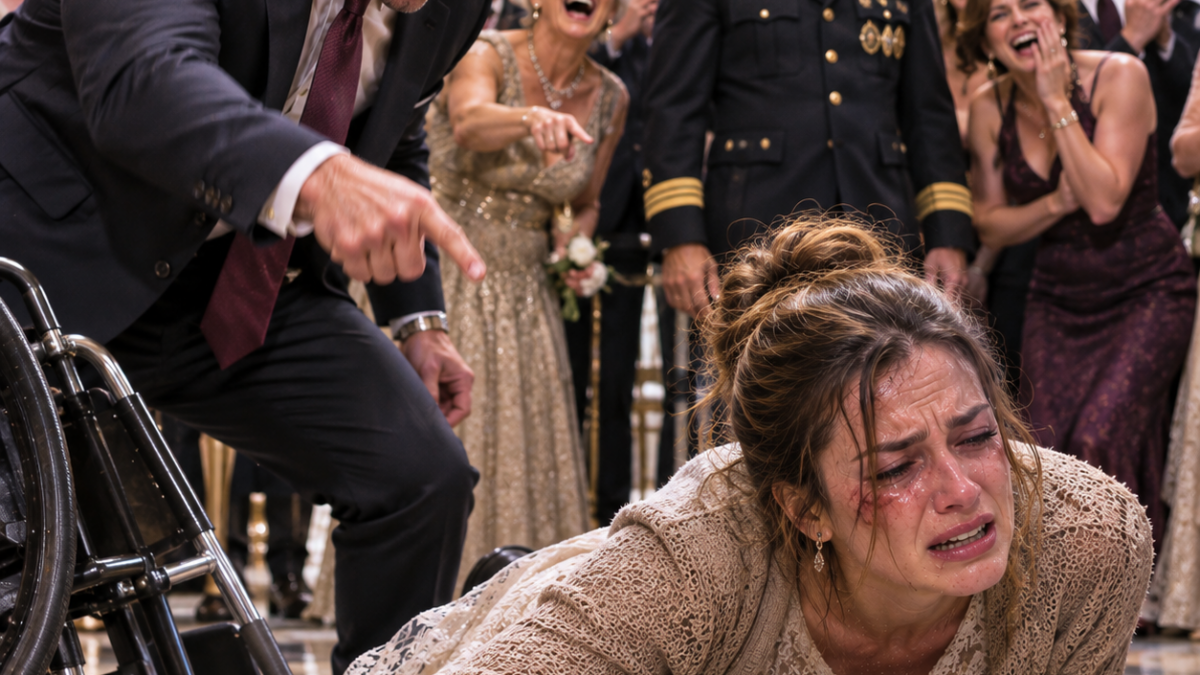
FULL STORY:“GET UP, YOU LYING FRAUD!” My Brother Threw Me Out of My Wheelchair While 50 Relatives Cheered—He Never Expected the Man Standing Behind Them
FULL STORY CONTINUATION
The strange thing about pain is that sometimes the first sensation isn’t pain at all.
It’s disbelief.
I remember the heat of the concrete against my cheek.
The smell of charcoal drifting from my uncle’s grill.
Somebody’s plastic cup rolling past my overturned wheelchair.
And the bright blue July sky above me.
For a few seconds, I couldn’t understand how I had ended up on the ground.
Then I tried to move my right leg.
A terrible sensation shot through my lower back.
I stopped.
My breath caught.
“Tyler,” I whispered. “Please don’t move me.”
My brother didn’t listen.
He was forty years old, broad-shouldered, with the same dark hair as our father and a voice that had dominated nearly every family gathering since we were children.
He had always liked an audience.
That afternoon, he had fifty.
“Look at her!” he shouted, turning toward the relatives gathered around us. “Two years of pretending, and now she won’t even stand up!”
Aunt Linda clapped.
“Come on, Maya! Show everybody!”
Someone laughed.
I heard another relative say, “I knew it.”
Uncle Richard raised his phone.
“Hold on, Tyler. Let me get this.”
My stomach dropped.
Richard was filming.
Not helping.
Not calling an ambulance.
Filming.
I turned my head as carefully as I could.
“Mom?”
She stood near the patio steps, both hands clasped around her purse.
Her name was Elaine.
She was sixty-six and had spent my entire childhood telling people how much she loved her children.
Now she wouldn’t look at me.
“Mom, please.”
Her lips moved.
For a moment, I thought she might tell Tyler to stop.
Instead, she whispered, “Maya, why can’t you just try?”
Those words hurt more than the fall.
Because I had tried.
For two years, I’d done almost nothing except try.
I’d learned to sit upright without becoming dizzy.
To transfer safely from bed to wheelchair.
To tolerate physical therapy.
To stand with support.
To take a few carefully supervised steps.
I’d celebrated movements other people performed without thinking.
And my own mother was looking at me as though I had simply refused to make an effort.
Tyler grabbed my shirt again.
“Enough of this.”
I felt the fabric tighten against my throat.
“Tyler, stop!”
He pulled.
My lower back erupted with pain.
I cried out.
And that was when Dr. Chen spoke.
“Take your hands off her.”
Five words.
No shouting.
No theatrical threat.
Just a calm, unmistakable instruction.
Tyler turned.
“Who the hell are you?”
Dr. Chen stepped forward.
He was fifty-three, slender, with neatly combed black hair and thin titanium glasses.
I’d seen him in surgical scrubs, clinic clothes, and a white coat.
That afternoon, he wore a light-blue button-down shirt and dark trousers.
He’d been attending the reunion as a guest of my cousin Rebecca, whose husband knew him through a local veterans’ rehabilitation fundraiser.
I hadn’t known he’d arrived.
Apparently, neither had Tyler.
“My name is Dr. James Chen,” he said. “I’m Maya’s orthopedic trauma surgeon.”
Aunt Linda scoffed.
“Well, Doctor, maybe you ought to take a closer look at your patient.”
Dr. Chen ignored her.
He looked directly at Tyler.
“Release her collar.”
Tyler’s hand loosened.
Dr. Chen knelt a short distance from me.
“Maya, can you hear me?”
I nodded.
“Did you strike your head?”
“I don’t think so.”
“Where does it hurt?”
“My back. And my knee.”
He looked toward my overturned wheelchair.
Then toward the relatives standing around us.
“Everyone needs to move back. She may have sustained another injury.”
Tyler laughed nervously.
“Oh, come on. She fell a couple feet.”
Dr. Chen turned his head.
“Your sister has a surgically reconstructed spine and an existing neurological injury. This is not something you get to dismiss.”
The laughter stopped.
He looked back at me.
“Maya, don’t try to stand. We’re going to have you assessed properly.”
I started crying.
Not because he had revealed some secret.
Because he was the first person who had asked where I hurt.
Someone called 911.
Later, I learned it was Rebecca.
She had been near the back of the yard when Tyler shoved me.
She saw the wheelchair tip.
Saw me fall.
And immediately reached for her phone.
By the time Dr. Chen reached the patio, she had already begun asking for an ambulance.
That mattered.
Because despite the way my family later told the story, Dr. Chen didn’t save me by threatening everybody with a lawsuit or displaying my medical records in front of fifty strangers.
He helped by recognizing that I needed medical care, protecting me from further movement, and making sure the emergency responders received accurate information.
He knew my medical history.
He understood the risks.
And he refused to let Tyler’s performance interfere with my safety.
When the ambulance arrived, the relatives parted.
Suddenly, nobody was chanting.
Nobody laughed.
Several people lowered their phones.
Uncle Richard slipped his into his pocket.
Tyler stood beside the grill, breathing heavily.
As the paramedics approached, he began talking.
“She was being dramatic. I barely touched her.”
I closed my eyes.
There it was.
The same explanation he’d used for years.
He barely touched me.
He didn’t mean anything.
I was too sensitive.
Everything was always smaller when Tyler described what he’d done.
One paramedic knelt beside me.
“Ma’am, I’m Daniel. Can you tell me your name?”
“Maya Thompson.”
“Okay, Maya. We’re going to assess you and figure out how to move you safely.”
I nodded.
He asked about the pain.
My medical history.
What had happened.
I told him.
My voice shook, but I told him.
Then I heard Tyler again.
“She can walk, you know!”
Daniel didn’t turn.
He kept his attention on me.
“Thank you, Maya. We’re going to focus on you right now.”
I looked toward Dr. Chen.
His expression softened.
“You’re doing fine,” he said.
And for the first time that afternoon, I believed somebody was telling me the truth.
To understand why Tyler did what he did, you need to understand the family I came from.
We grew up outside Columbus, Ohio, in a two-story house with white siding and a wide front porch.
Our father, Robert Thompson, worked as a mechanic.
Mom was a school secretary.
We weren’t wealthy, but we never went without the basics.
There were birthday cakes.
Summer vacations at a campground near Lake Erie.
Christmas mornings filled with wrapping paper.
Pictures of Tyler and me standing beside each other in matching winter coats.
From the outside, we looked like a close family.
Inside, things were more complicated.
Tyler was six years older.
He was loud, confident, athletic, and charming whenever adults were watching.
I was quieter.
I liked books.
Drawing.
Running.
And fixing things with Dad in the garage.
When Tyler won a baseball trophy, the entire family celebrated.
When I earned a school award, Mom told me not to make Tyler feel bad.
At first, I thought that was normal.
Older brothers and younger sisters were different.
Families had favorites sometimes.
At least, that’s what I told myself.
But as we grew older, Tyler learned that he could turn almost any disagreement into a contest.
And if he shouted loudly enough, somebody usually surrendered.
Usually me.
When I was thirteen, Tyler broke my bicycle.
He’d borrowed it without asking, ridden it recklessly, and damaged the front wheel.
I was furious.
I’d saved birthday money for almost a year to buy that bike.
When I confronted him, he laughed.
“It’s just a bicycle.”
“You broke it.”
“Stop whining.”
Dad came outside.
I explained.
Tyler immediately said I was exaggerating.
Dad looked at the damaged wheel.
Then at me.
“It’s unfortunate, Maya. But things happen.”
I stared.
“Is Tyler going to pay for it?”
Tyler laughed.
Dad sighed.
“Don’t turn everything into a fight.”
That sentence became the rule of our house.
If Tyler did something cruel, the problem was his behavior.
But if I objected, the problem became my reaction.
By the time I turned eighteen, I’d learned to swallow a great deal.
Then I joined the Army National Guard.
And for the first time, I entered a world where responsibility meant something different.
I didn’t join because I wanted to prove Tyler wrong.
That would make a neat story.
But it wouldn’t be true.
I joined because I wanted to serve.
I wanted structure.
I wanted to learn skills.
And I wanted to become part of something larger than the arguments I’d grown up listening to.
Military training challenged me.
Physically.
Emotionally.
Mentally.
I made mistakes.
Learned from them.
Made different mistakes.
I discovered that confidence didn’t have to mean dominating everybody in the room.
Sometimes the most reliable person was the quiet one who noticed when somebody needed help.
I liked that.
I served under federal orders during part of my military career and later received an honorable discharge.
My records reflected that service.
I also developed strong friendships.
People who knew me as Maya.
Not Tyler’s little sister.
Not the quiet daughter who caused arguments by speaking up.
Just Maya.
A person with strengths.
Weaknesses.
Responsibilities.
And a place on the team.
Those years changed me.
Not because they made me fearless.
Because they taught me that fear and courage could exist together.
The accident happened during a period of military service.
It was sudden.
Serious.
And life-changing.
I don’t need to describe every second.
What matters is that my spine was badly injured, and I required emergency surgery.
When I woke after the operation, I was surrounded by machines.
My mouth was dry.
My back hurt.
And I couldn’t understand why my legs felt so strange.
I remember looking toward the foot of the hospital bed.
Trying to move.
Waiting for the familiar response.
It didn’t come the way I expected.
Panic rose immediately.
A nurse noticed.
She came closer.
“Maya?”
I tried again.
My right leg moved slightly.
My left felt heavy.
I began crying.
“I can’t—”
She took my hand.
“The surgical team will explain what’s happening. You’ve been through a major injury.”
I looked toward the doorway.
Then Dr. Chen entered.
He didn’t pretend everything was fine.
He sat beside the bed and explained what had happened.
The structural injuries.
The reconstruction.
The hardware.
The nerve damage.
The uncertain recovery.
He told me that rehabilitation would be demanding and that nobody could promise exactly how much function I would regain.
I stared at him.
Then asked the question I was terrified to hear answered.
“Will I walk again?”
He was quiet for a moment.
Then said, “We will work toward the best function possible. Some people regain meaningful walking ability after serious injuries, but your recovery will depend on several factors. We need to take this one stage at a time.”
I began crying.
He waited.
Then he added, “Needing a wheelchair does not mean you’ve failed.”
At the time, I didn’t understand why those words mattered.
Later, I would.
The first weeks after surgery were miserable.
I was exhausted.
In pain.
Frightened.
There were days when even sitting upright seemed impossible.
I hated needing help.
Hated waiting for someone to bring me water.
Hated asking for assistance with tasks I’d performed automatically for thirty years.
Sometimes I became angry.
Not at the nurses.
Not at the therapists.
At the situation.
At my body.
At the loss of the life I’d known.
One morning, a physical therapist asked me to attempt a carefully supported movement.
I tried.
The pain overwhelmed me.
I stopped.
Then began crying.
“I can’t do this.”
She sat beside me.
“Not today?”
I shook my head.
“Ever.”
She waited.
Then said, “You don’t have to decide your entire future this morning.”
I stared at her.
She smiled gently.
“Today, we work with what your body can do safely. Tomorrow, we’ll reassess.”
That became the foundation of my recovery.
Not heroic speeches.
Not dramatic miracles.
Small steps.
Sometimes literally.
Sometimes not.
My mother visited during the first week.
She brought flowers.
A blanket.
A bag of snacks.
She cried when she saw me.
Then sat beside the bed and held my hand.
“Oh, Maya.”
I smiled weakly.
“Hi, Mom.”
She looked at the monitors.
The surgical dressings.
My legs beneath the blanket.
Then she asked, “Did the doctors say when you’ll be normal again?”
The question hurt.
I knew she didn’t intend it that way.
At least, I wanted to believe she didn’t.
I explained that recovery would take time.
That I might need mobility aids permanently.
That the doctors couldn’t predict everything yet.
Mom nodded.
Then sighed.
“Well, you always were stubborn. Maybe if you work hard enough, you’ll surprise them.”
I looked away.
She meant it as encouragement.
But I heard something else.
That the outcome would depend entirely on how hard I tried.
And if I remained disabled, perhaps I hadn’t tried hard enough.
Tyler didn’t visit.
Not the first week.
Not the second.
Not during the month I spent moving between hospital care and rehabilitation.
I called him once from the ICU.
No answer.
I called again after surgery complications delayed my progress.
No answer.
I called a third time when I was transferred to rehabilitation.
He sent a short text.
Busy with work. Glad you’re okay.
I stared at it.
Glad you’re okay.
I wasn’t okay.
I was frightened.
In pain.
Learning how to live in a body that no longer behaved the way it used to.
But Tyler hadn’t asked.
Eventually, I stopped calling.
The first time he saw me in a wheelchair was six months after the accident.
I had returned to Ohio and was staying in an accessible apartment while continuing rehabilitation.
Mom invited us both to dinner.
Tyler arrived late.
He walked into the living room carrying a six-pack of beer.
Then stopped when he saw my wheelchair.
His eyebrows rose.
“Wow.”
I looked up.
“Hi, Tyler.”
He stared at the chair.
“You’re still using that thing?”
I felt my stomach tighten.
“Yes.”
He laughed.
“Seriously?”
I glanced toward Mom.
She was setting the table.
I looked back at him.
“My doctors say I still need it.”
He shook his head.
“Man, the military really messed you up.”
I didn’t answer.
He moved toward the kitchen.
Then called over his shoulder, “Don’t get too comfortable in that chair, sis. You’ll never get out of it if you stop trying.”
I stared at the doorway.
For a moment, I considered explaining the rehabilitation plan.
The nerve injuries.
The pain.
The fatigue.
Then I decided I didn’t have the energy.
I was wrong to think silence would make him leave the subject alone.
Over the next year, Tyler became increasingly obsessed with proving I wasn’t disabled.
At first, it was little comments.
“Funny how you can move your legs when you want.”
“Those benefits must be nice.”
“Some of us have to work for a living.”
I tried to ignore him.
Then he began talking to relatives.
He told them I was exaggerating.
That I’d found a way to collect government money.
That I was manipulating Mom into helping me.
Most of those claims were false.
My benefits were tied to documented eligibility and official review.
My medical care involved extensive records.
My disability was evaluated by qualified professionals.
And I wasn’t draining Mom’s savings.
I had my own income and carefully managed expenses.
Mom sometimes helped with practical tasks.
She brought groceries.
Drove me to appointments when accessible transportation wasn’t available.
But I didn’t expect her to finance my life.
Tyler didn’t care about those distinctions.
He wanted a story.
And the story he chose was simple.
His sister was a fraud.
He was the only person brave enough to say it.
The supermarket incident happened about five months before the reunion.
I had been participating in a structured rehabilitation program.
On certain days, with medical clearance and appropriate support, I practiced short periods of standing and assisted walking.
Those sessions were exhausting.
They weren’t proof that I no longer needed my wheelchair.
They were part of trying to maintain or improve whatever function I safely could.
One afternoon, my therapist and I practiced a very short walk in a controlled public setting.
I used my mobility aid and followed the plan.
I was exhausted afterward.
My back hurt.
My legs trembled.
But I was proud.
For several minutes, I had moved through a familiar environment in a way that had seemed impossible after surgery.
I called Mom later.
“I had a good therapy day.”
She sounded pleased.
“That’s wonderful.”
I smiled.
“I took some assisted steps outside the clinic.”
She immediately said, “See? I told you that if you tried hard enough—”
“Mom.”
She stopped.
I took a breath.
“It’s progress. It doesn’t mean I’m suddenly healed.”
She sighed.
“Of course, sweetheart.”
I thought the conversation ended there.
Then Aunt Linda saw a short video from the outing.
I had allowed my therapist to record part of the session for rehabilitation review.
Someone in the family saw it after I’d shared a brief clip privately to celebrate the milestone.
Within days, Tyler had turned that achievement into an accusation.
He sent the video to relatives.
Then added his own commentary.
Look who suddenly doesn’t need a wheelchair.
I stared at the message.
My stomach tightened.
I replied once.
This was assisted gait training. It doesn’t mean I can walk normally or safely without a mobility aid.
Tyler responded with a laughing emoji.
Then:
Sure, Maya.
That was when the rumors accelerated.
Aunt Linda called Mom.
Uncle Richard began asking questions.
Several cousins stopped responding to my messages.
At a birthday dinner, Tyler announced that disabled veterans were taking advantage of the system.
Then looked directly at me.
I left early.
At Thanksgiving, he joked that I could probably outrun everyone if somebody waved a benefits check in front of me.
A few people laughed.
Mom told me not to be so sensitive when I asked him to stop.
I began avoiding family gatherings.
It was easier than defending my medical history to people who had already decided what they wanted to believe.
But then Mom called in June.
“The reunion is next month.”
I hesitated.
“I don’t know if I’ll come.”
She sounded hurt.
“Maya, everyone wants to see you.”
I almost laughed.
“Mom, Tyler keeps telling them I’m pretending.”
She sighed.
“He’s just frustrated.”
“With what?”
“He worries about you.”
I stared at the phone.
“That’s a strange way to show it.”
Mom became quiet.
Then she said, “Please don’t make this another argument.”
I closed my eyes.
There it was again.
The family rule.
Tyler could accuse me.
Mock me.
Humiliate me.
But if I objected, I was the one creating conflict.
Still, I wanted to see my cousins.
Some of them had been kind.
Rebecca especially.
And part of me hoped that if the family saw me in person, they might finally understand.
So I agreed to attend.
I wish I’d understood that Tyler wasn’t planning a reunion.
He was planning a performance.
The gathering took place at Uncle Richard’s house.
A large property outside town with a wide patio, swimming pool, and enough lawn for several folding tables.
It was July.
Hot.
Humid.
The kind of afternoon when the pavement seemed to hold the sun’s heat long after the air began cooling.
I arrived shortly after one.
Rebecca met me near the driveway.
She hugged me carefully.
“Maya!”
I smiled.
“Hey.”
She looked at my wheelchair.
“Need help with the ramp?”
“I’m good, thanks.”
She nodded.
Then leaned closer.
“Tyler’s been talking.”
My stomach tightened.
“What now?”
She looked uncomfortable.
“He told people he was going to prove something today.”
I stared.
“Prove what?”
She shook her head.
“I don’t know exactly. But I don’t like the way he’s acting.”
I looked toward the backyard.
Music was playing.
Children ran across the grass.
Relatives stood near the grill.
I considered leaving.
For a moment, I almost turned around.
Then I thought about Mom.
The reunion.
The people I hadn’t seen in years.
I told myself Tyler was probably exaggerating.
Again.
I was tired of allowing him to decide whether I could participate in family life.
So I continued toward the patio.
For the first hour, everything seemed normal.
People greeted me.
Asked about work.
Complimented my hair.
Offered food.
I sat near the edge of the patio where there was enough space for my wheelchair.
Rebecca stayed nearby.
We talked about her job.
Her children.
A vacation she’d recently taken.
I began relaxing.
Then Tyler arrived.
He walked through the yard carrying a cooler.
Several relatives greeted him loudly.
He laughed.
Clapped shoulders.
Made jokes.
Then he spotted me.
His smile changed.
“Well, look who’s here.”
I took a breath.
“Hi, Tyler.”
He looked at my chair.
“Still keeping up the act?”
Rebecca immediately spoke.
“Tyler, don’t.”
He laughed.
“What?”
“Leave her alone.”
He raised both hands.
“I’m just saying hello.”
I looked away.
That was my mistake.
I thought refusing to engage would make him move on.
Instead, it encouraged him.
He began talking louder.
Making comments about veterans’ benefits.
About people who didn’t want to work.
About relatives who took advantage of sympathy.
Eventually, people began looking toward me.
I felt my cheeks heat.
“Tyler,” I said, “please stop.”
He smiled.
“There she is.”
I stared.
“The victim.”
A few people laughed.
I looked toward Mom.
She was standing beside Aunt Linda.
Neither intervened.
My stomach tightened.
I turned toward Rebecca.
“I think I’m leaving.”
She nodded immediately.
“I’ll help you get to your car.”
But Tyler stepped into my path.
“Wait a minute.”
I stopped.
“Move.”
He grinned.
“Not until we settle something.”
I felt fear rise.
“Tyler.”
He looked around.
“Everybody’s been wondering how long you’re going to keep pretending.”
The conversations around us grew quieter.
People turned.
Several raised their phones.
Rebecca stepped forward.
“Tyler, that’s enough.”
He ignored her.
Then placed his hands on my wheelchair.
I gripped the armrests.
“Don’t touch my chair.”
He laughed.
“Why? Afraid you’ll have to stand up?”
I looked directly at him.
“Let go.”
He leaned closer.
“Show them, Maya.”
I felt my heart hammer.
“Tyler, stop.”
Then he shoved.
I remember the world tilting.
The wheelchair moved sharply.
One wheel lifted.
I tried to brace myself.
But there wasn’t enough time.
The chair overturned.
My body struck the concrete.
Pain exploded through my back.
For a moment, everything became white.
Then sound returned.
Laughter.
A chair scraping.
Someone shouting, “Oh, my God!”
And Tyler’s voice above everything.
“See? Now get up!”
I couldn’t.
Not safely.
Maybe not at all in that moment.
I knew what another uncontrolled movement could do.
I knew the pain was different from ordinary soreness.
I knew I needed medical assessment.
But Tyler interpreted my refusal to move as proof of deception.
He began shouting.
Then Aunt Linda started clapping.
“Stand up!”
Others joined.
Not everyone.
Rebecca was arguing with Tyler.
A few relatives stood frozen.
Some looked shocked.
But enough people laughed and cheered that the sound surrounded me.
It felt like the whole family had decided I wasn’t human anymore.
Just entertainment.
I looked toward Mom.
She was standing beside the patio steps.
Her face was pale.
“Mom,” I whispered.
She didn’t move.
Then Tyler grabbed my collar.
And Dr. Chen arrived.
At the hospital, they evaluated me for injuries from the fall.
The pain was severe.
My right knee was swollen.
My back hurt in a way that frightened me.
The medical team examined my neurological status and obtained imaging as clinically appropriate.
I was terrified that the impact had damaged the surgical reconstruction or worsened my existing nerve injury.
Dr. Chen remained involved in coordinating my care.
He didn’t make promises.
He explained what the team was checking and why.
At one point, while I lay on the examination bed, I began crying.
“I worked so hard.”
He looked up.
“I know.”
“Two years.”
My voice broke.
“I worked for two years just to be able to do what I can now.”
He nodded.
“And Tyler—”
I couldn’t finish.
Dr. Chen pulled a chair closer.
“Maya, what happened today was not a test of your character.”
I stared at him.
He continued.
“You were assaulted. You were injured. Your rehabilitation progress doesn’t become less real because someone tried to humiliate you.”
I looked away.
Tears ran down my face.
He waited.
Then said quietly, “We’ll assess the injury and make a plan based on what we find.”
I swallowed.
“Okay.”
He nodded.
“One step at a time.”
The same words he’d used after my first surgery.
I closed my eyes.
And cried.
The initial evaluation did not reveal the catastrophic hardware failure I feared.
That was a relief.
But I had suffered painful injuries, including trauma to my knee and a significant flare of symptoms that required follow-up and adjustments to my rehabilitation.
I couldn’t simply return to my normal routine.
For days, even ordinary transfers were more difficult.
My pain increased.
Sleep became harder.
And the emotional impact was overwhelming.
I had spent two years learning to trust my body’s limits.
Now I was afraid to move.
Not because I’d forgotten the rehabilitation exercises.
Because the fall had reminded me how quickly someone else’s recklessness could change everything.
The police came to speak with me.
I told them what happened.
Tyler touching my wheelchair.
My repeated requests for him to stop.
The shove.
The fall.
The chanting.
His attempt to drag me upright.
I explained my disability and the injuries.
I gave them the names of people who had witnessed the incident.
Rebecca had already provided an account.
Dr. Chen described what he personally observed and provided medical information through the appropriate process.
Several relatives had recorded portions of the confrontation.
Those videos became relevant.
Uncle Richard’s footage was particularly clear.
It showed Tyler approaching me.
The argument.
My requests to be left alone.
The wheelchair tipping.
The fall.
And the crowd’s reaction.
I hadn’t wanted to be recorded.
But the videos meant Tyler couldn’t simply describe the incident as an accidental stumble.
The police evaluated the available evidence.
The legal process would determine what charges and consequences were appropriate.
There was no magical moment when a doctor could declare Tyler guilty.
No instant subpoena appearing because someone waved a phone.
But the records mattered.
The witnesses mattered.
And my account was no longer the only evidence of what had happened.
Tyler called that night.
I didn’t answer.
He left a voicemail.
“Maya, this has gotten completely out of hand.”
I stared at the screen.
He continued.
“I was trying to motivate you.”
I closed my eyes.
“I didn’t know you’d fall like that.”
My hands tightened.
Then:
“Now everybody’s acting like I attacked you.”
I almost laughed.
Not because it was funny.
Because he still couldn’t say the words.
I pushed you.
You told me to stop.
I hurt you.
Instead, he talked about misunderstandings.
Motivation.
People overreacting.
The same excuses I’d heard since childhood.
I saved the voicemail.
Then turned off the sound.
Mom came to the hospital two days later.
I hadn’t asked her to visit.
Rebecca had told her where I was.
When Mom entered the room, she looked exhausted.
Her eyes were swollen.
She carried a small bouquet of flowers.
For a moment, I felt the old instinct to comfort her.
To ask whether she’d slept.
Whether she’d eaten.
Whether Tyler was making things difficult.
Then I remembered her standing beside the patio.
Watching.
I looked away.
“Hi, Mom.”
She sat.
“Hi, sweetheart.”
Silence.
Then she began crying.
“I never wanted any of this.”
I stared at the blanket.
She continued.
“Your brother was trying to make a point.”
I closed my eyes.
There it was.
Even now.
Even after the ambulance.
The hospital.
The medical assessment.
She was still explaining Tyler.
I looked at her.
“Mom, he pushed me out of my wheelchair.”
She wiped her face.
“He didn’t realize—”
“I told him to stop.”
She looked down.
“I know.”
“He heard me.”
She remained silent.
I swallowed.
“He watched me hit the ground.”
Tears filled her eyes.
“And then he tried to drag me up.”
Mom began crying harder.
“I know.”
I stared at her.
“Then why didn’t you help?”
The question hung between us.
For several seconds, she didn’t answer.
Then she whispered, “I froze.”
I looked away.
Maybe she had.
But freezing didn’t explain the years before that afternoon.
The jokes.
The accusations.
The times I’d asked her to intervene and she’d told me not to cause trouble.
I took a breath.
“Mom, you believed him.”
She looked up.
“No—”
“You did.”
Her lips trembled.
I continued.
“You believed I was faking.”
She began crying.
“I didn’t know what to think.”
I stared at her.
“You could’ve asked my doctor. You could’ve listened when I explained therapy. You could’ve believed the medical records.”
She lowered her eyes.
“I know.”
I swallowed.
“But Tyler said I was lying, and you let him.”
For the first time, she didn’t defend him.
She simply sat there.
Crying.
I looked toward the window.
Then said quietly, “I need some distance.”
Mom’s head lifted.
“Maya—”
“Please.”
She stopped.
I took a breath.
“I can’t keep doing this.”
She stared.
“I love you,” I said.
My voice broke.
“But I need to recover without being asked to protect Tyler from what he did.”
She covered her mouth.
Then nodded.
“I understand.”
I wasn’t sure she did.
But for once, I wasn’t going to spend my strength explaining the same boundary again.
The video spread through the family quickly.
Some relatives deleted their recordings.
Others apologized.
A few insisted they’d only been laughing because they thought Tyler was joking.
That explanation made me angry.
Because I’d been on the ground.
Crying.
Asking him not to move me.
What part of that looked like a joke?
Aunt Linda sent a message.
I didn’t realize your condition was that serious.
I stared at it.
For two years, she’d been told my condition was serious.
She simply preferred Tyler’s version.
Uncle Richard sent a longer message.
He claimed he had been recording because he thought the situation would prove I was pretending.
Then he said he hadn’t meant to hurt me.
I didn’t answer.
I wasn’t interested in comforting people who had watched me suffer and were now embarrassed by the evidence.
Rebecca visited me after I returned home.
She brought groceries.
Helped with a few practical things.
Then sat beside me in the living room.
For a while, we talked about ordinary subjects.
Her children.
Work.
The weather.
Then she looked at me.
“Maya?”
“Yes?”
“I’m sorry.”
I frowned.
“For what?”
“I knew Tyler was planning something.”
I looked down.
She continued.
“I warned you, but I wish I’d done more.”
I shook my head.
“You called for help.”
“After he pushed you.”
I looked at her.
“Rebecca, Tyler was responsible for what he did.”
She swallowed.
“I know.”
I reached for her hand.
“You were the one who tried to stop him.”
Her eyes filled.
“And you were the one who called 911.”
She nodded.
I smiled sadly.
“Thank you.”
She began crying.
We sat together for a long time.
Then she looked toward my wheelchair.
“Do you still want to come to the veterans’ community picnic next month?”
I hesitated.
Part of me wanted to say no.
I didn’t want another gathering.
Another crowd.
Another afternoon where people might stare at me.
Then I remembered the people who had supported me during rehabilitation.
The veterans who understood that disability wasn’t a competition.
The therapists who celebrated progress without turning it into proof that all limitations had disappeared.
Dr. Chen.
The friends who had visited when my family hadn’t.
I took a breath.
“Yes,” I said.
Rebecca smiled.
“Good.”
The legal consequences unfolded over time.
Tyler’s conduct was examined as a physical assault.
The video evidence and witness statements were reviewed.
My injuries were documented.
Dr. Chen supplied appropriate medical information with my authorization and through the relevant procedures.
My attorney, Jennifer Woo, helped me understand my rights and options.
She specialized in matters involving disability rights and veterans.
The first time we met, she placed a folder on the table.
Then looked directly at me.
“Maya, what do you want from this process?”
I stared.
For a moment, I didn’t know.
I wanted Tyler to understand.
I wanted my family to admit they were wrong.
I wanted the humiliation erased.
I wanted my back to stop hurting.
I wanted to return to the day before the reunion and choose not to go.
But none of those things could be accomplished through a single legal filing.
Finally, I said, “I want him held accountable.”
Jennifer nodded.
“And?”
“I want him to stop telling people I’m faking.”
She wrote that down.
I swallowed.
“And I want to be left alone while I recover.”
She looked up.
“Those are understandable goals. We can discuss what legal remedies may be available and what each process can realistically accomplish.”
I nodded.
She continued.
“But I need you to know something.”
I looked at her.
“You do not have to prove that you are permanently unable to walk in order to establish that someone assaulted you.”
My eyes filled.
She continued.
“Your disability status and medical history matter to the context, but nobody has the right to shove you out of a wheelchair simply because they dislike or question your diagnosis.”
I looked down.
For two years, I’d felt as though every step I took in therapy might be used against me.
Now Jennifer was telling me something I should have understood long ago.
I didn’t have to remain physically helpless to deserve protection.
I was allowed to improve.
Allowed to struggle.
Allowed to use a wheelchair one day and practice assisted walking another.
Allowed to have good days.
Bad days.
And needs that changed over time.
None of that made me a fraud.
Tyler initially insisted the fall had been accidental.
Then the videos were reviewed.
He changed his explanation.
He said he’d been trying to help me stand.
Then the footage showed me repeatedly telling him not to touch my chair.
He claimed he hadn’t understood my condition.
Then the family messages and earlier conversations demonstrated how often I’d explained it.
His story kept changing.
The evidence didn’t.
Eventually, the legal proceedings resulted in accountability for his conduct.
The precise outcome followed the applicable charges, findings, and procedures.
There were consequences.
Real ones.
But they didn’t arrive through one spectacular courtroom speech.
They came through documented facts.
Witnesses.
Medical evidence.
And decisions made by people whose job was to evaluate what happened.
I didn’t celebrate.
I felt relieved.
Exhausted.
And sad.
Because the person who had hurt me was my brother.
The same boy who had once taught me how to ride a bicycle.
The same teenager who occasionally sneaked cookies into my room when Mom said I’d had enough.
The same man who had grown into someone willing to humiliate me in front of fifty relatives.
Those memories existed together.
And accepting that was painful.
My rehabilitation suffered after the fall.
For several weeks, pain and fear made some activities harder.
My care team reassessed my mobility.
We adjusted the therapy plan.
Focused on symptom management.
And gradually resumed appropriate exercises as I recovered.
There were days when I became frustrated.
I hated that Tyler’s actions had interrupted progress I’d worked so hard to achieve.
One afternoon, during a therapy session, I stopped after a difficult movement.
Tears filled my eyes.
“I was doing better before the reunion.”
My therapist nodded.
“I know.”
I looked away.
“It feels like I’m starting over.”
She sat beside me.
“Some parts of recovery may need to be rebuilt. That doesn’t erase the work you’ve already done.”
I swallowed.
“But what if I don’t get back to where I was?”
She considered the question.
“Then we’ll work toward the best outcome available, with the body and circumstances you have now.”
I looked down.
She continued.
“Your progress isn’t a debt you owe anybody.”
I began crying.
Because that was exactly how I’d been treating it.
As something I had to produce.
For my mother.
For Tyler.
For every relative who wanted proof.
For everyone who thought disability had to look one particular way to be real.
Now I was being reminded that rehabilitation belonged to me.
Not to the audience.
Not to the family.
Me.
Three months after the reunion, Tyler wrote me a letter.
I almost threw it away.
Then I decided to read it with Jennifer’s guidance rather than respond impulsively.
The letter began with apologies.
He said he hadn’t intended to injure me.
He said he had been frustrated.
He admitted he’d allowed rumors to influence his judgment.
Then he wrote that he’d been jealous.
I stopped.
Read the sentence again.
Jealous.
Of me?
I continued.
Tyler described how he’d felt overlooked after my military service.
How relatives praised me.
How Mom worried about me.
How he had begun resenting the attention my injury received.
He said watching the family reorganize around my medical needs made him feel unimportant.
I stared at the page.
Then began crying.
Not because I forgave him.
Because the truth was so ugly.
My brother had watched me struggle to recover from a life-changing injury and interpreted the care I received as a prize he was being denied.
He’d seen my pain as competition.
My wheelchair as attention.
My benefits as unearned reward.
My rehabilitation as a performance intended to make him feel smaller.
He had needed me to be lying because accepting that I was genuinely hurt meant admitting he’d been cruel to someone who needed compassion.
I closed the letter.
Then stared at the wall.
For years, I’d tried to understand what I could do to make Tyler stop resenting me.
Now I finally understood that the answer wasn’t mine to find.
His jealousy was his responsibility.
Not mine.
I didn’t write back immediately.
When I eventually responded, I kept the message brief.
I acknowledged receiving his letter.
I stated that his actions had caused serious harm.
I explained that I was not ready to resume contact.
And I said that any future relationship would require sustained accountability, respect for my boundaries, and an end to the false accusations.
I didn’t promise forgiveness.
Didn’t threaten revenge.
Didn’t list everything he’d done since childhood.
I simply told the truth.
Then I sent the message.
For the first time, I didn’t wait anxiously for his reply.
I had other things to do.
Medical appointments.
Work.
Friends.
A life.
The following spring, I attended a veterans’ community event.
It was held at a local park.
There were food trucks.
Music.
Accessible seating.
Families.
Veterans of different ages and backgrounds.
Some walked without assistance.
Some used canes.
Some had prosthetic limbs.
Some used wheelchairs.
Some had disabilities nobody could see.
I sat near a group of friends I’d met during rehabilitation.
We laughed about ordinary things.
Bad coffee.
Military paperwork.
The difficulty of finding a decent parking space.
For the first time in months, I wasn’t worried that somebody might point at me and demand proof of my medical history.
Then a young veteran approached.
He was perhaps twenty-seven.
He used a cane.
He looked nervous.
“Excuse me,” he said.
I turned.
“Yes?”
“Are you Maya Thompson?”
I hesitated.
“Yes.”
He swallowed.
“I saw what happened at your reunion.”
My stomach tightened.
I looked down.
He immediately added, “I’m sorry. I didn’t mean to make you uncomfortable.”
I took a breath.
“It’s okay.”
He nodded.
Then said quietly, “My family does something similar.”
I looked up.
He stared at the ground.
“They think if I can walk a little, I shouldn’t need help.”
I felt my throat tighten.
He continued.
“They say I should just push through.”
I nodded slowly.
“That’s difficult.”
He looked at me.
“I thought I was the only one.”
I shook my head.
“No.”
He swallowed.
“Does it ever get easier?”
I considered the question.
Then answered honestly.
“Some parts do.”
He waited.
I continued.
“You learn whose opinions deserve your energy. You learn to trust your medical team. And you learn that you don’t have to perform your pain for people who have already decided not to believe you.”
His eyes filled.
I smiled gently.
“Your recovery belongs to you.”
He nodded.
Then whispered, “Thank you.”
After he walked away, I sat quietly.
For a long time, I’d wished nobody knew about the reunion.
I still hated that the videos existed.
Still hated the humiliation.
But if one frightened person could hear that he wasn’t alone, perhaps something useful could grow around the harm.
Not because the harm was necessary.
It wasn’t.
But because I could decide what to do with my life afterward.
Mom eventually began attending counseling.
I didn’t ask her to.
I learned about it months later.
She called and asked whether we could meet somewhere quiet.
I hesitated.
Then agreed.
We met at a small café.
She looked older.
Her hair had gone grayer.
Her hands trembled slightly as she held her cup.
For a while, we talked about the weather.
Then she looked at me.
“Maya, I owe you an apology.”
I waited.
She took a breath.
“I should have stopped Tyler.”
I felt my chest tighten.
She continued.
“Not just at the reunion.”
My eyes filled.
“All the years before.”
I looked down.
Mom wiped her face.
“I kept telling you not to argue because it was easier than confronting him.”
I swallowed.
She continued.
“I thought I was keeping the family together.”
I looked up.
“And I didn’t realize I was teaching him that he could hurt you without consequences.”
For a moment, I couldn’t speak.
Then I said quietly, “I tried to tell you.”
She began crying.
“I know.”
I stared at her.
She continued.
“You did tell me.”
That was the first time she’d said it.
Not that she hadn’t known.
Not that she’d been confused.
Not that Tyler was frustrated.
She acknowledged that I’d told her the truth and she’d refused to act on it.
I began crying.
Mom reached across the table.
Then stopped.
She looked at me.
“May I?”
I nodded.
She took my hand.
For a while, we sat quietly.
Then I said, “I don’t know how to make everything normal again.”
Mom nodded.
“Neither do I.”
I looked at her.
She continued.
“But I don’t want to pretend it was normal before.”
The words surprised me.
I stared.
Then nodded slowly.
“Neither do I.”
It wasn’t reconciliation.
Not yet.
But it was the first honest conversation we’d had in years.
Tyler and I remained distant.
I didn’t attend family events where I expected him to be present.
I didn’t allow relatives to pressure me into a public forgiveness scene.
I didn’t agree to sit across from him at Thanksgiving so Mom could take a photograph.
When people told me life was short, I agreed.
Then reminded them that being related to someone didn’t create an obligation to accept mistreatment.
Some relatives understood.
Others didn’t.
I learned to live with that.
Uncle Richard eventually apologized and cooperated with the legal process.
Aunt Linda took longer.
She sent several defensive messages before admitting that joining the chanting had been cruel.
I accepted the apologies I believed were sincere without pretending they erased the consequences.
And I stopped trying to rebuild every relationship.
Some connections had been damaged beyond what I was willing to repair.
That was painful.
But it was also honest.
A year after the reunion, Dr. Chen reviewed my progress during a follow-up appointment.
I sat beside the examination table while he looked at the relevant findings.
My rehabilitation had continued.
My pain was still present.
I still used my wheelchair for much of daily life.
On certain days, with appropriate support, I could practice limited standing or assisted walking.
There had been progress.
There had also been setbacks.
Dr. Chen looked up.
“How are you feeling about things?”
I considered the question.
“Better than last summer.”
He nodded.
“Good.”
I smiled faintly.
“Not perfect.”
He smiled.
“I wouldn’t expect you to be.”
I looked toward the window.
Then asked, “Can I tell you something?”
“Of course.”
I swallowed.
“For a long time, I thought I had to walk again to prove everybody wrong.”
He listened.
I continued.
“Like if I could stand long enough, or take enough steps, Tyler would finally admit I wasn’t pretending.”
Dr. Chen nodded slowly.
“And now?”
I looked down at my wheelchair.
“Now I think I’d rather focus on what makes my life better.”
His expression softened.
“That’s a meaningful shift.”
I smiled.
“I still want to improve.”
“Of course.”
“But I don’t want my body to become an argument I spend the rest of my life trying to win.”
Dr. Chen nodded.
“Good.”
For a moment, neither of us spoke.
Then he said something that stayed with me.
“Maya, the goal of rehabilitation is to improve your function, comfort, and quality of life as much as possible. It isn’t to satisfy people who refuse to understand your condition.”
My eyes filled.
I smiled.
“Thank you.”
He nodded.
“You’ve worked hard.”
I looked down.
Then whispered, “I know.”
For the first time, I believed it without needing my family to agree.
That summer, Rebecca hosted a small barbecue.
Not a reunion.
Just a few friends.
Her husband.
Their children.
Several people from the veterans’ community.
And me.
The backyard was shaded by tall trees.
There was a ramp leading to the patio.
The tables were arranged so I could move comfortably.
Nobody made a speech about it.
Nobody acted as though accessibility was an extraordinary favor.
They simply planned the gathering so everyone could participate.
I arrived in the afternoon.
Rebecca hugged me.
“Glad you’re here.”
I smiled.
“Me too.”
We ate.
Talked.
Laughed.
The children played in the yard.
At one point, somebody dropped a plastic cup.
It rolled across the patio.
For a split second, I remembered Uncle Richard’s house.
The hot concrete.
The overturned chair.
The laughter.
My breath caught.
Then I looked around.
Rebecca was helping her youngest child with a sandwich.
Her husband was checking the grill.
A friend was telling a terrible joke.
Nobody was staring at me.
Nobody was demanding that I stand.
I took a breath.
Then another.
And the memory loosened.
Later, I moved toward the edge of the patio to watch the sunset.
Rebecca joined me.
“Good day?”
I smiled.
“Really good.”
She looked out across the yard.
“I’m glad.”
I nodded.
Then said, “I used to think family meant people who shared your last name.”
Rebecca looked at me.
I continued.
“Now I think it means people who make room for you without asking you to prove you deserve it.”
Her eyes filled.
She smiled.
“I like that.”
We stood quietly.
And watched the sun disappear behind the trees.
I still think about the reunion sometimes.
The chants.
The phones.
The sound of Tyler’s voice.
The way Mom wouldn’t meet my eyes.
There are days when the memory makes me angry.
Other days when it makes me sad.
Sometimes I wonder how fifty people could stand around an injured woman and treat her suffering like entertainment.
Then I remember that cruelty often becomes easier when people stop seeing the person in front of them.
Tyler called me a fraud.
Linda called me lazy.
Richard called me a parasite.
After hearing those words often enough, some relatives stopped thinking of me as Maya.
The sister.
The cousin.
The veteran.
The woman who loved terrible mystery novels and always brought homemade cookies to Christmas.
They saw a story Tyler had told.
A convenient villain.
And when he shoved me out of my wheelchair, they cheered because they believed they were watching that villain exposed.
They had forgotten I was a person.
That was what made the incident so frightening.
Not just the physical harm.
The ease with which ordinary people joined in once somebody gave them permission to be cruel.
But there is another part of that day I remember.
Dr. Chen’s voice.
Five words.
Take your hands off her.
They didn’t erase my injuries.
They didn’t undo the humiliation.
They didn’t instantly make Tyler accountable.
But they interrupted something that had been building for years.
The belief that Tyler’s anger mattered more than my safety.
The belief that I had to prove my disability before I deserved respect.
The belief that because I sometimes practiced assisted walking, anyone could demand that I stand.
Dr. Chen didn’t have to reveal my complete medical history to make the point.
He didn’t need to expose my records to fifty relatives.
He simply recognized that I was injured and that Tyler had no right to keep hurting me.
Then he made sure I received proper care.
That was what protection looked like.
Not a dramatic promise of revenge.
Not a public humiliation of my brother.
Action.
Restraint.
Professional judgment.
And the refusal to let somebody’s cruelty continue.
On the second anniversary of the reunion, I went to the park alone.
It was a warm July morning.
Not as hot as the day I’d fallen.
The paths were wide.
Accessible.
Lined with trees.
I moved along the trail in my wheelchair, stopping occasionally to watch families enjoying the weather.
A little girl ran past carrying a bright red kite.
Her father followed, laughing.
An elderly couple sat on a bench sharing a newspaper.
Two teenagers argued about which direction led to the lake.
I smiled.
Ordinary life.
I had spent so much time fighting to be believed that I’d nearly forgotten how much I loved ordinary life.
I stopped beside a pond.
Ducks moved across the water.
A breeze rustled the leaves.
I looked down at my hands.
They rested comfortably on the armrests.
For a moment, I remembered gripping those same armrests while Tyler stood behind me.
The fear.
The shove.
The fall.
Then I looked toward the trail.
I was here.
Still moving.
Still living.
Still working toward the best recovery available to me.
Still capable of friendship.
Laughter.
Meaningful work.
And happiness.
I didn’t know whether I’d ever walk independently again.
Maybe I would.
Maybe I wouldn’t.
That uncertainty still existed.
But it no longer determined whether I believed my life had value.
I watched the ducks.
Then smiled.
For years, I’d wanted Tyler to understand me.
To apologize.
To acknowledge my pain.
To recognize that I hadn’t chosen this.
Now I understood that I could build a good life even if he never fully understood.
His approval wasn’t the finish line.
My family didn’t get to decide whether my rehabilitation counted.
My worth wasn’t measured by how long I could stand.
And my wheelchair didn’t make me less worthy of love, respect, or independence.
That evening, I received a message from Mom.
Thinking of you today. I love you.
I stared at it for a moment.
Our relationship was still complicated.
There were boundaries.
Difficult conversations.
Trust that needed time.
But she had been making an effort to understand.
Not perfectly.
Not without setbacks.
Still, she was trying.
I wrote back.
I love you too, Mom.
Then I put the phone away.
No long discussion.
No guilt.
No demand that I attend the next family event.
Just two people slowly learning to speak honestly.
It was enough for that evening.
When I returned home, I placed my keys beside the door.
My apartment had changed over the previous two years.
I’d rearranged the furniture.
Added better storage.
Made the kitchen more accessible.
Hung photographs from my military service beside pictures of friends and family members who had supported me.
There was a picture of Rebecca and me laughing at a veterans’ event.
A photograph of my rehabilitation team.
And one of Dad standing beside me when I graduated from high school.
He’d died years before my accident.
Sometimes I wondered what he would have said about the reunion.
I liked to believe he would have defended me.
But I’d learned not to build my future around imaginary conversations.
I could love the memories I had of him without pretending I knew exactly how he’d responded to every situation.
I moved into the living room.
A book waited on the table.
The windows were open.
Outside, someone was mowing a lawn.
I made tea.
Then settled near the window.
For a long time, I sat quietly.
No chanting.
No phones recording me.
No brother demanding that I prove something.
Just my home.
My body.
My life.
And the peaceful knowledge that I didn’t need to perform strength for anyone.
People often ask what happened to Tyler.
I tell them the truth.
He faced the consequences of his actions through the appropriate legal process.
His accusations were challenged by evidence.
The family members who had encouraged him were forced to confront what they’d participated in.
Some apologized.
Some remained defensive.
Others drifted out of my life.
Tyler and I did not return to the relationship we had before the reunion.
I wasn’t ready for that.
Maybe I never would be.
I no longer treated forgiveness as a deadline somebody else could impose.
What happened to me was serious.
It caused physical harm.
It interrupted rehabilitation.
It damaged relationships.
And it forced me to reconsider who I could trust.
I wasn’t going to pretend otherwise to make family gatherings more comfortable.
But I also refused to spend the rest of my life focused on punishing Tyler.
There were too many things I still wanted to do.
Places I wanted to visit.
People I wanted to know.
Books I wanted to read.
Work I wanted to accomplish.
And ordinary afternoons I wanted to enjoy.
My future deserved more attention than my brother’s resentment.
Sometimes I look at the short video from my rehabilitation session before the reunion.
The one Tyler used to accuse me of lying.
In it, I’m standing with support.
My therapist is nearby.
I’m concentrating so hard that my face looks almost angry.
Then I take one careful step.
Another.
And stop.
The clip lasts only a few seconds.
For a long time, I couldn’t watch it.
Not because I was ashamed of the progress.
Because it reminded me of what Tyler did with it.
He took one of the proudest moments of my recovery and turned it into evidence against me.
Now I watch the video differently.
I see a woman who survived a serious injury.
Who endured surgery.
Rehabilitation.
Pain.
Fear.
And uncertainty.
A woman who kept trying even when progress was slow.
A woman who didn’t know what her future would look like but continued building it anyway.
I don’t see a fraud.
I see courage.
And for the first time, I don’t need anybody else to agree.
The last time I spoke with Dr. Chen, he asked about my plans for the coming year.
I told him I wanted to travel.
Continue rehabilitation.
Spend more time with friends.
Maybe volunteer with a veterans’ organization.
He listened.
Then smiled.
“That sounds like a full year.”
I laughed.
“Hopefully.”
He looked at me.
“Anything you’re particularly looking forward to?”
I considered the question.
Then answered.
“Not having to prove anything at a family reunion.”
He laughed softly.
Then became serious.
“Maya, you never did.”
My throat tightened.
I nodded.
“I know that now.”
He smiled.
“Good.”
That evening, I sat on my balcony watching the sunset.
The sky turned orange.
Then pink.
Then deep blue.
I thought about the day Tyler pushed me out of my wheelchair.
How frightened I’d been.
How small I’d felt.
How desperately I wanted my mother to help.
Then I thought about the life I’d built afterward.
The friends who stayed.
The professionals who treated me with dignity.
The family relationships I’d repaired where genuine accountability was possible.
The boundaries I’d maintained where it wasn’t.
The rehabilitation I’d continued for myself.
And the ordinary happiness I’d slowly allowed back into my days.
I rested my hands on the armrests.
Then smiled.
My brother had thrown me onto the ground because he believed standing up would prove I was lying.
My relatives had cheered because they believed mobility was a simple choice.
But the truth had never depended on their understanding.
I was disabled when I used my wheelchair.
I was disabled when I practiced assisted walking.
I was disabled on days when the pain was manageable.
And on days when it wasn’t.
I didn’t need to be completely immobile to deserve compassion.
I didn’t need to reveal private medical records to satisfy an audience.
And I didn’t need to become someone else’s idea of a perfect survivor before my life could be meaningful.
I looked toward the horizon.
For years, Tyler had accused me of seeking attention.
But all I’d ever wanted was the freedom to live without being treated like a liar.
To move through the world in whatever way was safe and possible for my body.
To celebrate progress without fearing somebody would use it against me.
To rest when I needed rest.
To ask for help without shame.
And to be believed when I said something hurt.
The reunion taught me something painful about my family.
But the years afterward taught me something far more important about myself.
My life didn’t belong to the people who cheered when I fell.
It belonged to me.
I took a sip of tea.
The evening breeze moved through the balcony.
Somewhere below, a child laughed.
I closed my eyes.
And for once, I wasn’t thinking about what Tyler had taken from me.
I was thinking about everything I still had.
My brother demanded that I stand to prove I wasn’t broken. But I never needed to stand for him, or for anyone else, to prove that I deserved dignity.
And when Dr. Chen spoke those five words on that terrible July afternoon, he wasn’t simply ordering Tyler to step away.
He was reminding everyone there that my body was not theirs to control.
My medical history was not theirs to judge.
And my recovery was not a performance staged for their approval.
Two years later, sitting peacefully on my balcony, I finally understood the lesson I’d needed all along.
The strongest thing I ever did wasn’t getting out of my wheelchair. It was refusing to let the people who pushed me down decide what my life was worth.








