FULL STORY:“GET THAT DOG AWAY FROM THE CONVICT!” The Judge Ordered Him Removed—Then the Dog Exposed a Scar That Reopened a Murder Case
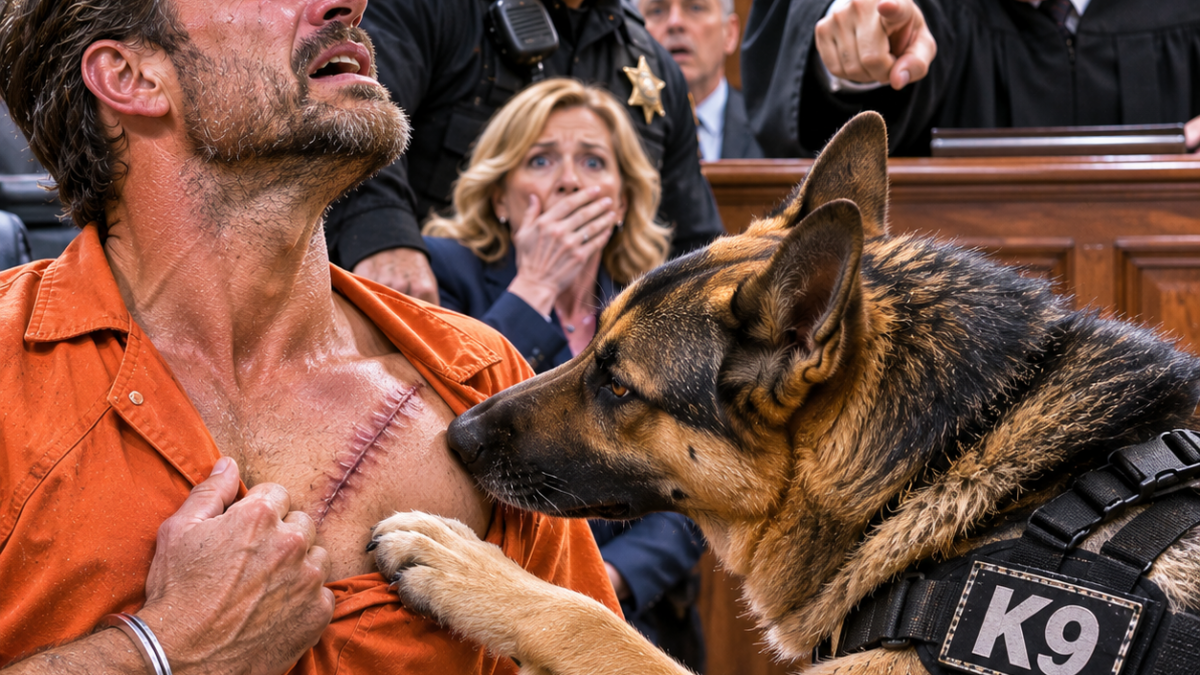
PART2
I didn’t move.
That was the strangest part.
A large German Shepherd was coming directly toward me, and I didn’t feel the instinct to pull away.
I hadn’t touched a dog in nine years.
Hadn’t felt warm fur beneath my fingers.
Hadn’t heard the soft breathing of an animal sleeping beside a chair.
I had almost forgotten what that kind of companionship felt like.
But when the Shepherd reached me, something inside my chest tightened.
He stopped inches from my knees.
Looked up.
Then gently pressed his nose against my cuffed hands.
The officer shouted:
“Get that animal under control!”
The handler hurried forward.
“Atlas, here!”
Atlas.
That was his name.
The dog ignored the command.
Instead, he licked my wrist.
Once.
Then again.
His tongue touched the narrow gap between the metal cuff and my prison sleeve.
I flinched.
Not from pain.
From memory.
Rain.
A highway.
Headlights flashing through darkness.
A small animal crying beside the road.
A sixteen-year-old boy tearing off his shirt to stop the bleeding.
I looked down at the dog.
My throat closed.
“No.”
The word escaped before I understood why.
Atlas nudged my sleeve upward.
Then caught the loose fabric gently between his front teeth.
The handler reached for him.
“Atlas, leave it.”
But the dog persisted.
Not biting my skin.
Not pulling violently.
Just moving the material that covered my wrist.
My sleeve slid back.
There, beneath the handcuff, was the scar.
A pale crescent.
Almost faded.
The judge leaned forward.
“What’s happening?”
Rachel looked down at my arm.
Then at the dog.
“Daniel?”
I couldn’t answer.
Atlas lowered his muzzle.
Licked the scar.
And sat beside my legs.
My breath caught.
I remembered another pair of eyes.
Small.
Terrified.
Looking up at me from wet asphalt seventeen years earlier.
I looked at Atlas.
“No.”
Then whispered:
“It can’t be.”
The dog lifted one paw.
Rested it against my knee.
And suddenly I wasn’t sitting in a courtroom anymore.
I was sixteen years old again.
Standing on the shoulder of Route 19.
In the rain.
Trying to save a puppy everybody else believed was already dying.
I had been driving home from my evening shift at a grocery store when I saw something moving on the highway.
It was late October.
Cold enough that rain felt like needles against the skin.
The road curved through a wooded area outside Millbrook.
I remember the headlights sweeping over something small.
Brown fur.
A flash of movement.
Then a car ahead of me swerved.
I hit the brakes.
Pulled onto the shoulder.
Turned on my hazard lights.
And ran.
The puppy lay near the center line.
He couldn’t have been more than four months old.
German Shepherd mix, or so I thought.
One front leg was badly injured.
Blood darkened his fur.
He tried dragging himself toward the shoulder but collapsed every time he moved.
Cars passed.
Some slowed.
Most didn’t.
A truck driver shouted from his window:
“Kid, leave it!”
I stepped toward the puppy.
The truck driver yelled again.
“He’s not going to make it!”
But the puppy looked up.
And for one second, his eyes met mine.
I don’t know how to describe what happened then.
I wasn’t thinking about being brave.
I wasn’t thinking about getting hurt.
I was sixteen.
Cold.
Frightened.
And suddenly responsible for a tiny living creature that had no idea why the world had become so painful.
I waved both arms toward approaching traffic.
“STOP!”
A sedan slowed.
Then another.
A woman got out of her car and began directing drivers to the other lane from a safe position.
Somebody called emergency services.
I approached the puppy.
He tried biting when I touched him.
Not because he was vicious.
Because he was terrified.
One of his teeth caught the inside of my wrist.
I jerked back.
Blood ran down my hand.
The wound curved beneath the skin in a shape I would later recognize every time I looked at it.
I didn’t blame him.
I pulled off my overshirt.
Tore a long strip from the fabric.
Wrapped it carefully around the injured leg as best I could while waiting for help.
The puppy whined.
I kept talking.
“Easy.”
“It’s okay.”
“I’ve got you.”
A man on the shoulder shook his head.
“Son, that dog isn’t going to live.”
I looked at the puppy.
Then at the blood on my hands.
And said something I have never forgotten.
“If I leave him here, something inside me is going to die too.”
I was a teenager.
Dramatic.
Scared.
But I meant it.
Eventually, animal rescue volunteers and emergency responders arrived.
The puppy was taken for veterinary care.
I needed treatment for the bite on my wrist.
A local newspaper photographer happened to be covering a traffic accident farther down the road.
He photographed the rescue.
In the picture, I was kneeling on the asphalt.
My shirt wrapped around the puppy’s leg.
One hand stretched toward an approaching driver.
My bleeding wrist visible beneath the streetlights.
The article ran the next morning.
LOCAL TEEN STOPS TRAFFIC TO SAVE INJURED PUPPY
My mother bought six copies.
She placed one on the refrigerator.
One inside an old family photo album.
And one in a frame beside our front door.
For weeks, strangers recognized me.
Then the story faded.
The puppy survived surgery.
A rescue coordinator told me he had been placed with an experienced foster family who could continue his rehabilitation.
I wanted to adopt him.
My mother wanted that too.
But our landlord prohibited dogs.
We couldn’t afford to move.
I asked the rescue group to contact me if his circumstances changed.
They told me they’d keep the information.
Eventually, the calls stopped.
Life continued.
I graduated.
Started working construction.
Built a small company.
My mother grew older.
The scar faded.
And the puppy became one of those memories you carry with you without expecting ever to touch again.
Until that morning in Courtroom Four.
Atlas sat beside me.
His head resting against my knee.
The handler, a woman named Officer Megan Shaw, looked bewildered.
“He’s never done this before.”
The judge looked toward her.
“Officer Shaw, please explain the animal’s presence.”
Megan swallowed.
“Your Honor, Atlas is here as part of a court-approved demonstration concerning trained canine behavior and identification limits in a separate matter scheduled later today.”
The judge frowned.
“Then why is he approaching the defendant?”
“I don’t know.”
She looked at me.
“He seems to recognize something.”
The prosecutor stood.
“Your Honor, this is an extraordinary distraction.”
Judge Helen Whitmore raised a hand.
“Mr. Collins, I can see that.”
Rachel turned toward me.
“Daniel.”
I looked at her.
“Do you know this dog?”
I shook my head.
“Not like this.”
“What do you mean?”
I swallowed.
“Seventeen years ago.”
My voice cracked.
“I rescued a puppy.”
The courtroom grew quiet.
“He was hit by a car.”
“On Route 19.”
“I got bitten here.”
I lifted my wrist carefully.
The metal cuff shifted.
“This scar.”
Rachel stared.
“A German Shepherd?”
I nodded.
“I thought I’d never see him again.”
The prosecutor crossed his arms.
“Your Honor, the defendant’s childhood memories are not relevant to the murder conviction.”
He wasn’t entirely wrong.
A dog recognizing me couldn’t prove where I had been the night Richard Voss died.
Rachel knew that.
So did the judge.
But suddenly everyone in the room wanted to understand what they were seeing.
Judge Whitmore looked toward the courtroom clerk.
“Wasn’t there an archived photograph submitted with the defense’s biographical material?”
Rachel opened her folder.
“Yes, Your Honor.”
She was already reaching for a page.
Several months earlier, she’d assembled a history of my life before the conviction.
Employment.
Education.
Family.
Community activities.
The old newspaper article had been among the documents my sister provided.
It wasn’t part of the murder evidence.
Just a fragment of the person I’d been.
Rachel connected her laptop to the courtroom’s display system with the judge’s permission.
The old photograph appeared on the large monitor.
A highway.
Rain.
A frightened puppy.
A teenager on his knees.
And a bloodied right wrist.
The courtroom fell silent.
Rachel zoomed toward my hand.
The bite mark was visible.
Not healed.
Not yet a scar.
But in the same crescent shape.
Then she placed a recent photograph of my wrist beside it.
The comparison was unmistakably suggestive.
Not conclusive forensic identification.
But startling.
Judge Whitmore leaned forward.
Officer Shaw looked from the photograph to Atlas.
Then whispered:
“Oh, my God.”
I turned toward her.
“What?”
She had tears in her eyes.
“His rescue file.”
She swallowed.
“Atlas had a severe front-leg injury as a puppy.”
My heart began pounding.
“Which leg?”
“Left front.”
I looked down.
Atlas had a long healed line beneath the fur on that leg.
I remembered the original injury.
The way the little puppy tried dragging himself toward the road shoulder.
My eyes filled.
Officer Shaw continued.
“He spent months in rehabilitation.”
“He was placed with a foster handler.”
“Eventually, he entered an advanced training program.”
I stared.
“He became a working dog?”
She nodded.
“Yes.”
“He’s retired now.”
The judge asked:
“Do you have records connecting this animal to the earlier rescue?”
Megan looked at the screen.
“I can request them.”
Judge Whitmore nodded.
“Do so.”
Then turned toward the clerk.
“Preserve the record of what occurred.”
The prosecutor looked frustrated.
But Rachel wasn’t smiling.
She was staring at the old newspaper photograph.
Then at another document in her case file.
Something had caught her attention.
Something I didn’t understand yet.
And that was when the morning began to change.
The judge called a recess.
Atlas remained with Megan in a quiet waiting area.
I was taken to a secure room with Rachel.
For several minutes, neither of us spoke.
Then Rachel placed the old newspaper article on the table.
“Daniel.”
I looked up.
“Yes?”
“Do you remember exactly when this happened?”
“October.”
“Seventeen years ago.”
“Do you remember the day?”
I hesitated.
Then shook my head.
“I was sixteen.”
“My mom would know.”
Rachel’s expression softened.
“Your mother kept the original newspaper.”
I looked down.
“I know.”
“She saved everything.”
Rachel nodded.
Then pointed at the printed date.
October 18, 2008.
I stared.
The article had been published the morning after the accident.
October seventeenth.
That date meant something.
Not to me.
Not immediately.
But Rachel was looking at the timeline on her laptop.
I watched her.
“What?”
She didn’t answer.
Instead, she opened the original case file.
Richard Voss had been murdered in September 2017.
Nine years after the dog rescue.
Nine years before the hearing.
There was no direct connection between those two events.
At least none I could see.
Rachel scrolled through a document.
Then another.
Finally, she whispered:
“Daniel.”
I looked at her.
“Your confession.”
My stomach tightened.
“What about it?”
“There’s a passage describing how you injured your wrist while escaping the Voss warehouse.”
I stared.
“Yes.”
“I told you the detectives wrote that.”
She nodded.
“Read this.”
She turned the laptop toward me.
The confession contained a sentence I’d hated for nine years.
During the struggle, I caught my right wrist on a sharp piece of metal near the loading entrance, leaving the crescent-shaped injury observed by investigators.
My skin went cold.
I remembered arguing about that sentence in the interrogation room.
The detective had pointed at the scar.
Asked what caused it.
I told him about the dog.
He didn’t believe me.
Then later, the confession claimed the scar came from the warehouse.
At trial, the prosecutor had used it as corroboration.
A physical mark.
A confession.
A supposedly matching detail.
The jury heard that the injury connected me to the crime.
My lawyer at the time tried to challenge it.
But the old medical records weren’t located.
The newspaper photograph was never presented.
My mother had been ill.
My sister didn’t know where the article was stored.
And the prosecution’s theory remained unchallenged in a way that mattered.
Now the courtroom had seen the dog.
The old photograph.
The scar.
And Rachel was staring at the date printed beneath the article.
Nine years before the murder.
She looked at me.
“Daniel.”
I couldn’t breathe.
“This scar existed long before Richard Voss died.”
I nodded.
She leaned forward.
“And they used it as proof that you were injured during his murder.”
My mouth went dry.
“Rachel.”
She took my hand.
“This isn’t just a reunion.”
She swallowed.
“This gives us a documented reason to reopen part of the original forensic narrative.”
I stared at the photograph.
The bleeding puppy.
The teenager I’d once been.
The scar.
I had told the truth during interrogation.
And nobody listened.
Now a dog had pulled my sleeve up in court.
And the old photograph was finally in front of the people who needed to see it.
I began shaking.
Rachel squeezed my hand.
“Daniel.”
I looked at her.
“That’s not all.”
I stared.
“What do you mean?”
She opened another document.
The original medical examination after my arrest.
The physician had written that the wrist mark appeared to be a longstanding healed scar.
Not a recent injury.
Rachel pointed at the line.
“It was documented.”
I stared.
“They knew?”
She shook her head.
“We don’t know who reviewed this or how the discrepancy was handled.”
“But it was there.”
I covered my face.
For nine years, people had described the scar as evidence against me.
And inside the state’s own records was a medical note contradicting that interpretation.
Rachel leaned closer.
“Now we have to determine what else in that confession was treated as corroborated when it wasn’t.”
That was the beginning.
Not the end.
The beginning of nine years finally coming apart.
The hearing resumed that afternoon.
The courtroom was quieter.
Not because everyone now believed I was innocent.
Some people still looked at me with suspicion.
Others seemed confused.
The prosecutor continued objecting to the idea that a dog’s behavior could establish facts about a murder conviction.
Rachel agreed on that point.
She didn’t argue that Atlas had solved the case.
She argued that the old photograph and medical record deserved examination in relation to the confession.
The judge ordered the parties to address the discrepancy.
The hearing was expanded.
Further evidence preservation and review followed.
The dog was taken home with his handler after the court-approved portion of the proceedings ended.
But before he left, Atlas looked back toward me.
I raised one hand.
The officer beside me looked uncertain.
I whispered:
“Good boy.”
Atlas’s tail moved.
Then he disappeared through the courtroom door.
I watched until it closed.
And for the first time in nine years, I felt something I had almost stopped allowing myself to feel.
Hope.
Not because I expected to be released that afternoon.
But because the truth had finally been given a place in the record.
Rachel began reviewing the confession line by line.
It was painful work.
For her.
For me.
For everyone who had become accustomed to treating those six pages as the final account of Richard Voss’s death.
She compared each statement against independent evidence.
The timeline.
The forensic reports.
The interrogation notes.
The available recording fragments.
The witness statements.
The original photographs.
The medical examination.
And the details investigators had allegedly confirmed.
Problems appeared.
One after another.
A description of the warehouse entrance didn’t match the actual layout.
A claim about the murder weapon had been supplied by the detective during questioning before it appeared in my signed statement.
A sequence of events placed me at a loading dock after a security camera had recorded me at a different location.
That footage had been described as inconclusive because the image quality was poor.
A new review improved the comparison using the original file rather than a compressed copy.
The wrist injury that supposedly connected me to the crime predated it by years.
The interrogation had taken place after an extended period of questioning.
And critical parts of the interview were not captured on the available recording.
Rachel didn’t simply announce that every detail was false.
She examined where each detail came from.
What I had said independently.
What detectives had introduced.
Which claims could be corroborated.
Which could not.
Then she made a discovery that changed the direction of the investigation.
The detective who had written my confession, Henry Lawson, had also worked on an older case involving Richard Voss’s business dealings.
And one of the people connected to that case had a son.
A son who had left the United States shortly after Voss was murdered.
His name was Nathaniel Price.
Thirty-one when Richard Voss died.
Son of Everett Price, a businessman who had once been investigated in connection with a major financial dispute involving Voss.
Everett had been accused years earlier of document fraud and misappropriation.
The case never resulted in a conviction.
He died before the later murder investigation was completed.
His son, Nathaniel, had publicly blamed Voss for ruining the family.
Rachel found archived statements.
Messages.
Old court documents.
A threatening letter.
The older financial case had created years of bitterness.
But motive alone wasn’t evidence of murder.
Rachel understood that.
She began looking for something concrete.
Nathaniel’s travel records showed that he left the country shortly after Voss’s death.
Again, not proof.
People travel.
People move.
Then she found a witness statement from a former warehouse employee.
The worker had seen Nathaniel near the property shortly before the killing.
That witness statement had been included in the original investigation.
But classified as unreliable.
Why?
The worker had been unable to identify Nathaniel confidently from a small photo array.
Rachel contacted him.
He was older now.
Retired.
Living in Ohio.
He remembered the night.
Not every detail.
But enough to tell her that investigators seemed unusually uninterested when he mentioned the younger Price.
They focused on me instead.
The mechanic.
The man whose construction work had occasionally brought him near Voss’s property.
The man with the scar.
Rachel kept going.
The more she reviewed, the harder it became to explain why Nathaniel had not received sustained attention.
Then independent investigators recovered additional communications associated with Voss’s business dispute.
Those messages suggested Nathaniel had been threatening him in the weeks before the murder.
A new examination of financial and digital records supported the possibility that Nathaniel had arranged a meeting with Voss shortly before he died.
And evidence that had been considered secondary in the original case suddenly mattered.
A partial shoe impression.
A vehicle sighting.
A phone location estimate.
None decisive alone.
Together, they pointed away from me.
And toward the man who had vanished overseas.
The old confession became the center of the renewed proceedings.
Not because Rachel believed every false confession could be identified by one physical inconsistency.
Because the case against me depended overwhelmingly on that document.
There was no reliable eyewitness identification.
No murder weapon recovered from me.
No authenticated confession recorded from beginning to end showing that I independently supplied the critical details.
The forensic evidence had been overstated.
And the scar, one of the details the prosecution presented as corroboration, had a completely different history.
The older newspaper photograph helped establish that history.
So did medical documentation from the puppy-bite treatment.
A veterinary record connected the rescued dog to the same accident.
Atlas’s later records eventually confirmed his identity through the rescue organization’s records and microchip history.
He was the puppy.
The one I’d carried from the road.
The animal I’d bandaged.
The dog I’d never thought I’d see again.
The coincidence brought reporters to the courthouse.
They called him the dog who remembered the truth.
Rachel corrected that phrase when they asked her.
“Atlas recognized a person and drew attention to an old injury.”
“The records are what establish when the injury occurred.”
She paused.
“And the new investigation is what must determine whether the conviction can stand.”
People wanted the simple version.
The dog saved the prisoner.
The scar proved innocence.
The judge cried.
Justice arrived.
But the actual work took months.
And I lived every one of those months behind bars.
When Rachel visited, I asked the same question every time.
“Am I getting out?”
She never lied.
“I don’t know yet.”
The first few times, those words hurt.
Later, I began appreciating them.
Because people had spent nine years telling me things with certainty they didn’t deserve.
Detectives said they knew I was guilty.
Prosecutors said the confession was reliable.
Strangers said a man wouldn’t sign a statement unless he’d done something wrong.
I had learned how dangerous certainty could become when nobody asked how it was earned.
Rachel never promised what she couldn’t deliver.
She brought evidence.
Explained the process.
Told me where it stood.
Some days that was enough.
Other days, I went back to my cell and cried.
My sister, Hannah, came to visit after the dog story appeared on television.
She was thirty-nine.
Had two children.
I hadn’t seen her in nearly four years.
She walked into the visiting room looking frightened.
Then sat opposite me.
For a moment, neither spoke.
Finally:
“Daniel.”
I nodded.
“Hannah.”
She pressed her hands together.
“I saw the photograph.”
I looked down.
“The dog?”
She nodded.
“And the old newspaper article.”
Tears filled her eyes.
“I remember Mom keeping it.”
My throat tightened.
“She framed it.”
“I know.”
Hannah started crying.
“Daniel, I should have found it sooner.”
I closed my eyes.
“No.”
“I should have helped.”
“You were helping Mom.”
She shook her head.
“I let everybody tell me you signed because you did it.”
There it was.
The sentence I’d spent years fearing.
Hannah wiped her face.
“I wanted to believe you.”
“But I kept thinking…”
She stopped.
I waited.
She whispered:
“Why would they say you confessed if you didn’t?”
I looked at her.
“That was the question everybody asked.”
She stared down.
“I’m sorry.”
I wanted to tell her everything was fine.
That I forgave her.
That none of it mattered anymore.
But I wasn’t ready.
So I said:
“I missed you.”
Her face crumpled.
She reached toward me.
I reached back as far as the restraints allowed.
We touched fingertips.
Then both cried.
Not because the past was fixed.
Because something that had been broken finally had a chance to begin healing.
The public learned more as the independent investigation continued.
Nathaniel Price had been living abroad for years.
Investigators sought cooperation through appropriate international channels.
His connection to Richard Voss’s death was examined with greater seriousness.
Additional records and witness evidence supported the case against him.
Some of the original investigative conclusions were revised.
Others formally challenged.
The court ordered further hearings on my conviction.
The prosecution eventually acknowledged that the new evidence undermined its confidence in the original verdict.
That was a carefully worded statement.
I hated how careful it sounded.
Nine years of my life had been taken by a case the state could no longer defend with confidence.
But Rachel explained that this was progress.
Serious progress.
The process moved forward.
A new date was scheduled.
And I began counting the days again.
Not years.
Days.
Before the final hearing, Rachel brought me a photograph.
Atlas.
Sitting beside Officer Shaw.
Looking toward the camera with that same steady expression.
I stared.
“Is he okay?”
Rachel smiled.
“Very.”
“Still working?”
“Retired from his original duties.”
“He’s healthy enough for some controlled public demonstrations.”
I touched the edge of the photograph.
“Does he remember me?”
Rachel considered.
Then smiled gently.
“He certainly responded to you.”
I nodded.
I knew what I wanted the answer to be.
That Atlas had spent seventeen years carrying a memory of the boy who saved him.
That he had recognized me without hesitation.
That he had seen through nine years of accusations and known who I was.
But I also knew we couldn’t look inside his mind.
Maybe he remembered my scent.
Maybe my voice.
Maybe the way I reached toward him.
Maybe something about the scar.
Maybe several things together.
Whatever the reason, he had come to me.
And that mattered.
I looked at the photograph.
Then whispered:
“I didn’t forget you either.”
The hearing took place on a cold morning in February.
Courtroom Four again.
Same wooden benches.
Same tall windows.
Same clock above the judge’s bench.
But this time, the legal questions were very different.
The defense presented the new evidence.
The old rescue photograph.
The medical records.
The discrepancies in the confession.
The full interrogation history to the extent it could be reconstructed.
The newly developed evidence implicating Nathaniel Price.
The forensic reassessment.
The original case’s investigative failures.
The prosecution addressed the findings.
The judge listened.
Asked questions.
Reviewed the record.
The courtroom stayed quiet.
I sat beside Rachel with my hands folded.
No expectation of magic.
No belief that one emotional moment should replace the legal standard.
Just evidence.
Finally.
Then Judge Whitmore began to speak.
She described the seriousness of the newly discovered evidence.
The defects in the original proceedings.
The problem of relying on an unsupported confession.
The significance of evidence that had not been properly considered.
The court’s responsibility to ensure that a conviction rests on a fair and reliable process.
I barely breathed.
Then she reached the decision.
The conviction would be vacated.
The case against me could not remain in its existing form.
Further appropriate orders followed.
After the prosecution declined to pursue the charges in light of the developed evidence, the court ordered my release.
I heard the words.
But they didn’t feel real.
Rachel turned toward me.
Her eyes were shining.
“Daniel.”
I stared.
She smiled.
“You’re going home.”
I looked at the judge.
Then at Rachel.
“Home?”
She nodded.
“Yes.”
My chest tightened.
Nine years.
Three thousand mornings.
My mother gone.
My work gone.
My old life gone.
And now someone was telling me I could leave.
I put one hand over my face.
Then began crying.
The courtroom was silent.
A woman in the gallery sniffed.
Someone else started crying.
Even one of the officers who had escorted me seemed unable to look directly at me.
Judge Whitmore paused.
Then said:
“Mr. Mercer.”
I looked up.
Her voice was steady.
But soft.
“The court recognizes that the legal process cannot return the years you have lost.”
I swallowed.
She continued.
“Today’s order addresses the conviction before this court.”
“It cannot by itself repair every harm.”
“Nevertheless, the law requires us to act when the basis of a conviction has been fundamentally undermined.”
I nodded.
Unable to speak.
The judge’s expression tightened.
Then:
“You are entitled to leave this courtroom under the terms of the release order.”
I closed my eyes.
And for the first time in nine years, the future was no longer a locked door.
The release procedures took several more hours.
I signed forms.
Received my belongings.
Changed out of prison clothing.
Put on a pair of jeans Rachel had brought.
They felt strange.
Too loose at the waist.
Soft in a way I hadn’t felt for years.
I looked at myself in the mirror.
A middle-aged man with gray in his hair.
Lines around his eyes.
A pale crescent scar inside his right wrist.
I barely recognized him.
Then I turned toward the door.
An officer opened it.
“Mr. Mercer.”
I looked up.
“You’re free to go.”
The words were simple.
Almost ordinary.
I walked down a corridor.
Past a security desk.
Through one final doorway.
Then outside.
Sunlight struck my face.
I stopped.
The air smelled like winter.
Cars moved along the street.
Somebody laughed in the distance.
I heard birds.
Real birds.
Not through a narrow window.
Not across a prison yard.
Outside.
Above me.
I stood there breathing.
Then I saw Atlas.
He was sitting beside Officer Shaw near the courtyard entrance.
Calm.
Head raised.
Waiting.
I stopped.
For a moment, I couldn’t move.
The dog looked at me.
His tail began moving.
Slowly.
Then faster.
Officer Shaw smiled.
“Go ahead.”
I looked at Rachel.
She nodded.
I walked toward him.
Atlas stood.
Came forward.
Pressed his muzzle against my hand.
And I fell to my knees.
I wrapped both arms around him.
Buried my face in his fur.
And cried harder than I had in the courtroom.
Because freedom wasn’t one sentence from a judge.
It was the absence of metal around my wrists.
The warmth of an animal against my chest.
The ability to hold him without someone ordering me to stop.
I pulled back.
Looked into his eyes.
“Do you remember me?”
Atlas licked my cheek.
I laughed through tears.
“Yeah.”
I pressed my forehead against his.
“I remember you too.”
I didn’t go back to the house where I’d lived before prison.
It had been sold years earlier.
My company was gone.
Most of my belongings had disappeared.
My mother was buried in a cemetery I hadn’t been allowed to visit.
Freedom didn’t return those things.
And no amount of courtroom applause could make the losses smaller.
Rachel helped connect me with temporary housing and practical support.
Hannah offered me a room in her home.
I accepted after two weeks.
Not because everything between us had been repaired.
Because we both wanted to try.
Her children were shy around me at first.
They knew me from photographs.
Stories.
News reports.
The uncle who had been in prison.
I didn’t force closeness.
I helped with homework.
Washed dishes.
Took out the trash.
Tried to become someone they could know instead of someone they had heard about.
One evening, Hannah’s youngest daughter asked:
“Uncle Daniel?”
“Yes?”
“Are you bad?”
The question hit me like a physical blow.
Hannah froze.
Her daughter looked frightened.
Not because she thought she’d said something wrong.
Because she wanted an answer.
I sat on the floor beside her.
“No.”
“Then why were you in prison?”
I swallowed.
“Because people believed something about me that wasn’t true.”
She considered.
“Did they make a mistake?”
“Yes.”
“Can grown-ups do that?”
I looked toward Hannah.
Her eyes were filled with tears.
Then I answered:
“Yes, sweetheart.”
“Sometimes very big ones.”
The little girl nodded.
Then held out a toy car.
“Can you fix this?”
I stared.
The wheel had come loose.
I smiled.
“Probably.”
She handed it to me.
And just like that, I was allowed to be an uncle.
Not a headline.
Not a defendant.
Just a man repairing a child’s toy.
Atlas didn’t live with me immediately.
He was still under Officer Shaw’s care, and there were practical considerations about ownership, welfare, and his retirement arrangements.
I understood.
I wasn’t going to demand possession of an animal simply because he had recognized me.
He had a life.
People who loved him.
A stable home.
The last thing I wanted was to take something good away from him.
Megan invited me to visit regularly.
At first, I came once a week.
Then more often.
We walked in the park.
Sat beside the lake.
I brought approved treats.
Atlas followed me with calm affection.
Sometimes he’d rest his head on my knee.
Sometimes he’d stare at the water.
Sometimes he’d fall asleep while I talked.
I told him about prison.
About my mother.
About the shop.
About what I’d lost.
He didn’t answer.
That was part of what made it easier.
He didn’t ask whether I deserved what happened.
Didn’t ask me to explain the confession.
Didn’t ask why I had signed.
He simply stayed.
After several months, Megan told me Atlas was ready for a quieter retirement.
She’d observed how well he settled with me.
His veterinary needs were manageable.
And arrangements could be made for a permanent placement that supported his health and welfare.
Then she asked:
“Daniel, would you like him to live with you?”
I couldn’t speak.
She smiled.
“I thought so.”
I looked at Atlas.
He was lying beside my chair.
One ear bent slightly.
The same dog I’d helped seventeen years earlier.
The dog who had somehow found me again in a courtroom.
I whispered:
“Yes.”
Then began crying.
Again.
Megan laughed gently.
“You cry more than anybody I know.”
I wiped my face.
“Making up for lost time.”
The first night Atlas slept in my room, I left the door open.
I still had trouble with closed doors.
Even ordinary ones.
After nine years of hearing locks turn, a bedroom door could make my pulse race.
Atlas walked around the room.
Sniffed the corners.
Then lay beside the bed.
I watched him.
“You know, buddy…”
His ears moved.
“I used to think I’d never sleep somewhere without a guard outside.”
He lifted his head.
I smiled.
“Now I’ve got you.”
Atlas rested his chin on his paws.
I turned off the lamp.
The room went dark.
For a moment, fear rose.
The old prison fear.
Then I heard the dog’s breathing.
Slow.
Steady.
Near me.
And I slept.
The renewed investigation into Richard Voss’s death continued.
Nathaniel Price’s role was examined through additional records and witness evidence.
International legal processes were pursued because he had left the country.
The investigative failures surrounding my confession were formally scrutinized.
Some officials faced professional consequences.
Others were cleared of misconduct but criticized for mistakes.
The law didn’t magically become perfect because my conviction was vacated.
But more people began asking how a false confession could have carried so much weight when independent physical evidence failed to support it.
Rachel helped advocate for stronger interrogation recording practices.
Better procedures for reviewing exculpatory evidence.
More reliable documentation of where crime-specific details originate during questioning.
I participated when I could.
Not because I wanted to become famous.
Because I knew what it meant to have a sentence written down that you never independently said.
Then watch that sentence become evidence against you.
I couldn’t recover my own nine years.
But I wanted fewer people to lose theirs.
One afternoon, Rachel visited with a folder.
I was sitting on Hannah’s porch with Atlas beside me.
She smiled.
“I have news.”
I looked up.
“Good or bad?”
“Good.”
She sat.
“The state has formally acknowledged the basis for vacating your conviction in the relevant proceedings.”
I nodded.
She continued.
“There’s also movement on your compensation claim.”
I looked down.
Money.
I needed it.
Of course.
I’d lost everything.
But the word felt strange.
Compensation.
How much did nine years cost?
How much was my mother’s funeral without me worth?
How much for every Sunday dinner I never got to attend?
How much for nights when I thought about ending my own life because nobody believed me?
There was no amount that could make the loss equal.
Rachel seemed to understand.
“Daniel.”
I looked up.
“You don’t have to feel grateful for what happened just because you may receive financial relief.”
I swallowed.
“I know.”
She continued.
“The goal is to help you rebuild.”
I looked toward Atlas.
He was sleeping with his muzzle resting against my shoe.
“I’ve already started.”
Rachel smiled.
“Yes.”
“You have.”
Years later, I opened another small construction business.
Nothing like the old company.
Just home repairs.
Decks.
Fences.
Handrails.
Small projects.
Things I understood.
I hired carefully.
Worked slowly.
Made sure clients knew what I could deliver.
I no longer wanted a huge company.
I wanted stability.
A schedule I controlled.
Time to walk Atlas.
Time to visit my mother’s grave.
Time to be present for Hannah’s children.
Sometimes customers recognized me.
Some asked questions.
Others pretended not to.
I learned not to take either reaction personally.
One elderly woman hired me to repair her porch steps.
When I finished, she looked at the work.
Then at Atlas lying beside my truck.
“Is that the dog?”
I smiled.
“Yes, ma’am.”
She nodded.
“He remembers you?”
I looked toward him.
“He knows me now.”
She smiled.
“That’s enough.”
I laughed softly.
“Yes.”
“It is.”
Atlas grew older.
The bent ear became more noticeable against the gray around his muzzle.
His steps slowed.
He needed help climbing into my truck.
I stopped taking him on long hikes.
We walked shorter distances.
Rested more.
Spent sunny afternoons on the porch.
One evening, I sat beside him and looked at the crescent scar on my wrist.
It was still there.
Pale.
Almost invisible in certain light.
For nine years, the prosecution had used that mark as part of the story that made me a murderer.
Now it reminded me of the night I chose to stop on a dangerous road for a creature I didn’t know.
I thought about the boy I’d been.
Sixteen.
Scared.
Bleeding.
Kneeling in rain.
Then the man I’d become.
Forty-something.
Exhausted.
Standing in a courtroom while a dog tugged at his sleeve.
I leaned toward Atlas.
“You know what I think?”
He lifted his head.
“I think you saved me twice.”
He licked my hand.
I smiled.
“The first time, you gave me something worth remembering.”
I rubbed behind his ear.
“The second time, you helped everybody else remember who I was.”
Atlas sighed.
Then rested his head on my knee.
One Sunday, Hannah brought her children to visit.
We sat in the backyard.
Grilled hamburgers.
Talked.
Laughed.
The children played with Atlas gently, careful of his age.
After lunch, Hannah sat beside me.
For a while, we watched the dog sleeping beneath a tree.
Then she said:
“Daniel.”
“Yeah?”
“Mom would have loved this.”
My throat tightened.
I looked toward the house.
“Yeah.”
She reached for my hand.
“I’m sorry she didn’t get to see you come home.”
I closed my eyes.
There it was.
The grief that had never really left.
My mother died believing in me.
But she died before anyone proved she was right.
She never watched the judge vacate my conviction.
Never saw me step into the sunlight.
Never saw Atlas rush toward me.
I swallowed.
“She always believed me.”
Hannah nodded.
“Every day.”
I looked at her.
“Even when everyone else stopped?”
She began crying.
“Especially then.”
I covered my face.
For a long time, we sat together.
Then Hannah whispered:
“She kept saying the same thing.”
I looked up.
“What?”
“That you were the boy who stopped traffic to save a dog.”
I stared.
She continued.
“Mom said a person who would risk getting hit by a car to save an injured puppy wasn’t the kind of man who would murder somebody over money.”
Tears ran down my face.
It wasn’t a legal argument.
People capable of kindness can still do terrible things.
My mother knew me personally, not through forensic evidence.
But she’d held on to the memory of that road.
The boy.
The puppy.
The bloodied shirt.
The scar.
And she had never let the accusation erase the son she knew.
I looked toward Atlas.
The old dog stirred.
Opened his eyes.
And came slowly toward me.
I knelt.
Wrapped my arms around him.
Hannah watched.
Then started crying too.
Because for the first time, I understood that Atlas hadn’t been the only one who remembered.
My mother had remembered until her last day.
The local newspaper eventually published a feature about the case.
The headline was dramatic.
THE DOG WHO RECOGNIZED AN INNOCENT MAN.
The article described the courthouse reunion.
The scar.
The old rescue photograph.
The reopened investigation.
The confession.
The discovery of a different suspect.
The order vacating my conviction.
And the long road toward rebuilding my life.
I read it.
Then folded it.
Placed it in a drawer beside the original puppy-rescue article.
Two newspapers.
Seventeen years apart.
One showing a boy kneeling on a highway to save a dog.
The other showing the same dog beside a man leaving court without handcuffs.
I stared at them for a long time.
Then put them away.
Because the most important part of my life was no longer in either photograph.
It was outside.
In the yard.
Atlas sleeping under a tree.
Hannah’s children laughing.
A half-finished deck waiting for me to complete it.
A life that had not become perfect.
But had become mine again.
One morning, a young reporter asked me whether I hated the people who had believed the confession.
I thought about it.
Then answered:
“Some days, yes.”
She looked surprised.
I continued.
“I don’t think healing means pretending you never feel angry.”
“What about the prosecutor?”
“I think he had a responsibility to examine the evidence fairly.”
“And the detectives?”
“The same.”
“Do you forgive them?”
I looked at the scar on my wrist.
“I don’t know.”
The reporter waited.
I continued.
“But forgiveness isn’t what established the truth.”
“Evidence did.”
She nodded.
Then asked:
“What role did the dog play?”
I smiled.
“Atlas reminded everyone that a piece of my history existed before the accusation.”
I looked toward him.
“He couldn’t testify about the murder.”
“He didn’t know what a confession was.”
“He didn’t know why I wore handcuffs.”
“But he approached me, and his behavior drew attention to a scar that had been misunderstood for years.”
I paused.
“Then the lawyers and investigators did the work of proving why that mattered.”
The reporter nodded.
Then smiled.
“That’s less magical than the headlines.”
I laughed softly.
“Maybe.”
Then looked at Atlas.
“But it felt pretty magical to me.”
On the anniversary of my release, I drove to the old stretch of Route 19.
I hadn’t been there since the hearing.
The road looked different.
New guardrails.
Better lighting.
Wider shoulders.
A small roadside marker honoring a local traffic-safety program.
The curve remained.
I parked in a safe turnout.
Atlas sat in the passenger seat.
I opened the door.
Helped him down.
We walked a short distance along a designated path away from traffic.
Then stopped.
I looked toward the highway.
Seventeen years before the courtroom, I’d heard a puppy crying here.
I’d stopped.
I’d carried him.
I’d gone home with a bite on my wrist and blood on my shirt.
I didn’t know then that a photograph of that moment would someday become part of the evidence used to challenge a murder conviction.
I didn’t know the puppy would survive.
I didn’t know he’d become a working dog.
I didn’t know he’d live long enough to cross a courthouse floor and find me.
I certainly didn’t know I’d spend nine years behind bars.
I looked at Atlas.
He was sniffing the grass.
Calm.
Unconcerned with the strange weight of the moment.
I crouched.
Touched his scarred leg.
Then my own wrist.
“We both got hurt here.”
Atlas looked up.
I smiled.
“And we both made it home.”
He pressed his head against my chest.
I wrapped my arms around him.
For a moment, the traffic sounded distant.
I remembered the words I’d said as a teenager.
If I leave him here, something inside me is going to die too.
I had refused to leave him.
Years later, when everyone else looked at me and saw a convicted murderer, Atlas came toward me anyway.
He hadn’t known about my guilt or innocence.
He hadn’t read the confession.
He hadn’t watched the trial.
But he had recognized me.
And that recognition became the spark that brought old evidence back into view.
I held him a little tighter.
Then stood.
“Come on, buddy.”
Atlas followed.
Slowly.
Faithfully.
We walked back toward my truck.
No handcuffs.
No guards.
No courtroom waiting for me.
Just an old dog and the man who had once saved his life, moving together beneath a wide blue sky.
And for the first time in years, I stopped thinking about everything the world had taken from me.
I thought instead about what had survived.
My name.
My sister.
My mother’s faith.
The scar.
The dog.
And the strange, stubborn possibility that the truth can remain alive even when people stop looking for it.
Because sometimes justice doesn’t begin with a dramatic confession or a powerful speech.
Sometimes it begins with a memory.
A photograph.
A small scar.
And a loyal animal who recognizes the person standing in front of him when the whole world has forgotten who that person used to be.
The dog didn’t understand the case that sent me to prison—but when he touched the scar left by the night I saved him, he helped the courtroom find the first thread of a truth that had been buried for nine years.








