FULL STORY:“GET THAT DOG AWAY FROM MY BROTHER’S COFFIN!” The Military K9 Refused to Leave His Fallen Captain—Then His Sister Opened the Letter That Changed Rex’s Life Forever
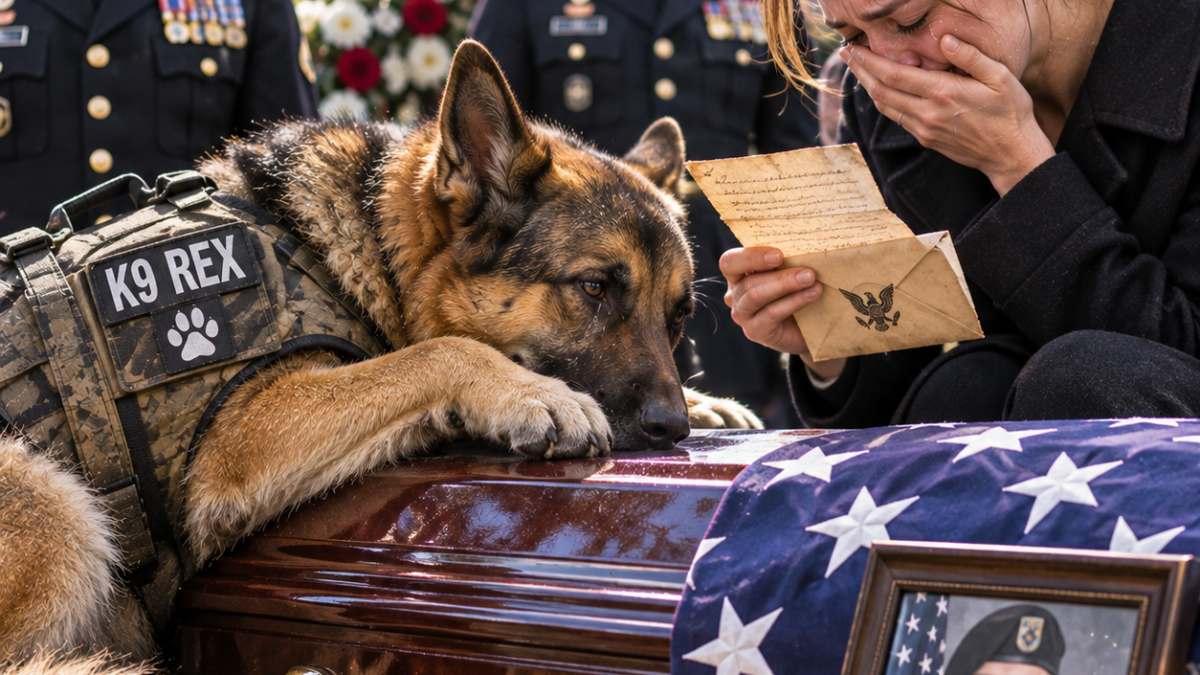
PART2
The military handler approached Rex when the ceremony ended.
His name was Sergeant Michael Hayes.
He was a quiet man with tired eyes and a face that looked older than his twenty-eight years.
He’d served alongside Daniel and Rex during their final deployment.
Michael waited until the last formal honors had concluded before touching the dog’s leash.
“Come on, buddy.”
Rex didn’t move.
Michael gave a gentle cue.
“Rex. Heel.”
The Shepherd’s ears shifted.
He remained beside the coffin.
Michael crouched.
“Come on, boy.”
Rex turned his head.
Looked at Michael.
Then pressed himself closer to the coffin’s stand.
It wasn’t aggression.
He didn’t bare his teeth.
Didn’t lunge.
Didn’t bark.
He simply refused to leave.
A senior officer, Lieutenant Colonel James Whitaker, watched from several feet away.
After a moment, he approached.
“Sergeant.”
“Yes, sir?”
“We need to return Rex to the vehicle.”
Michael nodded.
“Yes, sir.”
He tried again.
“Rex.”
The dog lowered his head.
My son tugged my coat.
“Mommy, they’re taking him.”
I swallowed.
“He needs to go with the soldiers.”
“But he wants Uncle Danny.”
My eyes filled.
“I know.”
Lucas pulled away from me.
Before I could stop him, he hurried toward the dog.
“Lucas!”
He stopped a few feet away.
Rex lifted his ears.
My son looked at the handler.
“Can I say goodbye?”
Michael glanced toward Whitaker.
The officer considered.
Then nodded.
“Carefully. Let the dog approach.”
Lucas knelt in the grass.
His little knees immediately became wet.
He held out his hand.
“Hi, Rex.”
The Shepherd stared.
Lucas whispered:
“I’m Lucas.”
He swallowed.
“Uncle Danny told you about me.”
Rex’s nose moved.
Then he leaned forward and sniffed the boy’s fingers.
Lucas smiled through tears.
“Remember?”
The dog touched his muzzle to Lucas’s hand.
My son began crying.
“Uncle Danny loved you.”
The words broke something in me.
Lucas continued:
“He said you were the bravest dog in the world.”
Rex’s tail shifted once.
Then he lowered his head.
Lucas gently stroked his fur.
I knelt beside them.
The dog looked up at me.
For a moment, I saw the animal Daniel had described.
Not a weapon.
Not a piece of military equipment.
A living companion.
A frightened dog who had survived something terrible.
I touched his shoulder.
“Hello, Rex.”
His body trembled faintly.
I swallowed.
“I’m Danny’s sister.”
He sniffed my hand.
Then moved closer.
And I realized that the last member of my brother’s team was standing right in front of me.
Alive.
Because Daniel had decided, in a single instant, that Rex’s life was worth protecting.
Eight days earlier, Captain Daniel Carter had been leading a small patrol through a damaged industrial compound.
The exact operational details would remain limited in what our family was told.
There were reasons for that.
Other soldiers had been involved.
The circumstances were still being reviewed.
And I had no desire to turn my brother’s death into a story filled with details nobody could verify.
But Michael Hayes later told me what he personally witnessed.
They had entered an area filled with dust and smoke.
Visibility was poor.
The team was moving carefully.
Rex was ahead of Daniel on a controlled lead.
A threat emerged suddenly.
The kind of threat that gives a person almost no time to decide.
Daniel saw Rex moving into danger.
He shouted.
Then lunged forward.
He threw himself over the dog, using his body to shield him.
The explosion struck moments later.
Other members of the unit were injured.
Rex survived with wounds that required treatment.
Daniel did not.
That was what we knew.
Those were the facts Michael could tell us.
Everything else—the exact final thought, what Daniel understood in those last seconds, whether he was afraid—remained beyond anyone’s certainty.
But one thing was clear.
My brother had moved toward danger to protect the dog beside him.
I heard the story for the first time in the family briefing.
Our mother, Margaret Carter, was sitting beside me.
She was sixty-eight.
Her hands rested motionless in her lap.
When the officer explained Daniel’s final action, she looked up.
“Did he know it was going to explode?”
The officer hesitated.
“Ma’am, we cannot know precisely what he understood.”
She nodded.
Then whispered:
“He always tried to save everybody.”
I held her hand.
She stared at the floor.
“Even when he was little.”
My brother had been that way.
When he was nine, he jumped into a flooded ditch to rescue a kitten.
When he was fourteen, he stood up for a boy at school everyone else mocked.
At twenty-one, he joined the Army because he wanted, as he put it, “to do something that mattered.”
Sometimes I worried that his instinct to protect people would cost him too much.
Daniel always laughed.
“Em, you worry enough for both of us.”
He was right.
And it hadn’t protected him.
After the funeral, our mother remained seated beside the grave.
She held the folded flag the honor guard had presented to her.
Her fingers moved slowly over the stars.
I approached.
“Mom?”
She didn’t look up.
“Emily.”
“Yes?”
“Do you remember the first time Danny brought a stray animal home?”
I swallowed.
“The kitten?”
She nodded.
“He put it in his school backpack.”
I laughed through tears.
“He thought you wouldn’t notice.”
“He walked into my kitchen with the backpack meowing.”
We both smiled.
Then her expression collapsed.
“He was only nine.”
I sat beside her.
“I know.”
She looked toward the coffin.
“I keep remembering him as a little boy.”
Her voice broke.
“Not the officer.”
“Not the man they saluted.”
“Just my little boy.”
I wrapped my arms around her.
She cried against my shoulder.
I looked toward Rex.
He was still sitting near the coffin.
Michael had given him some space.
The handler stood watching quietly.
And something about the sight made me reach for the envelope again.
I felt its edges beneath my fingers.
Daniel’s handwriting was visible across the front.
For Emily. Only if I don’t come home.
I hadn’t opened it.
Not during the week of arrangements.
Not while choosing photographs for the memorial.
Not when Mom asked whether Daniel had left any final message.
Part of me believed that if the envelope stayed closed, the terrible condition Daniel had attached to it would remain unreal.
But now he was buried.
And Rex was waiting.
I understood that I had to keep my promise.
I stood.
Walked toward Michael and Lieutenant Colonel Whitaker.
Then said:
“There’s something you need to see.”
Whitaker turned.
“Ms. Carter?”
I held out the envelope.
“Daniel gave me this before he deployed.”
The officer’s expression changed.
“What is it?”
“I don’t know everything that’s inside.”
I swallowed.
“He told me to open it if he didn’t come home.”
Michael looked at the handwriting.
His face softened.
“That looks like the captain’s writing.”
I nodded.
“It is.”
We moved to a sheltered bench near the cemetery path.
Mom came with us.
Lucas stayed close to my side.
Rex followed Michael only a few steps, then stopped near us.
He lay down beside the bench.
Watching.
I opened the envelope carefully.
Inside was a smaller folded letter and a little cloth pouch.
I knew the pouch.
Daniel had carried it for years.
When I tipped it into my palm, a small metal insignia fell out.
A worn silver-colored emblem from his military career.
The edges were scratched.
The back polished smooth from handling.
I remembered seeing it around his neck beneath his clothing during one of his visits home.
I’d asked why he wore it.
He’d shrugged.
“Reminds me who I am on bad days.”
Now it lay in my hand.
Cold.
Small.
Absurdly light for something that seemed to contain so much of my brother.
I unfolded the letter.
The first line made me stop breathing.
Em, if you’re reading this, I’m sorry I didn’t get to say goodbye properly.
My hands began shaking.
Mom leaned closer.
“Read it, sweetheart.”
I swallowed.
Then began aloud.
I know you’ll be angry with me for writing a letter like this. You’re going to tell me I should have spent the time packing or calling Mom instead of thinking about what might happen. But there are things I need to put into words while I still have the chance.
I stopped.
Daniel’s voice seemed to fill my head.
He knew me too well.
Even from thousands of miles away, he knew exactly what I would say.
I continued.
First, please tell Mom that every time she asked whether I was eating enough, I rolled my eyes—and then went looking for something to eat. Tell her she was right about the extra socks. Tell her I still remember her standing on the porch every time I left, waving until the car disappeared.
Mom made a small broken sound.
I looked toward her.
She was crying.
But she nodded.
“Keep going.”
I read.
Tell Lucas that being brave doesn’t mean never being scared. It means doing what’s right even when your knees shake. And tell him I never forgot our promise to build the biggest blanket fort in the history of the world. I’m sorry if I don’t get to keep that one.
Lucas began sobbing.
I pulled him close.
He whispered:
“He promised.”
“I know, baby.”
“He really promised.”
I kissed his hair.
Then forced myself to continue.
Now there’s something I need to ask you to do for Rex.
At the sound of his name, the dog lifted his head.
I stared at him.
For a moment, I couldn’t speak.
Then I read.
Rex isn’t just a military dog. He’s my partner, my brother in everything except blood, and the one creature who has stood beside me through days I never want the rest of you to experience.
He trusts me. I trust him. Sometimes that’s the only thing that makes a hard day bearable.
If something happens to me, please don’t let my last memory of him become the end of his story.
I covered my mouth.
Michael looked down.
Mom reached for the back of my hand.
I continued.
I know Ranger—sorry, I mean Rex—would laugh at me if dogs could laugh, because I keep telling him he’s going to retire someday and become completely spoiled. I picture him sleeping in a real house, stealing a sunny spot by the window, and chasing a ball across an ordinary backyard instead of working around smoke and gunfire.
I laughed through tears.
Daniel had almost written the wrong dog’s name.
A tiny human mistake.
Proof that this was not some polished ceremonial statement.
It was my brother sitting somewhere far from home, writing quickly, thinking about the dog beside him.
I continued.
If I’m not there to make that happen, please ask the Army whether Rex can retire and live with our family when it’s appropriate and possible. I know the decision has to follow the rules, and I don’t want anyone to neglect his medical or training needs. I just want him to have the chance.
No more danger if he’s ready for rest. No more treating him as useful only when he works. Let him be loved for being alive.
Mom was crying openly.
Lucas clung to my arm.
I looked toward Rex.
He remained still.
His ears slightly raised.
I read the final paragraph.
And Em, there’s one thing I need you to understand.
If Rex comes home, don’t see him as a reminder that I died. See him as proof that something I loved survived.
Let him know your voice. Let him know Mom’s hands. Let him run with Lucas in the yard when it’s safe. Let him sleep without waiting for another mission.
He has given everything he had to his service.
Let the rest of his life belong to peace.
I love you all.
And please, whatever happens, keep living.
Your annoying little brother,
Danny
I lowered the paper.
Nobody spoke.
The wind moved through the trees.
Somewhere behind us, a vehicle door closed.
But around the bench, silence held.
Michael stared at the ground.
Whitaker removed his cap.
Mom covered her face.
And Lucas whispered:
“Uncle Danny wanted Rex to come live with us?”
I nodded.
“Yes.”
My son looked toward the dog.
Then back at me.
“Forever?”
My throat tightened.
“If we can make it happen.”
Lucas stood.
Walked slowly toward Rex.
Knelt.
And whispered:
“Uncle Danny said you can come home.”
The Shepherd moved closer.
Sniffed the boy’s hand.
Then pressed his head into his palm.
My son began crying again.
I watched.
Then looked toward the officer.
“Colonel, is there any way?”
Whitaker’s expression was solemn.
“We can begin the appropriate review.”
I nodded.
“But it won’t be automatic.”
“I understand.”
“Rex has medical needs after the incident.”
“I understand.”
“And working-dog retirement decisions must be made properly.”
I looked at the letter.
Then at the dog.
“We’ll do whatever we need to do.”
Whitaker nodded slowly.
Then said:
“I’ll make sure the request is heard.”
That was enough for the moment.
Not a guarantee.
But a door opening.
And after a week in which every door seemed to lead toward another goodbye, I was grateful for one that might lead somewhere else.
We went home without Rex that day.
That fact hurt more than I’d expected.
After discovering Daniel’s letter, I wanted to take the dog by the leash and walk him straight into our car.
I wanted to tell him:
It’s over.
You’re safe.
You can sleep now.
But things weren’t that simple.
Rex was still an Army working dog.
He needed medical assessment.
Behavioral evaluation.
A decision about whether retirement was appropriate.
And if he could retire, a home prepared for the needs of an animal who had spent years working in demanding environments.
I understood all of that.
I hated it anyway.
Lucas cried in the car.
Not loudly.
Not dramatically.
Just little silent tears running down his cheeks while he stared at the empty back seat.
I reached behind me.
Touched his knee.
“Sweetheart.”
He looked up.
“Is Rex going back to war?”
My chest tightened.
“I don’t know what the Army will decide yet.”
“But Uncle Danny wanted him to be safe.”
“I know.”
Lucas looked away.
“What if he forgets us?”
I swallowed.
“He’s only just met us.”
“Still.”
I glanced at Mom beside me.
She was holding Daniel’s insignia.
Turning it slowly between her fingers.
Then she spoke.
“Lucas.”
He looked toward her.
“Your uncle asked us to try.”
The boy nodded.
“Then we’ll try.”
She reached back and took his hand.
“We’ll do everything we’re allowed to do to help Rex have a good home.”
Lucas sniffed.
“Promise?”
Mom looked at me.
Then answered:
“I promise we’ll try our best.”
That was my mother.
Even in grief, she refused to make promises that depended on people outside her control.
Daniel had learned that honesty from her.
And now I was learning how important it was.
The first night after the funeral, I couldn’t sleep.
Lucas had finally fallen asleep around midnight.
Mom was staying with us because I didn’t want her alone.
My husband, Andrew, had returned from an out-of-state work trip as soon as we learned about Daniel.
He tried to help with everything.
Meals.
Laundry.
Phone calls.
Bills.
He moved quietly around the house, unsure what to say.
I loved him for not pretending there was a sentence that could fix us.
At two in the morning, I sat at the kitchen table with Daniel’s letter.
The little insignia lay beside it.
I kept turning it over.
Looking at the worn edges.
Then I remembered the day he’d given me the envelope.
It had been spring.
Daniel was home on leave.
He sat on our back porch wearing jeans and a gray T-shirt.
Lucas was building a fort from couch cushions inside.
Rex wasn’t with him that visit.
The dog remained under military care while Daniel traveled.
But my brother spoke about him constantly.
“Em, I swear that dog understands sarcasm.”
I’d laughed.
“Then he’s smarter than you.”
Daniel grinned.
“Low bar.”
We sat together drinking iced tea.
Then he reached into his backpack.
Pulled out the envelope.
“Keep this.”
I frowned.
“What is it?”
“Something for later.”
“Daniel.”
He looked serious.
That was unusual enough to frighten me.
“Just promise you’ll keep it safe.”
I stared.
“Why?”
He looked toward the backyard.
Then said:
“Because there’s something I want Rex to have if I can’t give it to him myself.”
My chest tightened.
“Stop.”
“Em—”
“No.”
“You’re coming home.”
He turned toward me.
“I plan to.”
“Then don’t talk like this.”
He reached for my hand.
“Please.”
I looked at the envelope.
His name.
My name.
The careful handwriting.
Then agreed.
“Fine.”
He smiled faintly.
“Thank you.”
I placed it in the drawer beside my bed.
And spent the next eight months refusing to think about it.
Now it was open.
And the man who wrote it was gone.
I pressed the letter against my chest.
Then whispered:
“Why did you have to be the one to save him?”
There was no answer.
Only the hum of the refrigerator.
The ticking clock.
And the unbearable realization that I could love Rex and still wish my brother had survived instead.
That thought made me feel ashamed.
Then I remembered Daniel’s words.
See him as proof that something I loved survived.
I began crying.
Because my brother had known.
Somehow, he’d known that the people who survived might struggle with loving the life that remained.
And he had tried to give us permission.
The weeks afterward were difficult for everyone.
Mom went home but rarely slept through the night.
Lucas began asking whether I could die suddenly too.
Andrew found him sitting beside his bedroom door one evening.
“Buddy?”
Lucas looked up.
“Yeah?”
“Why are you sitting here?”
My son hugged his knees.
“Making sure Mom doesn’t leave.”
Andrew sat beside him.
For a long time, neither spoke.
Then my husband said:
“Your mom is here.”
Lucas nodded.
“But Uncle Danny was here.”
Andrew swallowed.
“Yeah.”
“He was here and then he wasn’t.”
My husband wrapped an arm around him.
“I know.”
“Can that happen to anybody?”
Andrew closed his eyes.
Then answered carefully.
“People can die, sweetheart.”
“But right now, you’re safe, and your mom and I are here.”
Lucas looked toward our bedroom.
“Can I sleep with the door open?”
“Of course.”
“Will you check on me?”
“Every night.”
Andrew did.
Sometimes three times.
Sometimes more.
Grief had entered our house wearing a child’s fear.
And no amount of explaining could make that fear disappear overnight.
I visited Mom every afternoon.
Sometimes she was in the kitchen.
Sometimes in Daniel’s old bedroom.
Sometimes sitting beside the telephone.
That was where I found her one Sunday.
She was holding a cup of tea.
Looking at the clock.
Seven fifteen.
Daniel used to call around seven on Sundays when his schedule allowed.
I sat beside her.
“Mom.”
She nodded.
“He always called.”
“I know.”
She looked at the phone.
“Sometimes he couldn’t talk long.”
I swallowed.
“I remember.”
“But he always asked about Lucas.”
“Yes.”
“And your work.”
I nodded.
“And whether I’d learned to use the new television.”
A small smile touched her mouth.
Then vanished.
“He’ll never call again.”
I took her hand.
“No.”
She began crying.
I held her.
For a long time, we stayed like that.
Then she whispered:
“Do you think Rex looks for him?”
I thought of the cemetery.
The dog’s eyes fixed on the coffin.
The way he’d refused to leave.
“I think Rex is adjusting to a terrible loss too.”
Mom nodded.
Then looked toward Daniel’s letter on her coffee table.
“I hope they let him come home.”
“Me too.”
She squeezed my hand.
“Danny wanted him to have peace.”
I looked at her.
“Yes.”
“Then that’s what we should ask for.”
Two weeks after the funeral, Sergeant Michael Hayes called.
I answered so quickly I nearly dropped the phone.
“Michael?”
“Ma’am.”
“How’s Rex?”
“He’s recovering.”
My knees weakened.
I sat down.
“Thank God.”
“His injuries are improving.”
“He’s eating regularly.”
“Resting.”
I closed my eyes.
“And?”
Michael hesitated.
“Emotionally, he’s having difficulty settling.”
I looked toward the photograph of Daniel and Rex on my shelf.
“What does he do?”
“He responds to familiar equipment.”
“Sometimes searches when a door opens.”
“Seems unsettled at certain sounds.”
My throat tightened.
“He’s looking for Danny.”
Michael spoke carefully.
“We can’t know exactly what he’s expecting.”
“But the change in his handler relationship has affected him.”
I nodded.
Even though he couldn’t see.
“What happens now?”
“The veterinary and working-dog teams are evaluating whether retirement is appropriate.”
“Do they know about Daniel’s letter?”
“Yes.”
“It’s been included with the family request.”
I took a breath.
“Thank you.”
Michael was quiet.
Then said:
“Emily?”
“Yes?”
“Daniel would’ve wanted me to tell you something.”
I closed my eyes.
“What?”
“Don’t let anybody turn Rex into a symbol before he’s allowed to be a dog.”
I stared.
Michael continued.
“Your brother loved him because Rex had a personality.”
“He was stubborn.”
“Playful.”
“Sometimes difficult.”
“He wasn’t just a heroic animal in uniform.”
My throat tightened.
“I know.”
Michael paused.
“Daniel wanted him to have ordinary days.”
I looked toward Lucas’s toys scattered across the living room.
Ordinary days.
I’d spent weeks longing for one.
“Then that’s what we’ll try to give him.”
The first official visit to see Rex took place at the military working-dog facility several weeks later.
It had been arranged with the appropriate staff.
We weren’t allowed to wander freely through kennels or approach working dogs without permission.
I appreciated that.
Rex had served in demanding environments.
His care and training deserved respect.
Mom came with me.
Lucas stayed home with Andrew because the initial visit involved evaluations and discussion with the veterinary team.
We entered a quiet indoor area.
Michael waited beside a door.
He looked tired.
But when he saw Mom, his face softened.
“Mrs. Carter.”
She hugged him.
He looked surprised.
Then hugged her back.
“How are you?” she asked.
He swallowed.
“Doing my best.”
Mom nodded.
“That’s all any of us can do.”
He opened the door.
Rex stood inside with a handler.
He was thinner than in Daniel’s old photographs.
A small shaved patch remained near his shoulder where veterinary treatment had been provided.
But his eyes were bright.
His ears lifted when he saw us.
Mom stopped.
“Rex.”
The dog sniffed the air.
Then took a step forward.
The handler allowed him to approach.
Mom knelt.
He moved closer.
Sniffed her hands.
Then pressed his muzzle against her fingers.
She began crying.
“Hello, sweetheart.”
I crouched beside her.
Rex looked at me.
For one second, I remembered the cemetery.
Then he leaned toward me.
I stroked his neck.
“Hey, boy.”
He made a soft sound.
My throat closed.
“You’re doing good.”
The veterinary officer explained his injuries and the progress of recovery.
Then the rehabilitation team discussed his behavior.
Rex remained capable and well trained.
But his physical condition, stress responses, and service history made retirement a serious option.
They were not making the decision based solely on the family’s grief.
That was important.
Rex needed what was best for him.
We listened.
Asked questions.
Took notes.
Then the officer said something that made my heart leap.
“If the retirement process is approved, your family can submit an adoption application.”
Mom looked at me.
I looked back.
Neither spoke for a moment.
Then Mom whispered:
“Can we start now?”
The officer smiled gently.
“Yes, ma’am.”
And for the first time since Daniel died, we had something to prepare for that wasn’t a funeral.
Our home was not ready for Rex immediately.
We had a backyard.
A sturdy fence.
A quiet house.
But a military working dog wasn’t the same as a family pet with no specialized history.
We needed a plan.
A veterinarian.
Appropriate training support.
A safe sleeping area.
Clear routines.
An understanding of possible stress triggers.
A way to introduce him to Lucas gradually and responsibly.
We met with professionals.
Asked what Rex needed.
Listened.
Sometimes the answers were inconvenient.
That didn’t matter.
Daniel had asked us not to lock Rex away from life.
He had not asked us to ignore the dog’s safety or limitations.
So we prepared carefully.
Andrew repaired the backyard fence.
I cleared space in the living room for a large orthopedic dog bed.
Mom brought one of Daniel’s old blankets.
It smelled faintly of the detergent she’d always used.
We placed it near the bed.
Lucas drew a picture.
A soldier.
A dog.
A small house.
Above them he wrote:
WELCOME HOME, REX.
He taped it to the refrigerator.
Then asked me every morning:
“Any news?”
Some mornings I had none.
Other days, a short update.
An appointment.
A document.
Another assessment.
Lucas kept waiting.
And every time I saw the picture, I remembered the final line of Daniel’s letter.
Let the rest of his life belong to peace.
The decision arrived on a Thursday.
I remember because Daniel had always hated Thursdays.
“Thursday is just Friday’s annoying little brother,” he’d say.
That morning, I was packing Lucas’s lunch when my phone rang.
An unfamiliar number.
I answered.
“Emily Carter.”
“Ms. Carter, this is Lieutenant Colonel Whitaker.”
I froze.
“Colonel.”
“How are you?”
I swallowed.
“Doing okay.”
He paused.
“I have news about Rex.”
My hands began shaking.
Lucas looked up from the kitchen table.
“Mom?”
I raised one finger.
“Go ahead.”
Whitaker’s voice was steady.
“The retirement decision has been approved.”
I closed my eyes.
“And?”
“Your family has been approved for adoption under the applicable process.”
For a moment, I couldn’t breathe.
I gripped the counter.
“Really?”
“Yes, ma’am.”
“He can come home?”
“Yes.”
Tears filled my eyes.
Lucas stood.
“Mommy?”
I looked at him.
He stared.
Then whispered:
“Rex?”
I nodded.
He began jumping.
“REX IS COMING HOME?”
I laughed through tears.
“Yes, baby.”
He threw his arms around me.
I nearly dropped the phone.
Whitaker chuckled softly.
“I take it your son is happy.”
I pressed my face into Lucas’s hair.
“More than you know.”
We arranged the transition.
Discussed the care paperwork.
Confirmed the date.
When the call ended, I stood holding my son while he cried against my chest.
Then I called Mom.
She answered.
“Emily?”
I couldn’t speak.
“Sweetheart?”
I swallowed.
“Mom.”
“What is it?”
“Rex is coming home.”
Silence.
Then a sharp intake of breath.
“Oh.”
I heard her crying.
“Oh, Danny.”
I closed my eyes.
For the first time, she wasn’t crying only because her son was gone.
She was crying because one of his last wishes was about to be honored.
The day Rex came home, we didn’t organize a crowd.
No television cameras.
No neighborhood parade.
No dramatic ceremony with hundreds of strangers.
Daniel had wanted Rex to know peace.
So we made the day quiet.
Mom came early.
She brought oatmeal cookies because Daniel had loved them.
Lucas put on his favorite dinosaur T-shirt.
Andrew made coffee.
I walked from the kitchen to the front window so many times that my husband finally laughed.
“Emily.”
“What?”
“Sit down.”
“I can’t.”
“I noticed.”
At ten forty-two, a vehicle pulled into our driveway.
My heart pounded.
Michael Hayes stepped out.
Then a civilian transition specialist.
And finally Rex.
The German Shepherd climbed down carefully.
Stood on the driveway.
Looked around.
He sniffed the air.
His ears rose.
I stepped onto the porch.
“Rex.”
He looked toward me.
Then Michael gave a quiet cue.
The dog approached.
Not rushing.
Not leaping.
Just walking steadily.
As though trying to understand the unfamiliar place.
He reached the bottom step.
Stopped.
Looked up at me.
I knelt.
“Hi, boy.”
He sniffed my hands.
Then pressed his muzzle against my palm.
My eyes filled.
“Welcome home.”
Mom came onto the porch.
Rex saw her.
His tail moved.
She lowered herself carefully onto the bench.
He approached.
Rested his head against her knee.
She began crying.
“Danny kept his promise.”
I looked at her.
Then at the dog.
“No, Mom.”
I swallowed.
“We’re keeping it for him.”
Lucas appeared in the doorway.
He stopped.
Remembering what we’d practiced.
Don’t run toward the dog.
Don’t throw your arms around him.
Let him approach.
Give him space.
“Hi, Rex.”
His little voice trembled.
The dog looked toward him.
Sniffed.
Took a step.
Lucas held out his hand.
Rex approached.
Touched his nose to the boy’s fingers.
Then sat.
Lucas looked at me.
“Mommy.”
I nodded.
His eyes filled.
“He’s really here.”
“Yes.”
The boy smiled through tears.
“Uncle Danny’s dog is home.”
And in that moment, my heart broke and healed a little at the same time.
The first week was harder than Lucas expected.
Rex didn’t immediately want to play.
He slept lightly.
Reacted to sudden noises.
Watched the doors.
Sometimes stood in the hallway as though waiting for someone.
He ate, but only after the house became quiet.
The transition specialist had warned us this might happen.
So we stayed patient.
Didn’t force affection.
Didn’t overwhelm him with visitors.
Didn’t turn every moment into a memorial to Daniel.
Rex needed time to learn that this house was safe.
That nobody would call him out for another mission.
That the loudest sounds he might hear were a dropped saucepan or Lucas laughing too hard.
At night, he often chose to lie near the front door.
I found him there the third evening.
It was almost midnight.
Lucas was asleep.
Andrew had gone upstairs.
Mom had returned to her house.
I stood in the hallway looking at the dog.
“Hey, Rex.”
He raised his head.
I sat on the floor.
He watched me.
“Are you waiting for him?”
The words escaped before I could stop them.
The dog lowered his head.
I wiped my eyes.
“I know.”
I leaned against the wall.
“I keep waiting too.”
For a long time, we stayed like that.
Then I whispered:
“I wish I could tell you where he went.”
My voice broke.
“I wish somebody could tell me.”
Rex moved closer.
Rested his head against my leg.
I began crying.
Not the controlled tears I’d managed in front of Lucas.
Not the quiet ones during the funeral.
The kind that make your chest hurt and leave you unable to speak.
I buried my face in my hands.
“Daniel.”
Rex remained beside me.
Warm.
Steady.
Present.
And for the first time since my brother died, I cried with somebody who had known a part of him I never could.
The first Sunday after Rex came home, Mom visited for dinner.
Daniel used to call her on Sundays when his duties allowed.
Around seven.
Sometimes earlier.
Sometimes later.
The timing had become a ritual.
Even after his death, Mom still looked toward the phone.
I noticed it that evening.
At six fifty-five, she became quiet.
At seven, her eyes moved toward the kitchen counter.
Her phone lay there.
Dark.
Silent.
Rex was sleeping near the sofa.
Then Mom whispered:
“He would usually call about now.”
I reached for her hand.
“I know.”
She looked toward the dog.
“He’d ask what we were having for dinner.”
I smiled sadly.
“Then tell us his food was terrible.”
Mom laughed softly.
“Yes.”
She wiped her eyes.
“Sometimes he’d make Rex sit beside him while we talked.”
I nodded.
“I remember.”
Rex lifted his head.
He looked toward Mom.
Then stood.
Walked across the room.
And lay down at her feet.
Mom stared.
For a moment, she couldn’t speak.
Then she bent forward.
Touched his ears.
“Oh, sweetheart.”
I swallowed.
The dog had not understood the time on the clock.
He wasn’t receiving a message from Daniel.
He was responding to an older woman whose voice and body had changed with grief.
But what he did mattered just the same.
He stayed beside her.
Mom placed one hand on his head.
Then whispered:
“Thank you.”
The phone never rang.
But the silence felt different.
Not empty.
Shared.
A month later, Lucas made Rex wag his tail.
It happened on a Saturday morning.
Nothing dramatic.
No music.
No crowd.
No miraculous revelation.
Just a little boy in a backyard.
And a worn rubber ball.
Daniel had once given Lucas the ball during a visit.
“Keep this safe,” he’d said.
“Rex loves it.”
Lucas had put it in a drawer.
After the funeral, he refused to touch it.
Then one morning, he brought it outside.
I was standing on the porch with coffee.
Rex lay beneath the maple tree.
Lucas approached carefully.
“Rex?”
The dog lifted his head.
Lucas held up the ball.
“Uncle Danny said this is your favorite.”
Rex’s ears rose.
He sniffed.
Then stood.
Lucas looked at me.
“Can I?”
I nodded.
“Gently.”
My son rolled the ball across the grass.
Not far.
Just a few feet.
Rex watched.
Then walked toward it.
Sniffed.
Picked it up.
And turned back.
Lucas began smiling.
“Mom!”
I lifted one hand.
“Easy, sweetheart.”
He nodded.
Rex carried the ball toward Lucas.
Stopped.
Then dropped it at his feet.
Lucas laughed.
A bright, surprised laugh.
The first truly carefree laugh I’d heard from him since Daniel died.
“Again?”
Rex’s tail moved.
Once.
Twice.
Then faster.
Lucas looked at me.
Tears filled his eyes.
“Mommy, he’s happy.”
I swallowed.
“He looks happy, baby.”
Lucas rolled the ball again.
Rex followed.
Picked it up.
Returned.
Tail moving.
And I stood on the porch crying quietly.
Because Daniel had been right.
There was more for Rex than danger.
More than the final explosion.
More than the cemetery.
There were ordinary things.
A backyard.
A soft morning.
A little boy.
And a worn rubber ball.
Rex became part of our family slowly.
At first, he slept near the hallway.
Then beside the living-room sofa.
Eventually, he chose the rug beneath the front window.
That was his place.
He liked being able to see the yard.
Liked watching squirrels.
Liked the sound of Lucas playing outside.
He developed a habit of following Andrew into the kitchen whenever dinner was being prepared.
Andrew pretended to be annoyed.
“You’re not getting any steak.”
Rex sat.
Watched.
Waited.
Andrew sighed.
“You are incredibly persistent.”
I smiled.
“Daniel said the same thing.”
He looked toward me.
Then at Rex.
“Well, your uncle had excellent judgment.”
Lucas laughed.
The dog wagged his tail.
Soon, we had ordinary stories about Rex.
The day he stole a dish towel.
The morning he refused to get out of the sunny patch by the window.
The time he pushed his empty food bowl across the kitchen floor with his nose.
The afternoon he barked at a garden statue until Andrew moved it.
We laughed.
Sometimes the laughter hurt.
Because we wanted Daniel to be there.
But gradually it began to feel less like betrayal.
More like honoring what he’d asked us to do.
Keep living.
Those words appeared near the end of the letter.
At first, I hated them.
How could Daniel ask us to live when he wasn’t here?
How could he imagine we’d laugh again?
Then Rex started bringing us the ball.
Mom began visiting more often.
Lucas started sleeping through the night.
Andrew stopped moving around the house as though every sound might break me.
And I realized my brother hadn’t asked us not to grieve.
He’d asked us not to let grief become the only thing we had left.
The military arranged a memorial gathering several months after Daniel’s funeral.
We attended with Rex under the appropriate arrangements.
Some of Daniel’s former teammates were there.
Men and women whose names I’d heard for years but whose faces I was only beginning to know.
Michael Hayes approached first.
He knelt near Rex.
“Hey, partner.”
The Shepherd lifted his ears.
Michael smiled.
“Still think you’re in charge?”
Rex wagged his tail.
I laughed softly.
“He definitely runs our house.”
Michael looked at me.
Then smiled.
“Captain would’ve loved that.”
My throat tightened.
“Tell me about him.”
Michael’s expression changed.
“What would you like to know?”
I thought about the things Daniel had never told us.
Not because he wanted to hide his life.
Because there are parts of military service that families cannot easily understand from phone calls.
“Anything.”
I whispered.
“Just something.”
Michael looked toward Rex.
Then said:
“Your brother had a terrible singing voice.”
I stared.
“What?”
“Absolutely awful.”
A laugh escaped me.
Michael smiled.
“He used to sing to Rex while cleaning equipment.”
I covered my mouth.
“Daniel couldn’t carry a tune to save his life.”
“I know.”
“He’d make up songs about whatever Rex did that day.”
I laughed through tears.
Michael continued.
“One time, Rex stole a glove.”
“Daniel spent ten minutes singing a ridiculous song about a criminal dog escaping justice.”
I bent forward laughing.
Then crying.
Both.
Because that was my brother.
Not just a captain.
Not just a casualty notification.
A man who made up stupid songs for a dog.
Michael’s smile faded.
“He kept everybody going.”
I looked at him.
He swallowed.
“Some days were hard.”
“Really hard.”
“And Daniel knew when somebody needed a joke.”
I nodded.
“That’s how he was at home.”
Michael looked toward the memorial photographs.
Then whispered:
“We miss him.”
I reached for his hand.
“So do we.”
We stood together.
No rank.
No ceremony.
Just two people grieving the same man from different parts of his life.
At the memorial, Mom met a young soldier named Private First Class Samuel Ortiz.
He looked barely twenty.
He approached hesitantly.
“Mrs. Carter?”
She turned.
“Yes?”
“I’m Samuel.”
“I served under your son.”
Mom’s face softened.
“Hello, Samuel.”
He looked down.
Then said:
“I wanted to thank you.”
She frowned.
“For what?”
“Raising him.”
Mom’s eyes filled.
Samuel swallowed.
“I messed up something during training.”
“Not dangerous, but embarrassing.”
“Everybody saw.”
He looked toward Daniel’s photograph.
“I thought Captain Carter would tear into me.”
“What did he do?” Mom asked.
Samuel laughed softly.
“He stayed afterward and helped me understand what I’d done wrong.”
“Then he told me not to let one mistake become my whole identity.”
Mom covered her mouth.
Samuel continued.
“He said he learned that from his mother.”
Tears ran down her face.
She looked at him.
“Really?”
He nodded.
“He said you always told him people could do better tomorrow.”
Mom began crying.
Samuel looked alarmed.
“I’m sorry.”
She shook her head.
“No.”
She reached for his hand.
“Thank you.”
Then she pulled him into an embrace.
The young soldier stood frozen for a second.
Then hugged her back.
I watched.
And thought about all the pieces of Daniel we were receiving from people who had known him.
Every story mattered.
Every memory made him larger than the moment he died.
That night, Mom came home with us.
We sat at the kitchen table looking through photographs.
Daniel smiling beside Rex.
Daniel holding a birthday cake someone had apparently baked in the field.
Daniel wearing a ridiculous paper crown.
Daniel standing with soldiers who looked exhausted and happy.
Lucas pointed at one picture.
“Why is Uncle Danny wearing that?”
I laughed.
“Ask Michael.”
Michael had sent a note explaining the photograph.
Daniel had lost a bet.
The punishment was wearing a paper crown through dinner.
My brother had insisted he looked magnificent.
Lucas laughed so hard he nearly fell off his chair.
Mom laughed too.
Then she stopped.
Touched Daniel’s face in the photograph.
Her expression changed.
For a moment, the room went quiet.
I reached toward her.
“Mom?”
She smiled through tears.
“I’m okay.”
I knew she wasn’t completely.
None of us were.
But she was smiling.
That mattered.
Rex lay beneath the table.
His head resting near Lucas’s feet.
We kept looking through pictures.
And for the first time, Daniel’s name filled the house without making every person afraid to speak.
The anniversary of his death arrived with cold weather.
I dreaded it for weeks.
Every morning felt closer to the day we had received the call.
I remembered where I was when the military officer contacted me.
Standing in the grocery store.
Holding a carton of milk.
My phone rang.
The caller asked whether I was somewhere private.
I knew then.
I left my cart beside the dairy section.
Walked outside.
And listened to a voice explain that my little brother had been killed.
I didn’t remember driving home.
Didn’t remember how Andrew found me.
Only remember sitting on the kitchen floor with my phone in my hand, unable to make the world feel real.
Now, a year later, the memory still hit me without warning.
A ringing phone.
A military vehicle.
A familiar song.
A photograph.
Anything could bring it back.
We planned a quiet day.
No television.
No interviews.
No public speeches.
Mom came over.
We made Daniel’s favorite dinner.
Roast chicken.
Mashed potatoes.
Green beans.
And apple pie.
Lucas insisted on setting an extra place.
I looked at him.
“Sweetheart—”
“I know Uncle Danny isn’t coming.”
His eyes filled.
“I just want his chair there.”
I swallowed.
Then nodded.
“Okay.”
We placed a photograph near the plate.
Not because we expected Daniel to return.
Because remembering him was part of loving him.
Rex lay beside the table.
At one point, Lucas looked toward the photo.
Then the dog.
He whispered:
“Uncle Danny saved you.”
Rex lifted his head.
Lucas continued:
“I’m glad he did.”
I looked away.
Because for months, part of me had struggled with that truth.
My brother had died.
The dog survived.
I loved Rex.
But there were nights when I wanted to scream at the unfairness of it.
Why Daniel?
Why couldn’t both have lived?
Why did a split-second act of love have to cost him everything?
That evening, Lucas said the one sentence that helped me understand something I had been resisting.
“Uncle Danny loved Rex enough to keep him alive.”
I looked at my son.
He continued:
“So we should love Rex enough to make his life good.”
I began crying.
Because it was simple.
And because my seven-year-old boy understood something I’d spent a year trying to accept.
Daniel’s death was a tragedy.
Rex’s survival was not.
We were allowed to mourn one and cherish the other.
Both could be true.
Over the next two years, Rex grew older.
His muzzle turned gray.
He moved more slowly after long walks.
Some mornings he preferred lying in the sun to chasing his ball.
The veterinarian explained that aging and the wear of his former work were affecting his joints.
We adapted.
Shorter walks.
Gentle exercise.
Appropriate medication when needed.
Soft bedding.
Regular checkups.
Lucas grew taller.
His voice changed.
He became old enough to understand more about Daniel’s death than he had at seven.
Sometimes he asked difficult questions.
“Did Uncle Danny know he was going to die?”
I answered carefully.
“We can’t know exactly what he understood.”
“Was he scared?”
“Maybe.”
Lucas looked at me.
“Can brave people be scared?”
I smiled sadly.
“Yes.”
“Your uncle told you that himself.”
He nodded.
Then looked toward Rex.
“Do you think he misses him?”
“I think Rex experienced a significant loss.”
Lucas sat quietly.
Then asked:
“Does that mean we should talk about Uncle Danny around him?”
I looked at the dog sleeping nearby.
“We can talk about Daniel because he’s part of our family.”
“We don’t need to know exactly what Rex understands.”
Lucas smiled.
“Okay.”
Then he leaned against me.
And I realized we were teaching each other how to grieve.
Not perfectly.
But together.
Mom began coming to our house every Sunday.
At first, she said it was because Rex needed company.
Then because Lucas wanted her to help with homework.
Then because Andrew was making roast chicken.
Eventually, she stopped giving reasons.
She simply came.
Sometimes she brought cookies.
Sometimes photographs.
Sometimes nothing.
She sat in her favorite chair beside the window.
Rex often chose to lie near her feet.
At seven in the evening, she still occasionally glanced toward her phone.
But she no longer sat waiting for a call that would never come.
Instead, she’d tell a story.
“Did I ever tell you about the time Danny tried making pancakes when he was eight?”
Lucas would grin.
“No!”
Mom would laugh.
“He put salt instead of sugar.”
Andrew would pretend to be horrified.
I would groan.
And Mom would continue.
Stories we’d heard before.
Stories we wanted to hear again.
The house filled with Daniel in a different way.
Not through absence.
Through memory.
One spring afternoon, Michael Hayes came to visit.
He’d left his former unit and was transitioning into another assignment.
He brought his wife, Sarah, and their baby daughter.
Rex recognized him.
The dog’s ears lifted.
His tail moved.
Michael knelt.
“Hey, partner.”
Rex approached.
Sniffed him.
Then leaned against his shoulder.
Michael closed his eyes.
I watched his expression change.
For a moment, he looked as though he was back somewhere far away.
Then he smiled.
“Look at you.”
He stroked the dog’s ears.
“Living the good life.”
I laughed.
“He’s completely spoiled.”
“Good.”
Michael looked up.
“That’s what Daniel wanted.”
We sat in the backyard.
Lucas played gently with the baby.
Sarah and Andrew talked near the table.
Michael watched Rex sleeping beneath the maple tree.
Then said:
“Emily.”
“Yes?”
“Can I tell you something?”
I nodded.
He looked toward the dog.
“After the explosion, I blamed myself.”
My chest tightened.
“Why?”
“I kept thinking I should have seen the threat sooner.”
I waited.
He swallowed.
“Maybe I could’ve warned Daniel.”
“Maybe I could’ve moved differently.”
“Maybe…”
He stopped.
I looked at him.
Then took his hand.
“Michael.”
He looked up.
“You loved my brother?”
His eyes filled.
“Yes.”
“Then you understand why he tried to save Rex.”
He nodded.
I swallowed.
“I’ve spent a lot of time asking why he couldn’t save himself too.”
Michael stared.
I continued.
“But none of us gets to replay that moment and choose a different ending.”
His face crumpled.
I squeezed his hand.
“You brought us the truth you knew.”
“You helped Rex recover.”
“You helped him come home.”
Michael began crying.
I pulled him into a hug.
He held on.
Not like a soldier.
Like a young man who had survived something he wished he could change.
Rex lifted his head.
Watched us.
Then went back to sleep.
I smiled through tears.
“He’s doing exactly what Danny wanted.”
Michael laughed softly.
“Yeah.”
“He is.”
The older Rex became, the more I understood that Daniel’s final wish wasn’t about keeping him alive at any cost.
It was about giving him a chance to experience ordinary happiness.
That meant good veterinary care.
Comfort.
Appropriate activity.
And eventually, making difficult decisions when his body began to fail.
I didn’t want to think about that.
None of us did.
But I remembered the letter.
Let the rest of his life belong to peace.
Peace includes being cared for when you’re weak.
Not forced to perform because people still want to see you as a hero.
Not expected to carry somebody else’s grief forever.
Rex had done enough.
He didn’t owe us constant loyalty displays.
Didn’t owe visitors a reunion scene.
Didn’t owe reporters a dramatic moment beside Daniel’s photograph.
He was allowed to sleep.
Eat.
Play when he wanted.
And grow old.
That was the life we tried to give him.
One evening, Rex had difficulty rising from his bed.
Lucas called me.
“Mom?”
I hurried into the living room.
The dog was awake.
Alert.
But clearly uncomfortable.
I knelt beside him.
“Hey, boy.”
He looked at me.
I stroked his head.
Then called the veterinarian.
We arranged an examination.
The diagnosis wasn’t a single dramatic illness.
Age-related decline.
Joint pain.
Complications from old injuries.
Things that could be managed for a time but not reversed.
The vet explained our options.
What to monitor.
How to keep him comfortable.
When to call.
Lucas sat beside me during part of the discussion.
He was older now.
Twelve.
Old enough to hear difficult things.
When the appointment ended, he looked at Rex.
Then at me.
“Mom?”
“Yes?”
“Is he going to die?”
I swallowed.
“Someday.”
His eyes filled.
“Soon?”
“We don’t know exactly.”
He looked at the dog.
“I don’t want to lose him.”
I pulled him close.
“Neither do I.”
Lucas started crying.
“He’s the last part of Uncle Danny.”
The words struck me.
I held my son tighter.
“No, sweetheart.”
He looked up.
“Rex is part of Daniel’s story.”
“But he isn’t the only thing we have left.”
I touched Lucas’s chest.
“You remember your uncle.”
He nodded.
“Grandma remembers him.”
“Yes.”
“I remember him.”
My voice broke.
“And there are people all over the world who remember what kind of man he was.”
Lucas wiped his eyes.
“But Rex was there.”
“I know.”
I kissed his forehead.
“And we’re going to make sure he knows he’s loved for as long as he’s with us.”
Rex’s final summer was quiet.
We took him on short morning walks.
Let him rest beneath the trees.
Gave him a comfortable place near the open patio door so he could feel the breeze.
Lucas sat beside him reading comic books.
Mom brought an old blanket she’d knitted years before.
Andrew built a small ramp to help Rex manage the porch steps.
We stopped expecting him to fetch the ball.
But we kept it near his bed.
The worn rubber ball Daniel had once given Lucas.
Sometimes Rex touched it with his nose.
Other times he ignored it.
That was okay.
One evening, Lucas sat beside him holding the ball.
He looked at me.
“Mom?”
“Yes?”
“Can I tell Rex something?”
I smiled.
“Of course.”
My son leaned close to the dog.
“Uncle Danny saved you.”
Rex’s ears moved faintly.
Lucas swallowed.
“And you saved us a little.”
I covered my mouth.
He continued:
“I know you can’t understand all of it.”
“But when Mom cried, you stayed.”
“When Grandma was sad, you stayed.”
“When I was scared at night, you slept near my door.”
His voice broke.
“Thank you.”
Rex lifted his head.
Touched his nose to Lucas’s cheek.
My son began crying.
I looked away.
Because there are some moments a parent wants to remember forever and also wishes their child had never needed to experience.
That was one.
When the end came, it was gentle.
We had time to prepare.
Time to consult the veterinarian.
Time to understand what was happening.
Time to make sure Rex wasn’t suffering unnecessarily.
Mom came.
Michael called to speak with us.
Lucas sat beside the dog.
Andrew held my hand.
I knelt on the floor and stroked Rex’s ears.
The same ears Daniel had scratched in a hundred photographs.
The same warm fur my son had touched on the day the dog first came home.
Rex was tired.
His breathing slow.
His eyes soft.
I leaned toward him.
“Hey, Rex.”
He looked at me.
My throat closed.
“You did it.”
Tears ran down my face.
“You got your peaceful life.”
I smiled through tears.
“You chased your ball.”
“You slept in the sun.”
“You learned Grandma’s voice.”
“You made Lucas laugh.”
I paused.
“And you never had to go back into another explosion.”
Mom began crying.
Lucas held the dog’s paw gently.
I stroked Rex’s forehead.
Then whispered:
“Thank you for loving my brother.”
My voice broke.
“And thank you for letting us love you.”
The veterinarian helped him pass peacefully.
We stayed beside him.
Nobody hurried us.
Nobody told Lucas he shouldn’t cry.
Nobody said it was only a dog.
Because Rex had been part of our family.
Not because he was a war hero.
Not because Daniel died saving him.
Because for years, he had lived beside us and become someone we loved.
And when he was gone, the house felt painfully quiet.
We buried Rex beneath the maple tree in our backyard.
The same tree where he liked to sleep in summer.
Lucas chose the spot.
Andrew prepared it.
Mom brought flowers.
Michael came.
A few of Daniel’s former teammates attended.
There was no military funeral.
No attempt to pretend Rex held a human rank or should receive honors identical to Daniel’s.
But the soldiers stood quietly with us.
Because they remembered him.
And because they loved Daniel.
Lucas placed the worn rubber ball beside the flowers for a moment.
Then he looked toward me.
“Mom?”
“Yes?”
“Can I keep it?”
I nodded.
“Of course.”
He held it against his chest.
Then whispered:
“I don’t want to forget.”
My throat tightened.
“You won’t.”
We placed a small stone beneath the tree.
REX CARTER
DANIEL’S PARTNER. OUR FAMILY.
HE FINALLY KNEW PEACE.
I stared at those words.
Then took Daniel’s insignia from my pocket.
The little metal emblem he’d placed in the envelope.
I held it in my palm.
For years, I’d kept it safe.
Now it reminded me of two lives intertwined by courage and loss.
I did not bury the insignia.
It belonged with Daniel’s letter.
But I touched it to the stone.
Just once.
Then whispered:
“We kept your promise, Danny.”
The wind moved through the maple leaves.
Nobody answered.
And I knew nobody would.
But saying the words mattered.
After Rex died, Mom stopped coming to our house for two Sundays.
She said she needed rest.
I understood.
Then I became worried.
I drove to her house.
Found her sitting beside the window with Daniel’s photograph.
“Mom?”
She looked up.
“Emily.”
I sat beside her.
“Are you okay?”
She smiled sadly.
“No.”
I took her hand.
She looked toward the photograph.
“Losing Rex felt like losing Danny again.”
My throat closed.
“I know.”
She wiped her eyes.
“When that dog came home, I had something to care for.”
“Something Daniel loved.”
“Something that moved through the house and made noise.”
She stared at her hands.
“Now it’s quiet again.”
I leaned toward her.
“Come to dinner.”
She shook her head.
“Sweetheart—”
“Please.”
She looked at me.
I continued:
“Lucas misses you.”
“Andrew misses you.”
“And I miss you.”
Her eyes filled.
“Emily.”
I took her hand.
“Daniel didn’t ask us to stop living when Rex was gone.”
I swallowed.
“He asked us to keep living even when he was gone.”
Mom closed her eyes.
For a long moment, she said nothing.
Then whispered:
“It’s hard.”
“I know.”
She looked at me.
“Will it always be hard?”
I thought about the years since the funeral.
The first Christmas.
The memorial gathering.
Lucas growing.
Rex learning to play.
The quiet Sunday evenings.
The difficult goodbye.
Then I answered:
“Some days.”
She nodded.
I smiled through tears.
“But not every moment.”
Mom squeezed my hand.
Then said:
“Dinner sounds good.”
The following Sunday, we set an extra photograph on the mantel.
Daniel beside Rex.
Not in uniform.
Not working.
Just sitting on the ground.
Daniel laughing.
Rex looking toward him.
The picture had been taken months before the final mission.
Nobody in that photograph knew what was coming.
That used to make it unbearable for me to look at.
Now I saw something else.
Happiness.
Real.
Brief.
Worth remembering.
We ate dinner.
Lucas told a terrible joke.
Andrew laughed too loudly.
Mom complained that the potatoes needed salt.
For a moment, I could almost hear Daniel saying:
“See? Nobody ever seasons anything properly when I’m gone.”
I laughed.
Then cried.
Mom reached for my hand.
I smiled.
“I’m okay.”
And I meant it.
Not perfectly.
Not forever.
But in that moment.
We were okay.
Years passed.
Lucas grew into a young man.
He joined his school’s science club.
Then volunteered at a local animal shelter.
He said he wanted to help injured dogs.
I knew where the idea began.
But I didn’t tell him what career to choose.
One afternoon, he came home carrying a photograph of a frightened rescue dog.
“Mom.”
“Yes?”
“I think we can help this one.”
I looked at the photo.
A mixed-breed puppy.
Thin.
Nervous.
Found near a highway.
My heart tightened.
I thought of Rex.
Then Daniel.
Then all the animals my brother had tried to help when we were children.
I looked at Lucas.
“Tell me about him.”
My son smiled.
And began.
We eventually fostered the puppy.
Not to replace Rex.
Not to recreate Daniel’s story.
Because an animal needed a safe place to recover.
We named him Cooper.
He was smaller than Rex.
Clumsy.
Afraid of thunderstorms.
Loved stealing socks.
Nothing like a military working dog.
We loved him anyway.
One evening, Lucas sat beside Cooper in the backyard.
He looked toward Rex’s stone beneath the maple tree.
Then at the puppy.
And smiled.
I watched from the porch.
For the first time, I understood the full meaning of Daniel’s letter.
He hadn’t wanted us to spend our lives preserving one animal as a monument.
He wanted Rex to live.
And by learning to care for Rex, we had remembered how to make room for life again.
That was the gift.
Not forgetting.
Continuing.
On what would have been Daniel’s fortieth birthday, we visited the cemetery.
Mom.
Andrew.
Lucas.
Me.
We carried flowers.
And a photograph of Rex.
The same photograph from the memorial.
Daniel and his partner sitting together in the evening light.
We stood beside the headstone.
For a long time, nobody spoke.
Then Lucas stepped forward.
He was nearly grown now.
Tall.
Serious.
With Daniel’s dark eyes.
He placed the photograph beside the flowers.
“Hey, Uncle Danny.”
His voice broke slightly.
“I wanted you to know something.”
I looked away.
Lucas continued.
“Rex had a good life.”
Mom began crying.
“He got old.”
“He stole food.”
“He slept everywhere he wasn’t supposed to.”
A small laugh escaped Andrew.
Lucas smiled through tears.
“He was loved.”
Then his voice softened.
“And he helped us when we missed you.”
I pressed my hand over my mouth.
Lucas looked toward the headstone.
“Thank you for saving him.”
Silence.
Then:
“I know you never got to come home.”
His voice broke.
“But he did.”
I closed my eyes.
My son continued.
“And because he did, we learned how to keep going.”
He stepped back.
I pulled him into my arms.
Held him.
And cried.
Because the little boy who had once asked whether Rex knew his uncle was inside the coffin had become a young man who understood that love could survive both goodbye and time.
People sometimes ask why Daniel saved Rex.
Why a soldier would risk his life for a dog.
Why he didn’t step away.
Why he moved toward the explosion.
I cannot answer what happened inside my brother’s mind during that final second.
No one can.
I know only what the soldiers told us.
Daniel saw his partner in danger.
He moved to protect him.
Rex lived.
Daniel died.
That is the terrible truth.
I won’t turn it into a simple lesson about heroism.
Because my brother was more than the way he died.
He was a boy who made his sister laugh.
A son who called home.
An uncle who built blanket forts.
A soldier who sang terrible songs to his dog.
A man who got frightened sometimes.
A man who loved deeply.
And someone who wrote a letter asking us not to let his partner’s life end emotionally with his own.
That is what I want people to remember.
Not only the explosion.
The love that existed before it.
And the life that continued afterward.
I still keep Daniel’s letter in a wooden box beside my bed.
The metal insignia rests inside the envelope.
Sometimes I take them out.
Sometimes I simply touch the box.
There are nights when I read the letter and cry until I cannot see the words.
Other nights, I smile at the line about Mom’s extra socks.
Or the joke about Rex being spoiled.
Or Daniel apologizing for the blanket fort he never finished building.
Then I reach the final words.
Keep living.
For years, I thought he had asked the impossible.
How could we live normally when the world had taken someone so essential?
But Rex taught us something Daniel already knew.
Life after loss is not the same as life before.
It doesn’t return unchanged.
It becomes something different.
A little quieter.
Sometimes harder.
But still capable of warmth.
A dog sleeping by a window.
A grandmother laughing on a Sunday evening.
A child rolling a ball across the grass.
A family learning how to say a dead man’s name without fearing the sound.
Those things matter.
They are not small.
They are the life Daniel hoped would continue.
One evening, long after Rex had died, I stood beneath the maple tree.
The sun was setting.
The little stone was warm from the afternoon light.
I knelt.
Touched it.
Then looked toward our house.
The windows glowed.
Andrew was cooking dinner.
Lucas was laughing inside.
Mom was sitting at the kitchen table.
Cooper, our foster dog, was barking at something entirely unimportant.
The house was full of ordinary noise.
I smiled.
Then whispered:
“Danny.”
My throat tightened.
“We did it.”
I looked at Rex’s stone.
“We brought him home.”
The wind moved through the leaves.
I continued.
“He had good days.”
“More than I could count.”
“He learned to sleep without waiting for another mission.”
“He played with Lucas.”
“He kept Mom company.”
“He grew old.”
I swallowed.
“And when he died, he wasn’t alone.”
For a long time, I stayed there.
Then I touched the little insignia in my pocket.
The one Daniel had left me.
And whispered:
“I wish you could’ve seen it.”
Tears filled my eyes.
“I wish you could’ve come home too.”
The words hurt.
They always would.
But I didn’t fight them.
I let them exist beside everything we had been given.
Then I stood.
Walked back toward the house.
And opened the door.
Warm air touched my face.
Lucas called from the kitchen:
“Mom! Dinner’s ready!”
Andrew looked up.
Mom smiled.
Cooper ran toward me, tail wagging.
And for one second, I could almost hear Daniel laughing at the chaos.
Not because he was there.
Because he had been there.
Because we remembered.
Because love had left its mark on every room.
I hung up my coat.
Washed my hands.
And joined my family at the table.
The dog lay near my feet.
The evening continued.
No ceremony.
No dramatic music.
No final salute.
Just life.
The thing Daniel had wanted Rex to have.
And the thing he had asked us not to surrender.
People may always remember Captain Daniel Carter as the soldier who died protecting his military dog.
I will remember him as my brother.
And I will remember Rex not as the animal my brother died for, but as the loyal companion who came home carrying the memory of the man we lost—and quietly taught us that loving someone means honoring the life they wanted others to live.
Daniel gave his life so Rex could survive one terrible moment; Rex spent the rest of his life showing our family how to survive the years that followed.








