FULL STORY:“GET OUT! YOU’RE NOT MY DAUGHTER, AND YOU’RE NOT GETTING A PENNY!” My Stepfather Threw Me Out on My 26th Birthday—But a Homeless Pit Bull Spent Two Months Searching for Someone Who Would Save Us Both
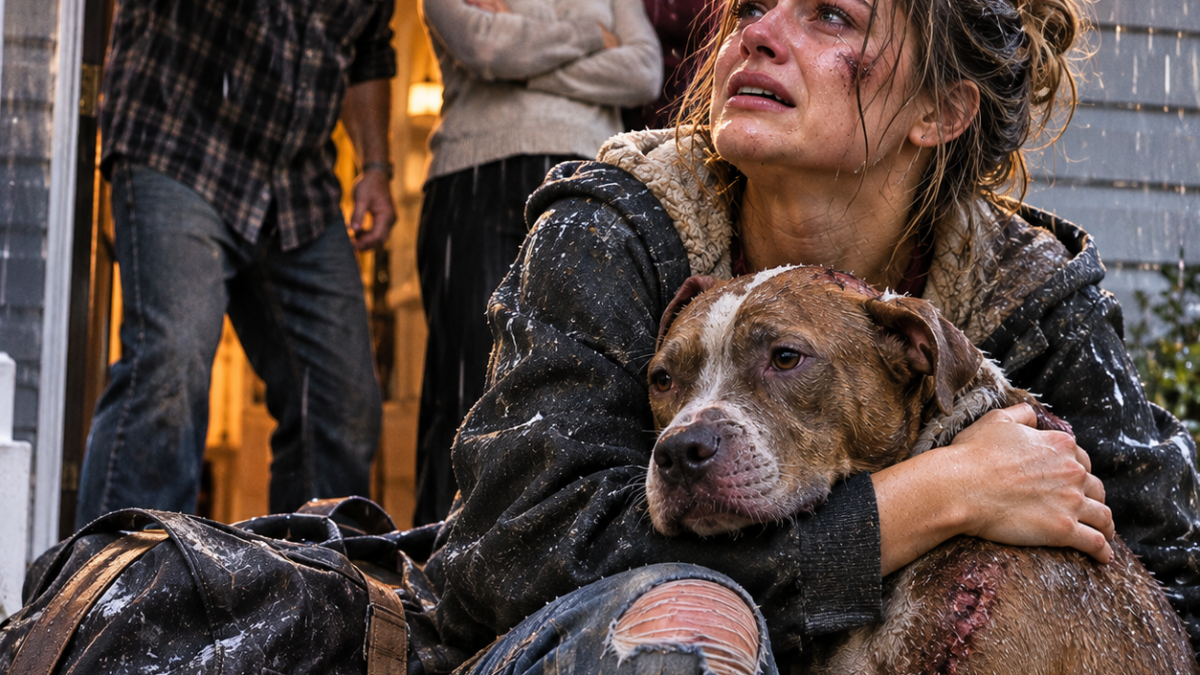
The first night without my mother’s house, I slept at a bus station.
I kept my suitcase pressed against my legs and my purse tucked beneath my coat.
Every time someone walked past, I opened my eyes.
I was terrified someone would steal what little I had.
But I was more frightened by the realization that I had no plan.
No apartment.
No reliable income.
No one I felt comfortable asking for help.
I had been working part-time while helping care for Mom during the last months of her illness. After her death, grief overwhelmed me, and my work situation became unstable.
Harold knew that.
He knew my savings had been depleted.
He knew I hadn’t recovered emotionally.
He also knew that the house had been my home for thirteen years.
Yet he’d waited until my birthday to throw me out.
As though becoming twenty-six made me someone he could discard without consequences.
I spent my first week trying to find somewhere temporary.
A friend let me stay for two nights.
Another offered a couch, but her apartment was crowded and she couldn’t keep me long.
I contacted local assistance services, applied for jobs, and searched for affordable rooms.
Everywhere I turned, there seemed to be another obstacle.
Deposits.
Identification requirements.
Waiting lists.
Transportation costs.
I wasn’t trying to avoid work.
I wanted to work.
But surviving each day had suddenly become a job of its own.
I learned which places stayed open late.
Where I could charge my phone.
Which public restrooms were accessible.
Where community organizations offered meals.
And which streets felt safer after dark.
By the time Duke found me, I was exhausted in a way I’d never known existed.
The first morning after he slept beside me, I woke to find him sitting upright near the curb.
The sun had barely risen.
His ears were pointed toward the street.
I sat up.
“Hey.”
He turned.
His tail moved once.
I smiled faintly.
“You’re still here.”
He stood and stretched.
Then approached me.
I held out my hand.
He sniffed it.
For a moment, I thought he might let me pet him.
Instead, he turned and trotted down the sidewalk.
I watched him disappear.
For some reason, I felt abandoned all over again.
“Of course,” I whispered.
“Everybody leaves.”
I gathered my things.
Then started toward the community kitchen where I’d been getting breakfast.
Twenty minutes later, I heard footsteps behind me.
I turned.
Duke was running toward me.
In his mouth was an old tennis ball.
He stopped at my feet.
Dropped it.
And looked up.
I stared.
Then laughed.
A real laugh.
The first one since Harold threw me out.
“You brought me a present?”
His tail wagged.
I bent down and picked up the ball.
It was filthy.
One side had been chewed almost flat.
But Duke watched it as though it were the most wonderful thing in the world.
I tossed it a short distance.
He chased it.
Returned.
Dropped it again.
I laughed until tears ran down my face.
Then I sat on the curb.
Duke settled beside me.
And for the first time in days, I didn’t feel completely invisible.
Duke wasn’t an easy dog.
He was wary of strangers.
He disliked being approached suddenly.
He became nervous when people shouted.
He sometimes retreated when someone reached toward his head.
I didn’t know his history.
Perhaps he’d been abandoned.
Perhaps he’d wandered away from a home.
Perhaps he’d spent so long surviving on the street that he no longer trusted unfamiliar people.
I couldn’t know.
He had no visible collar, and I tried to get help checking his identification and whether anyone was looking for him.
No owner emerged from the inquiries available to us.
As we continued together, I found assistance from local animal advocates who helped with basic supplies and made sure he received appropriate care.
But whatever his past had been, Duke made one thing very clear.
He had decided I was his person.
If I sat, he sat.
If I walked, he followed.
If I stopped outside a building, he waited.
And at night, when I finally lay down somewhere sheltered enough to rest, he positioned himself near the entrance or beside my feet.
Sometimes I woke to find him watching the darkness.
Sometimes his head rested against my leg.
On cold nights, he pressed his body close.
He wasn’t a magical guardian who could protect me from every danger.
He was a dog.
He needed food, shelter, medical care, and safety just as much as I did.
But his presence changed how those terrible nights felt.
I wasn’t alone anymore.
During our second week together, I discovered that Duke had an unusual morning routine.
Every day, shortly after sunrise, he’d stand, stretch, and look toward the street.
At first, I thought he needed to relieve himself or explore.
But he didn’t simply wander a few feet away.
He would move through the neighborhood with a strange sense of purpose.
Sometimes I followed him.
Sometimes I couldn’t keep up because I was exhausted or needed to stay near my belongings.
He’d walk past stores, turn down residential streets, and pause in front of houses.
At some homes, he stopped only briefly.
At others, he sat.
And waited.
I thought he was looking for food.
That seemed reasonable.
He was a stray.
Strays learned where kind people might offer scraps.
But Duke didn’t always approach houses where food was available.
Sometimes he simply watched.
People entering.
People leaving.
Children playing on porches.
An old man watering flowers.
A woman carrying groceries.
He seemed particularly interested in homes where people spoke gently to him.
Once, an elderly man reached down and scratched behind his ears.
Duke stayed beside him for nearly fifteen minutes.
Then returned to me.
I laughed.
“Are you making friends without me?”
He wagged his tail.
I had no idea that one day, those morning walks would lead us to Margaret.
The hardest nights weren’t always the coldest.
Sometimes they were the quiet ones.
The nights when I could hear music drifting from nearby houses.
Families laughing.
People preparing dinner.
Televisions playing.
Dishes clinking.
Normal life happening behind windows.
I would sit outside with Duke beside me and wonder whether anyone inside those houses understood what it felt like to have nowhere to go.
Once, I found myself watching a mother through a kitchen window.
She was helping a little girl with homework.
The girl looked frustrated.
The mother leaned over, pointed to something on the page, and smiled.
I suddenly remembered my own mother at our kitchen table.
Her hair tied back.
Her glasses slipping down her nose.
Her hand resting beside mine.
I turned away.
Duke looked up.
I pressed both hands over my face.
“She’s gone,” I whispered.
He moved closer.
I began crying.
Not quietly.
Not gracefully.
I cried with the kind of grief that makes your whole body ache.
Duke pressed his head against my knee.
I wrapped my arms around him.
“I miss her so much.”
He stayed.
And although he couldn’t understand the words, his steady presence gave me something to hold while the worst of the grief passed.
I tried calling Harold once.
It was late afternoon.
I’d been walking for hours, and my shoes were beginning to come apart.
I stood outside a convenience store with Duke sitting beside me.
Then I dialed the number.
Harold answered.
“What?”
I swallowed.
“It’s me.”
A pause.
Then a bitter laugh.
“Madison?”
My name was actually Claire, but Harold had a habit of using a mocking tone that made even the simplest greeting sound like an accusation.
I shut my eyes.
“Harold, I need to collect the rest of my belongings.”
He sighed.
“Didn’t I tell you to leave me alone?”
“They’re my things.”
“Should’ve taken them when you had the chance.”
I felt my stomach tighten.
“Can we arrange a time?”
He was silent.
Then said, “You’re not coming back inside.”
I swallowed.
“I don’t need to stay. I just need my documents and clothes.”
He laughed.
“Maybe you should’ve thought about that before spending your whole life depending on your mother.”
The words struck so hard I almost couldn’t breathe.
I looked down at Duke.
He was staring toward the road.
I whispered, “Please.”
Harold’s voice hardened.
“I’m done with this conversation.”
Then he hung up.
I stood outside the store with the phone against my ear.
And realized that he wasn’t simply refusing to let me live there.
He was trying to make me feel as though I had never belonged.
The second month was harder.
My body was tired.
My clothes were worn.
The soles of my shoes had become thin.
I had found occasional temporary work, but not enough to secure stable housing.
I kept applying.
Kept making calls.
Kept visiting assistance programs.
But I was becoming discouraged.
Sometimes I wondered whether I would ever have a place with a door that locked from the inside.
A place where I could shower without worrying about time limits.
A bed where I could sleep through the night.
A refrigerator.
A kitchen.
A window.
Such ordinary things.
Things I’d barely noticed when I had them.
Now they filled my dreams.
One morning, I woke beneath a tree in a public area where I’d been resting.
Duke was gone.
I looked around.
“Duke?”
No answer.
My stomach tightened.
I stood.
Called again.
Nothing.
For nearly an hour, I searched the surrounding streets.
I asked a shopkeeper whether he’d seen a brown-and-white pit bull.
He shook his head.
I walked farther.
My heart was pounding.
I had lost my mother.
Lost my home.
Lost nearly everything I owned.
And suddenly, I was terrified I’d lost Duke too.
I sat on a bench.
Covered my face.
And whispered, “Please come back.”
Then I heard nails clicking against the sidewalk.
I looked up.
Duke stood a few feet away.
His tail was wagging.
I stared.
“Where have you been?”
He approached.
Touched his nose to my knee.
Then turned.
Walked several steps.
Stopped.
Looked back.
I wiped my face.
“What?”
He took another few steps.
Then waited.
I stood.
“Duke?”
He wagged his tail.
And began leading me through the neighborhood.
We walked for almost twenty minutes.
Past a pharmacy.
A small church.
Several older homes.
A row of flowering shrubs.
Then Duke turned onto a quiet residential street.
The houses were modest.
Most had small porches and neatly kept yards.
He moved toward a white house with pale blue shutters.
There were flowerpots beside the steps.
A wind chime hung near the front door.
And in the window, I could see a painting of a yellow field beneath a bright sky.
Duke stopped at the gate.
I looked down.
“What are we doing here?”
He sat.
Then looked toward the porch.
I tugged gently at the leash a volunteer had helped me obtain.
“Come on.”
He didn’t move.
“Duke.”
He looked at me.
Then back at the house.
I sighed.
“We can’t just stand outside somebody’s home.”
He remained seated.
Five minutes passed.
Then ten.
Finally, the front door opened.
An elderly woman stepped outside carrying a small watering can.
She had silver hair tied loosely behind her head and wore a green cardigan over a floral dress.
She noticed Duke first.
Her face softened.
“Well, hello there.”
Duke’s tail began wagging.
She smiled.
“It’s you again.”
I froze.
Again?
She came down one step.
Then noticed me.
“Oh.”
I immediately felt embarrassed.
“I’m sorry. I was just leaving.”
She looked from me to Duke.
Then back again.
“Are you with this dog?”
I swallowed.
“Yes.”
Her eyebrows rose.
“Well, that explains something.”
I frowned.
“What do you mean?”
She looked down at Duke.
“This fellow has been coming to my porch for weeks.”
I stared.
“Weeks?”
She nodded.
“Sometimes early in the morning. Sometimes around lunchtime.”
My heart began pounding.
She continued.
“He sits there and watches the door. I thought he was a neighborhood dog.”
Duke stood.
Walked toward her.
And gently rested his head against her hand.
The woman smiled.
“Well, aren’t you something?”
I looked at him.
Then at the house.
And for the first time, I wondered whether those morning walks had meant more than searching for food.
The woman’s name was Margaret.
She was seventy-one.
Her husband had died five years earlier.
Her children lived far away, and although they called regularly, most of her days were spent alone.
She had worked as an art teacher before retiring.
Now she painted.
Gardened.
Read.
And volunteered occasionally at the church.
When she invited us inside, I hesitated.
I was dirty.
Exhausted.
My clothes were wrinkled.
I hadn’t slept properly in days.
I looked toward her clean doorway.
“I don’t want to make a mess.”
Margaret smiled.
“Honey, it’s a floor. It can be cleaned.”
My eyes filled.
She stepped aside.
“Come in.”
I entered cautiously.
Duke followed.
The house smelled of soup and fresh bread.
Paintings covered the walls.
Landscapes.
Flowers.
Small portraits.
A picture of a red barn beneath a stormy sky.
The furniture was old but carefully maintained.
A knitted blanket rested across the sofa.
A clock ticked softly above the fireplace.
It was the kind of house where every object seemed to have a story.
Margaret led us into the kitchen.
“Are you hungry?”
I opened my mouth.
Then stopped.
My stomach was aching.
But admitting hunger felt humiliating.
Margaret must have seen my expression.
She smiled gently.
“I made too much soup.”
I swallowed.
“You don’t have to—”
“I know.”
She pulled out a chair.
“That’s why I’m offering.”
I sat.
Duke settled beside her feet.
She looked down.
“He seems to have made himself comfortable.”
I laughed weakly.
“He does that.”
Margaret smiled.
“Well, he’s welcome.”
Then she placed a bowl of hot soup in front of me.
And I began crying before I took the first bite.
It had been nearly two months since I’d eaten a warm meal at a kitchen table without feeling rushed.
The soup was simple.
Chicken.
Vegetables.
Rice.
A little pepper.
But I will never forget the taste.
Margaret sat across from me.
She didn’t demand an explanation.
Didn’t ask why I was homeless.
Didn’t question whether I had made bad decisions.
She simply let me eat.
When I finished, she offered another bowl.
I hesitated.
She smiled.
“There’s plenty.”
I accepted.
Duke watched from beside her chair.
She reached down and scratched his ears.
He leaned into her hand.
I stared.
He rarely allowed strangers to touch him that easily.
Margaret noticed.
“Does he usually do that?”
I shook my head.
“No.”
She smiled.
“Well, perhaps he and I understand each other.”
I looked down at Duke.
His eyes were half closed.
His tail moved slowly against the floor.
And for the first time since I’d met him, he seemed completely at ease inside a stranger’s house.
I felt something tighten in my chest.
Because Duke had spent weeks leading me through streets, pausing at porches, watching people, and returning to my side.
I’d assumed he was wandering.
But looking at him beside Margaret, I couldn’t shake the feeling that he’d been searching for somewhere safe.
Not in a way I could scientifically prove.
Not as though he understood housing applications or human kindness.
But he knew where he’d been welcomed.
Where a gentle voice greeted him.
Where someone had opened a door.
And finally, he’d brought me there.
Margaret listened while I told her my story.
Not all at once.
At first, I only explained that I had been without stable housing for a while.
That Duke had been keeping me company.
That I was trying to find work.
Then she asked whether I had family.
I looked down.
“My mother died.”
Her expression softened.
“I’m sorry.”
I nodded.
“My stepfather threw me out.”
She remained quiet.
I continued.
“On my birthday.”
Margaret’s face changed.
“How old are you?”
“Twenty-six.”
She stared at me.
Then glanced toward Duke.
He was resting peacefully beside her chair.
For a moment, she said nothing.
Then she asked, “Do you have somewhere safe to sleep tonight?”
I shook my head.
Her eyes filled.
She stood.
Walked toward the hallway.
Then returned carrying a folded blanket.
“You do now.”
I stared.
“What?”
“You can stay here tonight.”
My heart began pounding.
“Margaret, I can’t—”
“Yes, you can.”
“But you don’t know me.”
She smiled sadly.
“That’s true.”
I looked down.
She continued.
“We’ll take sensible precautions and make sure everyone feels comfortable. But you don’t need to go back outside tonight.”
My throat tightened.
I stared at the blanket.
Then whispered, “Why?”
Margaret looked toward Duke.
The pit bull had rolled onto his side.
His eyes were closed.
For the first time since I’d known him, he was sleeping without watching the doorway.
Margaret smiled.
“Because sometimes someone knocks on your door when they need help.”
She looked back at me.
“And sometimes you open it.”
That night, I slept on Margaret’s sofa.
She had given me clean clothes.
Helped me arrange a shower.
Prepared a place for Duke.
And made sure I understood I was welcome to rest.
I lay beneath a soft blanket listening to the clock ticking.
The house was warm.
The doors were locked.
The windows were closed.
For a long time, I couldn’t sleep.
Not because I was afraid.
Because I was waiting for someone to tell me I had to leave.
Every sound made me open my eyes.
The refrigerator starting.
A pipe shifting.
Wind moving the chime outside.
Then Duke approached.
He settled near the front door.
His usual place.
The position he’d chosen during all those nights outside.
I watched him.
“Duke?”
He lifted his head.
I smiled faintly.
“Come here.”
He considered the invitation.
Then stood.
Walked toward the sofa.
And lay beside it.
I reached down.
Stroked his broad head.
His eyes closed.
His breathing slowed.
And suddenly I understood how exhausted he must have been too.
He’d spent two months sleeping lightly.
Watching.
Listening.
Staying close to me.
Now, inside Margaret’s little house, he could finally rest.
I whispered, “We made it.”
His tail moved once.
Then he fell asleep.
And a few minutes later, so did I.
The next morning, Margaret made pancakes.
I woke to the smell of butter and coffee.
For a moment, I thought I was back in my mother’s house.
Then I opened my eyes and saw the paintings.
The pale blue curtains.
The little clock above the mantel.
I remembered where I was.
My chest tightened.
Then Margaret called from the kitchen.
“Breakfast, sweetheart!”
I sat up.
Duke was already awake.
He stood beside the doorway, wagging his tail.
I looked at him.
“You knew, didn’t you?”
He tilted his head.
I laughed softly.
“You found us a place.”
He barked once.
Then trotted toward the kitchen.
Margaret laughed when she saw him.
“Your friend seems very pleased with himself.”
I smiled.
“He should be.”
I stayed another night.
Then another.
Margaret and I discussed boundaries, practical arrangements, and how long I could remain while seeking stable housing.
I helped with chores.
Cleaned.
Cooked.
Watered plants.
Organized supplies.
She didn’t treat me like unpaid household labor.
She insisted I focus on finding work and getting back on my feet.
Duke became her constant companion.
He followed her into the garden.
Slept beside her chair while she painted.
Waited outside the kitchen when she cooked.
Sometimes he sat beside her on the porch watching the street.
I would look through the window and see them together.
Margaret talking softly.
Duke listening.
And I would feel a warmth in my chest that I hadn’t known since Mom died.
Not because Margaret replaced her.
Nobody could.
But because kindness had finally returned to my life in a form I could touch.
One afternoon, a week after we arrived, Margaret came home carrying a folder.
Her expression was serious.
I was sitting at the kitchen table completing a job application.
Duke lay beneath my chair.
Margaret set the folder down.
“Claire, we need to talk.”
My stomach tightened.
I immediately thought she was going to ask me to leave.
I stood.
“Did I do something wrong?”
Her expression softened.
“No, sweetheart.”
I swallowed.
“I’m sorry if I’ve stayed too long.”
She reached for my hand.
“Sit down.”
I hesitated.
Then sat.
Margaret opened the folder.
“I spoke with an attorney.”
I stared.
“An attorney?”
She nodded.
“Her name is Sarah Mitchell. She helps people who can’t afford legal representation.”
My heart began pounding.
“Why?”
Margaret looked at me carefully.
“Because some of the things you told me about Harold didn’t sound right.”
I stared.
She continued.
“Particularly what happened after your mother died.”
My throat tightened.
I looked down.
Margaret took a breath.
“Did your mother have a will?”
I frowned.
“I don’t know.”
“Did anyone show you estate documents?”
I shook my head.
“Harold said everything belonged to him.”
Margaret studied me.
“Did your mother ever discuss leaving you money?”
I swallowed.
“She told me she’d made arrangements.”
My voice broke.
“She said I wouldn’t have to worry if anything happened to her.”
Margaret nodded.
“Then I think we need to find out what those arrangements were.”
I stared at her.
For months, I’d accepted Harold’s claims.
He owned the house.
He controlled the money.
I had no rights.
Nothing.
Now, for the first time, someone was asking whether his version had ever been true.
Sarah Mitchell was thirty-two, serious, and remarkably patient.
She worked with a legal-aid program and sometimes handled estate matters through volunteer arrangements.
When we met, she didn’t promise to recover a fortune.
She didn’t tell me Harold would be arrested.
She didn’t claim that every step of my eviction had automatically been illegal.
Instead, she asked questions.
About my mother.
The house.
My employment.
The date I’d been told to leave.
Whether I had received written notices.
Whether I’d had an established right to occupy the property.
Whether there were probate records.
What Harold had told me about the estate.
And what documents I could obtain.
I answered as carefully as I could.
Some questions were painful.
I didn’t know the answers.
I hadn’t been involved in the legal arrangements after Mom’s death.
Harold handled everything.
He told me I was too emotional to deal with paperwork.
At the time, I believed him.
I was grieving.
I was exhausted.
And I wanted to trust that the man Mom had married would honor her wishes.
Sarah listened.
Then said, “We need to examine the records before drawing conclusions.”
I nodded.
“But there may be rights or assets you haven’t been informed about.”
My throat tightened.
“Really?”
“Possibly.”
She looked toward Margaret.
Then back at me.
“Let’s find out.”
The investigation took time.
There were probate records to obtain.
Financial documents to review.
Questions about the estate.
The ownership of certain assets.
And the terms of my mother’s arrangements.
Sarah explained each step.
Margaret helped me organize paperwork.
I obtained replacement copies of documents Harold had refused to return.
We contacted the appropriate offices.
Reviewed records.
And gradually, a different picture began emerging.
My mother had left money intended for me.
Not an imaginary promise.
Not a vague comment.
Documented assets.
Some were tied to estate arrangements that required formal administration.
Others raised questions about how Harold had handled funds after her death.
Sarah found discrepancies between what Harold had told me and what the records actually showed.
The exact legal issues were complicated.
I didn’t understand every detail at first.
But one fact became painfully clear.
Harold had not been entitled to treat all of my mother’s money as his personal property simply because he’d been her husband.
And he had never told me the full truth about what she’d left.
I remember sitting at Margaret’s kitchen table when Sarah explained the findings.
Duke was sleeping beside the door.
Margaret sat across from me with both hands wrapped around a cup of tea.
Sarah placed several documents on the table.
“Claire, your mother made provisions for you.”
I stared.
My throat tightened.
“Are you sure?”
Sarah nodded.
“We have supporting documents.”
I looked down.
My mother’s name appeared on the pages.
Ellen.
Her handwriting.
Her signature.
For a moment, I couldn’t breathe.
I touched the paper.
Then began crying.
Not because of the money.
Because Mom had tried to protect me.
Even when she was ill.
Even when she knew she might not survive.
She had thought about my future.
She had made arrangements.
And for months, I’d believed Harold when he told me she had left me nothing.
I covered my face.
Margaret came around the table and held me.
I sobbed against her shoulder.
“She remembered me.”
Margaret stroked my hair.
“Of course she did.”
I looked toward the documents.
My mother had been gone for eight months.
I couldn’t hear her voice again.
Couldn’t sit beside her.
Couldn’t ask her whether she was proud of me.
But there, on the table, was evidence that she’d cared about what happened to me after she was gone.
And Harold had tried to keep that from me.
When Harold learned that legal questions were being raised, he became difficult to reach.
Calls went unanswered.
His responses through the relevant channels were inconsistent.
Eventually, Sarah pursued the appropriate proceedings to address the disputed assets and enforce my rights.
It wasn’t instant.
There was no dramatic courtroom scene where a judge slammed a gavel and handed me a check.
The process required documentation.
Legal arguments.
Review of the estate arrangements.
And formal decisions.
But the outcome established my entitlement to funds my mother had intended for me.
Harold was required to account for and release the money according to the legal determination.
When I received confirmation, I sat in silence.
Margaret looked at me.
“Claire?”
I couldn’t speak.
Duke approached.
Rested his head against my knee.
I looked down at him.
Then whispered, “Mom really did leave something for me.”
Margaret smiled through tears.
“Yes.”
I stroked Duke’s head.
For a moment, I imagined telling my mother everything.
How Harold threw me out.
How I slept on the street.
How Duke found me.
How Margaret opened her door.
How Sarah discovered the truth.
I imagined Mom listening.
Then taking my hand.
And telling me she was sorry I’d been frightened.
I began crying again.
But this time, I wasn’t crying only for what I’d lost.
I was crying because a future had opened.
I didn’t become wealthy overnight.
The money helped.
It gave me stability.
The ability to plan.
To pay for basic needs.
To stop living from one uncertain day to the next.
But it didn’t erase the two months I spent outside.
It didn’t remove the fear of being turned away.
It didn’t return the time I’d lost grieving my mother while believing I had nobody.
Healing required more than financial security.
It required routine.
Trust.
Work.
Friendship.
And the slow realization that I deserved safety even when I had nothing to offer in return.
Margaret understood that.
She didn’t rush me.
She encouraged me to find work.
To rebuild my confidence.
To reconnect with ordinary life.
And she made sure Duke was part of that process.
Three months after moving into Margaret’s house, I found a job at a café.
It wasn’t glamorous.
I made coffee.
Cleaned tables.
Prepared food.
Handled customers.
Sometimes I came home exhausted.
But it was honest work.
And for the first time in months, I had somewhere to go each morning where people expected me.
Margaret drove me during the early weeks while I arranged reliable transportation.
Duke often accompanied us, where permitted, and waited with Margaret during my shift.
When I finished, he’d greet me with such enthusiasm that customers stopped to watch.
His tail whipped from side to side.
His whole body seemed to wiggle.
He would look up at me as though I had returned from a journey across the world.
I laughed every time.
“Duke, I’ve only been gone a few hours.”
He didn’t care.
To him, I was back.
And that was worth celebrating.
I also enrolled in online classes.
I wanted to work with people experiencing homelessness.
At first, the idea frightened me.
The memories were still fresh.
The cold.
The hunger.
The humiliation.
The loneliness.
But I couldn’t stop thinking about how much difference one person’s kindness had made.
Margaret had opened her door.
Sarah had asked the right questions.
The café manager had offered me a chance to work.
And Duke had stayed beside me when I felt invisible.
I began studying social services, community support, and housing assistance.
The work was difficult.
Some evenings I struggled to concentrate.
Other nights I stayed awake reading long after Margaret went to bed.
Duke usually slept near my chair.
Sometimes he’d rest his head on my foot.
Whenever I became frustrated, I’d look down at him.
Remember the streets we’d walked.
Then keep going.
One evening, I sat on the floor beside Duke.
He was lying on his cushion near the living room window.
Margaret was painting in the next room.
The house smelled of fresh bread.
I looked at him.
“Do you know something?”
His ears lifted.
I smiled.
“You saved my life.”
He tilted his head.
I laughed softly.
“Not by doing anything magical.”
I stroked his cheek.
“You stayed.”
His tail moved.
“And when I didn’t know where to go, you kept bringing me back to a place where someone was kind.”
I swallowed.
“I don’t know how you knew.”
He looked at me.
“Maybe you didn’t. Maybe you just liked Margaret.”
I smiled.
“But I’m glad you found her.”
Duke leaned forward.
Licked my nose.
I burst out laughing.
“Oh, that’s disgusting!”
His tail wagged harder.
I wrapped my arms around him.
And held him close.
For a moment, I remembered our first night together beneath the laundromat awning.
The cold pavement.
The half piece of bread.
The way he’d settled beside me.
Now he was warm.
Fed.
Safe.
Loved.
And so was I.
A year later, I moved into my own apartment.
It was tiny.
One bedroom.
A small kitchen.
A narrow living room.
A window overlooking a parking lot.
Nothing impressive.
But when I signed the lease, my hands trembled.
Because my name was on it.
I had keys.
A place where my belongings could stay.
A bathroom I didn’t have to share with strangers.
A door I could close.
A bed.
A table.
A refrigerator.
And enough space for Duke’s cushion beside the sofa.
The first night, I stood in the center of the room with the keys in my hand.
Margaret had helped us move.
She was sitting on the sofa, watching me.
“Well?” she asked.
I looked around.
Then whispered, “It’s mine.”
She smiled.
“Yes.”
I began crying.
Margaret stood.
Came toward me.
And hugged me.
For a long time, I held on.
Then Duke walked between us.
Pressed against our legs.
And wagged his tail.
Margaret laughed.
“Apparently, he approves.”
I looked down at him.
“Of course he does.”
Duke didn’t forget Margaret.
Every morning, after breakfast, he’d walk toward the front door and look at me.
I knew what he wanted.
We’d developed a routine.
Whenever possible, we’d visit Margaret.
Sometimes we walked.
Sometimes I drove.
Duke recognized her street long before we reached the house.
His tail would begin moving.
He’d become alert.
Excited.
And when Margaret opened the door, he’d greet her as though he’d been waiting all week.
She always smiled.
“There you are, sweetheart.”
Duke would approach.
Rest his head against her hand.
Then follow her inside.
We joked that he had two homes.
Two families.
Two places where people loved him.
And perhaps that was true.
He’d brought us together.
There was no reason we had to choose who belonged to whom.
By the time I turned thirty, I had a stable job with a community organization helping people find housing and access support services.
I worked with individuals and families who had lost their homes for many different reasons.
Job loss.
Illness.
Family conflict.
Unexpected expenses.
Domestic violence.
Disability.
Housing shortages.
Some needed emergency shelter.
Others needed help with identification documents, applications, benefits, or legal referrals.
I learned quickly that no two stories were identical.
And that assumptions could be cruel.
Sometimes people asked why I cared so much.
Why I remembered small details.
Why I sat with clients after appointments rather than rushing them out.
Why I tried to make sure someone had eaten before discussing complicated paperwork.
I usually smiled.
Then told them about Duke.
The stray pit bull who found me when I was homeless.
The dog who stayed beside me for two months.
The dog who seemed to recognize the one porch where a gentle woman welcomed him.
And the woman who opened her door when I followed.
Sometimes people laughed.
Sometimes they cried.
But I always ended with the same thought.
Family isn’t necessarily the people who share your blood.
Sometimes family is the person who offers soup without demanding an explanation.
The friend who helps you get your documents back.
The stranger who believes you deserve a safe place to sleep.
Or the dog who lies beside you on the coldest night of your life.
Duke grew older.
His muzzle slowly turned gray.
He became less interested in long walks.
More interested in comfortable cushions and warm afternoons.
He still loved Margaret.
Still greeted me when I came home.
Still followed me from room to room.
But eventually, the years began showing.
He slept more.
Moved more slowly.
Needed additional veterinary care.
I adjusted our routines.
Shorter walks.
Softer bedding.
More rest.
Regular checkups.
I wanted him comfortable.
I wanted him happy.
And I wanted to give him the same patience he’d given me when I had nowhere else to go.
For six more years, Duke lived surrounded by love.
Not every day was easy.
There were health concerns.
Appointments.
Difficult decisions.
But he was never abandoned.
Never left wondering where his next meal would come from.
Never expected to spend another night guarding a frightened woman beneath an open sky.
He had a home.
Two, really.
Mine.
And Margaret’s.
And both of us loved him beyond anything we knew how to explain.
The day Duke died began quietly.
I came home from work and found him lying on his cushion.
Normally, he would lift his head when he heard my keys.
Sometimes he’d stand.
Sometimes he’d simply wag his tail.
That evening, he remained still.
His eyes were open.
He was looking toward the door.
I felt my stomach tighten.
“Duke?”
His tail moved faintly.
I approached.
Knelt beside him.
Touched his head.
His breathing was different.
Slow.
Tired.
I knew he had been declining.
We’d been working with his veterinarian to keep him comfortable.
But seeing him like that made the truth impossible to avoid.
My old friend was nearing the end of his life.
I sat on the floor.
Rested his head gently in my lap.
And began crying.
“Hey, buddy.”
His eyes moved toward mine.
I stroked his ears.
“You found me.”
My voice broke.
“Do you remember?”
He couldn’t answer.
But his tail moved once.
I smiled through tears.
“You found me when nobody else was looking.”
I swallowed.
“And you kept coming back.”
Duke closed his eyes briefly.
I leaned closer.
“You did good, my friend.”
My tears fell onto his fur.
“You did so good.”
With veterinary guidance and the support he needed, Duke was kept comfortable as his life drew to a close.
I stayed beside him.
Stroking his head.
Talking softly.
Telling him everything I wished he could understand.
That he was loved.
That he had never been a burden.
That Margaret and I were grateful for every day.
That he didn’t need to keep watching the door anymore.
Then, peacefully, Duke’s breathing stopped.
I held him.
And cried.
Grief didn’t arrive neatly.
It came in waves.
The next morning, I reached for his food bowl before remembering.
I opened the door and expected him to be waiting.
I came home from work and instinctively looked toward his cushion.
Sometimes I thought I heard his nails against the floor.
Then the silence returned.
Margaret grieved too.
She had loved Duke as fiercely as I did.
One afternoon, we sat on her porch looking toward the street he’d walked so many times.
She held a photograph of him.
Duke sitting beside her front door.
His broad face tilted toward the camera.
His tail a blur against the steps.
Margaret smiled through tears.
“He was always so pleased with himself.”
I laughed softly.
“He really was.”
She looked down.
“I still can’t believe he kept coming here.”
I swallowed.
“Me neither.”
Margaret touched the photograph.
“Maybe he just liked my porch.”
I smiled.
“Maybe.”
She looked toward me.
Then said quietly, “I’m very glad he did.”
My eyes filled.
“Me too.”
We sat together for a long time.
Two women who had once been lonely.
Now connected by a dog who had wandered into both our lives.
Today, I’m forty-one.
I still work for the organization that helps people find safe housing.
I’ve spent years sitting across from people who remind me of the woman I was at twenty-six.
Frightened.
Exhausted.
Ashamed to ask for help.
Convinced that losing a home meant losing personal worth.
Sometimes they apologize for crying.
Sometimes they tell me they should have been stronger.
Sometimes they insist they don’t deserve help because they made mistakes.
I listen.
Then I remind them that needing shelter isn’t a moral failure.
That circumstances can change.
That accepting assistance doesn’t make someone less deserving of respect.
And that a person can rebuild a life even after losing nearly everything familiar.
I never promise that recovery will be easy.
It rarely is.
I know the paperwork.
The waiting lists.
The uncertainty.
The exhausting work of starting again.
But I also know how much difference kindness can make.
Because once, when I had nowhere safe to sleep, a woman opened her door.
And before that, a stray pit bull decided I was worth staying beside.
On my desk, there’s a photograph of Duke.
He’s sitting on Margaret’s porch.
The morning light falls across his brown-and-white coat.
His ears are relaxed.
His tail is moving.
And he looks enormously proud.
I keep it where I can see it every day.
Sometimes, when work becomes difficult, I look at that picture.
I remember the first night beneath the laundromat awning.
The little piece of bread.
The wary eyes.
The way Duke settled beside me.
I remember waking and discovering he was still there.
I remember those strange morning walks.
The houses.
The porches.
The people he watched.
I remember the day he led me to Margaret’s gate.
How he sat.
Waited.
Refused to leave.
And how Margaret finally opened the door.
I don’t know whether Duke understood what he was doing.
Maybe he was simply drawn toward a place where he’d been treated kindly.
Maybe he recognized that Margaret was safe.
Maybe he just liked the smell of her kitchen.
I don’t need a supernatural explanation.
The truth is beautiful enough.
A homeless dog found a lonely woman.
The lonely woman opened her home.
And a frightened twenty-six-year-old who had been thrown onto the street finally had somewhere safe to sleep.
One evening, not long ago, I visited Margaret.
She was older now.
Her movements slower.
But her smile was the same.
We sat on the porch drinking tea.
The wind chime moved gently above us.
The sky was turning pink.
For a while, we talked about ordinary things.
Work.
Her paintings.
The weather.
A neighbor who had adopted a cat.
Then Margaret looked toward the gate.
“Sometimes I still expect him to come around that corner.”
My throat tightened.
“Duke?”
She nodded.
I smiled sadly.
“Me too.”
She looked toward the street.
Then whispered, “He brought you to me.”
I looked at her.
She continued.
“I’d been alone for five years after my husband died.”
Her voice trembled.
“The house was too quiet. The days were so long.”
I reached for her hand.
She smiled.
“Then that dog kept showing up.”
I laughed softly.
“And eventually he brought me.”
Margaret nodded.
Her eyes filled.
“I thought I was giving you a place to stay.”
I swallowed.
She squeezed my hand.
“But you gave me a family again.”
I began crying.
Because I’d spent so many years believing I had nothing worth offering.
No home.
No money.
No stability.
No future.
Yet Margaret had never measured me by what I owned.
She had simply welcomed me.
And somewhere along the way, we’d given each other something neither of us realized we needed.
Belonging.
That night, as I drove home, I thought about Harold.
I don’t spend much time thinking about him anymore.
The legal matters were resolved years ago.
The money my mother intended for me helped me rebuild.
The house he threw me out of no longer defines where I belong.
For a long time, I wanted him to understand what he’d done.
To feel ashamed.
To apologize.
To admit that leaving a grieving young woman homeless on her birthday was cruel.
Eventually, I stopped waiting.
His acknowledgment wasn’t necessary for me to know the truth.
What happened was wrong.
I deserved better.
And I didn’t need to spend the rest of my life asking him to admit it.
My mother had loved me.
She had tried to protect my future.
And the family I built afterward proved that her kindness hadn’t disappeared when she died.
I carried it forward.
Through my work.
Through Margaret.
And through every person I helped find a door they could close safely at night.
Sometimes people ask whether I ever adopted another dog.
I tell them that I’ve loved other animals since Duke.
Some through rescue work.
Some through friends.
Some who needed temporary care.
But Duke’s place in my heart is different.
Not because other dogs are less worthy.
Because he walked beside me through the most frightening chapter of my life.
When I had nothing, he didn’t turn away.
When I cried, he stayed close.
When I woke terrified, he was there.
When I lost hope, he gave me a reason to stand up, find food, and keep moving.
And when we finally reached Margaret’s house, he slept beside the door with his ears relaxed for the first time.
That image has never left me.
A dog who had spent months watching the darkness finally allowing himself to rest.
Because somewhere inside that small white house, something had changed.
We were safe.
I often tell people that Duke taught me what family really means.
But the older I get, the more I understand that his lesson was even simpler.
When someone is frightened and alone, you don’t always need the perfect words.
You don’t need to solve every problem immediately.
Sometimes you begin by staying.
By offering food.
By opening a door.
By helping someone reach the next morning.
Then the next.
Then the next.
That’s how Duke helped me.
Not with money.
Not with explanations.
Not with promises about the future.
He simply refused to leave me alone.
And when I was ready to follow, he led me toward kindness.
On my forty-first birthday, I visited Margaret with a cake.
We sat at her kitchen table.
The same table where she’d first placed a bowl of hot soup in front of me fifteen years earlier.
The walls still held her paintings.
The clock still ticked above the fireplace.
The wind chime still moved beside the front door.
Some things had changed.
We were older.
Duke was gone.
Life had brought losses and challenges neither of us could have imagined.
But the warmth remained.
Margaret lit the candles.
Smiled.
And said, “Make a wish.”
I looked at her.
Then toward the photograph of Duke on the mantel.
For a moment, I remembered being twenty-six.
Standing outside Harold’s house with my suitcase.
Hearing the lock turn.
Believing my life was over.
Then I remembered the stray dog who approached me three nights later.
The half piece of bread.
The long walks.
The cold mornings.
The little white house with blue shutters.
And the woman who opened the door.
I closed my eyes.
Made my wish.
Then blew out the candles.
Margaret applauded.
I laughed.
And for a moment, everything felt wonderfully ordinary.
I still have the old tennis ball Duke brought me that first morning.
It’s flattened on one side.
Its faded yellow covering is almost gone.
I keep it inside a small wooden box with his collar and photographs.
Sometimes I take it out.
Hold it.
Remember how he dropped it at my feet as though he were presenting me with treasure.
Back then, I thought the ball was the gift.
Now I know it was something else.
The sound of my own laughter after days of crying.
The realization that I could still feel joy.
The discovery that even when everything seemed lost, another living creature could reach me.
That little ball was the first thing Duke gave me.
But it wasn’t the last.
He gave me companionship.
Routine.
A reason to keep going.
A friendship with Margaret.
And years of love I never expected to find.
He didn’t understand inheritance law.
Didn’t know what Harold had done.
Didn’t know what a housing program was.
But he knew how to stay close.
How to trust a gentle voice.
And how to return to the place where he felt safe.
In doing so, he changed my life.
If I could return to the day Harold threw me out, I wouldn’t tell my twenty-six-year-old self that everything would be easy.
It wasn’t.
Those two months were frightening.
I was hungry.
Cold.
Exhausted.
And often ashamed.
There were moments when I felt utterly alone.
I wouldn’t pretend those experiences were necessary or good.
Nobody should have to become homeless to discover kindness.
Nobody should have to lose their mother and their home before being treated with compassion.
But I would tell that frightened young woman one thing.
Your life is not over.
There are people who will listen.
People who will help.
Doors that can open.
Work you haven’t yet discovered.
Friends you haven’t met.
And a future that still belongs to you.
And somewhere nearby, there’s a brown-and-white pit bull who will decide that sharing your last piece of bread is the beginning of a family.
Every day, when I arrive at work, I look at Duke’s photograph.
The big head.
The soft eyes.
The proud expression.
The tail wagging on Margaret’s porch.
I remember how he looked at me when I had nothing.
Not with contempt.
Not with disappointment.
Not as though I had failed.
He simply wanted to know whether I was coming with him.
And I did.
I followed him through streets I didn’t understand.
Past houses where people never opened their doors.
Through mornings when I had almost lost the strength to keep walking.
Until one day, he stopped at a little white house.
Sat beside the gate.
And waited.
Margaret came outside.
She smiled.
Then she opened the door.
That was the beginning of everything.
My stepfather threw me out because he believed I had nothing left worth keeping. But a homeless pit bull looked at me and decided I was worth staying for—and then he helped me find a woman who believed the same thing.
Duke is gone now.
I still miss him.
I always will.
But every time I help someone find a safe place to sleep, every time a frightened person sits across from me and admits they don’t know what to do next, I remember him.
I remember that he didn’t need to understand the whole problem.
He only needed to take one step toward someone who needed him.
Then another.
Until the path led somewhere safe.
And that is what I try to do now.
I help people take the next step.
Toward shelter.
Toward stability.
Toward the possibility of beginning again.
Because once, when the world had turned its back on me, a stray pit bull didn’t.
He stayed.
He searched.
And finally, he led me home.
Duke spent two months looking for a door that would open for us. I have spent the rest of my life trying to make sure other people don’t have to search so long.








