FULL STORY:“GET OUT—YOU DON’T LIVE HERE ANYMORE!” My Stepmother Threw Me Out of Dad’s House—Then I Found the Letters My Dead Mother Hid From Him
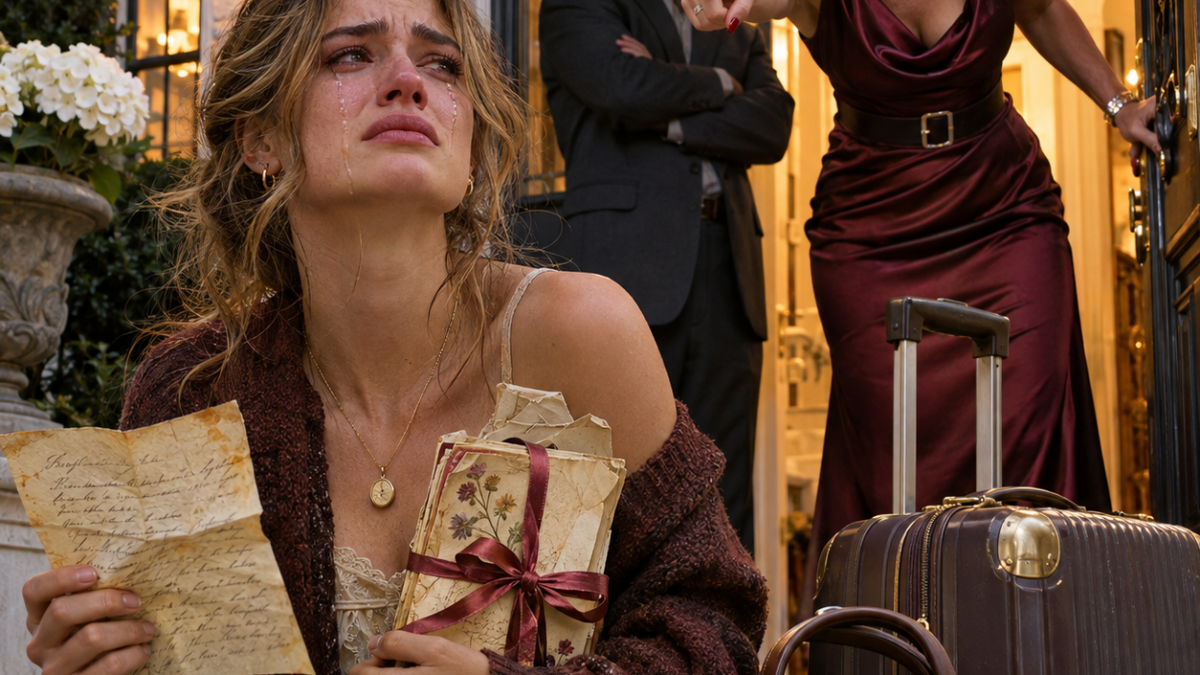
PART2
I looked at her.
“What does that mean?”
Emily opened her backpack again.
She pulled out a small jewelry box.
Dark green velvet.
I knew it immediately.
Sarah’s.
My wife kept it in the top drawer of our bedroom dresser for seventeen years.
Inside had been her wedding earrings, a cheap silver bracelet Emily made at summer camp, and a brass locket Sarah inherited from her grandmother.
Emily opened it.
The brass locket rested inside.
My chest tightened.
“That was your mother’s.”
“She gave it to me.”
“When?”
“Before she died.”
“What?”
Emily looked confused.
“You didn’t know?”
“No.”
“She told me never to let anyone take it.”
“She said it opened something.”
“What?”
“I don’t know.”
Then she reached deeper into the backpack.
A sealed cream envelope.
My name across the front.
Sarah’s handwriting.
I forgot how to breathe.
Six years disappeared.
I knew those letters.
The long M.
The tiny loop in the B.
She used to leave notes on the refrigerator.
Michael Bennett, if you finish the coffee and don’t start another pot, our marriage is over.
Same handwriting.
My hands shook.
“Where did you find this?”
“Inside one of Mom’s old coats.”
“Vanessa never saw it.”
I turned the envelope over.
Still sealed.
Emily whispered:
“Open it.”
I couldn’t.
Not yet.
I looked toward the house.
“Where is Vanessa?”
“Inside.”
“Anyone else?”
Emily hesitated.
“What?”
“There was a man here.”
“What man?”
“I don’t know.”
“Older.”
“Gray hair.”
“Expensive car.”
“When?”
“This morning.”
“Before she threw me out.”
“What were they doing?”
“Talking in the kitchen.”
“Vanessa told me he was her doctor.”
“Why?”
“She said he brought her migraine prescription.”
Something about that sentence made the hair on my arms rise.
“What did he look like?”
Emily described him.
Late fifties.
Silver hair.
Thin face.
Dark glasses.
Navy coat.
I knew before she finished.
“Dr. Hale?”
Her eyes widened.
“You know him?”
I knew that face.
Desmond Hale had been one of Sarah’s physicians at St. Catherine.
Not her primary oncologist.
Pain and palliative management.
He came in during the last months.
I had not seen him since the hospital.
“What was he doing here?”
“I don’t know.”
Emily lowered her voice.
“I heard Vanessa say she finally found what Mom had hidden.”
My mouth went dry.
“Exactly what did she say?”
“Something like…”
Emily closed her eyes.
“‘I found almost everything.’”
“Then the man said, ‘Almost isn’t good enough.’”
I stared at her.
“What else?”
“Vanessa said the letters were gone.”
“He asked about a box.”
“She said she still hadn’t found it.”
A box.
I looked at the locket.
Then at Sarah’s unopened envelope.
My daughter whispered:
“Dad?”
I finally tore the seal.
One page.
Not long.
Sarah’s handwriting became shakier toward the bottom.
Michael,
If you are reading this, something went wrong. I need you to listen to Emily before you listen to anyone else. Ask Vanessa about the hospital. Ask why you stopped being allowed to see me. Ask Dr. Desmond Hale why my medications changed after I told him I wanted another opinion.
My hands stopped.
Emily whispered:
“Dad?”
I kept reading.
You did not abandon me. I know that now. I was told you had stopped coming. If they told you I did not want to see you, they lied to both of us.
The words blurred.
I sat down on the porch step.
Six years earlier.
St. Catherine Hospital.
Sarah had been declining.
Weak.
Confused sometimes.
I came every day.
Then one Thursday, I arrived and Vanessa—then Nurse Vanessa Price—met me outside Sarah’s room.
“She doesn’t want visitors.”
I thought Sarah was exhausted.
The next morning:
Same thing.
Then:
“She specifically asked that you stop coming for a while.”
I remember staring at Vanessa.
“She said that?”
Vanessa had touched my arm.
“She’s angry.”
“She feels like you keep pushing treatment when she’s tired.”
That made sense.
Sarah and I had argued about treatment.
I wanted another specialist.
Another trial.
Another month.
She was exhausted.
I had been terrified.
So when Vanessa told me Sarah didn’t want to see me, guilt filled the gaps.
I obeyed.
At first.
Then I came back two days later.
Vanessa stopped me again.
“She said no.”
“Can I hear it from her?”
“She’s sleeping.”
“I’ll wait.”
“She doesn’t want you waiting.”
I had left.
God.
I had left.
For twelve days, I did not see my wife.
I called.
Staff said she was resting.
Vanessa occasionally called me.
Told me Sarah was comfortable.
Told me she needed emotional distance.
Then one morning the hospital called.
Sarah had deteriorated overnight.
I arrived twenty-three minutes later.
Too late.
My wife was dead.
I never said goodbye.
For six years I believed she had chosen that distance.
For six years I told myself that maybe, at the end, looking at me hurt too much.
Now Sarah’s letter sat in my hands.
You did not abandon me.
I began crying.
Not quietly.
Not like an adult trying to remain dignified.
My body folded.
I pressed the paper against my forehead.
Emily sat beside me.
“Dad.”
“She wanted me.”
My voice barely worked.
“She wanted me there.”
Emily wrapped both arms around me.
For the first time in my life, my child held me like I was the child.
The front door opened.
Vanessa stood there.
Her face changed the moment she saw the envelope.
“Michael.”
I stood.
Slowly.
“What is that?”
I looked at the woman I had slept beside for four years.
The woman who had cooked breakfast.
Signed birthday cards.
Sat beside me at Emily’s school concerts.
The woman I once believed helped me survive my wife’s death.
“Go inside.”
She stared.
“Michael.”
“Inside.”
She looked at Emily.
“This is exactly what I’m talking about.”
“Emily keeps digging through things she doesn’t understand.”
I stepped between them.
“Do not speak to my daughter.”
Vanessa’s face tightened.
“You’re letting her manipulate you.”
I held up Sarah’s letter.
For one second, Vanessa looked afraid.
Then:
“You don’t know the context.”
“Sarah was very sick.”
“Did she ask to see me?”
Vanessa said nothing.
“Did my wife ask to see me?”
“Michael.”
“Yes or no.”
“She had moments.”
“What does that mean?”
“Terminal patients change their minds.”
“Did she ask for me?”
Vanessa’s eyes moved toward the letter.
Then:
“She was confused.”
I laughed.
A horrible sound.
“You told me she refused to see me.”
“She did sometimes.”
“Sometimes?”
“You said she wanted me to stop coming.”
“She was upset.”
“Did she write to me?”
Vanessa looked away.
“Emily says there were dozens of letters.”
“Did you know?”
“No.”
Wrong answer.
Too fast.
Emily stood.
“She threw them away.”
Vanessa snapped:
“They were medical ramblings.”
I turned.
“You just said you didn’t know about them.”
Silence.
Emily stared.
I stared.
Vanessa realized.
Too late.
“What did you do with Sarah’s letters?”
She crossed her arms.
“Some things should stay buried.”
Something in me changed.
“Get out.”
She blinked.
“What?”
“Get out of my house.”
“Michael.”
“Now.”
“This is my home.”
“No.”
“It was Sarah’s home.”
“It is Emily’s home.”
“It was mine before I married you.”
“You are leaving.”
Her eyes widened.
“You’re choosing a dead woman over your wife?”
Emily gasped.
I stared at Vanessa.
“No.”
“I am choosing the truth over the woman who just admitted she destroyed it.”
Vanessa stepped toward me.
“You have no idea what Sarah was like in that hospital.”
“You were there.”
“Yes.”
“So tell me.”
“She was bitter.”
“Paranoid.”
“She accused people.”
“She didn’t trust treatment.”
“She hated everyone.”
“Did she hate me?”
Vanessa’s face changed.
That was enough.
“Pack a bag.”
“We will talk through lawyers after tonight.”
“You are not sleeping here.”
“You cannot just throw your wife out.”
I looked at the bags beside Emily.
“You had no problem doing it to my seventeen-year-old daughter.”
Silence.
Then I said:
“Emily comes inside.”
“You go.”
Vanessa’s face twisted.
“Fine.”
“But when you realize what you’ve done, don’t say I didn’t warn you.”
She went inside.
Emily whispered:
“Dad.”
“What?”
“There’s more.”
Of course there was.
That sentence would become the theme of the next forty-eight hours.
Vanessa left with two suitcases.
She tried taking the brass locket.
I caught her hand reaching toward Emily’s backpack.
“Don’t.”
“It belonged to Sarah.”
“So does Emily.”
“Mom gave it to me.”
Emily said.
Vanessa stared.
“She wasn’t supposed to.”
My head snapped toward her.
“What?”
“Nothing.”
“You said she wasn’t supposed to have it.”
Vanessa picked up her suitcase.
“I’m done.”
“No.”
I stepped in front of the door.
“You are going to explain that sentence.”
“Move.”
“Why wasn’t Emily supposed to have her mother’s locket?”
She stared.
Then laughed bitterly.
“Ask your perfect dead wife.”
She walked around me.
Outside.
Into her car.
Gone.
I locked the door.
Then changed the code.
That evening, Emily and I searched the house.
Not for revenge.
For Sarah.
Attic.
Closets.
Basement.
Old boxes.
We found very little.
Vanessa had been thorough.
Sarah’s clothes were almost gone.
Jewelry gone except the locket.
Journals gone.
Photographs missing.
The storage bin labeled SARAH contained Christmas decorations and nothing else.
At midnight, I opened the locket.
Inside:
Two photographs.
One of Sarah.
One of Emily as a baby.
Behind Sarah’s photograph sat a tiny brass key.
I stared.
Emily whispered:
“She said it opened something.”
A key that small did not fit a door.
Maybe a lockbox.
Desk.
Jewelry case.
I remembered an old cedar box.
Sarah’s grandmother gave it to her.
Small.
Dark wood.
Brass clasp.
I had not seen it in years.
“Did Vanessa mention a box?”
“Yes.”
“The man asked if she found it.”
My heart started racing.
We searched until two.
Nothing.
Then Emily said:
“Mom said she hid it with me.”
“What?”
“When I was little.”
“She said, ‘Some things belong wherever you keep your safest memories.’”
I stared at her.
“What is your safest memory?”
Emily thought.
Then her face changed.
“Tree house.”
Sarah and I built Emily a ridiculous backyard tree house when she was seven.
Not really in a tree.
More of a raised playhouse around an oak.
Sarah painted the inside yellow.
Emily had stopped using it years ago.
Vanessa hated it.
Called it ugly.
Wanted it torn down.
We grabbed flashlights.
The October air was cold.
Inside the old playhouse:
Dust.
Spider webs.
A faded plastic tea set.
Crayon marks.
One wall still had a drawing:
Mom + Dad + Emily.
Stick figures.
I nearly broke again.
Emily looked under the built-in bench.
“Dad.”
A loose plank.
I pulled it.
Below:
A cedar box wrapped in a plastic bag.
My heart hammered.
The brass key fit.
Inside:
Documents.
Hospital records.
Copies of medication administration sheets.
Printed emails.
Handwritten notes.
A small digital recorder.
And letters.
Dozens.
Mine.
Emily’s.
One envelope marked:
IF VANESSA IS STILL IN YOUR LIFE, READ LAST.
Emily stared.
“Vanessa.”
I touched it.
Did not open it.
Not yet.
First:
The hospital.
A folder on top carried Sarah’s handwriting.
WHAT THEY CHANGED
Dates.
Medication names.
Dosage adjustments.
Notes:
Dr. Hale says this is for comfort. I feel foggier every day.
Asked for oncology consult. Vanessa told me they already spoke. Dr. Kline later said nobody called him.
Requested Michael three times today. Vanessa says he refuses to come. I don’t believe her anymore.
My hands shook.
Emily read over my shoulder.
“Dad.”
Another page.
Vanessa says Michael wants me to accept dying and stop making it harder. That doesn’t sound like him.
I covered my mouth.
Not Sarah believing I abandoned her.
Sarah wondering whether I did.
That hurt almost as much.
Then an email printout.
From Dr. Desmond Hale to Vanessa Price.
Keep her comfortable. Limit agitation. Husband is escalating treatment conversations. Restrict access if necessary.
Another:
If board reviews the chart, they will ask why Kline was not consulted. Make sure notes show patient preference.
Then a handwritten note in Vanessa’s writing.
I recognized it from grocery lists.
No visitors per patient request. Husband specifically prohibited.
But underneath, on another sheet Sarah had written:
I NEVER REQUESTED THIS.
Emily started crying.
I sat on the tree-house floor.
Six years.
Sarah was less than fifty feet from me in a hospital room.
Asking where I was.
And a note on a chart told me she wanted me gone.
The recorder sat inside the box.
I pressed play.
Static.
Then Sarah’s voice.
Weak.
But hers.
“Thursday, March eighth.”
She coughed.
“If Michael gets this…”
Pause.
“I did not tell him to stay away.”
My eyes closed.
Emily grabbed my hand.
Sarah continued.
“Vanessa says he’s tired of this.”
“She says he’s ready to let me go.”
“I know my husband.”
“He gets scared.”
“He gets stubborn.”
“He does not disappear.”
A long breath.
Then:
“Dr. Hale changed the medication again.”
“I asked why.”
“He told me pain makes patients suspicious.”
“Vanessa told him no one believes a sick woman.”
The recording stopped.
I could not move.
Emily whispered:
“She knew.”
“Yes.”
“Vanessa knew Mom wanted you.”
“Yes.”
“Why?”
I had no answer.
Not yet.
There were more recordings.
Sarah speaking.
Some confused.
Some clear.
One recorded a conversation from the hallway.
Vanessa’s voice:
“Keep the husband away.”
Hale:
“He’s asking too many questions.”
Vanessa:
“If the board ever sees the Kline issue, you’re finished.”
Hale:
“Then make sure the chart reflects patient refusal.”
Vanessa:
“She signs whatever I put in front of her now.”
I stopped the recording.
Emily looked sick.
“Dad.”
“Don’t listen to more tonight.”
“But—”
“No.”
“You are seventeen.”
“I should have protected you from this.”
She stared.
“How?”
“You didn’t even know.”
That did not help.
Parents always imagine ignorance reduces guilt.
It doesn’t.
At 7:02 the next morning, I called an attorney.
Not our family lawyer.
Medical malpractice and healthcare compliance.
Rebecca Sloan.
A friend from college who became an attorney I had not spoken to in almost a decade.
I told her:
“My wife died six years ago.”
“I found evidence her hospital records may have been altered.”
Silence.
Then:
“Do not give anything to the hospital yet.”
“Make copies.”
“Preserve originals.”
“Do not confront the doctor.”
“Do not post anything.”
“And Michael?”
“Yes?”
“Do not let anyone destroy the rest.”
I looked at Emily.
“We won’t.”
Rebecca arrived at ten with a forensic document specialist.
By noon, every page was photographed, scanned, cataloged.
Recorder duplicated.
Metadata preserved where possible.
Rebecca asked:
“Was Sarah terminal?”
“Yes.”
“Stage four ovarian cancer.”
“Doctors estimated?”
“Months.”
“Then be careful about causation.”
I stared.
“What?”
“She may have died regardless of medication decisions.”
“I know.”
“I need you to understand something.”
Rebecca leaned closer.
“The strongest issue may not be whether someone caused her death.”
“It may be whether records were falsified, consent was misrepresented, contact was obstructed, medication decisions violated standards, and evidence was concealed.”
I swallowed.
“They stole our goodbye.”
“Yes.”
“That can matter without us claiming something we cannot prove.”
I nodded.
I needed that.
Anger wanted murder.
Evidence required discipline.
Rebecca picked up one hospital chart copy.
“Where did Sarah get these?”
“I don’t know.”
“She may have requested records.”
“Or someone helped her.”
One name appeared repeatedly in notes.
L. Warren, RN — Night Shift.
Rebecca said:
“We find L. Warren.”
Her full name was Lorraine Warren.
Retired nurse.
Seventy-two.
Still living twenty minutes from St. Catherine.
We did not arrive unannounced.
Rebecca called first.
Lorraine agreed.
When she opened the door and saw me, she started crying before anyone spoke.
“Mr. Bennett.”
I froze.
“You remember me?”
“Every day.”
We sat in her living room.
Emily beside me.
Rebecca across.
Lorraine held a handkerchief.
“I prayed you would come one day.”
“Why?”
“Because Sarah asked for you.”
My entire body tightened.
“Every day?”
Lorraine nodded.
“Every day I worked.”
“She asked why you stopped coming.”
I closed my eyes.
“They told me she refused to see me.”
Lorraine looked horrified.
“Who?”
“Vanessa Price.”
Her face changed instantly.
“Price.”
I noticed.
“What?”
“That was Vanessa’s name before she married you?”
“Yes.”
Lorraine looked toward Rebecca.
“I knew it.”
“What?”
“She stayed close.”
“To Sarah.”
“Too close.”
I stared.
“You were her nurse.”
“Night nurse.”
“Vanessa worked days some weeks.”
“Dr. Hale oversaw palliative medication.”
“What happened?”
Lorraine took a long breath.
“Sarah was very sick.”
“I won’t tell you otherwise.”
“She had pain.”
“Some confusion.”
“But she also had long stretches where she was completely lucid.”
“She asked to see you.”
“She wrote.”
“Vanessa kept saying the family situation was complicated.”
“Then one night Sarah asked me if I would mail letters without putting them through the nurses’ station.”
“Did you?”
“Yes.”
I looked at the letters in my folder.
“I never received them.”
Lorraine cried.
“I mailed three.”
“Three?”
“Yes.”
“The others Sarah eventually stopped trusting anyone with.”
“She told me she was hiding copies.”
“Did she mention a box?”
Lorraine nodded.
“She said if anything happened, Emily would have the key.”
My daughter touched the locket under her shirt.
Then Lorraine stood.
“Wait.”
She disappeared down the hallway.
Returned carrying an envelope.
My name.
Again Sarah’s handwriting.
“I kept this because she told me to.”
Lorraine handed it over.
“Sarah said if you ever came asking, give it to you.”
I opened it.
A note.
And a photocopy of a hospital incident form.
Patient repeatedly requesting husband. Visitor restriction entered by Nurse V. Price despite patient verbal objection witnessed by L. Warren RN.
The incident report had Lorraine’s signature.
“What happened to this?”
“I filed it.”
“Then?”
“It disappeared.”
“From the electronic chart?”
“Yes.”
“I was told not to concern myself with family disputes.”
“Who told you?”
Lorraine’s face tightened.
“Dr. Hale.”
Rebecca leaned forward.
“Did you document that?”
“I wrote an email to nursing administration.”
“Do you still have it?”
Lorraine almost laughed.
“I learned a long time ago never to trust one copy.”
She brought a USB drive.
Rebecca looked at me.
Things became very quiet.
The hospital did not respond emotionally.
Institutions rarely do.
Rebecca made formal preservation demands.
Requested records.
Notified risk management.
Informed state professional boards that potential record integrity concerns existed.
We did not accuse anyone publicly.
Two days later, St. Catherine hired outside counsel.
An independent review started.
That same afternoon, Vanessa texted me.
We need to talk before you destroy everything Sarah wanted.
I did not answer.
Then:
You don’t understand your wife.
Then:
You think Emily knows everything because she found a box? Sarah was sick.
Then:
Dr. Hale did nothing wrong.
Interesting.
I had not mentioned Dr. Hale to Vanessa.
Not once after she left.
Rebecca smiled when I showed her.
“Preserve that.”
Emily returned to school Monday.
She wanted to stay home.
I made her go.
Not because school mattered more.
Because Vanessa had already stolen enough normality.
I drove her.
At the entrance she sat in the passenger seat.
“Dad.”
“Yes?”
“Are you okay?”
“No.”
“Me neither.”
I smiled sadly.
“That’s fair.”
Then:
“Do you believe Mom knew she was dying?”
“Yes.”
“Was she scared?”
“Yes.”
“Did she think you didn’t love her?”
That one hurt.
“I don’t know.”
Emily looked toward the school.
“She wrote that she knew you.”
“Yes.”
“Maybe that was enough.”
Maybe.
I hoped so.
That evening, we finally opened the envelope marked:
IF VANESSA IS STILL IN YOUR LIFE, READ LAST.
Sarah’s handwriting was stronger than on the hospital letters.
Probably written earlier.
My baby girl,
Emily covered her mouth.
It was addressed to her.
I handed it over.
She read aloud.
If Vanessa is still in your life, there is something your father never knew.
Pause.
Emily looked at me.
Then continued.
Vanessa did not come into our lives by accident.
My skin prickled.
She is my sister.
Emily stopped.
“What?”
I stared.
“No.”
She read again.
Same words.
She is my sister.
I stood.
Walked to the window.
“No.”
Sarah had one brother.
That was what I knew.
Andrew.
Died young.
Motorcycle accident before I met her.
No sister.
Never.
Emily continued.
Technically, my half-sister. Our mother had Vanessa before she married my father. Vanessa grew up using her father’s last name, Price. We were raised separately for most of our childhood. I stopped speaking to her years before I met Michael.
I turned.
That explained the surname.
Sarah Mercer.
Vanessa Price.
Same mother.
Different fathers.
Different childhood homes.
Then:
I did not tell Michael because I was ashamed of how bad things became between us. Vanessa blamed me for our mother choosing my household during the last years of her life. After Mom died, Vanessa accused me of taking the family she should have had, the education she should have had, and later the husband and child she believed proved I had “won.”
Emily’s voice shook.
Years passed. I believed she was gone from my life. Then she appeared on my hospital floor.
My blood went cold.
She told me it was coincidence. I wanted to believe her.
It was not.
The room went silent.
Emily whispered:
“Oh my God.”
The letter continued.
Vanessa began telling me things Michael supposedly said. That he was tired. That he regretted pushing for treatment. That he wanted me to stop fighting because Emily needed a normal life. None of it sounded like him.
I sat.
I started writing down everything because I became afraid I would become too sick to remember what was real.
Then:
Dr. Desmond Hale knew Vanessa before he became part of my treatment team. I do not know what their relationship is. I know only that she asked him to take over more of my care after I requested another physician review.
Emily read slower.
Please understand this: I am dying because I am sick. Do not let anger turn my death into something it may not be. But if they kept you away, changed records, or used my illness to lie to you, I want you to know.
I closed my eyes.
Sarah.
Even dying, she anticipated my rage.
Then the last lines:
Michael, if you read this too, please do not blame yourself for believing a nurse in a hospital. We teach people to trust hospitals.
I broke.
Emily kept reading.
I loved you when I was angry. I loved you when I was scared. I loved you when I thought you had stopped coming. And when I realized someone might be lying to us both, I loved you enough to leave proof.
Then:
Tell Emily that her mother did not leave because she wanted to.
Emily’s voice disappeared.
I finished silently.
And tell her no one has the right to make her feel like she is a guest in the home we built for her.
I looked toward the front porch.
Vanessa’s words:
You don’t live here anymore.
Sarah had somehow warned us six years earlier.
The hospital review took weeks.
Not hours.
That mattered.
Real investigations are slow.
Interview.
Preserve.
Compare.
Audit.
Original medication orders.
Amended notes.
Security logs.
Electronic chart access.
Internal emails.
Nurse schedules.
Physician orders.
Visitor restrictions.
One important discovery came from electronic audit logs.
Sarah’s chart had been modified after certain dates.
Visitor-preference entries changed.
One entry originally documented:
Patient requesting spouse Michael Bennett.
Later version:
Patient requests no spouse contact due emotional distress.
The modification came from Vanessa’s credentials.
Another change involved a note about Sarah requesting outside oncology consultation.
Original:
Patient requests Dr. Kline review medication changes.
Later:
Patient declines additional oncology consultation.
Again:
Vanessa’s credentials.
Vanessa’s attorney argued nurses occasionally corrected documentation.
Possible.
But then investigators compared timestamps.
Some changes occurred after shifts.
After Sarah’s death.
That was harder to explain.
Dr. Hale’s records were worse.
He had approved medication adjustments that external reviewers called inadequately documented.
That did not prove he accelerated Sarah’s death.
Rebecca repeated that until I could say it without rage.
It did prove that requested consultations were not properly handled and that the chart contained inconsistent statements regarding consent and family access.
Then came email.
Dr. Hale to Vanessa:
He needs to stop showing up before Kline gets involved again.
Another:
If she keeps asking for Bennett, note confusion.
Another:
We can’t have family turning this into a treatment dispute.
The language was ugly.
But still ambiguous.
Then Lorraine’s old email archive produced something less ambiguous.
Vanessa:
Michael believes Sarah wants distance. Keep it that way.
Dr. Hale:
That is your family problem, not mine.
Vanessa:
It becomes yours if he asks why you changed her protocol without Kline.
Then Hale:
Fine. Keep him away until she settles.
My hands shook.
Sarah was reduced to:
Until she settles.
A dying woman asking for her husband became an inconvenience.
Then investigators discovered why Vanessa feared the box.
Not only hospital records.
Money.
Sarah had created a small trust for Emily before she died.
Nothing enormous.
Life insurance and inherited money from her mother.
Approximately $180,000.
I knew about life insurance.
I did not know Sarah had separated part of it into a protected educational trust.
The original trustee was supposed to be me.
Backup:
Aunt Melissa, Sarah’s cousin.
But a document in the hospital file purported to change certain beneficiary instructions and name Vanessa as temporary administrator for “family support.”
Signature:
Sarah.
A handwriting expert flagged it.
Not an obvious fake.
But inconsistent.
More importantly, it was dated on a day hospital records showed Sarah heavily sedated and unable to complete routine consent.
Vanessa had never successfully gained control of the larger trust because the financial institution rejected the paperwork.
But she had tried.
Rebecca looked at me.
“This may explain some of the motive.”
I felt sick.
Money.
Control.
Resentment.
Maybe all.
But Rebecca warned:
“Do not simplify yet.”
“People do terrible things for mixed reasons.”
Correct.
Vanessa finally asked to meet.
Through attorneys.
Neutral office.
I agreed.
Not because I wanted reconciliation.
I wanted answers.
She entered wearing gray.
No wedding ring.
My ring sat in a small envelope she placed on the table.
She looked tired.
For the first time since I met her, she looked like Sarah.
Not exactly.
The eyes.
God.
How had I never seen it?
Because I never knew to look.
“Why didn’t you tell me?”
I asked.
Vanessa stared.
“That I was her sister?”
“Yes.”
“Because Sarah made me promise.”
“Sarah wrote the opposite.”
“She wrote many things.”
“She said you showed up on her hospital floor deliberately.”
Vanessa looked away.
“Did you?”
“Yes.”
One word.
There it was.
“Why?”
“I wanted to see her.”
“Then why pretend not to know her?”
“Because she would have had me removed.”
“Why?”
Vanessa laughed without humor.
“Because your perfect wife hated me.”
“Why?”
“Because she had everything.”
Her voice broke.
“Mother chose her.”
“College.”
“You.”
“Emily.”
“Everything.”
I stared.
“Your mother was Sarah’s mother too.”
“You don’t understand.”
“Then explain.”
Vanessa leaned forward.
“Our mother was seventeen when she had me.”
“My father disappeared.”
“Grandma raised me.”
“Mom married Sarah’s father three years later.”
“They created this perfect family.”
“I visited.”
“I was the extra child.”
“The embarrassing mistake.”
“Sarah got piano lessons.”
“Vacations.”
“College.”
“I got envelopes at Christmas.”
I listened.
Some of that may have been true.
Pain can be real.
So can cruelty.
“What does that have to do with keeping me away from my dying wife?”
Vanessa’s eyes hardened.
“She never appreciated what she had.”
“Answer me.”
“She complained about you.”
“Married people complain.”
“She said you were controlling treatment.”
“I was scared.”
“She said you wouldn’t accept she was dying.”
“Probably true.”
“She cried because she wanted peace.”
“Did she say she never wanted to see me?”
Vanessa looked away.
“Did she?”
“No.”
The word nearly knocked me out of the chair.
I had known.
Evidence told me.
Hearing her say it changed something.
“You lied.”
“Yes.”
“For twelve days.”
“I thought distance would help her.”
“No.”
“You thought distance would help you.”
Vanessa’s face tightened.
“What were you trying to get from her?”
Silence.
“The trust?”
She shook her head.
“That wasn’t—”
“You submitted paperwork.”
“Dr. Hale said she needed someone practical.”
“She had me.”
“She didn’t trust you to accept her decisions.”
“Stop using my dead wife to speak for yourself.”
Vanessa flinched.
Then I asked:
“Why did you marry me?”
That was the question I had feared most.
She stared for a long time.
Finally:
“At first?”
“Yes.”
“Because I hated that even after she died, Sarah still had everything.”
I stopped breathing.
Vanessa continued.
“You.”
“Emily.”
“The house.”
“People crying at her funeral.”
“Everyone talking about how wonderful she was.”
“I spent my whole life being the part nobody wanted to talk about.”
“And suddenly I was standing inside her life.”
I felt physically sick.
“Then?”
She looked at me.
“I loved you.”
I laughed.
“No.”
“I did.”
“Maybe eventually.”
“You think that makes it better?”
“No.”
“I’m telling you because you asked.”
“What about Emily?”
Vanessa cried.
“I tried.”
“You threw her out.”
“She looked more like Sarah every year.”
That sentence was the truth.
Ugly.
Complete.
“You punished my daughter because she looked like your sister.”
“I didn’t mean—”
“Yes.”
“You did.”
“I watched it happen gradually and made excuses.”
“That is on me.”
“But you did it.”
Vanessa covered her face.
I asked:
“Why destroy the letters?”
“Because if you read them…”
She stopped.
“You’d know.”
“Yes.”
“You’d know I lied.”
“And you’d leave.”
I stared.
“You destroyed my wife’s last words to keep your marriage.”
She whispered:
“Yes.”
There was no sentence large enough for that.
Dr. Desmond Hale denied conspiring to harm Sarah.
Through counsel, he admitted poor boundaries.
Improper communication.
Documentation failures.
He blamed Vanessa for falsified visitor notes.
Vanessa blamed him for directing documentation.
They turned on each other exactly the way guilty people in bad partnerships often do.
Not proof by itself.
But evidence continued.
The state medical board opened formal proceedings.
The nursing board opened one concerning Vanessa.
The hospital placed past cases under review.
Local prosecutors evaluated potential records falsification and fraud-related conduct.
No one arrived dramatically during dinner to announce murder charges.
Reality was slower.
Six months after the box was found, Dr. Hale’s hospital privileges were revoked following internal findings.
Later, his medical license was suspended pending further board action.
He faced charges related to falsification of records and obstruction tied to the investigation—not for Sarah’s death itself.
That distinction mattered.
Vanessa’s nursing license was suspended.
She eventually entered a plea to offenses involving record falsification and attempted financial fraud connected to the trust paperwork.
She did not go away for the rest of her life.
No cinematic sentence.
Probation.
Loss of license.
Restitution.
Professional disgrace.
Civil liability.
Some people said it was not enough.
Maybe.
But the part no court could calculate was six years.
Six years believing my wife did not want me.
Six years of Emily believing her mother’s final days were simply too painful to discuss.
Six years sleeping beside the woman who created the lie.
There is no restitution line for that.
The hospital settled the civil claims without admitting every allegation.
Part of the settlement funded an independent patient-advocacy program.
I insisted on one condition:
No family member could be blocked from a conscious patient based solely on an undocumented verbal claim from one staff member.
Patient preference had to be directly verified whenever the patient had capacity.
Disputes escalated.
Documented.
Reviewed.
Rebecca told me:
“You know policies don’t guarantee humanity.”
“I know.”
“But they make hiding harder.”
That was enough.
Lorraine Warren was invited to help train patient advocates.
She laughed when I told her.
“I’m retired.”
“So?”
“I garden.”
“Do both.”
She did.
Emily changed too.
For months she slept with Sarah’s locket around her neck.
The photograph from Lake Erie went beside her bed in a new frame.
We restored copies of Sarah’s letters from what remained in the cedar box.
Not all.
Vanessa destroyed many originals.
That fact never stopped hurting.
But we had enough.
One letter for Emily’s eighteenth birthday.
One for graduation.
One for heartbreak.
One labeled:
WHEN YOU THINK YOU’RE NOT ENOUGH.
Emily read that one repeatedly.
Sarah wrote:
You were enough before anyone chose you, praised you, married you, hired you, or understood you. Do not let another person’s inability to love correctly become evidence against your worth.
I think Sarah wrote it about herself.
Emily needed it anyway.
The first Christmas after Vanessa left was strange.
Too quiet.
No matching decorations.
No perfect meal.
No tension over Sarah’s ornaments because Vanessa was not there to remove them.
Emily found an old box in the basement.
Inside:
Sarah’s ridiculous handmade angel.
Crooked wings.
Glitter falling everywhere.
I laughed so hard I cried.
“She made this.”
Emily smiled.
“She was bad at crafts?”
“Terrible.”
“You always made her sound perfect.”
I stopped.
She was right.
Grief had polished Sarah.
Turned her into a saint.
That was not fair either.
“She was terrible at crafts.”
“Couldn’t park.”
“Snored when she had allergies.”
“Once forgot your lunch three days in the same week.”
Emily laughed.
“What else?”
“She hated folding laundry.”
“She once pretended the washing machine was broken for two days because there were too many clothes inside.”
“Seriously?”
“Absolutely.”
That night, we stopped mourning a perfect dead woman.
We started remembering Sarah.
Better.
Emily turned eighteen in March.
I gave her the house key.
Not symbolically.
Just a new brass key after we changed the locks.
She stared.
“What?”
“Your key.”
“I already have one.”
“Old locks changed again after security work.”
She smiled.
Then:
“Dad.”
“Yes?”
“Remember when Vanessa told me I didn’t live here?”
Every day.
“Yes.”
Emily looked at the key.
“Mom’s letter said nobody gets to make me feel like a guest in this house.”
“I know.”
She slipped the key onto her ring.
Then:
“What happens when I move away?”
“It stays yours.”
“Even if I’m thirty?”
“Yes.”
“Forty?”
“Stop.”
She laughed.
“Home doesn’t expire.”
That became our rule.
A year later, Emily left for college.
Psychology.
Not nursing.
Not medicine.
Patient advocacy and counseling interested her, but hospitals made her anxious.
Understandably.
I drove her.
Her dorm room was absurdly small.
We built shelves.
Argued about screws.
I installed one backward.
She took a picture.
“Mom would be proud.”
“Your mother once built a bookcase upside down.”
“Genetics.”
“Rude.”
When it was time for me to leave, Emily hugged me.
Then whispered:
“Dad?”
“Yes?”
“Do you think Mom knew you still loved her?”
The question had haunted me every night for seven years.
I finally had an answer.
“I think she knew enough to leave me the truth.”
Emily nodded.
Then:
“Maybe that was her way of trusting you would eventually find her.”
Maybe.
I drove home alone.
Cried halfway.
But the grief felt different.
Less like punishment.
More like love with nowhere physical to go.
I never remarried.
People assume Vanessa ruined that.
Not exactly.
I dated eventually.
Slowly.
Therapy first.
A lot of therapy.
Because discovering your second wife manipulated the final days of your first wife does terrible things to your ability to trust ordinary kindness.
Someone brings soup?
What do they want?
Someone remembers your birthday?
How did they know?
Someone says:
“I’m here for you.”
Are you?
Therapy helped.
So did Emily.
She refused to let me turn paranoia into wisdom.
One woman I dated, Claire, asked why I checked the front-door camera so often.
I told her.
All of it.
She said:
“That explains the behavior.”
“It doesn’t mean you get to keep doing it forever.”
I laughed.
Fair.
We dated for almost two years.
Didn’t marry.
Still friends.
Normal ending.
I appreciated normal.
Vanessa wrote to Emily from time to time.
At first Emily returned every letter unopened.
Her choice.
I never interfered.
When Emily was twenty-two, she opened one.
Vanessa wrote:
I know saying I was jealous sounds too small for what I did. Jealousy was only the seed. I watered it for years until I could justify anything that made Sarah smaller and me larger. When Sarah died, I thought stepping into her life would finally prove I was not the unwanted sister. Instead, I became someone neither of you should have trusted.
Emily read it.
Then handed it to me.
“What do you think?”
I said:
“What do you think?”
She smiled.
“Therapy answer.”
“Expensive training.”
She looked at the letter.
“I believe she’s sorry.”
“That doesn’t mean I want her in my life.”
“That’s allowed.”
Emily eventually wrote back one sentence:
I hope you become someone who would never do it again.
Nothing more.
Vanessa never asked again.
That, strangely, made me believe she had changed some.
Respecting a boundary is sometimes the only apology left.
Dr. Hale’s case took longer.
His medical license was ultimately revoked after professional proceedings involving multiple documentation and prescribing violations beyond Sarah’s case.
That discovery hurt too.
Other families.
Other questions.
Not identical.
Not every patient harmed.
But enough concerns that Sarah’s fear no longer looked isolated.
He never admitted he intended to harm her.
Evidence never proved he caused her cancer-related death.
I learned to live without that certainty.
At first, I hated ambiguity.
I wanted one villain.
One act.
One answer.
Then Rebecca told me:
“Michael, sometimes justice is proving the wrong thing they actually did, not the worse thing you’re afraid they did.”
I wrote that down.
Because anger loves exaggeration.
Truth does not need it.
What they actually did was enough.
They altered records.
Misrepresented Sarah’s wishes.
Blocked me from her.
Concealed complaints.
Interfered with requested consultation.
Attempted to manipulate financial documents.
Destroyed letters.
Those facts were horrific without inventing murder.
Sarah herself warned me:
I am dying because I am sick. Do not let anger turn my death into something it may not be.
Even dead, she kept me honest.
Annoying woman.
I still loved her.
The cedar box sits in a fireproof safe now.
Every letter digitized.
Copies with Emily.
Copies with Rebecca.
The original recorder preserved.
Not because we expect more court cases.
Because nobody will destroy Sarah’s voice again.
Sometimes I listen.
Not to the hospital clips.
The other ones.
Sarah recorded ordinary messages too.
One:
“Emily, if your father tells you he can cook eggs better than me, he’s lying.”
Accurate.
Another:
“Michael, if you’re still wearing that ugly green sweater, I am haunting you.”
I threw it away.
The sweater.
Not the recording.
Another:
“I hope someday you both laugh when you say my name.”
We do.
That might be the most important victory.
When Emily graduated college, she wore Sarah’s locket.
I sat in the third row.
No reason.
Just good view.
Her name was called.
“Emily Bennett.”
I stood.
Cheered too loudly.
She rolled her eyes from the stage.
Afterward, she hugged me.
Then touched the locket.
“Mom made it.”
“What?”
“Here.”
I looked around.
Families everywhere.
Flowers.
Photographs.
Sun.
Emily smiled.
“She said she wanted us to laugh when we said her name.”
“I think she’d like this.”
I did too.
Then Emily handed me an envelope.
“Graduation present.”
“For me?”
“Open.”
Inside:
A photograph.
The Lake Erie picture.
Restored.
Sarah holding six-year-old Emily.
Yellow raincoats.
Both laughing.
Below it, Emily had added a line from Sarah’s letter:
No one has the right to make you feel like a guest in the home built by love.
I cried.
Of course.
My daughter laughed.
“Dad.”
“I’m old.”
“You’re dramatic.”
“Genetics.”
She rolled her eyes.
Then we went home.
Years later, people still asked how I could marry Vanessa without knowing she was Sarah’s sister.
The answer embarrasses people because they want secrets to require elaborate disguises.
They don’t.
Sometimes they require silence.
Sarah never told me about Vanessa.
Vanessa never told me about Sarah.
Different surnames.
Different childhoods.
No shared photographs displayed.
Sarah’s mother died before we married.
Sarah’s father died later.
Extended family knew there had been an estranged half-sister but rarely spoke about her.
When Vanessa entered our lives as a nurse, I knew only her professional name.
Price.
I had heard Sarah mention “Vanessa” maybe once in our first years together.
No surname.
No photograph.
No context.
After Sarah died, I was grieving.
Vanessa did not say:
I am the estranged sister your wife never discussed.
She said:
I was one of the nurses who cared for her.
That was enough.
People think they would have investigated.
Maybe.
Grief narrows your world.
Someone offers kindness and you rarely conduct a background check.
That was not stupidity.
That was vulnerability.
I had to forgive myself for that too.
The harder thing to forgive was my failure with Emily.
Not the hospital.
After.
There had been warning signs.
Vanessa resented Sarah’s photographs.
Called them morbid.
Said Emily talked about her mother too much.
Rearranged the house.
Removed things.
At first I thought:
We are building a new marriage.
I compromised.
One photograph moved from the bedroom.
Then another from the hallway.
Sarah’s clothes donated.
I told myself letting go was healthy.
Emily objected.
I said:
“Vanessa lives here too.”
True.
Incomplete.
Then Emily said Vanessa called her dramatic.
I told her:
“Give her time.”
Then:
“Vanessa doesn’t like when you compare her to Mom.”
Then:
“Try not to bring Mom up during arguments.”
Every sentence seemed reasonable alone.
Together, they taught my daughter to make her grief smaller.
I participated.
That was mine.
When Emily was twenty, we talked about it.
She said:
“You chose peace.”
I said:
“Yes.”
She corrected:
“You chose silence.”
That hurt.
She was right.
Peace where one person cannot speak is silence.
Not peace.
I apologized.
Not once.
Many times.
Then I learned to stop apologizing every time Sarah’s name came up because that made Emily responsible for comforting me.
Therapy again.
Very expensive.
Very useful.
I eventually sold the old house.
Not immediately.
Emily finished college first.
At twenty-four, she said:
“Dad, you know you can move.”
I stared.
“What?”
“You hate that house.”
“I don’t.”
“You check the attic every time you walk upstairs.”
I laughed.
Caught.
“Mom is not the building.”
“I know.”
“Do you?”
Maybe not.
We sold.
A young family bought it.
Two children.
They loved the tree house.
Before closing, I went outside with Emily.
The cedar box was already safe elsewhere.
The playhouse remained.
Fresh paint.
New roof.
Emily touched the bench where we found Sarah’s box.
“Leave it.”
“I am.”
“Good.”
The little girl buying the house had already claimed it.
Emily smiled.
“Mom would like that.”
“Yes.”
Before we left, I looked at the front porch.
The place where I found my seventeen-year-old daughter beside garbage bags.
For years, that image represented failure.
Then I realized something.
I came home.
Maybe accidentally.
Maybe late.
But I came home.
And once I saw her, I believed her.
That did not erase everything before.
But it mattered.
Late is not the same as never.
I carried that lesson.
My new house is smaller.
Two bedrooms.
One guest room always ready for Emily.
She lives three states away now.
Works as a patient advocate at a university hospital.
Of course.
The girl who watched her mother’s wishes disappear into false records grew into a woman whose job is making sure patients are heard.
She says she did not choose the career because of Sarah.
I pretend to believe her.
On her first day, she called.
“Dad.”
“Yes?”
“Guess what my badge says?”
“What?”
PATIENT RIGHTS ADVOCATE.
I cried.
She sighed.
“You cry too much.”
“Your mother made me soft.”
“She would hate you blaming her.”
“True.”
Emily’s work includes family communication.
Consent.
Medical decision-making.
Conflict.
She never tells patients:
Everything will be fine.
She says:
“I’m here.”
She learned that from somewhere better than the hospital that failed her mother.
On the tenth anniversary of Sarah’s death, Emily and I visited her grave.
We brought yellow flowers.
Sarah hated white funeral flowers.
Called them “aggressively dead.”
Emily sat on the grass.
“I have a question.”
“Okay.”
“If Mom hadn’t gotten sick…”
I knew.
“Would you still be married?”
“Yes.”
Immediate.
Emily smiled.
“Not even thinking?”
“No.”
“Would she have forgiven Vanessa?”
That one took longer.
“I don’t know.”
“Mom seemed kinder than me.”
“She was also excellent at holding grudges.”
“Really?”
“She refused to speak to our neighbor for seven months because he cut down her lilac bush.”
“That sounds healthy.”
“She called it boundaries.”
Emily laughed.
Then became serious.
“I think I forgive Vanessa.”
I looked at her.
“Do you want a relationship?”
“No.”
“Then what does forgiveness mean?”
She thought.
“That I don’t want her suffering anymore.”
“I don’t want updates.”
“I don’t need her punished more.”
“I just don’t want her near my life.”
I nodded.
“That sounds reasonable.”
“What about you?”
I looked at Sarah’s name carved into stone.
“I don’t hate her every day anymore.”
“Progress.”
“Yes.”
“I don’t know if forgiveness is a switch.”
“Maybe it’s losing interest in revenge.”
Emily smiled.
“Therapy again?”
“Very expensive sentence.”
She laughed.
We sat.
Then I said:
“I forgive myself more.”
That was the real answer.
For leaving the hospital when I was told Sarah didn’t want me.
For trusting a nurse.
For not knowing Vanessa’s history.
For wanting a second marriage.
For missing warning signs.
For believing some lies.
I still wish I had done things differently.
Forgiveness does not require pretending you were flawless.
It allows you to stop turning regret into a life sentence.
Sarah told me that without saying it.
Do not blame yourself for believing a nurse in a hospital. We teach people to trust hospitals.
She knew me.
Even dying.
She knew exactly which guilt I would choose.
And she tried to take it from me.
That was love.
One winter evening, almost twelve years after Sarah died, Emily came home.
Snow.
Late.
I opened the door.
She carried one suitcase.
For half a second, the old image hit me.
Seventeen.
Garbage bags.
Porch.
Tears.
My heart tightened.
“What happened?”
She smiled.
“Flight canceled tomorrow.”
“I thought I’d come early.”
“Oh.”
Then:
“Can I stay?”
I stared at her.
She laughed.
“Dad.”
“You have a key.”
“I know.”
“I’m being polite.”
I stepped aside.
“You never have to ask.”
She walked in.
Dropped the suitcase.
Then saw Sarah’s photograph on the shelf.
Lake Erie.
Yellow raincoats.
Next to it:
My favorite photograph of Emily at graduation.
And beneath both:
Sarah’s brass locket.
Not locked away anymore.
The evidence remained in the safe.
The memory could live outside.
Emily touched the locket.
“You know what’s strange?”
“What?”
“If Vanessa hadn’t thrown me out…”
I stopped.
“We might never have found everything.”
True.
I hated that truth.
Emily continued.
“That doesn’t make what she did good.”
“No.”
“It just means bad things don’t get to choose the only thing that comes after them.”
I stared.
“That is annoyingly profound.”
“I’m a professional.”
“Patient rights advocate.”
She smiled.
“Exactly.”
We made coffee.
Talked until midnight.
No secrets.
No locked attic.
No one making Sarah smaller so somebody else could feel larger.
Home.
I sometimes think about the last letter.
Not the sister revelation.
Another one.
Written to me.
No date.
Probably within Sarah’s final week.
The handwriting almost unreadable.
I keep the original in the cedar box.
I memorized it.
Michael,
If you are angry when you find this, be angry for a while. Then come back to Emily. She is the part of me that gets to keep living. Do not spend the rest of your life arguing with ghosts when our daughter needs a father who is still here.
Then:
I do not know what will happen to me. I know what happened with us. You loved me. I loved you. Do not let anyone rewrite that because our ending was ugly.
And finally:
If they kept you from me, they only controlled the room. They did not control what I knew. I knew you would have come.
That line saved me.
Not the lawsuit.
Not Vanessa’s admission.
Not the hospital records.
I knew you would have come.
Sarah did not die believing I abandoned her.
She questioned.
She feared.
She hurt.
But somewhere inside those final days, she knew me.
That was enough.
It had to be.
Because life does not always give perfect closure.
Sometimes it gives one sentence hidden beneath a child’s tree house for six years.
Sometimes that sentence is the difference between surviving grief and being imprisoned by it.
If I could go back to that Wednesday afternoon and speak to the man pulling into his driveway, I would tell him to look carefully.
Not at the garbage bags.
Not at the locked door.
At his daughter.
See how small she has learned to make herself.
Ask why.
Believe the answer.
When someone says:
She’s dead. Stop using her as an excuse,
understand that grief is not misbehavior.
When someone starts removing photographs because the past makes them uncomfortable, ask whether they are building a future or erasing competition.
When your child tells you something feels wrong, do not automatically interpret discomfort as teenage rebellion simply because believing the adult is easier.
And if a person you trust stands between you and someone you love, do not assume authority equals truth.
Ask.
Verify.
Listen.
Because six years is a long time to believe a lie.
It is also not forever.
Sarah lost her final days.
I cannot fix that.
Emily lost pieces of her mother.
I cannot recover every one.
I lost years inside a marriage built on secrets.
I cannot get them back.
But Vanessa did not get the final word.
Neither did Dr. Hale.
The hospital chart did not.
The destroyed letters did not.
Sarah did.
Through the box.
Through the locket.
Through Emily.
Through one sentence written by a dying woman who knew exactly which lie would hurt me most:
You did not abandon me.
I did not.
They kept me away.
There is a difference.
And after spending six years believing the woman I loved died because she no longer wanted me beside her, I finally learned the truth I should have been allowed to hear while she was still alive.
She wanted me there.
Every day.
Until the end.