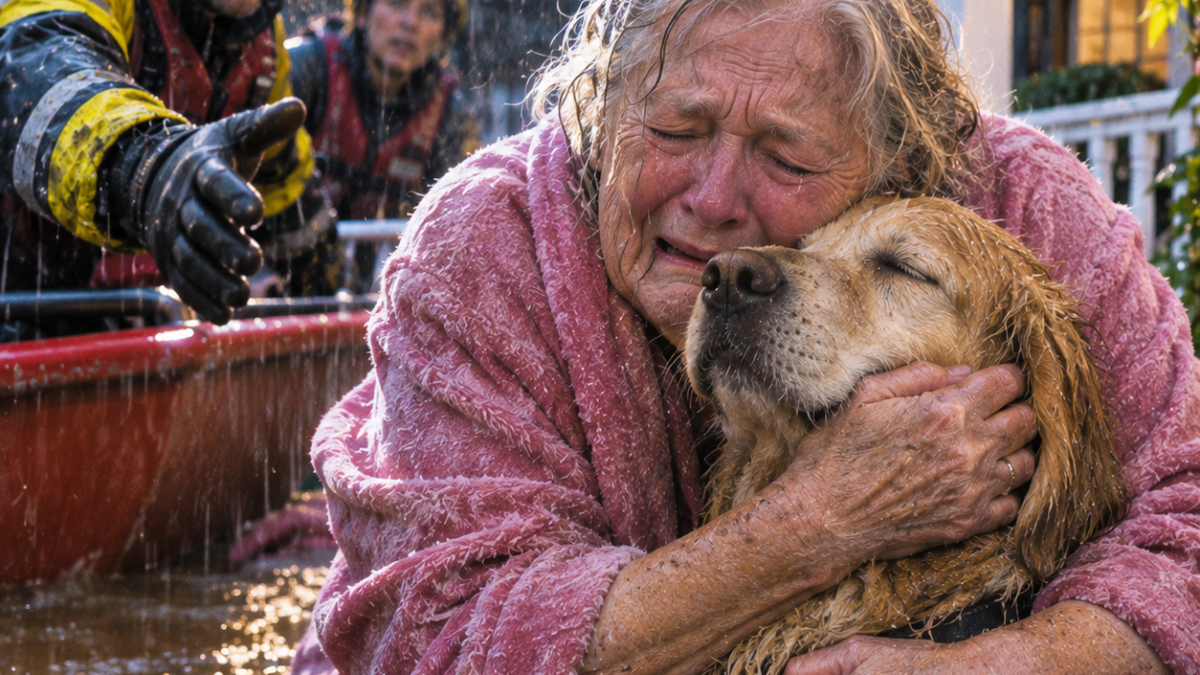
FULL STORY:“GET IN THE BOAT, MRS. HOPE! THE WATER IS STILL RISING, AND WE CAN’T KEEP COMING BACK FOR YOU!” the exhausted rescue volunteer shouted at an eighty-five-year-old widow who had been standing on her flooded porch for thirty-one hours, refusing to leave without her missing golden retriever.
FULL STORY CONTINUATION
I didn’t want to go to Elm Street that morning.
That’s one of the details people are surprised to hear.
They imagine reporters rushing enthusiastically toward every breaking story, desperate to be the first person holding a microphone beside the disaster.
But after nineteen years in local journalism, I’d learned that emergencies rarely looked the way they did on television.
They smelled of mud.
Wet insulation.
Gasoline.
Rotting wood.
And fear.
They involved exhausted volunteers, people who couldn’t find their medications, and families standing beside rescue boats wondering whether they would ever see their homes again.
The night before, I’d spent eleven hours covering evacuations along the river.
I was tired.
My clothes were damp.
I’d had two cups of terrible coffee and a packet of crackers.
When my editor called, I was sitting at my desk trying to write an update without falling asleep.
“Daniel.”
I recognized Martha’s voice immediately.
“Yes?”
“Elm Street.”
I closed my eyes.
“Martha.”
“Flood. Evacuation teams. People refusing to leave.”
“We’ve already covered the evacuations.”
“Not this one.”
I stared at the computer.
She continued.
“There’s an elderly woman at number nineteen. She’s been standing on her porch for more than a day.”
I sat straighter.
“Why?”
“Missing dog.”
I looked toward the rain-darkened window.
“Martha, the rescue team should be handling that.”
“They are. I need you to document what’s happening, without interfering.”
I rubbed my forehead.
“I’m exhausted.”
“So are they.”
I hated that she was right.
She softened her voice.
“Daniel, this isn’t just about water levels. There are people out there. Find out what they need and what they’re going through.”
I sighed.
Then reached for my jacket.
“Fine.”
“Be careful.”
I almost laughed.
She always added that after sending me somewhere dangerous.
But I appreciated it anyway.
The road toward Elm Street was barely recognizable.
The river had risen after days of relentless rain.
Normally quiet residential neighborhoods had become expanses of muddy water.
Cars sat partly submerged.
Fences disappeared beneath the surface.
Tree branches floated past mailboxes.
I parked my pickup near the emergency staging area, where volunteers were coordinating transport and helping residents reach shelter.
A young man in an orange life jacket approached.
He had a narrow face, dark circles beneath his eyes, and the expression of someone who’d been awake far too long.
“Daniel?”
I nodded.
“Sam?”
“That’s me.”
We shook hands.
His palm was cold.
Martha had arranged for me to accompany him during a permitted trip, subject to the rescue team’s direction.
He led me toward a small motorboat.
“You ever worked on floodwater before?”
“Yes.”
He looked at my boots.
“Good. Still, do exactly what I tell you.”
I nodded.
“Understood.”
We put on the required protective gear and checked the equipment.
Then Sam started the motor.
The boat moved slowly away from the staging point.
I looked across the water.
Everything was brown.
The road had disappeared.
Only the tops of street signs showed where intersections once existed.
A basketball hoop rose out of the water near a half-submerged driveway.
Farther ahead, a child’s plastic toy floated against a fence.
I lifted my camera.
Then lowered it.
Sometimes you don’t need a photograph to understand that something terrible has happened.
Sam steered carefully around submerged obstacles.
He didn’t talk much.
I couldn’t blame him.
After several minutes, I asked how long he’d been working.
“Since yesterday morning.”
I stared.
“Have you slept?”
“A little.”
“How many rescues?”
He shrugged.
“Three people overnight. Helped move supplies before that.”
I looked at his tired face.
“You should be resting.”
He gave a faint smile.
“Tell that to the river.”
Then he pointed ahead.
“Elm Street.”
I looked toward the houses.
Most were surrounded by deep water.
Some had reached the point where only their upper floors remained above the surface.
The neighborhood looked abandoned.
But Sam kept scanning windows and porches.
“She’s at the end,” he said.
“Mrs. Hope?”
He nodded.
“Number nineteen.”
“What do you know about her?”
“Eighty-five. Lives alone. Husband died years ago.”
“And the dog?”
“Golden retriever. Old. Blind, apparently.”
I frowned.
“She won’t leave him?”
Sam’s expression tightened.
“Not without knowing he’s safe.”
I watched the water sliding past the boat.
“How long has she been there?”
“Thirty-one hours, according to what she told the team and what neighbors saw.”
I looked at him.
“Thirty-one?”
He nodded.
“We’ve checked on her several times. She has access to the porch for now, but conditions are getting worse. We’re trying to find a safe way to get her out.”
I swallowed.
Then he said quietly, “She’s been singing.”
I turned.
“Singing?”
Sam nodded.
“You’ll hear.”
The first thing I saw was the white house.
It stood near the end of Elm Street, surrounded by floodwater.
A small, modest home.
Blue shutters.
A narrow porch.
A flower bed now hidden beneath the muddy surface.
Water had reached the lower steps.
The porch itself remained above the surface, but the margin was shrinking.
Then I saw her.
Jean Hope.
She stood near the top of the steps, holding the railing with one hand.
Her gray hair was wet and flattened against her head.
She wore a pink bathrobe and bright blue rubber boots.
Her shoulders were narrow.
Her face was pale.
And she was singing.
Softly.
steadily.
Her voice drifted over the water.
I couldn’t make out every word, but the melody had the unmistakable cadence of an old church hymn.
It was the kind of song people knew long before they remembered learning it.
Something sung at funerals.
Weddings.
Sunday services.
And lonely kitchen tables.
Jean wasn’t performing.
She wasn’t trying to attract attention.
She was looking past us, toward the flooded neighborhood, repeating the melody as though it were the only thing keeping her connected to the world.
Sam slowed the boat.
“Mrs. Hope!”
She didn’t turn.
“Mrs. Hope, it’s Sam!”
Her voice continued.
I looked at him.
He sighed.
“She does that.”
We approached to a safe position.
Sam called again.
“We’re here to help you evacuate.”
Jean stopped singing for a moment.
Then looked toward us.
Her eyes were clear.
Tired.
And filled with an unmistakable determination.
“I told you,” she said. “I’m waiting for Rossi.”
Sam took a breath.
“Ma’am, the water is rising.”
“I know.”
“We need to get you to shelter.”
She tightened her grip on the railing.
“Then bring him to me.”
I looked toward the house.
“Who is Rossi?”
Jean turned toward me.
Her expression softened.
“My dog.”
I nodded.
“I’m Daniel. I’m a reporter.”
She studied my face.
Then said, “A reporter won’t help him.”
I swallowed.
“Maybe not. But I can listen.”
For the first time, she looked directly into my eyes.
And her voice began to tremble.
“He’s blind.”
I waited.
“Nearly deaf.”
She looked toward the water.
“He can’t find me unless he knows where I am.”
I glanced toward Sam.
Then back at Jean.
“Is that why you’re singing?”
She nodded.
“Every time he gets frightened, I sing. He looks for me.”
Her lower lip trembled.
“He always comes.”
I didn’t know what to say.
Then she whispered, “Except this time.”
I climbed out only where the rescue team determined it was safe to do so, staying close to Sam and away from the deeper current.
I approached the porch steps.
Jean watched me.
Up close, she looked even more exhausted.
Her hands were red from gripping the railing.
Her face was lined with fatigue.
Her boots were wet.
The pink bathrobe hung heavily around her narrow shoulders.
I stopped a short distance away.
“Mrs. Hope, how long has Rossi been missing?”
She looked toward the house.
“Since the water started coming inside.”
I frowned.
“You saw him leave?”
She shook her head.
“I heard something fall in the kitchen. Then he disappeared.”
I looked at the front door.
“Did you check the house?”
“As much as I could.”
Her eyes filled.
“The water came so fast.”
I nodded.
“I understand.”
She looked toward me.
“No, sweetheart.”
Her voice was gentle.
But firm.
“You don’t.”
I was silent.
She continued.
“Rossi can’t see the steps anymore. He bumps into furniture when we move things. He doesn’t hear ordinary sounds the way he used to.”
Her throat tightened.
“When there’s thunder, he hides.”
I looked toward the dark windows.
“Where?”
She swallowed.
“In the kitchen.”
I felt something shift.
“Where in the kitchen?”
She pointed weakly.
“There’s a little cupboard near the floor. He used to crawl inside when he was young.”
I stared at the house.
Then looked toward Sam.
He had heard.
I turned back to Jean.
“Mrs. Hope, have the rescue teams checked that cupboard?”
She shook her head.
“They couldn’t safely search the whole house.”
I looked toward the waterline.
The situation was dangerous.
The house could contain unstable structures, electrical hazards, contaminated water, and debris.
We couldn’t simply rush inside because a dog might be there.
But there was now a specific location worth reporting to the rescue team.
I turned toward Sam.
“Can we get a trained team to check?”
Sam reached for his radio.
And while he contacted the staging area, Jean began singing again.
I sat beside her on the porch.
Not because I had nothing else to do.
Because she looked as though she might collapse if nobody remained close.
“Can I ask you about Rossi?”
She continued singing for another moment.
Then stopped.
Her expression changed.
And despite everything happening around us, she smiled.
“He was a terrible puppy.”
I blinked.
“What?”
She laughed faintly.
“Absolutely terrible.”
I smiled.
“Tell me.”
She looked toward the flooded street.
“He chewed Ray’s slippers. Both pairs.”
“Your husband?”
She nodded.
“Ray.”
Her smile trembled.
“He used to say Rossi had expensive taste because he only destroyed the good slippers.”
I laughed softly.
Jean continued.
“He stole dish towels. Dug up my flowers. And once he carried half a loaf of bread into the garden.”
I shook my head.
“Sounds like trouble.”
“Oh, he was.”
Then her expression softened.
“But he was wonderful trouble.”
She looked toward the doorway.
“Ray and I brought him home when he was still young.”
I nodded.
“He was such a beautiful little thing.”
Her voice broke.
“Golden fur. Big paws. Those eyes.”
She swallowed.
“Ray loved him.”
I waited.
Then asked gently, “How long ago did your husband pass?”
Jean’s gaze lowered.
“Five years.”
I nodded.
“I’m sorry.”
She looked toward me.
“Rossi was the one who kept the house from becoming silent.”
I felt my throat tighten.
She continued.
“After Ray died, I didn’t want to get up in the morning.”
Her eyes filled.
“I didn’t want breakfast. Didn’t want the garden. Didn’t want to answer the telephone.”
She looked toward the floodwater.
“But Rossi needed me.”
I watched her.
“He needed feeding. Walks. A clean bed. His medicine.”
She smiled sadly.
“He wouldn’t let me stay in bed all day.”
I swallowed.
“And little by little, I started living again.”
She looked toward me.
“Do you understand?”
I nodded.
This time, I did.
Or at least, I understood enough to recognize why she couldn’t bear the thought of leaving him.
Rossi wasn’t simply an animal she happened to own.
He was a companion.
A daily routine.
A living connection to the years she’d shared with Ray.
And after her husband’s death, he’d become one of the reasons she continued getting up each morning.
Now, in the middle of a flood, she believed he was somewhere frightened and helpless.
And she couldn’t imagine leaving him behind.
I looked at Jean’s hands.
They were trembling.
“Mrs. Hope, I’m worried about you.”
She smiled faintly.
“I’m eighty-five, Daniel. People have been worrying about me for years.”
I almost laughed.
She continued.
“But I know what you’re going to say.”
“What?”
“That I should get in the boat.”
I nodded.
“Yes.”
She looked toward the dark house.
“I know.”
I swallowed.
“Then please.”
Her eyes filled.
“If I go, who will call him?”
I didn’t have an easy answer.
I could tell her the rescue teams would continue searching if conditions allowed.
I could tell her people would try.
But I couldn’t promise they’d find Rossi.
And I couldn’t promise the water wouldn’t rise before they did.
I looked toward Sam.
He was still coordinating with the rescue team.
Then I turned back to Jean.
“We’re trying to find a way to check the place you described.”
She nodded.
“Thank you.”
I paused.
“But I need you to work with the rescuers. If the porch becomes unsafe, you mustn’t try to enter the house on your own.”
She looked at me.
For a moment, the stubbornness returned.
Then she lowered her eyes.
“I don’t want to die, Daniel.”
My throat tightened.
“I know.”
She continued.
“I just don’t want him to die alone.”
I stared at her.
And for the first time that morning, I had no words at all.
The sound came while she was singing the second verse.
At first, I thought it was part of the house settling.
A faint creak.
A distant movement.
Something barely audible beneath the soft slap of water against the porch.
Then I heard it again.
A low, rough sound.
Not quite a bark.
Not quite a whimper.
I lifted my head.
Jean stopped singing.
Her hand tightened around the railing.
“Did you hear that?”
I listened.
The floodwater moved gently against the steps.
Somewhere farther down the street, a piece of debris knocked against a fence.
Then came another sound.
Weak.
Short.
Coming from the house.
Jean’s eyes widened.
“Rossi.”
I looked toward the doorway.
“Sam!”
He turned immediately.
“What?”
“There’s something inside.”
We listened together.
Another faint whine came from the direction of the kitchen.
Jean stood suddenly.
“Rossi!”
She moved toward the door.
I reached out.
“Mrs. Hope, wait!”
She didn’t stop.
“That’s him!”
Her voice rose.
“That’s my boy!”
She reached the threshold and began pulling at the swollen door.
Water pressed against it from inside.
I moved closer, trying to prevent her from stepping into an area none of us had assessed as safe.
“Jean, please. We know where he is now. Let the rescue team get him.”
She looked at me.
Her face was wet with tears.
“He’s been in there all this time.”
I swallowed.
“We’ve heard him. That’s good. But we can’t lose you trying to reach him.”
For a moment, she looked ready to push past me.
Then another whimper came from the kitchen.
Jean covered her mouth.
“Oh, my baby.”
She began shaking.
I held her arm carefully as Sam radioed the new information.
A dog was possibly alive inside the flooded house.
The sound appeared to come from a low kitchen cupboard.
The owner was eighty-five and dangerously exhausted.
We needed trained assistance quickly.
The response felt unbearably slow.
In reality, the rescuers were working as quickly as conditions allowed.
But when you know something living is trapped in a house filling with water, every second seems longer.
Jean kept singing.
Her voice was softer now.
Almost a whisper.
She leaned toward the door, listening between verses.
“Rossi, sweetheart. Mama’s here.”
I crouched nearby.
“Keep talking to him.”
She nodded.
“I am.”
The dog made another faint noise.
Jean began crying.
“That’s my boy.”
Then she looked toward me.
“Daniel, he knows I’m here.”
I couldn’t know whether Rossi could hear her clearly through the water and damaged walls.
His hearing was severely impaired.
Perhaps he recognized vibrations.
Perhaps he sensed her presence in another way.
Perhaps the sounds were simply cries of distress.
But I wasn’t going to take away the comfort Jean drew from speaking to him.
So I nodded.
“Keep letting him know you’re close.”
She resumed the hymn.
And I sat beside her, waiting.
The rescue team approached with equipment suited to the conditions.
One of the responders, a broad-shouldered man named Carlos, examined the doorway and surrounding structure.
Sam explained what we’d heard.
I pointed toward the kitchen.
Jean described the cupboard.
Carlos listened carefully.
Then turned toward her.
“Mrs. Hope, we need you to move to the boat with Sam so the team can work safely.”
She shook her head.
“Not until Rossi comes.”
He crouched to speak at her level.
“We’re going to make every safe effort to reach him. But we need the doorway clear, and we need to know you’re out of danger.”
Jean stared at him.
Her lips trembled.
“He’s all I have left.”
Carlos’s expression softened.
“I understand he’s family.”
She began crying.
He paused.
“Help us help him.”
Those words seemed to reach her.
Jean looked toward the door.
Then toward the waiting boat.
For a moment, she didn’t move.
Finally, she nodded.
Sam guided her carefully toward the boat and helped her settle securely.
I remained with the responders only where they permitted me to stand, keeping out of the working area.
Jean reached toward the house.
“Rossi!”
Her voice broke.
“I’m still here, sweetheart!”
Carlos and his teammate began the rescue.
Through the doorway, I could see very little.
The interior was dark.
Floodwater had entered the lower rooms.
Furniture was displaced.
The kitchen floor was submerged.
The rescuers moved carefully, checking the environment as they proceeded.
Jean kept calling from the boat.
Sometimes she sang.
Sometimes she whispered Rossi’s name.
I stood near Sam, watching the doorway.
For a moment, there was no sound from inside.
My chest tightened.
I looked toward Jean.
She was staring at the house with such concentration that she seemed barely to breathe.
Then Carlos called out.
“We have the dog!”
Jean made a sound I will remember until the day I die.
Not a scream.
Not quite a sob.
Something between disbelief and relief.
She leaned forward.
“Rossi?”
Carlos’s voice came again.
“He’s alive!”
I closed my eyes.
For a moment, the entire flooded street seemed to stop moving.
Then I heard the rescuers working their way back toward the entrance.
Rossi appeared in Carlos’s arms.
He was an elderly golden retriever with a gray muzzle and soaking wet fur.
His body trembled.
His ears lay flat.
His eyes were clouded with age.
He was exhausted, frightened, and too weak to move confidently on his own.
But he was alive.
Carlos transferred him carefully into the boat, where the team had prepared a protected place for him.
Jean reached toward him.
“Oh, my baby.”
Her voice broke.
“Rossi.”
The dog lifted his head.
For a moment, he seemed confused.
Then Jean touched his face.
Her hands moved gently along his cheeks and ears.
Rossi pressed his nose against her fingers.
His tail moved.
A small, slow movement.
Jean began laughing.
Not because anything was funny.
Because the relief was too enormous for her body to contain quietly.
“Oh, sweetheart!”
She leaned forward as much as she safely could.
“I’ve got you.”
Rossi nuzzled against her.
Then began licking her hand.
Jean laughed again.
Tears streamed down her face.
“Daniel!”
I looked at her.
She smiled through her tears.
“He’s here!”
I nodded.
My own vision blurred.
“Yes.”
She stroked Rossi’s head.
“See? He’s here.”
I couldn’t answer.
Because for thirty-one hours, that woman had stood on a porch surrounded by rising water, singing to a dog she believed might still be searching for her.
Now he was resting against her.
Wet.
Cold.
Trembling.
But alive.
And for one brief moment, the flood hadn’t taken everything.
We evacuated them both.
Jean needed medical assessment after prolonged exposure, exhaustion, and the strain of remaining outside for so long.
Rossi needed urgent veterinary attention for possible hypothermia, contaminated-water exposure, dehydration, and any injuries sustained while trapped.
The rescuers moved them to safety as efficiently as conditions permitted.
I accompanied Sam back toward the staging area.
Jean sat securely in the boat.
Rossi rested in a protected space close to her, with the team monitoring him.
She kept one hand against his fur whenever she could do so safely.
At one point, she looked toward me.
“Daniel?”
“Yes?”
“Did you hear me singing?”
I smiled through tears.
“The whole neighborhood probably heard you.”
She laughed softly.
Then looked down at Rossi.
“Ray used to sing that hymn.”
I nodded.
“He did?”
“Every Sunday.”
Her voice trembled.
“He had a terrible singing voice.”
I smiled.
She continued.
“Rossi always came and sat beside him.”
She stroked the dog’s wet head.
“After Ray died, I kept singing it.”
Her eyes filled.
“And Rossi still came.”
I looked down.
She whispered, “I thought if I stopped singing today, he’d think I’d gone away too.”
I swallowed.
There was nothing I could say.
So I sat quietly and let her hold the moment.
At the emergency staging area, Jean and Rossi were transferred to the appropriate medical and veterinary teams.
I watched them go.
For a moment, I thought my work was finished.
I had the story.
The photographs.
The rescue.
A woman who’d waited thirty-one hours.
A blind and nearly deaf dog discovered inside a flooded kitchen.
It was the kind of article that might travel far beyond our small newspaper.
But when I looked toward the flooded neighborhood, I couldn’t bring myself to leave.
Sam was preparing for another trip.
I approached him.
“Need help?”
He stared.
“You’re a reporter.”
“I know.”
He looked toward the equipment.
“There are jobs you can do here without getting in the rescue team’s way.”
I nodded.
“Tell me.”
So I stayed.
I helped with permitted logistical tasks.
Carried supplies.
Recorded information that needed passing along.
Assisted at the staging area.
And listened to people who had just lost homes.
I didn’t pretend my presence made me a rescuer.
The trained responders were doing the dangerous work.
But there were ordinary ways to be useful.
And for the first time that day, I wanted to do more than collect a quote and leave.
That evening, I returned to the newsroom.
Martha was standing beside the television monitors.
She looked at my muddy clothes.
Then my face.
“What happened?”
I set down my bag.
“Found the woman.”
“Mrs. Hope?”
I nodded.
“And the dog?”
I looked at her.
“He was inside the house.”
Martha went still.
“Alive?”
“Yes.”
She covered her mouth.
I continued.
“The rescue team got him out.”
For a moment, she didn’t speak.
Then she whispered, “Thank God.”
I sat at my desk.
Opened a new document.
Placed my hands on the keyboard.
And stared at the blank page.
I’d written hundreds of stories.
Some difficult.
Some devastating.
Others surprisingly hopeful.
Usually, I could find the opening sentence within a few minutes.
This time, I couldn’t.
Because everything I typed sounded too small.
Elderly Woman Rescued With Dog.
Flood Survivor Reunited With Missing Pet.
Golden Retriever Found Alive After Thirty-One Hours.
All accurate in part.
None capturing what I’d seen.
I remembered Jean’s voice floating across the water.
The way she’d stood on the porch.
The way she’d said, He’s all I have left.
Then I remembered Rossi touching his nose to her fingers.
And the sound she made when she realized he was alive.
I closed the document.
I wasn’t ready to write it yet.
First, I needed to know whether they’d both survived the aftermath.
Three days later, I found Jean at a temporary shelter.
She’d received medical care and was resting.
Rossi had been evaluated by a veterinarian and was recovering, with arrangements made to keep them together in suitable accommodations.
The room was small.
Two narrow beds.
A chair.
A little table.
A window overlooking the parking lot.
Jean sat beside Rossi’s bedding.
She wore clean clothes.
Her gray hair had been brushed.
But she still looked tired.
The dog was sleeping.
His head rested near her foot.
One of her hands lay gently against his back.
When I entered, she looked up.
“Daniel.”
I smiled.
“Hello, Mrs. Hope.”
She laughed softly.
“Jean.”
I nodded.
“Jean.”
She gestured toward the chair.
“Sit.”
I sat.
For a moment, we watched Rossi sleep.
Then Jean whispered, “He sleeps all the time.”
I looked at him.
“He’s been through a lot.”
She nodded.
“The veterinarian says he needs rest and follow-up care.”
Her eyes filled.
“I should probably sleep too.”
I smiled.
“Probably.”
She looked down at the dog.
“But I keep watching him.”
I understood.
She’d spent more than a day not knowing whether he was alive.
Now the sight of his breathing was something she couldn’t take for granted.
I looked around the room.
“Are they taking good care of you?”
She nodded.
“Yes.”
“Do you need anything?”
She considered the question.
Then smiled sadly.
“My house.”
I looked down.
The flood had damaged the property badly.
It wasn’t clear how much could be repaired or how long restoration would take.
Jean seemed to read my thoughts.
“I know I can’t go back yet.”
I nodded.
“I’m sorry.”
She stroked Rossi’s fur.
“I’m just glad he’s here.”
For a moment, the room became quiet.
Then she looked toward me.
“Daniel, why did you come back?”
I hesitated.
“Because I wanted to see how you were doing.”
She smiled.
“And?”
I took a breath.
“I’d like to write your story.”
She looked surprised.
“Mine?”
“Yes.”
She glanced at Rossi.
“It’s just an old woman and her dog.”
I shook my head.
“No, Jean.”
My voice tightened.
“It’s a story about someone who has already lost a great deal and couldn’t bear to lose one more person she loved.”
She looked down.
I continued.
“And it’s about the people who helped you both get out safely.”
For several seconds, she didn’t speak.
Then she looked at Rossi.
Her expression softened.
“If you write about him, don’t make him sound brave in a way he wasn’t.”
I frowned.
“What do you mean?”
She smiled through tears.
“He was frightened, Daniel.”
I nodded.
“He was.”
“He hid in the cupboard because that’s what he does when storms come.”
She stroked his head.
“He’s old. He can’t see. He barely hears.”
Her voice trembled.
“He didn’t save anyone that day.”
I looked toward the dog.
Jean continued.
“He needed saving.”
I swallowed.
Then she looked at me.
“And the rescuers saved him.”
I nodded.
“Yes.”
Her eyes filled.
“Please make sure people know that.”
I smiled.
“I will.”
I returned to the newsroom that evening and began writing.
Not about an impossible miracle.
Not about an eighty-five-year-old woman defeating a flood through sheer determination.
I wrote about a widow who loved an elderly dog.
A dangerous evacuation.
The mistakes and uncertainties that can arise when water enters a home faster than anyone expects.
I wrote about Rossi’s impaired sight and hearing.
About the kitchen cupboard where he hid during thunderstorms.
About Jean singing an old church hymn because she’d grown accustomed to using her voice to reassure him.
And about the trained rescue team that entered a hazardous house and brought him out alive.
Most importantly, I wrote about why Jean had struggled to leave.
Ray.
Her husband.
The decades they’d shared.
The terrible quiet after his death.
And the golden retriever who had helped her find a reason to smile again.
I included her words.
“People are always talking about how loyal dogs are,” she had told me.
“But loyalty goes both ways, Daniel.”
I’d looked at her.
She continued.
“Rossi never stopped needing me when I became old and slow. I couldn’t bear the thought of him believing I’d stopped needing him.”
Her eyes filled.
“That’s what love is, sweetheart. You don’t forget someone just because they’re inconvenient.”
I remembered that sentence as I typed.
Then I looked at the photographs from the rescue.
Jean on her porch.
The floodwater.
The boat.
Rossi wrapped safely after being brought out.
And Jean’s face when she finally touched him again.
I wrote until nearly midnight.
When I finished, I sat back.
Read the story from beginning to end.
And cried.
Martha came over.
She read the article without speaking.
Then read parts of it again.
For a while, I watched her expression.
Finally, she looked up.
“This is good, Daniel.”
I nodded.
“Thanks.”
She studied me.
“Not because it’s dramatic.”
I looked at her.
She continued.
“Because you let her be a person.”
My throat tightened.
Martha pointed toward the screen.
“You didn’t turn her into some strange old woman refusing rescue. You explained what she was afraid of losing.”
I looked down.
She smiled.
“And you gave the rescuers credit for bringing them out.”
I nodded.
“They earned it.”
Martha was quiet for a moment.
Then she asked, “You okay?”
I thought about the flooded porch.
Jean’s pink bathrobe.
Sam’s exhausted face.
Rossi trembling in Carlos’s arms.
The sound of that first whimper.
I took a breath.
“I don’t know.”
Martha nodded.
Then gently touched my shoulder.
“Go home, Daniel.”
I smiled faintly.
“Boss’s orders?”
“Yes.”
I stood.
And for once, I listened.
The article was published the following morning.
I expected a few calls.
Maybe some readers wanting to know whether Rossi had recovered.
Perhaps someone asking how to help displaced residents.
But the response surprised all of us.
People began calling the newsroom.
Some remembered Jean from church.
Others had lived on Elm Street years earlier.
A woman said she’d once bought flowers from Jean’s garden sale.
A man remembered Ray helping him repair his porch.
Several readers wanted to donate supplies to the evacuation shelter.
Others offered temporary pet-friendly accommodation for flood survivors.
One family offered Jean and Rossi a place to stay while the house was assessed and repaired.
Martha contacted the appropriate relief coordinators so offers could be verified and directed toward genuine needs.
Nobody wanted Jean overwhelmed by strangers appearing at the shelter.
And there were other displaced families whose needs were just as urgent.
The article became part of a wider effort to connect people with assistance.
Food.
Clothing.
Temporary housing.
Cleanup supplies.
Veterinary care.
Transportation.
The kind of practical support that doesn’t always make a dramatic headline but changes what happens after the cameras leave.
I watched the response unfold.
And thought about how close I’d come to staying at my desk that morning.
How I’d told Martha I didn’t want to go.
How I assumed the story would be another sad photograph beside a flooded house.
Instead, I’d met Jean.
And she’d reminded me why I became a reporter in the first place.
The next few months were difficult for Elm Street.
Flood recovery didn’t happen quickly.
Water had damaged floors, walls, appliances, electrical systems, and belongings accumulated over decades.
Some homes required extensive repairs.
Others were beyond economical restoration.
Residents navigated insurance claims, inspections, assistance programs, contractors, and long waits.
Jean’s house was seriously damaged but ultimately repairable.
The process took planning and professional work.
While it was underway, she stayed in suitable temporary accommodation with Rossi.
I visited occasionally.
Sometimes I brought groceries.
Sometimes a newspaper.
Once, a new photograph of the house being repaired.
But usually, I just sat with her.
She liked talking about Ray.
And Rossi.
Especially Rossi.
She told me how the dog used to sleep at the foot of her husband’s chair.
How Ray pretended to be annoyed when Rossi stole his socks.
How the two of them would sit on the porch during thunderstorms, listening to the rain.
She told me how Rossi had gradually lost his sight.
How he’d begun hesitating at doorways.
How she learned not to move the furniture unnecessarily.
How she guided him through familiar routines.
And how, when his hearing began fading too, she continued talking and singing to him, sometimes using gentle touch so he knew she was near.
Her love wasn’t dramatic in everyday life.
It was patient.
Attentive.
Ordinary.
She knew the exact place he preferred to sleep.
Which side of the sofa he liked.
How he behaved when he was uncomfortable.
What frightened him.
What soothed him.
She understood that caring for an aging animal meant adjusting the world around him rather than expecting him to remain young forever.
And as I listened, I began to understand something.
Jean hadn’t stood on that porch because she was trying to become a hero.
She’d stood there because, in her mind, the creature who depended on her was still missing.
She couldn’t imagine leaving before someone knew where he was.
It had been dangerous.
The outcome could easily have been tragic.
But beneath that decision was a love built through years of ordinary mornings.
Rossi recovered gradually.
The flood had taken an enormous toll on him.
He was exhausted.
Frightened.
And needed careful veterinary follow-up.
But he was safe.
And Jean kept him close.
Whenever I visited, he was usually sleeping on a soft bed near her chair.
His golden coat had been cleaned.
His gray muzzle made him look dignified.
Sometimes, when Jean moved, he lifted his head.
She would reach down.
Touch his shoulder gently.
And he would settle again.
One afternoon, I watched her stroke his ears.
“Does he still respond to your singing?” I asked.
Jean smiled.
“Sometimes.”
She looked down at him.
“He can’t hear much now.”
I nodded.
“But I think the routine comforts us both.”
She laughed softly.
“Perhaps I’m the one who needs the song.”
I smiled.
“Maybe.”
She looked at me.
Then whispered, “Ray used to tell me I sang too loudly.”
I laughed.
Jean smiled.
“He’d say the whole neighborhood could hear.”
She paused.
“Now I wish they could.”
Her eyes filled.
I looked away.
Then she began humming.
Quietly.
Rossi rested against her hand.
And for a moment, it felt as though the little room held more love than some much larger houses I’d visited.
Three months after the flood, Jean returned to 19 Elm Street.
I went there on a bright Saturday morning.
The road was dry.
The damaged fences had been repaired.
Fresh grass was beginning to grow.
Some neighbors were still working on their properties.
Others had returned.
The neighborhood wasn’t exactly as it had been.
Disasters leave traces.
Sometimes visible.
Sometimes not.
But the white house stood again.
Its walls had been restored.
The porch steps were new.
The blue shutters had been repainted.
And flowerpots stood beside the entrance.
I parked across the street.
For a moment, I simply looked.
Then I saw her.
Jean Hope.
Sitting in a rocking chair on the porch.
She wore a pale blue sweater.
Her gray hair had been neatly combed.
A light blanket rested across her knees.
And beside her lay Rossi.
The old golden retriever was sleeping on a comfortable cushion.
His muzzle rested against her shoe.
One of Jean’s hands lay on his back.
She was singing.
The same hymn.
The same gentle melody.
But this time, there was no floodwater.
No desperate rescue.
No frightened cries from a dark kitchen.
Only sunlight.
The sound of birds.
A rocking chair moving softly across wooden boards.
And an elderly woman singing to the dog who had come home with her.
I didn’t approach immediately.
I stood beside my pickup and listened.
The sound drifted across the street.
Soft.
Imperfect.
Beautiful.
I remembered the first time I’d heard it.
Rising above brown floodwater.
Carrying across a neighborhood that seemed to have disappeared beneath the river.
Back then, Jean had sung because she was afraid Rossi was lost.
Now she was singing because he was there.
The difference nearly brought me to tears.
Finally, she noticed me.
She raised one hand.
“Daniel!”
I smiled.
“Morning, Jean!”
She waved me over.
I crossed the street.
Climbed the new steps.
And sat beside her.
Rossi lifted his head when he sensed my movement.
Jean reached down.
“It’s Daniel, sweetheart.”
She gently touched his shoulder.
He relaxed.
I smiled.
“Hello, old boy.”
His tail moved faintly.
Jean laughed.
“He remembers the important people.”
I looked at her.
“You two look good.”
She nodded.
“We’re home.”
I glanced toward the new porch steps.
“They did a beautiful job.”
She smiled.
“They did.”
Then she looked toward the garden.
“Ray would’ve complained that the paint was too bright.”
I laughed.
Jean continued.
“And then he’d have said it looked wonderful.”
We sat quietly for a moment.
The rocking chairs moved gently.
Rossi closed his eyes.
Then Jean turned toward me.
“Do you know what I remember most about that day?”
I looked at her.
“The boat?”
She shook her head.
“The water?”
“No.”
I waited.
She looked down at Rossi.
“The moment I touched his face.”
My throat tightened.
She continued.
“I’d been so afraid he’d died somewhere alone.”
Her eyes filled.
“Then they brought him out, and I felt him press his nose into my hands.”
She swallowed.
“I knew he was still with me.”
I looked toward the street.
Jean smiled through tears.
“That’s all I wanted, Daniel.”
For a moment, I couldn’t speak.
Then I said softly, “I’m glad you both made it home.”
She nodded.
“So am I.”
I stayed for nearly an hour.
Jean told me about the repairs.
Her neighbors.
The people who had helped her move back.
She showed me a new photograph of Rossi beside the restored fireplace.
Then she insisted I take a piece of homemade cake.
I tried refusing.
She gave me a look.
“Daniel, I’m eighty-five years old. Don’t argue with me about cake.”
I laughed.
“Yes, ma’am.”
She smiled.
“That’s better.”
When I finally stood to leave, she reached for my hand.
“Thank you for coming back.”
I looked at her.
“Of course.”
She squeezed my fingers.
“And for listening.”
My throat tightened.
“I should be thanking you.”
She looked puzzled.
“Why?”
I glanced toward Rossi.
Then back at her.
“Because you reminded me what matters.”
Jean smiled.
“Oh, sweetheart.”
She released my hand.
“Life has a way of doing that.”
I walked down the new steps.
Reached the sidewalk.
Then turned around.
Jean had already settled back into her chair.
Rossi rested beside her.
She placed one hand against his golden fur.
And began singing again.
I’ve covered many stories since that flood.
More storms.
More evacuations.
More people facing losses they never expected.
I’ve interviewed families who rebuilt homes from nothing.
Volunteers who worked until they could barely stand.
Neighbors who shared food with people they’d never spoken to before.
And each time, I remember 19 Elm Street.
The white house.
The pink bathrobe.
The bright blue rubber boots.
The elderly woman standing on her porch as floodwater rose around her.
But I don’t remember her as someone who defeated the river.
She couldn’t.
Nobody could.
And remaining in a dangerous flood zone was not a risk anyone should have to take to prove love.
I remember her as someone who was terrified of abandoning a vulnerable companion.
And I remember the trained responders who worked to bring both of them out safely.
I remember Sam.
His exhausted eyes.
The way he kept going despite having worked through the night.
I remember Carlos carrying the soaked golden retriever toward the boat.
And I remember the moment Rossi touched his nose to Jean’s hand.
That was the moment when the whole story became clear.
People sometimes ask me why I wrote so much about a dog.
There were houses destroyed.
Businesses ruined.
Families displaced.
Surely, they say, those stories were more important.
I tell them those stories mattered too.
We reported them.
We followed the rebuilding.
We examined the failures and the decisions that shaped the emergency response.
But Rossi’s story mattered because it revealed something people sometimes overlook in disasters.
A home isn’t only walls and furniture.
It’s the people and living creatures who make those walls feel safe.
It’s the familiar footsteps in the hallway.
The chair beside the fireplace.
The voice calling you to dinner.
The dog sleeping near your feet.
The small routines that tell you life is still yours.
When the flood came, Jean lost the safety of her home.
And she feared losing the last companion who connected her to the life she’d shared with Ray.
That fear was real.
It deserved compassion.
And it deserved a response that protected both her life and Rossi’s as far as possible.
I still have one photograph from that day.
Not the most dramatic one.
Not the picture of water reaching the porch steps.
Not the rescue boat.
Not the damaged kitchen.
It’s a photograph taken after the house was repaired.
Jean sitting in her rocking chair.
Rossi asleep beside her.
Sunlight falling across the new wooden steps.
Her face turned slightly toward the dog.
One hand resting on his back.
The image is ordinary.
You could look at it for a second and see nothing more than an elderly woman enjoying a peaceful morning with her pet.
But I know what came before.
The thirty-one hours.
The singing.
The rising water.
The frightened dog trapped inside.
The rescue.
The shelter.
The long return home.
And that’s why I keep the photograph near my desk.
It reminds me that a good story doesn’t always need a spectacular ending.
Sometimes the most beautiful ending is simply getting to live another ordinary day.
One afternoon, months later, Martha walked into my office and saw the photograph.
She picked it up.
“Jean Hope?”
I nodded.
“And Rossi.”
She smiled.
“How are they?”
“Home. Doing well, last I heard.”
Martha looked at the picture for a long moment.
Then said, “You know, I almost sent someone else that day.”
I looked up.
“Really?”
She nodded.
“You were exhausted.”
I laughed softly.
“I definitely was.”
She set the photograph down.
“I’m glad you went.”
I looked toward Jean’s smiling face.
Then nodded.
“So am I.”
Because before that assignment, I’d begun forgetting why ordinary people’s stories mattered.
I’d grown tired.
Cynical.
Too accustomed to tragedy.
Then an eighty-five-year-old widow stood on her porch and sang an old hymn into the floodwater.
And reminded me that behind every emergency report, every evacuation number, and every damaged house was a life filled with memories the outside world couldn’t see.
The last time I visited Jean, Rossi was sleeping beside her chair.
She was humming.
The porch steps had dried after an afternoon rain.
A few flowers were blooming beside the walkway.
I sat with her for a while.
Eventually, I asked, “Jean, do you ever think about leaving that day?”
She nodded.
“All the time.”
I waited.
She looked down.
“I wish I had known sooner where he was.”
Her voice trembled.
“I wish I could’ve gotten help before the water became so dangerous.”
I nodded.
She continued.
“I was frightened, Daniel.”
“I know.”
She looked at me.
“Not just of losing Rossi.”
She swallowed.
“Of being alone again.”
For a moment, neither of us spoke.
Then she smiled sadly.
“But those men found him.”
I nodded.
“They did.”
“And they brought us out.”
“Yes.”
She looked toward the sunlit street.
“That’s what I remember now.”
I smiled.
“Good.”
Jean rested her hand on Rossi’s head.
Then she whispered, “Sometimes love means refusing to give up on someone.”
She paused.
“And sometimes it means trusting other people to help when you can’t do everything yourself.”
I looked at her.
The woman who’d once stood alone on her flooded steps had found a way to say something far wiser than any headline I could have written.
I nodded.
“I think you’re right.”
Today, whenever heavy rain falls and the river begins rising, I think of Jean Hope.
I think of her old church hymn.
The sound drifting over brown water.
The way she stood on those steps, waiting for a dog who could barely see or hear.
I think of Rossi hiding inside the kitchen cupboard, frightened by the storm.
And I think of the moment the rescue team carried him back to her.
Jean reached out.
Touched his face.
And laughed through tears.
A sound so full of relief that for one brief moment, I forgot the mud, the danger, and the exhaustion.
Because the one thing she’d been waiting for was finally there.
And she could leave.
Not because she had stopped loving her home.
But because the living creature who made that home feel less lonely was safe beside her.
Jean Hope spent thirty-one hours singing into rising floodwaters because she was afraid her blind, nearly deaf golden retriever would never find her again. But when the rescuers finally placed Rossi within reach of her hands, she discovered that the love she’d been calling for had been waiting inside the house all along.
The river eventually receded.
The streets dried.
The damaged homes were repaired or rebuilt.
Life continued.
And at number nineteen on Elm Street, a little white house stood beneath the morning sun.
On its porch sat an elderly woman.
At her feet slept a golden retriever with a gray muzzle.
Sometimes she sang.
Sometimes he lifted his head and leaned toward her touch.
And sometimes they simply sat together.
No rushing water.
No fear.
No desperate search.
Just another ordinary morning.
The kind of morning Jean had nearly lost.
The kind she would never again take for granted.
I went to Elm Street to report on a woman who refused to leave her flooded home. I came away with the story of a woman who loved her dog, a team that saved them both, and the extraordinary beauty of being able to return home together.








