FULL STORY:“GET AWAY FROM THAT TRAIN CAR, RYAN! THE DEMOLITION CREW IS COMING AT DAYBREAK, AND WHATEVER’S INSIDE ISN’T WORTH YOUR LIFE!” the retired railroad mechanic shouted as a German Shepherd clawed desperately at a rusted steel door in an abandoned Oregon railyard.
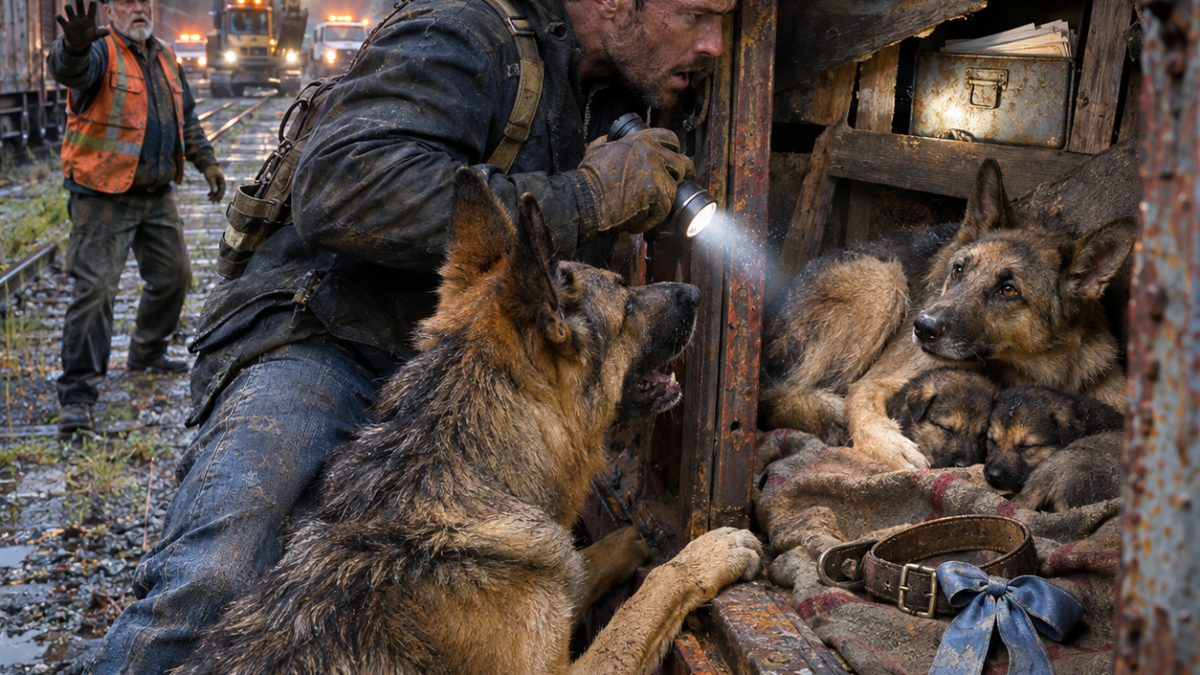
FULL STORY CONTINUATION
I remember the smell of that old train car more clearly than almost anything else.
Wet wood.
Rust.
Spoiled straw.
Engine oil that had soaked into the floorboards decades earlier.
And underneath all of it, something painfully familiar.
The warm, frightened scent of living creatures trying to survive.
The German Shepherd had already reached the far corner.
She lowered herself beside the two puppies and began licking them with frantic tenderness.
One made a weak noise.
The other didn’t move at all.
I crouched several feet away.
“Easy, girl.”
The mother lifted her head.
Her lips pulled back.
A warning growl vibrated through her chest.
I stopped moving.
“I know,” I whispered. “You don’t trust me.”
She stared.
“Can’t blame you.”
Behind me, Tom Miller ducked through the opening.
He was sixty-eight, broad through the shoulders, with a gray mustache, weather-beaten face, and a left knee that had apparently been arguing with him for twenty years.
“What have we got?”
“Two puppies.”
He leaned closer.
“Good Lord.”
The larger puppy was a male with a dark mask around his eyes. He was probably six or seven weeks old, though his condition made him appear younger.
His little paws were enormous compared with his thin legs.
The smaller puppy was female.
She had soft tan markings above her eyes, ears that hadn’t yet learned to stand upright, and a body so cold and still that I feared we were already too late.
The mother pushed her nose beneath the female’s belly.
Nothing.
She licked the puppy again.
A tiny movement passed through the little dog’s hind leg.
I released a breath I hadn’t realized I was holding.
“She’s alive.”
Tom lowered his tool bag.
“Then we need to get them warm.”
He turned toward the door.
“I’ve got a blanket in the truck.”
The mother growled again as I reached toward the puppies.
I withdrew my hand immediately.
“I’m not taking them away from you.”
She didn’t understand the words.
Not literally.
But she understood my movement.
My distance.
The fact that I stopped when she warned me.
I’d worked with military dogs before.
Not extensively enough to pretend I knew everything about them, but enough to respect how accurately they could read human behavior.
This shepherd wasn’t aggressive for the sake of aggression.
She was frightened.
Exhausted.
And guarding the only two things that mattered to her.
I sat on the filthy floor.
Waited.
Then slowly offered my hand, keeping it low and allowing her to approach.
She leaned forward.
Sniffed my fingers.
Paused.
Then returned to licking her puppies.
It wasn’t trust.
But it was permission to remain.
For the moment, that was enough.
Tom returned carrying a faded red-and-black flannel blanket.
“Clean enough,” he said.
I looked at the mud on it.
“Your standards are impressive.”
“My standards are realistic.”
He handed it over.
“Besides, it’s better than freezing.”
I carefully spread part of the blanket beside the nest.
The mother watched me.
Every muscle in her body seemed tense.
I moved slowly.
First, I slipped my hands beneath the larger puppy.
He whimpered.
The mother lunged forward.
I stopped.
“Easy.”
Her nose brushed my wrist.
I held still.
She sniffed the puppy.
Then my hand.
After several long seconds, she allowed me to move him onto the blanket.
The smaller puppy was more difficult.
She was frighteningly limp.
I picked her up as carefully as I could and tucked her beside her brother.
Then I pulled the blanket around both.
Tom looked at them.
“We need a veterinarian.”
“Know one?”
“Laura Hayes. Maple Street.”
He looked toward the mother.
“And we’d better bring Mama.”
I nodded.
“Agreed.”
The shepherd stood immediately when I lifted the bundle.
She pressed against my leg.
Followed every step.
When we reached the door, she climbed down first, then turned and waited.
I carried the puppies into the gray Oregon afternoon.
Rain touched my face.
The cold air felt sharp after the stale darkness of the train car.
Behind us, the elderly woman who’d recognized the ribbon stood motionless.
She had silver-white hair pinned into a loose knot and wore a navy raincoat buttoned almost to her chin.
Her eyes were fixed on the piece of blue fabric lying near the doorway.
Tom glanced at her.
“Helen?”
She didn’t answer.
“Helen Brooks?”
She slowly looked up.
“That’s my mother’s ribbon.”
I followed her gaze.
A narrow strip of faded blue cloth lay among the straw.
I hadn’t noticed it fall.
Helen bent with difficulty and picked it up.
She held it between two trembling fingers.
I looked toward Tom.
He had gone very quiet.
“Who was her mother?” I asked.
Helen answered without looking at me.
“Ruth Brooks.”
Tom lowered his eyes.
I waited.
Helen swallowed.
“She helped run the emergency shelter here during the flood of 1978.”
Her voice broke.
“And afterward, this town accused her of stealing the money meant for the people she saved.”
I looked toward the old green train car.
The rust.
The broken boards.
The sealed door.
Then back at the ribbon.
I didn’t understand the connection yet.
I couldn’t have imagined what was waiting behind that wall.
But the smaller puppy stirred weakly in my arms, reminding me what mattered first.
“We need to get these two to the clinic,” I said.
Helen nodded.
“Of course.”
She pressed the ribbon against her palm.
And stepped aside.
The veterinary clinic stood at the far end of Maple Street.
A squat white building with green shutters.
A faded sign shaped like a paw print.
A row of rain-soaked flowers leaning along the front walkway.
Tom drove.
I sat in the passenger seat holding the puppies.
Their mother rode in the back of the pickup, where Tom had secured a sheltered space for her.
Through the rear window, I could see her staring at the bundle in my lap.
She never looked away.
Not when we stopped at a traffic light.
Not when a delivery truck rattled past.
Not when Tom hit a pothole hard enough to make the tools behind us jump.
Her amber eyes remained fixed on her babies.
“She’s a stubborn one,” Tom muttered.
I looked back.
“She’s a mother.”
Tom considered that.
Then nodded.
“Fair point.”
I kept one hand lightly against the blanket.
Counting the puppies’ breaths.
The male’s chest moved regularly.
The female’s movement was barely visible.
I had spent years learning to function under pressure.
But sitting in that pickup with two fragile lives in my arms, I felt more helpless than I wanted to admit.
Because there was nothing heroic I could do.
No dramatic order to give.
No danger I could eliminate through strength.
All I could do was hold them carefully.
Keep them warm.
And hope we reached someone who could help.
Dr. Laura Hayes met us at the examination-room door.
She was forty-six, tall and lean, with copper-brown hair braided over one shoulder and sharp hazel eyes.
She took one look at the blanket.
“Room two.”
I followed.
Tom brought the mother inside.
The German Shepherd hesitated on the smooth clinic floor.
Her paws slipped slightly.
She lowered her body and growled when Laura approached the puppies.
Laura stopped.
“She’s their mother?”
“Yes.”
“Name?”
I looked toward Tom.
He shrugged.
“Far as I know, she doesn’t have one.”
Laura examined the shepherd.
“Let’s call her Sadie for now.”
The dog lifted her ears.
Tom smiled.
“Sounds like she approves.”
I wasn’t convinced.
Sadie looked as though she was considering filing a complaint against the entire establishment.
Laura worked carefully.
She checked the puppies’ temperatures.
Breathing.
Hydration.
Gums.
Overall condition.
The male was dehydrated and underfed but more responsive.
The female was weaker and required more urgent attention.
Laura began supportive treatment according to their needs, using warmed bedding and careful veterinary monitoring.
I watched every movement.
The mother stayed close.
At one point, Sadie leaned toward the examination table, her body trembling.
Laura stepped aside.
“Let her see them.”
Sadie sniffed the male.
Licked his head.
Then moved toward the female.
She touched her nose to the little puppy’s cheek.
For several seconds, nothing happened.
Then the female made the smallest sound.
Almost nothing.
A faint squeak.
Sadie began licking her again.
I looked away.
Because the noise did something terrible to my chest.
It reminded me of another voice.
A human voice.
A voice I’d spent years trying not to remember.
My younger sister, Meghan.
Meghan Cooper had been twenty-nine when she died.
She had dark hair.
A sharp sense of humor.
A laugh that always arrived before the punchline.
She loved sunflowers, terrible television mysteries, and leaving me voicemails at hours when she knew I was probably sleeping.
She was the person who knew me before the Navy.
Before the uniforms.
Before the training.
Before the missions and the memories I carried home.
To Meghan, I was always Ryan.
Her annoying older brother.
The boy who once broke her bicycle and spent three Saturdays fixing it.
The teenager who taught her to drive.
The man she called when her washing machine made a suspicious noise or she needed someone to listen.
For years, we’d been close.
Then my life became complicated.
Deployments.
Relocations.
Exhaustion.
Grief I didn’t know how to name.
And slowly, I became difficult to reach.
I told myself Meghan understood.
She was independent.
Funny.
Strong-willed.
She didn’t need me every time she called.
So I let some calls go unanswered.
Saved messages for later.
Promised myself I’d call when things settled down.
I was always waiting for things to settle down.
Then one day, Meghan was gone.
And the ordinary calls I’d treated as interruptions became the things I would have given anything to receive again.
Laura looked up from the examination table.
“Ryan?”
I blinked.
“Sorry.”
“Are you all right?”
I looked toward the puppies.
“Yes.”
She studied me for a second.
Then returned to her work.
I appreciated that.
I didn’t want questions.
Didn’t want pity.
Didn’t want someone telling me everything happened for a reason.
Some things happened because people became ill.
Because help came too late.
Because life could change without asking anyone’s permission.
And sometimes because the people who loved us failed to notice how much they were needed.
I knew that better than most.
Laura checked the smaller puppy again.
Then straightened.
“They’re in serious condition, but both have a chance.”
I exhaled.
“The little female?”
“She’s the one I’m most concerned about.”
I looked toward Sadie.
The shepherd was sitting beside the table.
She hadn’t relaxed.
Not once.
Laura continued.
“We’ll keep them warm, support their hydration and feeding, and monitor them closely.”
I nodded.
“Whatever they need.”
Laura looked at me.
“Are you their owner?”
“No.”
“Do you know who is?”
“No.”
She raised an eyebrow.
“Then we need to discuss the next steps.”
I swallowed.
“There’s a rescue in Bend.”
“There is.”
“I can call them.”
“You can.”
She paused.
“But right now, these puppies need stabilization, and their mother needs care too.”
I looked at Sadie.
She looked back.
I sighed.
“She’s going to make leaving difficult, isn’t she?”
Laura smiled faintly.
“I suspect she’s already started.”
I stayed at the clinic that night.
I told myself it was temporary.
The puppies were fragile.
Sadie was frightened.
Someone needed to help keep her calm during treatment.
That was all.
Once they were stable, I’d return to the railyard.
Finish the inspection.
Send my report.
And leave Pine Hollow.
I had a motel room.
A truck.
A temporary employment agreement.
No reason to become involved in a town I’d never planned to visit again.
That was my logic.
It seemed reasonable.
Then midnight came.
The clinic lights were dim.
The heater hummed.
The puppies slept in a warm recovery space with Sadie close beside them.
I sat in a metal chair, staring at the floor.
Laura had gone home after arranging overnight coverage.
The clinic was quiet.
Sadie lifted her head.
Looked at me.
Then toward the window.
She rose carefully.
Walked to the glass.
And stared into the darkness.
I frowned.
“What?”
She gave a low whine.
Her ears pointed toward the far side of town.
The railyard.
I looked at her.
“Your puppies are here.”
She glanced back.
Then faced the window again.
I leaned forward.
“There’s nothing else out there.”
She whined once more.
Then returned to the kennel.
I watched her settle around the puppies.
And told myself she was simply anxious.
An exhausted mother trying to return to the place she knew.
There couldn’t be another reason.
But the following morning, she proved me wrong.
By seven the next morning, Sadie had worn a path between the kennel and the recovery-room window.
Her puppies were doing better.
The larger male had accepted food and was becoming more alert.
The smaller female still needed careful monitoring, but she’d nursed for a short time and was responding to treatment.
Laura was cautiously encouraged.
I should have felt relieved.
Instead, I was watching a German Shepherd stare out a window as though someone had left an emergency unfinished.
“She’s been doing that since dawn,” Laura said.
I folded my arms.
“I noticed.”
“You going to take her?”
“Where?”
Laura gave me a look.
I sighed.
“The train car?”
She nodded.
“Provided we can leave the puppies safely under care for a short period, I don’t see why she can’t accompany you.”
I looked toward Sadie.
She was already watching me.
“I’m beginning to dislike how much that dog understands.”
Laura smiled.
“She’s not subtle.”
“No.”
I crouched beside the kennel.
Sadie stepped forward.
I held out a leash.
She sniffed it.
Then looked at me with profound disappointment.
“I know,” I said. “Terrible indignity.”
She allowed me to attach it.
Barely.
Laura handed me a cup of coffee.
“You look like you didn’t sleep.”
“I slept.”
“In that chair?”
“For a little while.”
She raised an eyebrow.
“You should consider a motel.”
“I have one.”
“Wonderful. Perhaps someday you’ll see what the room looks like.”
I almost smiled.
Then Sadie pulled gently toward the door.
I looked down.
“Okay, girl.”
She lifted her ears.
“We’re going.”
Tom let me borrow his truck.
He claimed he had no immediate need for it, although I suspected he simply wanted to know what Sadie would do next.
The drive took less than ten minutes.
Pine Hollow was still waking.
A bakery had opened near the town square.
A school bus rolled through an intersection.
Mist hovered above the roofs.
Sadie sat upright in the passenger seat.
She looked through the windshield without moving.
“Most dogs enjoy sticking their heads out the window,” I told her.
No reaction.
“Some of them even smile.”
Nothing.
“You are an unusually serious animal.”
She glanced at me once.
Then returned her attention to the road.
I laughed quietly.
It surprised me.
I hadn’t laughed without forcing it in a long time.
Helen Brooks was standing just inside the railyard gate when we arrived.
She held a large manila envelope against her chest.
Her silver hair was pinned neatly.
Her navy raincoat looked freshly brushed, although her shoes were muddy.
She appeared to have been waiting.
“I thought you’d come back,” she said.
I stepped out.
“Wasn’t exactly my idea.”
Sadie jumped down.
She didn’t wait for either of us.
She moved directly toward the old green train car.
Helen watched her.
“Remarkable.”
I followed.
“She’s stubborn.”
Helen smiled faintly.
“So was my mother.”
Inside the car, yesterday’s rescue site looked different.
Without the puppies, the nest beneath the bench seemed impossibly small.
Straw lay scattered across the floor.
The flannel blanket had been removed.
The rusted door stood partly open, letting morning light reach places that had been dark for years.
Sadie walked straight past the nest.
I stopped.
“Girl?”
She didn’t turn.
She continued to the rear wall.
Then sat.
Staring.
I looked toward Helen.
“Has she been here before?”
“I don’t know.”
Sadie pressed her nose against a section of vertical wooden planks near the floor.
The green paint was thicker there.
Uneven.
Almost as though somebody had tried to cover a repair without matching the surrounding boards.
I crouched.
“What’s this?”
Helen stepped closer.
Her expression changed.
“I don’t remember that panel.”
I looked up.
“From when you were a child?”
She nodded.
“I used to stand near this end of the car when Mother was helping people.”
I examined the wall.
One section sounded different when I tapped it.
Less solid.
I ran my fingers along the seams.
The boards appeared to be newer than the surrounding wood, though they were still old enough to have warped.
Sadie scratched once.
I looked at her.
“Stop.”
She stopped.
Then stared at me.
I sighed.
“Fine. I’ll look.”
Helen opened her envelope.
“I brought photographs.”
She handed me a black-and-white image.
The train car stood in deep floodwater.
Its door was open.
Blankets hung from one side.
Several people crowded near the entrance.
And beside the door stood a woman in her thirties.
Dark hair.
Sharp cheekbones.
Tired eyes.
A blue ribbon tied around her wrist.
“That’s Ruth,” Helen whispered.
I studied the photograph.
She wasn’t smiling.
She was holding a clipboard.
A child stood beside her clutching a blanket.
Behind them, another volunteer carried a crate.
“She looks busy,” I said.
Helen laughed softly.
“She was always busy.”
I handed the photograph back.
“She ran the shelter?”
“Unofficially, perhaps. The town had a relief committee, but my mother was one of the people who made sure things actually reached the families.”
Helen looked toward the wall.
“She organized food, blankets, temporary shelter. Whatever she could.”
“Then why accuse her of stealing?”
Her face tightened.
“Money went missing from the relief fund.”
I waited.
“Mother kept records that weren’t in the official accounting. Some people received supplies or cash without public documentation. The committee said the figures didn’t match.”
“Was there an investigation?”
“Nothing I would call adequate.”
Her voice became bitter.
“There were meetings. Questions. Whispering. A report. Then everyone decided they’d found the person responsible.”
“Your mother?”
She nodded.
“She denied taking anything.”
I looked at the photograph.
“Did they prove it?”
“No.”
Helen swallowed.
“They didn’t need to.”
For a moment, neither of us spoke.
Then she added, “I was nine. Old enough to know people were treating us differently, but too young to understand the records.”
Her voice trembled.
“Friends stopped coming over. Teachers became painfully kind. Adults lowered their voices whenever I entered a room.”
She looked away.
“Eventually, I started wondering whether everyone else knew something I didn’t.”
I watched her.
“And Ruth?”
“She worked. Kept quiet. Raised me. Tried to act as though nothing had happened.”
Helen’s eyes filled.
“Then she died with people still saying she’d stolen from flood victims.”
The silence inside the train car grew heavy.
Sadie scratched at the panel again.
Helen looked toward her.
Then back at me.
“Maybe we should find out what’s behind it.”
I didn’t immediately tear the boards apart.
The car was scheduled for demolition, but that didn’t make it safe to enter or alter indiscriminately.
I was authorized to inspect the property, not destroy evidence or dismantle structures without approval.
I photographed the panel.
Noted its location.
Called the county contact responsible for the inspection.
Then contacted Tom.
He arrived with tools and his usual expression of mild irritation.
“What now?”
I pointed toward Sadie.
“Ask her.”
Tom looked down.
The shepherd stared at him.
He sighed.
“Of course.”
I showed him the wall.
He studied the boards.
Tapped them.
Then leaned close.
“This section was replaced.”
“When?”
“Couldn’t say without looking closer.”
He examined the edges.
“But somebody made a cavity behind it.”
Helen stepped forward.
“A cavity?”
Tom nodded.
“Small one.”
Sadie pressed her nose against the seam.
Tom glanced at her.
“She’s got a better inspection method than half the county.”
I looked toward the wall.
“Can we open it without damaging what’s inside?”
Tom considered the structure.
“With care.”
We documented the condition and obtained authorization to inspect the concealed space.
Then Tom loosened the appropriate fasteners while I supported the damaged board.
The wood groaned.
Dust fell.
Helen flinched.
Sadie stepped forward.
“Back, girl.”
She stopped.
For once.
Tom slowly eased the panel outward.
Behind it was a narrow recess.
And inside the recess sat a small metal box.
It was rectangular.
Rust-speckled.
About the size of a large biscuit tin.
A faded blue ribbon had been tied around it.
For several seconds, I couldn’t move.
Helen covered her mouth.
The ribbon matched the one we’d found near the puppies.
And the one in Ruth’s photograph.
Not necessarily the same exact material.
But the resemblance was unmistakable.
Tom lowered his tool.
“Well,” he muttered.
I looked toward Helen.
She was trembling.
“Is that hers?”
“I don’t know.”
I carefully lifted the box.
It was heavier than I expected.
Dust covered the lid.
Beneath it, faint letters had been scratched into the metal.
I angled it toward the light.
Then read them aloud.
“For those who needed shelter.”
Helen made a small sound.
I looked up.
Tears were running down her face.
“My mother used to say that.”
She stepped closer.
“When people thanked her, she’d tell them it wasn’t charity. It was shelter.”
I looked toward Tom.
He was staring at the box.
For the first time since I’d met him, he seemed unable to think of anything sarcastic to say.
I placed the tin carefully inside my field bag.
“We need to handle this properly.”
Helen nodded.
“Please.”
I looked toward the empty train car.
The broken bench.
The abandoned nest.
The rusted walls.
Then down at Sadie.
She was sitting beside my boot.
Watching me.
Not scratching anymore.
Not whining.
Just watching.
I crouched.
“Is this what you wanted?”
She blinked.
Then looked toward the open door.
I shook my head.
“You’re one strange dog.”
But something inside me had shifted.
Because two days earlier, I had come to Pine Hollow intending to count broken equipment and leave.
Now I was holding an object someone had hidden for decades.
An object tied to a woman whose reputation had been destroyed.
And I couldn’t shake the feeling that a starving German Shepherd had led me into a story I was never supposed to find.
We carried the box to the old public library.
Helen still had access because she’d served as its librarian for thirty-nine years and was helping organize the local history collection.
The building had been closed for renovations.
Inside, the air smelled of old paper, furniture polish, and damp wool.
Helen led us into a small room lined with filing cabinets.
A green-shaded lamp stood on the desk.
She switched it on.
Its warm light spread across the table.
I placed the tin box in the center.
Tom stood beside the door.
Sadie settled near my chair.
Helen touched the ribbon.
Then stopped.
For a moment, she simply stared.
“Mother tied blue ribbons around everything,” she whispered.
I looked at her.
“Everything?”
“Letters. Christmas presents. Jars of preserves. Bundles of documents.”
She laughed softly.
“Once she tied one around Father’s hammer because he kept losing it.”
Tom grunted.
“Good woman.”
Helen smiled through tears.
“He pretended to be offended. Then asked her where she’d put it.”
We sat quietly.
Then Helen loosened the knot.
The ribbon came free.
She lifted the lid.
Inside lay a small ledger wrapped in old waxed paper.
Several folded letters.
Receipts.
Church supply vouchers.
Bus tickets.
And envelopes tied together with thread.
Helen stared.
Then reached for the ledger.
The cover was faded blue cloth.
Its corners were worn.
She opened it carefully.
On the first page, written in neat handwriting, were seven words.
Relief received must become shelter given.
Helen made a broken sound.
I looked at her.
She touched the handwriting.
“That’s hers.”
Her tears fell onto the table.
“That’s my mother’s writing.”
We began reading.
The ledger contained dates from the months surrounding the 1978 flood.
Names.
Amounts.
Descriptions of supplies.
Locations.
And notes beside certain entries.
A woman named Margaret Ellis had received money for medicine and coal.
A mother named Janie Bell had been given transportation out of town with her three children.
A farmworker named Luis Ortega had received boots and replacement tools after floodwater destroyed his belongings.
There were records of canned food.
Milk.
Blankets.
Fuel.
Temporary lodging.
Small cash payments.
And emergency transportation.
But what struck me most weren’t the numbers.
It was the writing in the margins.
Do not mention payment in front of her husband.
Child has fever. Deliver medicine tonight.
Family refuses charity. Tell them the food was donated anonymously.
Leave supplies behind church.
Helen read silently for a long time.
Then whispered, “She was protecting them.”
I looked up.
“What?”
“The people she helped.”
She pointed toward the ledger.
“These weren’t just expenses. She was trying to keep their circumstances private.”
I read another note.
Do not ask Mrs. Hale why her boy flinches. Help first.
My chest tightened.
I thought about Meghan.
About the times she’d called.
About the tiredness in her voice.
About how easy it had been to tell myself she was fine because she hadn’t specifically asked for help.
I looked down at Ruth’s handwriting.
Help first.
Such simple words.
Such an enormous demand.
Helen turned another page.
A letter slipped out.
I caught it before it fell.
The handwriting was uneven.
Childlike.
There was no full name.
Only a short message.
Thank you for helping me without making me tell everyone why I was scared.
I stared at those words.
And suddenly I wasn’t in the library anymore.
I was remembering a kitchen in Boise.
My sister standing barefoot beside the sink.
Her dark hair hanging loose.
Her smile too tired.
“Ryan, can you stay for coffee?”
I’d looked at my watch.
Told her I had somewhere to be.
Promised I’d come back.
I never did.
Not in the way she needed.
I placed the letter on the table.
Then looked away.
Helen noticed.
She didn’t ask immediately.
She continued reading.
Page after page.
The missing relief money appeared to have been spent on people whose needs had never entered the public accounting.
But we understood that the ledger alone wasn’t proof that every transaction had occurred exactly as written.
It was evidence.
Important evidence.
And it deserved independent review.
Tom leaned over the table.
“Official committee would have wanted signatures.”
Helen nodded.
“Mother may not have been willing to make some people sign.”
“Or put their names in a public record,” I added.
Helen looked at me.
I continued.
“If someone was hiding from an abusive husband, or ashamed of asking for help, she may have believed privacy mattered more than administrative convenience.”
Tom rubbed his mustache.
“Would’ve made the treasurer furious.”
Helen’s expression tightened.
“The relief committee treasurer was Benjamin Whitaker.”
Tom looked up.
“Gary’s father?”
She nodded.
Gary Whitaker.
The demolition contractor.
I frowned.
“Is that connected to the old accusation?”
Helen looked toward a filing cabinet.
“His name is on the report.”
For a moment, I felt the story become heavier.
Not because we had discovered another villain.
We hadn’t.
A signature on an old document didn’t prove dishonest intent.
But it meant the man scheduled to demolish the train car had a personal connection to the accusation surrounding it.
And the town was about to destroy one of the few surviving physical links to what happened.
Helen pulled out a folder from the local history collection.
Inside was a photocopy of a county report.
It summarized the concerns about the 1978 relief fund.
The missing records.
The discrepancies.
The allegation that Ruth Brooks had failed to account for certain expenditures.
At the bottom was Benjamin Whitaker’s signature.
I read the report carefully.
It contained conclusions.
But little supporting detail.
No complete accounting of the disputed transactions.
No explanation for several missing pages.
No clear record of interviewing some of the people the ledger identified as recipients.
Helen watched me.
“Mother denied stealing.”
I nodded.
“She may have been telling the truth.”
Helen swallowed.
For forty years, she’d wanted to hear those words.
But I wasn’t willing to promise certainty before the facts supported it.
“We need to compare the documents,” I said. “And find anyone who remembers.”
Tom looked toward the window.
“Better hurry.”
I followed his gaze.
Across the street, a white pickup had pulled beside the railyard gate.
Behind it came a flatbed carrying demolition equipment.
A broad man wearing an orange safety vest stepped out.
He had a shaved head.
A closely trimmed gray beard.
And the exhausted expression of someone who’d spent too many years working before sunrise.
Tom sighed.
“Gary Whitaker.”
I looked at Helen.
She had gone pale.
Outside, Gary glanced toward the old train car.
Then toward the library.
And I understood that the next part of this story wasn’t going to wait for us to finish reading.
Gary Whitaker didn’t look like a man who enjoyed destroying things.
That surprised me.
I’d expected someone loud.
Impatient.
Maybe even cruel.
Instead, he looked tired.
His work boots were caked with mud.
His orange vest was clean.
His hands were rough and scarred.
And when he spoke, he sounded like someone who had been arguing with invoices since before breakfast.
“You Ryan Cooper?”
I nodded.
“That’s right.”
“County says you’re inspecting the property.”
“Yes.”
He pointed toward the train car.
“You finished?”
“Not yet.”
Gary sighed.
“I figured.”
Tom stepped beside me.
“Morning, Gary.”
“Tom.”
The two men exchanged a look.
Apparently, neither particularly enjoyed the other’s company.
Gary turned back to me.
“County moved the schedule up. We start cutting tomorrow morning.”
Helen stepped forward.
“Tomorrow?”
Gary glanced at her.
“Miss Brooks.”
“That’s part of the town’s history.”
He rubbed his forehead.
“So is half the junk in this county.”
Her expression hardened.
“That car sheltered families during the flood.”
“I know.”
“Then you can’t simply destroy it.”
Gary looked toward his equipment.
“Ma’am, I have a signed contract.”
I stepped forward.
“We found historical records inside.”
He frowned.
“What kind?”
I lifted the file containing photographs of the ledger.
“Evidence relevant to the relief operation.”
Gary studied the pages.
Then looked at Helen.
“Ruth’s operation?”
She nodded.
His expression became guarded.
I said, “We need time to document the site and have the records reviewed.”
He sighed.
“How much time?”
“A week.”
He laughed without humor.
“A week?”
I held his gaze.
“Yes.”
Gary looked toward the flatbed.
“You see that equipment?”
I nodded.
“Rented.”
He pointed toward the truck.
“Crew scheduled.”
Then the gate.
“County agreement signed.”
His voice tightened.
“If I delay without authorization, I’m paying for machinery and workers I can’t use.”
I didn’t answer.
He continued.
“My people have families.”
I nodded slowly.
“I understand.”
“No, I don’t think you do.”
He turned toward the train car.
“People always want to save old buildings. Nobody wants to pay the bills while they figure out how.”
I looked at him.
He had a point.
Not a complete point.
But a real one.
The men he’d hired had obligations.
The equipment rental cost money.
His business couldn’t operate on sentiment.
I took a breath.
“Then help us find the person who can authorize a delay.”
Gary stared at me.
For a moment, I thought he would refuse.
Then he sighed.
“Come look at the contract.”
His temporary office was a small trailer beside the property.
It smelled of coffee and machine grease.
A fluorescent light buzzed overhead.
A stack of work orders sat on a metal desk.
Beside them was a framed photograph.
Gary standing next to an elderly woman in a wheelchair.
Both squinting in bright sunlight.
He noticed me looking.
“My mother.”
I nodded.
“She lives nearby?”
“Not far.”
He sat down.
“Eighty-one. Arthritis. Needs help with almost everything now.”
I looked at the photograph.
She had white curls and a mischievous expression.
Gary’s voice softened.
“Insurance pays part of her care. I cover the rest.”
He looked down at the contract.
“So when somebody tells me to delay a job for a week, I hear another week of bills without income.”
I nodded.
“Understood.”
He looked surprised.
Maybe he’d expected me to argue.
I leaned forward.
“But if the county destroys historical evidence before reviewing it, that’s a different problem.”
Gary sighed.
“You think your ledger proves something?”
“I think it’s worth examining.”
He looked toward Helen.
She stood near the door, the blue ribbon wrapped around her fingers.
Gary’s eyes narrowed.
“Your mother was accused of mishandling relief funds.”
Helen lifted her chin.
“Accused. Never proved guilty.”
He looked away.
“My father was on the committee.”
“We know.”
His expression changed.
I placed the copied report on the desk.
“His name is here.”
Gary studied it.
The room became quiet.
Then he said, “Dad was an honest man.”
Helen looked down.
I waited.
Gary continued.
“He kept records for half the town.”
“I understand.”
He looked at me.
“Then don’t stand here suggesting—”
“I’m not accusing him of theft.”
Gary stopped.
I continued.
“I’m asking whether the report was complete.”
He looked back at the paper.
For a long moment, he didn’t speak.
Then he pushed the contract toward me.
“If you want a delay, get it from the county.”
I nodded.
“We will.”
He leaned back.
“And Ryan?”
“Yes?”
“Do it before sunrise.”
We spent the afternoon making calls.
Helen began with people she remembered from her childhood.
I helped organize names.
Dates.
Addresses.
Relevant documents.
Tom searched for old railway records and information about the train car’s use during the flood.
Laura called from the veterinary clinic to report that the puppies were improving.
The smaller female had fed twice.
Her temperature was more stable.
Sadie, however, remained restless.
I returned to the clinic briefly to check on them.
The male puppy was awake.
He gave a tiny bark when I approached.
I smiled despite myself.
“Getting opinionated, are we?”
Laura looked up.
“He’s considerably stronger.”
“And his sister?”
“Still fragile. But making progress.”
I crouched beside the warm kennel.
The little female was curled against Sadie’s belly.
Her ears were soft.
Her tan eyebrows made her look permanently worried.
I watched her breathing.
Then whispered, “Come on, little one.”
Sadie lifted her head.
Looked at me.
Then slowly lowered it again.
The change was small.
Two days earlier, she’d growled whenever I came near her puppies.
Now she allowed me to sit beside them.
I felt something tighten in my throat.
Because trust from a frightened animal wasn’t given through speeches.
It was built through small, repeated proof that you would not hurt what mattered to her.
I wondered whether human beings were really so different.
Laura sat beside me.
“You look worried.”
I nodded.
“The county wants to tear the car down tomorrow.”
Her expression changed.
“The one where you found them?”
“Yes.”
“And the historical records?”
“We’re trying to get a review.”
She looked toward Sadie.
The shepherd was watching us.
Laura sighed.
“She’s had a difficult few days.”
I smiled faintly.
“Apparently she isn’t finished.”
Laura studied me.
Then said, “Neither are you.”
I looked away.
“I was supposed to leave tomorrow.”
“I know.”
“I’ve got another job possibility in Idaho.”
She nodded.
“Then you have choices.”
I stared at the puppies.
Laura continued.
“Ryan, caring about something doesn’t mean you’ve surrendered your freedom.”
I swallowed.
“Sometimes it feels that way.”
She was quiet.
Then asked, “What happened to your sister?”
The question caught me off guard.
I looked at her.
“Who told you?”
“Nobody.”
She paused.
“You’ve mentioned her twice. Both times you stopped speaking halfway through.”
I looked down.
For several seconds, I didn’t answer.
Then I whispered, “She died.”
Laura remained quiet.
“She was twenty-nine.”
My throat tightened.
“I missed calls. Messages. Things I thought I could answer later.”
I rubbed my forehead.
“And then there wasn’t a later.”
Laura didn’t offer the reassurance I expected.
She didn’t say it wasn’t my fault.
She didn’t tell me everything happened for a reason.
She simply asked, “Were you close?”
I nodded.
“Very.”
I looked toward the little female puppy.
“She was funny. Smarter than me. Always calling about something ridiculous.”
I laughed once.
Then my voice broke.
“Sometimes she called because she needed me. And I didn’t know the difference until it was too late.”
Laura watched me.
I wiped my face.
“I’ve spent years telling myself I should’ve answered.”
She nodded slowly.
Then said, “I think you loved her.”
I looked up.
“She knew that?”
“I can’t answer for her.”
Laura paused.
“But I think your grief is telling you how much she mattered.”
I closed my eyes.
For a long moment, neither of us spoke.
Then Sadie moved forward and rested her muzzle against my boot.
I looked down.
The shepherd closed her eyes.
Just for a second.
I reached toward her.
Paused.
Then gently touched the fur between her ears.
She allowed it.
And I felt the first fragile possibility that maybe I didn’t have to spend the rest of my life running from everything I couldn’t save.
Back at the library, Helen was on the telephone.
She had already contacted several people.
The first two offered little information.
The third remembered the flood.
A woman named May Collins.
Seventy-nine years old.
She’d been a child when the water reached Pine Hollow.
Helen sat very straight as she listened.
I could hear May’s thin voice through the receiver.
“Your mother gave us soup.”
Helen pressed a hand over her mouth.
May continued.
“My mama had nowhere to go. Our trailer was ruined.”
Her voice trembled.
“Ruth found us a place in that train car.”
Helen began crying.
“She never told me.”
“Well, honey, she didn’t want your mama worrying about all the things she was doing.”
May paused.
“She bought medicine for my brother too.”
Helen wrote quickly.
I watched her.
For forty years, she’d lived beneath a rumor.
Now one voice was beginning to pull it apart.
The next witness was Walter Price, a retired postman.
He remembered delivering envelopes for Ruth after the flood.
Sometimes at night.
Sometimes to houses where the recipients didn’t want neighbors to know they needed assistance.
Walter had never looked inside the envelopes.
But he remembered families receiving food and supplies afterward.
He also remembered people becoming uncomfortable when the town began questioning the relief money.
“I should’ve spoken up,” he told Helen.
She looked down.
“You were young.”
“Old enough to know better.”
Helen closed her eyes.
Walter continued.
“I let people say things about Ruth that I knew didn’t fit the woman I remembered.”
His voice broke.
“I’ve regretted that.”
When the call ended, Helen sat motionless.
Then whispered, “All these years.”
I placed a cup of coffee beside her.
She looked up.
“Is that supposed to fix everything?”
“No.”
I pulled out a chair.
“Figured it might help you stay awake.”
She laughed through tears.
Then picked up the cup.
We gathered more accounts.
Not everyone remembered clearly.
Some people had died.
Others had moved away.
A few were reluctant to revisit painful events.
One woman told Helen to leave the matter alone.
“Your mother is gone. What’s the point?”
Helen sat quietly for a moment.
Then answered, “The truth doesn’t stop mattering because the person who needed it has died.”
I looked at her.
She didn’t raise her voice.
Didn’t argue.
She simply thanked the woman and ended the call.
I admired that.
Helen had spent decades carrying a hurt that people expected her to accept silently.
Now, at seventy-two, she was finally asking them to examine what they’d believed.
Not because she wanted revenge.
Because she’d grown tired of being told that uncertainty was the same thing as guilt.
Near midnight, I returned to the train car.
I had notified the county’s emergency contact about the historical discovery and the approaching demolition.
I had photographed the relevant areas.
Preserved copies of the records.
And arranged for Helen’s material to be reviewed.
We were waiting for a decision.
The flood-era ledger lay in a protective folder beside me.
The tin box rested on the floor.
Sadie had accompanied me after Laura determined the puppies could remain safely at the clinic for a short period.
She curled near the open doorway.
Outside, the railyard was dark.
The old tracks reflected moonlight.
I sat against the wall with my phone in my hand.
For several minutes, I stared at Meghan’s name.
Her last voicemail was still saved.
I had listened to the beginning many times.
Never the entire message.
There was no dramatic reason.
No secret confession.
No revelation hidden at the end.
I was simply afraid of hearing her voice and knowing I couldn’t answer.
I pressed Play.
“Hey, Ryan.”
My chest tightened.
There she was.
That familiar, slightly teasing voice.
“I know you’re busy.”
A small laugh.
“I just wanted to hear your voice when you get a minute.”
I closed my eyes.
“No emergency.”
She paused.
“Don’t make that face. I can practically hear you making that face.”
I began crying.
“Call me when you can, okay?”
The message ended.
I sat in the dark.
For years, I’d imagined that listening to the whole recording would destroy me.
Instead, it left me with a terrible, gentle truth.
She’d loved me.
She’d wanted to talk.
And I’d been absent when I wished I hadn’t been.
But I couldn’t change the past by refusing to listen to it.
Sadie rose.
Walked toward me.
Sat beside my leg.
Then leaned against me.
I looked down.
Her fur was warm beneath my hand.
I whispered, “I miss her.”
Sadie closed her eyes.
I rested my palm between her ears.
For the first time, I said my sister’s name aloud without immediately trying to silence the memory.
“Meghan.”
The sound lingered in the empty car.
Then disappeared into the Oregon night.
Before dawn, I opened the tin box one more time.
We’d already documented its contents, but I wanted to check whether anything had been overlooked before the formal review.
Beneath the waxed-paper lining, the bottom felt uneven.
I examined it more closely.
There was a thin wooden insert.
Not part of the original metal container.
I lifted it carefully.
Something small rolled against the side.
A brass whistle.
Darkened with age.
A narrow blue ribbon tied through its ring.
Underneath lay another folded note.
Helen had shown me several examples of Ruth’s handwriting.
I recognized the neat, firm letters.
One whistle means the car is safe.
Come before the water rises.
I read the words twice.
Then stared at the little brass whistle.
During the flood, the train car had been more than temporary shelter.
It had been a signal.
A place people could reach when the water was rising.
A place where someone would open the door.
Even if they were frightened.
Ashamed.
Or unable to explain why they needed help.
I looked toward Sadie.
She was watching me.
I held up the whistle.
“Think this will get anybody’s attention?”
She tilted her head.
I smiled faintly.
“Worth a try.”
Outside, the sky was beginning to brighten.
Demolition was scheduled to begin that morning.
And we still didn’t have the formal delay.
I stood.
Placed the whistle safely in my pocket.
Gathered the records.
Then looked back at the car.
I had spent years believing that leaving was the safest thing I could do.
Now, for the first time in a long while, I knew I wanted to stay until something was finished.
Even if I couldn’t control the ending.
By seven-thirty, the demolition trucks were lining up outside the railyard.
I stood beside the gate with Helen on my right and Sadie at my left boot.
Tom had arrived carrying two thermoses of coffee.
Laura was there too, holding the puppies in a secure, warmly lined carrier after arranging the short outing around their veterinary needs.
She kept them sheltered and monitored.
The male was growing stronger.
The smaller female remained fragile.
But both were alive.
A week earlier, I hadn’t known any of these people.
Now they stood beside me in the cold Oregon morning, preparing to protect a piece of history that most of the town had forgotten.
Gary Whitaker climbed out of his truck.
He looked exhausted.
“Ryan.”
“Gary.”
He glanced at the group.
“You brought an audience.”
I shook my head.
“Witnesses.”
His expression tightened.
“There’s a difference?”
“Sometimes.”
He looked toward the train car.
Then toward the equipment.
“I told you I needed authorization.”
“I know.”
“Did you get it?”
“Not yet.”
He sighed.
“Then I have a problem.”
Helen stepped forward.
“Gary, please.”
He looked at her.
“Miss Brooks, I respect what you’re trying to do.”
“Then give us time.”
He rubbed his forehead.
“I don’t have authority to change the county’s plans on my own.”
I nodded.
“I understand.”
He looked surprised.
I continued.
“But the county has been notified about the records, and we’re asking you not to begin irreversible work until the officials responsible have reviewed that information.”
Gary folded his arms.
“Who’s paying for the delay?”
“I don’t know yet.”
He stared.
I wasn’t going to promise money I didn’t have.
Or pretend his employees didn’t deserve to be paid.
I took a breath.
“We need the county to make that decision.”
He looked away.
For several seconds, nobody spoke.
Then a few townspeople began arriving.
May Collins.
Walter Price.
Several older residents who remembered the flood.
A younger couple who had heard about the puppies.
Two people from the local historical society.
They gathered quietly near the gate.
There were no television cameras.
No reporters.
No crowd roaring for a dramatic confrontation.
Just ordinary people standing in wet gravel, uncertain whether the past was worth interrupting a scheduled demolition.
I reached into my pocket.
Took out the brass whistle.
And held it up.
The ribbon stirred in the morning breeze.
Helen stared at it.
“Where did you find that?”
“In the box. Beneath a false bottom.”
Her eyes filled.
I handed her the note.
She read it.
Then covered her mouth.
I looked toward the train car.
“The note says one whistle meant the shelter was safe.”
Helen nodded slowly.
“My mother used signals when the roads flooded.”
I watched her.
She looked down at the little object.
Then whispered, “I remember.”
Everyone went quiet.
Helen lifted her head.
“When I was a child, I heard that whistle at night.”
Her voice trembled.
“I used to think it meant Mother was coming home.”
She looked toward the car.
“But sometimes it meant people could come to her.”
I held out the whistle.
“Would you like to?”
Helen hesitated.
Then shook her head.
“You found it.”
I looked at Sadie.
She was standing perfectly still.
I raised the whistle.
And blew.
The sound wasn’t beautiful.
It was thin.
Rough.
Almost painfully ordinary.
But it carried across the tracks.
One worker looked up.
Another stopped unloading equipment.
Gary turned toward the car.
Helen closed her eyes.
For a few seconds, there was only that sound.
Then silence.
I lowered my hand.
And Helen opened her mother’s ledger.
She began reading.
Not every name.
Not the private details of people who might never have wanted their stories shared.
We had already discussed that.
Some recipients were still alive.
Others had surviving relatives.
Their privacy mattered.
Instead, Helen read the general entries and the accounts whose families had agreed to speak publicly.
She described the blankets.
The medicine.
The food.
The transportation.
The temporary shelter.
And the careful records Ruth had kept when the official committee apparently failed to account for those expenditures.
Her voice shook at first.
Then steadied.
“Relief received must become shelter given.”
She paused.
“These were my mother’s words.”
May Collins stepped forward.
She was small and round-faced, wrapped in a rose-colored coat.
Her white hair showed beneath a knitted cap.
“My mother received help from Ruth Brooks,” she said.
Everyone turned.
May swallowed.
“We lost our trailer in the flood.”
Her eyes filled.
“I remember sleeping in that train car. I remember the blankets. And I remember Ruth bringing soup.”
A faint smile appeared.
“Too much pepper.”
A few people laughed softly.
May wiped her eyes.
“But it was warm.”
She looked toward Helen.
“Your mother gave us somewhere safe to sleep when we had nowhere else.”
Helen began crying.
Walter Price spoke next.
His voice was rough with age.
“I delivered envelopes for Ruth.”
He leaned on his cane.
“Didn’t know everything inside them. But I knew where they went.”
He looked toward the crowd.
“Some of those families didn’t want their circumstances discussed. Ruth understood that.”
His voice tightened.
“I should’ve said something when people accused her.”
Helen looked at him.
Walter lowered his eyes.
“I didn’t.”
For a moment, nobody spoke.
Then he whispered, “I’m sorry.”
The apology was forty years late.
It couldn’t return Ruth’s reputation during her lifetime.
Couldn’t erase the whispering.
Couldn’t give Helen back the childhood she’d spent wondering whether her mother had lied.
But it mattered.
Because for the first time, someone who had remained silent was admitting that silence had helped the accusation survive.
I stepped forward with the historical report.
“There’s another document.”
Gary looked at me.
I handed him the copy.
He frowned.
“What’s this?”
“The relief committee report.”
He began reading.
His expression changed when he reached the signature.
Benjamin Whitaker.
His father.
Gary stared.
Then looked up.
“He signed this.”
Helen nodded.
“Yes.”
Gary read again.
His jaw tightened.
“Dad was the treasurer.”
“I know,” Helen said.
He looked toward the train car.
For a long time, he didn’t speak.
Then he asked, “Are you saying he stole the money?”
Helen shook her head.
“No.”
I stepped closer.
“We’re saying the report blamed Ruth without adequately accounting for the assistance described in her records.”
Gary looked down.
I continued.
“It needs a proper historical review. We don’t know every fact yet.”
He swallowed.
His father’s name remained at the bottom of the page.
The man he’d admired.
The man who’d taught him to work.
Keep his promises.
Pay his bills.
Treat a signed contract as something that mattered.
Gary looked toward the old train car.
Then at Helen.
“My father believed he was doing the right thing.”
Helen’s voice was quiet.
“Perhaps.”
He looked up.
She continued.
“But my mother spent the rest of her life under that accusation.”
Gary closed his eyes.
I could see him struggling.
Not between good and evil.
Between loyalty to a father he’d loved and the possibility that the man had helped perpetuate an injustice.
I knew something about that kind of struggle.
It’s hard to admit that people you trust can be wrong.
Harder still when they’re gone and can no longer answer for themselves.
Gary handed the paper back.
Then looked toward his equipment.
His employees were waiting.
I watched him.
For one moment, I thought he might order the work to begin.
Then a county vehicle pulled up beside the gate.
Council Chair Patricia Bell stepped out.
She was sixty-four, with short gray-blond hair and a camel-colored coat.
She carried a leather folder.
Her expression was serious.
I recognized the look.
Someone trying to solve a complicated problem without making it worse.
“Mr. Cooper?”
I stepped forward.
“Yes.”
“I’m Patricia Bell.”
“Thank you for coming.”
She looked toward Helen.
“Miss Brooks.”
Helen nodded.
“Patricia.”
The chair glanced toward the train car.
Then the gathered residents.
“I’ve reviewed the preliminary materials you sent.”
I held out the ledger copies.
“These are the pages we identified.”
She accepted them.
Then asked several questions.
Where the box had been found.
Who had been present.
How the discovery was documented.
Whether the site was structurally safe.
What records had been preserved.
Whether any demolition work had begun.
We answered carefully.
Tom explained the structure.
Helen described the documents.
May and Walter summarized their recollections.
Laura explained the animal rescue, though she made clear that the puppies’ discovery did not itself establish anything about the historical accusation.
Patricia listened.
She didn’t announce that Ruth had been proven innocent in a single morning.
She didn’t promise the building would stand forever.
She examined the information available and considered what would be lost if the demolition began before further review.
Then she turned toward Gary.
“Shut it down for today.”
He stared.
“Patricia.”
“I’m arranging an emergency county review.”
He looked toward his workers.
“And my contract?”
“We’ll address the contractual implications through the appropriate process.”
Gary exhaled.
For a moment, I thought he’d argue.
Then he looked toward Helen.
At the ledger.
The photograph.
The old train car.
Finally, he turned to his crew.
“Power down.”
One worker shut off the generator.
Another secured the cutting equipment.
The machinery fell silent.
The quiet seemed to spread across the entire yard.
Helen pressed the ledger against her chest.
Then she began crying.
Not loudly.
Not dramatically.
She simply stood there with tears moving down her cheeks.
I looked toward Sadie.
The shepherd leaned gently against my leg.
I placed my hand on her head.
For the first time, she didn’t merely tolerate the touch.
She rested against it.
The county review took weeks.
That was the part nobody remembered when they later told the story.
People liked the image of a brass whistle stopping demolition.
They liked the idea of a heroic dog uncovering a hidden box and proving everyone wrong.
But the truth required more patience.
The old documents had to be examined.
Their dates and origins reviewed.
The surviving financial records compared with Ruth’s ledger.
The historical site’s condition evaluated.
Witness statements documented.
The missing pages in the public records investigated as far as surviving evidence allowed.
Not every uncertainty could be resolved after so many decades.
Some records had been lost.
Some people who might have answered important questions had died.
But the evidence established that the old accusation against Ruth had been profoundly incomplete.
Her ledger documented relief work that the official report had failed to recognize adequately.
Surviving receipts and independent accounts supported significant portions of her records.
The recovered materials showed that the money described as missing had, in substantial part, been used to help families affected by the flood.
The town’s earlier conclusion could no longer be defended as a fair representation of the evidence.
Helen received that news in the library.
I was there.
So was Tom.
Patricia Bell explained that the county would correct its historical records and acknowledge that the accusation had been unsupported by a complete review.
Helen listened without interrupting.
When Patricia finished, she lowered her head.
For a long moment, nobody spoke.
Then Helen whispered, “She was telling the truth.”
My throat tightened.
Patricia answered carefully.
“The new evidence strongly supports the account your mother maintained.”
Helen pressed one hand against her face.
“She died thinking nobody believed her.”
I looked down.
There was nothing I could say that would make that fact less painful.
So I stayed beside her.
Tom placed a cup of coffee on the table.
And we let her cry.
The town council later voted to preserve the old train car.
Not every part of the railyard could be saved.
Several structures remained unsafe.
The county had legitimate maintenance and public-safety concerns.
But the boxcar’s historical value had become clear enough to justify restoration and preservation.
The decision required planning.
Funding.
Structural assessment.
And more work than anyone initially expected.
Tom became involved in evaluating the repairs.
Gary Whitaker offered practical assistance.
Helen helped organize the historical material.
Laura arranged to have the animal rescue story documented alongside the discovery.
And I found myself attending meetings in a town I’d intended to leave after three days.
At first, I told everyone I was only helping until the project was stable.
Tom laughed.
“Sure you are.”
I frowned.
“What?”
He shook his head.
“Nothing.”
Sadie sat beside my chair.
Tom glanced at her.
“You tell him.”
The shepherd yawned.
I sighed.
Everyone in Pine Hollow seemed determined to enjoy my discomfort.
Gary didn’t immediately become my friend.
He remained blunt.
Impatient.
Practical.
He still complained about paperwork.
Still disliked delays.
And still believed the county made decisions with insufficient regard for people who had to perform the work.
But he changed how he spoke about the boxcar.
One morning, I found him examining the entrance.
He held a tape measure.
A notebook.
And a pencil tucked behind one ear.
“What are you doing?” I asked.
He didn’t look up.
“Measuring.”
“For what?”
“A ramp.”
I stared.
He straightened.
“If people are going to visit the place, they ought to be able to get inside.”
I glanced toward the uneven gravel.
He was right.
The entrance was difficult to reach.
I looked at him.
“You volunteering?”
He shrugged.
“Depends how annoying you are.”
I smiled.
“Then probably not.”
Gary grunted.
“Hold the tape.”
I did.
We spent the morning measuring.
For a while, we worked without talking.
Then Gary said, “My father wasn’t a perfect man.”
I looked up.
He continued examining the measurements.
“Thought he was, when I was little.”
I waited.
“He worked hard. Kept the books. Everyone respected him.”
He paused.
“Maybe he believed Ruth had done something wrong. Maybe he didn’t examine enough.”
I nodded.
“We may never know everything he thought.”
Gary looked down.
“I spent forty years assuming that report was right because his name was on it.”
I said nothing.
He continued.
“I guess a signature isn’t the same thing as the truth.”
The words stayed with me.
Because I’d spent years trusting my own certainty about people I loved.
I’d believed my sister was fine because she said she didn’t want to be a burden.
I’d believed there would be time to call later.
I’d mistaken the absence of an urgent request for the absence of need.
Now, standing beside an old train car, I was learning how costly assumptions could become.
The puppies continued recovering.
The male grew stronger quickly.
He developed an appetite that seemed impossible for something so small.
Laura had to remind me not to confuse enthusiasm for food with permission to ignore his carefully planned feeding routine.
The female required more attention.
There were days when her progress seemed slow.
And moments when I worried she’d become weaker again.
But under Laura’s care, she gradually improved.
One morning, I arrived at the clinic carrying a clean towel.
The little female was awake.
She lifted her head when she heard me.
Then made a tiny sound.
Laura smiled.
“Look who’s greeting you.”
I crouched.
“Hey, little one.”
The puppy took several uncertain steps toward the front of her recovery space.
Her legs trembled.
She paused.
Then continued.
I felt my throat tighten.
Laura watched me.
“You’re smiling.”
I looked up.
“Am I?”
“Quite a lot.”
I laughed.
Then shook my head.
“Don’t spread that around.”
She smiled.
“Your reputation is safe with me.”
Sadie came forward.
Sniffed the little female.
Then licked her head.
The puppy tried to climb over her mother’s paw.
Sadie tolerated it with enormous patience.
I looked at Laura.
“They’re going to make it?”
She considered the question.
“They’ve made encouraging progress. We’ll continue monitoring them and addressing what they need.”
I nodded.
For once, I didn’t demand a promise about the future.
I simply sat down beside them.
And enjoyed the fact that both puppies were alive that morning.
We eventually named them.
The larger male became Scout.
Because he investigated everything.
Every towel.
Every toy.
Every unfamiliar corner.
Every person who entered the room.
He was fearless in the way young animals often are before the world teaches them caution.
The smaller female became June.
Helen suggested the name.
“She survived long enough to deserve something that sounds like sunshine,” she said.
I looked at the puppy.
Her little tan eyebrows made her appear permanently concerned.
“June,” I repeated.
She yawned.
Laura smiled.
“I think she likes it.”
Sadie watched us.
I scratched behind her ears.
“And you, Your Majesty?”
She pressed her head against my hand.
Tom, standing in the doorway, laughed.
“Looks like you’ve been accepted into the family.”
I looked at him.
“Temporary arrangement.”
He shook his head.
“Of course.”
Nobody believed me.
I’m not sure I believed myself.
By early autumn, the old railyard looked different.
Not completely restored.
Not polished into something that pretended its history had been easy.
The tracks were still rusted.
Weeds still grew between the ties.
The freight shed remained closed because it wasn’t structurally safe.
But the green boxcar stood beneath the pine trees with its walls repaired, its entrance stabilized, and a new accessible ramp leading toward the door.
The county had approved a preservation plan.
The local historical society helped organize the documents.
Volunteers donated time and materials.
Tom insisted that the restoration retain the car’s original character.
“Don’t make it too pretty,” he told me one morning.
I looked at him.
“What’s wrong with pretty?”
He pointed toward a dent in the metal siding.
“That’s part of the story.”
I nodded.
He continued.
“If you sand away every scar, people forget what the thing survived.”
I stared at the dent.
Then smiled faintly.
“That’s a surprisingly philosophical thing for you to say.”
Tom frowned.
“Don’t tell anyone.”
Helen spent weeks preparing the historical display.
Copies of Ruth’s ledger were placed behind protective glass.
The original documents were preserved appropriately.
A photograph from the 1978 flood hung beside an explanation of the relief operation.
The brass whistle rested in a display case, its faded blue ribbon tied gently around the ring.
The small metal box was included too.
Not as a treasure chest.
Not as proof of some enormous hidden fortune.
As evidence that one woman had cared enough to document people others preferred not to see.
Near the entrance, a wooden sign carried a simple name.
BLUE RIBBON BOXCAR
Beneath it appeared Ruth Brooks’s name.
And one sentence Helen had spent several nights trying to write.
She kept the door open when the water rose.
The first time I saw the sign, I stood beside Helen.
She looked at the words.
Then lowered her head.
I thought she might speak.
Instead, one tear moved down her cheek.
She wiped it away.
I didn’t say anything.
Some moments didn’t need commentary.
The boxcar became more than a historical exhibit.
The town organized a small community-support program around it.
Shelves held canned food.
Clean blankets.
Socks.
Pet supplies.
Information about local assistance programs.
Small grocery cards could be distributed through a coordinated process that respected recipients’ privacy.
Helen insisted on that.
“No one should have to explain their worst day to a room full of strangers before receiving a warm meal.”
The volunteers agreed.
The project wasn’t grand.
It didn’t solve poverty.
It didn’t erase the damage caused by the flood or decades of rumor.
But it honored the spirit of what Ruth had tried to do.
People could ask for help without becoming entertainment.
And the town had a place where the history of that principle could be remembered.
Gary Whitaker finished the entrance ramp before the first public event.
He worked early in the morning when few people were around.
I found him there one day, kneeling beside a support post.
“You know,” I said, “you could let somebody else help.”
He grunted.
“Hold that board.”
I smiled.
“Good morning to you too.”
He pointed.
“Board, Ryan.”
I held it.
We worked quietly.
Then Gary said, “My mother’s coming next week.”
I looked up.
“Agnes?”
He nodded.
“She’s been asking about the place.”
I glanced at the ramp.
“So that’s why you’re in a hurry.”
He didn’t answer.
I smiled.
“It’s good work.”
Gary looked down.
“Needs to be safe.”
I nodded.
“Of course.”
He tightened the last fastener.
Then stood carefully, stretching his back.
“My mother remembers Ruth.”
I looked at him.
“What does she say?”
Gary’s face changed.
“She says my father hated being wrong.”
I laughed softly.
He shook his head.
“Apparently, some things run in the family.”
I studied him.
Then said, “You don’t have to be the same man your father was.”
Gary looked toward the boxcar.
For several seconds, he didn’t speak.
Then he nodded.
“I know.”
Agnes Whitaker visited on a clear afternoon.
She was eighty-one, small, with white curls and arthritic hands that rested carefully on the arms of her wheelchair.
Gary pushed her along the new ramp.
I stood near the door.
Helen waited beside the historical display.
Agnes looked at Ruth’s photograph for a long time.
Then she asked to see the ledger.
Helen showed her the protected display and explained the findings.
Agnes listened.
Her eyes filled.
“I remember that flood.”
Helen nodded.
“Most people our age do.”
Agnes smiled sadly.
“Your mother brought food to our house.”
Helen looked surprised.
“She did?”
Agnes nodded.
“My husband was so busy with committee work that he forgot we needed help ourselves.”
Gary shifted uncomfortably.
Agnes looked toward her son.
“Your father wasn’t always easy to live with.”
Gary swallowed.
“I know, Ma.”
She continued.
“He thought being responsible meant never admitting uncertainty.”
For a moment, nobody spoke.
Then Agnes looked at Helen.
“I’m sorry your mother had to carry that accusation.”
Helen’s eyes filled.
“Thank you.”
Agnes reached toward her hand.
Helen took it.
Two elderly women stood—or sat—beside a photograph that had survived nearly half a century.
Nothing extraordinary happened.
No applause.
No dramatic announcement.
Just a moment of recognition.
And sometimes, I was learning, that was enough.
I rented a small yellow house two streets from the railyard.
That surprised everyone.
Especially me.
I’d intended to leave Pine Hollow after the inspection.
Then after the puppies recovered.
Then after the demolition hearing.
Then after the historical review.
Then after the boxcar restoration began.
Every time I chose a departure date, something needed attention.
A repair.
A meeting.
A veterinarian appointment.
A frightened dog who still didn’t trust sudden movements.
But eventually, I had to admit that none of those things truly prevented me from leaving.
I could have gone.
The town would have continued.
The restoration would have survived without me.
Laura would have cared for the puppies.
Helen would have completed the historical display.
Tom would have found someone else to argue with.
I stayed because I wanted to.
That was the hardest part to admit.
I had spent years telling myself that being unattached made me strong.
No house.
No routine.
No place where people expected me at dinner.
No animal waiting beside the door.
No reason to answer the phone.
It was safer, I thought.
If nothing depended on me, I couldn’t fail it.
Then Sadie had stood beside a rusted train car and refused to leave.
And somehow, she had led me toward everything I’d been avoiding.
The house wasn’t impressive.
Yellow siding.
A small porch.
Two bedrooms.
An old kitchen with cabinets that didn’t quite close properly.
The front steps needed repairing.
The backyard fence leaned slightly toward the neighbor’s property.
I loved it.
Tom helped fix the steps.
Gary gave me advice about the fence.
Laura inspected the yard before Sadie and the puppies moved in, identifying the changes needed to make it safe for them.
Helen brought curtains.
I protested.
She ignored me.
“They’re blue,” she said.
I looked at them.
“I noticed.”
“Your windows look terrible.”
I smiled.
“Thank you.”
She handed me the package.
“You’re welcome.”
The first night I slept there, Sadie settled beside the bedroom door.
Scout curled in a small dog bed.
June chose one of my old boots.
I looked at her.
“That’s not a bed.”
She closed her eyes.
I sighed.
“Fine.”
Outside, rain tapped softly against the porch roof.
I lay awake for a long time.
Not because I was frightened.
Because the quiet felt different.
It wasn’t the silence of a motel room where nobody knew my name.
It was the silence of a home.
Somewhere I had chosen to stay.
Sadie gradually learned to trust me.
Not all at once.
Some days she followed me everywhere.
Other days she watched from a distance.
She still disliked sudden movements.
She remained protective of her puppies.
And she regarded delivery drivers with deep suspicion.
But she began waiting beside the front door when I returned from work.
She learned the sound of my truck.
She rested her head against my knee when I sat on the porch.
Sometimes, late at night, she’d come outside and lie beside me while I looked toward the trees.
I told her things I hadn’t told anyone in years.
About the Navy.
About friends I missed.
About the places I’d been.
About Meghan.
Especially Meghan.
At first, saying my sister’s name was difficult.
Then it became easier.
Not because I missed her less.
Because I stopped treating memory like a dangerous room I could never enter.
I listened to her final voicemail sometimes.
Not every night.
Not as punishment.
Just when I wanted to hear her voice.
Her laugh.
The way she could make an ordinary sentence sound like a joke.
Call me when you can.
I couldn’t answer that call anymore.
But I could answer the ones still coming.
Helen’s.
Tom’s.
Laura’s.
And the quieter calls from people who didn’t know how to ask directly for help.
The first annual Blue Ribbon Day was held near the end of October.
It wasn’t elegant.
One folding table leaned sideways.
Tom burned the first batch of hot dogs and blamed the grill.
Laura arranged a small display about responsible animal care and local adoption resources.
Gary pushed Agnes up the ramp.
Helen stood beside the boxcar door wearing a blue scarf.
May Collins brought a tray of homemade cookies.
Walter Price sat near the entrance, telling children what the town had looked like before the flood.
People came carrying photographs.
Letters.
Old stories.
Donations.
And sometimes nothing at all.
Some simply wanted to stand inside the boxcar and remember.
I stood near the entrance with Sadie beside me.
Scout and June played in a secure area nearby, under supervision.
Scout investigated everything.
A leaf.
A loose shoelace.
A paper cup.
June chased him for a moment, then returned to sit beside my boots.
She had grown stronger.
Her coat shone.
Her eyes were bright.
She still tired more easily than her brother and continued receiving veterinary follow-up as needed.
But the tiny puppy who had barely moved beneath the broken bench was now exploring the world with serious determination.
I crouched.
She placed one paw on my knee.
I smiled.
“Hey, June.”
Sadie stepped closer.
Rested her head against my leg.
Then watched the crowd.
I looked toward the old train car.
The place where I had nearly walked away.
And felt my throat tighten.
Helen stepped onto the ramp holding Ruth’s brass whistle.
The crowd quieted.
She looked toward the faces gathered in front of her.
Some had known her mother.
Others hadn’t.
Some had once believed the accusation.
Others had been children when the story began.
Helen took a breath.
“My mother believed that help shouldn’t depend on whether someone could explain why they needed it.”
Her voice trembled.
I watched her.
She continued.
“During the flood of 1978, this train car became shelter for people who had nowhere else to go.”
She glanced toward the photograph displayed inside.
“For many years, people believed my mother had mishandled relief funds.”
The crowd remained silent.
“The records we’ve recovered tell a different story.”
She lifted the blue ledger.
“They show the work she did, the people she helped, and the care she took to protect their privacy.”
Her eyes filled.
“I wish she could be here to see this.”
For a moment, she couldn’t continue.
Then she smiled faintly.
“But I think she would be more interested in whether we’ve stocked the food shelves than in what we’ve written on the sign.”
A soft laugh moved through the crowd.
Helen looked toward me.
“Ryan?”
I stepped forward.
She held out the whistle.
I shook my head.
“Yours.”
She studied me.
Then nodded.
She raised it to her lips.
And blew once.
The sound crossed the old railyard.
Thin.
Imperfect.
Beautiful.
It moved over the repaired boxcar.
The rusted tracks.
The pine trees.
The gathered families.
And the people who had finally learned that a rumor repeated for forty years wasn’t the same thing as the truth.
Sadie leaned against my leg.
I placed my hand between her ears.
For once, I didn’t think about leaving.
Later that afternoon, after most visitors had gone, I found Helen sitting inside the boxcar.
The sunlight was low.
The old wooden walls glowed warmly.
She held a photograph of Ruth.
I stopped near the doorway.
“Everything okay?”
Helen looked up.
“Yes.”
I stepped inside.
She smiled.
“Do you know what bothers me most?”
I shook my head.
“That I doubted her.”
I sat beside her.
She looked down.
“When I was young, I believed her completely. Then I grew older, and everyone kept repeating the same story.”
Her voice tightened.
“Eventually, I wondered whether they were right.”
I said nothing.
She continued.
“I hate that I allowed those people into my memories.”
I thought about it.
Then answered carefully.
“You were a child when it started.”
She nodded.
“But I wasn’t always a child.”
“No.”
I looked toward Ruth’s photograph.
“You were a daughter trying to understand a story nobody would explain honestly.”
Helen was quiet.
I continued.
“I don’t think doubt means you loved her less.”
Her eyes filled.
She looked at me.
“And you?”
“What about me?”
“Have you forgiven yourself for your sister?”
The question caught me off guard.
I stared at the wooden floor.
For several seconds, I didn’t answer.
Then I said, “Not entirely.”
Helen nodded.
I swallowed.
“But I’m trying to stop making my whole life about the calls I didn’t answer.”
She looked at me.
I continued.
“I can’t go back. I can’t give Meghan another conversation. But I can be present for people now.”
Helen smiled sadly.
“I think she’d like that.”
I looked away.
My eyes filled.
“Maybe.”
We sat quietly.
Then Helen reached across the bench and took my hand.
For a moment, neither of us spoke.
Outside, Sadie barked once.
Scout answered.
Then June made a high, indignant noise.
Helen laughed.
“Your children are calling.”
I smiled through tears.
“Apparently.”
I stood.
Then looked back at Ruth’s photograph.
“Come on.”
Helen raised an eyebrow.
“Where?”
“Outside. Tom’s probably burned another hot dog.”
She laughed.
And followed me into the afternoon sunlight.
That winter, I received another temporary job offer.
The work was in Idaho.
Good pay.
Short contract.
Exactly the kind of assignment I’d accepted for years.
I read the email twice.
Then closed my laptop.
Sadie was lying beside the fireplace.
Scout had fallen asleep with his nose under the sofa.
June was curled inside one of my old boots.
I looked around.
The yellow walls.
The crooked kitchen cabinets.
The blue curtains Helen had insisted I needed.
My work boots by the door.
A photograph of Meghan beside the bookshelf.
It was an ordinary house.
Nothing expensive.
Nothing impressive.
But it was the first place in years where I could imagine waking up next month.
And the month after that.
I opened the email again.
Then wrote a polite reply declining the assignment.
I had work in Pine Hollow.
A longer-term arrangement involving property inspections and preservation support.
A local community that had become important to me.
And three German Shepherds who apparently considered me part of their household.
I wasn’t staying because I had nowhere else to go.
I was staying because I’d finally found somewhere I wanted to be.
On Christmas morning, snow covered the edge of the railyard.
The boxcar stood quiet beneath the trees.
A wreath hung beside the entrance.
Inside, donated blankets and food supplies waited for distribution through the community program.
Helen was hosting a small gathering later that afternoon.
Tom had promised not to cook.
Nobody believed him.
Gary was bringing Agnes.
Laura had invited several volunteers.
I walked toward the car with Sadie beside me and the two younger dogs following safely on their leads.
Scout was excited about the snow.
June was suspicious of it.
Sadie simply walked.
Calm.
Alert.
Certain of her place.
I stopped beside the entrance.
Looked at the green walls.
Then at the repaired door.
I remembered the first morning.
The rain.
The rust.
The handkerchief dangling from Sadie’s mouth.
The whimper I’d almost ignored.
For years, I’d believed that being useful meant being able to solve enormous problems.
Rescue someone from immediate danger.
Make the right decision under pressure.
Keep moving.
Stay strong.
Never hesitate.
But the most important thing I’d done in Pine Hollow began with something much smaller.
I listened.
I heard a frightened animal.
Followed her.
Asked for help when I couldn’t open the door alone.
And stayed long enough for other people to bring their knowledge, courage, and memories to the work.
I hadn’t saved the puppies by myself.
Tom helped open the car.
Laura provided medical care.
Helen uncovered the history.
Witnesses told the truth.
Gary helped preserve the building.
The county made the necessary decisions.
And the community turned the discovery into something useful.
No single person fixed everything.
That’s what made it real.
I opened the boxcar door.
Sadie stepped inside.
She stopped near the place where her puppies had once lain beneath the collapsed bench.
The bench had been repaired and retained as part of the historical display.
She sniffed the floor.
Then turned toward me.
For a moment, I saw her as she’d been that first morning.
Thin.
Wet.
Exhausted.
Terrified.
A mother fighting for two little lives in a place the world had forgotten.
I crouched.
“Good girl.”
She walked toward me.
Placed her head against my chest.
And stayed there.
I closed my eyes.
Rested my hand against her fur.
Outside, Scout barked.
June answered.
The winter light entered through the open door.
And I thought about Ruth Brooks.
A woman who had kept a shelter open when the floodwaters rose.
Who had helped people without demanding explanations.
Who had been judged by the very town she’d tried to protect.
I thought about Helen.
A daughter who had carried forty years of shame and finally found the courage to ask questions.
I thought about Gary.
A son learning that loving his father didn’t require defending every decision his father had made.
And I thought about Meghan.
My sister.
The person whose voice I still carried in my phone.
I couldn’t answer her last message.
But I could carry its meaning forward.
I could stop treating care as something to postpone until life became easier.
I could show up.
Make time.
Ask questions.
Listen when people were frightened.
And stay when staying mattered.
People sometimes ask whether Sadie knew there was a box hidden behind the train car’s wall.
I don’t know.
Maybe she smelled something unusual.
Maybe she recognized a sheltered space behind the boards.
Maybe she’d simply become attached to the place where she’d protected her puppies.
Dogs are extraordinary.
But I don’t need to pretend she understood a forty-year-old financial controversy to recognize what she did.
She refused to abandon her babies.
She led me to them.
And after they were safe, she drew my attention back to a part of the car I’d otherwise overlooked.
Everything that followed happened because people chose to investigate.
To listen.
To preserve evidence.
To confront assumptions.
And to care about something the town had nearly destroyed.
That’s enough of a miracle for me.
Late that evening, after the Christmas gathering ended, I returned to the yellow house.
Helen had sent me home with leftovers.
Tom had insisted his hot dogs were excellent.
Laura had laughed until she cried.
Gary had helped Agnes into her car and promised to return for the next community event.
The house was warm.
Scout ran toward his favorite blanket.
June settled beside the fireplace.
Sadie followed me into the living room.
I placed Meghan’s photograph on the mantel.
Then took out my phone.
Her last voicemail was still there.
I pressed Play.
“Hey, Ryan. I know you’re busy.”
Her voice filled the room.
“I just wanted to hear your voice when you get a minute.”
I smiled through tears.
“Call me when you can.”
The recording ended.
I sat quietly.
Then whispered, “I love you, Meg.”
Sadie came closer.
Rested her head on my knee.
I stroked her ears.
For the first time, remembering my sister didn’t make me want to run.
It made me want to live in a way that honored her.
I looked around the room.
Three sleeping dogs.
A modest home.
Work that mattered.
Friends who knew where to find me.
And a little town that had become somewhere I belonged.
I had come to Pine Hollow to inspect an abandoned railyard.
I’d intended to photograph the damage, write my report, and leave before anything could touch the parts of me I’d spent years keeping closed.
Instead, a starving German Shepherd stole my handkerchief.
Led me to a rusted train car.
And forced me to hear two tiny cries I’d almost ignored.
Behind that door were two puppies who needed help.
Behind a wall was a box containing a forgotten woman’s truth.
And somewhere inside the work of saving them, I discovered something I’d stopped believing was possible.
A future I wanted to remain present for.
I thought the German Shepherd had led me into that abandoned train car because her puppies needed saving. I didn’t understand until much later that she had also led me back toward the part of myself I’d been afraid to find.
The next morning, I woke to Scout barking at a bird outside the window.
June was sleeping across my boots.
Sadie stood beside the bedroom door.
Waiting.
I smiled.
“All right, girl.”
She wagged her tail.
I got out of bed.
Because for the first time in years, there was somewhere I wanted to be.
And someone waiting for me to show up.
The old tracks in Pine Hollow still ended at the abandoned yard. But the day Sadie refused to walk away, they finally led me home.








