FULL STORY:FULL ENDING :She Carried Six Puppies Through a Raging Flood, One by One, Until Her Paws Were Raw and Bloody. When We Finally Reached Her, She Didn’t Ask to Be Saved—She Used Her Last Strength to Push Her Smallest Baby Toward Us Before Falling…
FULL STORY CONTINUATION
But the closest known civilian calls were already assigned, and we were less than half a mile away.
Marcus turned us toward the location.
The current became stronger almost immediately.
Branches slammed against the hull.
A garbage bin floated past upside down.
Then a section of fencing.
Ashley pointed.
“There.”
At first I saw only concrete.
Then something moved.
A dog.
Medium-sized.
Brown coat almost black from water.
Standing over several small shapes.
“Puppies,” David said.
I counted.
One.
Two.
Three.
Four.
Five.
Six.
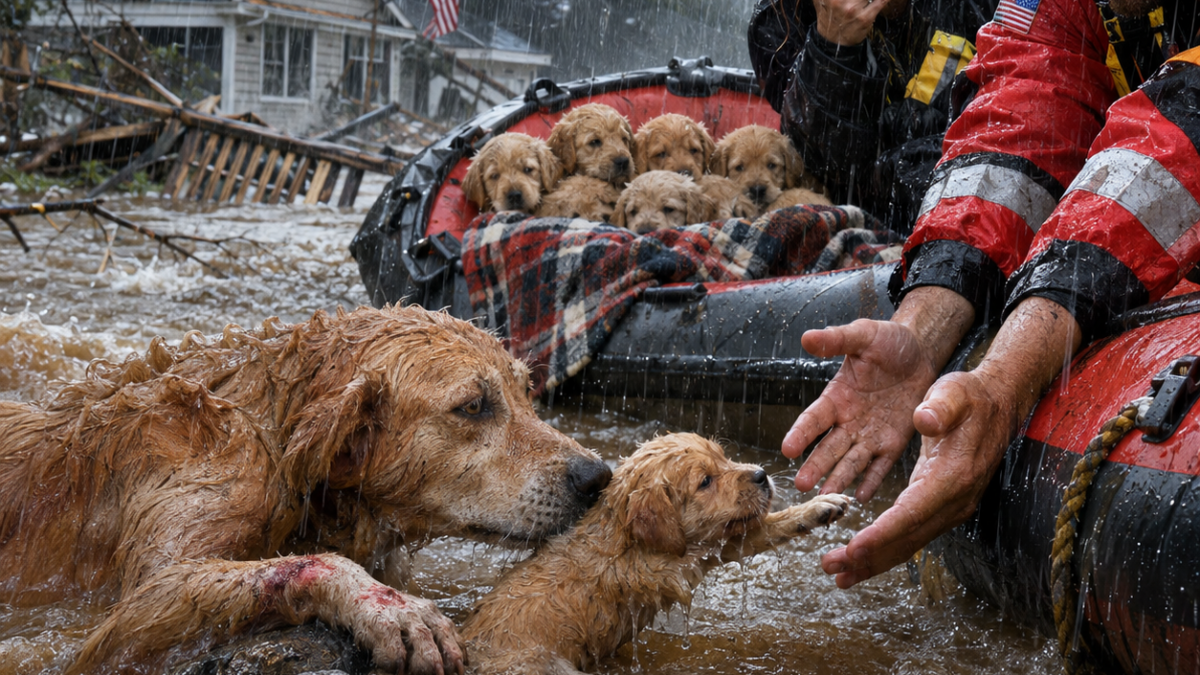
The mother stood between them and the water.
Her ribs showed even beneath soaked fur.
Her legs shook.
Her chest heaved.
She tried to stand taller when our boat approached.
Then nearly fell.
“Easy,” I said, though we were still fifty feet away.
Marcus slowed.
The platform had only a narrow approach.
Fast water on three sides.
Debris passing constantly.
The dog tried to move.
Her front legs buckled.
She hit the concrete.
Immediately she twisted around.
Not to protect herself.
To count.
She touched the first puppy with her nose.
Then another.
Another.
Six.
All there.
She tried to stand again.
Failed.
Ashley whispered:
“Oh my God.”
That was when David noticed the blood.
“Jake.”
I followed his gaze.
The mother’s paws were raw.
Several pads were torn.
Her nails looked ground down.
Not from standing there.
From swimming.
I stared at the current.
Then at the six puppies.
One thought hit all of us at once.
“She brought them here,” Ashley whispered.
Marcus looked at me.
“One at a time?”
I watched the dog check them again.
Six puppies.
Six crossings.
A river strong enough to move tree limbs.
A starving mother.
Already exhausted before the flood.
And somehow she had entered that water over and over until every one of her babies was out.
I stepped toward the side of the boat.
David grabbed my vest.
“Careful.”
“I know.”
“If she panics, she may jump.”
I looked at the mother.
She had no strength left for another crossing.
But her eyes were still awake.
Still watching us.
Still guarding.
Ashley began speaking softly.
“It’s okay, mama.”
The dog’s ears moved.
“We’re here.”
I lowered myself into knee-deep water, one hand gripping the boat.
The current pulled hard against my legs.
I moved toward the platform.
The mother stared at me.
Defensive.
Terrified.
I knelt.
Held out one hand.
“I’m not taking them from you.”
Her eyes never left mine.
“I’m helping.”
For several seconds, nothing happened.
Then she looked down.
Nudged the puppy closest to her.
And pushed it toward me.
Not accidentally.
Deliberately.
A tiny wet body slid across the concrete into my hands.
I froze.
The mother looked at me.
Then at the puppy.
Then back at me.
And in that moment, I understood exactly what she was doing.
She had carried them as far as she could.
Now she was handing them to us.
FULL STORY CONTINUATION
The puppy weighed almost nothing.
That was the first thing I noticed.
Cold.
Wet.
Shivering so hard I felt it through my gloves.
Its eyes were only partly open.
I cupped one hand beneath its chest and the other beneath its hindquarters.
“Got one.”
Ashley leaned from the boat with a thermal blanket.
“Give him to me.”
I passed the puppy carefully.
The mother watched every inch.
Ashley wrapped him immediately.
“Breathing.”
David checked.
“Good.”
I turned back.
The dog had already moved toward another puppy.
Her legs nearly gave out again.
“Don’t stand.”
She ignored me.
Of course she did.
She lowered her head.
Nudged the second puppy.
Forward.
Toward me.
I felt something tighten in my throat.
She was not simply tolerating us.
She was participating.
I picked up the second.
Then the third.
Each time, she watched until the puppy reached Ashley.
Only then did she look for the next.
Four.
Five.
The current surged around my knees.
Marcus shouted:
“Jake, we need to move!”
“I know.”
The platform vibrated slightly as debris struck its support.
The mother heard the impact.
Her head snapped toward the water.
Then immediately toward her puppies.
Five were now in the boat.
One remained.
The smallest.
I knew he was the smallest before touching him.
He lay closest to her body.
Almost hidden beneath her chest.
He did not squirm like the others.
The mother lowered her head.
Licked his face.
Once.
Again.
Nothing.
Her nose pressed against his ribs.
Then she looked at me.
I will remember that look until I die.
Not human.
I won’t pretend it was.
But unmistakable.
Fear.
Exhaustion.
And something worse.
A question.
Can you help this one?
I moved closer.
She did not growl.
Did not block me.
She licked the puppy again.
Then pushed him toward my hand.
His body was colder.
Too still.
I touched his chest.
“Come on.”
There.
A faint movement.
“Alive.”
Ashley leaned forward immediately.
“Give him here.”
I picked him up.
The mother followed my hands with her eyes.
I passed him to Ashley.
She pressed him inside a dry towel against her chest.
“David, heat pack.”
“Got it.”
“Low setting.”
“I know.”
I turned back toward the mother.
All six puppies were off the platform.
Something in her changed.
For the first time since we arrived, she stopped fighting.
Her front legs folded.
Her chest hit the concrete.
Her head lowered.
“Mom!”
I reached her before she slid.
She was conscious.
Barely.
Her breaths came shallow and fast.
I touched her neck.
Pulse.
Weak.
But present.
“Marcus!”
He was already moving.
David jumped into the water beside me.
Between us, we lifted her.
I remember how light she felt.
That shocked me more than anything.
A nursing mother her size should have had weight.
Muscle.
Mass.
She felt hollow.
My fingers passed over ribs.
Hip bones.
Wet fur stretched across a body that had been surviving on almost nothing.
Her paws were worse up close.
Raw pads.
Small cuts.
One nail torn almost completely down.
The river had taken pieces of her every time she entered it.
Still she went back.
Six times.
We lifted her into the boat.
The second her body touched the floor beside her puppies, she tried to raise her head.
Couldn’t.
Tried again.
I moved the smallest puppy closer.
Her nose touched him.
Then another.
I realized what she wanted.
“They’re all here.”
I moved each one within reach.
“One.”
Her nose touched the first.
“Two.”
Second.
“Three.”
Ashley looked at me.
She knew.
“Four.”
“Five.”
“Six.”
The mother’s eyes closed.
Not unconscious.
Relief.
Her body simply stopped holding itself ready for the next emergency.
The battle was finally somebody else’s.
I checked her breathing again.
Weak.
Steady enough.
“Move.”
Marcus hit the throttle.
The boat turned.
The current caught us hard.
I braced one hand against the side and the other against the mother.
The six puppies lay wrapped together.
Tiny bodies pressed close.
Ashley monitored the smallest.
“Still breathing.”
I nodded.
Then looked at the mother.
Her face rested inches from them.
Even unconscious with exhaustion, her nose pointed toward the pile.
That was when I cried.
I wish I could make it sound dignified.
It wasn’t.
Eight years in rescue.
I had watched homes disappear.
Carried children.
Seen families receive news nobody should hear.
I had learned how to compartmentalize.
Finish the call first.
Feel later.
But sitting in that boat with rain striking my face and six puppies alive because a half-starved dog had crossed a flooded river six times, something inside me gave way.
I turned toward the river so the others wouldn’t see.
Ashley saw anyway.
She put one hand briefly on my shoulder.
No one said anything.
The ride to the access point took eleven minutes.
It felt longer.
Every bump made me check the mother.
Every movement from the puppies mattered.
The smallest one finally made a noise.
Barely audible.
A thin squeak.
Ashley laughed through tears.
“There you are.”
The mother’s ear moved.
Even with her eyes closed.
Even nearly unconscious.
She heard him.
Her head shifted an inch.
That almost broke me again.
“She’s still checking.”
Ashley nodded.
“She doesn’t know how to stop.”
The veterinary clinic had been warned.
Dr. Catherine Moreau met us at the door with two technicians.
“Mother first.”
We carried her in on a stretcher.
The puppies followed in heated carriers.
The moment the mother disappeared through the treatment doors, I felt useless.
That is the part rescue workers hate.
In the water, there is always something to do.
Grip.
Lift.
Secure.
Move.
At the clinic, the work belongs to somebody else.
I stood in a hallway dripping river water onto tile.
Marcus took off his helmet.
David sat heavily against the wall.
Ashley hugged herself.
Nobody wanted to leave.
Technically, our unit needed to return.
More calls existed.
More water rising.
But dispatch sent another team to cover our immediate sector after hearing the situation.
Maybe they knew none of us were ready to walk away.
Forty minutes passed.
Then an hour.
I stared through the treatment-room glass whenever anyone opened the door.
Tubes.
Blankets.
People moving.
A technician carrying one puppy.
Then another.
At some point, Marcus handed me coffee from a vending machine.
I forgot to drink it.
Finally, Dr. Moreau came out.
Her expression told me nothing.
I stood.
“How are they?”
“The puppies are alive.”
Ashley covered her mouth.
“All six?”
“All six.”
I closed my eyes.
Dr. Moreau continued.
“They’re dehydrated, chilled, and underweight, but I’m optimistic.”
“The small one?”
“We’re watching him closely. He’s weak. But he responded to warming and fluids.”
Then I asked the question all of us feared.
“The mother?”
Dr. Moreau’s face changed.
“She’s alive.”
My knees almost weakened.
“But she’s exhausted.”
“How bad?”
“Severely dehydrated. Malnourished. Anemic. Multiple foot injuries. She’s lactating while significantly underweight.”
Dr. Moreau paused.
“And there’s more.”
I frowned.
“What?”
She looked back through the glass.
“There are older scars.”
My stomach tightened.
“What kind?”
“Old wounds. Healed injuries.”
She shook her head.
“Some consistent with prolonged neglect.”
Ashley whispered:
“She belonged to someone?”
“Possibly.”
“Microchip?”
“No.”
“Collar?”
“None.”
Dr. Moreau continued.
“Her body condition suggests she’s been surviving alone for months.”
I looked at the door.
“While pregnant.”
“Very likely.”
My chest tightened.
Dr. Moreau nodded.
“She may have been abandoned while pregnant, or shortly before.”
Marcus cursed under his breath.
Dr. Moreau continued quietly.
“This dog has been fighting long before the flood.”
That changed the story.
Until then, I thought we had arrived at the worst day of her life.
Maybe the worst day was only the newest one.
No safe home.
No dependable food.
Pregnant.
Then six newborn puppies.
Shelter somewhere near the river.
Maybe beneath an abandoned structure.
Maybe inside brush.
Feeding herself barely enough to keep producing milk.
Then the rain.
Rising water.
A den flooding.
Six puppies unable to swim.
No human.
No plan.
Just instinct.
Dr. Moreau looked at me.
“She must have moved them one by one.”
“We think so.”
“In that current?”
“Yes.”
The veterinarian shook her head.
“I’ve seen mothers do extraordinary things.”
She looked toward the treatment room.
“But this…”
She stopped.
No word seemed adequate.
We were eventually allowed to see her.
She lay on a padded bed.
IV line.
Blankets.
One paw wrapped.
Eyes closed.
The puppies rested inside a heated enclosure close enough that she could smell them.
The smallest had been placed near the warmer.
I stood outside the glass.
One of the technicians moved a puppy slightly.
The mother’s eyes opened.
Not fully.
Enough.
She lifted her head.
Looked toward the box.
The technician noticed.
“They’re okay, mama.”
Her head lowered.
I whispered:
“She never stops.”
Dr. Moreau stood beside me.
“No.”
Then she said something I never forgot.
“Some mothers survive because they have something to protect.”
I looked at the dog.
“What happens when there’s nothing left to protect?”
Dr. Moreau smiled sadly.
“Sometimes that’s when the body finally allows itself to admit how tired it is.”
We needed a name for the clinic paperwork.
“Unknown female” felt wrong.
Ashley looked at her.
“Hope.”
Marcus raised an eyebrow.
“That fast?”
Ashley shrugged.
“What else?”
I looked through the glass.
A dog abandoned, starved, injured, nearly drowned.
Six puppies alive.
Hope.
It fit.
“Hope,” I said.
Dr. Moreau wrote it down.
I returned to flood duty that afternoon.
I should have been focused.
Mostly, I was.
Rescue work does not stop because one call gets inside you.
We evacuated two elderly residents.
Pulled a stranded driver from a truck.
Moved supplies to a shelter.
But every time the radio became quiet, I saw Hope.
Her nose touching each puppy.
Counting.
Six.
That night, I slept badly.
I dreamed of water.
A brown dog swimming.
Something small in her mouth.
She reached the platform.
Dropped a puppy.
Turned around.
Went back.
Again.
Again.
Again.
On the sixth crossing, she disappeared beneath the current.
I woke at 3:12 a.m.
Sat upright.
My apartment was silent.
I called the clinic.
The overnight technician answered.
“I’m sorry. This is Jake Carter. The rescue dog from the flood.”
“Hope?”
Hearing the name made me feel foolishly grateful.
“Yes.”
“She’s sleeping.”
“And the puppies?”
“All stable.”
I exhaled.
“Thank you.”
The technician paused.
“You were the rescuer?”
“One of them.”
“She wakes whenever a puppy makes noise.”
I smiled in the dark.
“Yeah.”
“We’re keeping them close.”
“Good.”
I ended the call.
Then sat there another ten minutes before going back to sleep.
The next morning, before shift, I stopped at the clinic.
I told myself I was checking professionally.
Dr. Moreau did not believe me.
“You know we would call if something changed.”
“I was nearby.”
She looked toward the parking lot.
“You live twenty minutes the other direction.”
I stared.
She smiled.
“Come on.”
Hope was awake.
That was the first victory.
Her head rested on the blanket.
Eyes open.
The puppies were nursing.
All six.
I stood outside the kennel.
Her eyes found me.
I wasn’t sure she recognized me.
Then her tail moved.
Once.
Barely.
A small sweep against the bedding.
I froze.
Dr. Moreau saw it.
“Well.”
“What?”
“She remembers.”
My throat tightened.
I crouched.
“Hey.”
Hope watched.
“How are you doing?”
Her tail moved again.
I sat there longer than planned.
The days that followed were built from tiny victories.
Hope ate half a bowl.
Then a full bowl.
One puppy gained two ounces.
The smallest began nursing more strongly.
Hope stood without collapsing.
Three steps.
Five.
Her paws healed.
She began drinking normally.
Her eyes changed too.
At first, every door opening made her tense.
Every unfamiliar man made her body stiffen around the puppies.
She never attacked.
Never snapped.
But fear lived just beneath her skin.
I learned to move slowly.
Sit low.
Never reach over her head.
I brought no treats without approval.
No unnecessary touching.
Mostly, I sat.
Sometimes rescue after rescue makes you think action is the only form of help.
Hope taught me otherwise.
Trust often needs stillness.
I visited almost every day.
Ashley came too.
Marcus once.
David brought puppy pads and pretended it was “for operational reasons.”
None of us were fooling anyone.
Hope greeted each differently.
Ashley got a tail wag almost immediately.
Marcus received cautious sniffing.
David needed three visits before she relaxed.
With me, something strange happened.
Whenever I entered, she checked the puppies first.
Then looked at me.
As if confirming the same agreement from the platform.
They’re here.
You’re here.
Fine.
At two weeks, the puppies opened their eyes fully.
Their personalities began emerging.
One climbed everything.
One screamed whenever separated from the others.
One slept through chaos.
The smallest remained cautious but stronger.
Hope watched constantly.
Even asleep, her ears moved.
A puppy squeaked.
Her eyes opened.
Someone picked one up.
She followed.
One wandered too far.
Hope rose and nudged him back.
She had spent months learning that safety could disappear without warning.
Her body did not yet understand that she was allowed to rest.
One afternoon, I sat inside the kennel.
Hope lay several feet away.
The puppies wrestled over a towel.
I was reading messages on my phone when I felt movement.
Hope stood.
Walked toward me.
Slowly.
I put the phone down.
She stopped in front of my knees.
Looked at me.
Then sat.
For several seconds, nothing happened.
I reached one hand slowly toward her chest.
She didn’t move.
Then Hope lowered her head.
Placed it across my lap.
I stopped breathing.
The weight surprised me.
Warm.
Real.
Trust has weight.
I put one hand against her neck.
She closed her eyes.
And I thought of something Ashley had once told me.
A colleague named Sloane from animal control had rescued a dog called Cypress.
Eight years chained to a tree.
When the chain was finally cut, Cypress had not run.
He walked toward Sloane.
Sat at her feet.
Head against her knees.
At the time, I thought the story had probably become sentimental in retelling.
Then Hope rested her head on me.
And I understood.
Not gratitude in the human sense necessarily.
I couldn’t know that.
But trust.
Absolutely.
A creature with every reason to be careful had made a decision.
I am safe here.
That is one of the most valuable things any animal can give you.
I sat perfectly still.
Eventually Dr. Moreau passed the door.
Saw us.
Smiled.
Kept walking.
She knew not to interrupt.
That afternoon, I made a promise.
Not aloud.
Hope had been abandoned.
Pregnant.
Alone.
Had fought for food.
Shelter.
Milk.
Then crossed floodwater six times.
She had done enough surviving.
Whatever happened next, she would not be alone again.
I didn’t yet know what that meant.
Adoption?
Foster?
Fairhaven?
My job schedule was chaotic.
I lived alone.
I had never planned to own a dog.
Especially a traumatized mother with six puppies.
But promises do not always begin as logistics.
Sometimes they begin as certainty.
I would figure out the paperwork later.
The puppies moved to Fairhaven Rescue once medically stable.
Hope went with them.
Fairhaven was quieter than a municipal shelter.
Large indoor runs.
Outdoor space.
Experienced foster volunteers.
The first day we moved them, Hope panicked.
Not violently.
Her whole body simply went rigid when the carrier door closed.
I sat beside it.
“I’m here.”
Her eyes stayed on mine.
The drive took twenty minutes.
She shook nearly the entire way.
When we arrived, she refused to leave the carrier.
One puppy cried.
Hope came out immediately.
That was her weak point.
Not fear for herself.
Fear for them.
She checked all six.
Only then explored the new room.
Four puppies found prospective adoptive families quickly.
That part was wonderful and terrible.
Wonderful because homes waited.
Terrible because Hope had no way to understand future separation.
When families came to meet the pups, she stood nearby.
Watching.
Not aggressive.
Evaluating.
I sometimes joked that she had standards.
The rescue director said:
“She absolutely does.”
One man reached for a puppy too quickly.
Hope stepped between them.
Not growling.
Just present.
The man stopped.
The director coached him.
He sat on the floor.
Waited.
Eventually Hope moved.
Approval.
The smallest two stayed longer.
They needed more time to gain weight.
Hope seemed relieved whenever all six returned to the same enclosure after visits.
She counted.
Still.
Nose.
One.
Two.
Three.
Four.
Five.
Six.
Weeks after the flood.
Still counting.
The first time I saw that, I had to leave the room.
Outside, Ashley found me.
“You okay?”
“Yeah.”
“Lie.”
I stared toward the building.
“She still checks.”
Ashley knew immediately.
“The puppies?”
“Every time.”
She exhaled.
“I wonder if she dreams about losing them.”
I looked at her.
“Don’t say that.”
“Sorry.”
But I had already wondered too.
Hope started waking at night at Fairhaven.
Staff told me.
Not barking.
Just rising.
Checking each puppy.
Then lying back down.
Sometimes she would walk to the door and stare.
The rescue director believed the sound of rain triggered her.
The first heavy storm after the flood confirmed it.
Hope paced.
Panting.
Puppies sleeping.
She nudged each one awake.
Tried to move them toward the back of the kennel.
When I received the call, I drove over.
It was after eleven.
I entered quietly.
Hope saw me.
Still paced.
I sat on the floor.
“Hey.”
Thunder.
Hope flinched.
Looked toward the puppies.
“They’re safe.”
Another thunderclap.
She nudged one pup.
I stayed.
Eventually she came near me.
Still panting.
I placed my hand on the floor.
She pressed her shoulder against my knee.
We stayed like that until the storm weakened.
Around one in the morning, she finally lay down.
Her head touched my foot.
The puppies slept.
No water rose.
No current came.
I realized recovery would involve teaching her that rain did not always mean she had to save everyone.
That would take time.
The first puppy went home at eight weeks.
A little female with white toes.
The family had visited four times.
Mother.
Father.
Teenage daughter.
They did everything right.
Sat on the floor.
Let Hope approach.
Asked questions.
No impulsive promises.
On adoption day, I expected Hope to react badly.
She watched.
The puppy left.
Hope walked to the door.
Waited.
Then returned to the remaining five.
Counted.
Five.
That number looked wrong on her.
I don’t know how else to describe it.
She went back to the door later.
Once.
Then slept beside the others.
The family sent photographs that evening.
Puppy asleep on a child’s bed.
I showed Hope the phone.
Ridiculous, maybe.
She sniffed the screen.
Then looked away.
I told myself that was enough.
The second left two days later.
Then the third.
Then fourth.
Each departure changed Hope.
Not dramatically.
She became quieter.
Checked doors more often.
But she also began directing more attention toward people.
Toward me.
The remaining two puppies slept against her.
She rested her chin on them.
I began considering adoption seriously.
I spoke to Fairhaven.
My supervisor.
My landlord.
Then realized my lease allowed dogs.
No excuse there.
I looked at my schedule.
Impossible.
Then rescue director Dana said:
“Plenty of firefighters own dogs.”
“I’m not a firefighter.”
“Water rescue.”
“Same schedule problem.”
She shrugged.
“People figure things out when they want to.”
I stared.
“That’s manipulative.”
“Yes.”
I visited Hope that afternoon.
She was outside in the yard.
Sunlight.
No flood.
No rain.
Grass beneath her paws.
The two smallest puppies chasing each other nearby.
Hope walked toward me.
Sat.
Head against my thigh.
Decision made.
I filled out the adoption application that evening.
People later told the story as if I rescued Hope and immediately knew she would become mine.
No.
Real decisions are slower.
Responsibility matters.
Love is not enough if you cannot provide a stable home.
I had to arrange help for long shifts.
Emergency contacts.
Vet care.
Training.
A safe yard.
My life changed.
That was part of the promise too.
You do not save an animal only from the thing killing them today.
If you take responsibility, you have to think about tomorrow.
The last two puppies stayed until they were fully strong.
Both eventually found homes.
The smallest went to a retired couple who already had an older gentle dog.
The other went to a family with two teenagers.
On the final adoption day, Hope watched the last puppy leave.
Then walked back into the empty kennel.
No babies.
For the first time since I met her, nobody needed her to count.
She looked around.
Once.
Twice.
Then at me.
I sat on the floor.
She came over.
Head on my lap.
I whispered:
“You’re done.”
Her ears moved.
“No more swimming.”
She closed her eyes.
“No more doing it alone.”
My voice broke.
“You get to come home now.”
Hope came home with me that evening.
I had bought everything incorrectly.
Bed too small.
Bowls too large.
Three toys she ignored.
One cheap rope toy she loved immediately.
I showed her the apartment.
Kitchen.
Living room.
Bedroom.
Back patio.
She followed cautiously.
Then returned to the front door.
Sat.
I worried she wanted to leave.
Instead, she looked at me.
Then at the room.
As if waiting for permission.
“You live here.”
Her tail moved.
“Seriously.”
I pointed toward the bed.
“That’s yours.”
She sniffed it.
Walked away.
That night, she slept on the floor beside my bedroom door.
Of course.
At 2:37 a.m., I woke.
Hope was standing over me.
I nearly had a heart attack.
“What?”
She stared.
Then walked toward the hallway.
I followed.
She checked the living room.
Kitchen.
Front door.
Then returned.
I realized.
Counting.
No puppies.
Her body still expected six small lives somewhere.
She looked at me.
I crouched.
“They’re safe.”
Impossible words for a dog.
Still, I said them.
“All six.”
Hope’s ears moved.
“All safe.”
She leaned against me.
Then returned to the bedroom.
For weeks, rain remained difficult.
If water hit the windows hard, Hope paced.
I developed a routine.
Lights on.
Calm voice.
No forced reassurance.
Sometimes we sat on the porch under cover during lighter rain.
I wanted her to learn water could fall from the sky without becoming an emergency.
Progress came slowly.
The first storm she slept through almost made me cry.
She lifted her head once.
Looked at me.
I was reading.
No panic.
She lay back down.
That was a victory nobody else would understand.
My coworkers loved Hope.
Marcus claimed he didn’t.
Then bought her a collar.
Ashley visited constantly.
David brought treats.
Hope became part of the station on certain days.
Not working.
Just existing.
Everyone knew her story.
Somebody printed a photograph from the rescue boat.
Hope exhausted beside six wrapped puppies.
I hated the picture.
Not because it was bad.
Because she looked so close to disappearing.
We kept it anyway.
Not on the public wall.
In the crew room.
A reminder.
Three months after the flood, all six puppies were thriving.
We received updates.
One learning stairs.
One stealing socks.
One sleeping beside a little girl.
The smallest had gained enough weight that you could no longer identify him in photographs.
I kept every picture.
Sometimes showed Hope.
She sniffed my phone.
Not sure she cared.
I cared enough for both of us.
People asked why she crossed six times.
Instinct.
Maternal drive.
Biology.
All true.
But those words can become too clinical when you have seen the cost.
Each crossing required entering water that could kill her.
Each return required leaving puppies already safe to retrieve one still trapped.
Her body told her to stop.
Her paws tore.
She kept going.
Whether you call it instinct or love, the outcome does not change.
Six lives existed because she refused to stop at five.
That last crossing haunted me most.
Imagine being exhausted beyond reason.
Five puppies already safe.
Most of what you love already out of danger.
One remains.
You could physically justify stopping.
Your body could not be blamed.
Hope went back.
That taught me more than any heroic speech ever had.
One evening on my porch, I looked toward the Coldwater River in the distance.
Hope sat beside me.
No puppies now.
No kennel.
No flood.
Just sunset.
She stared toward the horizon.
I wondered what she remembered.
Do dogs replay trauma?
Do they remember images?
Scent?
Sound?
Maybe the river existed only as a feeling.
I would never know.
Hope leaned against my chair.
I rested a hand on her head.
“You don’t have to remember.”
Her tail moved.
“Just stay.”
Rescue work changed for me afterward.
Not because I became fearless.
The opposite.
I became more aware of what might already have happened before we arrived.
A stranded person may have been fighting for hours.
An animal may have done everything possible.
A family may have spent the night trying before calling.
We often enter a story late.
Uniforms and boats make us look like the beginning of the rescue.
We’re often not.
Hope rescued her puppies first.
We were backup.
That humbled me.
Months later, we responded to another flood.
Nothing like Coldwater.
A smaller creek.
A dog stranded on a shed roof.
We approached.
The owner shouted from shore.
“She’s been up there all night!”
I saw fear in the dog.
And suddenly Hope’s face returned.
I moved slower.
Talked more.
Waited for the dog to come toward us.
Afterward, Ashley said:
“You’ve changed.”
“Better or worse?”
“Slower.”
I laughed.
“Age.”
“No.”
She looked at me.
“Hope.”
I nodded.
Probably.
At Fairhaven, Hope became something like a legend.
New volunteers heard the story.
Some exaggerated it.
Ten crossings.
Eight puppies.
A mile through floodwater.
I corrected them every time.
“Six puppies.”
“Six crossings.”
“How far?”
“We don’t know.”
“But she swam through raging water?”
“Yes.”
Truth does not need inflation.
Six was enough.
One volunteer once asked:
“Did she know she could die?”
I thought about it.
“No idea.”
“But if she did, why go back?”
I looked toward Hope lying nearby.
“Because the puppy was still there.”
Sometimes the answer is that simple.
A year after the flood, Fairhaven held a reunion picnic for the litter.
Five of the six families attended.
The sixth couldn’t travel but sent video.
Hope arrived with me.
I did not know how she would react.
The puppies were grown.
Different smells.
Different homes.
Different names.
One still had white toes.
Another had Hope’s exact eyes.
When they entered the yard, Hope stood.
Her tail stopped.
Her nose lifted.
One young dog approached.
Hope sniffed.
Then another.
Within minutes, chaos.
Running.
Play bows.
Humans crying.
I stood back.
Hope moved among them.
Not frantic.
Not counting.
Just present.
Then she came back to me.
Sat at my feet.
I looked down.
“You good?”
Her tail moved.
Apparently yes.
That night, she slept without checking the house.
Maybe coincidence.
Maybe not.
I like to believe she knew.
All six.
Alive.
Loved.
Mission complete.
Hope changed me in another way I did not expect.
Before her, I measured rescue work in outcomes.
Lives saved.
Calls completed.
Response times.
Success.
Failure.
After Hope, I began noticing transitions.
The moment a frightened person finally lets you touch them.
The moment an animal stops struggling.
The moment someone hands responsibility to you because they can no longer carry it.
That moment on the platform was the purest example.
Hope pushed the first puppy toward my hands.
She surrendered control not because she stopped caring.
Because caring required trust.
That might have been harder for her than swimming.
We romanticize strength too much.
Holding on.
Fighting.
Never stopping.
Hope did all of that.
But the moment that moved me most was when she collapsed after the sixth puppy was safe.
Not weakness.
Permission.
She had held herself together until she no longer had to.
Humans do that too.
Parents.
Rescuers.
Caregivers.
People surviving impossible weeks.
Sometimes the strongest thing is making it to the person who can finally say:
I’ve got it from here.
One night after a difficult call, I came home and sat on the kitchen floor.
We had lost someone.
Not an animal.
A person.
I won’t tell that story here.
It belongs to another family.
But I was tired in the way sleep does not fix.
Hope entered.
Looked at me.
Then sat.
Her head went onto my knees.
Same gesture.
I put both hands around her.
For the first time, I understood why I had said she saved me.
Not because she made the bad calls disappear.
She reminded me of the good ones.
Of the reason we kept showing up.
Some days, rescue is not enough.
Other days, six puppies live.
Both are true.
You need something that helps you carry both.
Hope did.
I once told Dr. Moreau that.
She smiled.
“She gave you perspective.”
“She gave me a dog.”
“That too.”
I asked:
“Do you think she remembers the flood?”
Dr. Moreau shrugged.
“Probably aspects.”
“Does that go away?”
“Trauma responses can improve.”
She looked at Hope.
“She has safety now.”
That phrase stayed with me.
Safety now.
Not erase before.
Build after.
Hope’s paws healed completely.
The scars remained.
If you knew where to look, you could see pale lines where pads had been torn.
Sometimes I touched them while she slept.
Six crossings.
Physical evidence.
She never seemed bothered by the scars.
That may be another thing dogs do better.
They do not need to hate the body that survived.
People online eventually found the rescue story.
Photographs circulated.
Headlines exaggerated.
MOTHER DOG DEFIES DEADLY FLOOD SIX TIMES TO SAVE BABIES
I hated the word defies.
Hope did not defeat the river.
The river was stronger.
She survived it.
That’s different.
Nature doesn’t lose.
Sometimes you simply make it through.
One local station interviewed me.
I almost refused.
Fairhaven wanted adoption visibility for other animals, so I agreed.
The reporter asked:
“Would you call Hope a hero?”
I looked at her lying near my feet.
“Yes.”
“Why?”
“Because she did everything she could before she knew help existed.”
The reporter paused.
That became the quote they used.
For once, they got it right.
Hope’s story brought donations to Fairhaven.
That mattered.
Food.
Medical funds.
Kennel repairs.
People applied to foster.
I liked that more than attention.
One dog’s survival created space for others.
Maybe stories are useful when they do that.
Two years later, Hope began accompanying me to certain educational events.
Not rescue scenes.
Schools.
Community preparedness days.
Kids loved her.
I told the story carefully.
Not graphic.
“Hope had six puppies.”
“Water rose.”
“She moved them somewhere safe.”
A child once raised his hand.
“Did she know how many?”
“Yes.”
“How?”
I smiled.
“Moms know.”
Teachers laughed.
The child nodded as if that solved biology.
Another child asked:
“Why didn’t somebody help her before?”
That question hurt.
“I don’t know.”
“Was she homeless?”
“Yes.”
“Why?”
“I don’t know.”
“Did somebody leave her?”
“Probably.”
The room became quiet.
Then the child said:
“That’s mean.”
“Yes.”
Sometimes children do not need complexity.
Hope loved children.
That surprised me considering her history.
Gentle.
Patient.
She sat while small hands touched her ears.
Never overwhelmed.
If she had scars involving people, she had chosen not to make every new person answer for them.
I thought about that often.
The flood anniversary used to make me anxious.
Weather forecasts.
Heavy rain.
Hope sensed something in me too.
On the first anniversary, a storm rolled through.
Hope paced once.
Then came to my chair.
Lay down.
No panic.
I touched her neck.
“We’re okay.”
This time I was saying it to both of us.
Marcus visited that night.
He brought beer.
Hope greeted him.
He looked toward the rain.
“Remember?”
“Unfortunately.”
He sat.
“She was done.”
I nodded.
“I thought she’d die in the boat.”
“Me too.”
We sat quietly.
Marcus said:
“You cried.”
I stared.
“No.”
“You absolutely cried.”
“Rain.”
“Inside the covered boat?”
“Humidity.”
He laughed.
Hope looked between us.
Then put her head on my leg.
Marcus smiled.
“Yeah.”
He raised his bottle.
“To humidity.”
I laughed.
Years into rescue, cynicism creeps in.
People do careless things.
Ignore warnings.
Abandon animals.
Refuse evacuation until it’s almost too late.
You begin expecting stupidity.
Hope interrupted that.
Not because humans became better.
Because courage appeared somewhere I did not expect.
A starving dog.
No audience.
No training.
No guarantee.
Six times.
When I become cynical, I remember her going back.
There is one question people ask more than any other.
“How did she know which puppy was still missing?”
I don’t know.
Scent.
Memory.
Instinct.
Sound.
Mothers recognize offspring in ways we don’t fully appreciate.
The technical answer is probably some combination.
The emotional answer is simpler.
She knew her babies.
All six.
Sometimes I imagined the first crossing.
Water rising around wherever she had given birth.
Puppies crying.
Hope grabbing one gently.
Entering.
Current pulling.
Reaching the platform.
Leaving the puppy.
Turning back.
That turn is what gets me.
Not reaching safety.
Leaving it.
Going back into danger by choice.
Second.
Third.
Fourth.
Fifth.
By the sixth, her paws already torn.
Body empty.
Still one cry behind her.
She went.
That is the part of the story I can barely think about.
When Hope grew stronger, she became playful.
That shocked everyone.
For months we knew her only as Mother.
Protector.
Survivor.
Then one morning she stole one of my socks.
I chased her through the apartment.
She ran with it hanging from her mouth.
Tail high.
Eyes bright.
I stopped.
Started laughing.
Hope looked at me.
Then ran again.
That may have been the happiest moment of the entire story.
Not rescue.
Not adoption.
A dog finally having enough safety to be ridiculous.
She developed terrible habits.
Counter surfing.
Blanket theft.
Refusing to move from my side of the bed.
Ashley blamed me.
“She has no boundaries.”
“She crossed a flood six times.”
“That is not a lifetime legal defense.”
“It is in my house.”
Hope agreed.
My house changed.
Dog bed.
Hair everywhere.
Toys.
Water bowl.
Vet appointments.
Photos.
A framed picture of all six puppies at the reunion.
The empty place I had never noticed before Hope suddenly seemed obvious.
Maybe that was what I meant when I said she saved me.
I had made my job the center of everything.
Rescue people often do.
You spend all day being needed.
Then come home to silence.
Hope brought ordinary need home.
Dinner.
Walk.
Open the door.
Sit.
Stay.
Nothing heroic.
Perfect.
I began leaving work on time more often.
Not always.
Emergencies still happened.
But if shift ended and someone else could cover, I went home.
Hope waited.
That mattered.
Before her, I thought dedication meant always being available.
After her, I learned you can love the work without letting it consume every part of you.
Sometimes somebody at home needs you too.
One of the puppies, now named Cooper, visited once with his family.
Hope sniffed him.
Cooper bounced around like an idiot.
Hope tolerated him for ten minutes.
Then gave me a look.
I laughed.
“Your child.”
She sighed.
Parenthood.
Years passed.
Hope’s muzzle lightened.
Her pace slowed.
The flood became a story from another life.
But she still checked during storms.
Not six puppies.
Doors.
Windows.
Me.
If thunder woke her, she sometimes walked to my bed.
Touched my hand with her nose.
I would wake.
“Here.”
She would lie back down.
Maybe she was checking the family she had left.
One.
Just one now.
Me.
That realization hit me hard.
At first, I adopted Hope because I promised she would never be alone.
Somewhere along the way, she began making sure I wasn’t either.
When new rescue technicians joined our team, I told them about Hope only when appropriate.
Not as motivation to take foolish risks.
Important distinction.
Love does not cancel safety.
We use equipment.
Training.
Assessment.
No life is helped by creating another victim.
Hope took risks because she had no tools.
We do.
The lesson was not “jump into the water no matter what.”
The lesson was:
Do not quit simply because helping is hard.
Those are different.
I once heard someone describe Hope’s act as “not calculating the risk.”
I used similar words myself.
Later, I changed my mind.
She probably did feel fear.
She probably did know the water was dangerous in whatever way dogs know danger.
Courage is more meaningful when fear exists.
She went anyway.
Not because risk meant nothing.
Because the puppy meant more.
Fairhaven eventually named a small recovery room after her.
HOPE ROOM
Animals recovering from neglect stayed there.
Quiet space.
Warm bedding.
No cages facing heavy traffic.
I attended the dedication.
Hope sat beside the sign.
Someone took a picture.
I laughed.
“She can’t read.”
Dana answered:
“She earned it anyway.”
Fair.
One day Dr. Moreau told me Hope’s bloodwork was perfect.
I asked her to repeat it.
“Perfect.”
“Like normal-dog perfect?”
“Yes.”
I looked at Hope.
Healthy weight.
Shiny coat.
Strong.
The same body I had lifted from the flood feeling almost weightless.
I became emotional.
Dr. Moreau pretended not to notice.
Veterinarians are kind that way.
I kept the old rescue photograph.
Hope soaked.
Collapsed beside six pups.
Then beside it, I placed one from the reunion.
Same dog.
Healthy.
Surrounded by six grown puppies.
Before.
After.
Not to glorify suffering.
To remember recovery.
We often photograph crisis and forget to photograph healing.
That is a mistake.
A reporter once asked me:
“What was the most heroic moment?”
I said:
“The sixth crossing.”
Then changed my answer.
“No.”
She looked confused.
“The moment she pushed the first puppy toward me.”
“Why?”
“Because that’s when she trusted someone else enough to stop doing everything herself.”
That answer surprised me too.
Hope lived a good life after the flood.
That is important.
I don’t want her remembered only as exhausted.
Bleeding paws.
Starving mother.
She became healthy.
Loved.
Annoying.
Funny.
Safe.
The flood was something she survived.
Not her entire identity.
When I tell her story now, I spend less time describing water and more time describing the porch.
Hope beside me.
Sunset.
Her head on my knee.
Because rescue should lead somewhere beyond the rescue.
Otherwise we freeze people and animals forever inside their worst day.
Hope deserved better.
She taught me that motherhood can look fierce.
But also soft.
The same dog who entered floodwater six times later let grown puppies climb over her.
The same body that fought a river eventually slept upside down on my couch.
Strength and gentleness were never opposites in her.
Maybe they aren’t in us either.
One evening, years later, rain began suddenly.
Heavy.
Hope woke from the couch.
I watched.
She stood.
Listened.
Her old pattern.
For a moment, I expected pacing.
Instead, she walked to the window.
Looked outside.
Then turned.
Walked toward me.
Placed her head on my knee.
I stroked her.
“That’s it?”
Her tail moved.
No counting.
No searching.
No panic.
She had learned.
Rain could just be rain.
I cried after she fell asleep.
Quietly.
Not because she was suffering.
Because she wasn’t.
Sometimes healing is only visible when the old fear fails to arrive.
People think the rescue ended when our boat left the platform.
It didn’t.
It continued in the clinic.
Fairhaven.
Storm nights.
Adoptions.
Training.
Home.
Years.
Saving a life is sometimes quick.
Helping it believe it is safe can take much longer.
Hope did both to me too.
Eight years into my career, I had started wondering whether rescue mattered.
Not because lives didn’t matter.
Because constant crisis can make you numb.
Another flood.
Another call.
Another person yelling.
Another report.
You start reducing everything to operations.
Hope destroyed that numbness.
Not gently.
She forced me to feel again.
Six puppies.
Six crossings.
One collapsed mother.
The fact that I cried in the boat embarrassed me then.
Now I am grateful.
Maybe numbness is useful temporarily.
It should never become who you are.
I still work rescue.
Years later.
Different equipment.
More experience.
More gray hair than I want.
Every time I enter water, I check my harness.
Current.
Exit.
Team.
Risk.
Then somewhere behind all that training is Hope.
Not telling me to be reckless.
Telling me why preparation matters.
Someone may already have done everything possible before I arrive.
Now it is my turn.
That became the sentence I use with new rescuers.
Now it’s our turn.
The family climbed to the roof.
Now it’s our turn.
The dog found higher ground.
Now it’s our turn.
A mother carried six puppies.
Now it’s our turn.
We do not arrive as heroes.
We arrive as the next hands.
That mindset keeps ego out of rescue.
Ego is dangerous in water.
Years later, Ashley reminded me of something I had forgotten.
On the boat after we lifted Hope, I kept counting the puppies aloud.
Six.
Again.
Again.
She said:
“You sounded exactly like Hope.”
I laughed.
“Did I?”
“Yes.”
Maybe counting had become contagious.
Or maybe once someone hands you six lives, you become part of the counting too.
The smallest puppy eventually became the largest adult.
His family sent a photograph.
Huge.
Healthy.
Tongue out.
I stared at it.
“That was him?”
Hope sniffed the photo.
I laughed.
“You almost killed your mother, you tiny liar.”
Of course he had done nothing.
But humor is how rescue people survive tenderness.
The families stayed loosely connected through Fairhaven.
Birthdays.
Photos.
Updates.
Hope became the center of a strange extended family.
Every year around the flood anniversary, someone sent a collage.
Six dogs.
Six homes.
One mother.
Proof multiplied.
If Hope had stopped after five crossings, five puppies might have lived.
That would still have been extraordinary.
But she didn’t.
That thought shaped me.
We rarely know which final effort becomes the difference between “almost everyone” and “everyone.”
In rescue, that matters.
Check again.
Search one more room.
Count again.
Hope taught me to count to six.
Of course, humans need limits.
We are not required to destroy ourselves trying forever.
Hope nearly did.
I would never romanticize that part.
She should never have been abandoned.
She should never have had to fight alone.
Her heroism exists beside a failure.
Somebody failed her before we met.
Society failed to see her.
The environment turned dangerous.
Calling her brave should never excuse what put her in danger.
That matters too.
I think often about whoever left her.
I used to feel anger.
Still do.
But the story became less about them over time.
Whoever abandoned Hope does not deserve the center of her life.
Hope does.
Her puppies do.
The people who helped afterward do.
The family she built.
Do not give villains more narrative space than they earned.
Hope’s old scars remained.
Dr. Moreau could not tell me exactly what caused them.
That was fine.
I stopped needing to know.
Trauma does not owe us a full explanation before we offer safety.
One winter evening, Hope lay beside the fireplace.
Gray around her muzzle now.
I sat nearby.
She opened her eyes.
Looked at me.
Then closed them.
Complete trust.
I thought about the first day.
Her body positioned over six puppies.
Eyes watching every movement.
Defensive.
Ready.
Now she slept while I moved through the room.
That was the real ending.
Not adoption papers.
Sleep.
Animals only sleep deeply where they feel safe.
The first time Hope snored loudly, I recorded it.
Sent it to Ashley.
Heroic flood dog.
Ashley replied:
Terrifying.
I smiled for ten minutes.
Sometimes I visited Coldwater.
Not often.
The maintenance platform was repaired.
Water usually calm.
Hard to believe.
I stood at the bank once with Hope on leash.
She looked toward the river.
No obvious reaction.
I wondered whether bringing her was a mistake.
Then she sniffed grass.
Found something interesting.
Moved on.
Maybe she did not remember.
Maybe she remembered and chose grass.
Both were acceptable.
I did not force meaning onto her.
We left after five minutes.
On the drive home, Hope slept in the passenger footwell.
I realized I had wanted some cinematic reaction.
Recognition.
Closure.
Dogs do not owe us closure either.
She had already given enough.
At community events, people sometimes recognized her.
“Is that the flood dog?”
I always said:
“Her name is Hope.”
That mattered.
She was not a disaster.
She had a name.
One child once asked to hug her.
I said to let Hope decide.
The child sat on the ground.
Waited.
Hope approached.
Sat beside him.
The boy carefully touched her shoulder.
“She’s warm.”
I smiled.
“Yes.”
Such a simple observation.
Warm.
Alive.
Safe.
Everything we had fought for.
When Hope began getting older, I became afraid.
Not immediately.
Small signs.
Slower stairs.
Longer naps.
I hated them.
I had spent years teaching her rain did not always mean loss.
Now age taught me safety does not mean permanence.
That is harder.
Dr. Moreau noticed my anxiety.
“You know what you gave her.”
I shook my head.
“Don’t.”
“I’m not saying anything is imminent.”
“Good.”
She smiled.
“But Jake, don’t spend her healthy years mourning future ones.”
That was excellent advice.
Hard to follow.
I tried.
So we took longer porch afternoons.
Shorter walks.
More ridiculous treats.
Hope slept.
I worked less overtime.
Maybe she saved me twice.
First from believing my work meant nothing.
Then from letting work take everything else.
If you ask me what she taught me about love, I would no longer say love does not calculate.
That sounds beautiful.
Maybe too simple.
Love does calculate sometimes.
It notices risk.
Fear.
Cost.
Exhaustion.
Then chooses.
Hope’s body knew the river hurt.
Her paws proved it.
She went back because one puppy remained.
Love can know the price and still decide someone is worth paying it.
That is even more powerful.
If you ask what she taught me about strength, I would say:
Strength is not never collapsing.
Hope collapsed.
Strength is reaching the place where collapse becomes safe.
She did.
In our boat.
Beside her puppies.
That was victory.
If you ask what she taught me about trust:
A mother who had survived alone pushed her baby into my hands.
Enough said.
If you ask what she taught me about rescue:
We often arrive after someone else has already been heroic.
Respect that.
And if you ask why I adopted her:
Because after watching a living creature fight that hard not to lose her family, I could not become another person who walked away.
Simple.
Years after the flood, I once woke in the middle of the night.
No storm.
No emergency.
Hope stood near my bed.
Older.
Quiet.
I reached down.
She touched my hand.
Then walked to her bed.
I lay awake thinking about the first night she lived with me.
How she searched for puppies.
How she couldn’t understand there was no one left to rescue.
Now she had simply checked me.
One.
Here.
Safe.
Her family had changed.
The instinct hadn’t.
I smiled in the dark.
“Good night, Hope.”
Her tail tapped once against the floor.
That was enough.
People often ask which rescue changed me most.
I have answered differently over the years.
Some calls were technically harder.
More dangerous.
More lives.
But Hope remains the one I return to.
Because she changed the order of the story.
I thought rescuers arrived to save.
She showed me sometimes we arrive after the saving has already begun.
That day on the Coldwater River, I climbed out of a boat believing I was approaching a helpless dog.
She was anything but helpless.
Exhausted?
Yes.
Injured?
Yes.
In need of rescue?
Absolutely.
But helpless?
No.
She had moved six lives from danger to safety with the only tools she had.
Teeth.
Legs.
Instinct.
Love.
By the time I reached her, she had already done more than most could imagine.
She didn’t need a hero.
She needed relief.
There is dignity in understanding the difference.
When she pushed that first puppy toward me, she transferred responsibility.
Not helplessly.
Deliberately.
My turn is over.
Yours begins.
I have carried that message into every rescue since.
The river did not care.
Floodwater never does.
It moves.
Pulls.
Takes.
Hope cared enough for both.
Six crossings.
Six puppies.
One mother.
One boat arriving just before she had nothing left.
Timing is terrifying when you think about it.
Ten minutes later?
An hour?
I don’t know.
I try not to.
We arrived when we arrived.
She lasted until then.
That is the only version I can live with.
At the clinic, Dr. Moreau once said:
“Today she won.”
I used to think she meant the flood.
Now I think Hope’s real victory came later.
Eating without fear.
Sleeping through rain.
Letting people touch her.
Watching her puppies leave for homes without losing herself.
Learning play.
Becoming somebody other than a mother in crisis.
Survival is the beginning.
Living afterward is the victory.
Hope lived afterward.
Fully.
That is what I want remembered.
Not just the river.
The porch.
The stolen socks.
The snoring.
The ridiculous rope toy.
The children.
The reunion.
The storms she eventually slept through.
The way she rested her head on my knees.
Her tail moving when I came home.
A dog who spent months doing everything alone eventually learned that somebody else would come back too.
And I did.
Every shift I could.
Every night.
Home.
If Hope could speak, I doubt she would call herself brave.
She would probably ask for dinner.
That is another reason I loved her.
Animals do extraordinary things without building identities around them.
Maybe humans should try that occasionally.
The story of Hope became something we told at Fairhaven.
Not to make people cry.
Though they did.
To remind adopters that an animal’s behavior has history.
The dog afraid of rain may have a reason.
The dog guarding food may have known hunger.
The mother pacing at night may once have lost safety.
Patience matters.
Context matters.
Trust can be rebuilt.
Hope became proof.
Not that every trauma disappears.
That life can become larger than trauma.
Years later, someone asked me whether I believed meeting Hope was fate.
I usually dislike that word.
Rescue requires systems.
Dispatch.
Training.
Equipment.
People.
Calling everything fate erases the work.
But sometimes I look at Hope beside me and wonder.
A dog abandoned months earlier.
A flood.
A radio call.
Our boat available.
That platform.
Those six puppies.
My hands.
Her trust.
Then years together.
Fate?
Maybe.
Or maybe life simply creates intersections and we decide what they become.
I chose to keep showing up.
Hope had already made that choice six times.
The last lesson she gave me came gradually.
I used to believe love meant never leaving someone behind.
Hope taught me that too.
But later she taught me another version.
Love also means knowing when your job is finished.
She had to let puppies go.
One.
Then another.
Then another.
Homes.
Families.
She could not protect them forever.
At first she checked doors.
Then gradually stopped.
Motherhood changed shape.
That was growth.
Maybe rescue is similar.
You save.
Stabilize.
Transfer care.
Let go.
Trust somebody else to continue.
We are not meant to personally carry every life forever.
Except sometimes one stays.
Hope stayed.
The day she became officially mine, Dana handed me the paperwork.
“Congratulations.”
I looked down.
ADOPTED: HOPE
Simple.
A signature.
Date.
Legal transfer.
I laughed.
“What?”
“Feels too easy.”
Dana smiled.
“After everything?”
“Yeah.”
I signed.
Hope sat beside me.
Dana said:
“She already decided.”
I looked down.
Hope’s head rested against my leg.
Probably true.
When we left Fairhaven, Hope did not look back.
I did.
The rescue building.
The room where puppies had grown.
The yard.
The volunteers.
Everything between the river and home.
Then I looked forward.
Hope was in the passenger seat.
Sleeping.
I whispered:
“Your turn is done.”
She didn’t wake.
“Mine now.”
That promise remains the center of the story.
Not that Hope would never experience pain again.
No one can promise that.
Not that I could erase what happened.
Impossible.
The promise was simpler.
She would not face the next thing alone.
On difficult rescue days, I come home.
Hope used to meet me at the door.
Then, as she aged, from her bed.
Tail.
Eyes.
Enough.
I would sit beside her.
Sometimes tell her about the call.
Ridiculous.
She understood none of the words.
But she knew tone.
Presence.
And maybe that was all I needed.
One night I told her:
“We lost one today.”
Hope put her head on my knee.
I cried.
No heroism.
No lesson.
Just grief.
After a while, I remembered the six.
Both truths.
Loss.
Life.
Rescue requires carrying both.
Hope never fixed me.
I dislike stories that make animals magical therapists.
She was a dog.
She needed care.
Training.
Food.
Vet appointments.
She stole socks.
But loving her forced me to remain connected to the part of myself rescue work sometimes numbed.
That was enough.
I once saved others for a living.
Hope taught me to let something save parts of me too.
That is different from weakness.
The Coldwater River still floods some years.
Every warning brings back memories.
But now when I hear the forecast, I don’t picture only disaster.
I picture six adult dogs in six homes.
One old brown mother asleep safely.
Consequences can travel farther than catastrophe.
That is why I keep doing this work.
Not because every call ends like Hope’s.
They don’t.
Not because love always wins.
It doesn’t.
But because sometimes someone has already done everything they can.
Sometimes a mother has crossed the river six times.
Sometimes a family has climbed as high as possible.
Sometimes an animal has held on until there is nothing left.
Then our boat arrives.
Our hands arrive.
Our turn begins.
Hope taught me that.
She taught all of us.
Marcus.
Ashley.
David.
Dr. Moreau.
Fairhaven.
Every family that adopted one of her puppies.
Six households exist differently because one exhausted mother refused to stop.
That is a legacy.
I still have the rope toy she loved first.
Destroyed.
Frayed.
Useless.
I should throw it away.
I won’t.
Some objects are allowed to become evidence of ordinary happiness.
If all anyone remembers is that Hope crossed a flood six times, the story is incomplete.
Remember what came after.
She trusted.
She ate.
She slept.
She healed.
She raised her puppies.
She let them go.
She learned rain could be harmless.
She found home.
She played.
She grew old.
She was loved.
That is the real victory.
The mother I first saw on that platform looked like she had spent every drop of herself.
Years later, I watched that same dog snoring in sunlight without a single living thing depending on her.
Nothing to save.
Nothing to count.
Nothing to fear.
Just warmth.
That image means more to me than the flood.
Because the goal of rescue is not to create survivors.
It is to give survivors the chance to become ordinary again.
Hope became ordinary.
Beautifully ordinary.
On the worst day of her life, she was extraordinary because she had to be.
Afterward, she got to be a dog.
That is what we saved.
Not only her heartbeat.
Her future.
And she saved something in me too.
The belief that showing up still matters.
The belief that one more attempt can matter.
The belief that exhaustion does not erase meaning.
The belief that people—and animals—can trust again after being abandoned.
I once thought the lesson was:
Love doesn’t count the cost.
Now I know better.
Love can feel every cost.
Every torn paw.
Every exhausted breath.
Every frightening current.
And still say:
One more is waiting.
Then turn back.
Hope turned back six times.
We only had to go once.
I never forgot that.
Years later, when young rescuers ask what courage looks like, I don’t tell them about myself.
I tell them about a brown mother dog.
Underweight.
Bloody paws.
Six newborn puppies.
A flooded river.
I tell them she reached safety five times and still returned because one baby remained.
Then I tell them the part that matters most.
When she had nothing left, she trusted us enough to stop.
That is courage too.
Going back when you must.
Letting someone else carry the weight when you no longer can.
The day we rescued Hope, I thought I was climbing from a boat to save a helpless animal.
I was wrong.
I was meeting someone who had already done the impossible.
All she needed from me was to finish the last few feet.
She pushed the first puppy toward my hands.
I took him.
Then another.
Then another.
Until six tiny bodies were wrapped in blankets.
Then she collapsed.
I can still feel her weight in my arms.
Too light.
Still breathing.
Finally safe.
If I close my eyes, I hear the river.
Marcus yelling.
Ashley counting breaths.
The smallest puppy squeaking.
Hope’s exhausted exhale.
Then the boat turning toward shore.
I remember crying.
Not from sadness exactly.
Not joy either.
A mixture.
Awe, maybe.
The overwhelming realization that something had loved hard enough to nearly spend itself completely.
Today, when Hope wakes from a nap and puts her head on my knee, I sometimes think about that first look she gave me.
Take him.
The smallest puppy.
The final one.
All her strength gone.
Trusting hands she had never seen before.
I did not understand then that the gesture would change the next years of my life.
I do now.
Hope had spent months alone.
Pregnant.
Hungry.
Abandoned.
She gave birth without help.
Raised six puppies.
Then fought a flood.
By the time we came, there should have been nothing left inside her.
Yet there was enough for one more thing.
Trust.
That may be the bravest thing she ever did.
She trusted us with her children.
Later, she trusted me with herself.
I spent every year afterward trying to deserve both.
Sometimes, on the porch, she still looks toward the direction of Coldwater.
Maybe memory.
Maybe a bird.
Maybe nothing.
I no longer ask.
I sit beside her.
Her shoulder against my leg.
Sunset.
Safe home behind us.
No river rising.
No puppies crying.
No abandonment.
Just now.
That is where I want the story to end.
Not in floodwater.
On the porch.
Hope beside me.
Her six puppies grown and loved elsewhere.
Her head heavy on my knee.
The woman—no, the dog—who once had to save everyone finally allowed to rest while somebody else kept watch.
I’m Jake Carter.
I have spent years being called a rescuer.
But on the day I met Hope, I learned the word can move in both directions.
I pulled her from the flood.
She pulled me out of something quieter.
A growing belief that the work had become routine.
That one more call would not matter.
That maybe caring too much only made the difficult endings harder.
Hope destroyed that belief.
Because six puppies lived.
Because she lived.
Because years later, six families still had dogs who existed only because she kept going.
Because my house became a home I had not known I needed.
Hope taught me that love does not always look gentle.
Sometimes it looks like teeth gripping the loose skin of a newborn puppy while brown water crashes against your chest.
Sometimes it looks like torn paws finding the bottom one more time.
Sometimes it looks like leaving safety because someone you love has not reached it yet.
And sometimes, after the battle is over, love looks like finally lowering your head onto someone’s knees and allowing yourself to sleep.
That second kind took Hope longer to learn.
Maybe it takes all of us longer.
If you ever reach the point where you feel you have done everything you can, I will not tell you to destroy yourself trying one more time.
That is not the lesson.
The lesson is to look around.
Maybe somebody else has arrived.
Maybe there are hands reaching.
Maybe your part is no longer to swim.
Maybe your part is to trust.
Hope did both.
She fought.
Then she surrendered the fight to us.
That is why she lived.
On that flooded afternoon, she pushed the sixth puppy toward me.
I took him.
She checked.
One.
Two.
Three.
Four.
Five.
Six.
Then, and only then, she fell.
I caught her.
And I remember whispering something into her wet fur.
I didn’t think anyone heard me.
Maybe no one did.
I said:
“You’re done, mama.”
Her body went limp against my arms.
Not dead.
Safe.
For the first time in months, maybe longer, she no longer had to hold the whole world together.
Years later, when Hope lies beside me while rain taps harmlessly on the roof, I sometimes say the same words.
“You’re done.”
Her tail moves.
No river.
No emergency.
No one left to save.
Then I add the part she could not have known that day.
“You did enough.”
And every time I say it, I think maybe all of us need someone to tell us that once in a while.
Hope crossed the water six times.
We came on the seventh journey.
Not into danger.
Out of it.
Together.
And she never had to cross that river alone again.








