FULL STORY:For Five Weeks, the Old Shelter Dog Waited for the Man Who Promised to Come Back—At 2 A.M., He Finally Realized I Was Staying
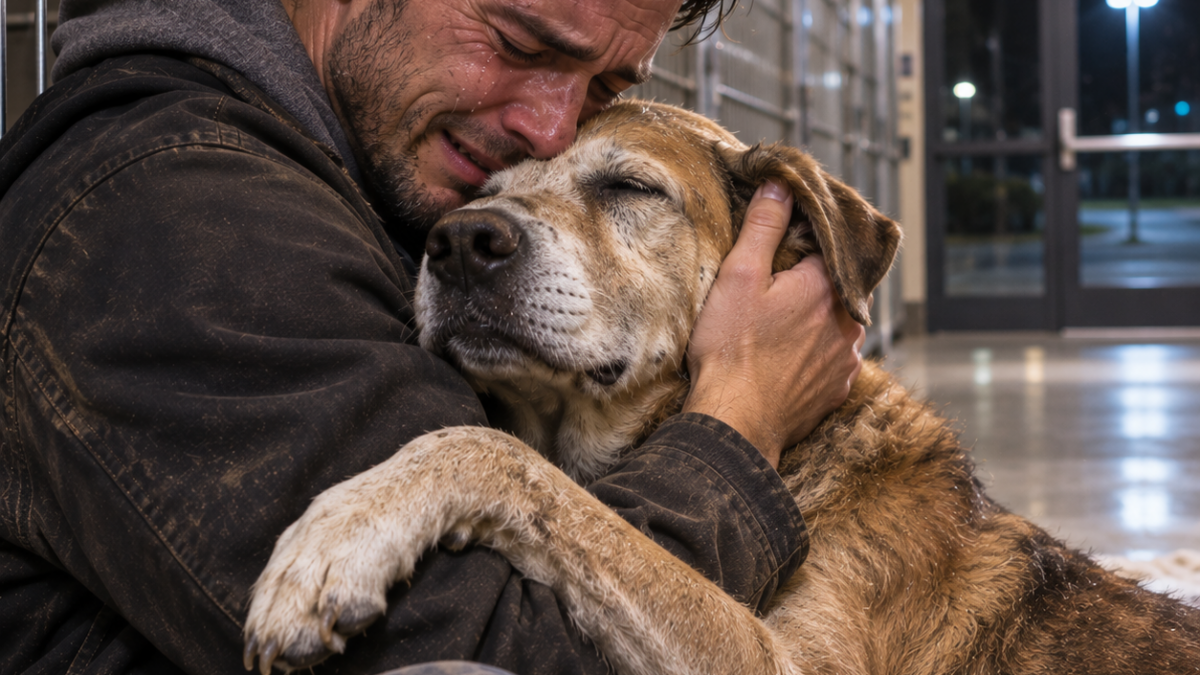
FULL STORY CONTINUATION
The drive home lasted twenty-three minutes.
It felt longer.
Benny sat in the back seat.
No pacing.
No whining.
No excited nose against the glass.
He simply sat.
Every now and then, when I spoke, his eyes lifted toward the rearview mirror.
So I kept talking.
I told him about the apartment.
“It’s small.”
His ears moved.
“Second floor.”
No reaction.
“There’s an elevator, so your hips won’t have to deal with stairs every day.”
He blinked.
“I make terrible grilled cheese.”
His head lowered.
“I forget it on the stove.”
Nothing.
“My smoke detector and I have a complicated relationship.”
One ear twitched.
I laughed nervously.
“That may be the first joke I’ve told anyone all week.”
Benny watched me.
The silence in the car felt less empty when I filled it with words.
So I told him things I had not intended to tell a dog I had known for less than an hour.
That I hated Sunday evenings.
That I sometimes left the television on after going to bed because the sound from the living room made the apartment feel occupied.
That I drank too much coffee.
That I had once gone nearly two days without speaking aloud and only realized it when my own voice sounded strange answering a delivery driver.
I stopped at a red light.
Looked at him in the mirror.
“You’re getting a very quiet life.”
Benny’s eyes closed.
Then opened again.
He looked exhausted.
I softened my voice.
“Sorry in advance.”
He lowered his head onto the seat.
Ten minutes later, he was asleep.
Or almost.
Every time I changed lanes, his head came up.
Every time we slowed, his eyes opened.
As though he could not quite allow himself to believe the journey had a destination.
When we reached my apartment building, Benny stood beside the car and stared at the entrance.
I gave him time.
“No rush.”
He took one step.
Then another.
The automatic door opened.
He flinched.
I stopped.
“Okay.”
It closed.
We tried again.
This time I walked through first.
Benny followed.
The elevator was worse.
Small enclosed box.
Metal doors.
He planted all four paws.
“No?”
He looked at me.
I looked at the stairs.
Second floor.
Old hips.
“Elevator.”
He disagreed.
We negotiated for seven minutes.
A woman carrying groceries waited patiently.
Eventually she said:
“He’s beautiful.”
I almost corrected her.
Old.
Thin.
Tired.
Then I looked again.
She was right.
“He is.”
That seemed important.
Not:
He was.
Not:
He will be when he’s healthier.
He is.
I stepped into the elevator.
Benny followed.
His shoulder pressed hard against my leg until the doors opened.
Then he walked out as if he had survived combat.
“Very brave.”
He ignored me.
Inside the apartment, I unclipped the leash.
Benny did not move.
He stood just inside the front door.
I waited.
Eventually his nose lowered.
He inspected the entry rug.
The wall.
A pair of shoes.
Then the living room.
Every movement careful.
Measured.
He sniffed the sofa.
Coffee table.
Bookshelf.
Kitchen.
He walked down the hall.
Looked into the bedroom.
Bathroom.
Returned.
Then disappeared behind the couch.
I stared.
“Okay.”
He lay there.
Not completely hidden.
His head visible if I knelt.
I had purchased a dog bed on the way to the shelter earlier that day.
Optimistic.
Maybe irresponsible.
Large orthopedic bed.
Dark gray.
I placed it near the sofa.
Benny looked at it.
Then looked away.
I filled a bowl with water.
Another with the food the shelter had sent.
He did not move.
“Dinner?”
Nothing.
I sat on the floor.
He watched.
“I’m not going to drag you out.”
Still nothing.
“Good talk.”
I stood.
Made my own dinner.
Pasta.
No broccoli.
Too tired.
As I cooked, I kept glancing toward the couch.
Benny remained there.
When I ate, he still hadn’t touched his food.
I moved the bowl closer.
He turned his head away.
The shelter had warned me.
Stress.
Transition.
Old dogs sometimes stop eating after major changes.
Still, anxiety rose.
What if I had made a mistake?
What if Benny wanted the shelter because the shelter was the last place connected to his owner?
What if my apartment was just another strange stop?
What if I had mistaken resignation for affection?
What if he had put his head on my shoe because he was tired, not because he chose me?
I hated how quickly my mind could manufacture catastrophe.
Maybe that was why I lived alone.
Fewer variables.
Fewer attachments.
Fewer opportunities for somebody else to leave.
I looked behind the couch.
Benny’s eyes were open.
Watching me.
“I don’t know what I’m doing either.”
His nose shifted against his paw.
“Maybe that’s fair.”
At ten, I turned off most of the lights.
Benny had still not eaten.
He drank once.
Good.
I moved his bed near the bedroom doorway.
Maybe he wanted to see me.
No.
Behind the couch.
I left both doors open.
“Good night.”
The phrase sounded ridiculous.
Then strangely important.
I had said “good night” to television characters for years as a joke.
Now there was an actual living creature in the apartment.
“Good night, Benny.”
His eyes followed me.
I woke a little after two.
Not sure why.
Maybe a sound.
Maybe the lack of one.
The bedroom was dark except for streetlight coming through the blinds.
Something sat beside the bed.
My heart jumped.
Then I saw the ears.
“Benny?”
He didn’t move.
He was sitting inches from the mattress.
Perfectly silent.
Head level.
Eyes wide.
Watching me.
Not asking to climb up.
Not whining.
Just watching.
At first I thought he needed to go outside.
I reached for the lamp.
He flinched when it came on.
“Sorry.”
His eyes stayed on me.
“Bathroom?”
Nothing.
“Water?”
Nothing.
Then I noticed the way he was sitting.
Rigid.
As if he had been there awhile.
And something inside me understood.
He was checking.
I thought of Melissa.
Five weeks.
Door.
Footsteps.
Waiting.
Owner promised to return.
Didn’t.
Benny had fallen asleep in a strange apartment with another stranger.
And sometime after two in the morning, he had woken.
Walked down the hall.
Come to my bed.
To see whether I was still there.
My chest tightened so sharply I had to swallow.
“Oh.”
Benny blinked.
I moved slowly to the edge of the mattress.
“Hey, buddy.”
He stayed.
“I’m here.”
His ears shifted.
“I’m not going anywhere.”
The words left my mouth before I considered whether I had any right to promise them.
But in that moment I meant:
Not tonight.
Not while you sleep.
Not without coming back.
Benny stared.
Then took one step closer.
I lowered my hand.
He sniffed my fingers.
I touched his forehead.
His eyes closed for half a second.
Then opened again.
Still checking.
I pulled back the blanket.
“Do you want up?”
He looked at the mattress.
Then me.
Old hips.
High bed.
I patted the edge.
Benny lifted his front paws.
His back legs trembled.
He tried.
Slipped.
I caught him around the chest.
“Easy.”
He tried again.
This time I helped.
Sixty-something pounds of stiff old dog climbed awkwardly onto my bed.
He stood there unsure what to do.
Turned once.
Twice.
Then slowly lowered himself.
Not at the foot.
Against my chest.
His head beneath my chin.
His side pressed against me.
He released a breath so deep I felt it through both of us.
Not the exhausted sigh from the shelter.
Different.
Longer.
Softer.
A body letting go.
I put one arm around him.
“Okay.”
My voice cracked.
“You can stay.”
That was when I started crying.
I had cried alone before.
Quiet tears.
Controlled.
This was different.
I buried my face in the fur behind Benny’s ear and cried hard enough that my chest shook.
Not because I had rescued him.
That idea seemed ridiculous.
Because a dog who had every reason to believe people disappear had walked into a dark room and taken one more chance.
On me.
I did not feel worthy.
Maybe worthiness was not the point.
Maybe he simply needed somebody to be there.
So did I.
The next morning, I woke with one numb arm and a dog taking up approximately seventy percent of the mattress.
I smiled before remembering to be embarrassed about it.
Benny was still asleep.
Deeply.
Mouth slightly open.
One paw twitching.
I stayed still.
For years, mornings had begun with coffee before anything else.
That morning I lay there for twenty minutes because I did not want to wake him.
When his eyes finally opened, they went immediately to my face.
I whispered:
“Still here.”
His tail tapped the blanket.
Once.
That was all.
Enough.
Breakfast was another battle.
Benny refused his bowl.
I warmed the food slightly.
Nothing.
Added the broth the shelter recommended.
Nothing.
I sat on the kitchen floor.
“Please eat.”
His eyes went toward the food.
Then away.
I picked up a spoon.
Held out a small amount.
Benny sniffed.
Turned away.
“Fine.”
I waited.
Another offer.
Nothing.
We sat there for almost thirty minutes.
Eventually he took one bite.
Then stopped.
I did not celebrate.
Did not want to startle him.
“Good.”
Another spoon.
He ate.
Then another.
By the time the bowl was half empty, my legs had gone numb from sitting on tile.
Worth it.
The first week developed its own strange rhythm.
Benny woke around two every morning.
Not always exactly.
1:47.
2:13.
2:05.
He would walk beside the bed.
Sit.
Watch.
The first two nights, I helped him up.
Third night, I put a low bench beside the mattress as a step.
He learned quickly.
Eventually he stopped sitting on the floor.
He climbed directly onto the bed.
But even after reaching it, he would stand near my face until my eyes opened.
I would say:
“I’m here.”
Only then would he lie down.
It hurt.
And healed something I had not known was damaged.
Eating remained difficult.
If I placed the bowl and walked away, Benny often ignored it.
If I sat beside him, he ate.
So I sat.
Every meal.
Morning.
Evening.
I talked.
Anything.
Weather.
News.
Grocery prices.
My work.
I discovered that Benny preferred warmed food.
Cold from the refrigerator?
Insulting.
Warm?
Acceptable.
He liked chicken.
Hated carrots.
Loved cheese far too much for a dog his age.
I learned to scratch behind his left ear.
The right seemed slightly sensitive.
He liked slow walks.
Not distance.
Just time.
Every smell deserved investigation.
Tree.
Lamp post.
Trash can.
Another tree.
The first few walks took fifteen minutes to cover half a block.
I had nowhere better to be.
That was new.
His hips hurt after too much walking.
The shelter veterinarian had noted arthritis.
I made an appointment with my own veterinarian.
Bought rugs because my hardwood floors were slippery.
Benny had difficulty standing from them.
I bought another orthopedic bed for the bedroom.
He ignored it.
Of course.
The sofa became his daytime bed.
My mattress his nighttime property.
The expensive dog beds existed mostly as décor.
On the third day, I went grocery shopping.
Forty-three minutes.
I timed it accidentally because I felt guilty leaving him.
Before going, I knelt.
“I’m coming back.”
Benny watched.
“I swear.”
I left.
The entire drive, I imagined him at the door.
Waiting.
Maybe panicking.
I rushed through the store.
Forgot coffee.
Forgot eggs.
Bought dog treats.
Priorities had changed alarmingly fast.
When I returned, I unlocked the apartment.
Benny stood in the entryway.
Not behind the couch.
At the door.
I froze.
His tail moved.
Slow.
Tentative.
Left.
Right.
Then again.
Like the tail itself wasn’t sure whether celebration was safe.
I dropped the grocery bag.
“Oh.”
Benny took one step.
Tail faster.
I sat on the floor.
He came toward me.
I put both arms around his neck.
“You knew.”
He licked my hand.
One lick.
I stopped.
He licked again.
I laughed.
Then cried.
Apparently Benny was turning me into someone emotionally unstable.
I called Melissa at the shelter.
“I need to tell you something.”
Her voice immediately changed.
“Is he okay?”
“Yes.”
“He ate?”
“Some.”
“What happened?”
“He licked me.”
Silence.
Then:
“What?”
“He licked my hand.”
Melissa became quiet.
“He never did that here.”
“Really?”
“Not once.”
I looked at Benny.
He had moved to inspect the grocery bag.
Probably cheese.
Melissa whispered:
“He’s choosing you.”
That sentence stayed with me.
I had always thought being chosen was something romantic.
Dramatic.
Two people across a room.
Friendship.
Marriage.
Family.
But there I was sitting on a kitchen floor while an old dog searched a bag for contraband cheese, and I felt chosen in a way I had not felt for years.
Maybe decades.
Benny needed me to return.
That responsibility frightened me.
It also pulled me outward.
I stopped forgetting food on the stove.
Not because I suddenly became competent.
Because Benny sat in the kitchen doorway whenever I cooked.
He stared.
If I wandered away, he followed.
I would turn.
“I’m not burning it.”
He stared.
“Fine.”
I returned.
My smoke detector got a vacation.
Evenings changed too.
Before Benny, I watched television until midnight because going to bed meant admitting the day was over and nobody had needed me.
With Benny, 8:30 meant walk.
9:00 meant medication.
9:15 meant water bowl refill.
Around 10:00, he started staring toward the bedroom.
“Really?”
Tail tap.
“You have a bedtime?”
Another tap.
I laughed.
“Old man.”
We went to bed.
My sleep improved.
Not because Benny was quiet.
He snored.
Loudly.
But there was something comforting about another creature breathing in the dark.
Proof of presence.
I stopped leaving the television on.
The apartment changed physically.
Dog hair.
Everywhere.
Leashes.
Medication bottles.
Towels near the door.
Treat jar.
A bright yellow raincoat someone convinced me he needed.
Benny hated it.
I returned it.
A tennis ball he never touched.
A stuffed duck he loved inexplicably.
The space stopped looking like a place someone had paused in.
It became occupied.
Used.
Alive.
So did I.
On walks, people spoke to us.
“Beautiful dog.”
“What’s his name?”
“How old is he?”
At first, I answered briefly.
“Benny.”
“Eleven.”
“Shelter.”
Then conversations grew.
Mrs. Patel from the building across the street carried small dog treats.
A retired teacher named George walked every morning at eight.
A young mother with a toddler learned Benny’s name before mine.
People would see us and say:
“There’s Benny.”
I became:
Benny’s person.
Strangely, I liked it.
One morning a little boy asked:
“Is that your dog?”
The question hit harder than it should have.
I looked at Benny.
His leash in my hand.
Red? Not yet.
Old shelter collar around his neck.
He looked back.
“Yes.”
My dog.
The words warmed something inside me.
“Yes, he is.”
Benny started responding to his name differently.
At the shelter, Melissa said he sometimes looked up.
At home, if someone called:
“Benny!”
His tail moved.
Eventually he approached strangers in the park.
Slowly.
Never desperate.
But interested.
The dog who had stopped expecting people to matter began noticing them again.
So did I.
There was a coffee shop near our building with outdoor seating.
I had walked past it for years.
One morning George said:
“Coffee?”
My instinct was no.
I had work.
I had things.
None urgent.
Benny sat between us.
I heard myself say:
“Sure.”
We talked forty minutes.
I learned George’s wife had died four years earlier.
He learned I lived alone.
No dramatic confession.
No therapy session.
Just two people and one old dog.
I walked home thinking:
I used to believe loneliness meant nobody was around.
Maybe sometimes loneliness is what happens when you forget how to let ordinary contact count.
Benny was making ordinary contact impossible to avoid.
The shelter called during the second week.
“How’s he doing?”
Melissa.
“He owns my bed.”
“That sounds right.”
“He eats if I sit with him.”
“Improvement.”
“He likes warmed food.”
“Obviously.”
“You knew?”
“We spoiled him.”
I smiled.
Then asked:
“Have you heard from his previous owner?”
Silence.
“No.”
I regretted asking.
“Okay.”
“We’ve tried.”
“I know.”
Then Melissa said something I appreciated.
“Don’t make him wait anymore.”
I looked toward Benny.
He was asleep beside the window.
“I won’t.”
I did not hate the old owner.
People expected me to.
Friends I eventually told said things like:
“How could someone do that?”
But the shelter staff had seen him cry.
He had not dumped Benny outside.
He surrendered him because he believed he could not provide care.
He promised to return.
Maybe he meant it.
Maybe life got worse.
Maybe shame grew with every day he failed to keep the promise.
I did not know.
Anger needs certainty.
I had none.
What mattered was Benny.
He had waited.
No explanation could undo those five weeks.
So my job was not to prosecute the man’s absence in my imagination.
My job was to make presence predictable now.
Breakfast.
Walk.
Home.
Bed.
Again.
The first Saturday, I had to attend a work meeting in person.
Three hours.
My stomach hurt leaving Benny.
Ridiculous.
I had installed a small camera near the living room.
Not because I was anxious.
Because I was extremely anxious.
At work, I checked.
Benny stood by the door for eleven minutes.
Then lay down.
Thirty minutes later, he moved to the sofa.
An hour later, slept.
At one point, he woke and looked toward the door.
Then went back to sleep.
He was learning.
I returned before noon.
When the lock turned, I heard paws.
Benny appeared.
Tail wagging.
Faster now.
I crouched.
“I came back.”
He leaned his entire body against me.
That became our ritual.
Not dramatic.
Door opens.
Benny appears.
Contact.
My day resets.
At night, he stopped checking at two.
Not suddenly.
First he skipped one night.
Then returned the next.
Then two nights.
Then three.
One week later, I woke around 2:10 from habit.
No Benny beside the bed.
My heart jumped.
I looked.
He was asleep on the blanket near my feet.
Deeply.
No checking.
I smiled into the dark.
“Good.”
I did not wake him.
His appetite improved gradually.
Hand feeding became spoon beside bowl.
Then hand resting on his shoulder while he ate.
Then me sitting nearby.
Then, one morning, I set down breakfast and went to make coffee.
When I turned around, Benny was eating by himself.
I nearly called Melissa again.
Decided I needed boundaries.
Then called anyway.
“He ate alone.”
She laughed.
“You know, most adopters send cute pictures.”
“This is cute.”
“Send a picture.”
I did.
Benny eating breakfast.
Melissa replied with six crying emojis.
At the end of the first month, Benny had gained nearly three pounds.
His coat looked better.
Eyes brighter.
More importantly, his posture changed.
He carried his head higher.
He walked farther.
His hips still hurt.
Age did not disappear because he was loved.
That mattered too.
I never wanted to pretend affection was medicine for everything.
He needed medication.
Weight management.
Gentle exercise.
Veterinary care.
Good flooring.
Love helped him trust those things.
It did not replace them.
Our veterinarian, Dr. Reynolds, was the sort of man who spoke to dogs before people.
“Benny.”
Benny sniffed him.
“You look better.”
Then Dr. Reynolds looked at me.
“You look tired.”
“Thank you.”
“Dog owns the bed?”
“Completely.”
“Expected.”
During the exam, Benny tolerated everything.
Teeth.
Eyes.
Ears.
Hips.
Heart.
Dr. Reynolds frowned slightly while listening.
My stomach dropped.
“What?”
“Nothing alarming.”
“That’s not a comforting face.”
He listened again.
“Senior heart.”
“What does that mean?”
“It means he’s eleven.”
“Anything wrong?”
“Not from what I’m hearing today.”
I exhaled.
We discussed arthritis.
Diet.
Blood work.
Dental cleaning later.
Nothing extraordinary.
I realized I had been bracing for catastrophe.
Old dog.
Too much grief in advance.
That was what people at the shelter saw.
Age as impending loss.
But Benny was alive today.
That needed to count.
Two months after adoption, we returned for another check.
The scale beeped.
Dr. Reynolds smiled.
“Five kilos.”
“What?”
“He’s gained about eleven pounds since intake records.”
I looked at Benny.
“Seriously?”
Dr. Reynolds put the stethoscope against his chest.
Listened.
Then smiled.
“Well, Benny.”
He moved the instrument.
“Heart sounds good.”
Then looked at me.
“Stronger than last time.”
I knew medically that hearts don’t become magically powerful because someone gets adopted.
Nutrition.
Hydration.
Reduced stress.
Treatment.
Still, the sentence hit me.
His heart sounds stronger.
Dr. Reynolds said:
“You’ve done a good job.”
I immediately became uncomfortable.
“I brought him home.”
“Exactly.”
“I didn’t do anything special.”
Dr. Reynolds laughed.
“You’d be surprised how special ‘home’ can be.”
On the drive back, I stopped at a pet store.
Benny looked betrayed.
He hated stores.
Too many smells.
Too many polished floors.
I chose a collar.
Bright red.
Not tasteful.
Not subtle.
Red enough to be seen across a park.
His old collar was faded.
Loose after his weight changes.
Something about replacing it mattered to me.
The employee asked:
“Name tag?”
“Yes.”
We engraved:
BENNY
Then my phone number.
I stared at the tag.
Simple.
Practical.
But the number meant:
If lost, call me.
I am the person.
I am where he belongs.
My throat tightened.
The employee probably thought I was unstable.
Correct.
Outside, I put the red collar around Benny’s neck.
Adjusted it.
He shook.
Tag jingled.
Then stood.
Head higher.
Obviously he did not understand the symbolism.
I did.
“Look at you.”
Benny looked for treats.
“Very handsome.”
Treat.
Fine.
I sent Melissa a photograph.
Her reply:
That dog looks ten years younger.
He didn’t.
Maybe two.
Still.
I saved the message.
Around that time, something else changed.
People started inviting me places because of Benny.
Not exactly.
But he opened doors.
George invited us to walk with a neighborhood group.
Mrs. Patel asked whether Benny could visit her husband, who had limited mobility.
A woman from my building named Erin joined us at the park.
Conversation led to coffee.
Coffee led to dinner with several neighbors.
I looked around one evening and realized I knew six people within three blocks.
Before Benny, I knew almost none.
He had not magically given me a social life.
He simply gave me reasons to leave the apartment at predictable times.
Reasons became encounters.
Encounters became familiarity.
Familiarity became connection.
Simple.
I started talking more at work too.
Not because Benny coached me.
Because I had stories.
“Benny stole half my toast.”
“Benny refused to walk because a leaf touched him.”
“Benny snored through a conference call.”
People laughed.
I stopped being the quiet person whose camera was always off.
One colleague asked:
“You sound happier.”
I deflected.
“Dog.”
She said:
“Whatever works.”
One evening, three months after adoption, I sat on the sofa reading.
Benny beside me.
His head on my knee.
Television off.
No need for background noise.
The apartment was quiet.
But not empty.
That distinction nearly overwhelmed me.
I put down the book.
“Do you realize something?”
Benny opened one eye.
“I haven’t thought about being lonely all day.”
His eye closed.
“Rude.”
Tail tap.
I scratched behind his ear.
“You made me responsible for someone besides myself.”
His head shifted deeper into my lap.
“I forgot what that felt like.”
I had spent years telling myself solitude was freedom.
Nobody disappointed you.
Nobody needed anything.
Nobody left dishes.
Nobody changed plans.
Nobody died in your life if you kept the circle small enough.
That philosophy sounded intelligent until Benny.
He needed me.
Every need introduced risk.
What if I failed?
What if he died?
What if I loved him and lost him?
But those risks were already part of caring.
Avoiding them had not protected me.
It had only made the apartment quieter.
People at the shelter had passed Benny over partly because of that same fear.
Too old.
Too expensive.
Too much heartbreak waiting nearby.
I understood them.
Adopting an eleven-year-old dog means knowing the calendar is not generous.
You do not get the illusion of endless time that comes with a puppy.
Every gray hair tells the truth.
But Benny taught me something I had forgotten:
Limited time is still time.
A week matters.
A month.
A year.
One safe night.
One door opening.
One old dog sleeping without checking whether you disappeared.
All of it counts.
Six months after adoption, the shelter invited us to an event for senior pets.
I almost said no.
Crowds.
Noise.
Benny surprised me.
He walked in wearing his red collar.
People recognized him.
Melissa dropped to her knees.
“Benny!”
Tail.
Fast.
He went straight to her.
Licked her cheek.
She started crying.
“I knew it.”
I laughed.
“You cry at work constantly?”
“Only because of people like you.”
Benny leaned against her.
Then returned to me.
Not clinging.
Just checking.
I rested a hand on his shoulder.
Here.
Still here.
Melissa told me the previous owner had never contacted the shelter again.
I nodded.
I felt sadness more than anger.
“For Benny?”
“Yes.”
Maybe the man’s life had fallen apart.
Maybe he could not face what he had done.
Whatever the reason, Benny had stopped waiting.
That was enough.
At the event, one couple stopped beside Benny.
“How old?”
“Eleven.”
They looked surprised.
“He’s beautiful.”
“Thank you.”
They had come intending to adopt a young dog.
Before leaving, they met a twelve-year-old beagle named Rosie.
Two days later, Melissa texted:
They adopted Rosie. Benny influenced them.
I looked at him.
“You’re an activist.”
Benny sneezed.
Very committed.
Our life became ordinary.
That is the highest compliment I can give it.
Morning.
Coffee.
Medication.
Walk.
Work.
Lunch.
Nap.
Evening walk.
Dinner.
Sofa.
Bed.
Sometimes park.
Sometimes vet.
Sometimes nothing.
Benny no longer needed every day to prove anything.
Neither did I.
His arthritis worsened one winter.
I noticed because he hesitated before standing.
Dr. Reynolds adjusted medication.
We added physical therapy exercises.
Short walks.
More rugs.
Ramp to the bed.
Yes.
I bought a ramp.
Benny refused to use it for four days.
Then discovered treats placed along the surface.
Suddenly ramp genius.
Old dogs are not incapable of learning.
They simply negotiate compensation.
Snow fascinated him.
First snowfall together, Benny stepped outside.
Stopped.
Sniffed.
Then shoved his nose into it.
Came up covered in white.
I laughed so hard someone on the sidewalk looked at me.
Benny trotted forward.
Old hips forgotten for approximately thirty seconds.
He rolled.
Tried standing.
Got stuck.
I helped.
“Dignified.”
He shook snow onto me.
Fair.
Christmas that year was the first holiday in a long time I decorated.
Not much.
Small tree.
Lights.
Benny stared at them.
I wrapped one toy.
Why?
He did not understand wrapping paper.
Still.
On Christmas morning I opened it for him.
Stuffed rabbit.
He carried it around for three months.
I took too many photographs.
Again:
life humiliates efficiently.
George spent Christmas afternoon with us.
His daughter lived overseas.
Mrs. Patel sent food.
Erin came by with cookies.
My apartment, once silent enough to hear the refrigerator hum, contained four people and one dog.
At some point I stood in the kitchen.
Looked at everyone.
Benny asleep in the middle of the floor.
And realized:
I did not remember exactly when my life stopped being empty.
No single moment.
Maybe 2 a.m.
Maybe first tail wag.
Maybe coffee with George.
Maybe all of it.
Filling happens slowly too.
Benny turned twelve.
We invented a birthday because no one knew the exact date.
The shelter intake date minus eleven years.
Scientific enough.
He received a dog-safe cake.
Hated the frosting.
Loved the cake.
I said:
“Happy birthday.”
Then immediately had the dangerous thought:
How many more?
I hated myself for it.
Benny did not care.
He was eating cake today.
That was the lesson.
Old dogs do not live inside forecasts.
Humans do.
We count remaining time before time asks us to.
Benny pulled me back.
Walk now.
Food now.
Sunlight now.
Scratch behind ear now.
Good.
His nighttime checking disappeared completely.
Months could pass without him waking me.
Then, during a thunderstorm, I woke to find him beside the bed.
Same posture as the first night.
My heart cracked open.
I reached down.
“Hey.”
He looked at me.
Thunder.
Not abandonment.
I helped him onto the bed.
He settled against me.
I whispered automatically:
“I’m not going anywhere.”
Years? No.
Forever? Impossible.
But tonight?
Yes.
That promise remained honest.
The shelter contacted me once because a senior dog had been surrendered by a family after an owner entered long-term care.
They needed a temporary foster.
“Absolutely not.”
Melissa laughed.
“You didn’t even hear the dog.”
“I have one old dog.”
“Tiny terrier.”
“No.”
“Three nights.”
“No.”
The terrier stayed nine days.
Benny tolerated him with the expression of a landlord reviewing a bad tenant.
The terrier found a home.
I became an occasional senior-dog foster after that.
Entirely Melissa’s fault.
Benny reacted differently to each dog.
Patient with some.
Avoidant with others.
One elderly spaniel slept beside him.
Two old men in a retirement home.
I watched them.
Thought:
There is something extraordinary about animals who do not need to impress anyone anymore.
They know what matters.
Warm place.
Food.
Comfort.
Someone nearby.
Humans spend decades complicating the same list.
Benny aged.
Of course.
Thirteen.
Then fourteen.
The veterinarian was mildly surprised.
“So much for too old.”
I said.
Dr. Reynolds smiled.
“He’s not immortal.”
“Don’t ruin this.”
“Medical ethics.”
His hearing declined.
I started using hand signals.
His vision clouded slightly.
Still enough.
He knew the apartment by memory.
Knew every rug.
Every doorway.
Every place food had ever fallen.
The red collar faded.
I replaced it with another red one.
Same color.
Same tag transferred.
Benny did not care.
I did.
Continuity.
At fourteen, Benny stopped sleeping on the bed.
The ramp became too much.
I moved my mattress lower.
Not kidding.
Friends said I was insane.
Correct.
Then he could step up more easily.
Eventually even that became hard.
I started sleeping on a mattress near the floor.
The dog had reorganized my furniture and my life.
No regrets.
Melissa visited one afternoon.
She sat on the rug.
Benny approached slowly.
Tail wag.
She cried before he reached her.
“You’re unbelievable.”
I laughed.
“At him or yourself?”
“Both.”
She kissed his head.
“He waited five weeks in that kennel.”
“I know.”
“He looked dead inside.”
I looked at him.
He had fallen asleep against her leg.
“He got better.”
“Yes.”
Then Melissa looked at me.
“So did you.”
I almost made a joke.
Couldn’t.
Maybe.
I had not considered myself someone needing rescue.
That language always felt too dramatic.
I was functional.
Bills paid.
Work done.
Groceries bought.
No crisis.
But function is not the same as fullness.
Benny did not save my life in a literal sense.
He gave it friction.
Need.
Routine.
Connection.
Someone noticed when I came home.
Someone needed me to leave the couch.
Someone made silence comfortable.
That can be enough to change a life without calling it rescue.
When Benny was fifteen, Dr. Reynolds found changes in his kidneys.
Early.
Manageable.
Special diet.
Medication.
Monitoring.
I listened carefully.
Then cried in the car.
Benny slept beside me.
Aging had become undeniable.
I thought of the people who called old dogs “too much heartbreak in advance.”
I finally understood the phrase completely.
They were right about the heartbreak.
Wrong about the conclusion.
Pain later does not invalidate love now.
If that were true, nobody should love anyone.
We adjusted.
More water stations.
Diet.
Bloodwork.
Slow walks.
Benny still greeted me.
Not by running.
Standing.
Tail.
Good enough.
One afternoon, I came home from a medical appointment of my own.
Nothing serious.
But I had been nervous.
Benny stood in the entry.
Tail wagged.
I sat down.
He came.
Head on knee.
Same gesture as the shelter.
All those years later.
I whispered:
“I’m home.”
Then realized I had started saying that every time I entered.
Not:
Hey.
Not:
Benny.
I’m home.
Because somebody cared.
That sentence existed now.
At 6:30 every evening, my apartment lights dimmed automatically.
Timer.
Old habit.
For the first months, Benny always glanced toward the door when that happened.
Shelter memory.
Evening.
Maybe owner.
Maybe return.
Gradually, the behavior faded.
Years later, he sometimes still lifted his head.
Looked toward the entrance.
Then looked at me.
And settled beside my chair.
That tiny sequence meant more to me than almost anything.
Door.
Then me.
Choice.
Present.
The end did not happen dramatically.
I am grateful.
Benny was fifteen, maybe sixteen depending on age estimates.
His body simply became tired.
Kidneys worse.
Hips painful despite medication.
Appetite inconsistent.
Longer sleep.
Dr. Reynolds and I used a quality-of-life scale.
I hated numbers.
Still useful.
Good days.
Bad days.
Food.
Mobility.
Interest.
Comfort.
Connection.
Benny still had good mornings.
Then fewer.
One night, he came beside my bed again.
He had not done that in months.
I was sleeping on the low mattress.
He sat.
Silent.
Watching.
Just like the first night.
I opened my eyes.
My entire body went cold.
“Hey.”
He stood there.
Eyes cloudy.
Tired.
Not frightened.
I reached for him.
He lowered himself beside me.
Head on my chest.
I put both arms around him.
Then I knew.
Not mystically.
His body was telling me.
Time.
I cried into his fur.
“I’m still here.”
His breathing slow.
“I told you.”
I kissed his head.
“I’m not going anywhere.”
For that night, still true.
The veterinarian came the next afternoon.
At home.
I could not make Benny’s final trip another unfamiliar room if I had a choice.
Melissa came from the shelter.
George too, briefly, then left us privacy.
I laid Benny on his favorite blanket.
Red collar around his neck.
I had considered removing it.
Couldn’t.
That collar meant family.
Dr. Reynolds explained each step.
I had heard it before from fostering.
Still needed explanation.
Benny’s head rested in my lap.
Exactly where it had the first day at the shelter.
I scratched behind his ear.
“Good boy.”
Tail moved once.
Tiny.
I cried.
Melissa cried.
Nobody pretended otherwise.
Before the sedative, I said:
“Remember the first night?”
Ridiculous question.
Benny’s eyes stayed on me.
“You kept checking.”
My voice broke.
“You wanted to know if I was still there.”
I put my forehead against his.
“I’m here.”
That was the promise.
Not forever.
Until the end.
“I’m here, buddy.”
His body relaxed under the first medication.
Breathing slowed.
He stopped carrying weight.
The same kind of sigh from that first night.
Safe.
Then quieter.
Dr. Reynolds waited.
No rushing.
When it was time, Benny died with his head in my lap.
And I stayed.
The apartment afterward was impossible.
Every object seemed too loud.
Water bowl.
Bed.
Leash.
Red spare collar.
Food container.
The silence returned.
But it was not the old silence.
The old silence had been empty.
This silence contained a missing someone.
Different pain.
Better pain, in a way.
Proof.
At 6:30 the lights dimmed.
I looked toward the front door automatically.
Then toward the place beside my chair where Benny used to lie.
Nothing.
I cried until my head hurt.
Then laughed because I could almost hear him demanding warmed dinner.
Grief is cruel and ridiculous.
For weeks, I woke around two.
Habit.
My body expecting him.
No dog.
I would reach toward the floor.
Nothing.
Eventually, that stopped.
Habits fade slower than life.
People told me:
“You gave him a wonderful ending.”
I appreciated the kindness.
But I did not want Benny’s years with me reduced to an ending.
He had a life.
Walks.
Snow.
Cheese.
Friends.
Foster dogs.
Christmas.
Red collars.
Stolen toast.
He had years where nobody called him abandoned.
Nobody called him senior shelter dog.
He was Benny.
My dog.
That was the achievement.
Melissa asked if I wanted his shelter intake photo.
I hesitated.
Then yes.
She emailed it.
I had forgotten how empty his face looked.
Gray muzzle.
Head low.
Eyes at the door.
I put it beside a photograph from his fourteenth birthday.
Same dog.
Different eyes.
People talk about physical transformation.
Weight.
Coat.
Muscle.
But eyes.
That was the change.
He looked present.
Interested.
Secure.
In the later photograph, I was beside him.
His red collar bright against his fur.
My hand on his back.
Both of us older.
Both of us home.
I did not adopt again immediately.
I needed time.
But I kept fostering senior dogs.
One weekend.
Two weeks.
A month.
Each one different.
None Benny.
Good.
I did not want another Benny.
That place belonged to him.
But my apartment no longer had to return permanently to silence.
Benny had taught me that.
A year later, an old black Labrador named Nora arrived at the shelter.
Twelve.
Owner deceased.
Arthritis.
Ignored for three weeks.
Melissa called.
“No.”
“You haven’t heard.”
“No.”
“Black Lab.”
“No.”
“Red collar would look good.”
“You’re evil.”
She laughed.
I went.
Nora came home with me.
Not because Benny sent her.
Not destiny.
Because I had room.
That was enough.
The first night, Nora slept in the kitchen.
No checking.
No fear.
She snored.
Different dog.
I smiled.
Good.
Love does not have to repeat itself to be real.
I kept Benny’s red tag.
Not collar.
The tag.
It hangs on a hook near my door.
BENNY
My phone number beneath.
Sometimes I touch it before leaving.
Not ritual.
Just memory.
He taught me what it meant for another heart to feel safer because I came home.
That lesson did not die when he did.
Years later, I still visit Oak Ridge.
The shelter changed.
New kennels.
Different staff.
Melissa became senior coordinator.
She sometimes tells volunteers about Benny.
I told her not to turn him into mythology.
She ignores me.
But she does include the important part.
People passed him over because they were afraid of grief.
Then he lived years.
Good years.
That matters.
A volunteer once asked:
“Was it worth it?”
I knew what she meant.
Old dog.
Shorter time.
End-of-life care.
Grief.
I answered immediately.
“Yes.”
“How can you say that when losing him hurt so much?”
I looked at her.
“Because hurt isn’t evidence that love was a bad decision.”
She went quiet.
Then adopted a thirteen-year-old spaniel.
I take partial blame.
I still believe people should be realistic.
Senior dogs can cost money.
Medical care.
Mobility needs.
More frequent vet visits.
Sometimes the time really is short.
Do not adopt one because a sad story makes you feel guilty for fifteen minutes.
Adopt because you can care for the dog in front of you.
Benny did not need pity.
He needed consistency.
Food.
Treatment.
Patience.
Someone who returned.
The emotional part followed.
The thing that changed me most was not his abandonment.
It was his willingness to trust again.
People romanticize that.
“Dogs forgive everything.”
I do not know if that’s true.
I think Benny learned through evidence.
I left.
I came back.
Again.
I left.
Returned.
Again.
Breakfast appeared.
Evening walk happened.
Bed remained.
My hand remained.
Repetition built safety.
That is more meaningful to me than instant forgiveness.
Trust became practical.
Maybe humans are similar.
We say:
Trust me.
But words cannot carry the whole job.
Return.
Call.
Show up.
Do what you said.
Again.
Again.
Eventually, nervous systems believe what promises alone could not prove.
Benny taught me that without language.
I thought about his former owner often.
Especially near the end.
Did he ever wonder?
Did he know Benny found a home?
The shelter had sent one final notification after adoption.
No response.
Maybe he saw it.
I hope so.
Not so he would feel guilty.
So he would know Benny did not die waiting.
That matters.
If I could tell him one thing, I would say:
Benny stopped watching the door.
Not immediately.
But eventually.
He learned dinner times.
Learned my footsteps.
Learned the elevator.
Learned that I came back from groceries.
Learned to steal toast.
Learned snow.
Learned my bed.
Learned friends.
He was loved.
Whatever happened to you, he was loved.
Maybe that would bring peace.
Maybe pain.
I don’t know.
But it is true.
And if I could speak to Benny one more time?
Different.
I would not say:
I saved you.
Never felt true.
I would say:
Thank you for checking.
At two in the morning.
On that first night.
Thank you for coming beside the bed instead of staying behind the couch.
Thank you for taking the risk.
Because once Benny decided to check whether I was still there, something changed.
I became someone who needed to remain.
Not trapped.
Connected.
There is a difference.
Before Benny, I thought being needed was pressure.
After Benny, I learned it could also be privilege.
A bowl needs filling.
A leash needs holding.
A dog waits by the door.
Small responsibilities.
But they create shape.
And sometimes shape is what pulls a life out of emptiness.
I do not fear silence the way I once did.
Even when the apartment is quiet.
Because Benny changed what silence means.
It no longer means nobody is coming.
Sometimes it means rest.
Memory.
Peace.
Sometimes Nora is sleeping.
Sometimes no dog is there at all.
I can still sit.
Read.
Drink coffee.
The loneliness that once felt permanent no longer defines every quiet room.
Benny broke that association.
I still burn grilled cheese occasionally.
Some things no dog can fix.
But not often.
I smile when it happens.
Because I remember Benny sitting in the kitchen doorway, staring at me as if poor cooking were a moral failure.
Maybe it is.
At 6:30 tonight, the lights will dim automatically.
They still do.
For years, that was the time Benny looked toward the door.
Then eventually toward me.
Now, when the room softens, I sometimes look at the hook beside the entrance.
Red tag.
BENNY.
And I think about five weeks in a shelter kennel.
Five weeks of an old dog waiting for footsteps.
Five weeks of believing a promise.
Then the night in my apartment when he woke terrified and came to see whether the newest person in his life had disappeared too.
I remember his eyes.
The trembling climb onto my bed.
That first deep sigh.
And my own voice:
“I’m not going anywhere.”
I could not promise forever.
Nobody can.
But I gave him every day I had with him.
And when forever finally ran out, I was still there.
That is the part I am proud of.
People told me Benny was lucky.
Maybe.
He got warmth.
Food.
Medication.
A ridiculous red collar.
A bed he mostly ignored.
Years he might not have had otherwise.
But luck went both directions.
Benny gave me someone to greet.
Someone to worry about.
Someone to speak to before I remembered how to speak to people again.
He gave me neighbors.
Friends.
Routine.
He gave my apartment a heartbeat besides mine.
And eventually, through loving him, he returned me to a world I had slowly withdrawn from.
That is not a small gift.
The saddest thing about Benny was never that he was old.
Age was simply where he was in life.
The saddest thing was that he spent five weeks believing the person he loved might still return.
The most beautiful thing was not that I adopted him.
It was the day he stopped needing to watch the door.
Because that meant home had moved.
Not erased.
Not replaced.
Moved.
From a person who did not come back to one who did.
That is what I think about when people walk through shelters and say:
“Too old.”
“Too slow.”
“Too many medical bills.”
“I can’t handle losing one so soon.”
I understand.
But sometimes the dog nobody chooses because his story seems too close to ending becomes the beginning of somebody else’s.
Benny was mine.
The last years of his life were not dramatic.
Thank God.
No viral heroism.
No extraordinary rescue.
Just an old dog stretched across a rug like he owned the lease.
A red collar.
Evening walks.
Warm food.
A man—me—learning how to be present again.
That ordinary life was the miracle.
And the sentence I remember most is still the one I said in the dark at two in the morning.
Not because it sounded poetic.
It didn’t.
I was half asleep.
Crying.
Terrified of promising too much.
But Benny needed something true.
So I gave him the smallest true promise I could.
“Hey, buddy… I’m still here.”
Night after night, day after day, I kept proving it.
Until eventually he stopped checking.
And years later, when his breathing slowed for the final time with his head in my lap, I whispered it again.
“I’m here.”
This time he did not need to open his eyes to make sure.
He already knew.
That was home.
And that was enough.








