FULL STORY:“DON’T GO UP—THERE ARE TWO PEOPLE INSIDE YOUR APARTMENT!” My Elderly Neighbor Hid Me at 1 A.M.—Then I Saw My Best Friend Holding Our Wedding Photo
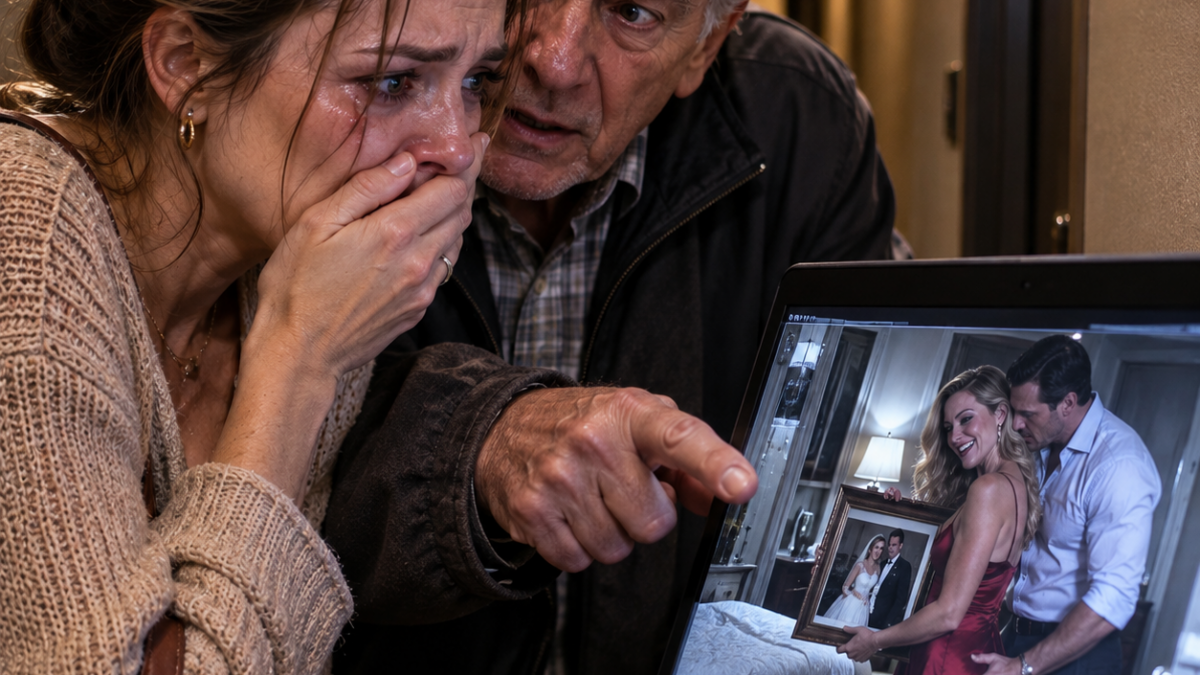
FULL STORY CONTINUATION
The hallway went silent.
Then came three soft knocks on Mr. Kowalski’s door.
I froze.
He pointed toward the laundry alcove.
“Behind the washer.”
I wanted to argue.
Instead I obeyed.
There are moments when fear strips away your need to understand everything before acting.
I squeezed into the narrow space between the washing machine and the wall.
My shoes were still in my hand.
One slipped.
I caught it before it struck the floor.
Mr. Kowalski opened the door only a few inches.
Brooke’s voice floated inside.
Sweet.
Almost playful.
“Good evening, Grandpa.”
I nearly gagged.
“We’re looking for Hannah.”
“I don’t know who you mean.”
“Oh, come on.”
Bryce now.
Low voice.
Less friendly.
“She lives upstairs.”
Mr. Kowalski answered:
“I was asleep.”
Brooke laughed.
“Sorry to bother you. We just thought maybe she came down here.”
Then Bryce said:
“That’s strange.”
Pause.
“We were told you live alone.”
My pulse slammed in my ears.
“But there’s a pair of women’s shoes beside your door.”
I looked down.
The shoes in my hands were mine.
Then remembered.
I had left a second pair outside earlier that week after stepping in rainwater.
Mr. Kowalski did not hesitate.
“My daughter-in-law.”
“Your daughter-in-law?”
“She brought food.”
Bryce asked:
“She’s here now?”
“No.”
“How long ago did she leave?”
Mr. Kowalski’s voice sharpened.
“Would you like to inspect my refrigerator too?”
Silence.
Long enough that I imagined Bryce pushing through the door.
Then Brooke laughed again.
“No need.”
Footsteps moved away.
Elevator bell.
Doors.
Silence.
I stayed hidden another full minute.
Then crawled out.
My legs barely supported me.
“Police.”
This time Mr. Kowalski nodded.
“Yes.”
“No more waiting.”
“Yes.”
I dialed.
The officers arrived quietly.
No sirens.
By then Bryce and Brooke had left the building.
The fifteenth-floor apartment was empty.
But not untouched.
Drawers open.
Files on the floor.
Closets searched.
Gavin’s home office nearly dismantled.
The mounted camera physically unplugged.
Bedroom camera too.
Nothing obvious missing.
That frightened me more.
Burglars take televisions.
Jewelry.
Laptops.
These people had searched.
They knew exactly what they were doing.
An officer asked how they entered.
I gave him Brooke’s name.
“She has had our guest code before.”
“Current?”
“I don’t know.”
Another officer checked the electronic lock log.
A valid secondary code had opened the apartment at 10:38 p.m.
No forced entry.
No damaged lock.
The code had supposedly been deleted months earlier.
Yet it worked.
That meant somebody had either restored it or never deleted it.
Gavin controlled the lock settings.
I felt a new kind of cold.
I called my husband.
Straight to voicemail.
Again.
Voicemail.
I texted:
CALL ME NOW. POLICE ARE IN THE APARTMENT.
No response.
The officers photographed everything.
Took names.
Requested building-security video.
Brooke and Bryce appeared on lobby footage entering separately within ten minutes of one another.
Bryce wore a baseball cap.
Brooke did not bother hiding her face.
They left together at 1:09.
Minutes before I arrived.
One officer asked:
“Do you know of any reason these two would believe documents or valuables were inside?”
“No.”
I thought of Mr. Kowalski.
Then corrected myself.
“Maybe.”
By the time the police left, it was almost four.
I refused to sleep in my apartment.
Mr. Kowalski insisted I return downstairs.
I followed him.
I had too many questions to resist.
We sat at his small kitchen table.
He made coffee.
My hands were still trembling.
“Start talking.”
He looked older suddenly.
Not seventy-six.
Ninety.
“Your father and I knew each other.”
I stared.
“My father died five years ago.”
“I know.”
“You never told me.”
“He asked me not to.”
“Why?”
Mr. Kowalski looked toward the ceiling.
“Because he believed someone might eventually come looking for what he left behind.”
My mouth went dry.
“What did he leave?”
“I don’t know.”
That sounded impossible.
“You’ve been secretly watching me for five years and you don’t know?”
His face tightened.
“I was not watching you the way you think.”
I stood.
“Then explain the photographs.”
He froze.
“What photographs?”
I looked toward the hallway.
The spare-bedroom door.
Slightly open.
His expression changed.
“Hannah.”
I walked toward it.
He tried to stand.
Too slowly.
I pushed the door open.
And stopped.
Photographs.
Dozens.
No.
Hundreds.
Me leaving our building.
Me buying groceries.
Me waiting for a rideshare.
Me at a coffee shop.
Me with Gavin.
Brooke.
My parents before Dad died.
Some photographs were years old.
Candid.
Taken from distances.
Dates written beneath many in black ink.
I turned.
“What the hell is this?”
Mr. Kowalski stood in the doorway gripping his cane.
“Those aren’t mine.”
“Then why are they covering your wall?”
“Your father gave me some.”
My stomach dropped.
“Some?”
“The rest I collected after he died.”
“Collected from where?”
“People following you.”
I could barely breathe.
“You’re telling me strangers have been photographing me for years?”
“Yes.”
“And you didn’t tell me?”
“No.”
“Why?”
“Because until tonight, they never entered your home.”
That was not an answer I could accept.
I stepped closer.
“You have thirty seconds before I call the police again and tell them to search your apartment.”
“Do it.”
I stopped.
He nodded.
“You should.”
No defensiveness.
No panic.
“I have nothing to hide from them.”
That was when I realized the wall wasn’t arranged like an obsession.
It was arranged like evidence.
Dates.
Locations.
Vehicle plates.
Arrows.
Names.
Copies of public records.
Photographs of the photographers themselves.
One recurring face.
Bryce.
Younger.
Longer hair.
Standing outside a courthouse six years earlier.
Another photo showed Brooke across the street from my father’s house.
Taken four years before she ever claimed to have met him.
My knees weakened.
“What is this?”
Mr. Kowalski whispered:
“The reason your father died believing his life had been destroyed.”
My father, Thomas Mercer, had worked for the city for almost twenty-seven years.
That was how I understood it.
Municipal procurement.
Construction compliance.
Boring.
Stable.
He reviewed contractor bids, permit compliance, and public-project documentation.
Five years before his death, he had been accused of taking bribes.
Not convicted.
Never charged criminally.
But an internal investigation alleged improper contact with contractors and conflict-of-interest violations.
The local newspaper ran his name.
Dad resigned before the city finished the disciplinary process.
He never recovered emotionally.
The accusation became the defining event of his final years.
He insisted he had been framed.
I believed him because he was my father.
But belief and proof are different things.
Then he had a heart attack.
He died before clearing his name.
I had spent five years trying not to think about it.
Mr. Kowalski now told me there had been more.
Dad had been investigating a pattern of inflated invoices and bid coordination involving several private contractors on municipal renovation projects.
One company kept appearing through subcontracting relationships.
Gallagher Construction Group.
The company where Gavin now worked.
Where Bryce was operations manager.
My stomach turned.
“Gavin wasn’t there then.”
“Yes, he was.”
“No.”
“He joined four years ago.”
Mr. Kowalski shook his head.
“He began consulting for Gallagher almost seven years ago.”
I stared.
Gavin had told me he joined after leaving his previous engineering firm.
Apparently not the whole truth.
“And you?”
I asked.
Mr. Kowalski took a slow breath.
“I worked internal audit for the city.”
That explained more than I wanted.
“You knew Dad through work.”
“For eighteen years.”
“Why didn’t I know you?”
“We were colleagues, not family friends.”
Then:
“Until his last investigation.”
He sat.
I remained standing.
“Your father found duplicate billing.”
“Projects where subcontractor invoices were inflated, then partially rebated through consulting entities.”
“Some of the records pointed toward people inside procurement.”
“Dad?”
“No.”
“He believed someone was using his approval credentials to make transactions appear legitimate.”
My skin prickled.
“What happened?”
“He reported it.”
“And then?”
“Records appeared showing money transferred to an account connected to him.”
“Bank statements?”
“Yes.”
“Real?”
“The account was real.”
“His?”
“Opened using enough of his identifying information to make it look that way.”
I thought of identity theft.
Forgery.
Corporate fraud.
It sounded enormous.
Mr. Kowalski raised a hand.
“Do not turn this into a conspiracy bigger than the evidence.”
That sentence grounded me.
“Your father could prove irregularities.”
“He could not prove who created the account.”
“Or who altered certain procurement records.”
“The city suspended him.”
“He resigned.”
“And he spent the last year of his life trying to find original records.”
“What records?”
“Documents showing the transaction chain before the altered copies entered the system.”
I looked toward the wall.
“And he found them?”
Mr. Kowalski’s eyes shifted.
“He thought he did.”
I sat opposite him.
“Where?”
“I don’t know.”
I laughed once.
Sharp.
“Convenient.”
“I truly don’t.”
“He told me he had created what he called a clean package.”
“Original bids.”
“Vendor confirmations.”
“Internal emails.”
“Bank correspondence.”
“Enough, he believed, to show that the bribery story was false.”
“Why didn’t he give it to the city?”
“He no longer trusted the internal chain.”
“So he hid it?”
“Yes.”
“Where?”
“He never told me.”
My head hurt.
“Then what exactly did he ask you to do?”
“Watch you.”
I closed my eyes.
There it was.
“He thought someone might approach me?”
“He feared they might search through his remaining property and then watch family members.”
“You took photographs of me.”
“Only when I noticed somebody else photographing you.”
He pointed toward the wall.
“Look at the dates.”
I did.
There were long gaps.
Months.
Sometimes nearly a year.
Not continuous surveillance.
Bursts.
Each cluster corresponded with something.
Dad’s funeral.
The sale of his house.
My wedding.
Gavin’s promotion at Gallagher.
Brooke moving back to Seattle after her divorce announcement?
No.
That was recent.
Then one date caught my attention.
My wedding.
Brooke in the background.
Bryce near the hotel entrance.
They had been in the same photograph.
Five years ago.
At the time, Bryce supposedly did not know Gavin personally yet.
I sat down hard.
“Why didn’t you tell the police?”
“I told investigators what I knew after your father’s death.”
“And?”
“They said none of it established a crime.”
“Did you show them this?”
“There wasn’t this much then.”
He looked toward the wall.
“After I moved here, I started seeing the same vehicles.”
“Same faces.”
“Bryce?”
“Yes.”
“What about Brooke?”
“Not until later.”
My voice fell.
“When?”
“Two years ago.”
I thought about my friendship with Brooke.
College.
Birthdays.
Trips.
Maid of honor.
She had been part of my life for thirteen years.
“How could she be connected to this before Dad died?”
Mr. Kowalski answered carefully.
“I don’t know that she was.”
“Then why the photograph outside his house?”
“She may have had an innocent reason.”
“Stop protecting me.”
“I am protecting the facts.”
Annoyingly, he sounded like my father.
We called the detective assigned to the break-in.
This time, Mr. Kowalski told everything.
The photographs.
Dad’s past.
His suspicions.
His old audit role.
Police came back.
They photographed the evidence wall.
Took copies of several records with his consent.
They did not suddenly declare a massive criminal conspiracy.
They asked questions.
Dates.
Sources.
Who took which photograph.
Which claims Mr. Kowalski personally witnessed.
That professionalism helped.
For the first time since midnight, the world felt solid.
Evidence separated from fear.
Gavin finally called at 6:22 a.m.
I stared at his name.
Detective Alvarez, still sitting at Kowalski’s table, nodded toward my phone.
“Answer if you want.”
“Speaker?”
“If you’re comfortable.”
I answered normally.
“Hannah?”
His voice sounded tired.
“Where have you been?”
“What happened?”
“Our apartment was searched.”
Silence.
Then:
“What?”
“Brooke and Bryce.”
Another silence.
Too long.
“That’s impossible.”
“I watched them on the camera.”
“Brooke?”
“Yes.”
“Bryce?”
“Yes.”
He exhaled.
“What were they doing?”
“Searching.”
“For what?”
I stared at Detective Alvarez.
“I was hoping you could tell me.”
Gavin did not answer.
My heart sank.
“You know something.”
“No.”
“Gavin.”
“I know Bryce has been dealing with an internal issue at work.”
“What issue?”
“I can’t discuss company matters.”
I almost laughed.
“My best friend and your manager broke into our apartment.”
“They didn’t break in if they had a code.”
Wrong answer.
Very wrong.
“Why did Brooke have a working code?”
“I don’t know.”
“You control the app.”
“Hannah—”
“Did you restore her access?”
Silence.
Then:
“A few weeks ago.”
The room went cold.
“Why?”
“She told me you asked her to pick something up.”
I closed my eyes.
“I never did.”
Gavin swore under his breath.
Detective Alvarez wrote something.
I asked:
“Why didn’t you tell me?”
“I forgot.”
“Where are you right now?”
“Portland.”
“Show me.”
“What?”
“Video call.”
Another pause.
Then:
“I can’t.”
My stomach dropped.
“Why?”
“Because I’m not in Portland.”
There it was.
Not the whole truth.
But a door opening.
Gavin was in Tacoma.
He claimed Gallagher had sent him to meet outside counsel regarding an internal financial review.
He lied because Bryce had told him the matter was confidential and because Gavin did not want me asking questions about my father’s old case.
My father’s old case.
He knew.
“How long have you known Gallagher was connected to Dad?”
Gavin’s breathing changed.
“About six months.”
I gripped the edge of the table.
“You knew for six months.”
“I found his name in archived project files.”
“And you didn’t tell me?”
“I was trying to verify it first.”
“Brooke?”
“I don’t know what she has to do with this.”
“Bryce?”
“He’s been nervous for weeks.”
“About what?”
Gavin lowered his voice.
“Audit documents resurfaced.”
Every person at the table went still.
“What documents?”
“I don’t know.”
“You’re lying.”
“No.”
“I genuinely don’t know.”
He sounded different.
Not defensive.
Scared.
“Someone sent anonymous copies to our general counsel.”
“Copies of what?”
“Old vendor ledgers.”
“Some municipal correspondence.”
“And?”
“One had your father’s handwritten initials.”
I stopped breathing.
Dad’s clean package.
Maybe not hidden forever.
Maybe partly resurfaced.
“Where did the copies come from?”
“No return address.”
“When?”
“Three weeks ago.”
Three weeks.
Brooke had started telling me her divorce was falling apart around the same time.
Bryce had become suddenly more present in Gavin’s work life.
Coincidence?
Maybe.
Not enough.
I asked:
“Did you tell Bryce about the package?”
“He already knew.”
“Why?”
“He oversees old-project records.”
Of course.
“Did he ask about me?”
Silence.
“Gavin.”
“Yes.”
My stomach turned.
“What did he ask?”
“Whether your father left you anything.”
There it was.
“And what did you tell him?”
“That you inherited personal papers but nothing company-related.”
“How did you know that?”
“Because you told me when he died.”
I had.
A box of letters.
Tax records.
Watch.
Tools.
Nothing else.
Or so I believed.
Detective Alvarez signaled for me to end the call soon.
I asked one final question.
“Gavin, did you know Brooke was coming to our apartment?”
“No.”
“Did you know Bryce was?”
“No.”
“If I find out that’s a lie, we’re done.”
Silence.
Then Gavin said:
“Hannah.”
“What?”
“I think you should stay somewhere else.”
I laughed bitterly.
“Finally, something we agree on.”
I ended the call.
The police advised me not to return home alone.
I took clothes under escort later that morning.
Our apartment looked violated.
Not destroyed.
Worse.
Carefully searched.
The wedding photograph Brooke had held lay face-down on the dresser.
I picked it up.
Gavin beside me.
Brooke behind us in pale blue.
Smiling.
Bryce barely visible near the hotel doorway.
I had never noticed him.
Five years.
One photograph.
Connections I had not known existed.
Then I saw something else.
The back of the frame.
The brown paper backing had been sliced open.
Empty.
They had searched inside it.
I showed Alvarez.
“Maybe they thought something was hidden behind the photo.”
“Was there?”
“No.”
At least I thought no.
Then a memory hit.
Dad had given us the frame.
Not the photograph.
The frame.
Wedding morning.
He handed it to me in a box.
“Put something worth remembering in it.”
I had laughed.
He died six months later.
My hands began shaking.
We examined the frame.
Nothing obvious.
Then the officer noticed one corner of the backing was thicker.
Inside the wooden molding was a narrow slot.
Empty.
Whatever had once been there was gone.
My heart pounded.
Had Dad hidden something?
Had somebody already removed it?
Brooke?
Bryce?
Gavin?
Or had there never been anything?
Again, uncertainty.
The detective took the frame as evidence.
Brooke stopped answering everyone.
Her phone went off.
Her condo was empty when police attempted contact later that day.
Not abandoned.
Just empty.
Bryce did answer.
Through an attorney.
He claimed he entered our apartment with permission from Brooke, whom he believed had permission from me.
He claimed they were searching for a personal item Brooke had misplaced.
What item?
An antique bracelet.
Inside my husband’s office?
Bedroom drawers?
Behind books?
The explanation weakened rapidly.
The camera footage damaged it further.
Especially Brooke deliberately disconnecting the feed.
Still, investigation takes time.
People do not go to prison because a story looks suspicious.
I learned patience badly.
Gavin returned that afternoon.
We met at a hotel lounge with Detective Alvarez aware of the meeting.
Public place.
I did not want him in Mr. Kowalski’s apartment.
He looked exhausted.
“What aren’t you telling me?”
He sat.
“I didn’t send Bryce.”
“I know.”
“You believe me?”
“I believe evidence hasn’t shown you did.”
He flinched.
Fair.
Then:
“I knew the company had a historical problem connected to your father.”
“How?”
“Six months ago, during a refinancing review.”
“Gallagher had to produce old litigation and municipal files.”
“I saw Thomas Mercer’s name.”
“And said nothing.”
“I wanted to investigate first.”
“Stop calling secrecy investigation.”
He looked down.
That landed.
“I was afraid.”
“Of what?”
“That your father’s accusations were true.”
I stared.
“Why would that frighten you?”
“Because Gallagher’s largest equity partner is Bryce’s father.”
I had not known that.
Bryce wasn’t merely a manager.
His family had ownership influence.
“If the old records showed systemic billing fraud, it could affect contracts, bonding, financing.”
“And your job.”
“Yes.”
At least honest.
“So you chose your job over telling me my father might have been framed.”
Gavin’s eyes filled.
“I chose delay.”
“No.”
I shook my head.
“You chose yourself.”
He had no answer.
Then he told me something worse.
Brooke had asked him about my father’s belongings twice.
Not recently.
Months earlier.
Once at dinner.
Once by text.
Casually.
“Did Hannah ever find out what happened with her dad’s city case?”
Then:
“Did he leave any weird documents? My ex had something like that happen in his family.”
Gavin dismissed it.
I did not.
Brooke had been fishing.
Why?
That question consumed me until Mr. Kowalski provided one possible answer.
He searched his old files and found Brooke’s maiden name.
Brooke Adler.
Her father:
Martin Adler.
A former subcontractor who had worked on three Gallagher-linked municipal projects during the period Dad investigated.
Not owner.
Not executive.
A concrete subcontractor.
His company later failed.
Again, not proof Brooke was involved.
She had been in college then.
But it connected her family to the old case.
I remembered Brooke telling me her father lost everything because “the city screwed him.”
I had never asked which city.
Seattle.
Ours.
When police eventually interviewed Brooke, she admitted something.
Not everything.
She said Bryce contacted her after learning she was my closest friend.
He told her my father had destroyed multiple families through false corruption accusations and that old documents had resurfaced that could “reopen everything.”
Brooke’s father had indeed blamed Dad for years.
Bryce convinced her that Dad had hidden records proving he fabricated parts of the investigation.
She wanted those records.
Not to hurt me, she claimed.
To clear her father.
The red dress?
Dinner earlier that evening.
The fake divorce crisis the previous week?
That was harder to explain.
She finally admitted she had used my trust to learn when Gavin would be away and when I worked late.
That betrayal hurt more than the old family connection.
She had planned access.
Bryce’s motive was more financial.
Investigators later established that the old documents resurfacing at Gallagher included evidence relevant to questionable reimbursements and subcontractor relationships from years earlier.
Bryce had not created the original scheme as a young man.
But he had inherited responsibilities connected to records that could expose people close to him, including his father.
He believed Dad’s missing originals could either strengthen or destroy the historical case.
So he wanted them first.
That was all.
No secret assassin.
No international conspiracy.
Fear.
Money.
Family loyalty.
Career protection.
Ordinary motives capable of producing extraordinary stupidity.
But where were Dad’s originals?
The answer came from the least dramatic place imaginable.
A safe-deposit box.
Not under floorboards.
Not inside a wedding frame.
A bank.
Dad had rented it under his own name and listed me as successor access upon proof of death.
The bank notification had been mailed to his old address after he died.
I never received it because the house was already being cleared.
Years later, dormant-account procedures eventually generated another notice.
That notice had been forwarded through an old estate attorney.
It arrived while the police investigation was underway.
Inside the box:
A flash drive.
Paper files.
A letter to me.
And the missing piece from the picture frame.
A tiny brass key.
Dad had hidden the safe-deposit key in our wedding frame.
Sometime after his death, I had unknowingly moved the frame between apartments, packed it, unpacked it, hung it.
The key remained inside.
Until someone removed it.
But if Brooke and Bryce had removed it, why had they not reached the box?
Because the bank required identification and estate documentation.
The key alone was not enough.
And by then, police were already involved.
Dad’s letter began:
Hannah, if you are reading this because something happened to me, do not assume everyone I suspected was guilty. Evidence is not suspicion.
I laughed through tears.
Even dead, he was correcting me.
He explained that the box contained copies of records he believed showed two things.
First, that financial activity attributed to him did not match his actual accounts or tax filings.
Second, that original vendor correspondence contradicted several documents later used against him.
He did not claim to know exactly who framed him.
That restraint mattered.
He named several people who might know more.
Mr. Kowalski was one.
An outside bank investigator another.
A former city attorney.
He asked me not to pursue anything alone.
If the records matter, give them to professionals. Do not turn my unfinished fight into your life.
I cried harder at that sentence than anything else.
Dad had known me.
The flash drive and papers went to law enforcement through counsel.
Then to the appropriate municipal investigators.
Not me.
I stopped playing detective.
Mostly.
It was difficult.
But Dad’s instructions were clear.
Professionals.
The review did not produce movie-style mass arrests.
It produced something slower and, to me, more important.
The city reopened parts of Dad’s disciplinary history.
Independent forensic review found that financial records attributed to him contained discrepancies inconsistent with his known accounts.
Several procurement documents had been modified after initial approval.
Dad’s prior conflict-of-interest finding was formally reconsidered.
Months later, the city issued a written correction acknowledging that evidence used in the original disciplinary process had been unreliable and that there was insufficient basis to sustain the most serious accusations against him.
My father was not alive to read it.
I was.
I sat in my car outside the municipal building holding the letter.
For five years, Dad’s name had carried an asterisk in my mind.
Not because I doubted him.
Because the world had.
Now there was paper.
Not perfection.
Not proof that every suspicion he had held was right.
But enough.
He had not taken the bribes they said he took.
He had been telling the truth.
I cried until my chest hurt.
The Gallagher matter continued separately.
The company cooperated after outside counsel became involved.
Bryce was terminated.
Not because of Dad’s decades-old case alone.
Because entering an employee’s private residence to search for documents under false pretenses was indefensible.
His family ownership connections did not save him.
An internal review uncovered control failures around records retention and historical subcontractor payments.
Some matters were referred to authorities.
Others became civil disputes.
I deliberately stopped following every development.
Dad had warned me.
Do not turn my unfinished fight into your life.
Brooke faced legal consequences for her role in entering our apartment and assisting the search.
The exact outcome involved an agreement I will not romanticize.
She accepted responsibility.
There were restrictions.
Restitution for damaged property.
No contact with me.
I did not ask the prosecutor to destroy her.
I also did not ask them to spare her because we had once been friends.
That distinction mattered.
Her father’s losses may have shaped her anger.
They did not give her permission to use thirteen years of friendship as a key to my home.
She sent one letter through her attorney months later.
I almost returned it unopened.
Then read.
I told myself I was searching for the truth about my father. The truth is that I chose Bryce’s story because I wanted it to be true. If your father had been guilty, then mine could remain only a victim. I used everything you trusted me with to get into your life. There is no excuse for that.
I stopped there.
Then finished.
You were my best friend. I treated that like access instead of something I was supposed to protect. I am sorry.
I believed she was sorry.
I did not reconcile.
Some apologies deserve acknowledgment without renewed access.
I learned that from pain.
Mr. Kowalski became more complicated.
I was furious with him for months.
He had protected me.
Yes.
He had also secretly documented people around me and withheld information that concerned my own life.
Intent does not erase impact.
We argued.
Often.
“You should have told me.”
“Yes.”
“Years ago.”
“Maybe.”
“Not maybe.”
He sighed.
“Yes.”
That was progress.
“Why didn’t you?”
“Your father asked me not to burden you unless danger became direct.”
“And you obeyed a dead man instead of trusting an adult woman.”
He winced.
“Yes.”
Good.
I needed him to hear that.
Protection can become control when the protected person is denied information about their own risk.
Mr. Kowalski eventually admitted it.
“I thought I was keeping you safe.”
“You were also keeping me uninformed.”
“Yes.”
We never completely resolved that contradiction.
Real relationships often contain both gratitude and anger.
I loved him for opening his door.
I resented him for the wall of photographs.
Both were true.
The photographs came down.
My request.
Not immediately.
After police finished documenting them.
Mr. Kowalski handed me every copy connected to me.
I kept only those relevant to the investigation.
Destroyed the rest.
He asked:
“Are you sure?”
“Yes.”
“Your father—”
“My father told me not to make his fight my life.”
Mr. Kowalski smiled sadly.
“He always was smarter than me.”
“Don’t tell him I agreed.”
We both laughed.
It was the first time I’d laughed in weeks.
Gavin and I were harder.
He had not sent Brooke or Bryce.
Police found no evidence he participated in the apartment search.
That mattered.
But he had hidden six months of information connecting his company to my father’s case.
He had restored Brooke’s access code based on a message without confirming it with me.
He had lied about Portland.
He had prioritized his career and corporate confidentiality over information directly related to my family’s history.
Was that marriage-ending?
I did not know immediately.
Anyone who tells you betrayal comes only in obvious categories has never had to decide what to do with a person who did not commit the worst act but still failed you when truth became inconvenient.
We separated temporarily.
Not dramatic.
Gavin rented a furnished apartment.
I remained in ours after security codes were changed, cameras replaced, and access tightened.
We went to counseling.
The first session was brutal.
Our therapist asked:
“Gavin, why didn’t you tell Hannah when you saw her father’s name?”
He said:
“I didn’t want to reopen her grief until I had facts.”
I laughed bitterly.
“You had enough facts to investigate without me.”
He closed his eyes.
“Yes.”
“Then say the real reason.”
He was silent.
The therapist waited.
Finally:
“I was afraid she’d ask me to leave Gallagher.”
There.
Truth.
“Would I have?”
“I didn’t know.”
“So you removed the possibility by hiding it.”
“Yes.”
That was what we had to work with.
Not an affair.
Not criminal betrayal.
Cowardice.
Self-protection.
Silence.
All capable of damaging trust.
For months, I did not know whether we would survive.
Gavin resigned from Gallagher before I asked him to.
I told him not to do it for me.
He said:
“I’m not.”
“Then why?”
“Because I watched my employer’s manager search my home for records connected to my wife’s dead father while I was lying to her about why I was away.”
He looked exhausted.
“I don’t want to work there anymore.”
Fair.
He accepted a position with an engineering consultancy at lower pay.
No heroic sacrifice.
A career choice.
One evening, I asked:
“Did you love me when you kept the truth from me?”
He stared.
“Yes.”
“Then what good did love do?”
He thought for a long time.
“Not enough.”
That answer may be why we eventually stayed together.
He did not say love excused him.
He admitted behavior had to carry what feelings alone could not.
We rebuilt slowly.
New shared rules.
No restoring access codes based on third-party requests.
No using “confidential” as a blanket excuse when something directly affects the other spouse’s safety.
No pretending that withholding information is protection without asking the person being protected.
Very romantic marriage lessons.
No greeting cards about those.
Still important.
My father’s name was formally addressed by the city eleven months after the break-in.
There was no grand ceremony.
I received a letter.
Then a meeting.
The city attorney said:
“We cannot undo what the original process did to your father.”
I nodded.
“We can correct the record where evidence no longer supports those findings.”
That sentence nearly destroyed me.
I asked for one extra certified copy.
Then drove to the cemetery.
I felt ridiculous carrying paperwork to a grave.
Did it anyway.
I sat beside Dad’s stone.
Read the correction aloud.
Wind.
Trees.
Nothing mystical.
He did not answer.
I placed one hand against the engraved name.
“Mr. Kowalski was a pain.”
I started crying.
“He helped.”
Then:
“You were right.”
I laughed through tears.
“You’d hate hearing that.”
I stayed twenty minutes.
Then took the letter home.
I did not leave it in the rain.
Dad would have called that stupid.
Bryce’s father eventually settled several civil claims connected to disputed old subcontracting transactions.
Some allegations were substantiated.
Others were not.
That mattered.
Dad had been right about irregularities.
He had not been omniscient.
I learned to resist turning him into a flawless hero simply because he had been wronged.
He was a man doing difficult work.
He made mistakes too.
The correction of his record did not require pretending otherwise.
Truth is strongest when it does not need exaggeration.
Brooke disappeared from my daily life.
At first, I dreamed about her constantly.
Sometimes she stood in my bedroom holding the wedding photograph.
Sometimes we were twenty again, eating fries in a dorm room.
Grief for a friendship is strange because nobody sends sympathy cards.
People said:
“At least you found out who she really was.”
I hated that phrase.
The years before the betrayal had not all been fake.
She had held my hand at Dad’s funeral.
She had slept on my couch after my miscarriage.
She had danced beside me at my wedding.
People can love you and still later make choices that betray you terribly.
That is harder to understand than discovering they were “always evil.”
I eventually stopped trying.
Her good moments did not erase the break-in.
The break-in did not erase every memory.
Both existed.
I moved forward anyway.
One year after that night, I came home from work at 8:30.
Not one in the morning.
I had stopped treating overtime like a virtue.
Mr. Kowalski sat in the lobby holding a grocery bag.
He pulled out a clementine.
“For vitamin C.”
I stared.
Then laughed.
“You’re unbelievable.”
“Take.”
I did.
We rode the elevator together.
At fourteen, the doors opened.
He stepped out.
Then turned.
“Hannah.”
“Yes?”
“You check your camera?”
“Every day.”
“Good.”
The doors started closing.
He pressed the button to reopen them.
For one terrible second, my body remembered that first night.
Then he smiled.
“Just checking.”
I threw the clementine at him.
He caught it against his chest.
Terrible reflexes.
Good enough.
Mr. Kowalski died two years later.
Peacefully.
Stroke.
His daughter-in-law really did exist, by the way.
She flew in from Chicago and laughed when I told her he had used her shoes as an excuse.
“He would.”
At his memorial, she gave me a small envelope.
“He left this for you.”
Inside was a photograph.
Not surveillance.
Dad and Kowalski at a city retirement dinner.
Both younger.
Dad holding a paper plate.
Kowalski pointing at the camera.
On the back, in Dad’s handwriting:
Stanley worries too much. But if I ever need someone to watch Hannah’s back, I know who I’ll ask.
I sat down.
Cried.
Then laughed.
That old man had taken the assignment too literally.
Gavin and I eventually moved.
Not because the apartment was unsafe anymore.
Because I could no longer walk into the bedroom without remembering Brooke touching our wedding photograph.
The new place was smaller.
Different neighborhood.
No connection to Gallagher.
The first thing we installed was a security system.
This time both of us understood every setting.
No secret codes.
No “I’ll handle it.”
Shared access.
Shared responsibility.
Technology cannot create trust.
But transparency helps.
The wedding photograph came with us.
I almost threw it away.
Then decided Brooke did not own it.
Neither did Bryce.
Dad had given me the frame.
Police eventually returned it after the investigation.
The hidden slot was empty.
Scratched.
I had a craftsman repair the backing but leave the slot visible inside.
Why?
Because I wanted the story intact.
Not displayed.
Known.
The photograph now sits on a shelf in our living room.
When I look at it, I see Dad’s frame first.
Then Gavin and me.
Then Brooke.
She is still in the photograph.
I did not cut her out.
Some people find that strange.
I don’t.
She was there.
Editing her from the image would not edit her from my history.
I no longer need photographs to lie for me.
My career changed too.
The night of the break-in began because I had stayed at work past one over a budget review.
After everything, I started asking why my job required that from me as often as it did.
Usually, it didn’t.
I had trained people to expect unlimited availability because I rarely said no.
A different pattern from Brooke.
Still unhealthy.
I delegated more.
Promoted two analysts.
Stopped answering emails after ten except in real emergencies.
Nothing collapsed.
Annoying discovery.
I had believed vigilance was the price of safety after the break-in.
For a while I checked cameras compulsively.
Front door.
Garage.
Hallway.
Again.
Again.
Therapy helped me distinguish awareness from surveillance.
I did not want Brooke and Bryce to turn me into someone who watched my own life from a screen.
So I reduced checks.
Notifications only.
Then normal use.
Safety that requires constant fear is not safety either.
Five years after Dad’s death became six.
Then seven.
Eventually his case was no longer the first thing people remembered when they heard his name.
That mattered.
The city archive reflected the corrected finding.
An old newspaper added an editor’s note to its digital story after legal review.
Small.
Maybe invisible to most people.
Huge to me.
I stopped searching his name online.
That was when I knew the fight had ended.
Not because everything was repaired.
Because I no longer needed daily confirmation.
One evening Gavin asked:
“Do you think your dad knew exactly what would happen?”
I laughed.
“No.”
“He hid a key inside our wedding frame.”
“He was dramatic.”
“You inherited that.”
“I did not.”
Gavin looked at me.
I had spent three years investigating a photograph wall, safe-deposit box, and municipal corruption history.
Fair.
“Maybe slightly.”
Then he asked:
“Why Mr. Kowalski?”
I thought.
“Because Dad trusted him.”
“Would you?”
“Now?”
“Yes.”
I smiled.
“With my life.”
Then:
“Not with my privacy.”
Gavin laughed.
Perfect answer.
The question everyone asked was why Brooke smiled at the camera before disconnecting it.
I never asked her directly.
Her attorney later said she knew the camera would preserve at least part of the visit and panicked.
The smile may have been bravado.
Maybe contempt.
Maybe nerves.
For months I treated it like a secret message.
Eventually I stopped.
Not every gesture contains a code.
Sometimes a bad choice looks strange because the person making it is frightened too.
I had enough facts.
I did not need to invent more.
The most disturbing discovery was never the break-in.
Not Bryce.
Not Brooke.
Not even the photographs.
It was learning how many people had decided what I should know “for my own protection.”
Dad.
Kowalski.
Gavin.
Different motives.
Different levels of justification.
Same pattern.
They all cared about me.
They also all withheld pieces of my own reality.
That became the lesson I carried forward.
Protection without information can become another kind of control.
Kind control is still control.
Dad had his reasons.
Kowalski too.
Gavin made his own mistakes.
I forgave some.
Accepted others without forgiving quickly.
But I changed the rule in my life.
If information materially affects my safety, finances, family, or future, do not decide for me that ignorance is kinder.
Tell me.
Let me react.
Let me choose.
I can handle truth better than a manufactured calm.
I know that now.
The first night I slept normally in our new apartment, I did not notice until morning.
No camera checks.
No hallway sounds waking me.
No dreams.
I opened my eyes at 7:14.
Sunlight across the wall.
Gavin asleep beside me.
I lay there for a while.
Nothing happening.
That felt miraculous.
Not the safe-deposit box.
Not the city correction.
Not Bryce losing his job.
Ordinary morning.
That was what I had been trying to get back.
I still receive clementines every winter.
Mr. Kowalski’s daughter-in-law sends a box.
The first year, the card said:
Stanley would insist.
I cried.
Now I smile.
Some memories soften without becoming less important.
If I could go back to that one-in-the-morning version of myself standing outside the elevator, exhausted, laptop digging into my shoulder, I would tell her:
Listen to the old man.
Not because old men are always right.
Because fear in someone who has never frightened you before deserves attention.
Then call police sooner.
Do not turn yourself into a detective because uncertainty is unbearable.
Document what you know.
Separate evidence from suspicion.
And when secrets start appearing, remember that knowing the truth may hurt—but being protected from it can cost you years.
I would tell her Brooke’s betrayal will hurt more than Bryce’s.
Prepare for that.
Strangers can frighten you.
Friends can rearrange your understanding of your own past.
I would also tell her not to spend forever trying to decide whether every happy memory with Brooke was fake.
It wasn’t.
People are not evidence files.
They change.
They contradict themselves.
Someone can once love you and later betray you.
The betrayal is still real.
So was the love.
You do not have to solve that paradox before walking away.
I would tell her Gavin’s lie will not fit neatly into the same category.
He did not invade the apartment.
He did not search the drawers.
But he withheld truth because truth threatened his comfort.
That will require a different decision.
Do not let other people tell you betrayal has only one acceptable consequence.
Examine behavior.
Require accountability.
Choose deliberately.
It is your marriage.
Not a jury poll.
And I would tell her something about Dad.
He did not leave you a mystery because he wanted you to spend your life solving him.
Quite the opposite.
His final letter will say:
Do not turn my unfinished fight into your life.
Believe him.
Clear his name where evidence supports it.
Then stop.
Go have breakfast.
Work sane hours.
Love your husband if he earns the rebuilt trust.
Remember Brooke without reopening the door.
Miss Kowalski.
Eat the clementines.
Live.
That is what he wanted.
People love the dramatic version of my story.
The elderly neighbor pressing the elevator button.
Two intruders upstairs.
The best friend in the red dress.
The black-clad construction manager.
The camera going dark.
The hidden wall of photographs.
The dead father’s secret.
I understand why.
Those moments still make my stomach tighten.
But the part that changed me most came much later.
I was sitting at my father’s grave with a certified letter from the city acknowledging that the most serious allegations against him could no longer be sustained.
For years I had imagined that moment would feel like victory.
It didn’t.
It felt quiet.
Sad.
Complete.
I read the letter aloud.
Then folded it.
Put it back in the envelope.
And said:
“You were right, Dad.”
Wind moved through the trees.
Nothing answered.
I smiled anyway.
Then I went home.
That was the difference between my father’s life and mine.
He died still trying to prove what happened.
I got to know enough.
Not everything.
Enough.
Brooke entered my apartment because she believed the truth about her father might be hidden there.
Bryce entered because old records threatened people and money tied to his family.
Kowalski watched because he believed he owed Dad a promise.
Gavin stayed silent because he was afraid truth might cost him his career.
Everyone was protecting something.
A father.
A company.
A promise.
A job.
And every one of them, in different ways, forgot that I was a person standing in the middle of those choices.
Not anymore.
The security camera did not reveal a monster beside my wedding photograph.
It revealed something harder.
Someone I loved making a decision that treated my trust as a tool.
The evidence wall did not reveal that Mr. Kowalski was secretly dangerous.
It revealed that protection can become frightening when it operates without consent.
Dad’s files did not reveal one perfect villain responsible for every bad thing.
They revealed greed, fear, altered records, weak controls, bad decisions, and people protecting themselves.
Reality was less cinematic than I feared.
And far more useful.
Because reality gave me something conspiracy never could.
A way forward.
Today, if an elevator door opens late at night, I still sometimes remember Mr. Kowalski’s hand reaching toward the button.
Don’t go up.
That sentence probably saved me from walking directly into a confrontation with two people desperate enough to search my home.
I will never know what would have happened if I had reached the fifteenth floor ten minutes earlier.
I do not need to know.
Alternate tragedies deserve less space than the life that actually happened.
I was warned.
I listened.
I survived the betrayal.
Dad’s record was corrected.
The investigation happened without consuming the rest of my life.
And the apartment I once thought had become the center of a terrifying mystery eventually became only an address I used to have.
That is how I prefer it.
I still have our wedding photograph.
Same picture.
Same repaired frame.
Dad’s narrow hidden compartment visible if you remove the backing.
Nothing inside now.
No secret key.
No evidence.
No message.
Just empty space.
Sometimes Gavin asks why I keep it that way.
I tell him:
“Because not every empty space needs to be filled.”
For years, everybody around me hid things because they believed uncertainty was dangerous.
Now I understand something better.
You can know enough without knowing everything.
You can survive unanswered questions.
You can stop digging.
You can close a file.
You can trust again carefully.
You can let an empty compartment stay empty.
And you can still sleep.
That night at one in the morning, I thought the most frightening thing I would ever see was my best friend holding our wedding photograph while another man searched my home.
I was wrong.
The truly frightening discovery was realizing how many people had made decisions about my life while believing I would be safer if I remained unaware.
But that discovery gave me something too.
A rule I have never broken since:
If the truth belongs to my life, I get to know it.
Mr. Kowalski protected me from walking into danger.
My father left enough evidence to protect his name.
The police protected the facts from becoming rumor.
But the person who ultimately had to decide what happened next was me.
And once I understood that, the secrets stopped controlling my life.
They became what they should have been all along.
Evidence.
History.
And then, finally—
the past.








