FULL STORY:“DON’T GO BACK IN! THE ROOF IS ABOUT TO COLLAPSE!” A Mother Dog Ran Into a Burning House Four Times to Save Her Puppies—But When She Went Back for the Fifth, I Heard a Sound I’ll Never Forget
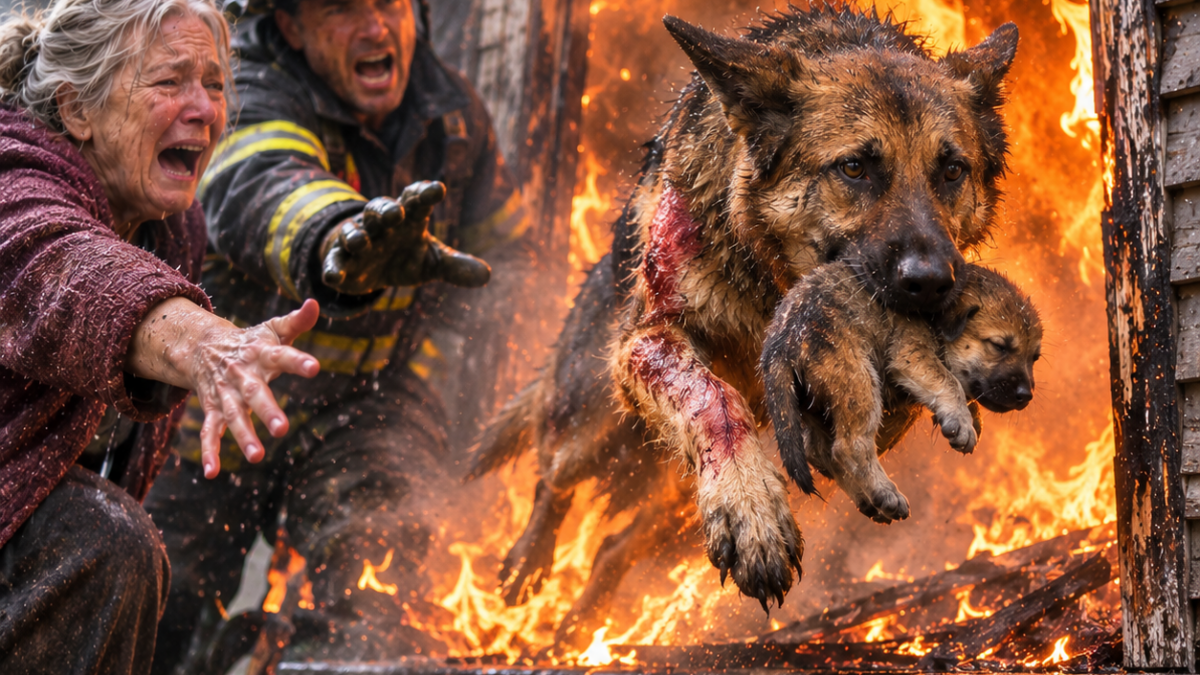
I wish I could tell you I wasn’t afraid.
I wish I could say years of firefighting experience had taught me to remain perfectly calm, that I saw the situation, understood the risks, and knew exactly how it would end.
But that’s not what happened.
When Luna disappeared into the burning house for the fifth time, something tightened inside my chest.
I had watched her make four trips.
Four times, she’d emerged carrying a puppy.
Four times, she’d returned to the fire instead of remaining outside.
And every time, she seemed to have less strength.
The fourth trip had been especially difficult.
I’d seen her stumble after lowering the puppy onto the snow.
Her body shook.
Her movements were stiff.
She stood for a moment with her head lowered, breathing rapidly.
Then she heard something—or sensed something—inside the house.
And she went back.
I looked toward my crew.
We were already working to contain the fire and assess the building.
There were serious structural concerns.
The flames had reached areas of the roof, and the house was becoming increasingly unstable.
Any attempt to enter had to be coordinated with the firefighters responsible for assessing the immediate danger.
I knew that.
I’d trained for that.
I also knew a living creature was inside.
And the sound of Luna’s bark had reached me through the smoke.
“There’s still a dog in there,” I called.
My colleague looked toward the doorway.
“The roof’s getting worse.”
“I know.”
He glanced toward the elderly woman near the driveway.
Margaret was crying so hard she could barely stand.
She clutched her coat with trembling hands.
“The baby,” she kept whispering.
“Please.”
I looked toward the four puppies.
They lay together on a blanket one of the firefighters had placed beneath them.
They were tiny.
Their eyes were not yet open.
Their bodies trembled with the cold.
The smallest sound came from the dark-coated one nearest the edge.
A thin, helpless cry.
I swallowed.
Then I looked back toward the house.
Somewhere inside were Luna and the fifth puppy.
And neither had come out.
Our crew’s actions were guided by the immediate fire conditions and the risks to everyone at the scene.
There was no room for impulsive heroics.
No room for pretending a collapsing building was safe because I desperately wanted to save an animal.
But while the fire response continued, a limited opportunity for rescue became possible.
The circumstances allowed an entry under the crew’s direction and appropriate protection.
I remember the weight of my equipment.
The harsh heat.
The reduced visibility.
The sound of fire moving through the damaged structure.
And the frightening knowledge that the situation could change in seconds.
I moved with the crew’s guidance, searching for the dog.
“Luna!”
My voice sounded strange inside the protective equipment.
I listened.
No answer.
I continued scanning the area.
The kitchen was badly affected.
Parts of the room were nearly unrecognizable.
The familiar objects of someone’s ordinary life had become shadows and broken shapes.
I thought about Margaret.
How she’d probably stood in that kitchen hundreds of times.
Preparing meals.
Making tea.
Feeding Luna.
Checking on the puppies.
Now the room was filled with smoke and heat.
I called again.
“Luna!”
Then I heard it.
A faint sound.
Not the strong bark I’d heard outside.
Something weaker.
Almost lost beneath the noise of the fire.
I turned toward the back corner.
And saw her.
Luna was lying low against the floor.
Her body formed a curve around something small.
For one terrible moment, I couldn’t see what she was protecting.
Then I noticed a tiny movement beneath her chest.
A puppy.
The last one.
He was almost completely hidden by her body.
Luna had positioned herself around him, shielding him as best she could.
Her paws were injured.
Her side was burned.
Her coat was damaged.
And she looked exhausted.
But when she saw me, her head lifted.
Her amber eyes met mine.
I stopped.
I’ll never forget that look.
People sometimes ask me whether I saw determination in her eyes.
Whether I could tell that she was choosing to sacrifice herself.
I can’t claim to know everything that went through her mind.
She was an animal, a mother trying to protect her young in a terrifying situation.
But I know what I saw.
She was hurt.
She was frightened.
She was still positioned around her puppy.
And she had not left him.
I moved carefully.
“Easy, girl.”
She watched me.
“I’m here.”
The puppy shifted beneath her.
I felt relief so intense that my knees nearly weakened.
He was moving.
He was alive.
But we had almost no time.
I worked to bring both animals out as safely and quickly as the conditions allowed.
Luna was too exhausted to make another trip on her own.
She needed help now.
I remember holding her close.
The small puppy protected against her body.
The urgency of the moment.
The sounds around us.
And the terrible fear that we might be too late.
I moved toward the exit under the crew’s direction.
Each second felt longer than the last.
Then the cold winter air struck my face outside.
And suddenly, we were beyond the doorway.
Margaret screamed.
But this time, the sound was different.
It wasn’t only terror.
It was shock.
Hope.
Disbelief.
She ran toward us, then stopped as the crew made room for the animals to receive care.
I lowered myself carefully.
Luna was in my arms.
The fifth puppy remained close to her.
For a moment, I couldn’t speak.
I had been holding myself together through the emergency.
Now, seeing Margaret’s face, I felt everything at once.
The fear.
The relief.
The terrible uncertainty about Luna’s injuries.
Margaret looked at the dog.
“Luna?”
Her voice broke.
“My girl?”
Luna’s eyes were partly open.
She was breathing.
The puppy moved beside her.
Margaret pressed her hands over her mouth.
“Oh, thank God.”
Then she looked toward the blanket where the other four puppies lay.
“All five?”
I nodded.
“All five are out.”
Her knees gave way.
One of the firefighters caught her before she fell.
She began crying uncontrollably.
“My babies.”
I looked down at Luna.
Her breathing was heavy.
Her body was hot from the exposure she’d endured.
Her injured paws needed immediate attention.
I was relieved we’d gotten her out.
But I knew the danger wasn’t over.
We still needed veterinary care.
Urgently.
The next five minutes felt endless.
Emergency responders at the scene continued their work while veterinary assistance was arranged.
I sat near Luna and her puppies in a sheltered area away from the fire.
The winter air was bitter.
The contrast with the heat we’d just escaped was almost unbearable.
The puppies huddled close together under a blanket.
They made tiny cries.
Thin sounds that seemed impossibly delicate after the roar of the flames.
Luna lay exhausted.
Her eyes remained half closed.
I watched her breathing.
I worried about her burns.
About smoke exposure.
About the strain her body had endured.
I had seen injured animals before.
But never one who had made repeated trips into a burning building carrying her young.
I wanted to tell her everything was over.
That she could finally rest.
That all five puppies were outside.
But she couldn’t understand my words.
So I stayed close.
And spoke softly.
“You’re okay, girl.”
Her ears moved faintly.
“Your babies are here.”
A puppy cried.
Luna raised her head.
The movement was slow.
Painful-looking.
But she turned toward the sound.
Then she lowered her muzzle.
And licked one of the puppies.
Just once.
A small, gentle movement.
I stared.
My throat closed.
Even now, exhausted and injured, she was responding to her baby.
Margaret saw it too.
She began crying harder.
“Oh, Luna.”
Her voice trembled.
“Sweet girl.”
I felt tears fill my eyes.
Because in that moment, the fire was no longer the only thing I could see.
I saw a mother.
Five tiny puppies.
And a bond that had survived something none of them should ever have experienced.
Dr. Keller examined Luna and the puppies at the veterinary clinic.
I remember the waiting room.
The bright lights.
The smell of disinfectant.
The way Margaret sat with both hands wrapped around a paper cup she never drank from.
Her face was pale.
Her eyes were swollen.
She had lost her home that morning.
Almost everything she owned had been inside.
Furniture.
Photographs.
Clothes.
Years of memories.
But when the veterinarian entered, she didn’t ask about the house.
She stood immediately.
“Luna?”
Dr. Keller looked toward us.
“She’s alive.”
Margaret covered her mouth.
He continued.
“She has significant burns to her paws and along her side. We’re treating those injuries carefully, and we’ll continue monitoring her.”
I swallowed.
“Will she recover?”
He nodded cautiously.
“Her prognosis is encouraging, though healing will take time.”
Margaret began crying.
Then she asked the question we’d all been waiting to hear answered.
“The puppies?”
Dr. Keller’s expression softened.
“All five are doing well. We haven’t identified any serious injuries in them.”
Margaret pressed her hands together.
“All five?”
“Yes.”
She closed her eyes.
Then whispered, “Thank you.”
The veterinarian looked toward the examination area.
“She protected them through an extraordinary situation.”
I nodded.
I could still see Luna curled around the last puppy.
Her body forming a shield.
The tiny movement beneath her.
The way she lifted her head when I approached.
I looked down.
And for the first time since leaving the farmhouse, I began to cry.
Margaret reached for my hand.
I looked up.
She was trembling.
“Thank you,” she whispered.
I shook my head.
“I was doing my job.”
Her eyes filled.
“No.”
I swallowed.
She continued.
“You heard her.”
I looked toward her.
“You went back.”
I didn’t know what to say.
I didn’t want her to think I’d acted alone or ignored the danger. My crew had coordinated the response, and the rescue depended on more than one person.
But I understood what she meant.
I’d heard Luna.
And I’d wanted desperately to reach her.
Margaret squeezed my hand.
“I thought I was going to lose them.”
Her voice cracked.
“All of them.”
I stared at the floor.
Then she whispered, “They’re all I have.”
Those words stopped me.
I looked at her.
She began crying again.
“My Luna.”
She looked toward the treatment rooms.
“My girl.”
I sat beside her.
And for a while, neither of us spoke.
I didn’t sleep much that night.
I went home after the emergency and tried to return to ordinary life.
I showered.
Changed clothes.
Made something to eat.
Then sat on the edge of my bed.
The room was quiet.
But inside my head, the fire was still roaring.
I could see the house.
The smoke.
Margaret’s face.
Luna emerging with one puppy.
Then another.
And another.
And another.
I remembered the fifth trip.
The desperate bark.
The dark corner.
The small puppy beneath her body.
I lay down.
Closed my eyes.
Then opened them again.
Every time I tried to rest, I thought about how easily the outcome could have been different.
What if the structure had become too unstable for entry?
What if we’d reached her a minute later?
What if she had been unable to protect the last puppy?
What if Mark—no, there was no Mark here, no easy second rescuer to appear. There had been only our crew, the fire, Margaret waiting outside, and Luna trapped with her baby.
I stared at the ceiling.
Then I thought about the things I had walked away from in my own life.
Not emergencies.
Ordinary difficulties.
Uncomfortable conversations.
Relationships that required more patience than I wanted to give.
People I hadn’t called because I didn’t know what to say.
Moments when leaving had seemed easier than staying.
I wasn’t proud of all those choices.
And I didn’t pretend one fire could suddenly turn me into a better man.
But I couldn’t stop thinking about Luna.
She had no understanding of heroism as people describe it.
She wasn’t trying to become famous.
She wasn’t asking anyone to admire her.
She was responding to the needs of her puppies.
And she’d continued trying to reach them even after she was injured.
I thought about the final image.
Luna curled around the smallest puppy.
Unable to leave him.
I closed my eyes.
And whispered, “You brave girl.”
The following afternoon, I returned to the clinic.
I told myself I only wanted to check on Luna.
To see whether her burns were being treated successfully.
To ask about the puppies.
But when I arrived, I realized I also wanted to see her.
Not a photograph.
Not a medical report.
Luna herself.
I needed to know she was still there.
Dr. Keller greeted me.
“She’s resting.”
I nodded.
“Can I see her?”
He allowed a quiet visit.
I entered the room.
Luna lay on soft bedding.
Her paws had been treated and protected.
The injured area along her side was receiving care.
She looked tired.
Much smaller than she had in my memory of the fire.
I knew that was partly because the emergency had made everything feel larger.
The flames.
The danger.
The urgency.
Now she was simply a recovering dog.
A mother who had endured burns and exhaustion.
I crouched nearby.
“Hey, girl.”
Her eyes opened.
They moved toward me.
I smiled.
“It’s Noah.”
She watched me.
I didn’t know whether she recognized my voice.
Perhaps she did.
Perhaps she simply noticed someone entering the room.
But I felt grateful that she was awake and responding.
I sat carefully.
“Your puppies are okay.”
Her ears shifted.
“All five.”
I smiled.
“You’re a pretty incredible mom.”
She lowered her head.
I remained beside her.
And the quiet felt different from the chaos of the fire.
For the first time, I could see her without thinking only about saving her.
Now she had time to heal.
And I could simply be grateful she had that chance.
I began visiting regularly.
Sometimes before a shift.
Sometimes afterward.
On my days off, I stayed longer.
The clinic staff became familiar with me.
A receptionist would smile when I entered.
“Here for Luna?”
I’d nod.
“How’s she doing?”
The answer changed gradually.
“Resting.”
“Her burns are being managed.”
“She’s eating.”
“She’s showing improvement.”
Each update mattered.
I knew recovery from burns could be painful and slow.
The first few days were not the end of the emergency.
Luna still needed careful veterinary attention, appropriate pain management, wound care, and monitoring.
Her body had endured serious injury.
But she was alive.
And her puppies were growing.
The first week passed slowly.
Luna spent much of her time resting.
She remained attentive to her puppies when they were with her.
The veterinary team ensured her needs and theirs were met safely.
I watched from a respectful distance.
Sometimes one puppy would move closer to her.
Sometimes another would cry softly.
Luna would shift her head.
Nuzzle them.
Attend to them.
I found it almost impossible to watch without remembering the fire.
There was the same protective posture.
The same attention to her young.
But now she lay on clean bedding.
In a warm room.
With no flames around her.
I felt relief each time I saw her settle comfortably.
One afternoon, Margaret arrived while I was sitting nearby.
She carried a small bag.
I stood.
“Hello.”
She smiled faintly.
“Hello, Noah.”
Her face looked tired.
She’d been staying with neighbors since the fire.
They had given her a room and helped her replace some basic necessities.
But her grief was still visible.
The house she’d lived in was gone.
She set the bag down.
“I brought her favorite treats.”
I smiled.
“She’ll like that when the vet says they’re appropriate.”
Margaret nodded.
Then approached Luna.
“My girl.”
Her voice broke.
Luna lifted her head.
Margaret knelt beside her.
And began crying.
I stepped back.
Some moments don’t need an audience.
Margaret rested her hand gently against Luna’s head.
“Oh, sweetheart.”
Her voice trembled.
“I’m so sorry.”
Luna watched her.
Margaret continued.
“I should’ve gotten you out.”
I felt something tighten in my chest.
She was blaming herself.
For the fire.
For the puppies.
For the injuries Luna had suffered.
I knew how easily survivors could carry guilt, even when they had done everything possible in a frightening emergency.
Margaret stroked the dog’s head.
“I didn’t know what to do.”
Her voice broke.
“I kept calling you.”
She looked toward the floor.
“And you kept going back.”
I approached quietly.
“Margaret.”
She looked up.
Tears covered her cheeks.
“You got out,” I said gently.
She swallowed.
“You called for help.”
I crouched nearby.
“The fire was dangerous. You couldn’t safely go back inside.”
Her lips trembled.
“But she did.”
I looked toward Luna.
“She was trying to protect her puppies.”
Margaret closed her eyes.
I continued.
“That doesn’t mean you failed her.”
For a moment, she said nothing.
Then she leaned toward Luna.
And whispered, “I’m going to take care of you now.”
I looked away.
Because I understood that promise.
It was the beginning of something she could do.
The house was gone.
The past couldn’t be changed.
But Luna was alive.
Her puppies were alive.
And Margaret could still care for them.
Over the following visits, Margaret told me about Luna’s life before the fire.
She had found Luna years earlier.
The dog had appeared near her home, thin and frightened.
Margaret had begun feeding her.
At first, Luna kept her distance.
She would approach the food, then retreat.
Margaret didn’t force contact.
She simply continued offering care.
After a while, Luna began staying nearby.
Then approaching the porch.
Then waiting at the door.
Eventually, she became part of the household.
Margaret smiled as she remembered.
“She just decided she lived there.”
I laughed.
“Sounds like a smart dog.”
Margaret nodded.
“Very smart.”
Her eyes filled.
“And very gentle.”
She looked toward Luna.
“When I was sad, she’d come to me.”
I listened.
“She’d put her head on my knees.”
Margaret smiled through tears.
“And stay there until I felt better.”
I looked at Luna.
She was resting with her eyes half closed.
Margaret continued.
“Sometimes I talked to her for hours.”
Her voice softened.
“About everything.”
I nodded.
“She sounds like wonderful company.”
Margaret smiled sadly.
“She was my family.”
Then she corrected herself.
“She is my family.”
I looked toward the puppies.
And understood why the fire had terrified her so completely.
Losing the farmhouse was devastating.
But losing Luna would have meant losing the companion who had filled that house with life.
The second week brought encouraging progress.
Luna became more comfortable moving as her injuries healed.
The veterinary team continued managing her recovery.
She began walking again, slowly and carefully.
I was there one afternoon when she took several steps across the clinic room.
Her movements were cautious.
Her paws still healing.
But she was standing.
Walking.
I felt my throat tighten.
“Look at you.”
Luna turned her head.
I smiled.
“Good girl.”
Dr. Keller watched nearby.
“She’s making progress.”
I nodded.
I thought about the moment I carried her out of the fire.
How limp and exhausted she’d seemed.
Now she was moving under her own power.
Not fully recovered.
Not ready for normal activity.
But moving.
I felt tears gathering.
“That’s wonderful.”
Dr. Keller smiled faintly.
“She’s a resilient dog.”
I looked toward Luna.
“She certainly is.”
The puppies grew quickly.
Their eyes began opening.
Their movements became more purposeful.
They explored their bedding.
Sought their mother.
And gradually began showing distinct personalities.
I became fascinated by them.
Five tiny German Shepherd puppies who had survived a fire before they were old enough to understand their surroundings.
I didn’t want their earliest days to become defined only by what had happened.
So I began noticing who they were becoming.
The darkest puppy was curious.
He seemed eager to explore.
The lightest one preferred remaining close to Luna.
Another was restless, always moving.
One seemed calmer, content to curl beside the others.
And the smallest—the last puppy Luna had protected—often slept tucked close to her body.
I found myself giving them names in my head.
Ash.
Cinder.
Ember.
Flint.
And Hope.
I didn’t immediately tell Margaret.
I knew the puppies were hers and that naming them was her decision.
But those names helped me think of them as individuals rather than simply “the five puppies from the fire.”
They were growing.
Changing.
Developing little personalities.
And the fact that they could do those things felt miraculous enough.
One afternoon, Margaret caught me smiling at the puppies.
“What?”
I laughed.
“Nothing.”
She raised an eyebrow.
“You’re thinking something.”
I looked toward the dark-coated one exploring the edge of the bedding.
“I may have started giving them names.”
Margaret’s eyes brightened.
“Have you?”
I nodded sheepishly.
“Only in my head.”
She smiled.
“Tell me.”
I pointed gently.
“Ash.”
Then another.
“Cinder.”
She laughed softly.
I continued.
“Ember.”
“Flint.”
Then I looked toward the smallest puppy curled beside Luna.
My throat tightened.
“And Hope.”
Margaret followed my gaze.
For a moment, she said nothing.
Then her eyes filled.
“Hope.”
I nodded.
“The last one.”
She reached toward the puppy gently.
He shifted in his sleep.
Margaret smiled through tears.
“I like that.”
She looked at me.
“I like all of them.”
I laughed.
“Really?”
She nodded.
“Yes.”
Then she looked toward Luna.
“She’s given us so much already.”
Her voice broke.
“I think those names are beautiful.”
By the end of the third week, Luna barked.
I was at the clinic when it happened.
A familiar sound came from her room.
Deep.
Strong.
Unmistakable.
I stopped in the hallway.
For a moment, I was back at the farmhouse.
The smoke.
The flames.
The desperate bark that had led us toward her.
My heart began pounding.
Then I heard it again.
This time, it sounded different.
Luna was alert.
Responsive.
Her voice had regained strength.
I entered the room.
She looked toward me.
Her tail moved.
I smiled.
“Well, hello there.”
Dr. Keller stood nearby.
He smiled too.
“She’s coming back.”
I looked toward Luna.
Her eyes were bright.
Her body stronger.
Her puppies moving around her.
And I began crying.
Because for weeks, I had remembered her voice as part of a terrifying emergency.
Now I was hearing it in a safe room.
From a living dog.
A mother surrounded by her healthy puppies.
I laughed through tears.
“That’s my girl.”
Meanwhile, the community began helping Margaret rebuild.
At first, she’d resisted the idea.
She didn’t want to burden anyone.
She was embarrassed by the attention.
But people had heard what happened.
Neighbors knew she’d lost her home.
Members of the fire department helped organize a fundraiser.
Local residents offered practical assistance.
Some contributed money.
Others provided building materials.
Furniture.
Curtains.
Household supplies.
Whatever they could reasonably spare.
The effort grew.
Not because Margaret was famous.
Not because someone wanted a dramatic story to share.
But because she was a neighbor who had suffered a terrible loss.
And people wanted to help.
I watched the donations come in.
A box of kitchen utensils.
A set of blankets.
A table.
An old but sturdy chair.
A small stack of carefully folded towels.
Simple things.
But each one represented someone choosing to care.
One afternoon, Margaret and I visited the site of her old farmhouse.
The fire had left the building beyond repair.
Snow covered parts of the ground.
The winter air was cold.
She stood beside me, looking at the place where her kitchen had been.
For a long time, she didn’t speak.
Then she pointed toward a patch of earth.
“Luna’s bed was there.”
I looked.
The ground was blackened.
Margaret’s voice trembled.
“Right near the kitchen.”
I swallowed.
She continued.
“That’s where she kept the puppies.”
I stared at the remains.
I could almost imagine the little nest of blankets.
A warm place.
A mother curled around five newborns.
Then the fire.
The smoke.
The frantic attempts to carry them outside.
Margaret pressed a hand against her mouth.
“I keep thinking about that morning.”
I nodded.
“Me too.”
She looked at me.
“Do you dream about it?”
I hesitated.
“Sometimes.”
Her eyes filled.
“I hear her barking.”
I looked toward the trees.
“Yeah.”
She began crying.
“I thought I’d lost her.”
I placed a hand gently on her shoulder.
For a while, we stood in silence.
Then she whispered, “I don’t know how to live in a different house.”
I looked toward her.
She continued.
“I lived here for so long.”
Her voice broke.
“Everything was familiar.”
I nodded.
“I know.”
She looked at the damaged ground.
“Now it’s gone.”
I swallowed.
There wasn’t a perfect answer.
I couldn’t tell her the house didn’t matter.
It did.
A home holds years of ordinary life.
Meals.
Conversations.
Photographs.
Birthdays.
Quiet mornings.
And the small routines that make people feel safe.
Losing those things can be devastating.
So I didn’t tell Margaret to be grateful for what survived.
She already was.
I simply stood beside her.
And let her grieve what she’d lost.
Eventually, she looked toward me.
“At least Luna’s alive.”
I nodded.
“Yes.”
Her voice grew quiet.
“And the babies.”
I smiled.
“All five.”
She wiped her eyes.
Then looked toward the place where the front door used to stand.
“Maybe we can start again.”
I felt my throat tighten.
“I think you can.”
She nodded slowly.
Then turned away from the ruins.
And we walked back toward the road.
The rebuilding took time.
There were decisions.
Practical problems.
Weather delays.
Money to manage.
Materials to gather.
And all the ordinary complications involved in creating a home after disaster.
But the community continued helping.
The new house was smaller.
Simpler.
Built around what Margaret truly needed.
A warm kitchen.
A comfortable living room.
A place to sleep.
And enough space for Luna and her puppies.
Margaret became involved in every detail she could manage.
She chose the curtains.
The blankets.
The little rug near the kitchen.
And the corner where Luna’s bed would go.
I remember watching her arrange the blankets for the puppies.
She folded them carefully.
Then stepped back.
For a moment, she looked almost afraid to hope.
“Do you think she’ll like it?”
I smiled.
“I think she’ll be glad to be with you.”
Margaret nodded.
Then whispered, “That’s what matters.”
By the end of February, Luna was ready to leave the clinic.
Her burns had healed enough for Dr. Keller to approve her return home with appropriate continuing care.
She was walking.
Eating.
Responding normally to familiar people.
Her puppies were growing well.
The veterinary team had given Margaret clear guidance for their ongoing needs.
There would still be monitoring and follow-up.
But the most difficult stage was behind them.
I arrived at the clinic early that day.
Margaret was already there.
She wore a warm coat and held Luna’s leash.
Her hands trembled slightly.
I smiled.
“Ready?”
She looked at me.
Her eyes filled.
“I think so.”
Then she turned toward Luna.
“Ready to go home, my girl?”
Luna’s tail moved.
Margaret began crying.
I looked away for a moment.
Because that simple question carried so much.
Home.
A word that had seemed impossible after the fire.
Now it was something Margaret could say again.
We brought Luna and her puppies to the new house.
The weather was cold but clear.
Snow still covered the fields.
The sun shone brightly.
When we arrived, Margaret stood in the driveway for a long moment.
The house looked unfamiliar.
New.
Smaller than the one she’d lost.
But warm light glowed through the windows.
And inside were the things people had given her.
A table.
Chairs.
Curtains.
A soft rug.
Blankets.
A place where she could begin again.
She opened the front door.
“Come on, Luna.”
The dog entered cautiously.
She sniffed the floor.
The doorway.
The furniture.
Then moved toward the kitchen.
She found the corner where Margaret had arranged bedding for the puppies.
She paused.
Looked around.
Then lowered herself carefully.
The puppies were settled beside her.
One by one, they moved closer.
Soon all five were gathered against her body.
Luna curled around them.
I stood in the doorway.
Unable to move.
Because I recognized the shape.
The curve of her body.
The way she positioned herself around her young.
The way her head rested near them.
It was the same protective posture I’d seen in the burning farmhouse.
But everything else was different.
There was no smoke.
No heat.
No collapsing roof.
Only a clean room.
Soft blankets.
Daylight falling through a window.
And the quiet sounds of puppies settling beside their mother.
Margaret crouched nearby.
Her face was wet with tears.
“Welcome home, my girl.”
Luna looked toward her.
Margaret stroked her head.
“Welcome home.”
I stepped outside.
The winter air was sharp.
The fields beyond the road were covered in snow.
The sky glowed pink and gold as the sun lowered.
I stood beside my vehicle.
And cried.
I had tried so hard to remain composed.
Through the fire.
The rescue.
The clinic visits.
The rehabilitation.
The rebuilding.
I’d told myself that being a firefighter meant understanding how to carry difficult memories without allowing them to overwhelm me.
But sometimes, a quiet scene can break through every defense you have.
A mother dog lying beside her puppies.
A woman whispering welcome home.
A house filled with donated furniture.
And the knowledge that all of it could so easily have been lost.
I closed my eyes.
For a moment, I heard Luna’s bark again.
Then I opened them.
And looked toward the new house.
Warm light shone through the window.
Luna was inside.
With her puppies.
With Margaret.
Safe.
I smiled through tears.
And whispered, “You made it, girl.”
The next few weeks brought something I hadn’t expected.
Peace.
Not complete peace.
Margaret still had difficult days.
Sometimes she remembered an item from her old house and reached for it before realizing it was gone.
Sometimes she woke from dreams about the fire.
Sometimes she cried while washing dishes because she remembered standing in the same place in her old kitchen, listening to Luna’s puppies.
Grief doesn’t disappear simply because a new house has been built.
And trauma doesn’t end the moment the immediate danger passes.
But Margaret was no longer living only in the aftermath.
She had routines again.
Breakfast.
Tea.
Laundry.
Feeding Luna.
Checking on the puppies.
Watching them grow.
The small things that make a house feel inhabited.
And slowly, the new rooms began collecting memories of their own.
I visited when my schedule allowed.
Sometimes I brought groceries.
Sometimes I helped with small repairs.
Sometimes I simply sat at Margaret’s kitchen table and listened.
She liked telling stories.
About Luna.
About the old farmhouse.
About the neighbors who had helped her.
And about how surprised she was that so many people cared.
One afternoon, she looked toward me and said, “I never knew I had so many friends.”
I smiled.
“People care about you.”
She shook her head.
“I always thought I was just an old woman in a house at the edge of town.”
I looked at her.
“You’re part of this community.”
Her eyes filled.
She glanced toward Luna.
“She taught me that.”
I smiled.
“How?”
Margaret stroked the dog’s head.
“She arrived at my door with nothing.”
Her voice softened.
“And somehow she made the whole house feel full.”
I nodded.
She looked around the new kitchen.
“Now she’s done it again.”
The puppies grew quickly.
Their paws became larger.
Their eyes brighter.
Their movements more confident.
Ash was the adventurous one.
He explored everything.
Cinder was curious but cautious.
Ember seemed to discover new reasons to play every day.
Flint often followed the others, then suddenly surprised us by becoming the most energetic puppy in the room.
And Hope, the smallest, remained especially fond of curling close to Luna.
I loved watching them.
Not because they were survivors of a fire.
But because they were becoming ordinary young dogs.
Curious.
Playful.
Occasionally mischievous.
With personalities that had nothing to do with the danger they’d escaped.
Margaret laughed more often now.
I’d hear her scolding one puppy for chewing a blanket.
Or reminding another that her slippers weren’t toys.
Then she’d look toward Luna.
“Your children are terrible.”
Luna would watch calmly.
Margaret would smile.
“And I suppose you think they’re perfect.”
I laughed.
The house was full of noise.
Movement.
Life.
And that was the most beautiful change.
Early in spring, I returned to visit.
Snowdrops were blooming near the porch.
The air smelled of damp earth and new grass.
The fields were beginning to turn green.
When I stepped out of my vehicle, five young German Shepherd puppies came running through the yard.
I laughed.
“Well, hello there!”
They bounded around each other.
Clumsy.
Excited.
Full of energy.
I crouched carefully and let them approach.
Ash came first.
Then Ember.
Flint followed.
Cinder stopped to investigate my shoe.
And Hope moved more cautiously before joining the others.
I smiled.
“Look at you.”
Four months earlier, I’d watched them lying in a blanket beside a burning farmhouse.
They had been so small.
So vulnerable.
Now they were running through the spring grass.
Their ears moving.
Their tails wagging.
Their paws carrying them wherever curiosity led.
I looked toward the porch.
Luna sat on the steps.
Her posture calm.
Her eyes attentive.
When she saw me, she stood.
Then approached.
I felt my throat tighten.
“Hey, girl.”
She stopped beside me.
Her amber eyes met mine.
I held out my hand.
She moved closer and rested her muzzle against it.
For a moment, I couldn’t speak.
I remembered carrying her out of the fire.
Her injured body.
Her exhausted breathing.
The last puppy beneath her.
Now she stood in front of me.
Alive.
Comfortable.
Her puppies playing nearby.
I gently stroked her head.
“Good to see you, Luna.”
Margaret appeared in the doorway.
She smiled.
“Noah.”
I looked up.
“Hello, Margaret.”
She walked onto the porch.
For a moment, she watched Luna beside me.
Then her eyes filled.
“She remembers you.”
I smiled.
“Maybe.”
Margaret shook her head.
“I think she does.”
I looked toward Luna.
I couldn’t know exactly what she remembered.
But she seemed comfortable with my presence.
And that was enough.
Margaret stepped closer.
Then said quietly, “Thank you.”
I looked at her.
“You’re welcome.”
She shook her head.
“No.”
Her voice broke.
“I mean it.”
I felt my throat tighten.
She continued.
“You gave me my family back.”
I looked toward the puppies.
Then toward Luna.
I swallowed.
“She did most of the work.”
Margaret smiled through tears.
“Yes.”
She looked at Luna.
“She did.”
Then she turned back toward me.
“But you didn’t turn away.”
I was quiet.
Margaret continued.
“You heard her.”
I remembered the bark.
The smoke.
The dark corner.
The tiny puppy hidden beneath Luna.
I nodded slowly.
“Yes.”
She reached for my hand.
“And you helped bring her home.”
I looked at her.
For a moment, I couldn’t speak.
Then I said, “I’m glad we could.”
We sat on the porch together.
The puppies played in the yard.
Luna settled nearby.
The sunlight was warm.
Margaret brought tea.
For a while, we talked about ordinary things.
The weather.
The garden.
The neighbors.
The puppies’ latest mischief.
Then Margaret looked toward Luna.
“You know what I think about sometimes?”
I shook my head.
“What?”
“That morning.”
I nodded.
“Me too.”
She looked down at her cup.
“I remember seeing Luna come out with the first puppy.”
Her voice softened.
“I was so relieved.”
I listened.
“Then she turned around and went back.”
Margaret closed her eyes.
“I thought she was going to die.”
I swallowed.
She continued.
“Every time she came out, I thought she’d stay.”
Her eyes filled.
“But she kept going back.”
I looked toward Luna.
She lay calmly in the sun.
Margaret’s voice broke.
“And when she went back for the last one, I thought I’d lost her.”
I reached for her hand.
She squeezed mine.
Then whispered, “I still hear her barking sometimes.”
I nodded.
“So do I.”
For a while, neither of us spoke.
Then Margaret looked toward the puppies.
All five were playing.
She smiled through tears.
“But now I hear them too.”
I followed her gaze.
Ash was trying to catch a leaf.
Hope was following Ember.
Flint had discovered a stick.
Cinder was investigating the porch steps.
The yard was full of movement.
Margaret laughed softly.
“And that’s a much better sound.”
I returned to the station that evening with something I hadn’t expected.
A kind of peace.
For months, the fire had remained vivid in my memory.
The heat.
The noise.
The fear.
The desperate bark.
The image of Luna curled around her last puppy.
I’d carried those moments with me.
Sometimes they appeared in dreams.
Sometimes they returned when I heard a dog bark.
Sometimes they surfaced unexpectedly while I was driving past a house with smoke rising from its chimney.
I knew experiences like that could stay with emergency responders.
We witness people and animals during some of the worst moments of their lives.
And even when the outcome is good, the memories can be difficult to carry.
But seeing Luna in the spring sunshine changed something for me.
The fire was still part of the story.
It always would be.
But it was no longer the only image I saw when I thought of her.
Now I could picture her resting on the porch.
Her puppies running through the grass.
Margaret smiling in the doorway.
A home filled with life.
And that made the memory easier to hold.
At the station, my colleagues asked about Luna.
“How’s the shepherd?”
I smiled.
“Doing great.”
“And the puppies?”
“Growing like weeds.”
Someone laughed.
“All five?”
I nodded.
“All five.”
I took out my phone and showed them a photograph.
Luna sat on the porch.
The puppies played around her.
The sunlight made her coat shine.
For a moment, the room grew quiet.
Then one firefighter smiled.
“Look at her.”
Another shook his head.
“Hard to believe.”
I nodded.
“I know.”
I looked at the photograph.
Then said, “She’s got her life back.”
Summer arrived.
The fields turned green.
The days grew longer.
And Luna’s story gradually became part of the history people told about our little town.
Some knew about the fire.
Some knew about the rescue.
Some remembered the community fundraising effort.
A few had helped build Margaret’s new home.
Others had donated furniture or household items.
When I saw those people, they often asked for updates.
“How’s Margaret?”
“Good.”
“And Luna?”
“Doing well.”
“The puppies?”
“Growing fast.”
People smiled.
Sometimes they asked whether the dog really entered the fire five times.
I explained what I’d witnessed.
Four trips carrying puppies out.
Then a fifth return for the last one.
And the rescue that followed.
I didn’t embellish it.
I didn’t need to.
The truth was extraordinary enough.
One afternoon, I sat alone at the station table looking at Luna’s photograph.
Outside, birds were singing.
The summer air was warm.
The ordinary sounds of the station surrounded me.
Someone was washing equipment.
Another firefighter was speaking on the telephone.
A coffee machine hummed in the corner.
I looked at Luna.
Then thought about the first day I joined the fire service.
I had been younger.
Eager.
Determined to prove myself.
I’d imagined heroism as something dramatic.
Running toward danger.
Saving lives.
Being brave when others were frightened.
Over time, I’d learned how incomplete that picture was.
Emergency response requires training.
Teamwork.
Discipline.
Good judgment.
Knowing when to act.
Knowing when not to.
And understanding that no individual is more important than the safety of the people depending on the team.
But Luna had taught me something about another kind of courage.
Not professional courage.
Not the kind learned through training.
The simple, instinctive determination to remain near someone who needs you.
I’d seen it in the way she protected her puppies.
I’d seen it in Margaret’s willingness to begin again after losing her home.
I’d seen it in the neighbors who gave their time and resources to rebuild a house for someone they cared about.
And I’d felt it in myself when I kept returning to the clinic.
Not because anyone required me to.
But because I wanted to know Luna was recovering.
Sometimes people ask me what being a hero means.
I don’t have a perfect answer.
I’ve seen people make extraordinary sacrifices.
I’ve also seen quiet acts of kindness that never make the news.
A neighbor checking on an elderly person.
A family offering shelter after a fire.
Someone bringing food to a frightened animal.
A volunteer helping rebuild a home.
A firefighter staying calm when a situation becomes terrifying.
And a mother dog refusing to leave her last puppy behind.
Those actions aren’t identical.
They involve different risks and responsibilities.
But they share something.
Someone recognizes that another life matters.
And chooses to respond.
I think that’s important.
Because courage doesn’t always look like fearlessness.
Sometimes it looks like being frightened and still doing the careful, necessary thing.
Sometimes it looks like returning the next morning.
And the morning after.
Sometimes it looks like staying involved long after the dramatic moment has passed.
I have one photograph of Luna that I treasure more than any other.
It was taken in spring.
She’s sitting on the porch steps of Margaret’s rebuilt house.
Her head is raised.
Her amber eyes are calm.
The puppies are playing around her.
Ash.
Cinder.
Ember.
Flint.
And Hope.
The five little lives she protected.
The five puppies who once lay crying beneath a blanket in the snow.
Now they’re growing in the sunlight.
In the photograph, Luna doesn’t look like an animal who has endured a terrible fire.
She looks like a mother watching her young.
A dog at home.
Safe.
Loved.
And that’s why I treasure it.
Because it reminds me that the most important part of rescue isn’t always the dramatic moment.
It’s the life that becomes possible afterward.
Margaret still sends updates.
Sometimes a photograph.
Sometimes a short message.
One day, she told me Hope had fallen asleep beside Luna.
Another day, Ash had discovered how to steal a towel.
Once, she sent a picture of all five puppies gathered around the kitchen rug.
The caption read:
They’re getting bigger every day.
I laughed.
Then looked at the photograph for a long time.
I remembered how tiny they had been.
How vulnerable.
How frightening it had been to watch Luna carry them through the smoke.
Now they were simply puppies.
Growing.
Playing.
Learning.
And being cared for.
I couldn’t imagine a better future for them.
One evening, I visited Margaret again.
The air was warm.
The yard smelled of fresh grass.
Luna was resting beneath a tree.
The puppies played nearby.
Margaret sat on the porch with a cup of tea.
I joined her.
For a while, we watched the dogs.
Then Margaret looked toward me.
“Noah?”
“Yes?”
“Do you think she knew what she was doing?”
I followed her gaze toward Luna.
“What do you mean?”
Margaret looked down.
“Going back into the fire.”
I thought carefully.
I couldn’t know exactly what Luna understood.
Animals respond to danger, attachment, and the needs of their young in ways we can’t fully translate into human thoughts.
But I knew what I’d witnessed.
She had repeatedly carried puppies out.
Then returned for the one that remained.
I looked toward Margaret.
“I think she knew her puppy was still inside.”
Her eyes filled.
I continued.
“And she was trying to reach him.”
Margaret nodded.
Then whispered, “She couldn’t leave him.”
I looked toward Luna.
The dog was watching the puppies.
“No.”
I swallowed.
“She didn’t.”
We sat quietly.
Then Margaret said something that stayed with me.
“I thought I lost everything that morning.”
I turned toward her.
She looked around the yard.
“The house.”
Her voice trembled.
“All my things.”
She wiped her eyes.
“I thought my life was over.”
I listened.
Then she looked toward Luna.
“But she came back.”
I felt my throat tighten.
Margaret continued.
“And the puppies came back.”
Her eyes filled.
“Then everyone helped me build this place.”
She looked toward the house.
“I still miss my old home.”
I nodded.
“Of course.”
“But I’m not alone.”
She smiled faintly.
“Not anymore.”
I reached for her hand.
She squeezed mine.
And we sat watching Luna while the sun lowered behind the fields.
I sometimes think about the moment I carried Luna outside.
The winter air.
The snow.
Margaret running toward us.
The four puppies gathered beneath the blanket.
And the fifth little body resting close to his mother’s injured side.
I remember sitting on the ground.
Holding Luna.
Waiting for veterinary help.
I remember her lifting her head.
And licking one of her puppies.
Such a small movement.
After everything she’d endured.
And yet it has stayed with me more clearly than the flames.
Because in that moment, I wasn’t thinking about bravery.
Or recognition.
Or what anyone would say afterward.
I was simply grateful she was alive.
Grateful that all five puppies were breathing.
Grateful that Margaret would have the chance to hold her dog again.
That was enough.
Sometimes I wonder what would have happened if the fire had started a few minutes earlier.
Or if the roof had deteriorated more quickly.
Or if Luna had been unable to make those first four trips.
There are too many possibilities.
And none of them are useful to imagine for very long.
We cannot change what almost happened.
We can only care for what remains.
Luna survived.
Her puppies survived.
Margaret survived.
The house was lost.
But the community helped her build another.
And in that new home, life continued.
Not exactly as before.
But meaningfully.
Warmly.
With love.
I still work as a firefighter.
The alarms continue.
There are difficult calls.
Frightening emergencies.
Days when the work is exhausting.
I know I can’t control every outcome.
No firefighter can.
But I carry Luna’s story with me.
Not as permission to ignore danger.
Not as a reason to act recklessly.
As a reminder of what matters when we respond to emergencies.
Living beings.
Families.
The bonds people and animals share.
And the importance of treating those bonds with respect.
A dog isn’t simply a possession to the person who loves her.
A litter of puppies isn’t an interchangeable group of animals.
To Margaret, Luna was family.
And the puppies were lives she had been waiting to watch grow.
Remembering that helps me see beyond the emergency itself.
It reminds me why our work matters.
Tonight, I’m sitting at the kitchen table in the fire station.
Outside, the summer evening is warm.
Birds are calling from the trees.
My coworkers are moving around the building, preparing for the next shift.
On the table beside me is the photograph of Luna and her puppies.
I look at it often.
The mother sitting on the steps.
Her five young ones around her.
Sunlight falling across the grass.
There is no smoke in the photograph.
No fire.
No injured paws.
No frightened woman standing in the snow.
Just life.
And sometimes, that is the most powerful ending a rescue story can have.
I know I’ll remember that winter morning for the rest of my life.
The burning farmhouse.
The snow.
Margaret’s scream.
The first puppy.
The second.
The third.
The fourth.
Then Luna turning back toward the doorway.
The terrible fear when she disappeared.
The bark I heard through the smoke.
And the sight of her curled around the final puppy.
I will remember carrying them outside.
The cold air.
The small movement of the puppy.
Margaret crying.
And Luna lifting her head to lick one of her babies even though she was exhausted.
But I hope that, with time, the memory I return to most often will be a different one.
Luna sitting in the spring sunshine.
Her puppies running through the grass.
Margaret smiling from the porch.
A home rebuilt.
A family together.
A second chance.
My name is Noah.
I’m a firefighter.
I’ve spent years learning how to respond when things go wrong.
But Luna taught me that surviving a disaster is only the beginning of a story.
What happens afterward matters too.
The medical care.
The healing.
The rebuilding.
The patience.
The people who continue showing up.
And the ordinary days that gradually become possible again.
I went into that fire hoping to bring out one mother dog and her last puppy.
I didn’t know I would spend months visiting them.
I didn’t know I’d become close to Margaret.
I didn’t know an entire community would help rebuild a home.
Or that a photograph of five puppies playing in spring sunlight would become one of my most treasured possessions.
But those things happened.
And I’m grateful.
If I could speak to Luna in a way she fully understood, I wouldn’t tell her she was famous.
I wouldn’t tell her people were calling her a hero.
I wouldn’t try to explain how many strangers had cried after hearing what happened.
I’d tell her something simpler.
I’d tell her that her puppies are safe.
That they’ve grown.
That their mother is loved.
That Margaret has a warm home again.
And that she doesn’t have to go back into the fire.
Not ever.
I would want her to know that she can rest now.
That the long nights of pain and recovery are behind her.
That the world is no longer filled with smoke and danger.
That there is grass beneath her paws.
Sunlight on her coat.
Food in her bowl.
And five healthy puppies nearby.
Most of all, I would tell her that the life she fought so hard to protect is still unfolding.
Every day.
In small, beautiful ways.
When I visited Margaret last, Luna came toward me and rested her muzzle against my hand.
I stroked her head.
Then looked toward the puppies.
They were playing near the porch.
Margaret stood in the doorway.
The new house glowed in the afternoon light.
For a moment, everything was peaceful.
I knelt beside Luna.
“Look at them, girl.”
She turned her head toward the yard.
I smiled.
“All five.”
Her tail moved.
I rested my hand against her shoulder.
“All five are here.”
Then I stood.
Margaret called from the porch.
“Coming in for tea?”
I smiled.
“Of course.”
I followed her toward the door.
Luna walked beside me.
And the puppies followed us into the yard, full of energy and completely unaware of how many people had worked to give them the ordinary life they were enjoying.
I looked down at Luna.
Then toward Margaret.
And felt something settle inside me.
This was what we’d been fighting for.
Not a headline.
Not applause.
Not a dramatic story.
This.
A mother dog walking beside the woman who loved her.
Five puppies playing in a safe yard.
And a home where everyone could rest.
That evening, as I drove away, I glanced in my mirror.
Margaret stood on the porch.
Luna sat beside her.
The puppies moved around the steps.
The sun was setting behind the fields.
And for a moment, the scene looked almost like a painting.
Warm.
Quiet.
Whole.
I thought about the cold winter morning when everything had been burning.
Then I looked at the peaceful house receding behind me.
And whispered, “We made it.”
Not because we’d erased what happened.
We hadn’t.
Margaret would always remember losing her home.
Luna’s body had endured injuries.
I would always remember the fear.
But the fire had not become the final chapter of their lives.
There was more.
Recovery.
Kindness.
A new house.
Spring.
Puppies learning to run.
And days when the most important thing anyone had to worry about was whether Ash had stolen another towel.
I laughed softly.
Then drove toward the station.
I have seen fire destroy buildings that took people a lifetime to create.
I have seen families stand outside in shock, unable to comprehend that their familiar rooms are gone.
And I have seen how difficult it can be to rebuild afterward.
But I have also seen something else.
People arriving with blankets.
Food.
Tools.
Money.
Time.
And the willingness to help someone start again.
I saw it happen for Margaret.
And I saw a different kind of devotion in Luna.
A mother who continued trying to reach her puppies while danger surrounded her.
Both have stayed with me.
One reminded me how powerful instinctive attachment can be.
The other reminded me that compassion continues long after an emergency ends.
And together, they changed how I think about courage.
I don’t know what tomorrow’s call will bring.
Another fire.
A medical emergency.
A frightened family.
An animal in danger.
That’s part of this work.
We prepare.
We respond.
We do our best within the limits of what is safe and possible.
Then we return to the station.
Sometimes exhausted.
Sometimes relieved.
Sometimes carrying memories that are difficult to explain.
But whenever I look at Luna’s photograph, I remember why it matters.
Because sometimes, after all the smoke has cleared, there is still a future waiting.
And sometimes that future looks like five little German Shepherds running through spring flowers while their mother watches from a porch.
The final image I carry is not of Luna disappearing into the flames.
It is of Luna resting in the doorway of Margaret’s rebuilt house.
Healthy enough to stand comfortably.
Her injured paws healed.
Her amber eyes calm.
Her five puppies playing nearby.
Margaret calling them inside.
The sun falling across the yard.
And the sound of a home full of life.
I remember that scene whenever the fire returns to my thoughts.
I remember the difference between what nearly happened and what eventually became possible.
And I feel grateful that, on that winter morning, Luna and her puppies were given the chance to live beyond the flames.
Luna carried four puppies out of a burning farmhouse, then returned for the fifth even though her paws were injured and her strength was failing. When I found her, she was curled around her last baby, unable to carry him another step but still keeping him close. Months later, I watched that same mother sit peacefully in the sunshine while all five puppies played around her.
The fire took Margaret’s house, but it didn’t take her family. And whenever I look at Luna surrounded by her puppies, I remember that the most beautiful part of this rescue wasn’t the moment we escaped the flames—it was every quiet morning afterward when all six dogs woke up safe, warm, and loved.








