FULL STORY:“DON’T GO BACK IN—SHE’S ALREADY DEAD!” A Mother German Shepherd Ran Into a Burning House Six Times for Her Puppies—What I Found Beneath Her Body Broke Me
PART2
Lieutenant Aaron Cole was standing near the engine when I reached him.
He’d been a firefighter for twenty-three years, long enough to recognize when a building was approaching the point where rescue operations could no longer be attempted safely.
He didn’t need me to explain what the fire looked like.
He needed to know what I had learned.
“June says there’s a German Shepherd inside,” I told him. “The dog went back for a sixth puppy. We heard barking from the rear section.”
Aaron looked toward the house.
A section of burning roofing material fell into the yard.
The fire was already well established in the upper structure, but the ground-floor rear section appeared to offer a narrow opportunity for a search while the suppression crew worked.
Aaron immediately coordinated with the firefighters handling the hose line.
He confirmed our equipment and communications.
Then looked directly at me and my partner, Marcus Reed.
“We work together. We stay within the plan. And when I order you out, you come out.”
I nodded.
Marcus did too.
I could hear June calling Bella’s name behind us.
That sound followed me as we moved toward the house.
Not the screaming of a woman demanding something impossible.
The voice of someone terrified that the last member of her family was about to disappear.
“Bella!” she cried again.
The dog didn’t answer.
I glanced at Marcus.
He saw the fear in my face.
“Let’s find them,” he said.
We moved under the protection of our crew’s operation, staying low where visibility and conditions allowed.
Inside, the farmhouse looked nothing like a home.
Smoke had swallowed the familiar shapes of rooms.
Furniture appeared as dark outlines.
Water moved across the floor beneath our boots.
A broken picture frame lay beside an overturned chair.
Above us, burning wood snapped and groaned.
I couldn’t see the family photographs that must once have hung on the walls.
Couldn’t see the curtains June had chosen.
Couldn’t see the table where she had probably eaten breakfast only hours earlier.
All I could see was the ruin of somebody’s entire life.
My radio crackled.
Aaron’s voice came through.
“Status?”
“Searching the rear room,” Marcus answered. “Limited visibility.”
We moved carefully, coordinating with the crew outside.
I raised the thermal camera.
For several seconds, its display showed little that helped.
Heat surrounded us.
The fire had already altered almost everything in the structure.
Then I noticed an irregular shape near the floor beyond a partially open doorway.
Something low.
Something that didn’t match the surrounding debris.
I paused.
“Marcus.”
He turned.
I pointed.
“There.”
We moved closer.
Then I heard it.
Not barking.
A tiny sound.
A thin, desperate whimper beneath the noise of the fire.
My heart jumped.
“There’s something alive.”
I lowered myself further.
The heat pressed against my protective equipment.
I could hear the suppression crew working nearby.
Marcus stayed with me, watching conditions and maintaining our way out.
I moved toward the shape.
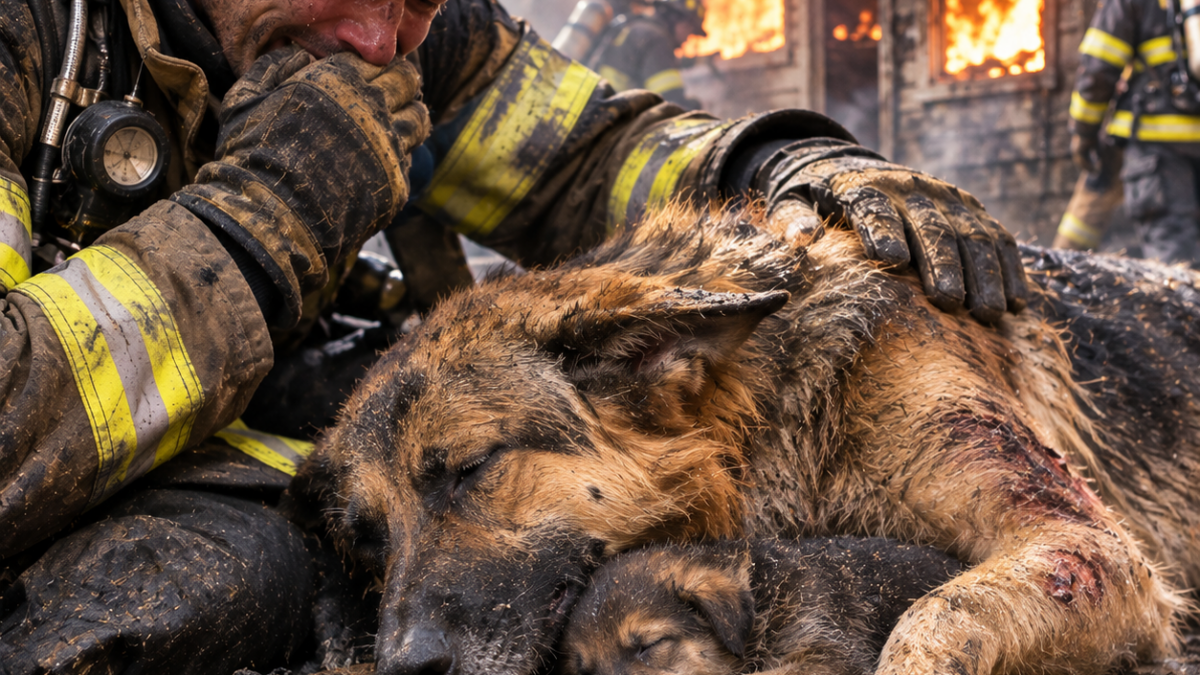
And then, through the smoke, I saw fur.
Black and tan.
A German Shepherd.
She was lying on the floor near the wall.
At first, I couldn’t understand her position.
Her back was curved.
Her legs were tucked awkwardly beneath her.
Her head faced the doorway.
Then she shifted slightly.
And I saw the puppy.
It was tiny.
Barely more than a handful of trembling fur.
The little body was tucked beneath Bella’s chest, shielded by her larger frame.
She had positioned herself between the puppy and the worst of the heat and falling debris.
The sight stopped me.
For one second, I forgot every other sound in the building.
The cracking beams.
The radio.
The water.
The alarms.
All I saw was the mother dog.
Her burned fur.
Her injured paws.
The puppy pressed against her.
She raised her head.
Her eyes were red and irritated from smoke.
She looked exhausted.
But she was conscious.
“Hey, girl,” I whispered.
Her ears moved.
I could see how hard she was breathing.
I also saw why she hadn’t come out.
The route she’d apparently used earlier was no longer clear.
Burning debris had fallen across part of the room.
The way back had become far more dangerous.
She had reached her final puppy.
Then she’d become trapped with him.
And instead of leaving the little one exposed, she’d stayed close, sheltering him beneath her body.
I felt my throat tighten.
“Bella.”
She looked toward me.
“I’m here, sweetheart.”
The puppy whimpered.
Bella lowered her head toward him.
Then looked at me again.
For one impossible moment, she gave a small movement of her tail.
Not a happy wag.
Not the excited movement of a dog greeting someone at home.
A weak motion.
Just enough to show she was still responding.
Marcus came beside me.
He saw the puppy.
Then Bella.
“Oh, God,” he whispered.
My radio crackled again.
Conditions were worsening.
We couldn’t remain there.
“Two animals located,” Marcus reported. “Preparing immediate extraction.”
We moved quickly but carefully.
Bella was badly weakened.
She couldn’t simply follow us out.
Marcus helped me position her for carrying without placing unnecessary pressure on the puppy or her injured areas.
I secured the little one separately, close enough to keep him protected.
Bella tried to move her head toward him.
Even then.
Even when she could barely lift herself.
I looked into her eyes.
“We’ve got your baby.”
My voice shook.
“We’ve got him, Bella.”
Then we started back.
I remember the next moments in pieces.
The weight of Bella.
Marcus calling out updates.
A burst of heat.
The terrible sound of stressed wood above us.
An urgent command over the radio.
We kept moving toward the exit the crew had maintained.
Then, behind us, something crashed.
A deep, violent sound.
A section of the damaged structure gave way.
I felt the vibration through the floor.
For a second, I thought the sound was coming from inside my own chest.
Marcus shouted:
“Move!”
We kept going.
The doorway appeared ahead of us.
Gray light.
Cold air.
The outline of another firefighter reaching toward us.
Then we were outside.
I stumbled onto the wet ground.
Hands reached for Bella.
For the puppy.
For my equipment.
The cold morning air struck my face when I was finally clear of the immediate danger.
I dropped to one knee.
And looked toward the dog.
She was alive.
Barely conscious.
But alive.
The sixth puppy moved inside the blanket.
Alive too.
I looked toward the farmhouse.
A portion of the roof was failing.
We had reached them during the last narrow opportunity for that rescue.
I understood how close it had been.
And then I heard June scream.
Not with fear.
With recognition.
“BELLA!”
June was moving toward us before anyone could stop her.
She still wore her thin nightgown beneath a blanket a paramedic had wrapped around her shoulders.
Her feet had finally been covered with borrowed shoes.
One shoe was too large.
The other was muddy.
She looked impossibly small against the fire trucks.
But when she saw Bella lying on the rescue blanket, she moved with a determination that made every firefighter nearby step aside.
“Bella!”
A paramedic gently reminded her to give the responders room.
June stopped.
Her hands trembled.
She stared at the dog.
Then at the tiny puppy being assessed nearby.
“Is he alive?”
I nodded.
“Yes, ma’am.”
Her face crumpled.
“Both of them?”
“Yes.”
She covered her mouth.
For several seconds, she couldn’t make a sound.
Then she began crying.
It wasn’t the quiet kind of crying people do when they’re trying to remain composed.
It came from somewhere so deep that I looked away to give her a little privacy.
Bella lifted her head weakly.
Her eyes moved toward June.
The old woman’s knees began to buckle.
I helped steady her while another responder brought a chair.
June sat.
Reached carefully toward Bella.
And placed two trembling fingers against the dog’s uninjured cheek.
“Baby.”
Her voice broke.
“Oh, my sweet girl.”
Bella’s tail moved.
Just once.
June began sobbing harder.
“You came back.”
She looked toward the rescued puppy.
Then toward Bella again.
“You got them all.”
The dog lowered her head.
She was exhausted.
Her breathing was labored.
The fur across portions of her back and legs was singed.
Her paws were injured, and she needed urgent veterinary treatment for burns and smoke exposure.
But she was alive.
June leaned closer.
Then whispered something I would remember for the rest of my career.
“I told you that you deserved better, sweetheart.”
Her hand moved gently along Bella’s head.
“You see? You see how much you matter?”
Bella’s eyes remained on her.
And for one moment, with a burning house behind us and freezing mud beneath our boots, the entire scene seemed to become quiet.
A woman.
A dog.
Six puppies.
And the simple fact that they were still together.
The veterinary emergency team was contacted immediately.
The puppies needed evaluation too.
Even the ones who appeared relatively unharmed could have been affected by smoke and heat.
Nobody assumed that a puppy was safe simply because he was crying or moving.
The five Bella had carried outside were kept warm and monitored while arrangements were made to transport them.
The last little one was assessed separately.
He was weak.
Trembling.
But responsive.
I crouched beside the blanket.
He was small enough that his entire body fit inside my two cupped hands.
His eyes weren’t fully open.
His nose was dark.
His paws looked almost transparent against the white towel.
I watched his chest rise and fall.
Then I looked toward Bella.
She was resting on her side while the responders prepared her for transport.
I thought about the room where we’d found them.
The burning debris.
The heat.
The way her body curved around him.
And I felt something inside me break.
I had spent seven years responding to emergencies.
I’d learned to keep moving when my hands wanted to shake.
I’d learned to focus on the next task.
I’d learned that sometimes you had to put emotion aside until the work was done.
But looking at that puppy, I couldn’t stop imagining what might have happened if Bella had left him.
I knew I couldn’t prove that her positioning alone had saved his life.
There were many factors we couldn’t reconstruct.
But I’d seen where he was.
I’d seen how she sheltered him.
And I knew she had stayed beside him when escape had become impossible.
I pressed my gloved hand against the ground.
For a moment, I couldn’t stand.
Marcus crouched beside me.
“You okay?”
I looked at him.
Then toward Bella.
“No.”
He nodded.
“Me neither.”
We stayed there for several seconds.
Then Aaron called us back to our duties.
The fire was still burning.
There were hazards to control.
People to account for.
Equipment to manage.
And June’s entire home was disappearing in front of us.
There would be time to cry later.
At least, that was what I told myself.
The rest of the fire seemed to pass in a blur.
The crew worked to control the remaining flames and protect the surrounding area.
The roof continued to deteriorate.
Part of the old farmhouse collapsed inward.
By the time the fire was under control, much of the building was beyond saving.
I stood near the driveway looking at the ruins.
Smoke curled from blackened beams.
The porch had disappeared.
Water and ash covered the ground.
A window frame hung at an impossible angle.
I tried to imagine the house before the fire.
A warm kitchen.
A table with two chairs.
A kettle near the stove.
Bella lying beside June’s feet.
Six tiny puppies sleeping near their mother.
Then I looked toward the ambulance where June was receiving care.
She’d lost nearly everything inside the house.
But her eyes kept turning toward the vehicle that had taken Bella to the veterinary clinic.
For a while, I couldn’t understand it.
How could someone lose a lifetime of possessions and think only about a dog?
Then I remembered the way June had called Bella her daughter.
Not as a joke.
Not as a sentimental exaggeration.
As the clearest explanation she could give for the bond between them.
And I began to understand.
When a person has already lost enough, love becomes the thing they cannot bear to lose again.
Later that day, June told me what had happened before we arrived.
She was sitting in a temporary shelter arranged by neighbors and emergency volunteers.
Someone had brought her clean clothes.
A warm blanket covered her knees.
Her hands were wrapped around a cup of tea she hadn’t touched.
I sat across from her.
At first, she didn’t speak.
Then she looked toward the window.
“She woke me up.”
I leaned forward.
“Bella?”
June nodded.
“Before the smoke alarm. Before I understood anything was wrong.”
Her voice trembled.
“She kept coming to the side of my bed and nudging me.”
I listened.
June continued:
“I thought she needed to go outside.”
She gave a sad little laugh.
“She had six babies in the back room. She didn’t want to leave them.”
I looked down.
“Then what happened?”
“I smelled smoke.”
Her fingers tightened around the cup.
“At first, I thought somebody had lit a fire outside. Then I heard something cracking.”
She closed her eyes.
“The hallway was full of smoke.”
I swallowed.
“I tried to get to the puppies.”
Her face crumpled.
“Bella was already moving toward them.”
June took a shaking breath.
“I opened the back door. I thought if I could get out, she’d follow.”
She looked at me.
“She didn’t.”
For several seconds, she stared at her hands.
Then whispered:
“She went back into the room.”
I waited.
June described the first puppy.
Bella emerged through the smoke with a tiny body held carefully in her mouth.
June had barely managed to take the little one before Bella turned around.
“Wait,” June had cried.
But Bella was already going back.
The second puppy came out.
Then the third.
Each time, June moved the babies farther from the burning house and returned to the doorway.
Each time, Bella appeared again.
Her fur became darker with soot.
Her breathing louder.
Her movements less certain.
But she kept going.
The fourth puppy emerged while flames were moving across part of the hallway.
June remembered Bella lowering him near the doorway.
Then turning toward the smoke before she could stop her.
The fifth came out after a frightening delay.
By then, June could barely see the entrance through the smoke.
She was coughing.
Her eyes burned.
Her legs shook from cold and fear.
Bella appeared carrying another puppy.
June took him.
Then Bella looked toward the house.
June knew there was still one inside.
She tried to reach for the dog’s collar.
“Bella, no!”
But Bella turned.
And went back for the sixth time.
June’s voice broke.
“That was the last time I saw her before you arrived.”
I stared at her.
She covered her face.
“I kept calling.”
I moved my chair closer.
“But she didn’t come.”
Her shoulders shook.
“I could hear her barking inside.”
I swallowed.
“June.”
She looked up.
“I tried to go after her.”
My stomach tightened.
“The neighbor stopped me.”
I closed my eyes.
“He said the house was too far gone.”
June began crying again.
“I knew he was right.”
Her voice broke.
“But I couldn’t stop thinking that she was in there.”
I reached for her hand.
She held it tightly.
Then whispered:
“I thought I’d sent my girl to die.”
For a long time, I couldn’t answer.
Because there was no sentence that could make that memory harmless.
No easy reassurance.
No promise that she would forget.
Finally, I said:
“June, Bella made it out.”
She looked at me.
“She did.”
“And all six puppies are receiving care.”
June nodded.
Tears rolled down her cheeks.
I squeezed her hand.
“We’re going to take the next part one day at a time.”
She lowered her head.
Then whispered:
“That’s what Bella deserves.”
I learned more about June during that conversation than I expected.
She had lived in the farmhouse for nearly forty years.
Her husband, Walter, had died six years earlier after a long illness.
They had never had children.
They’d raised chickens.
Grown vegetables.
Kept a few animals.
And built their lives around the little house on the hillside.
June told me the roof had always leaked near the kitchen window.
Walter used to joke that the house wanted to join the river.
They never had enough money to fix every problem at once.
But they made it comfortable.
After Walter died, the farmhouse became painfully quiet.
June kept a radio playing in the mornings.
She left one lamp on in the evenings.
Sometimes she spoke aloud just to hear another voice.
Then a neighbor told her about a young German Shepherd needing a home.
Bella arrived as an awkward puppy with enormous ears and a habit of stealing dish towels.
“She ate one of Walter’s old slippers,” June said, smiling through tears.
I laughed softly.
“She sounds like trouble.”
“She was.”
June looked toward the window.
“The best trouble I ever had.”
Bella grew into a strong, intelligent dog.
She followed June through the garden.
Waited beside the porch while she watered flowers.
Barked when trucks arrived.
Slept at the foot of her bed.
And somehow made the little farmhouse feel inhabited again.
June didn’t tell me Bella had replaced Walter.
She hadn’t.
No animal could replace a husband she’d loved for more than thirty years.
But Bella gave June a reason to get up.
A reason to walk outside.
A reason to laugh.
A reason to be needed.
When Bella had puppies, June rearranged the back room to keep the mother and babies comfortable.
She placed clean blankets beneath them.
Checked the room constantly.
And spent hours sitting nearby, watching Bella care for her litter.
“She was so proud,” June whispered.
I smiled.
“Proud?”
June nodded.
“She’d look at me whenever one of them made a noise.”
Her eyes filled.
“Like she wanted me to know she’d heard it first.”
I laughed.
Then June began crying.
“I thought I’d have all winter with them.”
I looked down.
Now the winter had taken her house.
Nearly all her belongings.
And almost taken Bella.
I didn’t know what to say.
Then June looked toward me.
“Owen?”
“Yes, ma’am?”
“Will you tell me something?”
“Of course.”
She swallowed.
“When you found her…”
Her voice broke.
“Was she trying to get out?”
I thought about the room.
The debris.
The puppy beneath her chest.
Bella looking toward the doorway.
I took a slow breath.
“She was trapped by the conditions inside.”
June nodded.
I continued:
“She was conscious. She was protecting the last puppy when we reached them.”
Tears filled her eyes.
“She didn’t leave him.”
“No.”
I swallowed.
“She stayed with him.”
June closed her eyes.
Then whispered:
“That’s my girl.”
The veterinary clinic was forty minutes from June’s farm.
I went there that evening after finishing the incident paperwork and checking on the remaining fire operations.
My uniform smelled faintly of smoke despite the precautions we’d taken.
My shoulders ached.
There was a bruise developing along one hip.
And every time I closed my eyes, I saw the same image.
Bella lying over her puppy.
I couldn’t stop thinking about the way she’d looked at me.
I had seen frightened animals before.
Cats hiding under burned furniture.
Dogs barking from locked rooms.
Horses panicking near smoke.
Fear looked different in every animal.
Bella had been frightened.
Injured.
Exhausted.
But when we’d reached her, she’d barely moved away from the puppy.
I couldn’t know what was happening in her mind.
Still, the memory wouldn’t leave me alone.
When I arrived at the clinic, a veterinary technician led me into a small waiting room.
A woman in blue scrubs approached.
“Are you Owen?”
“Yes.”
“I’m Dr. Hannah Parker. I’ve been treating Bella.”
My heart began pounding.
“How is she?”
The veterinarian took a breath.
“She survived the transport, and we’ve begun treatment for burns and smoke exposure.”
I swallowed.
“Is she going to make it?”
Dr. Parker looked at me carefully.
“She’s very sick, Owen.”
I closed my eyes.
“She has injured paws, damaged areas of skin, and significant respiratory concerns. We’re providing oxygen support, medication, wound care, and close monitoring.”
I nodded.
“Can I see her?”
“Briefly, once the team confirms it’s appropriate.”
I looked toward the treatment area.
“And the puppies?”
“All six are alive.”
I exhaled.
Dr. Parker continued:
“They’ve been assessed and are being monitored. The smallest puppy—the one you recovered with Bella—is doing better than we feared, but all of them need attentive care.”
I sat down.
For a moment, my legs wouldn’t hold me.
Six.
All six.
A mother had carried five outside and stayed with the last.
Our crew had brought them out.
And now, inside a clinic far from the burning farmhouse, there were seven living animals receiving the chance to recover.
I covered my face.
Dr. Parker waited.
Then said gently:
“Owen, it’s all right.”
I shook my head.
“No.”
My voice cracked.
“Not yet.”
She nodded.
“You’re right. There’s still a lot we don’t know.”
I looked up.
She continued:
“But they’re here. And we’re doing everything we reasonably can for them.”
That was the first moment I allowed myself to feel how much I wanted Bella to live.
Not for a headline.
Not because I’d entered a burning building.
Because June had already lost her home.
And I couldn’t bear imagining her losing the dog she loved most.
I saw Bella through the treatment-room doorway.
She lay on padded bedding beneath a light blanket.
Her body looked smaller than it had inside the house.
Without the smoke.
Without the flames.
Without the urgency of the rescue.
She was simply an injured mother dog.
Her paws were protected with veterinary dressings.
Parts of her coat had been clipped for treatment.
Her breathing required careful monitoring.
She looked exhausted.
I stopped.
For several seconds, I couldn’t speak.
Then I whispered:
“Hey, girl.”
One ear moved.
I took a step closer only after the technician indicated it was appropriate.
Bella opened her eyes.
For a moment, she looked toward me.
Then rested her head again.
I crouched beside her.
“It’s Owen.”
My voice shook.
“Remember me?”
Of course, she couldn’t understand the question the way a person would.
I knew that.
But I said it anyway.
“We met this morning.”
Her eyes moved slightly.
I swallowed.
“You did something amazing.”
The technician stood nearby.
I looked at Bella’s injured paws.
Then at the scarred patches along her back.
I felt tears roll down my face.
“You got them out, sweetheart.”
I lowered my hand near her head, allowing her to decide whether she wanted contact.
She didn’t pull away.
I touched the uninjured fur behind her ear.
Just once.
Then I whispered:
“Now let us take care of you.”
Bella closed her eyes.
I remained there until the technician told me she needed more rest.
Then I stepped away.
And cried in the hallway.
June arrived the following morning.
A neighbor drove her.
She wore borrowed jeans, a thick sweater, and a winter coat that hung loosely from her shoulders.
Her hair had been combed.
But her eyes looked tired.
I met her outside.
She took one look at my face and stopped.
“Owen?”
I shook my head quickly.
“She’s still with us.”
June pressed a hand against her chest.
“Oh, thank God.”
I moved closer.
“The veterinarian will explain everything.”
June nodded.
Then asked:
“Can I see her?”
“Yes.”
I walked beside her into the clinic.
Dr. Parker met us.
She explained Bella’s condition in language June could understand.
The injuries.
The treatment.
The concerns about her breathing.
The risk of infection.
The need for continued monitoring.
June listened without interrupting.
Then asked:
“Is she in pain?”
Dr. Parker answered honestly.
“She has painful injuries. We’re treating that and watching her closely.”
June’s face crumpled.
“Can you help her?”
“We’re doing everything appropriate to give her the best chance of recovery.”
I watched June.
She nodded slowly.
Then whispered:
“Can I talk to her?”
Dr. Parker smiled gently.
“Yes.”
When June entered the treatment room, Bella lifted her head.
Not far.
Just enough.
But June stopped as though the whole world had shifted.
“Bella?”
The dog’s ears moved.
June began crying.
“Oh, my girl.”
She approached slowly.
The technician guided her to a safe place beside the bedding.
June knelt.
Then touched Bella’s cheek.
“It’s Mama.”
I looked away.
Her voice trembled.
“I’m here, sweetheart.”
Bella’s tail moved beneath the blanket.
June pressed her free hand against her mouth.
Then whispered:
“You don’t have to go anywhere.”
She stroked Bella’s head.
“You hear me?”
Her tears fell onto the blanket.
“You’ve done enough.”
For a long time, she stayed beside the dog.
Talking softly.
Not about the fire.
Not about the house.
About ordinary things.
The garden.
The old apple tree.
The favorite place Bella liked to sleep.
The way the puppies used to squeak when June came into the room.
I stood near the doorway listening.
And I realized something that still matters to me.
When June spoke to Bella, she wasn’t speaking to a heroic animal from a dramatic rescue.
She was speaking to her family.
The dog who waited for her in the mornings.
The dog who followed her across the yard.
The dog who had shared her quiet life after Walter died.
The fire had made Bella remarkable to strangers.
But she had been remarkable to June long before anybody knew her name.
The puppies needed round-the-clock care too.
Bella wasn’t yet well enough to nurse and tend them normally.
The veterinary team arranged suitable feeding, warmth, and monitoring while assessing when supervised contact with their mother might be possible.
June worried constantly.
“Will they forget her?”
Dr. Parker reassured her that the team would carefully support the mother-puppy relationship as Bella recovered, while prioritizing everyone’s medical needs.
The puppies were small.
Demanding.
Surprisingly loud for creatures that weighed so little.
They moved against one another like a restless pile of black-and-tan fur.
The smallest one was easy to recognize.
He had a little white mark beneath his chin.
When I first saw him in the clinic, he was sleeping with his nose pressed against the blanket.
I thought about the room where we’d found him.
How Bella had curled around him.
How close everything had come to ending.
I asked whether I could see him.
A technician brought me near the area where the puppies were being cared for.
I crouched beside the enclosure.
The little one lifted his head.
Opened his mouth.
And made a tiny sound.
I began laughing.
“Hey, buddy.”
He wiggled.
Then settled again.
I looked toward June.
She was smiling for the first time since the fire.
“That one,” she whispered.
I nodded.
“The last one.”
She reached carefully toward the blanket as the technician guided her.
“He was always the smallest.”
I looked up.
“Really?”
June nodded.
“He was the last to settle when Bella lay down.”
Her voice softened.
“He always seemed to want to be closest to her.”
I swallowed.
Then looked back at the puppy.
Maybe that was why she’d gone back.
Maybe she’d heard him.
Maybe she’d known one baby was missing.
We couldn’t reconstruct every second.
But we knew she had returned to the burning room.
And we’d found him tucked beneath her.
June looked toward the treatment room where Bella was resting.
Then whispered:
“She wouldn’t let him be alone.”
I didn’t answer.
I couldn’t.
The first week of Bella’s recovery was difficult.
Some mornings brought encouraging news.
Her breathing seemed a little easier.
She tolerated treatment.
Her temperature remained stable.
Then another day would bring renewed concern.
A wound needed closer attention.
She was too tired to eat much.
Her lungs required continued monitoring.
June learned to live between telephone calls.
Every ring made her sit upright.
Every delay made her imagine the worst.
I called as often as I could.
Sometimes I visited after work.
Other times, I simply checked whether the clinic needed supplies or whether June had transportation.
I didn’t pretend I could solve her grief.
I couldn’t.
But I could show up.
One afternoon, I found June sitting in the waiting room holding a small photograph.
I recognized Bella.
She was younger.
Standing beside a garden bed full of yellow flowers.
Her ears were straight.
Her coat glossy.
She looked proud.
June handed me the picture.
“Walter would’ve loved her.”
I sat beside her.
“Did he ever meet Bella?”
She shook her head.
“He died before I adopted her.”
I looked at the photograph.
June continued:
“He used to say our house needed a dog.”
I smiled.
“Sounds like he was right.”
She nodded.
“After he died, I couldn’t bear the quiet.”
Her voice trembled.
“I kept the radio playing all day.”
I looked toward her.
“Then Bella came.”
June smiled through tears.
“She chewed the corner of my favorite chair.”
I laughed.
“Sounds familiar.”
“She dug up half my flower bulbs.”
I smiled.
“And once she dragged a muddy blanket straight into the kitchen after I’d cleaned the floor.”
June began laughing.
Then crying.
I waited.
She looked down at the photograph.
“I was angry with her that day.”
Her voice broke.
“I told her she was the worst dog in the world.”
I smiled faintly.
“I doubt she believed you.”
June shook her head.
“No.”
She wiped her eyes.
“She came over and put her head in my lap.”
For several seconds, she couldn’t speak.
Then whispered:
“I wish I could have that messy kitchen back.”
I looked down.
The old farmhouse was gone.
The muddy blanket.
The chair Bella had chewed.
The kitchen floor June had scrubbed.
All those ordinary things.
Gone.
And I understood that June wasn’t only grieving a building.
She was grieving the place where the happiest parts of her life had happened.
I reached for her hand.
“I’m sorry.”
She nodded.
Then looked toward Bella’s photograph.
“Just let me have my girl.”
Her voice broke.
“That’s all I want.”
Meanwhile, the community had begun doing something remarkable.
The same neighbor who reported the smoke started collecting clothing and household necessities for June.
A family from the next valley offered temporary accommodation.
The church organized meals.
A local contractor volunteered to inspect what remained of the property.
Another neighbor helped June begin contacting the appropriate agencies about the fire damage.
People who hadn’t spoken to her in months arrived carrying groceries, winter boots, bedding, and photographs they’d taken at old community gatherings.
The response surprised June.
She had always been independent.
She didn’t like asking for help.
One afternoon, she called me.
“Owen?”
“Yes, ma’am?”
“Do you know anything about a truck parked outside Mrs. Carson’s house?”
I hesitated.
“What kind of truck?”
“Full of furniture.”
I smiled.
“Maybe somebody’s moving.”
She sighed.
“Don’t you start.”
I laughed.
“Start what?”
“Pretending you don’t know everybody’s trying to give me things.”
I was quiet.
June continued:
“I don’t need people spending their money on me.”
I looked toward the station parking lot.
“June, you lost your home.”
“I know that.”
“And people want to help.”
She sighed.
“I’ve never liked being a burden.”
I took a breath.
“Can I tell you something?”
“Yes.”
“When we answered that fire, nobody asked whether your life was important enough to save.”
She went quiet.
I continued:
“People are helping because you matter to them.”
Her voice cracked.
“I’ve never been very good at accepting that.”
I smiled sadly.
“Neither have I.”
For a long moment, neither spoke.
Then June said:
“Would it be rude if I made everybody tea?”
I laughed.
“No, ma’am.”
“Good. Because I can’t just sit here while people carry furniture around.”
I smiled.
“Then make tea.”
And that was how June began contributing to the rebuilding effort.
Not by carrying lumber.
Not by lifting furniture.
By putting on a kettle whenever someone came through the door.
By remembering everybody’s name.
By thanking the people who helped.
And by slowly allowing herself to believe she deserved their kindness.
On the tenth day, Bella stood for the first time since her rescue.
Not by herself.
Not without veterinary support.
But she managed to bear weight carefully for a brief period while the team assessed her comfort and mobility.
Dr. Parker called June.
I happened to be sitting beside her when the phone rang.
She answered.
Listened.
Then covered her mouth.
I leaned forward.
“What?”
June shook her head.
Tears filled her eyes.
“What happened?”
She looked at me.
“Bella stood up.”
I stared.
Then smiled.
“She did?”
June nodded.
The tears spilled down her cheeks.
“She stood.”
I felt my own eyes fill.
For days, I’d pictured the dog lying in smoke.
Too weak to move.
Now she had stood.
It wasn’t a guarantee.
Her injuries still needed time.
Her breathing still required care.
But it was progress.
June hung up.
Then took my hands.
“She stood, Owen.”
I nodded.
“I heard.”
She began laughing and crying at the same time.
I smiled.
“Looks like your girl still has some fight left.”
June shook her head.
“Oh, honey.”
She looked toward the window.
“She has always had more fight than the rest of us.”
The first supervised reunion between Bella and her puppies happened after the veterinary team determined she was stable enough.
June and I were allowed to watch from a respectful distance.
The staff remained close.
Bella lay on clean bedding.
Her wounds were protected.
Her breathing was being monitored.
She looked thinner than before.
Her coat had patches where the fur had been clipped.
Some areas were healing with pink new skin.
But when the puppies began making their familiar little sounds, her ears lifted.
I felt my heart pounding.
The first puppy approached.
Bella lowered her nose.
Sniffed him.
Then began licking his head.
June covered her mouth.
The second puppy moved closer.
Then the third.
The little bodies shifted around their mother as the team supervised the reunion and managed their feeding needs.
Bella’s tail moved against the bedding.
Slowly.
Once.
Then again.
June began crying.
I put an arm around her shoulders.
She leaned toward me.
For several minutes, neither of us spoke.
Then the smallest puppy moved from behind the others.
The one we’d found beneath Bella.
The one with the white mark under his chin.
He approached her slowly.
Bella lifted her head.
Sniffed him.
Then lowered her nose toward his face.
He pressed against her.
And settled.
I couldn’t breathe.
I remembered the fire.
The room.
The heat.
The way we’d lifted them out together.
Now they were lying beside one another in a warm veterinary clinic.
No smoke.
No flames.
No burning debris.
Just a mother and her puppies.
June whispered:
“She knows him.”
I looked at her.
I couldn’t say exactly what Bella remembered or recognized.
But I watched the way she settled beside the smallest puppy.
The way her ears relaxed.
The way her tail moved.
And I understood why June was crying.
Bella was alive.
Her puppies were alive.
And for the first time since the fire, they could rest together without danger surrounding them.
I looked toward Dr. Parker.
She was smiling.
Then she glanced at me.
I wiped my eyes.
“Sorry.”
She shook her head.
“Don’t be.”
I looked back at Bella.
And for one brief moment, I felt that everything we’d endured had led us to something worth seeing.
The second week brought a different kind of progress.
Bella began showing more interest in her food.
Her wounds continued healing.
She could rest more comfortably.
And her breathing improved enough for the team to adjust her care.
But recovery wasn’t simply a matter of the calendar moving forward.
There were still difficult mornings.
Dressing changes.
Careful examinations.
Follow-up concerns.
And moments when June looked at her dog and saw how much the fire had taken from her.
One day, Bella flinched when a door slammed nearby.
June’s face changed.
“She never used to do that.”
Dr. Parker watched Bella settle.
“She’s recovering from a frightening event, June. We should give her time and keep the environment predictable.”
June nodded.
Then looked at me.
“Do you think she’ll ever be the same?”
I considered the question.
I knew better than to promise that everything would return to how it had been.
The old farmhouse was gone.
Bella’s injuries might leave permanent marks.
The puppies were growing.
June’s life had changed.
I took a breath.
“Maybe not exactly the same.”
Her eyes filled.
I continued:
“But she can still have a good life.”
June looked toward Bella.
The dog had lifted her head.
She was watching one of her puppies explore the edge of a blanket.
June smiled faintly.
“I suppose that’s what matters.”
I nodded.
“It is.”
At the end of the third week, Dr. Parker called with the news we’d been hoping to hear.
Bella was ready to leave the clinic under a carefully planned home-care arrangement.
Her injuries had improved significantly.
She still needed monitoring and follow-up.
She would need a safe, calm environment and protection from activities that could interfere with healing.
But the most difficult part of her early recovery was behind her.
When June heard, she sat down.
Then began crying.
I was at the fire station when she called me.
“Owen.”
Her voice trembled.
“What happened?”
“She can come home.”
I closed my eyes.
For a second, I couldn’t speak.
“Bella?”
“Yes.”
June laughed through tears.
“My girl can come home.”
I looked toward Marcus, who was checking equipment across the bay.
He noticed my face.
Raised his eyebrows.
I gave him a thumbs-up.
He smiled.
Then I turned back to the phone.
“June, that’s wonderful.”
She began crying harder.
I heard her take a breath.
Then she whispered:
“But I don’t have a home.”
The words stopped me.
I looked toward the fire engine.
The polished equipment.
The familiar walls.
Then I remembered the blackened farmhouse.
The collapsed roof.
The place where June had spent nearly forty years.
I swallowed.
“June.”
She was crying.
“I know everybody’s helping. I know I should be grateful.”
“You are grateful.”
“But I keep thinking…”
Her voice broke.
“Bella’s going to come home, and there’s no home left for her to recognize.”
I closed my eyes.
For a moment, I couldn’t find an answer.
Then I said:
“June, Bella’s home has always included you.”
She went quiet.
I continued:
“She’ll have a safe place to rest. We’ll help make sure of that.”
I swallowed.
“And when the new house is ready, she’ll have that too.”
June began crying again.
I rested my hand against the truck.
Then whispered:
“One day at a time.”
She took a shaky breath.
“One day at a time.”
We brought Bella out of the veterinary clinic on a bright morning at the end of January.
The air was cold.
But the sky was clear.
Sunlight fell across the parking lot.
June stood beside the vehicle that would take Bella to her temporary home.
She wore a warm green coat someone had given her.
Her hair was neatly pinned.
Her hands shook with anticipation.
I stood nearby.
Marcus had come too.
So had Barbara, one of the neighbors who’d organized supplies.
When the clinic staff brought Bella out, June stopped breathing for a moment.
The dog moved slowly.
Her paws were still sensitive.
Her coat looked uneven.
A healing mark remained along her back.
But she was walking.
Walking toward June.
“Bella.”
The dog lifted her head.
Her ears moved.
June knelt carefully.
“My baby.”
Bella approached.
Then rested her head against June’s chest.
The old woman wrapped her arms gently around the dog’s shoulders, mindful of the healing areas.
And began crying.
I looked away.
Marcus stood beside me.
He cleared his throat.
Then whispered:
“Man.”
I nodded.
“Yeah.”
June stroked Bella’s head.
“You came back to me.”
Bella’s tail moved.
The smallest puppy was brought nearby in a secure carrier with the others, under the rescue and veterinary arrangements that would allow the family to remain together safely.
Bella glanced toward the familiar sounds.
Then looked back at June.
I smiled.
Everything she had searched for inside the burning house was now outside it.
Alive.
Growing.
Waiting.
June lifted her face.
Her eyes found mine.
“Owen?”
I stepped closer.
“Yes, ma’am?”
She took my hand.
For a moment, she simply held it.
Then she whispered:
“You brought my girl home.”
I shook my head.
“Our whole crew helped.”
She nodded.
“I know.”
Her eyes filled.
“But you found her.”
I swallowed.
I remembered the smoke.
The tiny whimper.
Bella lying over her puppy.
Her weak tail moving.
I looked at June.
Then whispered:
“She gave us something to find.”
June smiled through tears.
Then turned back to her dog.
And for the first time since the fire, her face looked peaceful.
A month after the fire, I went to visit June.
She was staying in a small house belonging to a neighbor’s family while work continued on the plans for rebuilding.
It wasn’t a grand place.
Two bedrooms.
A narrow kitchen.
A living room with faded curtains.
But it was warm, and there was space for Bella and the puppies under the arrangements the veterinarian had helped June establish.
When I knocked, June opened the door wearing a blue cardigan.
Her face lit up.
“Owen!”
I smiled.
“Morning, June.”
She stepped aside.
“Come in, come in.”
The house smelled of tea and freshly baked bread.
A knitted blanket rested over the back of the sofa.
Near the window stood a large, comfortable bed for Bella.
I looked toward it.
Empty.
My heart tightened.
“Where’s the girl?”
June laughed.
“Probably making trouble.”
Then I heard paws on the wooden floor.
Bella appeared from the hallway.
She stopped when she saw me.
For a moment, I couldn’t move.
The dog looked different.
Not completely healed.
Not entirely back to her old strength.
But her eyes were bright.
Her ears stood upright.
Her tail began moving.
“Bella.”
I crouched.
She approached slowly.
Sniffed my hand.
Then leaned toward me.
I stroked the fur along her uninjured shoulder.
“Hey, sweetheart.”
Her tail moved faster.
June stood behind her smiling.
“She remembers you.”
I laughed softly.
“Maybe she remembers the smell of my uniform.”
June shook her head.
“No.”
She watched Bella rest her head near my knee.
“I think she remembers kindness.”
My throat tightened.
I didn’t argue.
I simply remained beside the dog.
For a long moment, I looked at the healing patches along her body.
The fur was beginning to grow back.
Some places remained thinner.
One small area along her back would probably always show evidence of the fire.
But Bella didn’t seem concerned about the scar.
She was interested in my hand.
The smell of my jacket.
And the possibility that I might have brought something good to eat.
I laughed.
“Sorry, girl. No treats today.”
June smiled.
“Don’t worry. She’s already had breakfast.”
Bella looked toward her.
Her tail moved.
I shook my head.
“Still hungry?”
June laughed.
“Always.”
It was the most beautiful ordinary conversation I’d had in weeks.
June brought me tea.
We sat at the kitchen table.
Bella lay beside her chair.
The puppies were nearby in a safe, warm area.
They were growing quickly.
Their ears were changing shape.
Their legs seemed too long for their bodies.
They had discovered that blankets could be climbed, toys could be dragged, and siblings could be used as pillows.
The smallest puppy was easy to recognize.
He still had the white mark beneath his chin.
Whenever Bella moved, he watched her.
When she settled, he approached.
Then lay close enough to touch her.
June smiled.
“That one still thinks he belongs underneath his mother.”
I laughed.
“Can’t blame him.”
She looked down.
“No.”
Her voice softened.
“He found the safest place in the world.”
I watched Bella lower her head near him.
The puppy pressed against her.
I thought about the fire.
The burning room.
The debris.
The way Bella had curved her body around the little creature.
Now, in this warm kitchen, the same movement looked almost ordinary.
A mother settling beside her baby.
I felt tears gather.
June noticed.
She reached for my hand.
“Owen?”
I smiled weakly.
“I’m okay.”
She studied my face.
Then said:
“You’ve been thinking about that morning.”
I nodded.
“Every day.”
She was quiet.
Then asked:
“Does it frighten you?”
I looked toward Bella.
“Yes.”
June waited.
I swallowed.
“I’ve been in dangerous buildings before.”
She nodded.
“I know.”
“But I keep remembering how close we came.”
Her expression softened.
“The roof?”
I nodded.
“And Bella.”
I looked down.
“If Marcus and I had reached that room later…”
My voice broke.
June squeezed my hand.
“You don’t have to finish.”
I closed my eyes.
For several seconds, I couldn’t speak.
Then I whispered:
“I thought we were going to lose them.”
June nodded.
“I thought so too.”
I looked at her.
She continued:
“But we didn’t.”
Her voice trembled.
“We didn’t, Owen.”
I glanced toward Bella.
The dog was asleep.
Her little puppy rested beside her.
June smiled through tears.
“And that’s what I’m trying to remember.”
I swallowed.
She continued:
“Not only the fire.”
I looked up.
“The day she came home.”
“The first time she ate properly.”
“The morning she stood again.”
“The way she looks at her puppies.”
Her eyes filled.
“I don’t want the worst morning of her life to become the only thing I remember about her.”
I stared at June.
Then looked toward Bella.
The dog was breathing quietly.
Safe.
Resting.
Loved.
And I realized June had given me something I hadn’t known I needed.
Permission to remember the rescue without living forever inside the danger.
We walked outside later that afternoon.
The ground was damp.
The air smelled of winter grass.
Bella moved slowly beside June, with her activity limited according to the veterinary recovery plan.
I stayed near them.
The neighbor’s yard was enclosed, and the puppies remained safely supervised indoors.
June stopped near the fence.
Looked toward the distant hills.
Then said:
“I used to think our farmhouse was the only place I could be happy.”
I glanced at her.
She smiled sadly.
“Walter built the kitchen shelves himself.”
I nodded.
“He wasn’t a very good carpenter.”
I laughed.
June continued:
“One shelf leaned so badly I could only put light things on it.”
Her eyes filled.
“I kept telling him to fix it.”
“What did he say?”
She smiled.
“That it gave the room character.”
I laughed.
She looked toward Bella.
“For years after he died, I wouldn’t let anybody touch it.”
I swallowed.
Then June looked toward the hills again.
“When the house burned, I thought I’d lost him all over again.”
For a moment, neither of us spoke.
Then she took a breath.
“But I still remember how he laughed.”
I nodded.
“I still remember the way he smelled after working in the garden.”
She smiled.
“And I still remember that ridiculous shelf.”
Her eyes filled.
“I suppose I don’t need the wood to keep those memories.”
I looked at her.
“No, ma’am.”
Bella moved closer.
June rested one hand gently against her neck.
Then whispered:
“And I’ve still got this girl.”
I smiled.
“You sure do.”
For a long time, we stood together beneath the pale winter sky.
A firefighter.
An elderly widow.
A German Shepherd who had nearly died protecting her puppies.
And an understanding that some things can be lost without taking everything meaningful with them.
The rebuilding effort took months.
Nobody could simply replace a destroyed farmhouse overnight.
There were inspections.
Permissions.
Materials.
Costs.
Weather delays.
And a great deal of work.
But the people in June’s valley refused to let the project disappear after the first burst of attention.
A local contractor helped coordinate the building work.
Licensed tradespeople handled the work that required their expertise.
Neighbors raised funds and contributed labor where appropriate.
Some brought meals.
Others helped with cleanup and landscaping once the site was safe.
A woman from the church organized a donation drive for household furnishings.
A retired teacher collected photographs from people who had known June and Walter.
Someone found an old picture of the original farmhouse taken during a summer festival.
June held that photograph for a long time.
Then asked if she could keep it near the front window of the new house.
Nobody objected.
Of course nobody objected.
It was her home.
Even when the walls were new, it would still stand on land filled with her memories.
I visited the construction site whenever I could.
Sometimes I helped with small tasks.
Sometimes I carried supplies.
Sometimes I simply stood beside June and watched the progress.
She brought tea.
Naturally.
And sandwiches.
And enough homemade cookies to feed three fire departments.
One Saturday, I found her standing near the unfinished front porch.
She looked up at the frame of the new roof.
Her eyes were wet.
“What’s wrong?” I asked.
She shook her head.
“Nothing.”
I smiled.
“June.”
She laughed softly.
Then whispered:
“I never thought I’d have another house.”
I looked toward the workers.
The lumber.
The tools.
The small crowd of people helping turn a plan into something real.
I swallowed.
“Looks like the valley disagreed.”
She laughed.
Then began crying.
I stood beside her.
Didn’t try to stop the tears.
Didn’t tell her she should be happy.
Sometimes gratitude and grief arrive together.
June had lost the home she’d shared with Walter.
No new building could undo that.
But the new house was being built by people who cared whether she had somewhere safe to live.
That mattered.
And I think June was slowly learning to let it matter without feeling guilty.
By early spring, Bella had recovered enough to enjoy carefully managed walks again.
Her paws had healed.
The burned areas had closed.
Most of her coat was growing back, although one small mark remained on her back.
June called it her brave spot.
Whenever she sat beside Bella in the evening, her hand would find that place.
Not pressing.
Not disturbing the skin.
Just resting gently where the fur was thinner.
Sometimes I watched.
June never spoke about the scar as though it made Bella damaged.
She spoke about it as a reminder of what her dog had survived.
The puppies grew stronger.
Their personalities began appearing.
One was cautious.
Another curious.
One loved carrying toys.
One seemed determined to sleep wherever somebody else was already lying.
The smallest puppy remained especially attached to Bella.
Even as he became bigger and more confident, he liked resting near her.
June often laughed.
“That one has never understood personal space.”
I smiled.
“Maybe he knows exactly where he likes to be.”
She looked down at him.
Then at Bella.
Her eyes softened.
“Maybe.”
As the puppies grew, June worked with veterinary professionals and trusted helpers to make sure their care, training, and living arrangements remained suitable.
Six growing German Shepherds were a great deal of responsibility.
More than one elderly woman could comfortably manage without help.
The community assisted with secure space, supplies, and practical care.
June was determined that the dogs would have a good life.
Not merely that they would remain alive.
She wanted them healthy.
Comfortable.
Confident.
And free to become the dogs they were meant to be.
After what Bella had endured, that seemed the least the world could offer her family.
When the new house was finally ready, June invited the entire neighborhood.
I arrived in the afternoon with Marcus and Aaron.
The front porch was smaller than the original one.
The roof was new.
The windows bright.
The walls still smelled faintly of fresh paint.
A little garden had been planted near the walkway.
June had chosen yellow flowers.
“Walter loved them,” she told me.
I looked toward the entrance.
Then saw something that made my throat tighten.
A small wooden sign hung beside the front door.
JUNE & BELLA’S HOME
I stared.
June smiled.
“The neighbors made it.”
I looked at her.
“It’s perfect.”
Her eyes filled.
“Isn’t it?”
Inside, the kitchen had sturdy new cabinets.
A broad window overlooked the fields.
The living room contained a comfortable chair, a bookshelf, and a fireplace.
Near the hearth lay Bella’s bed.
Not too close to the fire.
Just near enough for warmth.
June showed us every room.
The small bedroom.
The kitchen.
The pantry.
The space where she intended to keep the puppies’ supplies.
She described each detail with the excitement of someone who had been waiting months to believe she was allowed to have ordinary plans again.
Then we returned to the living room.
Bella was lying on the rug.
One of her puppies rested beside her.
I knelt.
“Hey, girl.”
Her ears moved.
She stood.
Walked toward me.
And pressed her head against my hand.
I smiled.
“Look at you.”
Her tail moved.
I glanced toward June.
The old woman was crying.
I stood.
“June?”
She shook her head.
“I’m happy.”
I smiled.
“I know.”
She looked around the room.
Then whispered:
“I never thought I’d hear her paws on a floor like this again.”
I felt my eyes fill.
Bella returned to her bed.
Circled once.
Then lay down.
June watched.
For a long moment, none of us spoke.
Then she smiled through tears.
“Well.”
She looked toward the kitchen.
“Who wants tea?”
We all laughed.
And the new house finally sounded like a home.
That evening, after the neighbors left, I stayed a little longer.
The sun was sinking behind the mountains.
The new windows reflected the last orange light.
June sat in her favorite chair.
Bella rested near the fireplace.
The puppies had settled into their sleeping area.
For a while, we listened to the quiet sounds of the house.
Then June said:
“Owen?”
“Yes, ma’am?”
“Do you remember what I said to Bella when you brought her out of the fire?”
I thought.
Then nodded.
“You told her she deserved better.”
June smiled faintly.
“I did.”
She looked toward the dog.
“Sometimes I wonder if she understood.”
I followed her gaze.
Bella was resting with her head on her paws.
I smiled.
“I don’t know.”
June nodded.
“Neither do I.”
A pause.
Then she said:
“But I think she understands this.”
I looked toward her.
“What?”
June gestured around the room.
“The quiet.”
I followed her gaze.
The warm lights.
The blankets.
The clean floor.
The puppies sleeping nearby.
Bella’s comfortable bed.
June smiled.
“She doesn’t have to fight for them anymore.”
My throat tightened.
She continued:
“She doesn’t have to run into a burning house.”
“She doesn’t have to carry them through smoke.”
“She doesn’t have to lie over them to keep them safe.”
Her voice broke.
“She can just be their mother.”
I looked toward Bella.
The dog shifted slightly.
Then settled again.
For the first time, I understood how much of the story I’d been carrying as a firefighter.
The danger.
The fire.
The rescue.
The narrow escape.
June was carrying something else.
The possibility of peace after terror.
The chance to watch Bella live a life that wasn’t defined by the morning she’d nearly died.
I smiled through tears.
“That’s a good thing, June.”
She nodded.
“The best.”
I continued responding to fires after that.
Some were small.
Others were serious.
A barn fire.
A chimney fire.
A kitchen accident that spread faster than the family expected.
A vehicle fire on a mountain road.
Each call required the same discipline.
The same equipment.
The same respect for danger.
The same commitment to work as a crew rather than act on impulse.
But something changed in me after meeting Bella.
I became more aware of the animals people left behind.
Not because I hadn’t cared before.
I had.
But now, when an owner told me there was a dog or cat inside, I thought of June standing barefoot beside the road.
I remembered her saying:
“She won’t leave them.”
I remembered the five puppies in the cardboard box.
The sixth trapped beneath Bella.
The way the mother dog’s tail had moved when I reached her.
And I remembered that behind every frightened animal might be a family who loved it deeply.
That didn’t mean every rescue was possible.
It didn’t mean we ignored structural danger or put firefighters at unreasonable risk.
The fire service cannot promise to save everything.
No one can.
But when a rescue was possible within a sound plan, I wanted to remember why the effort mattered.
Not for recognition.
Not for a photograph.
For the chance that somewhere outside, a person was waiting to see the creature they loved come home.
People in the valley sometimes called me a hero after the fire.
I never knew what to do with the word.
My crew had worked together.
The incident commander had made difficult decisions.
Marcus had stayed beside me inside the structure.
The suppression team had maintained our route.
Paramedics had cared for June.
Veterinary professionals had treated Bella and the puppies.
Neighbors had helped rebuild a home.
Nobody had done it alone.
And if there was a hero in that farmhouse, I couldn’t stop thinking about the German Shepherd who went back for her last puppy.
She didn’t understand fire tactics.
She didn’t have protective gear.
She wasn’t trained to evaluate a damaged structure.
She was a mother responding to the distress of her young.
What she did exposed her to terrible danger.
I would never want another animal forced into such a situation.
But I couldn’t forget the courage I saw in her behavior.
Not human courage.
Not the calculated choice of a firefighter.
The powerful attachment of a mother to her babies.
Something so immediate that she kept returning until the route became impossible.
And when she could no longer escape, she stayed close to the puppy she had reached.
That image remains with me.
Not because I want to remember her suffering.
Because I want to remember what it meant when we found them alive.
Years later, Bella still lives with June on the same land.
The new house has weathered its first winters.
The little garden has grown.
The porch boards have faded slightly under the mountain sun.
Bella’s puppies grew into strong dogs with personalities of their own, and with the help of their community, June has been able to keep their family together in suitable arrangements on the property.
They run through the fields.
Rest in the shade.
Explore the safe outdoor spaces.
And return to the familiar sounds of June calling them home.
The smallest puppy isn’t small anymore.
He’s grown into a handsome German Shepherd.
But he still likes staying near Bella.
Sometimes June sends me photographs.
One shows him sleeping beside his mother.
Another shows Bella standing in the field with the dogs around her.
In one, her tail is blurred because she was wagging it when June took the picture.
Every time I see that photograph, I smile.
I remember the weak movement of her tail inside the burning house.
Just once.
Then I look at the healthy dog standing in the sunshine.
And I feel grateful for the years she has been given since.
Bella still has a small scar along her back.
June says it’s the place her hand naturally finds when they’re sitting together in the evening.
She also says Bella seems to prefer resting a little distance from the fireplace.
No one can know exactly what she remembers about the fire.
Perhaps the heat or sound still makes her cautious.
Perhaps she simply likes that part of the room better.
June doesn’t try to force her closer.
She lets Bella choose where to sleep.
And I think that’s fitting.
A dog who had no choice about the danger she faced deserves to have as many ordinary choices as possible now.
Where to rest.
When to approach.
Whether to sit beside June or stretch out on the rug.
A life made of peaceful decisions.
After everything, that feels more meaningful to me than any medal or public recognition.
I visited again one late autumn afternoon.
The air was crisp.
The mountains were turning red and gold.
June met me on the porch.
Bella stood beside her.
Older now.
A little slower.
But still with those alert eyes.
“Owen!”
I smiled.
“Hello, June.”
She hugged me.
Then looked down.
“Bella, look who’s here.”
The dog approached.
Sniffed my hand.
Then wagged her tail.
I crouched carefully.
“Hey, girl.”
She leaned toward me.
I stroked her head.
“You’ve been keeping everybody in line?”
June laughed.
“Somebody has to.”
I smiled.
Then glanced toward the fields.
The grown puppies were moving through the grass beyond the garden.
One stopped.
Looked toward the house.
Then ran after another.
I watched them.
For a moment, I saw the five newborns in the cardboard box.
The sixth beneath Bella’s chest.
The trembling little bodies wrapped in towels.
I felt my throat tighten.
June noticed.
She took my arm.
“You’re thinking about that morning.”
I nodded.
“Always.”
She looked toward the dogs.
Then smiled.
“Look at them now.”
I did.
Really looked.
Healthy animals moving through a field beneath a clear sky.
A mother dog resting beside the woman who loved her.
A new home standing where ashes had once covered the ground.
I took a slow breath.
Then whispered:
“Worth every second.”
June squeezed my arm.
For a while, we simply stood together.
Watching the dogs.
Listening to the wind.
Letting the ordinary beauty of the afternoon be enough.
That evening, June insisted I stay for dinner.
She made soup.
Fresh bread.
Apple pie.
Far more food than two people could reasonably eat.
Afterward, we sat near the fireplace.
Bella settled beside June’s chair.
Her smallest puppy—now a large, strong dog—lay nearby.
June looked down at them.
Then smiled.
“She still checks on him.”
I laughed.
“Does she?”
“Every day.”
I watched Bella lift her head when the younger dog shifted.
Then lower it again when he settled.
I smiled.
“Some things never change.”
June nodded.
“No.”
Her eyes filled.
“Some things don’t.”
The fire crackled softly.
Outside, the mountain wind moved through the trees.
June rested her hand against Bella’s back.
The dog sighed.
A deep, comfortable sound.
I looked toward the small scar beneath June’s fingers.
Then remembered the smoke.
The heat.
The room where I’d found them.
For the first time, the memory didn’t end with the burning house.
It continued.
Through the veterinary clinic.
The long weeks of recovery.
The neighbors rebuilding.
The puppies growing.
The new house.
And this quiet evening.
Bella’s story wasn’t only about the six times she entered the fire.
It was also about every ordinary morning she woke afterward.
Every walk across the field.
Every meal beside her family.
Every night she could sleep without needing to protect her puppies from anything more frightening than a cold wind outside.
I smiled.
Then whispered:
“Good girl, Bella.”
Her tail moved.
June laughed.
“She knows.”
I looked at her.
“Maybe.”
Then I smiled.
“But I think it’s worth telling her anyway.”
I was thirty-two when I met Bella.
I’d already been a firefighter for seven years.
I believed I understood what courage looked like.
I thought it was a person entering danger while afraid.
Someone continuing to work when conditions were difficult.
A crew keeping its focus when everything around them was chaotic.
Those things are courage.
I still believe that.
But Bella taught me to recognize something else.
Devotion can be quiet.
It can be instinctive.
It can appear in an animal who doesn’t know what a hero is.
And it can remind the people watching that life is precious long before anyone calls it extraordinary.
I don’t know whether Bella understood that she’d nearly died.
I don’t know whether she remembers the exact moment we reached her.
I don’t know whether she recognized me that morning or whether the weak movement of her tail meant anything beyond a momentary response.
I know only what I saw.
A German Shepherd lying beside her last puppy.
Burns along her body.
Smoke in her eyes.
Her breathing weak.
Yet still alive.
Still close to the little one she had gone back to find.
And I remember what happened when we brought her outside.
June running toward us.
The five puppies waiting.
The sixth alive in his blanket.
The moment Bella saw the sky.
Then her head lowering as she finally rested.
That is the image I carry.
Not a dog choosing death.
A mother reaching her baby and staying with him until help arrived.
When my pager sounds now, I still get up.
I put on my equipment.
Join my crew.
And go where we’re needed.
I don’t know what the next call will bring.
None of us does.
Sometimes we arrive in time.
Sometimes we can’t save everything.
Sometimes we leave an incident carrying memories we wish we didn’t have.
But on difficult days, I think about the little house in the mountains.
The new one.
With yellow flowers near the porch.
A warm kitchen.
A comfortable rug.
And a German Shepherd who gets to sleep beside the woman who loves her.
I think about the six puppies.
Once so tiny they could fit into a cardboard box.
Now grown, moving through the fields behind their mother.
I think about June making tea for the neighbors who rebuilt her home.
And I remember that the story didn’t end in flames.
It ended with life continuing.
With a woman finding somewhere safe to live.
With a dog recovering from injuries that might have killed her.
With six puppies growing strong.
And with an entire community discovering how much love could remain after almost everything material had been lost.
Sometimes, in the quiet moments after a shift, I still hear June’s voice.
“She won’t leave them.”
Then I hear the bark from inside the house.
And I see Bella looking at me through the smoke.
I remember reaching toward her.
Lifting the puppy.
Moving back toward the light.
And I remember stepping outside.
The cold air.
The hands reaching to help.
June calling her name.
The moment we knew they were alive.
That memory has never stopped moving me.
I hope it never does.
Because I don’t want years of answering emergency calls to make me forget what each rescue means to the people and animals involved.
A life is never just another entry in an incident report.
A home is never merely a structure.
And love is never measured by the size of the creature who gives it.
Bella proved that to me on a January morning when she had almost nothing left.
And every time I visit June, the dog comes toward me with her tail moving, as though the world has always been kind.
I kneel.
Stroke her head.
And whisper the words I couldn’t say clearly through my breathing mask inside that burning house.
“It’s okay, Bella.”
“You’re safe now.”
She looks at me.
Then turns toward June.
Toward the puppies.
Toward the house standing on the land where she once almost lost everything.
And I understand that the most beautiful part of this story isn’t the moment I carried Bella out of the flames.
It’s every day that came afterward—every day she was allowed to be more than a mother fighting to save her puppies, and simply became a beloved dog living peacefully with the family she had refused to leave behind.
She went into the fire six times.
Five times, she came out carrying one of her babies.
The sixth time, she couldn’t find a way back.
So she stayed with the last one.
And when we finally reached her, we brought them both home.
Not because love can defeat every fire, but because that morning, courage, teamwork, and one mother’s fierce devotion gave seven lives another chance to begin again.








