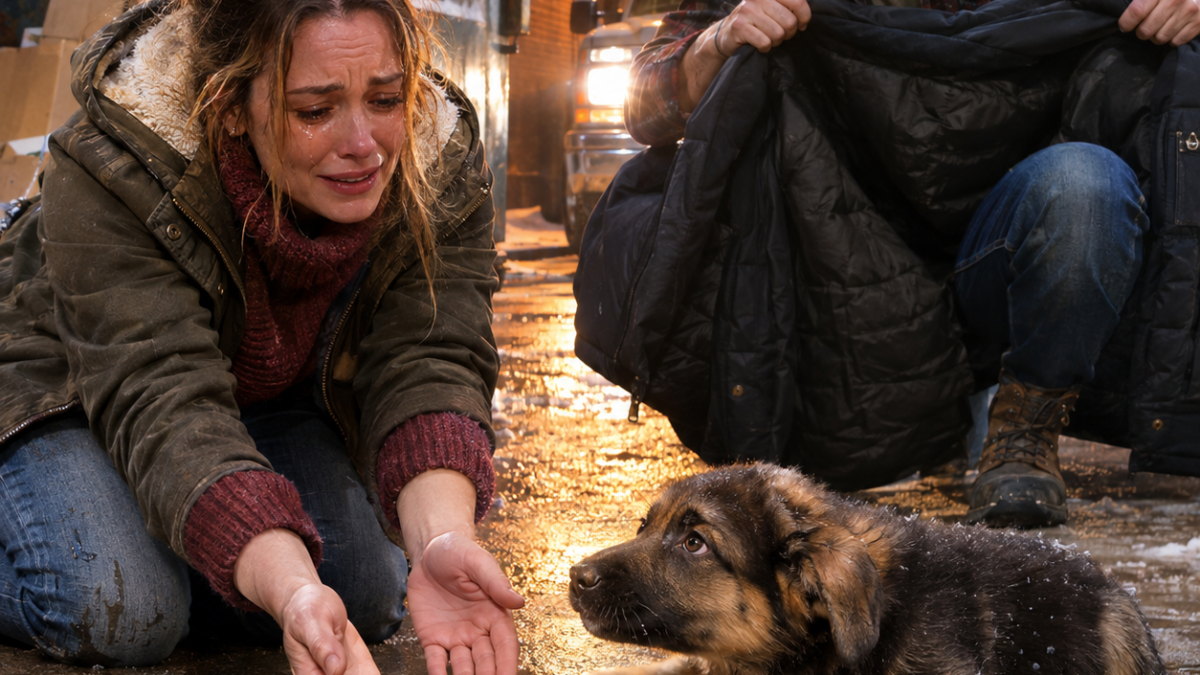
FULL STORY:“DON’T COME ANY CLOSER, SWEETHEART—YOUR LEG IS BROKEN!” I cried when a tiny German Shepherd puppy began dragging himself across the freezing pavement toward me, his injured front leg trailing uselessly behind his trembling body.
FULL STORY CONTINUATION
The words settled over us like a weight.
A week.
I stared at Dr. Jennifer, certain I’d misunderstood.
“Are you saying someone knew he was hurt and left him there?”
Jennifer’s expression softened, but she didn’t pretend to know something she couldn’t prove.
“I can’t tell you exactly what happened before you found him,” she answered. “But these fractures are not fresh. Based on what we’re seeing, he’s been injured for several days without treatment.”
I looked down at my hands.
There was dirt beneath my fingernails from lifting him off the pavement.
A faint smear of dried blood marked the sleeve of my sweater.
I could still feel his tiny body trembling against my chest.
“He was crawling,” I whispered.
Jennifer nodded.
“My husband and I found him behind a dumpster. He couldn’t stand properly. He just kept trying to get to me.”
My voice broke.
“He didn’t even cry.”
Jennifer pulled a chair closer.
“Some frightened animals become very quiet. Especially when they’re exhausted or in pain.”
I stared at her.
“He’s only a baby.”
“I know.”
My husband stood beside me.
His name was Daniel.
He was forty-one, tall, broad-shouldered, and usually the calmest person in any room.
He worked long hours as a building contractor, and I’d seen him handle injuries, emergencies, and terrible surprises without losing his composure.
But now his hands were trembling.
He looked toward the closed treatment-room door.
“What else is wrong with him?”
Jennifer opened the medical notes.
“He’s dehydrated, significantly underweight, and hypothermic. We’re stabilizing his temperature and fluids, and we’re providing pain relief. We’ll evaluate the fractures and determine the safest treatment plan.”
Daniel swallowed.
“Can he recover?”
Jennifer looked at both of us.
“He has a chance. He’s young, and that’s in his favor. But he’s in poor condition, and I don’t want to promise you an outcome before we’ve stabilized him.”
I nodded.
It was the kindest honest answer she could give.
But it frightened me more than reassurance would have.
Because somewhere beyond those doors was a puppy who had used the last of his energy to crawl toward a stranger.
And I had already fallen in love with him.
We sat in the waiting room for almost two hours.
The emergency clinic was bright and quiet, with pale walls, plastic chairs, and a coffee machine that hummed in the corner.
A television played above the reception desk.
I couldn’t have told you what was on it.
Daniel bought two cups of coffee.
He placed one beside me.
I never touched it.
My attention remained fixed on the swinging door leading to the treatment area.
Every time it opened, I sat straighter.
Every time someone walked through who wasn’t Jennifer, my heart sank again.
Daniel eventually reached for my hand.
“You need to drink something.”
I shook my head.
“I’m okay.”
He looked at me.
“You’ve said that three times.”
I tried to smile.
It didn’t work.
He squeezed my fingers.
“He’s getting help now.”
I nodded.
“I know.”
But I kept seeing the puppy crawling.
One movement.
Then another.
His front leg dragging.
His little paws scraping against the pavement.
He hadn’t cried out.
Hadn’t barked.
Hadn’t tried to frighten me away.
He’d simply approached.
And somehow that frightened me more than anything.
Because I couldn’t stop wondering what had happened before we arrived.
How many cars had driven past?
How many people had walked through that parking lot?
Had someone noticed him and assumed he was sleeping?
Had anybody heard him moving behind the dumpster?
Had he tried to crawl toward other people?
Had they kept walking?
I didn’t know.
And the not knowing was unbearable.
Daniel and I had been married for eleven years.
We lived in a quiet Texas neighborhood with a small backyard, two old oak trees, and a covered porch where we liked to sit after work.
We didn’t have children.
That wasn’t the result of one simple decision.
Life had moved differently than we’d imagined.
There had been years of medical appointments, difficult conversations, and hopes that slowly changed shape.
Eventually, we’d learned to build a life around what we did have rather than spending every morning grieving what we didn’t.
We loved each other.
We had friends.
Meaningful work.
A home we cared for.
And, until that night, a household without pets.
Not because we disliked animals.
Quite the opposite.
Daniel had grown up with dogs.
His childhood German Shepherd, Max, had been his companion for twelve years.
He still spoke about Max sometimes.
How the dog waited beside the door when he came home from school.
How he slept under Daniel’s bed during thunderstorms.
How he followed him everywhere, even when Daniel pretended to be annoyed.
When Max died, Daniel was seventeen.
He buried the dog beneath a pecan tree on his family’s property.
And he’d never adopted another.
Once, a few years into our marriage, I suggested getting a puppy.
Daniel smiled sadly.
“Someday.”
I didn’t push.
I knew what that word meant.
He wasn’t ready.
So we filled our house with other things.
Books.
Plants.
Photographs.
The occasional visit from friends’ dogs.
And a comfortable routine that had gradually become almost too predictable.
Then one cold night, a broken German Shepherd puppy appeared behind a dumpster.
And everything changed.
Jennifer returned shortly after two in the morning.
She looked tired.
A loose strand of dark hair had fallen from her ponytail.
But her expression was steadier than before.
“He’s responding to treatment.”
I stood immediately.
“Really?”
She nodded.
“His temperature is improving. He’s receiving fluids and appropriate pain medication. We’re monitoring him closely.”
Daniel stepped beside me.
“And his leg?”
“We’ve evaluated the fractures and immobilized the limb while planning the next stage of treatment. He’ll need follow-up care and a carefully managed recovery.”
I swallowed.
“But he’s going to live?”
Jennifer paused.
“I can’t give you a guarantee tonight. But I’m encouraged by his response.”
I covered my mouth.
Tears filled my eyes.
Daniel put his arm around me.
Jennifer continued.
“He’s very weak. He needs warmth, nutrition, rest, and time.”
I nodded quickly.
“Whatever he needs.”
She looked at us.
“Do you know whether he belongs to someone?”
“We found him alone.”
“Did you see identification?”
“No collar.”
“We’ll check for a microchip and follow the appropriate found-animal procedures.”
Daniel nodded.
“Of course.”
Jennifer studied us.
“Are you interested in caring for him if no owner comes forward and he’s legally available for adoption?”
I looked at Daniel.
For several seconds, neither of us spoke.
Then he looked toward the treatment room.
And said quietly, “I don’t think we could walk away from him now.”
My heart tightened.
I nodded.
“Neither do I.”
Before leaving, I asked if we could see him.
Jennifer hesitated.
“He needs rest.”
“I understand. Just for a moment?”
She studied my face.
Then nodded.
“Briefly.”
She led us into a small recovery room.
The puppy lay on soft white towels inside a warmed kennel.
His injured front leg had been stabilized.
His thin body was curled awkwardly, as though he still hadn’t learned that lying down no longer required guarding himself.
The harsh fluorescent lights were dimmed.
His breathing was slow.
Steadier than before.
I approached carefully.
“Hi, sweetheart.”
He didn’t move.
For one terrible moment, I felt panic rise.
Then his little ears twitched.
I crouched beside the kennel.
“It’s me.”
His eyes opened.
Dark brown.
Tired.
Still frightened.
He lifted his head slightly.
I smiled through tears.
“Hey, baby.”
His tail moved.
Just once.
A tiny, hesitant movement against the towel.
I stopped breathing.
Then it moved again.
Barely.
But unmistakably.
I pressed one hand over my mouth.
Daniel stood beside me.
His eyes filled.
Jennifer watched quietly.
I whispered, “He remembers us.”
She smiled.
“He certainly seems interested in you.”
The puppy made a faint sound.
I reached toward him, following Jennifer’s guidance.
He stretched his neck.
Touched his nose to my fingers.
Then closed his eyes again.
I began crying.
Not loudly.
I simply couldn’t stop the tears.
Because twelve hours earlier, he had been lying behind a dumpster in the cold.
And now, for one small moment, he seemed to know that the hands reaching toward him weren’t going to hurt him.
We drove home in silence.
The streets were nearly empty.
Streetlights reflected on the windshield.
Daniel kept both hands on the wheel.
I sat beside him holding the puppy’s treatment paperwork.
For a while, neither of us spoke.
Then I whispered, “What kind of person leaves a dog like that?”
Daniel was quiet.
“I don’t know.”
I looked down.
“He was so scared.”
“I know.”
“He still came toward me.”
Daniel swallowed.
“I saw.”
I turned toward him.
“He could barely move.”
His jaw tightened.
“I know.”
Then he reached for my hand at a red light.
“We got him there.”
I nodded.
But I couldn’t stop crying.
Because the rescue hadn’t begun when we reached the clinic.
It had begun when that frightened little puppy looked at me and decided to move.
When he pushed himself across the pavement despite his pain.
When he chose one unfamiliar voice over the darkness behind him.
He had no way of knowing I was safe.
No way of knowing whether my hands would hurt him.
He had only one fragile possibility.
And he took it.
I didn’t sleep much that morning.
I lay beside Daniel listening to the ceiling fan.
Every time I closed my eyes, I saw the puppy’s face.
His swollen leg.
His trembling body.
The way he’d pressed his head beneath my jacket.
At six, I got out of bed.
Made coffee.
Stared at the cup.
Then called the clinic.
The night receptionist answered.
“Pine Hollow Emergency Veterinary Care.”
“Hi. My husband and I brought in a German Shepherd puppy last night.”
“Yes, ma’am.”
“Could you tell me how he’s doing?”
She checked with the treatment team and returned.
“He’s resting. His temperature has remained more stable, and the veterinary team is continuing his care.”
I closed my eyes.
“Thank you.”
“Of course.”
I hesitated.
“Could I come see him?”
She paused.
“Let me ask.”
A few minutes later, she gave me a visiting window.
I thanked her.
Then hurried upstairs.
Daniel was still half asleep when I entered the bedroom.
He opened one eye.
“Where are you going?”
“The clinic.”
He sat up.
“What time is it?”
“Six-fifteen.”
He stared at me.
Then smiled faintly.
“I should’ve known.”
I paused in the doorway.
“Do you want to come?”
He looked at the clock.
Then at me.
“Give me ten minutes.”
When we arrived, Jennifer was finishing notes.
She’d been awake most of the night.
She looked at us and laughed softly.
“I had a feeling you’d be back.”
I smiled nervously.
“How is he?”
“Still weak, but we’re seeing encouraging signs.”
She led us toward the recovery area.
The puppy was awake.
His head rested on a folded towel.
He looked so small.
So painfully thin.
But when he heard my voice, his ears moved.
“Good morning, baby.”
He lifted his head.
Then gave another tiny tail wag.
Daniel looked at me.
I looked at him.
And we both smiled.
It was the first uncomplicated smile we’d shared since finding him.
I crouched beside the kennel.
“You remember us, don’t you?”
The puppy reached toward my fingers.
I let him sniff me.
Then gently stroked his cheek.
His eyes closed.
Jennifer stood beside us.
“He’s more responsive today.”
I looked up.
“Has he eaten?”
“We’ve started carefully supporting his nutrition. We’ll adjust based on how he tolerates it.”
I nodded.
“Can we bring anything?”
“Not at the moment. But we can discuss supplies if he’s ready to go home.”
Daniel glanced at me.
Then at Jennifer.
“Assuming everything works out with the found-animal process, we’d like to be the ones who take him.”
My heart stopped.
I turned toward him.
He was staring at the little dog.
His expression was tender.
Certain.
Jennifer nodded.
“We can work through the appropriate arrangements.”
I looked at Daniel.
“You’re sure?”
He smiled sadly.
“No.”
I blinked.
He continued.
“I have no idea how we’re going to manage a recovering puppy with a broken leg.”
I laughed through tears.
Then he reached for my hand.
“But I know I don’t want him going through it alone.”
And that was when I knew our quiet house was about to become somebody’s home.
For the next two days, our lives revolved around visiting hours and phone calls.
I went to work.
Answered emails.
Sat through meetings.
Spoke to clients.
And spent every free moment wondering whether the puppy was warm enough, comfortable enough, and still improving.
My coworkers noticed.
On the second morning, my friend Caroline stopped beside my desk.
“You’ve checked your phone eleven times.”
I looked up.
“Have I?”
She smiled.
“Possibly twelve.”
I set it down.
“Sorry.”
She pulled over a chair.
“What’s going on?”
I hesitated.
Then told her about the dumpster.
The tiny German Shepherd.
The broken leg.
The emergency clinic.
By the time I reached the part where he’d crawled toward me, Caroline’s expression had changed.
“Oh, my God.”
I nodded.
“He’s so little.”
She looked down.
“Do they think he’ll recover?”
“They’re hopeful.”
I swallowed.
“He needs a lot of care.”
Caroline watched me.
Then asked, “Are you going to adopt him?”
I smiled faintly.
“If we’re allowed to.”
She leaned forward.
“Then why do you look scared?”
I considered the question.
Because I was.
Not of the work.
Not of the expense.
Not even of the possibility that the puppy might need long-term medical treatment.
I was frightened because I’d already begun picturing him in our house.
Sleeping beside the sofa.
Learning to walk without pain.
Running through our backyard.
Growing old.
And the more I imagined it, the more terrified I became that something might happen before he ever came home.
I looked at Caroline.
“I don’t want to lose him.”
Her expression softened.
“You’ve only known him two days.”
“I know.”
I stared at the desk.
“That’s what’s strange.”
Caroline reached across and squeezed my hand.
“Sometimes it doesn’t take very long to care.”
I nodded.
Then looked toward my phone.
Waiting.
On the third day, Jennifer called.
I had been standing in our kitchen preparing lunch when the screen lit up.
I answered before the second ring.
“Hello?”
“Hi. It’s Jennifer.”
My heart began pounding.
“Is he okay?”
“He’s doing well enough that we can begin discussing discharge and home care.”
I sat down.
“Really?”
“Yes. We’re pleased with the progress he’s made.”
I covered my mouth.
Jennifer continued.
“He still needs close monitoring and follow-up treatment for the fractures. You’ll need to follow his activity restrictions carefully, administer medications as prescribed, and watch for signs of complications.”
I nodded, already reaching for a pen.
“We can do that.”
“Recovery won’t be immediate.”
“I understand.”
“And emotionally, he may need time to become comfortable in a new environment.”
I swallowed.
“We’ll give him as much time as he needs.”
Jennifer paused.
“I believe you will.”
She then explained that the required ownership checks and placement arrangements had been addressed, allowing us to proceed with caring for him.
I thanked her.
After the call, I sat motionless for several seconds.
Then I stood.
Walked into the living room.
And found Daniel measuring a corner beside the sofa.
I frowned.
“What are you doing?”
He looked up.
“Trying to figure out where a dog bed would fit.”
My eyes filled.
He smiled.
“What?”
I crossed the room.
Threw my arms around him.
And began crying.
He held me.
“Hey. What’s wrong?”
I laughed through tears.
“Nothing.”
He leaned back.
“Nothing?”
“Jennifer called.”
His expression changed.
I smiled.
“He can come home.”
For a moment, Daniel just stared.
Then he closed his eyes.
Exhaled.
And hugged me again.
We spent the rest of the afternoon preparing.
We bought a comfortable bed designed to keep the puppy supported.
Food approved by his veterinary team.
A water bowl.
Soft bedding.
A harness suitable for his condition.
A few gentle toys we would save for when he was ready.
We made sure the floors weren’t slippery.
Moved furniture to create a clear path.
Blocked access to the stairs.
And arranged a quiet recovery area where he could rest without being startled.
Daniel examined everything with the seriousness he usually reserved for construction projects.
He crouched beside the bed.
Studied the floor.
Then said, “This rug moves.”
I looked down.
“So?”
“He could slip.”
I smiled.
“Then we’ll secure it.”
He nodded.
A few minutes later, he was checking the doorway.
“Too narrow?”
“Daniel.”
He looked up.
“What?”
“He’s a German Shepherd puppy, not a refrigerator.”
Daniel smiled.
“I know.”
I walked toward him.
“You’re nervous.”
He exhaled.
“Terrified.”
I laughed softly.
He glanced toward the little bed.
Then said, “I haven’t done this in a long time.”
I knew what he meant.
Max.
The childhood dog he’d loved and lost.
I took his hand.
“This isn’t Max.”
He nodded.
“I know.”
“He doesn’t have to be.”
Daniel looked at me.
Then smiled.
“No.”
He glanced toward the bed again.
“He can be himself.”
We brought the puppy home just before sunset.
Jennifer carefully reviewed his instructions.
The treatment plan for his leg.
Medication times.
Feeding schedule.
Activity restrictions.
Follow-up visits.
Signs that would mean he needed urgent veterinary attention.
Daniel wrote everything down.
I asked questions.
Probably too many.
Jennifer answered patiently.
Then she brought him out.
He was wrapped in a soft blanket, his injured leg stabilized, his little head resting against her arm.
He looked cleaner than the night we’d found him.
His black-and-tan fur had been gently cleaned.
His eyes were brighter.
And although he remained painfully thin, he seemed more alert.
When he saw me, his tail moved.
I pressed my fingers against my lips.
“Oh, sweetheart.”
Jennifer smiled.
“Someone knows you.”
I reached out.
The puppy leaned toward my hand.
Then tucked his nose against my palm.
Daniel stood beside us.
His face was soft with emotion.
For a moment, the three of us were perfectly still.
Then Jennifer asked, “Have you chosen a name?”
I looked at Daniel.
He smiled.
“We’ve been arguing about that.”
Jennifer laughed.
“Of course.”
I looked down at the puppy.
“We were thinking Gracie.”
She raised an eyebrow.
“For a boy?”
I smiled.
“Yes.”
Daniel chuckled.
“I suggested Cooper.”
I glanced at him.
“And I said every other German Shepherd in Texas is probably named Cooper, Ranger, or Max.”
Jennifer laughed.
“Fair enough.”
I looked back at the puppy.
“Gracie.”
The name felt right.
Not because he moved gracefully.
He didn’t.
Not yet.
And not because his life had been gentle.
It clearly hadn’t.
I chose the name because the fact that he was alive felt like a gift.
He’d survived fear.
Pain.
Cold.
Hunger.
And days without help.
Yet when a stranger knelt in front of him, he’d still found the courage to move toward her.
That felt like grace to me.
An undeserved second chance.
A little life that had nearly slipped away but hadn’t.
I touched his ear.
“Welcome home, Gracie.”
He blinked.
Then rested his head against my hand.
The first night was difficult.
I had expected that.
Jennifer had warned us that Gracie might be frightened by unfamiliar sounds and need time to adjust.
But knowing something intellectually is different from watching it happen to a living creature you’ve begun loving.
We settled him in his recovery bed beside the sofa.
Daniel placed his water bowl nearby.
I sat on the floor with a book, speaking softly now and then.
At first, Gracie watched every movement.
When I reached for a blanket, his ears pulled backward.
When Daniel opened a kitchen cabinet, he startled so violently that I felt my heart twist.
Daniel froze.
“Sorry, buddy.”
Gracie stared at the cabinet.
His body trembled.
I lowered my book.
“It’s okay.”
We gave him space.
Waited.
Then Daniel carefully closed the cabinet.
Much more quietly.
Gracie watched.
For a long moment, he didn’t move.
Then he settled his head on the bedding again.
I looked at Daniel.
His face had changed.
He stared toward the kitchen.
Then whispered, “He thinks something bad is going to happen.”
I swallowed.
“We don’t know exactly what he remembers.”
Daniel nodded.
But we both understood that ordinary household noises frightened him.
And neither of us wanted to add to that fear.
Feeding him required patience.
Gracie was interested in food, but he hesitated when the bowl was placed in front of him.
He sniffed.
Looked toward the doorway.
Then back at us.
I wondered whether he expected someone to take it away.
There was no way to know.
Perhaps he was simply uncomfortable in a new environment.
Perhaps he was still feeling unwell.
Whatever the reason, we followed Jennifer’s feeding plan and gave him time.
The first evening, he ate more readily when I sat quietly nearby.
So I sat.
I didn’t talk much.
Didn’t keep reaching toward him.
I simply remained where he could see me.
Eventually, he lowered his head and began eating.
Small bites.
Careful movements.
Then he stopped.
Looked up.
Checked that I was still there.
I smiled.
“I’m not going anywhere.”
He returned to the bowl.
Daniel watched from the kitchen doorway.
Later, after Gracie had settled, Daniel whispered, “He keeps checking.”
I nodded.
“I noticed.”
He sat beside me.
“Like he doesn’t believe we’ll stay.”
I looked toward the puppy.
“I hope he’ll learn.”
Daniel put his arm around my shoulders.
“So do I.”
At two in the morning, Gracie woke trembling.
I heard a faint movement from the living room.
Then a small, frightened whine.
I opened my eyes.
For a moment, I didn’t understand what had woken me.
Then I remembered.
I slipped out of bed and walked downstairs.
The house was dark except for a small lamp we’d left on.
Gracie was awake in his bed.
His ears lay flat.
He was breathing quickly.
I crouched a short distance away.
“Hey, baby.”
He looked up.
The moment he saw me, he tried to move toward me.
“Easy.”
I reached out carefully, keeping his injured leg protected.
He lowered his head against my hand.
His body trembled.
I sat on the floor.
“It’s okay.”
For a while, I simply stayed there.
Stroking his cheek when he sought contact.
Letting him settle.
Listening to the soft sounds of the house.
The refrigerator.
The air conditioning.
A distant car passing outside.
Eventually, his breathing slowed.
His eyes grew heavy.
Then he fell asleep with his nose resting near my knee.
I remained beside him.
I told myself I would stay ten minutes.
Then fifteen.
Then another five.
Before I knew it, I was sitting against the sofa with a blanket over my legs.
The puppy was asleep.
And I didn’t want to move.
Daniel found me there at six-thirty.
He stood at the bottom of the stairs wearing sweatpants and an old T-shirt.
For a moment, he simply stared.
Then he smiled.
“I wondered where you went.”
I looked up.
“Gracie had a rough night.”
Daniel approached quietly.
“How’s he doing?”
“Sleeping.”
He crouched.
The puppy stirred.
Daniel held still.
Gracie opened his eyes.
Then settled again.
Daniel looked at me.
“You slept down here?”
“Sort of.”
He shook his head.
I braced myself for the suggestion that I was overdoing it.
Instead, he disappeared into the kitchen.
A few minutes later, he returned carrying coffee.
He handed me a mug.
Then sat beside me on the floor.
For a while, we watched Gracie sleep.
The sun began creeping through the curtains.
Daniel took a sip of coffee.
Then whispered, “Guess we have a dog.”
I looked at him.
“Apparently.”
He smiled.
“A demanding one.”
I laughed softly.
“Very.”
Daniel reached for my hand.
And we sat there together while the little puppy slept.
During the first week, Gracie was frightened by things that seemed impossibly ordinary.
The garage door.
The sound of keys.
The vacuum cleaner in another room.
A dropped spoon.
The microwave beeping.
Sometimes he startled when someone moved too quickly.
Other times he watched us as though he couldn’t decide what to expect.
We didn’t force him to confront everything at once.
We worked with his veterinarian’s guidance and later with a qualified trainer experienced in fearful dogs.
We gave him predictable routines.
Quiet places to rest.
Gentle interactions.
And choices whenever it was safe to provide them.
If he didn’t want to be touched, we respected that.
If he wanted to approach, we let him.
If a noise frightened him, we helped him recover without turning the event into another overwhelming experience.
I learned to notice the smallest changes.
An ear lifting.
A little tail movement.
His body relaxing when Daniel entered the room.
The moment he began eating without repeatedly looking toward the door.
Those details mattered.
Not because they were dramatic.
Because they meant he was beginning to feel safe.
The first time Gracie willingly approached Daniel, I nearly cried.
Daniel had been careful around him from the beginning.
He was a large man with a deep voice.
Sometimes that seemed to make Gracie uncertain.
So Daniel moved slowly.
Sat at a distance.
Let the puppy approach on his own terms.
For several days, Gracie accepted food and gentle contact from him but rarely initiated it.
Then one afternoon, Daniel came home from work.
He stepped through the door and quietly set down his keys.
“Hey, buddy.”
Gracie lifted his head.
Daniel crouched near the entrance.
“It’s me.”
For a moment, the puppy watched.
Then he pushed himself up, taking care of his injured leg.
He moved across the rug with an awkward three-legged gait.
One step.
Then another.
Daniel remained crouched.
Gracie stopped a few feet away.
I watched from the sofa.
My heart was pounding.
Then the puppy took one more step.
Reached Daniel.
And touched his nose to the back of Daniel’s hand.
My husband froze.
For a moment, he couldn’t speak.
Then he whispered, “Hey, little guy.”
Gracie’s tail moved.
Daniel looked toward me.
His eyes were wet.
I smiled through tears.
“He came to you.”
Daniel nodded.
“Yeah.”
He looked back at the puppy.
“Yeah, he did.”
That night, we talked about Max.
We were sitting on the porch after Gracie had settled.
The air was cool.
Crickets sounded from the yard.
Daniel leaned back in his chair.
“I forgot how much I missed having a dog.”
I looked at him.
“You never talked about getting another one.”
He smiled sadly.
“Max was special.”
“I know.”
He stared toward the trees.
“I was seventeen when he died.”
I waited.
“He’d been with me since I was five.”
His voice softened.
“When things were bad at school, I’d come home and he’d be waiting.”
I smiled.
Daniel continued.
“He didn’t care if I failed a test. Didn’t care whether I made the team. Didn’t care if Dad and I had argued.”
He looked down.
“He just wanted me there.”
For a while, we sat quietly.
Then he said, “When he died, I told myself I wouldn’t get that attached again.”
My throat tightened.
“Because losing him hurt?”
Daniel nodded.
“I thought avoiding another dog would mean avoiding that pain.”
He laughed softly.
“Pretty ridiculous.”
I shook my head.
“Not ridiculous.”
He looked toward the house.
“Then that little guy showed up.”
I smiled.
“Behind a dumpster.”
“Of all places.”
He shook his head.
“And now I’m afraid every time he moves the wrong way.”
I reached for his hand.
Daniel swallowed.
“I don’t want to lose him.”
I looked toward the living room window.
Neither did I.
But we’d both begun to understand that the possibility of grief wasn’t a reason to refuse love.
Gracie had needed us.
And perhaps we’d needed him more than either of us expected.
During the second week, Gracie began walking toward me when I entered the room.
Not every time.
Not confidently.
But enough that I noticed.
One morning, I came downstairs carrying laundry.
He was resting near the sofa.
When he saw me, he lifted his head.
His ears moved forward.
Then he carefully stood on his uninjured legs, keeping his healing limb protected.
He took a few slow steps.
I stopped.
“Gracie?”
He continued toward me.
His movement was awkward.
Careful.
But determined.
I set down the laundry basket.
Knelt.
And waited.
He reached me.
Looked up.
Then rested his little muzzle against my palm.
I felt tears rise instantly.
“Oh, sweetheart.”
He closed his eyes.
For a moment, we remained perfectly still.
Then I gently stroked his cheek.
He leaned into my hand.
And something about that tiny movement felt larger than anything I’d ever achieved.
Because this puppy had once been too frightened and injured to do anything except crawl.
Now he was choosing to stand.
Choosing to approach.
Choosing to trust.
Not because all his fear had disappeared.
But because he was beginning to believe that moving toward us led to something good.
Recovery wasn’t a straight line.
There were difficult days.
Follow-up appointments.
Moments when Gracie seemed tired or uncomfortable.
Times when we worried about his appetite.
Times when he startled at a noise we’d thought he’d learned to tolerate.
His leg required careful management and reassessment.
We followed the veterinary plan, adjusted activity as directed, and resisted the temptation to let him do too much simply because he seemed eager.
That was difficult.
Especially for Daniel.
One afternoon, Gracie spotted a fallen leaf moving across the patio.
His entire body changed.
His ears lifted.
His tail began wagging.
He wanted to chase it.
Daniel laughed.
“Look at him.”
I smiled.
“I see.”
Gracie took an excited step.
Daniel immediately looked worried.
“Nope. Not yet, buddy.”
He gently guided him back toward his safe area.
Gracie looked offended.
I laughed.
Daniel shook his head.
“He’s going to be trouble.”
I looked at the little dog.
His bright eyes.
His curious expression.
The way he stared at the leaf as though it had personally challenged him.
I smiled.
“I hope so.”
Daniel turned toward me.
“What?”
“I hope he gets to be ordinary puppy trouble.”
My voice tightened.
“Shoes. Toys. Leaves. Mud.”
I looked down.
“Anything besides being frightened and hurting.”
Daniel’s expression softened.
He reached for my hand.
“Me too.”
One month after we brought Gracie home, we returned to Jennifer’s clinic for another follow-up.
By then, Gracie had changed so much that people who hadn’t seen him since the first night barely recognized him.
His coat was cleaner and fuller.
He’d gained needed weight.
His eyes were brighter.
His ears had begun standing more confidently.
And the frightened little animal who once pressed his head inside my jacket now seemed curious about everything around him.
But I was nervous.
His leg had been healing.
We’d followed every instruction.
Kept his activity controlled.
Made sure he rested.
Yet I knew the damage had been serious.
Two fractures.
Days without treatment.
A growing puppy’s body trying to recover after a terrible beginning.
I sat in the examination room while Jennifer reviewed the new findings.
Daniel stood beside me.
Gracie rested on a blanket at our feet.
Jennifer looked up.
“The healing is progressing well.”
I released a breath.
“Really?”
She nodded.
“Really.”
Daniel smiled.
“That’s good news.”
“It is. We’ll still need to manage his activity and continue appropriate rehabilitation.”
I glanced toward Gracie.
“And the limp?”
Jennifer considered the question.
“He may retain some degree of lameness, particularly after strenuous activity. We’ll monitor him as he develops.”
My heart tightened.
“So he might never walk normally?”
“He may not have a completely normal gait,” she answered. “But that doesn’t mean he can’t have a comfortable, active life.”
I looked down at him.
He was chewing gently on the edge of a soft toy, apparently unaware that we were discussing his future.
Jennifer smiled.
“He’s already showing us how determined he is.”
I swallowed.
“Can he eventually run?”
“If his healing continues appropriately, we’ll work toward safe activity based on his condition.”
I nodded.
For weeks, I’d been imagining the day he would run through our yard.
But suddenly I realized something important.
Even if Gracie always limped, he wouldn’t be less worthy of love.
Even if he needed accommodations for the rest of his life, he would still belong.
His recovery didn’t have to be perfect to be beautiful.
I looked at Daniel.
He smiled.
“We’ll figure it out.”
I looked down at Gracie.
Then whispered, “Yes, we will.”
His rehabilitation took patience.
The veterinary team guided the progression of his physical activity and monitored his healing.
As he became strong enough, we introduced carefully controlled movement and exercises appropriate to his condition.
We celebrated small improvements.
Standing more comfortably.
Moving across the room without fear.
Placing weight more confidently when permitted.
Learning to navigate the house without panicking at every unfamiliar sound.
Some days, he made visible progress.
Other days, he seemed tired.
We adjusted.
Rested.
And continued.
I learned that healing was rarely as dramatic as people imagined.
It didn’t happen in one triumphant moment.
It happened in ordinary repetitions.
A little more strength.
A little more confidence.
A frightened reaction that became less intense.
A familiar sound that no longer made him flinch.
A puppy who began falling asleep before checking whether we were still watching him.
And perhaps most importantly, a little animal who no longer looked toward every doorway as though expecting someone to drive him away.
The first time Gracie picked up a toy, Daniel nearly dropped his coffee.
It was a small blue ball.
Soft enough for him to carry comfortably.
I’d placed it near his bed.
For days, he’d ignored it.
Then one morning, as Daniel and I sat having breakfast, Gracie lowered his nose toward the ball.
He sniffed.
Pushed it.
Watched it roll a few inches.
Then tilted his head.
Daniel stopped speaking.
I looked over.
Gracie touched it again.
The ball rolled farther.
He stepped toward it.
Sniffed it.
Then carefully picked it up.
I covered my mouth.
Daniel whispered, “Look.”
Gracie turned toward us.
The blue ball was hanging from his mouth.
His tail wagged.
I began laughing.
“Oh, Gracie!”
He looked startled by my excitement.
I immediately softened my voice.
“Good boy.”
Daniel crouched.
Gracie approached him.
The ball slipped from his mouth.
Rolled toward Daniel’s shoe.
Daniel picked it up.
Held it where Gracie could see.
Then placed it gently nearby.
Gracie stepped forward.
Took it again.
And brought it back.
Not a perfect game of fetch.
Not even a proper one.
But to us, it felt like watching the world begin again.
A few weeks later, Gracie barked happily when Daniel came home from work.
It was the first time we’d heard that particular sound.
Not the frightened noise he made when something startled him.
Not a warning.
Not a whimper.
A joyful bark.
Daniel stepped through the door.
“Hey, buddy.”
Gracie lifted his head.
His ears stood tall.
Then he gave one excited bark.
Daniel froze.
I stared.
Gracie barked again.
His tail whipped from side to side.
My husband began laughing.
“Well, hello to you too!”
Gracie moved toward him, walking more confidently than before.
Daniel crouched.
The dog reached him.
Pressed against his knee.
And wagged so hard his entire body seemed to move.
I stood near the kitchen doorway watching them.
My eyes filled.
Because for weeks, we’d been trying to teach Gracie that people coming through doors weren’t necessarily dangerous.
That footsteps could mean someone familiar was returning.
That a man’s deep voice didn’t always predict something frightening.
And now, instead of shrinking away when Daniel entered, Gracie was celebrating his arrival.
I covered my face.
Daniel looked up.
“Are you crying?”
I laughed.
“Maybe.”
He smiled.
“Again?”
I nodded.
“Again.”
He reached down and scratched Gracie’s chest.
Then his own eyes filled.
Neither of us mentioned it.
The moment I remember most clearly happened on an ordinary Sunday afternoon.
There was no appointment.
No special occasion.
No dramatic announcement.
I was sitting on the living room sofa reading a book.
Daniel was outside working on the garden.
The house was quiet.
Sunlight moved slowly across the rug.
Gracie was resting nearby.
His rehabilitation had progressed enough that he could move around the room comfortably under our normal supervision.
I heard his nails lightly touch the floor.
I looked up.
He was standing beside the sofa.
Watching me.
“Hey, sweetheart.”
His ears moved.
I smiled.
“What’s up?”
He looked toward the cushion beside me.
Then back at my face.
For a moment, I didn’t understand.
Then he carefully lifted his front paws toward the edge.
I set down my book.
“Oh.”
He paused.
As though reconsidering.
I followed the guidance we’d been given about protecting his leg and helped him settle safely beside me.
He moved slowly.
Carefully.
Then curled against my side.
For several seconds, he remained upright.
Watching me.
I reached toward him.
He leaned into my hand.
Then, with extraordinary gentleness, he lowered his head onto my lap.
I stopped breathing.
The room seemed to become perfectly still.
I looked down at him.
His dark brown eyes were half closed.
His breathing was calm.
His body warm.
No frantic trembling.
No desperate crawling.
No fear in the way he approached.
He simply wanted to be near me.
I rested my hand against his head.
And began crying.
Because the last time he’d pressed his face against my body like that, he’d been hiding beneath my jacket beside a dumpster.
He’d been cold.
Injured.
Terrified.
Now he lay beside me in a warm house, trusting that nobody would drive him away.
I whispered, “You’re home, baby.”
He closed his eyes.
And went to sleep.
Daniel found us an hour later.
He came through the back door carrying gardening gloves.
Then stopped.
Gracie was still asleep with his head in my lap.
I looked up.
Daniel smiled.
“Well, would you look at that.”
I held a finger to my lips.
“He’s sleeping.”
Daniel nodded solemnly.
“Clearly.”
He approached quietly.
Then crouched beside the sofa.
Gracie opened one eye.
Saw him.
And closed it again.
Daniel laughed softly.
“Not even going to get up for me?”
I smiled.
“He’s comfortable.”
Daniel looked at the dog for a long moment.
Then his expression changed.
“Remember that first night?”
My throat tightened.
“Yes.”
“He couldn’t stop shaking.”
I nodded.
Daniel touched Gracie gently.
“Now look at him.”
I stared down at the sleeping puppy.
His chest rose and fell steadily.
His ears were relaxed.
One paw rested against my leg.
I swallowed.
“He knows.”
Daniel looked at me.
“Knows what?”
“That he can stay.”
My husband didn’t answer immediately.
Then he sat beside us.
Rested his arm around my shoulders.
And whispered, “Yeah.”
For a long time, we remained there together.
Not doing anything important.
Not fixing a problem.
Not rushing to an appointment.
Just sitting in our living room with a sleeping dog.
And I remember thinking that happiness often entered life so quietly that you almost missed the moment it arrived.
We eventually began working with a trainer named Melissa, who specialized in helping fearful and undersocialized dogs.
She was patient.
Practical.
And careful not to make promises about erasing Gracie’s past.
During our first appointment, she watched him explore the training space.
He stayed close to me.
Sniffed the floor.
Approached a toy.
Then backed away when something clattered in another room.
I instinctively moved toward him.
Melissa raised a hand gently.
“Give him a moment.”
I stopped.
Gracie looked toward the noise.
His ears moved backward.
Then he looked at me.
I remained calm.
Melissa spoke softly.
“Good. Let him assess the situation.”
After a few seconds, Gracie relaxed.
He returned to sniffing the toy.
I released a breath.
Melissa smiled.
“He’s learning.”
I nodded.
“He’s still afraid of so many things.”
“That’s understandable. We don’t know exactly what his first months were like, and we shouldn’t assume every reaction has a specific traumatic cause.”
I listened.
She continued.
“But we can see that some situations make him uncomfortable. Our job is to help him build positive experiences without overwhelming him.”
I looked down at Gracie.
“So he’ll forget?”
Melissa considered the question.
“Maybe some responses will fade. Others may remain in some form. What’s important is that he can learn new associations.”
She smiled gently.
“His early experiences don’t have to define every day of the rest of his life.”
I felt my eyes fill.
For some reason, the words reached deeper than I expected.
Perhaps because I’d spent years believing that painful beginnings always left permanent walls around the heart.
Perhaps because Daniel had once refused to adopt another dog after losing Max.
Perhaps because I knew what it felt like to be frightened of hoping too much.
I looked at Gracie.
He was sniffing Melissa’s shoe.
Then he lifted his head.
And wagged his tail.
Training required consistency.
We practiced calm greetings.
Safe handling.
Comfortable responses to unfamiliar sounds.
Short exercises that rewarded confidence without forcing him into situations he wasn’t ready to manage.
We worked around his physical needs and followed the veterinary team’s recommendations.
There were setbacks.
Once, a delivery truck made a loud noise outside and Gracie retreated behind the sofa.
Another time, a dropped metal bowl startled him so badly that he avoided the kitchen for an hour.
We didn’t punish him.
Didn’t drag him toward the thing he feared.
We gave him space.
Helped him recover.
And continued gradually.
Some days were frustrating.
But most were filled with small victories.
The first time he rested through a passing motorcycle.
The first time he accepted a visitor without retreating.
The first time he walked confidently into a room he’d previously avoided.
Each one mattered.
We weren’t trying to turn Gracie into a fearless dog.
We wanted him to feel safe enough to make choices without expecting harm.
And little by little, he did.
Our first winter with Gracie brought a rare Texas snowfall.
The weather forecast had mentioned the possibility, but neither Daniel nor I expected much.
Then one morning, I opened the curtains and found the backyard covered in a thin layer of white.
I laughed.
“Daniel!”
He appeared in the bedroom doorway.
“What?”
“Look outside.”
He joined me.
For a moment, we stared.
Then he smiled.
“Well, that’s unusual.”
From downstairs came the sound of Gracie moving around his bed.
We exchanged a look.
And both started laughing.
Because we knew exactly what came next.
Once the weather was safe and we’d checked conditions for his recovering leg, we took him outside for a short supervised visit.
Gracie stopped at the threshold.
The entire yard looked different.
White grass.
White flowerpots.
White steps.
He stared.
Then lowered his nose.
Sniffed the snow.
Pulled back.
Looked at me.
I laughed.
“It’s okay.”
He tried again.
Touched it with one paw.
Then another.
His ears lifted.
His tail began wagging.
He took a careful step.
Then another.
Finally, he lowered his nose into the snow and sneezed.
Daniel burst out laughing.
I laughed so hard my stomach hurt.
Gracie looked startled.
Then wagged even harder.
He explored a small patch near the porch, curious and delighted by the strange new texture beneath his feet.
I watched him.
And thought about how different this was from the cold night we’d found him.
Back then, the cold had been dangerous.
There had been no blanket.
No warm house.
No one nearby to protect him.
Now he was discovering winter from a place of safety.
With people watching his comfort.
Ready to bring him inside.
I smiled through tears.
And whispered, “Look at you.”
The years passed.
Not quickly while we lived them.
There were long walks.
Training classes.
Veterinary appointments.
Quiet mornings.
Rainy afternoons.
And a truly astonishing number of dog hairs collected in our vacuum cleaner.
Gracie grew into a beautiful German Shepherd.
His black-and-tan coat became thick and glossy.
His shoulders broadened.
His ears stood tall.
His once-thin body became strong.
He remained affectionate with us, especially when he felt relaxed at home.
He loved soft toys.
Watching birds through the living room window.
Walking beside Daniel.
And lying on the porch while I read.
He developed a particular fondness for Daniel’s work boots.
Not chewing them.
Sleeping beside them.
Sometimes with his head resting directly on one.
Daniel pretended to be annoyed.
“Those are expensive boots, buddy.”
Gracie closed his eyes.
I laughed.
“He doesn’t care.”
Daniel shook his head.
Then left the boots exactly where they were.
Gracie’s injured front leg healed, but he retained a slight limp.
It was most noticeable after longer periods of activity.
We continued monitoring him and adjusted exercise according to veterinary advice.
Sometimes people noticed.
During walks, strangers would ask what had happened.
I’d explain briefly that he’d been rescued with a serious injury when he was a puppy.
Some asked whether he was in pain.
I’d tell them that we monitored his comfort and medical needs closely.
Others simply smiled and said he was beautiful.
That was my favorite response.
Because Gracie was beautiful.
Not despite the limp.
Not because the limp made him inspirational.
He was beautiful because he was Gracie.
Curious.
Stubborn.
Affectionate.
Sometimes hilariously dramatic when dinner was five minutes late.
Completely convinced that every tennis ball in the world should belong to him.
His leg was one part of his life.
It didn’t define the whole dog.
On his third birthday, we bought him a new blue ball.
It was almost identical to the first one he’d picked up during recovery.
Daniel found it at a pet-supply store.
He carried it home like a secret.
When Gracie saw it, his ears lifted.
His tail wagged.
Daniel held it up.
“Remember these?”
Gracie gave an excited bark.
I laughed.
We spent part of the afternoon playing a gentle game suited to his abilities.
He retrieved the ball.
Brought it back.
Dropped it near Daniel’s feet.
Then looked up expectantly.
Daniel shook his head.
“You’re a very demanding gentleman.”
Gracie barked.
I laughed.
“He agrees.”
Later, as the sun began setting, Gracie settled beside us on the porch.
He was three years old.
A strong, handsome German Shepherd with warm brown eyes and a small permanent reminder of the injury he’d suffered as a puppy.
I looked down at him.
For a moment, I could hardly believe he was the same animal.
The little creature I’d carried out from behind a dumpster had once been so weak I feared he wouldn’t survive the drive to the clinic.
Now he was resting beside Daniel, listening to birds calling from the oak tree.
His body was relaxed.
His breathing steady.
His tail moving occasionally when I spoke his name.
I reached down.
Stroked his ears.
“Happy birthday, Gracie.”
He looked up.
Then rested his head against my knee.
We don’t celebrate the night we found him as though his suffering were something beautiful.
It wasn’t.
I wish he’d never been injured.
I wish he’d never been left alone.
I wish someone had noticed him sooner.
I wish he’d spent his first six months being loved instead of learning to fear ordinary things.
But I am grateful that we stopped.
And I am grateful that he moved toward me.
Because there are nights when I still wonder what might have happened if we’d continued driving.
If I’d dismissed the movement beside the dumpster.
If Daniel had been too tired to turn around.
If I had assumed someone else would help.
Those thoughts don’t end with a satisfying answer.
We can’t know what would have happened.
But we know what did.
We stopped.
We found him.
We took him for medical care.
And we kept showing up after the dramatic moment was over.
Through medications.
Appointments.
Difficult nights.
Training.
Setbacks.
And ordinary days.
That’s the part of rescue stories I wish people talked about more.
The moment of discovery can be dramatic.
But love becomes real afterward.
When the frightened puppy wakes in the middle of the night and somebody comes downstairs.
When the injured leg needs months of careful attention.
When the dog growls because he’s afraid and you choose patience instead of punishment.
When progress seems slow.
When expenses arrive.
When your schedule changes.
When the excitement of saving an animal becomes the everyday responsibility of caring for him.
That is where the promise is kept.
Sometimes, late at night, Gracie still comes looking for me.
Not because he’s frightened the way he once was.
Often, he simply wants to be near me.
I’ll be reading on the sofa, and I’ll hear his nails moving lightly across the floor.
He’ll stop beside my knee.
Look up.
Wait.
I smile.
“Come here, sweetheart.”
He settles beside me.
Rests his head in my lap.
And closes his eyes while I rub his ears.
There are no dramatic sounds.
No desperate whimpers.
No frantic trembling.
Just a dog breathing peacefully in the home where he belongs.
Sometimes Daniel comes in from the kitchen and sees us.
He smiles.
“Your favorite boy again?”
I laugh.
“Don’t be jealous.”
He looks at Gracie.
Then at me.
“Wouldn’t dream of it.”
He sits beside us.
Gracie opens one eye.
Checks that we’re both there.
Then closes it again.
And I think about how extraordinary that simple moment would have seemed on the night we found him.
Not long ago, Daniel and I drove past the shopping center where we’d first seen Gracie.
It was early evening.
The sky was turning orange.
Traffic moved slowly along the road.
I looked toward the old dumpster enclosure.
The building beside it had been repainted.
The parking lot looked cleaner.
A new store had opened nearby.
Everything appeared ordinary.
I touched Daniel’s arm.
“That’s the place.”
He glanced over.
Then nodded.
“I know.”
For a moment, neither of us spoke.
Gracie was resting safely at home after his afternoon walk.
I looked toward the area where we’d found him.
And suddenly remembered every detail.
The cold pavement.
The discarded cardboard.
The little black-and-tan body pressed into the shadows.
The sound of his injured leg scraping as he tried to move.
And those eyes.
I closed mine.
Then whispered, “He was so small.”
Daniel swallowed.
“Yeah.”
I looked at him.
“Do you remember how he crawled?”
My husband nodded.
“I’ll never forget it.”
We stopped at a red light.
For a moment, I felt tears rise.
Then Daniel reached across the console and took my hand.
“He’s home now.”
I nodded.
“Yes.”
He squeezed my fingers.
“And he’s probably stealing my spot on the couch.”
I laughed through tears.
“He definitely is.”
The light turned green.
We drove on.
That night, when we reached home, Gracie was waiting near the living room.
The moment he heard Daniel unlock the door, his ears lifted.
His tail began wagging.
He walked toward us with the familiar slight unevenness in his gait.
Daniel crouched.
“Hey, buddy.”
Gracie greeted him enthusiastically.
Then turned toward me.
I knelt.
He pressed his head against my chest.
For a moment, I closed my eyes.
I remembered holding him beneath my jacket.
His body cold.
His leg broken.
His little heart beating too fast.
Now I felt his warmth.
His strength.
The steady trust in the way he leaned against me.
I wrapped my arms gently around him.
And whispered the same words I’d spoken beside the dumpster.
“It’s okay. I’m here.”
Gracie rested against me.
Then wagged his tail.
I began crying.
Not because I was sad.
Because for one brief moment, the first night and this one seemed to exist together.
The frightened puppy crawling toward an unfamiliar woman.
And the grown German Shepherd standing securely beside the person he’d chosen to trust.
I often think about what Gracie taught us.
Not a grand lesson about how kindness magically repairs every injury.
His leg still carries the effects of what happened.
We still pay attention to his comfort.
There are still sounds and situations that make him uncertain.
His past didn’t disappear just because we loved him.
But his life grew larger than that past.
He learned that hands could be gentle.
That a door opening could mean Daniel was coming home.
That food would arrive regularly.
That a warm bed would still be there tomorrow.
That unfamiliar things could be explored at his own pace.
That he could rest without having to remain watchful every second.
And that two people who found him behind a dumpster were going to keep caring for him, not simply because he needed rescuing, but because he had become part of their family.
Daniel learned that loving another dog didn’t mean replacing Max.
I learned that I could make room in my heart for a life I hadn’t planned.
And Gracie learned that not every person who approached him was going to cause harm.
Those changes weren’t instant.
They were built over three years.
One quiet morning at a time.
This morning, I woke to sunlight moving across the bedroom wall.
Daniel was already downstairs making coffee.
I could hear the familiar sounds of the kitchen.
A cabinet opening.
Water running.
A cup being placed on the counter.
Then soft footsteps outside the bedroom.
Gracie appeared in the doorway.
He stood there for a moment.
Tall.
Strong.
His ears upright.
His coat glossy in the morning light.
I smiled.
“Good morning, baby.”
He walked toward the bed.
Rested his chin against the edge.
And looked at me.
I reached down.
Stroked his ears.
He closed his eyes and leaned against my hand.
The same little ritual we share every morning.
No fear.
No urgency.
No need to crawl.
Just Gracie.
Home.
Loved.
Certain that when he comes looking for us, someone will be there.
I thought about that old dumpster.
The cold asphalt.
The broken leg.
The exhausted eyes.
Then I looked at the beautiful dog standing beside my bed.
And I felt the familiar ache of gratitude.
Because the world can be terribly unkind.
I know that.
Gracie knows that in whatever way animals remember the things that frighten them.
But cruelty wasn’t the end of his story.
It was something he survived before finding a life filled with warmth, safety, and people who wanted him.
I bent down and kissed the top of his head.
He wagged his tail.
Then turned toward the door when Daniel called from downstairs.
“Breakfast, buddy!”
Gracie’s ears shot up.
He looked at me.
Then toward the hallway.
I laughed.
“Go on.”
He trotted out.
That slight limp was still there.
It probably always would be.
But he moved with confidence.
With joy.
With the easy certainty of an animal who knew exactly where he belonged.
I listened as Daniel greeted him in the kitchen.
Then I heard the soft clink of his food bowl.
And my husband laughing.
Ordinary sounds.
Beautiful sounds.
Sounds I almost never heard because we almost didn’t stop that night.
I got out of bed and followed them downstairs.
Three years ago, a broken German Shepherd puppy used the last of his strength to crawl toward a stranger because he had nowhere else to go. Today, he walks through our home knowing he will never have to beg us to stay.
Gracie doesn’t hide behind dumpsters anymore.
He doesn’t sleep on freezing pavement.
He doesn’t wait for someone to notice his pain.
He has his own bed.
His favorite toys.
A backyard.
A man who calls him buddy.
And a woman who still strokes his ears every morning, remembering the first time he rested his frightened little head against her chest.
But the most beautiful thing he has isn’t something we bought.
It’s the certainty that when he comes toward us, we won’t turn away.
And every time I see him lying peacefully beside Daniel or running across the backyard with his tail held high, I remember that terrible night.
The moment I knelt on the cold pavement.
The tiny puppy who looked up at me.
And the impossible courage it must have taken to move one more inch.
We didn’t erase the pain Gracie had lived through. We gave him a future in which that pain was no longer the whole story.
He crawled toward us because he needed somewhere safe.
We brought him home because we couldn’t leave him behind.
And somewhere between that first desperate movement and the peaceful mornings we share now, the little dog who had been abandoned became the heart of our family.
Gracie had once been left where nobody was supposed to look. Now he is loved by people who never stop looking for him.








