FULL STORY:“COME GET YOUR USELESS DAUGHTER!” My Mother-in-Law Laughed After My Husband Knocked Out My Tooth—Two Hours Later, My Father Stood at Her Door and Every Smile Disappeared
FULL STORY CONTINUATION
My hands shook so badly that the first photograph blurred.
I deleted it.
Tried again.
Breathe.
Focus.
Document.
My cheek was already swelling.
The split inside my lip looked darker than it felt.
The broken tooth was worse.
A jagged piece missing from the front.
Blood along my gum.
I took photographs from several angles.
Timestamped.
Then I dialed three numbers I had spent years believing I would never use against someone I loved.
“911, what is the address of your emergency?”
I gave it.
My voice sounded strangely calm.
“My husband hit me.”
The sentence changed everything.
Not:
We had an argument.
Not:
Things got out of hand.
Not:
He lost his temper.
My husband hit me.
The dispatcher asked whether I was safe.
“I’m locked in a bathroom.”
“Is he trying to get inside?”
As if summoned by the question, Evan’s fist struck the door.
“Rachel!”
I flinched.
“Yes.”
“Open the damn door!”
Another blow.
The wood shook.
The dispatcher said:
“Stay where you are.”
Diane’s voice sounded beyond him.
“Evan, stop. The neighbors will hear.”
Not:
You hurt your wife.
Not:
Leave her alone.
The neighbors.
Appearance.
Always appearance.
The dispatcher asked whether there were weapons.
“Richard has a gun safe upstairs.”
“Do you know whether it is locked?”
“Usually.”
“Do not leave the bathroom.”
“I won’t.”
Then the pounding stopped.
That silence frightened me more.
I sat on the toilet lid with a guest towel pressed to my mouth.
Looked into the mirror.
A stranger stared back.
Red cheek.
Swollen lip.
Broken tooth.
But something underneath the fear had shifted.
For years, every time Evan humiliated me, I had immediately started calculating how to calm him.
What should I say?
What should I apologize for?
What could I do differently next time?
I wasn’t doing that anymore.
I was waiting for police.
The first officer arrived in under fifteen minutes.
I heard voices downstairs.
A second officer.
Then a knock at the bathroom door.
“Rachel Mercer?”
I did not answer immediately.
“Richmond County Sheriff’s Office. Your dispatcher is still connected with you.”
The woman on my phone confirmed it.
I unlocked the door.
A female deputy stood several feet back.
“I’m Deputy Walsh.”
I nodded.
Her eyes moved to my face.
Her expression changed.
Not dramatically.
Professionally.
“Do you need medical attention?”
“My tooth.”
“We’ll get you checked.”
She led me downstairs.
Evan was in the living room with another deputy.
Diane stood beside him with her arms folded.
Richard sat at the dining table.
Dinner still simmered.
Gravy.
Roast.
Carrots.
The absurd normality almost made me laugh.
Evan immediately spoke.
“She came at me.”
Deputy Walsh turned to me.
“Don’t respond to him.”
Diane interrupted.
“She provoked him for nearly an hour.”
“I said don’t respond.”
Diane looked offended.
I handed Walsh my phone.
“I photographed everything immediately.”
She reviewed the images.
Then:
“Did anyone witness the assault?”
I looked at Diane.
Then Richard.
“Both of them.”
Diane laughed.
“I certainly did not see what she claims.”
Richard remained silent.
Walsh looked at him.
“Sir?”
Richard’s hands were flat on the table.
He looked at his son.
Then at me.
Then down.
“I saw it.”
The room changed.
Diane spun.
“Richard!”
The deputy raised one hand.
“Let him answer.”
Richard’s voice was barely audible.
“Evan hit her.”
My husband stared at his father as though he had committed the betrayal.
“You’re taking her side?”
Richard finally looked up.
“I saw you hit your wife.”
There are sentences that arrive years too late and still matter.
That was one.
The second deputy asked Evan to stand.
His face changed.
“What?”
“Stand up, sir.”
“You’re arresting me?”
The deputy did not argue.
He explained what was happening while placing Evan’s hands behind him.
Diane began shouting.
“This is ridiculous!”
“Ma’am.”
“My son is not a criminal.”
“Ma’am, step back.”
“She came into our home and started a fight!”
I was still bleeding.
Still holding a towel to my mouth.
And somehow Diane looked at me as though I had orchestrated the entire evening for entertainment.
Evan passed me on the way out.
His eyes were full of something I had never seen directed at me so openly.
Hatred.
Then fear.
“You’re going to regret this.”
Deputy Walsh stopped.
“Do not speak to her.”
He was taken outside.
The door closed.
For the first time in eight years, someone had told Evan no and not immediately apologized for it.
I gave my statement.
Every detail.
The money accusation.
The demand to see the transaction.
The slap.
The tooth.
Diane taking my phone.
The call to my father.
I told Walsh that Diane had said Evan needed to teach me a lesson.
“Did your father hear that?”
“Yes.”
“Good. We’ll need his information.”
Diane scoffed.
“My God, you’re making it sound like we’re monsters.”
Walsh looked at her.
“I’m writing down what she says happened.”
“It was one slap.”
Deputy Walsh stopped writing.
I watched her expression.
Diane realized too late what she had just admitted.
“One?”
Walsh asked.
Diane’s mouth opened.
Closed.
I almost smiled.
Not because any of it was funny.
Because cruelty becomes careless when it believes itself normal.
A paramedic examined me.
My cheekbone did not appear fractured.
The tooth required urgent dental treatment.
My lip needed cleaning.
No concussion symptoms at that moment, though I was advised what to watch for.
I agreed to be transported to an emergency dental service rather than remain at the Caldwell house.
Before I left, Walsh asked:
“Do you have somewhere safe to go tonight?”
“Yes.”
“Where?”
“My father.”
I checked the time.
He would already be on the road.
Virginia Beach to the Caldwell house was roughly two hours in good traffic.
Knowing Dad, he had probably been halfway dressed before Diane hung up.
As the ambulance pulled away, I looked through the rear window.
Diane stood in the front doorway.
Arms crossed.
Richard behind her.
For the first time, her face did not look smug.
Still angry.
But uncertain.
She had expected my father to be a joke.
She had not expected police.
The dentist repaired the tooth temporarily.
The final restoration would require another appointment.
I sat beneath fluorescent lights while a technician cleaned dried blood from the corner of my mouth.
My phone vibrated.
Dad.
Where are you?
I answered.
“At emergency dental.”
His voice was controlled.
“Are you alone?”
“Deputy Walsh arranged a victim advocate to stay until I leave.”
“Good.”
“Dad.”
“Yes?”
“Evan was arrested.”
Silence.
Then:
“Good.”
Not triumphant.
Just relieved.
“Richard told the truth.”
“His father?”
“Yes.”
Another pause.
“Good.”
“You’re still going to the house?”
“Yes.”
“Why?”
“I need to speak with the deputy and get your things if they’ll allow it.”
“Dad—”
“Rachel.”
His voice softened.
“I am not going there to fight anyone.”
That was exactly what I needed to hear.
“Okay.”
“I meant what I said on the phone.”
My stomach tightened.
“Dad.”
“I meant legally.”
I closed my eyes.
“If anyone helped restrain you, hide evidence, take your phone, or intimidate you afterward, they answer for what they actually did.”
He paused.
“Not for what I’m angry enough to imagine.”
There he was.
The man from the kitchen table.
The louder the room gets, the more important it is that somebody keeps thinking.
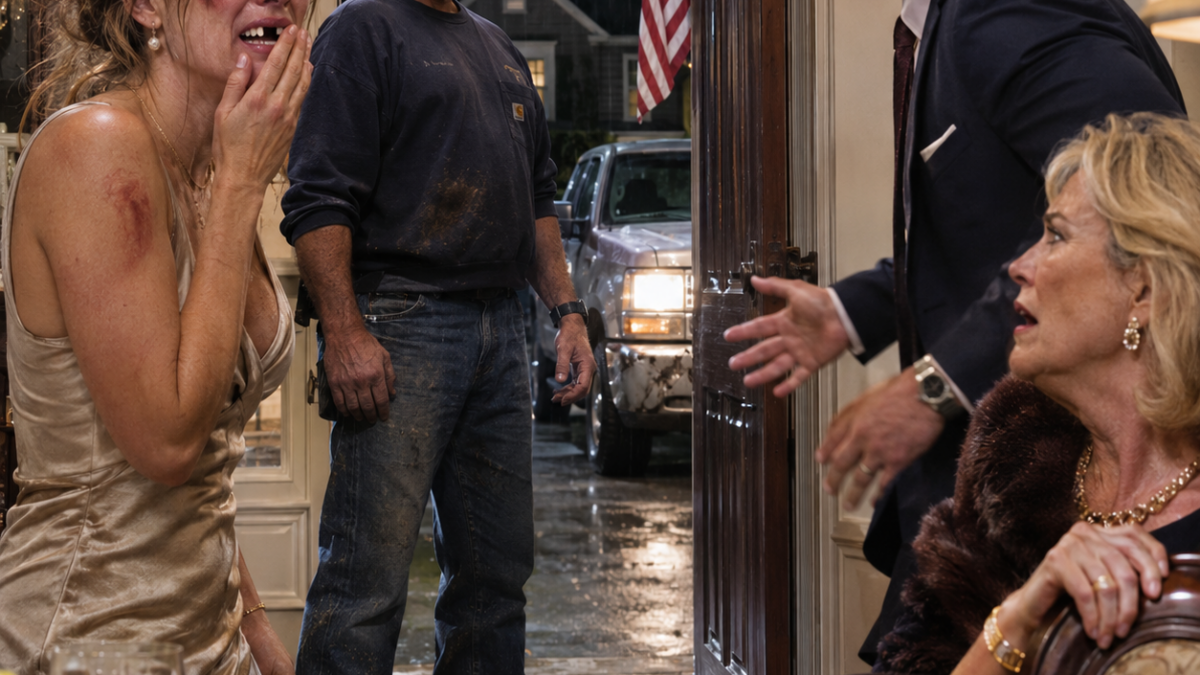
Exactly two hours after Diane ended that call, Dad’s silver pickup turned into the Caldwell driveway.
I know because the doorbell camera timestamp later became part of the evidence packet.
8:42 p.m.
The knock came hard.
Three times.
Diane opened the door.
Dad stood on the porch wearing jeans, boots, and one of those faded navy sweatshirts she used to mock.
He was sixty-seven.
Gray hair.
No giant entourage.
No expensive car.
No theatrical threat.
Just my father.
Beside him stood Deputy Walsh.
That was why the smiles vanished.
Richard had apparently been sitting at the table trying to eat.
Diane had been telling him that Evan would “sort this whole mess out in the morning.”
Then my father arrived with the same deputy who had photographed my injuries and taken her son’s statement.
Dad looked at Diane.
“You called me.”
She stared.
“Yes.”
“You told me to collect my daughter.”
Her voice became smaller.
“She isn’t here.”
“I know.”
Walsh stepped forward.
“Mr. Mercer is here to retrieve several essential items for Rachel with her authorization. He will be accompanied.”
Diane’s expression changed.
“No.”
Walsh remained calm.
“Mrs. Caldwell, he is not entering areas he hasn’t been authorized to access. Rachel has identified a bag, medication, work laptop, and several personal items she brought with her today.”
Diane looked at Dad.
“You brought the police?”
Dad shook his head.
“No.”
“The police were already involved because your son hit my daughter.”
That sentence destroyed the last performance.
Diane hissed:
“You threatened my family.”
Dad looked at her for several seconds.
“No.”
“Yes, you did.”
“I said if Rachel had more injuries, everyone responsible would answer for them.”
He nodded toward Walsh.
“This is what answering looks like.”
No fist.
No weapon.
No raised voice.
Paperwork.
Witnesses.
Evidence.
Law.
Diane had mistaken calm for weakness because she had spent too many years living around men who used volume as power.
My father did not.
Richard appeared in the hallway.
Dad looked at him.
“You saw it?”
Richard’s face collapsed.
“Yes.”
“You told the deputy?”
“Yes.”
Dad nodded.
“Thank you.”
Richard looked shocked.
Maybe he expected rage.
Dad added:
“You should have stopped it.”
Richard lowered his eyes.
“I know.”
That was all.
Sometimes truth does not need decoration.
Dad retrieved my overnight bag, laptop, prescription medication, and coat.
He did not touch anything else.
He did not make threats.
He did not insult Evan.
He did not tell Diane she had raised a monster.
He signed the property receipt the deputy provided.
Then he left.
That restraint bothered Diane more than rage would have.
Later, Richard admitted she spent the rest of the night saying:
“He thinks he’s better than us.”
No.
Dad simply knew the difference between protection and revenge.
It would take me longer to learn.
He met me at the dental clinic twenty minutes later.
I saw the silver truck through the window.
My entire body started shaking.
Not because I was afraid.
Because I no longer needed to hold myself together.
Dad entered.
Looked at me.
Stopped.
The swelling had darkened.
My lip was stitched.
Temporary dental repair visible.
He closed his eyes for one second.
Then walked to me.
“Can I hug you?”
That question broke me.
Not:
What happened?
Not:
Why did you stay?
Not:
Why didn’t you tell me?
Permission.
I nodded.
Dad wrapped both arms around me.
I cried against that faded Navy sweatshirt Diane had laughed about for years.
“I’m sorry.”
He pulled back.
“No.”
“I should have left before.”
“No.”
“I should have told you.”
“We’re not doing that tonight.”
“But—”
“Rachel.”
He took my face gently between his hands without touching the swollen side.
“You called.”
Tears filled my eyes.
“You told the truth.”
He nodded.
“That is what matters tonight.”
We drove toward Virginia Beach after midnight.
I slept for part of it.
Every time I woke, Dad’s hands were steady on the wheel.
The same battered truck.
The same old man the Caldwells had mocked.
I realized how much of my marriage had been built around false definitions of strength.
Evan looked successful.
Dad looked ordinary.
Evan wore thousand-dollar watches.
Dad wore a thirty-year-old military watch with scratches across the face.
Evan shouted.
Dad rarely raised his voice.
Evan needed everyone to know when he entered a room.
Dad had spent half his life doing difficult things nobody ever heard about.
I had known all of that.
And yet somewhere along the way, I had still allowed the Caldwells’ values to infect me.
Maybe they were right.
Maybe I was too sensitive.
Maybe Dad was old-fashioned.
Maybe keeping peace mattered more than dignity.
No.
Not anymore.
At Dad’s house, he had already made the guest room.
Fresh sheets.
Water.
A new toothbrush still in packaging.
He pointed toward the bathroom.
“Towels.”
Then toward the refrigerator.
“Soup.”
I laughed weakly.
“You made soup?”
“Bought soup.”
“More believable.”
He almost smiled.
Then became serious.
“Tomorrow we make calls.”
“What calls?”
“Your dentist.”
“Your employer if you need time.”
“An attorney if you want one.”
“Victim services.”
He stopped.
“Only what you want.”
I sat on the bed.
“What if I don’t know what I want?”
“Then tomorrow we figure out tomorrow.”
That was Dad.
No demand for a ten-year plan at one in the morning.
I slept badly.
Around three, I woke convinced Evan was outside the door.
He wasn’t.
I checked the lock twice.
Then again.
Dad was sitting in the living room when I came out.
Lights low.
Coffee.
“You didn’t sleep.”
“Neither did you.”
“I’m old.”
“That’s not an explanation.”
He pointed at the couch.
I sat.
For a while we said nothing.
Then:
“Why didn’t you ever tell the Caldwells what you did?”
Dad frowned.
“What I did?”
“Your Navy career.”
“The investigative work.”
“Any of it.”
He shrugged.
“Why?”
“Because they thought you were nobody.”
Dad looked genuinely confused.
“Rachel.”
“What?”
“I know who I am.”
The sentence was so simple it hurt.
“I didn’t need Diane Caldwell to know.”
I stared at him.
Eight years of trying to earn respect from people whose opinions should never have been worth that much.
Dad sipped coffee.
“People who need your résumé before they treat you decently are telling you something useful.”
I laughed despite myself.
“Could have told me that eight years ago.”
“I probably did.”
He was right.
Annoying man.
The next morning, Deputy Walsh called.
There would be follow-up.
A court date.
Information about requesting a protective order.
She gave me victim-services contacts.
She did not promise outcomes.
I appreciated that.
No one can guarantee what a court will do.
But my injuries were documented.
The broken tooth documented.
Richard’s statement documented.
Diane’s remarks documented.
The photographs timestamped.
The 911 call recorded.
For once, my reality existed somewhere outside my own memory.
That mattered more than I expected.
Abuse thrives in confusion.
Evidence gave the night edges.
This happened.
At this time.
This injury.
This statement.
Not:
Maybe I exaggerated.
Not:
Maybe it wasn’t that bad.
Facts.
Then came the three thousand dollars.
I almost forgot about it.
The argument that started everything.
Dad did not.
“What did Evan say was missing?”
“Three thousand.”
“Did you move it?”
“No.”
“Then find out who did.”
We logged into my bank account.
The transfer was right there.
Three thousand dollars from joint checking to a personal account I did not recognize.
Initiated through Evan’s authenticated banking profile.
Not mine.
I stared.
Dad did not.
“Screenshot.”
I did.
“Download the statement.”
I did.
Then I called the bank.
After verification, the representative confirmed what the transaction record already indicated.
The transfer had not originated through my credentials.
The receiving account was not mine.
I felt physically ill.
Evan had accused me of something he knew I had not done.
Why?
The answer arrived two days later through financial records my attorney obtained.
The money had gone toward a credit-card balance connected to Diane.
Not a criminal conspiracy.
Not millions.
A three-thousand-dollar payment Evan had apparently promised his mother and had not told me about.
He had moved the money.
Then confronted me.
Maybe he expected me to become defensive enough that no one would ask where it actually went.
Maybe anger was easier than explanation.
Whatever the reason, his lie had become violence when I refused to accept it.
I hired an attorney named Lauren Mitchell.
She practiced family law.
No dramatic speeches.
No promises to destroy Evan.
Good.
“I need to know what you want.”
She asked.
“Divorce.”
That answer came immediately.
No hesitation.
I surprised myself.
“Protective order?”
“Yes.”
“Financial separation?”
“Yes.”
“Do you have shared property?”
“House.”
“Accounts.”
“Retirement.”
“No children.”
Lauren nodded.
“That simplifies some things.”
Nothing else about it felt simple.
Evan called from an unknown number two days after his arrest.
I almost answered.
Dad saw my face.
“Who?”
“I think Evan.”
“Do you want to talk to him?”
I looked at the phone.
“No.”
“Then don’t.”
Simple.
I let it ring.
A voicemail arrived.
I did not listen until Lauren was with me.
Evan cried.
Said he loved me.
Said he was sorry.
Said everything had “gotten out of control.”
Then:
“You know I would never really hurt you.”
I touched my repaired tooth with my tongue.
Lauren stopped the recording.
“You okay?”
“Yes.”
I laughed once.
“Apparently I imagined dental work.”
She did not laugh.
Good lawyer.
Diane sent messages too.
First anger.
You have ruined Evan’s life.
Then bargaining.
Families handle these things privately.
Then blame.
Your father escalated everything.
Then:
We all said things we regret.
I never replied.
Dad read none of them unless I chose to show him.
He never told me what to do.
That freedom was unfamiliar.
For eight years, somebody always told me how I should feel.
Richard called once.
I answered.
“Rachel.”
His voice was shaking.
“I’m sorry.”
I waited.
“I should have stopped him.”
“Yes.”
“I’ve watched Diane excuse him since he was a teenager.”
My stomach tightened.
“There were other times?”
“Not like this.”
Then quickly:
“I mean—I never saw him hit you before.”
“But?”
Richard sighed.
“His temper.”
“Throwing things.”
“Punching walls.”
I knew those things.
I had minimized them.
Richard continued:
“I told myself marriage wasn’t my business.”
I closed my eyes.
“You looked away.”
“Yes.”
That was the truth.
He cried.
I did not comfort him.
Not because I hated him.
Because some guilt belongs to the person carrying it.
“I gave the detective another statement.”
“What statement?”
“About things I’ve seen over the years.”
That mattered.
“Thank you.”
He whispered:
“I’m sorry it took this.”
“So am I.”
Dad never called Richard.
Never confronted Diane.
Never threatened Evan.
The Caldwells kept waiting for some dramatic act from the former Navy investigator they had finally learned more about.
None came.
Instead, notices arrived.
Protective-order paperwork.
Attorney communications.
Financial-preservation requests.
The ordinary machinery of consequences.
Diane hated that more than a shouting match.
You cannot win an argument with a document by talking louder.
A week after the assault, I returned to the marital home with a police standby to collect clothing and personal work equipment.
Evan was not there.
Diane was.
She had apparently decided she needed to support her son by moving into our house temporarily.
Of course.
She stood in the doorway.
“You look fine.”
My cheek was yellow-purple.
The tooth restoration still temporary.
I looked at her.
“Excuse me?”
“You’ve made it sound like he nearly killed you.”
The officer nearby glanced toward her.
Diane noticed.
She lowered her voice.
“I’m saying you’re being dramatic.”
I walked past her.
Did not argue.
That irritated her.
She followed me toward the bedroom.
“Rachel.”
I kept packing.
“Your marriage does not have to end over one mistake.”
I folded a sweater.
“One mistake?”
“Yes.”
I turned.
“Which one?”
She frowned.
“The slap.”
“What about taking my phone?”
Silence.
“Calling my father to humiliate me?”
Nothing.
“Lying about the three thousand dollars?”
Her face changed.
That was interesting.
“You know where it went.”
She looked away.
I understood.
“Evan told you.”
“It’s family money.”
“No.”
“It came from our joint account.”
“You’re his wife.”
“And that means he can move three thousand dollars to cover your debt without telling me?”
Diane’s mouth tightened.
“He takes care of his mother.”
I stared.
Then:
“And who taught him that caring for his wife was optional?”
The question landed.
She had no answer.
I returned to packing.
The police officer helped carry two boxes.
Not because I needed physical help.
Because Diane had moved into the hallway and would not stop speaking.
At the front door she said:
“If you leave now, don’t expect Evan to take you back.”
I almost laughed.
Eight years earlier, that sentence might have frightened me.
Now?
I turned.
“Diane.”
“What?”
“I am not asking him to.”
Then I walked out.
My workplace surprised me.
I had spent years hiding everything.
Long sleeves after Evan grabbed my arm.
Makeup.
Excuses.
Migraines.
Family emergencies.
My supervisor, Lena, listened when I finally told her.
Not every detail.
Enough.
She said:
“Take whatever time you need.”
I immediately answered:
“I don’t want special treatment.”
She looked at me.
“Rachel, time to recover after someone breaks your tooth is not special treatment.”
I cried in her office.
Embarrassing.
Necessary.
Therapy was harder.
My therapist, Dr. Simone Hart, asked:
“When was the first time Evan frightened you?”
“The slap.”
She waited.
I hated that.
“Really?”
I thought.
Year two.
A wall punched after I disagreed about Thanksgiving.
Year three.
My keys taken because I was “too emotional to drive.”
Year four.
A plate shattered.
Year five.
He blocked a doorway.
Never hit me.
Not until Saturday.
I had built my definition of abuse around one line.
As long as he doesn’t hit me.
Then the line moved.
As long as he doesn’t hit me again.
I understood how people become trapped.
Not stupidity.
Incremental adaptation.
One unacceptable thing becomes yesterday’s thing you survived.
Then tomorrow introduces another.
Dad never asked:
“How could you stay?”
That may have saved our relationship.
One night I asked him why.
We were sitting on his porch.
“You want to know.”
“Of course.”
“Why don’t you ask?”
He looked out toward the yard.
“Because people stay for reasons that make sense while they’re inside them.”
I swallowed.
“And because if I make you defend the past, you’re spending energy I want you to use building the future.”
I stared at him.
“Did they teach you that in the Navy?”
“No.”
He smiled sadly.
“People taught me.”
I never asked which people.
Some stories belonged to him.
The temporary protective order became longer-term after a hearing.
I will not pretend the courtroom was satisfying.
It wasn’t.
Evan sat with his attorney.
Diane behind him.
I sat with Lauren and a victim advocate.
My photographs were discussed.
The 911 call.
Richard’s statement.
The broken tooth.
Evan’s attorney asked questions that made me feel as if my memory itself were on trial.
Lauren had warned me.
Still hard.
The judge made findings based on the evidence and issued the order.
No applause.
No dramatic condemnation.
A document.
Boundaries with legal weight.
That was enough.
The criminal case moved separately.
I will not invent courtroom fireworks.
There were negotiations.
Hearings.
Evidence review.
Evan eventually accepted responsibility through the legal process rather than forcing a full trial.
The exact terms mattered less to me than one thing:
The official record no longer described what happened as a “marital argument.”
It named the assault.
For years, language had protected Evan.
Temper.
Stress.
Bad night.
Miscommunication.
Now there was a word that belonged to what he did.
I did not need it to hate him.
I didn’t.
I needed it so I could stop blaming myself.
Divorce took almost a year.
Financial discovery revealed no giant secret fortune.
No second family.
No criminal empire.
Just a pattern.
Evan had repeatedly transferred money to Diane.
Paid her credit cards.
Covered repairs.
Helped with a loan.
Some contributions I knew about.
Many I did not.
The three thousand dollars was simply the first time I refused to let him make me feel unreasonable for asking.
That was what triggered him.
Not the money.
Loss of control.
Once I understood that, the whole marriage rearranged itself in my memory.
Diane insisted I was greedy for wanting a fair division of marital property.
She told relatives Dad was “using military connections” against them.
He wasn’t.
Lauren had never met Dad before my case.
Deputy Walsh had never heard his name.
No admiral appeared.
No secret federal team.
That disappointed some people when they heard the story later.
They wanted Dad to be a powerful hidden billionaire.
He wasn’t.
His power was simpler.
He understood systems.
Evidence.
Restraint.
He knew how not to panic.
And because he had spent years seeing what happened when frightened people were pressured into silence, he never pressured me.
That was worth more than influence.
The Caldwell family eventually learned more about him anyway.
Richard apparently looked him up.
Found old service references.
A retirement article.
A commendation from his civilian investigative years.
Nothing glamorous.
But enough to understand that the “quiet old man” they mocked had spent decades interviewing people on the worst days of their lives.
Diane once told someone:
“He intimidated us by hiding who he was.”
I laughed when the story reached me.
Dad had hidden nothing.
He simply never bragged.
People who rely on status often interpret humility as deception.
One afternoon, months into the divorce, Evan asked through attorneys whether I would agree to a supervised conversation.
Not required.
I said yes.
One time.
A counselor present.
Public professional setting.
He looked different.
Thinner.
Older.
His confidence had collapsed.
I did not enjoy seeing it.
That surprised me.
“Rachel.”
“Evan.”
He stared at the table.
“I don’t know how to say this.”
“Try.”
He swallowed.
“I hit you.”
My chest tightened.
No passive voice.
Good.
“I accused you of taking money I knew I had moved.”
That was new.
“You knew?”
“Yes.”
“Why?”
His eyes filled.
“I wanted you to stop asking.”
That answer was so ugly in its simplicity.
“Diane needed help.”
“She always needs help.”
“I knew you’d question it.”
“So you accused me first.”
He nodded.
I looked at him.
“Did you plan to hit me?”
“No.”
I believed that.
It did not help.
“I was angry.”
“I know.”
“You said no.”
He stopped.
As soon as he heard himself, shame changed his face.
I spoke quietly.
“That is the sentence you need to remember.”
He nodded.
Tears fell.
“You said no, and I thought that gave me the right to punish you.”
For the first time, he understood.
Maybe.
Understanding does not restore trust.
But it matters.
He apologized.
No excuses.
Not perfect.
But real enough that I could hear it without feeling gaslighted.
Then he asked:
“Is there any chance?”
I looked at the man I had loved for eight years.
Parts of me still did.
That is one of the cruelest things about abuse.
Love does not always shut off when safety disappears.
“No.”
He closed his eyes.
“I figured.”
“Then why ask?”
“Because I needed to hear the answer from you.”
I nodded.
Now he had it.
Diane never apologized.
Not fully.
She sent one letter after the divorce became final.
Three pages.
Most of it about how difficult the year had been for Evan.
Two sentences about me.
I wish things had not gotten so out of hand. I am sorry you were hurt.
Not:
I’m sorry I laughed.
Not:
I’m sorry I took your phone.
Not:
I’m sorry I blamed you.
I put the letter away.
Did not answer.
Some apologies are designed to close the speaker’s discomfort rather than repair the listener’s wound.
I had no obligation to participate.
Richard did better.
He divorced Diane?
No.
That would be too neat.
He stayed.
But he changed.
At least in one measurable way.
He stopped lying for Evan.
Later, he testified honestly when financial questions arose.
He called me on my birthday.
Left a voicemail.
“I know I don’t deserve a response.”
Then:
“I hope you are safe.”
I did not call back.
But I saved the message for a while.
Human beings can fail terribly and still do one decent thing later.
I no longer needed everyone sorted into heroes and villains.
That had been Diane’s way of thinking.
Family right.
Outsider wrong.
I wanted something more accurate.
My father never once said:
“I told you so.”
I finally accused him of restraint.
We were eating sandwiches on his porch.
“You have to want to say it.”
“What?”
“I told you so.”
He frowned.
“About Evan?”
“Yes.”
“Did I tell you so?”
“You didn’t like him.”
“I didn’t trust how he spoke to you.”
“Same thing.”
“No.”
Dad wiped mustard from his thumb.
“I hoped I was wrong.”
That silenced me.
Then:
“Being right about your child’s pain is not satisfying.”
I looked down.
“Fair.”
He nudged my shoulder.
“Also, you were stubborn at twenty-eight.”
“I remain stubborn.”
“Yes.”
He smiled.
“Much healthier direction now.”
I moved into a small apartment near Chesapeake after the separation.
Not because Dad asked.
Because I wanted distance.
My job allowed a transfer.
The apartment overlooked a retention pond rather than the ocean.
Luxury.
The first night, every sound frightened me.
Someone shut a door down the hall.
I jumped.
A man laughed outside.
My body froze.
Trauma does not care whether your mind knows you are safe.
We worked on that in therapy.
Breathing.
Grounding.
Locks checked once, not seven times.
Phone beside bed.
Emergency contacts.
Slowly, the apartment became mine instead of merely safe.
There is a difference.
The final dental crown was placed four months after the assault.
The dentist handed me a mirror.
“You’ll have trouble seeing the difference.”
She was right.
The tooth looked almost exactly like before.
I stared anyway.
Not because I wanted to forget the broken one.
Because I had believed damage had to remain visible to count.
It doesn’t.
A repaired tooth does not mean nobody broke it.
A healed bruise does not erase the hand.
A calm life afterward does not make what happened smaller.
Healing is not acquittal.
That was important.
I started exercising again.
Not to “take my power back.”
I hate phrases like that.
I walked.
Then ran.
My body had become something I associated with injury.
Running helped it become mine again.
One mile.
Two.
Three.
Dad sometimes came.
He hated running.
Complained constantly.
“You were in the Navy.”
“Retired.”
“You’re slow.”
“I have wisdom.”
“You have bad knees.”
“Same thing.”
We laughed.
A year after the assault, I asked Dad something I had avoided.
“What did you mean when you told them the whole family would pay?”
He looked embarrassed.
“Poor wording.”
I laughed.
“Terrible wording.”
“I was angry.”
“You didn’t sound angry.”
“That’s when I’m most angry.”
I knew.
He continued.
“I meant accountability.”
“If Diane prevented you from calling for help, that matters.”
“If Richard lied, that matters.”
“If Evan touched you again after I knew what was happening…”
His jaw tightened.
“I was going to make sure nobody talked you out of documenting it.”
“So your terrifying threat was paperwork?”
“Very good paperwork.”
I laughed until I cried.
Dad smiled.
Then became serious.
“Rachel.”
“Yes?”
“I also wanted them to know somebody was coming.”
My throat tightened.
“Sometimes abusers behave differently when they know the person is not isolated.”
There it was.
Not power.
Connection.
I had spent years becoming easier to isolate.
Declining visits because Evan complained.
Skipping holidays because Diane made scenes.
Answering Dad less often because I did not want him to hear tension in my voice.
The call changed something before he ever arrived.
They knew I had someone.
That became the lesson I carried most.
Abuse had made my world smaller.
Recovery made it larger.
Dad.
Friends.
Coworkers.
Therapist.
Victim advocate.
Lauren.
Deputy Walsh.
People who did not need to rescue me.
Just stand where I could see them.
Isolation had been part of the trap.
Connection became part of leaving.
Two years later, I bought a small townhouse.
My own.
The first thing Dad did was check the locks.
Of course.
“They’re fine.”
“I know.”
“Then why are you checking?”
“Professional hobby.”
“You’re retired.”
“Exactly. More time.”
He replaced one strike plate anyway.
Men need projects.
At dinner that night, I sliced carrots.
I did not realize what I was doing until the knife touched the board.
October.
Granite.
Carrots.
My hand froze.
Dad noticed.
He said nothing.
Walked over.
Took another carrot.
Started peeling.
We stood beside each other.
No dramatic speech.
After a minute, I continued slicing.
That was healing too.
Not avoiding every reminder.
Teaching the body that a carrot is sometimes just dinner.
The three-thousand-dollar transfer eventually became almost absurd in hindsight.
Such a small amount compared with what it cost.
Marriage.
Legal fees.
Dental work.
Therapy.
Housing.
Family relationships.
But again, money was never the real issue.
The issue was a question.
Show me the transaction.
For eight years, Evan had depended on me eventually doubting myself.
That afternoon I asked for evidence instead.
He could not tolerate it.
My refusal did not cause his violence.
It revealed his relationship to control.
That distinction took me months to accept.
I once told Dr. Hart:
“If I’d just waited, maybe he wouldn’t have hit me.”
She said:
“If you had obeyed, maybe he wouldn’t have hit you that day.”
I stared.
She continued.
“That’s not safety.”
That sentence changed me.
Safety cannot depend on perfect compliance.
If peace exists only while one person never says no, it is not peace.
It is submission.
Dad already knew that.
Maybe that was the real secret the Caldwells never understood about him.
Not that he was dangerous.
Not that he knew powerful people.
Not that his old career gave him hidden leverage.
He knew the difference between force and control.
Evan did not.
Dad had spent a lifetime learning that real control begins with yourself.
Your voice.
Your hands.
Your next decision.
That was why, when he arrived at the Caldwell door after seeing my injuries, he did not hit anyone.
He did not need to.
He protected me without becoming the thing he was protecting me from.
That is strength.
Three years after the divorce, I saw Evan at a grocery store.
Different city.
Pure coincidence.
He recognized me near the produce section.
For one second, both of us froze.
Then:
“Rachel.”
“Evan.”
He looked older.
So did I.
He glanced at my mouth.
Probably the tooth.
“You look good.”
“I’m doing well.”
He nodded.
“I heard your dad’s health is okay.”
“Still complaining.”
A tiny smile.
Then he said:
“I’ve been going to a program.”
I knew what he meant.
Anger intervention.
Counseling.
Something court-related that he had continued voluntarily afterward.
“Good.”
“I haven’t…”
He stopped.
“What?”
“I haven’t hit anyone again.”
The sentence was strange.
Painful.
I believed he wanted me to know he had changed.
I also knew it was not my job to certify him.
“I hope you keep doing the work.”
“I will.”
He looked down.
“I’m sorry.”
I nodded.
“I know.”
That was all.
No hug.
No reconciliation.
No cruelty.
We walked in opposite directions.
I bought carrots.
Of course.
Life enjoys symbolism more than I do.
Diane?
I saw her once after that.
At Richard’s funeral.
He died unexpectedly from a heart condition.
Dad came with me but stayed several rows back because I asked him to.
Diane looked smaller.
Age had caught her.
Grief too.
After the service, she approached.
For a moment I saw the woman from the kitchen.
Then just an elderly mother who had buried her husband.
“Rachel.”
“Diane.”
She looked at my father.
Then back.
“I was cruel to you.”
No qualifier.
I waited.
“I thought protecting Evan meant defending him no matter what he did.”
Her eyes filled.
“I made him worse.”
That was a hard truth.
“You didn’t make him hit me.”
“No.”
She nodded.
“He did that.”
Better.
Then:
“But I helped him believe he was always the injured one.”
I said nothing.
She whispered:
“I’m sorry.”
Years too late.
Still real.
I nodded.
“Thank you.”
That was as far as forgiveness needed to go.
No relationship resumed.
No family reunion.
Accountability does not require access.
Dad and I drove back toward Virginia Beach afterward.
He asked:
“You okay?”
“Yes.”
“Really?”
“Mostly.”
He nodded.
“Acceptable.”
We drove in silence.
Then I looked at him.
“You know they were afraid of you.”
“Why?”
I laughed.
“Dad.”
“What?”
“Diane thought you were going to destroy the family.”
He grunted.
“Families usually do that themselves.”
“Very uplifting.”
“You want wisdom or optimism?”
“Neither.”
“Good.”
He turned on the radio.
People who hear the short version love the moment Dad reached the doorstep.
They imagine a hidden weapon.
A team of federal agents.
Some cinematic revenge.
That is not what happened.
What arrived at that door was more frightening to people like Diane and Evan.
A witness who could not be bullied.
A father who would not be provoked.
A deputy with a body camera.
A documented injury.
A daughter who had already called 911.
Consequences.
Real ones.
That was enough.
Dad’s old truck is still running.
Somehow.
The paint is worse.
The driver-side seat is torn.
He refuses to replace it.
Whenever I complain, he says:
“Paid off.”
The Caldwells once laughed at that truck because they thought wealth was evidence of power.
Now when I see it, I remember headlights crossing their driveway.
Not because Dad came to save me like a helpless child.
I had already made the call.
Already photographed the injuries.
Already told the truth.
He came to make sure I did not have to stand alone afterward.
That difference matters to me.
I saved the first clear photograph of my injuries.
Not on my phone.
On an encrypted drive with legal records.
I do not look at it often.
Sometimes I do.
Not to relive the pain.
To remember the woman in that bathroom.
She was terrified.
Her hand shook.
Her mouth hurt.
Her marriage had just shattered.
And still she steadied the camera.
She called.
She spoke.
I used to think Dad saved me that night.
He helped.
So did Walsh.
Lauren.
The advocate.
Richard, finally telling the truth.
But the first person who acted to save me was the woman in that mirror.
Me.
That took longer to say than I wish it had.
The tooth Evan broke looks normal now.
Most people never notice.
I notice.
Every morning when I brush my teeth.
Not with fear.
Just awareness.
It reminds me of one hard truth and one better one.
The hard truth:
Love does not protect you from someone who believes your boundaries are an insult.
The better truth:
One act of violence does not get to decide the rest of your life.
I stopped keeping my background secret after the divorce.
Not because I began bragging about Dad.
He would hate that.
Because I stopped shrinking parts of myself to keep other people comfortable.
If someone asks what he did, I tell them.
Navy.
Security.
Investigation.
Retired.
Excellent gardener.
Terrible runner.
Stubborn about old trucks.
Those things can exist in the same man.
Real strength rarely looks the way insecure people expect.
And I no longer describe myself as the wife Evan hit.
That happened to me.
It is not who I am.
I am Rachel Mercer.
Thirty-nine now.
Divorced.
Homeowner.
Daughter.
Friend.
A woman with one professionally repaired front tooth and an unreasonable number of houseplants.
I still sometimes freeze when voices rise behind me.
I still dislike being blocked in doorways.
Healing is not amnesia.
But my life is larger than the fear.
Much larger.
On the anniversary of that Saturday, Dad and I cook dinner.
Not intentionally at first.
It simply happened.
Now it’s tradition.
I bring carrots.
He complains.
“Why carrots?”
“You know why.”
“Morbid.”
“Therapeutic.”
“You need a better therapist.”
“She likes you.”
“Poor judgment.”
We cook.
We laugh.
Sometimes we say nothing about Evan.
That may be the greatest sign of recovery.
The date no longer requires the story every year.
It can simply be dinner.
If I could speak to the Rachel standing at Diane’s granite island seconds before the slap, I would not tell her to duck.
I would not tell her to scream louder.
I would tell her something more important.
When he hits you, believe what happened.
Do not immediately begin translating it into language that protects him.
Do not call it stress.
Do not call it one bad moment.
Do not ask whether your tone caused it.
Get behind the door.
Take the photographs.
Call.
Tell the truth.
Then let the people trained to help do their jobs.
And when your father arrives, do not mistake his presence for proof you were too weak to save yourself.
You already began.
He is simply coming to stand beside you.
Diane once thought the most humiliating thing she could say was:
Come collect your pathetic, useless daughter.
Years later, I can almost thank her for making the call.
Not because cruelty deserves gratitude.
Because she put my father’s voice into that kitchen at the exact moment Evan and I had both forgotten something important.
I was not isolated.
I was not property.
I was not useless.
And somewhere two hours away was a man who had spent my entire childhood teaching me that fear is not the same thing as helplessness.
When Dad said:
“If I find one more injury on my daughter, your entire family will pay for it,”
the Caldwells heard a threat.
What he meant was something they had never practiced themselves:
Responsibility.
Evan would answer for his hand.
Diane for her interference and her own words where relevant.
Richard for the truth he chose either to tell or hide.
And I would finally answer for one thing too—
whether I was willing to keep protecting people who had stopped protecting me.
My answer was no.
That was the decision that changed everything.
Exactly two hours after they laughed at my father, he stood beneath the porch light in his faded Navy sweatshirt, beside a deputy and behind the wheel of the same rusty truck they had mocked for years.
He did not raise his voice.
He did not threaten anyone.
He did not need to.
Because by then the photographs existed.
The 911 call existed.
The broken tooth existed.
Richard’s witness statement existed.
And most importantly, my silence no longer did.
That was why every smile disappeared.
Not because my father turned out to be some secret monster more frightening than Evan.
Because the Caldwells finally realized the woman they had spent eight years calling weak had stopped hiding what they were doing to her.
And there is nothing an abusive family fears more than the moment its private rules are forced into the light.
That night, Dad did not teach them who he was.
He reminded me who I was.
And I have never forgotten again.








