FULL STORY:“CALL THE POLICE—HE’S ABANDONING OUR RULES!” HOA Karen Sent Five Cruisers When I Packed My Own House—She Had No Idea I’d Bought 53% of Her Neighborhood
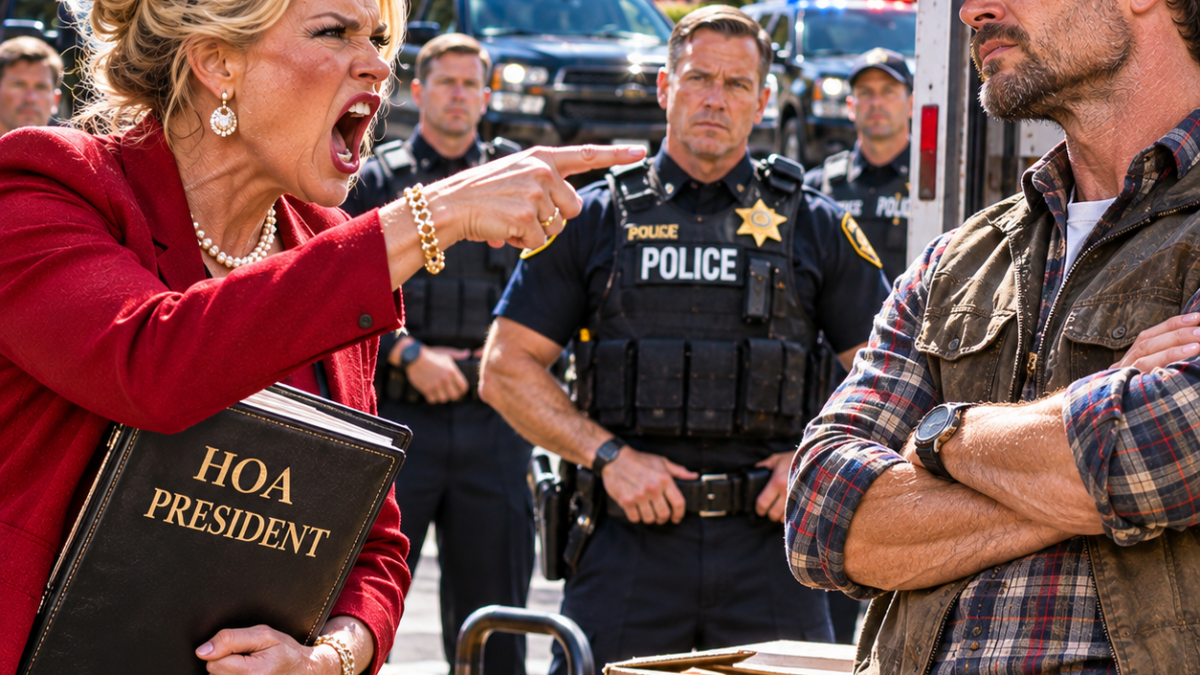
She handed me a forty-seven-page binder.
“Welcome to Pinewood Grove.”
I nearly dropped it.
“Light reading?”
She did not laugh.
“Community standards.”
Grass:
Two and a half to three inches.
Mailbox:
One of eight approved beige tones.
Visitor parking:
Four-hour maximum without prior permission.
Holiday decorations:
November twenty-fifth through January fifth.
Garbage cans:
Invisible except collection morning between six and eight.
I flipped pages.
“This is… thorough.”
“We take standards seriously.”
Then she smiled.
“I perform weekly inspections.”
There was something about the word inspections that should have warned me.
It did not.
Grief had made conflict feel expensive.
I nodded.
“Understood.”
Darlene left.
Two months later, she measured my lawn with a ruler.
Three-point-two inches.
Photograph.
Timestamp.
Fine:
$150.
I paid.
That was my first mistake.
Not because every HOA fine is illegitimate.
Because paying without asking taught Darlene something.
Roland will choose peace.
Then Pop visited.
He drove his small camper because hotel beds wrecked his back.
Parked in my driveway.
Two hours later:
Violation.
Recreational vehicle prohibited.
$500.
Remove within twenty-four hours or lien enforcement may begin.
I found Pop on my back deck reading the notice.
Sunset behind him.
Beer in hand.
The neighborhood was silent.
No kids.
No lawn conversations.
No basketball bouncing.
Nothing.
Pop looked at the paper.
Then at the street.
“Son.”
“Yeah?”
“I didn’t spend my twenties getting shot at so some woman with a clipboard could tell me where to park.”
I laughed despite myself.
Then looked around.
Really looked.
Blinds closed.
Perfect yards.
No personality.
No noise.
The kind of order that did not feel peaceful.
It felt frightened.
That night I opened my laptop.
Created a spreadsheet.
PINEWOOD GROVE HOA — FINES / OWNERS / BOARD / RECORDS.
Sarah would have laughed.
Maybe I heard her voice.
You’re making a spreadsheet because you’re angry.
Yes.
Exactly.
Within a week I learned Darlene had issued more than two hundred violation notices in eighteen months.
Every homeowner had been hit.
Some repeatedly.
The Chen family had repainted their house twice because one beige was supposedly “too warm” and the replacement “too yellow.”
The Torrances, two elementary-school teachers with young children, received a $400 violation because their kids drew with washable sidewalk chalk.
Harold Pierce, a veteran, paid hundreds over an American flag displayed outside an approved holiday period.
And then there was my turtle.
Sarah’s turtle.
Six inches tall.
Ceramic.
Hand-painted.
Ridiculous little smile.
She bought it for our twentieth anniversary because she said I moved through life like one.
Slow.
Methodical.
Eventually arriving.
I put it near the mailbox.
Darlene fined me $300.
UNAPPROVED LAWN ORNAMENT.
I sat in my car for twenty minutes holding the notice.
That turtle had survived Sarah’s illness.
The funeral.
The move.
Boxes I could barely open.
And now a woman who did not know Sarah existed had reduced it to aesthetic noncompliance.
Something inside me shifted.
This was no longer about three hundred dollars.
It was about somebody deciding grief, property, dignity, and fear were all leverage.
I attended my first board meeting.
Held in Darlene’s living room.
Of course.
Six homeowners.
Folding chairs.
Stale coffee.
Her husband Vernon writing minutes at a card table.
Darlene at the head.
I raised my hand.
“I’d like to discuss fine proportionality and request access to association financial records.”
The room went silent.
Darlene laughed.
“We don’t answer to renters.”
“I own my home.”
She looked irritated.
“Then you should know better than to challenge the board.”
At the door afterward, Vernon stopped me.
He looked behind him.
Then whispered:
“Drop it.”
“Why?”
“She’ll make your life hell.”
“How many people has she done this to?”
His eyes told me more than his mouth.
“We’ve seen things.”
Then he walked away.
That night I stopped asking whether Darlene was annoying.
I started asking how the system worked.
PART2
My lawyer’s name was Phyllis Grant.
Sixty-three.
Property and association law.
Office smelled like coffee and books older than both of us.
I brought the binder.
Violation notices.
Photos.
Fine schedule.
Copies of meeting minutes I had obtained through the association’s records process.
She read for an hour.
Then asked:
“What do you want?”
“To stop her.”
“Too broad.”
“To audit the finances.”
“Better.”
“To figure out whether these rules are valid.”
“Better.”
“And if they are?”
“I follow them.”
Phyllis looked up.
That answer seemed to matter.
“Good.”
“I’m not interested in helping a man become the next Darlene.”
Fair.
We made formal records requests under the association documents and applicable Indiana law.
Bank statements.
Budgets.
Vendor contracts.
Minutes.
Fine ledgers.
Not all arrived willingly.
Some came incomplete.
Some after reminders.
Some only after Phyllis got involved.
The first full set of financial records landed in a thick envelope.
We spread them across her conference table.
Fines collected:
Roughly $47,000 in the prior year.
Community improvements:
About $8,000 clearly documented.
The rest sat under categories like:
Administrative.
Consulting.
Management.
Special services.
Not automatically illegal.
But vague enough to justify questions.
I knocked on doors.
The bylaws allowed homeowners meeting a threshold to request a special meeting.
I needed four supporting owners.
Most did not answer.
Curtains moved.
Lights turned off.
At the third house, an elderly woman cracked the door.
Chain still on.
Her name was Gladys Monroe.
Eighty-three.
Tiny.
White hair.
Hands trembling.
“I’d sign.”
“Then why won’t you?”
She looked toward her front yard.
Bird feeder.
Simple wooden thing.
“They’ll fine me.”
“For that?”
“Darlene already threatened me.”
“Why?”
“She says it attracts squirrels.”
I stared.
Gladys whispered:
“I live on Social Security.”
“I can’t fight her.”
“What if I cover any new fine while we challenge it?”
Her eyes filled.
“You would?”
“Yes.”
She signed.
Word spread quietly.
People developed a signal.
Porch light on meant:
Safe to knock.
A week later I had enough signatures.
We filed the request.
Darlene responded through an attorney accusing us of forged signatures.
False.
I had copies.
Witnesses.
Dates.
Phyllis read the letter and smiled.
“She’s scared.”
“How do you know?”
“People comfortable in their authority usually cite it.”
“People who lack it often attack motive.”
Then she said something that changed everything.
“Roland.”
“Yes?”
“HOAs are corporations.”
“Essentially.”
“Yes.”
“And corporations are governed by voting rights.”
“Okay.”
“How are votes allocated here?”
I opened the bylaws.
One per lot, except certain duplex structures with allocation rules.
She leaned back.
“How many properties?”
“Twenty-two.”
“Control enough voting interests…”
Her eyes met mine.
“…and Darlene stops being president because homeowners remove her.”
I laughed.
“You’re suggesting I buy the HOA.”
“I’m suggesting ownership carries votes.”
“How you use that fact is your decision.”
I went home.
Opened the spreadsheet.
Twenty-two properties.
Eight rentals owned by absentee investors.
Several owners considering selling.
A few distressed.
One duplex.
I stared until two in the morning.
Then made my first call.
Texas landlord.
Owned an investment property in Pinewood Grove.
Tired of Darlene.
Tired of tenant complaints.
Tired of fines.
I offered above market for a fast, clean close.
He accepted.
First additional property.
I used a properly registered LLC.
Not to commit fraud.
To keep the transaction separate from my personal residence and because Phyllis advised clean ownership structures.
Pop moved into one side of the duplex after I purchased it.
He loved the arrangement.
“Now I’m an investor.”
“You’re paying rent.”
“Details.”
The other unit went to Marcus Reed.
Thirty-two.
Paralegal.
Friend of Phyllis’s firm.
Sharp.
Calm.
Zero tolerance for bullies.
He attended meetings as an owner-authorized representative where permitted and reported what happened.
Darlene noticed the sale.
Her response:
New rental rules.
Triple fines.
$1,200 quarterly absentee-owner fee.
Marcus texted:
She passed it in twelve minutes.
Phyllis reviewed.
“Procedural problems everywhere.”
“Challenge?”
“Not yet.”
“Why?”
“Because your property isn’t absentee.”
Pop lived there.
Darlene’s plan collapsed against the facts.
That became her pattern.
Panic.
Overreach.
Then Marcus noticed something worse.
Meeting minutes changed.
Dates.
Language.
Rules described as approved even when attendees remembered no vote.
We compared copies.
One version showed a vote on March fourth.
Another claimed February twenty-first.
Different quorum numbers.
Phyllis’s face hardened.
“Preserve every version.”
“Fraud?”
“Potentially false corporate records.”
“We prove before we label.”
Good rule.
I kept buying.
A foreclosed ranch.
Estate sale.
Another property from a divorcing couple who needed a fast close.
Different LLCs where appropriate, all disclosed properly in the transactions and controlled by me.
Darlene knew investors were buying.
She did not know the full picture yet.
She became paranoid.
Emergency meeting.
New right-of-first-refusal proposal.
Association wanted first chance to buy any home before open-market sale.
Phyllis laughed.
“Cannot undo contracts already executed.”
Three purchases were in escrow.
Darlene was always one step behind because she reacted emotionally.
Then she began dismantling community assets.
Gazebo sale discussion.
Playground equipment.
Common-area items.
She claimed Pinewood needed litigation funds against “hostile corporate acquisition.”
There was no filed hostile lawsuit.
Just fear.
At night I sometimes wondered whether I had become obsessed.
Sarah used to say I could turn a leaking faucet into a project plan.
One evening I drove to her grave.
Brought another ceramic turtle.
Placed it near the stone.
“You’d think this is insane.”
Wind moved through the cemetery.
“You’d also hate Darlene.”
No answer.
Obviously.
I sat.
“I don’t know if I’m doing this because it’s right or because I’m angry.”
That question bothered me.
When I returned, Pop waited at the kitchen table.
“Where were you?”
“Sarah.”
He nodded.
“Figure it out?”
“No.”
He opened two beers.
“Maybe it can be both.”
“What?”
“Angry and right.”
I looked at him.
“That’s not comforting.”
“Truth usually isn’t.”
By month ten, I controlled ten votes.
Close.
Darlene called another emergency meeting.
Special assessment.
$5,000 per household.
Reason:
Legal defense against unnamed outside interests.
Eighteen homeowners came.
Marcus sat near the back.
He texted me in real time.
Darlene stood at the front.
“Pinewood Grove faces an existential threat.”
A teacher named Daniel Torrance stood.
“We can’t afford five thousand.”
Darlene looked at him.
“Then perhaps Pinewood Grove isn’t the right fit for your family.”
Marcus later told me the room went silent.
Daniel’s wife grabbed his arm.
They walked out.
That line spread.
People had tolerated fines when they thought they were isolated.
But hearing Darlene tell two teachers with children they did not belong because they could not fund her war changed something.
Marcus challenged the assessment under the governing documents and statutory requirements.
Darlene claimed emergency authority.
“Show us the section.”
She could not.
The meeting collapsed into arguments.
Residents began comparing notices.
That was the beginning of the end.
Two days later, Gladys called.
“Roland.”
Her voice barely existed.
“I need to sell.”
I drove over.
She made Earl Grey.
Yellow curtains.
Photographs of grandchildren.
Her bird feeder visible through the window.
She had accumulated $1,100 in fines.
Lawn.
Feeder.
Seasonal flag.
One violation involved an American flag displayed on the Fourth of July because Darlene claimed the dimensions did not comply.
Gladys looked down at her hands.
“I’ve lived here nineteen years.”
“I thought I would die in this house.”
I swallowed.
“Do you want to leave?”
“I want to stop being afraid of the mailbox.”
That sentence made the decision easy.
I offered asking price.
Moving costs.
Flexible closing.
No pressure.
Gladys cried.
Accepted.
After moving to a senior community, she finally looked relaxed.
Until Darlene tracked her down.
Parking lot.
Broad daylight.
Called her a traitor.
Screamed that she had sold out the neighborhood to corporate interests.
Gladys’s daughter recorded everything.
Ninety seconds.
Darlene towering over an eighty-three-year-old woman.
Gladys standing quietly.
The video hit local Facebook groups.
Then regional.
Twenty thousand views in two days.
Comments appeared from former residents.
Old real-estate clients.
People who remembered Darlene’s license suspension years earlier after an ethics complaint involving undisclosed property problems.
For the first time, Darlene could not control the audience.
Meanwhile, I needed the Chens.
They had been punished more than almost anyone.
Two forced repaints.
Thousands gone.
Mr. Chen was an accountant.
His wife taught piano.
They were house hunting in Maplewood.
At a small July barbecue, I approached him.
“I heard you’re leaving.”
He looked toward the houses.
“We can’t stay.”
“What if I buy?”
He laughed.
“We haven’t listed.”
“Fifteen thousand over appraisal.”
“Closing costs on the new place.”
His expression changed.
“Why?”
I showed him the spreadsheet.
Not every detail.
Enough.
His house would push the voting block over the line.
He stared.
“You’re trying to take the board.”
“Yes.”
He looked at his wife.
Then back.
“We want front-row seats.”
“Deal.”
The sale closed three weeks later.
With the voting interests I controlled through my properties, I crossed fifty percent.
Twelve out of twenty-two applicable property votes under the structure Phyllis confirmed.
I did not become dictator.
That mattered.
I gained enough voting power to call for change through the process.
Election.
Notice.
Nominations.
Vote.
Thirty days.
Darlene still did not understand who owned the LLCs.
Then Mr. Chen called.
“Come over.”
His hands shook when he gave me the folder.
“I served as temporary board secretary in 2019.”
“Okay.”
“I copied things.”
“What things?”
“Everything.”
Bank statements.
Emails.
Invoices.
Lien records.
He was an accountant.
Numbers bothered him.
First:
$31,000-plus transferred over three years from HOA operating accounts to Grove Management LLC.
Consulting fees.
Grove Management traced to Darlene.
Second:
Emails with Morrison Construction, a company connected to a county commissioner’s family.
Inflated repair estimates.
Then a phrase:
20% finder’s fee per usual.
Third:
The Patterson file.
Former resident.
Darlene claimed unpaid fines.
HOA lien.
Refinance blocked.
Yet bank records showed Patterson had paid the disputed balance before the lien was recorded.
I stopped.
“Why didn’t you use this?”
Chen looked ashamed.
“I was scared.”
“Of what?”
“You.”
“What?”
“Not you.”
He shook his head.
“Her.”
“She destroys people.”
“The Johnsons.”
“Patels.”
“The family with the baby.”
“I watched them fight and leave.”
“I told myself copies were insurance.”
He wiped his face.
“Then Gladys moved.”
“And I realized insurance that never gets used is just paper.”
I called Phyllis.
She arrived.
Read.
Her face became serious.
“This may support civil fraud, breach-of-fiduciary-duty claims, and potential criminal referral.”
“Embezzlement?”
“Potentially.”
“Kickbacks?”
“Potentially.”
“Lien fraud?”
“The lien situation is extremely serious.”
She pointed at me.
“But we do not hold criminal evidence for theatrical timing.”
That hit my plan.
I wanted Darlene exposed at the election.
Publicly.
Phyllis said:
“We preserve.”
“We refer appropriately.”
“Then we use lawfully available records during association governance.”
No revenge circus.
She was right.
We provided evidence to the appropriate authorities.
No promise of charges.
No invented racketeering headline.
Evidence first.
Election still proceeded.
Darlene panicked harder.
She filed civil claims against “unknown investors” alleging conspiracy to undermine Pinewood Grove.
HOA reserves paid a large retainer.
Then she mailed threatening letters.
Anyone cooperating with hostile investors would face strict enforcement.
Terrible strategy.
A secret homeowner group formed:
PINEWOOD GROVE TRUTH.
Marcus moderated.
Fourteen of twenty-two owners joined quickly.
Photographs.
Fine notices.
Stories.
A child’s chalk drawing that cost $400.
A widow’s gutter.
A veteran’s flag.
The more people shared, the more one sentence appeared:
I thought I was the only one.
That was Darlene’s true source of power.
Isolation.
Not bylaws.
Every household believed their punishment was personal.
Once they compared notes, the system became visible.
My dining room turned into what Pop called the war room.
Laptop.
Printer.
Banker’s boxes.
Coffee.
Maps.
Voting charts.
Phyllis.
Marcus.
Chen.
Gladys, despite no longer living there, insisting on contributing.
“I want my bird feeder vindicated.”
The Torrances documented community stories.
Bernard Cooper, retired postal worker, knew everyone.
A reporter named Kate Monroe began investigating independently.
She had standards.
Documents.
Multiple sources.
No exaggeration.
“This isn’t a Karen story.”
She told me.
“It’s a governance story.”
“Less viral.”
“More useful.”
Good.
Phyllis prepared the corporate side.
Ownership interests.
Proxies where lawfully permitted.
Meeting procedure.
Nomination requirements.
Notice.
We reviewed everything twice.
No shortcuts.
Darlene’s regime had survived on sloppy procedure.
I did not want to defeat her with the same thing.
Chen organized financial evidence.
Kate interviewed former residents.
Gladys baked cookies for nervous witnesses.
Pop played Darlene during practice meetings.
He was terrifyingly good.
“You’re out of order!”
He screamed.
“Dad.”
“What?”
“Too much.”
“She’s worse.”
Correct.
One evening after everyone left, Pop and I sat with beer.
“What happens after?”
He asked.
“If we win?”
“Yes.”
I looked around Sarah’s turtle sitting near the porch.
“I don’t want to become president forever.”
“Good.”
“I want an audit.”
“Refund illegitimate fines if legally supported.”
“Fix the records.”
“Then residents decide what Pinewood should be.”
“What about the HOA?”
I thought.
“Maybe dissolve.”
“Can we?”
“High vote threshold.”
“But maybe.”
Pop nodded.
“And money recovered?”
That was where Sarah entered.
“I want a scholarship.”
He looked at me.
“Name?”
“Sarah’s Second Chances Scholarship.”
Pop stared at the table.
Then nodded.
No joke.
That meant he liked it.
The final week before the election, Kate found Darlene’s old real-estate disciplinary record.
Not gossip.
Documented suspension related to an ethics violation in a prior sale.
Pattern did not prove current fraud.
But it showed the public persona was not spotless.
Kate’s article was scheduled for election morning.
Phyllis reviewed what we planned to distribute.
“No accusations beyond documents.”
“Understood.”
“Do not say she stole $31,000 unless auditors and investigators establish it.”
“Say transfers to her company require explanation.”
“Understood.”
“Do not promise prison.”
“Never.”
“Do not block her from leaving.”
“Obviously.”
Pop raised a hand.
“What if she deserves dramatic humiliation?”
Phyllis stared.
“Then television exists.”
Election day.
Six a.m.
Kate’s article went live.
PINEWOOD GROVE FINANCES UNDER SCRUTINY AS RESIDENTS CHALLENGE LONGTIME HOA PRESIDENT.
Not sexy.
Devastating anyway.
Bank transfers.
Vendor relationships.
Former homeowners.
Fine patterns.
Gladys’s parking-lot video.
Darlene’s prior license discipline.
By noon, TV trucks appeared.
Neighbors walked outside.
Talked openly.
Bernard told a reporter about the widow fined for a dented gutter that existed before she bought the house.
Mrs. Torrance described the chalk fine.
Chen discussed repaints.
Darlene tried to postpone the election.
Email blast.
Legal review.
Meeting canceled.
Phyllis responded with the governing documents.
Once properly called, the election could not simply be erased by presidential email.
The meeting continued.
Seven p.m.
Community center.
Neutral location.
I rented it.
At five-thirty, Darlene’s Lexus sat in the fire lane.
Of course.
Inside, she argued with the manager.
“This room has been double-booked.”
I set a box down.
“No.”
She turned.
“You.”
“Me.”
I showed the rental contract.
Paid.
Valid.
Manager shrugged.
“He has the room.”
Darlene’s makeup looked heavier.
Tired underneath.
“Do you have any idea what you’ve done?”
“I called an election.”
“You’ve poisoned this community.”
“I asked questions.”
“You bought people.”
“No.”
“I bought properties.”
“Owners still choose how to vote within the governing structure.”
She leaned close.
“I know it’s you.”
“Good.”
“You think you’re clever?”
“No.”
“I think you underestimated spreadsheets.”
She walked away.
At six-thirty, cars filled the street.
Thirty-eight people entered, including owners, spouses, residents, media where permitted, and lawyers.
Record turnout.
Darlene sat at the head table.
Vernon beside her.
Two loyal board members.
Gavel.
Yes.
Actual gavel.
Seven sharp.
She began:
“Before elections, we must address defamatory attacks.”
She proposed a $25,000 crisis public-relations expenditure.
Someone groaned.
I stood.
“Point of order.”
Her face tightened.
“Sit down.”
“The governing documents place elections first when properly noticed on this agenda.”
Phyllis stood.
“He is correct.”
Darlene’s hand gripped the gavel.
“This is my meeting.”
I walked toward the front.
“No.”
“This is the homeowners’ meeting.”
Applause.
She slammed the gavel.
“Fine.”
“Nominations.”
Bernard stood.
“I nominate Roland Mercer.”
A dozen hands seconded.
Darlene stared.
Then I connected my laptop.
The ownership map appeared.
Blue highlights.
Properties held by me or my entities.
Voting interests.
“Eighteen months ago, I moved here because my wife died.”
I said.
“I wanted peace.”
“I found a neighborhood where people were afraid to put bird feeders outside.”
Gladys sat in the second row.
Tears already forming.
“I did not buy these properties to become king.”
“I bought them because your bylaws gave ownership voting rights, and every normal attempt to challenge Darlene’s administration was being shut down.”
I changed slides.
“Together, the properties I control represent fifty-three percent of the voting interests relevant to this election structure.”
Silence.
Darlene’s face emptied.
Vernon stopped writing.
One board member whispered something.
Then began packing.
Darlene stood.
“You can’t do this.”
“We are doing exactly what the governing documents permit.”
“You manipulated the system.”
“I bought houses.”
“You targeted vulnerable sellers.”
“No.”
I looked at Gladys.
“Every seller had independent choice.”
“Several received above-market offers.”
“Gladys received moving costs.”
“The Chens wanted out.”
“This is not foreclosure.”
“It is purchase.”
Then I said:
“Before anyone votes, I believe homeowners deserve to understand the records currently under review.”
Phyllis stepped forward.
“We will distinguish confirmed documents from allegations.”
That mattered.
First slide.
Transfers from HOA operating funds to Grove Management LLC.
$31,428 over three years.
Company tied to Darlene.
I said:
“These are documented transfers.”
“Whether they were legitimate consulting fees or improper self-dealing is under review.”
“Homeowners should ask why the relationship was not transparently disclosed.”
Second slide.
Morrison Construction quotes.
Inflated compared to comparator bids we had obtained.
Email:
20% finder’s fee per usual.
Murmurs became shouting.
Darlene stood.
“Fake.”
Phyllis held up copies.
“Records came from association files and were preserved for independent review.”
Third.
Patterson lien.
Fine balance allegedly unpaid.
Bank record showing payment before lien.
A woman in the third row began crying.
“Patterson was my brother.”
Darlene’s face turned white.
Phyllis said:
“Relevant materials have been referred to counsel and appropriate authorities.”
“We are not trying a criminal case here tonight.”
“We are deciding association governance.”
That pulled the room back.
Good.
Darlene pointed at me.
“You planned this.”
“No.”
“I moved here grieving.”
“You fined Sarah’s turtle.”
“What?”
“The little ceramic turtle.”
People looked confused.
Gladys started crying harder.
I continued.
“That was when I realized your rules were not just rules.”
“They were tools.”
“You chose who to pressure.”
“How much pain to apply.”
“How expensive resistance would become.”
Darlene shouted:
“I protected property values!”
Chen stood.
“My family repainted twice.”
Torrance:
“You told us maybe we didn’t belong because we couldn’t afford $5,000.”
Gladys:
“You threatened my home over a bird feeder.”
Bernard:
“You fined a veteran over a flag.”
The room changed.
People were standing now.
Not threatening.
Testifying.
One after another.
Darlene looked toward Vernon.
He stood.
Picked up the legal pad.
Walked out.
She watched her husband leave.
That was when her arrogance finally cracked.
“Vernon.”
He did not turn.
She looked toward the remaining board members.
One would not meet her eyes.
The other gathered papers.
Darlene whispered:
“You’re all cowards.”
Gladys spoke.
Softly.
“You made us afraid, dear.”
Then:
“That’s not the same thing as loyalty.”
No applause at first.
Just silence.
Phyllis reminded everyone:
“Election.”
Good.
Procedure.
We voted.
I won overwhelmingly.
Not unanimously.
Darlene voted against me.
One loyal owner too.
Two abstained.
Fine.
Democracy does not need unanimity.
I took the podium.
“My first actions will be administrative.”
“No revenge.”
“First, remove prior officers’ unilateral access to association bank accounts pending audit.”
“Second, hire an independent forensic accountant.”
“Third, freeze nonessential expenditures.”
“Fourth, suspend collection on disputed fines from the prior eighteen months until reviewed.”
“Fifth, appoint temporary board replacements according to the governing process until proper elections fill vacancies.”
Then I looked at Darlene.
“You are no longer president.”
The room exhaled.
Not exploded.
Exhaled.
Like twenty-two households had been holding breath for years.
Then applause came.
Gladys cried.
Torrances hugged.
Chen sat with his face in his hands.
Darlene grabbed her purse.
“You’ll regret this.”
No one answered.
Then Gladys said:
“You built a prison, dear.”
Her voice shook.
“These people are just opening the doors.”
Darlene walked out.
Cameras followed.
Nobody blocked her.
Nobody touched her.
That detail mattered later.
Twenty minutes after she left, sheriff’s deputies arrived.
She had reported an assault.
Of course.
The deputy looked around.
Forty witnesses.
Multiple cameras.
Recorded meeting.
“No one touched her?”
“No.”
I said.
Video confirmed.
The deputy sighed.
“Understood.”
Marcus was reviewing an association laptop left with records.
He called me over.
“Roland.”
“What?”
Recovered email.
Subject:
GLADYS FORECLOSURE TIMELINE.
My stomach dropped.
The email discussed initiating lien enforcement and eventual foreclosure if her fines remained unpaid.
Timing:
Two weeks.
Gladys had been closer than she knew to a potentially devastating legal process.
I looked across the room.
She was laughing with Mrs. Torrance.
Holding a paper plate of pizza.
“Print it.”
I told Marcus.
“Preserve metadata.”
“Give it to Phyllis.”
The celebration that night was messy.
Pizza.
Beer.
Kids in the parking lot.
Adults trading phone numbers.
People who had lived thirty yards apart for years introducing themselves properly for the first time.
Pop handed me a beer.
“Your wife would be proud.”
I looked at Sarah’s turtle.
I had brought it.
Set it on the community center steps.
Stupid mascot.
“Maybe.”
“No.”
He nudged me.
“She would.”
I looked inside.
Gladys laughing.
Bernard telling some impossible postal-service story.
Chen talking to Phyllis.
Children running.
For the first time, Pinewood Grove sounded like the neighborhood I thought I had bought into.
The audit began immediately.
Independent forensic accountant.
No friends.
No allies.
No shortcuts.
Two weeks.
Then another town hall.
Every owner.
Media.
Observers.
Darlene came with a criminal-defense attorney.
That told me the investigation had moved beyond HOA politics.
She sat in the back.
Silent.
Smart lawyer.
The accountant presented.
Transfers to Grove Management:
Confirmed.
$31,428.
Contractor-related payments and documented questionable finder’s-fee arrangements:
Roughly $18,000-plus requiring legal treatment.
Improper or unsupported fines:
More than $50,000 across nineteen homeowners.
Emergency reserve:
Depleted far below what residents had been told.
Insurance and governance issues:
Serious.
The total financial exposure was far larger than the first records suggested once refunds, fees, legal costs, and potential restitution were included.
I did not call everything theft.
The auditor separated categories.
Confirmed.
Unsupported.
Potential conflict.
Subject to investigation.
That made the report stronger.
Then victims spoke.
Gladys first.
“I’m eighty-three.”
“My worst crime was feeding birds.”
Laughter through tears.
“I spent six months afraid every car outside was someone coming to take my house.”
She sat.
Torrances next.
“We teach civics.”
Daniel said.
“We tell children institutions work when people participate.”
“We stopped participating because we were scared.”
Mrs. Torrance added:
“We are participating now.”
Bernard:
“Nineteen years.”
“I watched Pinewood go from neighborhood to dictatorship one fine at a time.”
Chen:
“I had the records.”
“I was too afraid to use them.”
Then:
“I’m ashamed.”
I interrupted.
“No.”
He looked at me.
“You preserved them.”
“And eventually used them.”
“That matters.”
Darlene finally stood.
Her lawyer tried to stop her.
She yanked her arm away.
“You’re all pathetic.”
The room froze.
“I made this neighborhood valuable.”
“Property values rose because I enforced standards.”
Chen, accountant to the end, had regional numbers.
Pinewood appreciation had actually underperformed similar nearby neighborhoods during much of her tenure.
Not proof she caused it.
But enough to destroy her favorite claim.
Darlene flushed.
“That’s because of—”
She stopped.
Everyone heard the ugliness she almost said.
Her lawyer pulled her down.
I changed the slide.
“Final agenda item.”
HOA dissolution.
We had researched it carefully.
Required high approval.
Need to address common areas.
Contracts.
Debts.
Insurance.
Legal obligations.
Not as simple as chanting no more HOA.
Phyllis explained.
“If dissolved, assets and obligations must be handled properly.”
“Common areas cannot simply vanish.”
“The city has indicated preliminary willingness to discuss accepting the playground and gazebo parcels if conditions are met.”
“Existing liabilities remain.”
“Dissolution is a process, not a magic eraser.”
Then we voted to authorize that process and pursue dissolution subject to required approvals and legal steps.
Nineteen of twenty-two voting interests supported.
Well above the governing threshold.
People cheered.
Darlene did not.
We did not declare everything magically ended that night.
We began formal dissolution.
That distinction saved us from becoming the same kind of people who ignored procedure when convenient.
Months followed.
Accountants.
City negotiations.
Insurance.
Lien resolutions.
Vendor contracts.
Tax issues.
Common-property conveyances.
Owner votes.
Attorney review.
Finally Pinewood Grove HOA dissolved legally.
The playground and gazebo moved into a public-maintenance arrangement after the city process concluded.
Some common landscaping became neighborhood responsibility through voluntary agreements.
No ruler.
No grass ruler.
No beige mailbox committee.
People still had municipal codes.
Property law.
Noise rules.
Normal civilization.
But not Darlene.
The criminal case developed separately.
Investigators examined the bank transfers.
Vendor relationships.
Lien conduct.
Association records.
Vernon cooperated.
Not because he became heroic.
Because his name appeared on documents.
He hired counsel.
Eventually provided information about Darlene’s control over payments and records.
The final criminal resolution was less dramatic than social media wanted.
Plea agreement.
Darlene received eighteen months of incarceration, followed by probation and substantial restitution obligations exceeding $100,000 across the matters resolved.
Additional restrictions prevented her from holding certain association fiduciary roles under the terms imposed and later governance reforms.
Vernon received probation after cooperation and lesser involvement was recognized.
Their marriage ended.
He moved west.
No one in Pinewood missed them.
The civil side returned money.
Improper fines refunded where documentation supported it.
Some insurance and settlement money.
Some restitution.
Some association liquidation proceeds.
There were shortfalls.
I covered approximately twelve thousand dollars personally so the oldest and most vulnerable residents would not wait years for every final recovery.
Phyllis yelled at me.
“You are not a bank.”
“I know.”
“You already bought half the neighborhood.”
“Temporary problem.”
“You’re insane.”
“Probably.”
The refund checks mattered.
Gladys held hers.
$1,100.
Not life-changing to me.
Huge to her.
She touched the check.
“Do you know what I’m buying?”
“What?”
“A bigger bird feeder.”
Of course.
She bought one almost four feet tall.
Multiple platforms.
Squirrel guard.
Solar light.
Absolute monstrosity.
I loved it.
Bernard installed a mailbox shaped like a trout.
Ugliest object in Indiana.
The Chens planted vegetables where Darlene once demanded decorative shrubs.
Torrance children covered their driveway in chalk.
The first rain washed it away.
Nobody fined them.
A house down the street kept Christmas lights up until March.
Then April.
Eventually the joke became:
Maybe never.
Kids played outside.
That was the biggest change.
Sound.
Basketball.
Bikes.
Parents calling children for dinner.
Dogs barking.
Darlene’s Pinewood had been quiet because everyone was afraid of being noticed.
Freedom was noisy.
I sold several of the houses I had purchased.
Some back to families.
Some to owner-occupants.
A few at losses.
I kept eight as rentals.
Charged below-market rent where financially sustainable.
Families.
Students.
Veterans.
Pop stayed in one.
He insisted on paying.
“Discount?”
“No.”
“I’m your father.”
“Exactly.”
He paid.
Late sometimes.
I fined him zero dollars.
Sarah’s Second Chances Scholarship began with recovered funds legally available for community-benefit use plus my own contribution and donations.
Not money owed back to homeowners.
We separated that carefully.
First fund:
$47,000.
First recipient:
The Torrances’ daughter.
Studying education.
$2,500 renewable.
She cried when we told her.
Her father cried more.
“Don’t tell my students.”
He said.
“They already know.”
His wife replied.
Over time, the scholarship grew.
Children who lost parents.
Survived illness.
Overcame poverty.
Escaped unstable homes.
Sarah had always believed a bad beginning should not determine the rest of your life.
That was why I used her name.
I planted a garden around the ceramic turtle.
Black-eyed Susans.
Coneflowers.
Lavender.
Sarah’s favorites.
A bench.
Small plaque:
SARAH’S GARDEN — SIT. REST. GROW.
Neighbors used it.
Sometimes I came home and found Gladys there.
Sometimes teenagers.
One afternoon, a delivery driver ate lunch on the bench.
Sarah would have liked that.
Marcus joined Phyllis’s firm full-time.
Then law school at night.
He wanted to represent homeowners and tenants who could not afford normal rates.
Bernard wrote a book.
Self-published.
Terrible cover.
Good stories.
Donated profits to the scholarship.
We helped other communities when people called.
But with one rule:
No vigilante advice.
No secret takeovers.
No encouraging people to buy homes they could not afford.
Every case different.
Read documents.
Preserve records.
Get local counsel.
Follow the law.
Sometimes the HOA was not wrong.
One caller complained his association fined him for parking a boat across a fire lane.
I asked:
“Are you blocking emergency access?”
“Yes, but—”
“Move the boat.”
He hung up.
Another demanded help because his board denied a seven-foot fence.
Recorded covenants clearly limited fences to five.
Uniformly enforced.
No discrimination.
No fraud.
I told him:
“You may dislike the rule.”
“That does not automatically make it unlawful.”
He called me a sellout.
Fine.
The point was never:
HOAs bad.
The point was:
Power without accountability gets dangerous.
That distinction mattered.
Six months after dissolution, local news returned.
They filmed Pinewood on a summer evening.
Kids.
Chalk.
Gladys’s enormous feeder.
Bernard’s hideous trout mailbox.
Property values had improved.
Not because freedom magically increases prices every time.
But because title uncertainty ended, conflict dropped, and the community became attractive again.
Kate interviewed me.
“What was the turning point?”
“Not the election.”
“No?”
“No.”
“Gladys opening her door.”
Kate looked surprised.
“Why?”
“Because fear only worked while everyone thought they were alone.”
“Once one person talked…”
“Then another.”
“Then another.”
“That was the actual takeover.”
Not my properties.
Not the spreadsheet.
People finding each other.
We created Liberation Day.
I hated the name.
Pop loved it.
Annual anniversary.
Food trucks.
Band.
Bouncy castle.
Cornhole.
Gladys’s cherry pie.
Bernard cheating at every game.
Children chalking the sidewalks.
One year a five-year-old handed me yellow chalk.
“Draw.”
“I’m bad.”
“Doesn’t matter.”
I sat on the curb.
Drew a sun.
Terrible.
He added stick figures.
Pop sat beside me.
“Miss the fight?”
“No.”
He looked around.
“This is the win.”
Exactly.
Years passed.
The five-cruiser morning became a neighborhood joke.
The day Darlene called police because I was moving boxes.
People tell it wrong now.
Ten cruisers.
SWAT.
Helicopter.
No.
Five.
No guns drawn.
No arrest.
No dramatic takedown.
Just police arriving because Darlene weaponized a phone call.
What happened after mattered more.
The responding officer eventually returned off duty for a Liberation Day barbecue.
He said:
“You know what I remember?”
“What?”
“Her saying your grief wasn’t relevant.”
My stomach tightened.
“That line stayed with you?”
“Yeah.”
“Why?”
“Because I realized she wasn’t mad about rules.”
“She was mad that your life existed outside her control.”
That was sharper than anything I had said.
He was right.
Darlene’s greatest offense was not grass.
Or turtles.
Or campers.
It was her belief that every part of Pinewood had to pass through her.
Your lawn.
Your mailbox.
Your visitors.
Your grief.
Your money.
Your decision to leave.
That was why she called 911 when I loaded boxes.
Moving out meant escape.
And escape threatened authority.
Except she misunderstood.
I was not abandoning Pinewood.
I was moving furniture between properties I had purchased while preparing renovations and tenant transitions.
When officers realized that morning there was no crime, one asked:
“Why does she think she can stop you?”
I looked across the street.
Darlene still gesturing.
Still furious.
“Because for years nobody told her she couldn’t.”
That was the whole story.
People imagine tyrants begin powerful.
Often, they grow powerful because each small abuse is easier to tolerate than fight.
$150 grass fine.
Pay it.
$300 turtle.
Remove it.
$500 camper.
Move it.
A widow’s feeder.
A teacher’s chalk.
One household at a time.
Everyone makes the rational decision:
Not worth the fight.
Collectively, those rational decisions create something irrational.
A dictator with a gavel in her living room.
I contributed.
That is important.
I paid the first fine.
Did not challenge.
Darlene learned.
When Pop’s camper got fined, I nearly paid that too.
Sarah’s turtle stopped me.
Funny.
A six-inch ceramic animal.
Not some constitutional principle.
Love.
Memory.
Sometimes that is enough.
I kept the turtle beside the front door for years after dissolution.
Nobody could fine it.
That made me smile.
When Pop turned eighty, we held dinner at my house.
Bernard.
Gladys.
Chens.
Torrances.
Marcus.
Phyllis.
Kate.
Pop raised a beer.
“To Darlene.”
Everyone stared.
I almost choked.
“What?”
He smiled.
“She brought us together.”
Gladys shook her head.
“No.”
“We brought ourselves together despite her.”
Pop raised the bottle toward her.
“Better.”
“To Gladys.”
She blushed.
“To the bird feeder.”
Everyone drank.
That was more accurate.
Gladys died at ninety.
Peacefully.
Her daughter asked if I would speak at the funeral.
I did.
I brought the first petition.
The one Gladys signed behind a chained door.
I told everyone:
“This signature mattered more than all my property deeds.”
Her daughter cried.
Afterward she gave me the bird feeder.
“No.”
I said.
“Keep it.”
“Mom wanted you to have it.”
I installed it in Sarah’s garden.
It is outrageously large.
Birds love it.
Squirrels too.
Darlene would have hated it.
Perfect.
Pop slowed.
Stopped driving.
Bernard took him fishing anyway.
They would return with impossible stories.
“Six-pound bass.”
“Indiana state record.”
“No photograph?”
“Battery died.”
Liars.
Good liars.
The kind that hurt nobody.
Pop died at eighty-four.
He left me his Vietnam medals.
Fishing rods.
And one handwritten note.
Son, I was proud of you before you owned half the damn neighborhood. Don’t forget that.
I kept it beside Sarah’s photo.
That note fixed something I did not know needed fixing.
For years after Sarah died, I believed usefulness determined worth.
I could not save her.
So I needed to save something.
Maybe Pinewood became that thing.
Therapy helped me admit it.
Yes.
I eventually went.
My therapist asked:
“If Darlene never existed, what would you have done with your grief?”
I did not know.
Work.
Drink more.
Move again.
Hide.
The fight gave grief structure.
Was that healthy?
Sometimes.
Sometimes not.
I obsessed.
Lost sleep.
Spent money.
Turned dining rooms into command centers.
But the outcome did not automatically justify every impulse.
That mattered too.
Phyllis prevented me from becoming reckless.
When I wanted public humiliation:
She demanded procedure.
When I wanted to call everything criminal:
She said prove it.
When I wanted to wait for maximum dramatic timing:
She insisted certain evidence be referred promptly.
Good lawyers ruin revenge fantasies.
That is why you hire them.
Marcus graduated law school.
Passed the bar.
First case:
An elderly homeowner facing questionable lien enforcement.
He did not promise victory.
He audited records.
Found accounting error.
Resolved without trial.
He called me.
“Boring.”
“Good.”
“I wanted a Darlene.”
“No, you didn’t.”
“You’re right.”
The community fund eventually separated from anything tied to old HOA recoveries and became an independent nonprofit supported by donations.
Clean governance.
Annual audit.
Public reports.
I insisted.
If you spend years complaining about opaque money, your scholarship fund better have immaculate books.
Chen served as treasurer.
Nobody could hide five dollars from that man.
Once he emailed because I submitted a $14.62 receipt without explanation.
“What is this?”
“Printer paper.”
“Write printer paper.”
“You know it’s printer paper.”
“Documentation.”
Darlene traumatized us all into good accounting.
Useful legacy.
Bernard’s book sold thousands of copies.
He called it:
HOA HELL: HOW PINEWOOD FOUGHT BACK.
I hated the title.
Too dramatic.
It outsold everything I ever wrote.
Which was nothing.
He donated royalties.
At signings, people told their own stories.
Some real abuse.
Some simple neighbor disputes.
Bernard learned to say:
“Talk to a lawyer.”
Good.
Not every story needs war.
Pinewood continued without an HOA.
There were disagreements.
Of course.
One resident stopped mowing for two months.
City code eventually handled it.
Someone painted a mailbox fluorescent orange.
Bernard loved it.
I hated it.
No one cared.
A teenager practiced drums in a garage.
Neighbors negotiated hours.
Humans can solve many things without a forty-seven-page binder.
Not everything.
But many.
When people ask whether dissolving an HOA is always best, I say no.
Some communities have roads, gates, pools, drainage systems, private infrastructure that require an association.
Pinewood’s situation made dissolution workable after common assets were handled legally.
Different community:
Different answer.
The viral version says:
Buy the board.
Destroy the HOA.
Freedom.
Reality says:
Read documents.
Understand obligations.
Build support.
Use process.
Repair harm.
Then decide.
Less exciting.
More responsible.
Darlene served her sentence.
Eventually released.
I never contacted her.
She never contacted me.
Years later I heard she lived in Arizona.
Small condo.
No board role.
I felt nothing.
People expected satisfaction.
Maybe early on.
But time changes enemies into names attached to old files.
My life became bigger than her.
That is the most complete victory.
Not hatred.
Irrelevance.
One afternoon, maybe eight years after dissolution, a young couple knocked.
New to Pinewood.
They had bought the Chen house from the family who bought it after them.
No idea who Darlene was.
The husband held a flyer.
“Are you Roland?”
“Yes.”
“We heard you know the neighborhood history.”
“Unfortunately.”
They wanted to start a voluntary garden club.
Needed old map of the common park.
I helped.
Before leaving, the woman pointed at the framed violation notice inside my hallway.
UNAPPROVED LAWN ORNAMENT — $300.
“What’s that?”
I looked toward Sarah’s turtle.
“Long story.”
“Was the ornament ugly?”
“Yes.”
She laughed.
“Then maybe they had a point.”
I almost liked her.
That night I sat in Sarah’s garden.
Lavender.
Coneflowers.
Bird feeder.
Ceramic turtle.
Sunset.
I thought about the morning five police cruisers entered my driveway.
Darlene shouting.
Officers scanning.
Pop angry.
Me holding a box.
That scene became the story people tell because it has spectacle.
But if I had to choose the moment everything changed, I would choose something quieter.
Gladys.
Door chained.
Bird feeder behind her.
Whispering:
I’d sign, but I’m scared.
Then signing anyway.
That was courage.
Not mine.
Hers.
I had money.
Lawyer.
Career.
Options.
Gladys had Social Security and a bird feeder.
She signed.
The Torrances spoke.
Chen handed over records.
Marcus challenged procedure.
Bernard told stories.
Phyllis kept us legal.
Kate verified.
Pop reminded me why community mattered.
I bought properties.
Yes.
That gave us votes.
But ownership alone would not have fixed Pinewood.
Without people willing to stand up after years of fear, I would have become a landlord with a large spreadsheet and a deeply stupid collection of beige mailboxes.
Community is not property.
Darlene never learned that.
I almost forgot too.
The night after the final dissolution paperwork recorded, I sat on my deck.
No gavel.
No meeting.
No cameras.
Sarah’s photo on the table.
I poured two glasses of wine.
Habit.
Then realized.
I laughed.
Poured one back into the bottle.
“Sorry.”
I looked at her photograph.
“You would’ve hated most of this.”
She would.
Sarah hated confrontation.
Loved messy flower beds.
Believed homeowners should be allowed to paint their doors whatever color they wanted.
Once threatened to spray-paint our Columbus mailbox purple because I said the HOA there would object.
She never did.
Maybe she should have.
I whispered:
“We made something good.”
Wind moved through maples.
No answer.
But the turtle caught the last sunlight.
Enough.
Years later, the scholarship committee invited me to announce the twentieth recipient.
A teenager named Maya.
Her mother died when she was twelve.
Father worked nights.
Maya held two jobs.
Wanted to study social work.
I read her essay.
She wrote:
A second chance is not pretending the first thing didn’t happen. It is deciding the first thing does not get the final word.
I stopped.
Had to walk outside.
Sarah would have loved that.
At the ceremony, I told Maya:
“My wife would have liked you.”
She smiled.
“I wish I could’ve met her.”
“Me too.”
When Maya graduated, she came back to Pinewood.
Social worker.
Helped seniors with housing.
Gladys would have loved her too.
That was the ripple.
Not Darlene’s sentence.
Not my property purchases.
One woman’s memory became a scholarship.
One widow’s fear became a petition.
One accountant’s hidden file became evidence.
One paralegal became a lawyer.
A neighborhood that stopped talking became a place where forty-three people showed up to potlucks.
That is what systems look like after repair.
Not perfect.
Alive.
One summer, Marcus texted:
RIVERSIDE HOA CASE. Military widow. Serious lien issue.
Pop would have said:
Here we go again.
I called Marcus.
“What do you have?”
“Not enough yet.”
“Good answer.”
“We need records.”
“Exactly.”
I did not grab keys.
Did not build a war room.
I gave him contact information for local counsel.
Shared public resources.
Then went back to my garden.
That was growth.
You cannot fight every battle personally.
You can teach people how to ask better questions.
I still get emails.
HOA horror stories.
Some terrible.
Some funny.
Some entirely self-inflicted.
A man once wrote:
HOA says I can’t keep six chickens in my townhouse courtyard. Tyranny?
I asked:
“What do the covenants say?”
No livestock.
I replied:
“Probably not your revolution.”
He did not appreciate that.
Freedom is not the absence of every rule.
It is the presence of legitimate, transparent, proportionate rules people can understand and challenge.
That distinction would have bored Darlene.
She preferred obedience.
That was why her favorite word was compliant.
I remember the first day.
She handed me the binder.
“We like everyone compliant.”
At the time, I thought it was simply an awkward word.
Later I realized it described her worldview.
Neighbors were not citizens of a small community.
They were subjects.
That worldview eventually turned every disagreement into disobedience.
A lawn is not two-tenths too long.
Homeowner is defiant.
A camper is not parked temporarily.
Owner is challenging authority.
A turtle is not sentimental.
It is an unauthorized object.
Once you stop seeing people, every rule becomes easier to enforce cruelly.
That is the opposite of community.
The strangest part?
Darlene believed she loved Pinewood.
I think she did.
In her way.
She loved the image.
Perfect lawns.
Matching mailboxes.
Quiet streets.
Predictability.
Property values.
She simply loved control more than people.
That is how abuse often disguises itself.
Protection.
Standards.
Safety.
Order.
The words are not inherently bad.
But ask:
Who benefits?
Who decides?
Can anyone appeal?
Are rules applied evenly?
Where does the money go?
Can leaders be removed?
Those questions separate governance from domination.
I wish I had asked sooner.
Maybe the first $150.
Maybe Pop’s camper.
But grief made me tired.
That is another thing Darlene understood.
Bullies target exhausted people.
Widows.
Elderly.
Young parents.
Divorcing couples.
People with less time, money, confidence.
I happened to recover enough energy to fight.
Others had not.
That never made them weak.
It made them human.
I once apologized to Gladys.
Years before she died.
“For what?”
“For not getting here sooner.”
She laughed.
“You weren’t Batman.”
“Thank God.”
“You couldn’t save people before you knew us.”
“I know.”
“Then stop making yourself important.”
Classic Gladys.
“Who saved Pinewood?”
I asked.
She thought.
“Everybody who finally stopped whispering.”
Perfect.
That line replaced my own version.
Not:
Roland bought the board.
Not:
Widower destroys HOA Karen.
Everybody stopped whispering.
That was the real ending.
The morning Darlene called police on my U-Haul, the officers left after about twenty minutes.
No arrest.
No citation.
The lead officer handed back my license.
“You’re free to continue moving.”
Darlene shouted from across the street.
“This isn’t over!”
I looked at her.
Then at the U-Haul.
Then at the houses I owned.
Pop stood beside me smiling.
“What?”
I asked.
He nodded toward Darlene.
“You going to tell her?”
“Not yet.”
“How long?”
“Twenty minutes.”
“What happens in twenty minutes?”
I checked the time.
A scheduled property closing would record the final deed transfer tied to one of the last houses in the block I was acquiring after dissolution-related reorganization.
Pop laughed.
“You really are a nerd.”
“Yes.”
I lifted the box.
Carried it into the truck.
Darlene shouted something about abandonment.
I ignored her.
Twenty-five minutes later, my phone buzzed.
Recording confirmation.
I looked across the street.
Darlene’s house itself was not mine.
Despite the viral retelling, I did not magically become her landlord by buying the entire block.
Real title law does not work like internet fantasy.
But I had acquired or retained enough surrounding properties and voting power that her old assumption was dead:
She no longer controlled Pinewood.
No board.
No fines.
No gavel.
No power over my move.
She could call police.
Yell.
Point.
Nothing changed.
That was more satisfying than owning her house.
Because the point was never to reverse roles.
I did not want Darlene to become my subject.
I wanted everyone to stop being hers.
Years later, a filmmaker asked whether he could dramatize the story.
I said:
“You’ll make me too heroic.”
He laughed.
“That’s movies.”
“Then no.”
He asked:
“What would you change?”
“Show more paperwork.”
“No one watches paperwork.”
“That’s the problem.”
He did not make the film.
Probably wise.
The true story is less tidy.
Darlene did real harm.
Some homeowners complied.
Some resisted late.
I used wealth to buy properties others could not.
That strategy worked because I had resources.
It is not a universal solution.
Some evidence led to consequences.
Some suspicions turned out less dramatic.
Dissolution required months of legal work.
Refunds took time.
Not every family returned.
Chloe—another former resident who left before I arrived—never moved back.
Patterson’s lost refinance could not be recreated.
Gladys lost months of peace.
Sarah remained dead.
Justice does not restore time.
That is why I dislike the phrase:
Everything worked out.
No.
Something new worked out.
Different.
Better in some ways.
Still carrying scars.
Pinewood’s children now draw on sidewalks without knowing why adults sometimes smile when they see chalk.
Good.
They should not inherit fear as tradition.
A teenager recently asked Bernard:
“Who was Darlene?”
He pointed toward me.
“Ask him.”
I said:
“Old HOA president.”
“Was she mean?”
“Sometimes.”
“Why does everyone make jokes?”
“History.”
The teenager shrugged.
Went back to basketball.
Perfect.
The day people stop needing the villain is the day the villain truly loses.
I am sixty now.
Retired from software project management.
Still own several rentals.
Still make spreadsheets.
Sarah’s garden is bigger.
The turtle’s paint faded.
I refuse to repaint it.
Its scratches belong there.
Some mornings I sit on the bench.
Coffee.
Birds.
Neighbors wave.
No one measures anything.
The white Lexus disappeared years ago.
A new family lives in Darlene’s former house after multiple sales.
Nice people.
They planted bright red flowers she would have hated.
I never tell them.
They deserve their own story.
Every Liberation Day, someone asks me to speak.
I try not to.
Gladys used to say I talked too much once given a microphone.
She was right.
But sometimes I tell the kids one thing.
“Your neighborhood belongs to everyone who lives here.”
“Not the loudest person.”
“Not the richest.”
“Not the person holding a title.”
“Everyone.”
Then Bernard yells:
“And read the bylaws!”
Kids laugh.
Adults understand.
Pop is gone.
Gladys too.
Sarah long gone.
Darlene somewhere else.
Time empties stages.
What remains is what people build after.
The scholarship.
The garden.
The friendships.
The habit of asking questions.
The fact that somebody new can move to Pinewood without receiving a forty-seven-page threat disguised as welcome.
That is enough.
Sometimes I think back to Sarah’s last months.
She knew she was dying before I accepted it.
One evening she told me:
“After I’m gone, don’t turn our life into a museum.”
I became angry.
“You’re not going anywhere.”
She smiled.
“Roland.”
I hated when she used that tone.
She continued.
“Do something stupid.”
“Travel.”
“Buy a motorcycle.”
“No.”
“Paint a wall red.”
“Absolutely not.”
“Make new friends.”
I looked away.
She squeezed my hand.
“Live somewhere that makes you breathe.”
Pinewood became that place.
Not because it was perfect when I arrived.
Because people fought to make it breathable.
That matters.
Darlene almost turned my fresh start into another place defined by loss.
Instead, her cruelty forced me into connection.
Not because cruelty was secretly good.
It was not.
But people can build meaning from harm without pretending harm was necessary.
Sarah taught me that before I understood.
Second chances.
Not erasure.
The scholarship’s name was right.
Pinewood did not get its old neighborhood back.
It got a second chance.
So did I.
One evening at the annual celebration, a little girl handed me sidewalk chalk.
Yellow.
Again.
“Draw the sun.”
“I did that years ago.”
“Do it again.”
Children are tyrants too.
I sat.
Drew a circle.
Terrible rays.
She added a house.
Then another.
Then people holding hands.
Pop’s voice came back in memory.
This is the win.
Yes.
No gavel.
No board takeover.
No reporter.
No police cruisers.
Just chalk Darlene would once have fined.
A bird feeder she would have banned.
A turtle she wanted removed.
A neighborhood loud enough to sound alive.
My phone buzzed.
I looked.
Email.
Another homeowner somewhere else.
Terrified.
HOA lien.
Questions.
I almost opened it.
Then put the phone away.
Tomorrow.
There would always be another broken system.
Another bully.
Another person who needed help.
But Sarah had also taught me something I had forgotten during the fight.
You cannot optimize every moment.
Sometimes you sit.
The little girl handed me blue chalk.
“Now make clouds.”
“Clouds are white.”
“No.”
“Blue clouds.”
“Scientifically incorrect.”
She stared.
I drew blue clouds.
Freedom.
Maybe that is the simplest definition I have now.
The right to draw blue clouds on your own sidewalk without a woman in a white Lexus measuring them.
The laughter around me grew.
Someone opened another beer.
Bernard cheated at cornhole.
The Torrance grandchildren ran through sprinklers.
Sarah’s turtle sat beneath flowers.
And for one evening, I did not think about fines.
Or bank statements.
Or votes.
Or Darlene.
I thought about the first night I moved here.
Fresh paint.
New carpet.
Hope smelling like Home Depot.
I thought that hope had lasted twenty-three days.
I was wrong.
It had been buried.
Not gone.
That is what Darlene never understood.
You can frighten people.
Fine them.
Isolate them.
Convince them they are alone.
You can even make good neighbors stop talking.
But once they compare stories, power changes.
One porch light turns on.
Then another.
A widow signs a petition.
A teacher asks where five thousand dollars is supposed to come from.
An accountant opens a folder.
A paralegal reads the bylaws.
A lawyer demands records.
A father parks his camper.
A man refuses to remove a turtle.
And eventually somebody who has spent years saying:
This is my community
hears an entire room answer:
No. It’s ours.
That was the day Pinewood Grove came back to life.
Everything after was paperwork.








