FULL STORY:By the time our fire engine reached the farmhouse, the German Shepherd had already run into the flames five times and carried five newborn puppies out one by one—but after disappearing inside for the sixth time, she never came back.
The address was on Hollow Creek Road.
I knew it.
Everybody did.
An old farmhouse sitting alone at the base of a ridge, almost twenty minutes from town in good weather.
That morning was not good weather.
I pulled on jeans over thermal underwear, grabbed my jacket and boots, and ran outside.
By the time I reached the station, four other volunteers were already there.
Captain Ellis tossed me my gear.
“Homeowner is reportedly out.”
“Any other people?”
“Neighbor says no.”
“Animals?”
“One adult dog.”
He paused.
“Puppies.”
“How many?”
“Nobody knows.”
That changed the room.
Not because animal calls mattered more than human ones.
They didn’t.
But puppies meant someone might already have gone back inside after getting out.
People do terrible calculations when the creatures they love are trapped.
“Owner elderly?”
I asked.
“Seventy-ish.”
“Neighbor is with her.”
We rolled.
Twenty minutes can feel very long when you know a house is burning without you.
The narrow roads were covered in freezing mud.
Our engine slid twice.
Branches scraped the sides.
Nobody talked much.
We listened to radio traffic.
The neighbor who called 911 had gotten the homeowner away from the building.
Good.
No human occupants believed trapped.
Good.
Then dispatch said:
“Caller advises dog is repeatedly entering structure.”
I looked at Captain Ellis.
“What?”
He keyed the radio.
“Repeat.”
Dispatch answered.
“Neighbor reports adult German Shepherd has entered and exited multiple times carrying puppies.”
Nobody in the cab said anything.
Then:
“Dog currently unaccounted for.”
I stared through the windshield.
Red lights flashed against trees heavy with ice.
Captain Ellis muttered:
“Damn it.”
We saw the smoke before the house.
Black against the gray morning.
Then the farmhouse appeared around a bend.
Flames were already coming through part of the roof.
Old wood house.
Dry framing.
A wraparound porch.
One side almost fully involved.
The kind of structure where you do not get extra time simply because you want it.
Our driver stopped well back.
We deployed.
Water supply.
Hose.
Scene assessment.
Then I saw June.
She was standing in the snow in a pale blue nightgown.
Bare feet.
No coat.
A neighbor had wrapped a blanket around her shoulders, but she kept trying to push it away as if warmth would somehow make her guilty.
Her white hair hung loose around her face.
Soot streaked one cheek.
She was saying the same words over and over.
“She won’t leave them.”
“She won’t leave them.”
I ran toward her.
“Ma’am.”
She grabbed my coat before I could ask her name.
“My Bella.”
“Is Bella the dog?”
“Yes.”
“Is anybody else in the house?”
“No.”
“Are you sure?”
“Yes.”
“My husband is gone.”
“It’s only me.”
“And Bella.”
“And the babies.”
Her eyes moved toward the burning house.
I followed them.
Near the end of the driveway, beneath another blanket, something moved.
Five tiny shapes.
Puppies.
German Shepherd puppies.
So young their ears were still soft.
They were wet.
Cold.
Covered in soot.
But alive.
One of our EMTs was already warming them.
I counted.
One.
Two.
Three.
Four.
Five.
“How many puppies did Bella have?”
I asked.
June’s face changed.
“Six.”
The word entered me like ice.
“Where’s the sixth?”
June pointed toward the house.
“She went back.”
“How long ago?”
“I don’t know.”
“Two minutes.”
“Five.”
“I don’t know.”
She grabbed my sleeve harder.
“She brought the first one out before I could even understand what was happening.”
“Then she went back.”
“She kept going back.”
“I tried to stop her.”
“She wouldn’t let me.”
June’s voice shattered.
“She won’t leave a baby.”
Then, over the roaring fire, we heard it.
One bark.
Not loud.
Not frantic.
One short bark from somewhere deep inside the house.
June’s entire body jerked.
“Bella!”
Another sound followed.
Not a second bark.
Something collapsing.
Captain Ellis was already studying the roof.
I knew the look.
We had a structure rapidly becoming too dangerous to enter.
And somewhere inside it was a dog who had voluntarily crossed that threshold six times.
I looked at the five puppies.
One of them let out a thin squeak.
June whispered:
“She’s in there because she knows there’s one more.”
That was when I reached for my mask.
FULL STORY CONTINUATION
Captain Ellis saw me.
“Owen.”
“I heard her.”
“So did everyone.”
He pointed toward the roof.
“Rear section has already started sagging.”
“I know.”
“Fire is moving through the kitchen wall.”
“I know.”
“You get one look.”
“Thermal camera.”
“Stay low.”
“If I call you out, you come out.”
I nodded.
He grabbed the front of my coat.
“Not negotiable.”
“I understand.”
Behind him, June was still watching me.
Her face held the expression I would later see in dreams.
It wasn’t hope exactly.
Hope is brighter.
This was what remained when someone had already watched too much disappear and was terrified of asking the world for one more mercy.
I pulled on my mask.
Checked my air.
Took the thermal camera.
Then walked toward the porch.
June whispered something as I passed.
I almost didn’t hear it.
“Tell her I’m here.”
I turned.
“What?”
“If you find her.”
June’s lips trembled.
“Tell Bella I’m still here.”
I nodded.
Then entered the house.
The first thing fire steals is the room you thought you knew.
From outside, a farmhouse is walls, windows, roof.
Inside a serious fire, those things stop behaving like architecture.
Smoke changes distance.
Heat changes direction.
Furniture becomes obstacles.
A doorway you could cross in one step becomes a black opening you have to trust your hands to understand.
I crouched immediately.
Visibility was almost zero.
My thermal camera gave me shapes where my eyes could not.
A sofa.
A table.
Heat building behind one wall.
Flame rolling high near the ceiling.
I moved low.
“Bella!”
Nothing.
I went farther.
“Bella!”
A crack somewhere overhead.
Then a small sound.
Not a bark.
A whimper.
Right side.
Rear of the house.
The kitchen and laundry area.
Exactly where June said the puppies had been.
I crawled.
The radio in my mask crackled.
“Owen, status?”
“Moving toward rear.”
“Thermal?”
“High heat kitchen side.”
“Possible animal signal.”
“Copy.”
I reached what had been a hallway.
A burned section of ceiling had dropped across it.
There was a narrow opening beneath.
Enough.
I went through.
Heat pushed harder against my gear.
My breathing sounded enormous inside the mask.
That is one of the strangest things about entering fire.
Everything around you is violent, but the loudest sound can still be yourself trying to stay calm.
In.
Out.
Move.
Check.
Listen.
Then the thermal image changed.
Two shapes.
One large.
One tiny.
Almost touching.
I knew before I saw them.
“Bella.”
I crawled closer.
And there she was.
She was not standing.
She wasn’t trying to run.
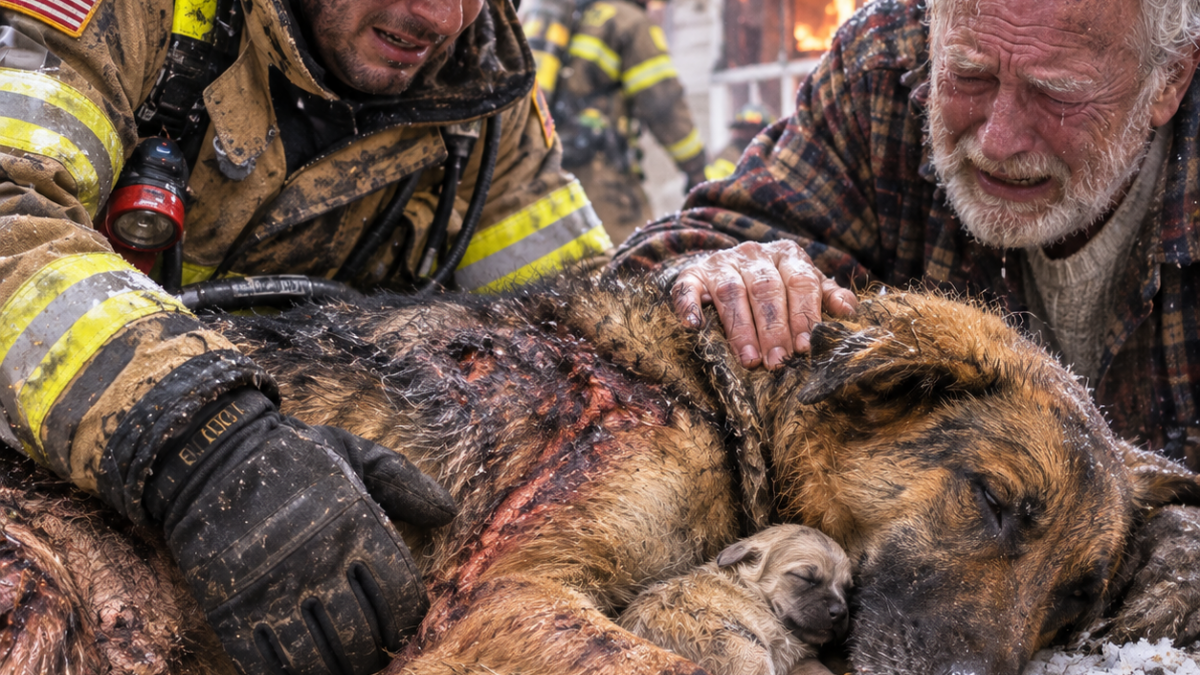
Bella was curled on the floor near the far wall.
Large German Shepherd.
Black-and-tan coat.
Except much of the fur along her side and back was scorched and wet.
Her paws were raw.
Later the veterinarian would tell us she had likely crossed burning debris repeatedly.
At that moment all I saw was blood dark against fur and the way she kept one front leg folded tightly beneath her body.
Her breathing was shallow.
Her eyes were half closed.
And under her chest—
a puppy.
The sixth puppy.
Alive.
The baby was pressed into the only protected hollow Bella could make between her front legs and belly.
Bella had covered him.
Her head was lowered over his body.
Her back faced the heat.
The mother had turned herself into a shield.
I stopped moving.
Not because I had time to stare.
Because some sights demand one second from you whether you can afford it or not.
Five puppies outside.
Five trips through smoke and flame.
Then the sixth trip.
The way back had become blocked.
Bella could have searched for another exit.
Maybe she did.
We would never know.
But at some point she had stopped trying to save herself.
She chose the puppy.
She put her body between him and the fire.
And waited.
I reached toward her slowly.
“Bella.”
Her eyes opened.
Red.
Wet.
Exhausted.
She looked directly at me.
I expected fear.
A growl.
Anything.
Instead, the very tip of her tail moved.
Once.
A tiny, weak sweep against the floor.
I will spend the rest of my life remembering that movement.
I had never met her.
She did not know what a firefighter was.
She did not know what my gear meant.
But something in that tired animal seemed to recognize that another living creature had finally reached her.
“There you are.”
I whispered.
“June sent me.”
Her ear moved at June’s name.
I swallowed hard.
“She’s outside.”
“She’s waiting.”
Another small tail movement.
Then Bella tried to lift her head toward the puppy.
“I know.”
“I’ve got him.”
I slid one hand beneath the puppy.
Bella tensed.
Even half-conscious, she was not going to surrender him easily.
“I’m not taking him away.”
I said.
“We’re all leaving.”
I tucked the puppy against Bella’s chest.
Then worked my arms beneath her.
She was heavy.
A full-grown German Shepherd weakened by smoke becomes dead weight very quickly.
I lifted.
Bella immediately curved her neck around the puppy.
Still shielding him.
Even in my arms.
Still mothering.
My radio erupted.
“Evacuate!”
Captain Ellis.
No debate.
Something in the roof had changed.
I turned toward the hallway.
The way I came in was worse.
Flames were pushing lower.
I went down as far as I could while holding Bella.
The puppy was trapped safely between her body and mine.
One arm supporting her chest.
One beneath her hindquarters.
My knees hit debris.
I nearly fell.
“Move.”
I said aloud.
Not to Bella.
To myself.
“Move.”
Wood cracked behind me.
Then a crash.
The sound was so violent that I felt it through my boots.
Part of the ceiling or a support beam.
I never looked back.
There is a rule in fire.
Sometimes knowing exactly what almost hit you is less important than not being there when the next thing falls.
I followed the hose line.
The puppy squeaked.
Bella stirred.
“You’re okay.”
I lied.
“We’re going home.”
Another few feet.
My shoulder hit the doorway.
I adjusted.
Heat pressed against my back.
Then the light changed.
Gray instead of black.
Cold air.
Snow.
Outside.
Hands reached for Bella.
I tried to lower her carefully.
My legs gave first.
I went to my knees.
Someone pulled my mask away after I cleared the danger zone.
I remember taking one enormous breath of freezing January air.
It hurt.
It was the best thing I had ever tasted.
Then I heard June scream.
“Bella!”
June ran barefoot across the snow.
The neighbor tried to stop her.
She shoved past him with strength I would not have expected from a woman her age.
She dropped beside Bella.
“Baby.”
Bella’s eyes remained closed.
June touched her face.
“Bella.”
Nothing.
The EMT fitted oxygen near her muzzle.
Someone took the puppy.
Bella’s head moved weakly toward the sound.
Then June said:
“I’m here.”
Bella opened her eyes.
That was the moment.
Not when I carried her out.
Not when she first moved her tail.
That.
Her person’s voice.
Bella looked at June.
Her tail struck the ground once.
June broke.
She folded over the dog, sobbing into Bella’s neck.
“I’m here.”
“I’m here.”
“You got them.”
“Oh, baby, you got them all.”
The six puppies were placed together inside a warmed transport container.
Five rescued by Bella.
One rescued with Bella.
All alive.
The last puppy coughed once.
Then crawled blindly over a sibling.
June saw him.
She put one hand over her mouth.
“That’s Ember.”
I looked at her.
“You already named them?”
“Some.”
She laughed through tears.
“That one was the smallest.”
“I called him Ember because he had that little orange mark above his eye.”
The irony almost hurt.
Bella lifted her head a fraction toward the puppies.
June stroked her cheek.
“They’re here.”
“All six.”
“You can stop now.”
Bella finally lowered her head.
And for the first time since the fire began, she stopped trying to move.
The veterinary clinic was forty minutes away.
Too far.
A sheriff’s deputy cleared the road ahead of the vehicle carrying Bella.
June rode with her.
The puppies followed in another car.
Before the door closed, June reached out and grabbed my hand.
“You saved her.”
I shook my head.
“She saved six dogs before we got here.”
“You brought her back to me.”
Her grip tightened.
“What’s your name?”
“Owen.”
She nodded as though storing it somewhere permanent.
“Owen.”
“If she dies…”
Her voice disappeared.
I didn’t know how to answer.
People imagine rescuers know what to say at those moments.
We don’t.
I looked at Bella.
She was receiving oxygen.
Eyes closed.
Bandaged loosely for transport.
Then at June.
“I don’t know what happens next.”
I said.
“But she didn’t quit in that house.”
“And nobody at that clinic is going to quit on her either.”
June nodded.
The door closed.
They left.
I turned back toward the burning farmhouse.
And went to work.
For the next six hours, we fought the house.
The roof eventually collapsed.
The laundry area was almost completely destroyed.
A large section of the kitchen burned down to the framing.
By noon, the home June had lived in for thirty-seven years was no longer a home.
It was smoking debris under a layer of dirty snow.
We performed overhaul.
Checked hot spots.
Moved what could still burn.
Documented what remained.
At one point I found a small ceramic food bowl near the rear wall.
The words on the side were blackened but readable.
BELLA’S BABIES
I stared at it.
Captain Ellis came beside me.
“You okay?”
“Yeah.”
“No, you’re not.”
“I will be.”
He looked at the bowl.
Then toward the ruins.
“Call the clinic when you can.”
I nodded.
I waited until nearly one.
The receptionist knew immediately who I was.
“The firefighter?”
“Yes.”
“Hold.”
Thirty seconds felt like ten minutes.
Then a woman answered.
“Dr. Melissa Crane.”
“How is Bella?”
There was a pause.
Not long.
Still terrifying.
“She’s alive.”
I sat down on the rear step of the engine.
“Okay.”
“We’ve stabilized her respiratory status for now.”
“She has significant smoke inhalation, burns to all four paws, and areas of burn injury along her back and left flank.”
“Any internal injuries?”
“Nothing obvious at the moment.”
“We’re monitoring closely.”
“And the puppy?”
“Ember?”
“Yes.”
“Remarkably good.”
“Minor smoke exposure.”
“No significant burns.”
My eyes closed.
Bella had done that.
Her body had taken what should have reached him.
“The others?”
“All five stable.”
“Cold and stressed, but doing well.”
I looked across the blackened foundation.
“Can June stay with her?”
Dr. Crane sighed softly.
“Technically visiting hours are limited.”
My heart sank.
Then she added:
“June is currently sitting on the floor beside Bella’s enclosure, so I suppose our policy has become flexible.”
I laughed.
First laugh since the call.
“Thank you.”
“She keeps telling Bella she’s a good mother.”
“She is.”
Dr. Crane went quiet.
Then:
“She is.”
I drove home that afternoon smelling like smoke.
Fire gets into everything.
Hair.
Skin.
Gear.
Truck seats.
Even after showering, I could still smell it.
I stood beneath hot water until it turned cold.
Then sat on the edge of my bed.
That should have been the moment I felt relief.
Everybody alive.
Homeowner safe.
Dog safe for now.
Six puppies alive.
Successful rescue.
Instead, I started shaking.
It came late.
Adrenaline leaving.
I saw Bella under me again.
The puppy.
The ceiling coming down.
The moment her tail moved.
Then I imagined being thirty seconds later.
A minute.
Five.
I bent forward.
Put my face in my hands.
And cried.
Not dramatically.
Quietly.
Because sometimes the body waits until nobody needs you anymore before admitting what almost happened.
Three days later, I drove to the veterinary clinic.
I told myself I was checking on a patient.
That was nonsense.
Bella wasn’t my patient.
I needed to see with my own eyes that she had survived.
June was sitting in the waiting area with a paper cup of coffee.
She wore donated sweatpants and a sweatshirt from a local church.
The fire had taken almost everything she owned.
She saw me.
Stood.
Then hugged me.
No warning.
No hesitation.
I froze for half a second.
Then hugged her back.
“You came.”
“I said I would check.”
“You didn’t.”
“I did in my head.”
“That doesn’t count.”
Fair.
She led me toward Bella.
The dog lay on thick bedding.
Parts of her fur had been shaved.
Bandages covered her paws.
A small oxygen line rested near her muzzle though she no longer needed constant support.
She looked smaller.
That shocked me.
In the fire, she had seemed enormous.
A mother filling the whole room with will.
Now she looked tired.
Fragile.
She opened one eye when I approached.
I crouched.
“Hey, Bella.”
Both eyes opened.
Her ears moved.
Then her tail began thumping.
Slow.
Steady.
I laughed.
“You remember me.”
June smiled.
“She remembers the man who carried her baby.”
Bella sniffed my hand.
Then put her chin against my palm.
My throat tightened.
“Good girl.”
Her eyes closed.
I stayed there.
Ember was in a small enclosure nearby.
The moment Bella heard him squeak, her eyes opened again.
“She does that every time.”
June said.
“Even asleep.”
“Mother radar.”
June nodded.
“She won’t relax unless she hears them.”
“What about the other puppies?”
“Healthy.”
“Clinic is helping arrange fosters until I have somewhere stable.”
Her voice changed.
I looked at her.
“Where are you staying?”
“With Ruth from church.”
“Two-bedroom house.”
“She has three grandkids there half the week.”
“June.”
“I’m fine.”
“You’re seventy years old and lost your home.”
“I am aware.”
“I don’t need another man telling me my age.”
I smiled.
“Fair.”
Then she touched Bella’s head.
“I don’t care about the house.”
“I care about her.”
I looked at the burns.
“You’re allowed to care about both.”
June said nothing.
A tear fell onto Bella’s fur.
That was when she told me Bella’s story.
Three years earlier, June had gone to the county shelter because her house felt too empty.
Her husband, Arthur, had died seven months before.
Forty-three years of marriage.
One heart attack.
Then silence.
June said she would wake up at night and still reach toward the side of the bed where Arthur used to sleep.
Sometimes she would make two cups of coffee before remembering.
Her daughter lived three states away.
Visits were good.
Not enough.
A neighbor suggested a dog.
June thought:
Something small.
Older.
Easy.
Then she saw Bella.
A young German Shepherd hiding at the back of a kennel.
Too thin.
Terrified.
Workers believed she had been abandoned near a logging road.
No chip.
No collar.
No one claimed her.
Potential adopters walked past because she would not approach the front.
“Everyone kept saying she was too nervous.”
June told me.
“I thought I understood nervous.”
She asked to sit inside the kennel.
The shelter worker warned Bella might not come close.
June sat anyway.
For forty minutes.
No touching.
No coaxing.
She talked.
About Arthur.
About the weather.
About how embarrassing it was that she had started talking to grocery-store cashiers because she missed conversation.
Bella stayed in the corner.
The next day, June returned.
Then again.
On the sixth visit, Bella walked forward and placed her chin on June’s knee.
“That was it.”
June whispered.
“I told the shelter she was mine.”
“How long before she trusted you at home?”
“Months.”
“First week she slept behind my washing machine.”
“She only ate after I left the room.”
“She flinched when doors closed.”
June stroked the scar forming beneath Bella’s shaved fur.
“I kept telling her:
‘You deserve a safe house.’
‘You deserve somewhere nobody leaves you.’
‘I’m not going anywhere.’”
Her voice broke.
“And then my safe house burned.”
Bella opened her eyes.
June bent down.
“I’m sorry.”
I said:
“For what?”
“I promised you.”
My chest hurt.
“June.”
“She doesn’t know what promises are.”
“I do.”
I looked at the old woman.
Then at the dog who had nearly died saving six children.
“You didn’t break your promise.”
June stared.
“The house burned.”
“You stayed.”
“Those are not the same thing.”
She cried then.
Quietly.
Bella licked one of her fingers.
Bella’s recovery was not a straight line.
Stories often skip that part.
Rescue.
Hospital.
Then miraculous improvement.
Real bodies are slower.
On day five, Bella developed worsening inflammation in her lungs.
June called me.
I drove to the clinic after work.
Bella’s breathing was harder.
Dr. Crane adjusted medication.
Oxygen support increased.
June sat beside her all night.
“I thought we already saved her.”
She whispered.
I had no answer.
Saving someone from one moment does not guarantee the next.
That is perhaps the cruelest thing emergency work teaches you.
We carried Bella out.
That did not mean her body stopped fighting smoke.
At 2:13 in the morning, Bella’s oxygen levels finally began improving.
June had fallen asleep in a chair with her hand inside the kennel.
Bella’s nose rested against her fingers.
I watched them from the hallway.
Then went home.
The following week, Bella stood.
Only for a few seconds.
Two veterinary technicians supported her.
Her bandaged paws touched the padded floor.
She shook.
June stood six feet away, hands pressed over her mouth.
“Come on, baby.”
Bella took one step.
Stopped.
Another.
Then her hind legs weakened.
The techs caught her.
June cried like Bella had crossed a finish line.
“Did you see?”
She kept saying.
“Did you see her?”
Everyone had.
Bella looked exhausted.
Proud.
Then Ember started squealing from his pen.
Bella tried to turn toward him.
Dr. Crane laughed.
“Apparently physical therapy is easier with maternal guilt.”
By the third week, Bella could walk slowly.
Her burns were healing.
New skin formed beneath the damaged areas.
Her paws remained tender.
Some fur would take months to return.
One patch along her back would never grow exactly the same.
Dr. Crane showed it to June.
“I’m sorry.”
June touched the mark gently.
“Don’t be.”
Everyone looked at her.
“This is where she carried the fire instead of Ember.”
She bent down.
Kissed the scar.
“This is my favorite part.”
Bella wagged.
The six puppies grew like weeds.
The first weeks after the fire, they were kept together as much as possible.
June visited all of them.
Bella inspected each one whenever the clinic allowed.
She would sniff them.
Nudge them.
Count them with her nose.
At least that is what it looked like.
One.
Two.
Three.
Four.
Five.
Six.
Only after checking the last would she lie down.
Every time.
Ember stayed closest.
The puppy she had shielded had no understanding of what his mother had done.
He only knew warmth.
Milk.
Her heartbeat.
And that when he cried, Bella answered.
Maybe that is the purest result of sacrifice.
The person protected does not have to understand what protection cost.
They simply get to live.
Meanwhile, the town found out about June’s house.
Somebody posted a photograph of the ruins.
Then another of Bella at the clinic.
The story moved faster than any of us expected.
A fundraising page appeared.
I assumed someone would raise a few thousand dollars.
Enough for temporary housing.
Maybe veterinary bills.
Then the hardware store donated lumber.
A local contractor volunteered labor.
The roofing company donated materials.
A retired electrician offered wiring.
A plumbing company contributed fixtures.
The church collected furniture.
One farmer donated a used refrigerator.
A school class made blankets for the puppies.
An eight-year-old boy arrived at the station with a jar containing $7.63.
“For Bella’s new house.”
I stared at the coins.
“Does your mom know?”
He nodded.
“She gave me the jar.”
Good.
“Why do you want to help Bella?”
He shrugged like the answer was obvious.
“She saved babies.”
Fair.
I put his jar on the front desk.
We kept it even after the money was deposited.
June hated accepting help.
At first.
“I don’t need charity.”
She told me.
“You need a house.”
“I can figure it out.”
“With what?”
She glared.
I held up both hands.
“Sorry.”
Then said:
“Bella accepted help.”
June’s eyes narrowed.
“That’s unfair.”
“Yes.”
“Effective?”
Also yes.
She finally agreed.
Not to a mansion.
Not to something extravagant.
A simple one-story house on the same land.
Better wiring.
Fire-resistant materials where practical.
Wide doors.
A mudroom.
A place for dogs.
A small porch facing the field where Arthur used to drink coffee.
June asked for one thing herself.
A fireplace.
Everyone stared.
After what happened?
She laughed.
“I did not declare war on fire.”
“Fire in the right place keeps people warm.”
Bella would later disagree.
Strongly.
Bella came home from the clinic after twenty-two days.
Except home was temporarily a guest cottage belonging to June’s neighbor, Ruth.
We gathered outside.
Not officially.
People just knew.
Construction workers stopped.
Neighbors arrived.
Kids held signs.
I hated the signs.
Bella loved the attention.
The vehicle door opened.
June stepped down first.
Then Bella.
Protective booties.
Harness.
Slow.
The crowd went silent.
Bella looked around.
Her fur was patchy.
Scar visible.
Body thinner.
But she was standing.
Someone began clapping.
Then everyone.
Bella froze.
Looked at June.
Then started wagging so hard her entire back end moved.
The crowd laughed through tears.
Ember came out next.
He immediately ran under Bella’s chest.
Almost knocked her over.
June shouted:
“Ember!”
Bella simply lowered her head.
Licked him.
Mother.
No matter how inconvenient.
I visited a month after the fire.
June had promised tea.
She made enough food for twelve people.
Apparently that was what elderly women meant by tea.
Bella sat at my feet.
Ember climbed onto my boot.
I scratched Bella’s ears.
Her eyes closed.
“You know people are calling you a hero.”
Tail thump.
June laughed.
“She knows.”
“No.”
“She thinks hero means roast chicken.”
Bella opened one eye.
“See?”
June smiled.
Then her face changed.
She looked toward the construction site through the window.
“Owen.”
“Yes?”
“What if she remembers?”
“The fire?”
“Yes.”
“She already does.”
June looked worried.
“How do you know?”
“Because she doesn’t like smoke.”
“Clinic said she reacts to alarms.”
“That is memory.”
June nodded.
“Do dogs forgive places?”
I thought about Bella.
The washing machine.
The shelter.
The farmhouse.
The flames.
“I don’t know.”
Then:
“Maybe she doesn’t have to forgive the old house.”
“Maybe she just needs to learn the new one is safe.”
June looked at me.
“That sounds like something people need too.”
Probably.
The five other puppies eventually needed homes.
That nearly caused a family crisis between June and reality.
“I can keep them.”
She said.
“No.”
“Why not?”
“Because six adolescent German Shepherds will overthrow the county.”
“I have land.”
“You have seventy-year-old knees.”
“Seventy-one soon.”
“That does not improve my argument.”
She glared.
“Traitor.”
We screened homes carefully.
The clinic helped.
No first-come, first-served.
No impulse adoptions because people saw Bella online.
One puppy went to a retired couple with twenty acres.
Another to a family with two teenagers who had experience with shepherds.
A female went to a physical therapist who later trained her as a therapy dog.
One went to a sheriff’s deputy.
One stayed with a family three miles from June, which meant frequent visits.
Ember remained.
There was never a vote.
Bella had nearly died for that puppy.
No one was going to tell her he had moved to another zip code.
The day the first puppy left, Bella searched.
That hurt.
The family came.
Met June.
Sat on the floor.
Let the puppy approach them.
Everything was done correctly.
Still, after their vehicle disappeared down the drive, Bella walked back to the place where the puppy had been.
Sniffed.
Looked at June.
Then at me.
June’s eyes filled.
“I feel horrible.”
“She’s going to adjust.”
“What if she thinks I let someone take her baby?”
I did not know how dogs conceptualize adoption.
I only knew Bella searched the porch twice.
That evening, the family sent a video.
Puppy asleep beside their fireplace.
Safe.
Loved.
June played it on her phone.
Bella heard the puppy squeak.
Her ears rose.
She looked at the screen.
We laughed and cried at the same time.
“See?”
June whispered.
“Your baby is okay.”
Bella licked the phone.
Technology solved nothing.
But it helped us.
Each puppy left differently.
Bella seemed less distressed by the last.
Maybe she learned.
People can leave and still be safe.
That is a difficult lesson even for humans.
Ember stayed against her side throughout.
At night they slept together.
He grew.
Soon he was almost as large as Bella.
Still tried to crawl partly on top of her.
Bella tolerated it with the exhausted expression of a mother whose child does not understand personal space.
The new house was finished before the next winter.
The community did not build June something extravagant.
It built her something solid.
One level.
Two bedrooms.
Wide hallway.
Good insulation.
Modern wiring.
Smoke detectors connected throughout.
Exterior materials less vulnerable than the old dry farmhouse.
Dog washing station in the mudroom because apparently the entire county had become insane.
June cried when she saw the kitchen.
Not because it was expensive.
Because somebody had salvaged her old cast-iron skillet from the ruins.
Cleaned it.
Seasoned it.
Hung it beside the stove.
Arthur had bought that skillet the year they married.
June held it against her chest.
For the first time, I understood rebuilding was not about replacing objects.
It was about choosing which memories deserved another home.
Then came the fireplace.
Modern.
Enclosed.
Safe.
Beautiful.
Bella refused to go near it.
The first time June turned it on, Bella froze in the doorway.
Her body lowered.
Ears back.
Tail tucked.
June shut it off immediately.
“Oh, baby.”
Bella backed away.
June sat on the floor.
Did not force her closer.
That was the same woman who once sat inside a shelter kennel for forty minutes without touching a frightened dog.
She knew.
“You don’t have to.”
She whispered.
“We have blankets.”
The fireplace remained off for weeks.
Then one night June turned it on low while Bella was outside.
When Bella came in, she stopped.
Watched.
June sat on the opposite side of the room.
Ember lay beside her.
Bella remained near the hallway.
Nothing happened.
Next night, same.
Weeks later, Bella entered the room.
Stayed ten feet away.
Eventually, she chose a bed across from the hearth.
Never closer than several feet.
June put the bed exactly where Bella wanted it.
Safety is not forcing someone to prove they are no longer afraid.
Safety is giving them enough room to decide for themselves.
The story went quiet after that.
Thank God.
Because extraordinary survival deserves ordinary years afterward.
Bella woke every morning with June.
Ate breakfast.
Walked the fields.
Corrected Ember.
Stole toast.
Rolled in mud immediately after baths.
Barked at delivery trucks.
Slept in sunlight.
Her coat regrew except for the small irregular mark along her back.
June touched it whenever they sat together.
The scar became less noticeable to everyone except her.
She always found it.
I kept volunteering.
More fires came.
A barn in April.
A chimney fire the following winter.
Vehicle accidents.
Medical calls.
Wildfire evacuations.
Some ended well.
Some did not.
There were nights when we returned to the station too quiet.
You learn not to ask:
“Was it worth it?”
after every bad call.
Sometimes there is no clean answer.
But Bella stayed in my mind.
Not as proof that every rescue succeeds.
That would be dishonest.
She became proof that success matters precisely because it is never guaranteed.
About six months after the fire, I started having the same dream.
In it, I entered the farmhouse.
Everything happened correctly until I reached the laundry room.
Then Bella was gone.
No puppy.
No dog.
Only the burned bowl.
I would wake with my heart racing.
Sometimes smelling smoke that wasn’t there.
I ignored it.
Firefighters are excellent at telling everyone else to ask for help.
Less talented at doing it themselves.
Captain Ellis noticed.
“You sleeping?”
“Sure.”
“That means no.”
“I sleep.”
“How much?”
“Enough.”
He stared.
Then gave me the number of a counselor who worked with first responders.
I almost threw it away.
Kept it.
Two weeks later, I called.
The counselor asked why that fire bothered me when others had been worse.
I did not know.
Then I said:
“Because Bella chose to stay.”
He waited.
“She could have saved herself.”
“Maybe.”
“She didn’t.”
“Why does that bother you?”
I thought about it.
Because I had spent years believing rescuers were supposed to leave before the building took them too.
Because survival sometimes requires accepting that you cannot save everything.
Bella had violated every rational calculation.
And it worked.
Barely.
Maybe that frightened me because part of me admired something I could never recommend.
“I don’t want people thinking what she did was safe.”
I said.
“It wasn’t.”
“Can something be dangerous and still meaningful?”
I hated therapy.
“Yes.”
“Then maybe let both be true.”
Annoying.
Useful.
I told June eventually.
About the dreams.
She did not laugh.
“I have them too.”
“What happens in yours?”
“Bella goes back inside.”
“And?”
“I can’t move.”
“I can see her.”
“I can hear her.”
“But my feet don’t work.”
June stared at the field.
“Then I wake up and she’s beside me.”
Bella was lying several yards away beneath an apple tree.
Ember chewing a branch he was absolutely not supposed to have.
June smiled.
“So I touch her.”
“To make sure.”
“Yes.”
We sat quietly.
Then June said:
“People think the worst thing would have been losing the house.”
“No.”
“No.”
“The house was wood.”
She looked at Bella.
“She was family.”
On the first anniversary of the fire, nobody planned an event.
That was intentional.
June did not want television cameras.
No speeches.
No dramatic reunion.
She invited our fire crew for dinner.
That was enough.
Bella wore a red bandanna.
Someone had embroidered:
MOUNTAIN VOLUNTEER FIRE & RESCUE
She tolerated it for fifteen minutes.
Ember stole it.
Ran through the yard.
Six adults chased him.
June sat on the porch laughing so hard she cried.
At sunset, she brought out a photograph.
The six puppies lying together beneath a blanket after the fire.
Tiny.
Soot-streaked.
Alive.
She had framed it.
Below the photograph, she had written:
ALL SIX.
Nothing else.
It did not need anything else.
The puppies visited on their first birthday.
All six.
That was chaos.
Cars everywhere.
Families.
Treats.
Leashes.
Bella stood in the middle of the field while six nearly grown German Shepherds ran around her.
Every few minutes one returned.
Touched her nose.
Ran away.
Bella watched.
June stood beside me.
“She still counts.”
“You think?”
“I know.”
One puppy disappeared behind the shed.
Bella barked once.
He reappeared.
June raised one eyebrow.
“Count.”
Fair.
Ember stayed closest.
He became a huge dog.
Bigger than Bella eventually.
Still slept beside her.
Still looked for her before eating.
Still followed her into the field.
But there was one place he never followed her.
Near the old foundation.
June had chosen not to rebuild on exactly the same footprint.
The blackened farmhouse foundation was removed, but a few stones remained at the edge of the property as part of a small garden.
Bella rarely went there.
When she did, she stood for a moment.
Sniffed.
Then returned.
No drama.
No trembling.
Just a place containing something she did not need anymore.
One spring afternoon, June called me.
“Come over.”
“Emergency?”
“No.”
“Then why does your voice sound strange?”
“Just come.”
I drove there after work.
June was on the porch.
Bella beside her.
Ember nearby.
She handed me an envelope.
Inside was a letter from one of the families that had adopted a puppy.
Their daughter had been struggling with severe anxiety after losing her father.
The dog—one of Bella’s daughters, renamed Lucy—had bonded with her immediately.
They eventually worked with a trainer.
Lucy became her emotional support animal.
The letter said the girl had returned to school.
Was sleeping through most nights.
Had started laughing again.
At the bottom:
Bella saved six puppies. We thought you should know one of those puppies helped save our daughter too.
I read it twice.
June was crying.
“I thought the fire ended with six.”
She whispered.
“What?”
“Six lives.”
She looked at Bella.
“Maybe it didn’t.”
No.
It did not.
Another puppy became a therapy dog in a rehabilitation center.
Another helped a retired veteran leave his house more often after years of isolation.
One was simply a ridiculous family pet who stole socks and slept upside down.
That mattered too.
A life does not need a noble job to justify being saved.
Sometimes the point of rescue is simply allowing someone to have ordinary Tuesdays.
Bella’s scar faded.
Her paws remained sensitive.
Winter road salt bothered them.
June bought booties.
Bella hated them with astonishing passion.
The first time June put all four on, Bella took one step as though every leg belonged to a different animal.
I laughed.
Bella stared at me with betrayal.
“I carried you out of a fire.”
I said.
“You can survive shoes.”
She turned away.
June handed her chicken.
Suddenly footwear became acceptable.
At five years after the fire, Bella was older.
Gray around the muzzle.
Slower getting up.
Ember had become the protective one.
If Bella stumbled, he stopped.
If she lagged on walks, he waited.
I visited that January.
The station had presented Bella with an honorary member bandanna again because apparently nobody learned.
This time she wore it peacefully.
Maybe age softened pride.
Or maybe she knew snacks followed.
Our chief gave June a framed copy of the photograph with the six puppies.
June already had one.
She cried anyway.
Then the chief said something I still remember.
“People always call Owen the rescuer.”
I immediately wanted him to stop.
“But by the time Owen entered that building, Bella had already completed five rescues.”
He looked at her.
“She was not waiting for someone else to be brave.”
“She had already been brave enough for all of us.”
I looked down.
Bella’s head rested against my knee.
Her tail moved.
I whispered:
“Show-off.”
Afterward, a young reporter asked me:
“Do you think Bella knew she might die?”
I hated the question at first.
Then realized it was fair.
“I don’t know what Bella understood about death.”
I said.
“But she understood one puppy was missing.”
“And that was enough.”
The reporter asked:
“Would you call what she did heroic?”
“Yes.”
“Would you encourage someone to go back into a burning building for an animal?”
“No.”
He looked confused.
“Both?”
“Both.”
I said.
“Love can make someone do something extraordinary.”
“That doesn’t make fire safe.”
“Bella survived partly because we arrived when we did.”
“If we tell the story without that truth, we turn courage into bad advice.”
He nodded.
I hoped he understood.
Years passed.
Bella aged.
June aged.
So did I.
Emergency calls kept coming.
I became captain eventually.
That still feels strange to say.
Young volunteers started arriving who had been children when Bella’s fire happened.
Some knew the story.
I used it in training.
Not to teach people to rush into collapsing structures.
The opposite.
“Assess.”
“Communicate.”
“Know your exit.”
“Respect command.”
“Control your air.”
“Your job is not to become part of the emergency.”
Then I showed them Bella’s photograph.
Her covering Ember.
“Why show us this?”
One recruit asked.
“Because behind every address is something somebody cannot imagine losing.”
“That is why we train.”
“Not so we can be fearless.”
“So we can remain useful while we are afraid.”
That was the lesson Bella left me.
Bella reached an age we did not expect after the fire.
Every veterinary checkup became a small victory.
Her lungs carried some lasting sensitivity.
Her paws developed arthritis.
But she remained herself.
Protective.
Stubborn.
Soft with June.
Strict with Ember.
Whenever one of the grown puppies visited, Bella greeted them the same way.
Nose.
Face.
Shoulder.
Then a long inspection.
Count.
Always count.
One evening, when Bella was old enough that getting onto June’s bed had become difficult, I visited and found carpenter’s tools in the bedroom.
“What are you doing?”
June pointed toward a small wooden staircase beside the bed.
“Bella can’t jump anymore.”
“You built that?”
“I supervised.”
A neighbor built it.
Bella approached.
Sniffed.
Looked suspicious.
June climbed onto the mattress.
“Come on, girl.”
Bella stepped onto the first stair.
Then second.
Slow.
Third.
Bed.
She turned twice.
Lay beside June.
Head against June’s shoulder.
Ember slept on the floor.
I stood in the doorway.
June looked at me.
“What?”
“Nothing.”
“You’re staring.”
“I’m leaving.”
“Good.”
I walked outside before they saw me cry.
I did not cry because Bella was old.
Not exactly.
I cried because the dog I once found lying in fire over a newborn puppy was now being helped onto a warm bed by the same woman who once promised her a safe house.
Promises do not always mean preventing disaster.
Sometimes that is impossible.
Sometimes a promise means rebuilding afterward.
Staying after the fire.
Giving someone stairs when their legs stop jumping.
Adjusting the world around the person you love instead of demanding they remain who they were when you first made the promise.
June had kept hers.
Bella never lost her discomfort around open flame.
Birthday candles made her watch carefully.
Burnt toast brought her into the kitchen to investigate.
Fireplace crackles kept her several feet away.
No one forced her closer.
People sometimes call that fear.
Maybe.
I think it was memory.
And memory is not always something that needs to be cured.
Sometimes memory is simply the body saying:
I know what that cost.
The original farmhouse existed in photographs.
June kept one framed in the hallway.
Old white siding.
Blue trim.
Arthur standing on the porch.
A much younger June beside him.
Years after the fire, I asked why she kept it.
“That was a good house.”
“Even after what happened?”
“The fire was one morning.”
She said.
“We had thirty-seven years before that.”
That silenced me.
Trauma tries to steal backward.
It tells you one terrible ending gets to own everything that came before it.
June refused.
The old farmhouse had hosted Christmases.
Birthdays.
Arthur’s bad jokes.
Her daughter’s teenage arguments.
Bella’s first safe sleep outside the laundry room.
Six puppies being born.
The fire did not get to erase those things.
I started thinking differently about my own calls after that.
The house that burned was not only a fire scene.
It had been someone’s kitchen.
The wrecked car had been where somebody sang badly to the radio yesterday.
The old barn had held a child’s first pony.
When we arrive, we see catastrophe.
The people we serve see history.
That matters.
One winter morning years after Bella’s rescue, our station received another house-fire call.
Different road.
Different family.
No animals trapped.
Everyone out safely.
We saved most of the structure.
Afterward, a little girl stood in the snow crying because her stuffed rabbit remained inside her bedroom.
The fire was extinguished enough for overhaul.
I found the rabbit.
Smoke-damaged.
Wet.
One ear partly singed.
I brought it out.
The girl hugged it.
Her mother started crying.
One of our new volunteers whispered:
“It’s just a stuffed animal.”
I looked at him.
“No.”
I said.
“It’s never just what it looks like to us.”
Bella taught me that too.
The last puppy Bella saved—Ember—grew older alongside her.
People assumed he would become independent.
In some ways he did.
He explored farther.
Barked more.
Loved strangers faster than Bella ever had.
But at night, he always found her.
If Bella slept near June’s chair, Ember slept nearby.
If she moved rooms, he followed.
If Bella was at the veterinarian, Ember waited by the door.
The dog whose life began beneath his mother’s burned body never knew the story.
But his attachment seemed to know something his mind couldn’t.
Maybe bodies remember safety even when they do not remember danger.
June once asked me whether she should somehow “tell” Ember what Bella had done.
I laughed.
“How?”
“I don’t know.”
“Dogs communicate.”
“Do you want to sit him down with photographs?”
She glared.
“I’m serious.”
“So am I.”
Then I looked at Ember.
He was asleep with one paw resting over Bella’s.
“He knows the important part.”
“What?”
“That she stayed.”
June nodded.
That was enough.
By the time I reached forty, the fire had become one story among hundreds.
Not forgotten.
Just placed somewhere inside a larger life.
That surprised me.
I once thought important moments stayed sharp forever.
They don’t.
Edges soften.
Smoke smell fades.
Exact sounds become harder to recall.
I worried that meant I was losing Bella’s story.
Then I realized memory changing does not mean love shrinking.
You do not have to relive trauma perfectly to honor what happened.
The things I remembered most clearly changed.
At first:
The flames.
The collapsing ceiling.
Bella’s burned fur.
Then years later:
Her tail.
June’s bare feet.
Six puppies under one blanket.
Bella trying to walk in booties.
Ember stealing the fire-station bandanna.
June’s tea.
The steps beside the bed.
Maybe healing is when the story stops ending at the worst frame.
One January evening, I drove to June’s new house after a long shift.
Snow covered the field.
Lights glowed warm behind the windows.
I knocked.
No answer.
Then the door opened slowly.
June.
Older.
Smaller.
“About time.”
“I didn’t know I was expected.”
“You’re always expected.”
Inside, Bella slept near the fireplace.
Far enough away to feel safe.
Close enough to enjoy the warmth.
Ember beside her.
I sat on the floor.
Bella opened her eyes.
She was very old then.
Her breathing slower.
Gray face.
I touched her head.
“Hey, hero.”
Her tail moved once.
One.
Exactly the way it had inside the fire.
I laughed and cried at the same time.
June saw.
“She still remembers you.”
“Or she wants food.”
“Let me have this.”
We sat quietly.
June said:
“I used to think I saved her.”
“At the shelter.”
“I thought that was our story.”
“Old widow saves scared dog.”
She smiled.
“Then she saved six puppies.”
“You saved her from the fire.”
“The town saved our house.”
“Her puppies went on helping other people.”
She looked at Bella.
“Maybe rescue is never one direction.”
I thought about the young firefighters I had trained.
The counselor Captain Ellis pushed me toward.
The little girl with the stuffed rabbit.
The way Bella changed how I thought about courage.
“No.”
I said.
“Probably not.”
Bella eventually stopped climbing the bed stairs.
Not because June removed them.
Because Bella preferred a thick orthopedic bed on the floor.
June moved her own mattress closer to the edge so she could reach down and touch Bella at night.
She refused to move Bella into another room.
“I told her I wouldn’t leave.”
So every night, June slept above.
Bella below.
Ember beside her.
One hand reaching down.
One old dog breathing beneath it.
I want to be careful here.
Because stories like this sometimes become cruel in the final paragraphs.
People assume if enough time passes, death must arrive dramatically to make the story meaningful.
That is not the ending Bella earned.
Bella did not die in the fire.
She did not die weeks later from her injuries.
She did not collapse heroically after completing some symbolic mission.
She lived.
That is the ending.
She lived through the fire.
She lived through rehabilitation.
She lived long enough for her fur to grow back.
Long enough for her six puppies to become adult dogs.
Long enough to watch them run through June’s new field.
Long enough to become gray around the muzzle.
Long enough to steal food.
Avoid the fireplace.
Wear ridiculous booties.
Sleep beside the woman who once found her afraid behind a shelter kennel.
Bella got years.
Ordinary, beautiful years.
That was the miracle.
And June got those years too.
The woman who stood barefoot in the snow believing her whole family might disappear spent evenings with Bella’s head near her shoulder.
She watched Ember grow.
Received photographs from the other families.
Collected Christmas cards showing Bella’s offspring beside trees, children, hiking trails, couches they weren’t supposed to occupy.
June kept every card.
One wall of the hallway eventually became what she called:
Bella’s Family Wall.
Six puppies.
Six lives.
Six futures.
In the center:
Bella.
The photograph she chose for the middle was not the fire.
Not the clinic.
Not me carrying Bella.
It showed Bella lying in summer grass.
All six grown dogs around her.
June sitting behind them.
Nobody looking at the camera properly.
One puppy facing backward.
Ember licking Bella’s ear.
June laughing.
Bella’s eyes half closed.
Safe.
That was the photograph that mattered.
Years after the fire, someone asked me what the most heroic thing I had ever seen was.
I had answers available.
Firefighters crawling through smoke.
A teenager lifting his injured brother after a crash.
A nurse holding pressure on a stranger’s wound for forty minutes.
Parents doing impossible things for children.
Then I thought about Bella.
Not entering the house the first time.
Or the fifth.
The sixth.
Specifically the moment after she realized she could not get out.
Because bravery is easy to romanticize while someone is still moving.
Bella’s greatest decision came when movement failed.
She stopped.
Covered Ember.
Accepted the heat on herself.
Not because she expected a firefighter.
Not because she expected applause.
Not because dogs understand heroism.
Because her baby was there.
That was all.
I answered:
“A mother dog.”
The person laughed.
I didn’t.
“A German Shepherd.”
“She went into a burning farmhouse six times.”
“On the last trip she couldn’t escape.”
“So she lay over her puppy.”
“And waited.”
The person became quiet.
“Did she survive?”
“Yes.”
“Did the puppy?”
“Yes.”
“All of them?”
I smiled.
“All six.”
That is still my favorite part to say.
Today, when our station alarm sounds, I still feel the old shift inside my chest.
Whatever I am doing becomes secondary.
Boots.
Gear.
Truck.
Radio.
Address.
Go.
Sometimes, for half a second, I think of Bella.
Not every call.
That would be too sentimental.
But enough.
I think of her when somebody says:
“There’s still one inside.”
I think of June when someone stands behind the hose line with the face of a person waiting for their whole world to come back through a door.
I remember that what we carry out may look ordinary to us.
A dog.
A photograph.
A child’s toy.
A person.
To someone else it is everything.
And when younger firefighters ask how I keep going after bad calls, I never tell them that every rescue is worth the pain.
That would be dishonest.
There are nights that hurt.
There are names I still remember.
There are doors we reached too late.
Instead, I tell them about Bella.
I tell them:
“There will be days when you cannot save what you want to save.”
“There will also be days when six puppies are waiting under a blanket.”
“Remember both.”
“Do not let the bad days convince you the good ones never happened.”
If I close my eyes, I can still see that room.
Smoke.
Orange light.
Bella’s body over Ember.
Her eyes opening.
The tiny movement of her tail.
For years, I believed that was the image I would carry forever.
I was wrong.
Now when I close my eyes and think of Bella, I see something else.
A new house.
Snow outside.
Fire contained safely behind glass.
Bella lying several feet away on her soft bed.
Ember asleep beside her.
June reaching down from the couch and finding the small scar beneath Bella’s fur.
Her fingers resting there.
Not because the scar is beautiful.
Because the dog beneath it is alive.
Bella opens her eyes.
June whispers:
“You’re safe.”
Bella exhales.
And believes her.
That is the ending I choose to remember.
Not the moment Bella ran into the flames.
The moment she finally understood she would never have to run into them again.
She had done it six times.
She had come back out five times on her own.
The sixth time, she needed someone else to carry her.
There was no shame in that.
Maybe that was the final thing Bella taught me.
Even the bravest creatures eventually need somebody to come looking for them.
Even the ones who spend their whole lives protecting others deserve a moment when someone says:
You’ve done enough. Let me carry you now.
That morning in January, Bella saved six puppies.
I carried Bella and Ember through the door.
June stayed beside Bella while she healed.
The veterinarians carried her through pain.
The neighbors carried June through losing her home.
The town carried lumber, furniture, money, blankets, and food.
And years later, Bella’s puppies carried pieces of their mother’s courage into six different homes.
Rescue never belonged to one person.
It moved from hand to paw to heart and back again.
That is why, whenever someone calls me a hero for running into that farmhouse, I correct them.
“No.”
I tell them.
“I was only the sixth rescue.”
They usually look confused.
I smile.
Because I remember the five soot-covered puppies already waiting outside when we arrived.
I remember the sixth under Bella’s chest.
I remember June barefoot in the snow.
And I remember the tired German Shepherd looking at me through smoke as though she had held on just long enough for somebody else to take over.
Bella was the one who ran into the fire.
Six times.
Bella was the one who refused to leave a child behind.
I just happened to arrive when the bravest mother I had ever met finally needed someone to do the same for her.
And I did.
I went in.
I found her.
I carried her home.
Years later, every time I visited June and saw Bella sleeping peacefully beside the woman who had once promised she would never abandon her, I knew exactly what that one weak movement of Bella’s tail had meant inside the burning house.
It had never said:
I knew a hero would come.
It had said something much simpler.
Something every frightened creature, every grieving person, every child, every old woman standing barefoot in the snow hopes will someday be true.
I knew someone would come back for me.








