FULL STORY:At 4 A.M., a Dog Walked Into Our Police Station Carrying One Worn Shoe—Then He Led Us Miles Into the Dark
FULL STORY CONTINUATION
At 4:09 a.m., Officer Zhao and I stepped outside with a dog whose name we did not know and a worn shoe that made absolutely no sense.
The dog walked beside us without a leash.
No command.
No hesitation.
He did not behave like a stray hoping somebody would feed him.
He behaved like someone with directions.
Left at the corner.
Right at the pharmacy.
Across a small bridge.
Through the edge of Millford Park.
Every twenty or thirty yards he turned his head.
Checking.
Still coming?
Yes.
We followed.
I called Sergeant Martinez.
“He’s taking us east.”
“Toward Old Oak?”
“Past it.”
Thomas came over the radio.
“Yesterday I saw him near number eighty-four.”
“Did you check?”
“No complaint. Dog was in a yard.”
“House occupied?”
“Looked like it.”
Sergeant Martinez said:
“Keep following. I’ll have Thomas run the address.”
The dog accelerated.
Zhao and I picked up our pace.
Millford at four in the morning feels like a different place.
Storefronts dark.
Traffic lights changing for nobody.
Street lamps making the wet pavement shine.
The town ends gradually.
Homes spread farther apart.
Sidewalks disappear.
The road rises toward wooded hills.
Zhao looked at me.
“If he takes us much farther, we’re reaching County Road Six.”
“I know.”
“There’s that bend.”
“What bend?”
She pointed ahead.
“Sharp right near the old roadside stop.”
“Two crashes last month.”
I remembered.
One minor.
One involving a truck that missed the guardrail.
The dog stopped.
Turned.
Then suddenly began moving faster.
Not running yet.
But close.
His entire body changed.
Head low.
Eyes forward.
No more looking into yards.
No interest in anything except what lay ahead.
“Something’s there.”
Zhao said.
I already knew.
We had been walking roughly twenty minutes when we reached the abandoned roadside relay.
People still called it a relay even though no one had stopped there for years.
A low building.
Boarded windows.
Faded sign.
Tall grass.
The road curved hard beyond it.
The dog broke into a run.
“Hey!”
I called.
He ignored me.
He disappeared into weeds beside the road.
Zhao grabbed her flashlight.
I followed.
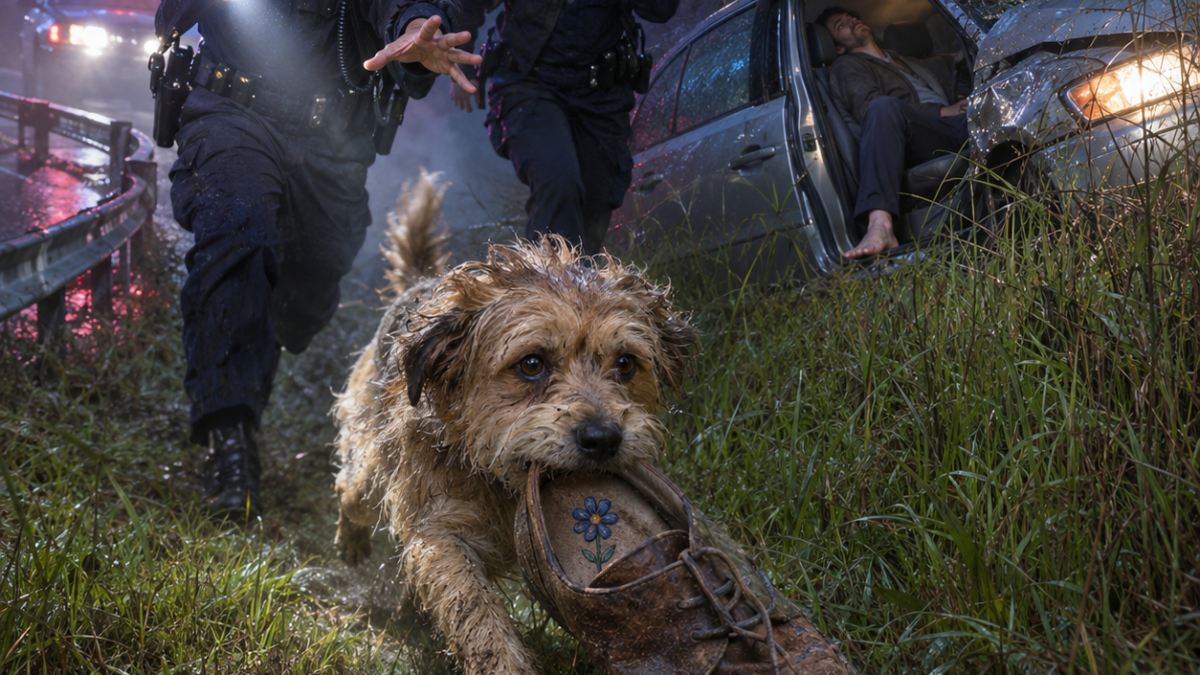
The beam caught silver metal.
A car.
Small sedan.
Half-hidden below road level.
Front end against a tree.
Driver-side door open.
Headlights still glowing faintly.
Not bright.
Almost exhausted.
The dog reached the car and began barking.
Softly.
That detail still bothers me.
Most dogs would have been frantic.
He sounded as if he was afraid to scare the person inside.
We approached.
I saw a leg first.
Then a hand.
Then the driver’s body slumped sideways toward the open door.
“Sir?”
Nothing.
Zhao moved to the passenger side.
I checked the scene.
No smoke.
No obvious fuel leak.
Airbags deployed.
Then I leaned closer.
Man.
Early sixties, maybe.
Weathered face.
Sun-darkened skin.
Gray hair.
Dry lips.
Unconscious.
One foot wore a sock.
The other was bare.
I looked down at the shoe in my hand.
Then at him.
Then at the dog.
Everything made sense at once.
“Oh my God.”
Zhao whispered.
The dog had removed his owner’s shoe.
Carried it.
Walked miles.
Found us.
Not a random object.
Identification.
Scent.
Something belonging to his person.
The only message available to him.
I checked the man’s pulse.
Weak.
But present.
“Alive.”
Zhao was already on the radio.
“Millford dispatch, we have a single-vehicle collision on County Road Six near the old relay, one unconscious adult male, breathing, weak pulse. Start EMS and fire.”
Sergeant Martinez responded instantly.
“Copy.”
Then:
“Dog led you?”
I looked at him.
He had climbed partly into the open doorway and was licking the man’s hand.
“Yes.”
A pause.
Then Thomas:
“No way.”
“Yes way.”
I touched the man’s shoulder.
“Sir.”
No response.
“Can you hear me?”
His eyelids moved.
Barely.
His lips moved too.
No clear words.
Zhao checked for obvious bleeding.
Nothing catastrophic.
A bruise near his temple.
Some cuts.
Seatbelt mark.
The car appeared to have struck the tree at relatively low speed, but speed can be deceptive.
We did not move him unnecessarily.
We supported him as safely as possible while waiting for EMS.
The dog refused to leave his side.
I tried once.
“Come here, buddy.”
He looked at me.
Then stayed.
Fair.
I would have done the same.
The minutes waiting for an ambulance always feel longer when somebody’s condition is uncertain.
I watched the man’s chest.
Rise.
Fall.
Slow.
His skin felt cool.
His lips were badly dry.
Zhao said:
“Dehydration?”
“Maybe.”
His hands told a story.
Calluses.
Scars.
Deep lines.
Working hands.
The car contained water bottles.
One empty.
A blanket.
Some tools.
A paper grocery bag.
Nothing obviously strange.
The dog sat beside him.
Every so often he licked the man’s fingers.
Then looked at us.
Not begging.
Checking.
Are you helping?
Yes.
We were helping.
EMS arrived with fire personnel several minutes later.
The paramedic knelt beside the driver.
“Male, approximately sixties?”
“Unconscious when found.”
“Pulse weak but consistent.”
“Possible head injury.”
“No major external bleeding observed.”
The paramedic examined him.
Then looked at the dog.
“Yours?”
“No.”
“His.”
“How do you know?”
I held up the shoe.
“You have time for a story later?”
He looked confused.
“Apparently.”
They stabilized the man.
Cervical precautions.
IV.
Vitals.
The dog moved only when necessary.
When the stretcher came out, he followed.
One firefighter tried to stop him near the ambulance.
The dog slipped around him.
“Hey.”
I said.
“Let him.”
The paramedic looked at me.
“We can’t always take animals.”
“This one just walked several miles to get police.”
The paramedic stared.
Then:
“Fine.”
The dog jumped into the ambulance.
Sat near the stretcher.
No one argued again.
Before the ambulance doors closed, I touched the dog’s shoulder.
“You did good.”
His tail moved once.
Then the doors shut.
The ambulance left for Millford Regional Hospital.
Zhao and I remained beside the wreck.
For a few seconds, neither of us spoke.
Then she said:
“Did that dog actually pull a shoe off an unconscious man?”
“I think so.”
“Carry it all the way into town?”
“Looks that way.”
“Find the police station?”
“Yes.”
“How?”
I looked down the dark road.
“I have no idea.”
The car was processed.
The scene documented.
A tow requested.
Nothing suggested another vehicle.
No obvious criminal activity.
Likely medical event, fatigue, disorientation, or simple loss of control.
We would know more later.
Then Sergeant Martinez called.
“Got an address.”
“Who?”
“Vehicle registration comes back to Walter Harris.”
“Sixty-three.”
“Lives on a small farm about twenty-five miles outside town.”
Thomas added:
“Old Oak house was probably somewhere he stopped yesterday. Doesn’t match his residence.”
“Any family?”
“Nothing obvious in local records.”
“Dog?”
“Nothing yet.”
I looked toward the road where the ambulance had disappeared.
“Walter Harris.”
The shoe suddenly felt heavier.
When we returned to the station, it was nearly daylight.
Thomas stood up immediately.
“Well?”
“Alive.”
He exhaled.
Sergeant Martinez asked:
“Condition?”
“Unknown. EMS said dehydration, possible concussion, maybe more.”
Then she looked at the shoe.
“You kept it?”
“For now.”
We bagged it properly.
Not because we expected a crime.
Because it was connected to the incident.
And because, frankly, none of us wanted that shoe disappearing after everything it had just done.
The little blue flower remained inside the heel.
Zhao noticed me looking at it.
“You think his wife stitched it?”
“Maybe.”
“Daughter?”
“Could be.”
“Or Walter.”
I looked at her.
She shrugged.
“Men can sew.”
“Fair.”
We would eventually learn the answer was simpler and sadder than either of us expected.
But not yet.
I went home after shift.
Tried to sleep.
Could not.
Every time I closed my eyes, I saw the dog entering the station.
The seriousness in his face.
Shoe in his mouth.
There is a tendency to make animals mystical when they do something we do not understand.
I try to avoid that.
He did not know what a police department was in the way humans do.
He did not understand emergency dispatch.
He did not know hospital systems.
But he knew his person was not waking up.
He knew leaving him there had not fixed anything.
And somehow he understood that going toward people might.
That was enough.
The next morning, I went to Millford Regional.
Not officially necessary.
I wanted to know.
Walter was awake.
Room near the end of the hall.
His dog lay curled beside the chair.
The second I entered, the dog’s head lifted.
Those serious eyes recognized me.
Tail.
One slow wag.
“There you are.”
I said.
Walter looked toward me.
His voice was rough.
“You’re police?”
“Yes.”
“Were you the one who found me?”
I looked at the dog.
“He was.”
Walter’s eyes filled.
His name was Walter Harris.
Sixty-three.
He lived alone on a small farm outside town.
No wife.
No children nearby.
Few close relatives.
He remembered leaving home.
Remembered driving toward Millford.
Remembered feeling dizzy sometime after midnight.
Then fragments.
Headlights.
Road.
A sudden jolt.
Tree.
He thought he woke once.
Could not move properly.
Felt confused.
Then darkness again.
He did not remember the dog leaving.
“What is his name?”
I asked.
“Bailey.”
At the sound, the dog stood and pressed his head against Walter’s hand.
Walter stroked him.
“This idiot saved my life.”
Bailey looked deeply unconcerned by the insult.
I pulled a chair closer.
“Tell me about him.”
Walter smiled weakly.
“Found him during a storm.”
“How long ago?”
“Years.”
“Little thing.”
“Completely soaked.”
“He was curled up inside a cardboard box near the edge of my property.”
“I thought someone might come looking.”
“No one did.”
He looked at Bailey.
“I used to say dogs were just animals.”
“Never understood people making their lives about them.”
Bailey placed his chin on Walter’s mattress.
Walter’s voice softened.
“Then my wife died.”
There was the story inside the shoe.
Walter looked toward the window.
“Eleanor.”
“Cancer.”
“After she was gone, that farmhouse got quiet.”
“Too quiet.”
“Bailey was there.”
“He followed me everywhere.”
“He slept outside my bedroom door for months.”
“When I stopped wanting to get up in the morning, he made sure I had to.”
His eyes filled.
“I thought I rescued him from that storm.”
Then he laughed softly.
“Turns out we had the relationship backward.”
I thought of the blue flower.
“Walter.”
“Yes?”
“Your shoe.”
He blinked.
“What about it?”
“There’s a little blue flower stitched inside.”
His expression changed.
For a moment, he could not speak.
“Eleanor.”
I knew before he said more.
“She used to sew those inside my work shoes.”
“All of them?”
“Just the ones I complained were ugly.”
I smiled.
“Why?”
Walter’s eyes filled again.
“She said if I insisted on wearing terrible shoes, at least something beautiful should be hidden inside them.”
There are sentences that tell you an entire marriage.
That was one.
“So the shoe Bailey brought us…”
“Oldest pair I own.”
Walter laughed.
“She stitched that flower maybe fifteen years ago.”
He reached toward Bailey.
The dog licked his fingers.
“I should’ve thrown those shoes out years ago.”
Then he shook his head.
“Glad I didn’t.”
A doctor later told us Walter was badly dehydrated and had suffered a mild concussion.
No major internal injuries.
No life-threatening trauma.
But his condition could have worsened significantly if he had remained beside the road much longer.
The location was partly hidden by tall grass.
The road was quiet overnight.
Someone had reportedly noticed a vehicle near the area earlier and made a vague report, but the information had been routed incorrectly and did not generate the response it should have.
That mistake bothered Sergeant Martinez deeply.
We reviewed it.
Processes changed.
But the unavoidable fact remained:
Without Bailey, Walter might have stayed there far longer.
And far longer might have been too long.
I asked Walter what he thought Bailey had done.
He looked at the dog.
“I don’t know.”
“He probably tried waking me first.”
Bailey’s ears moved.
Walter continued.
“He knows the town.”
“I take him with me sometimes.”
“Not usually all the way to the station.”
“Obviously.”
“Maybe he followed the road.”
“Maybe he smelled people.”
“Maybe he remembered patrol cars.”
He shrugged.
“We’ll never know.”
Then:
“But he knew I needed somebody.”
That was enough for Walter.
It became enough for me too.
Bailey stayed in the hospital room as much as staff permitted.
He was remarkably calm.
He did not jump on people.
Did not bark.
Did not wander.
He sat in the corner and watched Walter.
Whenever Walter moved, Bailey’s eyes opened.
When a nurse adjusted an IV line, Bailey watched.
When Walter slept, Bailey rested.
No longer the intense, urgent expression from the police station.
His job, whatever he believed that job to be, was finished.
His person was surrounded by people.
Safe.
I returned to work that evening.
The first thing Thomas asked:
“Well?”
“Walter’s awake.”
He smiled.
“And dog?”
“Bailey.”
“Of course his name is Bailey.”
“What does that mean?”
“Looks like a Bailey.”
Zhao said:
“Every dog looks like a Bailey if you already know the name.”
Thomas ignored her.
Sergeant Martinez asked:
“Prognosis?”
“Good.”
She nodded once.
Then looked toward the front door.
“I still can’t get over him walking in here.”
Neither could any of us.
The department security footage became the most watched video inside the station for the next week.
Not publicly.
Internally.
There he was.
4:02 a.m.
Door opening.
Dog entering.
Shoe in mouth.
Walking to my desk.
Setting it down.
Waiting.
Every time somebody watched, the same thing happened.
Silence.
Then:
“He really knew.”
Maybe.
Again, I am careful with that word.
Knew what?
That Walter needed help?
Clearly.
That police could provide it?
Maybe.
That the shoe would communicate ownership?
Probably not in the sophisticated way humans imagine.
But Bailey chose an object connected to Walter.
Carried it.
Brought it to people.
Then led us back.
You can debate cognition all day.
The behavior itself remains extraordinary.
Two weeks later, Walter was discharged.
At 10:15 that morning, the front door of our station opened again.
This time Bailey was not carrying a shoe.
Walter walked beside him.
New shoes.
Clean shirt.
Still moving a little carefully.
And in his hands was a large cardboard box.
Thomas saw it first.
“Dog brought backup?”
Walter laughed.
“Cookies.”
Homemade.
Sergeant Martinez immediately said:
“You’re allowed back anytime.”
“Sergeant.”
I said.
“What?”
“Professional standards.”
“Professional standards permit cookies.”
Apparently.
Walter placed the box on the desk.
Then looked around at all of us.
Zhao.
Thomas.
Martinez.
Me.
“I wanted to say thank you.”
I shook my head.
“You should thank Bailey.”
“I have.”
“Steak?”
“Two.”
“Good.”
Walter looked down at him.
Bailey leaned against his leg.
Then Walter said:
“I want you all to know something.”
We waited.
“This dog is not the smartest dog in the world.”
Bailey looked up as if offended.
“He has never learned tricks.”
“Won’t fetch the newspaper.”
“Doesn’t care about Frisbees.”
“Sometimes ignores me when I call unless food is involved.”
Thomas nodded.
“Normal dog.”
“But when I was in danger…”
Walter stopped.
His voice tightened.
“…he knew enough.”
Bailey pressed closer.
Walter rested one hand on his back.
“He did not know how to use a telephone.”
“He couldn’t tell anyone my name.”
“He couldn’t explain where I was.”
“So he did the only thing he could think to do.”
Walter looked at me.
“He brought you my shoe.”
Nobody made a joke.
Walter continued.
“I spent years thinking intelligence meant knowing commands.”
“Maybe I was wrong.”
“Maybe sometimes intelligence is knowing who needs you.”
“And refusing to leave.”
Sergeant Martinez stepped around the desk.
She crouched slowly in front of Bailey.
“Good boy.”
Bailey sniffed her hand.
Then leaned into it.
Martinez smiled.
I had worked with her for years.
She did not smile that way often.
Thomas opened the cookie box.
She looked back.
“Not yet.”
He froze.
“Sorry.”
I returned Walter’s shoe that day.
The old one.
Evidence no longer needed.
Cleaned only as much as appropriate.
Blue flower still inside.
He held it for a long time.
Then laughed.
“Eleanor would never believe this.”
“What?”
“That this ugly thing finally became useful.”
He wiped his eyes.
I pretended not to notice.
Some grief deserves privacy.
Walter told us he was going to keep the shoe.
Not wear it.
Display it.
I assumed he meant a closet.
Months later, I learned he had placed it on the windowsill in the farmhouse.
The exact shoe Bailey carried.
Worn leather.
Frayed laces.
Tiny hidden blue flower.
A reminder.
Of Eleanor.
Of the crash.
Of Bailey.
Of the night help arrived because a dog refused to give up.
After his recovery, Walter resumed his morning routine.
He came into Millford several times a week.
Sometimes Main Street.
Sometimes the feed store.
Sometimes the diner.
Always Bailey beside him.
New shoes now.
That detail became a joke.
Thomas once saw him and called:
“Walter!”
Walter looked down.
“Both shoes today?”
Walter lifted one foot.
Then the other.
“Checked twice before leaving.”
Bailey wagged.
The story traveled through town.
Slowly at first.
Millford is small.
Nothing stays private long.
Someone heard about the dog.
Someone else knew Walter.
The hospital staff talked.
Before long, people recognized Bailey.
Children wanted to pet him.
Walter tolerated the attention.
Bailey seemed indifferent.
If anything, he preferred old routines.
Walk.
Farm.
Walter.
Food.
Sleep.
Dogs have a way of surviving fame by not understanding it.
People asked whether the department gave Bailey an award.
We did not hold some huge ceremony.
Walter would have hated it.
Bailey definitely would not have understood it.
But Sergeant Martinez kept a photograph behind the front desk.
Bailey sitting beside Walter after his hospital discharge.
Small handwritten label:
4:02 A.M. — GOOD BOY
That was enough for us.
The incident changed one thing in our department.
Maybe several.
We reviewed how rural vehicle reports were routed.
Dispatch procedures tightened.
That matters because romanticizing Bailey cannot excuse a system failure.
A dog should never have been Walter’s only successful route to help.
We were grateful.
We also learned.
Both things can be true.
It changed me too.
Not dramatically.
I did not become the kind of person who believes every dog entering a police station carries a secret message.
But I started paying more attention to small anomalies.
A dog barking at the same abandoned car.
An animal repeatedly returning to one area.
A person saying something that seems insignificant.
Police work, like rescue work, is often about patterns.
What does not fit?
What is somebody trying to tell you without having the right words?
Bailey had no words at all.
Still, he communicated.
I often think about the route he traveled.
From the crash.
Through the darkness.
Back toward town.
Across roads.
Past houses.
Into Millford.
Through a police-station door.
Carrying one shoe the entire way.
Was he scared?
Almost certainly.
Did he stop?
Probably.
Did he know where he was going every second?
Impossible to know.
But he kept moving.
That matters more than perfect certainty.
There is something almost unbearable about imagining the moment he left Walter.
Dogs do not like leaving injured companions.
Bailey must have faced a problem.
Stay.
Or go.
Staying meant Walter was not alone.
Leaving meant the possibility of help.
Somehow Bailey left.
That choice saved time.
Maybe life.
Then, after bringing us the shoe, he did not remain at the station.
He turned toward the door.
That is the part I remember most clearly.
He had delivered the object.
But we had not yet understood completely.
So he made the next step obvious.
Follow.
When people tell the story, they usually focus on the shoe.
I understand why.
It is memorable.
A dog walking into a police station carrying one worn man’s shoe sounds almost fictional.
But the most remarkable thing to me was what Bailey did afterward.
He did not act satisfied.
He did not lie down.
He did not accept treats.
He kept moving.
Because bringing the shoe was not the mission.
Walter was.
The blue flower became part of the story too.
People loved that detail.
I did as well.
But not because it was mysterious.
Because it connected three kinds of love across time.
Eleanor sewing something beautiful into her husband’s ugly old shoe.
Walter keeping it years after she died.
Bailey carrying that exact shoe through the night when Walter needed help.
None of them planned that chain of events.
Life rarely announces which ordinary objects will one day matter.
Sometimes a shoe is just a shoe.
Until it isn’t.
I asked Walter once whether he regretted not throwing it away.
He laughed.
“After this?”
“No.”
Then:
“I don’t throw out anything Eleanor touched anymore.”
I smiled.
“That explains the farmhouse.”
“It absolutely does.”
Bailey lay between us.
Walter scratched his ears.
“Besides, she would tell me the dog has better judgment than I do.”
“Would she be wrong?”
“Not remotely.”
Months passed.
Bailey’s paws healed.
Walter’s concussion symptoms resolved.
His strength returned.
The car was replaced eventually.
Walter complained about the cost.
Bailey did not care.
Life became ordinary again.
That is the best part of many rescue stories.
Not the emergency.
The return to ordinary.
Morning walks.
Coffee.
Farm chores.
A dog sleeping near the door.
I saw Walter one winter morning on Main Street.
Cold enough that everyone wore heavy coats.
Bailey trotted beside him.
Walter waved.
I crossed over.
“How’s everything?”
“Boring.”
“Excellent.”
“Best thing in the world.”
Bailey sniffed my glove.
Then leaned briefly against my leg.
“You remember me?”
Walter said:
“Of course he does.”
I scratched Bailey’s head.
He closed his eyes.
Peaceful.
No urgency.
No shoe.
Exactly how I wanted to see him.
Sometimes officers encounter people on the worst night of their lives and never see them again.
You always wonder.
What happened afterward?
Did they recover?
Did they go home?
Did things get better?
With Walter, we got to know.
That was a gift.
He went home.
Bailey went with him.
They kept walking.
One evening, Sergeant Martinez asked me:
“Do you think Bailey really understood that we were police?”
I thought about it.
“No.”
She raised an eyebrow.
“Then why the station?”
“Maybe he recognized people going in and out.”
“Maybe he remembered patrol cars.”
“Maybe he followed Thomas’s scent from the day before.”
“Maybe the building simply had lights on.”
“Maybe.”
She waited.
I added:
“But I think he understood we were people who might follow.”
Martinez nodded.
“That’s enough.”
Exactly.
We humans are obsessed with explaining miracles until they become ordinary.
Sometimes explanation helps.
Sometimes it misses the point.
Bailey did not perform magic.
He used senses dogs have.
Memory dogs have.
Attachment dogs have.
Persistence dogs have.
But ordinary abilities combined under desperate circumstances can create an extraordinary outcome.
That is not less beautiful because it has a natural explanation.
It is more.
Walter once said something to me that I wrote down afterward.
“I always thought loyalty meant staying beside someone.”
He looked at Bailey.
“But he saved me by leaving.”
That sentence stayed with me.
Because it was true.
Sometimes love means holding on.
Sometimes it means running for help.
Bailey knew the difference when it mattered.
The crash itself was not dramatic enough to make television.
No explosion.
No cliff.
No massive rescue operation.
A silver car hit a tree near an old roadside building.
A man became unconscious.
A dog went for help.
Simple.
But simplicity does not reduce stakes.
Walter was alone.
Dehydrated.
Concussed.
Hidden enough that traffic could easily pass without seeing him.
Time mattered.
Bailey created time.
That is what he gave Walter.
Time for us to find him.
Time for paramedics to treat him.
Time to wake in a hospital and hear what his dog had done.
I still remember the look on Walter’s face when I told him Bailey walked into the station.
“He went inside?”
“Yes.”
“With my shoe?”
“Yes.”
Walter laughed through tears.
“That dog hates automatic doors.”
“Apparently urgency cured him.”
He shook his head.
“Unbelievable.”
But Bailey was right there.
Proof.
The officers who worked that night still refer to it as “the shoe call.”
Thomas:
“Remember the shoe call?”
As though anyone could forget.
Zhao once gave me a tiny blue-flower patch as a joke.
I keep it in my locker.
Not because I need a symbol.
Because it makes me smile.
The front door still scrapes sometimes.
Every time it does around four in the morning, somebody looks up.
Usually nothing.
Wind.
Delivery.
Officer returning from patrol.
Once, months later, a stray cat came inside.
Thomas immediately said:
“Check if it has footwear.”
Zhao nearly threw tea at him.
Life moves on.
But some nights, when the station becomes very quiet, I think about Bailey sitting on the floor in front of my desk.
Patient.
Serious.
Watching me examine the shoe.
What if I had laughed?
What if we put him outside?
What if we assumed he was playing?
Maybe he would have returned.
Maybe he would have barked.
Maybe he would have found someone else.
I do not know.
I am glad we listened.
There is a broader lesson there, though I hesitate to make everything into a lesson.
Sometimes the world asks for attention in strange ways.
Not a clear alarm.
Not a complete explanation.
A detail.
A look.
A dog carrying one shoe.
Our job, whether police officer or neighbor or stranger, is sometimes simply to notice.
Walter told me later that after Eleanor died, he stopped believing much in signs.
“She liked signs.”
he said.
“Birds.”
“Songs on the radio.”
“Flowers blooming at odd times.”
“I told her coincidence was coincidence.”
He smiled.
“Now?”
I asked.
He looked at Bailey.
“I still believe coincidence is coincidence.”
Then he touched the blue flower inside the old shoe.
“But sometimes coincidence has good timing.”
Fair enough.
Two weeks after Walter’s visit to the station, I drove past his farm.
Not intentionally.
Patrol route.
Small house.
Barn.
Fence.
There, on the front porch, Walter sat with coffee.
Bailey beside him.
I slowed.
Walter raised his mug.
Bailey stood.
Tail wagging.
I waved.
That was all.
But I remember thinking:
This is why emergency work matters.
Not for the siren.
Not for the arrest.
Not for the adrenaline.
For this.
The person you found gets to sit on his porch later.
The dog gets to sleep beside him.
Ordinary life continues.
Years from now, that old shoe will probably deteriorate completely.
Leather dries.
Thread breaks.
Objects disappear.
The story may last longer.
Walter keeping it on the windowsill.
Blue flower inside.
Bailey at his feet.
Maybe someone will ask:
“Why do you keep that ugly shoe?”
And Walter will tell them.
Because once, when I could not call for help, my dog did it for me.
Not with words.
Not with a phone.
With the only thing he knew belonged to me.
There are people who will hear this and say Bailey could not have understood enough to intentionally seek police help.
Maybe.
I do not claim to know exactly what happened inside his mind.
I only know what happened in front of mine.
At four in the morning, he entered our station.
Carried Walter’s shoe.
Placed it at my feet.
Waited.
Then led us directly toward the crashed car.
Those are facts.
Whatever words you attach afterward are yours.
Walter calls it love.
I have no argument.
The thing I remember from the hospital is Bailey’s expression after Walter woke.
The urgency was gone.
No more fixed stare.
No more pacing.
He lay in the corner.
Eyes half-closed.
Tail moving occasionally.
Peaceful.
Mission complete.
That contrast told me more than any theory.
Something had been wrong.
Now it wasn’t.
His person was awake.
That was enough.
One afternoon, Walter told me he sometimes wondered what Bailey would have done if the station had been locked.
“Probably broken in.”
I said.
Walter laughed.
“He’d blame you for property damage.”
“Fair.”
Then he looked down.
“He doesn’t like leaving me now.”
“More than before?”
“Definitely.”
“Can you blame him?”
“No.”
Walter scratched Bailey under the chin.
“I don’t leave him much either.”
Good.
Some rescues come with medals.
Some make headlines.
Some disappear into reports.
This one lives mainly in the memories of four sleepy police officers and one farmer.
That seems fitting.
Bailey did not need a medal.
He needed Walter.
Walter needed Bailey.
They still had each other.
I have been asked whether I think dogs save people.
I used to answer with a joke.
After Bailey, I answer differently.
Yes.
Sometimes physically.
Sometimes emotionally.
Sometimes by getting a sixty-three-year-old man out of bed after his wife dies.
Sometimes by carrying a worn leather shoe through the dark because that man is unconscious beside a crashed car.
Saving a life can happen more than once.
Walter understood that.
Bailey probably did not need to.
The first time Walter rescued Bailey, the dog was soaked inside a cardboard box during a storm.
Small.
Shivering.
Alone.
Walter carried him home.
Years later, Walter was the one helpless beside the road.
And Bailey carried what he could.
A shoe.
Back toward people.
Maybe love remembers debts.
Maybe it does not think of them as debts at all.
The blue flower inside the heel remains my favorite detail.
Not because it helped us identify Walter.
It didn’t.
Not because it solved a mystery.
It didn’t.
Because it reminded me that every stranger we encounter carries invisible history.
Walter was not simply “unconscious male, sixty-three.”
He had loved Eleanor.
Lost her.
Kept her ridiculous stitched flower hidden inside an old shoe.
Taken in a wet puppy.
Built a quiet life on a farm.
And one night that puppy, now grown, carried a piece of that history back into town to save him.
You cannot put all that on an incident report.
But it was there.
Two years from now, maybe Walter will buy another pair of shoes.
Bailey will still prefer the old ones because they smell familiar.
Maybe.
I don’t know.
What I do know is that the famous shoe stays on the farmhouse windowsill.
Walter told me he sometimes sees it in the morning light and thinks:
I almost never came home.
Then Bailey walks into the room.
And Walter remembers why he did.
If I could return to 4:02 that morning, I would notice more.
How tired Bailey looked.
Dust on his legs.
The slight dampness around his mouth from carrying leather.
The patience in his eyes.
At the time, I saw only a strange dog with a strange object.
Now I know what I was really seeing.
A rescue already in progress.
We just had not joined it yet.
Thomas still insists he deserves partial credit because he had noticed Bailey the previous day.
Sergeant Martinez tells him:
“You watched a dog howl and drove away.”
Thomas answers:
“There was no crime.”
She says:
“Exactly.”
Then he steals another cookie.
Some things never change.
The story also reminded all of us that help does not always arrive looking official.
Sometimes help wears a badge.
Sometimes scrubs.
Sometimes work boots.
Sometimes no clothes at all except fur.
Bailey had no training.
No authority.
No language we could understand.
But he had urgency.
Persistence.
And a reason.
Sometimes that is enough to start everything else moving.
Walter said it best when he returned to the station.
“You taught me help comes in forms you don’t expect.”
I corrected him.
“We didn’t teach you that.”
I pointed down.
“Bailey did.”
Walter smiled.
“Yes.”
“He did.”
Now, most mornings, Walter walks down Millford’s Main Street with Bailey beside him.
People wave.
Bailey occasionally stops at the bakery because he has learned someone there gives him pieces of plain biscuit.
Walter complains that fame has spoiled him.
Bailey ignores the accusation.
He has new shoes too.
Walter, I mean.
Not Bailey.
Thomas still checks.
The old shoe remains at the farm.
Worn.
Frayed.
Blue flower inside.
A memorial without sadness.
Not to an accident.
To a return.
When I think about that night now, I do not think first about the crashed car.
I think about the station.
Fluorescent lights.
My third cup of coffee.
Thomas filling out paperwork.
Zhao making tea.
Martinez finishing a boring call.
The most ordinary possible night.
Then the door opening.
A small dog entering.
A shoe in his mouth.
Life can change direction that quietly.
No siren.
No announcement.
Just soft paws on tile.
Bailey walked toward me and set the shoe down as gently as if it mattered.
At the time, I thought that was strange.
Now I understand.
It mattered because Walter mattered.
Maybe that is all loyalty really is.
Recognizing that something belongs to someone you love and refusing to abandon either one.
I have seen impressive courage in twelve years of police work.
People running into danger.
Officers staying calm when they are afraid.
Parents protecting children.
Strangers helping strangers.
Bailey belongs on that list for me.
Not because I believe he thought like a police officer.
Because he acted when the person he depended on could not.
He kept moving until someone understood.
There are many ways to ask for help.
Somebody can dial three numbers.
Wave from a window.
Shout.
Write a message.
Bailey had none of those options.
So he brought a shoe.
And somehow, that was enough.
Walter once told me:
“Love always finds a road home.”
I told him that sounded like something Eleanor would say.
He smiled.
“It was.”
Then he looked at the shoe.
“She used to say it whenever I traveled.”
I understood.
The blue flower.
The old leather.
The dog.
The road.
Everything connected.
Not magically.
Humanly.
And perhaps a little dog-like too.
So if you ever find yourself awake at four in the morning wondering whether small acts matter, remember Bailey.
A medium-sized dog with messy fur.
A man unconscious beside a rural road.
A worn shoe with frayed laces.
A tiny blue flower nobody was supposed to see.
A police station full of tired people.
And one animal who refused to accept that his person was going to disappear simply because he could not explain what was wrong.
He carried what he could.
He found people.
He turned around.
And he led us home to Walter.
That was all.
And that was everything.








