FULL STORY:After Fourteen Hours in Surgery, I Sat Alone in a Hospital Hallway Before Dawn—Then the Dog Everyone Ignored Came Out of the Shadows
FULL STORY CONTINUATION
I left the operating room a few minutes later.
Removed my cap.
My hair was damp against my forehead.
The muscles between my shoulders felt like cables pulled too tight.
One nurse asked if I wanted coffee.
I shook my head.
Another asked if I needed to sit.
I almost laughed.
Need?
Yes.
Want anyone watching?
No.
So I went to my hallway.
The narrow one.
The hidden one.
The place where Dr. Holloway disappeared for a few minutes and James was allowed to exist.
I reached the wall.
Sat.
Closed my eyes.
My hands were still trembling.
That bothered me more than I wanted to admit.
A surgeon learns to trust his hands.
You train them.
Strengthen them.
Teach them to remain still when everything else inside you is chaos.
Seeing them shake afterward always felt like discovering that the instrument you relied on most had secretly become human.
I pressed my palms against my legs.
Didn’t help.
The fluorescent light above me hummed.
The hallway was cold.
Almost aggressively quiet.
I listened to myself breathe.
In.
Out.
Too fast.
Again.
I thought about Lily.
Would she wake?
Would she remember the accident?
How much pain waited for her on the other side of anesthesia?
Would her parents ever forgive themselves for whatever sequence of choices had led to that helicopter ride?
Then, without permission, my mind went somewhere else.
My daughter.
Three hundred miles away with my ex-wife.
I saw her last message.
You promised.
I had promised.
She was sixteen.
Old enough to understand emergencies.
Young enough that understanding did not make broken promises hurt less.
Every surgeon becomes skilled at explaining absence.
Emergency.
Trauma.
Complication.
Someone needed me.
All true.
Truth can still wound the people who wait for you.
My ex-wife had once said:
“The hospital always wins.”
I had argued.
Of course I argued.
“You knew what my work was.”
She answered:
“Yes, James. I just didn’t know work would become the only place you allowed yourself to be necessary.”
That sentence had followed me through the divorce.
I hated it because part of me thought she was wrong.
I hated it more because another part knew she wasn’t.
My hands shook harder.
I lowered my head.
Then I heard the sound.
Click.
Click.
Click.
Claws on linoleum.
I opened my eyes.
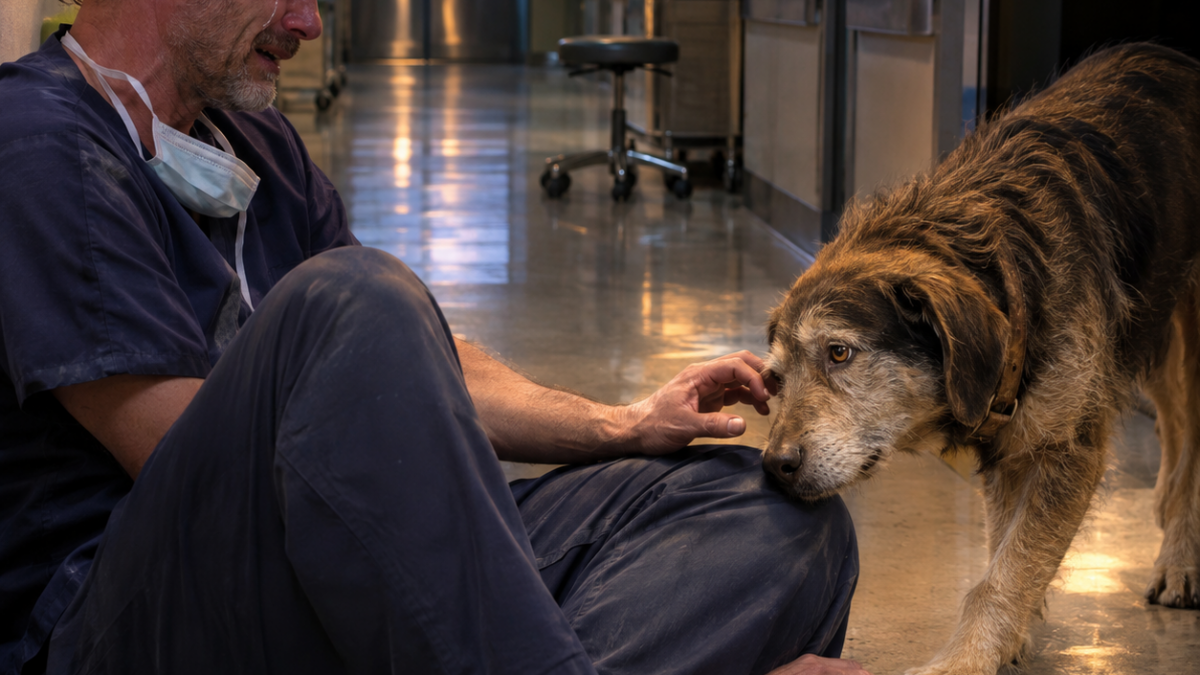
At the far end of the corridor stood a dog.
Brown coat faded with age.
Medium-sized.
One ear upright.
The other folded slightly at the tip.
Hendrix.
I knew him the way everyone at the hospital knew him.
Which meant I knew almost nothing about him.
He had appeared on hospital grounds years earlier.
A stray.
No collar.
No microchip that led anywhere useful.
Security tried to remove him more than once.
He came back.
Animal control evaluated him.
No aggression.
No obvious illness.
Several employees began feeding him.
Someone arranged vaccinations and veterinary care.
Eventually Hendrix became something between a hospital mascot and a tolerated mystery.
He slept near the cafeteria.
Walked through outdoor courtyards.
Sometimes followed maintenance staff.
Security pretended they had not approved his existence.
Nurses kept treats in drawers.
I had passed him dozens of times.
Maybe hundreds.
Never stopped.
I was busy.
Surgeons are always busy.
Hendrix looked at me from the end of that hallway.
Then began walking.
Not wandering.
Not sniffing doors.
Straight toward me.
Click.
Click.
Click.
I watched him approach.
He stopped about a foot away.
Then sat.
That was all.
No paw.
No lick.
No demand for attention.
He simply sat beside me.
I stared.
“Hendrix.”
One ear moved.
“You lost?”
Nothing.
I looked down the corridor.
No nurse.
No handler.
No one calling him.
Just us.
I reached out slowly.
Placed one hand on his back.
Warm.
Solid.
Alive.
He did not move.
My hand was still trembling against his fur.
Hendrix breathed in.
Then out.
Slow.
I felt the rise and fall beneath my palm.
Something happened inside me.
Not dramatic.
No revelation.
My body simply began following his.
In.
Out.
His breathing remained steady.
Mine slowed.
The tremor in my fingers softened.
I closed my eyes.
And for the first time in twenty-two years, I sat after a surgery like that without feeling completely alone.
Security footage later showed that Hendrix stayed with me for forty-three minutes.
I would never have guessed that long.
It felt like five.
Maybe ten.
Time behaves strangely when exhaustion is involved.
The camera showed me sitting against the wall.
Sometimes my eyes closed.
Sometimes my hand resting on his back.
Hendrix barely moved.
A slight turn of his head.
One ear lifting when carts passed somewhere beyond the corridor.
Once, he looked directly toward the camera.
Otherwise, still.
Forty-three minutes.
No words.
No advice.
No question:
Are you okay?
No expectation that I explain why a surgeon who had just saved a girl’s life looked as if something inside him had fallen apart.
That was the gift.
He did not need the story.
Human beings often do.
We ask because we care.
“What happened?”
“What’s wrong?”
“Do you want to talk?”
Sometimes those questions help.
Sometimes the effort required to answer them is more than a person has left.
Hendrix asked nothing.
His presence said only:
You do not have to perform for me.
I did not know how badly I had needed that.
At some point, my hands stopped shaking.
I noticed because I opened my eyes and realized my fingers were resting perfectly still in his fur.
The fluorescent light still hummed.
The hallway was still cold.
Lily was still critically injured.
My daughter was still waiting for a father who kept missing calls.
Nothing external had changed.
Yet my body had.
I could breathe again.
I could stand.
I could return.
I looked at Hendrix.
“Thank you.”
My voice sounded rough.
He moved his tail once against the floor.
One slow sweep.
I smiled.
“That’s it?”
Another look.
No second wag.
Apparently gratitude acknowledged.
Transaction complete.
I pushed myself upright.
My knees objected.
Hendrix remained sitting.
“You coming?”
Nothing.
I laughed.
“Fine.”
I walked toward recovery.
When I looked back, Hendrix was still there.
He did not follow.
A few minutes later, according to security, he stood, stretched, and walked the opposite direction.
As though he had another appointment.
Jennifer, one of the recovery nurses, saw me when I reached Lily’s room.
“You okay, James?”
That question would normally trigger the standard answer.
Fine.
Long night.
Need coffee.
Instead, I stopped.
Thought about Hendrix.
Then said:
“Something sat beside me this morning that didn’t need me to explain anything.”
Jennifer looked at me.
I continued:
“For the first time in twenty-two years, I didn’t feel alone after an operation like this.”
She smiled.
Not confused.
She knew.
“Hendrix?”
I looked at her.
“How did you—”
“James.”
“What?”
“Everybody knows where Hendrix goes at night.”
I stared.
“What do you mean?”
She nodded toward the hallway.
“He finds people.”
I almost laughed.
“That’s ridiculous.”
“Okay.”
“Dogs don’t conduct psychological rounds.”
“I didn’t say he did.”
“You implied it.”
Jennifer adjusted Lily’s IV line.
Then:
“You ever wonder why half the night staff keep treats in their pockets?”
“Because you’re all easily manipulated.”
“Also true.”
She smiled.
“But watch him.”
I did.
For years afterward.
First, Lily.
She survived.
I need to say that clearly.
She survived the operation.
The first forty-eight hours remained dangerous.
Then seventy-two.
There were complications.
Pain.
Another procedure.
Weeks of recovery.
But she lived.
When she woke properly, her first question was not profound.
“Can I have water?”
I laughed.
Her mother cried.
The nurse gave her exactly what was medically allowed.
Later, Lily asked:
“Were you my doctor?”
“Yes.”
“Did I almost die?”
Her mother stiffened.
I did not lie.
“You were very sick.”
“But I’m okay?”
“You’re getting there.”
She stared at me.
Then:
“You look tired.”
Twelve-year-old brutal honesty.
“Yes.”
“I was a lot of work?”
Her mother whispered:
“Lily.”
I smiled.
“A little.”
She grinned weakly.
Good.
Grinning meant future.
I saw Hendrix outside her room that afternoon.
He was lying across the hallway.
I stopped.
Looked at him.
He lifted his head.
Our eyes met.
I nodded.
One tail movement.
That became our language.
No one officially decided it.
But whenever I passed Hendrix after that night, I nodded.
He wagged once.
Never twice if once was enough.
That evening I called my daughter.
She answered after six rings.
“Hey.”
Not Dad.
Just:
Hey.
“I’m sorry.”
Silence.
“I know I promised.”
“You always promise.”
That hurt because there was no accusation in it.
Only history.
“Emergency surgery.”
“I know.”
“How?”
“Mom saw a news alert about the accident.”
Of course.
I sat in my office.
Hendrix’s warmth still somehow remembered by my hand.
“Her name is Lily.”
My daughter became quiet.
“She lived?”
“Yes.”
“That’s good.”
“It is.”
Another pause.
Then I said something I had rarely allowed myself to say.
“I still should have called.”
“You were operating.”
“I could have called before.”
Silence.
“I could have sent more than one sentence.”
Another silence.
“I’m trying not to use saving someone else as an excuse for disappointing you.”
My daughter inhaled.
“That’s new.”
“I know.”
“Are you okay?”
There it was.
The question.
I almost said yes.
Instead:
“No.”
She became immediately serious.
“What happened?”
“Nothing happened.”
I looked toward the empty corridor outside my office.
“It was just a very long night.”
She waited.
And for once, I tried to explain.
Not everything.
Enough.
The shaking.
The exhaustion.
Sitting alone.
Then the dog.
She laughed softly.
“A dog fixed you?”
“No.”
“Sounds like he did.”
“He sat.”
“That’s it?”
“That was enough.”
My daughter was silent.
Then:
“Dad?”
“Yes?”
“You can call me even when you don’t have anything good to say.”
That sentence landed somewhere Hendrix had already opened.
“I know.”
“No, you don’t.”
Fair.
“I’m learning.”
The change in me was not instant.
I did not walk out of that hallway transformed into a perfect father or enlightened physician.
Life doesn’t work like that.
I missed calls again.
Worked too late.
Forgot meals.
Became irritable when tired.
But something shifted.
I noticed.
That mattered.
Before Hendrix, exhaustion was simply evidence that I had worked hard enough.
After Hendrix, I began recognizing it as information.
My body saying:
You are not an endless resource.
My daughter saying:
You cannot keep giving every piece of yourself to strangers and expect family to live on what remains.
My staff saying:
Sit.
Drink water.
Rotate.
I started listening.
Poorly at first.
Then better.
I also started noticing Hendrix.
Really noticing him.
He had routes.
Night staff knew them.
Around midnight, he often slept near the cafeteria.
Around two, he wandered toward the emergency department.
Around three, sometimes pediatrics.
Near dawn, surgical wing.
No schedule was official.
Nobody directed him.
He just moved.
And stories accumulated.
A young nurse named Kelly lost her first patient.
Twenty-three years old.
Brand-new nurse.
She hid in a supply room because she did not want senior staff to see her cry.
Hendrix somehow pushed his nose through the partly open door.
Walked in.
Sat.
Kelly later told me:
“I kept telling him I wasn’t supposed to be crying.”
I asked:
“What did he say?”
She laughed.
“Nothing.”
“Smart dog.”
“He stayed until I stopped apologizing.”
That line stayed with me.
Stopped apologizing.
Not stopped crying.
Different.
A first-year surgical resident named Owen had a panic attack after a complicated procedure.
He made it into a hallway.
Could not catch his breath.
Hendrix was already there.
Or arrived.
Depending on who tells it.
Owen sat on the floor.
Hendrix lay beside him.
A respiratory therapist eventually found both.
Owen later said:
“I focused on the dog’s breathing.”
Exactly what I had done.
Not consciously.
Still.
In.
Out.
Body reminding body what normal looked like.
Marc, one of our janitors, had been waiting for months on news about his brother’s cancer.
The call came during an overnight shift.
Bad news.
Marc hung up.
Sat on a mop bucket.
Hendrix walked into the service area.
Placed his head on Marc’s knee.
Stayed.
Marc was the kind of man who never cried in public.
He cried into Hendrix’s neck.
The next morning, Hendrix had tears dried into the fur beneath one ear.
Nobody washed them off until lunchtime.
Maybe sentimental.
We were becoming sentimental people.
Hospitals do that when they aren’t making you numb.
I asked security once:
“How does he know?”
The guard, Luis, shrugged.
“Smell?”
“Body language?”
“Sound?”
“Maybe we’re all obvious when we’re falling apart.”
I disliked that possibility.
Luis smiled.
“You surgeons think you’re mysterious.”
“We are.”
“No.”
He pointed to a monitor.
Hendrix was asleep beside a vending machine.
“You’re all terrible liars.”
I became curious about Hendrix’s history.
Nobody knew much.
He had appeared years earlier near the loading dock.
Thin.
Dirty.
One paw injured.
Maintenance workers fed him.
Animal control scanned him.
No usable chip.
They tried placing him with a rescue.
He escaped the foster yard within days.
Returned to the hospital.
They tried again.
Same result.
Eventually one rescue coordinator said:
“He seems to have chosen his location.”
Officially, a hospital cannot simply adopt an unassigned stray and let it roam medical corridors.
There are hygiene rules.
Patient safety.
Allergy concerns.
Infection control.
Liability.
So Hendrix’s actual existence became more structured than the legend suggested.
Veterinary care.
Designated areas.
Restricted zones.
Security supervision.
Staff responsible for feeding.
No operating rooms.
No sterile areas.
No free access everywhere.
Over time, the story became:
He just lives here.
Reality was paperwork.
Reality usually is.
Still, within those boundaries, Hendrix had remarkable freedom.
Enough to find people.
I once asked the veterinarian who cared for him whether he was trained as a therapy animal.
“No.”
“Could he be?”
“Maybe.”
“Then why hasn’t anyone—”
“He doesn’t perform.”
“What?”
“He chooses.”
The veterinarian smiled.
“Formal therapy work requires predictable behavior and structure.”
“Hendrix is predictable in one way.”
“What way?”
“He stays when someone needs him.”
That sounded annoyingly mystical.
I accepted it anyway.
My daughter visited the hospital one summer.
She was seventeen then.
Long hair.
Headphones around her neck.
The practiced boredom of a teenager.
I introduced her to staff.
She tolerated me.
Then Hendrix appeared near the courtyard.
She stopped.
“Is that him?”
“Him who?”
“The dog.”
I smiled.
“You remembered.”
“You talk about him constantly.”
“I do not.”
“You absolutely do.”
Hendrix approached.
My daughter crouched.
He sniffed her.
Then leaned gently into her shoulder.
She looked up.
“Dad.”
“What?”
“He likes me more.”
“Everyone does.”
She laughed.
That sound mattered.
We had been rebuilding.
Slowly.
Phone calls.
Visits.
One weekend every two weeks became more regular.
I learned to stop scheduling elective work over her time whenever possible.
Emergencies remained emergencies.
But I became more honest about which absences were unavoidable and which were habits disguised as duty.
There is a difference.
I had hidden behind the first to excuse too much of the second.
My daughter eventually asked:
“Why did you and Mom really get divorced?”
Dangerous question.
I used to answer:
“We grew apart.”
Convenient.
Technically true.
Now I said:
“I was absent even when I was home.”
She looked surprised.
“That’s harsh.”
“It’s also true.”
“Mom says you cared about everyone.”
“Not correctly.”
“What does that mean?”
I thought.
“I thought loving people meant working hard enough to fix whatever was wrong.”
“And?”
“Some things don’t need fixing.”
I thought of Hendrix beside me.
“Sometimes people need you to sit down.”
My daughter smiled.
“You learned that from a dog.”
“Apparently medical school was incomplete.”
Lily visited again almost a year after her surgery.
Walking slowly.
Scar hidden beneath clothing.
Her parents beside her.
She brought cookies for the surgical team.
Too many.
Margaret claimed half.
Lily asked to see me.
Then:
“Is there a dog here?”
I stared.
“How do you know about Hendrix?”
“One of the nurses told me.”
Of course Jennifer.
“Why?”
“She said he sat with you after my surgery.”
I felt strangely exposed.
Lily grinned.
“Was I that stressful?”
“Yes.”
Her mother gasped.
Lily laughed.
“Can I meet him?”
We found Hendrix sleeping near the courtyard.
He was older.
A little grayer.
Lily sat on a bench.
Hendrix approached.
Sniffed.
Then sat near her feet.
Lily touched his head.
“You took care of my doctor?”
Tail once.
She smiled.
“Good.”
I stood several feet away.
Something tightened in my throat.
The girl whose survival had pushed me beyond my limits was now petting the creature that helped bring me back from those limits.
Hospitals are full of strange circles.
Years passed.
My hair grayed.
My surgeries decreased slightly as I moved into more teaching and complex-case supervision.
Hendrix aged beside us.
His coat faded.
The brown turned lighter around the face.
His back stiffened.
He walked more slowly.
Staff created a bed near the cafeteria.
Old cushion.
Thick blanket.
Someone embroidered:
HENDRIX
on the edge.
He ignored it for two days.
Then claimed it completely.
By then, everyone knew him.
New staff learned quickly.
“Don’t feed Hendrix from your tray.”
They did.
“Don’t let him into restricted areas.”
They didn’t.
“Tell security if he seems ill.”
Always.
“He may sit with you.”
No instruction required.
One night I finished a routine operation around midnight.
Nothing like Lily’s.
I stepped into the corridor.
Hendrix was there.
I sat on a bench.
He came over.
I scratched his head.
“You know, not every surgery destroys me.”
He yawned.
“Rude.”
One tail wag.
I laughed.
Then realized something.
I no longer needed him only when I was breaking.
Sometimes I could simply sit with him because sitting had become something I knew how to do.
That might have been his greatest effect on me.
He had taught me stillness before I knew stillness could be practiced.
Younger doctors began coming to me after difficult cases.
At first, I did what senior surgeons often do.
Explained.
Advised.
Taught.
Then one resident named Priya lost a patient after a brutal night.
She came into my office.
Eyes red.
“I did everything.”
“I know.”
“I reviewed it.”
“I know.”
“I keep thinking there had to be—”
“Priya.”
She stopped.
I pointed to the chair.
“Sit.”
She did.
I did not give advice.
Not immediately.
We sat for almost a minute.
She cried.
I let her.
Eventually she asked:
“Aren’t you going to say anything?”
I thought of Hendrix.
“No.”
She laughed through tears.
“That’s weird.”
“Yes.”
Then I said:
“You don’t have to explain why this hurts.”
That was enough for the first five minutes.
Advice came later.
Timing matters.
My mentor had taught me:
Do everything humanly possible.
Hendrix taught me the missing part.
Afterward, allow yourself to remain human.
I wish Dr. Levinson had lived long enough for me to tell him.
Maybe he already knew.
Older doctors sometimes know things we younger ones refuse to hear.
At some point, Hendrix’s story escaped the hospital.
Patients mentioned him.
Families took photographs.
A local paper wanted to write about “the hospital dog who comforts staff.”
Administration panicked.
Reasonably.
Privacy.
Patient consent.
Safety.
Legal language.
Hendrix did not care.
He slept through the meeting.
Eventually the hospital allowed a modest human-interest piece focused on staff wellness and Hendrix’s unusual history.
No patient details.
No invented miracles.
I declined to be interviewed.
Jennifer betrayed me anyway.
She told the reporter:
“One surgeon says Hendrix saved his hands.”
I confronted her.
“You said what?”
“I did not use your name.”
“Everyone knows.”
“Good.”
“You’re impossible.”
She gave Hendrix a treat.
He accepted the bribe.
Conspiracy.
The attention brought donations.
Beds.
Food.
Veterinary support.
Enough tennis balls for a dog who barely played fetch.
One child sent a handwritten letter:
Dear Hendrix, thank you for helping doctors because doctors help everybody else.
I kept a copy.
I don’t know why.
Maybe because children sometimes state obvious things adults overlook.
People who care for others also require care.
We build systems around patient outcomes.
Important.
Necessary.
But healthcare workers are not machines attached to those systems.
Bodies.
Families.
Limits.
Grief.
I knew that intellectually for years.
Hendrix made it physical.
My ex-wife noticed the change too.
We had moved beyond bitterness by then.
Mostly.
One afternoon at our daughter’s graduation, she stood beside me.
“You’re different.”
“That sounds ominous.”
“Less absent.”
“I still live three hundred miles away.”
“You know what I mean.”
I did.
She smiled.
“Our daughter says thank the hospital dog.”
“Everybody credits him.”
“Should they?”
I watched our daughter laughing with friends.
“Yes.”
Then:
“And you.”
My ex-wife looked at me.
“For what?”
“For telling me the truth before I was ready to hear it.”
She became quiet.
“I wasn’t very kind when I said it.”
“I wasn’t very present when you had to.”
That was as close to mutual peace as divorce sometimes gets.
Enough.
Lily grew up.
I did not remain deeply involved in her life.
Doctors should not become part of every patient’s family.
Boundaries matter.
But every few years, a card arrived.
At sixteen:
A photograph from a school play.
At eighteen:
Graduation.
At twenty:
A note saying she was studying nursing.
That made me laugh.
The girl whose life had nearly ended on my table had chosen healthcare.
Her mother wrote:
We tried to talk her out of it.
Fair.
Years later Lily came to the hospital as part of a nursing-school placement.
She found me.
“Dr. Holloway.”
I stared.
Adult.
Same eyes.
“You got taller.”
“Excellent medical assessment.”
I smiled.
“How are you?”
“Alive.”
She said it jokingly.
The word still hit.
Then:
“Where’s Hendrix?”
“He’s old.”
“So are you.”
“Get out.”
She laughed.
We found him.
Very old by then.
Mostly gray.
Lily knelt.
He sniffed her.
Tail once.
She looked at me.
“He remembers.”
“Maybe.”
“You always say maybe?”
“I’m a doctor.”
“Coward.”
She stroked his head.
“Thank you for taking care of him.”
I said:
“He took care of me first.”
Hendrix’s mobility declined.
The hospital limited his wandering.
Not because anyone wanted to.
Because slippery floors became dangerous.
He spent more time near the cafeteria.
Staff carried him outside sometimes.
A ramp replaced steps.
He received arthritis medication.
Veterinary visits increased.
And still, every once in a while, he disappeared from his bed.
Someone would say:
“Where’s Hendrix?”
Security cameras would find him.
Usually beside somebody.
A unit clerk crying after a family emergency.
A resident sitting alone.
A maintenance worker having chest pain—ironically, that incident led staff to realize the man needed emergency evaluation.
Hendrix had simply sat at his feet.
Coincidence.
Probably.
Useful coincidence.
One night, Jennifer called me.
I was home.
Unusual.
“What?”
“Hendrix is in ICU hallway.”
“Okay.”
“He walked there himself.”
“That’s not exactly breaking news.”
“He hasn’t walked that far in weeks.”
I sat up.
“Why?”
“There’s a family outside Room 8.”
I knew what Room 8 meant.
Bad.
“Whose?”
“Child.”
I closed my eyes.
Hendrix.
Old.
Arthritic.
Still going.
“Get him back to bed when he’s done.”
Jennifer said:
“You tell him.”
Fair.
The next morning, Hendrix slept almost the entire day.
I sat beside his bed during lunch.
“You’re retired.”
One eye opened.
“I mean it.”
Nothing.
“You’ve done enough.”
He slept.
Dogs are excellent at ignoring administrative decisions.
The hospital formally recognized him eventually.
Not employee.
Not therapy dog.
Something like:
Community Companion Animal
Lawyers invented the title.
Everyone laughed.
Hendrix remained Hendrix.
A photo appeared on a wall near the cafeteria.
No dramatic quote.
Just:
HENDRIX — A FRIEND OF THE HOSPITAL
Accurate.
The year before my retirement, I began counting lasts.
Last major overnight trauma.
Last resident class.
Last annual review.
Last holiday on call.
People talk about retirement as freedom.
For me, it also felt like losing an identity I had worn almost my entire adult life.
Surgeon.
Dr. Holloway.
The person called when something was terribly wrong.
Who would I be when nobody called?
I had once watched retired surgeons struggle with that.
Some became unbearable.
Others disappeared into golf.
I wanted neither.
My daughter—now an adult with a career of her own—said:
“Maybe try being Dad.”
Rude.
Correct.
The day before retirement, I went looking for Hendrix.
He was sleeping on his old cushion.
Thinner.
White around the eyes.
Breathing slowly.
I crouched.
My knees made noises.
We were both old.
“Hey.”
One eye opened.
“You know tomorrow’s my last day?”
No response.
“I suppose you don’t care.”
Tail moved once.
I smiled.
“There it is.”
I touched his head.
His fur felt softer than I remembered.
Or maybe my hands had become more sensitive to endings.
“I never understood how you did it.”
Hendrix looked at me.
“Maybe everyone else was right.”
One ear moved.
“Maybe you knew.”
I almost laughed at myself.
A surgeon discussing intuition with a dog.
Career had deteriorated badly.
Then I became serious.
“Thank you.”
Tail once.
Same as the first dawn.
Twenty-two years of surgery before I met him.
Years afterward.
One tail movement.
Enough.
I stayed there longer than planned.
No rush.
That was another thing he had changed.
Retirement day was unbearable.
Speeches.
Photos.
Cake.
Margaret, older and retired herself, came back.
Jennifer hugged me.
Residents I had trained recorded messages.
My daughter surprised me by arriving.
I almost cried.
Did cry.
No dignity.
At some point, someone asked:
“Where’s Hendrix?”
He was asleep.
Perfect.
The whole hospital celebrating.
Hendrix uninterested.
I went to see him before leaving.
“I’m going.”
He lifted his head.
I knelt.
My daughter stood behind me.
I pressed my forehead against his.
“Take care of them.”
Ridiculous.
Still.
He licked my hand once.
First time I could remember him doing that.
I stared.
“Now?”
Tail.
My daughter whispered:
“He’s making it dramatic.”
“Apparently.”
Then I stood.
Walked toward the exit.
And this time, I looked back.
Hendrix was still watching.
I nodded.
Tail once.
Then I left.
Retirement did not kill me.
Important finding.
I called my daughter.
Often.
Visited.
Learned how to cook two meals reliably.
Volunteered occasionally at a medical school.
Read books unrelated to medicine.
Slept badly for several months because my body expected pages at night.
Then better.
I missed surgery.
I did not miss everything about being a surgeon.
Identity expanded.
Slowly.
I returned to the hospital every few weeks at first.
Too often.
Jennifer accused me of haunting the place.
Then less.
Each time, I looked for Hendrix.
He became slower.
Eventually he stopped walking the corridors almost completely.
People came to him instead.
Interesting reversal.
The dog who spent years finding everyone became a destination.
Nurses on break.
Residents after calls.
Patients’ families when allowed.
Housekeeping.
Security.
People sat beside his cushion.
No one demanded anything.
He slept.
Sometimes opened his eyes.
Tail once if they were lucky.
His work had become simply being there.
Perhaps it always had been.
One winter morning, Jennifer called.
I knew before answering.
Some phone calls announce themselves.
“James.”
I sat down.
“Is it Hendrix?”
“Yes.”
“How bad?”
“He’s comfortable.”
Those words.
Medicine teaches you to hear what they mean.
“Should I come?”
Pause.
“If you want to see him.”
“I’m coming.”
My daughter happened to be visiting.
She drove.
Probably wise.
At the hospital, everything looked the same.
Smelled the same.
Disinfectant.
Coffee.
Air too cool.
I walked toward the cafeteria.
People were gathered but not crowding.
Hendrix lay on his cushion.
Blanket beneath him.
The veterinarian sat nearby.
Jennifer.
Luis from security.
Marc from maintenance.
Others.
People from years.
Hendrix’s people.
No single owner.
A whole institution had become his home.
I knelt.
He opened his eyes.
For one second, I was back against the hallway wall.
Hands shaking.
Dawn.
Brown dog walking toward me.
“Hey.”
His tail moved.
Barely.
Once.
Of course.
I laughed and cried at the same time.
“You stubborn old thing.”
I placed my hand on his back.
His breathing was shallow.
Not distressed.
Just tired.
The veterinarian explained.
Heart.
Age.
Multiple systems.
We all understood.
No need to force more days out of a body that had given enough.
Someone asked who should stay.
All of us?
Too many.
I said:
“Let him choose.”
We stepped back.
Hendrix looked around.
Then lowered his head again.
Maybe he did not care.
Maybe home was all of us.
In the end, several stayed quietly.
Jennifer.
Luis.
The veterinarian.
Me.
My daughter behind me.
I kept my hand on Hendrix.
His breathing.
In.
Out.
Slower.
Exactly as years earlier.
Only now, I followed him toward stillness for a different reason.
Before the medication, I whispered:
“You don’t have to find anybody else.”
My voice broke.
“They’ll manage.”
Jennifer cried.
Luis looked away.
I continued:
“You stayed long enough.”
Hendrix’s eyes were half closed.
“You can rest.”
The veterinarian gave the sedative.
His muscles softened.
His head settled deeper into the blanket.
I realized my hand was trembling.
Again.
After all those years.
I smiled through tears.
Of course.
Then Hendrix exhaled.
And I felt the tremor stop.
Not because I forced it.
Because I was touching something steady until the very end.
The final medication came.
His breathing faded.
Then stopped.
Nobody spoke.
The hospital around us continued.
Phones.
Carts.
Elevators.
Life.
Exactly as it had the morning he first sat beside me.
We held no large public memorial.
Hendrix would have hated it.
Or ignored it.
The hospital placed his old cushion in a small glass case?
No.
I argued against that immediately.
He was a dog, not a museum artifact.
Instead, they created a quiet bench near the garden.
Simple plaque.
HENDRIX
HE SAT WITH US.
That was all.
Perfect.
People left things there for a while.
Notes.
Dog treats.
One tennis ball.
A child’s drawing.
Eventually less.
Good.
Grief should be allowed to become ordinary.
But staff continued using the bench.
After difficult shifts.
Bad news.
Personal calls.
Sometimes two people sat without talking.
I visited once and saw a resident there alone.
I almost approached.
Then stopped.
Maybe silence was what he needed.
I kept walking.
Hendrix would have approved.
Years later, I spoke to a class of medical students.
They expected surgical stories.
I gave them some.
Mistakes.
Complications.
Technical judgment.
Then somebody asked:
“What was the most important thing you learned in your career?”
I should have said:
Know your anatomy.
Never become arrogant.
Respect nurses.
All true.
Instead I told them about Hendrix.
Not everything.
Enough.
A hallway.
A dog.
Forty-three minutes.
One shaking surgeon.
The room became very quiet.
I said:
“You are going to spend your careers learning how to act.”
“Diagnose.”
“Cut.”
“Repair.”
“Prescribe.”
“Intervene.”
“All necessary.”
Then:
“Learn how to remain too.”
They stared.
I continued.
“There will be moments when the person in front of you does not need an explanation.”
“Or advice.”
“Or a solution.”
“Sometimes the most humane thing you can do is sit down and make it clear they do not have to be alone in the next five minutes.”
One student raised her hand.
“Isn’t that what family is for?”
“Sometimes.”
“What if they don’t have family?”
“Then maybe it’s you.”
Another student:
“How do you know what to say?”
I smiled.
“You don’t always have to.”
Afterward, a student approached.
“My dad died last year.”
“I’m sorry.”
“People kept trying to make me feel better.”
I waited.
She said:
“I hated it.”
I nodded.
Then she smiled slightly.
“I could have used Hendrix.”
“Yes.”
“We all could.”
My daughter eventually had children.
I became a grandfather.
A role nobody pages you into.
I was terrible at diapers.
Good at sitting beside cribs.
Maybe Hendrix again.
My granddaughter once asked:
“Why do you have a picture of that old dog?”
The photograph sat in my study.
Hendrix in the hospital courtyard.
Gray face.
One bent ear.
I lifted her onto my lap.
“That dog helped me once.”
“Were you sick?”
I thought.
“No.”
“Then how?”
“I was tired.”
She frowned.
“That’s all?”
Children are ruthless.
“Yes.”
“Why didn’t you sleep?”
“Excellent question.”
She accepted that.
Then:
“Was he your dog?”
“No.”
“Whose was he?”
I smiled.
“Everybody’s.”
That confused her.
Good enough.
I still think about Lily.
About Margaret.
Jennifer.
Marc.
The young nurse in the storage room.
Owen’s panic attack.
All those people Hendrix sat beside.
But I have become careful not to turn him into magic.
He was not a supernatural creature detecting sadness through walls.
He was observant.
Social.
Calm.
People were drawn to him.
He responded.
Sometimes timing looked uncanny.
Humans gave it meaning.
That does not make the comfort less real.
We do not need magic for presence to matter.
Reality is enough.
The lesson became more powerful once I stopped asking:
How did Hendrix know?
And started asking:
Why did humans need a dog to remind us to stay?
We are uncomfortable with pain.
Another person’s grief makes us want to do something.
Fix it.
Explain it.
Reduce it.
We say:
“At least…”
“Everything happens for a reason.”
“Be strong.”
“You did your best.”
Maybe sometimes.
But sometimes those sentences are attempts to escape the discomfort of sitting beside suffering we cannot repair.
Hendrix had no need to escape.
So he stayed.
That was his advantage.
I became better at that with my daughter.
Years after my retirement, she called me after a relationship ended.
She was crying.
Old James would have analyzed.
Told her what I thought about the man.
Suggested next steps.
Asked practical questions.
Instead:
“Do you want advice?”
“No.”
“Okay.”
Silence.
She cried.
I listened.
After several minutes:
“You still there?”
“Yes.”
“Good.”
There it was.
Hendrix.
Not physically.
Behaviorally.
Love passed through practice.
Eventually she said:
“You got better at this.”
“At what?”
“Not fixing me.”
I smiled.
“Had a good teacher.”
“The dog?”
“Obviously.”
The strange thing is that I cannot remember exactly what Hendrix’s fur felt like that first morning.
Memory edits.
I remember warm.
I remember steady breathing.
I remember one bent ear.
The rest has blurred.
But I remember perfectly what changed inside my body.
My hands.
Shaking.
Then not.
For a surgeon, that was almost sacred.
People sometimes ask whether Hendrix saved me.
No.
I dislike making animals responsible for human salvation.
He did not fix my marriage.
Could not undo missed years with my daughter.
Did not remove burnout from medicine.
Did not make every patient live.
He sat beside me.
Then I made different choices afterward.
That feels more respectful to both of us.
He offered presence.
I had to decide what to do with the space it created.
Maybe that is what comfort really is.
Not solving someone.
Creating enough space for them to begin carrying themselves again.
Hendrix gave me forty-three minutes.
Then stood and left.
He did not follow me to recovery.
Did not supervise my phone call to my daughter.
Did not demand credit.
He stayed long enough.
Then trusted me to stand.
Beautiful boundary.
I think about that now whenever someone says:
“I don’t know how to help.”
You may not need to know.
If someone is grieving and safe, maybe sit.
If a colleague is overwhelmed, bring coffee and don’t demand conversation.
If your child calls crying, resist the urge to explain their feelings back to them.
If someone needs professional help, help them get it.
Presence is not a substitute for treatment.
Hendrix did not replace therapy, rest, staffing, or structural changes.
But presence can be the bridge that gets someone to the next thing.
That is what he was for me.
A bridge between the operating room and the rest of my life.
I had entered that hallway believing I needed to be alone.
That belief had defined much of my life.
Handle it privately.
Don’t burden anyone.
Regain control.
Return.
Hendrix did not ask permission to join me.
He simply sat nearby.
Not too close.
About twelve inches.
Enough space to choose.
Maybe that was why I let him stay.
He did not invade.
He accompanied.
Difference.
The security camera showed something else I only noticed years later.
At the beginning of those forty-three minutes, my body was folded forward.
Shoulders rounded.
Head down.
By the end, I was sitting upright.
No dramatic transformation.
A few inches.
But visible.
I like that.
Healing rarely looks like movies.
Sometimes it’s posture.
Breathing.
Hands.
A person able to stand again.
Lily once wrote to me after becoming a nurse:
I used to think the reason I survived was one surgery. Now I know it was hundreds of people doing small things before, during, and after.
Smart woman.
I wrote back:
Exactly.
Then added:
Never underestimate the person who stays after the procedure is over.
She replied:
Hendrix?
I laughed alone in my study.
His reputation persisted.
The hospital bench is still there.
I visited last year.
Older now.
Walking slower.
I sat.
No dog.
Fine.
The garden was quiet.
A nurse I did not know sat at the other end.
We nodded.
Neither spoke.
After ten minutes, she said:
“Did you know Hendrix?”
I smiled.
“Yes.”
Her eyes widened.
“Really?”
“Yes.”
“My preceptor told me about him.”
Of course.
Stories outlive facts.
“What was he actually like?”
I thought.
Then:
“Quiet.”
She laughed.
“That’s it?”
“Mostly.”
We sat another minute.
Then she said:
“I lost a patient today.”
There it was.
I turned slightly.
“I’m sorry.”
She nodded.
No more.
We sat.
Five minutes.
Maybe six.
Then her pager buzzed.
She stood.
“Thank you.”
I smiled.
“For what?”
She looked at the plaque.
Then at me.
“Nothing, I guess.”
Exactly.
She left.
I stayed a little longer.
That is Hendrix’s legacy to me.
Not the legend of a mysterious hospital dog roaming the halls and sensing pain.
Though people enjoy that version.
His real legacy is simpler.
He normalized staying.
He showed a building full of people trained to intervene that sometimes non-intervention can also be care.
Not neglect.
Not passivity.
Attentive presence.
A witness.
A warm body beside another warm body until the world becomes manageable again.
I had spent twenty-two years believing my value came from what my hands could do.
Cut.
Repair.
Suture.
Control bleeding.
Save.
Then one morning my hands would not stop trembling, and a creature with no medical degree, no language, no understanding of surgery placed absolutely no demand on them.
I rested one hand on his back.
And for forty-three minutes, my hands did nothing.
That may have been the first time in decades I understood they were allowed to.
The operation saved Lily’s life.
I remain proud of that.
But Hendrix saved something quieter that morning.
Not my life.
My ability to stop treating myself like a tool between cases.
He reminded me that the person inside the surgeon needed somewhere to exist.
And once I understood that, I became better.
Not perfect.
Better father.
Better teacher.
Maybe better doctor.
Certainly better listener.
If I could return to that hallway before Hendrix appeared, I would not tell myself:
A dog is coming to change your life.
Too dramatic.
I would say:
Stay seated.
Do not rush back just because you are uncomfortable being still.
Let your hands shake.
You do not have to hide the evidence that you are human.
And when you hear claws on the floor, don’t send him away.
He knows something you don’t yet know.
Hendrix never needed to be thanked.
Still, I thanked him twice.
The first dawn.
Then before retirement.
Both times:
One tail wag.
Maybe that was his answer.
Maybe only a tail.
Either way, it was enough.
I spent a career surrounded by machines designed to measure life.
Heart rate.
Blood pressure.
Oxygen.
Temperature.
Electrical activity.
Numbers telling us whether a body was improving or failing.
But nobody measured what happened in that hallway.
No monitor recorded the exact second my breathing slowed.
No chart noted:
Surgeon’s hands stopped trembling after contact with brown stray dog.
No billing code.
No procedure.
Yet I know it happened.
Some forms of care leave no entry in a medical record.
They are still real.
The night Lily arrived, I thought the most important thing I could do was remain standing for another hour.
Then another.
Then another.
And inside the operating room, that was true.
But after the operation ended, the most important thing someone did for me was sit.
No contradiction.
Different needs.
Different moments.
Wisdom is knowing which one the moment requires.
Hendrix knew—or happened to embody—that distinction better than many humans I had met.
When people needed someone beside them, he sat.
When the moment passed, he left.
No ownership.
No need to become indispensable.
No promise to fix tomorrow.
Just:
I’m here now.
Maybe that is why we trusted him.
His promise was small enough to keep.
Years after his death, when I close my eyes, I sometimes still hear the hospital before dawn.
Fluorescent hum.
Faraway cart wheel.
My own uneven breathing.
Then:
Click.
Click.
Click.
A dog emerging from shadow.
No rush.
No hesitation.
Coming straight toward the surgeon who had spent his whole career believing nobody could see what happened after the doors closed.
He saw enough.
Or I allowed myself to feel seen.
Maybe both.
Hendrix sat twelve inches away.
I placed a shaking hand on his back.
He breathed.
I followed.
Forty-three minutes later, I stood.
That is the entire miracle.
Nothing supernatural.
Nothing complicated.
One exhausted person.
One old stray dog.
A quiet hallway before sunrise.
And the discovery that sometimes the strongest thing another living being can offer is not an answer, not advice, not rescue—
but the willingness to sit beside you until you remember that you can stand again.
That morning, Hendrix never asked me to explain why my hands were shaking. He simply stayed until they stopped. And after twenty-two years of believing I had to carry every difficult night alone, that silent old dog taught me the lesson medicine had somehow forgotten to teach me: sometimes healing begins when someone sits beside you and refuses to make you face the silence by yourself.








