FULL STORY:After Eight Hours Beneath a Collapsed Building, I Found a Stray Dog Shielding a 6-Year-Old Girl—Three Weeks Later, I Realized He Had Rescued Me Too
FULL STORY CONTINUATION
Jacob crawled into position behind me.
“What have you got?”
“Girl.”
His breath caught.
“And dog.”
He looked past my shoulder.
“Jesus.”
“Call Michael.”
“Medical kit.”
“Slow.”
Everything had to be slow.
Above us, tons of damaged material depended on supports we had placed through the previous hours.
The little pocket that saved them could also become a trap if we moved the wrong piece.
The dog stood.
Barely.
His legs shook.
But he would not step away from the girl.
When Jacob tried to move closer, the dog growled again.
Jacob stopped.
“Friend.”
I whispered.
“We’re here to help.”
The dog’s eyes moved from me to him.
Then back to the little girl.
Michael arrived with the medical bag.
The three of us examined the space.
A large block trapped part of the access route.
We could not simply pull it.
Doing that might shift the slab above.
We would have to cut around it.
Brace.
Cut.
Remove debris in pieces.
The operation that had already taken us eight hours suddenly became more delicate.
Because now we knew exactly what we could lose.
The girl woke when the first small section of debris was removed.
Her eyes opened.
Wide.
Confused.
She did not scream.
She looked at me.
Then immediately reached for the dog.
“It’s okay.”
I said.
“My name is James.”
Her lips were dry.
She whispered something.
I leaned closer.
“What?”
“Don’t take him.”
“I won’t.”
The dog pressed against her.
“What’s your name?”
“Émilie.”
“Émilie, how old are you?”
She raised six fingers.
Six.
I swallowed.
“Are you hurt?”
She shook her head.
“Anything hurting?”
“My arm.”
I checked.
Scraped.
Bruised.
Nothing obviously severe.
“Do you know this dog?”
She nodded.
“What’s his name?”
She looked confused.
“He doesn’t have one.”
That surprised me.
“Isn’t he yours?”
“No.”
The dog licked her wrist.
Émilie touched his dusty head.
“I saw him outside.”
“When?”
“Three days ago.”
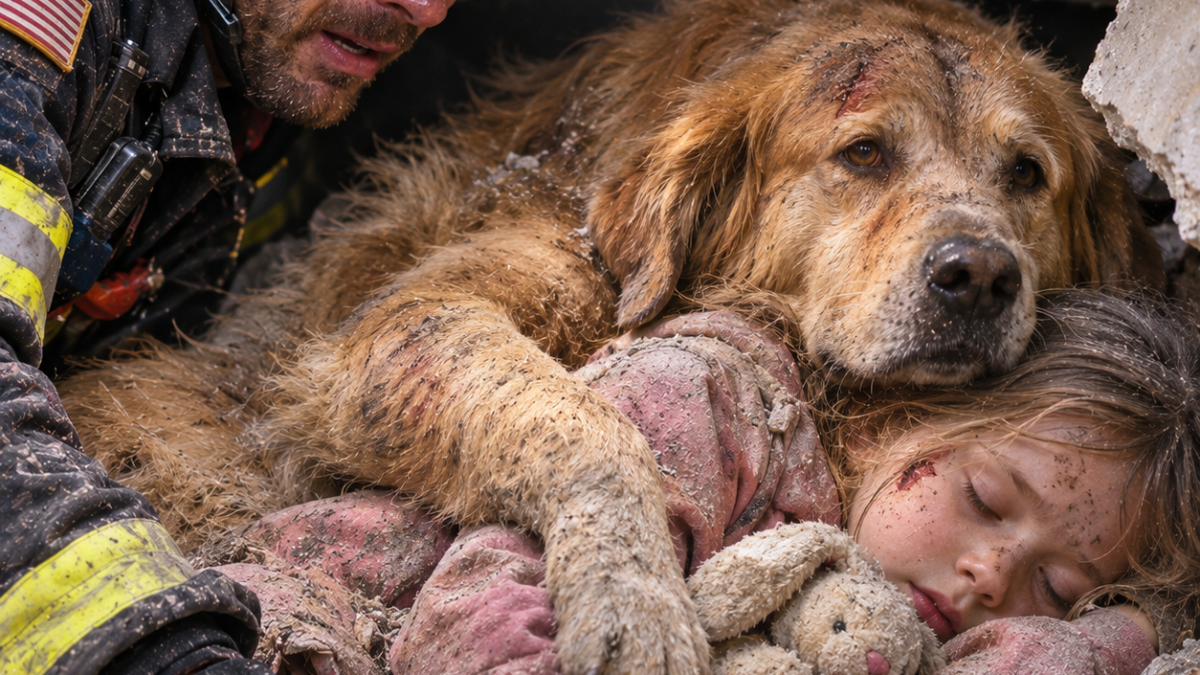
That was the first time I understood how extraordinary the situation might be.
The dog was not protecting his owner.
He was protecting a child he had barely met.
Émilie later told us what happened.
Three days before the collapse, she had seen him in the courtyard.
Thin.
Dirty.
Watching people from a distance.
She had brought him crumbs of bread.
Her mother told her not to get too close to an unknown dog.
Émilie listened.
Mostly.
She left food.
The dog returned.
Again the next day.
Then the building collapsed.
Émilie remembered noise.
Her mother yelling.
The floor moving.
Dust.
And then the dog appearing.
She could not explain exactly where he came from.
But she remembered him pulling at her clothing.
Pushing against her.
Driving her beneath a heavy table just before part of the room came down.
The table created an initial protective space.
Then shifting debris formed the pocket where we eventually found them.
For almost twelve hours, the dog stayed.
When Émilie tried to crawl away because she was frightened, he blocked her.
When she cried, he licked her hands.
When sounds came through the rubble, he pushed against her and listened.
He kept her inside the one space that remained stable.
That stray dog understood something a terrified six-year-old could not.
Moving was dangerous.
So he stayed.
And made her stay.
At the time, however, we knew only that we had two living beings trapped beneath unstable debris.
The large block between us and the exit took almost eight hours to work around safely.
People later misunderstood that detail.
They assumed I found Émilie and the dog after eight hours and immediately carried them outside.
No.
Finding them was only the beginning of the hardest part.
We could not rush.
Rescue is sometimes cruel that way.
You can see the person you want to save.
Speak to them.
Touch them.
And still spend hours only feet apart because one careless movement could kill everyone.
Jacob used the special saw.
Michael maintained contact with Émilie.
I stayed closest to the dog.
Each time the saw started, his ears flattened.
He moved in front of the little girl.
“Easy.”
I whispered.
“It’s okay.”
He did not believe me.
Fair.
Why should he?
He had already watched the world collapse once.
The first time I tried to place my hand near Émilie’s shoulder, the dog growled.
I stopped immediately.
“Look.”
I showed him my empty hand.
“This is for her.”
Obviously, he did not understand English.
But he understood movement.
Tone.
Intent.
I moved slowly.
Émilie whispered:
“He’s nice.”
“I know.”
“He won’t bite.”
I looked at his teeth.
“I appreciate your confidence.”
She almost smiled.
That tiny almost-smile inside the rubble nearly broke me.
The dog sniffed my glove.
Then allowed my hand to pass.
From that moment, something between us changed.
Not complete trust.
Permission.
I could approach Émilie.
But every time another rescuer shifted near her, he watched.
He was supervising us.
There is no better word.
Hours passed.
We gave Émilie small amounts of water safely.
Monitored her.
Talked to keep her calm.
The dog refused food at first.
Eventually he accepted a little water.
His body was exhausted.
His eyes were not.
At one point I asked:
“Why don’t you lie down?”
He looked at me.
Then at Émilie.
Of course.
He was already lying where he needed to be.
Outside, Émilie’s mother had been located.
Alive.
Separated from her daughter during the collapse.
I did not learn the full details until later.
She spent those hours waiting beyond the rescue perimeter, not knowing whether Émilie was alive.
Once we confirmed the child, someone told her.
That mattered.
But nobody promised an outcome.
Not while that block still stood between us and the exit.
The structure shifted twice during the extraction.
The first movement was small.
Dust fell.
The dog immediately pushed his body over Émilie.
I saw it.
No training.
No command.
Pure reaction.
Protect.
The second movement was worse.
A support creaked.
Jacob froze.
“Everyone stop.”
We stopped.
Even Émilie became completely still.
The dog looked at me.
For the first time, I saw fear clearly in his face.
That mattered.
Because courage looks different when you realize the brave one is afraid.
He was terrified.
He stayed anyway.
Eventually, the final major block was ready to come out.
Jacob looked at me.
“Once this moves, we have a path.”
“Stable?”
“As stable as anything down here.”
Not comforting.
Good enough.
Michael positioned himself.
I crouched beside Émilie.
The dog stood between us.
“Buddy.”
I said.
“You need to let me take her.”
Growl.
Soft.
Émilie wrapped her arms around his neck.
“He comes too.”
“He does.”
“I promise.”
I meant it.
Jacob removed the last section.
The opening cleared.
“Now.”
We moved.
Michael reached Émilie.
The dog stepped closer.
Then another piece shifted above.
“Move!”
I grabbed the dog.
He fought for half a second.
Not trying to bite.
Trying to turn back toward the child.
“She’s coming!”
I shouted.
“She’s right behind us.”
Again, meaningless English.
But maybe my tone reached him.
I pulled him through.
Michael brought Émilie behind.
And after more than eight hours of careful cutting and stabilization around that final obstacle, we were finally moving toward open air.
When we reached the surface, medical personnel took Émilie first.
The dog twisted out of my arms.
I panicked for one second.
Then saw where he was going.
Not away.
Toward her.
He ran directly to the stretcher.
Stopped beside it.
Émilie reached down.
The dog pushed his head into her hand.
Only then did he lie down.
As though his body had been waiting for permission to collapse.
Doctors examined Émilie.
Six years old.
Dehydrated.
Scratches.
Bruises.
Frightened.
But otherwise remarkably stable.
Her mother reached her soon afterward.
I stood back.
That reunion did not belong to me.
Émilie cried then.
Really cried.
Her mother held her.
The dog stayed beside them.
At one point Émilie’s mother reached toward him.
He flinched.
Then allowed her to touch his head.
She began crying harder.
“She said he saved her.”
Someone told her.
The mother looked at me.
I shook my head.
“No.”
I pointed toward the dog.
“He did.”
Then came the problem nobody had expected.
The dog belonged to no one.
No collar.
No tag.
No owner waiting.
No obvious home.
When Émilie left for further evaluation, he tried to follow.
But hospital logistics made things complicated.
Her mother could not simply take an unknown stray dog immediately while managing a traumatized child.
So I stood there holding a dog coated in concrete dust while ambulances moved around us.
He watched the vehicle carrying Émilie.
Until it disappeared.
Then he looked at me.
That look.
The same look from beneath the rubble.
Only different now.
The job he had chosen was finished.
The person he protected was gone.
And suddenly he had nowhere to go.
I crouched.
“What am I supposed to do with you?”
He leaned against my chest.
That was his answer.
I named him Hope.
The name came naturally.
People assumed later I chose it because hope is what rescuers are supposed to preserve.
Maybe partly.
But that was not exactly it.
When I looked into his eyes beneath the rubble, I had felt something I could not explain.
A certainty.
Not that the operation would be easy.
Not that everyone would survive every disaster.
Just that something in the world remained worth fighting for.
Hope.
It fit.
I took him to a veterinarian.
The first proper examination removed enough dust that I finally saw his actual coat.
Mixed breed.
Around three years old.
No microchip.
No evidence anyone had reported him missing.
No clear trace of previous ownership.
A stray.
He had minor cuts.
Exhaustion.
Dehydration.
Nothing severe.
The veterinarian looked at me.
“Where will he go?”
I had already contacted an animal organization.
That was the sensible plan.
Temporary placement.
Then adoption.
I said:
“I’ll keep him tonight.”
The veterinarian smiled.
Dangerous smile.
“What?”
“Nothing.”
“You know something.”
“No.”
“Say it.”
“You’ll see.”
I ignored her.
Rescuers are good at ignoring warnings outside their specialty.
My apartment was small.
One bedroom.
Old couch.
Kitchen designed for one person who rarely cooked.
Hope entered cautiously.
I expected him to explore.
Sniff every corner.
Investigate.
Try to escape.
He did none of those things.
He walked to the couch.
Turned once.
Lay down.
Put his head on his paws.
And watched me.
I stood near the door.
“This is temporary.”
Tail moved once.
“I’m serious.”
Nothing.
“You need a real family.”
He closed his eyes.
Apparently conversation finished.
That first night, I slept badly.
Not because of Hope.
Because rescue scenes replay after the adrenaline fades.
The sound of cutting.
Concrete shifting.
Émilie’s face.
The dog’s body covering her.
Around three in the morning, I woke.
Hope was beside the bed.
Not on it.
Beside.
His head rested against the edge of the mattress.
Eyes open.
“You okay?”
Ridiculous question.
He lifted his head.
I reached down.
Touched him.
Then slept.
For the first week, I tried to find him a home.
I called animal organizations.
Sent photographs.
Explained he was calm.
Good temperament.
No known owner.
Every time I made a call, Hope lay nearby.
Watching.
It felt like betrayal.
I told myself I was projecting.
Probably was.
Still felt like betrayal.
Each morning, I woke to find him beside the bed.
Each evening, I returned to find him waiting.
The first day after I went back to work, I opened the apartment door and something hit my leg.
Hope.
In his mouth:
One of my old socks.
He wagged his tail as though I had returned from war.
I had been gone eight hours.
“Is that mine?”
More wagging.
“You stole my sock.”
He offered it.
I sat on the floor.
He pushed against me.
And suddenly I could not move.
For years, I had come home to silence.
I told myself that was normal.
Necessary.
Rescuers should not become dependent on comfort.
We see too much loss.
Attachment complicates things.
That was what I believed.
But sitting on the floor with Hope pressed against my chest and an old sock between us, I realized something uncomfortable.
I had not chosen solitude because it made me stronger.
I had simply become used to it.
There is a difference.
I held him.
“You’re making this difficult.”
Hope licked my jaw.
“Very difficult.”
Tail.
“You’re supposed to go to another family.”
He rested his head against my shoulder.
I stopped talking.
The greatest test came three weeks later.
I had to leave for a two-week training course.
Mandatory.
Out of town.
Hope could not come.
I asked friends.
Busy.
Coworkers.
Schedules.
Family lived too far away.
I considered boarding him.
Something about the idea felt wrong.
Then someone gave me the name of an older woman named Margaret.
She had kept dogs for friends for years.
I called.
She listened.
“So?”
she said.
“So what?”
“Bring him.”
“You don’t even know him.”
“I like dogs.”
“That doesn’t mean—”
“Bring him.”
Conversation over.
Margaret lived in a small house with an old porch and a garden that had clearly defeated several attempts at organization.
She opened the door before I knocked.
White hair.
Strong voice.
“Hope?”
I nodded.
She looked at him.
Hope looked at her.
“All right.”
she said.
“You’ll do.”
I almost laughed.
When I left, Hope followed me to the door.
Margaret blocked him gently.
“I’ll be back.”
I said.
His ears changed.
He knew.
Or at least knew enough.
“Two weeks.”
Meaningless.
“I promise.”
I stepped outside.
Then Hope made a sound.
Not a bark.
A long, low whine.
Painful.
I turned around.
He stood behind the screen door.
Staring.
Something inside my chest cracked.
Margaret said:
“Go.”
“I can’t.”
“Yes, you can.”
“He thinks I’m abandoning him.”
“He’ll learn you’re coming back.”
“What if he doesn’t?”
Margaret looked at me.
“Then come back and prove it.”
So I left.
The training was useful.
I remember almost none of it.
Every night I thought about Hope.
Every morning I woke and reached toward the edge of the bed before remembering he was not there.
That embarrassed me.
Then frightened me.
For eight years, I had gone away for training without missing anyone like that.
I had coworkers.
Friends.
People I cared about.
But not somebody waiting at home.
For the first time, I understood what it meant to be expected.
Not professionally.
Personally.
There is a particular weight in knowing another living thing measures time partly by your return.
I had spent my career being needed during emergencies.
Hope needed nothing dramatic.
He wanted me to come home.
That somehow felt bigger.
The two weeks ended.
I drove directly to Margaret’s.
She stood on the porch smiling.
Hope sat beside her.
For half a second after I got out, he did not move.
He stared.
Then recognition hit.
He ran.
Hard.
I barely had time to brace.
He slammed into me with enough force to knock me backward.
Front paws against my chest.
Tongue across my face.
Tail moving so violently his entire body shook.
I started laughing.
Then crying.
Actually crying.
In Margaret’s front yard.
I dropped to my knees.
Wrapped my arms around him.
“I came back.”
Hope whined.
“I told you.”
He pushed harder against me.
“I came back.”
Margaret let us continue until even she seemed satisfied.
Then she said:
“My boy.”
I looked up.
“This dog belongs to you.”
I wiped my face.
“I know.”
“No.”
She shook her head.
“You still think you chose him.”
I frowned.
“He chose you.”
Inside, Margaret made tea.
Hope climbed partially onto my lap despite being much too large.
Margaret watched.
“First three days, he hardly ate.”
I looked at her.
“What?”
“He sat by the door.”
“All day?”
“Mostly.”
“Why didn’t you call me?”
“And tell you what?”
“That a dog misses you?”
“I knew that.”
“He wouldn’t eat.”
“He drank.”
“He was safe.”
“Fourth day, I put his bowl directly beside the threshold.”
“He ate there.”
My throat tightened.
“He kept watching the street.”
Margaret sipped tea.
“Waiting for you.”
I looked down at Hope.
He had fallen asleep with his head across my leg.
Margaret smiled.
“I’ve lived in this neighborhood thirty years.”
“I’ve seen dogs come and go.”
“Good dogs.”
“Difficult dogs.”
“Dogs who love everyone.”
“Dogs who choose one person.”
She pointed toward Hope.
“That one is an old-soul friend.”
“Those are rare.”
I laughed softly.
“You sound mystical.”
“I’m old.”
she said.
“I’m allowed.”
Fair.
That night, Hope and I sat on my balcony.
Millbrook lights below.
Stars above.
My hand rested on his head.
I thought about the first time we looked at each other beneath the rubble.
At the time, I had interpreted his expression as a demand.
Protect her.
Later, I understood there had been something else.
Trust.
He had no reason to trust me.
I was simply the human who appeared after hours of noise and darkness.
Yet at some point, he allowed me near Émilie.
Allowed me to lift him.
Followed me out.
Then came home with me.
I had spent years giving trust to strangers in emergencies.
“Put your hand here.”
“Follow me.”
“Don’t move.”
“You’re safe enough to take the next step.”
People trusted me because of the uniform.
The helmet.
The training.
Hope trusted me because I stayed.
That distinction mattered.
During the months that followed, I changed in small ways.
At first I barely noticed.
I stopped volunteering for every extra shift.
I came home.
I walked Hope in the morning.
Again at night.
I learned which corner he always wanted to sniff even though apparently nothing new had happened there since the beginning of time.
I started cooking slightly more often because he sat in the kitchen looking deeply interested.
I talked.
That was the strangest part.
Not commands.
Conversation.
“Terrible day.”
Hope tilted his head.
“You wouldn’t believe what Mark did.”
Head tilt other direction.
“Exactly.”
Sometimes I told him things I had never said aloud to another person.
Fear after difficult rescues.
Guilt when outcomes were bad.
The emptiness of returning home after seeing families reunite.
I knew Hope did not understand vocabulary the way humans do.
But he understood tone.
Presence.
When I stopped speaking, he often placed a paw on my knee.
Continue.
I’m here.
Maybe that was enough.
One evening, I came home angry.
A rescue had gone badly.
Not because anyone failed.
Sometimes reality simply wins.
I threw my keys onto the counter.
Sat on the couch.
Hope came over.
I did not pet him.
He waited.
Then disappeared into the bedroom.
Returned carrying his favorite toy.
A battered rubber bone.
He guarded that thing from everyone.
At the park, other dogs could borrow almost anything.
Not the bone.
That night, Hope walked directly toward me.
Placed it in my lap.
Then sat down.
Waited.
I stared at the toy.
Then at him.
“You giving me this?”
Tail.
I picked it up.
He did not grab it back.
Something inside me broke.
Not dramatically.
Quietly.
I started crying.
Years of things I thought I had handled.
People we saved.
People we did not.
Families reunited while I walked away alone.
Fear I had never named.
All of it.
Hope climbed beside me.
Placed his head against my chest.
And stayed.
We remained like that until early morning.
No solution.
No lesson.
Just presence.
I understood Émilie better then.
Twelve hours beneath rubble.
Sometimes what saves you is not someone fixing the darkness.
It is someone refusing to leave you inside it alone.
Hope had done that for her.
Now he was doing it for me.
Different rubble.
Same instinct.
Stay.
People often asked whether Émilie saw Hope again.
She did.
Her mother remained grateful.
Émilie would hug him fiercely when she saw him.
Hope always recognized her.
But the source story of our lives did not become some complicated custody battle or dramatic reunion.
Émilie had her family.
Hope had found his home with me.
The connection remained something beautiful rather than something we needed to turn into more.
That felt right.
I still worked rescue.
Of course.
Hope did not transform me into a different profession.
He did not cure every difficult memory.
I still went when the alert sounded.
Still crawled into places sane people avoid.
Still listened for structural movement.
Still came home tired.
The difference was the door.
Before Hope, I opened it onto an empty apartment.
After Hope, I could hear paws before the lock fully turned.
By the time I stepped inside, he was there.
Tail.
Sock sometimes.
Toy.
Pure certainty that my return mattered.
It made me stronger in ways I had not expected.
Not softer at work.
More anchored.
There is a difference.
Years earlier, I believed a rescuer had to remain detached.
People in our work hear versions of that constantly.
Don’t carry cases home.
Don’t get emotionally involved.
Build boundaries.
All true.
But I had interpreted boundary as isolation.
Hope taught me they were not the same thing.
You can care and still function.
Love and still enter danger.
Have something to lose and still be brave.
Maybe having somewhere to return makes bravery more human.
One morning, I woke before the alarm.
Hope was asleep beside the bed.
His paws twitched.
Running in some dream.
I wondered what dogs dream about after surviving something like the collapse.
Émilie?
Dust?
The table?
Maybe none of it.
Maybe he dreamed about breakfast.
Dogs are often wiser than us in that way.
They live closer to now.
The image of him beneath the rubble never fully left me.
Dust-covered.
Body curved around a child he had known for three days.
Eyes demanding that I be careful.
Sometimes I wondered what made him choose her.
The bread?
Her voice?
The fact that she was small and frightened?
Maybe it was simpler.
She needed someone.
He was there.
That was enough.
Humans often make heroism complicated.
We ask whether the person was trained.
Whether they understood the risk.
Whether they intended the outcome.
Whether their act deserves a medal.
Hope did not care about any of that.
Building collapsed.
Child in danger.
Stay.
Simple.
Perhaps that is why his courage affected me so deeply.
It had no ego attached to it.
The veterinarian once asked whether I planned to train him formally.
“For rescue?”
“Anything.”
I looked at Hope.
He was asleep beneath the chair.
“No.”
“Why?”
“He’s retired.”
She laughed.
“He performed one operation.”
“Perfect record.”
“Hundred percent success rate.”
“Quit while you’re ahead.”
Hope opened one eye.
Agreed.
Margaret remained part of our lives too.
Every few weeks, we visited.
Hope loved her.
Not the same way he loved me.
But close enough that she complained.
“You’re replacing me.”
“I thought he chose me.”
“He can have secondary attachments.”
“Generous.”
She always kept treats.
Hope knew which cabinet.
One afternoon Margaret asked:
“Do you still think you rescued him?”
I looked at Hope asleep beside her chair.
“No.”
She smiled.
“Took you long enough.”
“I carried him out.”
“So?”
“I took him to the vet.”
“So?”
“I gave him a home.”
Margaret pointed her tea spoon at me.
“And what did he give you?”
I looked away.
She did not press.
She did not need to.
He gave me a reason to come home.
That answer sounds small until you have lived without one.
People misunderstand loneliness.
It is not always sadness.
I did not walk around depressed.
I worked.
Laughed.
Had friends.
Went to training.
Ate dinner.
Slept.
Repeated.
My life looked functional because it was.
Loneliness can hide inside competence for years.
Nobody worries about the person who always manages.
Hope did not care whether I managed.
He simply wanted me there.
That was different.
The first time I became sick after adopting him, only a mild fever, Hope refused to leave the bedroom.
I told him:
“I’m not dying.”
He stared.
“Seriously.”
Nothing.
“I’ve had worse.”
Still there.
I laughed.
Then slept.
When I woke, his head was on the mattress.
Exactly where it had been the first week.
Guarding.
Maybe that was simply who he was.
Sometimes I thought of Émilie’s mother.
What it must have been like to learn that a stray dog had stayed with her child.
There are debts gratitude can never repay.
Maybe they are not supposed to.
Some gifts exist outside accounting.
I had spent eight years measuring rescue in outcomes.
Alive.
Injured.
Recovered.
Transferred.
Hope introduced another metric.
Stayed.
Did you stay when someone was afraid?
Did you come back?
Did you remain long enough for them to believe they were not alone?
Those questions began mattering more to me.
At work, I became more patient with newer rescuers.
Before Hope, when someone struggled after a difficult operation, part of me wanted to say:
You’ll adapt.
Everyone does.
After Hope, I started sitting down.
Listening.
Sometimes no advice.
Just:
“That one was hard.”
It is amazing how often people need permission to admit that.
I never turned Hope into some symbol everywhere we went.
No heroic vest.
No exaggerated stories for attention.
He remained a dog.
He stole socks.
Ignored commands when squirrels appeared.
Snored loudly enough to wake me.
Once ate half a sandwich off the counter and then looked offended when questioned.
Heroism does not eliminate nuisance.
Thankfully.
I liked him ordinary.
It reminded me that extraordinary courage can exist inside ridiculous creatures.
And humans.
Years after the collapse, I could still close my eyes and feel the exact moment my glove touched warmth beneath the slab.
That first movement.
Alive.
If I had reached ten centimeters farther left, I might have touched concrete.
Maybe another rescuer would have found them seconds later.
Maybe not.
Search-and-rescue work contains countless tiny intersections of timing.
You learn not to worship them.
But you respect them.
Émilie survived because many things went right.
The table held.
The debris formed a pocket.
The dog pulled her there.
The structure did not shift fatally during those hours.
Thermal equipment detected life.
Our team reached the right location.
Jacob cut carefully.
Michael monitored her.
Engineers kept us alive.
Hope kept Émilie in the safe space.
No single miracle.
A chain.
Hope was one link.
A remarkable one.
That is why I never liked stories that said:
“James saved Hope.”
Too simple.
I carried him out.
Yes.
But he had already spent twelve hours saving someone else.
And then he spent the rest of his life teaching me something I had been too stubborn to learn.
Being saved does not always mean being pulled from physical danger.
Sometimes it means someone notices the part of you that has learned to live beneath emotional rubble and simply refuses to leave it there.
One night, months after Margaret’s house, I sat on the balcony again.
Hope beside me.
Millbrook lights below.
I said:
“You know, I was fine before you.”
He looked at me.
“I was.”
Head tilt.
“I had work.”
Nothing.
“Friends.”
He yawned.
“Very supportive.”
Then I laughed.
“All right.”
“You win.”
Hope placed his head on my knee.
I looked at the city.
“I didn’t know I needed a home.”
Not an apartment.
A home.
Difference.
The word is easy to confuse with property.
Four walls.
Address.
Mortgage.
Furniture.
Hope taught me a home is simply the place where your absence is noticed and your return matters.
By that definition, my apartment had become a home the first day he waited behind the door holding my sock.
I made him a promise.
Not dramatically.
No ceremony.
Just one night with my hand on his head.
“You never have to wonder whether I’m coming back.”
Hope closed his eyes.
I continued.
“I’ll come back.”
Maybe he understood only tone.
Good.
Sometimes promises need no vocabulary.
I had seen how he waited for me at Margaret’s.
Three days without eating properly.
Door.
Street.
Listening.
I never wanted him to feel abandoned again.
Exactly as he had refused to abandon Émilie.
That symmetry mattered to me.
Life became ordinary.
Which is the best outcome.
Morning walks.
Work.
Food.
Hope asleep at my feet while I completed reports.
Occasional visits to Margaret.
Émilie recovering with her mother.
The collapsed building closed and dealt with by people whose job was no longer mine.
No constant drama.
Just life.
And yet the rescue remained inside me.
Every time I entered a collapsed structure afterward, part of me remembered the dog.
Not because I expected another animal hero.
Because Hope reminded me not to assume the most important living thing in the room would call out.
Sometimes survivors are silent.
Sometimes the clue is warmth beneath your glove.
Sometimes a growl.
Sometimes movement almost too small to notice.
Pay attention.
One of the younger rescuers once asked:
“What was your hardest rescue?”
I could have named technically worse operations.
More victims.
Greater danger.
Longer duration.
Instead, I thought of Hope and Émilie.
“Hardest?”
I said.
“Not sure.”
Then he asked:
“Most important?”
I looked toward home in my mind.
Hope waiting.
“That’s different.”
I told him the story.
Not everything.
Enough.
At the end he said:
“So you saved a kid and adopted the dog?”
I smiled.
“Something like that.”
He had no idea.
Maybe someday he would.
Today, while I write this, Hope is sleeping at my feet.
His breathing steady.
Paws moving occasionally.
Dreaming.
Maybe he is running.
Maybe he is beneath the rubble again.
Maybe chasing something in a field.
I hope it is the field.
He has done enough rescuing for one lifetime.
Sometimes I look at him and try to reconcile the two versions.
The dust-covered animal refusing to leave Émilie.
And the ridiculous dog who now gets offended if breakfast is ten minutes late.
Both are Hope.
That’s what makes it beautiful.
Heroes still want breakfast.
I have been a rescuer long enough to know not every story ends this way.
Not every trapped child survives.
Not every animal walks away.
Not every person finds what they need after a difficult call.
That is precisely why I refuse to make this story darker than it was.
Émilie lived.
Hope lived.
I took him home.
He remained with me.
The good outcome is enough.
We do not need tragedy added afterward to make love meaningful.
Hope taught me that too.
Humans often believe stories matter more if someone dies.
Dogs do not.
They choose the living.
They stay.
They wait by doors.
They celebrate returns as if survival itself is worth making a scene over.
Maybe they are right.
I used to think the greatest reward in rescue work was gratitude.
A hug.
A thank-you.
A family remembering your name.
Then years pass.
People move on.
As they should.
You become a story they tell occasionally.
They become a report you once filed.
Nothing wrong with that.
We are not supposed to own the lives we save.
Hope did something different.
He remembered me every day.
Not with human gratitude.
Something simpler.
You came.
You stayed.
You are mine now.
And somehow that was enough to heal something I had never admitted was injured.
After my first year in rescue, I thought strength meant carrying everything alone.
After eight years, I had become very good at it.
Hope taught me that strength can also mean allowing someone else to remain beside you.
Allowing attachment.
Allowing grief.
Allowing joy.
Allowing yourself to need.
That last one was hardest.
The night I cried with his rubber bone in my lap, I did not become weaker.
I woke the next morning clearer.
Lighter.
Hope had done nothing except stay.
Again.
Always stay.
That was his entire philosophy.
Émilie once asked me why I named him Hope.
I told her:
“Because that’s what he felt like.”
She thought about it.
Then said:
“I would have named him Cookie.”
I laughed.
“Why?”
“He likes cookies.”
Fair.
Six-year-old logic remains undefeated.
Hope would probably have preferred Cookie.
Too late.
She hugged him.
He licked her cheek.
I watched.
For a second, we were back beneath the rubble.
Then the moment passed.
Sunlight.
Safe room.
Her mother nearby.
No concrete.
No darkness.
Exactly as it should be.
I no longer wonder who saved whom.
That question assumes rescue has to travel in one direction.
Hope saved Émilie physically.
Our team got both of them out.
I gave Hope shelter.
He gave me connection.
Margaret cared for him when I couldn’t.
He reminded me to come home.
We all carried someone at some point.
Maybe that is what life actually is.
A series of rescues, most of them too small to make the news.
A hand.
A paw.
A meal.
A door opening.
A person returning.
A dog waiting.
The dramatic rescue took eight hours around that final obstacle.
The deeper one took months.
I did not notice it happening.
There was no collapse.
No alarms.
No saws.
Just an apartment that slowly stopped feeling empty.
A man who slowly stopped believing solitude was strength.
A dog who kept waiting beside the bed.
If you had told me before that Tuesday that a stray dog would change my understanding of rescue, I would have laughed.
I had training.
Experience.
Certifications.
Eight years on the job.
Hope had none.
Then I saw him beneath a collapsed building protecting a child he had known for three days.
Lesson delivered.
Heroism, I learned, is not always the act of pulling someone out.
Sometimes it is staying beside them until help arrives.
And being strong is not always being the one who saves.
Sometimes it is allowing yourself to be saved.
I had resisted that second lesson for years.
Hope did not ask permission.
Now, when I come home after difficult shifts, he still meets me as though I have returned from the edge of the world.
Maybe in his mind, I have.
Tail moving.
Paws on the floor.
Sometimes a sock.
Sometimes the rubber bone.
Sometimes nothing.
Just him.
I kneel.
Put my arms around him.
And for a few seconds, whatever happened during the shift stays outside the door.
That is home.
The building collapse happened years into my rescue career, but I divide my life around it.
Before Hope.
After Hope.
Before:
Work.
Apartment.
Sleep.
Repeat.
After:
Work.
Home.
There is a difference large enough to change a person.
The world contains thousands of stories about humans rescuing animals.
They deserve telling.
But there are other rescues too.
The quiet ones.
An animal arriving at exactly the right emotional moment.
No dramatic intention.
No speech.
No understanding of human loneliness.
Just presence.
Hope never said:
“You are not alone.”
He did not need to.
He lay beside my bed.
Waited behind my door.
Offered me his favorite toy.
Refused to eat properly while I was gone.
Ran into me when I returned.
Stayed against my chest while I cried.
The sentence was there every time.
You are not alone.
And that was more than enough.
I still answer rescue calls.
Still put on the gear.
Still enter damaged places.
Still help strangers.
But now, every time I leave, there is a small part of my mind already imagining the return.
The door.
The paws.
Hope.
It does not make me afraid to do my job.
It reminds me why coming back matters.
I once believed rescuers gave people hope.
Maybe sometimes.
But that day beneath the ruins, a nameless stray taught me hope can come from anywhere.
Covered in concrete dust.
Growling softly.
Curled over a sleeping six-year-old child.
After eight hours of rescue work, I carried Hope out from beneath the rubble.
That is the factual version.
The easier version.
The version that fits inside a sentence.
The truth is harder to explain.
He carried me out later.
Not from concrete.
From years of believing I was supposed to return to an empty apartment and call that strength.
From the emotional wreckage I had never considered wreckage because nobody could see it.
From the habit of being needed by everyone and known deeply by almost no one.
Hope did not repair me.
I do not like that phrase.
People are not machines.
He simply made room for a part of me I had locked away.
The part that wanted to matter to someone after the emergency ended.
Now I matter to him.
Completely.
Ridiculously.
Without condition.
And he matters to me the same way.
I promised he would never be alone again.
The funny thing is that I thought the promise was for him.
It was for both of us.
Tonight, Hope is asleep beside my chair.
In a moment, I will stand.
He will wake immediately because apparently I am not allowed to move through my own apartment unsupervised.
We will go outside.
He will inspect the same tree he inspected yesterday.
And the day before.
Then we will come home.
Nothing dramatic.
No collapsed building.
No frightened child.
No heroic rescue.
Just a man and a dog returning home together.
That ordinary ending means more to me than any medal ever could.
Because the greatest rescue Hope ever performed did not happen beneath the ruins.
It happened afterward.
Day after day.
Waiting.
Listening.
Staying.
Reminding me in the only language he knew that a life worth saving is also a life worth coming home to.
So thank you, Hope.
For Émilie.
For those twelve hours.
For trusting me under the rubble.
For choosing me afterward.
For waiting beside Margaret’s door.
For bringing me that stupid rubber bone.
For staying when I finally stopped pretending I was fine.
And most of all—
for teaching a man who had spent eight years saving other people that sometimes the strongest thing he could do was let somebody stay long enough to save him too.








